




Abstract
Students who possess information competency are better equipped to use the large volumes of data at their disposal and think critically and creatively. This study aims to address the research gap in Pakistani higher education by examining the information competency of undergraduate students at a premier university. A cross-sectional survey was conducted with 669 undergraduates, using descriptive and inferential statistics to draw inferences. The study found that students perceived their information competency to be slightly higher than average, with no significant difference based on gender or academic year. The subject domain significantly predicted students’ information competency level, with engineering students expressing higher information competency levels than students from other disciplines. The social sciences group of students reported feeling less information competent compared to the other five groups. The study addresses the literature gap and provides crucial measures for academicians and library practitioners to create effective digital and information literacy programmes for university students.
Keywords
Introduction
Information overload is a known phenomenon for information consumers in the contemporary world because of the abundance of information available from multiple sources. In 2021, the volume of data created every day was 2.5 quintillion bytes (Johnson, 2023). We know how ‘information overload’ feels: overwhelming, discouraging, frustrating and even conquering. This information explosion has created several authenticity, legality and accuracy issues. In contemporary society, every individual needs not only the sources to obtain desired information but also the skills to acquire that information. Like other business sectors, the value of information competency in the education system cannot be overemphasized (Osman, 2017). Information competency is a core literacy of the 21st century that reinforces all other forms of literacy (Garner, 2005).
According to the Chartered Institute of Library and Information Professionals, information literacy is ‘the ability to think critically and make balanced judgments about any information we find and use. It empowers us as citizens to reach and express informed views and to engage fully with society’ (MacDonald, 2019). The idea of information competency being part of information literacy emerged in the 1970s. Paul Zurkowski was the first to introduce the term ‘information literacy’ in 1974. The term has been extended in the technological age, with different definitions, terminologies and additional concepts. Later on, basic cognitive abilities became the part of information competency; these abilities can be enhanced by training or by the natural intelligence of individuals when interacting with information. In other words, the cognitive process is the set of information competencies related to the utility and management of information, which is linked to technological training to use it correctly in different information media (Hernández-Martín and Iglesias-Rodrigues, 2017; Marzal García-Quismondo, 2008).
‘Information literacy competency’ and ‘information literacy skills’ are two terms that are used interchangeably but are not the same. Information literacy competency refers to the knowledge, skills and attitudes involved in recognizing why and when information is needed, where to find it, and how to evaluate, organize, manage and use it ethically and legally. In contrast, information literacy skills are a component of information literacy competency that include knowledge and attitudes (Anunobi and Udem, 2014). Thus, information competency is the assimilation of information literacy, developing areas in which an individual can be trained to become information literate. Information competency is a survival skill in the information age. The significance of this notion is that a person who is information competent is a lifelong learner. Hence, information competency is essential in becoming information literate.
Across the globe, the standards of higher education have changed because of information technologies (Jefferies et al., 2018). Learning in the knowledge-based economy has changed from text-based to resource-based learning. For contemporary learners, information competency is considered to be the lifeblood that nourishes a problem-solving approach and thinking skills. So, in the changing dynamics of the information world, students are key actors who support the creation of new knowledge by using data, information and scholarly material ethically (Association of College and Research Libraries, 2015). Scholars also perceive that the information competency of university students can be increased with the help of information literacy programmes (Loo and Chung, 2006).
Students’ competencies in higher education are supposed to be multifaceted and, at the same time, specific to a field of study. In the digital world, students should have not only basic information literacy skills but also more advanced competencies. The evolution of information technologies challenges traditional pedagogies, key processes and the management of higher education. Students in the technological era, growing up as digital natives, should have advanced information literacy skills. To produce market-oriented graduates, Pakistani universities are concentrating on improving students’ information competency by offering digital literacy programmes. In Pakistan, the diffusion of information and communications technologies (ICTs) and smart technologies, the Internet of Things and cloud computing, for example, is visible in the higher education sector (Asim et al., 2022). The phenomena of information overload, the proliferation of smart technologies and the digital transformation that is taking place in the Pakistani higher education sector emphasize the importance of digital and information competencies. However, the literature shows that there is a scarcity of studies on this topic. Thus, it is necessary to assess the information competencies of university students in Pakistan and fill this gap in the literature.
Literature review
This literature review covers the research that has been conducted to assess the information competency level of undergraduate students across the globe. The review of the relevant literature reveals that information literacy is a core competency in the information age and has become an essential skill for survival in the digital world. Information competency has gained attention in the developed world, while in Pakistan this area of study still requires the attention of both academicians and practitioners. The review of the extant literature shows that information competency is a neglected area of study in the Pakistani higher education context. Many studies have addressed undergraduate students, but few have assessed the information competency of undergraduates in relation to their gender, academic year of study and discipline.
Due to the information explosion over the last two decades, rapid social changes have been noted worldwide. As a result, information competency has become essential in students’ lives. However, Pakistani students face technological challenges (Ansari and Zuber, 2010; Arshad and Ameen, 2021). Updating information is a continuous process because information is generated and becomes out of date very quickly. In the early years of the digital information age, research reveals that undergraduate students, as neophytes, commenced their research by asking for help from people (e.g. friends, classmates or family), using libraries, and consulting resources such as encyclopaedias or newspapers (Leckie, 1996). Over time, the Internet and databases landscape has grown. It has been chronicled that students’ skills in locating, evaluating and synthesizing information have lessened, and they do not feel sufficiently equipped to find and use information (Conley, 2003; Dunn, 2002; Fitzgerald, 2004; Thompson, 2003).
Several researchers (Baro et al., 2011; Haider and Ya, 2021; Khanum and Bashir, 2021) have identified that undergraduates are lacking ICT and searching skills. In contrast, Allari et al. (2022) claim that students have good technological abilities to acquire the desired information. Nakaziba et al. (2022), Ozden et al. (2020) and Podgornik et al. (2015) clarify that those students who take information techniques or information literacy courses exhibit strong information competency compared to those who do not. Therefore, researchers have suggested information literacy training programmes for university students (Rafique and Khan, 2018). Moreover, Nahyun and Hana (2011) point out that young undergraduates have less information competency than older students, while Govindarajan and Dhanavandan (2018) and Ozden et al. (2020) claim that the information competency level of undergraduates is independent of age. Conway (2011) found that undergraduate students in their twenties gained more information competencies compared to students in their thirties. Conway’s study also found that the information competency of students varied with age but also depended on a student’s past experiences. Unlike Conway, Hill et al. (2013) and Turusheva (2009) conclude that fresh undergraduates are less competent, while Zeeshan et al. (2020) determine that senior undergraduates have more information competency. This is consistent with Amunga’s (2011) observation that IC is beneficial for first-year students because the vast majority attend institutions with no information competencies.
According to Carter-Templeton et al. (2013), undergraduates have a poor level of identification of information sources, uncertain level of recognition of information and use of scholarly work, and limited abilities to assess and use information for tests, examinations, assignments and writing research papers. A similar situation is evident in Pakistan (Ali et al., 2010; Hussain et al., 2022; Khanum and Bashir, 2021; Kousar and Mahmood, 2013; Rafique and Khan, 2018). However, based on a study of a Pakistani university, Zeeshan et al. (2020) claim that senior undergraduates possess the skills to locate, search and authenticate retrieved information. Rafique and Khan (2018) identify that students are not trained to leverage advanced search strategies and have little knowledge about intellectual property rights and ethical issues. Kousar and Mahmood (2013) and Ozden et al. (2020) found that males and females have the same information competency level, while the studies by Nahyun and Hana (2011) and Rafique and Khan (2018) illustrate that females are more information competent compared to males. Pinto et al. (2016) reveal that there is a significant difference between gender beliefs in the importance of information competency, but no significant difference in self-efficacy.
Hill et al. (2013), Ozor and Toner (2022) and Turusheva (2009) studied multidiscipline undergraduates and determine that first-year and second-year students lack information competency. In contrast, Govindarajan and Dhanavandan (2018) claim that students have good information competency levels. Hussain et al. (2022) detect that social sciences and humanities students demonstrate low information competency levels compared to science students. In their study, Pinto et al. (2016) found that social sciences undergraduates are less competent. Nahyun and Hana (2011) investigated science and engineering students and found that young students are less competent than older students. McGuinness (2006) studied the perceptions of faculty and found that information competency is learned independently by students themselves. However, students indicated that if it was not a graded assignment, they would not spend time learning these skills. Bundy (2002) highlights that, in the 21st century, the more people have upgraded access to information, the more knowledge in the identification of information needs and the skills to use it needs to be at the core of the educational process. The literature on information competency from the perspective of undergraduate students shows that those students who are ‘not competent’ in information literacy often have high self-efficacy when they are asked about their perception of information competency (Gross, 2005; Gross and Latham, 2011a, 2011b, 2012; Latham and Gross, 2008).
With the latest technological advancements in the accessibility of information materials, acquiring information competency abilities is critical. Contemporary students first approach Google and Wikipedia if they require information and are oblivious to the constraints of these resources. Graduate-level students are considered mature researchers; however, they also approach Google as the first point of contact for information and only later consult knowledge resources in libraries (Williamson et al., 2008). Even senior students may lack Boolean and other advanced search strategies (Bloom and Deyrup, 2012). Likewise, undergraduate students lack the ability to access information (Carter-Templeton et al., 2013; Hussain et al., 2022; Ozor and Toner, 2022). Nakaziba et al. (2022) emphasize the importance of information literacy skills and abilities. Turusheva (2009) found that students prefer the Internet, which provides quick access to information compared to library resources. Allari et al. (2022) argue that students are good at using technology but lack the ability to obtain information from the mass media.
Statement of the problem
In the information society, information competency has become crucial to becoming a self-learner. In this respect, information professionals and curriculum designers are focusing on information competency instructional programmes to build the information competencies of information users, especially the student community, to cope with their information needs. Internationally, information literacy has gained importance as a core competency. Researchers have assessed students’ information competency levels and found that factors such as academic level, social background, gender, ICT proficiency and English-language proficiency are key antecedents when investigating the phenomenon under discussion. Around the globe, numerous studies have been conducted on the importance and need for information competency. In Pakistan, academicians and professionals have paid less attention to examining students’ information competency in higher education institutions (Kousar and Mahmood, 2013). Few studies have assessed the information competency of Pakistani undergraduate students (Zeeshan et al., 2020). Bhatti (2010) criticizes that most universities offer poorly planned and informal user education programmes without assessing their users’ information needs. So, in light of the significance of students’ information competency in the knowledge-based economy, this study aims to fill the research gap in the extant literature from the Pakistani perspective.
Aim of the research
This study aimed to investigate the information competency level of Pakistani university students based on their demographics, academic level, gender, academic discipline and year of study. To achieve this aim, the following four research questions were addressed: What is the information competency level of undergraduate students at the University of the Punjab, Lahore, Pakistan? Is there any significant difference in the information competency level among the students based on gender? Is there any significant difference in the information competency level among the students based on academic discipline? Is there any significant difference in the information competency level among the students based on their year of study?
Research design and methodology
The study used a quantitative survey research design underpinned by positivist philosophy to investigate the information competency level of undergraduate students in Pakistan. A cross-sectional survey design was utilized to collect data from the respondents. Saunders et al. (2016) state that quantitative research, using a survey methodology, is a suitable research design to test established scales by applying relevant statistical techniques. A similar approach was adopted by other researchers to examine the perceived level of information competency among graduates and undergraduates in Jordan (Allari et al., 2022).
Data collection
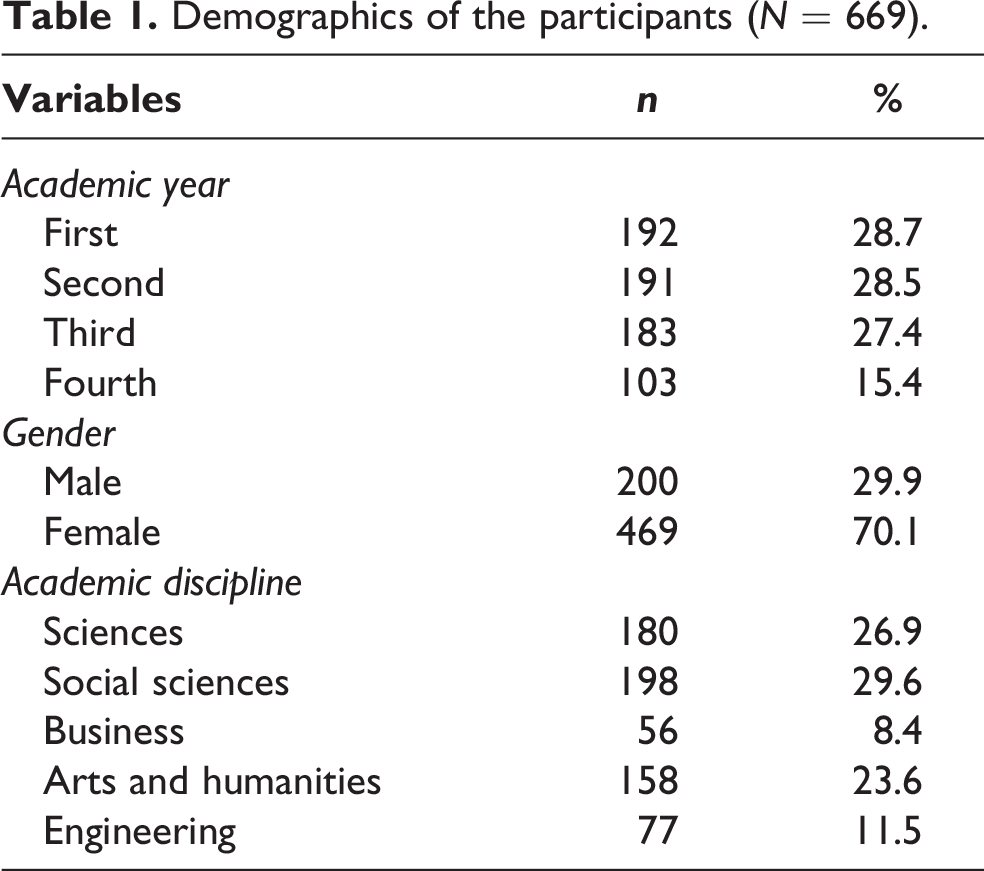
Currently, there are 223 public and private universities in Pakistan (Asim et al., 2022). This descriptive study was conducted at the University of the Punjab, which was founded in Lahore in 1882. It is the largest and oldest public-sector university in Pakistan. The university comprises 5 campuses, 19 faculties, 8 constituent colleges, and 138 centres and institutes. Using convenience sampling, the survey was administered to undergraduate students in five disciplines – sciences, engineering, social sciences, business, and arts and humanities – at the main campus (Quaid-e-Azam Campus). Convenience sampling is usually low-cost and is an easy method of collecting data from a larger population. Moreover, it gives the study’s participants the opportunity to take their time to think and answer the questions (Saunders et al., 2016). The data was collected over four months (March and June 2022) using electronic and paper-based modes. The students participated in the survey voluntarily and a total of 669 responded (see Table 1).
Demographics of the participants (N = 669).
Instrument and measurements
A well-established information competency scale was used to conduct this study. Several researchers have used Marshall’s (2006) Information Competency Assessment Instrument to investigate information competency among university students (Allari et al., 2022; Urra et al., 2021). After analysing the extant literature, it was evident that Marshall’s instrument would be an exhaustive tool for evaluating students from a developing country such as Pakistan where information literacy instruction is still in its infancy (Batool et al., 2022), very basic compared to what people really need (Batool and Mahmood, 2012) and focused on library orientation instead of information literacy components (Rafiq et al., 2020). Moreover, the Information Competency Assessment Instrument’s 10 dimensions mean that it was a better choice for investigating the phenomenon in a comprehensive manner compared with the other instruments available.
The instrument measures the different levels of skills that are needed to be information competent. Marshall (2001) claims that the Information Competency Assessment Instrument demonstrates good reliability and validity. It has 10 dimensions that include 40 statements based on closed-ended questions. These dimensions are considered important for individual competency and are: (1) recognize the research topic; (2) identify the source requirements; (3) know how to search to fulfil needs; (4) know how to discover and retrieve information; (5) selection and use of an appropriate medium for the information; (6) evaluation; (7) synthesize and organize the information; (8) present the information; (9) understand the legal, ethical and ideological issues of the information; and (10) get feedback and learn from it for future projects. This study made minor modifications to the instrument. First, it excluded the statements of the instrument that were negative in context; second, the demographic details (gender, subject, degree programme and semester of study) of the sample population were included to assess the correlation. A 7-point Likert scale was used for the measurement (1 = strongly disagree to 7 = strongly agree).
Data analysis
The collected data was analysed using Version 22 of the Statistical Package for the Social Sciences (SPSS). Descriptive statistics were applied to draw the results from the data to describe the participants’ gender, academic level, academic education and information competency level. Statistical tests – t-test, one-way analysis of variance (ANOVA) and post hoc least significant difference (LSD) – were run to find out the differences among the variables. The alpha level was set at .05. A total outcome was obtained for the information competency level and dimensions.
Findings
The study illustrates the information competency level of undergraduate students with respect to demographic variables including gender, academic year and academic discipline. The total score for information competency, sample attributes, scores of each dimension, significant differences and correlation are interpreted in the conclusion.
Demographics
There was a total of 669 respondents from the undergraduate level, of which 200 (29.9%) were male and 469 (70.1%) were female. The respondents were from the University of the Punjab. Data was collected from students in five disciplines: sciences, social sciences, arts and humanities, business and engineering. Most of the respondents were from the social sciences (29.6%; see Table 1).
Information competency level of undergraduate students
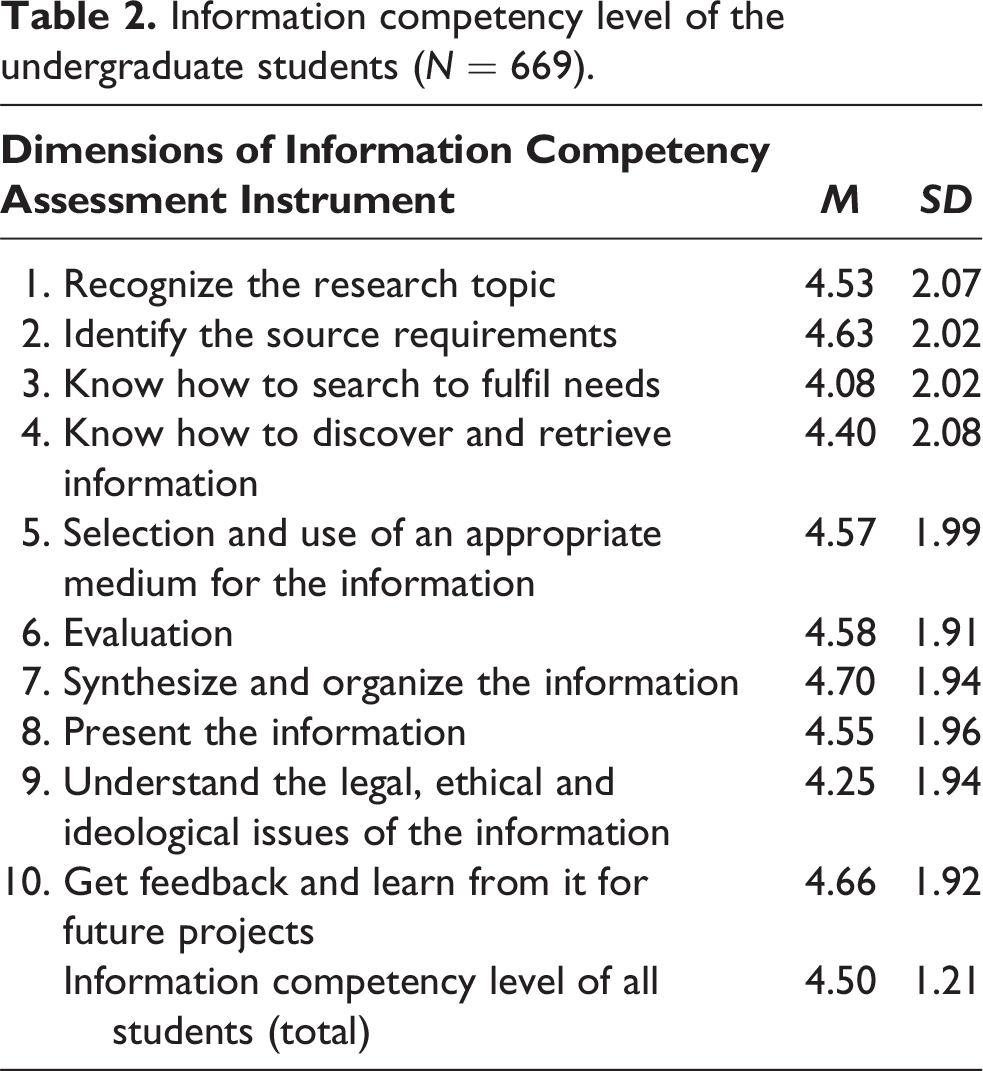
Information competency is vitally important for lifelong learning. So, to answer Research Question 1 – What is the information competency level of undergraduate students at the University of the Punjab? – the mean and standard deviation were computed for the 10 dimensions of the information competency scale. Among the information competency factors, ‘synthesize and organize the information’ had the highest mean value (M = 4.70, SD = 1.94), which indicates that the students could somewhat organize and synthesize information. Likewise, the students showed positive perceptions of other information competency dimensions – for example, ‘identify the source requirements’ and ‘know how to discover and retrieve information’. However, they had a neutral opinion with regard to three dimensions – ‘know how to search to fulfil needs’, ‘know how to discover and retrieve information’ and ‘understand the legal, ethical and ideological issues of the information’. The factor ‘know how to search to fulfil needs’ had the lowest mean score (M = 4.08, SD = 2.02). Moreover, the students were unable to understand the legal, ethical and ideological issues of information. It is important to understand why the students did not comprehend the legal, ethical and ideological issues of information. Overall, the information competency level of the students was above the average score (M = 4.5, SD = 1.21), revealing that the students somewhat agreed with the 10 dimensions of information competency (see Table 2).
Information competency level of the undergraduate students (N = 669).
Differences in information competency in terms of gender
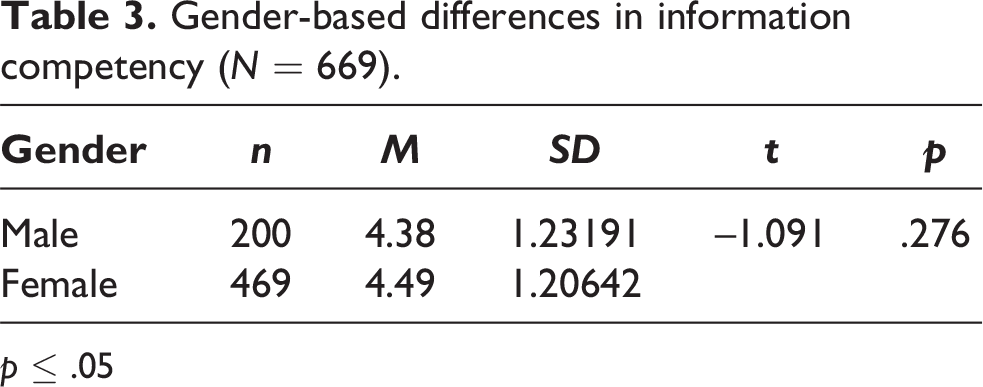
An independent samples t-test was applied to check the information competency difference based on gender (Research Question 2). The statistical results show that there was no significant difference in information competency based on gender (t = −1.091, p = .276). It can be concluded that both male and female students possessed the same level of information competency (Table 3).
Gender-based differences in information competency (N = 669).
p ≤ .05
Differences in information competency in terms of academic discipline
Since the respondents belonged to five academic disciplines, a one-way ANOVA was run to examine any differences in their self-perceived information competency based on their academic discipline (Research Question 3). The results reveal a significant difference in the students’ information competency level based on their academic discipline (F = 3.836, p = .004; Table 4). This means that the students’ information competency varied from discipline to discipline. This finding led to the application of an advanced statistical test to analyse the data for more in-depth insights.
Academic-discipline-based differences in information competency (N = 669).

p ≤ .05
The one-way ANOVA test was found to be significant, hence a post hoc LSD was applied to establish the differences between the groups (Table 5). The statistical analysis reveals that the social sciences students’ information competency level was significantly different from that of the business (p = .025), arts and humanities (p = .035) and engineering (p = .001) students. The social sciences students were less competent (M = 4.21) while the engineering students had high competency (M = 4.82) compared to the other groups. The engineering group also showed a significant difference (p = .005) in their information competency level from the sciences group (Table 5). The comparison of all the groups’ mean scores indicates that the engineering students had a comparatively higher information competency level.
Post hoc LSD results based on academic disciplines.

*p ≤ .05
Differences in information competency in terms of academic (study) year
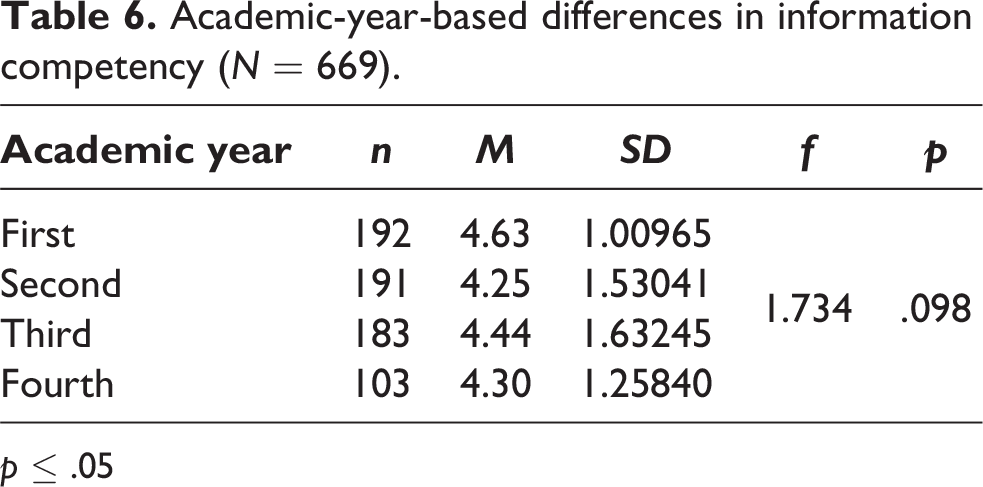
The respondents were students in a four-year Bachelor of Science (Honours) programme. Research Question 4 explored the significant differences in the information competency level among the students based on their year of study. A one-way ANOVA was applied to find the differences based on academic year. The means, standard deviations, f-values and p-values (sig. 2-tailed) were calculated. The analysis indicates that there was no significant difference among the students in terms of their year of study (Table 6).
Academic-year-based differences in information competency (N = 669).
p ≤ .05
Discussion
In the age of the knowledge economy, the most important competency for university students is the ability to think critically and analytically. Students should be able to find information, evaluate it and make decisions based on it. The knowledge and skills learned during university life support students in identifying problems, finding creative solutions, and developing strategies for the effective implementation of information in their professional lives. Thus, it is essential to assess university students’ information competency levels, especially from the perspective of the developing world. The review of the extant literature shows that Pakistani academicians and researchers have paid little attention to investigating students’ information competency, therefore this study aimed to investigate the information competency level of Pakistani university students in terms of gender, academic discipline and year of study.
The study’s findings reveal that the majority of the respondents were female and most of the respondents were young and studying in the first and second years of the Bachelor of Science (Honours) programme. Further analysis discloses that the students had competencies in identifying source requirements; the selection and use of an appropriate medium for information; evaluating information; synthesizing and organizing information; presenting information; and getting feedback and learning from it for future projects. Overall, the students were somewhat information competent. These findings are in line with prior studies – for example, Allari et al. (2022), Rafique and Khan (2018) and Zeeshan et al. (2020) found that students had a moderate level of information competency. However, the findings demonstrate a disparity with Hill et al.’s (2013), Turusheva’s (2009) and Ozor and Toner’s (2022) research, which highlights that undergraduates had low information competency.
Student competency is the ability to understand and apply the skills and knowledge needed to complete a task. Consequently, students’ information competency and study discipline are both important components of successful learning. It involves setting goals, developing effective study habits, and staying focused and organized (Zeeshan et al., 2020). The research findings based on disciplines illustrate that there are significant differences in terms of academic discipline, which indicates that students’ study discipline played a positive role in enhancing their information competency level. Social sciences students’ information competency is at the lowest level, whereas engineering students have a comparatively better level of information competency. In a similar study, Zeeshan et al. (2020) disclose that social sciences students had low information competency levels compared to sciences students. One of the reasons for this may be that, in Pakistan, academically bright and innovative students are more inclined to opt for sciences and applied sciences disciplines for better career prospects. The findings also reveal that the gender and academic year of the undergraduate students did not have any effect on their information competency level. The research of Govindarajan and Dhanavandan (2018), Kousar and Mahmood (2013) and Ozden et al. (2020) also supports this study’s findings. It is important to mention that the curricula of the Bachelor of Science (Honours) programmes do not include any courses on information literacy, and it is a similar situation in the libraries, which teach library orientation instead of information literacy. The findings highlight the gap between curricular and library interventions in this regard. It seems appropriate for universities to include digital and information literacy courses in the curricula of Bachelor programmes. Academic departments and institutes within the university should design courses on information literacy, digital literacy and media literacy. Courses or curricular contents should also focus on developing students’ critical and information evaluation skills. University libraries could also offer information literacy programmes for undergraduate students to improve their information competencies – particularly for social sciences students. As the study reveals that academic discipline influenced the information competency of undergraduates, training programmes should exert counter-influences by tailoring their interventions accordingly.
According to seven-point Likert scale, students showed their opinions above average except for three dimensions of information competency – searching relevant information; 1) searching for relevant information 2) discovering and retrieving the information 3) legal, ethical, and ideological issues of information knowing how to discover and retrieve information; and understanding the legal, ethical and ideological issues of information. In the digital world, university students should be knowledgeable about the searching and retrieval of information, and the legal, ethical and ideological issues of information. Training programmes on search engines, databases and other online resources can help them to become more familiar and competent with the technological platforms for information searching. Hands-on experience through providing practical, lab-based assignments and activities should also be incorporated by course instructors. Students can be assigned research topics and information tasks to find, retrieve and use information by considering legal, ethical and subjective norms.
Research limitations and directions for future research
Like other research studies, this research has some limitations. First, the study’s sample consists of undergraduate students in five disciplines only. Future researchers should also consider graduate students. Moreover, a self-reporting quantitative survey methodology was employed to conduct this study. In contrast to quantitative investigation, qualitative research provides more in-depth information and insights that allow researchers to explore the meanings, experiences, beliefs and perspectives of a study’s population (Saunders et al., 2016). So, for deeper insight into students’ information competency level, qualitative research could provide a more holistic picture of the phenomenon under study.
Secondly, a convenient sample of undergraduate students form one university across five academic disciplines participated in this study. Thus, the results of this study cannot be generalized. Moreover, the study data was based on the self-perceptions of the respondents. Thus, the findings may be used by considering the Dunning–Kruger effect (Kruger and Dunnig, 1999). The Dunning–Kruger effect is a cognitive bias whereby people with low ability or knowledge regarding a certain type of task or area of knowledge tend to overestimate their ability or knowledge. Past studies (Gross, 2005; Gross and Latham, 2011a, 2011b, 2012; Latham and Gross, 2008) also endorse that the Dunning–Kruger effect applies to information-competency-related studies.
Finally, this study adopted a cross-sectional survey and collected data during a limited time frame. Thus, future researchers should conduct a longitudinal study, which could perhaps provide more fruitful insights into students’ information competency.
Conclusions
In the contemporary world, information competency is the combination of knowledge and essential skills to find, evaluate and use information effectively and efficiently. It is a key component of success both in university life and one’s professional career. With the ever-increasing amount of information available, students must learn how to navigate this information landscape to make informed decisions. However, research on students’ information competency from the Pakistani perspective lacks theory and practice. Therefore, this study has sought to fill this research gap by investigating Pakistani undergraduate students’ information competency level. Adopting a quantitative survey approach, the study used an established information competency scale to examine the phenomenon in depth. Overall, the research findings disclose that the students possessed above-average information competency in all but three of the dimensions.
This research has key theoretical and practical implications. Both academicians and practitioners need to concentrate on the issues associated with the legal, ethical and ideological aspects of information and how to utilize different information channels in the digital world. Moreover, well-designed information and digital literacy programmes may work well to improve students’ information competency levels. Information literacy courses or contents should be part of undergraduate curricula in different disciplines, Moreover, educators and librarians may also design training programmes to take care of the needs of students and enhance their information competencies. Further studies are also needed to conduct on the phenomenon of information competency especially in Pakistan.
