




Abstract
The current study investigates the performance of concrete incorporating ground granulated blast-furnace (GGBF) slag in the presence of colloidal nano-silica. A control group of concrete mixtures is compared with a group of mixtures with 50% slag replacement, with each group examined at two different ratios of colloidal nano-silica (3% and 6% of the total cementitious material). Subsequently, the relative performance of the two groups is compared with ordinary Portland cement concrete in relation to strength and durability properties. Evaluation included experimental examination of compressive and tensile strength, rapid chloride penetration, and porosimetry using mercury intrusion tests. Furthermore, the microstructure of the cementitious matrix was evaluated using scanning electron microscopy imaging. Results of the tested concrete mixtures indicated that nano-silica particles can improve the properties of concrete containing GGBF slag. Improvement in high early strength as well as reduction in permeability are observed. Furthermore, nano-silica caused a refinement of the pore structure and an improvement to the interfacial transition zone (ITZ) as seen through mercury intrusion porosimetry (MIP) results and scanning electron microscopy imaging, respectively.
Concrete is known to be the most used manufactured material ( 1 ). Its production is based mainly on the cement industry with total yearly yield worldwide exceeding 4 billion tons ( 2 ). Furthermore, the cement industry is considered to be one of the most energy consuming industries and one of the major sources of carbon dioxide (CO2) emission. CO2 is a main greenhouse gas (GHG), to which global climate change is attributed ( 3 ). The cement manufacture industry is blamed for approximately 5% of the global man-made CO2 emissions every year ( 4 ). Emissions from cement manufacture are approximately equally divided between fuel consumption in the manufacture process and CO2 release during the calcination reaction in the kiln. Extensive research efforts have been directed to reducing the effect of cement industry on GHG emissions either by improving the manufacturing process efficiency or adopting the use of supplementary cementitious materials (SCMs) that may partially replace ordinary Portland cement ( 3 , 5 , 6 ). SCM may be defined as “a material that, when used in conjunction with Portland cement, contributes to the properties of the hardened concrete through hydraulic or pozzolanic activity, or both” ( 7 ). The term SCMs encompasses manufactured pozzolans, and industrial by-products such as fly ash, slag, and silica fume, to name a few. Although each SCM composition fluctuates appreciably with respect to the others, nonetheless all produce calcium silicate hydrate (C-S-H) gel, the main cementing compound in the matrix through the pozzolanic reaction. Reduced water demand, better workability, increased long-term strength, and improved durability in extreme environments are but a few of the typical benefits of using SCMs. The SCMs (one or multiple) can be added or inter-ground with cement as an integral component of a final commercial product of blended cement ( 8 ). Alternatively, SCMs are added during the mixing process at ready mix batch plants, which is the typical practice in the United States.
Ground Granulated Blast-Furnace Slag
Ground granulated blast-furnace (GGBF) slag, a glassy material formed from blast-furnaces as a by-product during iron manufacturing. The final granular slag constitutes about 95% of non-crystalline calcium-alumino-silicates ( 9 ). GGBF slag can be used as a direct replacement for ordinary cement on one-to-one as an industrial by-product, which makes it more environmentally friendly by reducing the amount of Portland cement in concrete ( 10 ). Beside its economic and environmental benefits, GGBF slag can also perform better than ordinary Portland cement in cases where aggregates have potential alkali-silica reactivity (ASR) ( 11 ). Veiga and Gastaldini indicated that the addition of slag to concrete enhances its resistance to sulfate attack ( 12 ). The proportion of GGBF slag in a mixture should be dependent on the following: 1) the application, 2) the curing temperature, 3) the grade of the slag, and 4) the characteristics of the cement. Concrete containing slag content at 50% replacement of cement shows a similar slump loss, no higher bleeding, and similar initial setting time at 29°C (85°F) in comparison with Portland cement concrete ( 13 ). The used slag was determined to be a grade 120 based on lab testing according to ASTM C989 slag activity index calculations.
Nano-Silica
Nano-silica is a manufactured material composed of particles size smaller than 100 nm. The highly amorphous silicon dioxide content makes it a very pozzolanic material in concrete. Byung-Wan et al. found that the smaller the particle sizes, the higher the rate of the early hydration and pozzolanic reactions ( 14 ). Experimental results indicated that the performance of concrete incorporating nano-silica was generally better than that containing micro-silica in relation to mechanical properties and general durability ( 15 – 17 ). The capacity of nano-particles to mitigate alkali silica reaction and physical salt attack was also shown ( 18 , 19 ). Furthermore, several studies showed that significant improvements of performance of cement mortars and concrete occur with the addition of nano-silica ( 20 , 21 ). Nano-silica is available in two main forms: compacted dry grains and colloidal suspension. The dry grained nano-silica requires a special preparation procedure before mixing to ensure appropriate dispersion. The addition of powder nano-silica can be hazardous and time sensitive since agglomeration of particles can start immediately after mixing. On the other hand, colloidal nano-silica, which is manufactured as a suspension electrochemically stabilized in a dispersive solution, is a form of nano-silica that is easier to use. Adequate dispersion prevents agglomeration of particles and maintains particle size at the nano-level, which can lead to a more pronounced nano-particle effect ( 22 ).
Experimental Program
Materials
The type of the Portland cement used was II/V which meets ASTM C150 specifications. Grade 120 GGBF slag was used with specific gravity 2.94. The main chemical constituents of slag and Portland cement are similar and they only differ in proportions. The colloidal nano-silica is an aqueous odorless solution with a milky white appearance. The silica content of the used nano-silica is 50% by weight and its average particles size is 35 nm, the density of the solution is about 1400 kg/m3 (87.4 lb/ft 3 ), and its pH value is 9.5. The coarse aggregate was rounded, well-graded natural gravel with specific gravity of 2.79, an absorption ratio of 0.60%, and dry rodded unit weight of 1634 kg/m3 (102 lb/ft 3 ). The fine aggregate, sand, which had specific weight 2.78, an absorption ratio of 0.80%, and fineness modulus (FM) of 3.00. The FM of the aggregate was measured every time it was collected from the source. FM variation up to 0.2 is acceptable. Consistent FM is important to maintain similar water demand thus ensuring consistency of concrete mixtures.
Procedures
The current study investigated six concrete mixtures. Three of these mixtures had only Portland cement as binder (Group A), whereas three mixtures had 50% GGBF slag replacement of Portland cement (Group C). Different dosages (3% and 6%) of nano-silica were used for both groups of mixtures. The complete mix proportions are presented in the Table 1. The two groups were used to compare the effect of slag and nano-silica individually and concurrently. Type of cement, aggregate size, grade, FM, and admixture, as well as batch size, were the same for all mixtures to isolate the effect of GGBF slag and nano-silica independently. According to ASTM C989, slag is classified on the basis of its activity index, which is determined based on the strength of mortars in accordance with Equation 1:

Details of Mixtures and their Proportions
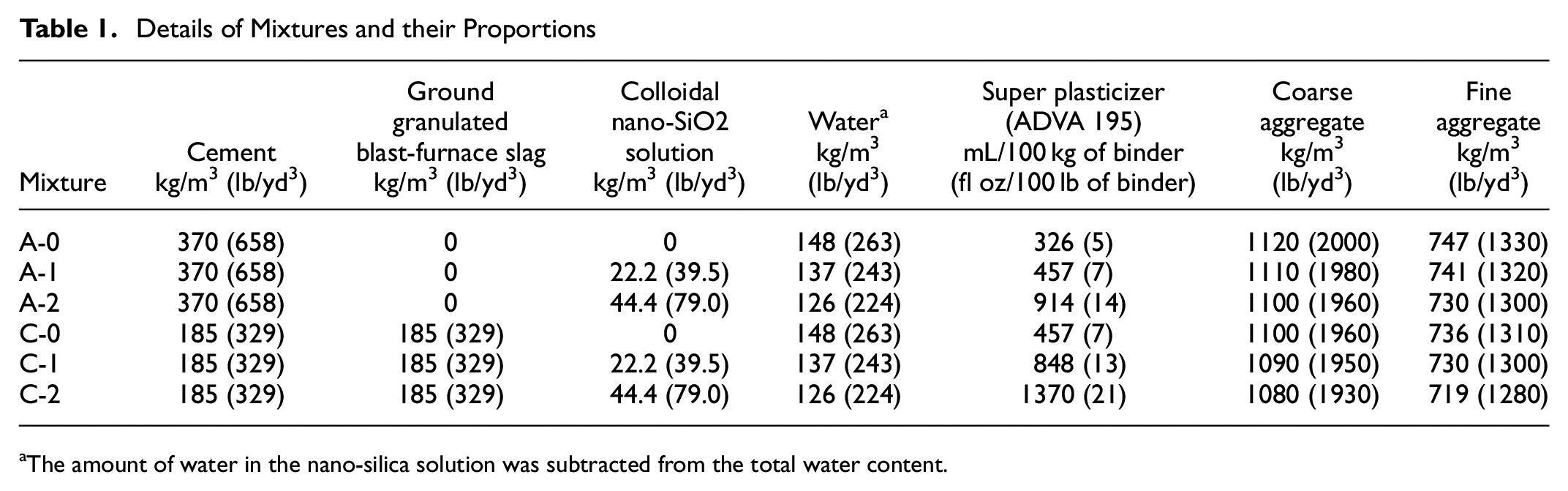
The amount of water in the nano-silica solution was subtracted from the total water content.
where SAI is slag activity index, SP and P are the compressive strengths of mortar cubes with 50% slag and 0% slag (control mixture) at 28 days, respectively. The values of SP and P were measured by the standard compressive strength test and the ratio was matched with the value published in ASTM C989. All the materials were kept at room temperature 23 ± 2°C (73 ± 3°F) for at least 24 h before mixing to assure a constant mixing temperature. An electrically powered concrete mixer was used. Ordinary tap water was used for mixing with a temperature of 21 ± 2°C (70 ± 3°F). For all mixtures, the water-to-cementitious-material (w/c) ratio was kept at a constant value of 0.40. The moisture content of the fine aggregate and coarse aggregate were measured before mixing any fresh batch of concrete, and the required amount of water was adjusted to keep a fixed w/c ratio. The high surface area of nano-silica decreases the amount of available water in the concrete mixture and interferes with the flowing characteristics of fresh concrete ( 23 ). To offset the workability problem for all the mixtures, a high range water reducer (HRWR) was employed. Several trial batches were made to determine the volume of the HRWR for every mixture by testing the slump according to ASTM C143. It was noted that HRWR was increased with the increase of nano-silica dosage.
Testing Methods
The adiabatic temperature was recorded to compare the difference in reactivity level of the cement and GGBF slag mixtures with nano-silica. The temperature change in the concrete was monitored for all mixtures using thermocouples and a data logger connected to a personal computer. It determined the adiabatic temperature according to ASTM C1064. Cylindrical specimen, 100 × 200 mm (4 × 8 in.), were prepared immediately after mixing where the thermocouple was embedded at the mid-height of the cylinders. The cylinders were wrapped with a thermal insulator and kept inside another airtight cylinder to prevent heat loss during the test. Every 1-min interval the temperature was recorded using a multi-channel data logger for more than 40 h after mixing at room temperature of 23 ± 2°C (73 ± 3°F).
Concrete compressive strength was determined according to ASTM C39 using a static testing machine for concrete cylinders for each of the tested mixtures. Sulfur caps with rubber pads were used for testing of the cylinders. Cylinders of 100 mm (4 in.) diameter and 200 mm (8 in.) height were prepared, molded, and compacted according to ASTM C192. The cylinders were unmolded after 24 h of mixing then cured in a curing room until the time of testing. The compressive strength was determined at the curing ages of 3, 7, and 28 days after casting. For each age, the average strength of at least three cylinders was calculated. Tensile strength was determined according to ASTM C496 using the static testing machine for the concrete cylinders cast for each of the tested mixtures. To determine tensile strength, cylinders of 4 in. diameter and 8 in. height were prepared, molded, and compacted according to ASTM C192.
Chloride present in plain concrete that does not contain steel is generally not a durability concern. Concrete protects embedded steel from corrosion through its highly alkaline nature. The high pH environment in concrete causes a non-corroding protective oxide film to form on steel. However, the presence of chloride ions from deicers or sea water can destroy or penetrate the protective film. Once the chloride corrosion threshold is reached, an electric cell is formed along the steel or between steel bars and the electrochemical process of corrosion begins. Therefore, the resistance of concrete to chloride ion penetration is an important property. Rapid chloride ion penetration test (RCPT), ASTM C1202, consists of monitoring the amount of electrical charge passed through a concrete specimen. The concrete specimen’s dimensions were 50 mm (2 in.) thick, 100 mm (4 in.) nominal diameter. The specimen was cut from the middle section of a standard cylinder. RCPT was conducted for all the mixtures at 28 days. The concrete cylinders were cut after removing the parent cylinders from the curing room. Then, conditioning process includes placing the discs in a vacuum desiccator for 3 h with the pressure less than 1 mm Hg (133 Pa), followed by soaking in de-aerated water for 18 ± 2 h. The specimens then were placed in the testing cell with one side filled with 3.0% sodium chloride (NaCl) solution and the other side filled with 0.3N sodium hydroxide (NaOH) solution. A potential difference of 60 volts DC is maintained across the ends of the specimen for 6 h. An additional testing procedure suggested by Bassuoni et al. to improve the quantitative accuracy of the test was performed at the end of the 6-h testing period ( 24 ). This procedure is also similar to method adopted by AASHTO T357 testing standard in 2015. The procedure involved measuring the physical penetration depth of chloride ions. The tested specimens were axially split after the standard ASTM testing procedure using an electrical saw. Then the inner face of each half specimen was sprayed with silver nitrate solution, which forms a white precipitate of silver chloride after about 15 min. The average depth of the white precipitation was calculated by measuring the depth in five different positions along the diameter of each specimen.
In the mercury intrusion porosimetry (MIP) test, samples were collected from the concrete cylinder cured for 28 days. The splitting tensile test was conducted to break the cylinder and a pea-sized chip, 3–10 mm (0.1–0.4 in.) in size, was collected from the core of the concrete cylinder. Subsequently, the sample was prepared by drying it in the oven for 72 h at a temperature of 60 ± 2°C (140 ± 4°F) followed by storing it in a desiccator containing silica gel. The coarse aggregate and cracks were carefully excluded as the MIP test significantly varies because of the presence of those in the sample. The Hg-concrete contact angle and the mercury surface tension were taken as 130° and 485 dynes/cm, respectively ( 25 , 26 ).
The small region, typically 10–50 micrometer thick, around the coarse aggregate is referred to as the interfacial transition zone (ITZ). In fresh concrete, water forms a film around coarse aggregates, which results in higher w/c ratio locally than in the bulk of the cement paste. Accordingly, excess voids and micro-cracks develop at the ITZ. Mehta et al. and Ollivier et al. observed that ITZ is weaker than two other main components of concrete, namely, aggregate and cement paste ( 1 , 27 ). Therefore, the ITZ is one of the principal factors that influence the mechanical behavior of concrete. The densification of the ITZ can be observed through image analysis of flat polished surfaces using scanning electron microscopy (SEM).
SEM is a technique which complements MIP tests. In this study, backscattered scanning microscopy was used. It gives clear images of ITZ and binder matrix. Special sample preparation was performed. Initially, small pieces 25 mm × 50 mm (1″ × 2″) were cut from concrete cylinders after curing for 28 days. Then, a polished thin section was prepared with the help of a petrographer.
Results and Discussion
Adiabatic Temperature
The recorded temperatures were plotted against the time for the all mixtures, as shown in Figure 1. The temperature increased after mixing, during the acceleration and the setting period, until a peak was reached, followed by a deceleration period where the temperature decreased until a relatively constant temperature was recorded. The recorded adiabatic temperature shows that the peak temperature, which can be an indicator of the hydration reaction of calcium tri-silicate (C3S) and calcium di-silicate (C2S), was higher for mixtures (C-1), (C-2), and (A-1), (A-2) compared with that of their control mixtures counterparts (C-0) and (A-0), respectively. This observation is an indication of higher reactivity level for mixtures containing colloidal nano-silica. Similar observations were reported in the literature for fly ash and were attributed to the high surface area of the nano-silica particles resulting in an increase in the intensity of the reaction ( 15 ). In Figure 1, the duration of the dormant period of C-1 and C-2 was more extensive than that of A-1 and A-2. The explanation of this phenomena is the chemical effect of HRWR. Kadri and Duval observed that the amount of HRWR causes a retarding effect on the hydration ( 28 ). They found that when the HRWR content increased from 0.6% (w/c = 0.45) to 5.5% (w/c = 0.25), the duration of the dormant period extended from 2 to 14 h. They also found that increasing of silica fume content compensated for the retarding effect of the HRWR. In the current study, a similar effect of nano-silica was observed. In this regard, the peak temperature of mixture C-2 is significantly higher than that of C-1.
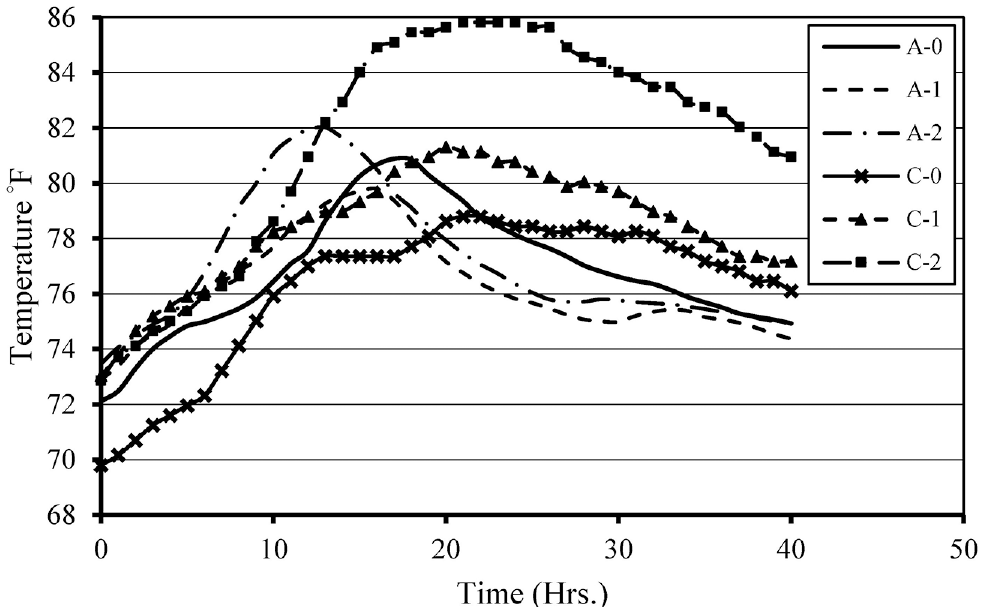
Change in adiabatic temperature for all mixtures.
Compressive Strength and Tensile Strength
The average compressive strength of the tested mixtures at different ages are given in Table 2. It was found that compressive strength of C-0 is higher than that of A-0 at 28 days. However, 3-day and 7-day compressive strength of A-0 is higher than that of C-0. Early strength development of C-0 is slower than A-0. Table 1 shows that the use of nano-silica improved the compressive strength of the concrete mixtures containing slag at all ages. Using 3% nano-silica with 50% replacement by GGBF slag (C-1) resulted in 10% and 16.8% increment of compressive strength compared with A-0 at 3 days and 7 days, respectively. Increasing the nano-silica dosage to 6% (C-2) resulted in 11% and 43% increase in strength compared with the control mixture (A-0) at 3 days and 7 days, respectively. Such increases over the control mixture (A-0) and evidently over mixture C-0 illustrate the capacity of nano-silica to address the deficiency in early strength development of concrete incorporating GGBF slag. It can be noticed from Figure 2 that between the 7th and 28th days, the slope of C-0 is lower than that of A-0 which indicates typical slower early strength gain of GGBF slag containing concrete compared with conventional concrete. Furthermore, the higher slope of A-1 than that of A-0 indicates faster rate of strength gain because of the incorporation of nano-silica. It is shown from Figure 3 that the addition of a higher amount of nano-silica in concrete with GGBF slag and concrete without GGBF slag increases the early strength. Moreover, the slope of both curves indicates it is more pronounced for concrete with GGBF slag than concrete without GGBF slag.
Average Compressive Strength for the Tested Mixtures

Note: ksi = kips per square inch.
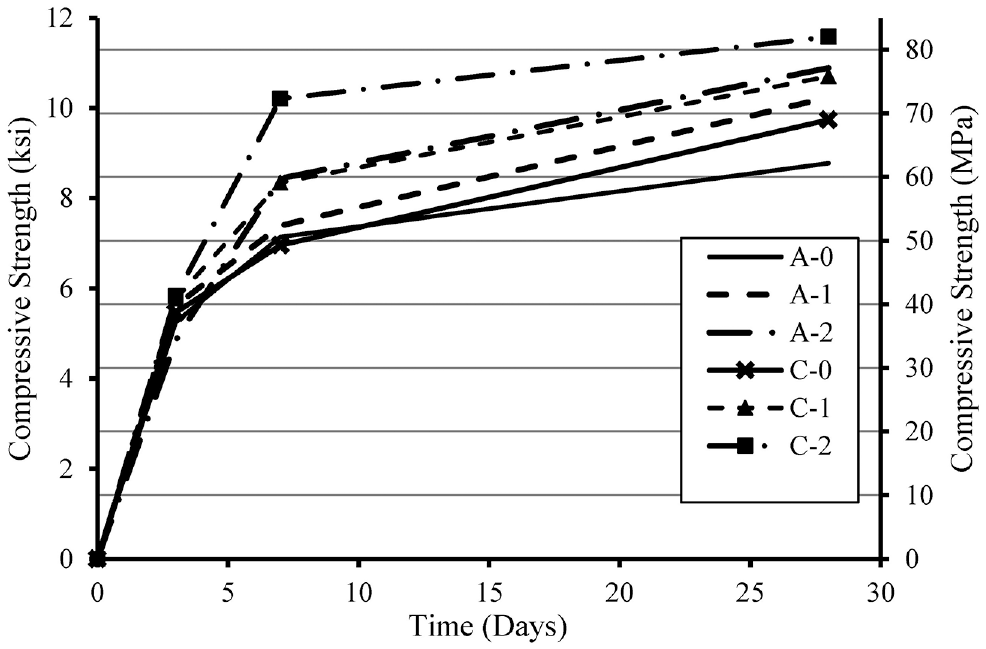
Relation between the compressive strength and curing age.

Relation between compressive strength at 3 days and nano-silica dosage.
The average splitting tensile strength of each mixture at 28 days was calculated and presented in the bar chart in Figure 4. For all the mixtures, the tensile strength ranged between 9% and 10% of the compressive strength apart from mixture (C-2). The addition of the nano-silica resulted in an increase in the tensile strength of the non-GGBF slag mixtures by 14% and 28% for nano-silica dosages of 3% and 6%, respectively. The strength was increased by 15% and 13% in the cases of concrete with GGBF slag. For both C-1 and C-2, the tensile strength was higher than that of the control mixtures, A-0 and C-0. Results show that slag and nano-silica individually and jointly improve the tensile strength of concrete, which is in line with the compressive strength results.
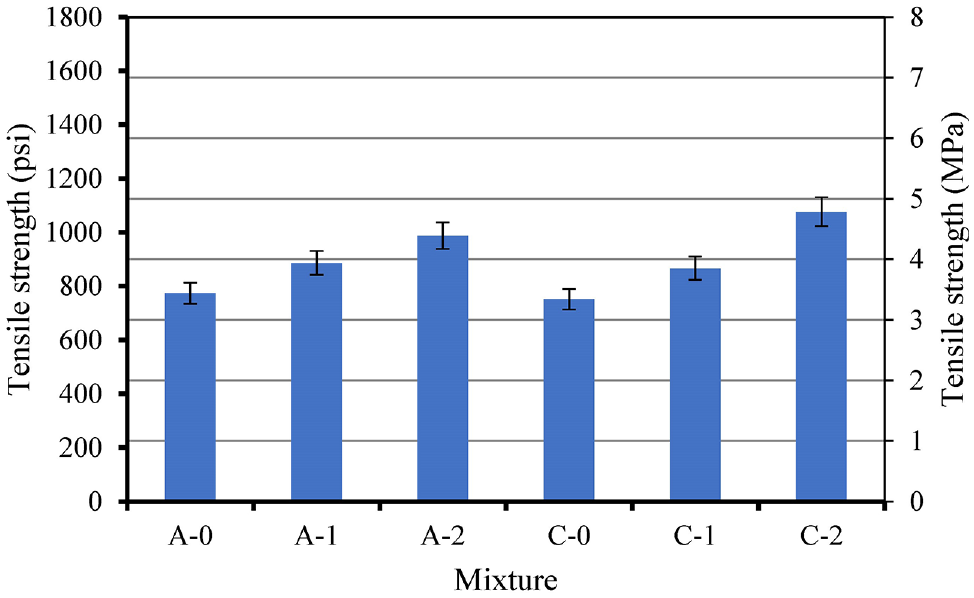
Average splitting tensile strength for the tested mixtures at 28 days.
Rapid Chloride Ion Penetration Test (RCPT)
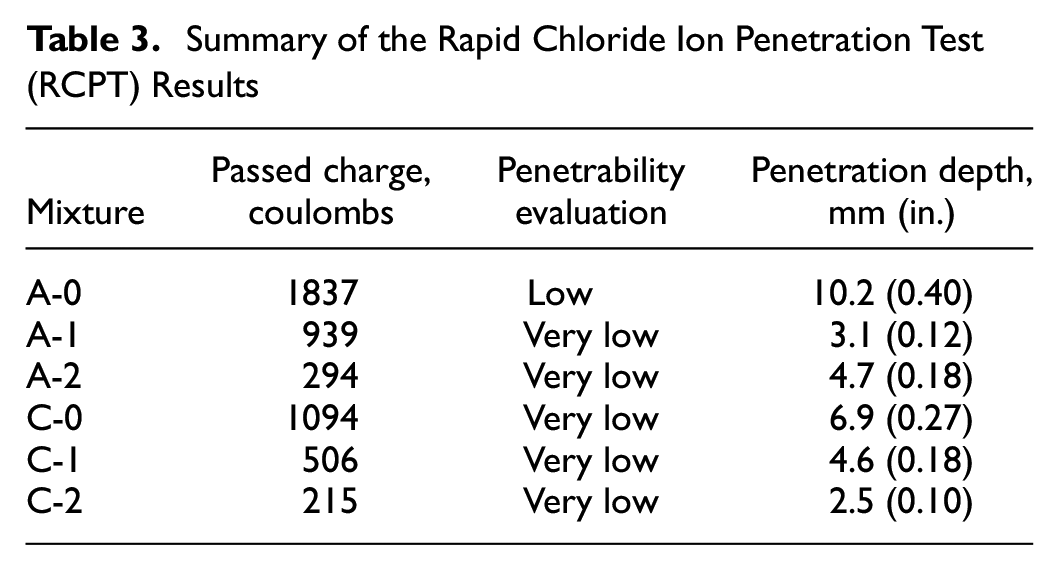
The total charge passed is shown in Table 3. The average chloride penetration depth is considered to be an indication of the physical ingress of the chloride ion as shown in Figure 5. The penetration depth measurements of Group A and Group C showed that the addition of nano-silica results in a reduction of the penetration depth. Also, the comparison between A-0 and C-2 implies that ternary blends of Portland cement, slag, and nano-silica improve the microstructure and reduce the porosity of the cement matrix, which are the main factors affecting the transport properties and consequently the durability of concrete.
Summary of the Rapid Chloride Ion Penetration Test (RCPT) Results

Physical chloride penetration for specimens: (a) C-0, (b) C-1, and (c) C-2.
Micro-Structure and Porosity
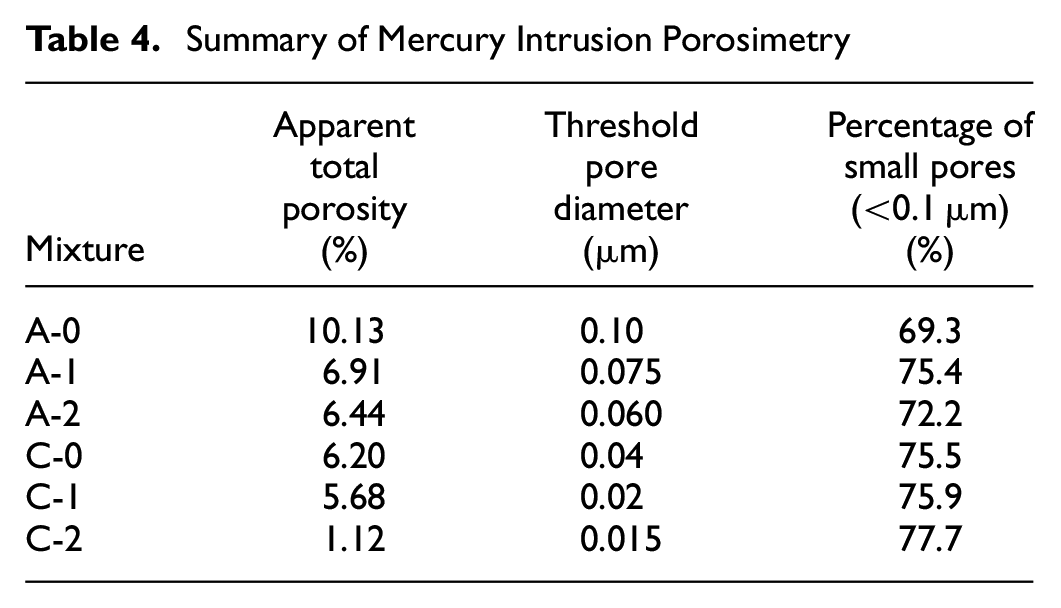
MIP was used to determine the pore volume distribution of the cement mortar. Figures 6 and 7 illustrate the initial slow growth of mercury intrusion, followed by a steep increase in intrusion after reaching the threshold pore diameter. In Table 4, the apparent total porosities, threshold pore diameters, and percentage volume of micro-pores (less than 0.1 μm) for the tested mixtures are presented. Results show that the total porosity deceases with the increase in nano-silica dosage. The threshold pore diameter of A-1 is less than that of A-0 as it contains nano-silica. The comparison between A-1 and A-2 shows that the threshold pore diameter of A-2 is less than A-1 as it has double the dose of nano-silica. A similar trend was observed in Group C. The percentage volume of micro-pores in C-1 and C-2 are greater than that of the reference mixture C-0, which shows that nano-silica introduces refinements to the pore structure.
Summary of Mercury Intrusion Porosimetry

Pore size distribution of the control mixture with different dosage of nano-silica.

Pore size distribution for mixtures with ground granulated blast-furnace (GGBF) slag and different dosage of nano-silica.
Scanning Electron Microscopy (SEM)
Figure 8 shows that the cementitious matrix of A-2 is remarkably dense, uniform, and less porous than reference concrete in control mixture, A-0. In Figure 9, the cement matrix of C-0 is porous with voids at the ITZ which leads to lower strength. However, C-2 cement film at the ITZ, shown in Figure 9, appears the densest and least porous compared with all other mixtures. The filling effect and pore refinement of the ITZ as well as in the bulk paste are attributed to the size of the finer particles of nano-silica. These results concur with MIP and compressive strength results.

(Left) Scanning electron microscopy (SEM) image of A-0 and (right) SEM image of A-2 pointing to interfacial transition zone (ITZ) improvement in specimen containing nano-silica.
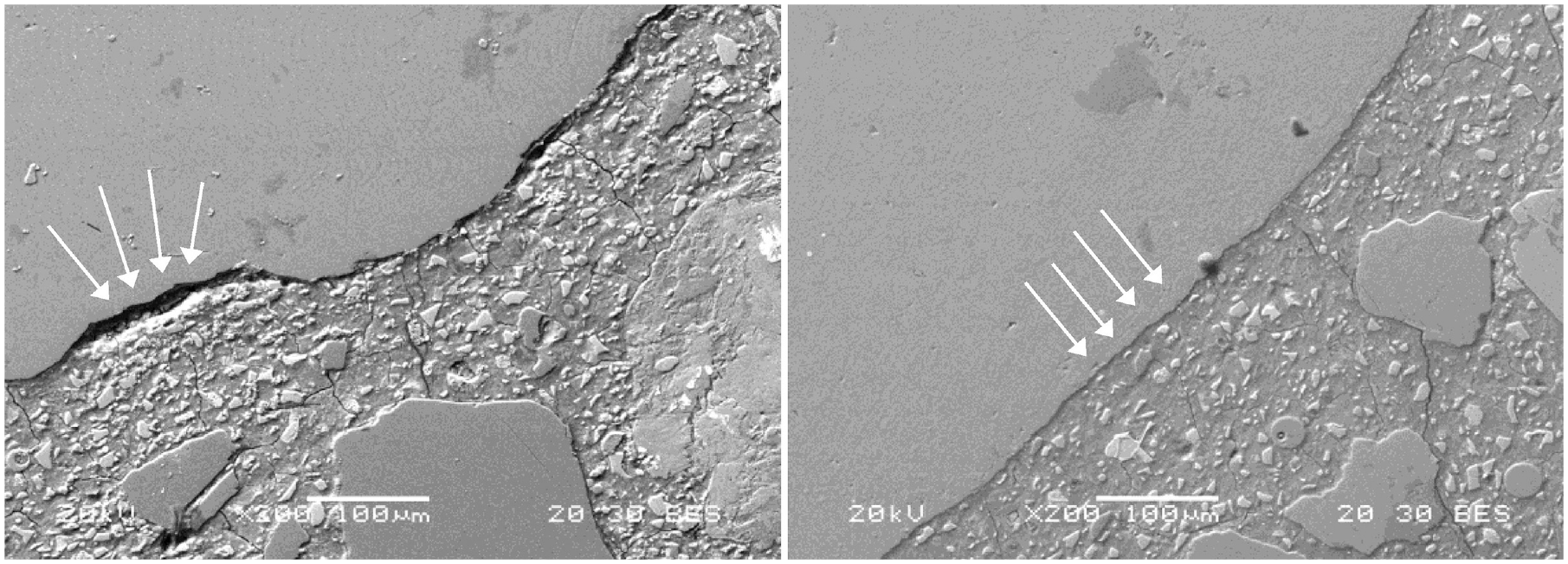
(Left) Scanning electron microscopy (SEM) image of C-0 and (right) SEM image of C-2 pointing to interfacial transition zone (ITZ) improvement in specimen containing nano-silica.
Conclusion
The significant findings of this research study are based on the experimental results using colloidal nano-silica and concretes with 50% GGBF slag and w/c of 0.40. The following conclusions can be drawn:
In the adiabatic temperature test, it was found that colloidal nano-silica increases the reactivity of both the control mixtures and GGBF slag concrete and also increase the compressive strength at early ages,7 days, and 14 days.
The RCPT results showed that a ternary blend of Portland cement, GGBF slag, and nano-silica can significantly reduce the permeability of concrete and the capacity of chloride ions to penetrate it. Such performance indicates superior durability of concrete incorporating nano-silica.
The MIP tests showed that the overall porosity and the threshold pore diameter were remarkably lower for the tested mixtures containing nano-silica compared with control mixtures.
The SEM imaging and its analysis showed dense ITZ which explains the increase in strength and durability of the tested concrete mixtures incorporating nano-silica compared with traditional control mixtures.
Footnotes
Author Contributions
The authors confirm contribution to the paper as follows: study conception and design: A.M.S, M.S.I., and M.S.Z.; experimental program and data collection: M.S.I., and M.S.Z.; analysis and interpretation of results: M.S.I., M.S.Z., A.M.S., and M.M.; draft manuscript preparation: Mohamed Zeidan, M.S.Z., M.S.I., A.M.S., and M.M. All authors reviewed the results and approved the final version of the manuscript.
Declaration of Conflicting Interests
The author(s) declared no potential conflicts of interest with respect to the research, authorship, and/or publication of this article.
Funding
The author(s) received no financial support for the research, authorship, and/or publication of this article.