




Abstract
Understanding the determinants of transport demand is crucial in making effective transport and environmental policies. In that context, the present study provides an empirical analysis of both road passenger and freight transport demand in Pakistan, using annual time series data from 1980 to 2016. The auto-regressive distributed lag bounds testing approach of co-integration is employed to estimate the short- and long-run elasticities. The empirical results show that fuel price, per-capita income, urbanization and road density are important determinants of road passenger transport demand in Pakistan. Similarly, fuel price, industrial production and international trade are the main drivers of road freight transport demand. In general, long-run elasticities are greater than short-run elasticities. Moreover, the long-run fuel price elasticities of passenger and freight transport demand are –0.044 and –0.784, respectively, implying that policy instruments (raising fuel taxes) are relatively less effective in controlling the future road transport demand and associated environment problems. The results based on short-run error correction models indicate that passenger transport demand adjusts about 75% in the first year to achieve its long-run equilibrium, while that of freight demand adjusts toward long-run equilibrium at a relatively slower rate, with about 16% of error correction taking place in the following year to reach long-run equilibrium.
Road transport (passenger and freight) demand is an important ingredient of transport planning and development. To that end, a significant amount of empirical studies, over the last few decades, have provided the empirical analysis of road passenger demand, freight transport demand, or both ( 1 – 14 ). For example, Oum et al. ( 12 ) reviewed the empirical literature of both passenger and freight transport demand for different modes and assessed the nature of own-price elasticities. After reviewing seven studies of automobile usage and twelve in relation to urban transit, they found that own-price elasticities of automobiles vary from –0.09 to –0.52 while the price elasticities of urban transit range from –0.01 to –0.78. Graham and Glaister ( 7 ) summarized the available elasticity estimates of income and price within the context of road transport (passenger and freight). Using a variety of indicators in relation to passenger traffic demand such as fuel consumption, car-kilometers, car trips and car ownership, the results suggested that the effect of income is positive and crucial for explaining the variation in all kinds of indicators used for passenger traffic demand. The results of fuel price elasticities suggested that the effect of fuel price on fuel consumption is much stronger than other definitions of road traffic used. Moreover, the price elasticity of road freight transport demand ranges from –0.5 to –1.5. Fouquet ( 13 ) examined the trends in price and income elasticities of overall land passenger transport demand in the United Kingdom from 1850 to 2010, and observed that price and income elasticities were –1.5 and 3 during the 1850s, which reduced to –0.6 and 0.8 in 2010, respectively. Recently, Sheng and Sharp ( 14 ) analyzed the road passenger transport demand for four modes—diesel cars, petrol cars, motorcycles, and buses—in New Zealand. The empirical results showed that the demands for both diesel and petrol cars are inelastic. The income elasticity of demand for petrol cars is positive (e.g., 0.51) while the income elasticity of the demand for travel by bus (–2.70) and by motorcycle (–4.56) is negative, implying that both of the latter transport modes can be treated as inferior goods.
Stark variation in elasticities found in past studies suggests that transportation demand is highly sensitive to local conditions, thus it cannot be generalized. For example, Oum et al. ( 12 ) are of the view that across-the-board generalizations of transport demand are impossible because differences in the nature of competition between routes, modes or firms and site-specific conditions give rise to a wide range of price elasticities. Moreover, other factors, such as the degree of aggregation, time-horizon (short or long run), functional form specification and so on, have significant impacts on the elasticity estimates. It also implies that a detailed study of a specific transport market is essential for obtaining reliable demand estimates of that market. Therefore, this study provides an empirical analysis of road passenger and freight transport demand in Pakistan at an aggregate level. The relevance of this paper consists of that only few studies on road transport demand have been completed in the past for Pakistan, which implies a knowledge gap for policymakers.
In Pakistan, the transport sector accounts for about 13% of the country’s gross domestic product (GDP). This sector creates 3.4 million jobs, which is 5% of the employed labor force in Pakistan, and represents 20% of total (public and private) gross fixed capital formation ( 15 ). There are three basic modes of transport in Pakistan, namely, road, rail and air, for facilitating passenger and freight transport. Road is the most dominant mode of carrying passenger and freight transport in Pakistan, followed by rail and air. In particular, the road sector handles around 92% of passenger and 96% of freight transport in Pakistan ( 16 ). Rail was considered the most dominant mode of transport in Pakistan until the 1970s. However, the performance of rail transport in Pakistan has decreased as (public) resources are diverted from rail infrastructure development to road infrastructure development. Consequently, the share of inland rail freight traffic has declined from 73% to 4% and from 41% to 10% for passenger transport ( 17 ).
On the other hand, road passenger and freight traffic has significantly increased over the last few decades. Road freight and passenger transport, measured in relation to passenger-kilometers (PKM) and ton-kilometers (TKM), respectively, has significantly increased over the last few decades. For instance, data from Figure 1 shows that road PKM demand has substantially increased by an annual average growth rate of 4.23%, from 66 billion PKM in 1980 to 282 billion PKM in 2016, while that of road TKM demand has also grown from 18 billion TKM to 167 billion TKM during the same period, at an average annual rate of 6.57%. The number of motor vehicles on the road has increased rapidly in Pakistan because of increasing road passenger and freight traffic. The number of registered road vehicles increased from 0.68 million in 1980 to 4.47 million in 2000 (more than 500%), and increased to 10.44 million in 2010. The number of road vehicles increased further to 24.26 million (more than double) in 2018 ( 15 , 18 ).

Pattern of road freight (ton-kilometers) and passenger transport (passenger-kilometers) per annum in Pakistan, 1980–2016.
A rapid increase in the demand for both road freight and passenger transport has also posed several challenges for planners and policymakers in Pakistan. For example, increasing reliance on the road sector is not only over-burdening the road system, deteriorating road quality, creating pollution and causing road congestion, but it also leads to higher transportation costs because of imported transport fuel ( 19 ). Moreover, since road transport demand and energy consumption are well integrated, increasing the demand for road freight and passenger transport has also resulted in higher energy consumption, particularly petroleum products, and the associated CO2 emissions. For instance, Pakistan’s road sector consumed about 2.07 million tons of oil-equivalent energy and emitted around 6.40 million tons of CO2 emissions in 1980 ( 20 , 21 ), which had increased to 15.65 million tons of oil-equivalent energy and 44.90 million tons of CO2 emissions in 2016, respectively ( 22 , 23 ). The demand for the transport sector (especially road transport) is expected to increase further with population growth and economic development: urbanization, agricultural development and rapid industrialization together increase the demand for freight and passenger transport, and higher incomes expand leisure-related travel ( 24 ), which could lead to an unsustainable development of road transport. Therefore, an empirical analysis of demand is important for the efficient planning and management of road transport.
This paper uses annual aggregate time series data for the period 1980–2016 and adopts the auto-regressive distributed lag (ARDL) bounds testing approach as an estimation method, as proposed by Pesaran et al. ( 25 , 26 ). The present study aims to address the following key policy issues:
What are the main short-run and long-run determinants of road transport (passenger and freight) demand in Pakistan?
How does the demand for passenger and freight transport respond to fuel price increases (decreases)?
Is the income of road travelers in Pakistan a more important determinant of road passenger transport demand than fuel price?
How effective are demand management policies (such as fuel taxes) in reshaping the current trend of road transport demand in favor of other modes, such as rail?
The remaining sections of the study are as follows. The second section will provide a review of the empirical literature on road transport (passenger and freight) demand. The third section will explain the methodological framework and data related issues. The empirical results will be discussed in the fourth section, and the fifth section concludes the study with some policy implications.
Literature Review
Studies of Road Passenger Transport Demand
The prime reason behind the estimation of road passenger demand is to determine its major determinants. Road passenger demand can respond to several monetary and non-monetary factors. Among them, price and income are the two main determinants of road transport demand. Several studies have analyzed road passenger transport demand using fuel prices as a cost of travel ( 27 – 30 ), and investigated the sensitivity of road transport demand to changes in fuel prices and other control variables. For example, Fujisaki et al. ( 28 ) used time series (both annual and quarterly) data to analyze the effects of gasoline price and income on various types of land transport (PKM/capita) in Japan such as public transport (adding both rail and commercial bus transport), personal automobiles (sum of both registered non-commercial passenger cars and more than two-wheeler light cars) and surface transport (a total of personal automobiles and public transport). Multiple regression and partial adjustment models with log-linear functional form are employed to derive and differentiate between short- and long-run (fuel) price and income elasticities. The estimated short-run real price and income elasticities of personal travel are –0.18 and 0.36 while those of long-run are –0.26 and 0.50, respectively.
Recent time series studies have analyzed the transport demand using co-integration and error correction models ( 31 – 33 ). For example, Liddle ( 31 ) investigated the relationship between vehicle-miles per capita, GDP per capita, gasoline price and registered vehicles per capita for the U.S.A. within the Johansen co-integration framework. The long-run price and income elasticities are estimated as –0.18 and 0.46, respectively. The results based on short-run causality suggested that only income exerts significant positive impact on vehicle-miles traveled, while other short-run effects of price and vehicle ownership are irrelevant. More recent studies investigated the asymmetric relationship between transport demand and fuel prices ( 34 , 35 ).
Traditionally, the possible solution to the problem of urban road congestion has been the expansion of the existing road network, which reduces road congestion and generalized costs of travel (particularly travel time). However, decreasing costs of travel may encourage more demand for transport and could offset the initial capacity expansion effect, therefore indirectly generating even more transport demand and road congestion. The behavioral response through which growth in the road network further promotes more transport demand and congestion is known as “induced demand.” Several studies have empirically investigated road transport demand within the context of induced demand and found strong empirical evidence that growth in the road network further accelerates the transport demand and road congestion ( 36 – 40 ).
Empirical Literature on Road Freight Transport
Over the last few decades or so, literature in relation to freight transport modeling has improved significantly on both theoretical and methodological fronts. For example, survey papers by Winston ( 41 ) and Zlatoper ( 42 ) emphasized and differentiated between the two broad methods of modeling freight transport demand, classified as aggregate or disaggregate models. The aggregate models are further classified as aggregate modal-split models or neo-classical aggregate models, based on the aggregate data available for a particular transport mode in an origin–destination pair. On the other hand, disaggregate models are categorized into behavioral and inventory models, where the behavior of the individual decision-maker is incorporated into the analysis, such as the individual shipper’s choice about a particular transport mode for given a shipment size. Discrete choice models such as logit and probit models are used in disaggregate studies. These models have strong microeconomic foundations and reflect the choices of individual decision-makers more appropriately. However, the difficulty arises in obtaining such rich data at an individual level, which may limit their use for many cases. Earlier studies have used either of these approaches to estimate freight transport demand and produced a wide range of elasticities ( 43 – 50 ).
Because of recent developments in time series methods, studies using aggregate time series data on regional or national commodity flows have used time series econometric models to estimate the price, income elasticities, or both, of freight transport demand ( 24 , 51–54). Bjørner ( 53 ) analyzed the demand for both road freight transport (ton-kilometers) and freight traffic (vehicle-kilometers driven) in Denmark; with freight traffic demand derived from shippers’ transport production function and that of freight transport used as an input in the firms’ production of output. The Johansen co-integration model is used to derive the empirical results. The long-run price (measured as generalized cost of transport) and output elasticities of road freight transport are –0.47 and 1.32, respectively, while the respective freight traffic elasticities of price and output are –0.81 and 0.92.
Numerous past studies have investigated the road transport demand for countries with different economic and geographical backgrounds, as displayed in Table 1. The above literature review indicates that there exists a large variation in transport elasticities across countries and, therefore, past researchers could not find converging results in relation to transport demand elasticities for various reasons. These factors may include the type of dependent and independent variables used in the model, the research method employed, data type (time series, cross-section or panel data), geographical scope, different functional forms, nature of intermodal competition among transport modes, and so forth. So, the results of previous studies cannot be easily generalized. Therefore, the current paper adds a new geographical setting to the past empirical transport demand literature by contributing to the local transport policymaking in Pakistan.
Summary Table of Road (Passenger and Freight) Transport Studies
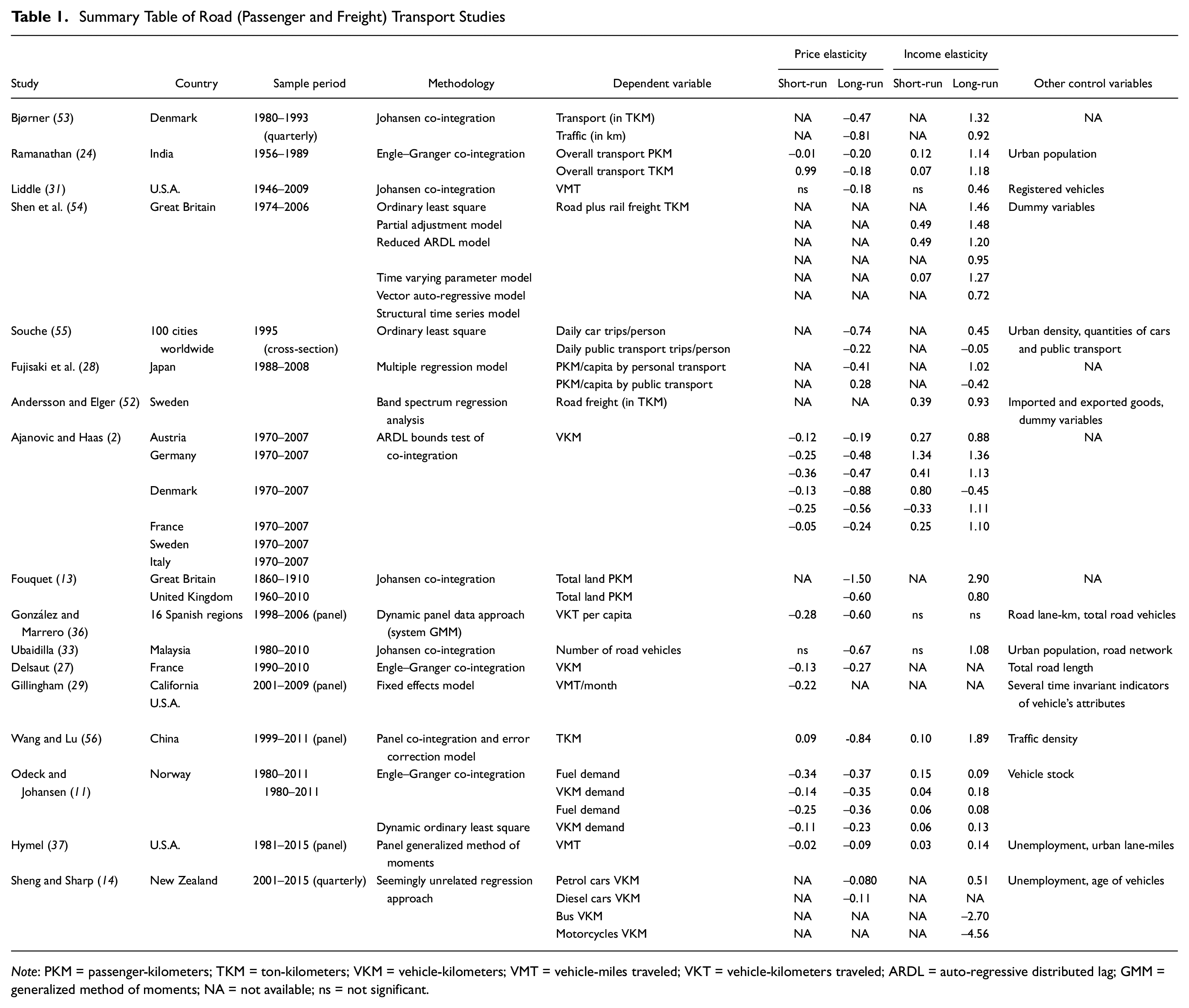
Note: PKM = passenger-kilometers; TKM = ton-kilometers; VKM = vehicle-kilometers; VMT = vehicle-miles traveled; VKT = vehicle-kilometers traveled; ARDL = auto-regressive distributed lag; GMM = generalized method of moments; NA = not available; ns = not significant.
Methodological Framework and Data
Theoretical Framework
Road transport demand is expected to be determined by several economic and demographic factors. Based on a review of the empirical literature, the following models are proposed to analyze the aggregate road passenger and freight transport demand, respectively.
Model 1

Model 2

where PKM refers to passenger-kilometers, FP is fuel price, Y is real per-capita GDP, UR is urbanization, RD is road density, TKM is ton-kilometers, IP is industrial production, and TR is international trade, respectively.
The models given by Equations 1 and 2 are non-linear models in variables and therefore can be linearized by some logarithmic transformations in the following manner,


The dependent variable in Equation 3 is the road passenger transport demand, measured in relation to PKM, is a function of cost of travel such as fuel price, per-capita GDP, urbanization and road density. The main advantage of using a log-linear model is that the parameters associated with explanatory variables can be directly interpreted as elasticities. For instance, all else being equal,
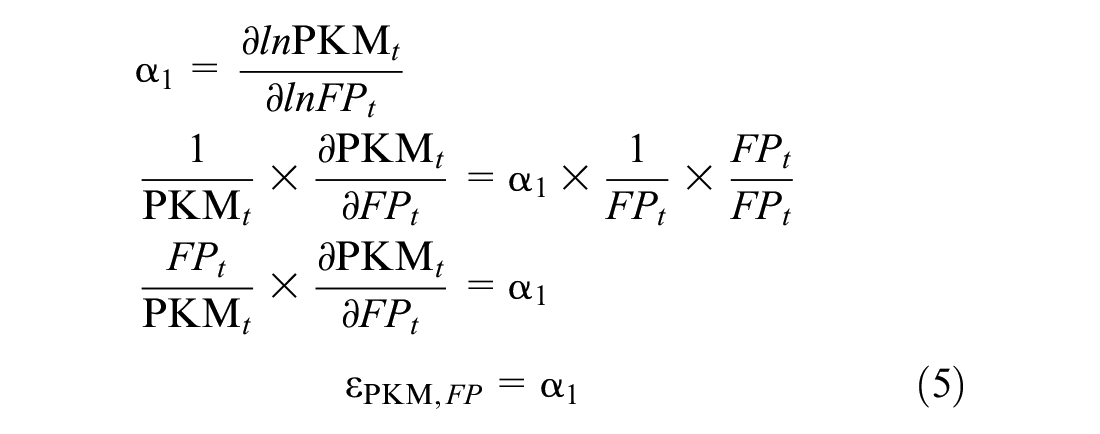
Likewise, all other elasticities of both models will be obtained.
The cost of traveling is an important determinant of passenger transport, for which different indicators such as generalized cost of transport (the costs related to vehicle ownership and maintenance, travel time, fuel taxes, safety, toll rates, etc.) or simply marginal cost (fuel price) of travel have been used in the literature. In current study, fuel price is used as a cost of travel. From theory, the expected sign of
On the other hand, road freight transport demand is measured in TKM, which also depends on fuel price, industrial production and international trade. The co-efficient
Econometric Method
Road transport demand is analyzed by using the ARDL bounds testing approach of co-integration, first proposed by Pesaran and Shin (
25
), and then Pesaran et al. (
26
) provided further extensions. An ARDL model is based on the ordinary least square (OLS) model with both “auto-regressive” and “distributed lag” components. It is generally used to model the relationship between economic variables in a single-equation time series setup. Subsequently, time series studies have widely used the ARDL technique in a variety of economic applications because of its several advantages. First, use of ARDL framework allows researchers to estimate the demand relationships even when all the choice variables are first-difference stationary
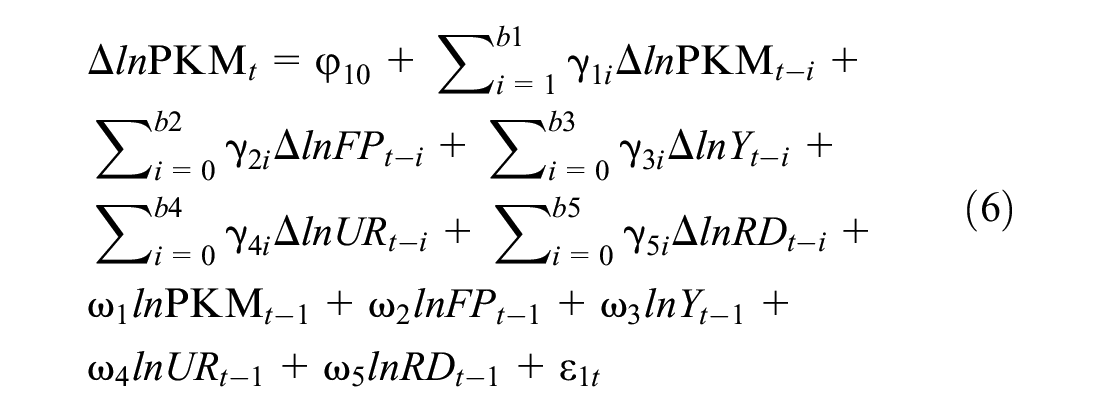
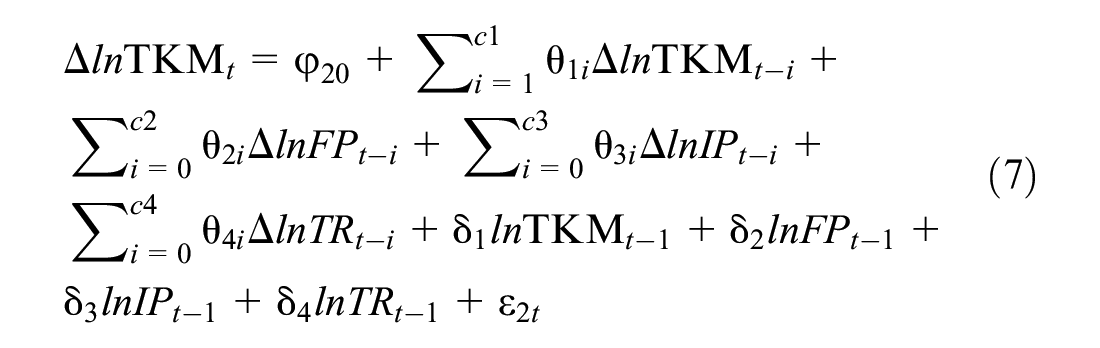
where
Model 1
Model 2

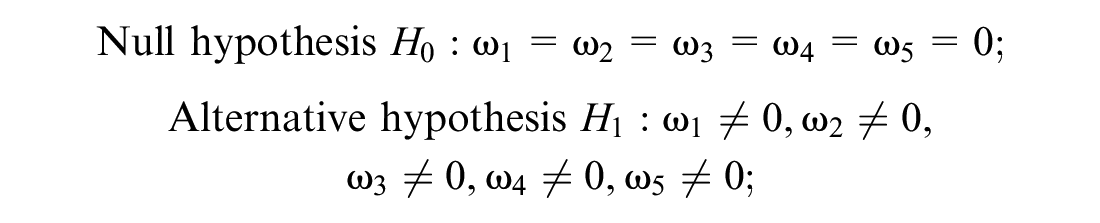
The joint significance of these parameters is based on the F-statistic, which follows non-standard asymptotic distribution under the null hypothesis of no co-integration among the listed variables. Therefore, the computed value of the F-statistic is compared with the two tabulated (critical) values provided by Pesaran et al. ( 26 ), and Narayan ( 63 ). These two critical values are known as upper and lower bound values and the critical values associated with upper bounds are derived on the assumption that all choice variables in the model are I(1), while for lower bounds, it assumes that all relevant variables are I(0). Three possibilities may happen when making comparison of F-statistic with the tabulated values. First, if the value of F-statistic becomes larger than the value associated with the upper bound, then the null hypothesis of no co-integration will be rejected in favor of the existence of co-integration among variables, without knowing their order of integration. Second, if the F-value falls short of the lower bound critical value, then the null hypothesis cannot be rejected, which implies that no co-integration exists among the variables of interest. Finally, if the F-computed value falls between the upper and lower critical bound values, then the results would be inconclusive in relation to co-integration and, in that case, the researcher may follow the other tests of co-integration.
In case of co-integration, the long-run ARDL passenger and freight transport demand models are estimated in Equations 3 and 4. The short-run parameters (elasticities) of passenger and freight demand can be estimated with the help of an error correction model and are given by the following equations, respectively.
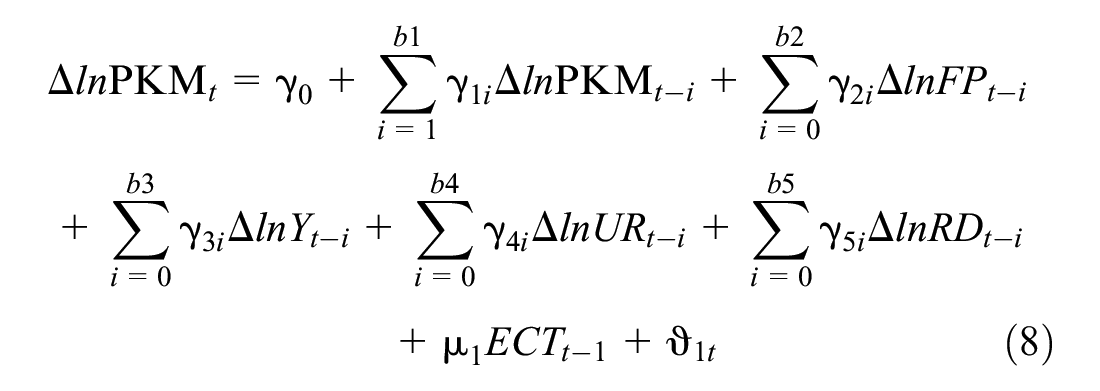
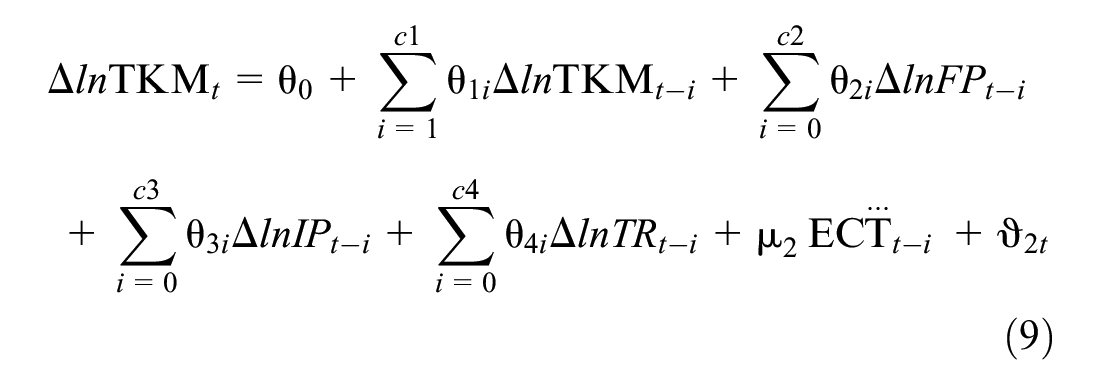
The error correction terms in both Equations 8 and 9 can be defined as;


where
A battery of diagnostic tests will also be conducted to ensure the validity of estimated ARDL models. These tests investigate serial correlation, heteroskedasticity, auto-regressive conditional heteroskedasticity, functional form specification and normality of residuals of the selected ARDL model. Moreover, the stability of the estimated parameters will also be tested with the help of cumulative (CUSUM) and cumulative sum of squares (CUSUMSQ) statistic, as suggested by Pesaran and Pesaran ( 64 ).
Variable Formation and Data Sources
The data in relation to PKM and TKM is from the Economic Survey of Pakistan (various issues), Pakistan statistical yearbook (various issues), and the Finance Division, Government of Pakistan (several issues). For further information, see also Karandaaz Pakistan ( 65 ). The road transport data in relation to passenger and freight combines transport on all kind of roads, especially the National Highway and Motorway Network, which has a share of only 4.6% of total road network, but carries 80% of Pakistan’s total commercial traffic ( 66 ). Data on fuel prices and fuel consumption were collected from the Hydrocarbon Development Institute of Pakistan (various issues). Data on per-capita GDP, industrial output and international trade is obtained from the Handbook of Statistics 2015 while those of total road network and total population are collected from Economic Survey of Pakistan (various issues). The data on urbanization is obtained from the World Development Indicators ( 67 ).
Some formation and definition of variables is worth mentioning. As in many other countries, the road transport sector in Pakistan uses several types of fuel. However, the share of high-speed diesel and gasoline consumption is dominant. So, fuel price is used as an index (2005 as base year), which is simply the weighted average price of gasoline and diesel (quantities of gasoline and diesel are used as weights). It is also consistent with previous studies ( 32 , 34 ). Similarly, data on GDP (million rupees) is from the Handbook of Statistic, available at different base years of 1980–1981, 1999–2000 and 2005–2006, which is converted to a single base year 2005–2006. Road density is used as the ratio of total road network (both high and low type), measured in kilometers, to total land area of Pakistan (square kilometers). Urbanization is the percentage of urban population to total population. The present study uses an index of large-scale manufacturing industries (2005–2006 as base year) for industrial production. International trade is the sum of imports and exports, in millions of Pakistani rupees.
Results and Discussions
Two standard unit root tests, such as augmented Dickey–Fuller (ADF) and Phillips–Perron (PP), are adopted for all variables in road passenger and freight transport demand models. The results of both these tests are given in Table 2. The results of both unit root tests indicate that most of the variables in road passenger and freight demand models are integrated of order 1, as the null hypothesis of unit root at levels cannot be rejected for most of the variables, whereas the null hypothesis of unit root at their first difference is clearly rejected by the significance of the computed test statistic in Table 2. It implies that none of the variables are integrated of order 2. Thus, one may proceed to test the long-run relationships between road transport demand (passenger and freight) to their determinants using the ARDL technique.
Results of Unit Root Tests
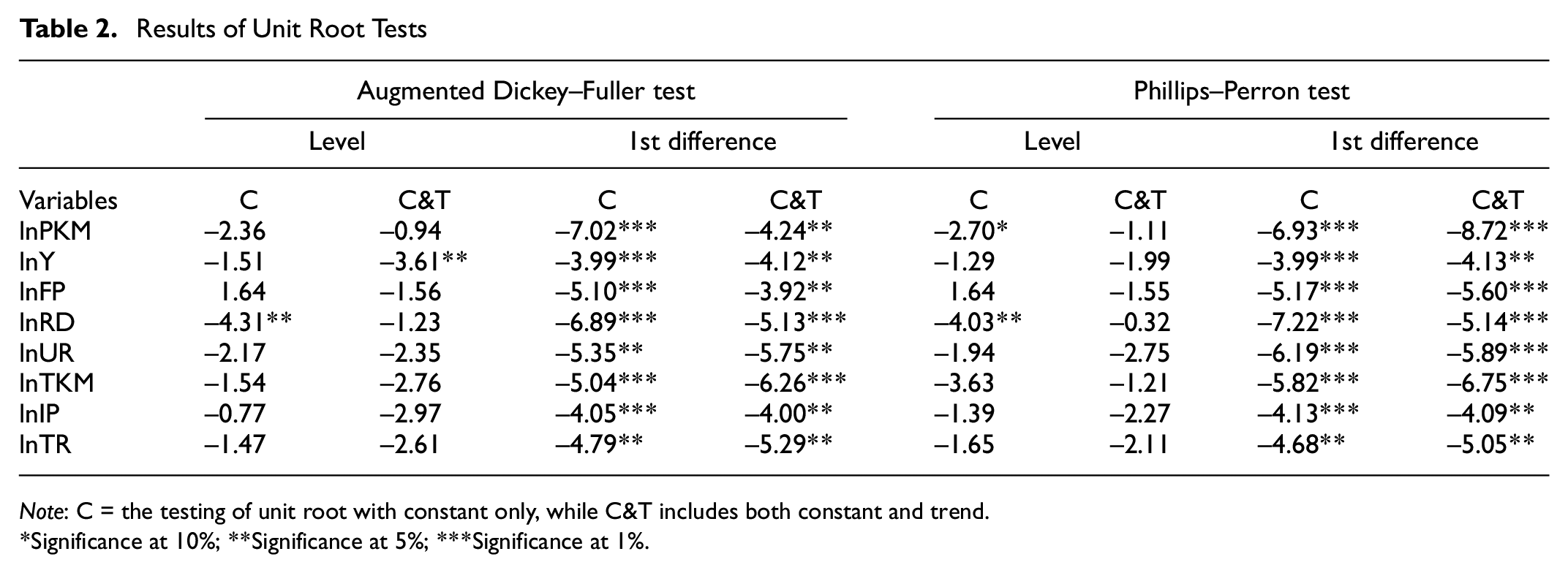
Note: C = the testing of unit root with constant only, while C&T includes both constant and trend.
Significance at 10%; **Significance at 5%; ***Significance at 1%.
Based on the OLS method, both models of passenger and freight demand are estimated with optimal lags are selected using AIC criteria, such that the residuals of both models are not serially correlated. The selected model for passenger demand is ARDL (1, 2, 0, 0, 1) while the optimal model for freight demand is ARDL (2, 4, 4, 2). The joint F-statistic of both passenger and freight models is computed to determine the possibility of long-run co-integration relationships between demand for road transport (passenger and freight) to their determinants. The results are given below in Table 3. A comparison of computed F-values to the critical values, provided by both Pesaran et al. ( 26 ) and Narayan ( 63 ), is provided. The calculated F-statistic in both models is significantly greater than the 5% critical upper bound values. Therefore, the null hypothesis of no long-run co-integration relationships between road (passenger and freight) demand and their influencing factors is rejected in favor of the existence of such a co-integration relationship.
Results of ARDL Bounds Test of Co-Integration
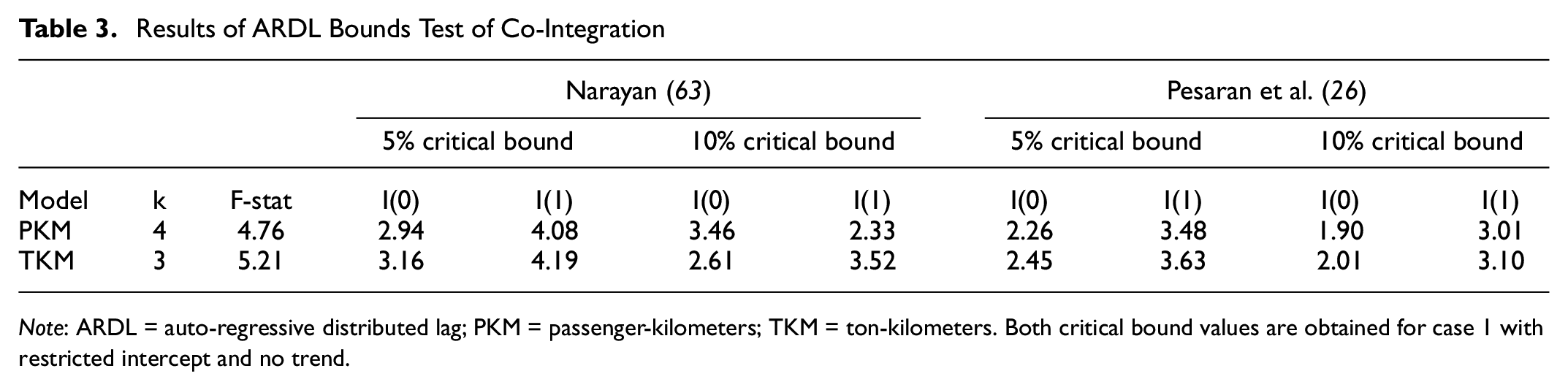
Note: ARDL = auto-regressive distributed lag; PKM = passenger-kilometers; TKM = ton-kilometers. Both critical bound values are obtained for case 1 with restricted intercept and no trend.
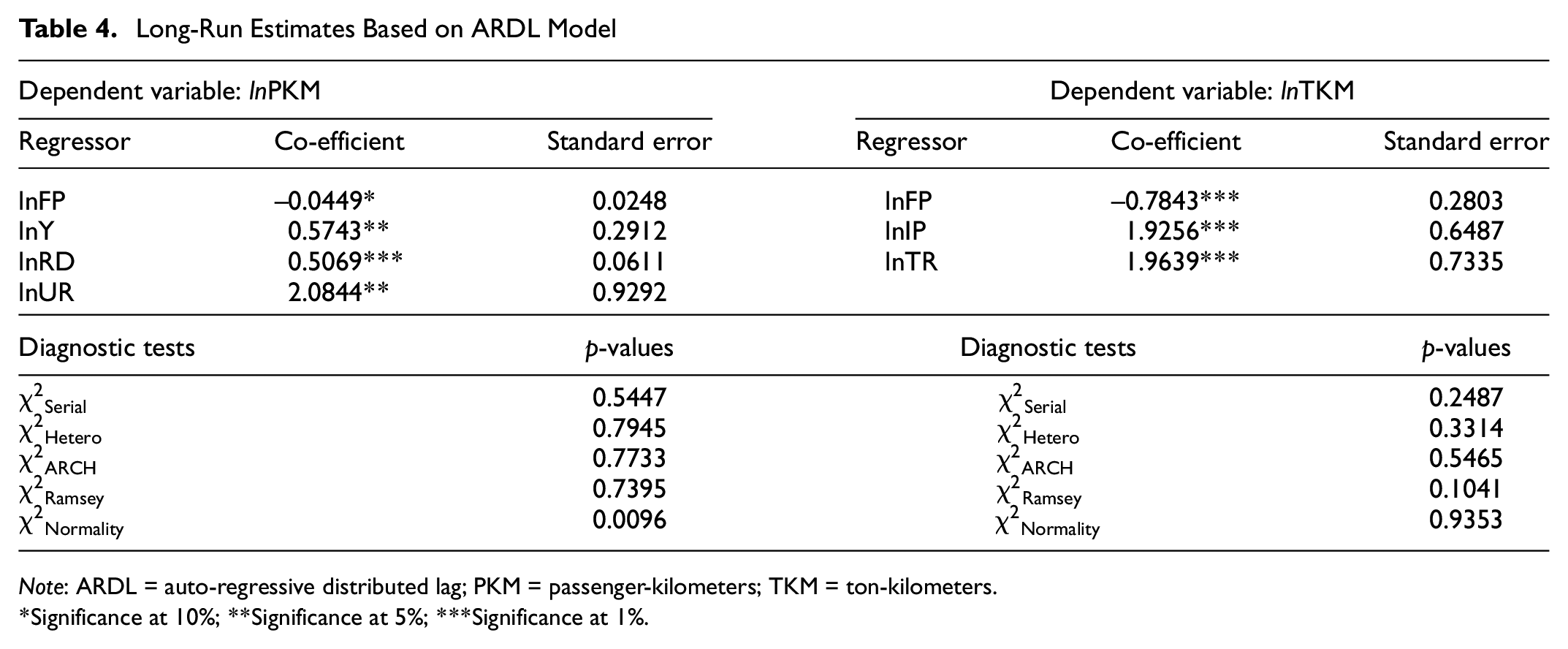
When co-integration is confirmed by the bounds tests, the next step in the ARDL model is to estimate the long-run and short-run coefficients. The long-run estimates of both passenger and freight models, along with some diagnostic tests, are provided in Table 4.
Long-Run Estimates Based on ARDL Model
Note: ARDL = auto-regressive distributed lag; PKM = passenger-kilometers; TKM = ton-kilometers.
Significance at 10%; **Significance at 5%; ***Significance at 1%.
All estimated long-run coefficients in both models have the expected signs. All other variables except fuel price are positively related to both road passenger and freight demand. For road passenger demand, the impact of fuel price is estimated as –0.044 and is significant at 10% level. This implies that road passenger demand, in the long-run, will decrease by 0.044% in response to a 1% increase in fuel price. The lesser sensitivity of passenger demand to fuel prices shows that road transport mainly depends on petroleum products for operations. Moreover, reduction of road passenger transport demand and associated externalities through fuel taxation will be less effective. Since fuel price directly affects the cost of travel, it suggests that there are few discretionary trips. However, the inelastic price effect also suggests that taxing fuel prices may also be an important source of government revenues. Unfortunately, it is not possible to compare the results of this study with the previous studies on road transport in Pakistan because of the lack of available empirical literature. However, many other international studies also report relatively low fuel price elasticities of road passenger transport ( 6 , 27 , 68 , 69 ). In general, although fuel price elasticities of road travel demand in developed countries (above cited) are low, they are relatively high compared with the fuel-price elasticity obtained by the present study. This implies that people in developed countries (because of higher incomes) make more discretionary trips and have more substitution possibilities than people in developing countries.
Per-capita real income is another potential determinant of road passenger transport. The co-efficient of per-capita income is 0.574, which implies that, ceteris paribus, an increase in income of 1% is associated with an increase of PKM by 0.574%. This suggests that passengers treat road travel as a normal (necessity) good. Our results are consistent with Goodwin et al. ( 6 ), Graham and Glaister ( 7 ), Liddle ( 31 ) and Litman ( 9 ), who also observe that the relationship between road passenger transport and income is positive and inelastic.
Road density and urbanization (UR) are two additional important control variables in the passenger demand model. The results show that road density appears to be the most statistically significant explanatory variable in the passenger transport demand model. In particular, the impact of road density on passenger transport demand is estimated as ‘0.506’, states that a hypothetical 1% increase in road density will increase road PKM in the long run by 0.506%. These findings are in line with other studies ( 34 , 35 , 37 , 70 ), which support the stance that improvements in the road network (building new roads or extension of existing roads) will lead to higher road passenger transport demand. For example, Noland ( 70 ) studied the relationship between road capacity (lane-miles) and vehicle-miles traveled in the U.S.A., and found that the long-run impact is in the range from 0.70 to 1.0. Kwon and Lee ( 35 ) estimated the long-run elasticity of travel demand in South Korea with respect to highway length, which turned out to be in a range from 0.41 to 0.51. Recently, Hymel ( 37 ) estimated the induced demand elasticity for the U.S.A., which ranged from 0.70 to 1.06 in the long run. However, in this study, the induced demand elasticity is not directly comparable to the sources cited because of different definitions used for dependent and independent variables. The elasticity of induced demand is expected to be higher in a developing country as compared with a developed country because poorly planned, highly congested cities can expect to have newly generated trips as an upgradation of roadway takes place. Finally, the co-efficient of UR is 2.084, conveying the impact of urbanization on road passenger transport demand in Pakistan. It can be interpreted as a 1% increase in urbanization leading to a 2.084% rise in road PKM in the long run. The variable is significant at 5% level and its impact on road passenger transport is the strongest one, as the co-efficient associated with it is greater than 1. The positive co-efficient offers a simple explanation that the demand for basic goods such as housing, jobs and transport increases as more people migrate from rural to urban areas. The empirical literature on the impact of urbanization on passenger transport demand is inconclusive, and further depends on the location of the study. Hymel et al. ( 71 ) find a negative relationship between urban population and travel demand for the U.S.A., and Karathodorou et al. ( 72 ) observe a significant and negative impact of urban density and fuel demand in the U.S.A. Souche ( 55 ) also finds a negatively significant effect of urban density on car travel demand in 100 of the world’s cities. On the other hand, Ramanathan ( 24 ) witnesses a positive and relatively strong effect of urban population on overall passenger transport demand in India. Similarly, Poumanyvong et al. ( 73 ) obtain a significant and positive effect of urbanization on national transport and road energy use in the case of low-, middle- and high-income countries. This implies that the impact of urban density depends on modal options and land-form patterns, among other factors, and the style of urban planning in each country is closely related to the elasticity of urban density. For example, Asian style urban planning, which favors high density zones with mass transit, should lead to smaller elasticities because higher densities promote shorter trip lengths and make non-motorized modes and transit more feasible. However, American style urban planning, which favors spread out suburban areas, would favor higher elasticities.
The estimation results of road freight transport are also provided in the fifth column of Table 4. The results reveal that all three explanatory variables—fuel price, industrial production and international trade—are statistically significant at the 5% level. In particular, the effect of fuel price on road freight transport is negative in the long run, whereby a 1% increase in fuel price results in a decrease of road freight transport by 0.78%. This means that an increase of fuel price is expected to increase the cost of road freight shipments and may induce the shippers to decrease the number of TMK shipped. In comparison with passenger transport, although the long-run fuel price effects of both road passenger and freight transport demand are inelastic, the effect of fuel price on road freight is significantly larger than on passenger transport, which means that freight movers are relatively more sensitive to fuel prices than passengers. A possible explanation could be given for this relatively more inelastic travel demand, that transport price is mostly passed on to the consumers, although some other factors, such as availability of other transport modes (rail), also play an important role. Moreover, the demand for passenger travel is relatively unsatiated in Pakistan because of a rapid growth of urban population and increasing vehicle ownership. There are few empirical studies that have investigated the impact of fuel price on road freight transport demand. De Jong et al. ( 4 ) provide the possible range of fuel price elasticities of road freight transport from –0.05 to –0.3. However, fuel price elasticities of road freight transport, in the current study, are similar to that of Wang and Lu ( 56 ).
The long-run estimate of road freight transport with respect to industrial production is 1.925, which means that an increase in industrial output by 1% causes road freight transport to increase by 1.925%. So, the observed impact of industrial output on road freight transport in the long run is elastic. This result is generally consistent with previous studies. For example, Ramanathan ( 24 ) finds that the long-run effect of industrial output on total freight transport (measured by TKM) in India is positive and elastic. Shen et al. ( 54 ) also observe that the long-run elasticity of total (road plus rail) freight transport with respect to industrial production in four out of six econometric models is greater than one.
Finally, the estimated impact of international trade on road freight demand is relatively strong and significant in the long run, whereby an expansion of Pakistan’s international trade with the rest of trading countries by 1% will likely increase the road freight transport by 1.963%. The importance of international trade for road freight transport is because road handles most of the country’s imports and exports to and from ports, while rail only carries a much lesser amount than road. Andersson and Elger ( 52 ) determine that the variations in Swedish freight transport (rail, road or sea) from short to medium run are mainly driven by fluctuations in imports and exports. Nguyen and Tongzon ( 74 ) document that Australia–China trade is the main driver of the Australian transport and logistics sector.
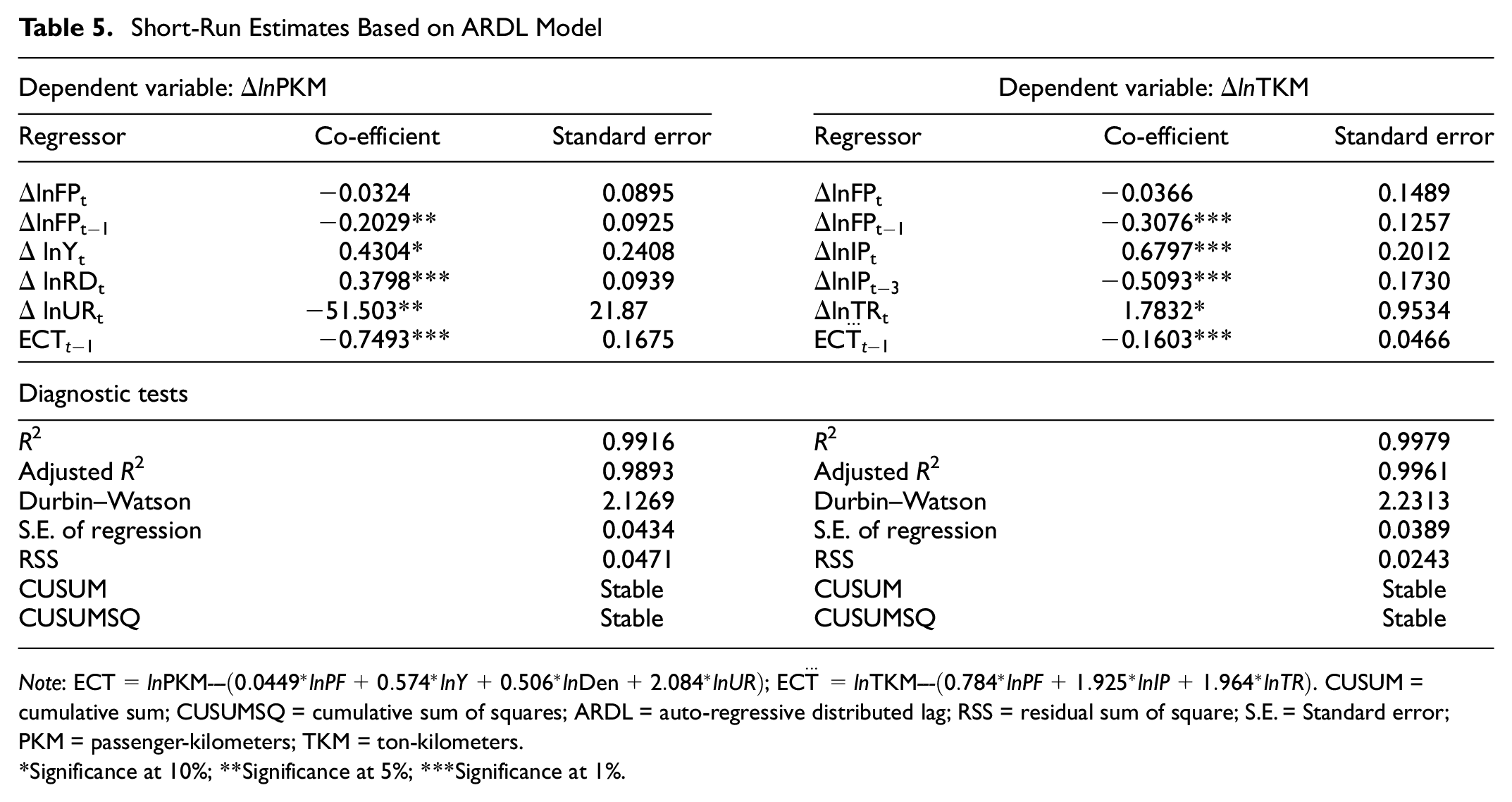
The results of short-run error correction models of road passenger and freight demand are given in Table 5. It is observed that the estimated coefficients of both short-run models are of the expected sign except for urbanization in the passenger demand model, which can be of more relevance in the long run. Most of the short-run coefficients are, in general, statistically significant at the 5% level and are smaller in magnitude than their long-run estimates, which implies that complete adjustment cannot take place in the short run. An important aspect of the short-run models is the co-efficient associated with lagged error correction terms (ECT t–1 ), which measure the speed of adjustment. For both models, the coefficients of ECT t–1 are provided in the last row of regressors in Table 5. The coefficients of error correction terms in both models (passenger and freight) are negative and are statistically significant at the 1% level of significance, further reinforcing the already established long-run co-integration relationships. For the passenger demand model, the co-efficient of ECT t–1 is –0.749, suggesting that road passenger transport demand adjusts toward long-run equilibrium by approximately 75% in the first year. Similarly, the estimated error correction co-efficient in the road freight demand model is –0.160, which indicates that short-run deviations in road freight demand are corrected in such a way that nearly 16% of the disequilibria gap is corrected in the first year to restore the long-run equilibrium. In comparison, disequilibrium error correction in the freight demand equation is relatively low in the first year as compared with passenger demand, which implies that supply chains are harder to adjust than personal travel.
Short-Run Estimates Based on ARDL Model
Note:
Significance at 10%; **Significance at 5%; ***Significance at 1%.
At the final stage, several diagnostic tests are adopted to ensure that selected ARDL models provide valid and reliable results. The results of all these tests are provided in the lower panel of Table 4. For the passenger and freight transport demand model, the p-values associated with these tests are much higher than traditional significance levels, implying that there is no problem of serial correlation, heteroskedasticity and auto-regressive conditional heteroskedasticity, or functional form misspecifications. Moreover, the plot of both cumulative sum and cumulative sum of squares of recursive residuals remains within the 5% critical bounds, indicating that the estimated parameters of the short-run models are stable and constant within the sample considered.
Conclusion
Over the last few decades, the road sector has become the most dominant mode of handling inland passenger and freight transport in Pakistan. A continuous growth in road transport has also resulted in various negative externalities such as road congestion, environmental emissions and road accidents. An accurate assessment of the demand for road transport is crucial for projecting environmentally sustainable road transport in the future. Therefore, this study investigates the determinants of road transport (passenger and freight) demand in Pakistan. Using the ARDL bounds testing approach on annual data from 1980 to 2016, this paper examines short- and long-run responses of both road passenger and freight transport demand to different economic and demographic factors, including fuel prices, per-capita income, urbanization, road density, industrial output and international trade. A summary of the empirical results is given as follows. First, although there is empirical evidence that both passenger and freight demand respond negatively to fuel price increases, both in the short and long run, the responses of freight transport are stronger. In addition, real per-capita income, road density and urbanization have positive and significant relationships with the demand for road passenger transport. Similarly, the demand for road freight transport also responds positively to industrial production and international trade.
The empirical findings also offer some important policy implications. First, the reason that both road passenger and freight demand are less sensitive to fuel prices in the long run is based on the fact that long-run fuel price elasticities are less than one in absolute value. Motor fuel tax revenues in Pakistan are generally used in public investment projects, such as transport infrastructure, education, health and energy. The results indicate that increasing fuel taxes will decrease demand (the elasticities are negative). However, additional fuel taxes can be collected by increasing the taxes because demand drops less relative to the increase in price (inelastic demand). These fuel tax revenues can further be used to augment transport and other public infrastructural projects. Although a policy of increasing fuel taxes is effective in terms generating additional fuel tax revenues, such a policy can be highly ineffective to mitigate the road transport demand and associated negative externalities (such as urban road congestion, accidents and greenhouse gas emissions). Second, urbanization has appeared to be the most dominant variable for road passenger transport, with a co-efficient of 2, implying that a significant increase in road passenger transport demand is expected as urbanization in Pakistan progresses. If the current trends continue, the share of urban population in Pakistan will increase to nearly 60% by 2025 ( 75 ), which will further accelerate the demand for basic services including the demand for road transport. Third, the empirical findings also show that an increase in road density attracts more passenger traffic, a phenomenon known as induced transport demand. This implies that capacity expansion may not be an effective long-term policy for controlling urban traffic congestion. Fourth, long-run elasticities of road freight transport with respect to both industrial production and international trade are positive and greater than one, which implies that future road freight transport in Pakistan is likely to increase by almost 2% in response to a 1% increase in trade and industrial production. Consequently, transport planners need to make alternative arrangements (such as incentives for modal split, providing better quality services of other modes) to make the growth of future road transport more sustainable.
Further research can be extended in the following directions. First, since recent empirical literature shows that responsiveness of transport demand to price/income increase is significantly different to that of price/income decrease, further research on transport demand in Pakistan can be improved on the methodological front to investigate the asymmetric effect of price/income on transport demand. Second, the impact of urban density on road passenger transport demand is approximated through urban population (as a percentage of total population) by using aggregate level national data, without explicitly considering the country’s urban structure. A more convincing analysis and accurate findings on elasticity of transport demand with respect to urban density can be obtained by using micro data at the city level.
Footnotes
Author Contributions
The authors confirm contribution to the paper as follows: study conception and design: Muhammad Zamir Khan; data collection: Muhammad Zamir Khan; analysis and interpretation of results: Muhammad Zamir Khan; draft manuscript preparation: Muhammad Zamir Khan. All authors reviewed the results and approved the final version of the manuscript.
Declaration of Conflicting Interests
The author(s) declared no potential conflicts of interest with respect to the research, authorship, and/or publication of this article.
Funding
The author(s) received no financial support for the research, authorship, and/or publication of this article.
Data Accessibility Statement
The data used in this article is publicly available from different publications of the Government of Pakistan.