



Abstract
A marriage between dockless bike-sharing systems and rail transit presents new opportunities for sustainable transportation in Chinese cities. However, how to promote the bicycle–metro integration mode remains largely unstudied. This paper designs a public–private partnership program to promote bicycle–metro integration. We consider the cooperation between bike-sharing companies and rail transit companies to improve both services and attract long-distance travelers to choose the bicycle–metro integration mode, with government subsidies. To analyze the proportion of each population participating in this public–private partnership program, we establish an evolutionary game model considering bike-sharing companies, rail transit companies, and long-distance travelers, and obtain eight scenarios of equilibriums and corresponding stable conditions. To prove the evolutionary game analysis, we construct a system dynamics simulation model and confirm that the public–private partnership project can be achieved in reality. We discuss key parameters that affect the final stable state through sensitivity analysis. The results demonstrate that by reasonably adjusting the values of parameters, each equilibrium can be changed into an optimal evolutionary stable strategy. This study can provide useful policy implications and operational recommendations for government agencies, bike-sharing companies, and transit authorities to promote bicycle–metro integration.
Urbanization is continuing at a fast pace, and Chinese cities have been facing, and will continue to face, the challenge to provide satisfactory transportation while striving to reduce traffic congestion, air pollution, and greenhouse gas emission ( 1 ). In response to the challenge, an increasing number of Chinese cities have constructed metro systems to cope with traffic problems ( 2 ). Because transferring is often stressful and time-consuming ( 3 ), consideration of the feeder service is an option to increase the attractiveness of a metro system ( 4 ). Cycling is a convenient, economic, and sustainable mode because of its low cost, flexibility, and moderate travel speed ( 5 ). The metro system and cycling may be complementary modes ( 6 ); the combination of bicycle usage and metro system, which means using bicycles to reach or leave metro stations ( 4 ), presents new opportunities for sustainable transportation ( 7 ). The bicycle–metro integration has drawn substantial attention worldwide ( 8 , 9 ) and is regarded as the major feeder mode for the metro system ( 10 ). Biking is a faster feeder mode compared with walking ( 11 ), offers more flexibility, provides a travel time comparable with feeder buses, and reduces energy use, air pollution, and traffic congestion compared with feeder cars. Therefore, the bicycle–metro integration is an effective way to promote both transit and cycling ( 12 ), and to reduce car use in transit station corridors ( 13 ).
In the field of research on bicycle–metro integration, there are several research gaps. First, studies exploring measures to promote bicycle–metro integration in Chinese cities remain scarce. Cycling rates have been declining in China ( 14 , 15 ). Producing effective measures to attract more people to choose the bicycle–metro integration mode in growing cities will aid bicycle renaissances in China, and add to the existing literature. Second, the impacts of dockless bike-sharing systems near metro station areas have not received sufficient attention. Major bicycle–metro integration studies have focused on private bikes or dock-based shared bikes. However, dock-based bike-sharing systems are gradually disappearing in China. Dockless bike-sharing, which allows bikes to be parked at any authorized parking area and offers a sustainable solution to completing the trip chain for metros ( 16 ), has become popular worldwide compared with dock-based bike-sharing systems, given its convenience and governmental advocacy ( 17 ); however, little is known as to whether and why dockless bike-sharing systems could significantly promote bicycle–metro integration. Third, the existing literature mainly focuses on the use of bike-sharing systems and metro systems, and the direct stakeholders have rarely been investigated. The combined use of bicycle and metro may increase cycling users and metro ridership, thereby strengthening the economic performance of both services ( 18 ). Bike-sharing companies (BSCs) and rail transit companies (RTCs) may benefit from bicycle–metro integration systems. Several Chinese cities have successfully introduced bike-share programs and allowed smart cards to be used interchangeably between bike-share and public transit, which will further improve the service of bicycle–metro integration systems ( 7 ). Considering the cooperation between BSCs and RTCs is significant in improving both services and attracting more users. Fourth, few studies have considered the bicycle–metro integration problems from the perspective of travelers. The development of bike-sharing triggers new problems, such as disorderly parking, particularly around the metro stations, occupying bicycle and motor vehicle lanes and blocking sidewalks ( 19 ); the construction of metro stations rarely considers bicycle interchange needs. Bearing in mind such problems, we need to understand how to significantly ameliorate the bicycle–metro intermodal inconvenience, so travelers can easily switch to choosing the bicycle–metro mode. Fifth, researchers have paid little attention to bicycle–metro integration as part of government policy. To encourage and promote cycling and metro use, many governments have introduced policies to advocate bicycle–metro integration, such as bicycle-sharing programs and a huge amount of investment into improving metro services (20, 21). However, for the government, there is a lack of theoretical guidance for the operation and management of the bicycle–metro integration mode ( 22 ).
This paper attempts to fill the above research gaps by exploring the cooperation potential of BSCs and RTCs, which may need financial incentives from the government to promote bicycle–metro integration. We propose a novel public–private partnership (PPP) program. PPP is a mechanism by which the public sector (government or other state organizations) uses private sectors’ capabilities, such as knowledge, experience, and financial sources, to provide infrastructure services (transportation system, education system, etc.) ( 23 ). To reduce government expenditures and make full use of the advanced management experiences from BSCs and RTCs, the PPP scheme is considered to promote the cooperation between BSCs and RTCs, and encourage the use of bicycle–metro integration mode. When BSCs and RTCs are willing to cooperate to improve their services, and long-distance travelers (LDTs) have more reason to choose the bicycle–metro integration mode, the PPP program will be effective. Therefore, how to promote cooperation between BSCs and RTCs and encourage LDTs to choose the bicycle–metro integration mode is the main topic of this paper.
This paper aims to promote bicycle–metro integration by investigating the cooperation behaviors between BSCs and RTCs and exploring the behaviors of LDTs choosing the bicycle–metro integration mode. Whether to choose cooperation for BSCs and RTCs and whether to choose the bicycle–metro integration mode for LDTs can be considered as games. Obviously, the payoffs of BSCs, RTCs, and LDTs are the main factors influencing their behaviors. Evolutionary game theory describes the dynamic process of decision-making theoretically. This paper uses an evolutionary game method to analyze the decision behaviors of the three populations. BSCs, RTCs, and LDTs are participants in the PPP program, and we use evolutionary game theory to obtain the equilibriums of the game and the conditions in which each population adopts a certain strategy. Therefore, we can acquire the optimal strategies when BSCs and RTCs choose cooperation and LDTs choose the bicycle–metro integration mode with specific conditions. The information can be used to design the optimal PPP scheme and thus promote bicycle–metro integration.
The rest of the paper is organized as follows. The next section provides a literature review on bicycle–metro integration, and then the PPP program is described and an evolutionary game model established. Following this we calculate the equilibriums of the game and derive stability conditions, then present a sensitivity analysis for each influential factor using system dynamics. We then present a discussion of the findings, and finally our conclusions. The results can serve as a reference for bicycle companies, transit agencies, and urban planners to improve transportation services.
Literature Review
Extensive literature has focused on the combination of cycling and transit in relation to the basic characteristics of bicycle–transit integration trips ( 13 , 20 , 24 – 26 ) and the influential factors of the bicycle–transit integration mode ( 17 , 27 , 28 ). La Paix and Geurs examined the effects of three unobserved factors: perception of connectivity, attitude toward the station environment, and perceived quality of bicycle facilities on people’s choice of biking as the access mode ( 21 ). Ma et al. analyzed the spatiotemporal characteristics of bike-and-ride trips between metro stations and shared bikes in Nanjing, China ( 26 ). However, the literature on how to improve bicycle–metro integration with dockless bike-sharing systems has been fragmentary; the limited literature about this topic can be summarized from the perspective of bike-share, the linkage between bicycle and transit, the characteristics of travelers, and policies to help incentivize the change.
Bike-share
The research about bike-share is abundant and growing rapidly. Previous studies may be summarized into the following topics: history, growth and challenges of bike-sharing ( 29 ), determinants ( 30 – 32 ), users’ travel patterns ( 33 – 35 ), demand forecasting ( 36 – 38 ), bicycle redistribution issues ( 39 , 40 ), and infrastructure enhancements ( 41 , 42 ). Fishman suggested “improved public transport integration” as one of the most important future directions in the bike-share literature ( 43 ).
Pucher and Buehler ( 44 ) and Ma et al. ( 45 ) cited that bike-share had already been viewed as a feeder mode for metro and indicated that the planned bike-share program was indeed an effort for bicycle–metro integration. Demaio and Gifford ( 46 ) and Yang et al. ( 47 ) suggested placing more bike-share docking stations near metro entrances to encourage bike-share–metro transfers. Zhao and Li ( 17 ) and Wang et al. ( 48 ) found that a widespread network of bike-share stations near travelers’ homes was also important to encourage bike-share–metro transfers. These studies provided great insight into promoting bike-share–metro transfers. However, most previous studies exploring the use of public bicycles as a transfer mode were focused on dock-based shared bikes, and there are few studies on the operation and management of dockless bike-sharing systems near metro stations.
Bicycle–Transit
In comparison with walking, the catchment areas of the metro stations relying on biking as the transfer mode can be largely expanded. Lin et al. proposed methods to generate the bike catchment areas of the metro stations in Shanghai ( 4 ); the results showed that the sizes of the bike catchment areas were positively associated with good metro service but negatively associated with the density of metro stations. Griffin and Sener designed a framework for integrated bike-share and metro planning ( 49 ). Cheng and Lin conducted a cost–benefit analysis of public bicycle-sharing system incorporation into the metro system to determine its cost-effectiveness ( 50 ). Few studies considered the direct stakeholders of bike-share–metro integration. Cooperation between BSCs and RTCs may be effective in increasing the bike-sharing and metro service, so as to promote the bicycle–metro integration mode.
Travelers
Many researchers have studied the basic characteristics of travelers choosing biking as the rail transit access mode. Ji et al. conducted a survey of feeder mode choice among rail transit users in Nanjing, China ( 7 ); the study revealed the effects of personal demographics, trip characteristics, and station environments on public bicycle usage for rail transit access. Yang et al. found that many commuters who drove medium to long distances strongly favored the metro–bike-share as an alternative commute mode ( 47 ). Short-distance travelers prefer walking or private vehicles; this paper considers the behaviors of LDTs choosing the bicycle–metro integration mode. Lin et al. analyzed the mode choices of passengers for connecting travel between trip origins/destinations and metro stations, and determined that collecting local empirical knowledge on travel behaviors was critical for developing bike-friendly environments for a city ( 51 ).
The existing literature rarely considered the impacts of bicycle–metro intermodal inconvenience on LDTs. Owing to the operating characteristics of bike-sharing systems, the number of shared bikes near some metro stations does not match the demand during morning and evening peak hours. In such cases, measures should be taken to solve the problem and meet the users’ demand so as to increase the bike-sharing usage and metro ridership.
Policies
Some researchers put forward suggestions on the policy promotion of the bicycle–metro integration mode. Ji et al. proposed that Chinese cities hoping to significantly increase public bicycle and rail transit integration with limited resources might prioritize initiatives that made the public bicycle system more acceptable, accessible, and friendly to female, older, and lower-income riders ( 7 ). Mohanty et al. tested three policy implementation scenarios: presence of pedestrian crossings near all transit stops, introduction of bicycle lanes throughout the city, and introduction of a bicycle-sharing system throughout the city ( 52 ). However, the total infrastructure construction throughout the city may be expensive.
Promoters in both the public and private sector have been important to the spread of bicycle–metro integration in China, which means that strong support from the government, BSCs, and RTCs is necessary. The government could give financial incentives to encourage bicycle–metro integration, and the business cooperation model of BSCs and RTCs is also important for the long-term sustainability of bicycle–metro integration. Parkes et al. suggested that the challenges associated with controversial or high-consumption policies remained key obstacles to the spread of sustainable transportation policy innovations ( 53 ). To reduce government expenditure and utilize the advanced management experience of the private companies, we consider the PPP scheme to provide transportation services.
Problem Description and Formulation
Problem Description
We propose a PPP project to promote the bicycle–metro integration mode by encouraging cooperation between BSCs and RTCs. The main stakeholders of the PPP project include the government, investment groups, and users (
54
). In this paper, the government, BSCs, RTCs, and LDTs are the main stakeholders in the PPP project. The government formulates relevant policies, introduces participants, and designs PPP contracts (
55
). When BSCs and RTCs choose to cooperate, the government will give them some subsidy, which is
In this PPP project, all stakeholders will maximize their benefits through cooperation: the government pursues the maximization of social and environmental benefits; BSCs and RTCs establish a unified charging mechanism which reduces the cost of the bicycle–metro integration travel mode to maximize LDTs’ payoffs; BSCs and RTCs will gain the benefit A with the benefit distribution ratio
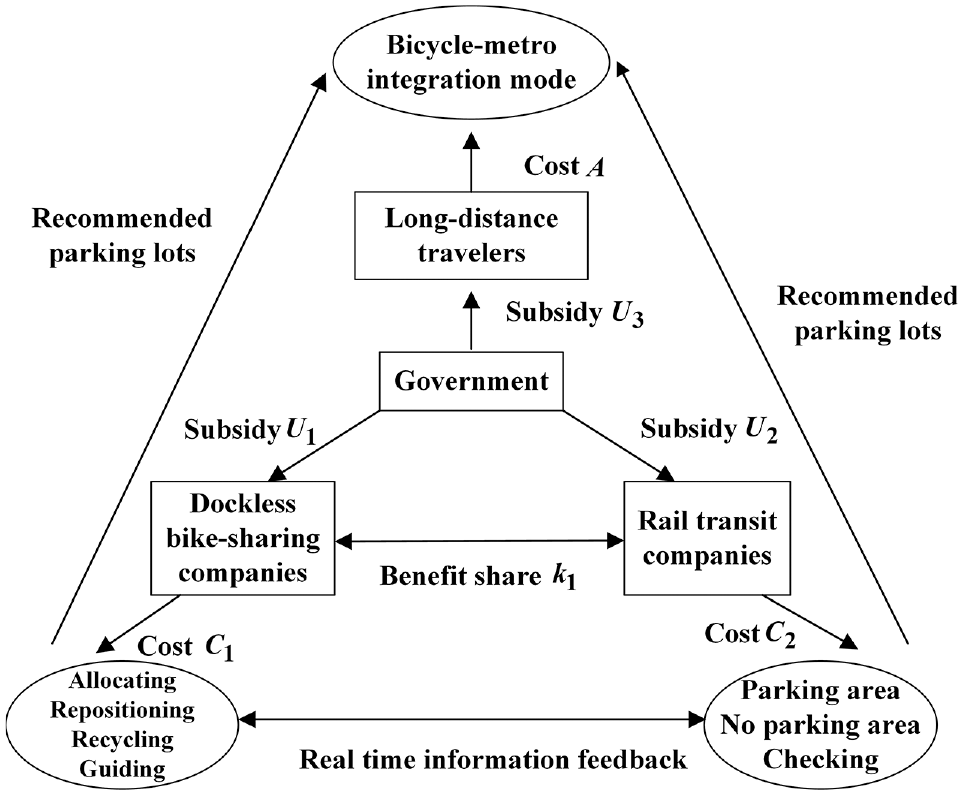
The relationship between bike-sharing companies, rail transit companies, and long-distance travelers based on the public–private partnership mode.
Evolutionary Game Model
Game theory is the study of strategic interaction in mathematical models between rational decision-makers ( 56 ). Traditional game theory usually assumes that the players are completely rational ( 57 ). Evolutionary game theory combines game theory with dynamic evolution process analysis and holds that the players are limited in rationality. In the process of the evolutionary game, each player can evolve into the best decision-making results through continuous learning and evolution ( 58 ). It is difficult for BSCs, RTCs, and LDTs to determine the optimal strategy in a game, and they adjust their strategies in multiple games. Therefore, this paper uses evolutionary game theory to analyze decision-making behaviors among the players.
Hypothesis
To analyze the problem, we make the following hypothesis:
The players in the evolutionary game model are BSCs, RTCs, and LDTs. BSCs refer to dockless bike-sharing companies. The players are bounded rational.
The goal of each player is to get the maximum payoff. All the players make dynamic decisions by comparing their payoffs with others. They are constantly adjusting and changing their strategies through learning from the one that has the maximum payoff in the population, and eventually achieve the equilibrium state.
Each player has two alternative strategies, which are listed in Table 1. The probability of BSCs choosing to cooperate with RTCs is x (
The cooperation between BSCs and RTCs reduces the cost of the bicycle–metro integration travel mode, which will increase the users of shared bikes and metros. If the income of BSCs and RTCs is greater than the cost respectively, making it profitable for each stakeholder, the PPP project in this paper will be implemented.
The Strategies for Each Player in the Evolutionary Game
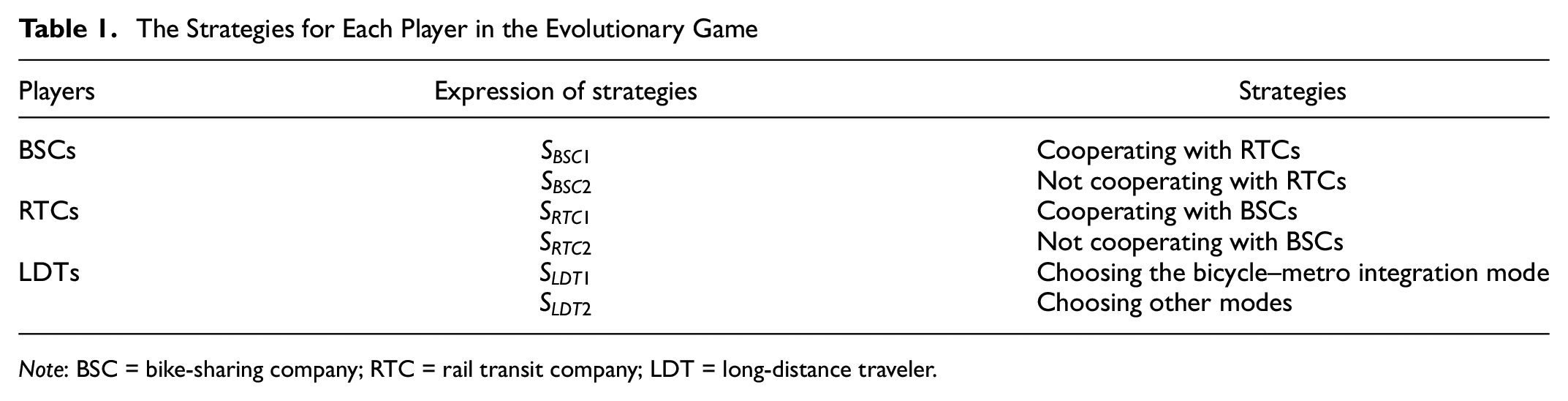
Note: BSC = bike-sharing company; RTC = rail transit company; LDT = long-distance traveler.
Variables
The three players of the evolutionary game model make choices based on relevant impact variables.
The benefit of BSCs running their own business is
When LDTs choose the bicycle–metro integration mode, BSCs and RTCs gain profits. The benefit distribution ratio refers to the share of profits taken by BSCs. When BSCs and RTCs choose to cooperate with each other, the benefit distribution ratio is
When BSCs or RTCs choose to cooperate, it may improve the environment and enhance their reputation, which can increase the number of potential users. The extra benefits of BSCs and RTCs are
The punishment of LDTs for not parking bicycles at recommended lots is M.The reward of LDTs for parking bicycles at recommended lots is Q.
The punishment for LDTs can be considered as the additional benefit of BSCs and RTCs. The distribution ratio
The cost of LDTs choosing the bicycle–metro integration mode is A, and the cost of LDTs choosing other modes is B.
Table 2 shows all the definitions and assumptions of the abbreviations and parameters in this paper.
Definitions and Assumptions of the Abbreviations and Parameters

Note: BSC = bike-sharing company; RTC = rail transit company; LDT = long-distance traveler.
Payoffs of Players
Based on the hypothesis and variable analysis, this paper establishes the evolutionary game model to determine the game strategies among players. The payoff matrix of BSCs, RTCs, and LDTs is shown in Table 3.
The Payoff Matrix of BSCs, RTCs, and LDTs
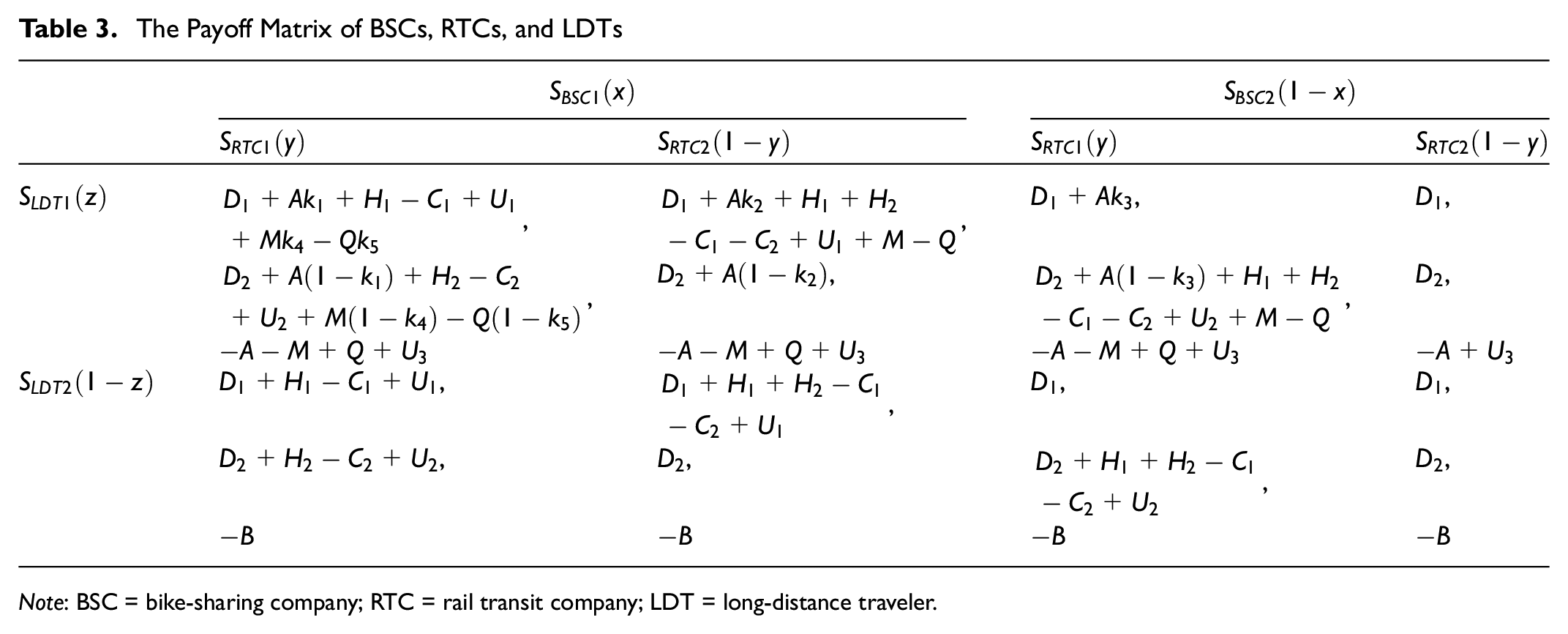
Note: BSC = bike-sharing company; RTC = rail transit company; LDT = long-distance traveler.
Evolutionary Dynamics
In this section, we establish the replicator dynamic equations, solve the equilibriums, and investigate the stability conditions of the evolutionary stable strategy (ESS) to analyze the evolutionary dynamics.
Replicator Dynamic Equations
Based on evolutionary game theory, the replicator dynamic (RD) equation can be used to describe the learning and evolution mechanism of the game under the bounded rationality condition ( 59 ). It shows the growth rate of the proportion of players choosing a certain strategy. The growth of the proportion is positively related to the payoff difference of strategies and the average expected payoff of the group ( 59 ). Thus, we research the respective RDs for three populations.
Suppose that



For BSCs, the replicated dynamic equation is as follows:

Suppose that
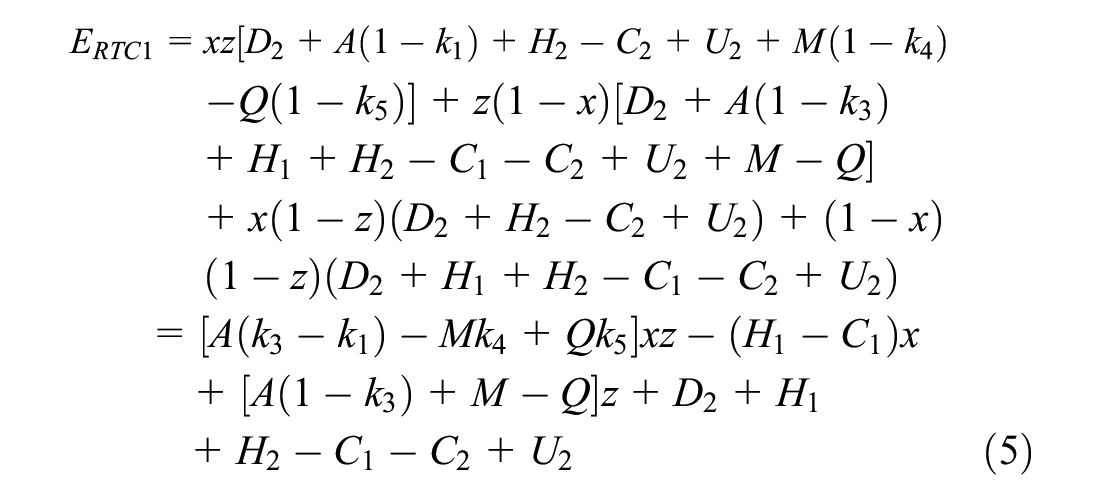


For RTCs, the replicated dynamic equation is as follows:
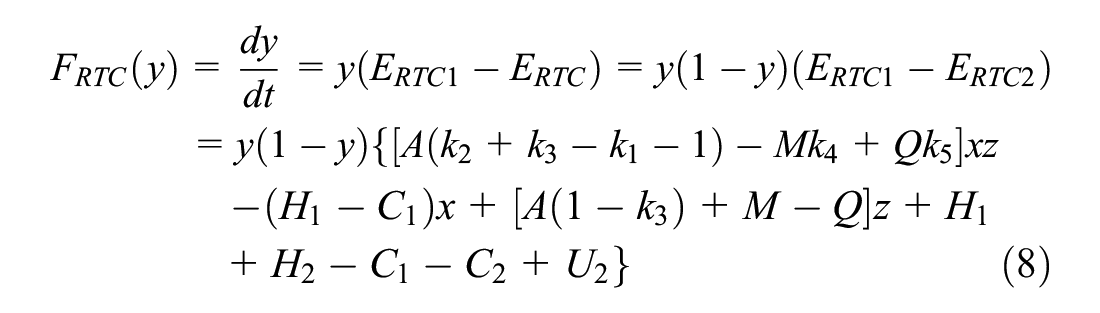
Suppose that
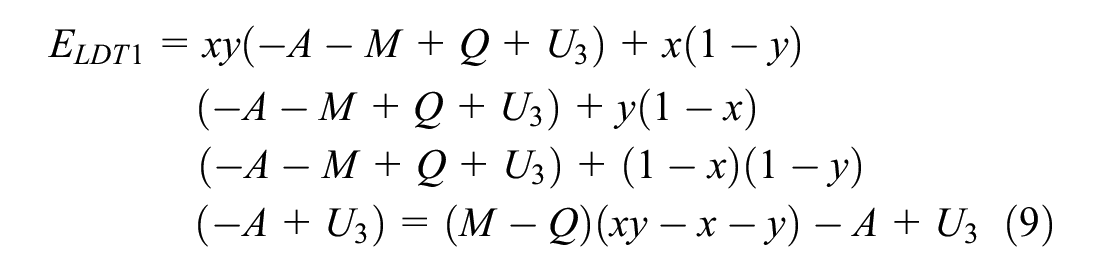


For LDTs, the replicated dynamic equation is as follows:

From the RD equations, the proportions of BSCs and RTCs who wish to cooperate and LDTs who choose the bicycle–metro integration mode are influenced by the payoff they obtained in different strategies. For example, when BSCs get higher payoffs by cooperating than non-cooperating, the proportion of BSCs choosing to cooperate will increase and the value of increased proportion is linear related to the payoff difference of the two strategies. In Lin et al. ( 4 ), when the expected payoff of BSCs choosing to cooperate is higher than the average expected payoff of BSCs, the willingness of BSCs for cooperation will increase, while the average expected payoff is positively related to the difference between the two expected payoffs which are determined by the proportion of RTCs choosing cooperation and LDTs choosing the bicycle–metro integration mode. Similar interpretations apply to RTCs and LDTs.
Stability Analysis of the Equilibriums
Smith proposed the concept of the ESS ( 60 ). An ESS is a strategy which is applied by a population in a certain environment and it cannot be invaded by an alternative strategy ( 61 ). Each ESS corresponds to a Nash equilibrium solution, but not all Nash equilibrium solutions belong to ESSs ( 61 ). When the players cannot obtain higher payoffs by changing their strategies, the proportions of players choosing certain strategies will reach a constant and stable level; at this time, the three-party strategy is called the ESS.
The equilibrium point describes the situation in which there is no longer evolution. According to evolutionary game theory, an equilibrium point satisfies the condition that the replicated dynamic equations equal to zero. By setting
The Jacobian matrix is as follows:

Table 4 shows the eigenvalues of the Jacobian matrix and stability conditions at each equilibrium point. Each equilibrium point can become the evolutionary stable strategy by adding constraints.
When the three players finally stabilize at
When the three players finally stabilize at
When the three players finally stabilize at
When the three players finally stabilize at
When the three players finally stabilize at
When the three players finally stabilize at
When the three players finally stabilize at
Only The stability conditions at The stability conditions at The stability conditions at
The Eigenvalues of J and the Stability Conditions at Each Equilibrium Point

System Dynamics Simulation
System dynamics is a computer simulation methodology which is aimed at enhancing the understanding of complex feedback systems while simultaneously supporting the formulation process for decision-makers ( 63 ). The PPP project in this paper is a complex and dynamic system; a system dynamics approach can be used to model complex systems using visual representation that can be converted into mathematical formulas by software. To justify the previous analysis and further illustrate the influence of parameters in the model, we use system dynamics to provide deeper insights into the studied problem.
System Dynamics Model
According to the evolutionary game model, we establish the system dynamics model of the bicycle–metro integration evolution game system based on the PPP mode by using Vensim PLE, as shown in Figure 2.
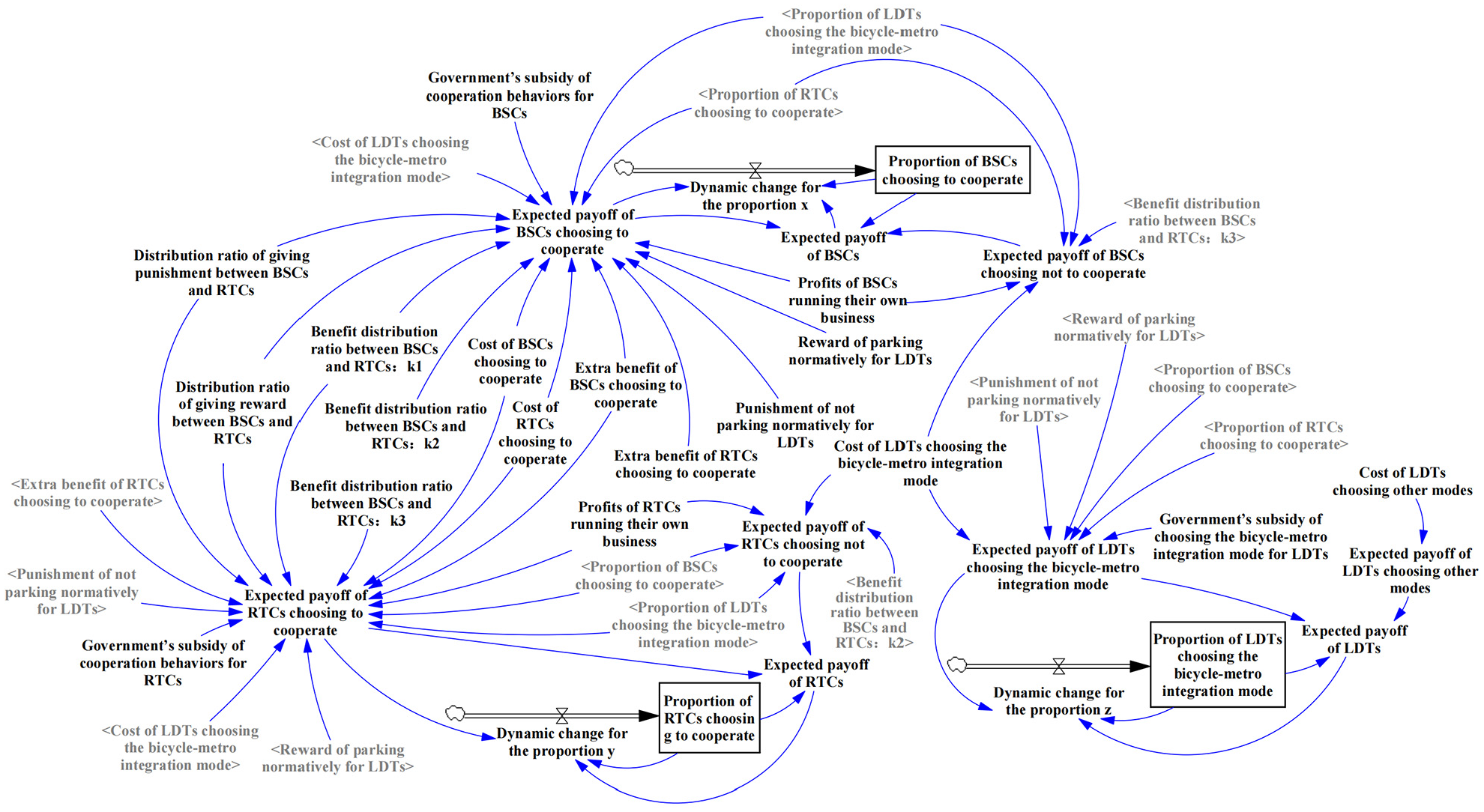
System dynamics model of the bicycle–metro integration evolution game system based on the public–private partnership mode.
The initial values of parameters are set and listed in Table 5 based on the legal practice and the specific conditions of the game scenario; we set the initial evolutionary strategy ratio of three populations in the game as (0.1,0.1,0.1). The influence of the initial values and parameters are discussed in detail then in the case of loss of generality.
Values of the Parameters

Simulation Results
With above data and parameters, the game dynamic evolution paths of the three players are shown in Figure 3a. The evolutionary trajectories converge to ESS (1,1,1). In this case, as the benefit of LDTs choosing the bicycle–metro integration mode is high, LDTs will not choose other modes and quickly converge to the evolutionary stable strategy. All LDTs choosing the bicycle–metro integration mode makes it profitable for BSCs and RTCs, then the willingness of cooperation between BSCs and RTCs will increase and quickly reach 1. The values of parameters meet the stability conditions at
Now we change values of parameters to analyze the evolution trajectories under different evolutionary stability conditions.
From Figure 3b, when the other conditions remain unchanged in Table 5, we set
From Figure 3c, when the other conditions remain unchanged in Table 5, we set
From Figure 3d, when the other conditions remain unchanged in Table 5, we set
In Figure 4a, when the other conditions remain unchanged in Table 5, we set
In Figure 4b, when the other conditions remain unchanged in Table 5, we set
In Figure 4c, when the other conditions remain unchanged in Table 5, we set
In Figure 4d, when the other conditions remain unchanged in Table 5, we set
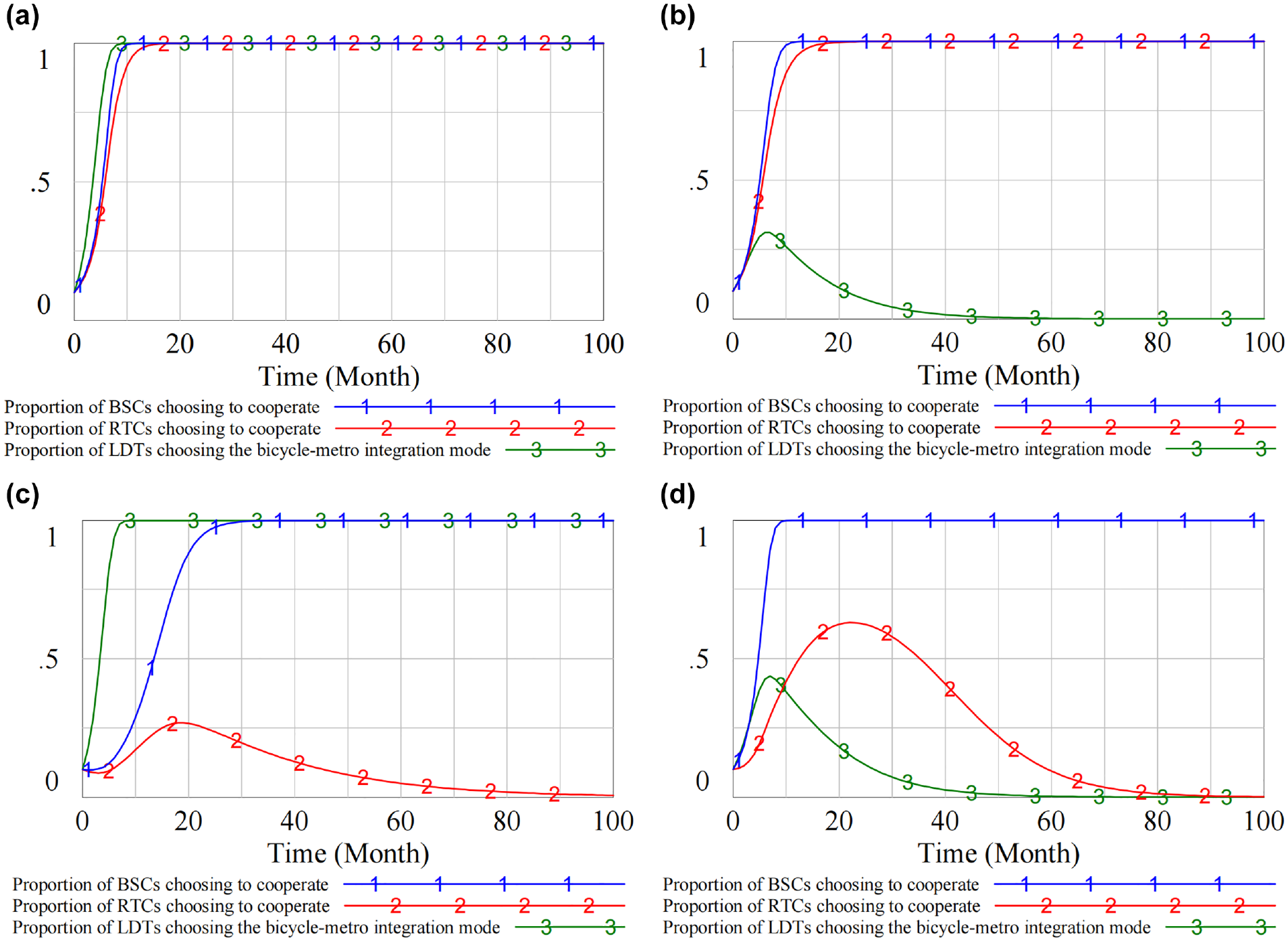
Evolutionary trajectories of players at evolutionary stable strategy: (a) (1,1,1), (b) (1,1,0), (c) (1,0,1), and (d) (1,0,0).

Evolutionary trajectories of players at evolutionary stable strategy: (a) (0,0,0), (b) (0,0,1), (c) (0,1,0), and (d) (0,1,1).
Influence of Initial Values
The initial values of (x, y, z) are randomly selected to present their influence on the evolving process. When the other values of parameters remain unchanged in Table 5, set (x, y, z) = (0.01,0.01,0.01), which means only a small part of BSCs and RTCs would like to cooperate, and only a few LDTs would choose the bicycle–metro integration mode at the beginning. The results are shown in Figure 5a. The evolutionary trajectories reach the ESS (1,1,1). When the other values of parameters remain unchanged in Table 5, set (x, y, z) = (0.2,0.3,0.4), which means the initial evolutionary strategy ratio of the three players is different. The results are shown in Figure 5b. The evolutionary trajectories increase quickly to the ESS (1,1,1).
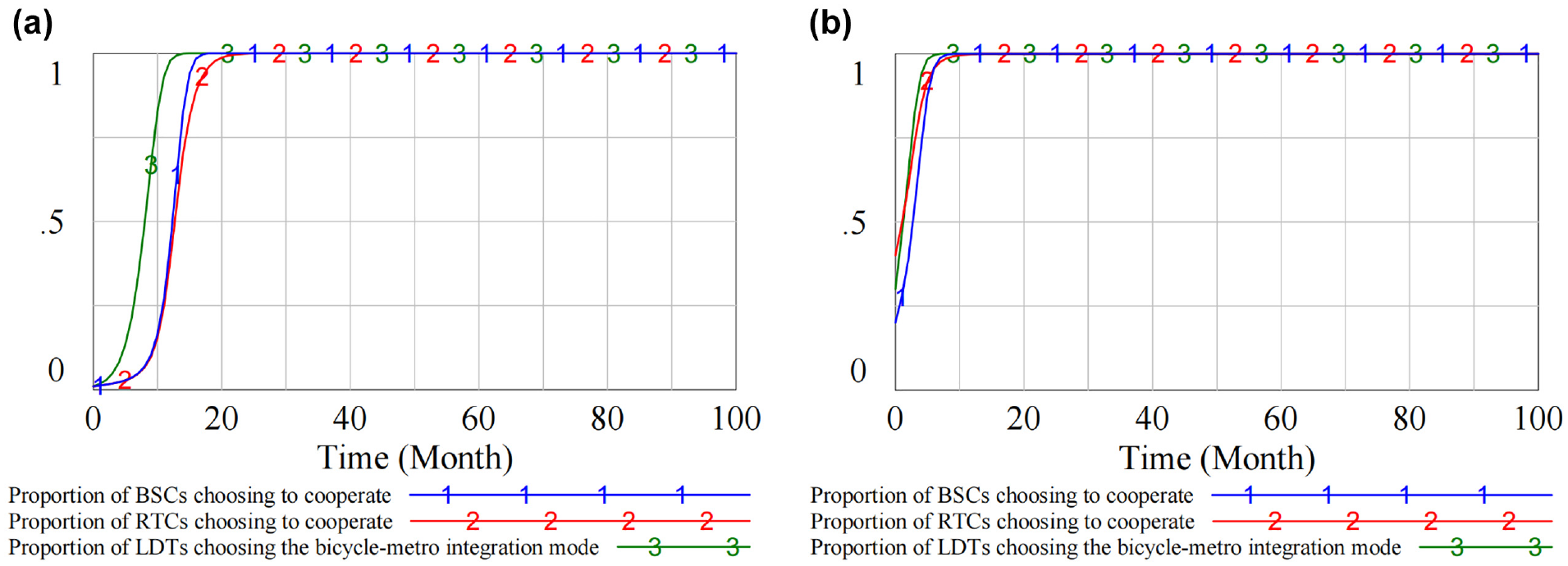
Evolutionary trajectories of players at the initial point: (a) (0.01,0.01,0.01) and (b) (0.2,0.3,0.4).
When the parameters are the same, the initial values will not change the final evolution result except for (0,0,0) and (1,1,1), but they will affect the time to reach the ESS. The larger the initial values, the faster the three players reach the equilibrium.
Parameters Change Game Strategy
In this section, we discuss the influence of parameters on the eight equilibrium points and the transition process of the ESSs.
For the initial ESS (1,1,1), Figure 6 illustrates the influence of M,
For the initial ESS (1,1,0), Figure 7 presents the influence of A on the evolving process. To change the ESS which means to change the strategies of LDTs, the most influential parameter is A. When the cost of the bicycle–metro integration mode decreases, LDTs will receive higher benefits by choosing the bicycle–metro integration mode. At the same time, the cooperation strategies of BSCs and RTCs are stable as they can always gain positive payoffs.
For the initial ESS (1,0,1), Figure 8 presents the influence of
For the initial ESS (1,0,0), Figure 9 presents the influence of
For the initial ESS (0,0,0), Figure 10 presents the influence of B on the evolving process. The original ESS (0,0,0) means BSCs and RTCs are unwilling to cooperate and LDTs choose other travel modes. In this case, we need to find the parameter that promotes cooperation behaviors and bicycle–metro integration mode. When traffic is congested, the cost of LDTs choosing other modes increases, LDTs may change their travel mode. The willingness of LDTs choosing the bicycle–metro integration mode increases with the increasing cost of other modes. The willingness of BSCs and RTCs to cooperate will be promoted with the income increases. The ESS will be (1,1,1) if B is 1.7.
For the initial ESS (0,0,1), Figure 11 presents the influence of Q on the evolving process. When the reward for LDTs parking normatively decreases, the cost of BSCs choosing cooperation will decrease, and the willingness of BSCs to cooperate will increase. However, the willingness of RTCs to cooperate still decreases to 0 by simulation, which means the value of Q has little impact on RTCs.
For the initial ESS (0,1,0), Figure 12 presents the influence of
For the initial ESS (0,1,1), Figure 13 presents the influence of M on the evolving process. When the punishment for LDTs not parking normatively increases, the payoff of BSCs choosing cooperation will increase, thus the willingness of BSCs to cooperate will increase. In this case, LDTs will still be willing to choose bicycle–metro integration mode as they can get positive payoff.
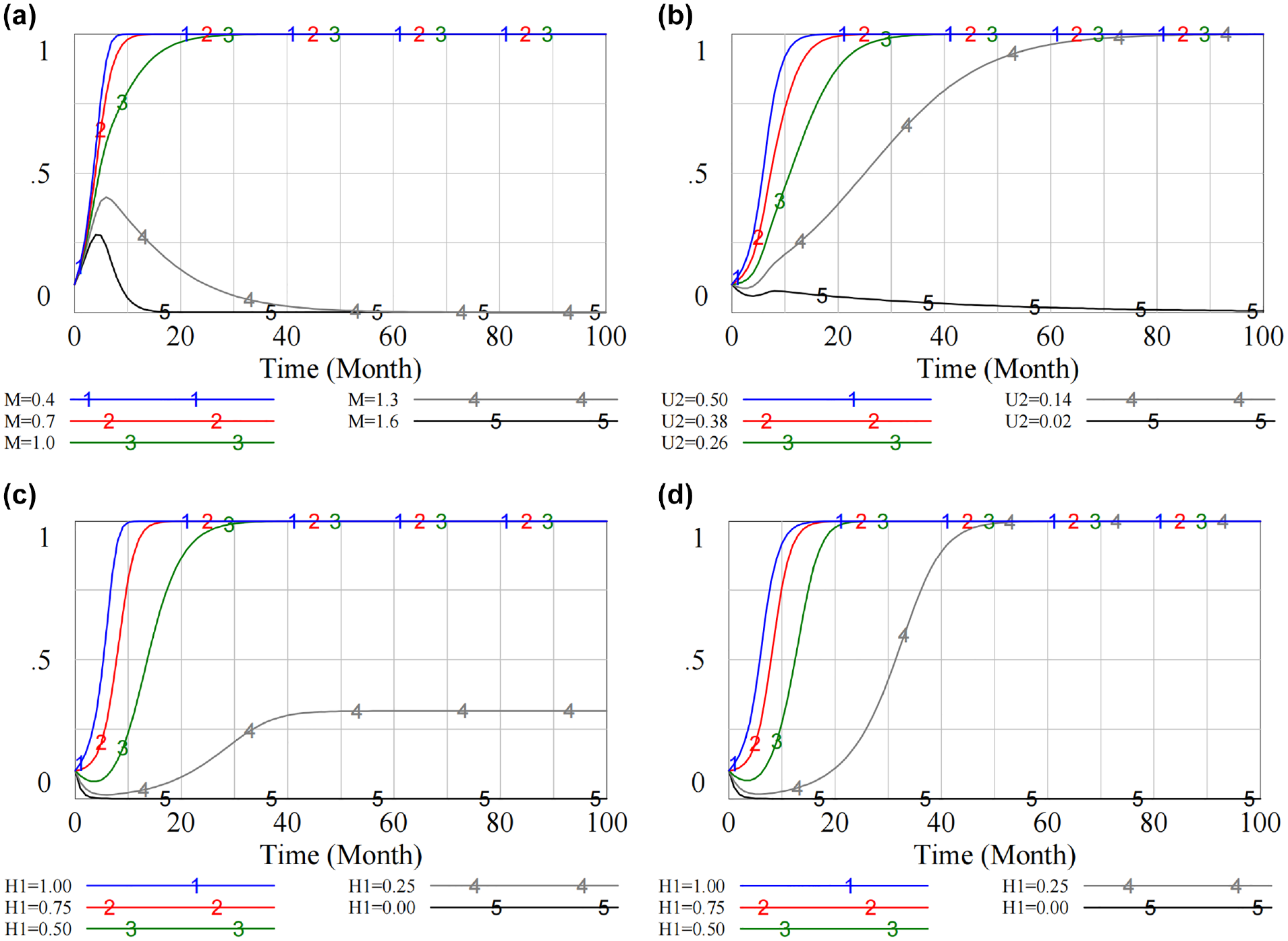
The sensitivity analysis of the initial evolutionary stable strategy (1,1,1): (a) the evolutionary trajectories of long-distance travelers influenced by M, (b) the evolutionary trajectories of rail transit companies (RTCs) influenced by
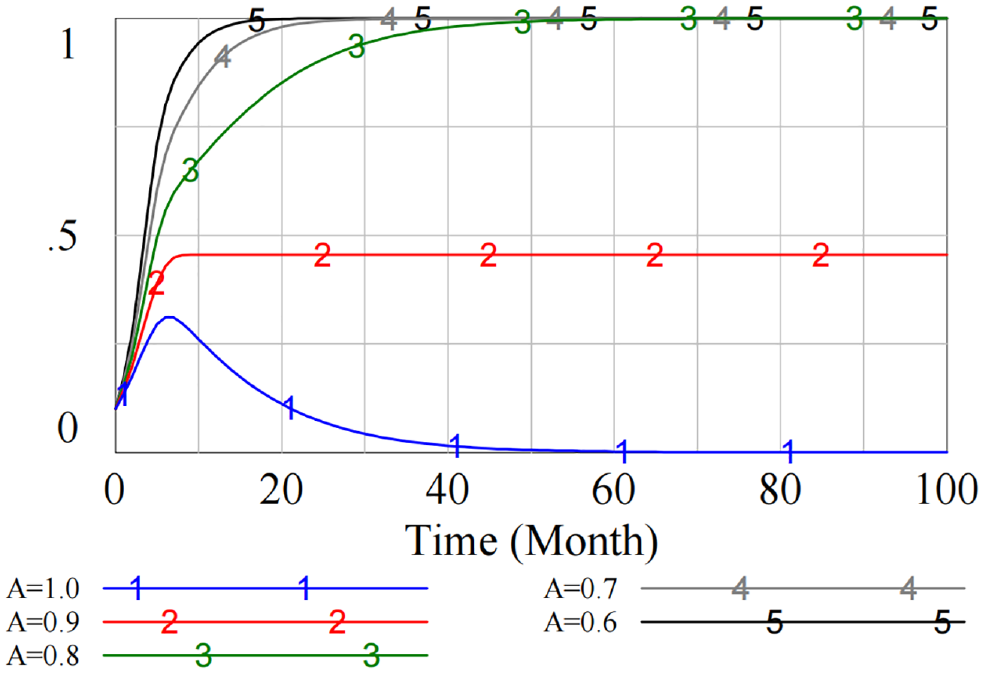
The sensitivity analysis of the initial evolutionary stable strategy (1,1,0): the evolutionary trajectories of LDTs influenced by A.
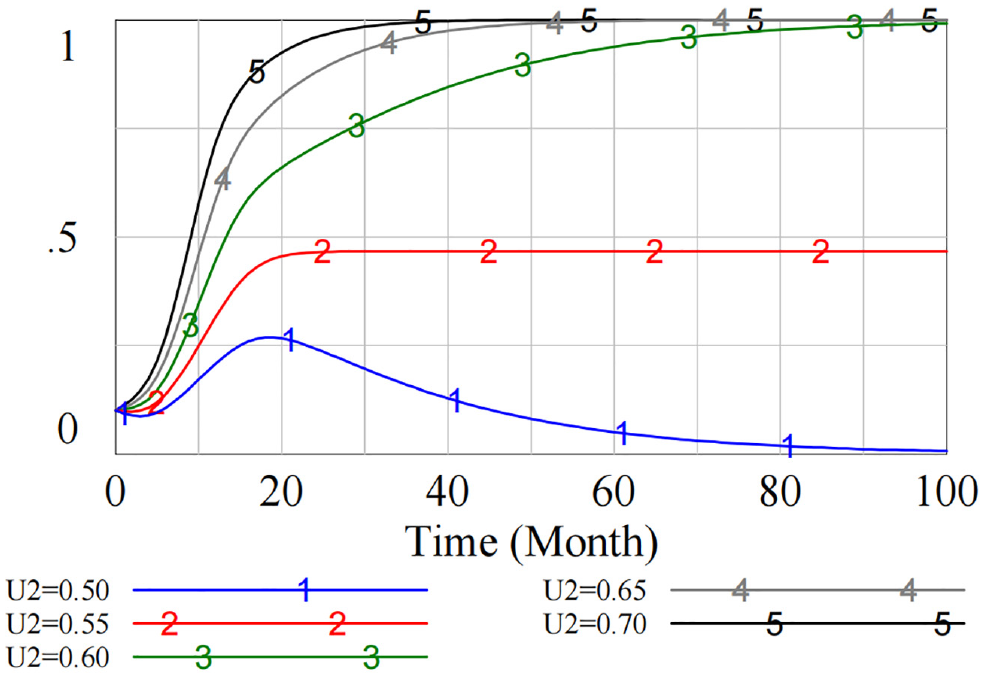
The sensitivity analysis of the initial evolutionary stable strategy (1,0,1): the evolutionary trajectories of rail transit companies influenced by
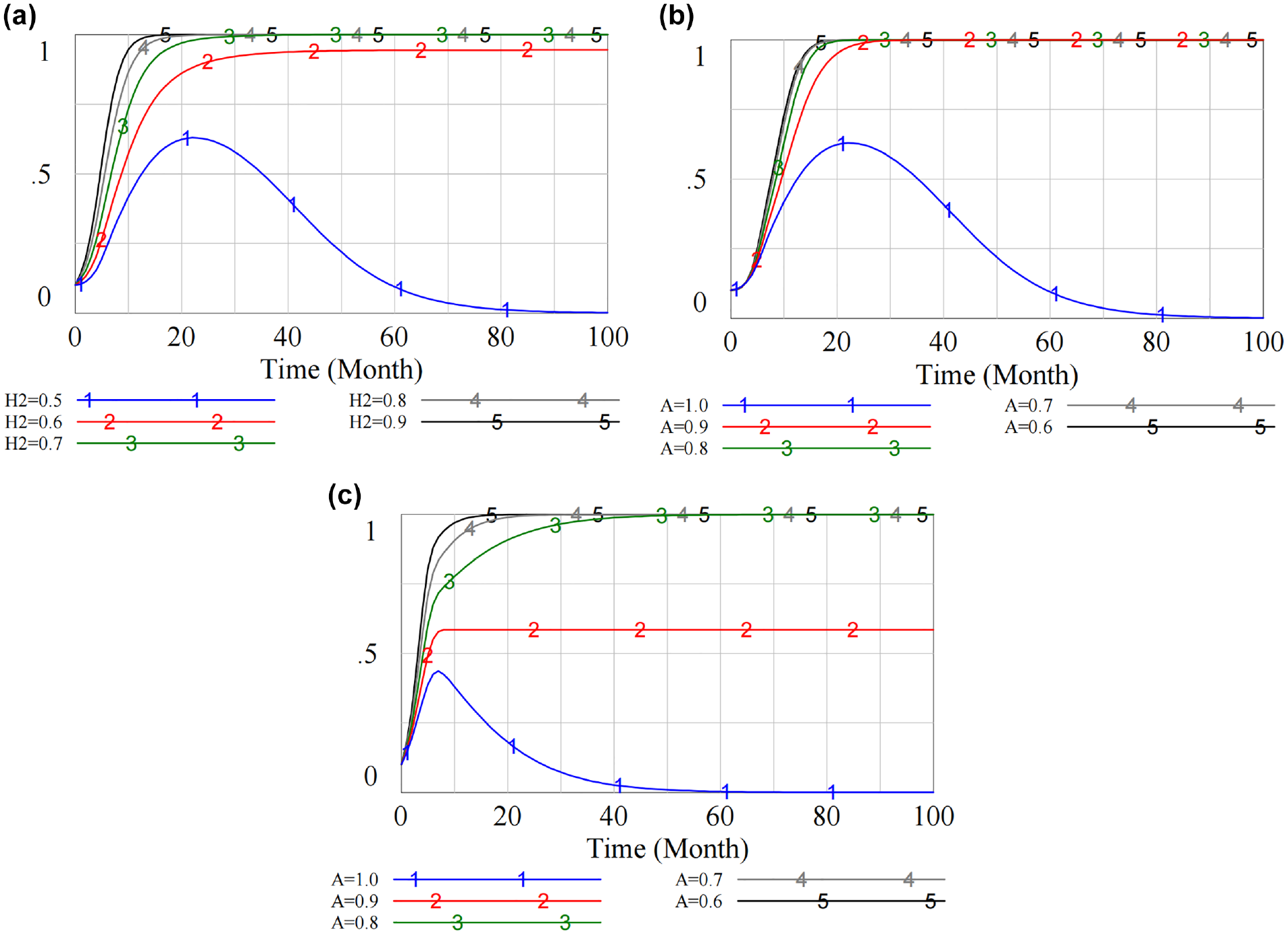
The sensitivity analysis of the initial evolutionary stable strategy (1,0,0): (a) the evolutionary trajectories of rail transit companies (RTCs) influenced by
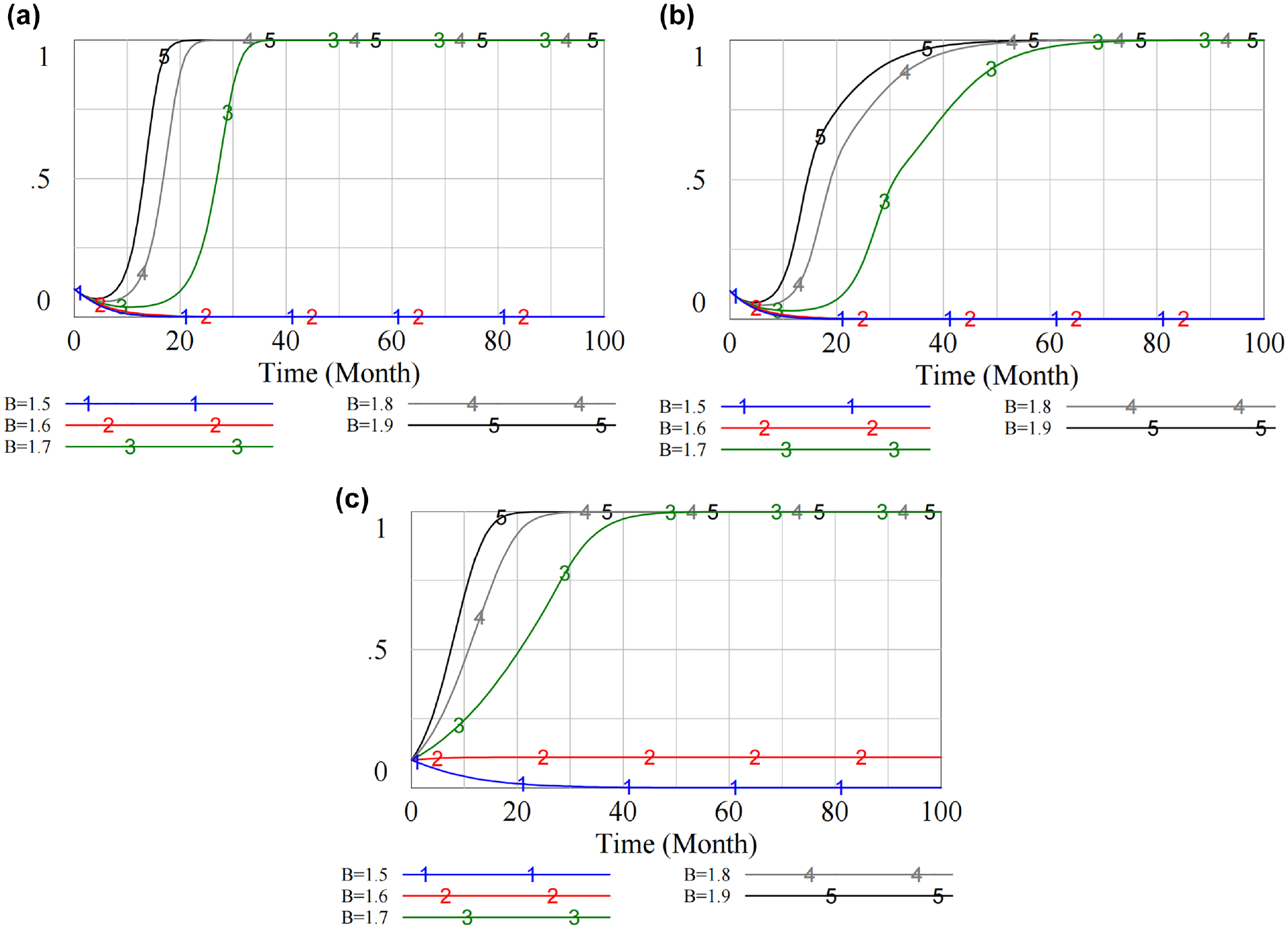
The sensitivity analysis of the initial evolutionary stable strategy (0,0,0): (a) the evolutionary trajectories of bike-sharing companies influenced by B, (b) the evolutionary trajectories of rail transit companies influenced by B, and (c) the evolutionary trajectories of long-distance travelers affected by B.

The sensitivity analysis of the initial evolutionary stable strategy (0,0,1): the evolutionary trajectories of bike-sharing companies influenced by Q.
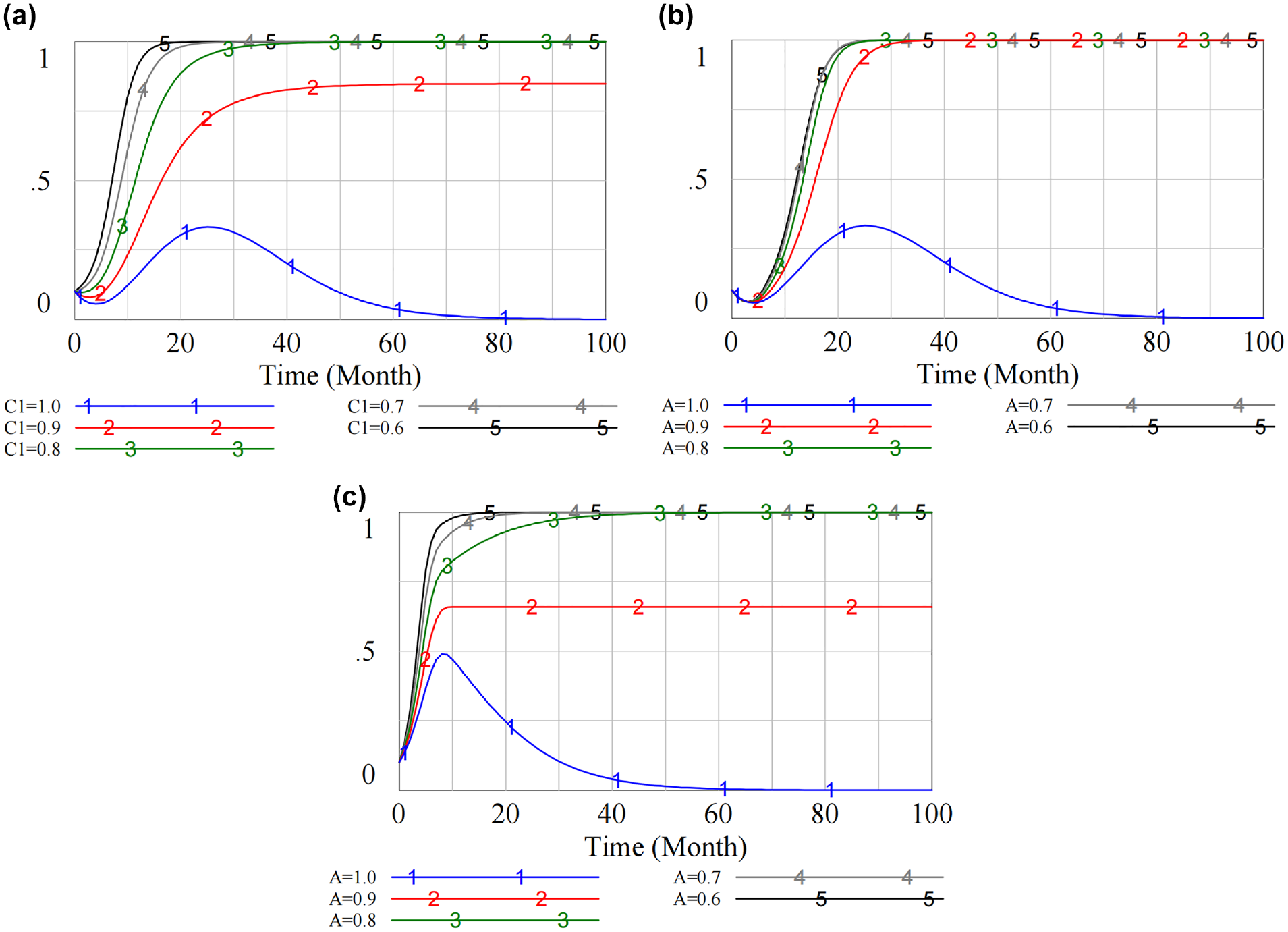
The sensitivity analysis of the initial evolutionary stable strategy (0,1,0): (a) the evolutionary trajectories of bike-sharing companies (BSCs) influenced by
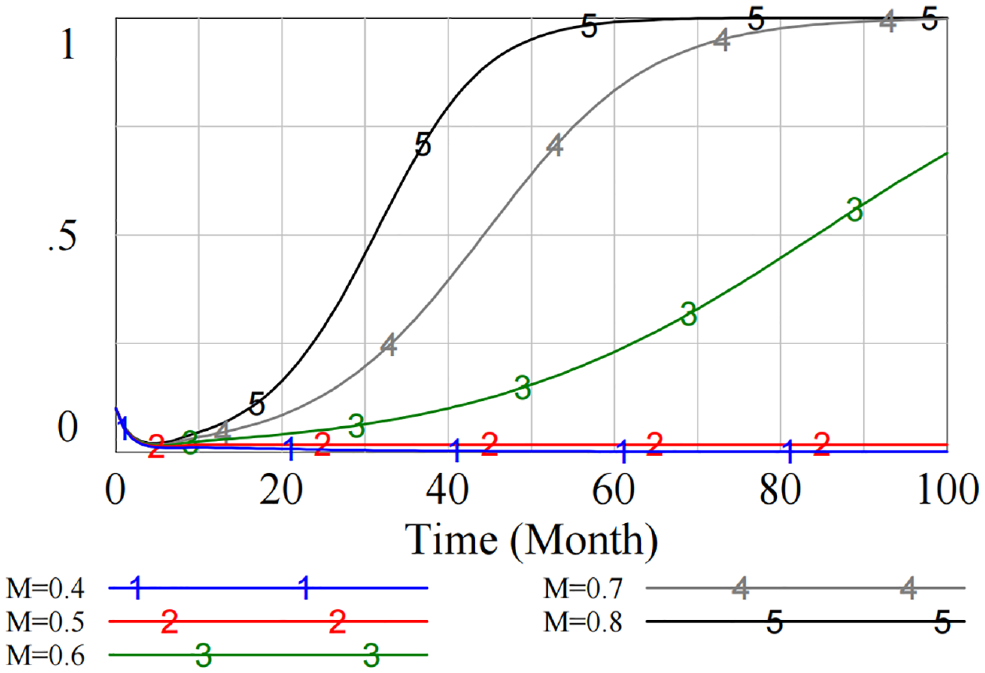
The sensitivity analysis of the initial evolutionary stable strategy (0,1,1): the evolutionary trajectories of bike-sharing companies influenced by M.
To conclude, Table 6 illustrates the transition process of the ESSs influenced by the parameters. The results show that M,
Transition Process of the Evolutionary Stable Strategies (ESSs) Influenced by the Parameters

Discussion
Based on our findings, we will discuss several key points and make some policy suggestions for the promotion of bicycle–metro integration.
First, dockless bicycle-sharing systems can promote bicycle–metro integration. The results of our study indicate that organizing dockless bicycle-sharing systems at metro stations is an effective way to encourage travelers to choose the bicycle–metro integration mode. This is consistent with many empirical studies ( 17 , 18 , 47 ), but our study only focuses on dockless bike-sharing systems instead of dock-based bike-sharing systems.
Second, the cooperation behaviors between BSCs and RTCs are significant and effective to improve both services and attract more users. From the equilibrium conditions and the sensitivity analysis, the key factors affecting the cooperation behavior of BSCs lie on the potential benefit of cooperation, the punishment, and reward for LDTs. The total incomes are the target for BSCs and thus must be guaranteed. By cooperation, BSCs can reposition bicycles properly at any time with the real-time information feedback from RTCs to ensure a sufficiently high quality of service for users, which solves the imbalance and stochasticity of bikes’ arrivals and departures near metro stations. Tian et al. suggested that bike-sharing enterprises and organizations improve their performance and provide high-quality products and services to attract customers ( 41 ). The improvement of the cycling environment may attract more bike-sharing users. The driving factors for RTCs to cooperate are the potential benefit and the value of subsidies from the government. Zhao et al. found that bicycle park-and-ride spaces were significantly connected to metro station ridership ( 64 ). The Rasch analytical results of Cheng et al. showed that external environmental factors could influence users’ perceived inconvenience rather than the factors of the intra-transit system that a transit agency could ameliorate ( 65 ). By cooperation, RTCs set the shared bikes’ parking area to help LDTs transfer more conveniently and increase metro ridership. In addition, the government needs to consider a high subsidy for RTCs to attract them to cooperate.
Third, improving external environmental factors can encourage LDTs to choose the bicycle–metro integration mode; the main factors influencing the decision of LDTs are the cost difference between the bicycle–metro integration mode and other modes, and the punishment and reward for LDTs. When traffic is congested, the cost of other modes will be high, and LDTs may prefer the bicycle–metro integration mode. Wang et al. mentioned that the overuse of Chinese bike-sharing systems could be controlled effectively by the mode of a low fee with strict restrictions or a high-fee management mode ( 66 ). The reward of parking normatively not only improves the travel environment near metro stations, but also gives great incentives for LDTs.
Fourth, the government needs to encourage BSCs and RTCs to cooperate and promote the bicycle–metro integration mode. Subsidies from the government increase the proportion of BSCs and RTCs choosing cooperation. For policy design, the government could suggest adding parking space for shared bikes near metro stations, setting no-parking areas to prevent the occupation of sidewalks, setting the reward regulations for specific LDTs, and designing bicycle lanes and signs to metro stations.
Conclusions and Future Research
Conclusions
The bicycle–metro integration mode could be a successful way to achieve efficient and sustainable urban transport. To promote bicycle–metro integration, we consider the cooperation between BSCs and RTCs, propose a PPP project, establish an evolutionary game model, and find that each equilibrium point can become the ESS and the PPP project is likely to succeed under the following conditions:
For BSCs or RTCs, the payoff of choosing cooperation is greater than the payoff of choosing no cooperation, respectively, under the circumstance that the other two players choose optimal strategies; for LDTs, the cost of choosing other modes is greater than the cost of choosing the bicycle–metro integration mode after getting the subsidy, reward, and punishment.
At least one of the following three conditions needs to be satisfied. For BSCs, the total extra benefit of unilateral cooperation after getting the subsidy is higher than the total cost; or for RTCs, the total extra benefit of unilateral cooperation after getting the subsidy is higher than the total cost; or for LDTs, the cost of choosing the bicycle–metro integration mode after getting the subsidy is less than the cost of choosing other modes.
At least one of the following three conditions needs to be satisfied. For BSCs, the total benefit of unilateral cooperation after getting the subsidy is greater than the total cost; or for RTCs, the total benefit of unilateral cooperation after getting the subsidy is greater than the total cost; or for LDTs, the cost of choosing other modes is less than the cost of choosing the bicycle–metro integration mode after getting the subsidy.
Through establishing a system dynamics model and simulating, we justify that the optimal state when BSCs and RTCs choose to cooperate and LDTs choose the bicycle–metro integration mode can be achieved. LDTs have the strongest willingness to choose the bicycle–metro integration mode, followed by BSCs and RTCs choosing cooperation. Consequently, if the PPP scheme is proposed in practice, each population will choose the optimal strategies and the cooperation behaviors will be stable in the market.
ESS is only influenced by the values of parameters which satisfy the stability conditions. The larger the initial value is, the faster the evolutionary trajectory reaches the ESS (1,1,1).
The simulation results also prove that other ESSs can be achieved by properly choosing parameters. To help achieve the optimal ESS, we consider parameters changing game strategies; the specific references are listed as follows:
When BSCs and RTCs are willing to cooperate and LDTs choose the other modes, the situation can be changed by decreasing the cost of the bicycle–metro integration mode.
When BSCs are willing to cooperate, LDTs are willing to choose the bicycle–metro integration mode, and RTCs are unwilling to cooperate, increasing the government subsidies for RTCs can improve the participation of RTCs.
When BSCs are willing to cooperate, RTCs are unwilling to cooperate, and LDTs choose other modes, the situation can be changed by decreasing the cost of the bicycle–metro integration mode. LDTs will intend to choose the bicycle–metro integration mode as they can save money, and the increasing users will help RTCs choose cooperation.
When BSCs are unwilling to cooperate, RTCs are willing to cooperate, and LDTs choose other modes, the situation can also be changed by decreasing the cost of the bicycle–metro integration mode. LDTs will intend to choose the bicycle–metro integration mode, and the increasing users will help BSCs choose cooperation.
When BSCs are unwilling to cooperate, RTCs are willing to cooperate, and LDTs choose the bicycle–metro integration mode, the situation can be changed by increasing the punishment for LDTs not parking normatively. The payoff of BSCs choosing cooperation will increase, thus the willingness of BSCs to cooperate will increase. LDTs will still choose the bicycle–metro integration mode as they can get positive payoff.
To conclude, we find that the cost of the bicycle–metro integration mode is the most important factor influencing the final stable state. With increasing traffic congestion in urban cities, the cost difference between the bicycle–metro integration mode and other modes will lead LDTs to choose the low-cost, effective, and convenient travel mode. We also find that the potential benefits are vital to the cooperation behaviors. The improvement of the cycling environment near metro stations and the effective management of parking space may attract more shared-bikes users and increase metro ridership. The potential users play vital roles in the cooperation between BSCs and RTCs. The reward and punishment for parking behaviors of LDTs are also important determinants for cooperation behaviors of BSCs. BSCs may consider the values of the reward and punishment carefully to obtain higher payoffs. As for the government subsidies, the subsidy for RTCs is more influential compared with the subsidy for BSCs or LDTs. Thus, by adjusting the parameters, the cooperation behaviors can be promoted effectively. The findings from our study can assist stakeholders, such as the city government authority, transit agencies, and bicycle companies, in deriving several directions for promoting bicycle–metro integration.
Future Research
In the process of the promotion of the bicycle–metro integration mode and the realization of PPP projects, the connections between three populations will be more complicated. This work could be extended by considering deeper relationships between BSCs and RTCs and obtaining travel data to examine the transfer characteristics of users. In addition, taking the specific government policies among the bicycle–metro integration socio-demographic factors, travel-related factors, and environmental factors into account is also necessary.
Footnotes
Author Contributions
The authors confirm contribution to the paper as follows: study conception and design: Y. Liang; data collection: J. Cai; analysis and interpretation of results: Y. Liang and J. Cai; draft manuscript preparation: Y. Liang. All authors reviewed the results and approved the final version of the manuscript.
Declaration of Conflicting Interests
The author(s) declared no potential conflicts of interest with respect to the research, authorship, and/or publication of this article.
Funding
The author(s) received no financial support for the research, authorship, and/or publication of this article.