



Abstract
Congestion pricing is proposed as an effective travel demand management strategy to circumvent the problem of congestion and generate revenue to finance developmental projects. There are several studies focusing on optimal pricing strategies to minimize the congestion level or maximize the revenue of the system. However, with regard to equity issues, benefiting only users with higher value of time is claimed to be the main factor that prevents implementation of such policies in practice. While many studies aimed to tackle the equity issues by certain welfare analyses, most of these studies fail to fully consider realistic features of users’ behavior and the uncertainty in link travel times. Given the variability of travel time in real-world networks and the impacts of pricing policies on path travel time distributions, it is important to consider the users’ reliability valuations, in addition to their travel time valuations. Thus, the goal in this study is to find an equitable pricing scheme that minimizes the total travel time of auto users in a general bimodal network considering heterogeneous users with different values of time and reliability. A particle swarm optimization algorithm is proposed to find self-funded and Pareto-improving optimal toll values. A reliability-based user equilibrium algorithm is embedded into this optimization algorithm to assign travelers to the equilibrated paths for different user classes given toll values. The proposed approach is successfully applied to a modified Sioux Falls network to explore impacts of subsidization, congestion level, and considering travel time reliability on the pricing strategy and its effectiveness.
Traffic congestion is a critical issue in urban areas, with associated adverse impacts including inconvenience for motorists, travel time delays, and poor environmental quality ( 1 ). In recent decades, transportation planners and policymakers have become increasingly interested in congestion pricing as a possible mechanism to mitigate traffic congestion in urban areas. Without congestion pricing, traffic is distributed along the different routes in the network such that a user equilibrium (UE) traffic route assignment pattern is obtained. This undesirable UE route assignment pattern results in inefficient use of the network capacity and excessive delays. However, pricing strategies shift the UE pattern toward a system optimal pattern, as a portion of the travelers modify their routes to avoid paying the tolls. Despite technological advancements in implementing pricing strategies, some serious impediments hinder the application of these strategies in practice. For instance, without a careful redistribution scheme of collected tolls, congestion pricing can inequitably affect travelers (providing benefit for some travelers and loss for the others). Therefore, a comprehensive congestion pricing strategy is required not only to alleviate congestion, but also to neutralize equity issues.
To make road pricing appealing to the public, many studies propose strategies for the distribution of toll revenues considering travelers’ benefits and losses after pricing strategy implementation. Among the first in the line of research are Daganzo and Garcia ( 2 ) and Lawphongpanich and Yin ( 3 ) who proposed the Pareto-improving pricing strategy. Pareto-improving pricing refers to a scheme that does not make any traveler worse off, and makes at least one traveler better off with regard to generalized costs. Following this concept, several other studies propose Pareto-improving second-best pricing schemes for unimodal and bimodal networks (e.g., transit and highway) ( 4 , 5 ). Redistributing toll revenues among travelers is also considered to avoid inequity problems associated with congestion pricing ( 6 ). In addition, considering the variable impacts of congestion pricing on travelers with different socio-economic characteristics, trip purposes, and preferences, congestion pricing models that account for the variability of travelers’ value of time (VOT) have been developed. For example, Liu et al. ( 7 ) introduced a Pareto-improving pricing scheme, which is revenue-neutral for a bimodal network. Their proposed scheme increases utility for all users and resolves the equity issue for travelers assuming a uniform VOT distribution. Nie and Liu ( 6 ) explored Pareto-improving schemes for different distributions of VOT and demonstrated that such a scheme always exists for concave VOT distributions. However, this is not the case for the realistic log-normal distribution. The impacts of congestion pricing on different traveler classes are also highly affected by the reliability valuation of network users. However, most studies have considered only different VOT classes, neglecting variations in the value of travel time reliability (VOR).
Travelers respond differently to travel time uncertainty, reflecting heterogeneity in their preferences and risk attitudes ( 7 , 8 ). Considering a reliability measure in travelers’ path choice decisions would naturally affect the modeled congestion pattern in the network, which in turn, affects the outcomes of pricing strategies. Incorporating measures of travel time reliability into congestion pricing schemes thus enhances the consistency of the schemes with travelers’ route choice behavior. A few studies in the literature have considered applications of variable travel time in congestion pricing ( 9 , 10 ). For example, Li et al. ( 11 ) presented a bi-level reliability-based optimal toll design model in which travel time reliability is a network objective at a higher level. However, travel time reliability should also be considered as users’ objective in route choice and traffic assignment. Boyles et al. ( 12 ) proposed an algorithm to find first-best pricing values for static transportation networks under daily capacity variations. They also defined the problem with travel time reliability and link travel time correlations. However, no solution algorithm was presented for this problem. In addition, the solution methodology considered only one single user class with regard to VOT and VOR. As such, two main limitations could be identified in existing models for equitable roadway pricing. First, most studies on congestion pricing either completely ignore travel time reliability or use simplified assumptions for its representation. Second, to our knowledge, there is no study that considers the reliability-based user equilibrium (RBUE) in finding an equitable road pricing strategy for heterogeneous users with multiple VOT and VOR classes, which affects the fidelity of the traffic route assignment pattern in the network and thus the accuracy of the generated pricing schemes.
In this context, this research is motivated by the need to develop a modeling framework and efficient solution methodology for self-funded and Pareto-improving congestion pricing schemes, which are shown to provide equity among transportation users in the literature. The framework ensures that all travelers are experiencing an improvement in their generalized travel cost (utility) after deploying the pricing scheme, which is addressing the equity issue. The framework explicitly captures the effect of travel time reliability on travelers’ mode-route choice, considering heterogeneous travelers with multiple classes of VOT and VOR. In addition, for self-funded congestion pricing, revenues generated from the collected tolls could be utilized to improve public transportation services, subsidize the users of these services, and/or compensate travelers who experience an increase in their generalized travel cost. However, there are concerns about the equity of the mechanism developed for toll revenue distribution. To overcome these concerns, the framework developed in this paper is extended to address the self-funded congestion pricing problem. Two revenue distribution strategies are considered for self-funded pricing schemes in a bimodal network, namely the transit-based strategy and the credit-based strategy ( 6 , 13 ). For the transit-based strategy, the tolls collected from highway users are distributed only among transit users, reducing their travel cost and enhancing their regional accessibility. For the credit-based strategy, the collected tolls are distributed in the form of credits for all travelers (both private cars and transit users) to compensate for any increase in the travel cost.
The modeling framework developed in this paper extends the second-best pricing optimization problem by integrating an RBUE algorithm. From the societal perspective, the objective of the pricing algorithm is to minimize total travel time of highway users given a revenue-neutral and Pareto-improving pricing scheme. Users’ heterogeneity in response to the reliability measures, their response to different toll values and toll distribution strategies, and link travel time correlations are considered in the RBUE problem. A particle swarm optimization (PSO) algorithm is developed to determine the optimum toll values given the objectives of the current study and toll distribution strategies (e.g., credit-based, transit subsidy). The algorithm is applied to a modified Sioux Falls network with an area-based pricing strategy. This paper contributes to the existing literature in several aspects:
Accounting for the travel time reliability in finding an equitable pricing scheme
Considering heterogeneity of users in response to travel time uncertainty using multiple classes for users’ VOR defined based on the VOT distribution
Presenting an RBUE algorithm that assigns heterogeneous users, differing in their VOT and VOR, to their least generalized cost paths
Incorporating link travel time correlations in the RBUE problem for congestion pricing
Presenting a solution method that integrates an RBUE algorithm, which entails a Monte Carlo simulation-based approach, and a PSO algorithm to solve an equitable congestion pricing problem considering travel time reliability
Comparing the effect of different revenue distribution strategies on the performance of the generated pricing schemes
Exploring the impacts of different types of relations (i.e., linear, concave) between mean and standard deviation of link travel time on self-funded and Pareto-improving pricing schemes
The rest of the paper includes the following sections. First, a brief review of the literature is presented. Next, the problem is formally defined and formulated. Afterwards, the solution methodology is described, which adopts the PSO algorithm to determine near-optimal equitable toll values minimizing total travel time of highway users. The numerical results of implementing this algorithm on the case study are then presented. Finally, the last section presents key findings and proposes future research directions.
Literature Review
As mentioned above, congestion pricing could bring considerable benefits in rectifying congestion externalities. Nonetheless, the strategy is suffering low public acceptance concerning its possible inequity ( 14 ). Congestion pricing generally improves mobility and accessibility for high income travelers, and penalizes low income travelers forced to change their routes, departure times, or transportation modes to avoid paying the tolls. The previous section reviewed several studies that focus on equity issues associated with congestion pricing. Credit-based and transit-based toll distribution strategies are frequently used in the literature to distribute the revenue of collecting tolls among transportation users. Yang and Wang ( 15 ) were among the first to introduce a credit-based strategy by charging pre-determined credits on the links of generalized transportation networks. Wang et al. ( 16 ) used a similar strategy for a network with heterogeneous users in VOT. Many other studies, such as the studies by Nie and Yin ( 17 ) and Shirmohammadi et al. ( 18 ), present different variants of credit-based strategies to improve the equity of pricing schemes in transportation networks. In addition, the transit-based toll distribution strategy is used in multiple studies in the literature ( 6 , 7 ). However, most of these studies mainly focus on presenting a toll distribution strategy for homogeneous users or heterogeneous users with different VOTs, neglecting variations of VOR among travelers. The following subsections provide a background on the travel time reliability measure and user heterogeneity.
Travel Time Reliability Measure
Travel time uncertainty in transportation networks comes from either the demand side or the supply side. Different users have different responses to travel time uncertainty based on their personal preferences or risk acceptance levels. This study, consistent with Zockaie et al. ( 19 ), considers uncertainty by assuming that link travel times follow pre-defined probability distributions. There is no agreement on the measure of travel time variability in transportation networks. Standard deviation of travel time ( 20 , 21 ), the coefficient of variation of travel time ( 22 ), and probability of being lower than a threshold ( 23 ) are common definitions used in the literature for travel time variability.
A common approach to consider travel time reliability in routing problems is to add a buffer index, representing the uncertainty, to the mean travel time ( 24 ). Standard deviation and variance of travel time are the most common attributes considered as the buffer index. While it is easier to solve the routing problem with variance as the buffer index ( 25 ), standard deviation is a more intuitive measure, since it has the same unit as mean travel time ( 26 ). However, incorporating the standard deviation makes the path cost function non-linear and non-additive, violating the Bellman’s principle of optimality ( 24 ). This violation makes the reliable path finding problem difficult to solve especially for large-scale applications. Zockaie et al. ( 23 , 27 ) proposed a Monte Carlo simulation-based approach to solve this problem. In addition to the routing problem, many studies have explored the RBUE problem, following the modified algorithms for the path finding problem ( 28 – 30 ). Jiang et al. ( 10 ) developed a multicriterion dynamic UE traffic assignment model that considers heterogeneous users who are seeking to minimize their travel time and travel cost, and maximize travel time reliability. Their study considered users’ heterogeneity with a random distribution of VOT and a single VOR, and adopted a simplified relation to find standard deviations of link travel time.
Heterogeneity of Travelers’ Behavior
While most of the studies in the literature consider homogeneous users or discrete/continuous classes of VOT ( 4 , 31 – 33 ), Van den Berg and Verhoef ( 34 ) claimed that the distributional impacts of congestion pricing are controlled by something more than VOT classes. They considered a distribution of VOT and a value of schedule delay in a bottleneck model and stated that these two important factors should be considered in congestion pricing assessment studies. Therefore, in addition to VOT, the reliability valuation of users is a critical factor in indicating the welfare losses and gains of heterogeneous users from congestion pricing. Carrion and Levinson ( 35 ) defined the VOR as an amount of money that individuals are willing to pay to reduce the variability of travel time. Brent and Gross ( 36 ) investigated the response of heterogeneous users to high occupancy toll lanes, highlighting the importance of considering VOR in addition to VOT. Liu et al. ( 9 ) investigated the morning peak hour problem considering risk-averse and risk-prone users. All the abovementioned studies have some simplifying assumptions about heterogeneous users. To our knowledge, there is no study that integrates an RBUE, an equitable congestion pricing model, and a system optimal model in one modeling framework. Given the significance of travel time variability and reliability measures in the design of an equitable and efficient pricing scheme, there is a need to consider VOR distributions and travel time variability, in addition to VOT and expected travel times.
Problem Statement
Consider a general bimodal network,
Nomenclature

Given these notations, the bimodal self-funded and Pareto-improving pricing problem considering travel time reliability for heterogeneous users is formulated as follows.








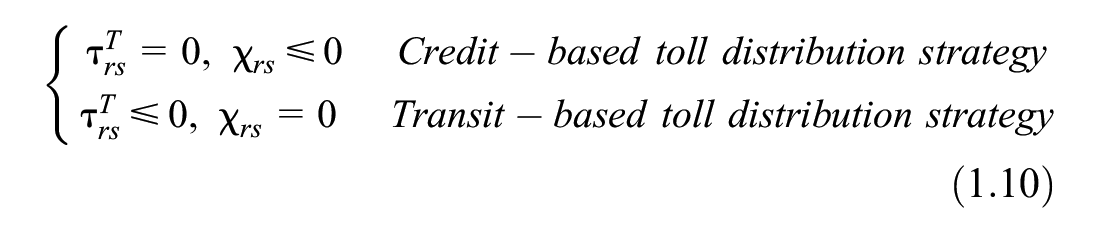
The objective function, defined in Equation 1, minimizes the total travel time of highway users. This function is subject to the UE constraints, Constraints 1.1 to 1.4, ensuring travelers choose the path with the least generalized cost. Constraints 1.1 and 1.2 describe the route assignment pattern for the private car users. Similarly, Constraints 1.3 and 1.4 describe the route assignment pattern for the transit users. The second term in Constraints 1.1 and 1.2 considers the correlation between the subsequent roadway links in the paths. As mentioned earlier, two approaches are considered with regard to subsidy distribution: transit-based and credit-based. In the transit-based strategy, the tolls collected from highway users are distributed only among transit users,
To satisfy Constraint 1.8, a scaled value of the rectified linear unit (ReLU) function of

The second term in function 2 minimizes the users’ loss arising from toll implementation. In this function, each user class’s ReLU function of

In the numerical experiment section of this study, a zone-based pricing strategy is considered. To this end, the network is divided into multiple zones, z, and users are charged with the maximum toll value of the zones they pass. Therefore, the decision variable changes to the tolls on the links of each zone,



Methodology
The problem presented above is a non-convex mathematical problem with UE constraints, which is a class of problems that are difficult to solve, especially for large-scale networks. The objective function is not convex considering the ReLU function included to ensure the Pareto-improving condition of the selected pricing scheme. In addition, in this study a concave relation between the mean and standard deviation of the travel time is considered for each link to estimate its travel time variability. This problem is computationally demanding and its solution could be time-consuming without a proper approach, as the RBUE algorithm should be called multiple times to find the optimal toll values. As gradient descent type algorithms are unable to solve this problem because of the non-convexity, it is proposed here to use a metaheuristic algorithm based on PSO ( 39 ). Considering its distributed multi-agent search structure, PSO has proved to be successful in a variety of problem domains, which motivated its use in this study. Different variants of the PSO algorithm are used for optimizing complex transportation problems ( 40 – 43 ). PSO is a population-based search algorithm and uses a swarm of particles to optimize the problem. Each particle has two features that identify its movements: position and velocity. The particle position represents a feasible solution for the problem’s decision variables (i.e., toll values). The particle velocity defines the step size as the particles move within the feasible region in each iteration. This feasible region typically belongs to a multidimensional search space, where the particles move toward the best positions of individual particles (local best values) and the position of the entire swarm (global best value) ( 40 , 44 ). Several techniques are developed in the literature to represent the particles’ movement ( 45 ). In this paper, the Clerc and Kennedy PSO approach is used to move particles within the search area ( 44 ).
For each particle, j, a position is first initialized (an initial solution) with a uniformly distributed random vector,


The first term in Equation 5 is the velocity of the particle in previous iteration (

where

Here,
Particle Swarm Optimization Algorithm: Parameters and Variables

An RBUE algorithm is embedded in the PSO algorithm to find the objective function value pertaining to each toll value (particle). The proposed path-based formulation cannot be applied to large-scale networks, since the number of paths increases exponentially with the network size. To address this issue a column generation approach is implemented to generate the set of used paths by travelers. The details of the algorithm to solve the RBUE problem are described hereafter. To satisfy the self-funded condition, Constraint 1.6, the collected tolls are distributed among transit users or all users. As the current study can be applied to any toll distribution strategy, it should be specified as part of the input of the PSO algorithm. Therefore, the toll distribution strategy, which is kept the same over all iterations, is an input to the PSO algorithm and defined by the system planner. If a credit-based toll distribution strategy is selected, the credits are distributed among users at each iteration of the PSO algorithm. This credit can be used by users to pay toll or compensate the travel time loss. In the non-credit-based or transit-based approach, the collected tolls are distributed at each iteration of the RBUE algorithm to ensure the self-funding condition. An illustration of the PSO algorithm to find the optimal toll values considering reliability and equity is shown in Figure 1.

Particle swarm optimization algorithm to find optimal toll values minimizing highway travel time and violation of Pareto-improving condition considering reliability.
As illustrated in Figure 1, the RBUE problem is solved for each particle’s position (set of toll values) at each iteration of the PSO algorithm. The output of the RBUE algorithm includes the link flows, the tolls collected from highway users, and the subsidy distributed among transit/all users. The output also includes the generalized costs of all users in the network, which are used to check the Pareto-improvement criterion. In this study, a heuristic approach is used to solve the RBUE problem in which each user class finds its least generalized cost path. The approach consists of three main components: (i) a reliability-based optimal path finding procedure that can reflect heterogeneous users’ preferences; (ii) a column generation approach to generate the set of superior paths for each traveler; and (iii) an algorithmic iterative process for redistributing user choice outcomes to achieve the desired equilibrium state. For the path finding sub-problem, a Monte Carlo simulation-based approach, adopted from the literature ( 27 , 46 – 49 ), is used. The uniqueness of this approach is to consider link travel time correlations and heterogeneous travelers with regard to reliability preferences. The methodology generates path travel time distributions for a set of candidate paths in a stochastic network based on a joint link travel time distribution at the network level. The optimal route choice of each user class is found using the least generalized cost path among the set of candidate paths. Note that the set of candidate paths at each iteration is generated by solving a deterministic shortest path problem for a set of link travel time realizations. To ensure a comprehensive set of candidate paths is obtained, the process repeats for a pre-specified number of Monte Carlo simulation iterations, where each iteration uses a realization of travel time obtained from the joint link travel time distribution. Please refer to the study by Zockaie et al. ( 50 ) for further information about the Monte Carlo simulation-based approach. Furthermore, a variant of the method of successive averages is used to redirect flow to the optimum path at each iteration of the RBUE algorithm ( 51 ). The likelihood of re-assigning a portion of user class from its current path to the optimal path, found for that user class in each iteration, depends on the iteration number in RBUE. Therefore, as the algorithm proceeds, a smaller portion of each user class is moved to the newly generated least generalized cost path. The algorithm converges when a pre-defined gap measure is smaller than a small threshold. The algorithm used for solving the RBUE problem is illustrated in Figure 2.

Reliability-based user equilibrium algorithm considering toll values and heterogeneous users.
Numerical Experiments
The solution methodology described above is applied to a modified version of the Sioux Falls network, which consists of 24 nodes, 76 links, and 528 OD pairs ( 52 ). The network is modified in several ways. First, a transit line is assumed to exist between every OD pair in the original network to be able to examine the effect of implementing the pricing scheme on users’ mode choices in a bimodal network. Second, considering the new bimodal network, the demand level for each OD pair is doubled to maintain a moderate level of congestion close to that in the original network (called “modified network” hereafter). In addition, a network scenario is considered with a higher demand level for highway links to investigate the impacts of the congestion level on pricing strategies. We refer to this network in the remainder of the paper as the “congested network.” Finally, two toll zones are assumed, where a specific toll value is applied to all links in the same zone. If a vehicle passes through both zones, the maximum toll between the two zones is charged. The schematic view of the modified Sioux Falls network, the new ratios of flow to capacity for each link in the non-tolled equilibrium state, and the two defined zones for applying tolls, are shown in Figure 3a. To consider travel time variability, the standard deviation of the travel time is considered for each link, in addition to the mean travel time. There is no consensus in the literature on the relation between standard deviation of link travel time and its mean travel time. Mahmassani et al. ( 20 ) presented a linear relationship for this purpose. This linear relationship is more appropriate at the network level, and at the link level it is scattered. The proposed linear relation for the link level in their study is as follows.


(a) Selected toll zones on the modified Sioux Falls network (x = link flow; c = the capacity of the link) and (b) the fitted concave function between standard deviation and mean travel time normalized to free flow travel time.
In addition, many studies claim that standard deviation of travel time increases up to a certain point of mean travel time and then decreases with a concave relation ( 21 ). Adopting this line of thought, the relationship between the standard deviation and the mean travel time values is obtained by fitting a second order polynomial function as given below using simulated travel time data for Chicago downtown network during the hours from 5:00 to 10:00 a.m. ( 19 ).

where
Calibrated VOTs and VORs play an important role in finding the optimum toll values for real-world applications. There are numerous studies in the literature that calibrate VOT, however, only a few studies focus on VOR estimation. The current study uses VOT and VOR estimations based on the work of Lam and Small ( 53 ). Lam and Small ( 53 ) used the data of actual behavior of commuters on a segment in California to define utility of users in a route choice model. They also defined travel time distributions across different days and weeks based on loop detector data. The results are then used to estimate VOT and VOR by finding the ratios of travel cost to travel time and travel cost to travel time variability coefficients, respectively. As illustrated in Figure 4, the VOT distribution among travelers for each OD pair follows a log-normal distribution. This log-normal distribution is assumed to have an average value of $21.00 per hour (/h), and a standard deviation of $10.50/h ( 53 ). The VOT distribution is discretized into 10 classes from $4.00/h to $60.00/h, as given in Figure 4b. Furthermore, each VOT class contains a uniform distribution of VOR ranging from 0.69 times to 1.12 times VOT ( 35 ). Four VOR classes are extracted for each VOT, as illustrated in the figure.

Value of time (VOT) and value of reliability (VOR): (a) distributions and (b) classes.
Four toll distribution strategies are considered in this study: CAll, COD, TAll, and TOD, which are defined in Table 3. Implementing the OD-based strategies is challenging, since it is not easy to differentiate travelers based on their OD pairs. However, the subsidy can be spent more efficiently on increasing transit utility for specific OD pairs or cluster travelers based on their home/work locations. Previous studies have also shown that finding a self-funded and Pareto-improving pricing scheme that distributes tolls evenly among all network/transit users is not always achievable (
13
,
31
). The PSO algorithm is applied to the modified Sioux Falls network considering the two demand levels (i.e., modified network and congested network, defined earlier) and the toll distribution strategies defined above. In the current implementation, the parameters
Toll Distribution Strategies

Figure 5 shows the search area and the objective function values (Equation 2) for a scenario in which the credit-based strategy is adopted for the high demand case. This figure shows that the algorithm searches the entire feasible space and moves efficiently toward the optimum toll values for zone 1 and zone 2 ($3.44 and $1.18). The figure also illustrates the non-convexity of the objective function, which precludes the application of gradient-based search algorithms to solve this problem adequately.

(a) The search area, (b) objective function values for different toll values on zone 1, and (c) objective function values for different toll values on zone 2, for the credit-based toll distributed among the same origin-destination pairs of the congested Sioux Falls network.
Table 4 summarizes the results of applying the self-funded and Pareto-improving pricing scheme for the different toll distribution strategies using both linear and concave relationships between the standard deviation and mean of the links’ travel times. The results are given for the congested and the modified networks. Several measures of performance are recorded for each case, including the optimum tolls, the improvement in travel time, total generalized cost of users, and the average loss in the users’ generalized cost. As illustrated in the table, there is no self-funded and Pareto-improving toll value for the congested and modified networks, once the collected tolls are distributed evenly among all network/transit users. However, if collected tolls are distributed among travelers of the same OD pair, almost all scenarios find self-funded and Pareto-improving pricing values that can be applied to zone 1 (inner zone) and zone 2 (outer zone), respectively. In addition, credit-based toll distribution strategies impose higher tolls on links relative to those of the transit-based strategies. Accordingly, more improvements in the total travel time of private car users and the total generalized cost of all travelers, considering their VOT and reliability valuation, are recorded for the credit-based strategy compared with the transit-based one. Furthermore, one can also observe the successful application of the penalty factor incorporated into the objective function to provide Pareto-improving pricing schemes. The average loss in the travelers’ generalized cost arising from toll implementation is insignificant (less than one cent) and can be neglected.
Optimum Tolls and the Resulting System and Users’ Costs for Different Network Scenarios and Toll Distribution Strategies for Different Reliability Relations

To highlight the importance of considering travel time reliability for developing self-funded Pareto-improving pricing strategy, the tolls are estimated without considering travel time variability (fourth column of Table 5) for the scenario in which the credit-based toll distribution strategy is implemented for the congested network. The resulting tolls are then substituted into the network with travel time reliability (fifth column of Table 5). Note that for the results in the fourth column, no optimization is executed and the toll values are just used to run the RBUE algorithm. These results are then compared with the optimum results that consider travel time reliability (third column of Table 5). Although the tolls resulting from the scenario without considering travel time reliability are close to being Pareto-improving and self-funded, the results show that the optimum points with and without considering travel time reliability are significantly different. Furthermore, not considering travel time reliability overestimates the expected benefits. For example, using the concave relationship while ignoring travel time reliability, it is estimated that $679 will be collected and there will be 20.86% improvement in travel time for private car users. However, substituting the toll values of this scenario into the realistic scenario, in which travel time reliability is considered, results in a total toll revenue of $511 and 12.97% reduction in the total travel time. Therefore, it is important to consider travel time reliability in the design of the pricing scheme to obtain more accurate estimation of collected tolls and the improvement in the overall network performance.
Comparison of the Results with and without Considering Travel Time Reliability for the Congested Network and the Credit-Based Toll Distribution Strategy in the same origin–destination Pair

Summary and Conclusion
Travel time variability is a primary determinant of travelers’ route choice behavior and any developed demand management strategy such as congestion pricing. Despite the growing interest in the welfare analysis of congestion pricing considering users’ VOT, there is still a gap in the current body of the literature to consider the reliability measures in developing equitable pricing schemes. This study presents a modeling framework and solution methodology for finding revenue-neutral and Pareto-improving congestion pricing values considering travel time variability for heterogeneous users with different VOTs and VORs in a bimodal network consisting of transit and personal cars. The framework extends the second-best pricing optimization problem by integrating an RBUE algorithm. The objective of the pricing algorithm minimizes the total travel time of highway users given a revenue-neutral and Pareto-improving pricing set. Users’ heterogeneity in response to the reliability measures, their response to different toll values and toll distribution strategies, and link travel time correlations are considered in the RBUE problem. A PSO algorithm is developed to determine the optimum toll values considering different toll distribution strategies (e.g., credit-based, transit subsidy).
The proposed algorithm is applied into a modified Sioux Falls network with different levels of congestion. In addition, two credit-based toll distribution strategies (i.e., OD-based versus among all users) and two transit-based toll distribution strategies are compared in the numerical experiments. This study also explores the impacts of different types of relationships (i.e., linear, concave) between mean and standard deviation of link travel time. The results show the importance of considering travel time reliability by comparing the optimum toll values, the changes in system cost, and the total travel time with and without considering travel time reliability. In addition, the results demonstrate that the PSO algorithm successfully searches the feasible region and efficiently finds the optimum toll values. Comparing the results of different toll distribution strategies also confirms that there is no self-funded and Pareto-improving pricing for the networks of this study, in case the collected tolls are distributed evenly among all network/transit users. However, if the tolls collected from travelers of each OD pair are used to subsidize only travelers of the same OD pair, such pricing values are successfully found. This subsidization can be done through investments on the transit lines or other infrastructure of the OD pairs to avoid violating equity.
Despite these important insights into the impacts of travel time variability and reliability on finding an efficient and equitable pricing strategy, there are some limitations that can be considered for future studies. For example, in this study, travelers are assumed to use one mode for their entire trip (i.e., no multi-modal trips). In addition, all OD pairs are assumed to be served by transit lines, which might not be the case in real-world transportation networks. Updating the algorithm of this study to consider multi-modal trips and OD pairs with no transit lines is considered for future research. In addition, extending the modeling framework to consider a state-dependent congestion pricing, in which the toll values are updated based on the real-time monitoring of traffic conditions, is another future research direction. Furthermore, the computational efficiency of the proposed algorithm in this study can be improved to accommodate networks of larger sizes as a future research direction. Providing equity to transportation users by equitable toll distribution strategies (other than evenly distribution among all users) is also a critical issue that requires deeper examination. These strategies and the innovations required for their implementation should be subject to further research. Finally, using real-world data to define travel time uncertainty on highway links and transit lines and other network and user parameters would improve the fidelity of the obtained pricing schemes.
Footnotes
Author Contributions
The authors confirm contribution to the paper as follows: study conception and design: F. Fakhrmoosavi, A.Zockaie, K. Abdelghany; data collection: F. Fakhrmoosavi, A.Zockaie, K. Abdelghany; analysis and interpretation of results: F. Fakhrmoosavi, A.Zockaie, K. Abdelghany; draft manuscript preparation: F. Fakhrmoosavi, A.Zockaie, K. Abdelghany. All authors reviewed the results and approved the final version of the manuscript.
Declaration of Conflicting Interests
The author(s) declared no potential conflicts of interest with respect to the research, authorship, and/or publication of this article.
Funding
The author(s) received no financial support for the research, authorship, and/or publication of this article.
