



Abstract
Owing to the current context of Industry 4.0, the importance of smart technologies in airport systems have increased substantially. State-of-art applications for transportation planning incorporating baggage services, routing, security, and safety are an evolving domain for both practitioners and researchers dealing with aviation applications. In this context, this paper seeks to answer these questions: Which standards are aimed at a smart airport to make the transportation planning sound? Which propositions are made based on the obtained prioritized standards? This study deals with standards including Environmental Effects, Docking & Navigation, Object Detection & Protection, Communications & Integration, and Terminology using a practical decision support system based on an analytical hierarchy process (AHP) and fuzzy inference system (FIS). Computational results reveal that the Object Detection & Protection standard has an effect on a safe and smart system. To give an overview of this standard for a smart logistics zone (SLZ), an architecture of autonomous robot units and a baggage handling system is proposed in this study. The suggested approach analyzes the obstacle photos obtained by cameras and allows the end-user to control the calculations visually. This research could provide advice to airport planners about smart policies and improving operations.
There is a great deal of digitalization on smart airports consisting of digital business, security, and smart service systems. Digitization dominates all the sectors of the industry and life by the integration of novel technologies. These innovative technologies within the industry are grouped under the Industry 4.0 concept ( 1 ). This concept and increasing competition have transformed the logistics concept and forced airports to adjust quickly to adapt the Industry 4.0 concept. The logistics term with the transportation, storage, loading and unloading, and information systems are focal parts of this concept. A well-functioning transportation system improves the operations efficiency and passenger experience. Autonomous robots are an essential part of the transportation units as they improve material handling in picking operations. These robots are grouped under the technological drivers of Industry 4.0.
Drivers of logistics based on Industry 4.0 are depicted in Figure 1. As can be seen, the architecture integrates several logistics drivers and two flows. In this sense, technological dimensions are essential for the logistics systems, which may comprise cyber-physical systems and smart devices. Another important dimension is the economic and ecological drivers. These drivers enable the interaction of globalization and service driven business models. Social and political drivers appear as the third dimension for the analysis of logistics processes. The components of this dimension are volatile demand, data protection, security and customer requirements. Finally, information and material flow are relevant dimensions of this system, which ensures a better understanding of the dimension connections.

Drivers of logistics in the context of Industry 4.0 ( 2 ).
Smart Logistics (SL) consists of identification, locating and sensing components ( 3 ). It is also defined as solutions for traceability, efficient fleet management and safety and security issues ( 4 ). SL is a decision-making process that evaluates the effect of digitalization on the logistics parts according to several different criteria. SL is divided into two groups: smart resources and smart products/shipments ( 5 ). To enrich the Logistics 4.0 concept, a smart logistics zone (SLZ) is developed ( 6 ). A representation of a SLZ is provided in Figure 2.

A representation of a smart logistics zone (SLZ) ( 7 ).
The SLZ is an actions area for analysis, evaluation, planning, control, regulation and configuration processes of logistics solutions and consistent with the integration of logistic objects, processes, systems and infrastructure ( 7 , 8 ). Sensor technologies, and real-time object tracking and tracing can be utilized for security aspects, workplace safety and process reliability ( 9 ). In the presented paper, a SLZ is developed to control the transportation processes at the airport.
The airport sector is an attractive area for novel advanced applications such as block chain technology ( 10 ). Many researchers have adapted smart technologies such as smart vehicles and logistics processes ( 11 ). These efforts to design smarter vehicles are based on transportation management processes ( 12 ). Emerging technologies in autonomous vehicles open up new windows of opportunity in airport logistics. Compared with regular guided vehicles, automated guided vehicles (AGV) have attractive features such as obstacle detection, energy efficiency and a cost effective transportation approach. As an evolved version of AGV, autonomous robots are more popular owing to their flexibility, intelligent navigation, responsiveness to environmental changes, intelligent behavior, and their ability to resolve multiple goals, in addition to their reliability, robustness, extensibility and adaptability. The response to environmental variables defines the robot’s ability to react to sudden changes in the environment to perform the task accurately, efficiently and safely. Intelligent behavior is the ability of the robot to offer logical solutions by processing the data using its sensors. The ability to resolve multiple goals defines the vehicle’s performance for different tasks. Robustness is the fulfilment of the task by the vehicle for unexpected events. Reliability is the ability of a vehicle to repeat the same behavior while performing a task with the same performance. Flexibility defines the ability to take into account the easy integration of tasks within the control architecture. Adaptability is the ability to adapt a vehicle control system to suddenly switch to different control strategies. Artificial neural networks (ANNs) are used for route planning, intelligent control and obstacle detection in autonomous robots. Classification of obstacle images is the focal point used to solve the safety and security problems. Obstacle detection and segmentation is related to the classification of obstacle photographs using deep learning applications. These problems are more complex as photos have similarities within a class if one considers the background, color, and so forth. The manual identification of obstacles on an airport floor is more complex. An automated computational system is required to achieve and detect these obstacles. Artificial intelligence applications have been used to guide the researchers in this context. Also, deep learning applications have been used for image recognition. Deep learning is based on ANNs architecture using large layers, the architecture has many real world applications. Classical machine learning methods choose the features manually while deep learning methods find complex features in the data automatically. The deep learning networks utilize large amounts of data and can cope with shallow networks. Deep neural networks, including various parameters require a massive variety of data to ensure the optimization. Convolutional neural networks are one of the deep learning tools used to model high level processes including larger data.
For SL applications, various technologies, such as RFID (radio-frequency identification systems), real time locating, cyber physical systems, big data, data mining, smart sensors, AGV, augmented reality, autonomous vehicles, dynamic routing, E-marketplace platforms, 3D printing, sustainability, web based optimization, real time management, ambient intelligence, active communication, and agility are considered ( 13 – 18 ). An obstacle detection and segmentation algorithm is presented for AGV navigation using a 3D real-time range camera, which produces both images and range information ( 19 ). The utilization of Internet of Things (IOT) technologies has been investigated for SLZ ( 20 ). The researchers developed a faceted classification method to classify and evaluate the IOT Technologies. Concerning smart airport applications, a smart airport service framework was developed to improve passenger-related processes and resources ( 21 ). Flight, location and transportation information are the most desirable outcomes to airline passengers. A delivery robot has been used to transport baggage in the airport ( 22 ). Path planning and random tree algorithms have been developed to avoid collision problems. A report which considered a new baggage handling solution named the Baggage Robot Concept has also been proposed ( 23 ). A simulation model has also been developed and the key aspects presented are the number of robots and the floor plan. A system based on the AGV to handle baggage was also developed ( 24 ). The developed system performs the tasks including tracking the baggage and dealing with obstacles. The use of biometric technology for the check-in process has been previously analyzed ( 25 ). The results show that 82.94% of passengers can use this technology. In short, some researchers have considered the utilization of AGV and IOT technologies for smart airports and introduced these to improve the performance of the airport. However, few studies have considered the influence of an airline passenger based service. To overcome this gap, the research results can scientifically guide the aviation decision makers to design a new SLZ and provide ideas for improving the airport performance. Thus, considering the above factors, some of the following research questions are listed as follows.
RQ1: Why is the SLZ required for an airport?
RQ2: What types of smart applications should be used for the SLZ in the airport?
RQ3: What is the priority for the mobile robot standards related to safety, security, applicability, and the degree of intelligence factors?
RQ4: Based on the AHP and FIS results, which smart technology is suggested for a SLZ? Which features should be available for the autonomous robot?
RQ1 and RQ2 are important to answer, because to provide smart logistics operations, decision makers should analyze the current state of this system. Thus, to respond to potential problems, RQ3 and RQ4 should be answered. The motivation of this study is to design a SLZ, with the aim of enabling autonomous transportation in the airport, detecting possible obstacles and processing the data via computer software based on meeting the standards. This paper utilizes a decision support system in relation to FIS and AHP to prioritize the standards in relation to applicability, safety, security, and intelligence metrics. The FIS has been developed to show nonlinear mapping of inputs and output. This research aims to propose a decision support system that covers the transportation phase including material handling and operations for a smart airport. The other aims and contributions of this research are as follows:
Developing a decision support system based on the FIS and AHP for prioritization of standards.
To provide an obstacle detection problem to manage baggage handling systems.
To guide the aviation firms in their decision making processes about the smart logistics zone systems.
To find novel solution methods that are scientifically sound for computer aided baggage handling systems.
Problem Definition
Decision making methods are carried out to identify and prioritize the standards and manage the SLZ processes. This process is depicted in Figure 3. In addition, this system aims to improve the system safety and security. The first stage of these processes is the comprehensive analysis of the logistics zone, taking into consideration the experts’ evaluations. The process is started by identification of standards and metrics to determine the intelligence and applicability levels. Decision making methods and fuzzy systems are implemented in various sectors. Airport sectors are one of the optimal sectors for digitalization, in which various processes are conducted for the transportation, loading/unloading and information systems. Transportation problems in these area affect the other processes. A major share of the total costs is related to these processes. The SL problem includes logistics identification processes in relation to the logistics 4.0 properties of the target system. In this process, it is necessary to establish a similarity relationship between the SL requirements and the target system to determine the optimal approach. AHP and fuzzy logic are beneficial options used to model this relationship mathematically under uncertain environments. During the formation of a relationship, one of the two most important metrics is safety-security, the other is the intelligence. In the literature, various metrics, such as the applicability, financial, and environmental metrics have been addressed. However, the interaction between various metrics is not incorporated into the system. To overcome this deficiency, four metrics are presented by utilizing AHP and fuzzy logic. Moreover, a deep learning solution framework is provided based on the AHP and fuzzy logic results.
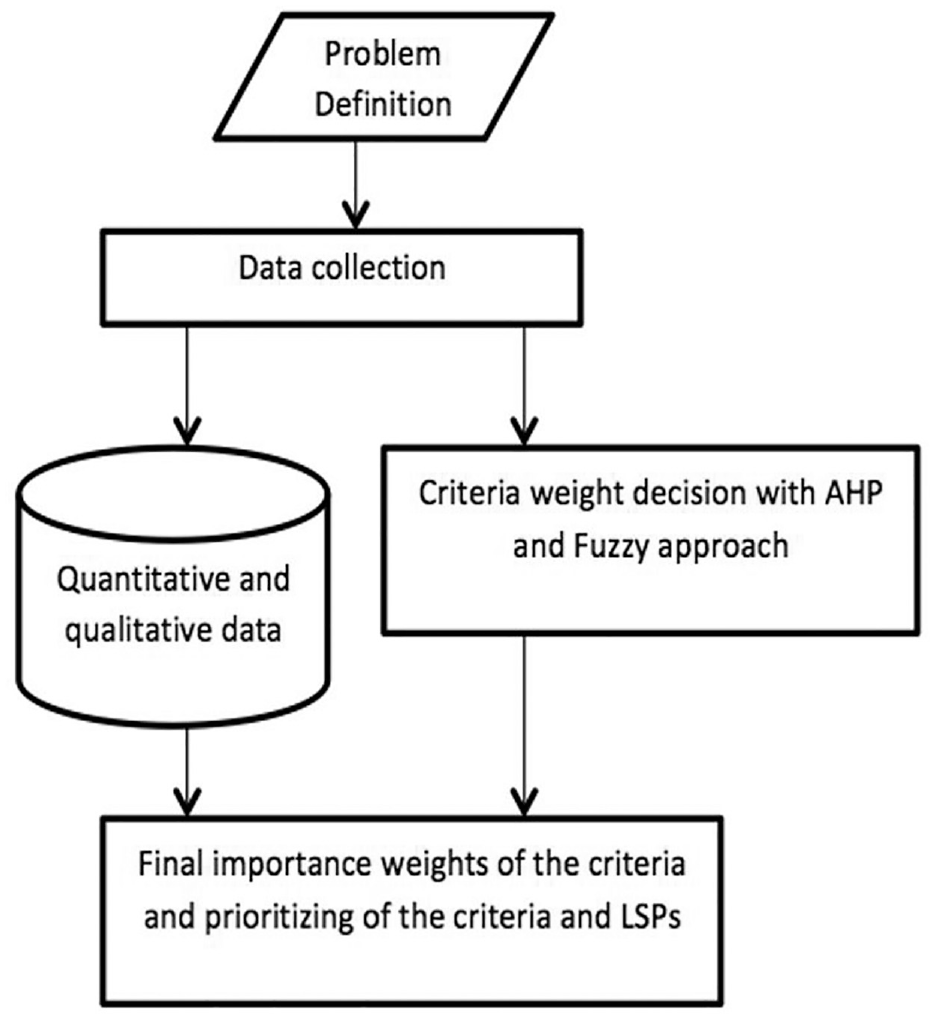
A flowchart for problem definition.
In this section, research questions are presented to analyze the problem statement presented in the following:
RQ1: Why Is the SLZ Required for an Airport?
To answer RQ1, it is first necessary to understand what the essential dimensions of the SLZ for an airport should be. These dimensions are the digital identity, autonomous vehicles, remote control tower, and the internet of things. In recent years, integrating these dimensions and aviation applications has attracted considerable attention and undergone a transformation. The smart logistics approach is of vital importance for the decision makers to revise the traditional airport systems as it enables the optimization of operations and maintenance processes. Effective autonomous techniques are crucial to deciding whether or not the aviation firms consider the global world requirements. Smart applications are, as of now, the main driver to seeking new solutions. A decision support system for a SLZ should ensure the following indicators. Passenger traffic forecast based on the peak and annual numbers should be conducted as airport traffic dramatically increases. The airport should control the costs of the technological transformation as the financial results on the airport are massive. To deal with these issues, the actual state of the systems should be examined, measured and analyzed. Worst-case and best scenarios should be created to plan the resources in an ideal way.
RQ2: What Types of Smart Applications Should Be Used for the SLZ in the Airport?
Smart vehicles are the main critical parts of these applications and require some standards to complete their tasks. As the use of autonomous technologies, such as mobile robots, AGV, and novel technologies are required to provide safe object detection. The extensive use of mobile robots ensures object based tracking for transportation. In addition to the technical developments, mobile robot standards are an important aspect.
Methods
As mentioned in the previous sections, a decision support system which provides smart decisions, and the best policy is presented in this section. To make the decisions scientifically sound, AHP and fuzzy logic is conducted. One of the most important and widely used multi criteria decision making (MCDM) tools is the analytical hierarchy process (AHP) ( 26 ). The steps of this methodology are presented as follows: (i) identification of the criteria; (ii) weighting the criteria; (iii) pairwise comparison; (iv) overall priority ranking; and (v) selection of the best alternative. AHP puts the problem into a hierarchical structure. The first phase of the AHP is to define the problem. The problem is represented as a hierarchical structure and each level consists of certain criteria in the second phase. These main criteria are divided into sub-criteria. Finally, the entire system, its sub systems and their relationships are analyzed comprehensively. To assess the pairwise comparison, Saaty developed a scale to evaluate which of the two alternatives are more important ( 27 ). The scale for the pairwise comparison is presented in Table 1.
Scale for the Pairwise Comparison ( 27 )

In the third step, pairwise comparison is conducted in relation to the scale. The criteria and alternatives are compared to determine the relative weightings. The comparison matrix, A, is presented below, w1, w2,…, wn define the weights of the comparisons ( 27 ).

The next step is to obtain the weights of each factor in the matrix. The normalization process is calculated by dividing the numbers of the columns in the matrix by the corresponding column sum. Weights (significance vectors) for the relevant criterion are obtained by taking the average of each row for which the normalization process has been completed. The input and output variables do not have a linear function in the AHP. Therefore, the FIS ensures that appropriate rules are formed for various conditions. The inputs in the fuzzy approach include linguistic values and these are fuzzied by utilizing triangular membership functions. Fuzzy rules are formed, and the Fuzzy Logic Designer Tool was employed in Matlab. The developed fuzzy design is depicted in Figure 2. In this design, the min-max methods, min implication, max aggregation, and centroid defuzzification are used. Ranges are decided as (0–3) for each input variable.
The presented AHP and fuzzy logic was conducted by comparing the standards to answer the following research question:
RQ3: What Is the Priority for the Mobile Robot Standards Related to Safety, Security, Applicability and the Degree of Intelligence Factors?
Airports should follow some standards with regards to at digitalization, safety, and security. Airports ensure these safety standards meet the requirements of this new era. Many authors address influential factors for selection of the performance standards. Four metrics are used in this paper including safety, security, applicability, and the degree of intelligence. Performance standards for mobile robots by ASTM (American Society for Testing and Materials) are presented in the following ( 28 ): Environmental Effects, Docking & Navigation, Object Detection & Protection, Communications & Integration, and Terminology. MCDM is one of the most vital methods used to deal with these decisions. The decision makers considering historical data evaluate 5 performance standards. These evaluations are based on the decision maker’s judgments, which are numerical values based on the historical data of the company. Scoring and assignment of standards based on safety criteria is demonstrated in Table 2.
Scoring of Standards Based on Safety

Table 3 demonstrates the criteria weights and thus, the most important criteria in this study are safety related. The Security, Intelligence and Applicability are obtained based on their weights, respectively.
Weighting of Criteria

The normalization process is obtained by dividing the numbers of the columns in the matrix by the corresponding column sum. Weights (significance vectors) for the relevant criterion are obtained by taking the average of each row for which the normalization process has been completed.
FIS includes both an expert system and fuzzy logic parts considering a set of fuzzy IF-THEN rules ( 29 ). FIS is based on the experts’ judgment. The Mamdani and Assilian technique is used to provide fuzzy relationships based on input–output process ( 30 , 31 ). The Mamdani FIS is considered to give the best output expression ( 32 ).
The inputs in the fuzzy approach include linguistic values and they are fuzzied using triangular membership functions. Fuzzy if-then rules are developed. A fuzzy approach is applied and coded using the Fuzzy Logic Designer Tool in Matlab. The developed fuzzy design is depicted in Figure 4. In this design, min-max methods, min implication, max aggregation, and centroid defuzzification are used. Ranges are decided as (0–3) for each input variable. In this stage, the input and outputs are developed. Five standards are handled as the input and the four metrics are dealt with as the output. Standards include the three membership functions of low, medium, and high, output also includes these three functions. In Figure 5, the membership functions of the input are depicted.

Developed fuzzy design.

Membership functions of the input variables.
The triangular membership function consisting of low, medium, high for the input values is depicted in Figure 5 and the fuzzy numbers have the values of low (0, 0, 1.5), medium (0, 1.5, 3), and high (1.5, 3, 3). This figure presents the important levels of inputs evaluated using the fuzzy number.
Fuzzy if-then decision rule combinations are formed for the discussed problem in Figure 6. The developed FIS entails five input variables and three membership functions. Thus, 125 rules are defined and 5 of these rules are presented in the figure. The most critical criteria are safety, thus, the rules are developed using high values.

Developed fuzzy inference rules.
After the presentation of the fuzzy inference rules, relationships between the input and output in the three-dimensional space are observed.
Results and Discussion
The standards are evaluated with regards to their values for the four criteria and the ranking of each standard is obtained in this section, as shown in Table 4. Object Detection & Protection and docking-navigation are crucial based on this ranking.
Results of Prioritizing for Standards

In Figure 7, a–d , the fuzzy inference rules are demonstrated in three-dimensional space for applicability, safety, security and intelligence, respectively.

Representation of fuzzy inference rules in the three dimensional space: (a) applicability, (b) security, (c) safety and (d) intelligence.
Object Detection & Protection and docking-navigation are crucial for autonomous indoor driving metrics. The applicability, safety and security metrics of the airport environment integrate the following decisions: (1) The airports should ensure object detection, meeting the standards; and (2) Airports should have docking and navigation systems within the airport coverage zone.
RQ4: Based on the AHP and FIS Results, Which Smart Technology Is Suggested for a SLZ? Which Features Should Be Available for the Autonomous Robot?
Computational results demonstrate that the Object Detection & Protection standard for an autonomous robot should be handled first to ensure a more safe and effective system. Thus, five units of the autonomous robot are proposed to meet this standard. The first unit is the driving assist mode using sensors to enable collision or object detection. The self-balanced robot enables agile maneuvering and dynamic driving around obstacles. The second unit is the climbing mode which allows the autonomous robot to safely climb. This climbing mode could be provided by an autonomous robot equipped with a Kinect sensor, as shown in Figure 8.

A representation of an autonomous robot searching a ramp ( 33 ).
The mechanical platform of the robot uses the sensor units that are required to detect the environment and smart control units to enable autonomous control. The architecture of the proposed robot units are depicted in Figure 9. A position sensing unit (PSU) is used for autonomous control, intelligent control unit for the evaluation of the data and a user interface unit for interaction are all used in the architecture. The distance to objects is visualized on the user platform in the driving support screen of the user interface unit. Also, in addition to the visual warning, audible warnings are also activated if any object is observed to pose a risk. On the navigation screen, the map of the environment is visualized, and route planning is performed in this sketch. Using this approach, some of the problems and deficiencies encountered in airports are eliminated.

Architecture of the proposed autonomous robot units.
With regards to the above features and decision-making results, a representation of the suggested approach is depicted in Figure 10. At the beginning of the system, the passengers put the baggage on the conveyor. The baggage obtained from the conveyor is transported by the mobile robots. These robots should detect the objects to transport the baggage safely.

Representation of the presented approach.
Between the conveyor and the gate, this robot automatically moves between rows in the airport and collect images in the first phase of this system. The collected parameters are the GPS coordinates of the corners of this port, the distance between the rows and continuous images of the obstacles taken from the front and sides. The robots process the photos taken from the front and side with the help of a mini computer and ANNs on the robot and makes a decision to go back or continue so that it can intelligently detect whether the area is safe or not. Autonomous movement of the robot also involves reading data from sensors and adjusting the speeds of the motors accordingly. For example, the front camera takes photos continuously and these are processed instantly to detect the line end of the route. Whenever the line end is detected, the turning command is sent to microcontroller board to change the speed and direction of the motors. If rotation is decided, the rotation process is performed by using the distance information between the rows. Using the GPS coordinates, the user will be able to check whether the robot has moved out of the area boundaries. The photographs taken on the queue and at the end of the queue are used to train the artificial neural network algorithm. Some of these photographs are used to test the algorithm. Improvements can be made on the algorithm for real time operation of the system. In the next phase, the smart robot wirelessly transmits images from the cameras on the left and right to a remote computer. The deep learning method used in this computer will recognize an obstacle and produce a map. At this stage, obstacles will be photographed from different angles and all of them will be used to train the artificial intelligence algorithm. Simulation tests will be performed in the computational environment and improvements on the route will be provided.
Managerial Insights
Discussions about the metrics of smart airports have grown rapidly. Airports are encouraged to develop smart and holistic approaches. According to the results and discussions mentioned in the previous section, some managerial aspects are presented, as follows:
For an appropriate SLZ design, Object Detection & Protection and docking-navigation are crucial and these standards should be implemented with decision-making methods, which provide a roadmap for future researchers.
Airports should analyze passenger movements to determine the specific area for the baggage services.
Biometric authentication should be implemented in autonomous robots to decrease the incidence of human interactions.
Simulation models should be included in the decision making method to optimize the complex operational baggage systems and to create a digital twin of the SLZ.
Airport decision makers could consider redesigning the available structural area to adapt the standards mentioned in the previous sections.
In addition to the object detection and docking-navigation aspects, it is necessary to maintain safe and smart operations, addressing Airport 4.0, smart operations, digital transformation of processes, BIM (Building Information Modeling), cargo digitization, and remote control ( 34 ).
Conclusions
Considering the opportunities of the current age, smart systems have gained importance and the trend to adapt products for use with the Internet of things is increasing. Airports have significant potential to outline how services and operations are designed based on Industry 4.0 technologies. Using the AHP and FIS, a decision support system was developed for a SLZ for use in airports. These two methods are used to determine the importance levels of performance standards. The proposed methodology efficiently tackles both quantitative and qualitative decisions involved in the prioritization of standards. This research represents the first attempt to propose a smart airport zone, considering a series of metrics and performance standards and the use of smart technology for use in the baggage system. Among the available smart technologies, autonomous robots are one of the focal points of the smart logistics zone. Systems that are used manually and proceed on a straight path are not optimal for use with a SLZ. The proposed approach meets the requirements of the digital era. Considering the research findings, object detection reveals a substantial influence on the SLZ design. In this respect, airports can identify new strategic priorities for the implementation of baggage handling systems and autonomous robots. However, it is important to point that the constraints of implementing SLZ are insufficient investments in current airports. For financial support, collaborating with airport stakeholders and governments is important to capturing the SLZ opportunities. For future studies, the effects of Covid 19 on airport processes could be examined. Different scenarios could be employed to reduce the number of human-to-human interactions. Operation models and simulation techniques should be developed to ensure real time, dynamic solutions. The social and cultural aspects of smart airport applications could be evaluated by the researchers.
Footnotes
Author Contributions
The authors confirm contribution to the paper as follows: study conception and design: Elifcan Göçmen; data collection: Elifcan Göçmen; analysis and interpretation of results: Elifcan Göçmen; draft manuscript preparation: Elifcan Göçmen. All authors reviewed the results and approved the final version of the manuscript.
Declaration of Conflicting Interests
The author declared no potential conflicts of interest with respect to the research, authorship, and/or publication of this article.
Funding
The author received no financial support for the research, authorship, and/or publication of this article.
