



Abstract
In downtown areas of large cities, it is very challenging for drivers to find available parking spots, even when they are provided with information on parking availability and location information. To overcome this challenge, this paper develops a dynamic vehicle routing system to search for the optimal routes for connected vehicles to find parking spots successfully and to minimize total trip time, including driving time and walking time. The system predicts the probability of each parking lot having available parking spots based on the existing available number of spots and the vehicle arrival and departure rates collected by connected vehicles. This probability is integrated in the search for vehicle routes to minimize total travel and walking times. Numerical experiments indicate that the proposed system can reduce the cruising time spent searching for available parking spots, and the total trip time can be reduced by up to 24%. In addition, the system can decrease the number of re-routing decisions, which reduces the stress of drivers on the road. A sensitivity analysis of the parking probability is also conducted. Some future work based on the proposed system is proposed in the conclusion to this paper.
In large cities, especially crowded downtown areas, the number of parking spots is limited. It becomes very challenging for drivers to search for parking successfully. In 2017, each U.S. driver had to spend an extra 17 h annually searching for parking spots, costing $345 per driver in wasted time and fuel and increased greenhouse-gas emissions ( 1 ). In large cities, such as Los Angeles and New York City, the situation was even worse, where the annual parking search time and cost were 107 h and $2,243 and 85 h and $1,785, respectively. In addition, in a survey in the U.S.A., almost two-thirds of drivers reported they felt stressed trying to find a parking spot: nearly 42% had missed an appointment, 34% had abandoned a trip because of parking problems, and 23% had experienced road rage. Moreover, drivers searching for a parking spot in congested downtown areas were responsible for 30% of urban traffic ( 2 ), and further increased road traffic congestion ( 3 ). It is becoming urgent to develop a smart vehicle parking spot routing system to eliminate parking difficulties and minimize the total trip time, including travel time to available parking spots and walking time to the destination, of each vehicle in large cities.
In the literature, there are numerous studies on parking spot routing (PSR) systems working on searching for available parking and vehicle routes. Longfei and Hong ( 4 ) developed a distributed intelligent parking guidance system to search for and book available parking spots and estimated parking route guidance for vehicles to take from their current locations and the intended parking spots. Rhodes et al. ( 5 ) proposed a collaborative PSR system with the help of smart parking systems, which can provide the availability and location information of parking spaces, to alleviate road congestion caused by multiple vehicles being directed to the same parking lots, including parking garages and on-street parking, concurrently. Moreover, Arndt et al. ( 6 ) utilized the probability of on-street parking and developed a heuristic search algorithm to find a free on-street parking spot for a vehicle. The system searched the optimal route to minimize the total trip time, including vehicle travel time and walking time to the destination, with a high probability of finding a spot successfully. Djuric et al. ( 7 ) developed a so-called ParkAssistant algorithm to search for an optimal route for each vehicle to search for on-street parking to minimize the weighted cost of parking, including price and time to the destination. The algorithm also considered parking rules of streets, traffic conditions, probabilities of finding an empty parking spot, and drivers’ utility. Moreover, Hedderich et al. ( 8 , 9 ) developed a PSR system based on an A* algorithm to search for optimal routes for vehicles with the highest parking probabilities. The system was designed for on-street parking with the consideration of both vehicle travel time and parking probability. The work was also extended to parking garages in Hedderich et al. ( 10 ). These studies were all very efficient to help drivers to find parking spots faster. However, they only focus on searching parking routes around destinations without incorporating the work in the whole route choices for vehicles.
To improve on the aforementioned work, Hedderich et al. ( 11 ) developed a universal routing algorithm, which integrated the proposed PSR system with a stochastic routing algorithm to search for the optimal route for a vehicle to take from its origin to the destination. The optimal route helps the vehicle to arrive its destination with the highest probability as well as maintaining a high parking probability close to the destination. However, the work of Hedderich et al. ( 8 , 9 , 11 ) always assumed that the parking probability was constant, which ignored the dynamics of vehicle arrival and departure to parking garages and on-street parking. In the real world, time-dependent parking probabilities limit the implementations of the proposed systems and reduce their benefits.
In this paper, a dynamic vehicle routing system will be developed with consideration of time-dependent parking probability to minimize the total trip time with the help of connected vehicles. The system utilizes connected vehicles to monitor available spots in parking lots, including parking garages and on-street parking, around their destinations and predicts the successful parking probability of each parking lot. The dynamic routing with (time-dependent) parking probability (DRPP) system then applies Dijkstra’s algorithm to search for and update the shortest path and the optimal sequence of parking lots, that is, the parking route, for each connected vehicle to minimize trip time. The system will be evaluated with a numerical experiment and compared with two base routing systems to illustrate its advantages. A sensitivity analysis of the parking probability is also conducted to understand its reliability under different parking situations.
The rest of the paper is organized as follows. The second section presents the development of the DRPP system with connected vehicles. The third section evaluates the system with a numerical experiment and conducts a sensitivity analysis of parking probability. The final section concludes the findings and suggests some recommendations.
System Development
The major objective of the DRPP system is to minimize total trip time, including travel time to parking lots and walking time to destination, of connected vehicles with the consideration of the parking probability of parking lots. In this section, some definitions of the road network with parking probability are presented first (Table 1), followed by the detailed development of the DRPP system.
Notation of Variables
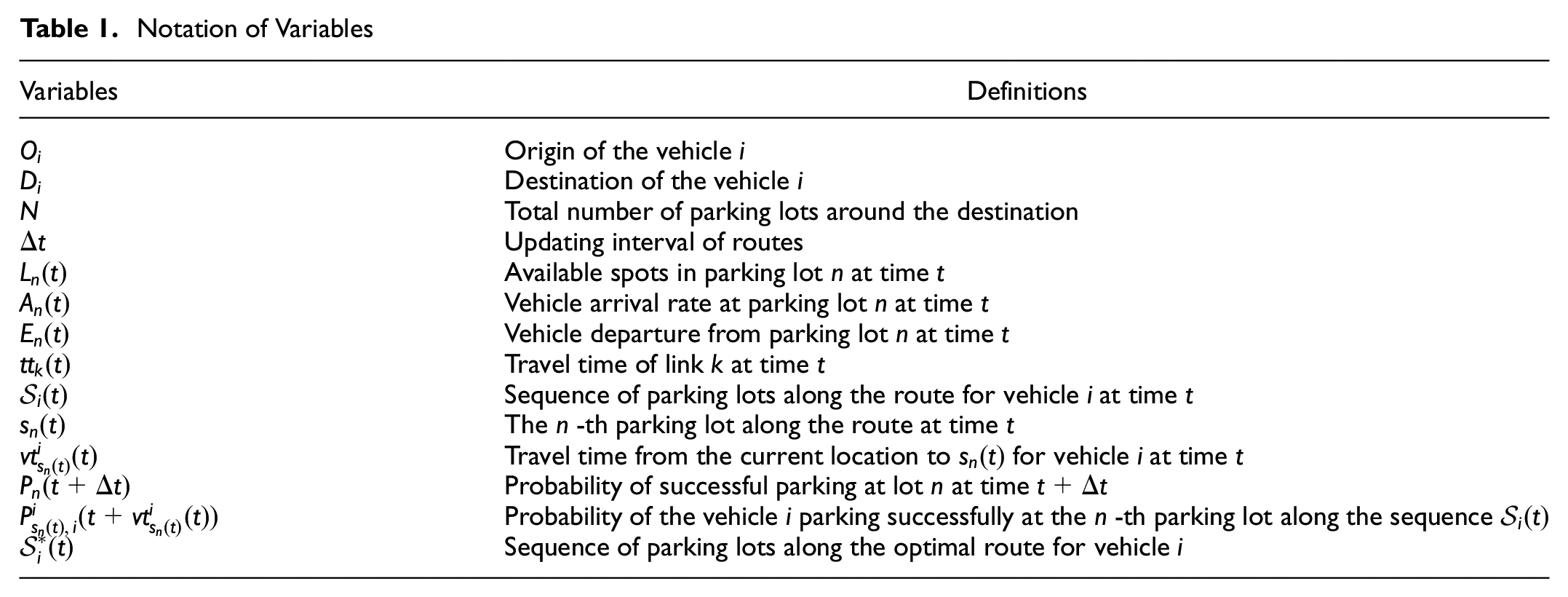
As shown in Figure 1, assume that the origin and destination of one connected vehicle

In addition, the walking time from the parking lot

Road network with parking lots. (See Table 1 for notations.)
At time

where
For any other parking lot

where

With Equation (2), an optimal sequence of the parking lots,
With these definitions, the DRPP system can be developed, as shown in Figure 2. In the first step, the connected vehicle will be applied to monitor the status of all parking lots, including the parking availability, vehicle arrival, and vehicle departure rates. For example, if one parking lot has a surveillance system installed to monitor available parking spots in real time, then connected vehicles can communicate with the surveillance system to capture information about the number and location of available spots and the arrival and departure rates ( 12 ). If there is no surveillance system, or there is a lot of street parking, the connected vehicle can utilize its own sensors, such as camera, lidar, and so forth, to detect the available spots ( 13 – 16 ). The information can also be shared with the other connected vehicles via direct vehicle-to-vehicle communication, cellular vehicle to everything (V2X), and so forth. Second, with the number of available parking spots and vehicle arrival and departure rates, the parking probability of each lot can be predicted based on the Poisson distribution, see Equation (1). Third, all possible sequences of the parking lots will be selected, and the Dijkstra’s algorithm ( 17 ) is applied to search for the shortest path from the current location of the vehicle to the first parking lot in each sequence. The expected trip time of each sequence is calculated with Equation (2) to find the optimal sequence to minimize the total trip time.

Flow chart of the dynamic routing with time-dependent parking probability system.
In the real-world implementation of the DRPP system, the walking time from the selected parking lot to the destination cannot be very long, that is, the number of parking lots that will be considered is smaller. In that sense, the possible number of sequences is also small (proportional to
Note that, in the implementation, if the probability of a parking lot with available spots is too small (
Results and Discussion
In this subsection, the proposed DRPP system is evaluated in a grid network to understand its performance on minimizing the total time of vehicle trips. The system will also be compared with two base routing systems. In addition, the impact of parking probabilities will be analyzed to understand the reliability of the proposed system.
System Evaluation with a Grid Network
In this subsection, a grid network is modeled to evaluate the performance of the DRPP system. The network geometry is show in Figure 3, where the length of each block (horizontal and vertical) is set as one unit. The vehicle travel time and walking time of each block is set as 2 min and 4 min, respectively. The times are assume to be constant in the experiments.

Grid network with parking lots. (See Table 1 for notations.)
Assume that the origin and destination of one connected vehicle are set as
In the evaluation, two base routing systems are applied. In the first one, the vehicle is always searching for the closest parking lot with available spots and routes to the lot. The route of the vehicle is updated at every 2 min from when it leaves the origin. In the second system, the vehicle routes to the destination first. Once it is 4 min away from the destination, it starts to search for parking spots. Similar to the first one, it will search for the closest one to the destination with available spots. Figure 4 shows sample routes of the connected vehicle instructed by the three systems. The total trip times of base 1, base 2, and the DRPP system are 46 min, 46 min, and 36 min, respectively, that is, the DRPP system reduced the trip time by 22%. Additionally, the route provided by the DRPP system is much easier for the vehicle to follow.

Estimated vehicle routes: (a) base 1, (b) base 2, and (c) dynamic routing with time-dependent parking probability (DRPP) system. (See Table 1 for notations.)
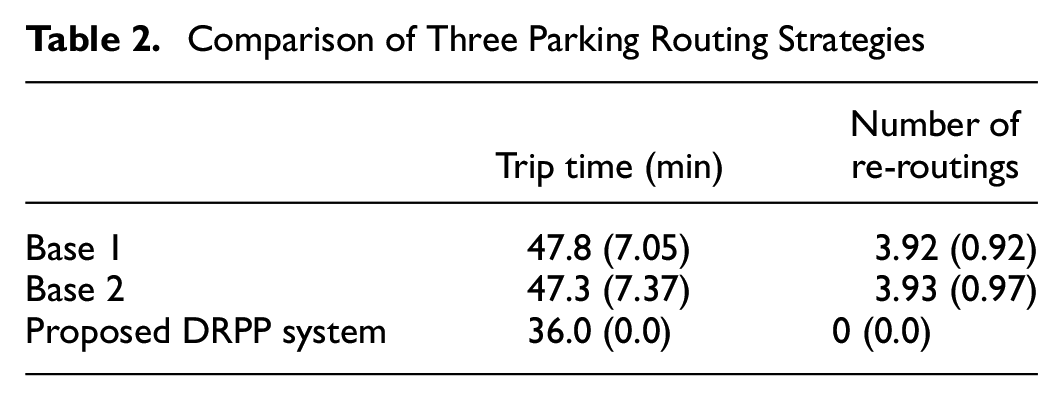
A comparison of the three systems, including the proposed dynamic routing system, is shown in Table 2. In the experiment, the vehicle arrivals and departures are randomly generated based on Poisson distribution with the predefined rates. Each system is run 500 times, and the average time of the trip and the average re-routing number of each trip is summarized to evaluate the performance of the strategy. Compared with the two base systems, the proposed routing system can reduce the total time of the trip by up to 24%. In addition, with the two base systems, the connected vehicle has to revise the sequence of the parking lots and re-routes up to four times before it finds an available parking spot successfully. In contrast, the proposed DRPP system can search for an optimal route at the origin, and the vehicle can follow the route to find the available parking spot successfully without any re-routing. The results indicate that the DRPP system not only reduces the total trip time of the connected vehicle, but also alleviates the stress of the driver when searching for parking spots.
Comparison of Three Parking Routing Strategies
Sensitivity Analysis of Parking Probability
In this subsection, a sensitivity analysis of the parking probability is conducted to understand the effectiveness of the DRPP system under different parking conditions. To reproduce the parking probability, the number of available spots in each parking lot is changed by a scale factor. (The factor is defined to scale up or down the number of spots in each parking lot. For example, the scale factor of 0.5 indicates that the number of spots is reduced to 50% of the original number defined above.) With a higher scale factor, that is, a larger number of available spots, the probability of parking successfully in the parking lot is higher.
The same settings as used above are applied, except the number of parking spots in each parking lot is scaled by a factor varying from 0.1 to 1.5. Figure 5 illustrates the simulation results under different scale factors. Compared with the two base systems, the total trip time from the DRPP system is always shorter, that is, the system can optimize the performance of the connected vehicle on searching parking lots and reducing trip time. In addition, with a larger scale factor, that is, a higher probability of parking successfully in each parking lot, the trip time can also gradually decrease with the DRPP system. The base systems also have the similar effect. This is because, with the higher probability, it would be much easier for a connected vehicle to find a parking spot successfully in a parking lot closer to the destination. Both the travel time and walking time can thus be reduced.

Total trip time of the three routing systems under different scale factors.
Figure 5 also indicates that when the scale factor is small, that is, the probability of successful parking is low, the trip time differences between the base systems and the DRPP system are very large. The large gap can be explained by the frequent re-routing decisions of the connected vehicle under the base systems. A low successful parking probability means that the target parking lot has few available spots and it will be full before the vehicle arrives. The vehicle then has to re-route to find a nearby parking lot with available spots. In contrast, the DRPP system predicts the parking probability and includes it in the routing strategy. Consequently, the vehicle can move to a sequence of parking lots to minimize the total trip time without re-routing. When the scale factor is large, that is, when the successful parking probability is high, it will be much easier for the vehicle to find a parking spot successfully around the destination. Consequently, the vehicle does not need to re-route before it is parked. Then trip time differences between the base systems and the DRPP system are then smaller at high-scale factors.
Conclusions
In this paper, a DRPP system is developed using time-dependent parking probability to reduce the difficulty of searching for parking spots in crowded urban areas and to minimize total trip time of vehicles. The system utilizes connected vehicles to monitor the number of available parking spots in each parking lot and vehicle arrival and departure rates. The probability of the parking lots with available spots is modeled with the Poisson distribution, and it is applied to predict the successful parking probability when a vehicle arrives at the parking lot. The DRPP system searched for the shortest path and the optimal sequence of parking lots to minimize the expected trip time, including vehicle travel and walking time. The experiments showed that the DRPP system can reduce the total trip time by up to 24%, compared with the base routing systems, and it could also reduce the stress of drivers when searching for parking by avoiding re-routing operations. Furthermore, the sensitivity analysis of parking probability illustrates the advantage of the DRPP system in searching for parking spots in crowded areas with low successful parking probability.
Based on the findings in the paper, there are some further recommendations for future work. First, the system was only evaluated with numerical experiments under a grid network, where many arbitrary settings are applied. In the future, the system will be evaluated in a realistic geometry of road networks with microscopic traffic simulations to understand its real-world advantages. In addition, the experiments in this paper assume that the link travel times are constant, and the vehicle arrival and departure rates of each parking lot are also constant over a certain period. In the future, the time-dependent travel time and the vehicle arrival and departure rates will be included in the model development and evaluation. Moreover, the existing system is distributed, where connected vehicles receiving the same information will be instructed to take the same route, which will reduce the probability of each of the vehicles finding a parking spot successfully. Consequently, a cooperative DRPP system should be developed in the future to support more connected vehicles searching for optimal routes simultaneously with high probabilities of successful parking. Furthermore, a more realistic distribution of parking probability will be introduced to increase the accuracy of probability prediction. A comprehensive comparison of the proposed system with the other parking routing systems will be conducted to illustrate its advantages in dealing with dynamic parking probability. Finally, in the near future, advanced vehicle technologies, such as fully connected and autonomous vehicles, will be mature, and real-time parking reservation systems will be widely deployed, which will reduce the concerns of drivers/passengers at finding parking around their destinations. This will, however, bring new parking issues, such as induced traffic volumes around parking lots and high energy usages of autonomous vehicles. The proposed system will be extended in the future to deal with these parking challenges caused by the new technologies.
Footnotes
Author Contributions
The authors confirm contribution to the paper as follows: study conception and design, data collection, analysis and interpretation of results, draft manuscript preparation: H. Yang, K. Oguchi. Both authors reviewed the results and approved the final version of the manuscript.
Declaration of Conflicting Interests
The author(s) declared no potential conflicts of interest with respect to the research, authorship, and/or publication of this article.
Funding
The author(s) received no financial support for the research, authorship, and/or publication of this article.
