




Abstract
Construction stormwater practices have a vital role in protecting downstream water bodies from runoff that is typically characterized with large amounts of sediment and suspended solids. Most sediment control practices lack the capability to capture fine-sized soil particles that are responsible for causing elevated turbidity. Flocculation is a form of chemical treatment that uses flocculant particles as a binding bridge to form larger particles to enhance the gravitational settling process. The use of flocculants provides promising results for removing fine particles and treating construction stormwater. This study provides a comprehensive review of flocculants and their applications in construction stormwater treatment in the U.S. The study presents a literature review and results of a state-of-the-practice survey distributed to state departments of transportation. Results from 37 participating state agencies and data from specifications and design manuals for non-participating agencies were compiled to develop a comprehensive understanding of current uses and perceptions. Results indicated that 39% of state agencies currently use flocculants on construction sites. Within that, 54% of the state agencies rely on manufacturer guidance for dosage and application rates and only 23% require monitoring residual flocculant in downstream receiving waters. The potential risk of polluting downstream water bodies because of overdosage of flocculants related to inadequate application rates and techniques is the main concern of the state departments of transportation on flocculant usage. Understanding the perspective of the state agencies on flocculants will provide an insight into future research agendas for extending the use of flocculants in construction stormwater management.
Stormwater runoff from construction sites has the potential to pollute downstream water bodies because of ground-disturbing activities typical of land-grading operations. Active construction sites are susceptible to an increased risk of rainfall-induced soil erosion. Erosion and the resulting sedimentation are a major concern in protecting the nation’s water bodies. The United States Environmental Protection Agency (USEPA) considers sediment as one of the most persistent pollutants that threaten the waters of the U.S. ( 1 , 2 ). The release of sediment into the water bodies creates a hazardous environment for aquatic life, deteriorates water quality, and decreases the capacity of streams and rivers, leading to potential flooding concerns ( 3 ).
Point and nonpoint stormwater pollution sources are regulated by the Clean Water Act’s National Pollutant Discharge Elimination System (NPDES) Construction General Permit (CGP) ( 4 ). Land-disturbing activities on construction sites require the need for erosion and sediment control (E&SC) practices because of the amount of exposed land susceptible to erosion. Phase II of the NPDES program targets nonpoint source pollution and requires construction activities generating land disturbance greater than 1.0 ac (0.4 ha) to receive coverage through the CGP ( 5 ). The CGP permit requires the development and implementation of a site-specific Stormwater Pollution Prevention Plan (SWPPP), a comprehensive stormwater management implementation and maintenance plan for temporary E&SCs (6, 7). In addition to these regulations, several states have numeric effluent limitation requirements. For instance, water quality regulations in Alabama and North Carolina require turbidity levels to not exceed more than 50 Nephelometric Turbidity Units (NTUs) above background levels (8, 9). Noncompliance with stormwater effluent regulations may result in environmental fines and potential litigation. Therefore, understanding the effectiveness of E&SC practices, and ensuring their efficiency with correct installation and maintenance methods, is critical for designers and contractors.
Minimizing construction stormwater pollution is possible with the proper implementation of construction methods, strategies, and use of E&SC practices. Erosion control practices are used on construction sites to manage surface runoff and reduce the amount of soil loss because of rainfall impact, runoff, and wind. Sediment controls are used to contain eroded soil on-site and minimize off-site discharge. Sediment barriers, sediment basins, construction exit pads, surface roughening, temporary mulching, seeding, erosion control blankets, check dams, and inlet protection practices are some examples of common E&SC practices. However, traditional E&SC practices are not sufficient in removing fine-sized particles, which are difficult to remove from suspension and contribute to turbidity plumes ( 10 – 13 ). Typically, detention-based practices such as sediment basins and traps are used to capture these fine-graded particles. Sediment basins can be effective for reducing the turbidity in the runoff, but they require laminar flow conditions and adequate residence time for sediment to fall out of suspension ( 14 ).
Flocculants are chemicals that encourage the process of flocculation of fine suspended solids. They are commonly used in various water treatment sectors such as wastewater, drinking water, mineral processing, mining, and biotechnology ( 15 ). Flocculants work by forming a binding bridge to aggregate particles together to produce larger solids or flocs. These flocs become large enough to quickly settle out of suspension through gravity. Construction stormwater management is one sector that can highly benefit from the use of flocculants. When properly implemented, flocculants have been proven to not only enhance the capture of sediment particles from runoff but have also proven effective when used to armor barren slopes against erosion. The use of flocculants enhances the performance of E&SC practices and supports permittees in meeting stormwater effluent compliance regulations.
This study provides a comprehensive review of flocculants and their use across U.S. departments of transportation (DOTs) for construction stormwater treatment. The study presents a literature review to understand the implementation of flocculants for stormwater treatment and includes results from a state-of-the-practice survey among U.S. DOTs. The literature review provides information on the flocculation fundamentals, commonly used flocculant types, and recent stormwater research studies. The survey questions prepared for DOTs were developed based on this literature review.
Literature Review
Flocculants are water-soluble molecules that consist of long-chains with a combination of repetitive small molecules, and they are capable of separating suspended fine particles from aqueous suspension (15, 16). Flocculants are chemical agents that function to aggregate solid particles together and increase their settling velocity ( 17 ). Flocculants are manufactured in different physical forms such as powder, granular, blocks, socks, emulsion, dispersants, beads, and liquid ( 18 ). Figure 1 shows the most common commercially available flocculant forms: granular/powder, blocks, liquid, and socks. Some flocculants are soil specific and their performance depends on specific soil characteristics. Flocculation and coagulation are two different procedures; however, they are often perceived as the same concept because of their similar nature. For example, Chibowski submits the term “flocculation” as a synonym of “coagulation” ( 19 ). However, many other studies support the opposite. Vajihinejad et al. define flocculation as the aggregation of particles because of high molecular weight polymers that occur as a result of bridging between particles ( 15 ). They define coagulation as a separate process: the aggregation of particles by the manipulation of solid surface charges. Stechemesser and Dobias describe flocculation as an agitation stage that changes particle size from micro-floc to larger floc particles, and coagulation as a neutralization stage of particle charges with the addition of oppositely charged chemicals ( 20 ).

Figure 2 compares coagulation and flocculation by illustrating their working mechanisms. Figure 2a displays the coagulation mechanism, a physical process of the attraction between particles because of the charge neutralization after the coagulant introduction. Figure 2b presents flocculation, large particle formation, and settlement process because of the occurrence of chemical bridging mechanism between particles after flocculant introduction.
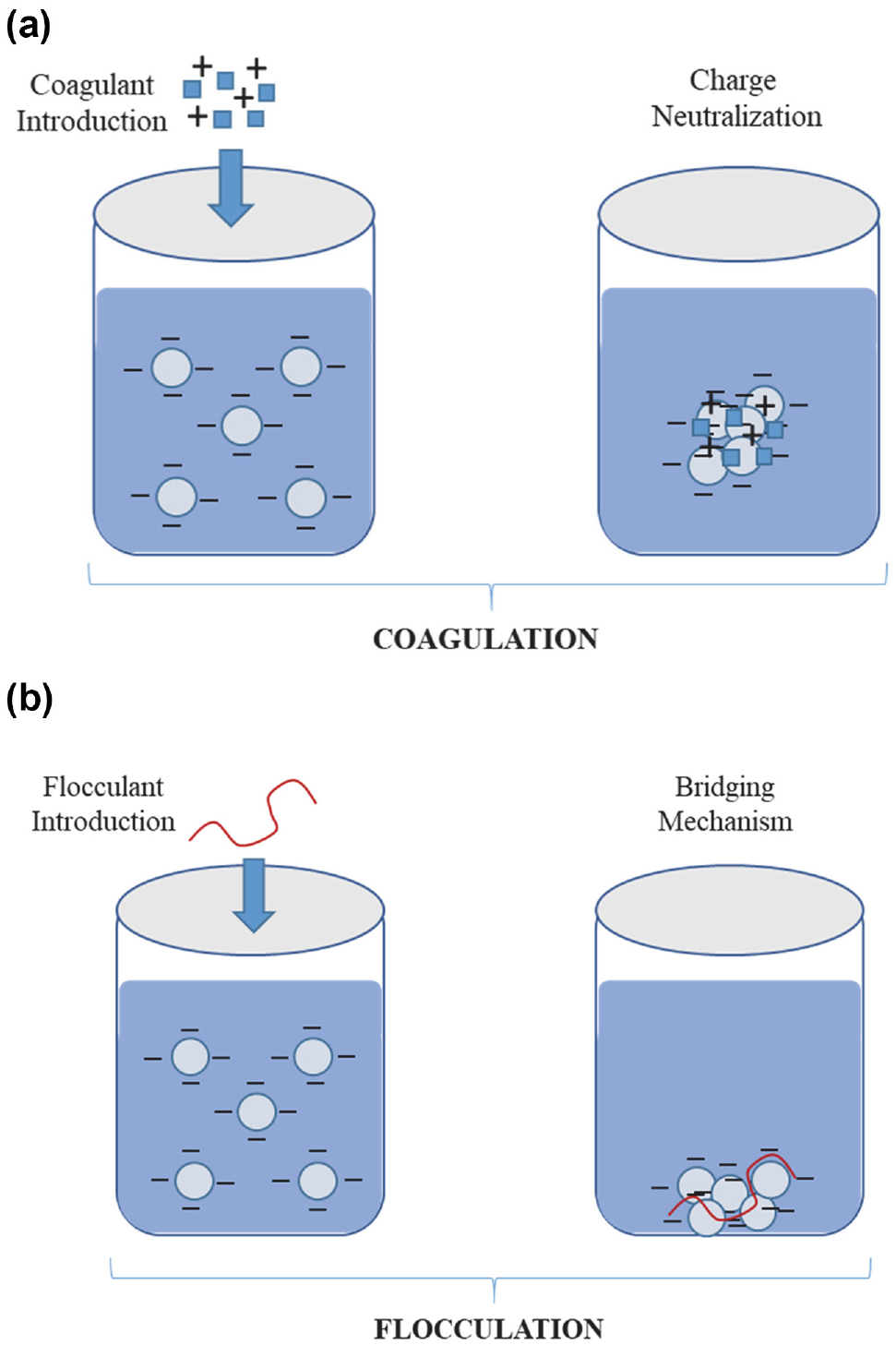
Comparison of coagulation and flocculation mechanisms: (a) coagulation mechanism and (b) flocculation mechanism.
Flocculant types are classified into four main groups; (a) synthetic flocculants, (b) inorganic flocculants, (c) bio/natural flocculants, and (d) stimuli-responsive flocculants. Synthetic flocculants are considered as the most commercially available flocculant type and are classified by their net charge: cationic (positively charged), anionic (negatively charged), nonionic (neutral), and amphoteric (changeable, depending on the pH of the water) (25, 26). These flocculants are produced with the use of polymerization of water-soluble monomers technique and their average molecular weight has a significant role in classifying their characteristics ( 15 ). Cationic flocculants can be highly toxic to aquatic life as the polymers have the potential of binding with the negatively charged hemoglobin in fish gills, causing suffocation (27–30). Anionic flocculants are commonly used in industrial wastewater treatment systems (27, 31–33). Typically, anionic flocculants show very low residual concentration in treated water and their toxicity level is also very low compared with cationic flocculants (16, 27). Nonionic flocculants are defined as polymers that do not carry any charge or carry less than 1% charge. Because of high molecular weight, nonionic flocculants tend to create flocculation by constructing bridging mechanisms with solid particles in the water (17, 31). Amphoteric flocculants include both anionic and cationic charges because of the copolymerization of both groups. The charge of these flocculants is changeable depending on the pH of the water and they are effective in the rapid removal of oppositely charged pollutants (26, 34). Polyacrylamide (PAM) is one of the most commonly used synthetic flocculants and can be manufactured in various chain lengths and charges (15, 31, 33, 35, 36). PAM rapidly aggregates soil particles, decreases soil bulk density, and absorbs water (37, 38). Anionic PAM is commonly preferred for environmental applications since it has not been proven to be toxic to aquatic life (28, 38–40).
Inorganic flocculants are also commonly used in the stormwater industry, as they are generally less expensive than other flocculant types and can be more effective for flocculation. Inorganic flocculants have low molecular weight and a small size for aggregation between particles compared with organic flocculants ( 41 ). Examples of inorganic flocculants include alum, polyaluminum chloride (PAC), aluminum chloride, aluminum sulfate, ferric chloride, and ferrous sulfates (41–44).
Bio/natural flocculants are plant- or animal-product-based polymers that consist of polysaccharides, tannins, and chitins. Even though synthetic flocculants have replaced the use of natural flocculants in many water treatment sectors, they are still commonly used by the mining and food industries (26, 43, 45). The most commonly used natural, polysaccharide-based flocculants include chitosan, cellulose, starch, alginate, and amylopectin (15, 42). Among these natural flocculants, chitosan requires special dosage precaution as it can be activated with the use of petroleum-based cationic monomers, which may be harmful to aquatic life when overdosed ( 15 ). With proper usage, chitosan can offer effective flocculation results. For instance, Zeng et al. prepared a novel composite chitosan that can potentially replace PAC in the water treatment industry, a common inorganic flocculant ( 46 ). Kangama et al. created a composite chitosan flocculant for tap water treatment that provided a 96.38% reduction in turbidity ( 47 ). Moreover, Yang et al. reviewed various flocculation mechanisms and highlighted the effectiveness of chitosan-based flocculants with proper application techniques ( 48 ).
Stimuli-responsive polymers experience changes in their physical and chemical characteristics based on changing environmental conditions ( 49 ). Stimuli-responsive flocculants have three subcategories: thermo-responsive, pH-responsive, and electromagnetic-responsive, showing different physical and chemical characteristics related to the changes in temperature, pH, and magnetic nature, respectively ( 15 ).
Flocculants have the potential to significantly improve methods for treating stormwater on construction sites since they provide rapid and effective results for decreasing turbidity. Table 1 presents commonly used flocculants for turbidity treatment and explains their characteristics together with their drawbacks. Several types of chemical treatments have been used in stormwater treatment. Aluminum sulfate, calcium sulfate, and polyacrylamide are commonly accepted flocculants in stormwater treatment among the others presented in Table 1 (44, 50–52).
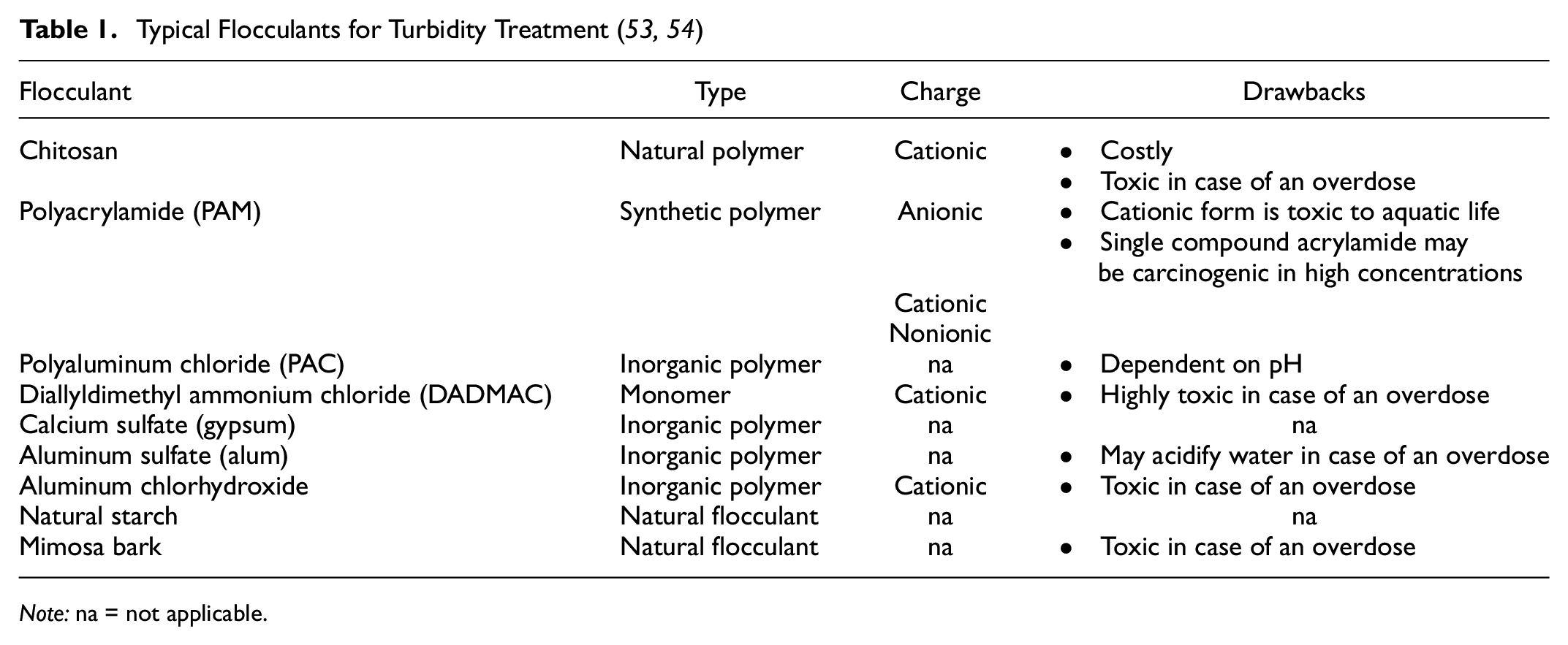
Note: na = not applicable.
Several research studies have been conducted to evaluate the use of flocculants in stormwater management applications. Harper investigated the effects of aluminum sulfate (alum) treatment in lake systems in Florida and concluded its use provided an effective and economical approach to reduce the toxicity of sediment particles in lake systems by reducing total nitrogen, total phosphorus, and heavy metals ( 44 ). Przepiora et al. conducted laboratory testing on the efficiency of calcium sulfate compounds as a flocculant by treating sediment basin water from two different urban construction sites in the Piedmont region of the southeastern U.S. ( 50 ). The study tested three types of calcium sulfate compounds: hemihydrate, agricultural gypsum, and phosphogypsum, which consist of different calcium sources. Test results showed that hemihydrate was the most effective calcium sulfate compound for treating stormwater runoff with rapid flocculation compared with agricultural gypsum, and less toxic compared with phosphogypsum. In another study, Przepiora et al. implemented field testing at two urban construction sites to evaluate the efficiency of calcium sulfate compounds as a flocculant with large-scale testing methods (51). Hemihydrate was introduced to several sediment basins at the two construction sites and their turbidity compared with untreated basins throughout 14 rainfall events. This field evaluation showed that hemihydrate was highly successful in reducing the turbidity levels in sediment basins. The results indicated that hemihydrate decreased untreated turbidity levels (100–1,600 NTU) to less than 50 NTU in 20 h ( 51 ). Bhardwaj and McLaughlin used large-scale laboratory testing methods to evaluate active and passive PAM dosing systems in sediment basins ( 52 ). The passive treatment was conducted through the use of a PAM block, while the active treatment was implemented by injecting an aqueous PAM solution into the water pump. The study indicated that active PAM treatment provides the most effective treatment system compared with untreated or passively treated systems, since it reduced total suspended solids (TSS) by up to 80% at the outlet. The passive system provided a 65% turbidity reduction in an untreated discharge with a turbidity of 260 NTU. The active treatment introduces flocculants to captured stormwater through mechanical pumping and passive treatment introduces flocculants through rainfall and runoff ( 55 ). Unique flocculant dosage and delivery techniques have been implemented around the world. For example, an innovative method was developed in New Zealand to dose sediment basins, with the use of a rainfall-activated floc shed. This method includes three tanks: a header tank, a displacement tank, and a flocculant reservoir. Rainfall is collected on the roof of the floc shed and captured in the header tank which has three attached hoses at increasing depths. The header tank transfers this rainfall into the displacement tank through these hoses. The system introduces flocculant to a sediment basin according to the fill rate of the displacement tank and provides a controlled dosage based on rainfall intensity ( 56 ).
Flocculants have also been proven to work in other E&SC applications. Kang and McLaughlin investigated the use of flocculants with geotextile dewatering bags ( 37 ). Dewatering bags are commonly used on construction sites to treat pumped sediment-laden water before off-site discharge. Their study implemented two different flocculant treatment systems: passive treatment with Chitosan and active treatment with PAM. The introduction of flocculants upstream of the dewatering bag provided 97% turbidity reduction in the discharged water ( 37 ). Moreover, Lentz and Sojka conducted field studies, which introduced PAM to irrigation water and showed positive results for reducing furrow erosion and increasing infiltration ( 36 ). The results showed that PAM provided 57% sediment reduction in treated water ( 36 ).
USEPA recommends the application of flocculants with proper dosage, guidance, and additional precautions to minimize pollution ( 7 ). State agencies are trying to integrate flocculants into their specifications and approved products in the U.S.; however, they are being very cautious while mentioning flocculants in their guidelines because of environmental concerns. New York State Department of Environmental Conservation briefly mentions the use of PAM, aluminum sulfate (alum), and polyaluminum chloride for erosion control in E&SC specifications; however, the agency also states that flocculants cannot be used as standard E&SC applications ( 57 ). Although the use of flocculants has not been commonly adopted by the state agencies in the U.S., an interest in understanding and applying the principles of flocculation has emerged. The Minnesota Department of Transportation (MnDOT) funded a research project that investigated the safe dosage rates and application techniques for flocculants ( 58 ). The Alabama Department of Transportation (ALDOT) provides special drawings for the use of flocculants, which primarily rely on passive treatment through the use of powder, block, and sock forms of flocculants. These special drawings include flocculants upstream of sediment basins, within a channel, and inside of a slope drain ( 59 , 60 ). North Carolina Department of Transportation (NCDOT) maintains turbidity control by using anionic flocculants on wattle barriers, sediment basins, and rock ditch checks. The powder form is used on wattle barriers and re-application is required after every rainfall event that exceeds 0.5 in. (12.7 mm) ( 61 ). Florida is one of the states that use flocculants for both erosion control and sediment control applications. The Florida Department of Transportation (FDOT) E&SC manual presents a case study about the use of PAM in a powder form on a highway severely damaged because of Hurricane Dennis ( 62 ). The treatment showed positive results and mitigated coastal erosion on U.S. Highway 98. Texas Department of Transportation (TxDOT) funded research that investigated the use of flocculants on construction sites for turbidity reduction by focusing on performance testing of chemical agents ( 63 , 64 ). PAM and chitosan were specifically tested for turbidity reduction in construction runoff and nonionic PAM, and chitosan showed promising results by decreasing turbidity levels of the synthetic runoff below 200 NTU, according to the performed research ( 64 ). The California Department of Transportation (Caltrans) has preferred the use of chitosan, ferric chloride, and alum in past construction projects. Their stormwater manual suggests active treatment with flocculants on sediment basins for turbidity reduction. Moreover, PAM is used as a tackifier and soil stabilizer on Caltrans’ construction sites ( 65 , 66 ). Oregon Department of Transportation (ODOT) applies passive treatment with chitosan socks on treatment swales for sediment control. ODOT also implement active treatment using pumps, tanks, and filters; however, electricity outage and maintenance requirements create failure in active treatment ( 67 ). Washington State Department of Transportation (WSDOT) allows the use of chitosan and anionic PAM; however, this agency suggests a pre-treatment facility before chitosan dosing ( 68 ).
Methodology
This state-of-the-practice review primarily focused on the literature review to build sufficient background for preparing a questionnaire survey. Qualtrics XM™ survey software was used to create an online survey. Skip logic was incorporated into follow-up questions depending on the answers of the participants. The survey consisted of three multiple-choice questions for state agencies which indicated they do not use flocculants, and up to 10 multiple-choice questions for state agencies that allow the use of flocculants (see Supplemental Appendix). Open-ended questions were not included in the questionnaire to ensure a time-efficient survey for the target audience. The questionnaire focused on identifying which DOTs allow the use of flocculants for construction stormwater management. Understanding the background of the hesitation for using flocculants was an important factor that may potentially motivate further research studies. Therefore, respondents that indicated flocculant use was not permitted by their DOT were asked a follow-up question to elicit reasons for not using flocculants.
DOTs that allow the use of flocculants received detailed questions about their purpose in using these chemical agents. The literature review provided information on various types and forms of flocculants. Thus, the questionnaire also investigated the most common types and forms of flocculants that are preferred by the state agencies. Dosage is a significant factor for flocculant applications. Flocculants may be hazardous for the environment when overdosed. The survey also addressed a question to identify if state agencies are providing standard guidance on dosage and application rates or not. The perspective of agencies on residual monitoring in downstream receiving waters and including flocculant products in their approved product list was also questioned by the survey.
The target audience of this survey was DOTs in the U.S., therefore, the lead construction stormwater/environmental professionals of each state agency were identified. The questionnaire was published online and distributed through an e-mail invitation that included an anonymous link created by the Qualtrics XM™ software. The survey was distributed in June 2020 to 51 DOTs in the U.S., and it was kept open through the end of July 2020. Three distribution cycles were needed as reminders and contact information corrections. However, altogether, 14 state agencies did not participate in the survey. E&SC manuals and specifications for these state agencies were manually analyzed and compiled with the survey data to gather appropriate data and complete the study. Several phone interviews were held with the DOTs which agreed to complete the survey over the phone. ArcMapTM 10.5.1 geospatial processing software was used to compile, organize, and display results.
Survey Results and Discussion
The survey was distributed to 51 DOTs in the U.S. Among these agencies, 37 of them responded to the survey invitation and participated in the questionnaire. The 14 potential respondents that did not respond to the survey invitation included Alaska, Colorado, Connecticut, District of Columbia, Hawaii, Illinois, Kentucky, Massachusetts, Michigan, Montana, New Jersey, New York, Pennsylvania, Rhode Island, and West Virginia. Data for these non-participating DOTs were only included in the results shown in Figure 1 based on information gathered from their E&SC manuals and specifications. Among the non-participating potential respondents, only Alaska, Connecticut, District of Columbia, Illinois, New York, Rhode Island, and West Virginia state agencies mentioned the use of flocculants in their E&SC manuals ( 57 , 69–74). However, the survey results, which will be discussed further in this section, did not include data for these. Results of the survey data showed that 13 state agencies are using flocculants and 24 state agencies are not. The addition of the non-participating states increased these numbers to 20 and 31, respectively. Figure 3 illustrates the flocculant usage of state agencies in the U.S. Orange-colored states represent the ones that avoid using flocculants and blue-colored states represent the ones that prefer using flocculants in construction stormwater treatment. According to the pie chart in Figure 3, it can be observed that only 39% of the states are using flocculants on active construction sites to treat stormwater runoff. The data shows that flocculants are commonly used in the southeast and west coast. Only a few DOTs outside of these regions use flocculants on construction sites.
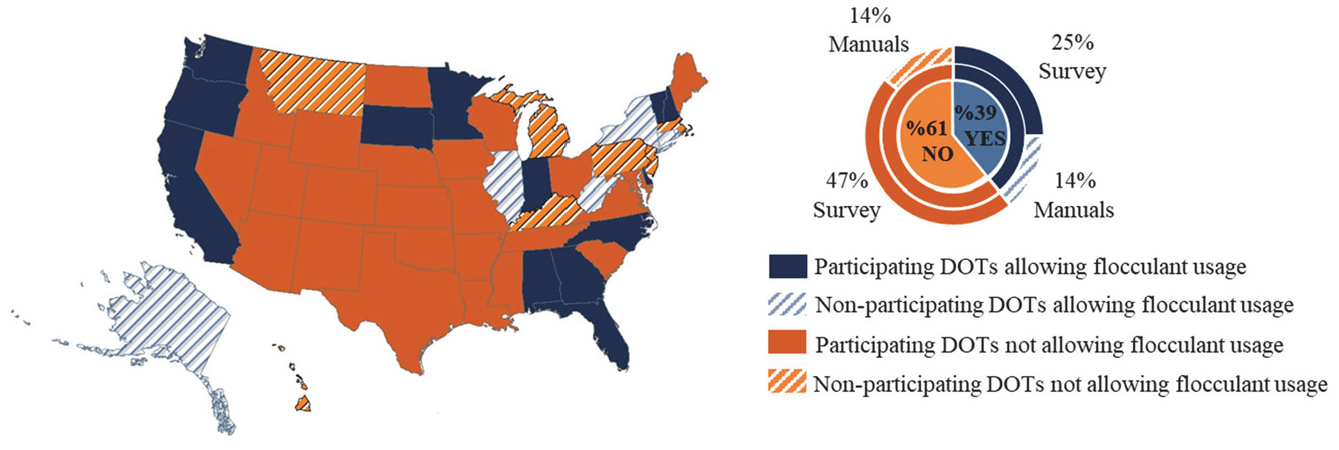
Map of flocculant usage of the state agencies in the U.S.
Currently, 31 state agencies do not allow the use of flocculants for construction stormwater management. The reasons behind not using flocculants were investigated by the questionnaire. Figure 4 presents these reasons for the 24 DOTs which participated in the survey and confirmed that flocculants are not adopted by their agency. The results emphasized that the most common reason stated for not using flocculants (given by 50% of the participating states) was the perception that current E&SC practices are sufficient in treating stormwater. Another major reason for not allowing flocculant usage is toxicity concerns (given by 35% of the participating states). Regulatory restrictions and lack of guidance for dosage are also other factors that have a negative impact on flocculant usage. Maintenance requirements are not a concern for agencies, according to the survey results displayed in Figure 4.

Reasons of state agencies for not using flocculants.
State agencies provided additional reasons for not using flocculants as a side note. According to some responses, implementing new products and methods is a slow procedure unless there is regulatory enforcement that requires their use. Moreover, another participating DOT stated that typically the state agencies evaluate new products or practices for erosion and sediment control through their research division; however, there are not enough research study results that provide sufficient information to move forward in utilizing flocculants.
The survey results highlighted sediment control as the main application for using flocculants. Among the agencies which adopt flocculants into their construction stormwater management procedures, eight of them are utilizing flocculants just for promoting settling out of sediment in collected stormwater runoff, and four of them are using it for both erosion and sediment control applications. One of the participants mentioned that they are using flocculants for very large sediment settle-out needs or underground storm pipe drill boring in their agency. The most commonly used flocculant types among the DOTs are anionic PAM (62%), chitosan (38%), and PAC (23%), as shown in Figure 5. Regulatory restrictions, non-toxic properties, and availability of the products are the reasons for DOTs to prefer these specific types of chemical agents. These products are commonly used in powder/granular and block forms by the DOTs. Survey data showed that 77% of DOTs are using powder/granular form and 68% of them are using block form. State agencies also use socks (46%) and emulsions (23%).
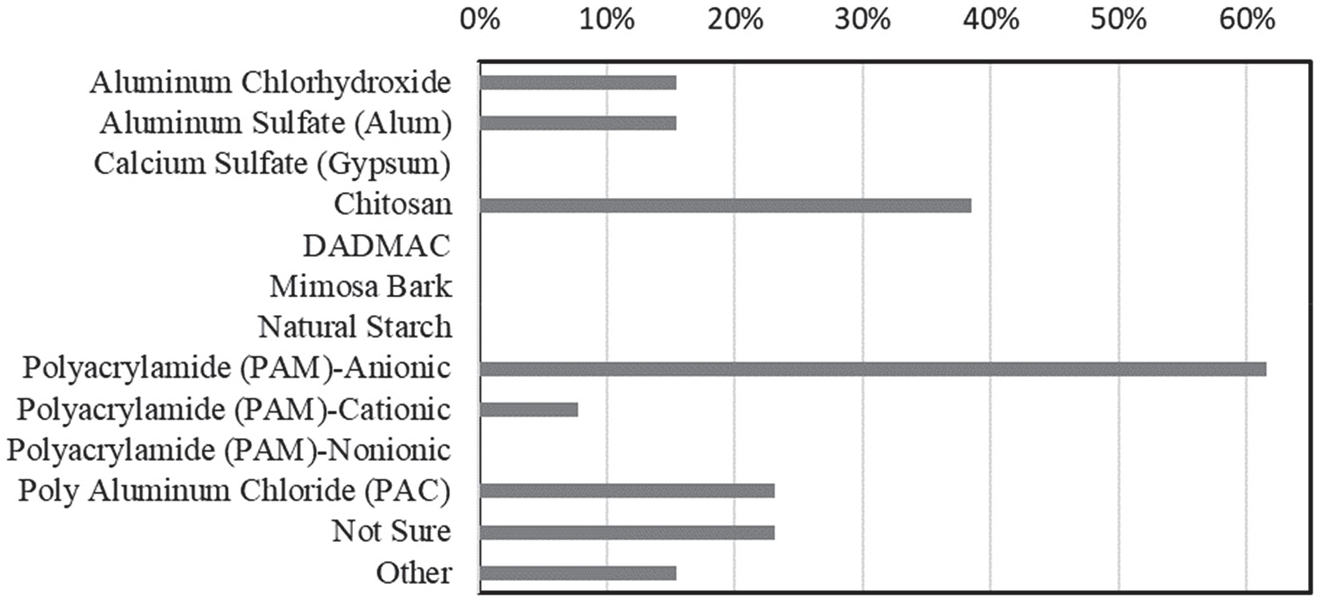
Flocculant types that are preferred by the state agencies.
The questionnaire results identified the demand for developing regulations for dosage and application rates. Responses showed 54% of the state agencies rely on manufacturer guidance and only 15% of the agencies have regulations for dosage. Dosage and application rates are highly critical for preventing overdoses and taking precautions for not polluting receiving waters. Manufacturer guidance might be a temporary solution to implement the dosage requirements of the product. However, the DOTs would highly benefit from developing their own dosage and application regulations, since manufacturer guidance might not be sufficient depending on differences in soil characteristics and climate for each state. In addition, residual testing is another substantial factor for protecting receiving waters from the toxic effect of flocculants. Residual concentrations can be used as a control mechanism by the agencies to ensure that they are not polluting the downstream receiving waters with high concentrations of chemical agents. However, the survey results showed that only 23% of the DOTs require monitoring of residual flocculant in downstream receiving waters.
DOT-approved product or qualified product lists are detailed catalogs that provide preapproved manufacturers and products. The survey results presented that 54% of agencies do not include flocculant products and manufacturers on their approved product lists even if they actively use flocculants on construction sites. Based on this result, it can be interpreted that the majority of DOTs should start incorporating flocculants into their approved product list to have standardized product preferences based on their specific needs. This would potentially support the adoption of standard dosage and application rate guidelines based on allowable products for each DOT.
Conclusion
Traditional E&SC practices are often insufficient for capturing sediment-laden runoff on construction sites. Construction stormwater management applications have been benefiting from flocculants, which significantly improve the performance of E&SC practices with the flocculation mechanism that forms an environment for particles to bind together and settle out of suspension. This study conducted a comprehensive assessment of the use of flocculants across DOTs in the U.S. The study reviewed current studies and provided an understanding of various flocculant types and their characteristics. This review formed a basis for developing a state-of-the-practice survey.
The main goal of the study was to understand the perspective of state agencies on flocculant usage for construction stormwater management. Thus, an online survey, which consisted of detailed questions based on the literature review, was distributed to DOTs in the U.S. The survey had participants from 37 DOTs. Non-participating state agencies created a limitation for providing a complete national understanding of the state-of-the-practice. However, to capture this data as much as possible, these state agencies were compiled together with the survey data for displaying flocculant usage in the U.S. by reviewing the E&SC manuals of these agencies. The results indicated that the majority of the DOTs, 61%, are not using flocculants. The most common reasons given for not using flocculants are sufficient E&SC practices and the potential risk of polluting downstream waterbodies. Most of the DOTs, 54%, which allow flocculant usage, rely on manufacturer guidance. Some flocculants require soil sampling for site-specific formulation and manufacturer guidance might be insufficient because of changing soil characteristics. Thus, designers or permittees might potentially hesitate to use flocculants on construction sites. Furthermore, 31% of DOTs do not use flocculants because of regulatory restrictions on flocculant usage. States that must achieve a numeric turbidity limit are more inclined to use flocculants, to ensure the appropriate level of treatment. Conversely, some state agencies are deterred from applying flocculants because of regulative restrictions, such as monitoring effluent for flocculant concentrations. Such requirements add cost and effort to the E&SC plans.
The results of this study provide insight into future research agendas and the practical application concerning the use of flocculants in construction stormwater management. Further studies should focus on developing guidance for the use of flocculants on construction sites. It would be beneficial to evaluate various flocculant products with small-scale and large-scale testing methods for DOTs by considering various soil types in each state. The DOTs need standardized installation, dosage, and residual testing methods for controlling overdoses. The study results showed that proper dosage and application rate guidance would potentially extend the usage of flocculants among the DOTs.
Supplemental Material
sj-docx-1-trr-10.1177_0361198121995192 – Supplemental material for State-of-the-Practice Review on the Use of Flocculants for Construction Stormwater Management in the United States
Supplemental material, sj-docx-1-trr-10.1177_0361198121995192 for State-of-the-Practice Review on the Use of Flocculants for Construction Stormwater Management in the United States by Billur Kazaz, Michael A. Perez and Wesley N. Donald in Transportation Research Record
Footnotes
Acknowledgements
This paper is based on a study sponsored by the Alabama Department of Transportation. The authors gratefully acknowledge this financial support.
Author Contributions
The authors confirm contribution to the paper as follows: study conception and design: M.A. Perez, W.N. Donald, B. Kazaz; data collection: B. Kazaz and M.A. Perez; analysis and interpretation of results: B. Kazaz and M.A. Perez; draft manuscript preparation: B. Kazaz, M.A. Perez, W.N. Donald. All authors reviewed the results and approved the final version of the manuscript.
Declaration of Conflicting Interests
The author(s) declared no potential conflicts of interest with respect to the research, authorship, and/or publication of this article.
Funding
The author(s) disclosed receipt of the following financial support for the research, authorship, and/or publication of this article: This work was supported by Alabama Department of Transporation (grant number 931-017).
Data Availability Statement
Some or all data, models, or code that support the findings of this study are available from the corresponding author on reasonable request. The following data sets are available: raw measurements collected during experimentation and photographs documenting experiments.
Supplemental Material
Supplemental material is available in the online version of the article.
The findings, opinions, and conclusions expressed in this paper are those of the authors and do not necessarily reflect the view of the sponsor.
References
Supplementary Material
Please find the following supplemental material available below.
For Open Access articles published under a Creative Commons License, all supplemental material carries the same license as the article it is associated with.
For non-Open Access articles published, all supplemental material carries a non-exclusive license, and permission requests for re-use of supplemental material or any part of supplemental material shall be sent directly to the copyright owner as specified in the copyright notice associated with the article.
