



Abstract
The frequent stops of transit buses significantly block lanes on roads and generate vehicle queues behind. The passenger cars traveling behind buses may be stuck in the queues and miss the green light in the downstream intersection. They will be very tempted to make lane changes to avoid the stopping vehicles efficiently. However, without knowing the information of bus stations and traffic signals, it is very difficult and dangerous for the queued vehicles to make lane changes at last minute. In this paper, an optimal dynamic path planning system will be developed to assist passenger cars avoid buses so as to improve their mobility on local roads. The system utilizes connected vehicles to receive stop information, including times, duration, and locations, of buses, and the signal timing information from intersections. The information is applied to predict the delay of connected vehicles caused by the buses and intersections. The system also estimate optimal paths for the target vehicles to make lane changes and overpass the buses and the downstream intersection to minimize its travel time delay. In this paper, both synthetic and realistic examples are designed with microscopic traffic simulations to evaluate the performance of the proposed system. The results indicate that the travel time delay for connected vehicles can be reduced by up to 35%. In addition, a sensitivity analysis of the market penetration rates of connected vehicles and demand levels is conducted to understand the benefits and reliability of the system under different stages of the connected environment.
In most cities, especially downtown areas with heavy traffic, the frequent stops of transit buses and delivery trucks can disrupt traffic flow and result in severe congestion. For example, to facilitate easy and timely access to getting back onto the route, many bus stops do not have any designated bays at the roadside for picking up and dropping off passengers. Because of that, stopping buses will block lanes, reduce the capacities of roads, and generate vehicle queues and congestion upstream. Moreover, they will also waste green light time at the downstream intersection. Similar to buses, some other commercial vehicles, such as delivery trucks, mail trucks, garbage trucks, and ride-hailing vehicles, also block main traffic lanes or partially block roads when they stop in bike lanes. In addition to the congestion caused by the stopping buses and delivery trucks, the vehicles in the queues behind find it very difficult to make lane changes to avoid the stopping vehicles because of the high speed of traffic in the adjacent lane and the consequent long waiting time and high risk of collision. And, as a result of the delay, they may also miss the green light at the downstream intersection. In that sense, there is a very urgent need to develop an advanced assistance system to improve the mobility of the queued vehicles.
In the literature, the congestion impact of public transits, especially bus stations, on a road segment or network had been widely investigated. The impact of bus stations on traffic flows were well analyzed with both mathematical models (1–4) and field observations ( 5 ). These studies indicated that the bus frequencies, dwell time, stop locations, stop types, and number of lanes had significant impact on the capacity of roads and the stability of traffic flow. Gu et al. ( 6 ) showed that near-side bus stops which were close to intersections could reduce the delay to passenger cars, while delays to buses could be reduced with far-side bus stops which were far away from the intersections. Shen et al. ( 7 ) demonstrated the advantage of near-side bus stops for improving the urban network while they affected the bus-carrying capacity. In addition, the impact of bus stops on a large-scale network was also evaluated with microscopic traffic simulations ( 8 ). Johari et al. ( 9 ) investigated the impact of bus stop locations on the network macroscopic fundamental diagram. Their study showed that the near-side bus stops reduced network performance, that is, produced smaller capacities and higher network average delays. To reduce the negative impact of bus stops, two major strategies were being implemented. The first strategy focused on optimizing the locations and design of bus stops under different congestion and demand levels (10–12); the second method relied on transit signal priority to assign green lights for buses to pass intersections without stopping (13–16). Both methods were able to minimize the delay to buses as well as reduce road congestion caused by buses and their stops. However, they were not designed to assist the queued vehicles to avoid buses, especially in their immediate responses to bus stops.
Even though specific studies for the assistance of the queued vehicles were not well represented, there was a lot of effort spent on solving similar problems, such as road congestion caused by traffic incidents or work zones. In Yamada et al. ( 17 ), Harada et al. ( 18 ), and Xing et al. ( 19 , 20 ), variable message sign (VMS) systems were developed with lane-level traffic information and provided lane-changing instructions to balance traffic on all lanes as well as to mitigate traffic congestion caused by incidents. However, the VMS systems required installing signs at fixed locations on roads, and this was very expensive to implement if there were a lot of buses or if delivery trucks were involved. Recently, the development of connected vehicles brought innovative solutions for the problem with low cost. Connected-vehicle-based variable speed limit (VSL) control was one widely applied strategy to mitigate congestion from vehicle incidents. Most VSL systems utilized PID (proportional-integral-derivative) control ( 21 ) and model predictive control (22–25) to restrict flow entering the regions of nonrecurrent congestion as well as to maximize the discharge flow rates. These systems were very effective at mitigating road congestion.
Moreover, connected-vehicle-enabled lane-changing assistance systems were also developed to instruct vehicles passing nonrecurrent road congestion caused by traffic incidents. In Moriarty and Langley ( 26 ), several cooperative lane selection strategies were developed to search for the optimal lane for each vehicle to maintain high speed on the road using supervised and reinforcement-learning algorithms. The strategies relied solely on the sensors installed on the vehicles to monitor the surrounding traffic and to make decisions. In Jin et al. ( 27 ), a real-time optimal lane selection (OLS) algorithm was established to reduce vehicle travel times. The algorithm applied connected vehicles to collect location, speed, lane, and desired driving speed information of individual vehicles along a road, and a lane selection agent determined the optimal lane for each vehicle to improve the system-wide benefits such as travel time and fuel consumption. In Ye and Ramezani ( 28 ), a lane distribution optimization was proposed for autonomous vehicles to choose the optimal lanes to reduce freeway congestion. Xiaoping et al. ( 29 ) utilized connected vehicles to coordinate lane-changing behaviors of vehicles near nonrecurrent freeway bottlenecks, and the system estimated advisory lane instructions for connected vehicles to make early lane changes to pass bottlenecks. In Kang et al. ( 30 ), the authors developed an optimal lane-changing advisory system using connected vehicles. For each connected vehicle, the system defined a speed utility for each lane based on the downstream connected-vehicle dynamic information, and advised the vehicle to make lane changes to the optimal lane with the highest speed utility. Yang and Oguchi ( 31 ) extended the work in Kang et al. ( 30 ) and developed an advisory lane-changing assistance system to help connected vehicles bypass road incidents. The system estimated the optimal lane for each connected vehicle based on the information collected by all connected vehicles, and it was able to shorten the congestion region caused by road incidents. However, the authors of that study did not work on solving the specific problem of queued vehicles behind stopped buses or delivery trucks.
One pioneer approach to the problem was proposed by Ratnasingam ( 32 ), who invented the idea of determining the lane instructions for vehicles to avoid lanes with frequent stops of buses, delivery trucks, garbage trucks, and so forth. However, the idea was not evaluated with any experiments, and the system did not consider the impact of traffic signals. Moreover, it was not able to provide an immediate response for queued vehicles to avoid bus stops. In this paper, an optimal dynamic path planning (ODPP) system will be developed with the help of connected vehicles to overcome this challenge. The system uses connected vehicles to share information on vehicle dynamics and the signal timing plan among buses, signals, and passenger cars. A delay prediction model is proposed to estimate the extra travel time delay to upstream vehicles caused by bus stops at intersections. In addition, the connected vehicles behind buses will be provided with lane-changing instructions based on the predicted delay to minimize their travel time. The system is also evaluated with both synthetic and real-world experiments using microscopic traffic simulations to understand its mobility benefits for both connected and non-connected vehicles, and a sensitivity analysis of market penetration rates (MPRs) of connected vehicles and traffic congestion levels is conducted to understand the reliability of the system under different traffic conditions and at different stages of connected-vehicle development.
The rest of the paper is organized as follows. The next section describes a delay prediction model and the development of the ODPP system with the help of connected vehicles to improve the mobility of queued vehicles caused by buses (and other commercial vehicles). The third section evaluates the proposed system with both synthetic examples and microscopic traffic simulations, and a sensitivity analysis of MPRs of connected vehicles is also conducted. Finally, the fourth section concludes the findings and makes some recommendations.
Optimal Dynamic Path Planning System
To assist queued vehicles in the upstream of a bus, it is very important to understand the dynamics of the bus and the traffic in the upstream. In this section, a delay prediction model of the queued vehicles is proposed based on vehicle-to-vehicle (V2V) and vehicle-to-signal (V2S) communications, followed by the development of the ODPP system.
Delay Prediction of Queued Vehicles
In this subsection, a delay prediction model is developed to calculate the extra travel time delay caused by the bus stops. Figure 1 shows the queue generated by a single bus on a road, where there is a bus stop ahead of the intersection. In the system, we assume that there are several connected vehicles and one bus ahead of the intersection. Both the connected vehicles and the bus are equipped with wireless communication devices, and they are able to share their dynamics, including location, speed, and lane information, with each other. Moreover, they are able to communicate with the signal to obtain the signal phasing and timing information.

Vehicle queue behind a single bus.
Assume that the intersection is the starting point, and the bus stop is located at distance
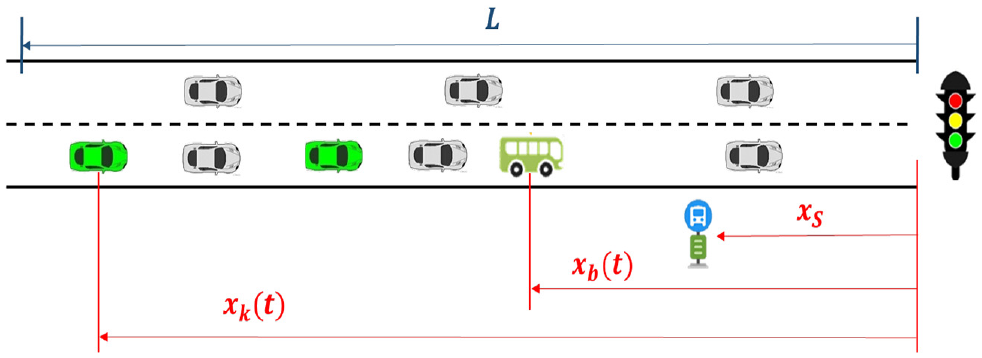
Demonstration of vehicle information with bus.
Based on the speed and location of the bus at time
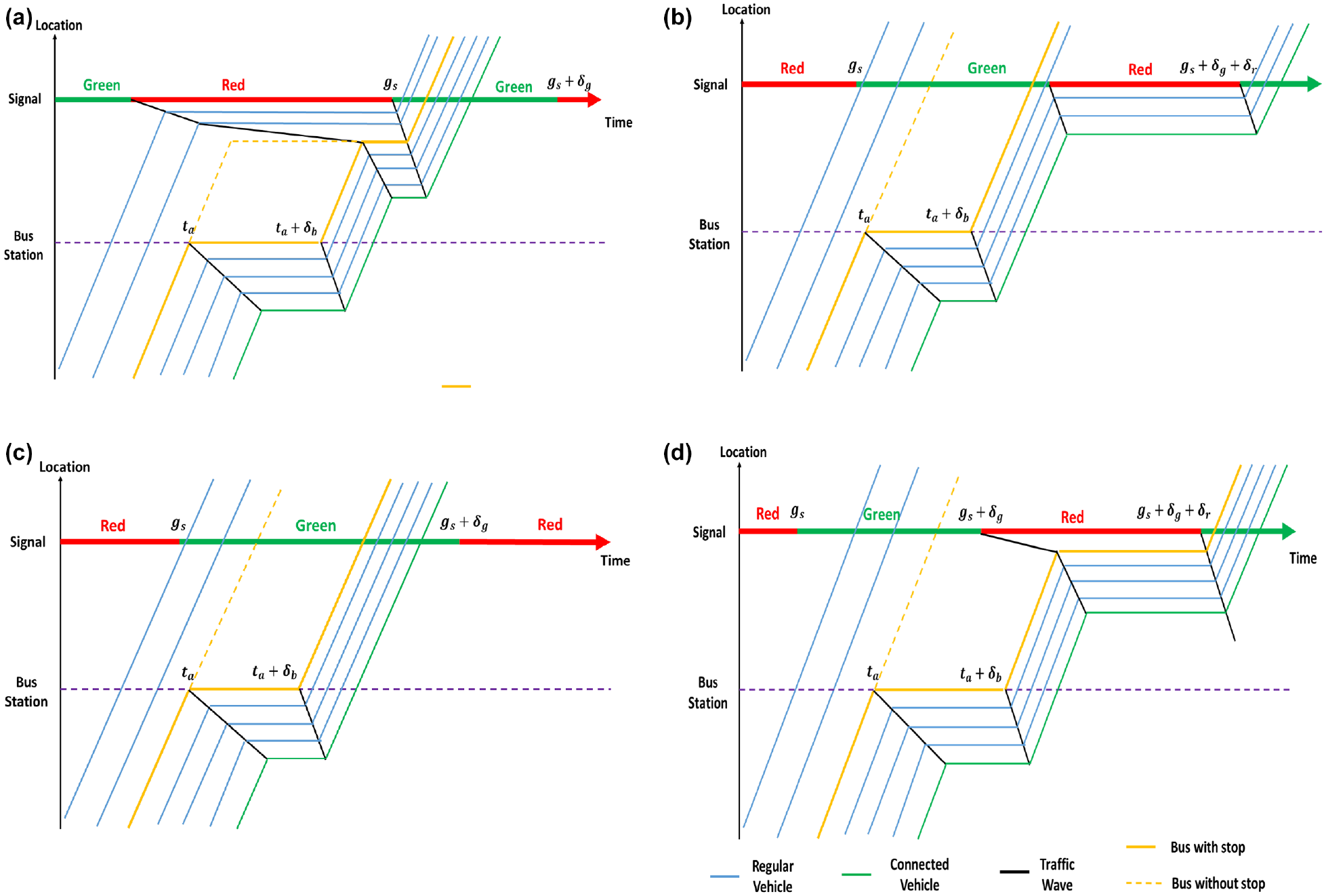
Dynamics of bus and passenger cars ahead of intersection: (a) no delay, (b) partially block I, (c) partially block II, and (d) fully block.
Figure 3a shows the first scenario,
In the second scenario (see Figure 3b),

where

where
Figure 3c shows the third scenario,
The first situation occurs if the connected vehicle

where

where the two component on the right side are the times of the vehicle passing the intersection when the bus skips and stops at the bus stop, respectively.
The second situation occurs if the connected vehicle

Then, the extra delay of the connected vehicle
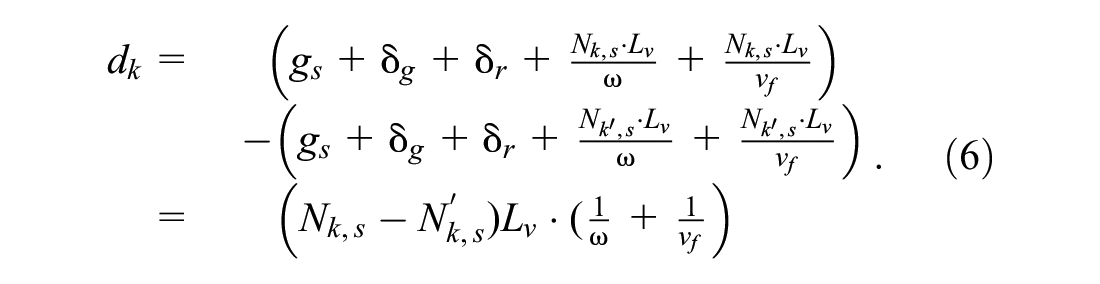
Figure 3d demonstrates the last scenario,

where

In the second situation, the vehicle will be queued ahead of the intersection if the bus stops at the bus stop, and the queue length is

With all the four scenarios described above, the delay of any connected vehicle behind the bus can be estimated based on their dynamics, the bus stop information, and the signal timing information. The estimated delay will be applied for the development of the ODPP system in the rest of this paper.
System Development
With the extra delay to connected vehicles caused by bus stops, an ODPP system will be developed in this subsection. The system is designed to reduce or remove the delay applied to the connected vehicles. Figure 4 shows the flow chart for the development of the system.
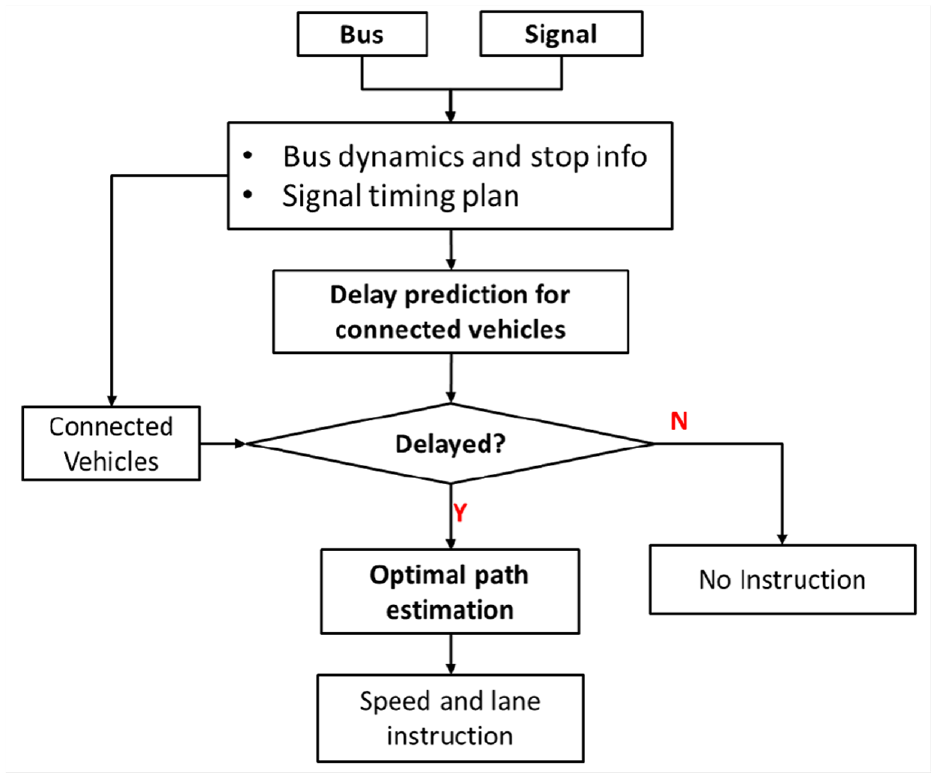
Flow chart of the ODPP system.
The system utilizes connected vehicles to obtain information on the bus and the signal. The bus will share its location
Results and Discussion
In this section, the proposed ODPP system will be evaluated with both synthetic and realistic networks to understand its benefit for reducing travel delay caused by bus stops. Aimsun, a microscopic traffic simulator, is utilized to model the dynamics of all vehicles and the entirety of the traffic in both networks. Sensitivity analysis of MPRs of connected vehicles and traffic demand is conducted to understand the reliability and robustness of the system under different stages of connected-vehicle development and traffic conditions.
Case Study I: Synthetic Example
In this subsection, a corridor with three intersections is simulated to evaluate the ODPP system. Figure 5 shows the geometry of the network, and the gap between any two consecutive intersections is set as 500 m. All roads have two lanes. Three bus stops are set ahead of the intersections, and their distances to the intersections are shown in Figure 5.
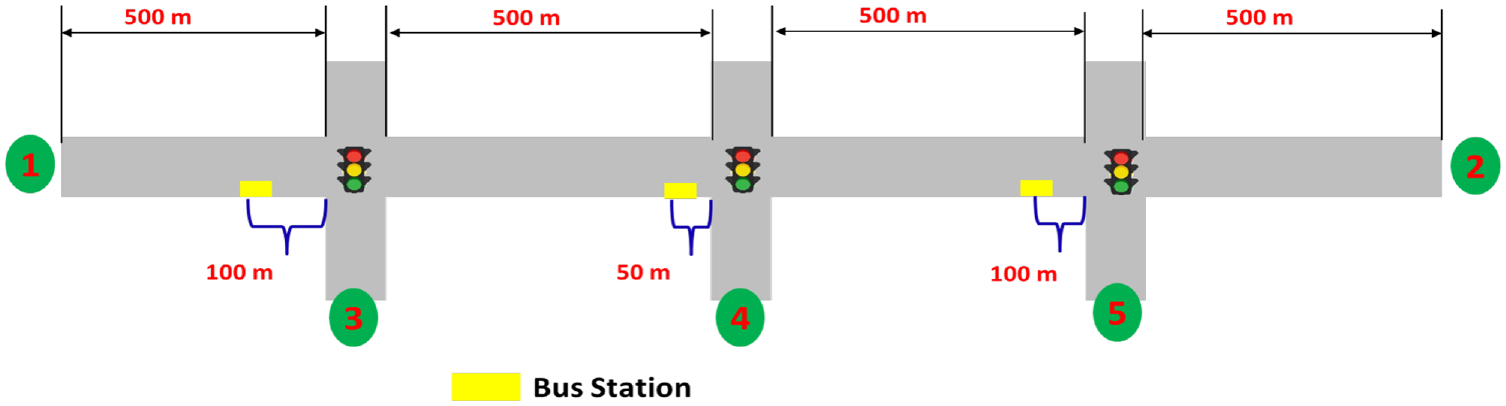
Geometry of a corridor.
In the experiment, one bus line will be set from point 1 to 2, and the bus is assigned at every 3 min. The bus will stop at all bus stops, and the loading time at each one is set as 30 s. The simulation will run for 1 h, and 1,750 non-connected vehicles are loaded from 1 to 2 in the simulation. In addition, the connected vehicles are assigned from point 1 to points 3, 4, and 5. Each destination will have connected-vehicle demand set at 75 vehicles per hour. Moreover, all intersections are signalized, and the cycle length and the green time of the through movement are set as 80 s and 40 s, respectively. The offsets of all signals are set as 0 s. In the deployment of the ODPP system, the penalty of each lane change for a connected vehicle is set as 2 s, and the length of the control region is 300 m.
Figure 6 shows the trajectories of the bus, non-connected vehicles, and connected vehicles. Figure 6a indicates that as a result of bus stops, a long queue will be formed behind the bus, and both connected and non-connected vehicles are delayed for a long time to pass the intersection. In the figure, the delays of the three connected vehicles are all over 75 s. However, with the deployment of the ODPP system, the connected vehicles are instructed to make lane changes to avoid the bus stops, and they can catch the green lights on the road (see Figure 6b). With that, their delays can be reduced significantly. For the first two connected vehicles, their delays are less than 25 s, that is, the reduction is more than 64%. For the third one, even it is not blocked by the bus, it will still meet the red light. Therefore, its delay keeps at the same level, and the reduction is less than 5%.
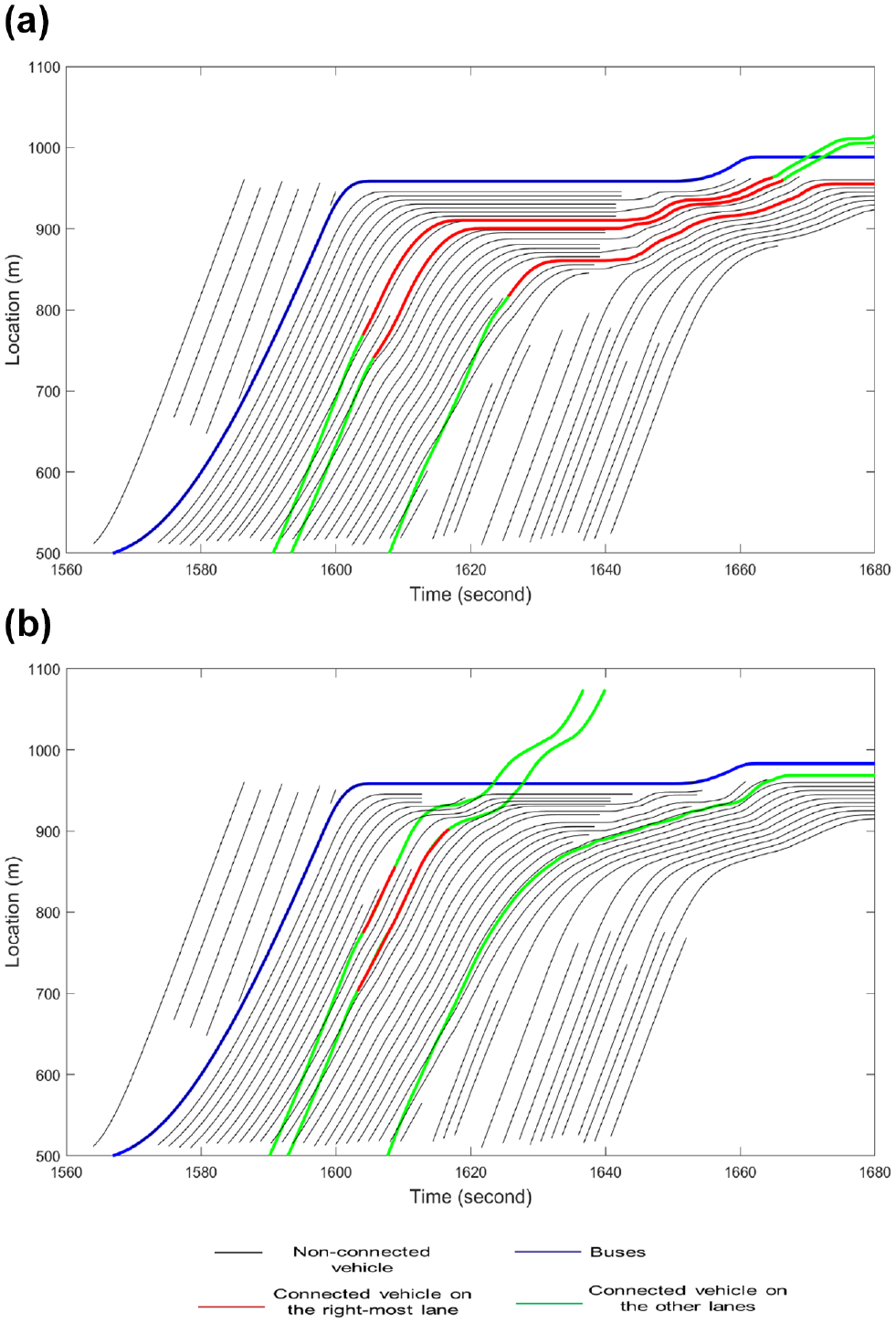
Synthetic example 1: vehicle trajectories: (a) base case and (b) control case.
In addition to the benefits to individual vehicles, the ODPP system can also improve the mobility of all connected vehicles. By comparing the trajectories of all connected vehicles in the whole simulation, the delay reduction of connected vehicles is as high as 20%. However, because of the intensive lane changes of connected vehicles, the performance of non-connected vehicles, which are all the through vehicles, is worse. The average delay of non-connected vehicles increases by about 8%.
Case Study II: Real-World Network Example
In this subsection, the ODPP system is implemented on a small-scale real-world network, the California connected-vehicle test bed (see Figure 7). The test bed is developed along El Camino Real in Mountain View, California, with a length of 2 mi and a speed limit of 35 mph. It consists of 16 signalized intersections, and they are all installed with roadside units based on DSRC (Dedicated Short-Range Communication) technology, which can broadcast signal phasing and timing information to all connected vehicles. Moreover, there are two major and four minor bus lines scheduled on the test bed. The major lines assign buses at every 12 to 15 min, and the minor lines have an interval of 15 to 20 min.
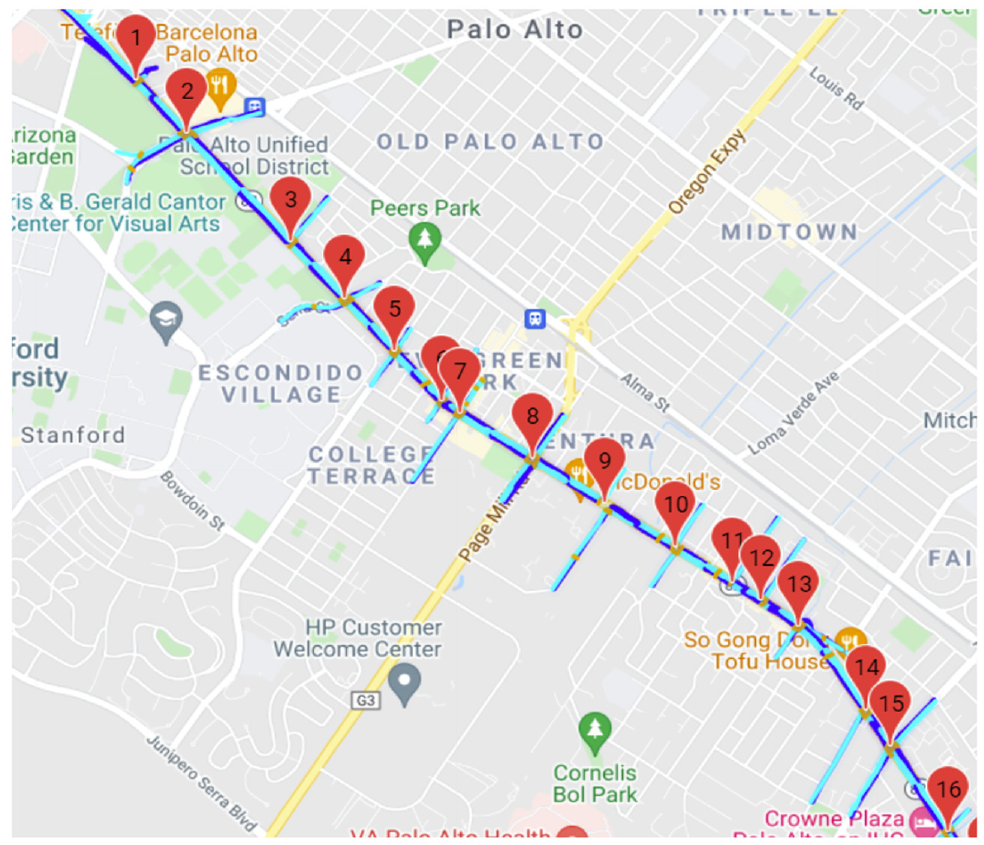
California connected-vehicle test bed.
In the Aimsun simulation, more than 5,300 vehicles are uploaded to the network within 1 h, and demand is calibrated with the real-world traffic during morning peak hours. Moreover, 48 buses are scheduled along the four predefined routes and the signal timing plans are optimized with the calibrated traffic conditions. Furthermore, only a portion of the passenger cars are assumed to be connected vehicles, and the MPR varies in different simulation scenarios. The connected vehicles can communicate with both buses and traffic signals in real time to deploy the ODPP system.
In the first experiment, the MPR of connected vehicles is set as 10%, and their demand levels
Comparison of Travel Time Delays under Different Demand Levels
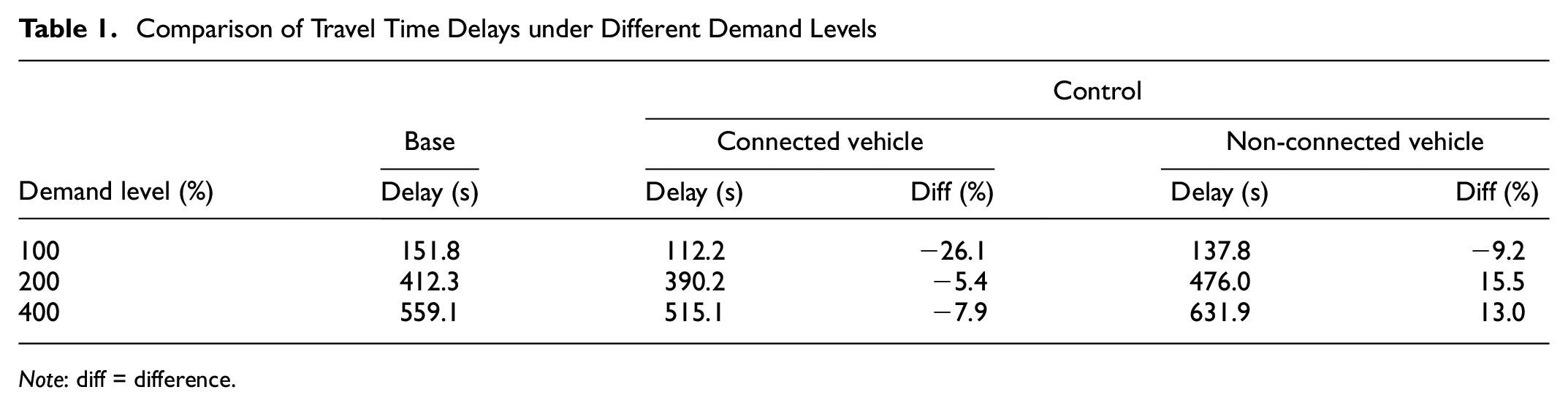
Note: diff = difference.
In the second experiment, the network is simulated with 100% demand level, and MPR varies from 4% to 50%. Figure 8 shows the savings in travel time delay for connected and non-connected vehicles under different MPRs. For connected vehicles, with higher MPRs, the savings of travel time delay will be smaller. At MPR = 4%, the delay is reduced by up to 34% and the saving is maintained at the high level when MPR ≤ 30%. However, when MPR > 30%, the saving will be reduced dramatically, and it can be negative when MPR ≥ 50%. This trend can be explained by the distributed control of the ODPP system, where each connected vehicle estimates its own optimal path without coordination with the other connected vehicles. With a smaller number of connected vehicles, it will be easier for them to utilize the high speed of the adjacent lane to reduce the delay. In addition, the system can improve the mobility of the non-connected vehicles. Figure 8 shows that there exists a concave relationship between the delay savings and MPRs. The optimal saving is achieved at MPR = 30%, and the reduction is more than 20%. The mobility benefit to the non-connected vehicles can be explained by the improved traffic conditions arising from connected vehicles and shorter queue lengths. However, with high MPRs, the delay savings can also be negative because of worse traffic congestion caused by a high number of lane changes from connected vehicles.
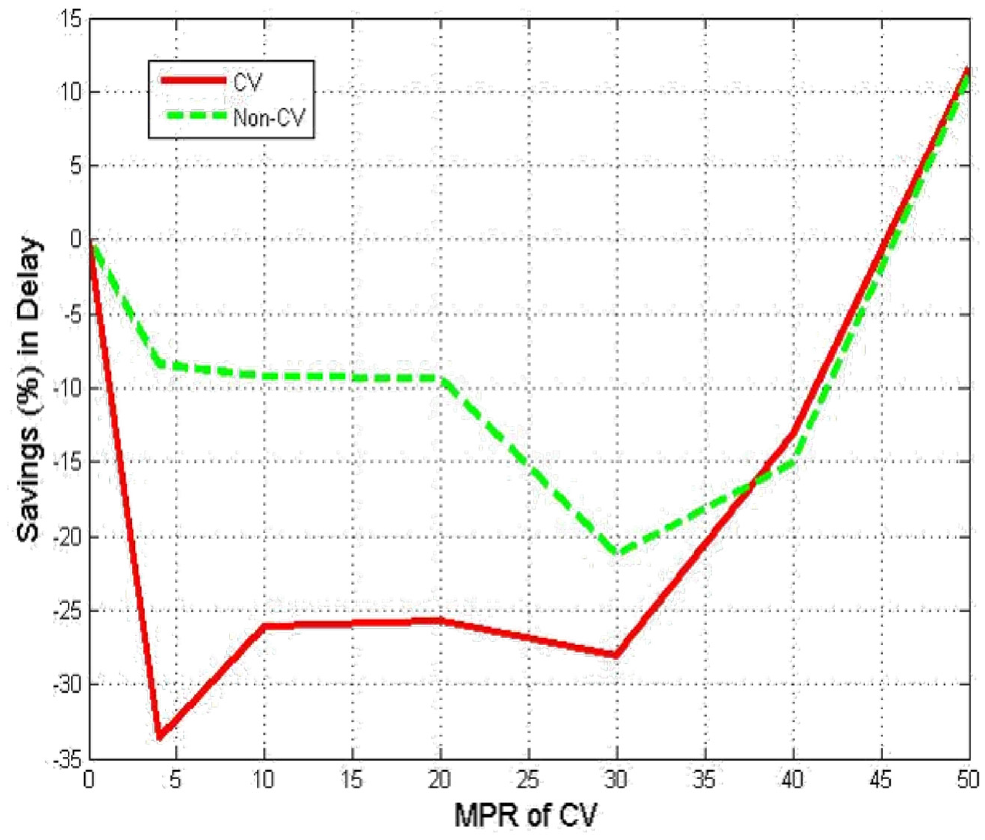
Savings in travel time delay under different MPRs.
In a word, both experiments illustrate the mobility benefits of the proposed ODPP system under different demand levels and MPRs of connected vehicles. However, because of the distributed control mechanism of the ODPP system, the system does not work well under high demand levels and high MPRs. This issue will be overcome with centralized control in the future.
Conclusion
This paper developed an ODPP system with the help of connected vehicles to assist passenger cars in passing buses and intersections with smaller delays. The system connected signals, buses, and passenger cars to obtain signal timing information, the dynamics of buses and connected vehicles, and the bus stop information. A delay prediction model was developed with the collected information to predict the extra delay of passenger cars caused by bus stops. The proposed system estimated lane-changing instructions with the predicted delay to assist the connected vehicles in passing stopping buses and intersections faster. The system was also evaluated with both synthetic and realistic examples in microscopic traffic simulations. The synthetic experiment showed that the delays to connected vehicles were reduced by up to 64%, and the system could also reduce the delay of connected vehicles by up to 34% and non-connected vehicles by 21% under a real-world network. Moreover, the impact of demand levels and MPRs of connected vehicles was analyzed. The results indicated that the benefits of the proposed system were reduced when the road was more congested. Also, higher MPRs might result in lower savings in travel time delay for connected vehicles. And, because of the distributed control mechanism, a concave relationship between the delay savings of non-connected vehicles and MPRs was observed, and the optimal MPR was estimated as 30%.
Based on the findings from the study, we have the following recommendations for future studies. First, the system has limited benefit at high MPRs of connected vehicles and high demand levels. It lacks the coordination of connected vehicles in all lanes to achieve higher delay savings at higher MPRs and positive savings for both connected and non-connected vehicles at high demand levels. Second, in this paper, the dwell times of buses at bus stops were assumed to be constant. However, they were highly related to the arrival times and the number of waiting passengers. In the future, a probability model will be applied to describe the dwell times for the estimate of travel time delay for connected vehicles. Third, the system is only evaluated in a small-scale network with a limited number of buses and passenger cars. It would be more promising to implement the system in a large-scale network, especially in downtown areas, with more bus routes, so as to better understand its mobility benefits. Fourth, the current system does not consider the situation that the bus will make a left turn at the intersection after the bus stop, which may potentially block the movements of the connected vehicles. The system will be extended to more general scenarios with different bus routes to avoid such conflicts. Moreover, in this paper, we only evaluated the system on roads with a fixed-time signal plan. The benefits will be more significant if the system can be combined with advanced signal control systems to optimize the paths of both passenger cars and buses. Finally, a field experiment will be conducted using a connected-vehicle test bed to evaluate the real-world benefits of the proposed system.
Footnotes
Author Contributions
The authors confirm contribution to the paper as follows: study conception and design: Hao Yang and Kentaro Oguchi; data collection: Hao Yang and Kentaro Oguchi; analysis and interpretation of results: Hao Yang and Kentaro Oguchi; draft manuscript preparation: Hao Yang and Kentaro Oguchi. All authors reviewed the results and approved the final version of the manuscript.
Declaration of Conflicting Interests
The author(s) declared no potential conflicts of interest with respect to the research, authorship, and/or publication of this article.
Funding
The author(s) received no financial support for the research, authorship, and/or publication of this article.
