



Abstract
Railway freight operations aim not only to market themselves aggressively to capture the market in a competitive environment but also to achieve refined management. The operational decisions chosen by carriers can have a significant impact on the revenue across freight services. Nowadays, various forms of transported products, train make-up, and schedules are developed from the perspective of production convenience, with less consideration of shippers’ needs for the time utility, frequency, and tariffs of transportation services. This paper investigates a joint optimization approach to railroad operation planning that combines meeting the transport demand preferences of different shippers in a competitive environment. Considering the heterogeneity of shippers’ transportation demands and the competitive environment with freight trucking, a new bi-level programming model is proposed that incorporates pricing decisions and operational planning policies, such as car blocking, train routing, and make-up. An exact solution for this model is developed by adding valid inequalities to the mixed-integer formula and the experiment is conducted with data from bulk coal cargo transportation of the S Railway Bureau Group Corp. A simple transportation network is presented, and the calculation results of the pricing decisions that maximize the profit in each operation decision in this network are reported.
Keywords
For many years, transportation service companies have understood that better marketing management and refined operational management of their logistics operations can improve their strategic position on the market. The revenue and freight market share aspects of day-to-day activities are becoming more and more important nowadays since many companies have realized that profit maximization mostly depends on the integration of logistics operations with improved pricing management. That is why pricing management plays a major role in transportation industries such as trucking, shipping, railroads, and airlines.
This paper analyzes rail freight transport as a vital economic sector. In 2020, China’s rail freight volume, an indicator of economic activity, reached 3.58 billion tons (China Railway Group 2020 Statistical Bulletin, 2020) ( 1 ). Rail accounted for 9.9% of the total social freight volume which includes freight volume transported by five modes: road, rail, water, air, and pipeline, so the overall market share level of rail freight to the whole society is still low. Competition has evolved to the point where the market and other transportation modes have a dominant influence on the policies of the railroad industry. In China, for example, the 2013 reform of railroad government-enterprise separation gave railroad companies more freedom, and transport competition has since played a greater role in regulating the rates charged for railroad cargo transport. In response to this competitive pressure from the market, railroad companies were forced to re-examine their operational management processes and pricing policies to remain competitive.
With the development of modeling and optimization techniques, many industries have improved their operational planning by establishing better activities management to take advantage of these innovations. However, railroad operations are composed of complex interrelated policies such as car blocking, timetabling, make-up and routing, yard management, locomotive assignment, empty car assignment, and crew scheduling. These are the main reasons why railroad transport has always been confronted with operational management tools that do not encompass all the realism of day-to-day operations. Part of the complexity is also because the railroad is operating on an existing physical network that has its own constraints, such as the resorting capacity of the marshaling yards, a freight train’s carrying capability, and so forth. The railroad industry is characterized by shippers with different attributes and perceptions of the services to be provided (e.g., sensitivity to tariffs or service reliability). Nowadays, various forms of freight products and marshaling plans in the railroad industry are designed from the perspective of facilitating production, with less consideration of shippers’ requirements for time utility, transport security, tariffs, frequency, volume, and convenience of transport service. The analysis of an integrated approach combining train operation planning decisions and marketing strategies is an interesting research perspective when trying to study the connection between operation management plans and pricing policies. This paper introduces a new bi-level mathematical formulation that combines both pricing decisions and train operation planning decisions. The paper analyzes the pricing policies of different freight shippers’ mode choice preferences and their impact on the formulation, as well as the resulting properties and valid inequalities that are used to strengthen the mathematical model. An exact solution method is proposed and computational results for randomly generated examples are reported.
Literature Review and Outline of Paper
Although growing research interest in the topic of operational planning and pricing issues in rail freight transportation can be observed, to the best of the authors’ knowledge, few research works have been focused on both pricing and operational planning in the context of bulk freight mode choice. This section reviews relevant research on operational planning, pricing method, and freight mode choice issues.
Railroad Freight Operation Planning and Management
Railroad freight operations have been extensively studied in the operations research literature and the main modeling and methodological contributions have been surveyed ( 2 – 10 ). More recently, operational research methodologies in rail passenger transportation have been surveyed and reviewed ( 11 – 15 ). This section takes a closer look at the contributions of integrated railroad freight operation planning and management activities including car transit, blocking and train make-up as well as train scheduling. Assad ( 2 ) mainly focused on the car routing and train make-up model. Crainic et al. ( 16 ) described a model with routing freight traffic, scheduling train services, and allocating classification work. Haghani et al. ( 4 ) presented a formulation and solution of a combined train routing and make-up, and empty car distribution model. Gorman ( 17 ) presented a joint train scheduling and traffic assignment model solved by a hybrid genetic and tabu search algorithm. Ahuja et al. ( 18 ) developed an algorithm to solve the railroad blocking problem which is a very large-scale, multicommodity, flow network design and routing problem. Lin et al. ( 19 ) presented a bi-level programming model to seek optimal settings for train services and traffic assignment in China’s rail network. Zhu et al. ( 20 ) proposed a model and solution methodology integrating car classification and blocking, train make-up, and routing as well as service selection and scheduling. A model based on the dynamic balance of transport and logistics was developed by Rakhmangulov et al. ( 21 ), in which the main events in the transport process, such as the operation of cargoes in independent railcars and the operation of trains, were modeled. Calculation of relevant parameters, such as timeliness of transportation and other indicators, were also determined. Xiao et al. ( 22 ) presented a block-to-train assignment model solved by the genetic algorithm and tabu search. To solve the problem of delayed cargo transport flows on the train network, taking into account the interests of each member of the transport and logistics chain, an efficient train assignment model based on the progressive distribution of flows on the network was developed, and then a hybrid intelligent system for cooperative railroad transport operations planning was also proposed to improve the management of railcar flows and improve the reliability of cargo transport, based on the principle of interaction of participants in the transport process ( 23 , 24 ). Ruf and Cordeau ( 25 ) proposed a formulation for the integrated planning problem comprising the railcar interchanges, the humping sequence, the schedule of service and safety processes, and the assignment of resources (infrastructure, staff, and locomotives) to processes. The optimization model is solved by a tailored adaptive large neighborhood search heuristic. These representative papers have conducted optimization studies that focus on several major production stages processes and full processes affecting the train formation planning process, and have achieved good results, but mainly from the perspective of improving the transport efficiency of enterprises, and less from the perspective of intervention and adjustment of transport economic instruments.
Freight Pricing Management
The management of the pricing aspect of freight transportation is very important today because of the increasing competition among different modes of cargo transportation. Kraft ( 26 ) proposed a model for both “dynamic car scheduling” and “train segment pricing” by using a bid price control framework. Li and Tayur ( 27 ) developed a mathematical programming model that jointly considers pricing and operations planning in the intermodal transportation and solved the model by a decomposition using the structure of subproblems. Crevier et al. ( 28 ) pointed out that logistics integration and revenue management can maximize the profit of railway freight transport, and proposed a bi-level mathematical programming model, including pricing strategy and network planning. Zhang and Dan Liu ( 29 ) built a mixed-integer programming model for joint optimization of train operation decisions and pricing decisions with the maximum operating revenue of the railroad transportation company as the objective function and the stability of the railroad transportation network as the premise. Zeng et al. ( 30 ) developed an improved gray relational analysis to establish a comprehensive performance evaluation of railroad freight pricing policies and to improve the price decision-making ability of railroad freight companies. There are papers that consider railroad transport organization jointly with pricing strategy for optimization, for instance, on the allocation of rail wagons, on the intermodal transport, on the combination with revenue management, or on the consideration of price factors on container transport, but few papers specifically study the combination of formation planning and pricing for bulk railroad freight at freight marshaling stations.
Freight Mode Choice Management
The mode choice is the third stage of the conventional four-step disaggregate model, which is traffic generation, traffic distribution, traffic mode classification, and traffic assignment. Transportation mode choice or transport chain is the most critical part of any freight demand modeling framework, and understanding the reasons why shippers, receivers, and freight forwarders choose a particular mode of transportation for their shipments is critical to developing appropriate transportation policies. In the methodological aspect of transportation mode choice, the development of transportation mode choice models has gone through several different steps. Based on the theory of mode choice behavior of shippers or receivers, Winston ( 31 ) developed a stochastic expected utility model and estimation suitable for econometric analysis. Cook et al. ( 32 ) summarized the key factors of cargo transportation mode selection and presented the relative importance of these factors and customer satisfaction evaluation. Jiang et al. ( 33 ) estimated a discrete choice model for classification using freight demand survey data from France and found that transport distance and shipper access to transport infrastructure were key determinants. Norojono and Young ( 34 ) developed a model for the freight choice decisions between rail and road and found that safety, reliability, and responsiveness are the main attributes affecting the choice of rail versus road freight modes. Two binary choice models were developed by Samimi et al. ( 35 ) to understand mode choice behavior in the U.S. freight markets and found that trucking is extremely sensitive to travel time whereas rail transportation is cost sensitive. A discrete choice model was applied by Arencibia et al. ( 36 ) to analyze the main determinants of freight mode choice based on a SP data set. The SP (stated preference) survey is designed to obtain people's subjective preferences for multiple choices under hypothetical conditions. Jensen et al. ( 37 ) presented the estimation of a discrete freight transport chain choice model for Europe, which is based on disaggregated data at the shipment level.
Maritime freight transport is another important mode of transport and some scholars have studied the operation methods in response to the increase of freight volume by considering cost minimization and price decisions. Xu et al. ( 38 ) developed a model to study empty equipment repositioning decisions by using capacity pricing policies to balance the cargo demands between carriers and freight forwarders. An appropriate pricing strategy has been proposed by Umang et al. ( 39 ) based on a given baseline vessel schedule to generate greater revenue from late-arriving vessels to solve the real-time recovery problem in port operations. An integrated optimization model was presented by Zhen et al. ( 40 ) for the daily berth planning problem in tidal ports, where ships have a higher priority and more attention should be paid to reducing their waiting time in the presence of channel flow control. Xiang et al. ( 41 ) aimed to minimize the recovery cost and adopted the prospect theory to express the preference of decision-makers, and proposed a reactive strategy for different disruptions on the allocations of berths and quay cranes under uncertainty. Dulebenets ( 42 – 44 ) studied cost-effective sailing schedules and green vessel scheduling, and proposed a collaborative agreement between shipping companies and marine container terminal operators to enhance the efficiency of the shipping operations. According to the existing literature mentioned above, the integration of pricing decision management with rail freight operation planning management has not been well considered in the literature. There are few studies on the comprehensive optimization of railway bulk cargo transportation. At present, the pricing decision-making of railway transport companies lacks flexibility, and the single pricing method cannot meet the rapid change of transport market demand. Because the transport market is becoming more and more complex and competitive pressure is increasing, railway operation management needs to explore more scientific pricing methods in combination with the transport behavior of competitors (road transport in this paper). The specifics of pricing and market environment in the transport industry are strongly influenced by the type of competitive market, as well as the specifics of rail transport organization and management in different countries. For example, unlike the oligopolistic markets in the United States, the rail transport markets in China and Russia are monopolistic. However, many private companies own rail vehicles in Russia. This will limit the flexible pricing ability of that rail transport industry to some extent. Because of the complexity of the railway transportation network, when making comprehensive optimization of railway freight pricing decisions and train operation decisions, it is necessary to combine such factors as the customer’s behavior in choice of cargo transportation modes, capacity limitations of the transport network and competition in the transport market. Therefore, this paper studies the comprehensive optimization of train operation decision-making based on differential pricing decision-making for different routes, transport equipment elements, and cargo types, combined with the customer’s transport mode selection behavior aimed at the lowest total generalized cost. The rest of the paper is organized as follows. The third section presents a customer’s generalized cost calculation formula to describe the behavior of customers in the choosing of cargo transportation modes. The fourth section provides a comprehensive optimization model for differentiated pricing based on train operation decisions. The fifth section develops a solution algorithm by using an effective inequality to enhance the relationship between differential pricing and freight volume decision variables. The sixth section shows how the instances on which the solution methodology was tested were generated. Finally, in the seventh section, a few concluding remarks and opportunities for subsequent research are provided.
Customer Choice Behavior in Choosing the Mode of Cargo Transportation
With the continuous growth of the freight market and intense competition between various modes of cargo transportation, the share of different modes of transport in the freight market depends not only on the freight rates, but also on the level of their freight transport services. Moreover, when considering the level of service of other transport modes, the shipper chooses the transport mode with the lowest generalized transport costs. The shipper’s generalized transportation cost refers to the factors such as transportation cost, shipping time utility, and service quality satisfaction. These are converted into monetary values through the time value of cargo transportation to support the shipper’s mode choice; a detailed description is provided in Crevier et al. ( 28 ). Transportation costs are the costs to be paid for transporting a unit of goods. The shipping time unity aims at shortening product delivery time and improving product delivery on-time, bringing benefits to customers. The rail shipping time includes cargo dispatch time, transit time, and intermediate operation time. Service quality satisfaction refers to the shipper’s perception of service quality, considering the safety and convenience of goods in transportation. Safety can generally be measured by the rate of damage during shipping. Better accessibility leads to lower transportation costs and shorter time to the freight station. Accessibility is mainly measured by the convenience of transport, that is, the distance of the shipper or receiver from the rail freight station loading and unloading location. Characterization of each itinerary as well as the sensitivity of customers to service quality was proposed by Marcotte and Savard ( 45 ) and Côté et al. ( 46 ) for airline passenger transportation and Crevier et al. ( 28 ) extended this to rail freight. The formula for calculating the cargo owners’ generalized cost is as follows:

where
Customers need to evaluate the three kinds of cost indicators, synthesize the generalized transportation cost of each mode of transportation, and choose the transportation mode with the smallest generalized cost ideally. If the general costs of railway transport and other competitive modes of transport are equal, then it can be assumed that customers will choose railway transport according to the “optimism” principle. The optimism principle in this case means that shippers will give priority to rail freight, subject to compliance with the Chinese government’s environmental protection policies. The calculation of each cost indicator in the customer’s generalized cost is as follows.
Shipping time utility measurement. The calculation of shipping time utility is mainly calculated by shipping time value. Previous studies, such as Hummels and Schaur G ( 10 ), extracted the shipper’s valuation of time for air and ocean shipments and estimated that each day in transit is worth 0.6 to 2% of the value of the goods. The time utility measurement can be understood as each day in transit and having the impact on the production and sales of unit goods in one day’s transportation. It can be extended in rail freight in the same way and expressed as A × TR, where A is the average value per railcar load of a certain type of cargo such as coking coal. China’s Daqin Railway coal transportation service can pull about 80 tons of coal per railcar. Coking coal accounts for 27% of China’s total coal, and in August 2021 the price was close to RMB 2,500 (CNY) per ton, so the A-value used here is RMB 200,000 (CNY) per railcar. TR is the ratio of the shipping time cost incurred per unit of cargo in one day of transportation to the average value of the unit of cargo, and this paper takes the ratio of 1%.
The perceived cost of service quality is the customer’s evaluation of the transport quality of the carrier company, including the convenience and safety of transport. Convenience cost can be calculated by the time consumed in the process of loading and unloading goods. Through the investigation of the steps of loading and unloading railway goods, this paper assumes that the loading and unloading process at both ends of the transport process takes 3 h, and then calculates the convenience cost by combining the time-consuming cost of the unit hour derived from the time-consuming cost. (20,0000 × 1% / 24) ×3 = 250 CNY/railcar. Safety is mainly manifested in the rate of damage to goods in transit. The rate of damage to goods can calculate the cost of safety. According to relevant research, the rate of damage to goods on the railroads accounts for 0.05% of goods, and that on the highway accounts for 0.06%. According to the calculation, it can be concluded that the safety cost of the railway is 100 CNY (14.9 USD) per car, and that of the highway is 120 CNY (17.9 USD) per car.
Comprehensive Optimization Model of Train Operation Decision Based on Differential Pricing
This paper studies cargo shipments as operated on the railroad transportation network. It considers the marshaling yard operation handling capacity, the trains operated economically with loading capacity from the marshaling yard, and the railway line section passing capacity as constraints, and pursues the objective of total profit maximization of the railroad transportation company under the differentiated pricing policy. A bi-level program model is developed, with the upper level objective of maximizing the profit of the railroad transportation company and the lower-level objective of minimizing the generalized transportation cost of the shipper. This integrated optimization model is based on the pricing decision assumptions in the case of competitively differentiated pricing for road cargo transportation. The game state of rail and road freight volume-sharing under differential pricing of the road transportation network is analyzed by assuming the freight rate decisions of road transportation competitors under differential pricing conditions. According to the characteristics of the model, a simplified model based on the first duality principle is used as a single-level mixed-integer programming model, and the branch-and-bound method is used to solve the model.
Model Building Environment
Model Hypothesis
To simplify the influencing factors of the problems studied in this paper, the following assumptions need to be made:
In this model, it is assumed that the competitor of rail freight is road transport, and the customer can only choose between rail and road transport modes.
It is assumed that the transport price of road cargo transportation is known.
It is assumed that in the transport market, rail transport and road transport capacity will be able to meet the needs of freight customers.
Under differential pricing conditions, assuming that the total demand for each origin–destination pair (OD) is fixed, the rail and road freight market shares change accordingly as the rail OD demand points are differentially priced.
The customer’s perception of the time utility of transportation and the quality of service is transformed into the generalized cost. The customer chooses the mode of transportation based on the generalized cost consisting of freight, shipping time cost, and service perceived cost. In the condition of equal generalized costs for rail and road transport, the “optimistic” principle can be followed, assuming that the shipper will choose rail shipment.
Assuming the differential pricing decisions in railway freight rates, the road freight rates remain unchanged for a short time, and the price response function of freight volume is only related to railway freight rates.
It is assumed that freight train formations are operating at full capacity. Major freight trains of Chinese railroads, including bulk freight trains, are required to operate in formation at full axle load, except for some types of freight trains, such as pick-up and drop train and district transfer train, which are allowed to operate on less than full axle loads. Full axle load indicators are mainly expressed in the number of train cars, the total length of the train, and the total traction weight of the train. Train formation can be carried out by meeting one of the constraints of the full axle load constraint. When establishing the model, only the full axle load constraint of the number of train cars is considered, but not the total train length and total traction weight. The reason is that there is a large gap between different freight locomotive types in total train length and total train traction weight.
Variables and Parameters Involved in the Model
1. Model parameters
g = the category of road cargo transportation mode.
I = the set of all OD demand pairs in the railway transport network.
L = the set of all sections in a railway transport network.
Bi = the set of all marshaling stations on an ith OD demand pair.
Eb = the set of available train element types at marshaling station b.
The transport trains are categorized as two types: technical direct train and through cargo train. The main operation of China’s railroad formation stations is the disassembly and grouping of many trains, most of them being technical direct trains and through cargo trains. Technical direct trains are cargo trains that are made up in technical stations and pass through one or more marshaling stations without reorganization operations. Through cargo trains are cargo trains that are made up in technical stations and pass through one and more district stations without reformatting operations. Technical direct cargo trains and through cargo trains are both cargo trains grouped at technical stations, the difference is that technical direct trains pass through one or more marshaling stations without regrouping, while through cargo trains pass through one or more district stations without regrouping.
cape = the capacity of type
capb = indicates the maximum operational handling capacity of a marshaling station over a period of time, measured by the number of trains.
Nl = the capacity of section
Se = the fixed operational cost of type e of trains.
V = the variable cost of transportation per unit of rail transportation.

2. Decision variables
Modeling
According to the actual situation, both transportation modes in the competitive relationship in the model consider their profit maximization when pricing. This relationship is a non-cooperative game in game theory. Railroads are not competitive in time utility and comfort of service when transporting cargoes, compared with road transportation. Considering the requirements to attract more time-sensitive and service-sensitive cargo from competitors, therefore, it is necessary to set different rates for different types of cargo and different OD freight demands. This subsection combines this theory with an integrated optimization model for pricing decisions and train operation decisions. The volume of freight carried by railroad transport companies is closely related to the price, and differential pricing inevitably changes the customer’s choice of freight transport mode, that is, it changes the share of freight volume allocated to the railroad transport network. To simplify the problem, a linear function of the price response of rail freight volumes is introduced into the integrated optimization model of differential pricing and train operation decisions, assuming that road prices do not change over a short period of time, while rail prices are fixed. Obviously, the curvilinear freight volume price response function will reflect the real freight volume price response more accurately, but it will increase the difficulty of model solving if the curvilinear freight volume price response function is considered. The analysis shows that the operating profit of railroad freight companies is influenced by the cost of running trains and the fixed costs of transportation as well as the volume of freight. The upper level objective of the model is expressed as follows.

The model takes into account that the shipper’s choice of transport mode is necessarily influenced by differentiated pricing decisions based on transport routes, cargo types, and train element types, which are directly reflected in the rail and road transport shares. In addition, the price response function for rail freight share is added to consider the supply–demand relationship for rail freight. The upper level constraints of the model are as follows:






Constraint 3-1 indicates that the number of trains passing through rail section



Constraint 4-1 is expressed as the sum of the volume of K-type goods transported by rail and the volume of K-type goods transported by road is equal to the total demand for K-type goods transported. Constraint 4-2 indicates that the number of wagons transported by rail and road on line i is greater than or equal to zero and both are integers.
Finally, the bi-level programming model formula in Equations (3)–(3-6) and (4)–(4-2) for train operation decision-making optimization based on differential pricing is obtained as follows:










The decision variables of the model are
Solution Algorithm
Algorithmic Design
Through the structure of the model formula (Equations (5)–(5-9), we can see that the model is a non-linear integer bi-level programming model. This subsection reconstructs the bi-level programming model into a single-level mixed-integer programming model using the original duality theory, and the number of decision variables in the model is simplified, that is, the number of alternative decisive variables will be changed into known variables. The dual model of the lower model Equations 5-7–5-9 is as follows:



The second level program of optimization conditions includes original feasibility (constraints 4-1, 4-2), dual feasibility (constraints 6-1, 6-2), and the following complementarity constraints:


The following optimization conditions are proposed based on the model building environment as well as the model structure.
Linearization of complementary constraints, such as the linear representation of constraint 6-3 is as follows:
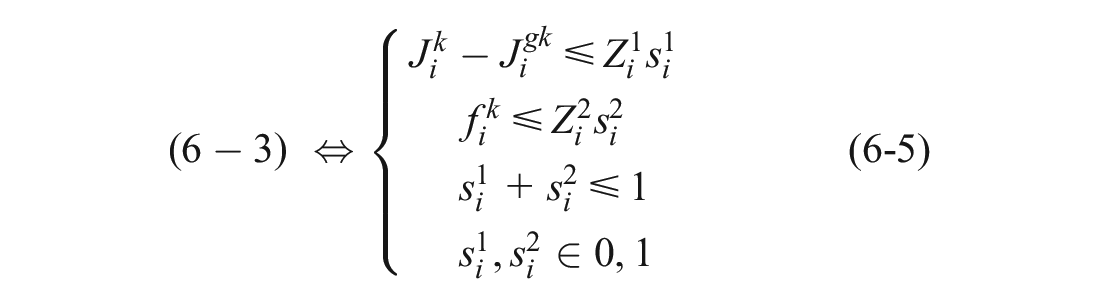
The constant parameter Z represents the upper bound on the left side of the corresponding constraint and the
2. It can be concluded that the share of railway transport mode and railway freight volume can be regarded as approximately equal.

The values of
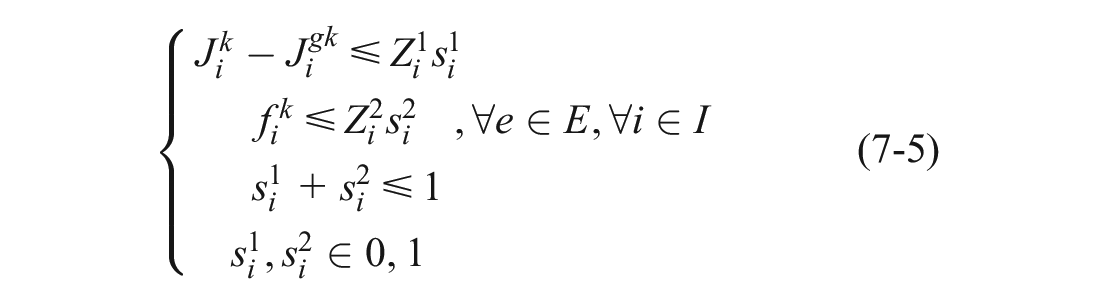
The bi-level model formula (Equations (5)–(5-9)) based on differential pricing can be optimized to the model in Equation 7 as follows:







Effective Inequalities to Strengthen the Relation Between Differential Pricing and Freight Volume Decision Variables
After the initial solution of the model in this paper, the few model inequalities makes it more convenient to solve. By sorting out the parameters of the model, however, it is found that the integrality gap of branch-and-bound root nodes is generally large, that is, the difference between the objective value of the problem and the objective of the initial solution is large, which is not conducive to the solution of the larger scale model. Therefore, an effective inequality optimization method is proposed to enhance the correlation between differential pricing and freight volume decision variables to optimize the integrality gap of the demarcation points. The inequalities proposed are as follows:
Inequality: For

where
Proof: First, to ensure railway freight transport has sufficient freight demand, the optimistic assumption is that the generalized cost per line for rail shippers is less than or equal to the generalized cost for road shippers.

Therefore, it can be deduced that:

Equation 10 expresses the upper bound of freight rate for OD demand of K-type goods. However, in the process of seeking the ptimal solution, there must be:

Then the upper bound of the freight rate will be changed to:

The upper bound decreases:

According to constraint 7-5, only when

The inequality will be evaluated by adding the bi-level formula (Equation 7). The model bi-level formula (Equation 15) is as follows:





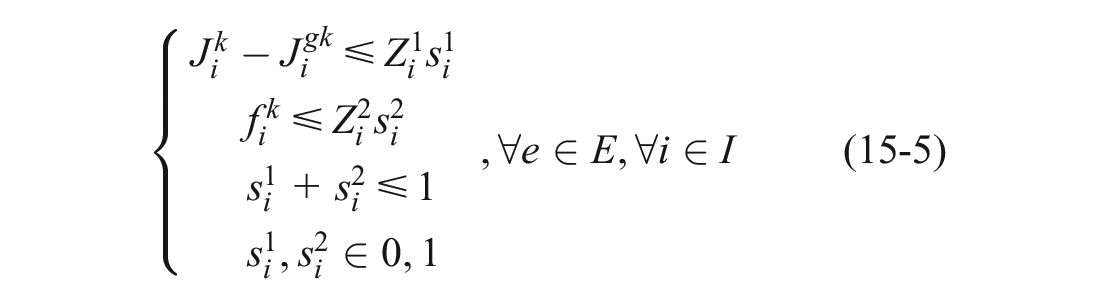



Constraint 15-6 represents the valid inequality that enhances the relationship between differential pricing and freight volume decision variables.
Case Verification
Data Preparation
In this case, marshaling stations with high freight formation activity under the jurisdiction of China Railway S Railway Bureau Group Ltd were selected to form a simple railroad transportation network. The S Railway Bureau Group Ltd is one of the 18 bureau group companies managed by China Railway Corporation. According to the distribution of marshaling stations and the activity of freight transportation within the jurisdiction of S Railway Bureau Group Ltd, in this paper, five marshaling stations were chosen to form a simple railway transportation network, namely: Hefei Station, Xuzhou Station, Nanjing Station, Ningbo Station, and Jinhua Station. The inter-station transport relationship is shown in Figure 1 below.
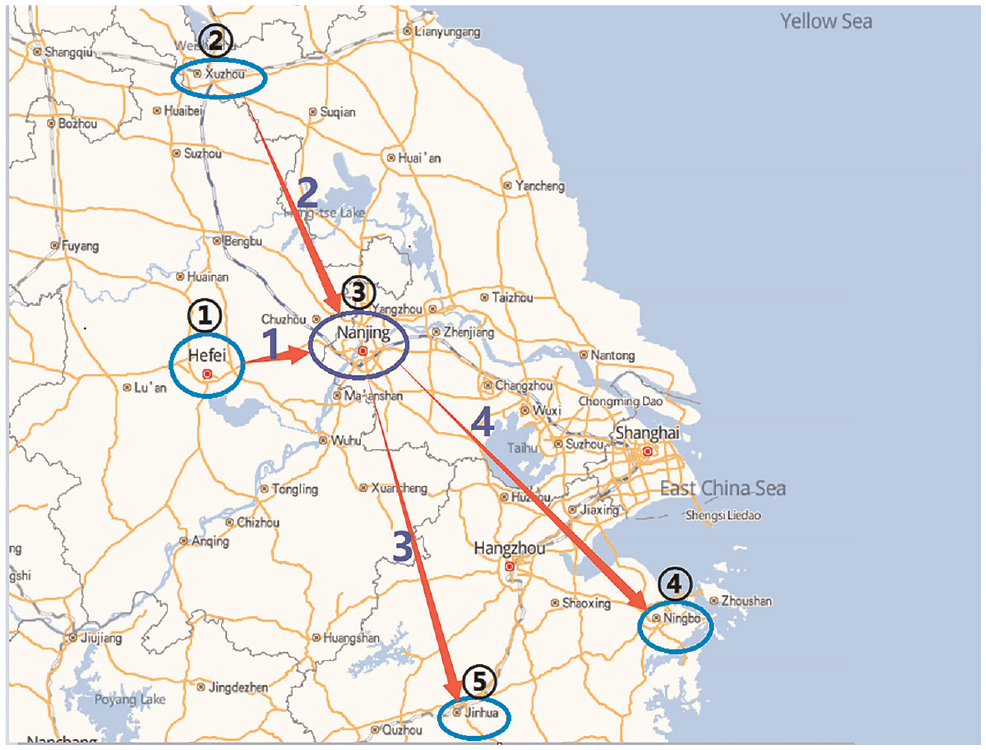
Schematic chart of freight transport network of five marshaling stations in China.
According to the network schematic diagram, it can be seen that the freight transport network is composed of two simple lines, 1. Hefei Station→3. Nanjing Station→4. Ningbo Station and 2. Xuzhou Station→3. Nanjing Station→5. Jinhua Station, which are intersected by Nanjing marshaling station. Here the name of the marshaling station is only marked by the name of the city, not the actual name of the grouping station, such as Nanjing East marshaling station. For concise expression, only the Nanjing station is marked. It can be seen that there is a variety of OD demand in the transport network which is composed of a combination of lines, and each line can be transported by either rail or road. According to the historical data of S Railway Administration in 2017, there are eight OD demands in the transportation network: 1→3, 1→4, 1→4, 1→5, 2→3, 2→4, 2→5, 3→4 and 3→5. It is assumed that, according to the transport rules of transport companies for each category of goods and the customer’s preference requirements for transporting each category of goods, the transported goods are classified as price-sensitive goods (k = 1), time-sensitive goods (k = 2), or service-sensitive goods (k = 3), and both rail and road can transport these three types of cargo. According to the composition of the example transportation network diagram, this paper sets the type of transportation trains as the two types of technical direct trains and through cargo trains.
In this paper, the feasibility of the model is validated by the data of one day of freight transportation in the transport network, and the decision-making of daily train operation for railway freight transportation is obtained. It is assumed that the transport demand between OD demand is relatively stable over a period (
Daily Demand for Various Types of Goods at Origin–Destination (OD) Demand Points
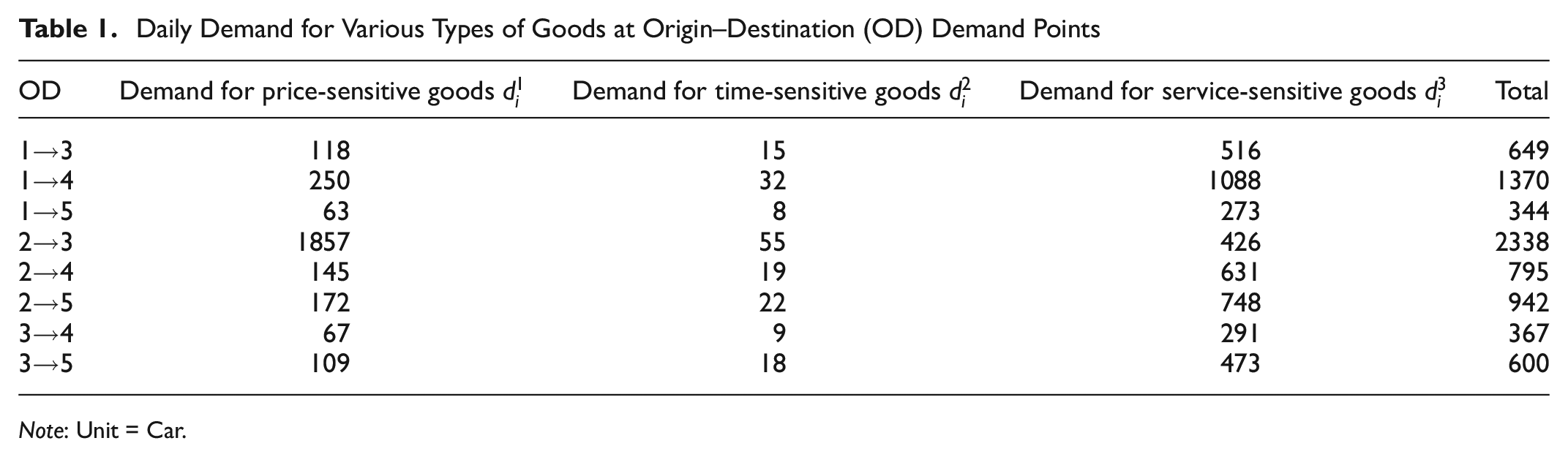
Note: Unit = Car.
After calculation, the perceived cost of service quality of railway transportation is 350 CNY per railcar. Because road transportation can carry out “door-to-door” transportation, it can be considered a zero-convenience cost. The perceived cost of service quality of road transportation is 120 CNY per vehicle, and the perceived cost of cargo time utility and the service quality for rail and road transport can be derived.
According to the questionnaire of cargo owners and the data collected, the generalized cost can be used to calculate the freight cost and the weight of each perceived cost. Based on the statistics of historical freight data of S Railway Bureau Group Ltd, we know the freight rates of various types of goods in road transport, the generalized cost of road transport, the variable cost of railway freight transport, and the fixed cost of running various types of trains. The train capacity of all types of trains that can be operated on the line is set to 60 railcars per train. It is known that there are five marshaling stations and four sections in the transport network, and the operating capacity of each formation station for freight trains is assumed as follows:
In addition, the matrices
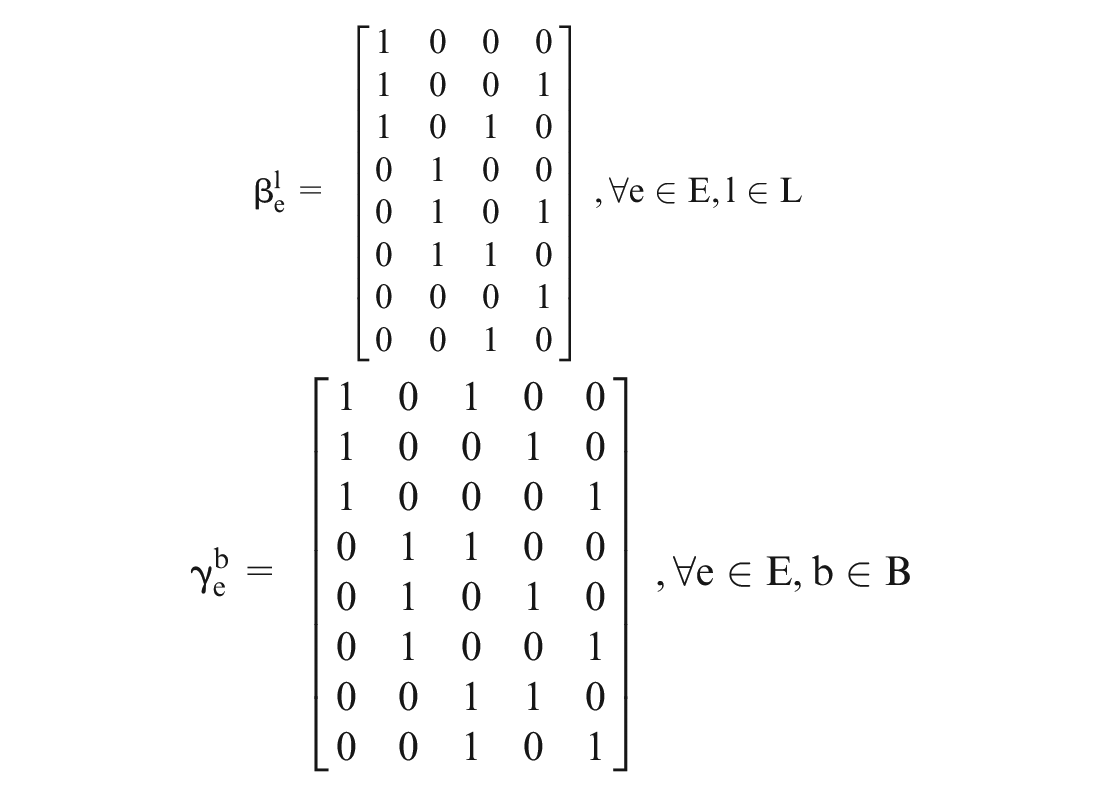
where the number 1 in the matrices
Model Solution
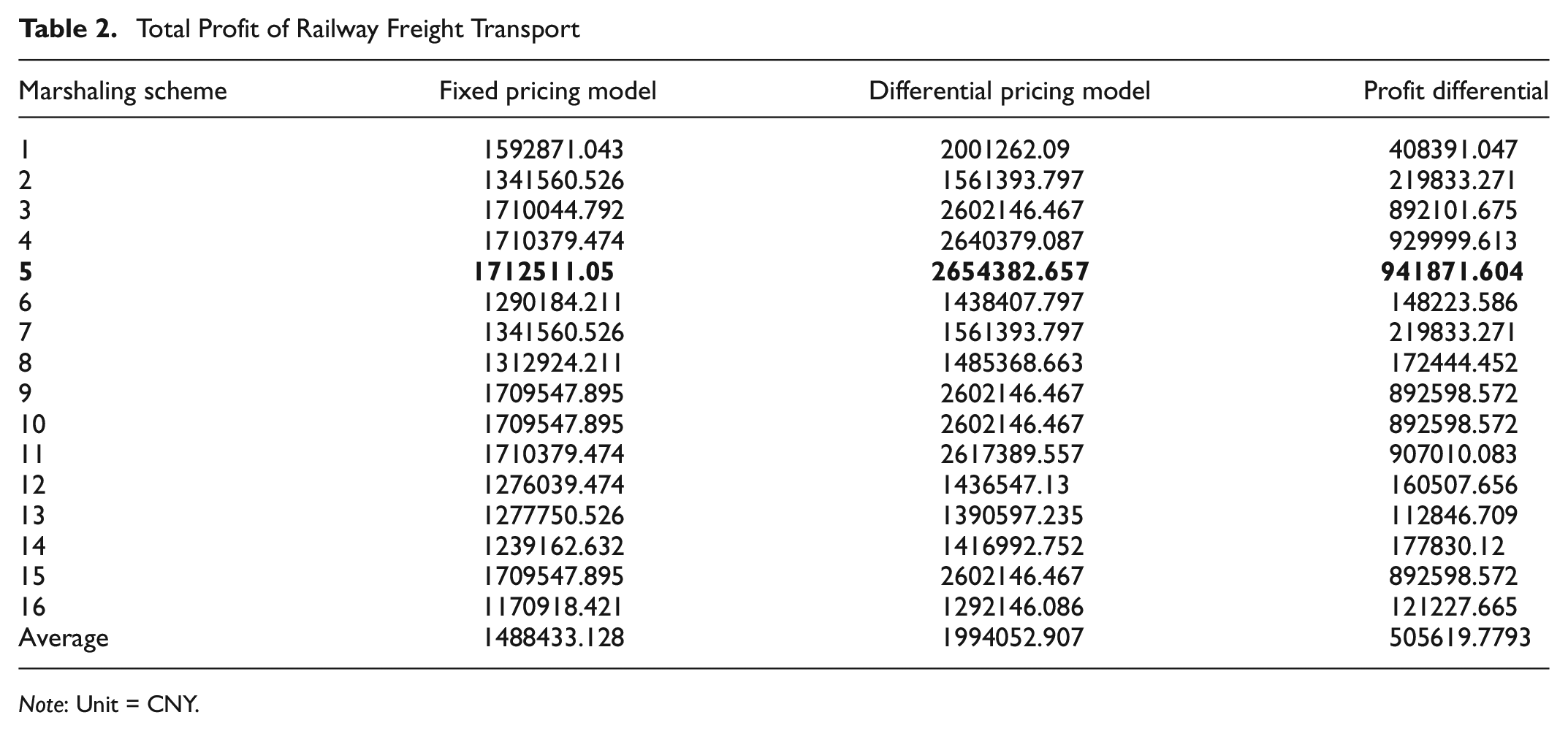
Since all the models in this paper belong to the integer programming model, the solution method of the linear programming model can be used. This paper will use IBM ILOG CPLEX solver to solve the model. Note that a 0.01% optimality gap and a maximum execution time of 2 h have been configured in the CPLEX solver in each execution. When the data corresponding to the different marshaling schemes obtained in the previous section are brought into the CPLEX solver program, the following results can be obtained, as shown in Table 2:
Total Profit of Railway Freight Transport
Note: Unit = CNY.
From the above table, it can be concluded that if the railroad operating company operates its trains according to the marshaling scheme 5 in Table 2, then it will have the highest operating profit, and it is clear from the results that the implementation of differentiated transportation pricing on freight lines will yield higher operating profits than those obtained from fixed pricing with an average gain of 505619.7793 CNY (75465.54 USD), or 34% of the revenue at fixed rates.
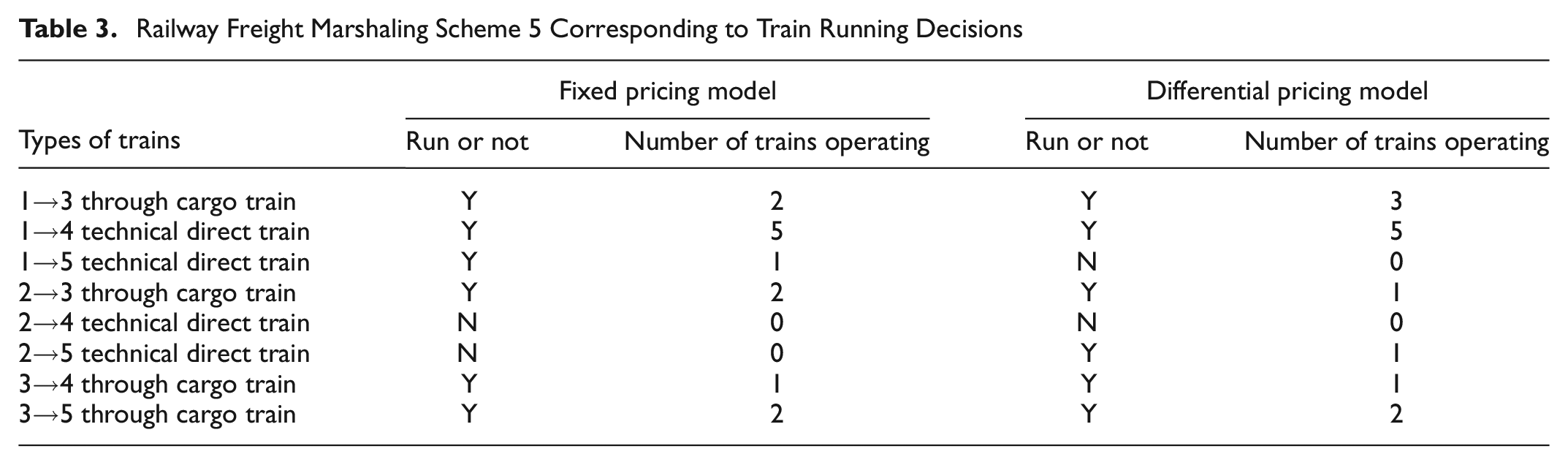
By solving the optimization model of train operation decision based on fixed price and differential pricing, marshaling scheme 5 can maximize the profit of the railroad company under the condition of meeting the road network and market competition. The revenue of the marshalling scheme 5 using the fixed pricing model is 1712511.05 CNY and the revenue using the differential pricing model is 265482.657 CNY, and the profit difference between the two is 941871.604 CNY. As a result, differentiated pricing based on the type of goods transported, the type of trains running, and the transport routes can significantly improve the profitability of transport companies compared with fixed pricing decisions. Railway transportation has an advantage in price-sensitive goods because its transport price is lower than that of road transportation. We know that in the market competition of freight transportation over 800 km, railroad cargo transportation has obvious advantages over road transportation. However, because of the constraints of railway transportation conditions, the advantages of time-sensitive and service-sensitive freight transportation are relatively low. The comparison results obtained from differentiated pricing and fixed freight pricing show that the optimal train operation decision scheme based on differentiated pricing can improve the revenue of time-sensitive and service-sensitive cargo transportation, and can flexibly control the freight rate and capacity allocation of each line, which can realize attracting more cargo sources with original lower competitive levels, and then can improve the operating profit of railroad freight transportation. The results of the train operation decision corresponding to the profit maximization of railroad transport operations are shown in Figure 2 and Table 3.
Railway Freight Marshaling Scheme 5 Corresponding to Train Running Decisions
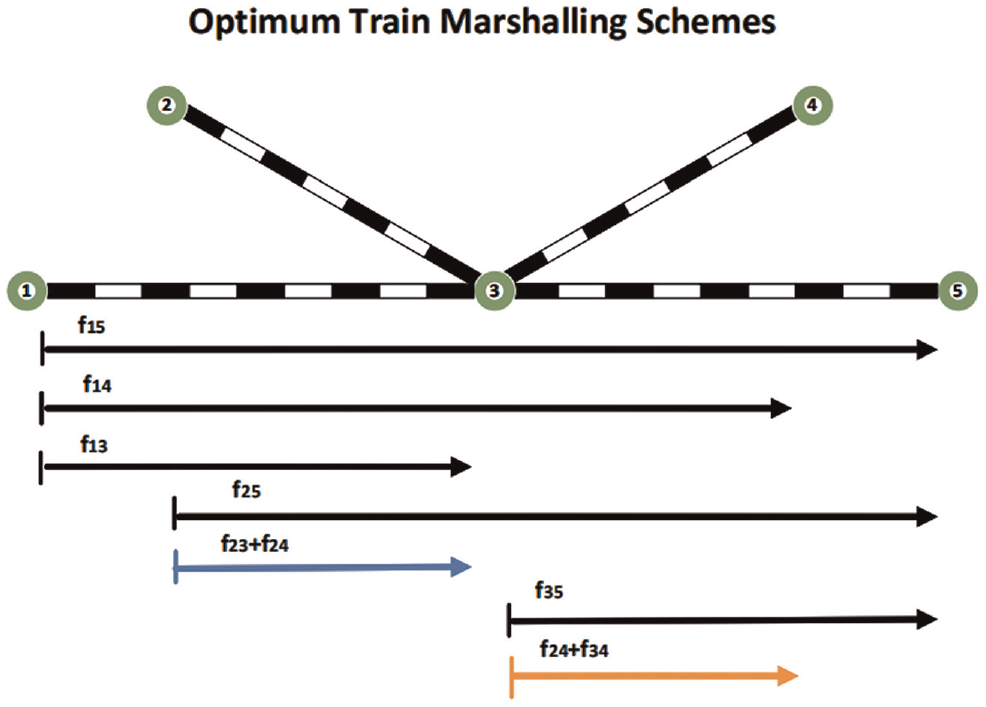
Optimum train marshaling schemes.
Figure 2 shows the details of marshaling scheme 5, which is the optimum train marshaling scheme from among the 16 marshaling schemes generated by the exhaustive method, as shown in Table 2. In Table 3, “Run or not” means to run this type of train or not to run this type of train. As can be seen, the number of 2→4 technical direct trains in operation is zero, therefore, this type of train is not run. Figure 2 shows that 2→4 technical direct trains stop operation, and the 2→4 OD cargoes are shipped by 2→3 through cargo and 3→4 through cargo train.
Table 3 shows the performance of marshaling scheme 5 under two different pricing methods. There are some differences in decision-making on opening lines. Under the fixed pricing method, the number of 1→3 through cargo train runs is two trains, but under the differential pricing method, the number of 1→3 through cargo train operating is three trains. Under the fixed pricing method, the number of 2→5 technical direct trains operating is zero trains, but under the differential pricing method, the number of 2→5 technical direct trains operating is one train. Based on the original bi-level model formula (Equation 7) for the integrated and optimal reconstruction of differential pricing and train operation decisions for railroad freight, the addition of the inequality optimization solution process, which is Equation 15, strengthens the correlation between differential pricing and freight volume decisions. By using the IBM ILOG CPLEX solver to obtain the solution results, adding inequalities does not affect the results of the model. The result of the solution is consistent with that of the original differential pricing optimization model. However, the advantage of adding inequalities in solving examples is that the integrality gap of branch-and-bound root nodes GAPr is obviously reduced by adding inequalities. The calculation of the GAPr value is the difference between the objective value of the problem and the objective value of the initial solution divided by the objective value of the initial solution. The results of the comparison between the original model and the improved model GAPr are shown in Table 4.
Comparison Between the Original Model and the Improved Model
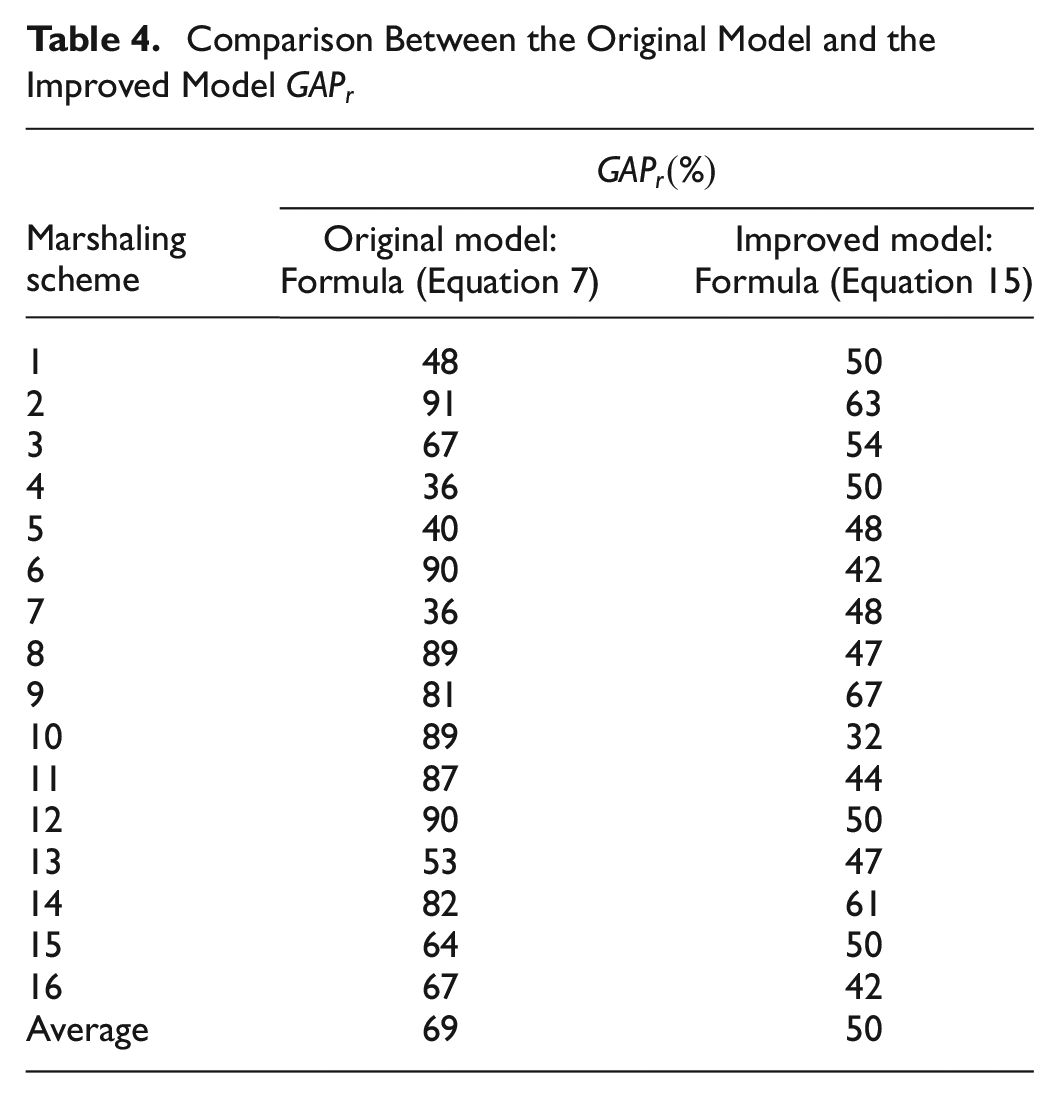
As shown in Table 4, the integrality gap GAPr of branch-and-bound root nodes decreased by 19% on average. Although the inclusion of the inequality solution more or less increases the solution computation time, the precise algorithm of adding inequality can provide help for solving more extensive examples in the future, so this method is worth studying, and the precise algorithm could provide practical help.
Conclusion
In this paper, using the integrated optimization model of train operation decision based on differential price, we can identify the train operation decision with the highest total profit of the railroad freight company. The optimal differential pricing scheme corresponding to the train operation decision is also given for comparison with the revenue by using fixed pricing. The model can be improved by proposing an efficient inequality to strengthen the relationship between differential pricing and freight volume decision variables. The integrality gap between the branch and the root node of the constraint tree can be reduced by 19%, and the solution accuracy of the IBM ILOG CPLEX model is optimized for solving more examples in the future. However, the simplified railroad transportation network chosen in this paper allows for a lower computational complexity that can be listed by the exhaustive method of train grouping plans. Future work will focus on the in-depth study of more complex issues in railroad transportation organization, such as multimodal transportation organization and management of empty railcars allocation to achieve comprehensive optimization of pricing decisions and train operation decisions under complex transportation networks.
Footnotes
Author Contributions
The authors confirm contribution to the paper as follows: study conception and design: J. Zeng, X. Zhang; data collection: J. Zeng, X. Zhang, K. Jin; analysis and interpretation of results: J. Zeng, X. Zhang; draft manuscript preparation: J. Zeng, X. Zhang, K. Jin. All authors reviewed the results and approved the final version of the manuscript.
Declaration of Conflicting Interests
The author(s) declared no potential conflicts of interest with respect to the research, authorship, and/or publication of this article.
Funding
The author(s) disclosed receipt of the following financial support for the research, authorship, and/or publication of this article: This research was supported by the Fundamental Research Funds for the Central Universities 2021PT207.

Data Accessibility Statement
The data used in this study are not accessible.