




Abstract
Individual travel prediction is very important for the construction of intelligent urban transportation systems. Previous studies mainly focus on the improvement of algorithms, but pay little attention to the mining of data information. In this paper, the concept of the travel pattern is introduced into the field of individual travel prediction of frequent bus passengers. The travel pattern of passengers refers to the trip with similar boarding time and similar boarding and alighting stations of the same person. Through clustering the travel pattern by DBSCAN algorithm, the regularity of passenger travel can be better exploited and travel information can be integrated into a unified unit as well. In the process of prediction, we first predict whether the passenger will travel, and then, if so, predict the probability distribution of the next trip conditional on the previous one. The proposed method is tested using the Automatic Fare Collection data of Chengdu’s frequent bus passengers in May 2019. Based on travel pattern, the average accuracy of travel information prediction is about 41%, which is 13% higher than the method without using travel pattern. Furthermore, this paper also discusses the influence of spatial threshold in clustering on the prediction results.
Keywords
Individual travel prediction is based on a disaggregate model, which takes the differences between individual trips of passengers into account. Compared with group research using the aggregate model, individual travel prediction aims to provide personalized services for passengers. Nowadays, with the concept of MaaS (Mobility as a Service) being further popularized, the prediction of individual demand is more and more important. Furthermore, individual travel prediction is also one of the key factors to support various applications of the intelligent traffic system, such as personalized traveler information, targeted demand management, and dynamic system operation, which can effectively improve the customer experience and the performance of the traffic system (1).
In regard to prediction content, previous studies mainly focused on the location that the user will visit next ( 2 ) or the location of the user in the next timestamp (often set as an hour) ( 3 ). In this kind of problem, the prediction accuracy tends to be higher when people have lower travel frequency ( 3 ). However, in transportation, we pay more attention to the few hours when people travel ( 1 ). Therefore Zhao et al. ( 1 ) take next trip as the prediction object and trip information as the prediction content to predict whether passengers will travel and attributes of the next trip, which are composed of trip start time T, origin O, and destination D. They predicted the three travel attributes respectively according to the order of T, O, D, and the real values of T and O are used to predict the following travel attributes. However, this method is meaningless in reality, for the real O can be obtained while getting the real T in the public transport system. In this paper, we will predict all the travel attributes at the same time because of the strong correlation between spatial and temporal attributes in travel, which is a key point that has never been noticed in the previous literature.
In regard to data sources, the most commonly used data set is mobile phone data ( 2 ); in addition, there are Wi-Fi data ( 4 ), global positioning system (GPS) data ( 5 ), and so on. These kinds of data are generated by non-transportation activities, and cannot be interpreted as travel behavior directly ( 1 ). Generally, the information we can get from such data is the location of the user at regular intervals (depending on the collection time interval of the device), whereas the start time, origin, and destination of each trip cannot be obtained directly. And, it is difficult to convert such data into travel behavior because of the correlated but distinct personal preferences which vary across individuals (6). Another kind of data is collected from urban transportation systems, such as the transit smart card data ( 7 – 9 ) adopted in this paper. This kind of data is obtained by individual travel decisions, including the start and end stations of the travel and the corresponding timestamp. Thus, transit smart card data can be used to predict the next trip in real time according to the passenger’s travel decision, which is also very important because the demand of the individual is time sensitive.
Although several algorithms have been proposed for individual travel prediction, there is no existing model for the prediction of all of the travel attributes of the next trip at the same time. Previous studies mainly focus on the improvement of algorithms, but pay little attention to the mining of data information. Most of them only describe the phenomenon of travel, or summarize some travel rules in some aggregate methods, but lack mining the historical travel rules of individual passengers. Therefore, this paper introduces the concept of the individual travel pattern (which will be discussed in next section) into the field of individual travel prediction, and establishes a real-time prediction model for all of the travel attributes of the next trip of the individual passenger. The result of whether to use the travel pattern for prediction will also be compared by using the IC card data of Chengdu, China in this paper.
The rest of this paper is organized as follows. The second section reviews the literature related to this paper. The third section covers the data set and the preparation of data. The fourth section introduces the clustering method of travel patterns and the algorithm of individual travel prediction based on travel patterns. The fifth section will use Chengdu’s IC card data to evaluate the effects of algorithm.
The influence of spatial threshold in clustering on the prediction results is discussed in the sixth section. Finally, the conclusion of this paper is given.
Literature Review
Most existing methods for individual mobility prediction are based on modeling sequential patterns of individual location histories, and the most common way is to model the location sequence by Markov chain (MC). Lu et al. proved that even the simple MC model can achieve high prediction performance in the question of next location prediction ( 10 ). Gambs et al. proposed a mobility Markov chain to discuss the influence of the previous k locations on the prediction results, and they found that the accuracy of predicting the next location can reach 70–95% when k = 2 ( 11 ). And when k increases, the prediction result will not improve much, but it will lead to calculation difficulty caused by the increase of the number of transition probabilities. This kind of research only considers the spatial attribute of travel and ignores the temporal attribute of travel. Alvarez-Lozano et al. used a hidden Markov model to propose a spatio-temporal prediction approach to forecast user location in a medium-term period (0.5 h–7 h) which considers that the users may have a different mobility pattern for each day of the week ( 12 ). However, they still did not match the travel time and location together.
From Table 1, it can be found that the aforementioned methods mainly focus on the next location prediction problem. In this paper, we focus on the problem of next trip prediction, which includes spatial and temporal attributes together. Zhao et al. proposed a Bayesian-based n-gram model, which divides the travel prediction into two parts: whether to travel or not and next trip attributes ( 1 ), and divides the trip into the first trip of the day and other trips. Compared with the MC method, the prediction of T (travel time), O (boarding station), and D (alighting station) is improved by 10.6%, 7.5%, and 10.2%, respectively. Although the model can predict individual travel information, it still separates T, O, and D, which means that the prediction results of T and the first trip information of the day are not good. And when TOD is combined to predict together, the prediction accuracy of the first trip of the day and other trips are only 23% and 29.4%. The above methods all directly use individual historical travel data without mining potential information such as patterns and rules in personal travel history. In the vehicle trajectory prediction, Wang et al. used the method of segmented trajectory clustering to predict the destination of the vehicle ( 13 ). It segmented the sub-trajectories through the Douglas–Peucker-based algorithm for clustering the sub-trajectories, and then used the neural network method to predict the destination of the vehicle. This method achieved better results by using the historical regularity information of the vehicle compared with the method based on MC. However, this method of clustering passengers’ travel regularity before prediction has not been adopted in the field of bus passenger so far.
Summary of Existing Studies of Mobility Prediction

IC card data have the characteristics of large data volume, wide coverage, and high authenticity. In addition, because of the immutability of the passenger ID, long-term travel data for the same passenger can be obtained, which provides the possibility of mining the travel patterns of passengers and predicting the travel of passengers. The concept of travel pattern, which refers to the trip with similar boarding time and similar boarding and alighting stations, is usually used in the study of the regularity of bus passengers. Zhong et al. identified the quasi-periodicity of transit behavior ( 14 ); Goulet-Langlois et al. concluded that the sequence of travel events is an important part of travel pattern ( 9 ); Medina used a week’s IC card data and 1% of the residents’ travel survey data to obtain the main activity patterns of passengers ( 15 ). Through the study of travel pattern, it can be found that the travel of bus passengers is implied imply with regularity. Unfortunately, these findings about travel patterns have not yet been applied to bus passenger travel predictions.
In summary, the previous study of individual travel prediction has mainly focused on the improvement of methods, and MC or Bayesian distribution are mainly used to predict one single attribute of passenger travel or different travel attributes separately. However, the mining of spatio-temporal regularity which may be hidden in the individual travel data is missing. In regard to vehicle trajectory prediction, some scholars have begun to use the trajectory clustering method for prediction, and have achieved better results. For bus passengers, several studies have shown that their travel is associated with regularity, and the travel patterns of passengers can be obtained through clustering. Therefore, the use of travel pattern in travel prediction is applicable to bus passengers. At the same time, the travel pattern integrates travel information which is more in line with individual travel prediction.
Data Preparation
This paper takes the bus IC card data of Chengdu, China in May 2019 as an example. Chengdu has a complex bus network and many bus passengers, with about 700 bus lines and over 8,000 bus stations. As shown in Figure 1 below, Chengdu bus stations are very densely distributed. In the area within the Third Ring Road (the red area in the Figure 1), there are more than 2,500 stations within a 200-square-kilometer area. Such a high-density distribution of bus stations lays the foundation for citizens to use public transport to travel. According to the IC card data of Chengdu in May 2019, the number of cards is 4,519,735, and the number of trips is 96,065,229. The average number of daily trips on weekdays and weekends are 3,451,356 and 2,358,674. This shows that many Chengdu citizens use public transportation as a way of travel, which provides a realistic basis for the research in this paper.
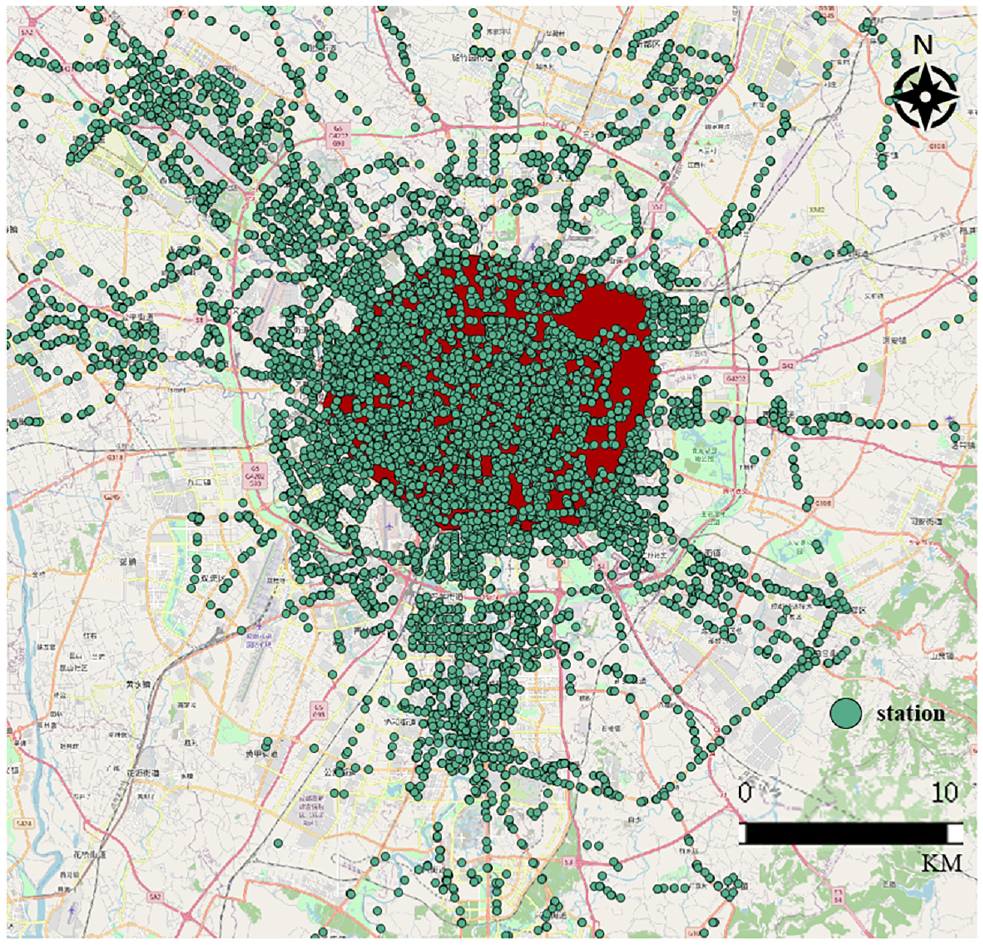
The map of bus station in Chengdu, China.
For Chengdu’s intelligent public transportation system, Automatic Fare Collection (AFC) data record information such as card number, card type, consume time, bus line ID, and vehicle ID; Automatic Vehicle Location (AVL) data record vehicle operation information for each bus; and Geographic Information System (GIS) data records the GPS information for each station. Through the fusion of GIS data and AVL data, the error records in GIS data will be corrected. Through the fusion of AFC and AVL data, the travel information of bus passengers can be inferred. The calculation of the boarding station is done mainly by matching the IC card and the GPS data of the bus, and selecting the location of the bus stop at the time of swiping the card as the boarding station. As passengers do not need to swipe their cards to get off, their alighting station needs to be inferred according to some assumptions. The two basic assumptions most commonly used are: (1) for two consecutive trips, the alighting station of the current trip is closest to the boarding station of the next trip; (2) the destination of the last trip of the day is the boarding station of the first trip of the previous day ( 16 – 18 ). For the identification of passenger transfer, this paper modified the two-stage transfer identification method of Nassir et al. ( 19 ) by using the actual walking distance obtained from Gaode map to replace the Euclidean distance between transfer stations. Finally, the calculated success rate of boarding station is 95.61%, and that of alighting station is 78.06%.
Among bus passengers, not only are there those who rely on public transport for most (or even all) travel, but also included are passengers who occasionally use public transport as a transfer method between different modes of transportation. Because the latter type of passengers use public transport less frequently and travel irregularly, in previous research scholars have usually deleted them from the research object by setting certain criteria. Zhao et al. selected passengers with more than 60 travel days and average trip rate over 1.99 per active day as the research object from 2 years of railway travel data in London ( 1 ); Goulet-Langlois et al. selected passengers with more than 10 trips in 1 week as the research object from 1 month’s London bus card data ( 9 ). In this paper, we used the travel frequency to filter the frequent bus passengers. This paper selects passengers who travel at least 60 times as the research object (travel at least twice a day on average). The problem of travel prediction for bus passengers with low-frequency trips is beyond the scope of this paper. After filtering, a total of 16,486,171 trips by 199,073 passengers entered the research dataset. Although only 4.4% of passengers were selected, these passengers made up 22% of all trips.
Methodology
Problem Formulation
The individual travel prediction studied in this paper is a dynamic prediction of passengers’ next travel information based on passengers’ historical travel pattern. People usually travel in days, so the prediction interval in this paper is 1 day (0:00–24:00). Dynamic prediction means that the real-time travel information of the passengers will be used to modify the last prediction result and continue to predict the next travel information under the revised results. Based on Zhao et al. ( 1 ), this paper divides travel prediction into the following four questions:
P1: Predict whether the passenger will travel on that day;
P2: Predict whether the passenger will make another trip based on the last trip observed;
P3: Predict the first travel information when the passenger will travel on that day (result of P1);
P4: Predict the next travel information when the passenger will make another trip (result of P2).
In this paper, we predict the passengers’ travel at the daily level, and exact the travel sequence by preserving the order of trips in the day. The travel sequence is represented as Equation 1. The

In this way, P1 and P2 can be convert to predict whether
Algorithm of Individual Travel Prediction
The problem of P1 and P2 can be solved by a logistic regression model. For the problem of P3 and P4, we adopt the n-gram model which was introduced into the field of mobility prediction by Zhao et al. (
1
). The n-gram model is usually used to estimate the probability of different word sequences, and supports a series of applications such as speech recognition and machine translation. In this paper, the travel sequence
The n-gram model is based on the following assumption: the occurrence of the nth word is only related to the previous (n–1) words and has nothing to do with other words. The probability of the whole sentence is the product of the probability of each word in the sentence. Suppose a sentence

The

The probability value of


For the above four questions (P1–P4), we use the prediction method which is shown in Equations 6–9, and it will be represented by TI in the following.




The
Algorithm of Travel Pattern Identification
The direct use of travel attributes (
Through the research on bus passengers in previous literature (
9
,
14
,
15
), it can be found that some passenger trips have the same travel pattern, which means these kinds of trips have similar boarding time and similar boarding and alighting stations. Therefore, this paper introduces the concept of travel pattern into the prediction of individual travel. For the trips with travel patterns, we can establish the travel pattern sequence

The
The method of travel pattern identification in this paper is density-based spatial clustering algorithm with noise (DBSCAN). For IC card data, the greatest feature of DBSCAN algorithm is that there is no need to pre-determine the number of clusters, which is not available in other classical clustering algorithms (such as k-means, Gaussian mixture model, etc.). This feature is very important for the travel pattern because the number of individual travel patterns is unknown ( 20 ). Another clustering algorithm which also does not give the number of clusters in advance is the hierarchical method. However, it cannot be applied to large-scale data sets because of its low efficiency. The comparison of classical clustering algorithms is shown in Table 2. Therefore, DBSCAN algorithm is the most commonly method used in the study of travel pattern.
Comparison of Classical Clustering Algorithms

For the DBSCAN algorithm, there are two key parameters that need to be defined: radius distance (
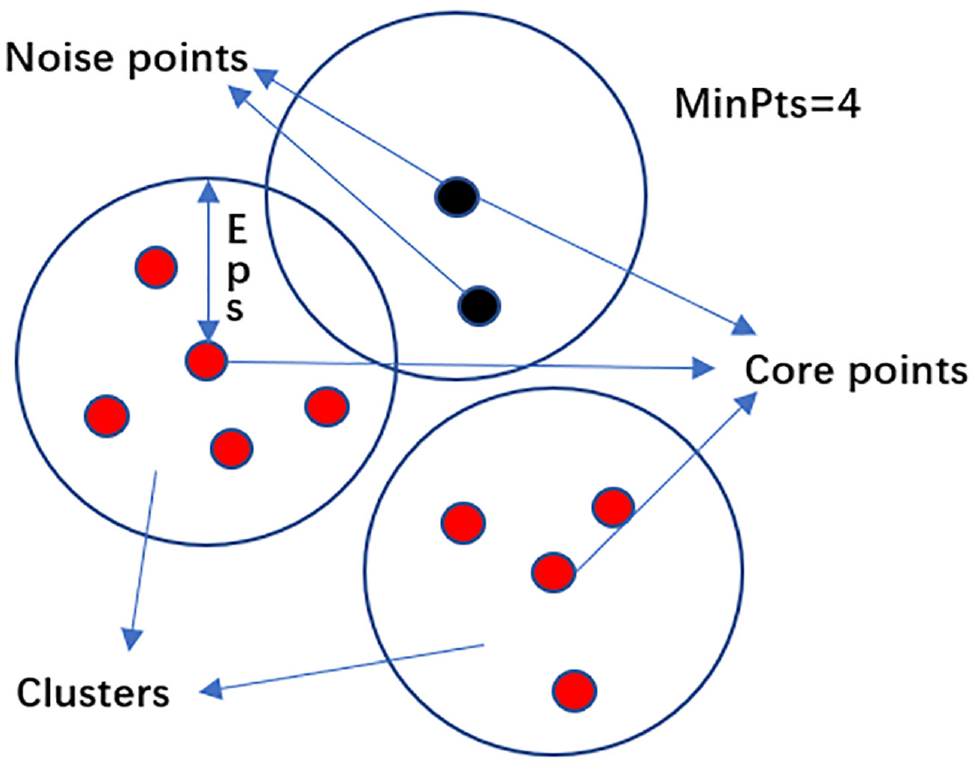
Algorithm diagram of DBSCAN.
The travel pattern of passengers has three attributes: T, O, and D, so a dual-neighborhood DBSCAN algorithm is adopted in this paper, in which the neighborhood radius1 (

As shown in Figure 3,
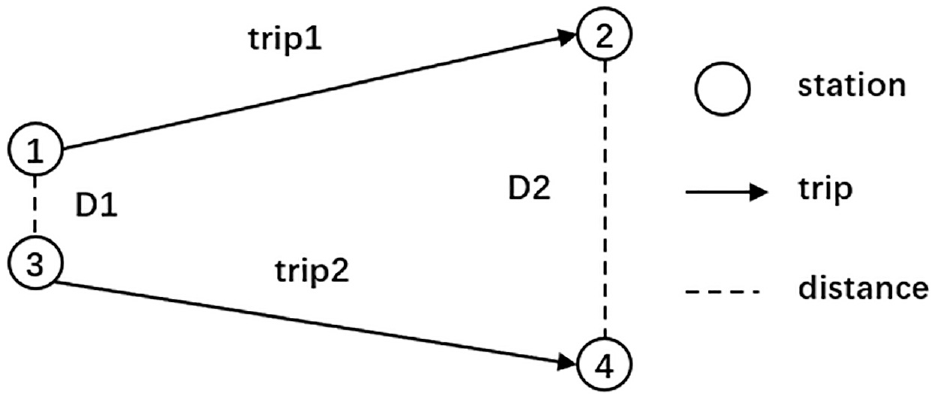
Distance diagram between travel patterns.
To obtain follow-up passenger travel prediction results accurate to the station, the
Therefore, the algorithm of travel pattern identification is as follows:
Step 1: Randomly extract one unused record from the passenger travel data set, mark it as used and form a cluster;
Step 2: Check the boarding time difference between unused records and the record just extracted. If the different is less than 1 hour, move to step 3, else repeat step 1;
Step 3: Check the spatial distance between unused records and the record just extracted. If it is equal to 0 m, mark the record as used and store it in the cluster generated in the first step, else repeat step 1;
Step 4: For each cluster, if the number of records contained is less than 4, all records in the cluster will be marked as noise; If it is equal to or greater than 4, it will be confirmed as a new cluster category;
Step 5: Continue steps 1 through step 4 until all records in the data set are marked as used.
Step 6: Extract the data of another passenger and repeat steps 1 to 5 until the data of all passengers are marked.
For the trips for which we can obtain a travel pattern, we use the prediction method based on travel pattern, and the method is represented by TP in the following. The prediction method is shown in Equations 12 to 15:




On the basis of TI, TP uses travel pattern
Case Study
Result of Travel Pattern Identification
This paper takes the card number 30001746 as an example, and the travel pattern results obtained by the method above are as follows (Table 3).
Example of Identification Results of Passenger Travel Pattern

Analyzing the proportion of travel patterns for all research objects, the number of journeys with pattern is 532,503,323, which accounts for 32.3% of the total number of trips.
Result of Prediction
This paper randomly selects 10 passengers as a sample to make predictions. Taking the first 3 weeks of the data as the training set to predict the travel information for the fourth week, this paper compares the two methods of TI and TP. The overall prediction results are shown in Table 4. The prediction accuracy in the table is equal to the number of correct predictions in the travel data divided by the total number of travel data. The correct prediction in this paper refers to the correct prediction of the overall travel information, which means that the difference between the predicted time and the actual value is less than 1 h (this is to correspond to the threshold of
Comparison of Overall Prediction Results

It can be seen from Table 4 that the overall prediction accuracy of TP is improved by 6% compared with TI. Further analysis of travel prediction accuracy with travel pattern (37% of trips have travel pattern), TP accuracy is 41%, which is 13% higher than TI. This shows that TP has a better predictive effect in travel with travel patterns.
We further analyze the travel with travel patterns, and compare the accuracy rates of the four questions in Table 5. For the two classification problems of whether to travel such as P1 and P3, the prediction accuracy between TI and TP is similar in general. Although there is a 2% drop on P3, this is mainly because of the volatility of the data. For the prediction of travel information, there is a significant improvement between the two methods. The prediction accuracy of P2 has been improved by 11%, and the prediction accuracy of P4 has been improved by 15%. This shows that the method that based on the travel pattern has a certain improvement in the prediction of travel information.
Comparison of Travel Prediction Results With Travel Patterns

Further analysis the accuracy of travel prediction at different stages with travel patterns, as shown in Figure 4, we find that no matter which method is used, it shows a gradual upward trend except for the first trip each day, and the prediction results of TP are all higher than TI. However, as many trips are mainly concentrated in stages 1 to 3, the overall prediction improvement is not as obvious as shown in Figure 4. Through further analysis, it can be found that the rates of increase of the two lines in Figure 4 are similar, which means applying the clustering method can extract the most likely travel pattern from different combinations of next travel (start time, origin, and destination) to improve the prediction accuracy.
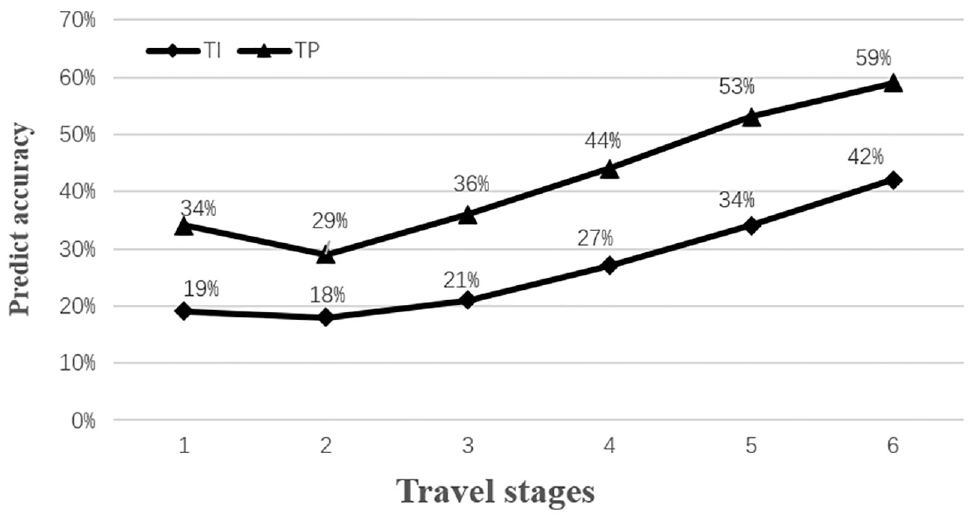
Comparison of prediction accuracy in different travel stages.
In summary, the use of travel patterns can effectively improve the prediction accuracy of passenger travel information. Although the overall improvement is only 6%, the prediction accuracy is increased by 13% for the trips with travel patterns. This shows that it is effective to introduce the concept of travel pattern in the field of bus passenger travel prediction.
Discussion
As shown in Figure 1, the distribution of bus stations in downtown Chengdu is very dense. Considering the arrival of the bus, passengers may choose similar routes to reach a neighboring station for the same destination instead of choosing the same boarding and alighting stations every time. So, as shown in Figure 5, it is reasonable to use active areas to replace stations when the prediction does not need to be accurate for each station ( 21 ).
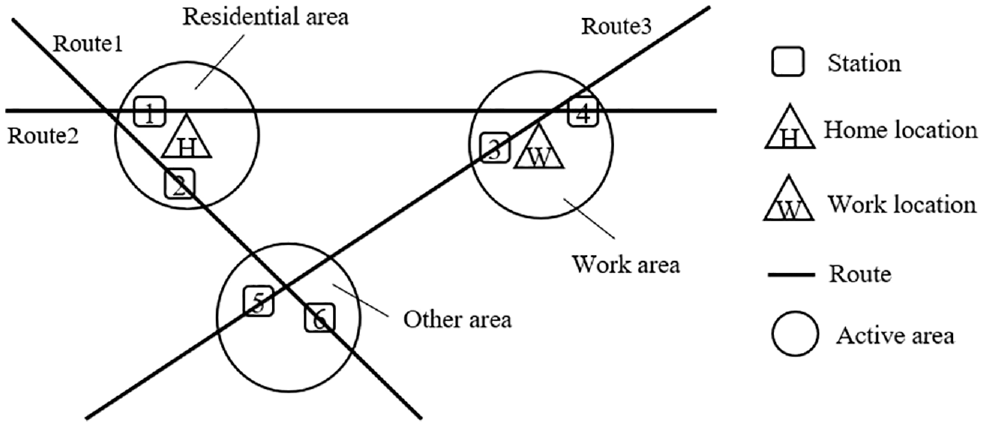
Schematic diagram of station distribution in passenger activity area.
In this paper, we experimentally set the threshold of
Example of Pattern Fusion

We define the method of predicting using the modified travel pattern based on active areas as TP’. The prediction results of TP and TP’ are compared, as shown in Table 7. The accuracy of all travel prediction has been improved by 5%, and the accuracy of travel prediction with travel patterns has been improved by 9%.
Comparison of Overall Prediction Results

We further analyzed the trips with travel patterns, and the comparison results of the four questions are shown in Table 8. For both P2 and P4, TP’ is increased by 8%. This shows that under the premise of reducing the accuracy of spatial prediction, relaxing the spatial threshold can effectively improve the prediction results.
Comparison of Travel Prediction Results With Travel Patterns

Conclusions
This paper proposes an individual travel prediction algorithm based on travel pattern by using the travel data of bus passengers. When predicting individual travel information, the algorithm first excavates the individual historical travel rules, and integrates the travel information into travel pattern for prediction. First, this paper uses the DBSCAN algorithm to cluster the historical travel of passengers in space and time, so as to obtain the travel patterns of passengers, then uses the travel patterns to dynamically predict the next journey of individuals, and verifies it by using the data of frequent bus passengers in Chengdu, which proves that this method can effectively improve the prediction results. In addition, this paper also discusses the use of active areas instead of stations to identify travel patterns and predict passengers’ travel, and the result shows that the identification of travel patterns based on active areas can improve the prediction further.
The innovation of this paper is mainly to introduce the concept of the travel pattern into the field of individual travel prediction of frequent bus passengers, and in the identification of travel pattern, considering the choice of space thresholds, a station-based prediction method and an activity area-based method are proposed. This effectively improves the prediction effect. In previous studies, the improvement of the prediction effect was mainly focused on the improvement of the algorithm; this paper shifted the focus from the algorithm to the data, and proposed methods to improve the prediction effect from the mining of passenger travel rules.
There are still a couple of shortcomings in this paper: (1) There is no objective basis for the selection of the threshold of travel pattern. Through the Discussion, it can be found that enlarging the threshold can effectively improve the prediction results, but it will also reduce the accuracy of the spatial prediction. (2) Because of time and technical reasons, only a part of the samples is selected for testing in this paper. The universality of the algorithm still needs further verification.
Based on the shortcomings summarized above, we have the following prospects for future research directions: (1) As the thresholds for travel pattern clustering are artificially defined, a scientific method is required to dynamically determine the thresholds according to different data and different research demands. (2) The impact of passenger travel behavior (such as transfers and number of interchanges, etc.) on travel pattern clustering and individual travel prediction needs to be further studied. (3) Algorithm problem: The efficiency of prediction algorithm needs to be improved for larger samples and practical application scenarios. In addition, as the main research content of this paper is the application effect of travel pattern in the field of individual travel prediction, the influence of different algorithms on the prediction results is not studied, which also needs further research in the future.
Footnotes
Author Contributions
The authors confirm contribution to the paper as follows: Study conception and design: Ye, Ma; Data collection: Ye; Analysis and interpretation of results: Ye, Ma; Draft manuscript preparation: Ye, Ma. All authors reviewed the results and approved the final version of the manuscript.
Declaration of Conflicting Interests
The author(s) declared no potential conflicts of interest with respect to the research, authorship, and/or publication of this article.
Funding
The author(s) received no financial support for the research, authorship, and/or publication of this article.