



Abstract
Bicyclist injuries are underreported in police crash databases. We explored the value of linking police-reported crash data with emergency medical services (EMS) data within the City of Milwaukee, WI. Using data from 2014 to 2016, we linked records by inspection (identical date, similar time of day, and similar roadway location) and found 154 matching records between the two databases (representing 41% of the 375 police crash records and 44% of the 348 EMS injury records). Matched records were more likely to involve fatal and severe injuries according to police-assessed injury ratings. The two datasets also provided different insights into bicyclist injury crashes. Injuries captured only by police reports were significantly more likely than injuries captured only by EMS to be along high-traffic streets and commercial districts and significantly less likely to be near parks. Nearly all police records described the driver and bicyclist movements (e.g., turning) and operating behaviors (e.g., failure to yield) that had contributed to the crash. In addition to capturing more bicyclist injury events, EMS records revealed additional information about their causes. Twenty-three percent of EMS narratives described falls. These falls involved intoxication, striking a curb, swerving to avoid automobiles or other bicyclists, doing tricks, and getting a tire caught in rail tracks. Another 11% described bicyclists striking objects, including a bus stop shelter, stop sign, fire hydrant, and fence. Although there are strengths and limitations to both datasets, linking police-reported crashes with EMS records produced a broader understanding of bicyclist injuries.
Transportation injury analysis, particularly for vulnerable road users such as pedestrians and bicyclists, has been limited for decades by a lack of complete data. For example, based on crash reports from law enforcement agencies, the National Highway Traffic Safety Administration ( 1 ) estimates that approximately 50,000 Americans are injured in bicycle crashes each year. Yet, safety experts have known for more than two decades that this number is greatly underestimated: even for the most serious bicyclist injuries—those requiring emergency room treatment—only half or fewer may be captured in police databases ( 2 , 3 ). For less serious bicyclist injuries, underreporting is even more drastic, with fewer than one in five injuries captured in many communities ( 4 , 5 ).
Police crash report databases are limited because they usually exclude crashes that do not involve a motor vehicle, such as collisions between bicyclists, pedestrians, and other low-speed vehicles (e.g., electric scooters, skateboards) and falls resulting from surface conditions. Health system data, including death certificates, emergency department records, hospital admission records, and emergency medical services (EMS) records have also been used to evaluate transportation injury risk. Health system databases may also provide incomplete coverage of transportation-related injuries, depending on which parts of the health system did or did not treat the patient. Linking police and health system data has the potential to overcome some limitations of both sources and provide a richer understanding of crash locations and causes, though this has only been done in a few previous studies.
Our study supplements police-reported crash data with EMS data, resulting in a more complete set of transportation injuries within the City of Milwaukee, WI. We focused specifically on bicyclist injuries owing to their underrepresentation in police databases. We chose to examine EMS data rather than other types of health system data because EMS records include geographic coordinates showing where the injury crashes occurred. As one of the first studies to link police crash reports and EMS records, we take an exploratory approach. We compare the two datasets and offer initial insights that can be explored in more depth in the future. We focus on two questions: 1) What overlap and gaps are there between police crash reports and EMS records? 2) What insights into the locations and causes of bicyclist crashes are provided by police crash reports versus EMS records? We conclude by discussing the advantages and challenges of using both of these data sources for bicyclist safety analysis.
Literature Review
Although the transportation safety field has been aware of crash underreporting from law enforcement databases for many years ( 2 ), most U.S. transportation agency safety analyses are based only on police-reported crashes ( 1 , 6–9). However, there has been national interest in creating more complete transportation injury databases. For example, the National Highway Traffic Safety Administration’s Crash Outcome Data Evaluation System (CODES) project supported state-level data linkage initiatives from 1992 to 2013 ( 10 ). Most CODES linkages were between police crash reports and hospital records, but some also connected with medical sources such as EMS and medical examiner records. Despite institutional challenges to linking police and medical system databases ( 11 ), a Centers for Disease Control and Prevention review found that 31 states had attempted some type of data linkage program, and many of these were done as a part of CODES ( 12 ). Other national-level recommendations to supplement police records with medical data have been made by the Safe States Alliance ( 13 ), Collaborative Sciences Center for Road Safety ( 14 ), and the National Cooperative Highway Research Program ( 15 ).
Recent studies combining police data with other sources have been done in North Carolina, Washington, D.C., and Oregon. Harmon et al. developed an algorithm to link police crash reports with hospital emergency department records in North Carolina ( 16 ). Examining bicyclist injuries specifically, they found that 487 (43%) of 1,142 police-reported bicyclist crashes were linked to a hospital record. Bicyclist injuries were more likely to be linked when they were more severe (though not fatal) and occurred during the daytime. Their report notes the technical challenges of matching police crashes with multiple hospital records resulting from transfers between hospitals and followup hospital visits within days of initial treatment. Calma and Jackson gathered raw data from 911 calls in Washington, D.C. ( 17 ). They found that 71 (30%) of 236 pedestrian and bicyclist collisions with vehicles reported to 911 did not have a corresponding police crash report. McNeil and Roll analyzed both police- and EMS-reported pedestrian injuries for the Oregon Department of Transportation ( 18 ). They used EMS data to compare the injury location with the pedestrian’s home address to understand how sociodemographic factors relate to pedestrian safety. Of 888 pedestrian injuries, half occurred less than 1.06 mi from the pedestrian’s home, and pedestrians younger than 16 and older than 64 were more likely than pedestrians of other age groups to be injured closer to home. The results also highlighted the high level of risk experienced by pedestrians living in census tracts with high poverty levels and high Black Indigenous People of Color populations, likely because of the prevalence of factors such as multilane roadways with high traffic volumes and -speeds within these tracts.
Most efforts to combine police-reported crashes with medical records have focused on linkage processes, the prevalence of injury underreporting by each source, the sociodemographic characteristics of injury victims from each source, and differences in how injury outcomes are classified. However, few studies have examined the detailed attributes of matched and unmatched injury records to identify where injuries occurred within the transportation system and what factors may have contributed to these injury events. Further, few linkage studies have focused specifically on bicyclist injuries. We help to fill this gap by linking police- and EMS-reported bicyclist injuries in Milwaukee.
Methods
Our study focuses on bicyclist injuries that occurred in the City of Milwaukee between January 1, 2014 and December 31, 2016. We obtained records for all traffic crashes reported to police from the Wisconsin Department of Transportation ( 19 ). To be included in this source, a crash must be reported by a law enforcement officer, involve a motor vehicle, and occur on a public roadway or private parking lot or driveway (not on a multiuse trail). This database included 15,244 total crash records resulting in an injury, and 375 (2.5%) were bicyclist injuries. We obtained a subset of all EMS records that were flagged as involving a transportation-related injury from the Milwaukee County Office of Emergency Management. Some individual bicyclists experienced injuries to multiple parts of their bodies, and the database contained separate records for each body part that was injured. To match with the police crash database, we combined these records so that there was only one per EMS patient. After cleaning, the EMS database included 10,838 total records, and 348 (3.2%) involved a bicyclist. Note that some of the bicycle injury records in both databases were originally classified incorrectly as pedestrian or motorist injuries. We discovered that these records were classified incorrectly by reading the narrative descriptions of the incident and by cross-referencing the other database. We assumed that the narrative description was correct because it provided more detail than the user type code.
We matched bicyclist injury records from each database by inspection (identical date, similar time of day, and similar roadway location information) (Figure 1). We found 154 matching records in the two databases.
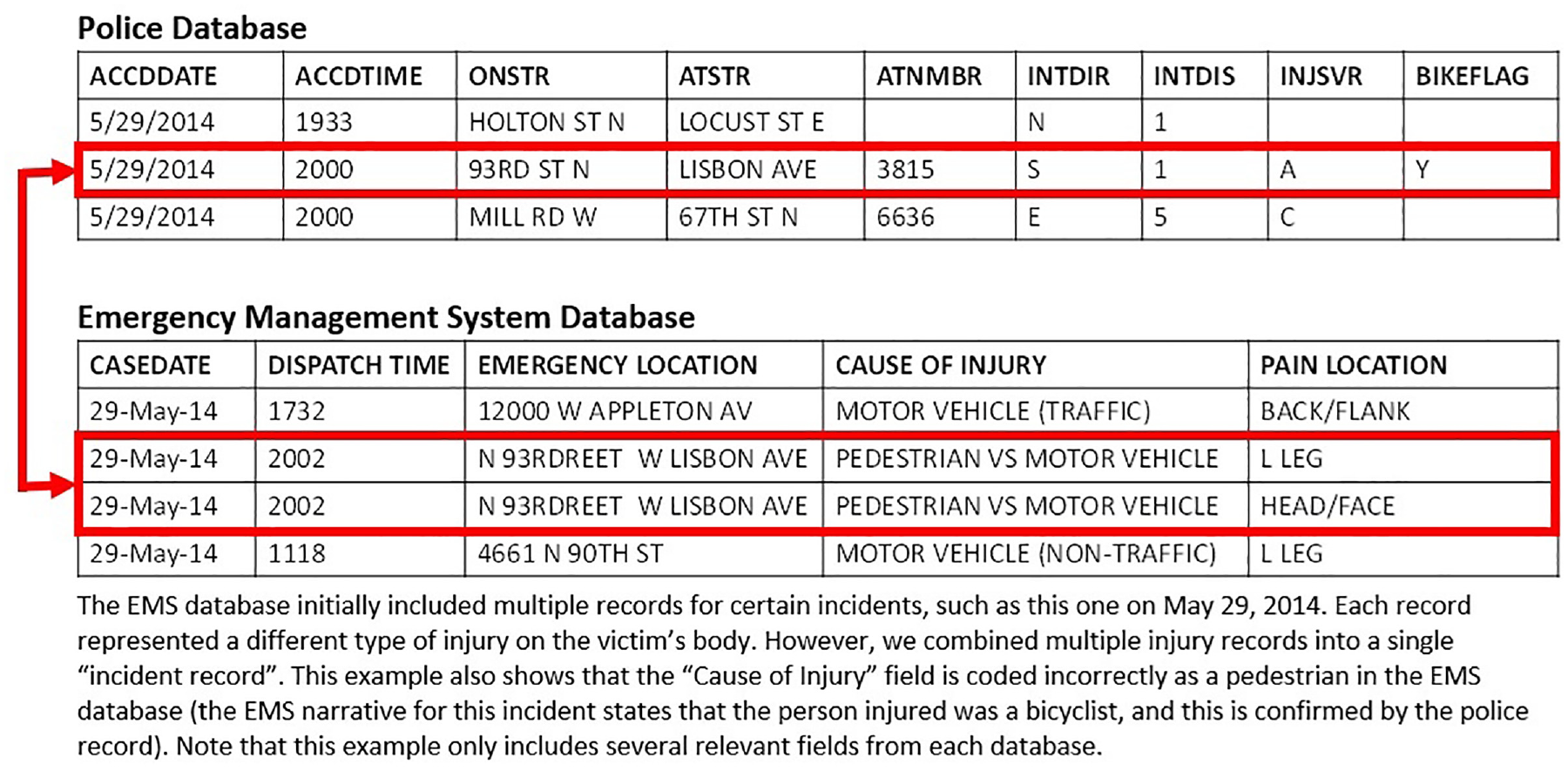
Example of police and emergency medical services (EMS) injury record matching.
We compared the two datasets by (1) examining the spatial distributions of injury-producing bicyclist crashes and (2) summarizing demographic and contextual data from each bicyclist injury record, including information about crash causes. First, we used geographic information system (GIS) software to analyze the locations of each crash. Most police and EMS records had longitude and latitude coordinates. We geocoded incidents that did not already have latitude and longitude coordinates using the address from each record. Then we used GIS kernel density analysis to identify spatial concentrations of bicyclist injuries and examined the proximity of these injuries to several specific transportation features and land uses, including multiuse trails, arterial streets, bus stops, parks, schools, and commercial retail properties.
Second, we examined specific information within the police reports and EMS records related to the cause of the crash. The Wisconsin police crash database has dozens of variables that come directly from each police crash report, including estimated injury severity, driver and bicyclist movements before the crash, contributing circumstances, and alcohol involvement in the crash. The Milwaukee County EMS database includes several details about injury characteristics, vital signs, and medical professionals’ assessments of injury severity. EMS staff prioritize treating and documenting medical conditions (in fact, records often refer to the bicyclist as “the patient”). The most relevant information related to the cause of the crash is included in the narrative description. So we read each available EMS narrative and flagged categories such as being struck by an automobile, striking an object (e.g., utility pole), getting tires caught in a rail track, swerving to avoid something, falling only (not striking anything), doing tricks or stunts, or involving alcohol or drugs. Then we compared information provided by the police reports and EMS records.
Results
Overall, the 154 matching records between the two databases represented 41% of the 375 police crash records with bicyclist injuries and 44% of the 348 EMS records with bicyclist injuries (Figure 2). We first compare the two databases by examining the spatial distribution of bicycle injury crashes captured by each. Then, we discuss factors associated with bicycle injury crashes in each dataset.

City of Milwaukee bicyclist injuries reported by source, 2014 to 2016.
Spatial Distribution of Police and EMS Injury Records
After geocoding the locations of all injury-producing bicyclist crashes, we used kernel density analysis to map spatial concentrations of crashes (i.e., “hot spots”) (Figure 3a). Broadly, bicyclist injuries in both databases tended to be concentrated in high-density areas of Milwaukee, including Downtown and the east side. However, at a finer-grained scale, police-reported hot spots appeared to be in somewhat different locations than EMS-reported hot spots (Figure 3b). We explored these spatial distributions in more detail by analyzing the proximity of each injury-producing crash to the locations of several types of geographic features throughout Milwaukee.
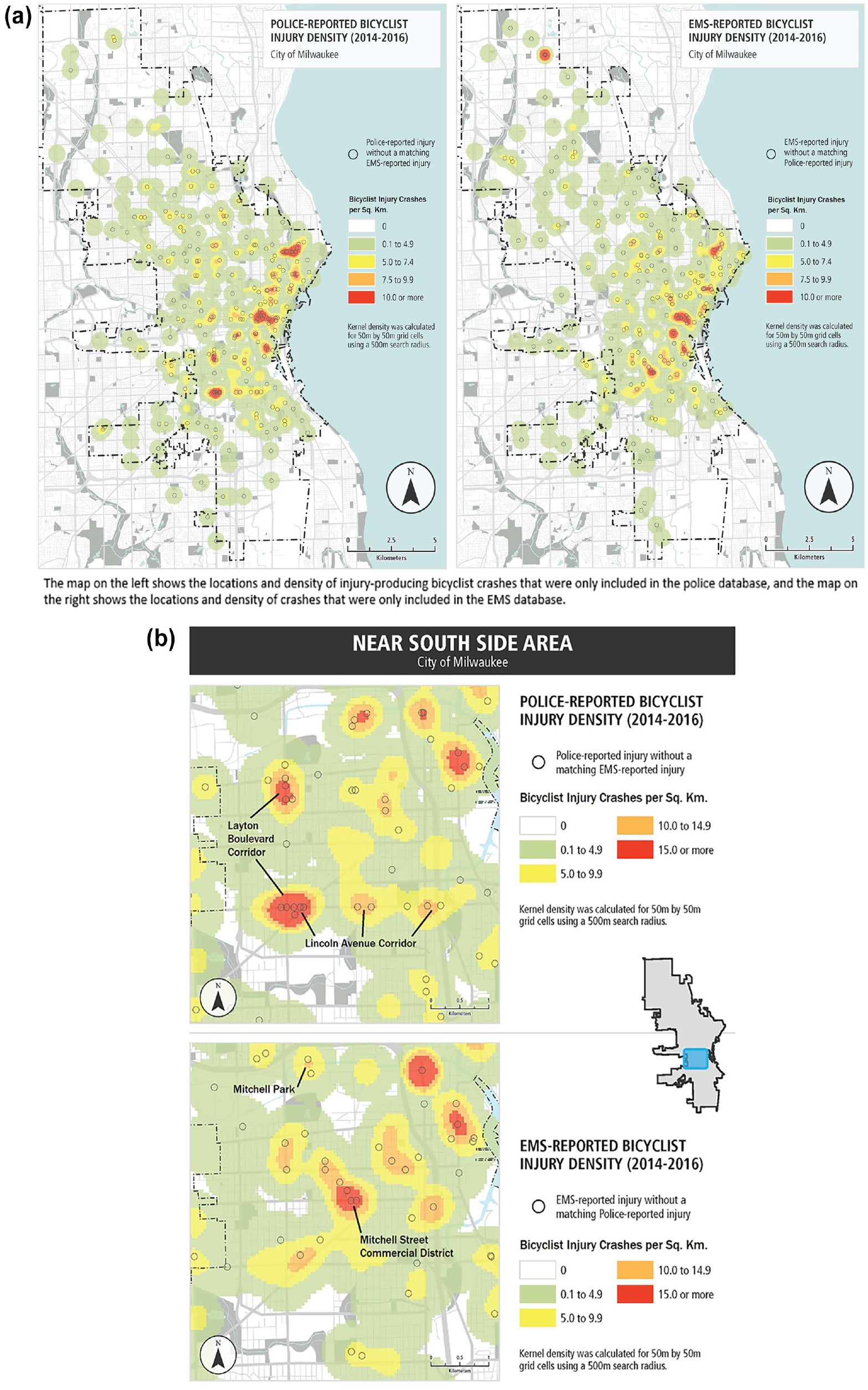
(a) Police-reported and emergency medical services (EMS)-reported bicyclist injury hot spots, citywide and (b) police-reported and EMS-reported bicyclist injury hot spots, near south side area.
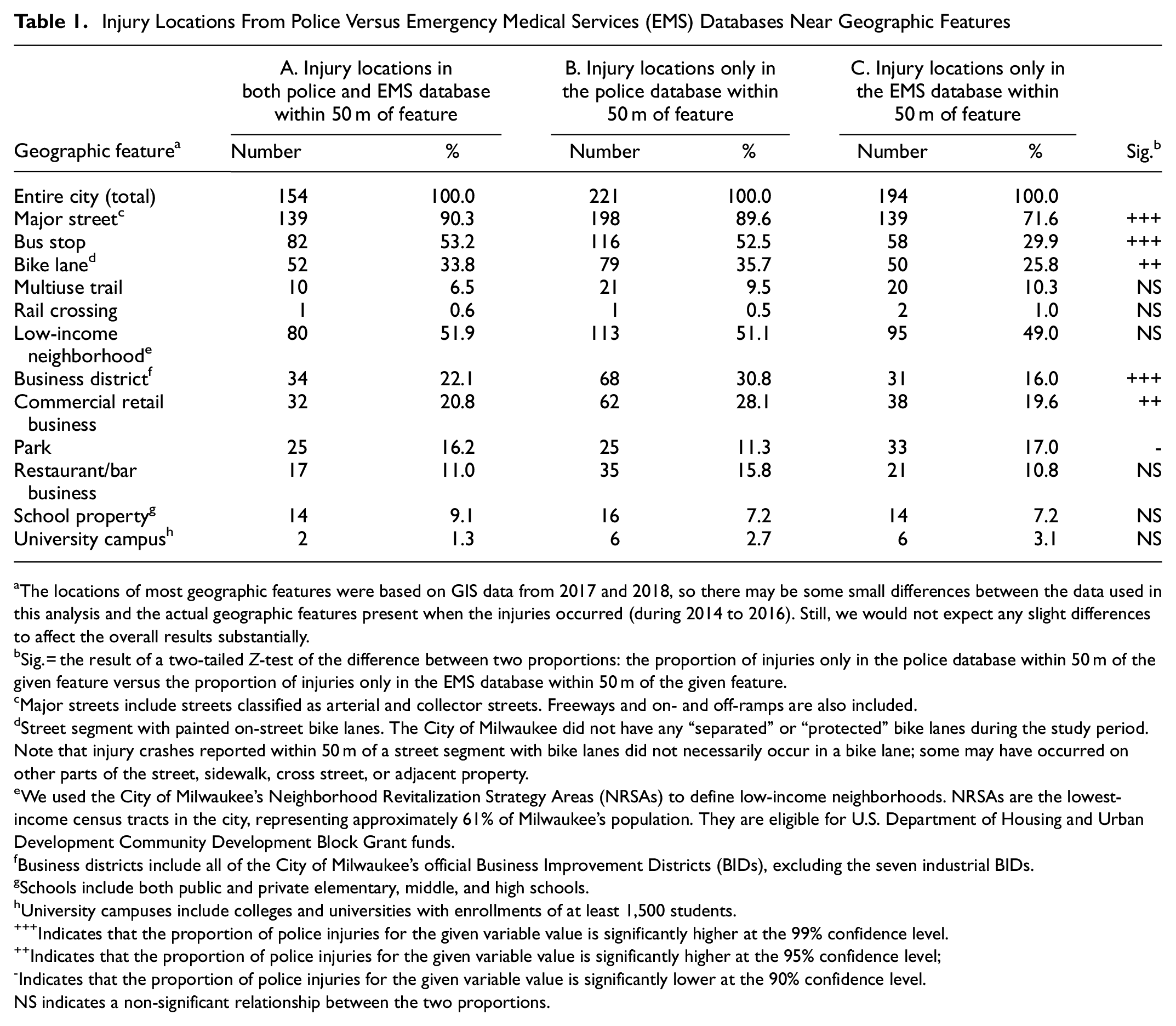
Table 1 shows the types of geographic features near where bicyclist injuries occurred. Column A includes the 154 locations where injuries were captured by both police and EMS sources, Column B includes the 221 locations that were only in the police database, and Column C includes the 194 locations that were only in the EMS database. We conducted a statistical comparison between the percentages in Columns B and C.
Injury Locations From Police Versus Emergency Medical Services (EMS) Databases Near Geographic Features
The locations of most geographic features were based on GIS data from 2017 and 2018, so there may be some small differences between the data used in this analysis and the actual geographic features present when the injuries occurred (during 2014 to 2016). Still, we would not expect any slight differences to affect the overall results substantially.
Sig. = the result of a two-tailed Z-test of the difference between two proportions: the proportion of injuries only in the police database within 50 m of the given feature versus the proportion of injuries only in the EMS database within 50 m of the given feature.
Major streets include streets classified as arterial and collector streets. Freeways and on- and off-ramps are also included.
Street segment with painted on-street bike lanes. The City of Milwaukee did not have any “separated” or “protected” bike lanes during the study period. Note that injury crashes reported within 50 m of a street segment with bike lanes did not necessarily occur in a bike lane; some may have occurred on other parts of the street, sidewalk, cross street, or adjacent property.
We used the City of Milwaukee’s Neighborhood Revitalization Strategy Areas (NRSAs) to define low-income neighborhoods. NRSAs are the lowest-income census tracts in the city, representing approximately 61% of Milwaukee’s population. They are eligible for U.S. Department of Housing and Urban Development Community Development Block Grant funds.
Business districts include all of the City of Milwaukee’s official Business Improvement Districts (BIDs), excluding the seven industrial BIDs.
Schools include both public and private elementary, middle, and high schools.
University campuses include colleges and universities with enrollments of at least 1,500 students.
Indicates that the proportion of police injuries for the given variable value is significantly higher at the 99% confidence level.
Indicates that the proportion of police injuries for the given variable value is significantly higher at the 95% confidence level;
Indicates that the proportion of police injuries for the given variable value is significantly lower at the 90% confidence level.
NS indicates a non-significant relationship between the two proportions.
Injuries captured only by police reports were significantly more likely than injuries captured only by EMS records to be along major streets (90% of police-reported versus 72% of EMS-reported injuries), near bus stops (53% versus 30%), near bike lanes (36% versus 26%), within business districts (31% versus 16%), and near retail businesses (28% versus 20%). In contrast, injuries captured only by EMS were significantly more likely than injuries captured only by police reports to be near parks (17% versus 11%). EMS-reported injuries were also more likely to be near multiuse trails, rail crossings, and university campuses, but these differences were not statistically significant probably owing to the relatively small numbers of injuries in these types of locations.
Note that we used 50 m as our search distance to identify features near each injury location. This distance captured the street where the crash occurred, a nearby intersecting street (if the crash was close to an intersection), and properties or districts adjacent to the crash location. A longer distance threshold could have been used, but that would have captured more features that were not in the immediate vicinity of the crash, potentially diluting the differences between the police- and EMS-reported injury locations.
Content of Police and EMS Injury Records
We examined detailed information about each injury-producing bicyclist crash in both databases. Interestingly, both databases provided important insights, but there was little information besides the crash time, crash location, victim age, and victim sex that was contained in both databases. This suggests that, in addition to representing a more complete set of bicyclist injury events, combining both databases also provides more qualitative information about the causes of bicyclist injuries.
Bicyclist and Driver Age and Sex
Both police and EMS databases provide basic demographic information about the bicyclist who was injured. For example, many injured bicyclists were younger than 20 years old (31% of police-reported injuries; 31% of EMS-reported injuries), but relatively few were older than 59 years old (7% of police; 9% of EMS). Most injured bicyclists were male (77% of police; 81% of EMS).
However, only the police database includes demographic information about the driver. Of the police records, 286 drivers involved in bicycle injury crashes had a reported age and 296 had a reported sex. Eighty-three (29%) of these drivers were younger than 30 years old and 45 (16%) of these drivers were older than 59 years old. Some 167 (56%) of these drivers were male.
Injury Severity and Type
Police and EMS databases provide different information about bicyclist injuries. The police records use a “KABCO” injury severity scale (K = “Killed,” A = “Incapacitating,” B = “Nonincapacitating,” C = “Possible,” O = “No injury”) ( 19 ). According to the police database, two (0.5%) of the 375 bicyclist injuries were fatal and 17 (4.5%) were incapacitating. The rest were less severe. As expected, bicyclist injury records were more likely to be contained in both the police and EMS databases when the injuries were more severe (Figure 4). This relationship between injury severity and database overlap makes sense because EMS are more likely to be called when immediate medical attention is needed. The incapacitating (A-level) bicyclist injuries reported to police but missing from the EMS database could have involved the bicyclist being transported to the hospital by a friend or family member. Other possible reasons why serious injuries may not be captured in EMS databases should be explored through additional, case-by-case research.
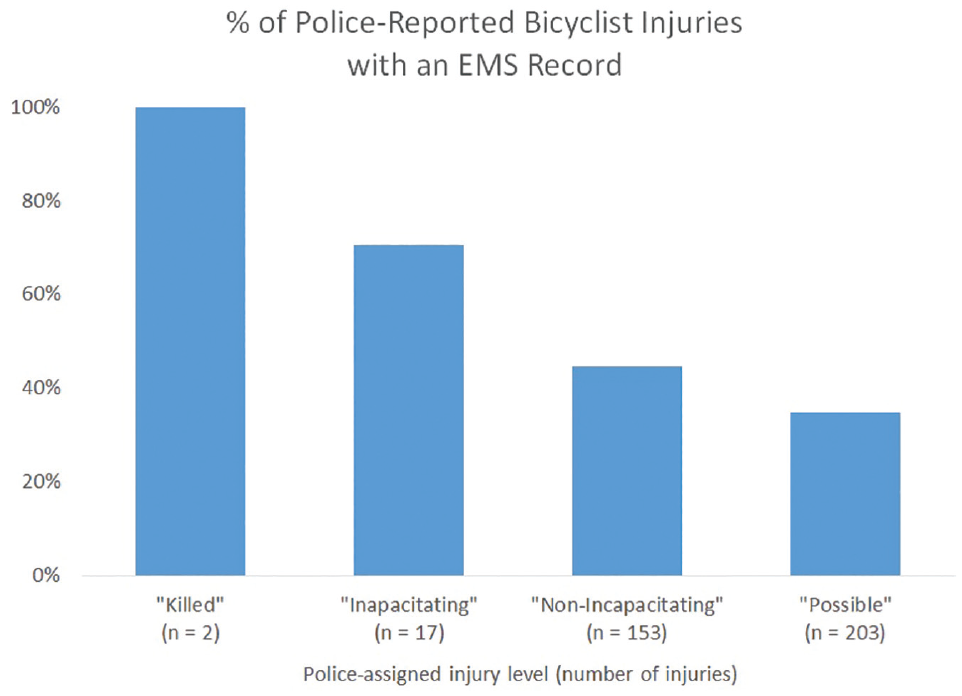
Overlap between police and emergency medical services (EMS) records by injury severity level.
The EMS records provide more details about which body parts were injured, the type of injury (e.g., blunt trauma, laceration), pain, and the impact of the injury on vital functions. For example, the raw EMS records (some of which include more than one injury location per bicyclist) documented 245 injuries. Of these, 95 (39%) were to the head or face, 65 (26%) were to the legs, 59 (24%) were to the arms, and 27 (11%) were to other parts of the body.
Contributing Circumstances
The police and EMS databases each provided different insights into factors that contributed to the bicyclist injury crash. The police crash records included several types of factors that law enforcement officers determined had contributed to the crash. These included motor vehicle and bicyclist turning movements, operating behaviors (e.g., following too close, failure to yield), and roadway conditions (e.g., snow, ice, wet) (Table 2). The Milwaukee police records showed that the most common driver movements in bicyclist injury crashes were going straight (49% of crashes) and turning right (26%). Most bicyclists were going straight (86%). Problematic behaviors contributing to bicyclist injury crashes recorded by police were drivers failing to yield to a bicyclist (29% of crashes) and bicyclists failing to yield to a driver (11%). Police noted snowy, icy, or wet conditions contributing to just over 5% of both drivers’ and bicyclists’ involvement in bicyclist injury crashes. Some 102 (27%) of the bicyclist injuries occurred as a part of hit-and-run crashes, which explains why many of the police records are missing driver age and sex.
Circumstances Contributing to Bicycle Injury Crashes From Police Database

Two records did not show the bicyclist movement because the police crash database only includes movement information for two parties involved in a crash. In these two cases, the bicyclist was at least the third party listed on the crash report.
The EMS database also captured factors contributing to bicyclist injury crashes, but these factors were described as a part of the text narrative rather than coded into specific variables. Of the 348 bicyclist injuries in the EMS database, 186 included a text narrative that described the injury incident (narratives were not available for the other records because they did not include a specified injury). We reviewed and noted specific topics within these narrative descriptions (Table 3).
Cause of Bicyclist Injury Based on Emergency Medical Services (EMS) Narrative Descriptions

Just under half (83, or 45%) of the 186 EMS records mentioned that the bicyclist was injured when struck by an automobile. The majority (63, or 76%) of these EMS records had a corresponding police report. Of the 20 EMS records without a police report, 9 of them (45%) described circumstances that may have contributed to the crash. Five commented about the automobile’s speed. Others mentioned intoxication, vehicular assault, and crossing a parking lot entrance. This represents additional information about motor-vehicle-involved bicyclist crashes that was not available from the police crash database.
Nearly one-quarter (43, or 23%) of the 186 EMS records noted that the injury occurred when the bicyclist fell from their bicycle. None of these 43 EMS injuries were included in the police crash database, so they all provided additional data that the police-based crash analyses would miss. Six of these injuries occurred indoors (e.g., an indoor mountain bike park), and two were on multiuse trails. Of the 43 EMS records about bicyclist falls, 17 (40%) described circumstances that may have contributed to the crash. Eight involved intoxication, three occurred when the bicyclist struck a curb, three involved a bicyclist swerving to avoid automobiles or other bicyclists, three happened when the bicyclist was doing tricks or stunts, and one involved the bicyclist getting their tire caught in rail tracks. The EMS injury data hinted at several possible temporal trends in bicyclist falls. Falls at the indoor mountain bicycle park tended to be in winter (when people do more indoor activity in Milwaukee’s cold climate), and falls on city streets tended to be in early summer (less experienced bicyclists may start bicycling as weather gets warmer).
Twenty (11%) of the 186 EMS records involved bicyclists who struck an object. Of these, nine (45%) did not link with police records. Five of the nine stated that the bicyclist crashed into an automobile (three specified that the automobile was parked, and one specified that the bicyclist struck an automobile door as it was being opened). The other four records involved bicyclists crashing into a bus stop shelter, stop sign, fire hydrant, and fence. Three of the nine EMS records without a police record mentioned that the bicyclist was intoxicated.
Many of the rest (37, or 20%) of the 186 EMS records had an unknown cause of the injury. Most of these narratives only described medical conditions without providing information related to what caused the injury. Although 70% of the EMS records with unknown injury causes did not have a matching police record, they did not add substantial insights about the crash besides an incident location that was not included in the police crash database. The “Other” category included crashes with strange circumstances, such as a bicyclist who cut their finger when reaching down to move their bicycle chain.
Factors included in the EMS narratives may not be reported consistently. For example, helmet use (either with or without) was mentioned in just 12% of the narratives (23 of 186). Also, EMS narratives sometimes referred to the speed of the vehicle or impact speed. However, they often used the undefined terms “high speed” or “low speed,” rather than specific speeds. Sometimes specific speeds are listed, but they appear to be estimated by the bicyclist, driver, or other witnesses. Without specific data fields for helmet use, speed, or any of the aforementioned contributing factors, these attributes may be reported by some EMS staff but not others. Still, having crash details reported in at least some EMS records can help provide a more complete understanding of how bicyclists are injured.
Discussion
Like many agencies, the City of Milwaukee and Wisconsin Department of Transportation base nearly all of their transportation safety analyses on police-reported crash data ( 6 , 20 ). These data can be mapped easily to highlight roadway intersections and corridors that are crash hot spots. With respect to bicyclist safety, police crash reports contain useful information about how the crashes happened, especially driver and bicyclist movements and operating behaviors at the time of the crash. They also include information about both bicyclist and driver demographic characteristics and provide a cursory assessment of injury severity. However, police databases do not capture all bicyclist injuries. By definition, police databases like Wisconsin’s do not include bicyclist crashes that do not involve motor vehicles. They also lack bicyclist injuries from motor vehicle crashes that are simply not reported to police.
EMS databases have the potential to fill some of the gaps in police crash databases. They include geographic coordinates of incident response locations, so they can also identify injury hot spots. Considering bicyclist injuries, EMS records are not limited to injuries that result from crashes with motor vehicles. They include many injuries that occurred when bicyclists struck objects or fell for a variety of reasons. EMS records include more detailed information about where injuries occurred on parts of the body as well as the type of bodily harm.
Overall, the geographic differences between the two datasets likely reflect that police only report crashes that involve motor vehicles. Greater portions of police crashes are along high-traffic streets and near high-traffic locations (e.g., bus stops and business districts). In contrast, EMS databases tend to capture more injuries near parks, trails, and campuses, which are places where bicyclists may be more likely to be injured in other ways besides being struck by a motor vehicle. To provide a more complete understanding of the geographic distribution of bicyclist injuries, safety analysts could combine the two injury databases to provide a composite map of injury hot spots.
Practical Challenges to Using EMS Data
Practically, it is challenging to supplement police crash databases with EMS records for bicyclist safety analysis. Like many other states, Wisconsin’s police crash database can be accessed publicly and has thorough documentation. In contrast, we were only able to obtain the Milwaukee County EMS database through a special request following university Institutional Review Board approval. This is a requirement because EMS databases, in their raw form, contain personally identifiable information, and medical information is particularly sensitive. Further, comparing the police and EMS databases is difficult because of the data structure: the EMS database included multiple injury records for the same bicyclist. Even after consolidating these records, we still needed to link them with each police record so that we could account for overlapping records from each dataset. We did this task by hand, which was feasible with our sample size. However, matching thousands of records would likely require developing and validating a linking algorithm. Each of these steps would be a barrier to a transportation agency with limited resources for safety analysis.
Potential for Making EMS Data More Usable
Some steps could be taken to make EMS records more accessible for bicyclist injury analysis. Transportation agencies could develop partnerships with EMS agencies to remove personally identifiable and sensitive medical data from EMS records and make them publicly available. These agencies could also work together to create algorithms for linking the police and EMS records associated with each specific injury event (which would also involve reconciling multiple EMS records from the same incident that refer to different body parts).
Further, EMS could place greater emphasis on reporting causal factors leading to crashes. Fewer than half (79, or 42%) of the 186 EMS narratives included details that describe circumstances that led to the fall or collision (e.g., bicyclist striking a rock, pothole, or other surface hazard; bicyclist swerving to avoid a vehicle or other hazard; bicyclist losing consciousness; bicyclist not paying attention to what is in front of them; bicyclist simply losing their balance). For example, a section of the EMS record could address, “How did the crash happen?” To accommodate this new information while minimizing excess reporting burden, EMS personnel could be given more training about the types and causes of crashes and how to record them. This process could be formalized by adding new crash cause data fields into the EMS database (e.g., movements of the bicyclist before the crash, type of object struck, what precipitated a fall) or providing a simple crash diagram so that the information could be recorded more consistently than in the written narrative. EMS databases could also have a required field indicating whether or not the bicyclist was wearing a helmet. It is particularly important to gather insights into crash causes since EMS captures so many bicyclist injuries that are not in the police crash database.
The National EMS Information System (NEMSIS) has already made significant progress standardizing EMS-reported variables and has created a publicly available national dataset. However, the publicly available NEMSIS database is currently limited by being a convenience sample of agency-submitted records as well as by not containing specific location coordinates or narrative descriptions of injury-producing incidents ( 21 ). Geographic identifiers and additional information about the causes of bicycle and other transportation-related crashes could be integrated in future iterations of NEMSIS.
In addition to enhancing EMS databases for bicyclist injury analysis, EMS agencies could improve communication with law enforcement agencies to supplement police databases. For example, EMS agencies could flag bicyclist injury crashes involving automobiles that should be in the statewide crash database. Any crashes that have not been documented by the police already could be added to the database. At the very least, sharing information about the locations of injury crashes would make it possible to create more complete hot spot maps.
Considerations and Future Research
Ideally, analysts should have information about all transportation-related injuries that occur in a community. Considering both police and EMS records can help provide a more complete picture of bicyclist injuries. However, this approach is still likely to miss a portion of bicyclist injuries because none of the parties involved in a crash call either the police or EMS. For example, the victim could determine that they have a minor injury that does not need medical treatment. More consequentially, the victim could suffer a severe injury and have someone transport them directly to an emergency room without calling the police or EMS. There may be other situations that lead to injury underreporting, such as a victim being uncomfortable contacting law enforcement or not initially thinking that they sustained an injury that was worth reporting but going to the emergency room the following day because of persisting pain.
The EMS database misclassified many bicyclist injuries as either pedestrian or motorist injuries. Of the 154 matched police records, EMS coded 93 (60%) as bicyclist injuries, 49 (32%) as pedestrian injuries, and 12 (8%) as motorist injuries. We corrected these codes for our analysis. The EMS database also misclassified a pedestrian fatality (the pedestrian was pushing a bicycle ice cream cart, according to the police narrative), and two motorcyclist injuries as bicyclist injuries. We excluded these records from our analysis. In contrast, the police database only misclassified one bicyclist as a pedestrian. EMS classification errors may indicate that these professionals focus more on treating injuries than on understanding their causes, but training could help improve reporting detail and accuracy.
Given the tendency for EMS to misclassify bicyclist injuries, our initial query for injuries produced by bicycle crashes probably missed some bicyclist injuries that had been misclassified as pedestrians or motor vehicle users. However, we would not know which records these were without reading the narratives of the more than 10,000 additional injuries in the raw EMS database that are not currently labeled as bicyclist injuries.
Our data came from two specific agencies: the Milwaukee Police Department and Milwaukee County EMS. Police and EMS injury records should continue to be compared in Milwaukee to see whether reporting trends change over time as new reporting protocols are developed. Since this is a case study from a single city, our findings apply to Milwaukee. Police and EMS reporting practices may differ by jurisdiction, so future research should compare these two data sources in other communities. Future studies should also link police and EMS records for pedestrians, motor vehicle drivers and passengers, and other roadway users. Automating the linking process would make these types of analyses more feasible, though linking is challenging owing to slightly different police and EMS arrival times and location recording formats. Finally, with more complete data, researchers should be able to develop multivariate models to identify statistically significant factors associated with bicyclist injury crashes.
Conclusion
This is one of the first studies to examine the causes of bicyclist injury crashes by linking and analyzing both police-reported crashes and EMS injury records. Although there are important limitations to both datasets, complementing police-reported crash databases with EMS records is likely to produce a more complete picture of bicyclist injuries, including capturing more motor-vehicle-related injuries as well as additional information about bicyclists falling and crashing into objects. Analyses that combine these datasets could lead to more complete injury prevention strategies.
Footnotes
Acknowledgements
Thanks to Milwaukee County EMS for providing their data for the study.
Author Contributions
The authors confirm contribution to the paper as follows: study conception and design: R. J. Schneider, S. Hargarten; data collection: J. Willman, R. J. Schneider; analysis and interpretation of results: R. J. Schneider, J. Willman, S. Hargarten; draft manuscript preparation: R. J. Schneider. All authors reviewed the results and approved the final version of the manuscript.
Declaration of Conflicting Interests
The authors declared no potential conflicts of interest with respect to the research, authorship, and/or publication of this article.
Funding
The authors disclosed receipt of the following financial support for the research, authorship, and/or publication of this article: This study was funded by a grant from the Comprehensive Injury Center at the Medical College of Wisconsin.
Data Accessibility Statement
The police crash records used in this study are available publicly from the Wisconsin Traffic Operations and Safety Laboratory WisTransPortal System: https://transportal.cee.wisc.edu/. The emergency management system records used in this study can be requested from the Milwaukee County Office of Emergency Management:  .
.