



Abstract
Roller compacted concrete (RCC) is an emerging pavement technology especially for secondary roads and is additionally valued for its lower installation costs, faster opening to traffic, high load-carrying capacity, and durability. One major drawback to use of RCC in secondary roads is the balance of smoothness and target surface durability over time. To achieve more consistent RCC mixes, the compaction (flow) performance and rheology of about 40 freshly prepared zero-slump graded aggregate concrete pastes were explored with selected types and levels of additives and water saturation levels. Viscosity modifiers were found to be critical to achieve the highest yield strength formulations. The high yield strength RCC formulations identified from this study followed the key guidance, namely graded aggregate, viscosity, and lubricity, of the Superpave program for fresh asphalt concrete.
Keywords
Roller compacted concrete (RCC) is an emerging pavement technology because of its low installation costs and durability. However, one limitation to widespread installation of RCC has been surface smoothness. In this work we use fundamental rheological and bulk solids measurements, combined with learnings from other compacted systems, to understand and recommend additive selection to optimize RCC properties such as homogeneity and workability.
Introduction: Compacted Pavement Systems and Additive Selection
Cements with High Volume Fraction of Aggregate
Mechanically compacted concretes using different binders, such as asphalt concrete (AC) and cementitious concrete, derive their design from the overlap of traditional soil compaction (water as the binder) and self-compacting concrete ( 1 ). Traditional soil compaction aims for maximal density through optimization of water content and aggregate design (e.g., packing fraction, aggregate size and shape). Self-compacting concrete optimizes the formulation to maximize density, homogeneity, and rheology to achieve durable concrete while minimizing labor and cost versus traditional Portland cement concrete. The mechanically compacted concretes achieve high density in a similar fashion to traditional soils, but further optimize the design based on compacting equipment parameters to reduce costs and labor, similar to self-compacting concrete.
Mechanically compacted concrete designs have higher fractions of aggregate and lower fractions of binder than traditional and self-compacting concretes. The aggregate gradation is designed to achieve maximum packing, density, and shear strength ( 2 , 3 ). These concretes result in zero-slump flow and low workability, and thus must be mechanically sheared to achieve both compaction and lower labor costs relative to traditional Portland cement concretes. One common aggregate gradation design to maximize density is the 0.45 power curve ( 4 ). Here, the cumulative percentage of particles passing (P) from aggregates in the mix is plotted versus the sieve size (d) raised to the 0.45 power, (d)0.45. Maximum density is achieved when the combined aggregate gradation falls on the maximum density line, P = (d/D)0.45 × 100 where D is the maximum aggregate size.
Despite aiming for maximum density designs, both AC and RCC can fail to produce consistent, high-quality dense pavement surfaces, resulting in raveling and erosion over time. Further optimization in the binder phase and rheology is needed to achieve more consistent compaction, and therefore denser and stronger AC and RCC pavements in the long term. As AC is more widely used and more heavily researched, in this paper we discuss how RCC pavements can improve compaction by learning from the literature on analogous asphalt determined by the Superpave program ( 5 ). In this work, we discovered that viscosity and lubricity of the cement binder phase are important compaction criteria for RCC pavements, similar to AC. We use comprehensive approaches by using laboratory-scale rheology, extrusion, and shear testing to mimic the forces of RCC paving (including compaction and shearing), as well as to achieve additional measurements of viscosity, green strength, and lubricity (internal angle of friction) of freshly prepared RCC samples. Through these laboratory experimental methods, we determined that cellulose ethers uniquely provide both the viscosity and lubricity to improve the workability and mechanical properties of the RCC pavement mixture.
AC Case Study: Asphalt Viscosity and Lubricity Are Critical
One of the three pillars of the Superpave program was to determine specifications for asphalt binder to optimize pavement performance and compaction ( 2 ). The viscosity, and therefore the temperature, of compaction was one of the critical parameters defined within the program to maximize pavement density and compressive strength. If the viscosity of the binder is too high, then compaction is too difficult and the design cannot achieve the desired density ( 5 ). If the viscosity of the mix is too low, then segregation of binder and aggregate can occur. The Superpave program determined that a viscosity of 0.28 Pa·s was ideal for compaction with unmodified asphalt binders, which are Newtonian fluids. For modified asphalt binders, because such binders are pseudoplastic and their viscosity is dependent on shear rate, it was necessary to modify guidance on the ideal compaction to identify the correct shear rate for the viscosity measurement ( 5 ). Compaction was estimated to occur at around 500 s−1 using gyratory compactor/asphalt pavers ( 5 ).
Asphalt binder viscosity alone, however, does not adequately describe and predict AC pavement compaction, particularly for modified binders used in warm-mix asphalt ( 6 , 7 ). The relationships of temperature and density were found to be nonlinear and additive-dependent in these systems ( 7 ). Lubricity was hypothesized to be the critical differentiator in modified binder AC performance ( 6 , 7 ). Lubricity describes the reduction of interparticle and/or particle-wall friction from lubricative binders between aggregate particles. Optimal binder lubricity leads to greater densification during compaction through two mechanisms. First, high lubricity enables the aggregate particles to move more easily and re-arrange into more compacted configurations. In addition, the Janssen stress effect ( 8 ) from wall friction can be mitigated by increasing lubricity. In the Janssen stress theory, wall friction reduces compaction forces in the depth direction and causes significantly reduced compaction efficiency beneath the surface layer. In AC pavement compaction, high lubricity reduces friction between aggregate particles during compaction and aggregate particles in their adjacent area, which is analogous to reducing wall friction in the Janssen stress theory. The high lubricity results in greater compaction forces in the deep bed and more densification compared with lower lubricity situations.
In summary, the optimal densification and compaction occurs in asphalt when its aggregate gradation is a 0.45 power design, the compaction viscosity is 0.28 Pa·s (shear strain rate = 500 s−1), and the binder provides adequate lubrication. It is hypothesized that this guidance would yield similarly optimal performance if the asphalt binder were changed to a cement binder. Because RCC pavements are typically paved with high density asphalt paving equipment, and the aggregate gradation designs are analogous, we hypothesized that a simple cement paste does not provide sufficient viscosity or lubrication to achieve optimal compaction. We believe that RCC pavements could be optimized by raising the compaction viscosity of the cement paste phase and enhancing lubricity when using proper additives.
Hypothesis for RCC: Cement Paste Viscosity and Lubricity Are Critical
Viscosity of the Cement Paste
Similar to the AC case, we hypothesized that the viscosity of the cement paste phase at 500 s−1 was critical to achieving optimal densification and strength in RCC. Too low a viscosity would result in segregation (consolidation) of the cement paste, while too high a viscosity would result in a mix that was difficult to compact. Struble and Sun ( 9 ) reported that the viscosity of a cement binder as a function of cement paste volume fraction measured at 500 s−1 follows the Krieger-Dougherty equation (Equation 1), where ϕM = 0.64 and [η] = 6.3 for a cement suspension without plasticizer, and where ϕM = 0.76 and [η] = 6.2 when a superplasticizer was added:

where
η = apparent viscosity of the suspension
ηc = apparent viscosity of the continuous, or liquid phase
ϕ = concentration of solids by volume
[η] = intrinsic viscosity of the suspension
ϕM = maximum solids concentration by volume
RCC mixtures have ≈0.4 fraction of cement paste by volume, which, according to the Krieger-Dougherty equation, corresponds to a viscosity of ≈0.03 Pa·s with superplasticizer and ≈0.05 Pa·s without superplasticizer, which is far below the optimal 0.28 Pa·s viscosity recommended in the asphalt space ( 3 , 9 ). To achieve a 0.28 Pa·s viscosity, the volume fraction of cement paste approaches 0.5 which is not an economical or sustainable option. This indicates that the RCC mixture should benefit from the addition of a viscosity modifying admixture (VMA). Interestingly, the RCC literature does not recommend the addition of VMAs into the mixture ( 10 – 12 ).
Choosing Viscosity Modifiers and Admixtures for RCC
VMAs are not typically recommended for RCC because of the mixture’s stiffness. Ideally, the RCC mixture contains graded aggregate that follows the 0.45 power chart. Struble et al. demonstrated that concrete follows Krieger-Dougherty type viscosity behavior, where the aggregates make up the solid fraction and the fluid fraction is the cement paste ( 13 ). This design results in a high packing density of the solid fraction and therefore high yield stress, which must be overcome to achieve compaction. Thus, any VMA must be chosen judiciously to increase the viscosity of the paste and maintain lubrication without increasing its yield stress. Typical VMAs for concrete pavements include modified starch, diutan gum, welan gum, and cellulose ethers ( 14 – 16 ). All but the cellulose ethers have demonstrated significant impact on the yield stress or are inefficient at low dosages ( 10 ). Uniquely, the cellulose ethers are much more efficient at building viscosity, providing lubrication, and retaining water, and are inefficient at increasing yield stress ( 14 ). We postulated that the best VMA to achieve the ideal viscosity and provide lubrication for RCC pavements is a cellulose ether (CE). Another class of additives of interest are superplasticizers. Superplasticizers are added to reduce yield stress and increase the plasticity of concrete for paving ( 10 , 11 , 12 , 15 ). As mentioned previously, the ideal set of admixtures will limit the yield stress in the paste phase while achieving the right compaction viscosity. Therefore, we also studied combinations of VMAs and superplasticizer.
Methods to Test RCC Model Mixtures
In this work, we studied the flow performance and mechanical properties of about 40 freshly prepared RCC model mixes by varying water saturation and VMA and superplasticizer type and loading. Three different types of experimental techniques are used to examine and demonstrate the effect of CEs on controlling the viscosity of cement paste and promoting lubricity of the RCC samples during compaction, which is critical to improve the mechanical properties and processability of RCC. These three experimental setups include: (i) a strain-controlled capillary rheometer that assesses the steady-state extrusion performance; (ii) a stress-controlled rotational rheometer that measures the critical onset (yield) stress associated with the paste transition from a solid-like to fluid-like state with nonlinear oscillatory shear flows; and (iii) a shear testing method with an approach mimicking the RCC compaction process in a paver to measure the unconfined yield strength (green strength) and lubricity (angle of internal friction) of freshly prepared RCC samples. This approach of using three different experimental methods to comprehensively evaluate the effect of VMA and superplasticizer for RCC mixes is unique and new for RCC applications. Although all the studies in this work were limited to modeling micro-concrete paste formulations to enable flow through the narrow gaps associated with the experimental setups, the conclusions are expected to be relevant to all formulations (e.g., RCC with fine and coarse aggregates, unpaved roads/soils, compacted concrete blocks) with graded aggregates.
We use these techniques to demonstrate that improved mechanical properties are achieved at an optimal range of CE loading and water saturation levels, where both the unconfined yield strength and lubricity substantially increase and steady-state extrusion performance is achieved compared with formulations without admixtures. Addition of less CE and lower water saturation results in high friction and thus low yield strength, and difficulty in achieving steady-state extrusion. Meanwhile, excessive CE and water overlubricate RCC and also result in lower yield strength and no compaction from steady-state extrusion. Further analysis shows that the CE aqueous solution viscosity measured based on the CE and water loading in the RCC formulation acts as a key parameter for defining this optimal design range. The unconfined yield strength correlates to CE aqueous solution viscosity on a semi-log relationship at a water saturation under 54%, which provides a basis for the admixture design in the RCC pavement applications. Alternative VMA chemistries studied did not increase yield strength or result in higher lubricity, validating our hypotheses. Furthermore, we demonstrate that both CE and superplasticizer contribute to lubricating the aggregate in model RCC mixtures, and that the right combination of CE and superplasticizer results in the easiest to compact, well-lubricated, and highest yield strength mix design.
Experimental Section
Model Micro-Concrete Formulations
To evaluate the effect of the viscosity modifier and plasticizer on extrusion in a laboratory-scale capillary rheometer set up, as well as in ring shear testing, it is necessary to develop a model micro-concrete formulation. A discussion of the specific requirements and assumptions of aggregate sizing limits for laboratory-scale testing is included in each of the respective experimental test sections. In general, the cement is set at 15 wt%, as this is a typical level for RCC. Given the experimental limitations on particle size, a parallel gradation is constructed, essentially the Power 45 curve is extrapolated to cover the micro-concrete gradations and the sand and limestone content is selected such that the mix would fall within the bounds. Parallel gradation techniques have been commonly used in studying shear strength of aggregates given similar constraints on the size of the testing cells to the maximum particle size ( 17 ). More recently this approach was used to study compaction of recycled asphalt as aggregate ( 18 ). The application of the Power 45 curve enhances densification and compaction of the mix with extrusion and therefore is used to guide the selection of filler content. The water/cement ratio is determined experimentally to result in a compactable and extrudable paste and is a result of the void fraction defined by the aggregate phase. The CE and superplasticizer loadings are varied, the effects of which are detailed in the next sections.
A typical formulation is shown in Table 1, where one type of hydroxyethyl methyl cellulose (WALOCELTM M20678) is used as an additive. The solids were mixed by hand, then the water was added to the solids. The composition was mixed for 5 min in a Hobart mixing bowl. In other formulations studied in this work, when the additive fraction was varied, the total fraction of silica sand and additives was kept at 65 wt% of the total dry powder mass, and the Portland cement and crushed limestone mass fractions were constant. The fraction of water to dry powder mass was varied between 5% and 13.5% to investigate the water saturation effect.
Example Micro-Concrete Formulation
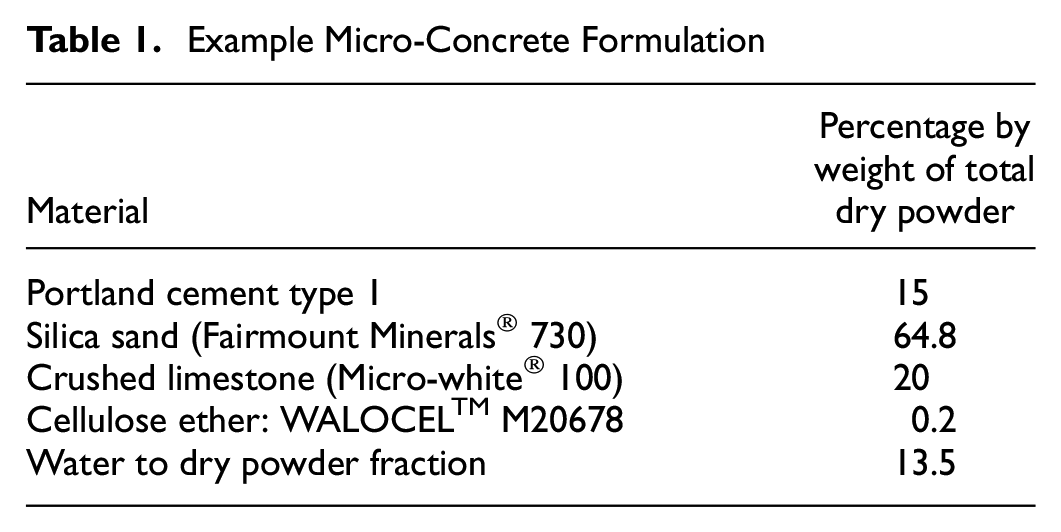
As these low slump concretes in the fresh state are similar to damp silty aggregates, the use of parallel gradations is reasonable. Trends identified with and without the large aggregate component are expected to be similar ( 18 ), which enables a first-pass study of the impact of additives on the performance with “micro-concrete” formulations.
Materials
All components were used as received.
Graded Aggregate
The silica sand (Fairmount Minerals 730), 300 μm sieve particle size, was obtained from Fairmount Minerals. The crushed limestone (Micro-white 100), 44 μm sieve particle size, was obtained from Nagase Specialty Materials. The cement (Portland, type 1) was obtained from Lafarge.
Additives
The primary objective was to evaluate CEs as lubricative additives for RCC. For comparison, several conventional viscosity modifiers and superplasticizers were also evaluated, as listed below.
All the CEs were commercial materials that were produced from cellulose pulp in a heterogeneous reactor and intended for industrial applications. One CE was hydroxyethyl methyl cellulose (HEMC, WALOCEL™, Dow, Incorporated). The degrees of side-chain substitutions are about 1.4 MeO/AGU and 0.17 EtO/AGU for the low viscosity material (15 Pa·s, 20°C, 2.0 wt% CE), and about 1.4 MeO/AGU and 0.32 EtO/AGU for the high viscosity material (80 Pa·s, 20°C, 2.0 wt% CE). The other CE material was hydroxypropyl methyl cellulose (HPMC, METHOCEL™, DuPont). Its degrees of side-chain substitutions are about 1.80 MeO/AGU and 0.15 HPO/AGU, and its aqueous solution viscosity is about 40 Pa·s at standard conditions (20°C, 2.0 wt% CE).
Other viscosity modifiers (VMs) and superplasticizers used where: diutan gum (Kelcocrete DG-F from CP Kelco), Visctrol (Euclid), V-MAR F100 (GCP Applied Technologies), and V-MAR VSC500 (GCP Applied Technologies). The polycarboxylic ether superplasticizer (MelFlux 2651 F, BASF), lignosulfonate (EUCON LR, Euclid), and polyethylene oxide (4,000,000 Da) were obtained from Sigma-Aldrich.
Water Saturation
Water saturation is defined as the percent void volume (% VV) that is filled with a cement paste. A cement paste volume includes both the cement volume (Vc) and water volume (Vw) fractions but excludes graded aggregate. Water saturation is given by Equation 2:

where Vc = mc/ρc, where mc is the mass of cement in the wet cement composition and ρc is the material density of the cement. Vw is the volume of water in the wet cement. The total void volume (VV) is determined by first measuring the mass (mi) of each component in the dry mix other than cement, and then measuring the total volume (V) of a well-mixed mixture of these materials after being poured into a graduated cylinder. Therefore, the total void volume is given in Equation 3:

where ρi is the particle density of each component in the dry mix (e.g., sand and limestone). Void volume fraction, also referred to as voidage or interparticle porosity (ε), is calculated by ε = Vv/V = 1 – [Σ(mi/ρi)]/V, and the packing fraction of aggregate is 1 - ε.
Test Methods
Micro-Concrete Extrusion
A strain-controlled capillary rheometer was set up to characterize extrusion performance at end use conditions. The rheometer comprised a vertically mounted testing frame (Instron Model 5985, Instron Corporation, Norwood, MA) equipped with BLUEHILL3 data acquisition software (Instron Corporation), a 250 kN load cell mounted below the crosshead, and a clevis pin (rated at 100 kN) connecting the load cell to a cylindrical metal piston (44.45 mm diameter). The capillary was a stationary metal cylindrical barrel (200 mm length, 44.45 mm diameter) anchored to the lower test frame table, with a conical transition from the barrel to the lower attached metal die (12.7 mm diameter, 50.8 mm length). The setup was placed in a room with constant temperature and humidity (23°C, 50% humidity) for all tests. The barrel was hand filled with 300 g of freshly prepared wet cement compositions, and the compositions were pushed downward by the piston from the barrel into the capillary, and ultimately exited the capillary die as a paste extrudate. A slow piston velocity (20 mm/min) was applied until a force F of 0.2 kN was achieved, and then the velocity was increased to 500 mm/min for the extrusion measurements.
The load cell force F was recorded as a function of piston displacement D. The piston displacement sometimes stopped before maximum displacement (160 mm) when the load cell approached its upper force safety limit (90 kN). Steady-state flow was identified when the extrusion force F measured by the load cell became insensitive to piston displacement D and the average force at a displacement of 100 mm was recorded as steady-state force FSS. Extrusions at 500 mm/min were completed in 9 to 20 s. Each formulation was measured once. The extrusion stress σ was reported as the force F divided by the capillary cross-sectional area A. The extrusion apparent shear strain rate dγ/dt at the capillary wall (dγ/dt) = 32Q/[π· (Ddie)3] = 514/s is based on the paste volume rate Q of flow (Q = vpiston·π· (Ddie[m]/2)2), the capillary diameter Ddie[m], and the piston velocity (vpiston). The apparent shear viscosity η (Pa·s) at the capillary wall is defined as the ratio of the extrusion stress σ and the apparent shear strain rate
For capillary extrusion the largest particle size is required to be less than one-tenth the gap diameter. This led to the selection of sand and limestone as the filler phase in the micro-concrete formulation. This simplifies the experimental set up and data interpretation, allowing the material to flow through the capillary, continuous data acquisition to be attained, and for data interpretation based on continuum mechanics.
Rheology of Wet Cement Composition
Rheological data of wet RCC smaples was measured at 20.0°C with a stress-controlled rotational rheometer (AR-G2, TA Instruments, New Castle, DE) equipped with a Peltier temperature controller and using RHEOLOGY ADVANTAGETM data acquisition software (TA Instruments, v5.5.24). Materials were sheared via rotation of a four-vaned stainless steel rotor within a stainless steel cup having an inner radius of 15 mm. The vane had an outside radius of 14 mm. The cup was filled to 42 mm immersed height. The approximate sample volume was 28.7 mL. Expressions used to translate transducer data into rheology were associated with DIN concentric-cylinder fixtures, so the rheology data were labeled as apparent rheology.
Wet cement compositions were studied immediately after their preparation. First, the recovery of the composition from flow in the mixer was monitored for 15 min. with a time resolved small amplitude oscillatory shear flow (angular oscillation frequency of 1 rad/s, stress amplitude in the linear viscoelastic regime). The yield stress (σY) of the recovered unconfined paste was determined with a stress amplitude sweep (1 to 5,000 Pa, 25 points/decade). The yield stress was identified as the stress amplitude associated with the inflection point of the dependence of the magnitude |G*| of the complex shear modulus on the stress amplitude (σ0). The inflection point was determined quantitatively with a nonlinear fit of data on semi-log axes with a sigmoidal function. Three replicate studies were performed using a fresh wet cement composition aliquot for each replicate and the results were averaged.
Shear Testing
Shear testing was performed in accordance with ASTM D6773–16 (Standard Test Method for Bulk Solids Using Schulze Ring Shear Tester, 2016, see Figure 1). Shear testing measures the flow properties of particulate solids such as the strength of bulk solids, the angle of internal friction, and cohesion. These measured flow properties can often be used for general assessment of the flowability of bulk solids, for hopper and bin design, or for troubleshooting problems during discharging, transporting, or storing particles and powders. This method has been used by other researchers to evaluate the mechanical properties of concrete ( 10 ). An automated shear ring tester (RST), controlled by the software RSTCONTROL 95 for MS Windows (Dietmar Schulze, Wolfenbüttel, Germany), was used to measure parameters with 50,000 Pa as the given pre-shear stress. The indicated wet cement composition samples were loaded into an annular test cell within 10 min after being prepared. The test cell was then placed into the RST and the ring shear testing program was initiated. Detailed information on the procedure and data processing method using RST can be found in previous work ( 19 , 20 ). Two parameters were measured in this work to quantify mechanical properties of the wet RCC compositions: unconfined yield strength (σc) and internal friction angle θ.
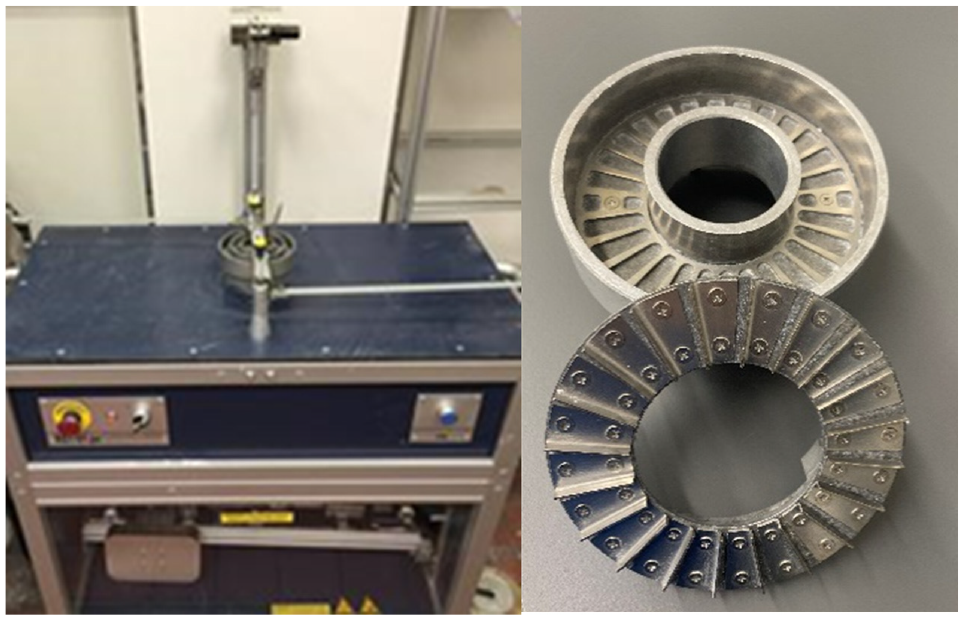
Ring shear tester setup: left: Schulze RST.01 pc; right: inner structure of a shear cell (#MV10, stainless steel).
Unconfined yield strength quantifies the strength of a bulk solid under a level of compaction or consolidation in unconfined state (no confining side walls) and was determined as the normal stress level that caused the wet cement composition in an unconfined (unsupported) state to yield in response to shear.
Internal friction angle (lubricity), or the ability of particles in the RCC sample to move against one another under shear, was determined as the slope of a yield curve measured by shear testing. Internal friction equals the resistance of the particles to moving against each other under compaction and shear and is the ratio of the maximum internal shear force that resists the movement of the particles to the normal force between the particles. Lower internal friction means higher lubricity. While measured friction angles in direct shear differ from those in triaxial configuration, the trends observed between different formulations for strengths and friction angles will still be valid indicators of lubricity and compaction efficiency.
Similar to the extrusion and rheology studies, a micro-concrete formulation was needed for shear testing. The largest aggregate particle size used in shear testing was limited to 5 mm in diameter, one-tenth of the annular gap of the shear cell to avoid the wall effect ( 21 ). Using smaller aggregates also ensured minimal variation in the shear testing measurements associated with the granularity of large-size particles.
A variability study was performed on the shear testing method for RCC samples with the formulation shown in Table 1. Four repeats for this formulation were conducted using identical preparation and testing procedures. Table 2 shows that there is small variation for both parameters measured from the shear testing, where standard deviation is less than 3% of the mean value of the unconfined yield strength and 1% of the mean value of the internal friction angle.
Results of Shear Testing for the Variability Study

Results and Discussion
While numerous types of additives ( 15 , 16 ) have been studied for applications in cement-based materials, the focus of this work was on the use of CEs as VMAs. This was based on the hypothesis that the efficiency of CEs at building viscosity, providing lubrication, retaining water, and minimally contributing to increase of yield stress would make them good candidates for RCC applications. Two representative CE materials (hydroxyethyl methyl cellulose [HEMC] and hydroxypropyl methyl cellulose [HPMC]) often used in cement formulations were the initial focus of this work. Several other water-soluble VMs commonly used in cement-based materials were provided as comparisons: diutan gum, Visctrol, V-MAR F100, and V-MAR VSC500. In addition to the VMAs, we also studied two chemistries of superplasticizers: modified polycarboxylic ether and lignosulfonate superplasticizers.
RCC Model Micro-Concrete Capillary Extrusion
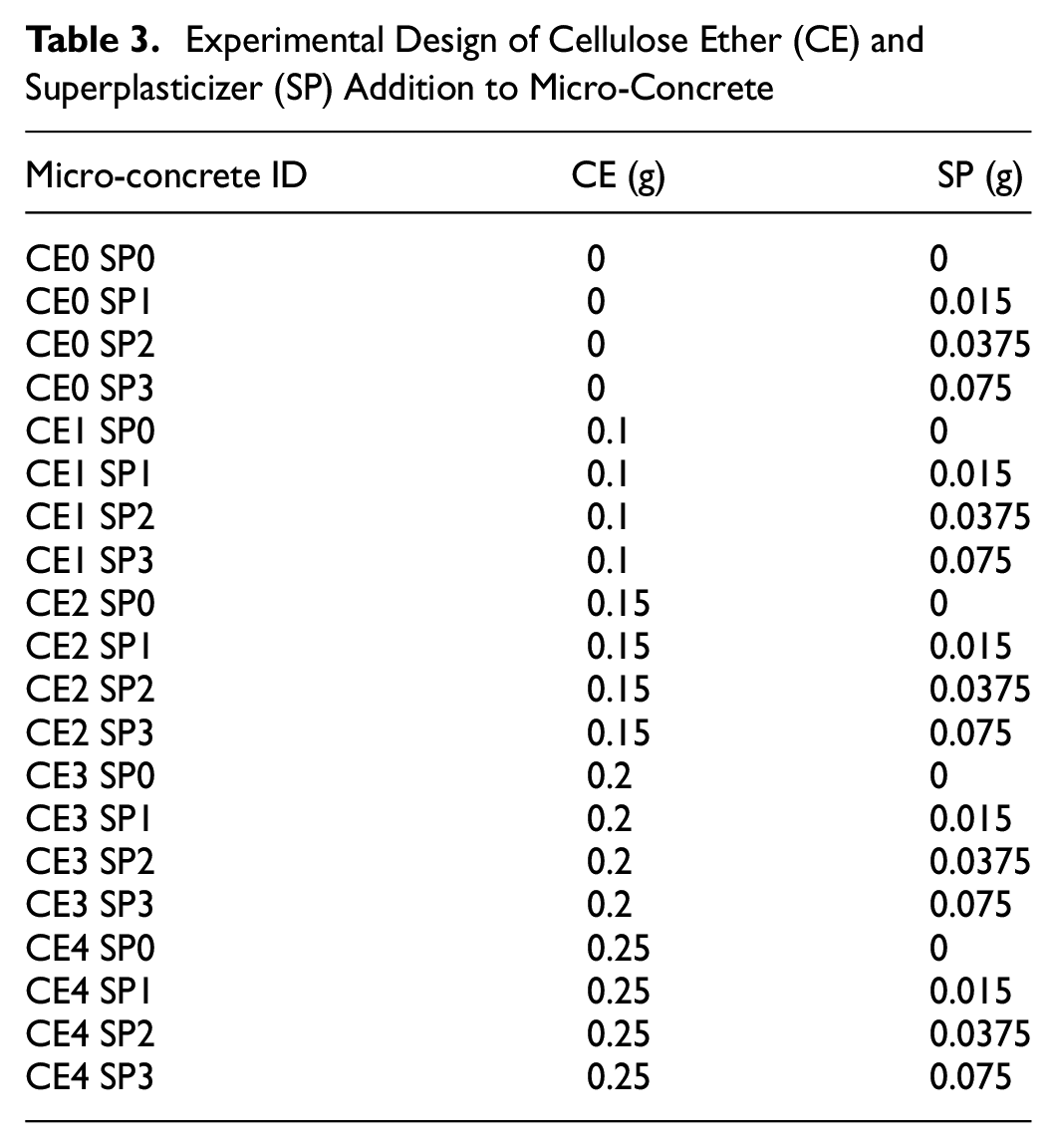
The extrusion of about 40 freshly prepared micro-concrete formulations was studied in a capillary rheometer at a constant piston speed to assess the impact of CE and superplasticizer levels. The setup and protocol were guided by those reported elsewhere ( 22 – 28 ). The lower viscosity HEMC component was explored at five levels between 0 g and 0.25 g while the superplasticizer component (modified polycarboxylic ether) was explored at four levels between 0.0 g and 0.075 g (see Table 3 for details). All formulations had a water/cement mass ratio of 0.944 and a sand/cement mass ratio of 4.3. The CE concentration in the aqueous domains of these formulations ranged from 0 to 1.73 wt%. The chain overlap concentration c* for the CE material in water was 0.121 wt% so the reduced CE concentration c/c* (5.8 to 14.3) well exceeded unity, indicating the CE chains are highly entangled in these formulations. The high values of c/c* in these formulations enables this viscosity modifier to thicken at very efficient concentrations.
Experimental Design of Cellulose Ether (CE) and Superplasticizer (SP) Addition to Micro-Concrete
An image of the capillary rheometer used for the ram extrusions is shown on the left side of Figure 2. All extrudates exhibited smooth surfaces without swelling or fracture as they exited the capillary die as shown in the four examples in Figure 2. The extrusion force F was observed to increase monotonically with the piston displacement D until it reached its steady-state value, Fss. The applied shear stresses σW (20 to 800 Mpa) at the capillary wall during the steady-state flow far exceed the yield stresses (σY = 10−3 Mpa) of the formulations suggesting simple laminar shear flow in the capillary. The shear strain rate
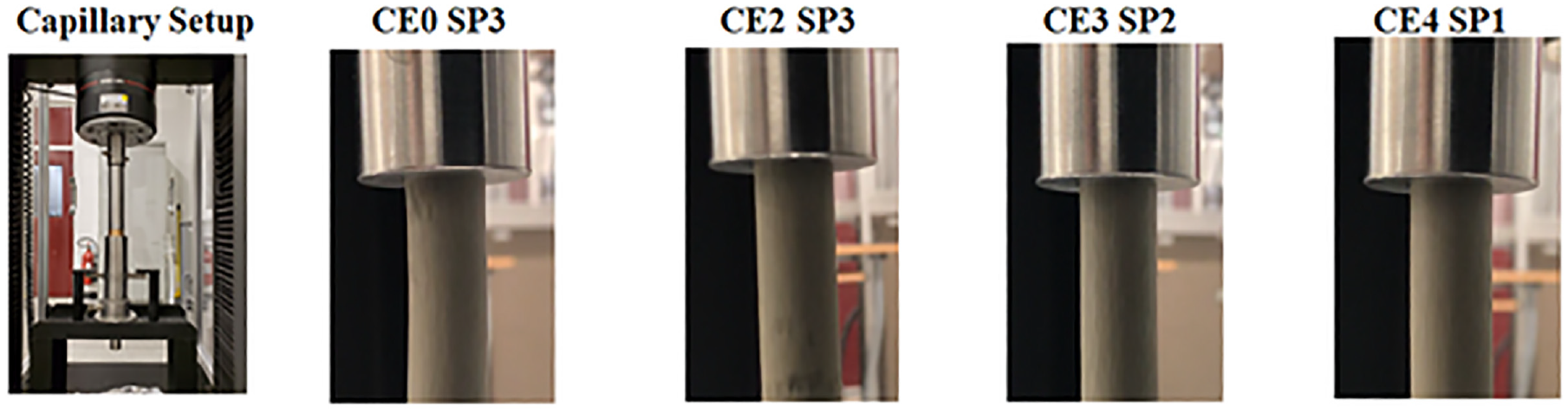
Image of the capillary extrusion setup and close-up images of four freshly prepared micro-concrete extrudates exiting the capillary die.
The impact of the formulation CE and superplasticizer levels on the steady-state extrusion force Fss is summarized in Figure 3. The data fit well with a three-parameter model assuming an empirical functional form of ln Fss[lbF] = a0 + a1· CE[g] + a2·SP[g], shown as the dashed lines on the graph. The error of the fit coefficients (a0 = 10.16 ± 0.21, a1 = −7.7 ± 1.1, a2 = −23.6 ± 3.6) are reported at 95% confidence (± two standard deviations). The negative slopes of coefficients a1 and a2 indicate that both components (CE and superplasticizer) are able to lubricate the steady capillary flow. The more negative value of a2, relative to a1, indicates the superplasticizer is more effective at lubrication on a weight basis. The level of lubrication, as summarized by the fit coefficients, is critical for the design/optimization of RCC formulations.

Steady-state extrusion force as a function of cellulose ether and superplasticizer loading in a freshly prepared micro-concrete formulation.
Yield Stress in Oscillatory Shear Flow
Oscillatory shear measurements, on a stress-controlled rotational rheometer, were used to independently evaluate the yield stress of the micro-concrete formulations. These formulations contained the same low viscosity HEMC and superplasticizer (modified polycarboxylic ether) measured in capillary extrusion. The formulations were placed in a cylindrical cup and deformed with a four-vaned rotor at an angular oscillation frequency of 1 rad/s and the applied stress amplitude was slowly increased from 1 to 5,000 Pa. The yield stress σY was identified as the stress amplitude associated with the inflection point of the dependence of the magnitude |G*| of the complex shear modulus on the stress amplitude, σ0.
The measured yield stress for each composition is shown in Figure 4. It is observed that the yield stress is relatively insensitive to the CE level but has a strong negative dependence on the superplasticizer level. Thus, the effect of the CE and superplasticizer are apparent. As observed in the extrusion data, the superplasticizer and CE material both lubricate the flow of the freshly prepared micro-concrete formulations when flowing in a fluid state (e.g., applied shear stress σ exceeds the yield stress σY). But the oscillatory shear results demonstrate that only the superplasticizer reduces the critical applied stress (σY) that enables shear flow to transform the formulation from a solid to a fluid.

Dependencies of the yield stress σY, on the cellulose ether level C for selected levels of the superplasticizer components in a set of freshly prepared micro-concrete formulations.
Shear Testing Results
Figure 5 shows the unconfined yield strength (σc) of each formulation as a function of the CE aqueous solution viscosity (η) defined and measured from rheology experiments. The aqueous solution viscosity increases when the CE concentration in the aqueous solution increases ( 14 ). Therefore, the solution viscosity represents the combined effect of CE and water loading in RCC. The minimum solution viscosity in Figure 5 is 0.89 mPa·s, representing the viscosity of water at ambient conditions, where no CE was added to RCC samples. The maximum solution viscosity is ≈40,000 mPa·s, representing 11.9 wt% water fraction and 0.35 wt% of the low viscosity CE in RCC. The viscosity of the CE aqueous solution is measured based on the method described in the Appendix. The results in Figure 5a clearly show that the unconfined yield strength of freshly prepared wet RCC samples increases as the CE solution viscosity increases with a semi-logarithm relationship. When the CE solution viscosity reaches 40,000 mPa·s, the unconfined yield strength of RCC samples increased more than 70% compared with that of the RCC samples without CE in RCC. However, at a higher water saturation level, shown in Figure 5b, such a monotonic trend does not exist. The unconfined yield strength at 58% water saturation peaked around 50 mPa·s and started to decrease as more CE was loaded into the RCC samples. The benefit of CE in increasing RCC strength nearly diminished when the CE solution viscosity reached above 10,000 mPa·s.
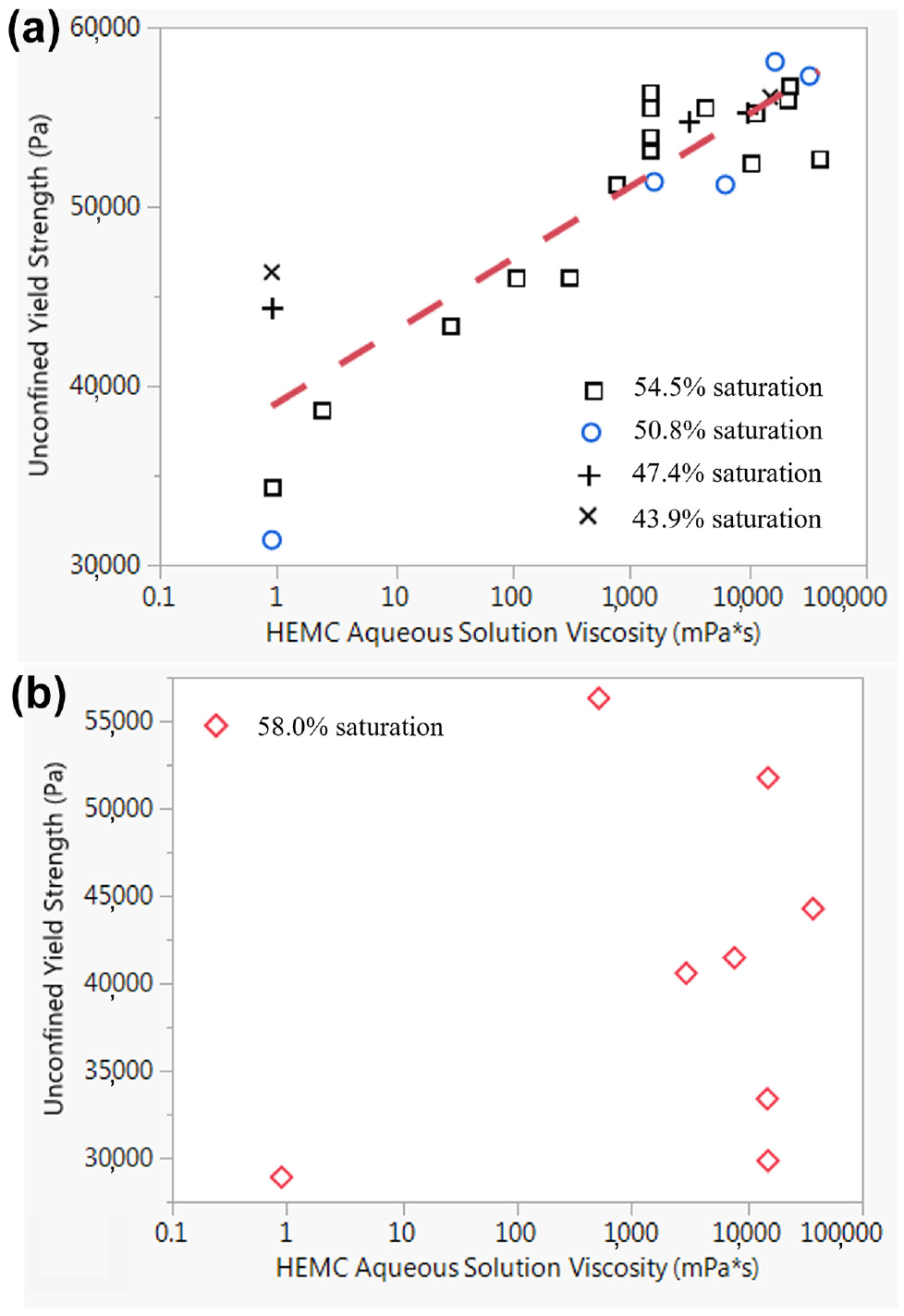
Dependency of the unconfined yield strength σc on the viscosity η of the aqueous domains in the roller compacted concrete (RCC) pastes. (a) RCC sample pastes with lower water saturation levels: 43.9% saturation or 8.9% water fraction; 47.4% saturation or 9.9% water fraction; 50.8% saturation or 10.9% water fraction; and 54.5% water saturation or 11.9% water fraction. Red dashed line indicates a semi-log fit to the data (σc = 3.9•105 + 1747 ln(η)). (b) RCC samples with higher water saturation level (58% saturation or 12.9% water fraction).
We hypothesized that the influence of the CE on the confined yield strength of RCC is the result of two underlying mechanisms. First, the strong water retention of CE can reduce water drainage and migration during compaction. This ensures a homogenous and adequate water fraction locally in the voids between aggregate particles. Local water retention helps maintain strong interparticle cohesive forces through the liquid bridge and thus also the strength and cohesion of RCC. Second, the well-known lubrication effect of CE solutions can reduce resistant frictional forces between aggregate particles during compaction. The additional lubrication allows more efficient rearrangement of aggregate particles and thus higher packing and densification. The lubrication of CE can be clearly observed through the lubricity measurement (angle of internal friction), as shown in Figure 6.
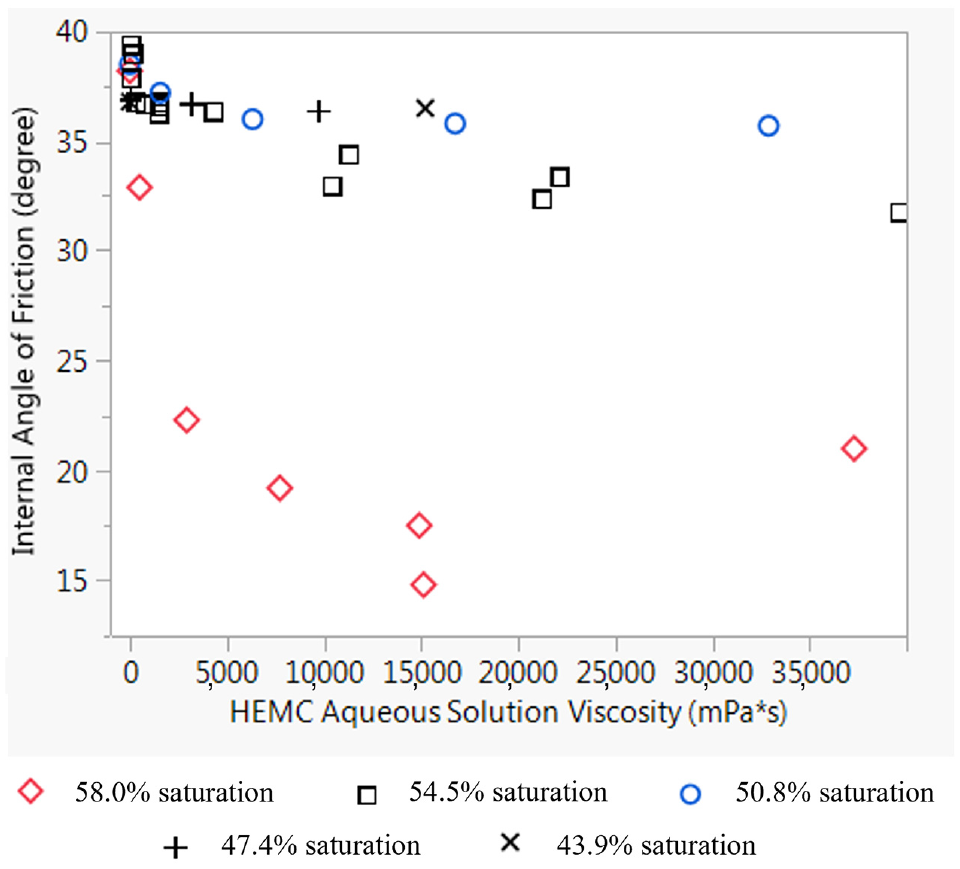
Dependency of the internal angle of friction (lubricity) on the viscosity η of the aqueous domains in the roller compacted concrete (RCC) pastes: 43.9% saturation or 8.9% water fraction, 47.4% saturation or 9.9% water fraction, 50.8% saturation or 10.9% water fraction, 54.5% water saturation or 11.9% water fraction in RCC, and 58% saturation or 12.9% water fraction.
Figure 6 shows that lubricity of each RCC sample also varies with the viscosity of the CE HEMC aqueous solution. Lubricity increases (or angle of internal friction decreases) as the solution viscosity increases at the same water saturation level, although most of increase in lubricity occurs when the CE solution viscosity is smaller than 5,000 mPa·s. However, water loading also has a strong influence on lubricity. At the same solution viscosity, higher water saturation results in higher lubricity. Particularly, when water loading is at 58% for the micro-concrete samples, the internal friction angle decreases significantly to ≈15°. This explains what is observed in Figure 5b, where the unconfined yield strength decreases when more CE is added to RCC at higher water saturation. The lubricative effects of both CE and water together overlubricated the RCC so that a phase transition of the RCC materials occurred. The RCC transitioned from wet frictional granular solids toward a paste state. As a result, high loading of CE at higher water loading conditions does not increase the strength of uncured RCC materials, as evidenced in Figure 5b.
In Figure 7, the unconfined yield strength is plotted as a function of lubricity for all RCC samples shown in Figures 5 and 6. Lubricity affects the unconfined yield strength of RCC, where the highest yield strength occurs at an optimal lubrication. Optimal lubrication occurs between 30° and 36° angle of internal friction. Above 36°, there is not enough lubricity to fully compact and densify the RCC because the samples are too frictional. Below 25°, RCC samples are overlubricated, reducing the high strength provided by the dense aggregate matrix through interparticle friction. For all samples studied in this work, we did not find the angle of internal friction falling between 25° and 30°, although we suspect that there is a CE loading and water saturation that could fall within this range. In summary, we show that using CE in RCC or other graded aggregate mixes can significantly increase its strength by adequately lubricating aggregates during compaction. The optimal range of CE loading, quantified by CE aqueous solution viscosity, occurs at water saturation levels below 58%. For >58% water saturation levels, CE might not be able to achieve greater strength because of overlubrication.
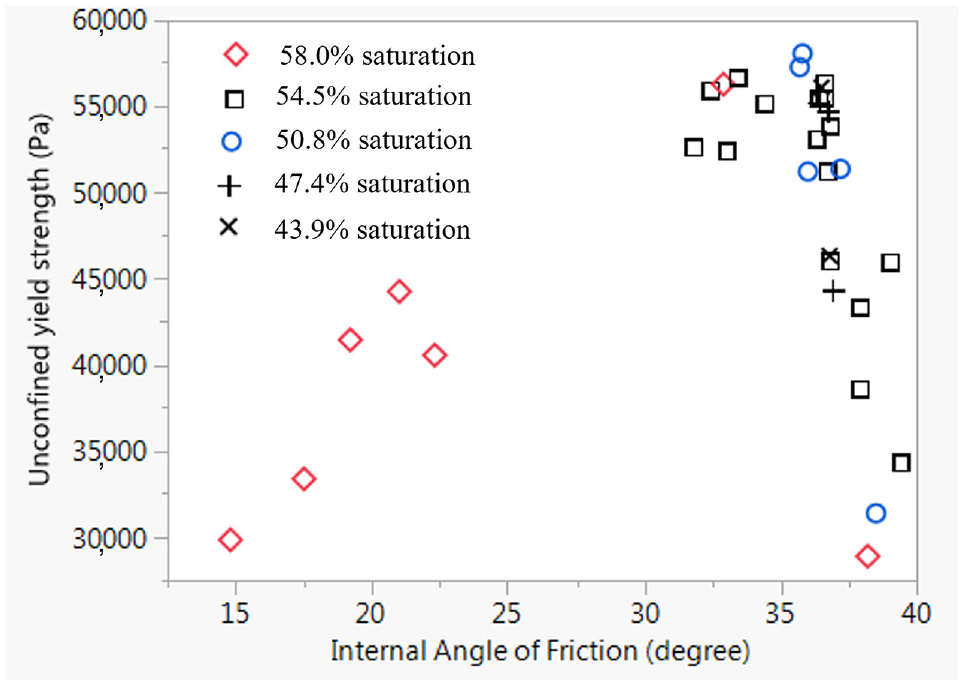
Dependency of the unconfined yield strength on lubricity for roller compacted concrete (RCC) pastes. All symbols are the same as Figures 5 and 6. Optimal strength occurs at lubricities between angles of 32° and 37°. Lower strength arises from strong friction (>37°) between aggregates or overlubrication (<26–27°).
We next examined if this effect is general to all VMAs. We initially hypothesized that CE would offer unique properties for zero-slump concrete because of its low contribution to yield stress as well as lubricious nature. In Table 4, the performance of various VMA materials and a lubricant (e.g., polyethylene oxide, PEO) was compared with the performance of CE, with and without the addition of superplasticizer. Even in the absence of superplasticizer, we observe that the effect of CE on uncured RCC is unique. In these comparative studies shown in Table 4, the VMA and PEO loading was adjusted to match the aqueous solution viscosity to the optimal range found in the CE studies. Results show that only CE can achieve both higher unconfined yield strength and lubricity simultaneously. In fact, only diutan gum affected yield strength and lubricity to a small degree. The remaining VMs did not improve either yield strength or lubricity. Finally, to ensure consistency across methods of investigation, a combination of CE and superplasticizers was also included within our testing. The findings and conclusions from the shear testing are the same when superplasticizers were included as they were in the extrusion work. The lubricity of the RCC mix increased with increasing loading of superplasticizers. However, increased concentration of superplasticizers decreased the yield strength of the RCC mix, limiting their loading.
Shear Testing Results of Micro-Concrete Formulations that Contain No Admixture, Various Viscosity Modifying Admixtures (VMAs), Superplasticizers (SPs), or Combinations of VMA and SP, at Multiple Use Levels

Note: All samples were measured at 54.5% water saturation.CE = cellulose ether; HEMC = hydroxyethyl methyl cellulose; HPMC = hydroxypropyl methyl cellulose; PEO = polyethylene oxide.
Brand name included because the chemical compositions of these rheology modifiers is unknown.
Conclusions
In this work, we use fundamental rheological and bulk solids measurements, combined with learnings from other compacted systems, to understand and recommend additive selection to optimize RCC mechanical properties and workability. We hypothesize that optimal compaction, density, and strength of RCC would occur at an optimal viscosity and lubricity range by adding a CE as the viscosity modifying agent and lubricant. We use three different experimental methods to evaluate the flow performance and mechanical properties of freshly prepared RCC samples with selected types and levels of CE and superplasticizers, as well as water saturation levels. The experimental methods include extrusion testing, ring shear testing, and rheological testing. Key metrics were the steady-state extrusion forces from extrusion testing, unconfined yield strength and lubricity from shear testing, and yield stress from rheology testing.
Based on the experimental results on model micro-concrete mixes, we found that CEs can be used as additives simultaneously to optimize the viscosity and lubricity of RCC paste for improved workability, compaction efficiency, and mechanical properties because of its unique viscosity modifying and lubricative functionality compared with other VMAs. More specifically, we found from experiments that
Addition of CEs at an optimal water content resulted in the highest combined values of yield strength (Figure 5) and lubricity (Figure 6), and lower extrusion force (Figure 3). Higher yield strength from shear testing indicates improved mechanical properties (green strength). Higher lubricity and lower extrusion force indicate reduced resistance forces during compaction within the bulk of compacted concrete and between the compacted solids and walls, respectively. All these results clearly showed improved compaction efficiency and workability of RCC because of the lubrication and viscosity modifying functionality from CE.
We discovered that the aqueous viscosity of CE, determined based on the CE and water loading in each RCC sample, is a controlling parameter to achieve higher yield strength and lubricity (Figures 5 and 6), which can be used for RCC admix design when selecting optimal loading of CE and water.
Additionally, there was an optimal lubrication for RCC compaction that could be moderated by water content and CE (Figure 7). Underlubrication, or too high friction, occurred when water loading was too low, the CE content was too low, or both. Overlubrication of the system occurred when either the water loading was too high, the CE content was too high (e.g., 58% water saturation shown in Figure 5), or both. Both conditions can result in reduced mechanical properties (Figure 7).
The rheology experiments of freshly prepared RCC pastes demonstrated that addition of CE in RCC does not increase the yield stress of RCC pastes within the level studied in this work (Figure 4). Meanwhile, adding superplasticizers can reduce the yield stress, allowing more efficient compaction. Therefore, we suggest that CE and superplasticizers should be used together in RCC applications for improved compaction efficiency.
However, note that the use of extrusion and ring shear testing in the laboratory has its limitations. Because of the equipment gap size, the maximum aggregate size that could be used was 5 mm (0.2 in.). This is far smaller than the typical RCC maximum aggregate size of 0.75 in. While the mix design proportions were maintained using the Power 45 gradation curve, the model RCC micro-concretes required higher water loadings to wet fully the higher surface area aggregate than conventional RCC mixes, and therefore required proportionally higher cement loadings to maintain optimal water to cement ratios. The greater portion of fines also exacerbate workability and compaction issues relative to conventional RCC mixes. Therefore, we recommend corroborating this work in an RCC mix design where the maximum aggregate size is at least 0.5 in., which could complete other studies ( 29 , 30 ).
Supplemental Material
sj-docx-1-trr-10.1177_03611981231193403 – Supplemental material for Role of Additives in Compacted Concrete Pavements
Supplemental material, sj-docx-1-trr-10.1177_03611981231193403 for Role of Additives in Compacted Concrete Pavements by Jessica Levin, Yi Fan, Sean Keenan, Kurt A. Koppi, Brian Nickless, James Pressler, Michael J. Radler, Stacey A. Saba, Robert L. Sammler, Jörg Theuerkauf and Michael Zink in Transportation Research Record
Footnotes
Author Contributions
The authors confirm contribution to the paper as follows: study conception and design: Y. Fan, R. L. Sammler, K. A. Koppi, M. J. Radler, J. R. Levin, S. Saba, J. Theuerkauf; data collection: S. Keenan, J. Pressler, M. Zink, S. Saba, B. Nickless; analysis and interpretation of results: Y. Fan, R. L. Sammler, K. A. Koppi, M. J. Radler, J. R. Levin, S. Saba, J. Theuerkauf; draft manuscript preparation: Y. Fan, J. R. Levin, S. Saba, M. J. Radler, R. L. Sammler, K. A. Koppi. All authors reviewed the results and approved the final version of the manuscript.
Declaration of Conflicting Interests
The author(s) declared the following potential conflicts of interest with respect to the research, authorship, and/or publication of this article: The authors acknowledge that they were employed by Dow Inc. during the time this research was conducted, which is a company that could be affected by the findings in this paper.
Funding
The author(s) received no financial support for the research, authorship, and/or publication of this article.

Supplemental Material
Supplemental material for this article is available online.
References
Supplementary Material
Please find the following supplemental material available below.
For Open Access articles published under a Creative Commons License, all supplemental material carries the same license as the article it is associated with.
For non-Open Access articles published, all supplemental material carries a non-exclusive license, and permission requests for re-use of supplemental material or any part of supplemental material shall be sent directly to the copyright owner as specified in the copyright notice associated with the article.
