



Abstract
The 7th edition of the American Association of State Highway Transportation Officials (AASHTO) document, A Policy on Geometric Design of Highways and Streets, also referred to as the Green Book, defines performance-based design as: “a design approach in which key design decisions are made with consideration of their anticipated effects on aspects of future project performance that are relevant to the project purpose and need. Thus, performance analysis becomes a tool to inform design decisions. Performance-based analysis enhances the exercise of design flexibility by documenting the anticipated performance effects of design decisions.” In addition, the Green Book introduces an expanded classification system for geometric design, including rural, rural town, suburban, urban, and urban core context classifications. A variety of guidance and examples is available to help practitioners apply performance-based design and consider context in the design process. This paper highlights recent research, as well as processes from Minnesota, Oregon, and Washington. It includes an example scenario to illustrate how performance-based design can be applied to generate, evaluate, and iterate alternatives for a roadway transitioning from rural to suburban development.
Keywords
When producing a performance-based design framework, the aim is to tailor design decisions based on needs and desired outcomes. This is a particularly helpful approach where transportation agencies are challenged by limited resources and potentially competing objectives, such as safety, mobility, access, and environmental effects. Recent research supports performance-based methodologies and context-based approaches, as reflected in the 7th edition of the American Association of State Highway and Transportation Officials (AASHTO) document, A Policy on Geometric Design of Highways and Streets (also referred to as the Green Book) ( 1 ), the National Cooperative Highway Research Program (NCHRP) Web-Only Document 320, Aligning Geometric Design with Roadway Context ( 2 ), and NCHRP Research Report 1036, Roadway Cross Section Reallocation: A Guide ( 3 ), among others. At the same time, more and more states are incorporating design flexibility in their roadway design processes.
This paper provides additional guidance on how context influences the design process, selecting performance measures, evaluating alternatives, assessing tradeoffs, and documenting decisions using a performance-based framework. This information can support state agencies that may consider to integrate performance-based design in their practices based on the future updates to the AASHTO Green Book, in its 8th edition. It provides an overview of current research and state processes, as well as an example scenario that illustrates the four primary steps of performance-based design, namely:
• Establish project context, goals, and performance measures
• Develop concepts
• Evaluate and select an alternative
• Begin design.
Current Research and State Processes
Several state and national initiatives and publications support the use of performance-based design and discuss how it can be integrated in project development. The following sections provide summaries from key documents and processes from Minnesota, Oregon, and Washington.
NCHRP Report 785 ( 4 )
NCHRP Report 785 ( 4 ) provides a framework for integrating performance-based analysis in the project development process. It states that “performance-based analysis of geometric design provides a principles-focused approach that looks at the outcomes of design decisions as the primary measure of design effectiveness.” It includes six basic steps (Figure 1).
• Identify intended project outcomes by which performance can be measured, such as safety, livability, economic development, and environmental sustainability.
• Establish geometric design decisions, such as design criteria and preliminary design.
• Evaluate the performance of the geometric design in comparison with the desired project outcomes.
• Iterate the design and outcomes to be optimized based on the results of the evaluations.
• Evaluate benefits or costs to determine the value of the geometric design, compared with the project outcomes.
• Select or advance projects or alternatives based on viability within the project context.
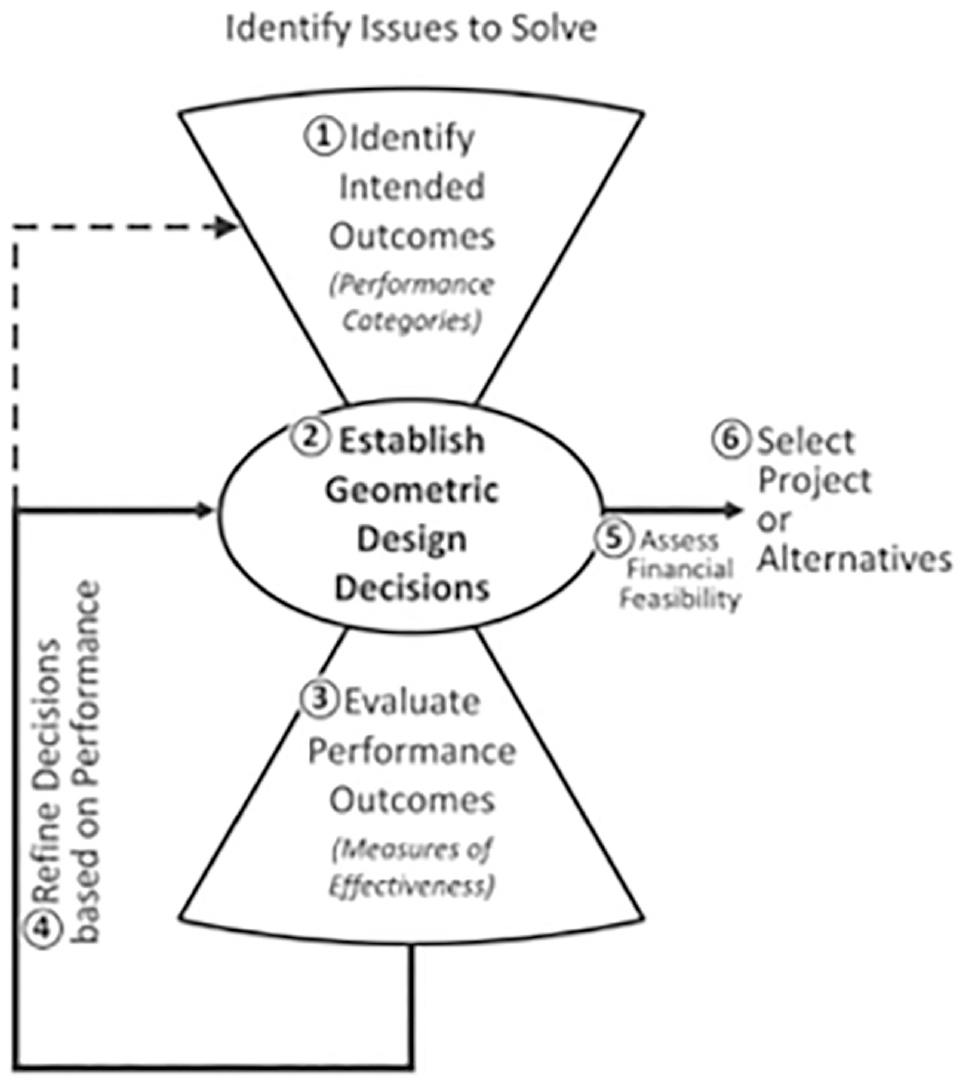
Fundamental model for performance-based analysis of geometric design of highways and streets ( 4 ).
Performance-based design can be applied to various stages of project development using a basic framework that can be tailored to specific circumstances (Figure 2). This process can be incorporated in a basic environmental review process.
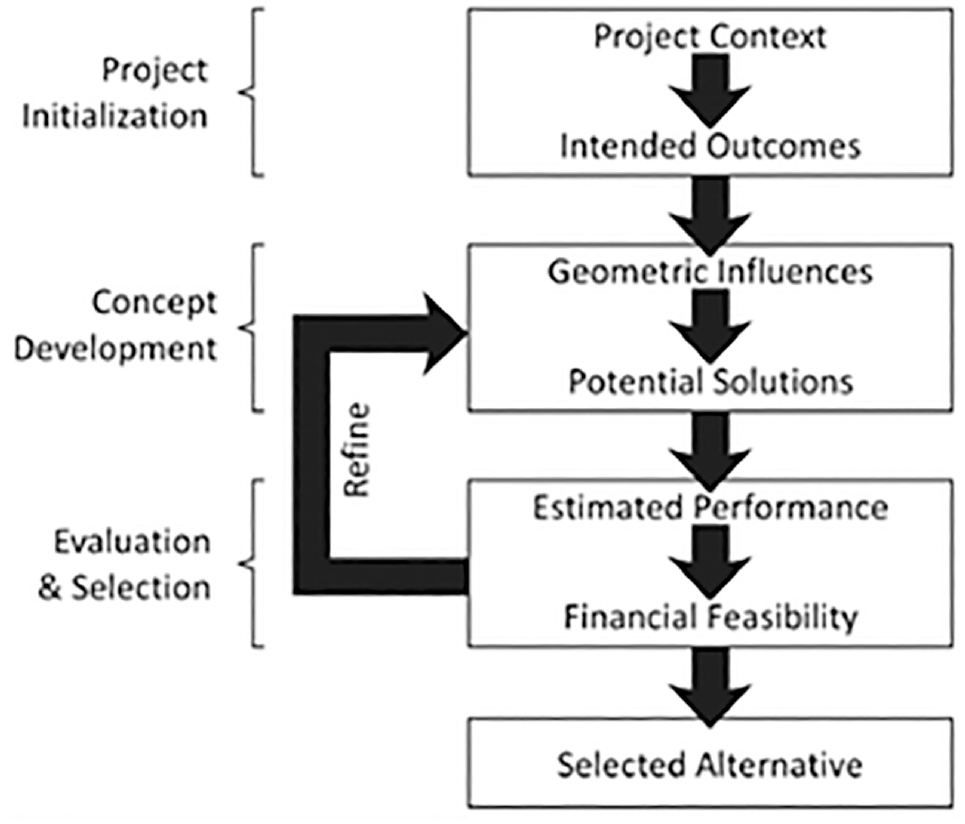
Performance-based analysis application framework ( 4 ).
The last chapter of NCHRP Report 785 ( 4 ) provides six project examples that illustrate the application of performance-based design to a variety of project types in various stages of development across different contexts. The examples use the process framework (Figure 2) and include detailed alternative evaluations illustrating a range of performance categories, including safety, mobility, reliability, accessibility, and quality of service. The performance categories are tailored to road users and include such metrics as crashes per year, average delay, variation in transit and auto travel time, pedestrian accessibility, and multimodal level of service.
NCHRP Research Report 839 ( 5 )
NCHRP Research Report 839 ( 5 ) presents a process for highway geometric design focused on the “transportation performance of the design rather than the selection of values from tables of dimensions applied across the range of facility types.” The report includes basic findings on the highway design development process that help inform the suggested changes to the process. The findings include discussions of context, substantive safety, performance, and the iterative nature of the design process. Based on these findings, the report recommends a revised performance-based geometric road design process (Figure 3).
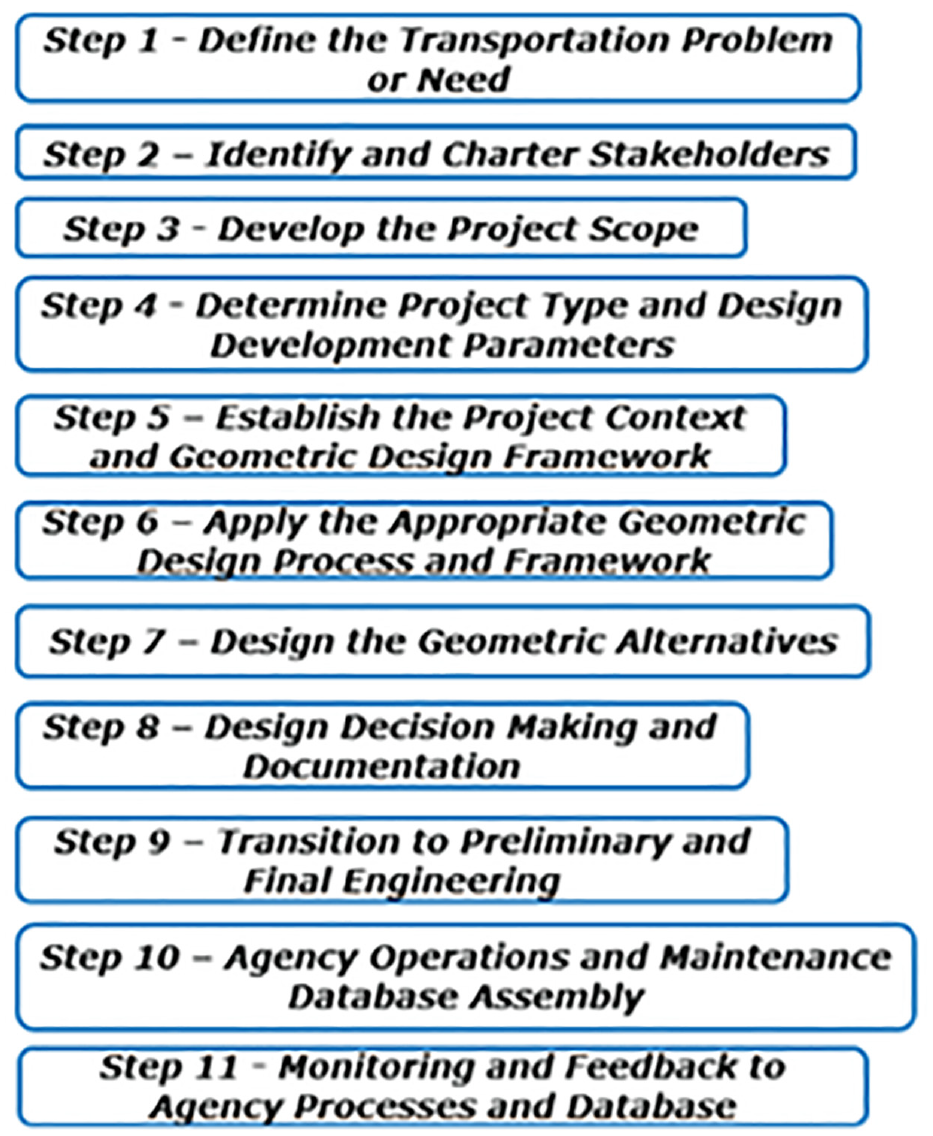
Performance-based design process ( 5 ).
The report identifies needed updates to the technical guidance in the Green Book, most notably that “design criteria lacking traffic volume sensitivity and formulated in a manner that treats all contexts the same are strong candidates for significant revision” ( 5 ). Case studies outlined in the report serve to highlight where there are available Highway Capacity Manual ( 6 ) and Highway Safety Manual ( 7 ) tools to evaluate alternatives (such as comparing interchange improvement alternatives), and where there are not adequate tools (such as evaluating cross sections with varying facilities and widths).
AASHTO Green Book, 7th Edition ( 1 )
The 7th edition of the AASHTO Green Book ( 1 ) was updated based on guidance from NCHRP Report 785 ( 4 ) on performance-based design, NCHRP Research Report 855 ( 8 ) on an expanded context classification system, and NCHRP Research Report 839 ( 5 ) on the design process. With these changes, the Green Book emphasizes the importance of flexibility and context. As stated in the preface, “Chapter 1 of this edition has been rewritten entirely and provides a new framework for geometric design. It expands the land use contexts from two (urban or rural) to five (rural, rural town, suburban, urban, or urban core). It emphasizes design flexibility provided in this policy and encourages practitioners to take advantage of that flexibility. Chapter 1 also introduces a performance-based approach to geometric design which, when used, will allow practitioners to quantify and convey design tradeoffs in meaningful terms to a broad audience and, ultimately, for consideration by decision makers” ( 1 ). The future 8th edition of the Green Book is expected to expand on this new framework.
Chapter 1 of the Green Book includes sections on design flexibility and performance-based design. It includes the following guidance.
• Many design dimensions provided are ranges of values as opposed to single values.
• Such words as “should” and “may” are often used to note design guidance that is desirable, but not required.
• Documentation is needed to explain why design decisions are made.
• The project purpose and need determine the performance measures that are considered.
• Performance-based design seeks to balance a variety of performance measures.
• Performance assessments should consider both qualitative and quantitative measures.
• Tools are available to help evaluate performance measures, including the Highway Capacity Manual ( 6 ), the Highway Safety Manual ( 7 ), and the FHWA Guidebook for Developing Pedestrian and Bicycle Performance Measures ( 9 ).
NCHRP Web-Only Document 320 ( 2 )
The final report for NCHRP Project 15-77 is provided as Web-Only Document 320, Aligning Geometric Design with Roadway Context ( 2 ). The project focused on design flexibility and roadway context classifications. The report includes draft chapters for Part IV of the future 8th edition of the Green Book, focused on facility design in context. While the final report is focused on Part IV, it notes that the other parts of the 8th edition of the Green Book will introduce context classifications; performance metrics; and flexible, performance-based multimodal planning and design decision making. The draft Chapter 13 is titled Context and Facility Type Considerations and is intended to bridge Parts I, II, and III of the Green Book with the “specific planning and design considerations for context classifications” provided in Part IV. NCHRP Web-Only Document 320 shows how context can be integrated in a performance-based design approach (Figure 4), building on the performance-based design framework provided in NCHRP Report 785 ( 4 ).

Connecting context-based design and performance-based design ( 2 ).
The draft chapter walks through each element shown in blue in Figure 4, and connects it to the performance-based design process. As noted in the chapter, context classification is a first step in “identifying a range of potential solutions appropriate for a given context classification” ( 2 ). The performance-based design framework can be adapted based on the context classification to ensure that concepts developed and the alternative selected are compatible with the context classification.
NCHRP Research Report 1036 ( 3 )
NCHRP Research Report 1036 ( 3 ) presents a “new approach to allocating roadway space” and a guide to help allocate roadway space based on community priorities. It includes a six-step process for making decisions about cross sections (Figure 5). This process is driven by a community’s priorities and evaluates tradeoffs based on a broad set of outcomes, using a performance-based design approach.

Cross section decision making framework ( 3 ).
Key elements of this process include the following.
• Prioritize safety: cross sections must meet context-specific minimum safe widths and separation elements, provided in the guide.
• Simplify decisions: the guide distills complex tradeoffs into manageable decisions.
• Estimate outcomes: quantitatively assess environmental, social, and economic outcomes.
• Daylight decision making: make the tradeoffs considered and priorities clear.
The guide connects the cross section design process to other recent research, including context classification, performance-based design, and a safe system approach ( 10 ). It includes a chapter that walks through a variety of core cross section elements, highlighting key considerations and outcomes associated with each element. The last chapter of the guide demonstrates how to evaluate cross section changes, including examples that consider a range of metrics.
The guide includes a spreadsheet tool to support decision making that follows the cross section decision making framework of Figure 5, specifically Steps 3 through 6. The tool can be used to evaluate whether alternatives meet minimum safe dimensions and document how well alternatives support project goals.
Minnesota Department of Transportation Performance-Based Practical Design ( 11 )
In 2017, the Minnesota Department of Transportation (MnDOT) developed its performance-based practical design (PBPD) policy, which established PBPD as the prescribed design practice. MnDOT developed a document with information on the PBPD process and design guidance, called Performance-Based Practical Design Process and Design Guidance ( 11 ). It is intended to be used as the first source of information on PBPD. The document defines PBPD as: “the use of performance-based methods and processes to solve problems and produce outcomes, all the while recognizing our limited financial resources and the need to spend public funds wisely and with a long-term, system-wide outlook […] It tends to rely on the use of a flexible design approach to choose appropriate dimensions and parameters within and sometimes outside the ranges of standard nominal values” ( 11 ). It encourages value, flexibility, analysis, and financial sustainability.
Part I of the document describes the PBPD and key process elements, including the following.
• Intended project outcomes: determine project purpose, need, and problems, as well as establish desired outcomes and goals. Performance characteristics include quality of service, safety, reliability, accessibility, infrastructure integrity, ease of use, ease of maintenance, visual quality, and fit to context and community.
• Designing to achieve intended outcomes: develop and evaluate concepts to identify a “cost effective solution that achieves performance improvement and solves problems within the bounds of practicality and context sensitivity” ( 11 ). This element corresponds with MnDOT’s scoping and preliminary design phases of project development.
Part II of the document provides guidance on design controls and elements from a “performance-based, economical design approach.” The elements covered include fundamental design controls, cross sectional elements, roadside design, sight distances, and alignment elements. For each element, the document provides a discussion, guidance and criteria, and design standards or administrative control. For example, in the section on travel lane widths, the document notes research on operational and safety effects related to lane width, guidance on lane widths based on project and facility type, and references for MnDOT’s lane width standard. References are made throughout to multimodal considerations. For example, the document suggests computing “pedestrian, bicyclist, and transit passenger levels of service […] where non-motorized traffic and/or transit use is significant or where the crossing or facility serves as a key non-motorized and/or transit connection. Perform a multimodal level of service (MMLOS) analysis to compare cross section allocation options, especially in constrained areas” ( 11 ). The section on design speed notes that vehicle speed is directly related to survivability of vulnerable users in a crash. Narrower lanes provide space for bicycle lanes and shorten pedestrian crossings.
Oregon Department of Transportation Blueprint for Urban Design ( 12 ) and Highway Design Manual ( 13 )
In 2020, the Oregon Department of Transportation (ODOT) released its Blueprint for Urban Design (Blueprint) ( 12 ) to help bridge urban design until the state updated its Highway Design Manual ( 13 ) in 2023 to reflect the latest principles of performance-based, context-sensitive, and practical design. The Blueprint is the governing document for the State of Oregon when design criteria and processes provided in other publications do not align. The Blueprint’s purpose is to “highlight opportunities for flexibility in ODOT’s current design criteria. This allows practitioners to determine the effective outcomes for each facility based on the urban context and to identify ways in which design flexibility can accommodate individual community needs” ( 12 ). The updated 2023 Highway Design Manual includes much of the content from the Blueprint.
Chapter 4 of the Blueprint provides a multimodal decision making framework that applies performance-based design. The content is largely incorporated in the Highway Design Manual as part of ODOT’s PBPD strategy. As stated in the Highway Design Manual, “PBPD requires sound engineering judgment and making informed decisions based on a specific project scope, purpose, and need. PBPD will typically require more contextual information around project outcomes and goals during project development allowing for proper decision making when weighing and determining the design elements for a specific project” ( 13 ). PBPD is incorporated in ODOT’s project workflow and project stages (Figure 6).

Performance-based approach to Oregon Department of Transportation (ODOT) project flow ( 13 ).
ODOT notes that a performance-based approach is most effective when applied in earlier stages of project development, as it becomes more challenging to affect overall project outcomes as a project moves into later stages of the project development process. It is important to document the decisions made around PBPD.
The Highway Design Manual ( 13 ) provides guidance on developing project goals and desired outcomes, which is done by the multidisciplinary project team (the project scoping team). Project goals may reflect the vision of the place (e.g., context, land use patterns, nature of growth, role in the region, community values), the desired role of the facility, and major users of the facility. Desired outcomes need to be objectively measurable, help differentiate between alternatives, and be specific to the plan. More guidance and example project goals and performance measures are provided in the Blueprint ( 12 ). In addition, Chapter 4 of the Blueprint includes examples of applying a performance-based design approach to various project types.
Washington State Department of Transportation Design Manual ( 14 )
The Washington State Department of Transportation (WSDOT) Design Manual ( 14 ) includes a chapter on practical design. As noted in the Design Manual, WSDOT’s practical design approach is “context-appropriate, multimodal, and performance-based.” To document a practical design approach, WSDOT uses the basis of design template, which includes seven steps (Figure 7), listed next. Each of these steps is discussed in the Design Manual, including the process for documentation.
• Assemble a project advisory team as needed. The advisory team may include internal and external stakeholders, representing a variety of skills, knowledge, and responsibilities.
• Clearly identify the baseline need. The baseline need is usually derived from the WSDOT planning or programming process. Identify performance metrics, a baseline performance target, contextual needs, and contributing factors, and produce a project need statement.
• Identify the land use (rural, suburban, urban, urban core) and transportation context (roadway, bicycle route, pedestrian route, freight route, transit use, complete streets, main street highways), as well as environmental use and constraints.
• Select design controls compatible with the context, including design year, modal priority, access control, design speed, and terrain classification. WSDOT provides initial modal integration levels and target speeds based on roadway type and land use context, with modifications made based on the specific project context.
• Formulate and evaluate potential alternatives, including transportation systems management and operations strategies, that resolve the baseline need for the selected context and design controls. Alternatives are compared based on performance-based decision making, considering cost, the baseline need, context, and environmental requirements.
• Select design elements that will be included in the alternatives, such as lane width, shoulder width, alignment, and clear zone.
• Determine design element dimensions consistent with performance needs, context, and design controls. In some cases, WSDOT provides a range of dimensions to choose from based on context and considering tradeoffs. WSDOT uses the mode–function–performance approach when a range of dimensions is given. This approach (Figure 8) considers the modal needs, the function of the design element, safety, and mobility performance.
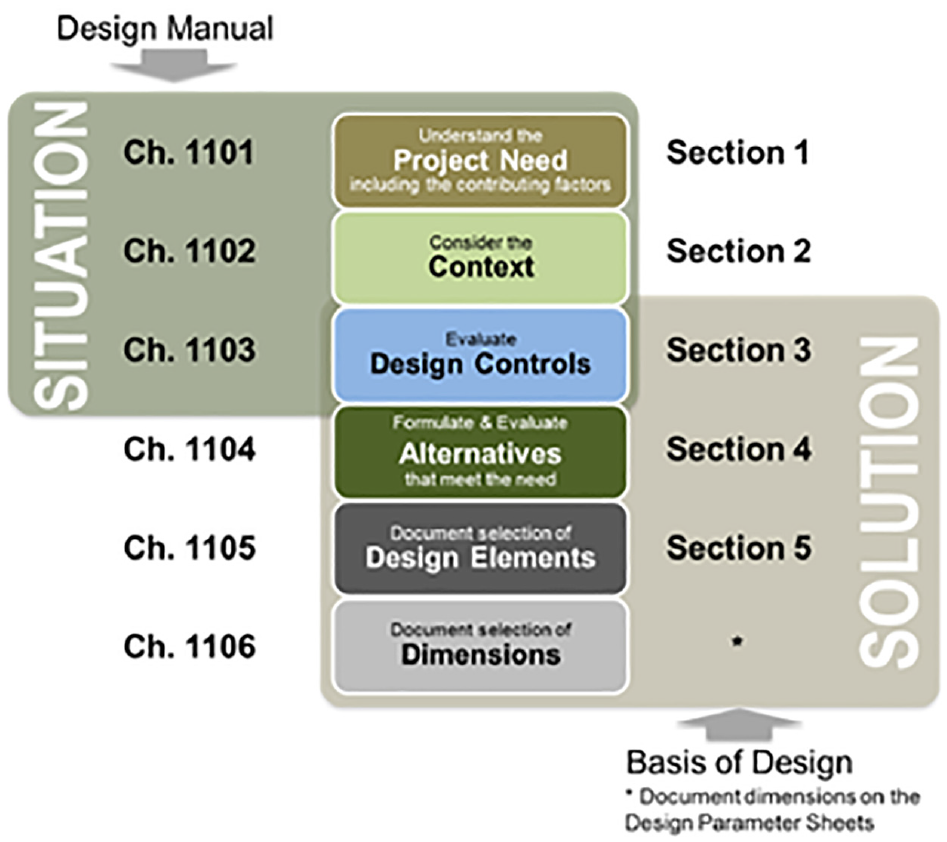
Basis of design flowchart ( 14 ).

Mode–function–performance approach ( 14 ).
Example Scenario
This section provides a fictional example to illustrate the application of performance-based design and reflects characteristics of real projects. It demonstrates the application of current research to show how a practitioner could apply performance-based design to develop, evaluate, select, and implement a design concept for a corridor. While not specific to any agency, it utilizes a similar approach to the processes from Minnesota, Oregon, and Washington described in the previous section.
In the example, the following scenario is considered.
• The existing roadway includes two lanes and is a high-speed arterial located in an area that is currently rural with low-density residential development.
• The roadway extends through a forested area with natural features including a water crossing and several large mature trees near the roadway.
• The roadway connects an established metropolitan area and growing suburban development.
• The area is currently rural but is transitioning from a sparsely developed rural community to suburban development with growth from the metropolitan core.
• Improvements are being considered on the roadway to address a recent increase in crashes and to better serve all users and ongoing development.
• Existing residents on the corridor are concerned about maintaining the character of the roadway and current aesthetic.
This example highlights the four key steps in a performance-based design approach. Not all steps of the process are illustrated in full. For example, Step 1 provides an example of a scoring approach that could be used to evaluate the safety performance measure but does not include an approach for other performance measures. Where applicable, potential resources are referenced.
Step 1: Establish Project Context, Goals, and Performance Measures
The first step in the process is to identify the overarching project outcomes that are driving the need for the project. Clearly articulating the context and goals early in the project is important so they can serve as a basis to evaluate alternatives and confirm that the selected alternative complies with the project purpose and produces the intended outcomes.
Context
Several resources are available for context classification and identifying target speed, including the Green Book ( 1 ), NCHRP Web-Only Document 320, Aligning Geometric Design with Roadway Context ( 2 ), and NCHRP Research Report 1022, Context Classification Application: A Guide ( 15 ).
In this example, the roadway is in an area that is transitioning from rural to suburban. Key characteristics of the roadway and surrounding land uses include the following.
• Cross section: two undivided 12 ft vehicle travel lanes, 2 ft paved shoulders, 4 ft gravel shoulders, and roadside ditches (Figure 9), for a total paved width of 28 ft. The existing right of way (ROW) is 60 ft.
• Density: currently low but increasing with ongoing and planned development.
• Users: through traffic between the metropolitan area and outlying rural communities, moderate truck traffic, recreational bicyclists, occasional pedestrians.
• Land use: mix of low-density residential and newer denser neighborhoods and commercial clusters.
• Parking: no on-street parking.
• Speed: posted speed of 45 mph, observed 85th percentile speed of 48 mph, and target speed of 35 mph for suburban context.
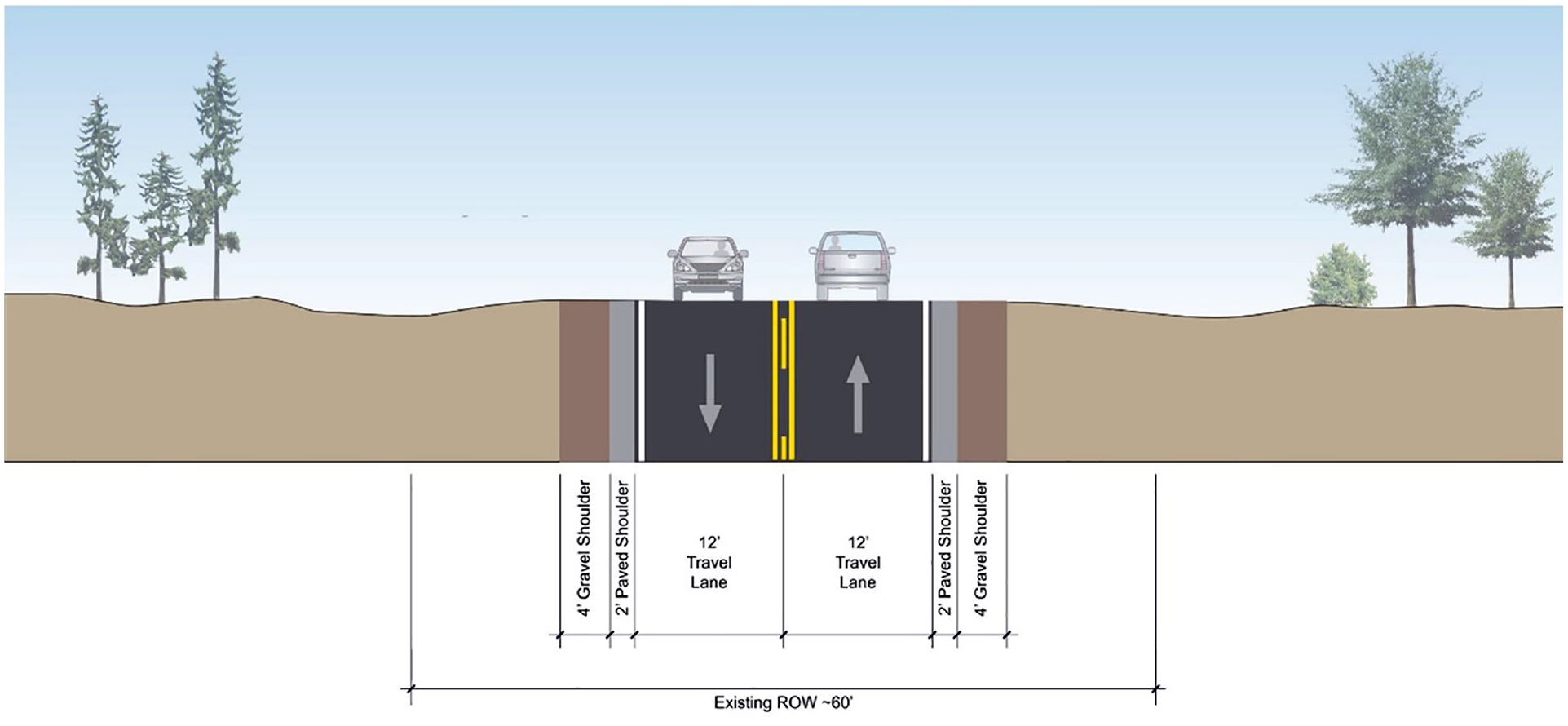
Existing cross section.
Goals
Project goals are intended to be brief statements that capture the vision for the corridor and surrounding areas. They can be visionary but should be easily understood and measurable. Goals for this project include the following.
• Provide increased safety and access for pedestrians and bicyclists along the corridor.
• Enhance the long-term viability for the local community.
• Accommodate future traffic expected on the corridor.
• Preserve existing natural features.
Performance Measures
Performance measures provided quantitative or qualitative means of assessing the project goals and intended outcomes for a project. Performance measures should be identified based on the specific project objectives. Example performance measures are provided in several of the research documents and processes discussed, including NCHRP Report 785 ( 4 ), NCHRP Research Report 839 ( 5 ), and the ODOT Blueprint ( 12 ). Practitioners should be aware of ongoing research that will continue to expand the toolbox for potential performance measures. Performance measures for this project include the following.
• Safety: measured based on expected change in travel speeds, predicted change in crashes, and pedestrian and bicycle risk factors.
• Multimodal integration: measured based on consistency with modal considerations for suburban context.
• Environmental and ROW effects: measured based on square footage of ROW required, properties affected, and environmental features affected.
• Feasibility: measured based on expected project costs, life cycle costs, and construction feasibility.
• Operations: measured based on future volume-to-capacity ratio and travel time reliability.
• Livability: measured based on community feedback on how well the design maintains the character of the existing roadway.
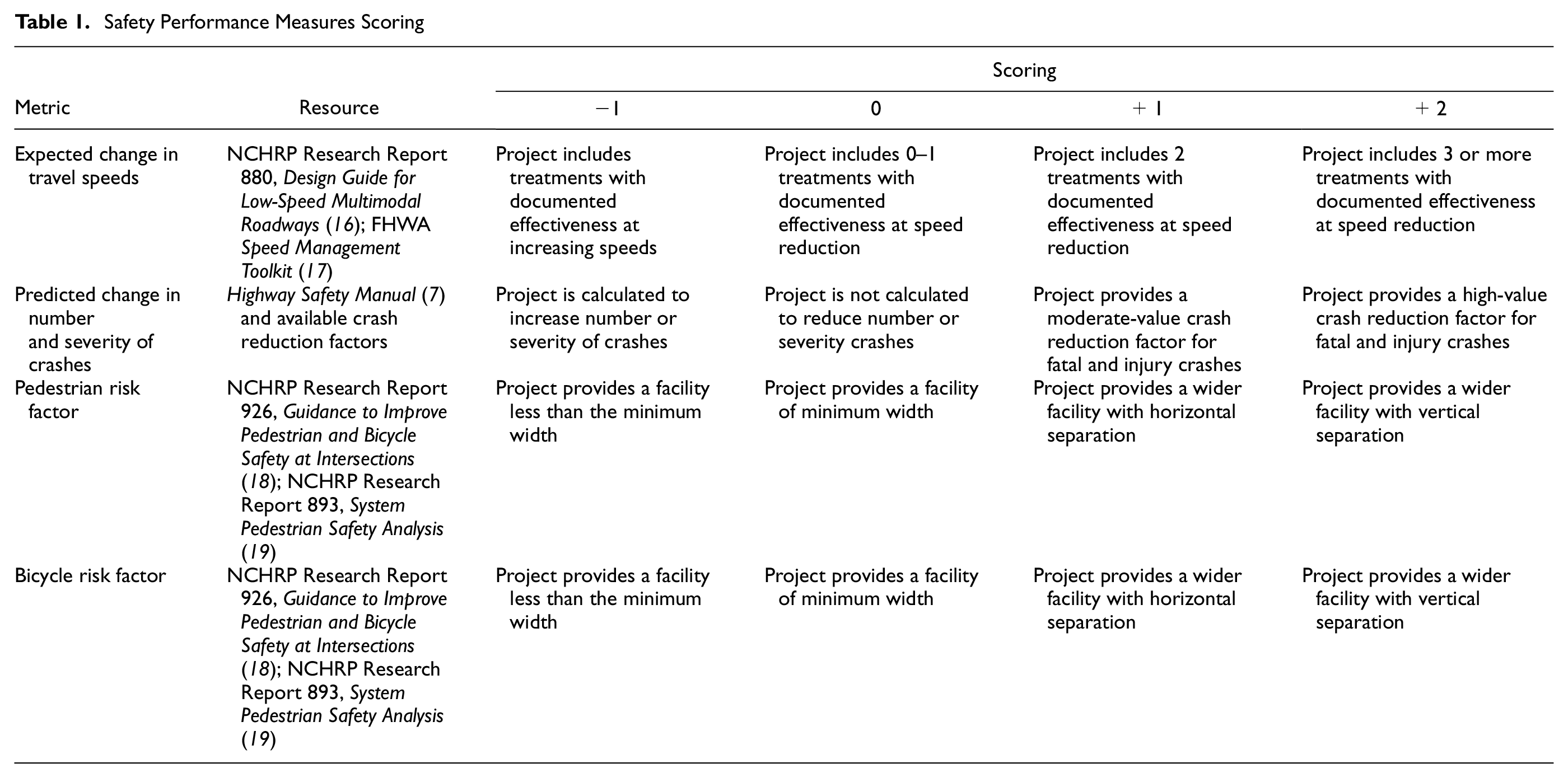
A method for evaluating the performance measures should be developed. For example, a scoring system could be used to rate each performance measure on a predefined scale. Some performance measures may be deemed more important than others and weighted more heavily. An example scoring approach for the safety performance measures is given in Table 1. Although not shown here, a similar scoring approach would be developed for the other performance measures as well.
Safety Performance Measures Scoring
Step 2: Develop Concepts
The next step in the process is to develop alternative concepts. The alternatives are intended to represent a range of options and may be refined through the evaluation process.
The project seeks to address existing conditions on the corridor, including the following.
• Increasing crash severity and frequency, especially run-off-the-road crashes and turning crashes at higher-volume intersections.
• High speeds, especially on the far end of the corridor closer to the rural communities.
• Lack of access for bicyclists and pedestrians, with current recreational riders using the narrow shoulder or sharing the travel lane.
• Limited sight distances at curves along the roadway.
• Projected traffic volumes and a desire to minimize delays for through vehicles on the corridor.
Alternatives were designed based on design guidance in NCHRP Web-Only Document 320, Aligning Geometric Design with Roadway Context ( 2 ) and collaboration with community members. Alternatives included the following.
Vehicle-oriented five-lane suburban cross section including four 12 ft travel lanes, 14 ft two-way left-turn lane, 4 ft bicycle lanes, 2 ft curb or gutter, and 5 ft sidewalks (total width 84 ft) (Figure 10).
Multimodal five-lane suburban cross section including four 10 ft travel lanes, 12 ft two-way left-turn lane, 2 ft curb or gutter, 5 ft landscape buffer, 6 ft separated bicycle lanes, and 8 ft sidewalks (total width 94 ft) (Figure 11).
Multimodal three-lane suburban cross section including two 10 ft travel lanes, 12 ft two-way left-turn lane, 6 ft bicycle lanes with 3 ft buffer, 2 ft curb or gutter, 5 ft landscape buffer, and 8 ft sidewalks (total width 80 ft) (Figure 12).
The ROW dimensions for the respective alternatives would be refined as the project progressed in the next design stages to account for potential cut or fill slopes and to address constrained locations.

Alternative 1: vehicle-oriented five-lane suburban cross section.
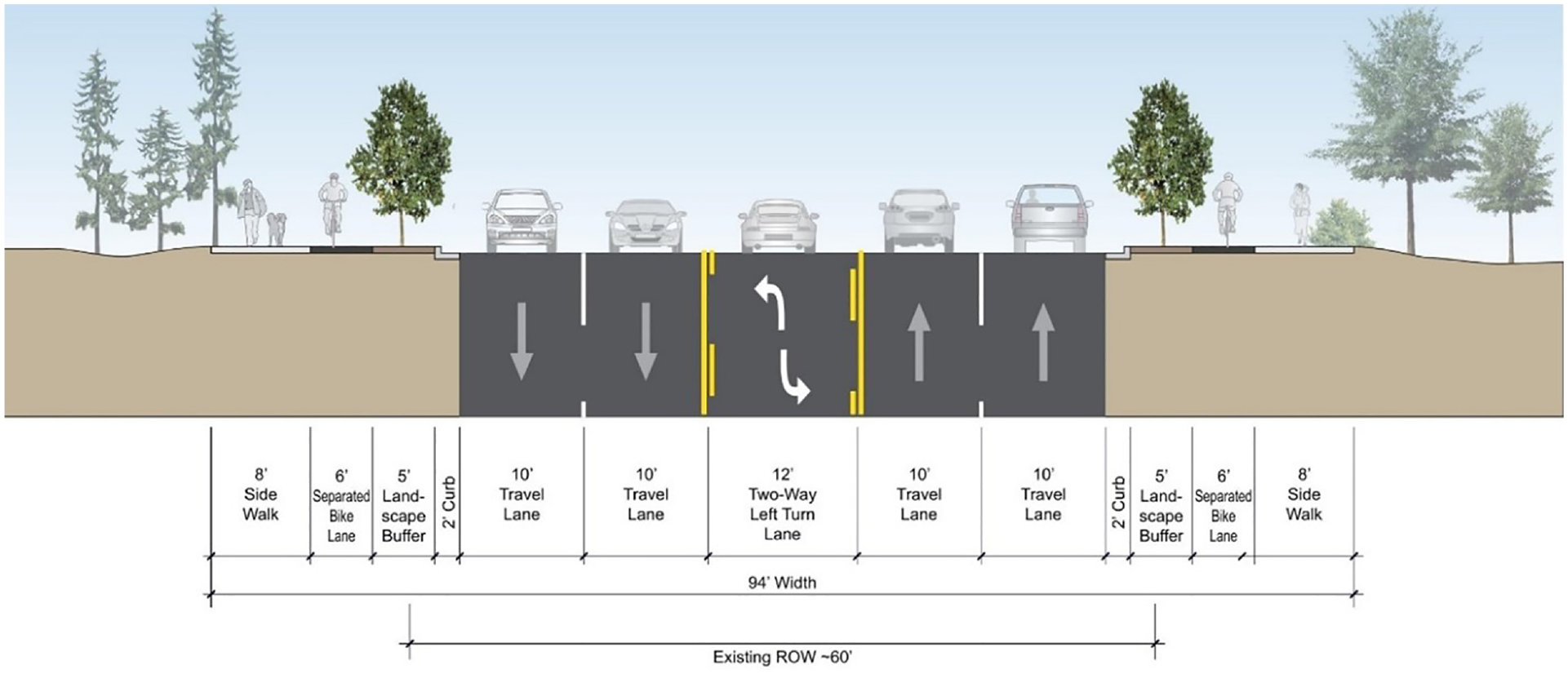
Alternative 2: multimodal five-lane suburban cross section.
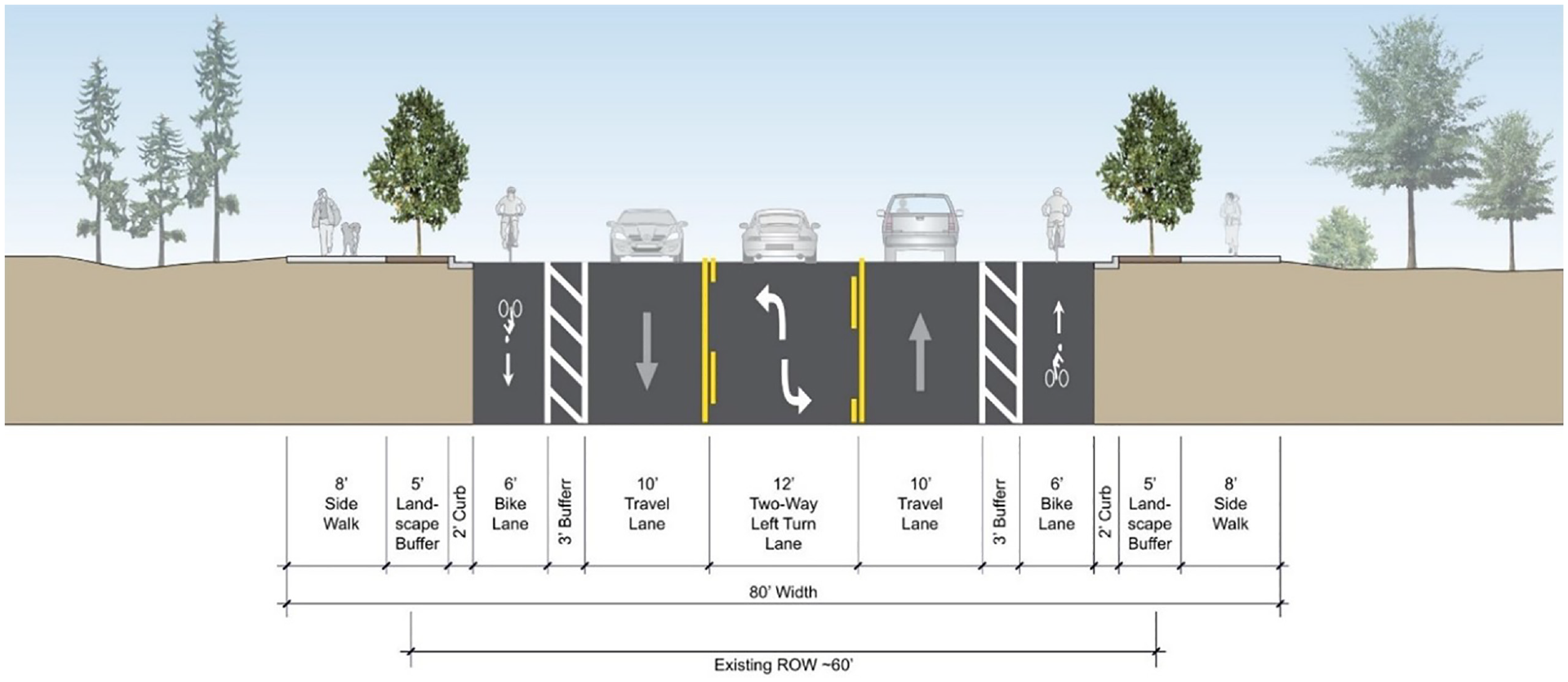
Alternative 3: multimodal three-lane suburban cross section.
Step 3: Evaluate and Select an Alternative
The alternatives are now evaluated against the performance measures previously identified. The evaluation of the alternatives against the safety performance measures is given as an example in Table 2. Although not shown here, a similar evaluation would be conducted for the other performance measures as well.
Safety Performance Measures Scoring a
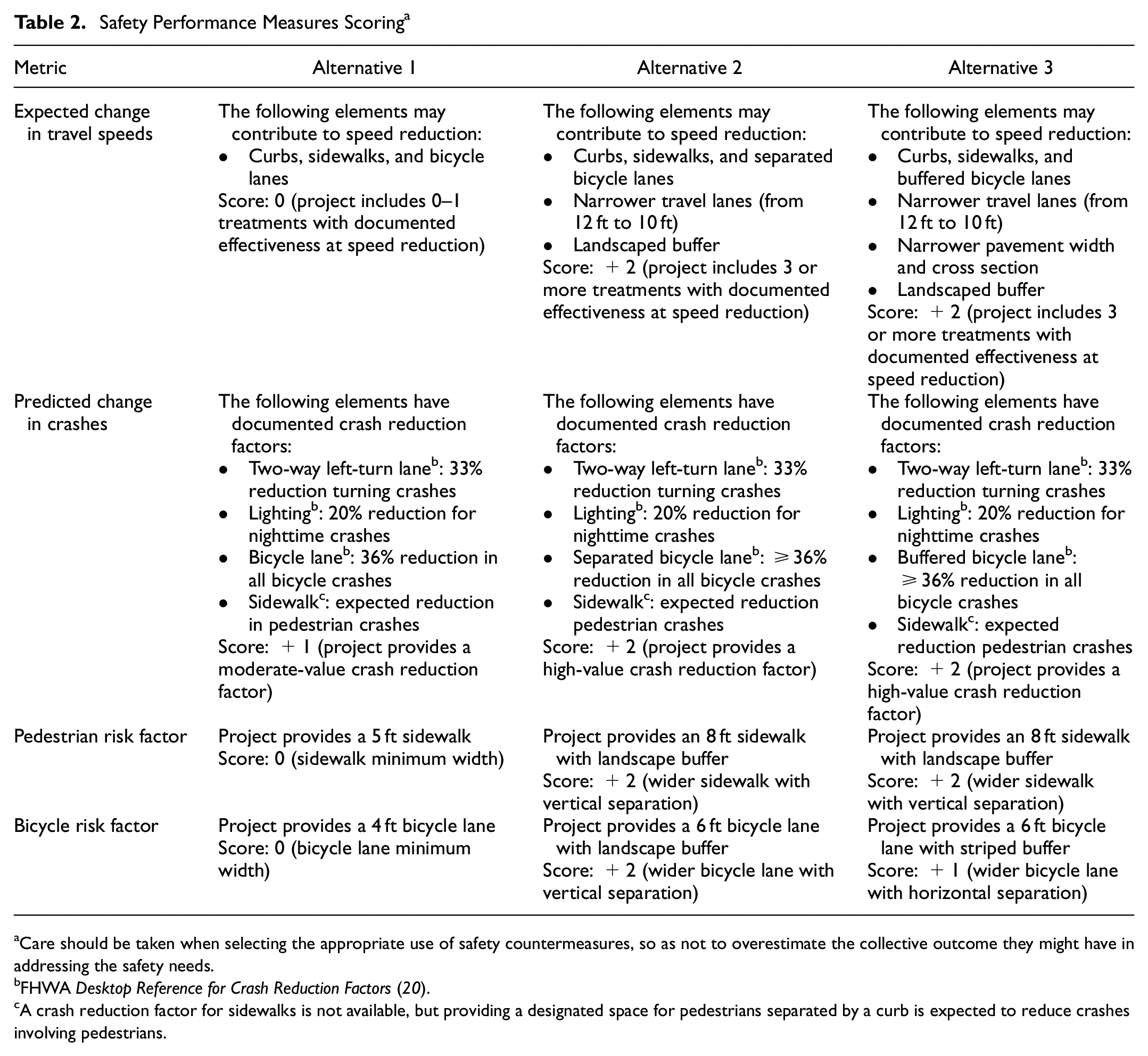
Care should be taken when selecting the appropriate use of safety countermeasures, so as not to overestimate the collective outcome they might have in addressing the safety needs.
FHWA Desktop Reference for Crash Reduction Factors ( 20 ).
A crash reduction factor for sidewalks is not available, but providing a designated space for pedestrians separated by a curb is expected to reduce crashes involving pedestrians.
Once all performance measures have been evaluated, it may be useful to summarize them in a table to help inform selection of an alternative that is most consistent with the project context and goals.
In many cases, the preferred alternative might not be clear-cut and such limitations as ROW, environmental features, and cost may necessitate difficult choices to be made as to how to serve different users along a roadway. In these cases, the design team may have to further evaluate tradeoffs and consider the availability of alternative facilities; context; modal priorities; and relationship between safety, mobility, and convenience. It is important for the project team to document their reasons considering the tradeoffs when selecting the preferred alternative based on the project specific constraints and needs.
As part of the evaluation and selection process, the alternatives may be refined or combined. For example, Alternative 3 could be pursued but the travel lanes increased to 11 ft to serve the moderate freight volumes expected on the corridor. An additional travel lane may be added in advance of intersections to provide adequate capacity, with primarily a three-lane cross section between intersections. The cross section may be reduced in areas with environmental features that the community seeks to preserve (e.g., over a water crossing or near mature trees) by removing the center turn lane or reducing the buffer between the vehicle lane and travel lane. However, the design should maintain continuity for pedestrians and bicyclists and not reduce the sidewalk or bicycle lane to less than the minimum widths, based on applicable design guidance.
The selected alternative is reviewed against the project goals and intended outcomes again when the preliminary design and final design are developed to ensure it is still consistent with the initial purpose of the project.
Step 4: Begin Design
Additional constraints may become apparent throughout the design phase of the project development that require project elements to be revisited and refined. If changes are made to the preliminary concept, advanced design, or final design that do not support the project context and intended outcomes, the practitioners should revisit the context and goals and adjust the design as needed. This iterative process ensures that if changes are made throughout the design process the design remains consistent with the project goals (original intended outcomes). Changes should be clearly documented, and justification provided for decisions made throughout the various steps.
For example, in this project, Alternative 3 was selected and horizontal alignments were developed with the proposed cross section centered on the existing ROW. During the design process, it was determined that the roots of matures trees adjacent to the corridor would be affected by the footprint of the proposed cross section. The design team brainstormed alternatives and developed a plan to avoid impacts to the trees by removing the center two-way left-turn lane for a 200 ft section of roadway and reducing the bicycle lanes to 5 ft with a 1 ft buffer. This preliminary design was compared with the project context and goals and determined to be consistent with the project’s intended outcomes. Appropriate access to adjacent properties was achievable without the center two-way left-turn lane by using a planned roundabout to the south, while the buffered bicycle lane dimensions exceeded the minimum widths for a suburban arterial route.
Conclusions
This paper summarizes current research and state processes on performance-based design and opportunities to incorporate performance-based design in the design process. The example scenario illustrates how performance-based design can be used to select a preferred alternative that meets the project goals and produces the intended outcomes. This information can support state agencies that may consider integrating performance-based design in their practices based on future updates to the 8th edition of the AASHTO Green Book. Future research is expected to continue to support a performance-based design process and provide additional resources for practitioners to evaluate alternatives and make outcome-based decisions. Future research is expected to support state agencies in integrating these processes in their project development.
Footnotes
Acknowledgements
The material represents excerpts from Performance-Based Design and Example Scenario, the white paper that was prepared for the Tennessee Department of Transportation (TDOT) in collaboration with the following TDOT staff: Ali Hangul, MSCE, P.E.; William Rogers; Michael Gilbert; and Jon Storey.
Author Contributions
All authors contributed to the paper, and reviewed and approved the final version of the manuscript.
Declaration of Conflicting Interests
Kelly Laustsen, Julia Knudsen, and Hermanus Steyn are employed by Kittelson & Associates, Inc., which has received funding for work on the Highway Capacity Manual from Transportation Research Board (TRB) and from the National Cooperative Highway Research Program (NCHRP). NCHRP is administered by TRB.
Funding
The author(s) disclosed receipt of the following financial support for the research, authorship, and/or publication of this article: This paper was prepared without funding but was based on work associated with the Tennessee Department of Transportation (TDOT).
