




Abstract
The resilience of pavements depends not only on asphalt mixture performance and structural design but also on the bonding between two adjacent pavement layers and interlayer performance as well as on traffic and environmental conditions. This paper thus aims to assess the impacts of several parameters on the interface shear resistance. Accordingly, the response surface method (RSM) was initially employed to design an experimental matrix based on the factors that exhibit the highest impacts on the shear resistance of the interface including the dosage of emulsions, temperature, and loading rate (as the independent variables) and responses obtained from the Leutner shear test. A pull-off test was also performed to evaluate the bonding between layers. Furthermore, the possibility of moderating the influence of ambient temperature on the interface using the pavement solar collector (PSC) system was investigated. The results showed that temperature is the most influential factor that can compromise the interface performance. The applied loading rate and dosage of emulsions also affected the bonding between pavement layers. The optimization analysis indicated that the utmost interface shear resistance could be attained at mid-range temperatures, coupled with the application of emulsions up to a specific limit. While the emulsion dosage can be controlled during pavement construction, it is beyond human capability to restrain the environmental temperature throughout the pavement’s lifespan. Nevertheless, the PSC system exhibited a superb ability to effectively reduce and increase the interface temperature during summer and winter, respectively, beneficially resulting in higher interface shear strength and consequently construction of more climate-resilient pavements.
Keywords
Transportation infrastructure, particularly the road industry, plays a pivotal role in the economy and growth of all developing/developed countries. Pavement is a multi-layered construction with, in ascending direction, an increase in quality and bonded materials. The main purpose of multi-layered asphalt pavements is to distribute the traffic load toward the sub-grade layer while providing comfort and safety of the driver. Nevertheless, climate change has undesirable effects on pavement systems, compromising their durability and performance. Since durability and performance are directly related to the materials’ properties, mix, and structural designs, one of the recent methods to enhance the resilience of pavement infrastructure and confront climate change’s destructive effects is the optimization and reinforcement of existing materials. One of these materials is the adhesive layer which bonds asphalt pavement layers. This adhesive layer provides an integrated structure for better transferring the stress of traffic loading. Whereas the absence/inadequacy of such layers can considerably reduce the shear resistance of the interface between pavement layers making the system vulnerable to many distresses including layers slippage, cracking, potholes, and raveling. Another way to confront the effects of climate change is the construction of pavement equipped with a pavement solar collector (PSC). PSC systems use an embedded pipe network with circulating fluid to increase/decrease the overall pavement temperature during winter and summer, respectively. Such systems could potentially moderate the effects of alteration in climatic conditions, which destructively compromise pavement performance and durability. This study attempts to discover the influence of modified and unmodified tack coats at different application rates on the shear resistance of two adjacent pavement layers and the potential improvement of their performance using a PSC system under diverse loading conditions.
Literature Review
Temperature variations throughout the seasons influence the durability of asphalt roads in a way which can jeopardize the expected long-term performance and resilience of the road surface. In addition to mixture performance and structural design, the durability of pavement relies on the performance of the interlayer between asphalt layers. A compromised or weakened interlayer between asphalt layers can negatively affect the pavement lifespan. Ensuring the integrity and strength of the interlayer is thus crucial for maintaining pavements’ long-term performance and durability.
The importance of bonding between asphalt layers to prolong the service life of pavements has been studied and highlighted in several studies. For instance, Ragni et al. ( 1 ) indicated that incorporating a tack coat as a bonding layer at the interface can enhance the resistance to shear failure and fatigue cracking resulting in more durable pavements. Xu et al. ( 2 ) emphasized that elevated temperatures, particularly during the summer, can increase horizontal tensile stress which has a detrimental effect on the bonding between pavement layers. In response to this issue, Wang et al. ( 3 ) conducted a study to address heat storage in pavement layers by incorporating conductive adhesive layers. Their research focused on modifying water epoxy resins as the adhesive layer by incorporating carbon fiber, which enhanced heat dissipation efficiency. They reported that such modification increased the minimum shear resistance by approximately 1.3 MPa ( 3 ). In addition to temperature effects on interface bonding, Yang et al. ( 4 ) demonstrated that the surface characteristics of adjacent layers also influence the bonding between asphalt layers. Chen and Huang ( 5 ) found that, while surface characteristics such as mean texture depth and film thickness are crucial for interlayer bonding, their influence on interface bonding is more pronounced at higher temperatures. Moreover, several adhesive agents have been used to bond asphalt layers including traditional and modified emulsions, liquid asphalt, coal asphalt, epoxy resins, and so forth. Biglari et al. ( 6 ) compared the effects of four types of tack coats (crumb rubber-modified, liquid 60/70 bitumen, cationic slow-setting, and cationic rapid-setting emulsions) at different application rates on the shear resistance of asphalt layers. It was found that crumb rubber-modified and liquid 60/70 bitumen, when applied at the optimal rate of 600 g/m2, exhibited superior performance compared with other tested emulsions ( 6 ).
Furthermore, several advanced technologies have been coupled with the road industry to confront the destructive effects arising from environmental conditions. Pavement solar collector (PSC) systems showed great potential as an innovative technology for harnessing thermal energy from asphalt pavements in various settings such as roads, parking lots, and airports. PSCs function by circulating water or another liquid through a network of pipes embedded within the asphalt pavement. The PSCs can serve several purposes, such as clean energy production, increase in road safety, and an increase in the service life of the asphalt pavement. Moreover, they can mitigate the development of the urban heat island effect. One of the PSCs’ key advantages lies in their ability to mitigate the effects of extreme ambient temperatures on pavement performance ( 7 ). The main objective of PSCs is to extract heat from the asphalt pavement during the summer season. The harvested heat can then be used to keep the asphalt surface free from snow and ice, thereby preventing the formation of black ice during winter. The implementation of PSC systems can enhance road safety and decrease reliance on de-icing chemicals. By using PSCs, the seasonal temperature difference within the asphalt pavement can be minimized, increasing the overall lifespan of pavements ( 8 , 9 ). Additionally, using PSCs to regulating the temperature of the asphalt throughout different seasons can help to mitigate pavement distresses such as top-down cracking, rutting, and fatigue cracking ( 10 ). The ability to control the temperature at the interfaces between the collector and base layers offers benefits in reducing the risk of shear failure in the interface layers zone during summer and winter (brittle failure). By regulating the temperature at these interfaces, PSCs provide a means to address and minimize these potential pavement distresses associated with temperature fluctuations throughout the year ( 11 ). Although some research has been carried out on the cooling effect of PSCs in asphalt pavement ( 12 , 13 ), there has been no attempt to investigate the influence of PSC systems on the shear strength of the pavement interface layer.
Accordingly and to construct a resilient pavement, this study first evaluated the impacts of type and application rate of tack coats subjected to different conditions on the shear resistance of the interface between two adjacent pavement layers. Further, the potential beneficial impact of a PSC system on the tack coat performance and durability considering environmental conditions such as extreme low and high temperatures, which can be exacerbated by climate change, was also investigated. This paper is thus structured as follows: after a brief introduction and overview of previous studies, the materials and methods employed to conduct this research are presented, followed by the discussion of the convergence of these results and the effects of variables and PSC systems on tack coat performance and interface layer shear resistance. Finally, the paper concludes with major findings and recommendations for future work.
Materials and Methods
Materials
Two types of tack coats were used as part of the experimental procedure in this study. Modimuls TT C55B4 (named hereafter as A) is a conventional storage stable and rapid-setting undiluted emulsion based on low penetration grade bitumen with trackless abilities, whereas the other undiluted emulsion Modimuls 1000 C60BP3 (named hereafter as B) is a rapid-setting polymer-modified cationic bitumen emulsion. Both emulsions comply with specification: NEN-EN 13808 which specifies the requirements for performance characteristics of cationic bituminous emulsion. The properties of both emulsions (as provided by the supplier) are shown in Table 1. The name of the supplier is not presented to avoid potential commercialization.
Technical Properties of Emulsions

Note: NA = not available.
Two mixtures, AC20 base layer with 50/70 penetration grade bitumen and AC6 surface layer coarse with 50/70 penetration grade polymer-modified bitumen with the addition of red pigments, were used to produce asphalt mixture slabs. The red pigments make it possible to, at a later stage, identify the shear failure mode in the samples. To produce the slabs, the AC20 loose mixtures were first compacted using a roller compactor in accordance with EN 12697-33, followed by emulsion application at designated rates as outlined in the following section. The second layer hot mix (AC6) was then poured and compacted once the applied emulsion was set. Subsequently, after cooling, the specimens were core drilled with 150 and 50 mm diameters to conduct shear and pull-off tests, respectively. It should be mentioned that the pull-off samples were not cored to the bottom of the slabs but to a depth of 20 mm to the next layer in accordance with the standard procedure requirements. All cores were then airdried for at least one week before the testing. Figure 1 presents the pictures of the specimens before conducting both Lautner shear and pull-off tests.

Specimens before performing: (a) Leutner shear; and (b) pull-off tests.
Methods
Confocal Laser Scanning Microscope (CLSM)
Before the experimental design and testing, a confocal laser scanning microscope (CLSM) was used to evaluate the morphology, texture, and surface characteristics of both emulsions. Accordingly, the Keyence VK-X1000 model CLSM, equipped with a VK-D1 motorized XY-stage and six objective lenses, including a Nikon Lens Plan Apo EPI 150X, with different resolutions was employed to perform the tests. The analysis to detect topographical laser scanning information was then performed using the VK Multi File Analyzer.
Experimental Design and Evaluated Parameters
One set of experiments (similar for both emulsions) was designed using central composite design (CCD) embedded in the response surface method (RSM) to study the interface shear resistance of two adjacent pavement layers when subjected to different conditions. RSM is a combination of techniques used to build up a series of experiment designs, finding relationships between experimental factors and responses to establish the optimum conditions using these relationships. Following previous studies, one of the main advantages of using the RSM/CCD method is its ability to minimize the total number of required samples to conduct tests ( 14 ). In this study, the dosage of undiluted emulsions (DE), testing temperature (TT), and application loading rate (LR) as the main influential factors on the interface shear behavior were chosen as the independent variables (IVs), whereas the shear test outcomes such as maximum shear stress (τmax), shear stiffness modulus (kmax), shear energy (E), and fragility index (FI) (calculated using Equations 1–6) were selected as the responses or dependent variables (DVs). Fifteen combinations of the IV conditions were considered in the experimental design. Since the CCD requires some replication to estimate the experimental error, three samples were prepared and tested at the central point condition (based on the designed matrix) to evaluate the experimental error, which led to a total of 17 tested samples for each emulsion. In this study, the shear test is used to assess the bonding quality and to determine the shear resistance of the interface layer between two adjacent pavement layers subjected to different stresses and temperatures to simulate different real-life scenarios. To perform the tests, specimens were subjected to direct shear loading at a controlled temperature with a constant shear rate (according to the designed experimental matrix provided in the following sections). Subsequently, the following equations were employed to calculate the abovementioned parameters (DVs) from the recorded force-displacement curves.






where
Fpeak is the peak load,
D represents the diameter of the specimen,
F’ is the slope of the ascending part of the force-displacement curve, integration of F(δ)dδ represents the area under the force-displacement curve,
E is energy to the peak,
Epp denotes the post-peak energy until 70% of peak load, and
Etot is total energy.
Table 2 presents the experimental design and shear test outcomes.
Experimental Design and Shear Test Outcomes
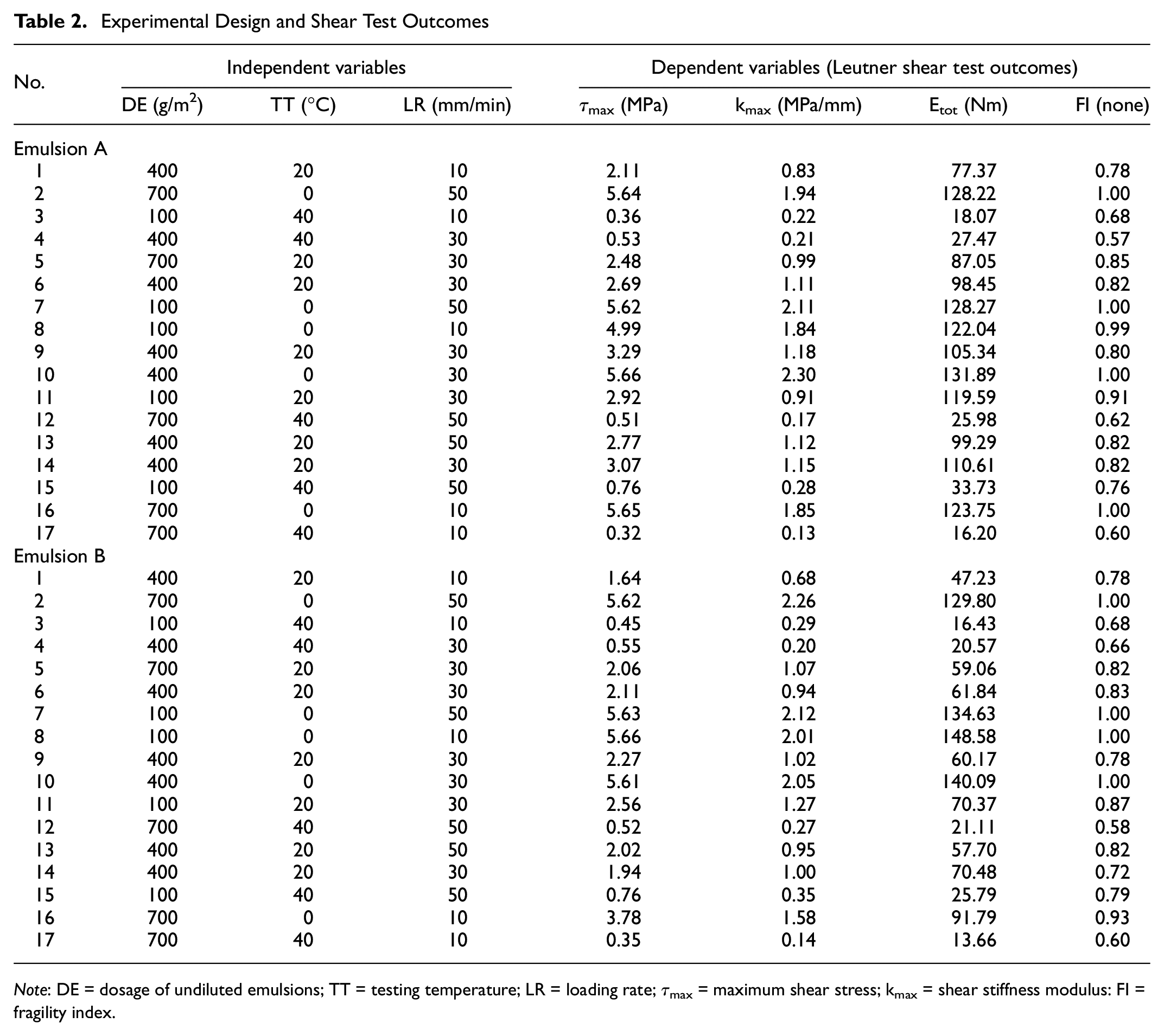
Note: DE = dosage of undiluted emulsions; TT = testing temperature; LR = loading rate; τmax = maximum shear stress; kmax = shear stiffness modulus: FI = fragility index.
Testing Procedures
In this study, the shear resistance of the interface between pavement layers was determined using the Leutner shear test in accordance with EN 12697-48:2021 standard procedures. Accordingly, all cored specimens were conditioned in a climate chamber for at least 4 h at the testing temperature and the shear test was performed at the designed loading rates. Moreover, the pull-off test was carried out using the Proceq DY-2. To perform the test pull-off, disks were initially glued to the cores and subsequently, similar to the shear test, the slabs were conditioned for at least 4 h at a temperature of 23 ± 2°C in accordance with EN 24624 standard. In total, four replicates (randomly scattered on the slabs to verify the homogeneity of the application of the emulsion) were carried out for evaluation. The Leutner shear and pull-off test devices are presented in Figure 2, a and b , respectively.

(a) Leutner shear; and (b) pull-off tests devices.
Experimental PSC Prototype
This section aims to offer an overview of the large-scale PSC research prototype and the validation approach for simulation modeling. The finite element (FE) simulation framework is also outlined, highlighting geometrical specifications, modeling inputs, assumptions, and simplifications. The experimental data collected from the PSC set-up is used to validate the simulation framework, ensuring its accuracy and reliability.
The PSC system was designed and constructed at the University of Antwerp and covers a total area of 65 m2. This prototype comprises four interconnected heat exchange sections and two reference zones (refer to Figure 3). The asphalt pavement consists of three layers, with a combined thickness of 12 cm, and is positioned on a foundation made of unbound materials. The cross section of asphalt pavement, position of pipes, support grid and location of embedded temperature sensors are shown in Figure 4. During the construction phase, the collector layer, accompanied by an integrated network of pipes and a support/reinforcing grid, along with the top layer, was positioned one day subsequent to the placement of the base layer. Consequently, the network of pipes and support/reinforcing grid was placed and sprayed with bitumen before the paving of the collector and the top layer. Moreover, a total of 96 fast-response insulated thermocouples were positioned within the set-up. These thermocouples were placed perpendicular to the traffic direction in two sections within the reference zones and two additional sections within the collector parts. The purpose of this arrangement is twofold: first, to facilitate continuous monitoring of the temperature profile within the asphalt layers, and second, to enable comparisons between temperature fluctuations in the heat exchanger and the reference zones. Each section is equipped with 24 sensors positioned near the surface at depths of 4, 7, and 10 cm within the asphalt layers.

The layout of the pavement solar collector (PSC) prototype.
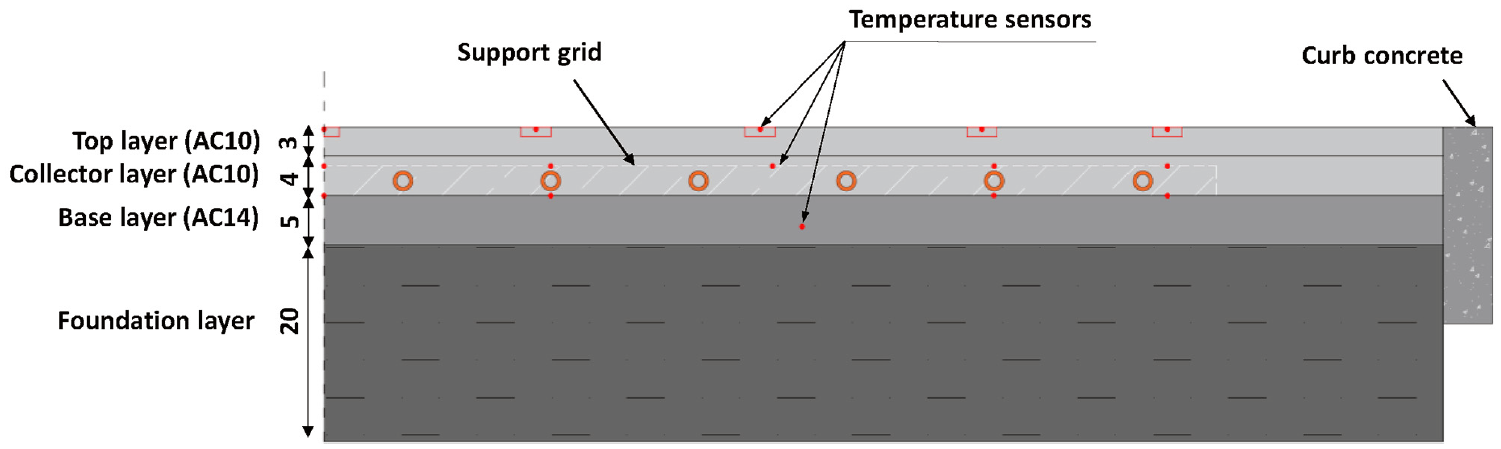
Asphalt pavement cross section and location of temperature sensors in Section 4 (units in cm).
Furthermore, the PSC system allows control over several operational and design parameters, including flow rate, inlet water temperature, and pipe length. One of the main advantages of this PSC prototype is its flexible system configuration, which allows for simultaneous sensitivity assessments of both design and operational parameters within the same experiments. This capability enables researchers to evaluate the impact of various factors on the system’s performance. By conducting these simultaneous assessments, valuable insights can be gained into the optimal configuration and operation of the PSC prototype, facilitating informed decision making and further advancements in the field of PSCs.
To create a vertical borehole thermal energy storage (BTES) system, two boreholes were drilled to a depth of 100 m. These boreholes were then filled with U-shaped pipes to form a heat-exchanging surface with the surrounding soil. Although the BTES boreholes are filled with a water and anti-freeze mixture, to address environmental concerns, the heat exchangers of the PSC system do not use any glycol mixture to avoid potential leakage risks and groundwater contamination. The BTES serves as the thermal energy source for the PSC system during the winter months and acts as a heat sink in the summer. In the summer, colder water flows through the pipes, absorbs heat, and is then collected in the buffer tank. The heat pump (HP) captures thermal energy from the warm water and transfers it back into the BTES for storage and future use. For further information on the technical specifications and instrumentation, please refer to Ghalandari et al. ( 11 ).
Finite Element Modeling and Validation
In this study, an FE modeling framework was employed, and its accuracy was confirmed by validating the outcomes with the experimental data obtained from the abovementioned PSC prototype. The FE models used in this study are simulated in full 3-D to achieve a thorough evaluation of the PSC systems. This approach avoids the need for thin wall assumptions and geometrical simplifications, ensuring a more accurate representation of the system. The comparison between the modeled results and the actual measurements of the PSC system demonstrated a satisfactory agreement between the outlet fluid temperatures and the asphalt pavement surface ( 9 ). Therefore, the developed FE model is employed to assess the impact of a PSC on the interface shear strength of the asphalt layer.
Although the FE modeling framework is adopted from the validated PSC prototype, several parameters such as geometrical variables and operational conditions are modified and set for this study. For geometrical properties, the FE models have a surface area of 7.65 m2, where the embedded pipe length within the model is 50 m and arranged in a serpentine pattern. The total thickness of the asphalt pavement is modeled as 10 cm to correspond to the laboratory samples for shear strength testing with the same thickness. The embedded pipes are modeled with an outer diameter of 20 mm and an inner diameter of 13 mm. These pipes are arranged with a center-to-center spacing of 15 cm and are embedded in the middle of asphalt pavement at 5 cm below the surface (from the center of the pipe). Moreover, the FE models have a total height of 1,000 mm, with the soil layer extended to 680 mm beneath the aggregate base to minimize any boundary effects.
The boundary conditions applied at the asphalt surface are identical to those used in the reference section. This includes considerations for solar radiation, ambient temperature, and convective heat flux. At the inlet boundary, a constant fluid flow rate of 3 l/min is specified, while a no-slip boundary condition is applied at the pipe wall. These simulations are conducted for the turbulent flow regime, using two separate solvers. One solver is employed to analyze stationary fluid flow, while the other focuses on time-dependent heat transfer. In the simulations, the inlet temperature of the fluid is set to 12°C and 25°C for summer and winter, respectively. Furthermore, the extracted or injected energy q (kWh) of the PSC system (for one hour) is calculated according to Equation 7 ( 15 , 16 ):

where
Shear Test Data Analysis
The RSM design was performed using design-expert software to conduct the data analysis. As explained earlier, the RSM determined the DVs by designing the experiment plans and subsequently applying the regression models. Different regression models including linear, quadratic, cubic, and two-factor interaction (2FI) were studied for each emulsion. The accuracy of models was obtained according to the sequential F-tests, lack-of-fit tests, and R 2 . The best-fitted model was then adopted for further analysis and detection of the influence of IVs on the responses. The significance of each IV was tested using analysis of variance (ANOVA). It should be noted that the insignificant IVs were eliminated to enhance the precision of the analysis, and the best-fitted models were proposed to predict the responses. Once the best-fitted models were determined, the desirable interface shear resistance was determined based on the specimens’ optimal performance and FI as the principal factor representing the longevity of the interface.
Results and Discussion
Confocal Laser Scanning Microscope Test
As stated earlier, CLSM was used to examine the morphology and texture of emulsions as the results shown in Figure 5, a and b , correspond to the conventional and polymer-modified emulsions, respectively. Although both emulsions comply with the NEN-EN 13808 standard which specifies the requirements for performance characteristics of cationic bituminous emulsion, the difference in the morphology and roughness of specimens indicates that conventional emulsion exhibits more homogeneity compared with the polymer-modified one. Such dissimilarity can influence the tack coat’s performance which will be discussed in the following sections.

Confocal laser scanning microscope (CLSM) results: (a) conventional emulsion; and (b) polymer-modified emulsion.
Leutner Shear Test
The calculated results of the Leutner shear test performed based on the experimental plan (Table 2) are presented in Figures 6 to 10. Figure 6 shows the maximum shear stress for both emulsions at different load application rates, temperatures, and dosages of emulsions. The results indicate that the testing temperature is the most dominant parameter influencing τmax. It can also be observed that the proportion of conventional emulsion merely influenced the τmax while an increase in the dosage of polymer-modified emulsion slightly compromised the τmax, particularly at lower testing temperatures at all applied load rates. Such a trend can be associated with excessive emulsion application which can lead to the construction of an interface with different thicknesses. The impacts of a higher application rate coupled with the inhomogeneity of polymer-modified emulsion determined via CLSM can exacerbate its destructive impacts resulting in lower shear stress. Moreover, the results show that the changes in the loading rate which can simulate the acceleration and deceleration of vehicles can also influence τmax where the highest corresponding value can be found at the middle loading rate. Such trends indicate the destructive impacts of changes in the vehicle speeds, particularly deceleration (lower load rate) which can contribute to lower interface shear resistance. For paper brevity and since the trend of IVs influence on the DVs remained approximately constant (similar to τmax), only the results at mid-loading rate (30 mm/min) are provided for other calculated DVs.

Results of maximum shear stress (τmax): (a) conventional emulsion; and (b) polymer-modified emulsion.

Results of shear stiffness modulus (kmax) at 30 mm/min application load rate: (a) conventional emulsion; and (b) polymer-modified emulsion.

Total shear energy (Etot) to reach failure at 30 mm/min application load rate: (a) conventional emulsion; and (b) polymer-modified emulsion.

Results of fragility index (FI) at 30 mm/min application load rate: (a) conventional emulsion; and (b) polymer-modified emulsion.

Optimal independent variables (IVs) with respect to interface shear resistance: (a) conventional emulsion; and (b) polymer-modified emulsion.
The results of the maximum shear stiffness modulus (kmax) are illustrated in Figure 7. It can be seen that the stiffness modulus of the interface decreased when temperature increased which is in line with the results of τmax. The changes in the kmax can be correlated to the fluctuations in the viscoelastic properties of base bitumen which becomes softer at higher temperatures and results in lower stiffness modulus. Figure 7 also indicates that changes in the emulsion dosage exhibit no considerable influence on the shear modulus at elevated temperatures for both emulsions. Whereas an increase in the dosage of conventional emulsion at a lower temperature increased the shear modulus initially while decreasing when the application rate exceeded a certain value. However, this trend is reversed for the polymer-modified emulsion. The difference in the stiffness of emulsions can be associated with the impacts of modification which enhances bitumen flexibility and improves its stiffness at low temperatures. In other words, conventional bitumen becomes rigid and brittle at lower temperatures resulting in higher stiffness which is not favorable. However, the modification of bitumen using polymer improves its flexibility denoting the possibility to be incorporated in colder environmental conditions.
Furthermore, the influence of IVs on the shear energy was evaluated as the results provided in Figure 8. From the results, as expected, it can be inferred that temperature exhibits the dominant impact on the required energy to reach failure where a considerably lower energy is needed to reach failure at a higher temperature compared with the corresponding value at colder testing temperatures. This can be associated with the changes in the viscoelasticity of bitumen at different temperatures. Moreover, the results of conventional emulsion suggest that the energy to the failure is slightly lower at 0°C, indicating that conventional bitumen fails with lower energy as a result of higher brittleness at low temperatures. Whereas the polymer-modified emulsion exhibited a higher energy requirement for failure which can be attributed to the changes in bitumen flexibility because of the polymer modification. The results also show that the changes in the dosage of the emulsion application rate may not influence the energy for conventional emulsion while an increase in the corresponding value decreased the failure energy in the case of polymer-modified specimens. Although such a trend can be associated with the inhomogeneity of modified emulsion as found by CLSM, it can also be inferred that having excessive emulsion can contribute to weaker bonds between layers, reducing the overall structural integrity of the pavement (weakening bonding between pavement layers).
Figure 9 illustrates the IVs’ effects on the interface FI parameter. There is an inverse interplay between the shear strength and FI since lower temperatures create a more brittle structure with regards to high temperatures and vice versa. Brittleness is characterized by the inability of a structure to undergo plastic deformation after the peak load is reached, which results in immediate rupture and a limited lifespan of the structure. On the other hand, a low fragility index resulted in the material not possessing enough stiffness and therefore a lower peak ( 17 ). A balance is, therefore, sought between the pre-and post-peak areas. The results show that increasing the test temperature as the most influential factor reduced the FI which can be correlated to the changes in bitumen’s lower brittleness at higher temperatures. While no considerable influence of tack coat dosages can be detected, slightly lower FI can be observed for the mixtures produced using the highest and lowest proportions of emulsion at lower temperatures.
Eventually, the 3-D contour plots indicating the optimal values of IVs with respect to interface performance are presented in Figure 10. From the figure, the best shear resistance of the interface layer can be achieved when both emulsion application rate and temperature are in the mid-range. These results indicate that exceeding/lacking the emulsion application rate can be detrimental while neither elevated nor lower temperature is favorable given lower bitumen stiffness and higher fragility at the corresponding temperatures, respectively. The emulsion application rate can be controlled during construction. However, the environmental temperature which directly influences pavement performance cannot be restrained. Therefore, this study proposes the usage of the PSC system as will be discussed in the following sections to adjust the pavement temperature which can lead to the construction of resilient pavements.
Pull-Off Test
Subsequently, the pull-off test was conducted as results displayed in Figure 11, a and b . Figure 11a represents the results of four pull-off test replicates of slab produced with polymer-modified emulsion and an application rate of 300 g/m2. Such a constant sampling trend was similar for other slabs showing homogeneous application of emulsions, but the results are not provided here for brevity. Figure 11b shows the mean value of changes in maximum pull-off forces obtained for both conventional and polymer-modified emulsions at different application rates. The results indicate that although the conventional emulsion outperformed the polymer-modified emulsion which can be associated with the lower penetration and the softening point of polymer-modified emulsion (refer to Table 1) or the difference in the homogeneity of emulsions morphology (CLSM results as discussed earlier), the emulsions’ application rate plays a critical role in bonding between pavement layers. It can be seen that the optimal tack coat application rate is approximately 300 g/m2 for both emulsions. This finding is in agreement with the Leutner shear test outcome and denotes that an increase or decrease in emulsion application rate is not favorable and can lead to shear failure and consequently occurrence of layer slippage and potholes on the pavement which contribute to lower pavement durability.
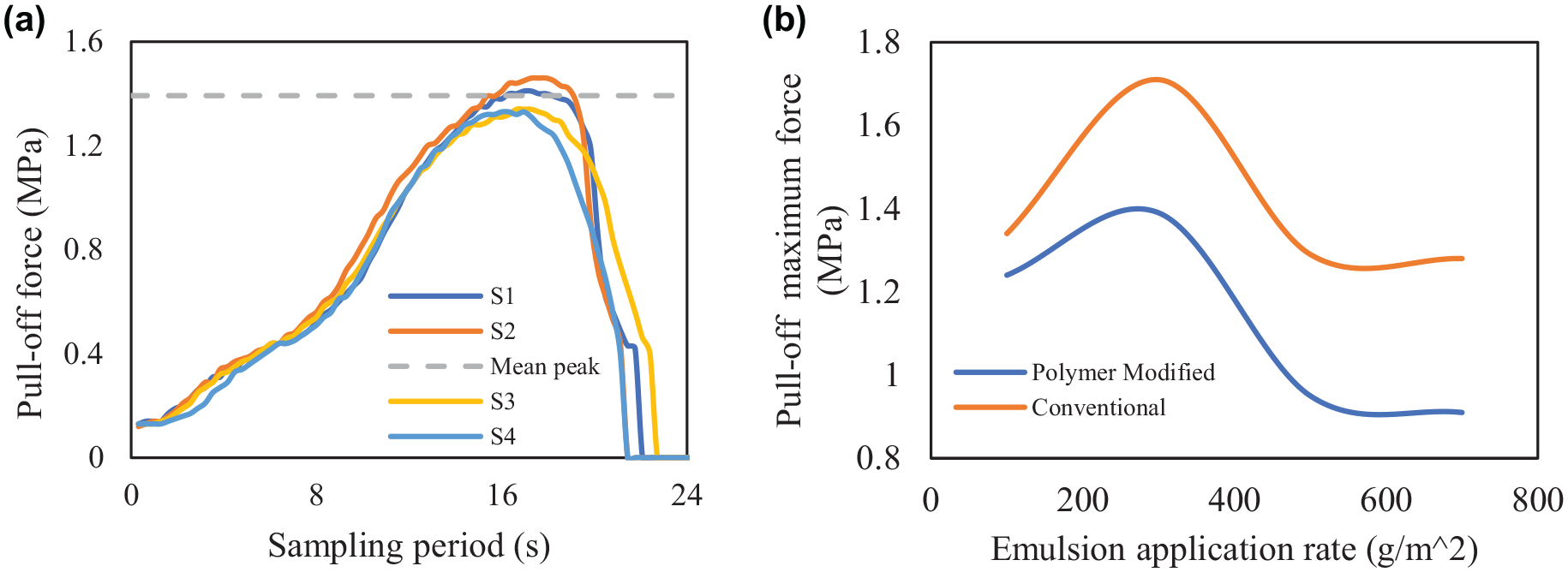
Pull-off test results: (a) example of test conducted on polymer-modified emulsion at the application rate of 300 (g/m2); and (b) maximum forces.
Pavement Solar Collector System
As highlighted in a recent study ( 11 ), one significant advantage of PSCs is their capability to regulate the temperature at the collector and base layer. This regulation plays a crucial role in mitigating the risk of cold thermal crack formation and brittle shear failure behavior during winter, as well as reducing the likelihood of rutting development and shear failure during summer. To determine the possible influence of the PSC system on interface performance, the FE simulations were performed for one day in summer and winter to assess the impact of cooling and heating in extreme weather conditions on interface shear strength (ISS) response. The simulation for the summer scenario was performed for 24 h on August 3rd, 2019, where the ambient air temperature was fluctuating between 15.9°C and 28.6°C. Figure 12 shows the temperature of the asphalt interface variations with and without the PSC system with respect to the cumulative harvested heat.

Asphalt temperature variations with PSC and without (REF) at the interface of asphalt layer versus harvested heat.
The analysis reveals that the PSC system effectively reduces the profile temperature of the asphalt pavement, particularly at the interface layer near the pipe embedment depth. As the fluid flows through the PSC system, the temperature at its interface becomes notably cooler compared with the reference section, and this temperature difference progressively increases during the day, reaching its peak around 17:00. Even during nighttime, the PSC system continues to cool down the pavement; however, the temperature difference becomes less pronounced. This can be correlated to the thermal capacity of the asphalt pavement which can retain the absorbed heat, leading to a slower cooling-down process that can extend over several hours throughout the night. The cumulative harvested heat (HH) given in Figure 12 indicates that a total of 35 kWh of heat was harvested during the day, where the rate of harvesting was higher between 10:00 and 19:00 as a result of a higher ambient temperature. The Leutner shear test results indicated a higher possibility of interface shear failure at higher temperatures. This outcome thus shows that using a PSC system will reduce the peak temperatures of asphalt pavement leading to an increase in the ISS and consequently the lower chance of shear failure at the interface and construction of more climate resilience pavements. It should also be noted that the HH capacity of a PSC system depends on several variables, including weather parameters and operational conditions. As a result, the daily HH capacity can change dramatically in a monthly period and should be taken into account in the long-term HH capacity estimation of PSC systems.
Furthermore, the FE simulations for the winter period were performed on January 5, 2019. The asphalt temperature values at the interface for the reference and activated PSC system are shown in Figure 13. The FE simulations show that the temperature of the interface was fluctuating between 0.5°C and −2°C for the reference section while activating the PSC at midnight increased the temperature of the interface which reached a temperature difference of up to 9°C around noon. Such an increase can moderate emulsions fragility which can lead to more optimal shear resistance of the interface layer as can be seen based on the desirability index provided in Figure 10. Moreover, since the ambient temperature reached the freezing point around midnight, the inlet temperature of the fluid was set to 25°C to provide an ice-free asphalt surface. The injected heat (IH) to the system was calculated using Equation 7 and a cumulative IH is presented in Figure 13. According to these results, the total IH for the 24 h was calculated to be 55 kWh. The cumulative IH shows a linear increase since the inlet supply is a high-temperature flow that is provided by the HP, although the injected heat is partially supplied from collected (low-temperature) heat in the summertime.
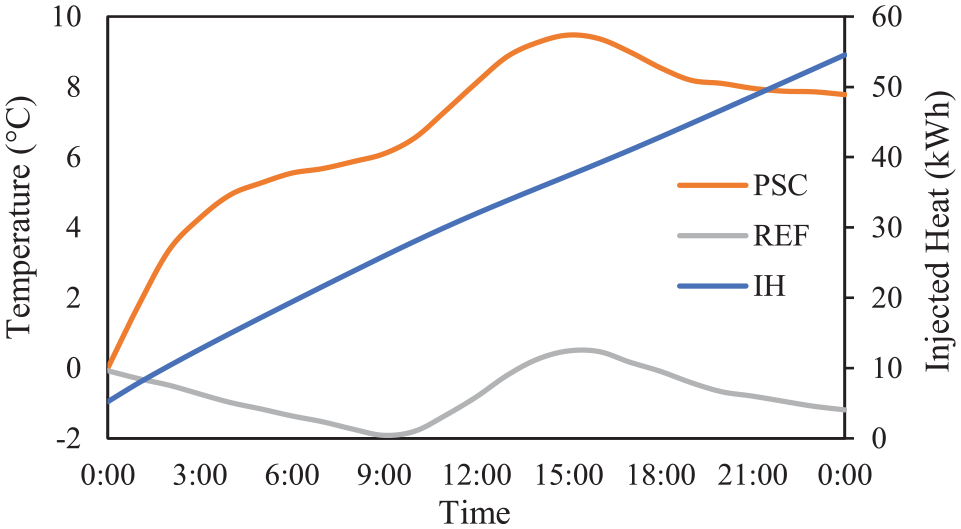
Asphalt temperature variations with PSC and without (REF) at the interface of asphalt layer versus injected heat.
For the balance between harvested and injected heat, experimental results showed that using a low-temperature supply in wintertime could consume approximately 80% of the collected heat in the summertime ( 11 , 18 ). It is important to highlight that the test conditions in this study involved using a high-temperature supply, but this is limited to only a few days during winter to prevent freezing of the asphalt surface. Therefore, the excess heat remaining in the storage can be effectively used for various applications, including providing preheated domestic hot water and serving as a heat source for the heating system of nearby buildings.
Conclusion
To contribute to climate-resilient and sustainable pavements, this study investigated the impact of a PSC system, emulsion types, and dosages on interlayer performance. The effects of loading rates and temperatures on the bonding between interface layers were also assessed using the Leutner shear test. The results clarified that the temperature is the dominant factor that can compromise the interface shear resistance. The optimization analysis showed that the highest interface shear resistance can be achieved at mid-range temperature as a result of the desirable stiffness and lower fragility of emulsions’ base bitumen. It was also found that the loading rate, particularly at both extreme conditions (high and low), causes more damage denoting the destructive influence of vehicle acceleration/deceleration on the interface shear resistance. Moreover, the results indicated that the application of emulsions would only be beneficial up to a certain proportion where exceeding/lacking this limit can be detrimental. The pull-off test confirmed this finding. The pull-off test also indicated that, at intermediate temperatures, the conventional emulsion outperformed the polymer-modified emulsion as a result of either a lower penetration grade and softening point of base bitumen of polymer-modified emulsion or the difference in the homogeneity of emulsions’ morphology obtained from CLSM. Whereas, based on the data obtained from the Leutner shear test, polymer-modified emulsion performed better particularly at lower temperatures, denoting the beneficial impacts of emulsion modification using polymer in colder regions.
It is known that the amount of applied emulsion can be controlled during pavement design and execution; however, the environmental temperature cannot be restrained. Therefore, the possibility of constructing climate-resilient pavement using a PSC system was researched. The FE simulations indicated that using the PSC system in the summertime, in addition to harvesting renewable energy, can effectively cool down the asphalt temperature at the interface (up to 12°C) resulting in higher interface shear strength and construction of more climate-resilient pavements. Moreover, heating the asphalt pavement to provide an ice/snow-free surface in the wintertime also benefits the interface shear strength by moving it away from the brittle response zone which also beneficially contributes to higher durability of the interface layer.
Footnotes
Acknowledgements
We would like to thank LATEXFALT B.V. for supplying the emulsions.
Author Contributions
The authors confirm contribution to the paper as follows: study conception and design: S.R. Omranian; data collection: S.R. Omranian., T. Ghalandari., E. Djug, B. Craeye; analysis and interpretation of results: S.R. Omranian., T. Ghalandari.; draft manuscript preparation: S.R. Omranian, T. Ghalandari, W. Van den bergh, C. Vuye. All authors reviewed the results and approved the last version of the manuscript.
Declaration of Conflicting Interests
The author(s) declared no potential conflicts of interest with respect to the research, authorship, and/or publication of this article.
Funding
The author(s) disclosed receipt of the following financial support for the research, authorship, and/or publication of this article: The authors would like to thank the University of Antwerp and the Faculty of Applied Engineering for sponsoring the CyPaTs project ( ) as well as the Industrial Research Fund (IOF-SBO) for funding the project AQ2UABIT “Advanced Qualitative and QUantitative surface Analysis of BITuminous binders using laser scanning confocal microscopy.” (project nr. 40204).