



Abstract
Several benefits, including low cost, versatility, robustness, and local availability, contribute to concrete being humankind’s most widely used construction material. Possessing one of the lowest carbon footprints of any construction material, its widespread use has rendered concrete one of the largest single sources of anthropogenic greenhouse gas (GHG) emissions. Therefore, the cement and concrete industries possess an incredible opportunity to reduce overall emissions through adopting technologies, processes, and procedures proven to lower the carbon footprint of concrete. Several roadmaps have been published in recent years, notably by the Portland Cement Association and the Global Cement and Concrete Association outlining the path to concrete carbon neutrality by 2050. The American Concrete Pavement Association has also published a white paper to guide the concrete pavement industry toward sustainability in concrete pavements, recommending pavement design optimization, performance-engineered mixtures, and blended cements for environmentally sustainable concrete pavement design. The path to reducing the carbon footprint of concrete is well-defined by these documents, but there are barriers in the path. These barriers must be identified, addressed, and removed, using a clear plan of action, to successfully achieve carbon reduction goals. The major barriers identified are related to 1) existing materials production and logistics, 2) specifications, testing, and design procedures, and 3) adopting new technologies in a risk-adverse industry. Each is discussed at length, along with an action plan to remove them, clearing the path to concrete carbon neutrality.
Keywords
The cement and concrete industries are committed to being carbon neutral by 2050, and various roadmaps to achieve that goal have been published, most notably by the Portland Cement Association (PCA) ( 1 ) and the Global Cement and Concrete Association ( 2 ). In January 2023, the American Concrete Pavement Association (ACPA) published a white paper ( 3 ) outlining concrete pavement’s role in sustainability, aligning with PCA’s roadmap to carbon neutrality. These documents share common elements addressing the carbon footprint across the entire concrete value chain, and touch on all life cycle stages of the concrete product. To meet the carbon reduction goals outlined in the roadmaps, substantial progress must be achieved within the next 5 to 10 years through enhancements in concrete production and use. In the longer term, modifications in cement production, including incorporating carbon capture, utilization, and storage technologies, as well as major breakthroughs in lower-carbon cement technologies, will lead to even greater emissions reduction. Specific to concrete pavement, pavement design optimization, use of blended cements beyond Portland limestone cement (PLC), and performance-engineered mixtures (PEMs) are the focus of current efforts for environmentally sustainable design. Although it is agreed these new processes and technologies must be adopted to achieve carbon reduction goals, there are several logistical challenges to doing so. These challenges, or barriers, fall into three categories related to 1) existing materials production and logistics, 2) specifications, testing, and design procedures, or 3) adopting new technologies in a risk-adverse industry. Once a broad understanding of these barriers is established, an action plan can be developed, the path described by the roadmaps can be followed, and achieving carbon reduction goals becomes more realistic.
Concrete Pavements and Sustainability
Concrete pavement offers several economic, social, and environmental benefits, making it an overall “sustainable” material ( 4 ). Whereas the initial cost of materials and labor involved in constructing concrete pavement is typically higher in comparison to other paving materials, less maintenance is required over its lifespan. This makes concrete both economically and socially sustainable, as less maintenance reduces both the risks and costs associated with frequent construction zones to the traveling public. Other social benefits include providing a smooth and safe roadway as well as its ability to withstand and recover from catastrophic events, such as wildfire, and provide safe travel in and out of affected areas. Smoother and stiffer concrete pavement also lends itself to improved fuel efficiency, which in turn reduces emissions. Concrete’s high albedo can also result in radiative forcing and reduce the urban heat island effect ( 5 , 6 ), leading to carbon reduction; concrete also has CO2 absorbing properties. Although the topic of sustainability involves a balancing act between meeting these economic, social, and environmental demands, there is currently a strong emphasis on the environmental component. The starting point for addressing the embodied environmental impact of concrete pavement is altering the way concrete is designed.
The following pavement design improvements can result in significant environmental benefits: pavement design optimization, PEMs, and increased use of blended cement. Optimizing pavement designs can reduce overdesign. Life cycle thinking is an essential element of this. By using a combination of mechanistic-empirical design, with software tools such as AASHTOWareTM PavementME along with life cycle cost analysis (LCCA) and life cycle assessment (LCA), an iterative process is developed, improving the pavement’s environmental and economic sustainability. Optimizing the concrete mixture itself through PEMs will also aid in improving the sustainability of concrete pavement mixtures through better durability, enabling concrete to last at least as long as designed ( 7 ). The first place to begin reducing carbon in concrete, however, is to examine the ingredients of the concrete mixture. Emissions from concrete can mainly be attributed to the cement, mostly from Portland clinker production, which will be discussed more thoroughly in the following section. Reducing the amount of cement in a concrete mixture through partial or full substitution of other materials can substantially reduce the carbon footprint of the mixture.
Carbon Footprint of Portland Cement
On a unit mass basis, concrete has one of the lowest carbon footprints of all manufactured materials ( 8 ). However, owing to its low cost, versatility, robustness, and local availability, concrete is humankind’s most widely used construction material ( 8 ), thus causing concrete to be one of the largest single sources of anthropogenic greenhouse gas (GHG) emissions ( 9 ). Emissions for concrete can mainly be attributed to the production of Portland cement, with roughly 90% of emissions attributed to cement coming from the energy-intensive process of chemically creating clinker. Clinker production involves the mining and processing of raw materials, predominantly clay and limestone, and pyroprocessing those raw materials in a massive rotary kiln at high temperatures. The clinker is then ground with a small amount of calcium sulfate and other additives, producing a fine powder consisting of particles mainly 10 microns in diameter or smaller. About 60% of onsite emissions during clinker production come from the calcination of limestone in the kiln and the remaining 40% are associated with the fossil fuel combustion required to achieve high kiln temperatures ( 10 ). The combination of fuel combustion and limestone calcination results in a global warming potential (GWP) of approximately 0.9 kg CO2 eq/kg for Portland cement produced in the United States and Canada. In the United States, the production of Portland cement was responsible for approximately 0.7% of the total U.S. GHG emissions in 2020 ( 11 ), but Portland cement production accounts for approximately 7% of the total GHG emissions worldwide ( 12 ). Therefore, lowering emissions produced by cement and concrete has the potential to reduce overall emissions both domestically and internationally.
Current Cement Usage
To establish a deeper understanding of where barriers exist, it is important to break down where and for what applications cement is being used. Twice a year, the PCA releases a summary ( 13 ) providing cement consumption estimates across 46 market classes for 56 state and partial-state geographic areas. The breakdown of these market classes, based on the 2021 PCA State and Market Report, is shown in Figure 1a. In total, 106,003,000 metric tons (∼116,850,000 tons) of Portland cement were placed in 2021, with almost 30% of Portland cement being used for street and highway construction. Zeroing in on public works construction, and more specifically streets and highways, Figure 1b shows that nearly half (45%) was used for state highways, about 20% was used for urban streets and roadways, about 20% for vehicle and pedestrian bridges, about 13% for maintenance and rehabilitation, and the remaining 2% for rural roadways.

2021 apparent use of Portland cement (metric tons) in the United States in (a) specific markets and (b) public works ( 13 ).
Whereas the PCA State and Market Report is limited to Portland cement use in the United States, the Freedonia Global Cement Report ( 14 ) provides a global perspective on Portland cement, blended cement, and specialty cement use. The June 2021 report provides a breakdown of historical, current (as of 2020), and predicted cement demand by product type (i.e., Portland, blended, and specialty cements), and by end user (i.e., ready mix producers, consumers, concrete products, and other end users). It is common to use the term “end users” to describe purchasers of a product. Figure 2 shows a comparison between the 2020 cement demand by product for the United States, North America, and globally. The dominant product type in the United States was Portland cement, making up about 95% of the total cement market. When Canada and Mexico were also considered, the percentage of Portland cement demand decreased to about 80%; however, globally, blended cements were the dominant cement product type, making up over 70% of the market. Until 2020, compared to much of the rest of the world, the United States has been slower to adopt blended cements. However, based on United States Geological Survey data, the market share of blended cements in the United States has increased dramatically in recent years (Figure 3). This can be attributed to the more widespread use of PLC.
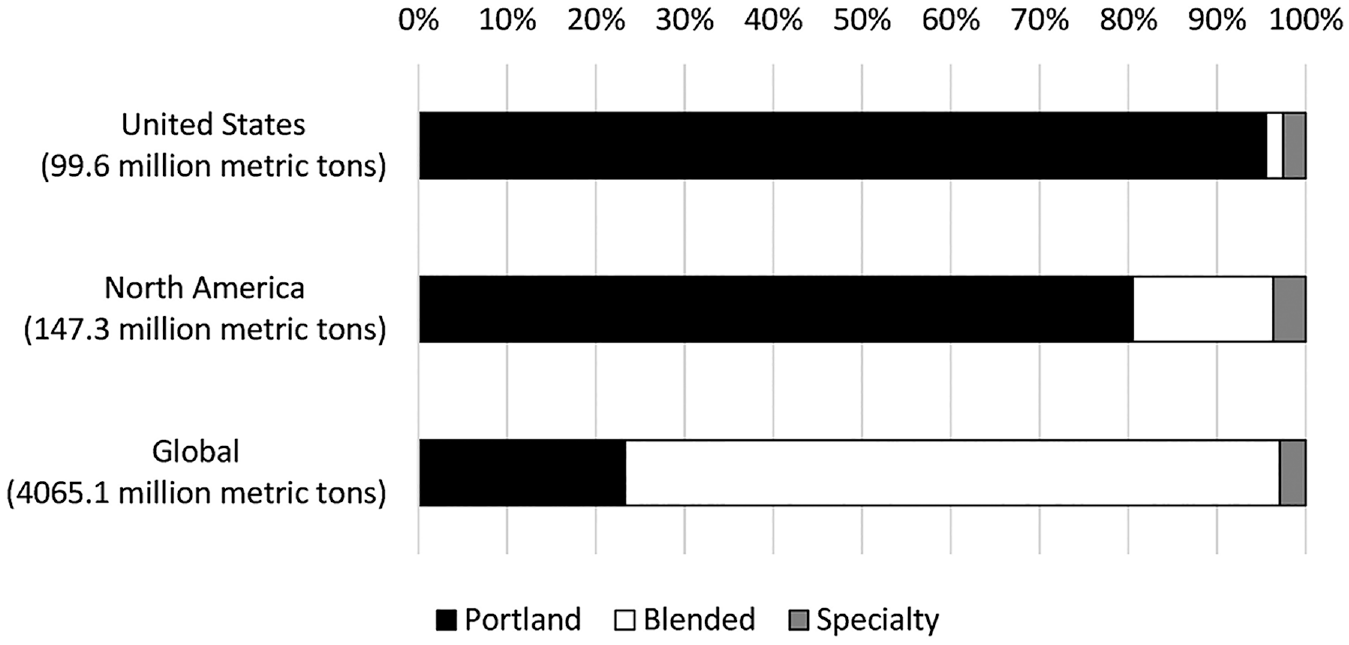
2020 Cement demand by product from Freedonia Global Cement Report ( 14 ).

United States blended cement market share January 2020 to August 2023 ( 15 ).
When comparing end users (Figure 4), ready mixed concrete was the primary end user of cement for both the United States and for all North America in 2020. Ready mixed concrete has widespread use in nonresidential and nonbuilding construction, and according to the National Ready Mixed Concrete Association, 9.2% of ready mixed concrete used in 2021 in the United States was for streets and local roads, and 5% was used for parking lots. Worldwide, the distribution is more equal among ready mixed concrete, consumers, concrete products, and other end users. Portland cement accounts for most cement sales to ready mix producers ( 14 ), so it would make sense that the predominant end user in the United States is ready mixed concrete.

2020 cement demand by end user according to Freedonia Global Cement Report ( 14 ).
Identifying Barriers
The various recently published carbon reduction roadmaps share several common elements for achieving carbon neutrality by 2050 across the cement and concrete value chain, setting various short- and long-term carbon reduction goals. Pavement design optimization, PEMs, and use of blended cements beyond just PLC are design solutions to help the concrete pavement industry achieve those goals. However, barriers exist, blocking the path forward to carbon neutrality, and this team has identified the most impactful ones and has devised a clear plan to remove the barriers. This section will describe several of the barriers relating to materials production and logistics, specifications, testing, design procedures, and risk.
Materials Production and Logistics
To address the challenges of implementing either new concrete-making materials or new materials-related technologies, it is important to first understand the production, logistics, and use of existing materials. Although new technologies offering opportunities to achieve significant carbon reduction are available or emerging, those technologies must integrate into the existing construction materials market. In the near term, any new cementitious product introduced to replace Portland cement must easily fit within the existing infrastructure of the cement, concrete, and construction industries. This includes fitting within cement and concrete storage and shipping infrastructure, allowing concrete producers to use new material in existing concrete production facilities, and being cost-competitive with Portland cement. This section will discuss the logistics behind concrete and cement manufacturing and the challenges associated with integrating new materials, specifically supplementary cementitious materials (SCMs), alternative cements (ACs), and alternative supplementary cementitious materials (ASCMs) into the existing production infrastructure.
Concrete
Concrete is a robust material, produced using several different approaches depending on the specific application, and placed under a wide range of environments and conditions. Concrete is not a single product, rather tens of thousands of products using a variety of local materials and mixture proportions, and those products are designed to achieve a broad range of fresh, hardened, and durable properties. These variations are required to economically meet the range of owners’ needs while accommodating locally available materials. The forgiving nature of concrete is a result of the robustness of Portland cement, which is one reason why concrete is so widely used. If new materials and mixtures are to be successfully used in concrete applications, they must be similarly adaptable to a variety of conditions.
With the exception of precast concrete, concrete is the only construction material manufactured at the job site. The act of placing fresh concrete is an important consideration when discussing barriers to new material technologies. Changes made to concrete for the purposes of carbon reduction may lead to changes in setting times, finishing times, and other considerations such as curing and timing of joint sawing. Contractors must rely on the extensive and valuable experience of trades workers to achieve quality products and meet project specifications, and if new technologies are introduced, the workforce must be trained on how to work with the new material. Therefore, it is imperative education and technology transfer efforts extend to the level of the trades workers who will be placing and finishing these new materials.
Portland Cement
Portland cement, a hydraulic cement, is the predominant type of cement used in concrete in the United States and is also the main component of most blended cements. As mentioned previously, it is responsible for up to 90% of the embodied carbon in Portland cement concrete, and the main contributor to this embodied carbon is the production of clinker. There are two general approaches for reducing clinker content in concrete: reduction and substitution. Reduction refers to decreasing the total cementitious content per unit volume of concrete, and substitution is the partial or full replacement of Portland cement with alternative materials.
Introducing alternative materials requires integration into the existing materials storage and distribution network currently supporting the concrete industry, with several requirements at the plant needing to be satisfied. There are five types of Portland cement specified under AASHTO M 85 and four types of blended hydraulic cements specified under AASHTO M 240; however, by design, most cement plants produce only one type of clinker and in most cases only one type of cement. Because limestone is the primary raw material in cement, cement plants are usually located next to large deposits of limestone. Storage and distribution are important aspects of Portland cement production as well. Cement plants must be able to distribute their products either by water or rail, in a cost-effective manner, and storage capacity of clinker and cement at the plant is limited. Another factor to consider is that cement production requires specialized equipment for material handling, processing, pyroprocessing, grinding, and storage. Cement plants are designed for a long operating life to compensate for high initial investment costs. All of these are contributing factors, limiting flexibility in a cement plant’s operations and presenting barriers to a cement manufacturer producing new material.
Supplementary Cementitious Materials
Most modern concrete mixtures contain SCMs used in addition to, or as a partial replacement of, cement in concrete. Examples include coal fly ash, slag cement, ground glass, and natural pozzolans. The use of SCMs lowers the GWP of the concrete mixtures and will play an important role in realizing carbon neutral concrete, however, historically, SCMs have been used to reduce cost and improve durability. SCMs have reduced costs by partially replacing the most expensive component of the mixture—cement. Furthermore, SCMs lead to more durable concrete by reducing permeability and mitigating deleterious chemical reactions. However, whereas the cost and durability benefits of SCMs are well understood, many codes and specifications still place limits on the maximum allowable SCM content, creating a significant barrier. Limited or geographically restricted quantities also pose barriers. Some common SCM types (e.g., fly ash, slag cement, natural pozzolans, and ground glass pozzolans) are discussed in the following paragraphs.
Coal fly ash is the most widely used SCM, but its production has dropped to less than half its maximum in 2008, and freshly produced fly ash will continue to decline as coal-fired power plants close. This has led the coal ash industry to move toward harvested coal ash, which is recovered and processed from landfills or disposal ponds. The American Coal Ash Association ( 16 ) estimates that in 2021 60% of the coal ash used was recycled. However, coal ash, fresh or harvested, has distribution challenges. As coal-fired power plants close or convert to gas, ash must be transported longer distances, making it less cost-effective and less energy-efficient. Harvested fly ash can offer improved supply reliability, as most geographic locations have coal ash deposits in landfills or ponds that are able to be harvested. However, the authorization and capital investment needed to launch a harvesting operation require both time and market demand, so new sources of harvested coal ash will only become available slowly. Slag cement is the next most used SCM, with shipments of approximately 4 million metric tons (4.4 million short tons) in 2021, about a quarter that of coal fly ash.
Natural pozzolans are raw or calcined pozzolans derived from natural mineral deposits, and are classified by ASTM C 618 and AASHTO M 295 as Class N pozzolans. Some examples include calcined shale, calcined clay, metakaolin, and pumice. According to the Natural Pozzolan Association, the raw natural pozzolan capacity in 2021 was estimated to be 1 million tons per year, with another million tons of capacity in 2022, totaling of 2 million tons per year ( 17 ). Between now and 2025, the NPA predicts rapid and significant growth in the production of calcined clays, given their broader availability across the United States. Although natural pozzolans are becoming an alternative to fly ash and slag cement, primary deposits are limited western U.S. states ( 18 ).
In 2018, the most recent data available from the U.S. Environmental Protection Agency, 11.2 million metric tons (12.3 million short tons) of container glass were produced, which is the largest single source of recycled glass. However, there are only two producers in the United States and one in Canada who produce ground glass pozzolan, which has prevented the widespread use of recycled glass in concrete. The estimated annual production is in the order of 35,000 metric tons (40,000 short tons) with another production plant expected to be added in 2023.
Alternative Cement
Alternative cement is a cement that is able to replace Portland or blended hydraulic cements but is not covered by the applicable specifications for either Portland or blended hydraulic cements. The American Concrete Institute (ACI) groups alternative cements into clinkered-,calcined-, and nonclinkered alternative cements. ACs can provide carbon reduction and enhanced performance advantages over Portland cement ( 19 ), however, the challenges associated with ACs relate to risk, specifications, and market size. ACs are new cements with limited field experience and therefore pose a risk to owners and contractors as they are currently lesser-known materials. One of the more recent developments in ACs is limestone calcined clay (LC3) ( 20 ). Although extensive research results over the past 12 years look promising, including field trials, no major cement producer in Europe or North America is currently producing LC3, except in limited trials.
Cement in the United States is specified using ASTM or AASHTO standards, which are prescriptive in scope and only cover hydraulic cements. For this reason, combined with limited field trials as well as the small market for ACs currently being unable to produce in quantities large enough to significantly displace Portland cement, alternative cementitious systems are expected to evolve slowly.
Alternative Supplementary Cementitious Materials
ASCMs are entering the marketplace and will play an increasing role in achieving carbon neutrality given the current pressures on coal fly ash supplies and the limited quantities of other SCMs. Several are manufactured, so the production facility can be located near the point of use or a navigable waterway. Manufactured ASCMs can be more consistent and allow for larger, more predictable substitution levels in concrete mixtures. Some are also being manufactured with carbon sequestration.
Implementation of ASCMs is less challenging than an AC, as the system is still largely Portland cement-based. The key remaining barrier is the lack of a national specification for these materials. A general specification is under development at ASTM, applicable to most emerging SCMs.
Specifications, Testing, and Design Procedures
Background on Specifications
Specifications are the written portion of a construction contract; plans and drawings comprise the remainder of the contract. Specifications may be enforced as part of a contract but are not statutorily enforced and may be superseded by independent action taken by the owner, or through mutual agreement between the owner and the contractor, assuming said action still meets any applicable code. Normally in such discussions, the licensed design professional or a construction manager is the owner’s representative.
A specification may be prescriptive or performance based. Although a prescriptive specification may require the use of a specific type and/or quantity of material, a performance-based specification states the desired outcome, or performance, but does not provide specific requirements to achieve that outcome. Performance-based specifications can provide opportunities for new technologies to be introduced, thus playing an important role in carbon reduction. Often, specifications provide both a performance requirement and a prescriptive “deemed to comply” requirement, and meeting either requirement demonstrates compliance. Given the choice, contractors typically prefer prescriptive specifications, which places the risk of specifying new technologies back on the owners and designers.
Development of Specifications
Specifications may be standard specifications written by consensus organizations such as ACI, ASTM, or AASHTO, or they may be drafted independently by the owner. State departments of transportation (DOTs) are good examples of this, as they write their own specifications for road and bridge construction, drawing on standard specifications while also developing their own specification language. Many develop their own standard tests, which are often modified versions of national standards. This results in a multitude of sets of specification and testing requirements, complicating the process of introducing new materials into highway construction. Further complicating the issue, state DOT material specifications are often more restrictive than standard material specifications, and so state DOT specifications generally define the materials available from ready mixed concrete producers.
Performance-Based Specifications as a Path Forward
Although specifications present barriers to innovation, without them, it would be difficult to move forward with innovation because there would be no apparent path to market. The recent acceptance by many state DOTs of PLC is an example of this. When ASTM C1157, the performance-based specification for hydraulic cement, was published in 1992 a specification path was made allowing for producers to have the option to try something new, bring it to market, and build demonstration projects. The resulting cement ultimately became PLC, which was later specified under ASTM C595, and already had wide acceptance in state and local specifications. It is imperative that key influencers in specifying organizations continue working within those organizations to ensure a specification path is available for innovative materials.
Tests Correlating with Performance
Traditionally, concrete specifications have been based on measurements such as strength, slump, and air, which have a limited correlation with the future performance of the material. Recently, concrete testing technologies have been developed, affording better predictions of long-term performance and improving durability, leading to longer-lasting concrete pavement with a lower environmental impact ( 21 ). These include improved tests for strength and workability, as well as tests for freeze-thaw durability, oxychloride expansion, and resistivity. The barriers related to performance-engineered concrete paving mixtures relate to the amount of education and training required, as well as to the adoption of specification language allowing these tests. Recently, extensive work has been performed by the National Concrete Pavement Technology Center (CP Tech Center) at Iowa State University to assist with implementation, but more work is required for full implementation of PEMs ( 21 ).
Pavement Design Optimization
AASHTOWare™ Pavement ME is a state-of-the-art pavement design software built on the Mechanistic-Empirical Pavement Design Guide ( 22 ). It requires extensive inputs considering material properties, traffic, and environmental conditions. Life cycle thinking is a key element in reducing the cost and environmental impact of concrete pavements. Ideally, it would be incorporated into the design procedure, utilizing an iterative procedure that would provide a feedback loop, improving performance, lowering cost, and lowering the environmental impact ( 4 ). However, this would require additional training on a design software that already requires extensive training. ACPA has begun filling this educational gap, providing extensive training on Pavement ME design in 2021 and on LCCA in 2023. Widespread acceptance of incorporating LCCA and LCA into the already complex mechanistic-empirical design procedure will take time.
Pavement design optimization will also play an important role. Optimization not only allows for reduction in pavement thickness but also for innovation. Many DOTs use a set concrete pavement structure and rarely deviate from that structure. The process will need to be a more open one that takes materials, traffic, and environmental conditions into consideration, as well as considering cost and environmental impact at a later date with the inclusion of LCCA and LCA.
Risk
Risk affects all aspects of innovation and can be broadly organized into two categories: life-safety risk and economic risk. Though minor in comparison to the building sector, life-safety is always the primary focus in all paving projects. Life-safety is not negotiable. Economic risk is more nuanced, resulting from several different situations that can affect the use of alternative materials. Examples of economic risk to concrete product suppliers include construction delays incurred if the new material is more sensitive to ambient weather conditions, or uncertainty in achieving specific pay items with an unfamiliar material. Outside of cost (i.e., the green premium), risk is the largest barrier to implementing new technologies within the construction sector. Adoption of new concrete materials technologies can only be advanced if the risk is assessed and shared. A nonequitable distribution of risk can result in overdesign and may completely derail the implementation of a new technology. At the end of a project, the owner expects to receive a product with the ability to perform over the intended service life for the price agreed on at the start. Whereas owners may want to use lower-carbon concrete or reduce pavement thickness through pavement design optimization, those desires may recede if the risk of failure is too high. Contractors simply want to be paid for what they agreed to provide, and using the materials and procedures that they are familiar with provides them with the lowest risk of failure.
Owner of Risk
As stated, the term “end users” describes purchasers of a product. In the case of Portland cement, a chain of ownership is followed. From the time it is purchased, Portland cement will pass through the hands of multiple entities as it moves toward its final placement in concrete. Each entity imparts added value along the way, and each then shares in the risk associated with the concrete placement and use. For example, ready mixed concrete producers are major purchasers of Portland cement, yet they do not use it to produce concrete for their own use. They produce concrete for multiple other intermediate users (e.g., contractors) and owners (e.g., building owner, highway agency) receiving delivery of their product on a project site to construct the end product. This distinction is important because the true end user is not the original purchaser of the Portland cement or the ready mixed concrete, the end user is the entity benefiting from its use. In public works, for example, the end user is the general public. When analyzing how decisions are made about cement and concrete procurement and use, it is more informative to think about who holds the risk if the concrete fails to perform the way it is intended.
Discussion
As discussed, the most impactful barriers to concrete carbon reductions are related to existing materials production and logistics, specifications, testing, design procedures, and risk. Given the existing infrastructure for manufacturing, delivery and installation of concrete, and the massive capital investment required to change it, advancements in carbon reduction must be made within this infrastructure. This leaves changing how cement and concrete are used, and mitigating the risk of new technologies as the key areas to address to effect carbon reduction in the next 5 to 10 years.
There are several reasons why carbon reduction solutions have not been implemented to date, including,
Education being required across the industry, for all stakeholder groups, including but not limited to contractors, producers, suppliers, and designers;
Lacking fact-based technical information, such as materials performance data and documentation on construction-related impacts when changing materials, to facilitate the use of a new technology;
Initial higher costs (i.e., the green premium) continuing to be a barrier to implementation; and
In some cases, the availability of low carbon technologies or material supplies being limited geographically.
Outside of cost, the risk associated with the adoption of a new technology, real and perceived, is one of the most significant barriers to implementing new technologies within the construction sector. As new technologies are adopted, the risk must be assessed and shared. A nonequitable distribution of risk can have several negative side effects, including but not limited to overdesign, poor construction, and compromised quality control practices, which may completely derail the implementation of a new technology.
Action Plan
Approximately 30% of Portland cement used in the United States was for streets and highways in 2021, with nearly half being used in state highways. Each sector of the cement and concrete industries poses unique barriers to carbon reduction and, given the stakeholders and contracting environments involved, the potential for a near-term impact therefore varies. Unlike the building sector, the streets and highways sector does not have restrictions imposed by building codes. Public sector improvements can be approached on a push–pull basis from both the technology/engineering side and the policy/legislation side. Although public works is the smaller use compared to the building sector, requirements for public works projects represent the lowest common denominator for concrete producers and, in most regions, are often dictated by state DOT specifications. It is common for ready mixed concrete producers to keep in stock materials meeting the state DOT specification and to use compliant concrete mixtures for all projects, public or private. Therefore, effecting change at the state DOT level will have a cascading impact on the broad use of concrete throughout the entire state. Cross support between policy/legislation teams and technical teams will have the largest impact on public sector projects. For these reasons, focusing on progress in public sector construction, including streets and highways, offers the best opportunity for making meaningful carbon reductions in the near term. To do so will require action in the areas described below.
Education
Education is required at several levels to successfully integrate new materials and improved design procedures into the existing cement and concrete industries. This involves educating the existing workforce, as well as students who will be entering the workforce soon (college-level engineering students) and the next generation (K-12 students). Policy makers will also need to be educated in low carbon technologies. Technology transfer and training are imperative for all stakeholders.
Existing Workforce
There is an immediate need to educate tradespeople and professionals working in the cement and concrete paving industry. Training on carbon reduction strategies should be provided by the organizations and associations serving them, such as ACPA, ACI, PCA, FHWA, and various DOTs. A train-the-trainer approach is recommended, aiding in the preparation and delivery of the continuing education curriculum, which would include providing applicable reference materials along with model curricula. Training for public owners needs to be delivered to both elected and nonelected officials, but for elected officials a different scope of training activities will be required. This is discussed separately below. In the transportation sector, organizations such as the CP Tech Center, AASHTO, and the American Road & Transportation Builders Association are possible partners. At the municipal level, groups such as the National Association of County Engineers could be an important ally, providing opportunities to present and train at their annual meeting. Also, the ACI has a vast network of local chapters and harnessing those groups to deliver carbon reduction training could reach multiple audiences.
College-level Engineering Students
At the college level, civil engineering students do not currently receive adequate training on sustainability or specifically on carbon reduction in concrete. Several barriers exist within the university system, caused by significant pressure to minimize the required number of credits for a bachelor’s degree, and to control time and cost to a bachelor’s degree. With the conversion of many universities to the semester system over the past 10 to 20 years, the ability to provide elective courses has also become limited. However, students are aware of and motivated to learn about carbon reduction and seek opportunities to become better informed and engaged when beginning their posteducation career.
To overcome these barriers, it is recommended for faculty to be provided with summer workshops to give them the background they need to lecture effectively on this topic. Applicable reference materials and model curricula need to be provided. Additionally, a cadre of guest lecturers needs to be developed to visit individual schools. Minors or certificate programs need to be developed for carbon reduction in construction materials. Finally, undergraduate and graduate scholarships need to be made available for minor or certificate programs as well as for summer programs, providing 1 to 2 weeks of intensive study on this topic.
K-12 Outreach
There is no better way of changing society’s thinking than educating the next generation and creating demand for carbon reduction. K-12 outreach is a crucial step in accomplishing this. A prime example is the Carbon Zero Youth Initiative, a carbon reduction mentorship program built on the work of Girl Scout Troops 1477 and 1952 ( 23 ), who embarked on a high-impact, take-action project focused on the embodied carbon of concrete. The video they made has reached an audience of thousands who otherwise may not have known about this subject. They have made an impact on industry and political leaders with their message and have educated their peers. Harnessing and directing the energy of the next generation is paramount to success, so this initiative and other similar efforts empowering young individuals should be supported.
Policy Makers
It is imperative to provide both elected and nonelected government officials with the necessary education on the technical feasibility and practicality of the policies and regulations on which they are voting. Without this technical understanding, unrealistic and unachievable goals may be set, hindering progress. This education effort should include delivering tailored seminars or workshops to provide background information on the complexity of the issue and on practical implementation of laws and regulations.
Technology Transfer/Outreach
As discussed previously, changing any ingredient in a concrete mix will alter its fresh, hardened, and durable properties. For example, many AC systems will require special curing to achieve full strength and these new procedures will need to be taught to tradespeople. The success of implementation is in their hands. Therefore, technology transfer and skill training efforts will be required to incorporate any new products or processes. Licensed design professionals will also need to implement the new technologies in their designs. Furthermore, at the highest level, all stakeholders need to be aware of carbon reduction strategies, understand why some facets of their job may be changing, and comprehend the impact of continuing business as usual. Such technology transfer and skill training could be accomplished through state DOTs, federal agencies, engineering and design firms, trade organizations, industry associations, union halls, and trade schools.
Technology Validation
As innovation occurs and new technologies emerge, another potential barrier is “green washing,” when a company or sponsor makes incomplete or false claims implying or stating carbon reduction goals can be achieved using their technology. This plays into the barriers associated with risk. If a stakeholder buys into a technology and it does not live up to what it claims to do, they will be much more hesitant to try other innovative technologies in the future. To ensure technologies are accurate and reliable, there must be a process to vet carbon reduction claims. The ACI has launched the Center of Excellence for Carbon Neutral Concrete, and has created an ISO-compliant ( 24 – 29 ) technology validation/verification program ( 30 ), which will use third party laboratory testing to verify claims. Demonstration projects will also help address this barrier.
Demonstration Projects
In a risk-averse industry, the largest barrier, second only to cost, is to find early adopters of such technology. To address the issue of risk, it is necessary to conduct demonstration projects in which innovative materials or technologies can be put into practice with minimum risk to the owner. These technologies must be exposed to real-world conditions, be monitored for a period after construction, and their results reported publicly. With the level of work involved with this type of effort, it will be a slower process; however, facilities such as the MnROAD pavement test track ( 31 ) has already placed and will monitor performance of low carbon concrete pavement mix designs in a real-world environment and can serve as a model for other demonstration projects. Documentation of in-place projects already using low carbon concrete will assist with this effort.
New sources of funding, such as Inflation Reduction Act Section 60506, which will provide grants for low carbon transportation materials, will play a huge role in successfully integrating these materials on a state and local level. These grants will help bridge the gap between the cost of traditional materials and the higher cost of lower emissions materials ( 32 ).
Specifications and Testing
Prescriptive specifications, including those requiring minimum cement contents, can be barriers to innovation. Performance-based specifications provide opportunities for producers to try something new, bring it to market, and build demonstration projects. For ready mixed concrete producers, state DOT specifications dictate the material they produce. As state DOT specifications move toward alternative materials, the other sectors of the construction industry will follow.
Tests correlating with concrete pavement performance are key to long-lasting concrete with a lower environmental impact. A great deal of work has already been done in implementing these tests, but more work is needed in relation to education and training as well as in the adoption of specification language to support this effort.
Onboarding New Technology
Numerous new materials are being promoted by founders of small startups funded by venture capitalists who tend to favor “disruptive” technologies over innovations offering marginal change. The concrete industry is unlikely to accept these disruptive technologies, which could be a major barrier. Founders and funders must work with industry experts who can champion worthwhile new technologies and help companies integrate such technologies into this well-established industry.
Footnotes
Acknowledgements
The authors thank the Breakthrough Energy Foundation for its support. We also acknowledge and thank all the individuals and entities who provided information for this article. Several are cited in this document, but specific thanks go to the Portland Cement Association and the National Ready Mixed Concrete Association for their valuable input.
Author Contributions
The authors confirm contribution to the paper as follows: study conception and design: T. Van Dam, L. Sutter, R.D. Hooton, A. Innis, S. Lopez, K. Senn; data collection: L. Sutter, S. Lopez, R.D. Hooton, T. Van Dam, A. Innis; data analysis and interpretation of results: S. Lopez, L. Sutter, R.D. Hooton, T. Van Dam, A. Innis; draft manuscript preparation: S. Lopez, L. Sutter, R.D. Hooton, T. Van Dam, A. Innis, K. Senn. All authors reviewed the results and approved the final version of the manuscript.
Declaration of Conflicting Interests
The authors declared no potential conflicts of interest with respect to the research, authorship, and/or publication of this article.
Funding
The authors disclosed receipt of the following financial support for the research, authorship, and/or publication of this article: This work was funded through a contract with the Breakthrough Energy Foundation. Breakthrough Energy is committed to supporting the development and scaling of critical solutions to reach net-zero emissions.
