




Abstract
In two multipart studies, we tested the effectiveness of an experiential learning-based intervention (Workshop Activity for Gender Equity Simulation–Academic [WAGES-Academic]) to reduce sexism endorsement. We randomly assigned undergraduates to either WAGES (n = 144) or one of two control conditions (n = 268): one where participants received the same information as WAGES but without experiential learning or another that included an experiential group activity but no gender equity information. WAGES participants (vs. both controls) reported less endorsement of sexist beliefs after completing the activity and/or at a follow-up 7–11 days later as measured by the Modern Sexism (Study 1), Neo-sexism (Study 2), Hostile Sexism (Study 2), and Gender-Specific System Justification (Studies 1 and 2) scales. Both studies demonstrated that these effects were attributable to WAGES providing more information, evoking less reactance, eliciting more empathy, and instilling more self-efficacy compared to the other conditions. Results suggest that programs to reduce sexist beliefs will be successful only insofar as they invite access to discussion in such a way that does not elicit defensive denial of the problem, create a context in which participants are readily able to empathize with other, and instill feelings of self-efficacy that one can address the problem.
Sexism is defined as an “individual’s attitudes, beliefs, and behaviors, and organizational, institutional, and cultural practices that either reflect negative evaluations of individuals based on their gender or support unequal status of women and men” (Swim & Hyers, 2009, p. 407). It is based on attitudes, stereotypes, and cultural practices that promote the belief that women are less competent and less deserving of power and status than men (Swim & Hyers, 2009). Sexism is manifest in the persistence of restrictive, limiting, and oppressive stereotypes (Jost & Kay, 2005), unequal pay and advancement rates (Ginther & Hayes, 2003), and sexual harassment (Hage, 2000). Given these costs, it is surprising that sexist beliefs, and discriminatory actions justified by these beliefs, persist in the present-day United States (for overviews see Barreto, Ryan, & Schmitt, 2009; Rudman & Glick, 2008; Swim & Hyers, 2009). The purpose of our research was to test the effectiveness of an experiential learning intervention, the Workshop Activity for Gender Equity Simulation–Academic version (WAGES-Academic; Shields, Zawadzki, & Johnson, 2011), for reducing endorsement of sexist attitudes and beliefs.
It is important to acknowledge that sexism is not a unitary construct and can manifest in different ways—including in overt, covert, and subtle forms (Benokraitis & Feagin, 1995; Swim & Cohen, 1997). Overt sexism involves visible and observable forms of unequal and harmful treatment of women. Covert sexism involves engaging in the unequal and harmful treatment of women but in a clandestine manner (e.g., outwardly opposing sexism, but then engaging in sexist acts when not being monitored). Subtle sexism involves unconsciously deployed stereotyping or bias that results in unequal and harmful treatment of women, which is not noticed or addressed because it is perceived to be customary behavior (e.g., the use of language that excludes women, such as using “he” or “him” to refer to people in general). Particularly damaging about subtle sexism in the workplace is that the effects are hard to see in the moment but are substantial over the course of one’s career—accumulating, along with other stressors of daily life, to affect morale, performance, and even willingness to continue working within the academic setting (Klonoff & Landrine, 1995; Swim, Hayes, Cohen, & Ferguson, 2001). WAGES-Academic is explicitly designed to address subtle sexism; however, as we discuss subsequently, we also examined whether WAGES-Academic is effective in reducing a wider range of endorsement of sexist beliefs.
Sexism-Reduction Interventions
Sexism has many features that enable it to persist (Eagly & Mladinic 1994; Jackman, 1994; Sidanius & Pratto, 2001). For example, women and men are interdependent and cannot avoid each other, unlike other forms of prejudice where in- and out-group members can more easily be segregated (e.g., racism). Thus, an intervention for sexism is unlikely to succeed if it simply increases intergroup contact between women and men. Furthermore, interdependence does not denote equality in patriarchal systems that endorse unequal power and differences in valued traits for women and men (Glick & Fiske, 2011). For instance, many of the positive stereotypes of women (e.g., warm, gentle, empathic) are at odds with perceptions of competence (Eagly & Mladinic, 1989; Glick & Fiske, 2001; Langford & MacKinnon, 2000). Because these traits seem wholly positive, they have the insidious effect of making efforts to address gender inequality seem unnecessary and ill-founded (Becker & Wright, 2011; Glick & Fiske, 2001). In the following sections, we outline four specific challenges to interventions aimed at reducing sexism (i.e., providing information, minimizing reactance, enhancing empathy, and encouraging a sense of self-efficacy), and we discuss what existing interventions have done to address these challenges.
Information about sexism
Interventions designed to reduce sexism need to convey information about its harms and prevalence (Becker & Swim, 2012). For example, the Ask, Answer, and Announce model of confronting sexism points out that people must first be aware that a particular behavior or incident may be sexist before they can be expected to respond to it (Stangor et al., 2003). This is an easier task for overt compared to subtle sexism: The latter may go unnoticed because it is perceived to be customary or normal behavior (Swim & Cohen, 1997). Many individuals may not be aware of the subtle ways that sexism permeates society (e.g., assuming women are responsible for taking care of children, even if they are employed, because women are stereotyped as more nurturing than men; Glick & Fiske, 2001). Thus, a challenge to sexism-reduction interventions is the need to educate participants about subtle forms of sexism.
Some programs, most of which are not explicitly designed to reduce sexism, speak to the importance of providing information about subtle sexism. For example, women’s studies and psychology of gender classes have successfully reduced sexist beliefs, presumably because the material covered in the courses teaches about the harms of sexism (Case, 2007; Jones & Jacklin, 1988). In support of this argument, research indicates that these classes increase awareness of discrimination against women and encourage endorsement of egalitarian beliefs (Malkin & Stake, 2004; Rios, Stewart, & Winter, 2010; Sevelius & Stake, 2003; Stake & Hoffman, 2001).
As another example, many of the National Science Foundation’s (NSF) ADVANCE programs include components designed to educate participants about the nature of unconscious bias and teach strategies for minimizing the effects of bias (e.g., Stewart, La Vague-Manty, & Malley, 2004). Briefly, the goal of NSF’s ADVANCE mission is to increase the participation and advancement of women in academic science and engineering careers (NSF ADVANCE, n.d.). One of the methods that NSF ADVANCE uses to achieve its goal is to provide grant funding to develop and test programs and interventions within specific organizations. Several of these have achieved measurable changes in hiring, promotion, and retention outcomes. In these programs, however, it is not clear whether it was the information alone, or some unmeasured mechanism, that accounts for the observed effects (e.g., empathy or a sense of self-efficacy evoked by the information). Indeed, in an early study (Pugh & Wahrman, 1983), when female participants were only told about gender bias in power relations, the information had no effect on behavior as indicated by the extent to which women deferred to men during group interactions. However, when information was presented in a way that demonstrated the bias, behavior did change as women deferred less to men. Together with the college class studies, the NSF ADVANCE studies suggest that the most effective interventions do more than simply deliver information.
Reactance
We define reactance as a motivational state to refuse and reject information regardless of its content or actual veracity (based on Brehm & Brehm, 1981). An intervention cannot succeed if its message elicits reactance because this can cause the adoption or strengthening of an attitude that is contrary to the message and can increase resistance to considering alternative perspectives (Batson, 1975). Information about the need to address and eliminate subtle sexism can create reactance because many subtly sexist beliefs and actions are associated with beliefs about the inevitability and naturalness of existing gender arrangements (Jost & Kay, 2005). As a result, it is easy for people to believe that subtle sexism is not a problem (Swim, Aiken, Hall, & Hunter, 1995) or that subtle sexism is relatively benign (Sue, 2010). Thus, reactance may form because attempts to change subtle sexism seem unnecessary (Becker & Wright, 2011; Glick & Fiske, 2001).
Empathy
We define empathy as taking the perspective of another and imagining how that person’s circumstances affect them (Coke, Batson, & McDavis, 1978). Empathy is important because the topic of subtle sexism can elicit a range of negative reactions ranging from resentment and antagonism towards women’s demands for fairness (Tougas, Brown, Beaton, & Joly, 1995) to outright hostility toward these demands (Glick & Fiske, 1997). Empathy can interrupt these negative reactions by leading to more positive evaluations of stigmatized groups (Batson et al., 1997), and it may increase the perceived need to address the problem. Eliciting empathy for targets of prejudice and discrimination is a feature of many effective interventions to reduce prejudice (Becker & Swim, 2011; Vescio, Sechrist, & Paolucci, 2003). For example, Becker and Swim (2011) found that participants who recorded observations of everyday sexism over the course of a week, as compared to those who attended to other qualities of social interactions, were more likely to reject sexist beliefs; for men, this change only occurred if empathy toward the target was encouraged.
Self-efficacy
Bandura and Locke (2003, p. 87) define self-efficacy as “the belief that one has the power to produce desired effects.” In the context of our intervention, this belief would include the perceptions that individuals can use information to implement behaviors that should help them achieve a goal (based on Bandura, 1977). Information about the pervasiveness of sexism or its detrimental effects may induce feelings of powerlessness to fix the problem. Thus, interventions that provide information about sexism may need to do so in a way that increases feelings of self-efficacy. Research in the health domain has demonstrated that self-efficacy increases message acceptance and promotes positive behaviors (Bandura, 2004; Floyd, Prentice-Dunn, & Rogers, 2000; Good & Abraham, 2011). In the context of sexism reduction, Kilmartin and colleagues (2008) found significant reductions in sexism endorsement when they induced male students to question normative beliefs about sexism endorsement. Specifically, they taught male students that their perceptions of peer endorsement of sexism were inflated. Of particular note, Kilmartin’s program also explained steps to take to address sexism, focusing on bolstering self-efficacy as an intervention component (although the degree to which self-efficacy was elicited was not directly assessed).
Experiential Learning and Sexism Intervention
In summary, in addition to providing information about subtle sexism, we propose that effective sexism-reduction interventions must minimize reactance against the message, foster empathy, and elicit feelings of self-efficacy. One means of achieving this goal is to implement a sexism intervention that relies on the tenets of experiential learning theory. Current educational research shows that to develop competence in an area of inquiry, the learner must have a foundation of knowledge to be able to understand facts and ideas in the context of a conceptual framework as well as organize knowledge in ways that facilitate retrieval and application (Bransford, Brown, & Cocking, 2000). This is exemplified in Kolb’s (1984) influential model of experiential learning, which describes the process of how knowledge is continually reshaped and re-formed based on new information and experience (Kolb & Kolb, 2005). This process starts with individuals having a concrete experience (whether generated spontaneously or through a structured intervention) on which they can then reflect. Next, individuals engage in peer learning and discussion (Schmidt, Loyens, van Gog, & Paas, 2007), which helps them avoid getting sidetracked or simply assimilating their experience into existing belief structures without modification. The reflection that comes from discussion then leads individuals to form abstract ideas about their experiences through which they can further connect their present experience to past and future experiences. Finally, participants are encouraged to actively experiment with the acquired information and to incorporate new experiences into the learning process (i.e., create new knowledge based on the acquired information).
The processes involved in experiential learning appear to be effective in reducing or eliminating the barriers to sexism-reduction interventions we described previously, although the proposed mechanisms are not explicitly laid out in Kolb’s (1984) theory. When individuals reflect on their own experience, they are less likely to question the source of the information, thereby reducing the likelihood that it will elicit reactance. Furthermore, the experience moves individuals’ scope of understanding beyond themselves—which, when combined with a social justice framework, can further encourage perspective taking and elicit empathy (Schwartz & Lindley, 2009). Last, information must be retained and the participant instilled with self-efficacy to apply that information to other contexts (Bransford et al., 2000). The goal of experiential learning is to shape and transform current knowledge so that it informs and shapes future experiences, which we argue is achieved via enhanced self-efficacy.
The WAGES intervention (described in the following section) provides information about sexism within an experiential learning framework. Supporting these proposed processes, research demonstrates that participating in WAGES increased knowledge of gender inequity and did so by instilling self-efficacy and minimizing reactance (Zawadzki, Danube, & Shields, 2012). The present experiments extend our prior work by examining reactance and self-efficacy process variables, in addition to empathy, in the context of reducing endorsement of sexist attitudes.
WAGES
WAGES is an experiential learning activity designed to demonstrate the cumulative effect of common and seemingly minor experiences of bias and discrimination experienced by women in the workplace (for more information, including current applications and how to obtain a copy, see http://wages.la.psu.edu/). It consists of a game play portion followed by a guided discussion (for further information, see Shields et al., 2011; Zawadzki et al., 2012). During game play, four to eight individuals are randomly divided into two mixed-gender teams (Green and White). The goal of the game is to earn credit chips that allow members of each team to advance up the academic career ladder. The gendered nature of the experiences of having the Green Team (represents women) versus the White Team (represents men) emerge over the course of the game as players draw cards describing typical workplace events that occur for both teams but that are experienced differently by Green and White Team members. Unbeknownst to the players, cards give a small overall credit advantage to the White Team so that the cumulative effect is revealed as the game progresses. Cards tap a range of issues for which gender bias has been demonstrated (e.g., work–family balance, salary, mentoring, workplace climate, token status) and are based on published peer-reviewed empirical research studies and/or demographic data. Although WAGES items focus on the diverse experiences of women of color and White women, many also pertain to multiple marginalization.
Following game play, a facilitator leads a guided discussion. The cumulative effect of small biases becomes obvious as participants compare Green and White Team cards and see how the same events result in more benefits for the White Team than the Green Team. In comparing the cards, the links between gender and the teams emerges. Discussion concludes with consideration of actions that can be taken at the institutional and individual level to counteract the operation of unconscious gender bias.
Extending Kolb’s (1984) model, WAGES uses the features of experiential learning that should be most effective to deliver information that does not evoke reactance, elicits empathy, and instills self-efficacy. In the game portion of the intervention, participants see and experience how bias operates to have a cumulative effect on limiting the advancement of women in the academic workplace. This method of delivering information about gender bias fosters empathy and the adoption of multiple perspectives, and information is assimilated in a way that is less likely to elicit reactance. WAGES also uses game play as a way to present knowledge in an engaging format. Importantly, the use of entertainment while educating is suggested as a way to reduce reactance (Moyer-Guśe, 2008). Participants then reflect on this bias during the structured group discussion, where they are encouraged to identify specific strategies to apply what they have learned, that is, as a means to foster self-efficacy. Overall then, WAGES focuses on providing information in a manner that reduces reactance and bolsters self-efficacy (Zawadzki et al., 2012) as well as fosters empathy.
To date, Shields, Zawadzki, and Johnson (2011) found that WAGES effectively increased participants’ knowledge of gender inequity compared to a control condition. Moreover, participants reported applying concepts about subtle sexism and bias in their own lives (e.g., noticing instances of favoritism towards male employees that was not previously noticed). In follow-up work, Zawadzki, Danube, and Shields (2012) found that WAGES increased knowledge of gender equity compared to control conditions because it instilled self-efficacy and did not evoke reactance. An important question not yet addressed is whether WAGES influences endorsement of sexism. In other words, it is unknown whether WAGES, as a brief intervention, can affect ingrained attitudes. Moreover, in the present experiments, we sought to better understand the mechanisms by which WAGES is effective. In addition to self-efficacy and reactance, we tested the extent to which knowledge acquisition and evoked empathy contributed to WAGES’ positive effects.
The Present Research
In two studies, we examined the effect of WAGES on reducing endorsement of sexism. We used WAGES-Academic, a version of WAGES developed to demonstrate the effect of unconscious bias in the academic workplace, particularly for science, technology, engineering, and mathematics domains (Shields et al., 2011). We compared WAGES to two control conditions: (a) a group activity that included a discussion of group-based issues (Studies 1 and 2) and (b) an information-only condition that provided information about gender inequity in a nonexperiential learning format (Study 2). These controls allowed us tease apart the potential influence of simply providing information about gender equity (information-only condition) and of engaging in an experiential learning activity about group dynamics (group activity condition). In other words, by comparing WAGES-Academic to these two control conditions, we could discern that it is only when information is presented in an experiential learning format that demonstrable effects on reducing sexism ensue.
We assessed endorsement of sexist attitudes at three points: before the intervention (baseline phase), immediately following the intervention (intervention phase), and approximately 1–2 weeks after the intervention (follow-up phase). We measured overt, covert, and subtle manifestations of sexist attitudes. To understand the process by which WAGES was effective, we measured participants’ knowledge of the gender equity information provided (Studies 1 and 2), reactance (Study 2), empathy (Studies 1 and 2), and self-efficacy (Study 2) immediately following the intervention phase. Finally, in both studies, we explored whether the effectiveness of WAGES was moderated by participant characteristics (gender along with team membership; i.e., playing on the Green or White Team).
We tested the effect of WAGES on sexism endorsement with undergraduate participants. Game-based learning has been shown to be effective among college students (e.g., to improve career goals; Chiang, Shih, Liu, & Lee, 2011). Moreover, using student samples provided a feasible way to conduct randomized control studies. Importantly, experiential learning is proposed to be effective for individuals across age and education levels (Cantor, 1997; Springer, Stanne, & Donovan, 1999), suggesting that college students constitute an appropriate sample to test the effect of experiential learning to reduce endorsement of sexism.
If experiential learning, as delivered through WAGES, is an effective method for providing information about subtle sexism, then we expected: (Hypothesis 1a) WAGES would reduce endorsement of sexist beliefs and maintain this reduction over time, and (Hypothesis 1b) WAGES would reduce endorsement of sexist beliefs more than the group activity and information-only conditions after intervention and at follow-up (Hypothesis 1). Additionally, we expected that, compared to the group activity and information-only conditions, after the intervention, the WAGES condition would show (Hypothesis 2a) more knowledge about gender inequity in the workplace, (Hypothesis 2b) less reactance, (Hypothesis 2c) more feelings of empathy, and (Hypothesis 2d) more feelings of self-efficacy (Hypothesis 2). Furthermore, we expected that increased knowledge about gender inequity, less reactance, more empathy, and more self-efficacy would mediate the relationship between WAGES versus (Hypothesis 3a) group activity and (Hypothesis 3b) information-only on endorsing sexism at the follow-up phase (Hypothesis 3). Finally, as exploratory hypotheses, we examined whether WAGES’ effectiveness was moderated by participant gender and team (Green Team-disadvantaged and White Team-advantaged).
Study 1
In Study 1, we employed a three-part design (i.e., baseline phase, intervention phase, and follow-up phase) to test the effect of WAGES on two measures of sexist beliefs—gender-specific system justification (GSSJ) and Modern Sexism—and two process variables: knowledge and empathy. In the intervention phase, an experimental manipulation took place in which groups of participants were randomly assigned to either the WAGES condition or the group activity control condition. The present data are part of a larger data set that contains additional variables irrelevant to the present hypotheses. Portions of these data examining the effect of WAGES on knowledge of gender equity over time are reported elsewhere (Shields et al., 2011).
Method
Participants
In exchange for course credit, undergraduate participants at a large mid-Atlantic university completed a study with three parts, baseline phase, intervention phase, and follow-up phase. At the baseline phase, 1,235 people (664 women, 557 men, and 14 gender-unspecified; Mage = 19.01, standard deviation [SD] = 2.04, range = 18–55) completed an online study that included a number of personality and individual difference measures and in which the measures for the present study were embedded. We contacted a randomly selected subsample of 468 baseline participants for the intervention phase; of those contacted, 144 (30.8%) participated (75 women, 65 men, and 4 unspecified; Mage = 19.23, SD = 1.35, range = 18–27). Participants identified as predominantly non-Hispanic Caucasian (117, 81%), followed by Asian American (10, 7%), African American (4, 3%), and Latino/a (3, 2%). Those who participated in the study did not differ on baseline levels of GSSJ from the entire baseline population (p = .80). Because participants were randomly assigned to one of two experimental conditions (i.e., WAGES or group activity), we examined these demographics by condition (WAGES: 39 women, 35 men, and 4 unspecified; group activity: 36 women and 30 men). An independent samples t-test for age (p = .88), as well as independent samples chi-square tests for gender (p = .83) and race (p = .26), revealed no group differences. Finally, participants who completed the intervention phase were contacted for the follow-up phase; of those contacted, 119 (82.6%) participated (62 women, 53 men, and 4 unspecified; Mage = 19.20, SD = 1.25, range = 18–24). The ethnic/racial breakdown at the follow-up phase was similar to the intervention phase: non-Hispanic Caucasian (99, 84%), followed by Asian American (6, 5%), African American (4, 3%), and Latino/a (3, 3%). Those who participated in only the baseline and intervention phases of the study did not differ on baseline levels of GSSJ from those who participated in all three phases of the study (p = .78).
Procedure and Materials
For the baseline phase, participants completed the sexism measure (GSSJ scale and several other measures not pertinent to this research) online. For the intervention phase, participants were told that the purpose of the study was to learn about the dynamics of group interactions. Participants were randomly assigned in groups to play either WAGES-Academic or complete the group activity game. Participants in the WAGES condition played WAGES-Academic and engaged in the post-game discussion as described previously. Participants in the group activity condition played a modified version of the children’s game, Chutes & Ladders®, and then engaged in a discussion about group dynamics. The group activity condition and WAGES activity were similar because participants played in two teams (Green and White Teams), progressed through the game by luck, and advanced and fell behind as the game progressed. The discussions were similar because both considered factors that enable groups to work together efficiently. In other words, both WAGES and the group activity conditions employed aspects of experiential learning to discuss aspects about different groups. However, the game play content and discussions differed across conditions in that the group activity did not specifically mention subtle sexism, its impact on women’s advancement in the workplace, or means of overcoming barriers to advancement.
Participants were broken into teams with no more than 3 players on a team; session sizes ranged from 5 to 12 participants. When there were more than 6 participants to a session, two groups played simultaneously with a combined post-game discussion. Each intervention phase session was conducted by one of the four trained female undergraduate research assistants. Responses across outcome variables did not vary across research assistants. Participants completed process measures at the end of the session. For the follow-up phase, participants were recruited via e-mail 1 week after the intervention phase to complete two sexism measures online. Those who did not respond were contacted every 2 days, up to two more times.
Sexism scales
Two sexism measures were included in Study 1. First, the GSSJ (Jost & Kay, 2005)—completed at the baseline (α = .74) and the follow-up phases (α = .81)—is an 8-item scale that measures beliefs in the fairness of the current state of gender relations, and it is considered a measure of subtly sexist beliefs. Second, the Modern Sexism scale (Swim et al., 1995)—completed only at the follow-up phase (α = .96)—is an 8-item scale that measures denial of discrimination towards women and antagonism towards women’s demands for fairness, and it is considered a measure of subtle or covert sexism (Swim & Cohen, 1997). Participants responded to both measures using a 1 (Strongly Disagree) to 7 (Strongly Agree) scale. For each scale, items were reverse scored when appropriate and averaged such that higher numbers indicated more endorsement of sexism.
Process measures
Two process measures were included in Study 1. First, the Knowledge of Gender Equity scale (Shields et al., 2011; Zawadzki et al., 2012), measured at the end of the intervention phase (α = .90), is a 21-item scale that measures knowledge of facts regarding gender bias and concepts and processes relevant to workplace equity. Second, self-reported feelings of empathy were measured at the end of the intervention phases with a single item asking participants to report how much empathy they were currently feeling. Participants responded to the Knowledge of Gender Equity scale using a 1 (Very Much Believe to be True) to 5 (Very Much Believe to be False) scale and to the empathy item using a 1 (Not at All) to 7 (Very Much) scale. Items on the Knowledge of Gender Equity scale were reverse scored when appropriate and averaged such that higher numbers indicated more knowledge.
Results
Hypothesis 1: Endorsement of Sexism
We tested whether WAGES would reduce endorsement of sexism with a 2 (Experimental Condition: WAGES, group activity) × 2 (Study Phase: baseline, follow-up) mixed design analysis of variance (ANOVA), with time as the repeated measure and GSSJ as the outcome variable (see Table 1 for means). Supporting predictions, we obtained a significant interaction, F(1, 113) = 5.28, p = .02, ηp 2 = .05, which we interpreted using pairwise comparisons. Supporting Hypothesis 1a, endorsement of GSSJ decreased from baseline to follow-up for the WAGES condition (p = .002, d = .54) but not for the group activity condition (p = .75, d = .07). Supporting Hypothesis 1b, at the follow-up, participants in the WAGES condition endorsed GSSJ less than those in the group activity condition (p = .005, d = .55).
Means (Standard Deviations) of Sexism and Process Variables by Condition for Studies 1 and 2.
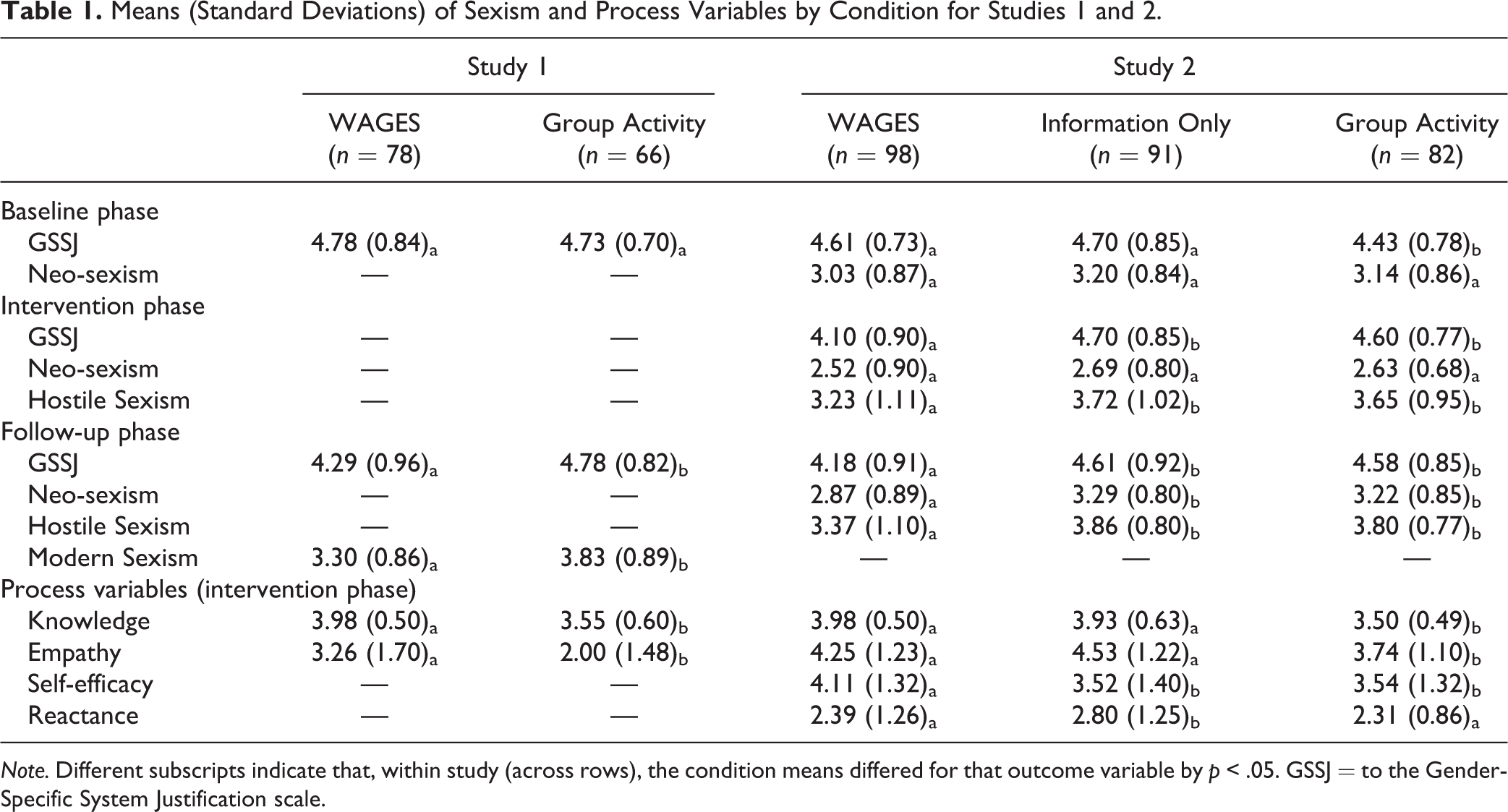
Note. Different subscripts indicate that, within study (across rows), the condition means differed for that outcome variable by p < .05. GSSJ = to the Gender-Specific System Justification scale.
To test the effects of the WAGES intervention on Modern Sexism at follow-up, we used a one-way (Experimental Condition: WAGES, group activity control) between-subject ANOVA. Supporting Hypothesis 1b, participants in the WAGES condition endorsed Modern Sexism at follow-up less than those in the group activity condition, F(1, 113) = 9.91, p = .002, ηp 2 = .08, d = .60.
Hypothesis 2: Process Variables
We tested whether WAGES (vs. group activity) would influence the process variables of knowledge and empathy with one-way between-subject ANOVAs (see Table 1). Compared to the group activity condition, participants in the WAGES condition after the intervention reported more knowledge (supporting Hypothesis 2a), F(1, 142) = 22.13, p < .001, ηp 2 = .14, d = .78, and more empathy (supporting Hypothesis 2c), F(1, 142) = 21.96, p < .001, ηp 2 = .13, d = .79.
Hypothesis 3: Process Variables as Mediators
We tested whether knowledge and empathy mediated the effect of WAGES versus group activity on sexism endorsement for GSSJ (Figure 1A) and Modern Sexism (Figure 1B). We ran a multiple mediator model using PROCESS in Statistical Package for Social Sciences (Hayes, 2012). We tested Model 4, using 5000 re-samples, and setting 95% confidence intervals. This analysis employs a bootstrapping procedure to test for mediation rather than relying on the Sobel test or a causal steps approach (e.g., Baron & Kenny, 1986). Bootstrapping is recommended with smaller samples because it maintains statistical power, controls Type I error rates, and is robust to nonnormality in the sampling distribution (Preacher & Hayes, 2008). Moreover, it produces a confidence interval showing the range of the size of the effect of the mediator. Finally, the bootstrapping approach allows for the testing of multiple mediators in a single model, which avoids issues such as the omitted variable problem that could lead to biased parameter estimates (compared to separate tests for each mediator as advocated in a causal steps approach), and it allows the researcher to assess the relative magnitude of the effect of each mediator (Preacher & Hayes, 2008).
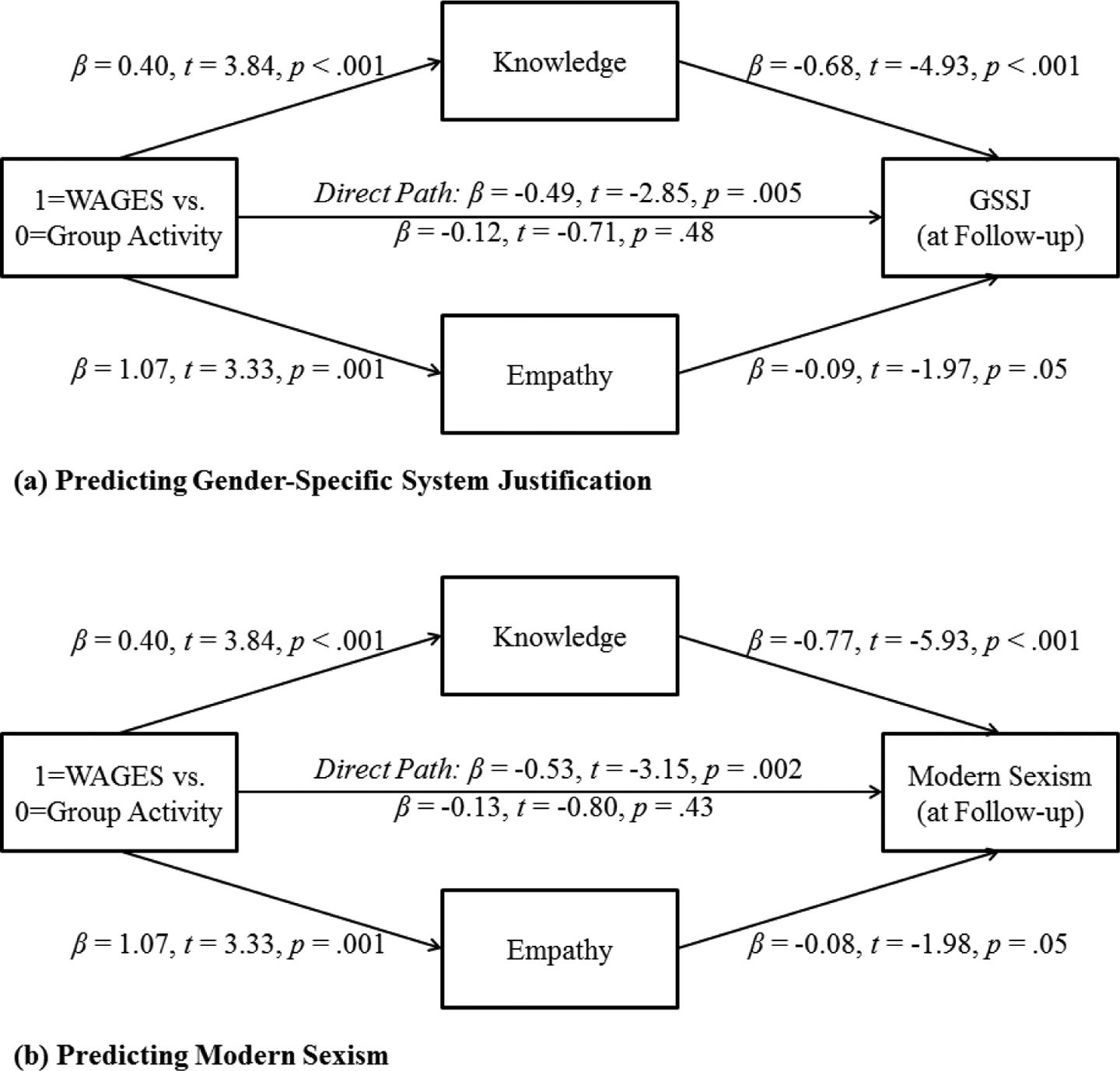
Knowledge and empathy mediate the effect of intervention condition (WAGES vs. group activity) on follow-up sexism endorsement in Study 1. WAGES = Workshop Activity for Gender Equity Simulation.
As Figure 1 shows, experimental condition (WAGES vs. group activity) predicted knowledge and empathy, and knowledge and empathy each predicted levels of sexism endorsement. Moreover, knowledge and empathy mediated the effect of WAGES versus group activity on endorsement of sexism because the bias corrected and accelerated confidence intervals for these indirect effects did not include zero for GSSJ (knowledge: 95% CI [−.50, −.11]; empathy: 95% CI [−.26, −.01]) and Modern Sexism (knowledge: 95% CI [−.55, −.14]; empathy: 95% CI [−.24, −.004]).
Moderators of WAGES’ effectiveness
As exploratory hypotheses, we tested whether the effects of WAGES on sexism were moderated by participants’ gender or team. We restricted these analyses to participants in the WAGES condition. Because GSSJ was measured at both baseline and follow-up, we used a 2 (Gender: male, female) × 2 (Study Phase: baseline, follow-up) mixed design ANOVA, with time as the repeated measure and replacing gender with team (Green, White) when appropriate. There was an effect of gender such that, compared to men, women (M = 4.72, SD = .60) reported less endorsement of GSSJ than men (M = 4.39, SD = .61), F(1, 63) = 4.70, p = .03, ηp 2 = .07, d = .55. The main effect of gender was qualified by a Gender × Time interaction, F(1, 63) = 19.28, p < .001, ηp 2 = .23. For men, there was no difference between baseline (M = 4.65, SD = .90) and follow-up (M = 4.79, SD = .78, p = .50, d = .17), whereas women’s endorsement of GSSJ decreased from baseline (M = 4.96, SD = .76) to follow-up (M = 3.82, SD = .91, p < .001, d = 1.36). There were no main or interaction effects of team for GSSJ, Fs < 1.20, ps > .27. Because Modern Sexism was only measured at follow-up, we used a one-way ANOVA with either participant gender or team as the independent variable. There was an effect of gender such that, compared to men (M = 3.78, SD = .64), women (M = 2.82, SD = .84) reported less endorsement of Modern Sexism, F(1, 63) = 26.13, p < .001, ηp 2 = .29, d = 1.29. The main effect of team for Modern Sexism was not significant (F = .11, p = .74).
Discussion
Relative to the group activity condition, WAGES-Academic effectively reduced endorsement of sexism as measured by the GSSJ and Modern Sexism scales, and the effects occurred via increased knowledge and empathy. Exploratory analyses suggest that team does not matter, but the effect of WAGES on sexist beliefs may only occur for women.
Study 2
Two changes to the Study 1’s design enabled us to further examine WAGES’ effectiveness in reducing endorsement of sexist beliefs. We added another experimental control condition (information only) in which participants were given the same information as in WAGES but without the experiential learning component. In other words, this condition allowed us to test the effect of simply providing information about gender equity in the workplace. Second, we added reactance and self-efficacy to our process variable measures, which again included knowledge and empathy. The data for this second study are part of a larger data set that contains additional variables irrelevant to the present hypotheses. Portions of these data examining the effect of WAGES on knowledge of gender equity over time are reported elsewhere (Zawadzki et al., 2012).
We also made changes to our outcome measures. First, we measured sexism both at the end of the intervention phase and at the follow-up phase to better assess attitude change over time. Second, we included two additional measures of sexism in order to fully tap the range of sexism endorsement that might be affected by participation in WAGES, measuring Neo-sexism (Tougas et al., 1995), as another way to assess covert sexism, and Hostile Sexism (Glick & Fiske, 1996), as a way to assess overt sexism. Third, we improved our empathy measure by adding additional items. Finally, to better account for WAGES’ effects, we added three individual difference measures that may influence individuals’ openness to information provided by WAGES: need for cognition, trait psychological reactance, and trait empathy. Given the complex and potentially threatening nature of providing information about subtle sexism and its effects, we felt it necessary to control for how much participants were willing to and enjoy thinking about complicated issues (need for cognition) and to react against new information (trait psychological reactance). In addition, given that learning about gender inequity in an experiential learning intervention involves taking the perspective of women who face inequity, we assessed people’s ability to take the perspective of others (trait empathy).
Method
Participants
In exchange for course credit, undergraduate participants at a large mid-Atlantic university completed a study in three parts: baseline phase, intervention phase, and follow-up phase. At the baseline phase, 1,249 people (705 women, 529 men, and 15 gender unspecified) completed an online study with a number of personality and individual difference measures and in which the measures for the present study were embedded. We contacted a randomly selected subsample of 894 participants from baseline; of those contacted, 271 (30.3%) participated in the intervention phase (158 women and 113 men; Mage = 19.38, SDage = 1.94, range = 18–41). Participants identified themselves as non-Hispanic Caucasian (231, 86%), followed by Asian American (9, 3%), African American (9, 3%), and Latina/o (9, 3%). Those who participated in the study did not differ on baseline levels of GSSJ compared to the entire baseline population (p = .14), but they endorsed Neo-sexism less than the entire baseline population (M = 3.10, SD = 0.86 vs. M = 3.23, SD = 0.84, p = .03, d = .15). Because participants were randomly assigned in groups to one of three experimental conditions (i.e., WAGES, group activity, or information-only), we examined these demographics by condition (WAGES: 66 women and 32 men; group activity: 45 women and 37 men; and information-only: 47 women and 44 men). A one-way ANOVA for age (p = .63) and independent samples chi-square tests for race (ps > .17) revealed no group differences among the three experimental conditions. Regarding gender, independent samples chi-square tests revealed no proportional differences in gender between the group activity conditions and the WAGES and information-only conditions (ps > .08); however, a greater proportion of women participated in the WAGES condition compared to the information-only condition (67.3% vs. 51.6%, p = .03). Finally, participants who completed the intervention were contacted for follow-up; of those invited, 243 (89.7%) participated (139 women and 104 men; Mage = 19.38, SDage = 1.94, range = 18–41). The ethnic/racial breakdown at the follow-up phase was similar to the intervention phase: non-Hispanic Caucasian (231, 86%), followed by Asian American (9, 3%), African American (9, 3%), and Latina/o (9, 3%). Those who participated in only the baseline and intervention phase of the study did not differ on baseline levels of GSSJ and Neo-sexism than those who participated in all three phases of the study (ps > .23).
Procedure and Materials
For the baseline phase, participants completed the sexism measures (GSSJ and Neo-sexism scales and several other measures not pertinent to our article). The intervention phase of Study 2 was similar to that of Study 1, except for the following changes. First, at the beginning of the session, participants filled out personality measures (e.g., need for cognition). Second, participants were randomly assigned in groups to the WAGES condition or group activity condition (as described in Study 1) or to an information-only condition. In the information-only condition, participants received all of the information contained in WAGES, but in a nonexperiential learning format. Participants had 15 minutes to read handouts based on the WAGES game cards and 8 minutes to read a transcribed version of the WAGES post-game discussion. Each session was conducted by one of the four trained female undergraduate research assistants. Participants’ responses across the outcome variables did not vary across research assistants. Finally, at the end of the intervention phase, participants first completed the process measures (knowledge of gender equity, reactance, empathy, and self-efficacy) and then completed the sexism measures (GSSJ, Neo-sexism, Hostile sexism). For the follow-up, as in Study 1, participants were e-mailed 1 week after the intervention phase to complete the sexism measures online. Those who did not respond were contacted every 2 days, up to two more times.
Sexism scales
Three sexism measures were included in Study 2. First, the GSSJ, as described in Study 1, was completed at the baseline (α = .74), end of intervention (α = .77), and follow-up phases (α = .81). Second, the Neo-sexism scale (Tougas et al., 1995)—completed at the baseline (α = .85), end of intervention (α = .79), and follow-up phases (α = .85)—is an 11-item scale that measures the manifestation of conflict between egalitarian values and residual negative feelings towards women, and it is considered a measure of covert sexism (Campbell, Schellenberg, & Senn, 1997; Leaper & Van, 2008). Third, the Hostile Sexism scale (Glick & Fiske, 1997)—completed at the end of intervention (α = .79) and follow-up phases (α = .88)—is an 11-item scale that measures overt hostility towards women, particularly those in nontraditional roles (e.g., feminists, women who work outside the home). Participants responded to these sexism measures using a 1 (Strongly Disagree) to 7 (Strongly Agree) scale. For each scale, items were reverse scored when appropriate and averaged such that higher numbers indicated more sexism.
Process measures
Four process measures were included in Study 2. First, the Knowledge of Gender Equity scale, as described in Study 1, was completed at the end of the intervention phase (α = .90). Second, self-reported feelings of empathy were measured at the end of the intervention phase with 4 items (α = .81; “How much did you feel [empathy, empathetic, able to identify with others’ difficulties, able to understand others]”). Third, state reactance (Zawadzki et al., 2012), completed at the end of the intervention phase (α = .84), was measured by a 4-item scale tapping the extent to which participants denied the veracity of information provided during the intervention. Fourth, state self-efficacy (Zawadzki et al., 2012), completed at the end of the intervention phase (α = .88), is a 7-item scale that measures the extent to which participants believed they had personal control or agency to act on what they learned during the intervention. Participants responded to the Knowledge of Gender Equity scale using a 1 (Very Much Believe to be True) to 5 (Very Much Believe to be False) scale, to the empathy measure using a 1 (Not at All) to 7 (Very Much) scale, and to the state self-efficacy and state reactance measures using a 1 (Strongly Disagree) to 7 (Strongly Agree) scale. Items on the scales were reverse scored when appropriate and averaged such that higher numbers indicated more knowledge, empathy, state reactance, and state self-efficacy.
Individual difference measures
Three individual difference measures assessed participants’ openness to information. First, the Need for Cognition scale (Cacioppo, Petty, & Kao, 1984), completed at the beginning of the intervention phase (α = .90), is an 18-item scale that measures the tendency to engage in and enjoy cognitive endeavors. Second, the Hong Psychological Reactance scale (Hong & Page, 1989), completed at the beginning of the intervention phase (α = .86), is a 14-item scale that measures reactance proneness, including reactions to compliance and resisting compliance from others. Third, the Empathy Questionnaire (Davis, 1980), completed at the beginning of the intervention phase (α = .87), is a 28-item scale that measures the tendency to take the perspective of and have concern for others. Participants responded to the Need for Cognition and Trait Empathy measures using a 1 (Extremely Uncharacteristic of Me) to 7 (Extremely Characteristic of Me) scale and to the Trait Reactance measure using a 1 (Not at All) to 7 (Very Much) scale. Items on the scales were reverse scored when appropriate and averaged such that higher numbers indicated more need for cognition, trait reactance, and trait empathy.
Results
Hypothesis 1: Endorsement of Sexism
We tested whether WAGES reduced endorsement of sexism, and whether this reduction was sustained over time using a 3 (Experimental Condition: WAGES, group activity, information only) × 3 (Study Phase: baseline, intervention, follow-up) mixed design analyses of covariance (ANCOVAs), with GSSJ and Neo-sexism as the outcome variables. For Hostile Sexism, because we did not have baseline data and thus would not predict an interaction, we ran one-way (Experimental Condition: WAGES, group activity, information-only) ANCOVAs, examining the intervention phase and follow-up phase separately. Need for cognition, trait reactance, and trait empathy were entered as covariates; there were no interactions with these measures, but because there were main effects they were retained as covariates. All means appear in Table 1.
For GSSJ, we obtained a main effect of experimental condition, F(2, 237) = 3.95, p = .02, η p 2 = .03, which was qualified by a significant Experimental Condition by Study Phase interaction, F(4, 474) = 8.57, p < .001, η p 2 = .07. Supporting Hypothesis 1a, compared to baseline levels, participants in the WAGES condition endorsed GSSJ less at the end of both the intervention phase (p < .001, d = .62) and the follow-up phase (p < .001, d = .52). Supporting Hypothesis 1b, those in the WAGES condition endorsed GSSJ less than those in the information-only and group activity conditions at both the intervention phase (p = .01, d = .38; p < .001, d = .60, respectively) and the follow-up phase (p = .002, d = .47; p = .005, d = .45, respectively). Participants in the group activity and information-only conditions did not differ at the intervention phase (p = .36, d = .12) or the follow-up phase (p = .83, d = .03).
For Neo-sexism, we obtained a main effect of experimental condition, F(2, 237) = 3.19, p = .04, η p 2 = .03) and a main effect of study phase, F(2, 474) = 3.87, p = .02, η p 2 = .02; the predicted interaction was only marginally significant and thus not discussed further, F(4, 474) = 2.12, p = .08, η p 2 = .02. The main effect of experimental condition revealed that, in partial support of Hypothesis 1b, participants in the WAGES (M = 2.81, SD = .90) condition endorsed Neo-sexism less than those in the information-only condition (M = 3.06, SD = .81, p = .02, d = .29) and marginally less than the group activity condition (M = 3.00, SD = .80, p = .08, d = .22), whereas the group activity and information-only conditions did not differ (p = .54, d = .07). The main effect of study phase revealed that participants endorsed Neo-sexism less at the intervention phase (M = 2.62, SD = 0.80) than the baseline phase (M = 3.13, SD = 0.86, p < .001, d = .61) and follow-up phase (M = 3.13, SD = 0.86, p < .001, d = .61); the baseline and follow-up phases did not differ from each other (p = 1.00, d = .00).
For Hostile Sexism, because we did not collect baseline data, we could not test Hypothesis 1a. Supporting Hypothesis 1b, we found a main effect for experimental condition at the intervention phase, such that participants in the WAGES condition endorsed Hostile Sexism less than those in the information-only (p < .001, d = .47) and group activity conditions (p = .001, d = .42), F(2, 264) = 7.65, p < .001, η p 2 = .06. Those in the group activity and information-only conditions did not differ (p = .86, d = .06). A similar effect was found for experimental condition at the follow-up phase, such that participants in the WAGES condition endorsed Hostile Sexism less than those in the information-only (p < .001, d = .42) and group activity conditions (p = .002, d = .44), F(2, 237) = 7.71, p < .001, η p 2 = .06. Those in the group activity and information-only conditions did not differ (p = .69, d = .03).
Hypothesis 2: Process Variables
We tested whether WAGES (vs. group activity and information-only) influenced the process variables with several one-way between-subject ANOVAs. All means are presented in Table 1. Consistent with Hypothesis 2a, WAGES enhanced knowledge more than the group activity condition (p < .001, d = .97), F(2, 268) = 20.25, p < .001, η p 2 = .13; however, it did not differ from the information-only condition (p = .47, d = .09). Consistent with Hypothesis 2b, WAGES produced less reactance than the information-only condition (p = .02, d = .33); however, it did not differ from the group activity condition (p = .63, d = .07), F(2, 268) = 4.72, p = .01, η p 2 = .03. Consistent with Hypothesis 2c, WAGES produced more empathy than the group activity condition (p = .004, d = .44), F(2, 265) = 9.84, p < .001, η p 2 = .07; however, it did not differ from the information-only condition (p = .10, d = .22). Supporting Hypothesis 2d, WAGES produced more self-efficacy than both the information-only (p = .003, d = .43) and the group activity conditions (p = .005, d = .43), F(2, 268) = 5.88, p = .003, η p 2 = .04.
Hypothesis 3: Process Variables as Mediators
We ran two sets of multiple mediation analyses following the bootstrapping procedure described in Study 1 to test the processes by which WAGES reduced endorsement of sexism. We first tested whether knowledge, empathy, and self-efficacy at the intervention phase mediated the effect of the WAGES versus group activity conditions on sexism endorsement at follow-up. Recall that these experimental conditions did not differ on reactance so that reactance was not included in the model. (We also ran exploratory models with reactance included, but with all the sexism outcomes the confidence interval for reactance included zero suggesting it was not a significant mediator.) As Figure 2 shows, experimental condition (WAGES vs. group activity) predicted knowledge of gender equity, empathy, and self-efficacy. Knowledge was a significant mediator for GSSJ (95% CI:[ −.48, −.17]) and Neo-sexism (95% CI:[ −.51, −.19]), but for not Hostile Sexism (95% CI: [−.29, .02]). Empathy mediated for Neo-sexism (95% CI: [−.19, −.02]) and Hostile Sexism (95% CI:[ −.17, −.01]) but not for GSSJ (95% CI: [−.09, .05]). Self-efficacy was a significant mediator for Neo-sexism (95% CI:[ −.18, −.01]) and Hostile Sexism (95% CI:[−.19, −.01]), but not for GSSJ (95% CI:[ −.05, .08]).
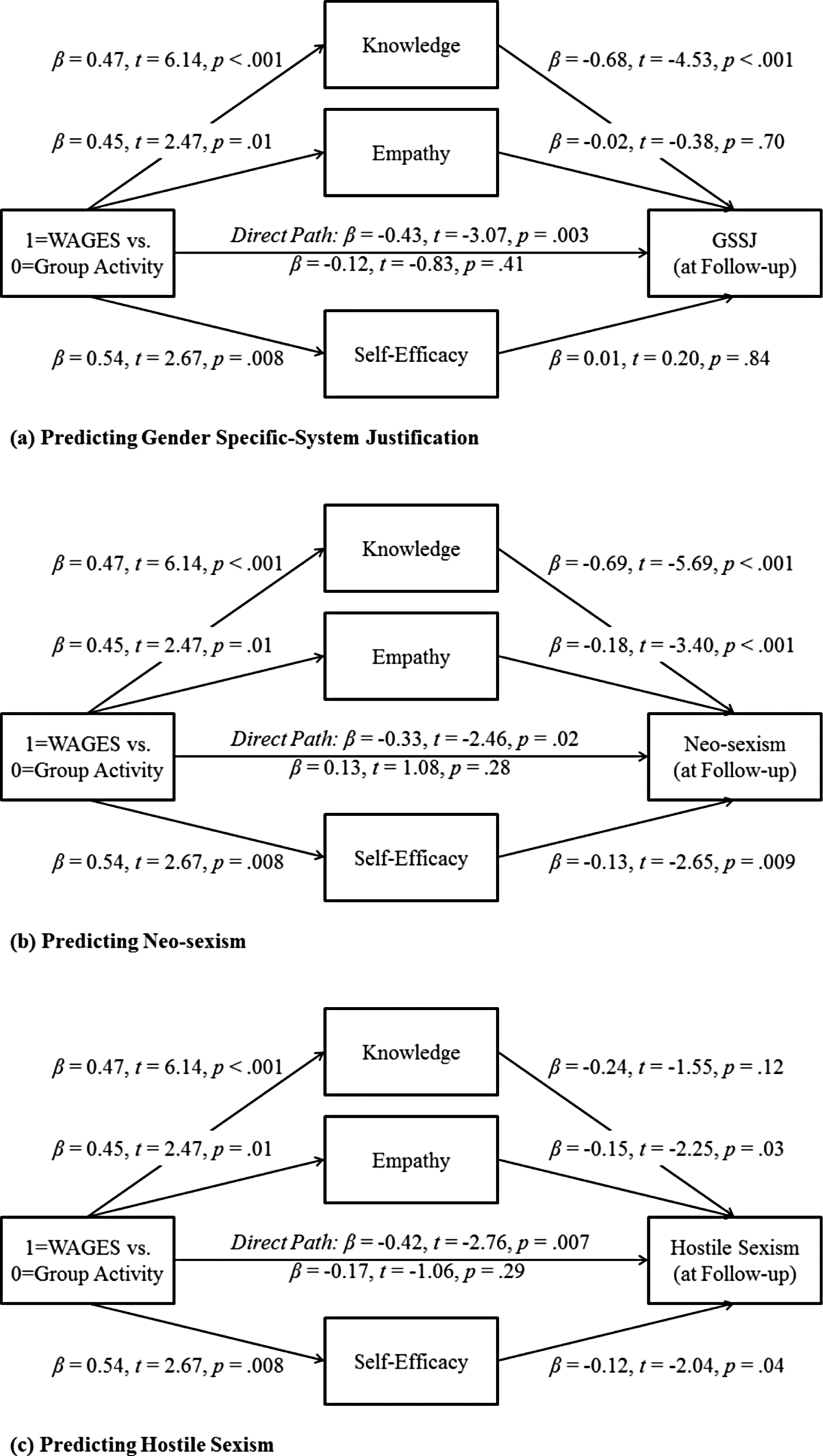
Knowledge, empathy, and self-efficacy mediate the effect of intervention condition (WAGES vs. control) on follow-up sexism endorsement in Study 2. WAGES = Workshop Activity for Gender Equity Simulation.
Next, we tested whether reactance and self-efficacy mediated the effect of the WAGES versus information-only conditions on sexism endorsement. Recall that these experimental conditions did not differ on knowledge or empathy and so were not included in the model. (We also ran exploratory models with knowledge and empathy included, but with all the sexism outcomes the confidence intervals for knowledge and empathy included zero, suggesting they were not significant mediators.) As Figure 3 shows, experimental condition (WAGES vs. information-only) predicted reactance and self-efficacy. Reactance was a significant mediator for GSSJ (95% CI:[ −.22, −.01]), Neo-sexism (95% CI: [−.20 to −.01]), and Hostile Sexism (95% CI: [−.19, −.01]). Self-efficacy was a significant mediator for Neo-sexism (95% CI: [−.22, −.01]) and Hostile Sexism (95% CI: [−.19, −.01]), but not for GSSJ (95% CI: [−.14, .02]).
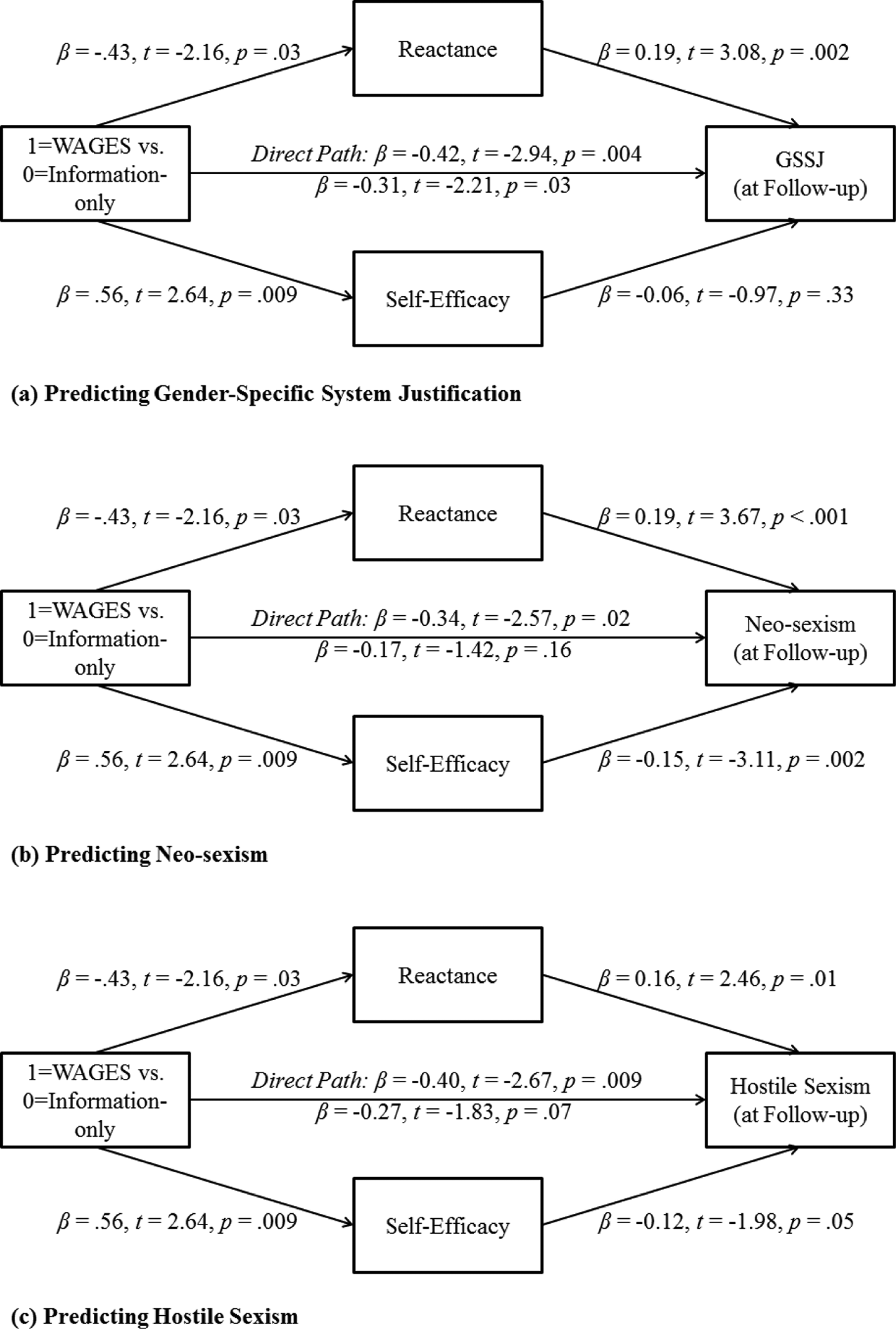
Reactance and self-efficacy mediate the effect of condition (WAGES vs. information-only) on follow-up sexism endorsement in Study 2. WAGES = Workshop Activity for Gender Equity Simulation.
Moderators of WAGES Effectiveness
As exploratory hypotheses, we tested whether the effects of WAGES on sexism were moderated by participants’ gender or team. As in Study 1, we restricted these analyses to the WAGES condition. For GSSJ and Neo-sexism, we used 2 (Gender: male, female) × 3 (Time: baseline, intervention, follow-up) mixed design ANOVAs, with time as the repeated measure and replacing gender with team (Green, White), when appropriate, for each sexism measure. We used the same design for Hostile Sexism but only had the intervention and follow-up as time points. There were significant main effects of gender such that, compared to men, women reported less endorsement of GSSJ (M men = 4.61, SD = .67; M women = 4.15, SD = .68), F(1, 86) = 9.09, p = .003, η p 2 = .10, d = .68; Neo-sexism (M men = 3.42, SD = .69; M women = 2.57, SD = .68), F(1, 86) = 29.49, p < .001, η p 2 = .26, d = 1.24; and Hostile Sexism (M men = 4.04, SD = .94; M women = 3.00, SD = .94), F(1, 86) = 23.67, p < .001, η p 2 = .22, d = 1.11. There were no interaction effects for participant Gender × Time for GSSJ or Hostile Sexism (Fs < 1.83, ps > .17). Gender and time interacted for Neo-sexism, F(2, 172) = 4.07, p = .02, η p 2 = .05. Men (M base = 3.47, SD = .83; M foll = 3.57, SD = .66, p = .43, d = .13) returned to baseline levels at the follow-up, whereas women (M base = 2.87, SD = .83; M foll = 2.59, SD = .81, p = .002, d = .34) did not. There were no effects of team for any of the sexism measures (Fs < 3.72, ps > .05).
Discussion
Replicating and extending Study 1, relative to the group activity and information-only conditions, WAGES-Academic was effective in reducing participants’ endorsement of sexism as measured by the GSSJ, Neo-sexism, and Hostile Sexism scales. These effects occurred via increased knowledge, decreased reactance, and increased empathy for WAGES versus group activity, and via decreased reactance and increased self-efficacy for WAGES versus information-only. Contrary to Study 1, exploratory analyses suggested that the effect of WAGES on sexist beliefs occurred for both women and men, although men’s endorsement of Neo-sexism was not sustained over time. As in Study 1, assigned team did not influence WAGES’ effectiveness. It should be noted that there was a greater proportion of women in the WAGES condition compared to information-only condition. However, our finding that gender did not interact with GSSJ or Hostile Sexism suggests that the difference in gender proportions does not explain why the WAGES condition yielded less endorsement of sexism across these two variables than the information-only condition. In addition, participants who took part in the study endorsed Neo-sexism less than those who did not participate, perhaps indicating a selection bias. However, there were no differences in GSSJ, and the magnitude of the effect for Neo-sexism was very small (d = .15), suggesting an inconsistent and, at most, minor difference between the two groups.
General Discussion
In two multipart studies, we demonstrated the effectiveness of WAGES-Academic as an experiential learning-based intervention to reduce endorsement of sexist beliefs on four different measures of sexism that assess overt, covert, and subtle sexism. In Study 1, when compared to a group activity control condition, WAGES’ impact on sexism reduction at the follow-up was mediated by knowledge about gender equity and empathy. In Study 2, these effects were replicated and extended to include self-efficacy as a mediator. That is, WAGES provided more information about sexism, elicited perspective-taking and emotional connection to the issue of sexism, and bolstered self-efficacy to act on the knowledge. In Study 2, our results also demonstrated that the experiential learning component of WAGES is the key to its effectiveness. Compared to a group given the same information, but without the experiential learning dimension (i.e., the information-only control condition), WAGES’ impact on sexism reduction at follow-up was mediated by reduced reactance and enhanced self-efficacy, although the latter was not a significant mediator for one of the three sexism measures (i.e., system justification as measured by the GSSJ). In summary, WAGES is effective because it conveys information about sexism in a manner that does not lead participants to reject the message, encourages participants to experience empathy, and instills in them a sense of self-efficacy that they can act on the information they have learned.
Although team membership (disadvantaged Green Team or advantaged White Team) did not influence the effectiveness of WAGES on sexism endorsement, participant gender did affect the results. Consistent with prior literature (e.g., Becker & Swim, 2011), there were main effects across the sexism measures, with women endorsing sexist beliefs less than men. In both Studies 1 and 2, however, the interaction between gender and time was inconsistent, generally indicating that the effects of intervention were less reliably retained by men. In Study 1, men’s GSSJ scores did not differ between baseline and follow-up (GSSJ was not measured immediately after the intervention in Study 1); in Study 2, however, men’s scores decreased from baseline levels after the intervention and remained at lowered levels at the follow-up. Furthermore, in Study 2, there was no Gender by time Interaction for Hostile Sexism, suggesting that effects on Hostile Sexism were retained at follow-up. Finally, men showed a decrease in endorsement of Neo-sexism after the intervention, but this effect disappeared at follow-up. Given this inconsistent pattern of results, we conclude that overall WAGES is effective for male as well as female participants, but effects of the WAGES experience on sexist beliefs are not retained as well by men as by women. These results suggest that it might be particularly important to include “booster” sessions for male participants to bolster the extent to which WAGES decreases sexism.
Our predicted impact of WAGES over time was generally observed for women. One obvious potential explanation for the difference in impact on women and men is the greater self-relevance of the WAGES intervention to women’s experience. It is also possible that men may have been less motivated to engage with the issues addressed in WAGES which would account for the less consistent effects on sexism for men. Previous work, however, has shown that, although women do score higher than men on knowledge of gender equity at baseline, intervention, and follow-up, men’s knowledge significantly increases over baseline and is retained at follow-up (Shields et al., 2011; Zawadzki et al., 2012). This suggests that it is not simply less motivation that accounts for inconsistencies in men’s sexism scores.
The pattern of results observed suggests that WAGES may be more effective in addressing some types of sexism than others. Specifically, WAGES had more lasting impact on overt sexism (as measured by Hostile Sexism) and subtle sexism (as measured by GSSJ) than on covert sexism (as measured by Neo-Sexism). This makes sense in that WAGES encourages empathy, which has been shown to decrease Hostile Sexism, and it is an intervention specifically designed to reveal the nature, operation, and effects of subtle sexism. Covert sexism (Swim & Cohen, 1997), on the other hand, entails unequal and harmful treatment of women in a clandestine manner. WAGES was designed to be used with individuals who are assumed not to have foreclosed discussion of gender equity or harbor intentions to retaliate or act in opposition to women’s interests, so there is no content included in the intervention that explicitly addresses this dimension of sexism.
Limitations and Future Directions
For the present study, we recruited undergraduate participants, yet WAGES-Academic was designed to be used by academic administrators and faculty decision makers in the post-secondary education context (Shields et al., 2011). It is difficult to know whether the observed results for the student sample would generalize to academic administrators and faculty. Experiential learning, however, is proposed to be effective for individuals across age and education levels so we would expect WAGES to be effective for individuals with a broad range of characteristics. Furthermore, the theme of WAGES-Academic (career advancement) and game items (e.g., performance evaluation, relations with coworkers, work–life balance, projects affecting career advancement, networking) is relevant to the work environment of faculty and administrators. Future work will validate the effectiveness of WAGES-Academic for college and university faculty and administrators.
As is often the case, the large majority of our participants identified as non-Hispanic Caucasian, which has potential implications for generalizability to members of other racial and ethnic groups. Items were specifically designed to reflect the diverse work experiences of women of color and White women, although we have some anecdotal evidence that men from underrepresented or otherwise marginalized groups also can identify their own experience in the Green Team cards. It will be important in further work to investigate WAGES’ efficacy for samples that are not predominantly non-Hispanic Caucasian. If there are differences between other racial ethnic groups and the non-Hispanic Caucasian samples used in our research thus far, we would expect differences to be a matter of degree, given the salience of everyday racism in U.S. culture (Deitch et al., 2003; Sue et al., 2007). In other words, we would expect mostly main effects of race/ethnicity similar to those found for gender in our predominantly White sample.
It would be useful to extend the present findings beyond the reduction of sexist attitudes and to test whether WAGES enhances participants’ ability to detect subtle gender bias. Future research will examine whether WAGES affects the ability to detect subtle bias without increasing a tendency to see bias in bias-free or wholly ambiguous situations. In addition, although the retention of knowledge of gender equity and effects on reduction of sexist beliefs is encouraging, future studies of WAGES’ effectiveness should follow participants over a longer period and include assessment of whether the impact on beliefs and knowledge is reflected in behavioral change. For example, in our target audience, we would expect heightened awareness of sexism, especially subtle sexism, to promote the use of selection and evaluation tools that are explicitly designed to interrupt the influence of automatic and unconscious biasing factors (e.g., use of standardized evaluation forms, gender-neutral evaluations).
Practice Implications
Results of the present research highlight the utility of experiential learning for programs designed to reduce endorsement of sexism. Relatively few investigators have addressed ways to confront and reduce sexist prejudice (Becker, Zawadzki, & Shields, 2013). In fact, we have been able to identify only a handful of published interventions (e.g., Becker & Swim, 2011; Kilmartin et al., 2008; Rios et al., 2010). The prevalence and harm of sexism, especially in its subtle forms, however, speaks to the need for effective interventions to confront and reduce sexism.
One of the core challenges of introducing a discussion of sexism is the likelihood that the topic will be met with denial that sexism exists at a level that actually impedes women’s advancement. Denial of the existence of sexism is a key feature of contemporary forms of sexist attitudes, as captured in the Modern Sexism scale (Swim et al., 1995) and Neo-sexism scale (Tougas et al., 1995). Any intervention against prejudice must therefore first establish that the prejudice exists (i.e., provide information) but in a way that does not elicit immediate denial of the problem (i.e., reactance). Overall, reduction of reactance is an important pathway to enhancing receptiveness to information about the nature, prevalence, and consequences of sexism. A second aspect of experiential learning that accounts for WAGES’ effectiveness is self-efficacy. This is an important aspect of experiential learning because it gives the individual a framework for acting on the newly acquired knowledge (Kolb, 1984). Efficacy need not be posed as transformative. Even small steps toward positive change are useful, offering the individual an opportunity to participate in making that change happen. In the case of WAGES, the individual is invited to think about the various ways in which sexist bias can be addressed at the individual, group, and institutional levels. A third element, providing information in a way that fosters empathy, as the present studies show, is an effective way to reduce sexist beliefs.
The implications for broader educational efforts to raise awareness about sexism as a social issue are clear. Our research indicates that programs to reduce sexism will be successful only insofar as they employ two key strategies from experiential learning. First, invite access to discussion in such a way that does not elicit defensive denial of the problem, and insofar as sexism reduction is concerned, create a context in which participants are readily able to empathize with others. Second, provide information but ensure that the information does not elicit the reaction that the problem is too big or too complex to be affected by the actions of a single individual (i.e., instill feelings of self-efficacy that one can address the problem). Following these recommendations, we believe our work also has clear implications for development of interventions that address other complex social issues that, like sexism, have the potential to be met with reactance, including, for example, environmental issues and climate instability or sexual agency and consent.
Conclusions
We propose that WAGES is a viable intervention to reduce sexism. Although simply providing information about sexism may seem an intuitive way to influence attitudes, data from the information-only condition suggest that this approach is unlikely to be effective. Instead, WAGES, as an experiential learning intervention, has great potential to teach about gender inequity in the workplace in a way that will be better assimilated by participants. WAGES is easily administered (approximately 90 minutes), portable, and inexpensive. Furthermore, as these studies show, the facilitator does not need to have specialized training for the WAGES experience to be successful (i.e., the facilitators were undergraduate students and not experts on gender equity). Eliminating sexism will take concerted efforts on many fronts, but a necessary step includes exposing individuals to gender inequity knowledge in a manner that does not increase reactance, that facilitates empathy, and that bolsters feelings of self-efficacy. As an intervention, WAGES has the potential to fill a needed void.
Footnotes
Acknowledgments
We thank Elizabeth Demeusy, Jessica Esandrio, April Foster, Lisa Makings, Arielle Riutort, and Brittney Schlechter for their invaluable assistance as experimenters.
Declaration of Conflicting Interests
The author(s) declared no potential conflicts of interest with respect to the research, authorship, and/or publication of this article.
Funding
The author(s) disclosed receipt of the following financial support for the research, authorship, and/or publication of this article: This research was supported in part through a grant awarded by (a) the National Science Foundation (Award #0820212), (b) that aims to increase the participation and advancement of women in academic science and engineering careers, (c) awarded to Stephanie A. Shields. In-kind support was provided by The Schreyer Institute for Teaching Excellence, The Pennsylvania State University.
References
Supplementary Material
Please find the following supplemental material available below.
For Open Access articles published under a Creative Commons License, all supplemental material carries the same license as the article it is associated with.
For non-Open Access articles published, all supplemental material carries a non-exclusive license, and permission requests for re-use of supplemental material or any part of supplemental material shall be sent directly to the copyright owner as specified in the copyright notice associated with the article.
