




Abstract
Research suggests that posture exerts powerful affective and cognitive influences, although recent studies have indicated that these embodiment effects are moderated by gender. We examined two sociocultural factors that may contribute to the effects of postural feedback in women: self-objectification and power. Across a 2 × 2 × 2 between-subjects design, 80 female undergraduates completed various cognitive tasks and self-report measures after having been in an upright or slouched posture, seated in either a (powerful) throne or child’s chair, and wearing either a formfitting (objectifying) tank top or loose sweatshirt. The results showed that posture had the predicted influence on mood, with those seated upright reporting more positive mood than those seated in a slouched position. For the cognitive tasks, our findings were more complex and, due to low power, are best considered preliminary. Participants who were seated upright in a child’s chair while wearing a sweatshirt attempted the highest number of math items compared to those in the other conditions, supporting our prediction that postural benefits would be greatest in a context where power cues were gender-appropriate and self-objectification effects were attenuated. On a measure of satisfaction with performance, our findings suggest that self-objectification outweighed the power manipulation, leading to poorer outcomes when a seated position emphasized sexualized features of the body. Taken together, our results suggest that embodiment effects appear to be impacted by contextual cues, perhaps particularly for women.
Phrases such as “smile, and you will feel better” or “whistle to keep up courage” reflect a layperson’s understanding of the concept that physical comportment and facial expression have a strong influence on our emotional and cognitive states. These axioms support William James’s (1884) theory of emotion, which emphasizes physiological arousal and assumes that adopting bodily positions will bring about the emotional and cognitive changes that would typically accompany such postures or facial expressions. In his exposition, James suggested that adopting a hunched posture, for example, will increase feelings of melancholy whereas an erect posture will elicit positive feelings such as pride. Indeed, studies conducted over a century after James’s proposal have borne out his predictions, demonstrating that subtle manipulations of bodily position impact both emotional and cognitive states (cf. Niedenthal, 2007).
However, recent studies have complicated the picture of the relationship between proprioceptive feedback from bodily positions and emotional or cognitive state (Roberts & Arefi-Afshar, 2007; Schubert, 2004; Schubert & Koole, 2009). For example, Roberts and Arefi-Afshar (2007) showed that an upright posture did not unequivocally have positive effects on all persons adopting the posture, but instead was moderated by gender. Schubert (2004) found that hand position—specifically making a fist—affected feelings of power in men differently than in women. In the present study, we sought to extend our thinking about how postural position might combine with power and body-objectifying cues to influence women’s emotional and cognitive states.
Embodiment Effects
The facial feedback hypothesis posits that the proprioceptive feedback from one’s facial expression exerts considerable influence on one’s emotions and behaviors (Buck, 1980). Various studies have provided support for this hypothesis, demonstrating that covert manipulation of facial expressions is related to corresponding felt emotions (Laird, 1974; Stepper & Strack, 1993). For example, manipulating participants’ facial expression into a smile was associated with reports of greater felt happiness than a manipulated anger expression (Laird, 1974). The effects of facial feedback upon emotional states appear to be specific, although not unilateral: Adopting a certain facial expression may affect one’s emotions in a way that typically corresponds to such an expression, but there may be more than one emotion that meets such a criterion (Duclos et al., 1989).
Not only do facial expressions appear to affect emotional states, but bodily positions also exert an influence on emotions and cognitions. Schubert (2004) and Schubert and Koole (2009) examined the effects of making a fist in the context of a rock-paper-scissors game upon felt power, ratings of an ambiguous vignette character, and self-concept. They found that making and holding a fist invoke greater associations with power than making a neutral hand gesture.
The covert manipulation of body posture has also been shown to impact participants’ emotional states, with an erect, upright posture corresponding to increased feelings of pride (Stepper & Strack, 1993) and a slouched posture with feelings of helplessness and depression (Riskind & Gotay, 1982). Riskind and Gotay (1982) suggested that posture affects participants’ susceptibility to certain emotional states—indicating that postural position alone may not induce emotional states, but rather facilitates some emotional experiences over others.
The appropriateness hypothesis (Riskind, 1984) states that the effects of proprioceptive feedback are dependent upon the appropriateness of bodily position to one’s situational context. Indeed, participants in a success condition felt better when in an upright posture than when in a slouched posture, whereas participants in a failure condition felt better in a slouched posture than in an upright posture (Riskind, 1984). This finding suggests that one’s bodily position must be congruent with contextual features in order to receive benefits from proprioceptive feedback, and if the posture is incongruent, the bodily feedback effects are likely to be attenuated.
Gender and Embodiment Effects
Early studies of bodily and postural position only included male participants. More recent investigations have found gender differences in the effects of bodily feedback. Schubert (2004) and Schubert and Koole (2009) found that men experienced greater hope for control, rated a vignette character as more kind and less hostile, and had increased power in their self-concept when making a fist than when in a neutral hand position. In contrast, women felt less hope for control, rated the character as less kind and more hostile, and had a decreased sense of power in their self-concept when they were making a fist compared to a neutral hand position. Roberts and Arefi-Afshar (2007) found that only male participants experienced effects consistent with James’s (1884) theory and previous research concerning bodily posture. That is, men felt greater pride and performed better on subsequent tasks when in an upright posture than when in a slouched posture. However, women felt prouder of their performance and performed better on later tasks when in the slouched posture than in the upright posture. Roberts and Arefi-Afshar posited two explanations for the opposite effect that posture had on women, which focused on power and self-objectification and which generated the hypotheses of the current exploratory study.
The Present Study
Our goal for the present study was to experimentally manipulate posture in the context of felt-power and self-objectification to ascertain their effects on affect and performance, as well as the potential interaction among these variables in female participants. Felt-power was manipulated by having participants sit in either a large, ornate, throne-like chair (intended to prime feelings of high status and power) or in a small child’s chair (intended to prime feelings of low social status and power). In order to manipulate self-objectification, participants were asked to wear either a formfitting, sleeveless tank top or an oversized sweatshirt during the experiment. The intention was to induce the self-monitoring and body awareness that is typical of self-objectification in the tank top condition, while removing such body consciousness in the oversized sweatshirt condition. Finally, a paradigm utilized in prior proprioceptive feedback research was used to experimentally manipulate participants’ posture into upright or slumped positions prior to performing in the assigned shirt and chair.
For Hypothesis 1, we hypothesized a main effect for the posture manipulation on women’s affect, with those having adopted a slouched position reporting more negative and less positive mood than those having adopted an upright posture, replicating previous work on postural embodiment (Niedenthal, 2007). Regarding Hypothesis 2, our predictions for performance and satisfaction were more complex and involved an interaction among the power, self-objectification, and posture variables. According to Riskind’s (1984) appropriateness hypothesis, postural positions must be congruent with the situational context in order to reap corresponding proprioceptive benefits. Because sitting in a powerful throne may be perceived as incongruent with women’s social status, it is possible that the potential proprioceptive benefits of sitting upright may be lessened. In support of this view, Bugental and Lewis (1999) found that powerless participants experienced cognitive and social difficulties when placed in a demanding power-related context, implying that a situation incongruent with one’s felt power may lead to cognitive disruptions. In the case of upright posture, then, sitting in a child’s chair may actually allow participants sitting upright to perform better on cognitive tasks as compared to those seated in the throne. In contrast, a slouched posture, signifying submission, may enable women to reap the benefits of being in a posture congruent with their felt social role when seated in the throne.
With regard to self-objectification, it is possible that women seated in an upright position may experience deficits in performance due to the fact that their bodies are being made salient. This is particularly true if they are wearing a formfitting shirt. An upright posture—which involves placing the breasts front-and-center—may for women signify being on display and open to sexual objectification. This communication may induce self-objectification, which has been shown to disrupt cognitive performance (Fredrickson, Roberts, Noll, Quinn, & Twenge, 1998). Upright, breasts-forward posture may interfere with the benefits of proprioceptive feedback, accounting for decreased feelings of pride and worse performance on tasks. In contrast, a slouched posture may remove a focus on the breasts, thus decreasing self-objectification and enabling enhanced focus on tasks. Therefore, we only expected to see increased performance and satisfaction for those women who were seated upright in a status-appropriate child’s chair and wearing a form-covering, nonobjectifying sweatshirt.
Method
Participants
Eighty traditional college age (18–22 years old) female undergraduates from a liberal arts college in the Rocky Mountain west region of the United States participated in our study. As an incentive, all participants were entered into a drawing for one of four US$50 gift certificates to a local retailer of their choice. The majority was European American or Caucasian (n = 63, 79%), with 8 (10%) Latina or Hispanic, 5 (6%) Asian American, 2 (3%) African American, and 2 (2%) Native American or Pacific Islander.
Design
Our experimental design was a 2 × 2 × 2 (Posture: upright or slouched; Shirt: tank top or sweatshirt; Chair: throne or child’s) between-subjects design, involving 9–11 participants per cell. The two levels of the Posture variable, upright or slouched, were detailed to the participants with precise direction. For the Shirt variable, participants either wore a formfitting tank top or an oversized sweatshirt. Finally, the participants sat in either a grandiose, carved wooden decorative antique throne from the campus chapel (in which participants were aware the female Dean of the college typically sits in regalia during all-college assemblies) or in a small wooden child’s chair from the campus day care facility (in which participants were aware the toddler children of college staff and faculty typically sit). Participants were randomly assigned to one of the eight experimental conditions. Given our small cell sizes, our analyses are necessarily underpowered and hence exploratory; however, in addition to statistical significance, we will include effect sizes and interpret these according to Cohen’s (1988) parameters of small (.20), medium (.50), and large (.80).
Procedure and Materials
The experimental area consisted of a reception area, a private restroom used as a changing room, and an experimental room (which contained both the child’s chair from the day care and the grandiose throne from the chapel). When each participant arrived in the reception area, she first completed the Objectified Body Consciousness Scale (OBCS; McKinley & Hyde, 1996) and the “Back Health Questionnaire” (a 5-item filler questionnaire we created to purportedly assess the back health of the participant and her family that helped bolster the cover story). Upon completion of these measures, the experimenter (a Caucasian and female undergraduate) presented the cover story concerning the clothing condition: “A major component of today’s study is the effect of ergonomics, or posture, on physiological responses. To measure physiological changes, we will be using a BioDot, which measures stress levels.” At this point, the directions diverged depending on assigned shirt condition: “We ask that you change into the provided top so that…
…we may be able to assess the effects of posture as properly and thoroughly as possible. To do this, it is important that we make close observations of your posture. In the restroom, you will find three sizes of the top that we request you wear. Please choose a size that will fit snugly so that we may see the shape of your back, and specifically your spine. (Tank top condition) …we may eliminate the variable of other features of the body from our experiment. To do this, it is important that we only make observations of your postural position, and not of your spine. In the restroom, you will find two sizes of this top, and we would ask that you change into a size that completely masks the shape of your back, and specifically your spine. (Sweatshirt condition)
The participant was shown to the restroom where the clothing for the given condition waited, and she was asked to change and then meet the experimenter in the experimental room.
Once the participant had changed into the appropriate clothing, the experimenter casually discussed both chairs with her, reminding her of their typical locations and uses at the college (day care vs. chapel) and then asked her to take a seat in the given chair for the condition. For both chair conditions, the experimenter explained (implying that both chairs had been tested previously and that the other was soon to be taken away): “We have found that this chair is helpful for the experiment, since it provides limited back support, and therefore will help you resist breaking the posture in order to rest back against it. Also, the limited support will require you to support the posture from your own musculature.”
Before the participant was actually asked to adopt the posture, she was completed the Raven’s (1958) Progressive Matrices task. Once finished, the experimenter demonstrated the assigned posture to the participant, while simultaneously giving the following verbal instructions:
Sit back in your chair. [Pause] Put your feet together and slide them underneath your chair. [Pause] Slump forward, allowing your rib cage to drop and your shoulders to rotate forward. [Pause] Allow your head to drop towards your chest. (Slumped condition) Sit back in your chair. [Pause] Put your feet firmly on the floor underneath your knees approximately shoulder width apart. [Pause] Sit tall lifting your rib cage upwards and pull your shoulders slightly backwards…straightening your spine. [Pause] Elevate your chin…straightening your neck. (Upright condition)
This manipulation of posture was adapted from prior research on proprioceptive feedback (Riskind & Gotay, 1982; Roberts & Arefi-Afshar, 2007). After the participant adopted the appropriate posture, the experimenter placed a BioDot upon her forehead and explained that the dots would detect physiological changes. The experimenter further explained that the participant would be required to maintain the posture for approximately 5 minutes so that the posture could have an effect on her physiological responses. The experimenter left the room for 3 minutes under the pretense of scoring the Raven’s (1958) Progressive Matrices task. Upon return, the experimenter presented the participant with verbal and written success feedback, telling every participant that she did very well (scoring in the top 25% of everyone who takes the test). The participant was then asked to complete the Right Now Mood Questionnaire (Forster, Grant, Idson, & Higgins, 2001), and the Twenty Statements Test (Bugental & Zelen, 1950), while still in the assigned posture.
After completing these procedures, the participant was allowed to resume whatever posture was natural to her, and the experimenter pretended to examine the BioDot and record the data. The participant was then asked to complete the satisfaction questionnaire for the Raven’s (1958) Progressive Matrices task. Then she was given 7 minutes to work on the math test, followed by instructions to complete the satisfaction questionnaire for the math test, the Trait Dominance-Submissiveness Scale (TDS; Mehrabian, 1994), and the ergonomic posture check. The procedure utilized in this portion of the study was consistent with methodology used in several studies in which participants completed tasks immediately after embodiment manipulations, with the assumption that the embodied action would continue to exert aftereffects (Chandler & Schwarz, 2009; Roberts & Arefi-Afshar, 2007; Xu, Zwick, & Schwarz, 2011). Once these final measures had been completed, the experimenter probed the participant for suspicion regarding any connection she might have made between the posture manipulation and her performance (as in Stepper and Strack, 1993). No participant guessed at this connection. The experimenter then verbally debriefed the participant, explaining to her the true nature of the study and the various manipulations, and the participant was given the opportunity to ask any questions.
OBCS
The OBCS (McKinley & Hyde, 1996) asks participants to rate the extent to which they agree or disagree with 24 statements concerning the extent to which they see their bodies from a sexually objectified perspective. Participants used a 7-point Likert-type scale to rate their responses from 1 (strongly disagree) to 7 (strongly agree). Half the items were scored positively; the other half, negatively. After reverse scoring the appropriate items, the overall OBCS score was obtained as the average of the 24 items, with higher numbers indicating higher levels of self-objectification. This measure demonstrated an acceptable level of reliability (α = .78) on par with related studies (McKinley & Hyde, 1996). The OBCS score was used to establish participants’ trait self-objectification and as a covariate in several of the subsequent analyses.
Raven’s progressive matrices
The Raven’s (1958) Progressive Matrices task is a test of abstract reasoning abilities. In each question, an image containing geometric shapes and/or patterns is presented with a missing component, and participants are asked to select one of eight answers that best completes the image. For the present experiment, one set of questions (set D of the Raven’s task; a total of 12 questions) of increasing difficulty were selected for participants to complete. This task was used to fill in the time during which the participant adopted and held her assigned posture while the experimenter presumably “scored” the participant’s performance on this test.
Right Now Mood Questionnaire
Participants were asked to rate the extent to which they currently felt various emotions. Sixteen emotions were included in this measure, which is based on a questionnaire used by Forster, Grant, Idson, and Higgins (2001). Each question was formatted as: “Right now, how [emotion] do you feel?” Participants were asked to respond from 1 (not at all) to 10 (extremely). Eight positive emotions (happy, powerful, calm, proud, content, relaxed, satisfied, and amused) and eight negative emotions (discouraged, disappointed, tense, worried, embarrassed, ashamed, angry, and sad) were included. A factor analysis using principle components extraction and Varimax rotation was performed on the 16 items and four factors emerged, which the experimenters termed Positive Mood (α = .89), Negative Mood (α = .88), Bodily State (α = .88), and Self-Conscious Mood (α = .45). For the positive mood factor, the loadings were Powerful (.83), Proud (.81), Satisfied (.81), Happy (.74), and Content (.73). For the Negative Mood factor, the loadings were Angry (.84), Disappointed (.76), Discouraged (.75), Sad (.73), Worried (.64), and Ashamed (.64). For the Bodily State factor, the loadings were Relaxed (.85), Tense (−.75), and Calm (.71). Finally, for the Self-Conscious Mood factor, the loadings were Embarrassed (.83) and Amused (.66). For each of these factors, the individual items were averaged to create four separate subscores of mood.
Twenty statements test
A modified version of the Twenty Statements Test (Bugental & Zelen, 1950) was used as a manipulation check to ensure that the clothing condition successfully induced feelings of greater body awareness in the tank top than in the sweatshirt condition. For this task, the participants were asked to complete 20 “I am” statements about themselves; they were given the following instructions, which were modified to be appropriate for this experiment:
Body position and posture can often have an impact on people’s views of themselves. Please take a moment to think about how this particular posture position makes you feel about yourself and your identity. In the twenty blanks below, please make twenty different statements about yourself and your identity that complete the sentence I am _____________. Complete the statements as if you were describing yourself to yourself, not to somebody else. Write your answers in the order they occur to you. Don’t worry about logic or importance. Go along fairly fast.
Two independent coders scored the responses, placing each response into one of six categories: (a) body shape and size (e.g., “I am short” or “I am fat”), (b) other physical appearance (e.g., “I am blonde” or “I am beautiful”), (c) physical competence (e.g., “I am strong” or “I am athletic”), (d) traits or abilities (e.g., “I am kind” or “I am intelligent”), (e) states or emotions (e.g., “I am warm” or “I am frustrated”), and (f) uncodable (e.g., “I am a daughter” or “I am from Colorado”). Only the first category (body shape and size) was used for the present experiment, and the interrater reliability α for this item was .89. Because the interrater reliability was high, only the first rater’s scores were used for each participant. Thus, this test yielded a single score for each participant that counted the number of times she mentioned her body shape and size, possibly ranging from 0 to 20. In the current study, participants mentioned their body shape and size 4.44 times on average (standard deviation [SD] = .46, range = 3.05–5.45).
Math test
Twenty multiple-choice questions were selected from the math portion of a practice Graduate Record Examination (Martin, 1995). Participants were given 7 minutes to complete as many questions as they were able and to skip questions if they wished to do so. The math test was scored based on the number of questions attempted and the number of attempted questions answered correctly.
Satisfaction questionnaires
Participants were asked to complete a 3-item satisfaction questionnaire for both the abstract reasoning task (The Raven’s [1958] Progressive Matrices) and the math test. Each questionnaire asked participants to rate the difficulty of the tasks from 1 (extremely easy) to 10 (extremely difficult), their level of satisfaction with their performance on the tasks from 1 (completely dissatisfied) to 10 (completely satisfied), and the extent to which they were proud of their performance on the tasks from 1 (not at all proud) to 10 (extremely proud). Level of satisfaction and pride were averaged together to form a satisfaction/pride composite variable. Although we computed this score for both the Raven’s Test and the math test, we focused only on the latter in our main analyses because the Raven’s Test was simply a filler task.
TDS
Participants completed the short version of the Revised Trait Dominance-Submissiveness Scale (TDS), developed by Mehrabian (1994), to assess whether trait-level dominance predicted posture effects (used as a covariate). Participants were asked to rate the extent to which they agreed or disagreed with each of the 14 statements on a 9-point scale from −4 (very strong disagreement) to +4 (very strong agreement). Half the questions were reverse-scored, and the overall score was obtained as a sum of the individual questions’ scores, with higher numbers indicating higher levels of dominance. In our study, the coefficient α for the Revised Trait Dominance-Submissiveness Scale was .91, which was identical to that found by other researchers (Mehrabian & Stefl, 1995).
Ergonomic posture check
Participants were asked to rate the difficulty of maintaining their assigned posture from 1 (not at all difficult) to 10 (extremely difficult). They were also asked to estimate the number of times they broke the posture, and the overall percentage of experimental time they were able to hold the assigned posture. These ratings were used to ensure that one posture was not inherently more difficult than the other posture for participants to maintain. Also, this measure (along with the experimenter’s visual observations during the experimental time) served as a manipulation check for the participants’ maintenance of the assigned postures.
Results
Preliminary Analyses
Manipulation checks
The items that were included in the experiment as manipulation checks were analyzed within a 2 × 2 × 2 (Posture × Shirt × Chair) multiple analysis of covariance (MANCOVA) that was used to analyze all of the dependent variables and in which the covariates were the TDS(Mehrabian, 1994) score and the OBCS(McKinley & Hyde, 1996) score. First, to ensure that the chair manipulation effectively induced greater feelings of power in those sitting in the throne than those sitting in the child’s chair, the Powerful item from the Right Now Mood Questionnaire was examined within the MANCOVA. There was a main effect of Chair on the Powerful item of the questionnaire, F(1, 68) = 4.75, p = .03, d = .35, with participants seated in the throne (M = 5.62, SD = 2.25) feeling significantly more powerful than those in the child’s chair (M = 4.84, SD = 2.25).
Second, the results of the Modified Twenty Statements Test were examined to ensure that the shirt manipulation induced greater feelings of self-objectification in participants wearing the tank top than in those wearing the sweatshirt. A marginally significant interaction between Shirt and Posture emerged, F(1, 68) = 3.97, p = .05, ηp 2 = .055. For those participants wearing a tank top, those who maintained an upright posture (M = 4.95, SD = 1.49) felt significantly more self-conscious than those in a slouched position (M = 3.53, SD = 1.70), t(37) = −2.78, p = .009, d = .88. Those participants wearing a sweatshirt and slouched did not differ in their reported levels of self-consciousness (M = 3.95, SD = 1.84) from those sitting upright (M = 3.98, SD = 1.24), t(38) = −.059, p = .954, d = .02. This finding is in accordance with our speculation that feelings of self-objectification would emerge when participants were asked to maintain a posture that highlighted their bodily attributes while wearing a shirt that did not provide cover. No other main effects or interactions were found on the other codes for the Twenty Statements Test, indicating that the tank top manipulation specifically induced greater self-consciousness about the body’s appearance.
The three questions of the ergonomic posture check were also analyzed within the MANCOVA to determine whether any of the eight experimental groups were fundamentally more difficult to be in than the others. A main effect of Posture was found for two of the ergonomic-related questions. Those seated in a slouched position reported greater difficulty in maintaining the posture (M = 5.89, SD = 3.33) compared to those who were instructed to sit upright (M = 4.61, SD = 3.23), F(1, 68) = 6.01, p = .017, d = .39. However, participants seated in a slouched posture were able to maintain the position for a longer period of time (M = 91.56, SD = 21.56) than those seated upright (M = 84.90, SD = 20.93), F(1, 68) = 3.84, p = .05, d = .31.
Covariates
As noted previously, the Trait Dominance Score (M = 2.69, SD = 15.87) and the OBCS total score (M = 4.09, SD = .60) were included in the 2 × 2 × 2 MANCOVA as covariates. There was a significant effect for OBCS score on the Positive Mood factor, F(1, 68) = 4.01, p = .049, d = .49, but neither covariate was a significant predictor of any other variable. Therefore, in subsequent analyses to test the main hypotheses, the covariates were included only in our analyses of mood ratings.
Tests of the Hypotheses
Hypothesis 1: Posture and mood
The four mood factors were analyzed within a 2 × 2 × 2 MANCOVA, which included TDS and OBCS as covariates. In support of our hypothesis regarding mood, a significant main effect of Posture was found for both positive and negative mood. Those seated in a slouched position reported fewer positive feelings (M = 5.12, SD = 1.98) compared to those who were seated upright (M = 6.72, SD = 1.92), F(1, 68) = 26.25, p < .001, d = .82. Also, participants who were slouched reported more negative feelings (M = 3.39, SD = 2.01) than those sitting upright, (M = 2.21, SD = 1.96), F(1, 68) = 13.76, p < .001, d = .59.
Hypothesis 2: Posture, objectification, and power
To examine the effects of the independent variables on math performance and satisfaction, the number of math questions attempted, the number of items correct, and the math satisfaction/pride composite score were all analyzed within a 2 × 2 × 2 (Posture × Shirt × Chair) multivariate analysis of variance. There were no main effects or two-way interactions for Posture, Shirt, or Chair on any of the dependent variables. However, a significant three-way interaction was revealed for both the number of questions attempted, F(1, 72) = 6.85, p = .01, ηp 2 = .087, and the satisfaction/pride composite variable, F(1, 72) = 9.38, p < .001, ηp 2= .115.
To probe the significant three-way interaction in line with Hypothesis 2, a simple interaction effects analysis was performed at each level of the Chair variable (child’s chair and throne) for number of math questions attempted. A significant two-way interaction was found between Posture and Shirt for those seated in a child’s chair, F(1, 35) = 4.87, p = .03, ηp 2 = .170. An interaction was also found between Posture and Shirt for those seated in a throne; however, the results did not reach significance, F(1, 35) = 2.82, p = .073, ηp 2 = .139 (see Figure 1).
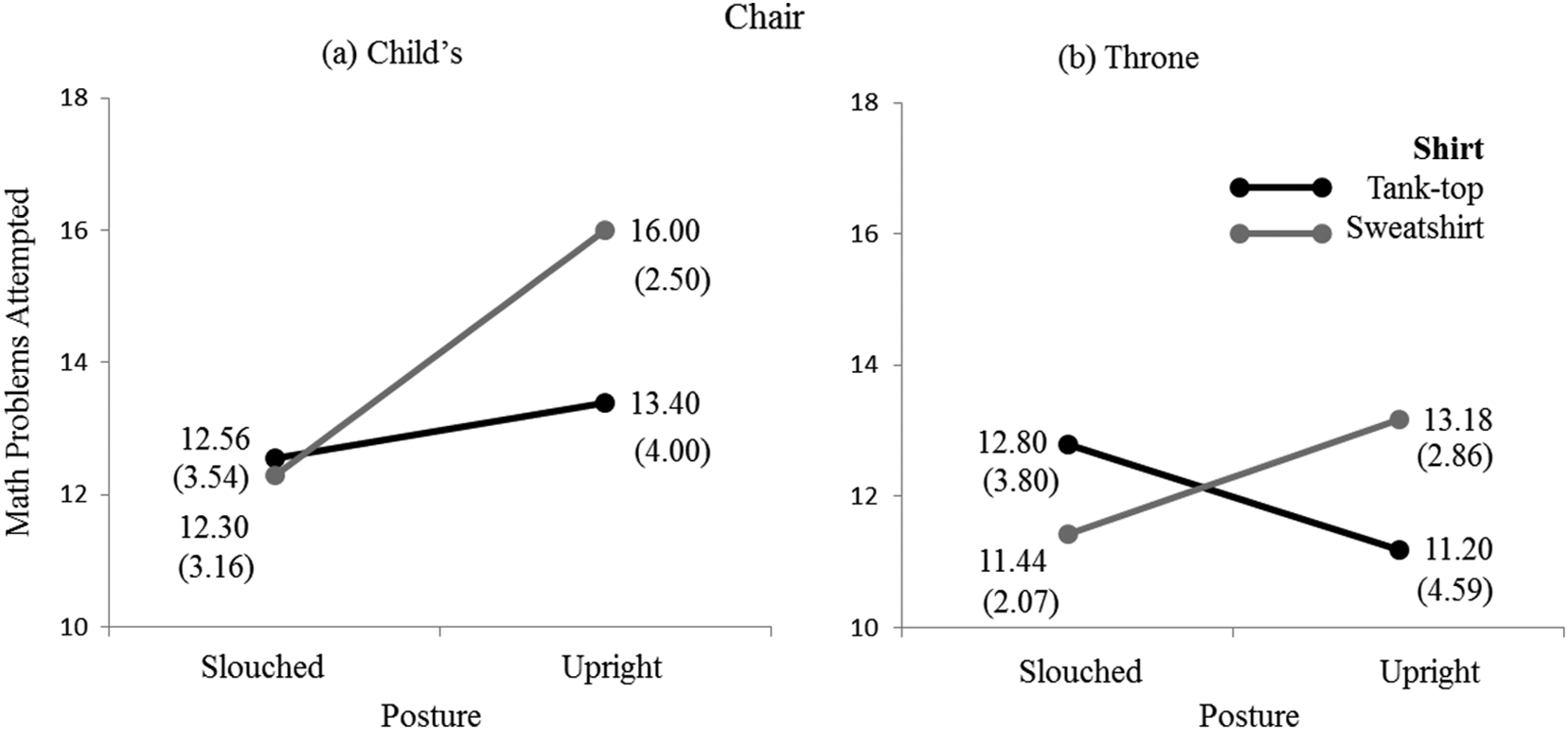
Cell means (and standard deviations) for the interaction of Posture × Shirt within each level of Chair for number of math problems attempted. The interaction within Child’s Chair reached significance, however, the one within throne did not.
To further examine the significant two-way interaction, a univariate analysis of variance (ANOVA) was performed within the child’s-chair condition. A marginally significant overall difference was found between groups, F(3, 36) = 2.67, p = .06, ηp 2 = .180. Post hoc analyses using Student–Newman–Keuls revealed that women sitting in the child’s chair who were wearing a sweatshirt and sitting in an upright posture attempted significantly more math questions compared to those in the other three child’s-chair conditions (p < .06). The effect sizes for these differences between women with upright posture and wearing a sweatshirt and the other three conditions were quite large: d = .78 for upright/tank top; d = 1.12 for slouched/tank top; and d = 1.30 for slouched/sweatshirt. Furthermore, no differences emerged among the latter three conditions. Although these results are marginally significant, they appear to be sizable effects detected by our small sample and are supportive of both the self-objectification and appropriateness hypotheses that underlie our Hypothesis 2.
A similar analysis was conducted in order to clarify the three-way interaction found for the satisfaction/pride composite. The data were first split by Chair. A marginally significant two-way interaction was found between Shirt and Posture at the child’s-chair level, F(1, 36) = 4.01, p = .05, ηp 2 = .100, and a significant two-way interaction was found at the throne level, F(1, 36) = 5.73, p = .02, ηp 2 = .137. Because the two-way interaction at the child’s-chair level was only marginally significant, we did not conduct a formal simple effects analysis. We did proceed to do so at the throne level. A univariate ANOVA revealed a significant overall effect between groups, F(3, 36) = 3.00, p = .04, ηp 2= .200. However, post hoc analyses using Student–Newman–Keuls did not reveal specific differences among groups (p = .07). This is likely due to the sharp decrease in statistical power that resulted from splitting the data by the Chair factor.
Given this low statistical power, it is perhaps more useful to look within each level of the Chair factor at the effect sizes associated with the differences between conditions (see Figure 2). For those seated in a child’s chair, an upright posture corresponded to higher feelings of satisfaction and pride. Specifically, those wearing a sweatshirt while seated upright reported higher levels of satisfaction than those in a slouched position, d = .53. Similarly, those wearing a tank top while seated upright reported higher levels of satisfaction compared to those who were slouched, d = .94. Although a significant main effect for Posture within child’s chair and across attire was not found, these effect sizes are suggestive of such a pattern.
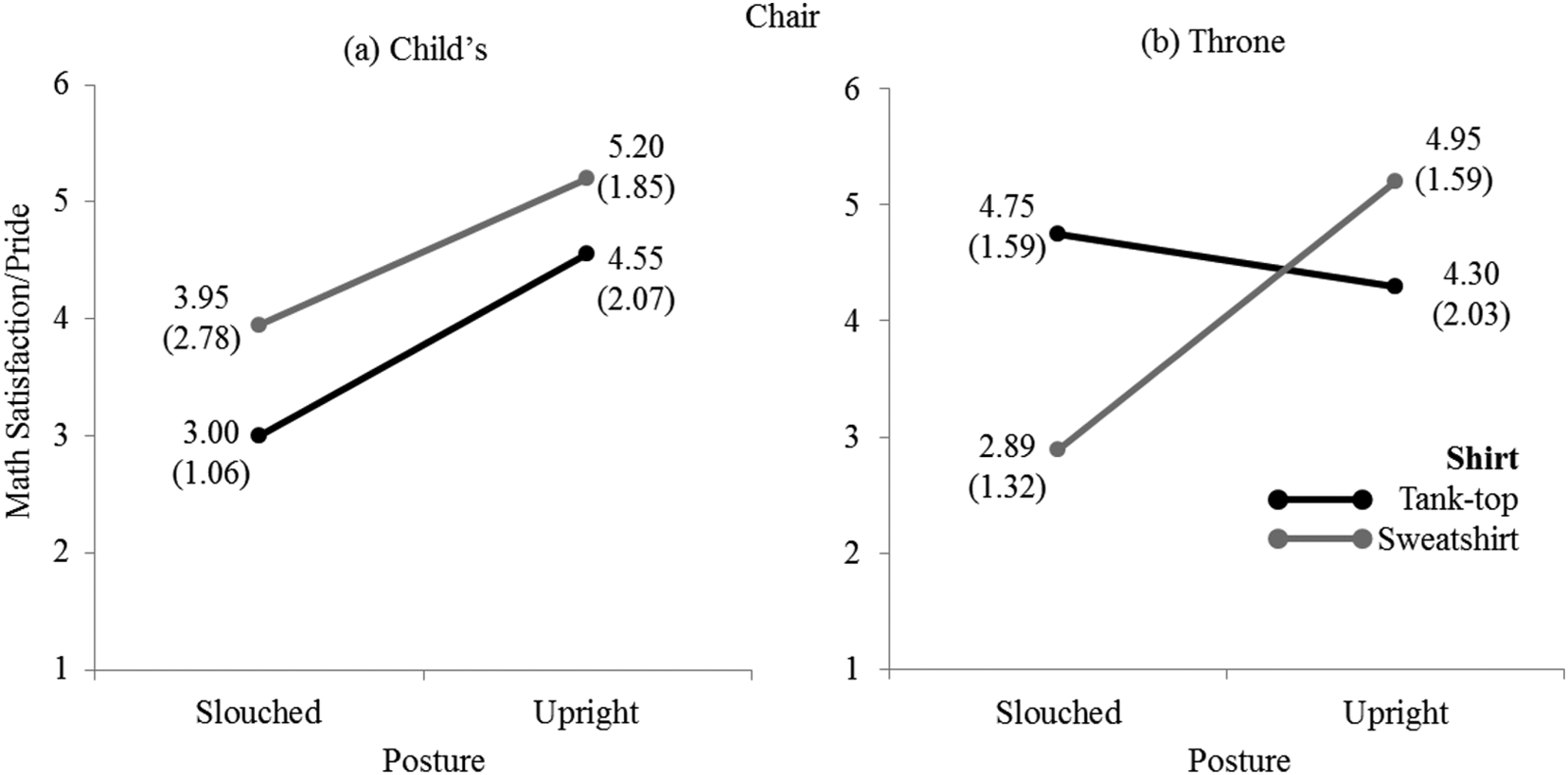
Cell means (and standard deviations) for the interaction of Posture × Shirt within each level of Chair for the pride/satisfaction composite variable.
Turning to Posture × Shirt within the throne condition, participants seated upright in a throne while wearing a sweatshirt reported greater feelings of satisfaction and pride compared to those wearing a sweatshirt who were slouched, d = 1.41 (see Figure 2). This pattern is consistent with the findings reported within the child’s chair condition. Most notably then, participants sitting in a slouched position while wearing a tank top reported slightly higher levels of satisfaction compared to those sitting upright and wearing a tank top, d = .25, suggesting a small to flat effect. Taken together and noting the exploratory nature of these patterns, upright posture appears to be consistently related to higher satisfaction, except when women are seated in a gender-inappropriate throne and wearing an objectifying tank top.
Discussion
The current study extends the literature regarding gender differences in posture embodiment effects. Previous research has suggested that men and women experience different effects of bodily feedback, and women’s affective and cognitive responses to different bodily positions are far more complex than current theories of embodied grounding can explain (cf. Roberts & Arefi-Afshar, 2007; Schubert, 2004; Schubert & Koole, 2009). With our study, we explored factors believed to affect the ways in which women respond to upright or slouched posture. We predicted that the association of status and power with upright posture, which is incongruent with women’s actual experience in society, may have interrupted any direct, Jamesian proprioceptive input from the posture. As well, being in an upright posture—which involves emphasizing the breasts and physically opening the body to observation and scrutiny—may have induced feelings of self-objectification and thus also made more complex any feelings induced by being in such a posture.
The results of the current study indicate that posture itself influenced participants’ reported moods in an intuitive way, with women generally feeling better (higher positive mood ratings and lower negative mood ratings) upright than slouched, a result consistent with previous research and theories of embodiment (Niedenthal, 2007). This finding suggests that the social factors that were expected to complicate or interrupt the effects of proprioceptive feedback were not influential in participants’ reported moods. This result may have been due to demand characteristics, because the upright posture is a universally recognized posture of pride, whereas the slouched posture communicates melancholy or dejection. Participants may have believed they were expected to feel a certain way based on these postures. However, it is also possible that the mood-related communicative effects (to self or to others) of posture are robust, and therefore resistant to influences such as gender socialization or cultural associations with gender. One’s mood (as opposed to one’s performance) likely holds less bearing on how one is perceived in society, so the social factors may have been less relevant on this measure.
However, upright posture was associated with significantly higher self-conscious moods than slouched posture, specifically in cases where the participant was asked to wear a formfitting tank top Here then the picture becomes somewhat more complicated. The greater embarrassment felt by those sitting upright in a position that highlighted their bodies suggests that embodiment effects are not straightforward once we consider more subtle associations between an upright versus more slouched bearing in women in a culture that affords them less status and that sexually objectifies them.
The hypothesized three-way interaction found among all the independent variables (posture, power, and self-objectification) offers a complex picture of how context and congruency impact postural embodiment effects. However, with only 9–11 participants in each condition, our study was clearly underpowered. Therefore, our findings, especially those pertaining to the interaction among the three main independent variables, should be considered preliminary. Given our limitations in power, we included measures of effect size in addition to statistical significance.
To unpack the three-way interaction, we first split the data by the type of chair in which participants were seated. With regard to the number of math questions attempted, the results revealed that participants who were seated upright in a child’s chair while wearing a sweatshirt attempted more questions compared to the other conditions. Although this difference was only marginal in significance, the effect sizes associated with the differences between the upright/sweatshirt condition compared to the other three were large (ranging from .78 to 1.30). This finding is in support of both the appropriateness hypothesis (Riskind, 1984) and the self-objectification hypothesis (Fredrickson et al., 1998). Sitting in a child’s chair is congruent with a societal view of women as less powerful. In addition, participants in this condition were able to reap the benefits of sitting in an upright posture without having their bodies on display. Wearing the sweatshirt provided protection from potential self-objectification effects that can result from having one’s body made salient.
The results pertaining to the math pride/satisfaction questionnaire were more complicated and unfortunately, our low statistical power did not allow us to completely unpack them. A marginal two-way interaction between Shirt and Posture was found for those conditions in which participants were seated in a child’s chair. A significant two-way interaction between Shirt and Posture was found at the throne level. We therefore sought to further clarify this interaction for those conditions in which participants were seated in a throne. Although a univariate ANOVA revealed an overall difference between groups, post hoc analyses did not reveal any significant differences.
Given our small sample size, it was perhaps more informative to examine the pattern of means across groups and the associated effect sizes. For all of the comparisons discussed, the effect sizes ranged from medium to large (.53–1.41). Overall, we believe that the self-objectification manipulation (shirt) interacted more powerfully with Posture than did the manipulation of felt power (chair). After participants sat upright wearing sweatshirts in either a child’s chair or in a throne, they displayed the most intuitive postural effects: more math questions attempted and higher feelings of pride and satisfaction with their performance. This seems to suggest that covering the body “allowed” for the proprioceptive benefits of uprightness because chair type (our effort at inducing greater or lesser feelings of power and status) had no effect when women wore body-covering sweatshirts.
When participants wore a tank top, however, the findings were less straightforward. When seated in a throne and wearing a tank top, whether participants were upright or slouched yielded similar levels of satisfaction and pride as those who were upright and in the sweatshirt. However, examining the means in the child’s chair, the tank top wearing slouchers were less proud than the tank top wearing upright women. This finding deviates from the self-objectification portion of our hypothesis that would have predicted that sitting upright while wearing a formfitting tank top would draw focus to the body and would potentially lead to lower feelings of satisfaction and pride. This unanticipated finding could be due to the fact that slouching in the small child’s chair may have inadvertently placed the participants in a self-objectifying posture. Observational data based on participants’ comments to the experimenter suggest that the child’s chair may actually have intensified feelings of body consciousness for participants in the tank top condition. A number of participants who were slouched in the tank top and the child’s chair remarked on their self-consciousness due to a feeling of stomach bulging (“rolls” or “muffin-top”) as well as a display of cleavage. The slumped posture in the child’s chair, because it was so low to the ground, placed the participants’ bodies in an extremely compressed position that highlighted both their breasts and their abdominal regions (in a current cultural climate emphasizing “tight abs”). However, sitting in an upright posture while in this chair enabled participants to avoid this added abdomen- and cleavage-focused component of body consciousness, so it makes sense that the participants adopting upright posture reported more feelings of pride and satisfaction regarding the math test than did those who had slumped (cf. Fredrickson et al., 1998; Quinn, Kallen, Twenge, & Fredrickson, 2006). In other words, the child’s chair created further body consciousness in women leaning forward, wearing a formfitting tank top, and indeed these participants had the highest self-objectification scores and the most negative moods of any other conditions in the study. Although this pattern was not expected, it is explicable within the framework of objectification theory (Fredrickson & Roberts, 1997).
Limitations and Future Directions
Although the design of the experiment allowed two differing hypotheses (power and self-objectification) to be explored simultaneously, and thus it was possible to also explore the interaction of the two, it was difficult to isolate and understand the influence of either factor alone. Our manipulation check was flawed in that it was conducted in the context of these three interacting variables. That is, we cannot be certain that it was the chair type alone that impacted participants’ feelings of power, nor that it was the shirt type alone that impacted feelings of bodily self-consciousness, because both of these measures were taken in the context of one another and in the assigned posture. Future research should concentrate on examining the moderating impact of self-objectification and social status on embodiment effects independently (and with independent manipulation checks) as well as together.
In addition, our sample size was a significant limitation in our study. An ad hoc power analysis conducted using G*Power software shows that in the current study, our power ranged between .12 and .17, which is very low. The results of this power analysis are not surprising because we employed a complex 2 × 2 × 2 design. Our deficit in statistical power suggests that although the results of the current study can begin to shed light on the complex interaction among posture, self-objectification, and power, more research employing larger cell sizes are needed. However, the sizable effects that we obtained given our small sample suggests are quite encouraging. Thus, we hope that our research can serve as a solid catalyst for future work in this area.
The interaction between self-objectification and power should also be further examined to clarify ways in which women may empower themselves through being objectified. Physical attractiveness has been shown to bolster women’s perceived competence and actual social status (Haas & Gregory, 2005; Jackson, Hunter, & Hodge, 1995). As such, it is possible that women, who believe sexual objectification is an effective strategy or who are deemed successful in gaining resources and status via their physical appearance, may actually feel empowered through self-objectification. In these cases, self-objectification may have a positive impact on women’s felt performance and self-evaluation. Further research should be conducted to examine the circumstances in which self-objectification may in some cases be related to increased performance and a more positive self-concept.
A primary issue with the current study was the unintended way in which the slouched posture, child’s chair, and tank top apparently interacted to induce elevated body consciousness (due to felt stomach bulging and the revealing of cleavage), which made it difficult to compare the participants in this condition to those in the upright posture under the same Chair and Shirt conditions. The unforeseen effect of the child’s chair added an additional dimension of body consciousness, but because the effect of body consciousness became so intense, it overrode the impact of the powerlessness manipulation. It would be beneficial to employ a role-based power manipulation in future research, rather than a physical one (e.g., ask the participants to complete some task as the lower power assistant within a fictitious dyad), so as to isolate the impact of felt power from any additional effects a physical manipulation may incur.
Another concern with the current study (as well as the previous study conducted by Roberts & Arefi-Afshar, 2007) was that the main cognitive task was a math test. Due to stereotype threat, women are expected to underperform on math tests, and they are similarly likely to underestimate their performance on such tasks (Steele, 1997). It would be beneficial to conduct a similar study, but involving a linguistic or even more neutral task. Because situational cues appear to activate gender-related schemas, it may be that the self-objectification, power, and even posture manipulations can serve as reminders of a participants’ gender, thus reinforcing the stereotype threat already present with the math test (Deaux & Major, 1987). This would complicate the impact of the different manipulations because any cue that reinforces gender could impact performance and feelings of satisfaction via stereotype threat.
Finally, gender differences should be examined in other areas of embodied cognition. Fist-making and posture are both strongly associated with gender differences that would favor men because men are more likely to make fists and employ an erect posture, which appear related to increased feelings of power and pride, respectively (Roberts & Arefi-Afshar, 2007; Schubert & Koole, 2009). It would be useful to examine components of embodied cognition that may favor women, such as smiling. According to James’s (1884) theory of emotion and previous research on facial expression (Laird, 1974), smiling should be related to greater felt happiness. However, studies have shown that women are more likely than men to smile overall, as well as more likely to smile for reasons other than happiness (such as affiliation), so it would be interesting to examine gender differences in the affective and cognitive effects of smiling (LaFrance, 2002).
Conclusion
According to embodiment theories, physical comportment exerts a strong affective and cognitive influence upon individuals (Niedenthal, 2007). Many studies have demonstrated the impact that facial expressions, physical movements, and bodily postures can have on emotions and cognitive functioning (Chandler & Schwarz, 2009; Riskind & Gotay, 1982; Stepper & Strack, 1993; Xu et al., 2011). However, previous studies have also suggested that women experience different effects of proprioceptive feedback than do men (Roberts & Arefi-Afshar, 2007; Schubert & Koole, 2009). The current study provides further evidence supporting the idea that sociocultural factors—such as self-objectification and power—moderate embodiment effects. Both the magnitude and valence of different body positions may be influenced by sociocultural factors, which finding suggests that we must consider context in understanding proprioceptive feedback and embodied grounding. The clothing that a woman wears and the extent to which she feels powerful or powerless may enable an upright posture to exert the benefits William James (1884) described, or these factors may lead a slouched posture to be less disruptive and perhaps even protective. Our study suggests that embodiment does not exist in a vacuum, but rather we must consider it within a broader context of social experience. Indeed, the social experience of being female in a sexually objectifying culture, in which less status is afforded to them, appears to mean that women often stoop to conquer.
Footnotes
Declaration of Conflicting Interests
The author(s) declared no potential conflicts of interest with respect to the research, authorship, and/or publication of this article.
Funding
The author(s) received no financial support for the research, authorship, and/or publication of this article.
References
Supplementary Material
Please find the following supplemental material available below.
For Open Access articles published under a Creative Commons License, all supplemental material carries the same license as the article it is associated with.
For non-Open Access articles published, all supplemental material carries a non-exclusive license, and permission requests for re-use of supplemental material or any part of supplemental material shall be sent directly to the copyright owner as specified in the copyright notice associated with the article.
