




Abstract
Although the objectification of women is widespread, there is relatively little research on objectification in romantic relationships. The purpose of our research was to explore how partner-objectification might be related to sexual pressure and coercion in heterosexual relationships. Two studies were conducted, one with heterosexual men and one with heterosexual women as participants. An online survey of 119 heterosexual men in the United States demonstrated that men who frequently survey their partners’ bodies are more likely to sexually pressure and coerce their partners—primarily because partner-surveillance is related to feelings of shame regarding one’s partner’s body, which in turn is related to increased sexual pressure and coercion. An online survey of 162 heterosexual women in the United States demonstrated feeling objectified by a partner is related to several (but not all) measures of sexual pressure and coercion. Furthermore, women who felt that their partners frequently surveyed their bodies were more likely to experience self-surveillance, which in turn predicted increased body shame and lowered sexual agency. Our research can inform interventions aimed at reducing sexual coercion and spark future research on the distinction between physical attraction and objectification in the context of romantic relationships.
Keywords
Sexual objectification is pervasive and primarily affects girls and women (American Psychological Association, 2007; Fredrickson & Roberts, 1997). To sexually objectify a woman is to mentally divide her body and mind in order to focus on her sexual body parts. Her body parts and their functions are no longer associated with her personality and emotions but instead are seen as instruments to be used by others (Bartky, 1990). Because objectification has widespread consequences in a number of domains, it is an omnipresent force in women’s work, school, political, and private environments (Fredrickson & Roberts, 1997; Nussbaum, 1999). On average, college women in the United States are sexually objectified in subtle ways at least 1–2 times per week (Swim, Hyers, Cohen, & Ferguson, 2001). Although men can also be objectified (Davidson, Gervais, Canivez, & Cole, 2013; Rohlinger, 2002), empirical research has demonstrated that women are more likely to be objectified in terms of basic cognitive processes (Bernard, Gervais, Allen, Campomizzi, & Klein, 2012), of emphasis on the body’s appearance-based attributes (as compared to the body’s competence-based attributes; Strelan & Hargreaves, 2005), and of sociocultural phenomena such as portrayals in the media (Aubrey & Frisby, 2011; Conley & Ramsey, 2011; Hatton & Trautner, 2011). The objectification can come in many forms, including a whistle, a well-intentioned compliment on her body, a joke, or an advertisement (Bartky, 1990).
Objectification theory purports that objectifying someone may make it easier to commit violence against that person (Fredrickson & Roberts, 1997), in part because objectification is a form of dehumanization (Heflick & Goldenberg, 2009; Heflick, Goldenberg, Cooper, & Puvia, 2011; Loughnan, Pina, Vasquez, & Puvia, 2013; Puvia & Vaes, 2013). For example, in one study, participants were instructed to write a few sentences about a female public figure (either Sarah Palin or Angelina Jolie, two public figures who are frequently objectified; Heflick & Goldenberg, 2009). Half the participants were randomly assigned to focus on her appearance, whereas those in the control group wrote more generally about her. They then rated the target on a number of personal characteristics. Results showed that, compared to the control group, participants in the appearance condition were more likely to rate her lower on characteristics that they view as essential to human nature (i.e., the traits that most characterize us as humans). This study offers an empirical demonstration that objectification can lead to dehumanization, and other similar research demonstrated that this effect occurs only for female targets (Heflick et al., 2011) perhaps because of the widespread objectification of women. This research further connects to issues of violence against women because it is considered easier to physically violate an object compared to a human (Bandura, 2002; Nussbaum, 1999). Indeed, Loughnan, Pina, Vasquez, and Puvia (2013) found that an objectified woman was more often blamed for her own rape than a woman who was not presented in an objectified manner, and this effect was due to a decrease in moral concern for the objectified woman. Therefore, empirically examining how and whether the objectification of women is associated with violence against women are of utmost importance.
There is limited but important empirical evidence for the link between objectification and violence against women. Rudman and Mescher (2012) demonstrated that men who implicitly associate women with objects have a higher proclivity toward sexual aggression. Several studies have shown that viewing objectifying media perpetuates violence against women. For example, men who viewed nonviolent scenes from a movie that portrayed the objectification of women were more likely to perceive a date rape victim as enjoying her rape and being partly responsible for it occurring, compared to men who viewed a control video of a cartoon (Milburn, Mather, & Conrad, 2000). Similarly, objectification in video games causes increased rape myth acceptance among men (Beck, Boys, Rose, & Beck, 2012). Perhaps even more starkly, aggressive erotica has been experimentally shown to increase aggression toward a female target (Donnerstein, 1980).
Most sexual violence against women is perpetrated by an intimate partner as opposed to an acquaintance or a stranger (Carney & Barner, 2012). In one study, of the women who reported sexually coercive acts, 93% were committed by men they knew, such as their partner (Testa & Livingston, 1999). However, estimates of sexual violence by an intimate partner are difficult to gauge, given that many researchers suspect underreporting. For example, although one nationally representative survey showed that 4.5% of women (compared to .2% of men) have experienced forced sexual intercourse with a partner (Tjaden & Thoennes, 2001), another nationally representative survey found that 10–13% of partnered women experienced rape by their current partner (Basile, 2002). Of course, sexual violence against women includes more than forced penetration or activities that meet the legal definition of rape. For example, sexual pressure is defined as conforming to gendered expectations to have sex (Jones & Gulick, 2009), and sexual coercion is sexual pressure that involves threats of violence, actual physical force, or emotional manipulation (Shackelford & Goetz, 2004).
Previous research shows that both college men and men from the general community show high rates of sexual coercion. In fact, in two relatively recent studies, a third of college men who are sexually active reported using nonphysical tactics to get their unwilling partner to have sex with them, including arguments about sex and the relationship, threats to end the relationship, manipulation of emotions, and intentional ignorance of the partner’s refusal to have sex (DeGue & DiLillo, 2004; Lyndon, White, & Kadlec, 2007). Similarly, 22–27% of men from community samples reported using the same strategies to get unwilling women to have sex with them (Calhoun, Bernat, Clum, & Frame, 1997; Senn, Desmarais, Verberg, & Wood, 2000). Not surprisingly then, 7 of 10 college women reported experiencing “emotional manipulation” from men who were looking to have sex with them (Struckman-Johnson, Struckman-Johnson, & Anderson, 2003). Understanding the correlates and potential precursors to sexual coercion—such as objectification—is crucial to better understanding sexual coercion and informing interventions to reduce it.
Despite the theoretical connections between objectification and violence against women, and despite the fact that most violence against women is perpetrated by a romantic partner, there is a dearth in the literature on objectification in romantic relationships. Furthermore, most research on objectification has focused directly on its consequences for women without taking into account how the male gaze influences the men who practice it. Therefore, the current project aims to empirically document the connection between objectification and sexual pressure and coercion in the context of heterosexual relationships, considering how objectification influences both men and women to contribute to women’s sexual coercion.
Heterosexual Men’s Objectification of Their Romantic Partners
One of the subtle ways women are objectified is the male gaze, which is simply a look that men give women to inspect their bodies (Fredrickson & Roberts, 1997; Gervais, Vescio, & Allen, 2011). There is empirical evidence that heterosexual men do generally tend to objectify women (Kozak, Frankenhauser, & Roberts, 2009; Strelan & Hargreaves, 2005). A qualitative study of 21 heterosexual men even concluded that the objectification of women is one aspect of many heterosexual men’s self-schema (Elder, Brooks, & Morrow, 2012). Interestingly, some men may not understand the negative ramifications of objectification; in one study, men perceived significantly fewer negative emotions in a self-objectifying female target than did women (Newheiser, LaFrance, & Dovidio, 2010). However, objectifying women may have negative consequences even for the men who practice it. Men who objectify women are more likely to endorse sexist attitudes toward women and experience an increased drive for muscularity (Swami & Voracek, 2013). Furthermore, even beyond men’s own objectification of women, men’s exposure to objectified images of women increases their desire to be muscular (Lavine, Sweeney, & Wagner, 1999) and increases their anxiety and hostility (Johnson, McCreary, & Mills, 2007). Relevant to gender relations, men’s exposure to objectified images of women decreases their empathy toward rape victims (Linz, Donnerstein, & Penrod, 1988), increases their opposition to affirmative action programs for women (Wright & Funk, 2014), and increases their proclivity toward sexual coercion and sexual harassing behaviors (Galdi, Maass, & Cadinu, 2014). The objectification of women clearly has consequences for men and how they interact with women.
Despite these negative consequences, the male gaze may be an integral part of many heterosexual relationships. For men, physical attractiveness is one of the most valued characteristics in mate selection (Feingold, 1990), purportedly because physical attractiveness signals women’s reproductive viability (Buss, 1989) but also because women are culturally valued for their beauty (Wolf, 1990). The media encourage objectification by portraying particular behaviors of men and women, especially in showing women behaving as objects and men treating them as such. Given that the male gaze is an important form of objectification with consequences for both men and women and that physical attraction is widely accepted as an important part of romantic relationships, it is surprising that objectification has not been more widely studied in the context of heterosexual romantic relationships.
Objectifying women may have particular consequences for heterosexual men’s romantic relationships with women. Brooks (1995) has proposed the “centerfold syndrome,” a phenomenon wherein exposure to media that objectify women substantially influences heterosexual men’s sexuality and disrupts their ability to form meaningful relationships with women. A review of the literature has shown that Brooks’s ideas are somewhat substantiated by empirical research (Wright, 2012), concluding that survey and experimental research supports the contention that viewing media that objectify women leads men to reduce women to sexual objects and to be more interested in nonrelational sex. For example, a study of heterosexual college women found that the extent to which their previous partners consume pornography predicted the extent to which they felt objectified and their internalization of beauty standards, which in turn predicted self-objectification and its consequences (namely, body shame, lowered bodily awareness, and increased eating disorder symptomatology; Tylka & Kroon Van Diest, 2014). Furthermore, Taylor (2006) found that undergraduate men’s centerfold magazine consumption predicted their willingness to have both oral sex and intercourse in an unestablished relationship. Zurbriggen, Ramsey, and Jaworski (2011) demonstrated that undergraduate men who consume objectifying media are more likely to objectify their partners and then, in turn, are more likely to experience lowered relationship satisfaction and lowered sexual satisfaction.
The focus of the present research is on the connection between partner-objectification and sexual coercion and pressure. Based on objectification theory (Fredrickson & Roberts, 1997), it stands to reason that viewing one’s partner as an object could interfere with acknowledging the objectified partner’s needs and emotions, given that objects do not have feelings. Furthermore, although little empirical research has directly examined partner-objectification and men’s violence against women, a qualitative study involving interviews with five male hockey players came to the conclusion that their objectification of women was a major factor in exporting hockey violence into their interpersonal relationships (Pappas, McKenry, & Catlett, 2004). The present research aims to offer a more robust test of the association between heterosexual men’s objectification of their partners and intimate partner violence, particularly in the form of sexual pressure and coercion.
Women’s Experiences of Objectification
The objectification of women affects women in a number of ways. In addition to women’s treatment by others being influenced by their objectification, women experience psychological consequences from being objectified. One important consequence is the internalization of that objectification in the form of self-objectification (Fredrickson & Roberts, 1997). Women who have experienced objectification in the form of appearance-related remarks and sexual harassment are more likely to take a third-person perspective of their own bodies (Kozee & Tylka, 2006; Lindberg, Grabe, & Hyde, 2007; Tylka & Hill, 2004), a key indicator of self-objectification (Fredrickson & Roberts, 1997; McKinley & Hyde, 1996). This then leads to feelings of body shame, which can contribute to a host of negative outcomes (Fredrickson & Roberts, 1997; Moradi & Huang, 2008).
Objectification from one’s romantic partner may be particularly powerful, given that physical attraction is a key element of romantic relationships and investment in romantic relationships is a feminine norm (Mahalik, Morray, Coonerty-Femiano, Ludlow, Slattery, & Smiler, 2005). Women are taught that they need to monitor and improve their appearance if they are going to be seen as desirable to men and that they should take pleasure in being identified as objects (Bartky, 2003). Some theorists have even proposed the idea that romantic relationships are one context where objectification is safe, and even enjoyable, because of the emphasis on physical attractiveness in romantic relationships (Nussbaum, 1999). However, even though some women report enjoying this kind of sexualization, previous research has shown that it actually exacerbates the negative consequences of self-objectification (Liss, Erchull, & Ramsey, 2011). The emphasis on physical attractiveness in heterosexual romantic relationships may be one reason why exposing single women to words related to romantic relationships increases their self-objectification (Sanchez & Broccoli, 2008). Within relationships, women may internalize their partners’ objectification of them in an effort to appear desirable, leading to increased self-objectification. Although the relationship between these variables has yet to be tested, Gervais and Davidson (2013) did show that women who have experienced psychological abuse from their partners are more likely to self-objectify. In the present study, we will examine the association between perceived partner-objectification and self-objectification in a sample of heterosexual women in relationships. Furthermore, self-objectification is expected to be associated with body shame (Moradi & Huang, 2008), thus establishing an indirect connection between perceived partner-objectification and body shame.
Previous research has linked self-objectification to a host of negative consequences (Moradi & Huang, 2008). Correlational research has shown that self-objectification is associated with lowered self-esteem (Hurt et al., 2007; Tolman, Impett, Tracy, & Michael, 2006), depressive symptomology (Harrison & Fredrickson, 2003; Hurt et al., 2007; Szymanski & Henning, 2007; Tiggemann & Williams, 2012; Tolman et al., 2006), and sexual dysfunction (Steer & Tiggemann, 2008; Tiggemann & Williams, 2012). Experimental evidence shows that those who self-objectify also place emphasis on the body’s appearance-based attributes (as compared to the body’s competence-based attributes; Strelan & Hargreaves, 2005), perform more poorly on cognitive tasks (Fredrickson, Noll, Roberts, Twenge, & Quinn, 1998; Gervais et al., 2011), are less interested in gender-based activism (Calogero, 2013), speak less in social interactions (Saguy, Quinn, Dovidio, & Pratto, 2010), engage in restrained eating (Fredrickson et al., 1998), and feel overall shame of their bodies (Fredrickson et al., 1998; Hebl, King, & Lin, 2004; Quinn, Kallen, & Cathey, 2006). Particularly pertinent to romantic relationships, self-objectification is correlated with lower relationship satisfaction (Sanchez & Broccoli, 2008; Zurbriggen, Ramsey, & Jaworski, 2011) and sexual dysfunction (Steer & Tiggemann, 2008). The basic nature of sex involves partners focusing on each other’s bodies, which can magnify the sense of body shame and appearance anxiety associated with self-objectification and result in poorer sexual functioning (Sanchez & Kiefer, 2007; Steer & Tiggemann, 2008).
Furthermore, if a woman self-objectifies, then she may concentrate on her body as a physical object that needs to be desired by men, and consequently she may focus much less on her own wants and needs. Previous research has linked objectification with the denial of agency or the restriction of one’s freedom and ability to make decisions (Gray, Knobe, Sheskin, Bloom, & Barrett, 2011). By definition, an object has no agency, and so viewing oneself as an object could interfere with one’s ability to see oneself as an independent person who can freely make decisions and assert oneself. Sexual agency, which is the ability to make decisions and assertions related to one’s own sexuality, is particularly relevant to both sexual objectification and sexual pressure and coercion. Lowered sexual agency has been linked to a number of different consequences, including decreased sexual risk knowledge, difficulty in engaging in safe sex practices (such as requiring a partner to wear a condom during intercourse), and the inability to refuse unwanted sex (Curtin, Ward, Merriwether, & Caruthers, 2011; Rostosky, Dekhtyar, Cupp, & Anderman, 2008). Some research has shown support for a relationship between self-objectification and lowered sexual agency. For example, Impett, Schooler, and Tolman (2006) found that adolescent girls who self-objectified were less likely to feel like they could act upon their own sexual needs in a relationship and were less likely to use safe sex practices. Similarly, a qualitative study of six adolescent girls showed that girls who engaged in less self-objectification were more comfortable talking about sexuality (Hirschman, Impett, & Schooler, 2006). The present study will test for an association between self-objectification and sexual agency in a sample of heterosexual women in relationships.
Importantly, a relationship between perceived partner-objectification and self-objectification combined with a relationship between self-objectification and lowered sexual agency insinuates a more subtle way that partner-objectification can lead to sexual pressure and coercion in heterosexual relationships. Due to lowered sexual agency, an objectified partner might be less inclined to act on her own feelings and emotions and find it more difficult to assert herself. In other words, an objectified woman might consent to sexual behaviors that she otherwise would not, in part because she has internalized the view of herself as an object that exists to please her partner. In fact, 34% of women in the United States report having unwanted sex with their partner (Basile, 2002). Women who are objectified by their relationship partners may be more likely to feel pressure from their partners to participate in particular sexual behaviors, with little regard from the objectifying partner or the objectified partner for what the objectified partner may desire.
We then propose that partner-objectification takes two paths to creating increased sexual pressure in heterosexual relationships. First, the objectifying partner may be less likely to value his partner’s wants and desires, making it more likely that he will sexually pressure or coerce her. Second, feeling objectified by a partner may lead to the internalization of that objectification in the form of self-objectification, which then contributes to feelings of lowered agency, which can manifest itself in an inability for the objectified partner to assert herself and express her sexual desires (including sexual activities in which she does and does not want to partake). To test this second path, our research will examine whether self-objectification mediates the relationship between partner-objectification and lowered sexual agency in a sample of heterosexual women.
The Present Research
We present the current research in two studies conducted concurrently, both of which employed samples from the general population. In the first study, heterosexual men’s objectification of their female partners is examined in relation to sexual pressure and coercion. Because partner-objectification has only been measured in one known prior study (Zurbriggen et al., 2011), careful consideration is required regarding the measurement of this construct. Zurbriggen et al. (2011) used a measure of partner-surveillance (i.e., the degree to which one frequently thinks about a partner’s appearance and surveys her body) to operationally define the construct of partner-objectification. This operationalization stems from a long history of research on self-objectification that employs a measure of self-surveillance to assess self-objectification. We follow suit by using partner-surveillance as our measure of partner-objectification.
The present research also goes a step further and measures partner-shame, which is the degree to which one feels shame when their partner cannot control the size and shape of her body. This extension also stems from research on self-objectification that has conceptualized self-surveillance as the behavioral manifestation of self-objectification and body shame as the affective consequence of that self-surveillance (see Moradi & Huang, 2008, for a review). Similarly, we suggest that partner-shame is the affective consequence of partner-surveillance. It may even be that, in the case of partner-objectification, partner-shame is a central component of partner-objectification itself, given that surveillance of one’s partner’s body is somewhat unavoidable (unless one never looked at their partner) and it is difficult to understand why someone would feel partner-shame unless they are viewing their partner as an object. Furthermore, by including measures of both partner-surveillance and partner-shame, our study allows for a test of whether partner-shame mediates the relationship between partner-surveillance and sexual pressure and coercion because body shame mediates the relationship between self-surveillance and various outcomes in the self-objectification literature.
Thus, in our study of heterosexual men, we test two hypotheses. First, heterosexual men’s surveillance of their partners’ bodies will be positively related to their sexual pressure and coercion of their partners (Hypothesis 1). Second, partner-shame will mediate the relationship between partner-surveillance and sexual pressure and coercion such that heterosexual men’s partner-surveillance will be related to increased partner-shame, which in turn will be related to increased sexual pressure and coercion (Hypothesis 2). In testing these hypotheses, we examined demographic characteristics and measures of hostile and benevolent sexism as covariates to ensure that partner-objectification predicts sexual pressure and coercion independently of age, religion, political conservatism, and sexism.
Our second study provides a conceptual replication and extension of the first by measuring how much heterosexual women perceive being objectified by their partner and their experiences of sexual pressure and coercion from their partners. In this second study, we limit the conceptualization of perceived partner-objectification to surveillance from a partner, in part because partner-surveillance is a behavior that someone could observe (such as in the form of the male gaze), whereas other possible components of partner-objectification (such as partner-shame) are internal and may be more difficult for a partner to accurately assess. In this study, we test three hypotheses, starting with our prediction that women’s perceptions of their partner’s body surveillance will be positively related to their experiences of sexual pressure and coercion (Hypothesis 3).
In our study of heterosexual women, we also examine how women’s perceptions of partner-objectification relate to their own self-objectification, feelings of body shame, and sexual agency in the relationship. In particular, we test the idea that perceived partner-objectification is related to increased self-objectification, which in turn is related to increased body shame and lowered sexual agency. Connections among perceived partner-objectification, self-objectification, and lowered sexual agency could offer evidence of a more subtle route to sexual pressure for women in heterosexual relationships, wherein women are less able to offer full sexual consent due to their lowered sexual agency. Therefore, we hypothesize that self-surveillance will mediate the relationship between perceived partner-surveillance and increased body shame, such that women’s perceptions of their partners’ body surveillance will be related to increased self-surveillance, which in turn will be related to increased body shame (Hypothesis 4). Finally, self-surveillance will mediate the relationship between perceived partner-surveillance and increased body shame, such that women’s perceptions of their partners’ body surveillance will be related to increased self-surveillance, which in turn will be related to decreased sexual agency (Hypothesis 5).
Study of Heterosexual Men
Method
Participants and Procedure
We recruited 199 male participants by using a web service known as Amazon Mechanical Turk (AMT), which distributes task requests to a population of workers throughout the United States, who can volunteer to complete a task (such as a survey) for a nominal amount of money. Previous research has demonstrated that AMT can produce reliable data appropriate for social science research by providing samples that are more diverse and more representative of the U.S. population than typical samples gathered in college settings or typical Internet samples (Buhrmester, Kwang, & Gosling, 2011).
Participants completed the measures described in the following via an online survey using Qualtrics software. These data were collected as part of a larger online data collection so that only the measures relevant to the present hypotheses are described here. Three attention questions were randomly placed throughout the survey (e.g., “If you have been reading the questions in this survey, click never.”). Men who did not answer at least two of the attention questions correctly or did not complete the majority of the survey items were eliminated from the data set (n = 49) as were men who did not identify as being heterosexual (n = 16). Participants were given the option to answer survey questions about their most recent partner if they were single or their best other-sex friend if they had never been in a romantic relationship. Men who have never been in a romantic relationship (and thus answered the survey about their best other-sex friend) or who did not indicate about whom they were responding were eliminated from the present analyses (n = 15). These exclusions resulted in a final total of 119 participants.
Participants ranged in age from 18 to 61 years (M = 25.98, SD = 7.99). The majority of the sample self-identified as working class (n = 38, 31.9%) or middle class (n = 57, 47.9%), although some did identify as being in poverty (n = 11, 9.2%), upper middle class (n = 12, 10.1%), or wealthy (n = 1, 0.8%). Most of the men who responded identified as White/Caucasian (n = 97, 81.5%); others identified as African American (n = 2, 1.7%), Asian/Pacific Islander (n = 10, 8.4%), Latino (n = 6, 5.0%), or multiracial (n = 3, 2.5%), and one participant chose not to disclose his race/ethnicity. The men identified politically as being very liberal (n = 16, 13.4%), liberal (n = 39, 32.8%), moderate (n = 48, 40.3%), conservative (n = 14, 11.8%), or very conservative (n = 2, 1.7%). About 64% (n = 76) of the participants reported that they were currently in a relationship. Of the 119 men, 43 (36.1%) responded that they were single, 19 (16.0%) were dating, 23 (19.3%) had a steady partner, 8 (6.7%) were engaged, 8 (6.7%) were living with their partner, and 18 (15.1%) were married.
Measures
Participants completed the measures in the order listed subsequently. Participants’ responses to items within a scale were averaged such that higher scores indicate more endorsement of that construct (e.g., increased partner-surveillance, increased sexual coercion). Because of the low levels of missing data (as described subsequently for each measure), available item analysis was used to handle missing data, as recommended by Parent (2013). Therefore, each of the 119 participants had scores for each variable.
To create a measure of partner-objectification, Zurbriggen et al. (2011) modified the surveillance subscale of the Objectified Body Consciousness Scale (OBCS) that measures self-objectification (McKinley & Hyde, 1996). Zurbriggen et al. (2011) did not test the validity of this modification, although the convergent validity of the OBCS has been demonstrated via correlations with body esteem and public body consciousness, and discriminant validity has been established via the lack of correlations with body competence and private body consciousness (McKinley & Hyde, 1996). We also used this measure, and we added the modified versions of the shame subscale of the OBCS as well. Thus, our two measures of partner-objectification were as follows: (a) partner-surveillance (8 items, e.g., “During the day I think about how my partner looks many times,” α = .74, compared to α = .67 in the original use of this scale; Zurbriggen et al., 2011) and (b) partner-shame (8 items, e.g., “When my partner can’t control his/her weight, I feel like something must be wrong with him/her,” α = .87). Participants used a 6-point scale from 1 (disagree strongly) to 6 (agree strongly). There were two missing data points for partner-surveillance and five missing data points for partner-shame, with no participant missing more than two data points for either subscale.
The Sexual Pressure Scale for Women–Revised (Jones & Gulick, 2009) was designed to measure how much heterosexual women feel pressure from their partners to engage in sexual acts. Jones and Gulick (2009) established satisfactory validity through positive correlations with the Sexual Experiences Survey (which measures sexual victimization) and a measure of sex-risk behaviors as well as negative correlations with measures of dyadic trust and relationship power. The α reliability coefficients of the subscales in their investigation (which included two studies) ranged from .76 to .88. For our study, this measure was modified to reflect how much the man sexually pressured the woman in the relationship. For example, the item, “If my partner wants sex, it’s my responsibility as his woman to have sex with him,” was modified to read “If I want sex, it’s my partner’s responsibility as my woman to have sex with me.” Items were answered on a 5-point scale ranging from 1 (never) to 5 (always). The three subscales we used for this measure were as follows: (a) men expect sex (5 items, e.g., “There are times my partner feels I would leave her if she did not have sex with me,” α = .83), (b) women’s sexual role (5 items, e.g., “A woman needs to please her man sexually to hold on to him,” α = .88), and (c) sexual coercion (3 items, e.g., “I have threatened to hurt my partner after she told me she would not have sex with me,” α = .88). We did not use the “show trust” subscale from the original measure because it could not be appropriately modified for use with men. There was only one missing data point for the men expect sex subscale, one missing data point for the women’s sexual role subscale, and no missing data points for the sexual coercion subscale.
The Sexual Coercion in Intimate Relationships Scale (SCIRS) was used to measure the frequency and severity of sexual coercion in a romantic relationship (Shackelford & Goetz, 2004). In Shackelford and Goetz’s (2004) original investigation of this scale, convergent validity was established through positive correlations with the Violence Assessment Index, the Controlling Behavior Index, the Injury Assessment Index, and the Women’s Experience with Battering Scale; and men’s self-reports resulted in α reliability coefficients for each subscale ranging from .87 to .95. Items were answered on a 6-point scale, where respondents chose from options ranging from 1 (act did not occur in the past month) to 6 (act occurred 11 or more times in the past month). The two subscales used were (a) resource manipulation/violence (15 items, e.g., “I threatened violence against my partner if she did not have sex with me,” α = .98) and (b) commitment manipulation (10 items, e.g., “I hinted that if my partner loved me, she would have sex with me,” α = .98). There were 10 missing data points for the resource manipulation/violence subscale, with no participant missing more than three data points. There were five missing data points for the commitment manipulation subscale, with no participant missing more than one data point.
We identified multiple variables to include as potential covariates. Demographic covariates included age, religiosity—a single item, “How religious are you?” rated on a 5-point scale from 1 (not at all) to 5 (very)—and political conservatism—a single item, “When it comes to politics, how would you describe your position?” rated on a 5-point scale from 1 (very liberal) to 5 (very conservative). Hostile and benevolent sexism were measured as covariates as well, using the Ambivalent Sexism Inventory, which previous research has established has satisfactory convergent, discriminant, and predictive validity (Glick & Fiske, 1996). Hostile sexism represents sexist antipathy (11 items, e.g., “Women seek to gain power by getting control over men,” α = .86, compared to αs ranging from .80 to .92 in the original investigation of the scale; Glick & Fiske, 1996), whereas benevolent sexism represents a subjectively positive yet unequal attitude toward women (11 items, e.g., “Women should be cherished and protected by men,” α = .81, compared to αs ranging from .73 to .85 in the original investigation of the scale; Glick & Fiske, 1996).
Results
Prior to any substantive analyses, we examined the distribution of each variable to ensure they were all normally distributed. Three measures were not: the sexual coercion subscale of the sexual pressure measure and the two subscales of the coercion measure. Log transformations of each of these measures resulted in the data approximating normal distributions so that these log transformations were used in all further analyses.
The means, standard deviations, and bivariate correlations for the main variables of interest can be seen in Table 1. In order to identify possible control variables for the tests of our hypotheses using regression analyses, additional correlations were examined between our dependent measures and the potential covariates of age, religiosity, political conservatism, hostile sexism, and benevolent sexism. Age was not significantly correlated with any of the dependent measures. Religiosity was significantly correlated with two of the pressure subscales, women’s sexual role, r(117) = .33, p < .001, and sexual coercion, r(117) = .19, p = .04, and both of the coercion subscales, resource manipulation/violence, r(117) = .26, p = .01, and commitment manipulation, r(117) = .29, p = .001. Political conservatism was significantly correlated with all of the pressure subscales, men expect sex, r(117) = .19, p = .04, women’s sexual role, r(117) = .35, p < .001, and sexual coercion, r(117) = .21, p = .02. Hostile sexism was significantly correlated with two of the pressure subscales, men expect sex, r(117) = .39, p < .001, and women’s sexual role, r(117) = .39, p < .001. Benevolent sexism was significantly correlated with one pressure subscale, women’s sexual role, r(117) = .24, p = .01. We also conducted a series of t-tests to test whether participants reporting on their current relationship differed from those reporting on their most recent relationship in terms of each of the sexual pressure and coercion subscales; no significant differences were found. Generally, these results indicate that men who are religious, conservative, and/or endorse hostile and benevolent sexist beliefs are more likely to sexually pressure and coerce their partners. Therefore, these variables (religiosity, political conservatism, hostile sexism, and benevolent sexism) were included as control variables in the regression analyses reported next in an effort to rule out alternative explanations for the correlations.
Means, Standard Deviations, and Bivariate Correlations for Study of Heterosexual Men.
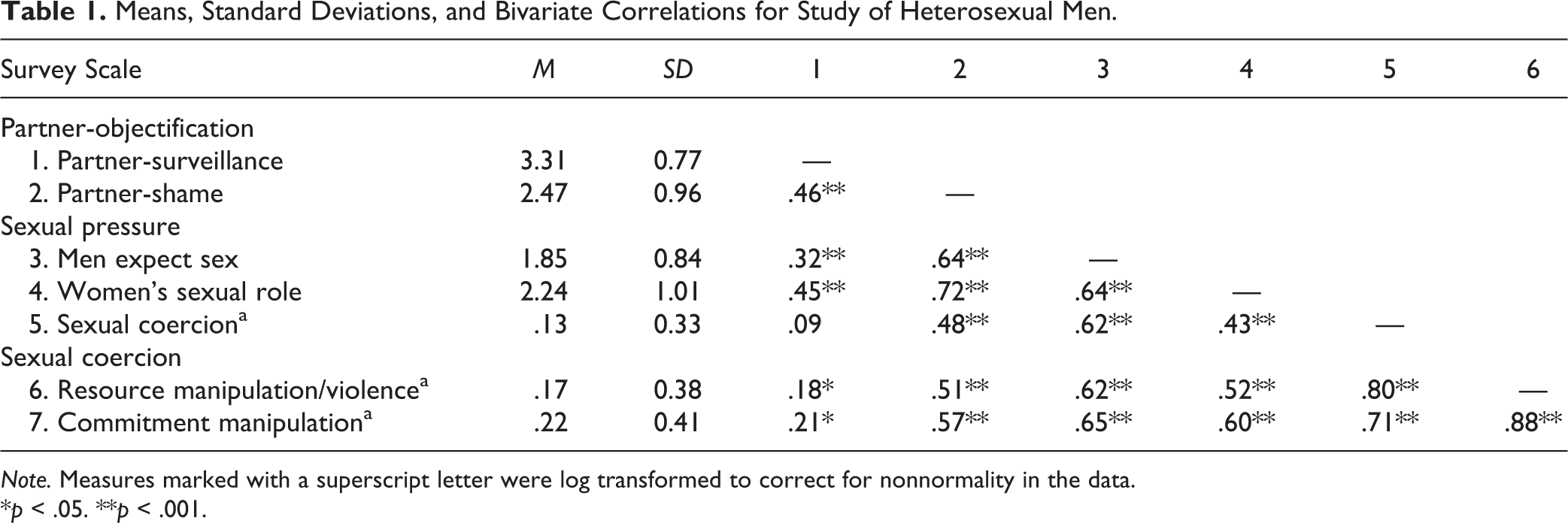
Note. Measures marked with a superscript letter were log transformed to correct for nonnormality in the data.
*p < .05. **p < .001.
Hypothesis 1: Partner-Surveillance and Sexual Coercion
Both correlation and regression analyses were used to test Hypothesis 1 that heterosexual men’s partner-surveillance will be positively related to their sexual pressure and coercion of their partners. As seen in Table 1, partner-surveillance was positively correlated with all of the pressure and coercion subscales, with only one exception (the correlation with the sexual coercion subscale of the sexual pressure measure was not statistically significant). Therefore, consistent with Hypothesis 1, this pattern suggests that the more men think about how their partners look, the more likely they are to sexually pressure and coerce their partner.
To identify the unique contribution of partner-surveillance to each of the pressure and coercion subscales, a series of regression analyses was run that included religiosity, political ideology, hostile sexism, and benevolent sexism as covariates (see Table 2). A significant amount of the variance in each dependent measure (ranging from 10% to 41%) was predicted in each of the regressions, with the exception of the sexual coercion subscale of the sexual pressure measure, which did not produce a statistically significant model. With covariates included in the regression model, partner-surveillance emerged as a significant predictor of the women’s sexual role subscale of the sexual pressure measure but none of the other measures. In light of the significant correlations reported in Table 1, these regressions suggest that the covariates (perhaps especially religiosity and hostile sexism, which were significant in several of the regression analyses) explain a substantial portion of the relationship between partner-surveillance and sexual coercion. In other words, partner-surveillance is related to sexual coercion because men who frequently survey their partners’ bodies also tend to be more religious and endorse more hostile sexist beliefs, which predicts their sexual pressure and coercion. These findings provide partial support for Hypothesis 1.
Regression Analyses Testing the Prediction of Sexual Pressure and Coercion From Partner-Surveillance.
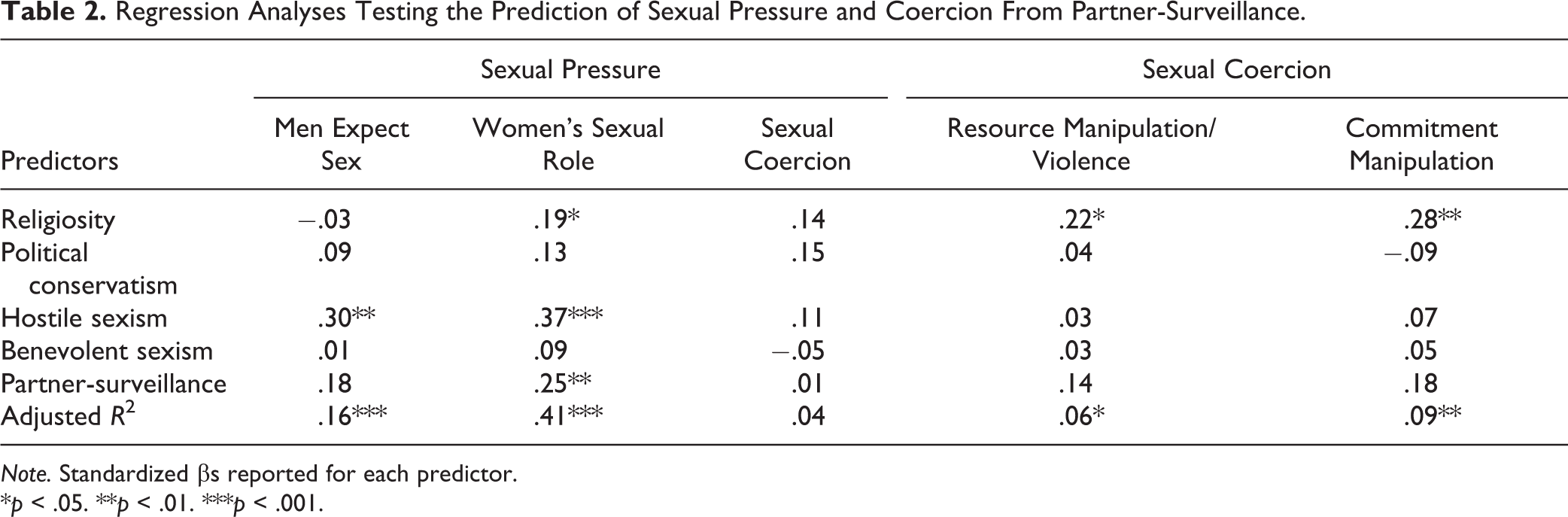
Note. Standardized βs reported for each predictor.
*p < .05. **p < .01. ***p < .001.
Hypothesis 2: Partner-Shame as a Mediator
The procedures for testing mediation recommended by Preacher and Hayes (2008) were followed using their corresponding SPSS macro to run four mediational analyses, one for each of the agency subscales. This analytic strategy for testing mediation has recently gained popularity because it does not require as many distributional assumptions to be met unlike previous strategies (e.g., the Sobel test) and because it directly tests the significance of the indirect effect, rather than inferring full or partial mediation from a change in significance as does the strategy proposed by Baron and Kenny (1986). Indirect effects reported are based on bias-corrected and accelerated bootstrapping using 5,000 bootstrapped samples; indirect effects are statistically significant if the 95% confidence interval does not include zero. Importantly, significant indirect associations can emerge even if direct predictor–criterion associations are not significant (Rucker, Preacher, Tormala, & Petty, 2011). Therefore, we proceeded to testing Hypothesis 2 that partner-shame would mediate the relationship between partner-surveillance and each of the sexual pressure and coercion subscales, even in cases where partner-surveillance was not a significant predictor of a particular subscale in the previous regression analyses. Each of these analyses controlled for the previously identified covariates.
Each analysis revealed significant positive relationships between partner-surveillance and partner-shame as well as between partner-shame and the dependent measures (see Table 3). Furthermore, each of the indirect effects was statistically significant—indicating that partner-shame significantly mediates the relationship between partner-surveillance and each of the sexual pressure and coercion subscales. In other words, the more the participants survey their partners’ bodies, the more likely they are to feel shame about their partner’s body and, in turn, the more likely they are to sexually pressure and coerce their partners. These analyses thus provide strong support for Hypothesis 2.
Summary of Mediational Analyses in the Study of Heterosexual Men.
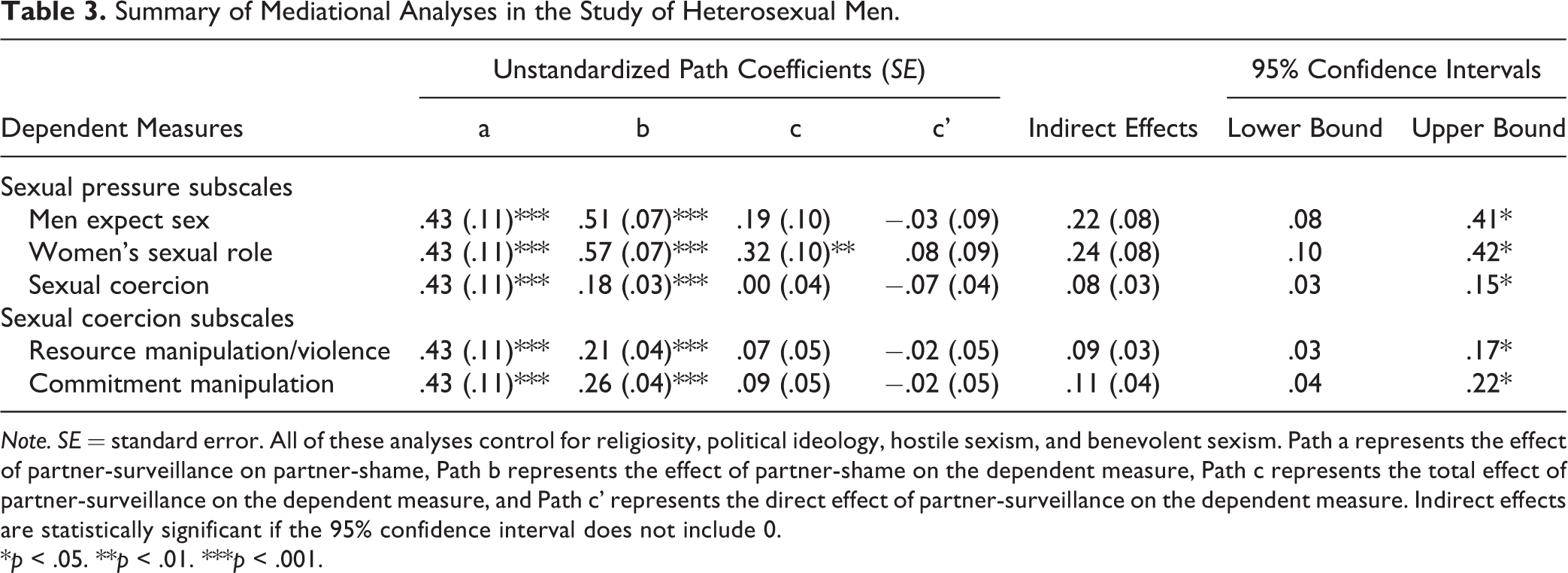
Note. SE = standard error. All of these analyses control for religiosity, political ideology, hostile sexism, and benevolent sexism. Path a represents the effect of partner-surveillance on partner-shame, Path b represents the effect of partner-shame on the dependent measure, Path c represents the total effect of partner-surveillance on the dependent measure, and Path c’ represents the direct effect of partner-surveillance on the dependent measure. Indirect effects are statistically significant if the 95% confidence interval does not include 0.
*p < .05. **p < .01. ***p < .001.
Study of Heterosexual Women
The second study examined objectification and sexual pressure in heterosexual romantic relationships from the woman’s perspective. In this study, we aimed to provide a conceptual replication of the study of heterosexual men by testing whether heterosexual women who feel objectified by their partner are more likely to experience sexual pressure and coercion from their partner (Hypothesis 3). We also wanted to investigate the ramifications of perceived partner-objectification for women’s perceptions of themselves as an object (i.e., self-objectification) and, in turn, their body shame and their ability to assert themselves sexually within the relationship. Therefore, we tested whether self-surveillance mediated the relationship between perceived partner-surveillance and both increased body shame (Hypothesis 4) and decreased sexual agency (Hypothesis 5).
Method
Participants and Procedure
We recruited 265 female participants using AMT and an online survey in Qualtrics. As in the study of heterosexual men, participants who did not answer at least two of the attention questions correctly or did not complete the majority of the survey items were excluded from the analyses (n = 46), as were those that did not identify as being heterosexual (n = 44). Participants were given the option to answer survey questions about their most recent partner if they were single or their best other-sex friend if they had never been in a romantic relationship. Women who had never been in a romantic relationship (and thus answered the survey about their best other-sex friend) were eliminated from the present analyses (n = 13). This resulted in a final total of 162 participants.
The participants ranged in age from 18 to 69 years (M = 29.53, SD = 11.90). Most of the sample self-identified as working class (n = 78; 48.1%) or middle class (n = 61; 37.7%), although some did identify as being in poverty (n = 5; 3.1%), upper middle class (n = 14; 8.6%), or wealthy (n = 2; 1.2%) and two participants chose not to disclose their socioeconomic status. A majority of the women who responded identified as White/Caucasian (n = 127; 78.4%); others identified as African American (n = 10; 6.2%), Asian/Pacific Islander (n = 13; 8.0%), Latina (n = 4; 2.5%), or multiracial (n = 6; 3.7%), and two participants chose not to disclose their race/ethnicity. The women identified as being politically very liberal (n = 17; 10.5%), liberal (n = 62; 38.3%), moderate (n = 59; 36.4%), or conservative (n = 23; 14.2%); one person chose not to disclose their political ideology. About 85% (n = 138) of the participants reported that they were currently in a relationship. Of the 164 women, 14.8% (n = 24) responded that they were single, 9.9% (n = 16) were dating, 24.1% (n = 39) had a steady partner, 7.4% (n = 12) were engaged, 14.2% (n = 23) were living with their partner, and 29.6% (n = 48) were married. Participants who were not currently in a relationship were asked to respond to the questions based on their most recent relationship. These data were collected as part of a larger online data collection, and so only the measures relevant to the present hypotheses are described here.
Measures
Participants completed the measures in the following order: demographics, self-surveillance, body shame, perceived partner-surveillance, agency, sexual pressure, and sexual coercion. Participant responses to each item within a scale were averaged such that higher scores indicate more endorsement of that construct (e.g., increased perceived partner-surveillance, increased sexual pressure). Because of the low levels of missing data (as described below for each measure), available item analysis was used to handle missing data as recommended by Parent (2013). Therefore, each of the 162 participants had scores for each variable.
To assess the degree to which each participant felt objectified by her partner, a modified version of the partner-objectification scale by Zurbriggen et al. (2011, α = .67) was used, which itself was a modified version of the self-surveillance subscale of the OBCS (McKinley & Hyde, 1996). The scale used by Zurbriggen et al. measured how much a person objectifies their partner in the sense of frequently surveying their partners’ body, but for our study, it was modified to assess how much a woman feels her partner surveys her own body. For example, “I rarely think about how my partner looks” (reverse scored) in the measure used by Zurbriggen et al. (2011) was modified as “My partner rarely thinks about how I look” (reverse scored) for the present study. To our knowledge, this is the first use of this kind of modification of the OBCS, although the convergent validity of the original OBCS has been demonstrated via correlations with body esteem and public body consciousness, and discriminant validity has been established via the lack of correlations with body competence and private body consciousness (McKinley & Hyde, 1996). Participants used a 7-point rating scale from 1 (disagree strongly) to 7 (agree strongly) to respond to the 8 items in the measure (α = .76). There were two missing data points for this measure, with no participant missing more than one data point.
The Sexual Pressure Scale for Women–Revised (Jones & Gulick, 2009) was used to measure the degree to which the participants felt pushed into unwanted sexual acts with their partner. Jones and Gulick (2009) established satisfactory validity through positive correlations with the Sexual Experiences Survey (which measures sexual victimization) and a measure of sex-risk behaviors as well as negative correlations with measures of dyadic trust and relationship power. The α reliability coefficients of the subscales in their investigation (which included two studies) ranged from .76 to .88. The four subscales used for this measure were (a) show trust (5 items, e.g., “I do not ask my partner to use a condom because he may think I do not trust him,” α = .79), (b) men expect sex (5 items, e.g., “There are times I feel my partner would leave me if I did not have sex with him/her,” α = .82), (c) women’s sexual role (5 items, e.g., “A woman needs to please her man sexually to hold on to him,” α = .83), and (d) sexual coercion (3 items, e.g., “My partner has threatened to hurt me after I told him/her I would not have sex with him/her,” α = .74). There were five missing data points for the show trust subscale, one missing data point for the men expect sex subscale, three missing data points for the women sexual role subscale, and no missing data points for the sexual coercion subscale; no participant was missing more than one data point on any given subscale.
The SCIRS was used to measure the frequency and severity of sexual coercion in a romantic relationship (Shackelford & Goetz, 2004). In Shackelford and Goetz’s (2004) original investigation of this scale, convergent validity was established through positive correlations with the Violence Assessment Index, the Controlling Behavior Index, the Injury Assessment Index, and the Women’s Experience with Battering Scale; women’s reports on their partners resulted in α reliability coefficients for each subscale ranging from .92 to .96. Items were answered on a 6-point scale, where respondents chose from options ranging from 1 (act did not occur in the past month) to 6 (act occurred 11 or more times in the past month). The two subscales used were as follows: (a) resource manipulation/violence (15 items, e.g., “My partner threatened violence against me if I did not have sex with him,” α = .93) and (b) commitment manipulation (10 items, e.g., “My partner hinted that if I loved him I would have sex with him,” α = .94). The resource manipulation/violence subscale had nine missing data points, five of which were due to a single participant, whereas no other participant was missing more than one data point. The commitment manipulation subscale had 14 missing data points, with no participant missing more than three data points.
Self-surveillance and body shame were measured using two subscales of the OBCS (McKinley & Hyde, 1996). McKinley and Hyde (1996) reported evidence of convergent validity of the OBCS (via correlations with body esteem and public body consciousness) and discriminant validity (via the lack of correlations with body competence and private body consciousness) as well as α reliability coefficients of .89 for surveillance and .75 for body shame. Participants responded to the items using a 6-point scale ranging from 1 (disagree strongly) to 6 (agree strongly). The two subscales used were (a) self-surveillance (e.g., “I think more about how my body feels than how my body looks,” reverse scored, α = .88) and (b) body shame (e.g., “When I can’t lose weight, I feel like something must be wrong with me,” α = .86). The self-surveillance subscale is often conceptualized as a measure of self-objectification (see Moradi & Huang, 2008, for a review). There were two missing data points for the self-surveillance subscale, with no participant missing more than one data point; the body shame subscale had no missing data points.
To measure sexual agency, participants completed four subscales of the Sexual Self-Efficacy Scale for Female Functioning (SSES-F; Bailes et al., 1989). Bailes and colleagues (1989) established strong test–retest reliability and internal consistency (α reliability coefficients for the subscales ranged from .70 to .87). Creti and colleagues (1989, as cited in Bailes et al.) reported satisfactory convergent validity for the SSES-F via positive correlations with several measures of sexual functioning (including the Sexual History Form, the Golombok Rust Inventory of Sexual Satisfaction, and the Sexual Interaction Inventory) and known-groups validity via comparisons between women seeking sex therapy versus those who reported no sexual dysfunction. Each subscale lists activities related to sexual agency and asks participants to respond with a zero if they are unable to do any of the sexual activities. If they can do the sexual activities, they are asked to rate their confidence in their ability to do each of them from 1 (quite uncertain) to 10 (quite certain). The four subscales used were (a) body acceptance (2 items, e.g., “Feel comfortable being nude with the partner,” α = .77), (b) refusal (2 items, e.g., “Refuse an advance by a partner,”α = .63), (c) communication (5 items, e.g., “Ask the partner to provide the type and amount of sexual stimulation needed,” α = .81), and (d) interpersonal interest/desire (6 items, e.g., “Be interested in sex,” α = .89). One participant skipped the page with the agency questions. Otherwise, there were no missing data points from the body acceptance subscale, two missing data points from the refusal subscale, two missing data points from the communication subscale, and three missing data points from the interpersonal interest/desire subscale, with no participant missing more than one data point on any given subscale.
Several demographic measures that were anticipated to be possible covariates in the main analyses were also measured, including age, religiosity (a single item, “How religious are you?” on a 5-point scale from not at all to very), and political conservatism (a single item, “When it comes to politics, how would you describe your position?” on a 5-point scale from very liberal to very conservative).
Results
The means, standard deviations, and bivariate correlations for each measure can be seen in Table 4. We examined the distribution of each variable to ensure they were all normally distributed. Two of the pressure subscales (show trust and sexual coercion) and both of the coercion subscales (resource manipulation/violence and commitment manipulation) were not normally distributed. Each of these variables had a substantial number of participants (ranging from 66.0% to 88.9%) who selected the lowest response option for every question, indicating that their partner had never sexually pressured or coerced them. A log transformation of the commitment manipulation subscale of the coercion measure resulted in a normal distribution so that log transformation is used in subsequent analyses. However, the other variables remained skewed, despite transformations so only nonparametric tests are performed with these measures.
Means, Standard Deviations, and Bivariate Correlations for Study of Heterosexual Women.

Note. aViolates assumptions of normality; therefore, correlations reported with those variables are Kendall’s τ rather than Pearson’s. bLog transformed to correct for nonnormality, although the mean and standard deviation are based on the original variable to aid interpretation.
*p < .05. **p < .01. ***p < .001.
In order to identify possible control variables for further analyses, correlations were tested between the dependent measures (i.e., sexual pressure, sexual coercion, and sexual agency) and age, religiosity, and political conservatism. Furthermore, t-tests were conducted to compare women currently in a relationship to those answering questions about a previous relationship on each of the dependent measures. Most of these analyses were not statistically significant; those that were are reported subsequently as covariates for the relevant analyses.
Hypothesis 3: Partner-Surveillance and Sexual Coercion
Both correlation and regression analyses were used to test Hypothesis 3 (that heterosexual women who perceive their partner as frequently surveying their body would report increased experiences of sexual pressure and coercion). Bivariate correlations between perceived partner-objectification and each subscale of the sexual pressure and coercion scales can be found in Table 4. Of note, perceived partner-objectification was positively correlated with three of four of the sexual pressure subscales and one of two sexual coercion subscales. Women who reported that their partners frequently surveyed their bodies were significantly more likely to endorse beliefs underlying sexual pressure (namely, that men expect sex and that it is a woman’s role to satisfy her partner sexually) as well as more likely to have experienced sexual coercion in general and sexual coercion via commitment manipulation. Perceived partner-surveillance was not significantly related to showing trust in one’s partner by foregoing condoms or sexual coercion via violence or resource manipulation.
Each of these significant correlations was further tested in a regression analysis in order to determine whether perceived partner-surveillance predicted sexual pressure and coercion above and beyond the covariates that correlated with sexual pressure and coercion. Because women reporting on a past relationship were found to be significantly more likely to believe that men expect sex in a relationship compared to women reporting on a current relationship, t(33.56) = −2.71, p = .01, relationship status (past vs. current) was included as a covariate in a regression where perceived partner-surveillance predicted beliefs that men expect sex. The regression accounted for a significant portion of the variance, F(2, 159) = 14.58, p < .001, and perceived partner-surveillance was a significant predictor, β = .30, p < .001, indicating that women who felt that their partners frequently surveyed their bodies were more likely to endorse beliefs that men expect sex in a relationship.
The women’s sexual role subscale of the sexual pressure measure was significantly correlated with both age, r(135) = .27, p = .002, and political conservatism, r(159) = .24, p = .002, such that older and more conservative women are more likely to endorse the belief that it is a woman’s role to satisfy her partner sexually. Therefore, a regression analysis including these covariates was conducted to test whether perceived partner-surveillance significantly predicted beliefs about women’s sexual role when controlling for age and political conservatism. Although the regression was significant, F(3, 132) = 7.01, p < .001, the coefficient for perceived partner-surveillance was not, β = .11, p = .19, suggesting that perceived partner-surveillance was correlated with beliefs about women’s sexual role due to its overlapping variance with age and political conservatism.
Political conservatism was also significantly correlated with the sexual coercion subscale of the pressure scale, r(159) = .19, p = .01, such that more conservative women were more likely to have experienced sexual coercion from their partners. A regression analysis was used to test whether perceived partner-surveillance predicted scores on the sexual coercion subscale above and beyond political conservatism. Because the sexual coercion subscale was severely positively skewed, it was converted into a binary variable where “0” indicated that the person had never been sexually coerced and “1” indicated that they had. A logistic regression with perceived partner-surveillance and political conservatism predicting the sexual coercion subscale was statistically significant, χ2(2) = 14.09, p = .001. Of particular note, perceived partner-surveillance was a significant predictor in the model; the coefficient for perceived partner-objectification had a Wald’s statistic of 7.78 (p = .01) and an odds ratio of 2.06. This finding indicates that women who felt like their partners frequently surveyed their bodies were more likely to have experienced sexual coercion.
None of the possible covariates significantly correlated with the commitment manipulation subscale of the sexual coercion measure, so there were no suspected covariates to include in a regression model. The correlation between perceived partner-surveillance and the commitment manipulation subscale of the sexual coercion measure suggests that women who perceived their partners as frequently surveying their bodies were more likely to report having experienced sexual coercion via commitment manipulation. Overall then, these correlation and regression analyses provide partial support for Hypothesis 3.
Hypotheses 4 and 5: Self-Surveillance as a Mediator
Table 4 shows the bivariate correlations among perceived partner-surveillance, self-surveillance, body shame, and each of the agency subscales (body acceptance, refusal, communication, and interest/desire). Perceived partner-surveillance was significantly positively correlated with self-surveillance. Perceived partner-surveillance, self-surveillance, and body shame were significantly negatively correlated with each of the agency subscales. Finally, self-surveillance and body shame were significantly positively correlated. These correlations imply that women who perceive their partners as frequently surveying their bodies are more likely to survey their own bodies, are less likely to feel comfortable with their bodies in the presence of a partner, less likely to be able to refuse sex from a partner, less likely to communicate their sexual needs to a partner, and less likely to experience interest and desire in sex. Similarly, women who feel shame about their bodies are less likely to feel comfortable about their bodies in the presence of a partner, less likely to be able to refuse sex from a partner, less likely to communicate their sexual needs to a partner, and less likely to experience interest and desire in sex.
Next, a series of mediational analyses were conducted to test Hypotheses 4 and 5 (i.e., whether the relationships between perceived partner-surveillance and body shame and agency were mediated by self-surveillance). As in the study of heterosexual men, the procedures for testing mediation recommended by Preacher and Hayes (2008) were followed. Indirect effects reported are based on bias-corrected and accelerated bootstrapping using 5,000 bootstrapped samples; indirect effects are statistically significant if the 95% confidence interval does not include zero. Five dependent measures were tested: body shame and each of the four agency subscales. Testing for covariates determined that women who were reporting on their current relationship were significantly more likely to accept their bodies, t(35.81) = 2.30, p = .03; to communicate their sexual needs to their partner, t(35.39) = 2.45, p = .02; and to have interest and desire in sex, t(159) = 2.34, p = .02, compared to women reporting on a past relationship. Therefore, relationship type was included as a covariate in each of the mediation analyses. Furthermore, age was significantly correlated with body shame, r(137) = −.22, p = 01, such that younger women were more likely to report experiencing body shame. Therefore, age was included as a covariate in the mediation analysis predicting body shame.
See Table 5 for a summary of the results. The indirect effects revealed that self-surveillance was a significant mediator of the relationship between perceived partner-surveillance and body shame as well as three of the agency subscales (body acceptance, refusal, and interest/desire). This pattern suggests that women high in perceived partner-surveillance are more likely to adopt a third-person perspective of their own bodies, which in turn relates to increased body shame, decreased acceptance of their body in the presence of a partner, decreased ability to refuse sex from a partner, and decreased interest/desire in sex. The indirect effect for the communication subscale of the sexual agency measure was not statistically significant, indicating that self-surveillance did not mediate the relationship between partner-surveillance and the ability to communicate one’s sexual interests and desires to one’s partner. Thus, Hypothesis 4 was fully supported, and Hypothesis 5 was largely supported.
Summary of Mediational Analyses for Study of Heterosexual Women.
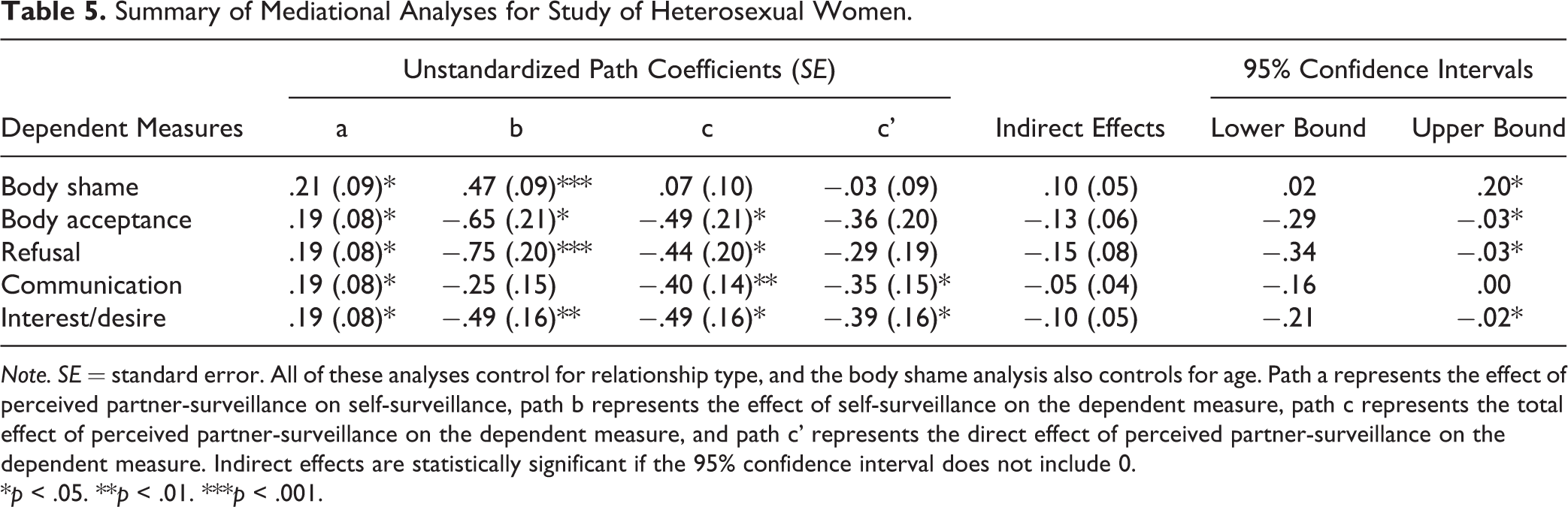
Note. SE = standard error. All of these analyses control for relationship type, and the body shame analysis also controls for age. Path a represents the effect of perceived partner-surveillance on self-surveillance, path b represents the effect of self-surveillance on the dependent measure, path c represents the total effect of perceived partner-surveillance on the dependent measure, and path c’ represents the direct effect of perceived partner-surveillance on the dependent measure. Indirect effects are statistically significant if the 95% confidence interval does not include 0.
*p < .05. **p < .01. ***p < .001.
Discussion
We conducted this pair of studies to test whether and how objectification within heterosexual romantic relationships is related to sexual pressure and coercion. Rooted in objectification theory (Fredrickson & Roberts, 1997), we proposed that two paths form the connection between objectification with sexual pressure and coercion. The first is a direct path: Heterosexual men who objectify their partners are more likely to sexually pressure and coerce their partners, given that objectification connotes a lower value on their partners’ wants and desires and a greater emphasis on using someone for one’s own purposes. The second is a more subtle path: Women who feel objectified may internalize this objectification and thus be more likely to experience body shame and less likely to exhibit sexual agency (i.e., assert herself and express her sexual desires in terms of what she does and does not want to do sexually). This would create a kind of internal pressure, such that women who feel objectified are less likely to have the skills and emotional resources to assert her wishes and thus are more likely to experience sexual pressure and coercion.
The data showed partial support for the direct path. Hypothesis 1, that heterosexual men’s partner-surveillance is related to sexual pressure and coercion, was largely supported by correlational analyses, but regression analyses revealed that most of those correlations were due to the overlapping variance between partner-surveillance and religiosity, political conservatism, benevolent sexism, and hostile sexism. Similarly, Hypothesis 3, that heterosexual women’s perception of their partners’ surveillance of their bodies would relate to their experiences of sexual pressure and coercion, was also partially supported in that the correlation and regression analyses were significant for some of the sexual pressure and coercion subscales but not others.
Interestingly, although there was only partial support for a direct relationship between heterosexual men’s partner-surveillance and sexual pressure and coercion, a consideration of partner-shame in our study of heterosexual men provided strong support for a mediated relationship between the variables. Hypothesis 2, that heterosexual men’s partner-shame would mediate the relationship between partner-surveillance with sexual pressure and coercion, was fully supported. Heterosexual men who think often of their partners’ appearance are significantly more likely to feel shame regarding their partners’ ability to control the shape and size of her body. In turn, this shame was a significant predictor of both beliefs related to sexual pressure (i.e., the beliefs that men expect sex and that it is a woman’s role to provide sex for her partner) and sexual coercion (both in general and via violence, resource manipulation, and commitment manipulation). This finding echoes the research literature on self-objectification, which has consistently shown that self-surveillance is related to body shame, which in turn is related to various outcomes (Moradi & Huang, 2008). The results of the mediation analyses in our study of heterosexual men point to partner-shame as an important mediator of the link between partner-surveillance with sexual pressure and coercion. This suggests that partner-shame is a crucial component of partner-objectification, and so future research should explore this phenomenon as it relates to partner-surveillance and various important outcomes, particularly in studies examining those who objectify.
The data largely supported the idea that women who feel objectified may internalize this objectification and thus may be more likely to experience body shame and less likely to exhibit sexual agency (i.e., assert herself and express her sexual desires in terms of what she does and does not want to do sexually). Hypothesis 4, that self-surveillance mediates the relationship between perceived partner-surveillance and body shame, was fully supported by the data. Heterosexual women who reported that their partners frequently surveyed their bodies were more likely to internalize that objectification and take a third-person perspective of their own bodies. In turn, this self-surveillance was significantly related to increased feelings of body shame. Because previous research has found that body shame predicts a wealth of negative outcomes for women, including eating disorder symptomology, depressive symptomology, and a disconnect from bodily functions (see Moradi & Huang, 2008, for a review), this finding suggests that there could be a wide range of negative ramifications to partner-objectification via an indirect relationship to body shame through self-surveillance. Future research may wish to investigate the consequences of perceived partner-surveillance for heterosexual women via self-surveillance and body shame.
Finally, Hypothesis 5, that self-surveillance mediated the relationship between perceived partner-surveillance and lowered sexual agency, was also generally supported. Three of four mediation analyses provided support for this hypothesis. Heterosexual women who perceive that their partners frequently survey their bodies are more likely to internalize that objectification in the form of self-surveillance, which in turn contributes to women’s lowered acceptance of their bodies in the presence of a partner, inability to refuse sexual advances from a partner, and lowered interest in sex. Self-surveillance did not significantly mediate the relationship between perceived partner-surveillance and the ability of women to communicate their sexual desires to their partner. However, there was a correlation between these two variables, suggesting that women’s perceptions of their partners’ surveillance of their bodies are related to increased difficulty communicating their sexual needs and desires to their partner. Together, these findings suggest that men’s objectification of their partners can contribute to an insidious form of sexual pressure, wherein women experience decreased agency related to their sexual needs and desires. In other words, this finding points to an internal manifestation of sexual pressure from partner-surveillance. Thus, partner-surveillance not only (somewhat) relates to pressuring and coercing one’s partner sexually but also creates an internal pressure for the objectified partner to consent to sexual activity, regardless of one’s own preferences. This important finding should be replicated and examined further in future research, given that it provides a more subtle, yet potentially potent, understanding of the connection between objectification and sexual violence in the context of heterosexual relationships.
Thinking about self- and partner-objectification in terms of agency and sexual pressure could also have implications for women’s relationship satisfaction. Women who feel that they have no control and who experience sexual pressure from their partner will not be as satisfied as women who feel like they have control over their body and the decisions in the relationship, both sexual and otherwise. With women as the primary targets of objectification (McKinley & Hyde, 1996) and its effects on all aspects of their lives including work, school, and relationships (Nussbaum, 1999), our research may be relevant to more than just women’s relationships with men.
These studies demonstrate an important extension of objectification theory into the realm of heterosexual romantic relationships. Little previous research has studied objectification in the context of relationships, even though the objectification of women has been frequently tied to the dominant culture of heterosexual men (Brooks, 1995). Furthermore, some theorists have suggested that objectification in the context of romantic relationships may not have as many negative consequences as it does in other contexts (Nussbaum, 1999), given that appearance and physical attraction are considered crucial aspects of enjoyable romantic relationships. However, the present research demonstrates that the objectification of women in the context of heterosexual romantic relationships may indeed be related to negative consequences (either directly or indirectly through mediators), including sexual pressure and coercion, women’s body shame, and women’s lowered sexual agency. Being more aware of how and when one thinks of their partner as an object, sexually or otherwise, could help relationship partners avoid sexual pressure and coercion and increase communication and respect within their relationship. In addition, acknowledging objectification in their relationships may help women realize when they lack agency and allow them to resist and avoid sexual pressure. Because so little research has focused on objectification in the context of romantic relationships, our research should spark future work aimed at understanding the nuanced balance between beneficial physical attraction and partner-objectification in romantic relationships.
Limitations and Future Research
Because this research relies on correlational and mediation analyses of survey data rather than experimental evidence, caution is needed in interpreting any causal relationships among these variables. For example, the correlation between perceived partner-surveillance and self-surveillance in our study of heterosexual women shows that women who feel that their partner objectifies them are more likely to also objectify themselves (in the sense of body surveillance). However, these data do not reveal if partner-surveillance really causes women to objectify themselves, if women’s self-objectification causes her partner to further objectify her, or if a third variable causes both self- and partner-objectification, producing a spurious correlation. The same logic follows for the other correlations reported. It is important that future research test these relationships experimentally to confirm whether partner-surveillance, partner-shame, sexual pressure and coercion, self-surveillance, body shame, and sexual agency are causally related, though this could be difficult, given the ethical and logistical barriers to manipulating these variables. In particular, it would be beneficial to test for a causal relationship between partner-objectification with sexual pressure and coercion because that would suggest that interventions aimed at reducing sexual violence in intimate relationships should include efforts to reduce objectification. Longitudinal studies examining these variables could be insightful as well, particularly if experimental manipulations prove to be an untenable option.
Additional variables are worthy of exploring in future research pertaining to partner-objectification with sexual pressure and coercion. For example, perceptions of power in the relationship are likely related to partner-objectification. Previous research has shown that social power increases objectification (Gruenfeld, Inesi, Magee, & Galinsky, 2008), and objectification is theorized to place the objectified into a more passive role (Nussbaum, 1999). Therefore, the power dynamics in a relationship could be both contributing to and resulting from objectification within the relationship. The relationship between power dynamics and objectification in the context of romantic relationships is important to explore because previous research has shown that increased power of one partner can translate into greater input into decision making (Centers, Raven, & Rodrigues, 1971; Murstein & Alder, 1995), which is certainly relevant to questions of sexual pressure and coercion. Another variable that could be incorporated into future research would be an expanded understanding of perceived partner-objectification. In the study of heterosexual women, perceived partner-objectification was limited to surveillance and did not include feelings of shame that one’s partner could have about the participants’ bodies. This was done in part to keep the focus on what the participants may have directly observed (e.g., their partner frequently engaging in the male gaze) as opposed to what they would have to infer (e.g., how their partner feels about their body). However, partner-shame emerged as an important predictor of sexual coercion and pressure in the mediation analyses in our study of heterosexual men, and so it would be interesting in future research to explore perceptions of partner-shame from the objectified partner’s point of view.
An additional limitation to our study includes the reality that it was not possible to include both partners of a couple in a present relationship. Although AMT allows increased access to diverse samples, it does not give the option to find people who are in a romantic relationship together. Therefore, the data from the present study are all based on one individual’s perception of the relationship. This affects how some variables are interpreted; for example, it is not possible to determine whether women who perceive that their partner objectifies them have a partner who actually does objectify them. To some extent, this may be a moot point because a person’s construal of their partner’s behavior can have stronger consequences for the relationship than their actual behavior (Murray, 1999). However, it would be interesting for future research to recruit both members of couples to further test and explore how objectification is related to agency and sexual pressure and coercion in romantic relationships. For example, a study of couples could help researchers better understand how objectification is communicated and observed within a relationship.
Finally, there are several fruitful avenues for additional future research. In our research, we only examined men objectifying women, but the consequences of women objectifying men should be studied as well. Furthermore, it would be helpful to collect data from gay/lesbian and bisexual individuals who likely experience different gender dynamics in their romantic relationships. Our research focused primarily on the consequences of objectification for the objectified partner, but there are likely implications for the partner doing the objectifying, such as difficulty forming emotional connections or lowered relationship satisfaction. Another idea would be to include items asking men and women about previous relationships. The current studies focused on current relationships or the participants’ most recent relationship if they were currently single. Men and women may have engaged in objectification or sexual pressure and coercion in past relationships, so it may be worthwhile to see how objectification in earlier relationships could influence current relationships. Additionally, it is important to continue looking into other possible consequences of partner-objectification because not much research has centered on this construct.
Practice Implications
Our study has important implications for a variety of professionals, including activists, counselors and therapists, and educators and student affairs professionals. Our study is the first known to demonstrate an association between objectification with sexual pressure and coercion in heterosexual romantic relationships. Although the design of the current study does not allow for causal conclusions, in the context of the vast literature on the negative consequences of objectification, it suggests that efforts to reduce objectification are justified. Thus, activists should continue their work reducing the objectification of women in our culture, such as through the recognition and removal of objectifying images in the media and increasing awareness of objectification, including its many forms and consequences. Our research suggests that the equation of a woman’s worth with her appearance is a component of sexual violence, yet overvaluation of women’s appearance is reiterated regularly in media images and gender roles throughout American culture.
Although objectification is clearly a societal issue, our data also suggest that it is an interpersonal issue—individual men who objectify their partners may be creating an unproductive dynamic within their particular relationship. Although women can and do objectify men (Strelan & Hargreaves, 2005), men’s objectification of women is more common, and men are the more common perpetrators of sexual violence. Therefore, the onus is on men to reduce objectification and sexual violence. It is of utmost importance that activists and educators work with men to reduce the objectification of women, both in general and in the context of romantic relationships. In particular, it seems that partner-shame is an important component of partner-objectification, and so developing programs and interventions that work with men to reduce the degree to which they survey and feel shame about their partners’ bodies has the potential to reduce sexual pressure and coercion in relationships. Within these efforts, a nuanced consideration of how the high value of physical attractiveness in romantic relationships can percolate into objectification is warranted. Educators and student affairs professionals should work with young men regarding relationship expectations and how real relationships differ from the objectified versions that exist in the media. Furthermore, although the rates of sexual coercion in our studies were relatively low, it is clear that sex education programming that emphasizes the importance of consent and open communication within relationships is vital.
Our research also demonstrated that women can internalize their partners’ objectification of them, which in turn can lead to increased body shame and lowered sexual agency. This finding points to the need to develop programs and interventions to empower women to recognize and resist the objectification that they experience, both from the culture at large and from individuals within their lives, such as their romantic partners. This training may shield women from the negative effects of objectification and help them maintain their sexual agency in order to be better equipped when faced with sexual pressure and coercion. Furthermore, developing and teaching specific techniques to assert one’s sexual agency in potentially dangerous situations may be beneficial. Activists, mental health professionals, and student affairs professionals should work with women to recognize the connectedness of objectification to other issues that may be happening in their lives.
For counselors and therapists working with couples, our research suggests that measuring and discussing objectification in relationships may be an important component to understanding relationship dynamics. When working with an individual man, it will be important to assess levels of partner-objectification to gain insight into how he may be approaching his relationship and the kinds of problems that are likely to arise. When working with an individual woman, assessing feelings of objectification and self-objectification will offer a better understanding of her emotional well-being, body image, agency, and ability to feel satisfied in relationships. Counselors and therapists who are aware of how objectification is connected to a host of negative consequences may be better suited to truly unpacking these issues with their clients.
Conclusions
Our research is important for understanding and improving dynamics within heterosexual relationships. The findings across our two studies add to the literature on objectification by showing some support for a relationship between partner-objectification with sexual pressure and coercion in heterosexual romantic relationships. Furthermore, partner-objectification seems to contribute to women’s lowered sexual agency (via self-objectification), offering a more subtle and internal mechanism for objectification to interfere with sexual consent in relationships. Attention to objectification in the context of romantic relationships may improve women’s overall welfare because romantic relationships are often a highly influential component of their lives and objectification has been shown in previous research to have a wide range of consequences. The objectification of women may also have a negative impact on men who may be more likely to become sexual offenders when adopting an objectifying view of their partners. Further research that explores partner-objectification is needed to fully understand this construct and how it may be manipulated in order to reduce sexual violence against women in romantic relationships.
Footnotes
Declaration of Conflicting Interests
The author(s) declared no potential conflicts of interest with respect to the research, authorship, and/or publication of this article.
Funding
The author(s) disclosed receipt of the following financial support for the research, authorship, and/or publication of this article: This research was supported in part by an Undergraduate Summer Research Grant from the Adrian Tinsley Program at Bridgewater State University.
References
Supplementary Material
Please find the following supplemental material available below.
For Open Access articles published under a Creative Commons License, all supplemental material carries the same license as the article it is associated with.
For non-Open Access articles published, all supplemental material carries a non-exclusive license, and permission requests for re-use of supplemental material or any part of supplemental material shall be sent directly to the copyright owner as specified in the copyright notice associated with the article.
