



Abstract
During the past 30 years, women’s participation in the workforce, in athletics, and in professional education has increased, while men’s activities have been more stable. Have gender stereotypes changed over this time period to reflect the new realities? And, to what extent does gender stereotyping exist today? We address these questions by comparing data collected in the early 1980s to new data collected in 2014. In each study, participants rated the likelihood that a typical man or woman has a set of gendered characteristics (traits, role behaviors, occupations, and physical characteristics). Results indicate that people perceive strong differences between men and women on stereotype components today, as they did in the past. Comparisons between the two time periods show stability of gender stereotypes across all components except female gender roles, which showed a significant increase in gender stereotyping. These results attest to the durability of basic stereotypes about how men and women are perceived to differ, despite changes in the participation and acceptance of women and men in nontraditional domains. Because gender stereotypes are apparently so deeply embedded in our society, those in a position to evaluate women and men, as well as women and men themselves, need to be constantly vigilant to the possible influence of stereotypes on their judgments, choices, and actions. Online slides for instructors who want to use this article for teaching are available on PWQ's website at http://pwq.sagepub.com/supplemental
The gender landscape in the United States has changed in many respects over the past three decades. In the workplace, on sports fields, and in educational institutions, women today have more representation and more visibility than they had 30 years ago, as verified by numerous objective indicators. Women now represent 47% of the U.S. workforce, compared to 38% in the mid-1980s (U.S. Census Bureau, 2010; U.S. Department of Labor, 2010). In sports, the passage of Title IX in 1972 led to a rapid acceleration of women participating in athletics at both the high school and the college levels. For example, girls accounted for only 7% of high school athletes in 1971–1972; that number is now more than 40% (National Coalition for Women and Girls in Education, 2012). College participation rates have shown similar growth, increasing sixfold in the same time period (National Coalition for Women and Girls in Education, 2012); 57% of women graduated with a bachelor’s degree recently (U.S. Department of Education, 2012) versus 40% in the early 1980s (Caplow, Hicks, & Wattenberg, 2001). Similar advances have been made in women’s enrollment in medical schools (47% vs. 35%; Association of American Medical Colleges, 2011) and law schools (47% vs. 34; American Bar Association, 2013; Martin & Jurik, 2006).
These numbers can seem impressive, suggesting considerable progress over the past 30 years. Yet from a glass-half-empty perspective, evidence indicates that gender parity is nowhere near a reality today. In the workforce, for example, women earn less than men in nearly all occupations for which gender comparisons are possible, and female-dominated occupations generally have lower median earnings than male-dominated occupations (Hegewisch & Hudiburg, 2014). Although women represent approximately half of the U.S. workforce, fewer than 6% of CEOs listed in the Fortune 1000 are women (Catalyst, 2014). In politics, women are underrepresented in the U.S. Congress, where they constituted only 20% of the Senate and 18% of the House of Representatives in 2014. Women are no better represented in statewide executive offices, with approximately 23% of those positions held by women in 2014 (Center for American Women and Politics, 2014). And in sports, although the numbers of women and girls participating have increased impressively, the amount of media coverage of women athletes on the major networks is less than 2% (Sabo & Snyder, 2013).
During this same period, men’s incursions into traditionally female domains have remained minimal (Croft, Shmader, & Block, 2015). In the field of nursing, for example, men now represent 9% of registered nurses (RNs), up from 4% of RNs in 1980 (Landivar, 2013), but there has been only a 0.5% increase in the last decade (National Center for Health Workforce Analysis, 2013). Men spent fewer than 10 hours per week in housework in 1985 (compared to women’s 20 hours a week) and that number has remained stable: Today men spend on average 9 hours per week on housework compared to women’s 16 (Parker & Wang, 2013). The percentage of stay-at-home fathers, although increasing from 10% in 1989 to 16% in 2012 (Livingston, 2014), is outweighed by the percentage of stay-at-home mothers at 29% (Cohn, Livingston, & Wang, 2014).
Psychological Aspects of Gender, Then and Now
The data on societal participation of men and women provide evidence both for transformations toward greater gender equality and evidence of stagnation. Because personal dispositions and social attitudes inevitably are influenced by the social context, we can ask how the psychological landscape might have changed over this same period of time. Have people’s views of gender shifted to reflect the changes described above, particularly with regard to the increased participation of women in formerly male-dominated arenas? Or is there evidence of the persistence of traditional attitudes and stereotyping that might contribute to some of the lags and intransigence that are also noted above? Some cross-sectional studies are available to address these questions.
Data on the Attitudes Towards Women Scale (AWS; Spence & Helmreich, 1972), a scale to assess the degree to which people hold traditional versus egalitarian attitudes about gender roles, provides some evidence of change. Attitudes toward gender roles between the 1970s and the 1990s were assessed in two separate projects. Spence and Hahn (1997) reported data collected from college students at the same university in 1972, 1976, 1980, and 1992; their analysis showed the lowest egalitarianism in the 1972 cohort and the most egalitarian attitudes in the 1992 cohort. Similarly, Twenge (1997a) conducted a meta-analysis of 71 studies using the AWS across the same three decades and found a steady trend toward more liberal/feminist positions (Twenge, 1997a; see also Bolzendahl & Myers, 2004).
Gender self-descriptors have also become less stereotypical. Twenge (1997b) reported changes in men’s and women’s self-descriptions, as assessed by scores on the Bem Sex Role Inventory (BSRI; Bem, 1974) and the Personal Attributes Questionnaire (PAQ; Spence, Helmreich, & Stapp, 1974), analyzed over a similar time period; women’s scores on the BSRI masculinity scale (e.g., independent, acts as leader, assertive) were significantly and positively correlated with year of publication, suggesting a steady increase among women in their self-reported masculinity/agency over the time period but with no systematic change for women in self-reported femininity/communality. Men’s self-reported masculinity/agency also showed an increase over the same time, though weaker than the women’s, and with no corresponding increase in femininity/communality. In a direct comparison of men’s and women’s self-ratings, Twenge (1997b) found that sex differences on the BSRI-M scale had decreased over the 20-year period.
Thus, in both attitudes toward gender roles and in self-ascribed characteristics, we see some changes over time in the direction of greater egalitarianism and somewhat less gender differentiation. To our knowledge, however, no studies report any systematic assessment of possible change in the gender stereotypes held by others, as opposed to the self-characterizations described above. Furthermore, most of the available studies of change were conducted in the latter part of the 20th century, leaving open the question of further change or stability of gender stereotypes in the early decades of the 21st century.
Gender Stereotypes and Their Components
Agency and communion have been the core dimensions used to characterize gender stereotypes as well as gender-relevant self-descriptions, dating from the early work of the Brovermans (Broverman, Broverman, Clarkson, Rosenkrantz, & Vogel, 1970; Broverman, Vogel, Broverman, Clarkson, & Rosenkrantz, 1972) and of Spence and Helmreich (1972) in the 1970s (see also Kite, Deaux, & Haines, 2008 for a review). Agency incorporates traits such as competence, instrumentality, and independence; communion encompasses expressivity, warmth, and concern with the welfare of others. On these measures, often using the same items as are included in the self-description studies reviewed above, women are typically rated higher on communion and lower on agency, as compared to men. This differential is observed not only in the United States but also has been reported in countries throughout the world (Williams & Best, 1990).
Gender stereotypes are not limited to agentic and communal trait ascriptions, however. Casting a wider net, Deaux and Lewis (1983, 1984) developed a set of scales that tap into four distinct components of gender: traits, role behaviors, physical characteristics, and occupations. Although not unrelated to one another, these components have distinct properties and can vary independently. Apart from the obvious advantage of assessing a greater range of gender associations, this multidimensional approach also allows one to distinguish between aspects of gender that might be relevant in different circumstances and could change independently over time. Why might we expect gender stereotypes to have changed in the past three decades (presumably in the direction of less differentiation between perceptions of men and women)? Or conversely, are there reasons to predict a resistance to change and the persistence of significant differences in the perceptions of women and men?
Reasons to Predict Stereotype Change
Changes in the positions of women in society, as noted in the opening paragraphs, suggest that we would find some concurrent change in stereotypes as well. Thus, as opportunity structures available to women broaden and as women occupy new positions and roles, people’s beliefs about the qualities of women might shift to match these new realities. At the same time, if the representation of men in different arenas has changed less over the years than has that of women, as the studies discussed earlier suggest (i.e., Croft et al., 2015), we would also predict fewer changes in the stereotypes of men than of the stereotypes of women.
Social Role Theory (SRT; Eagly, 1987; Eagly & Wood, 2012; Eagly, Wood, & Diekman, 2000) provides a theoretical basis for predicting that changes in stereotypes would follow from the changes that have occurred in social role distribution. In SRT, Eagly and her colleagues (Eagly, 1987; Eagly et al., 2000; Eagly & Wood, 2012) argue that people’s beliefs about gender characteristics emerge from observations of women and men behaving in their typical social roles. To the extent that those roles involve enactments of agentic or communal behaviors, people will assume that the average man and woman will have corresponding traits, enabling them to perform the expected role behaviors. For example, Eagly and Steffen (1984) demonstrated that knowing a person’s social role—either as homemaker or employee—was more diagnostic in eliciting communal and agentic traits, respectively, than knowing a person’s gender per se. In a series of experiments, Diekman and Eagly (2000) asked participants to imagine a man or a woman from the past (1950s), the present, or the future (2050s). With only that information, participants were asked to estimate the degree of role traditionalism that existed in the designated time period and then to rate the extent to which the imagined target person had masculine and feminine personality traits, cognitive abilities, and physical characteristics. As expected, participants assumed more egalitarian roles with the passage of time, and their beliefs in greater egalitarian roles were shown to mediate estimates of the likely attributes of women (but had less effect on estimates of men’s characteristics). The mediational argument was further supported by an experiment in which role distribution was manipulated and many of the inferred characteristics varied accordingly. Additional work by Koenig and Eagly (2014) provides further evidence for a causal link between changing occupational roles and inferred trait characteristics, supporting SRT’s assumptions that stereotypes follow from the roles that women and men are believed to occupy. Thus, from the perspective of SRT, we would predict that the greater participation of women in fields such as medicine, law, and management would have altered the stereotype about women. On the other hand, because men’s participation in more traditionally female domains such as homemaker, nurse, or elementary school teacher has not substantially changed (Croft et al., 2015), we would not expect parallel changes in the stereotypes about men.
Reasons to Predict Stereotype Stability
Other theories predict little or no change in gender stereotypes over time, despite some differences in the roles that women and men now play in society. The Backlash and Status Incongruity Hypothesis offered by Rudman and her colleagues (e.g., Rudman & Glick, 2001; Rudman, Moss-Racusin, Phelan, & Nauts, 2012), for example, suggests that vanguards—those who enter a previously segregated field—are more often punished than rewarded for challenging the status quo. In turn, vanguards themselves may engage in preventative measures to avoid backlash and, in the process, confirm the existing stereotypes.
Another position that tends to favor a no-change prediction can be argued from theories about how perceptual bias operates. Research on the confirmation bias (Higgins & Bargh, 1987), illusory correlation (Hamilton & Gifford, 1976), and self-fulfilling prophecies (Snyder, Tanke, & Berscheid, 1977) all suggest that beliefs about gender differences can be sustained and polarized on the basis of subjective assumptions rather than objective evidence. For example, people are often resistant to disconfirmations of their social beliefs (Rothbart & Park, 1986). More specifically, people can distort memory for gender atypical behaviors and see behaviors as more typical than they actually are (Fyock & Stangor, 1994). Thus, people might continue to see sharp differences between men and women, despite objective evidence to the contrary and despite evidence showing that women and men are similar on most psychological variables (Hyde, 2005). This argument for minimal or no change in gender stereotyping is further supported by the cultural lag hypothesis (Diekman, Eagly, & Johnston 2010), which argues that gender attitudes and beliefs are likely to lag behind societal changes as well as by models that emphasize the essentialism of gender categories (Croft et al., 2015, Prentice & Miller, 2007).
To summarize, we are asking whether gender stereotypes have changed or whether they have remained constant over the past 30 years. Some theories, such as SRT, would predict that gender stereotypes will have changed in the direction of less differentiation, driven by documented changes in the roles, activities, and occupational choices of women and men in U.S. society. Conversely, models that focus on processes such as backlash in the face of counterstereotypical behavior, confirmation bias in the judgments of the average woman and man, and a cultural lag between societal change and gender attitudes would predict that strong gender stereotypes will persist and that there will be little evidence of change over the past 30 years.
Assessing change over time presents a number of challenges to the extent that different populations are sampled at different points of time. One can choose, for example, to sample from the same institution (typically, a single university) at both time points. Yet this choice ignores the fact that the characteristics of that institution may have changed substantially in the intervening years, and hence the populations are not really equivalent. Alternatively, because we cannot really equate samples and because we are ultimately interested in the broad societal view of gender stereotypes, we chose to extend the sample beyond college students in the present study while using a methodology consistent with earlier studies. We believe that this choice also provides a methodology and representative reference point for future studies to assess potential changes in gender stereotypes in the future.
Method
Overview
In this study, we assessed the extent to which people still hold gender stereotypes, as compared to the earlier findings of Deaux and Lewis (1983), by collecting data similar to their data from 1983. In both the 1983 study and the current study (data were collected in 2014), participants were asked to estimate the likelihood that a man, a woman, or a person with gender unspecified had a set of male-typed and female-typed characteristics. Comparisons between data collected at the two time points were made on each gendered component: traits, role behaviors, occupations, and physical characteristics.
Participants
Participants in the 1983 study were college students enrolled in an introductory psychology course at a large Midwestern university who participated in the experiment as one means of fulfilling course requirements. Our goal in the 2014 data collection was to obtain approximately the same sample size (195), as in the original Deaux and Lewis (1983) study, while drawing from a broader population. Because we believed that some participants might not complete the study, we oversampled to 216 online. Twenty-five participants were eliminated because they did not complete the study, and the dropout rates were evenly distributed among conditions. All participants were paid $.45 for their participation. The median time for completion of the study was 21 min.
The 2014 sample consisted of 191 U.S. participants (52.4% female) who were recruited from Amazon Mechanical Turk. Ethnicity was 77.5% White/Caucasian, 8.4% Asian or Asian American, 7.9% Black or African American, 4.2% Hispanic or Latino, 0.5% Arab or Middle Eastern, 0.5% Native American, and 1.0% Other (who did not provide additional information). Participants had a mean age of 38.7 years (SD = 14.1; range 19–73). The original Deaux and Lewis (1983) paper did not report any demographic information on the participants, other than that they were college students. It can be assumed, based on the experience of the second author at that institution, that most if not all of the students were White/Caucasian. A subsequent study by the same authors (Deaux & Lewis, 1984) reports approximately equal representation of women and men.
Item Selection
We used 87 of the 91 items from the Deaux and Lewis (1983) components: male- and female-linked traits (16), role behaviors (25), occupations (21), and physical characteristics (25), with eight exceptions. Four items from the occupational set of Deaux and Lewis (1983) were dropped due to changes in technology that have made the occupations obsolete (i.e., telephone operator, machinist, bookkeeper, and key punch operator). Four additional items were modified slightly in order to make the occupations more in line with common usage. Specifically, “telephone installer” was changed to “cable installer,” “secretary” was changed to “administrative assistant,” “mail carrier” was changed to “postal worker,” and “urban planner” was changed to “politician.” (Because urban planner was not clearly understood or considered particularly gendered by members of our research team, we selected politician as a more recognized gendered occupation.) The items within each of the eight gender stereotype components (e.g., male gender role, female gender role) showed strong interitem reliability (range α = .81–.97).
Procedure
In the original study, participants were 195 introductory psychology students who participated for course credit. The study was described as a study of social perception in which there were no right or wrong answers. Participants rated each of the 91 characteristics in terms of how they applied to a man, a woman, or a person in a between-subjects design. Responses ranged from 0 (extremely unlikely) to 100 (extremely likely). Before the gender rating tasks, the participants completed warm-up items to familiarize them with the task. In this exercise, participants were asked to rate the likelihood that the average person had each of the five gender-neutral characteristics (e.g., percentage of likelihood that a person has red hair). Participants were randomly assigned to conditions (man, woman, or person) and then rated the characteristics using paper booklets. Component items were randomly ordered within the booklets.
In the current study, procedures were similar in that participants (a) were introduced to the study as an investigation of understanding people and that there were no right or wrong answers; (b) started with an initial warm-up exercise to rate the likelihood that the average person had each of five gender-neutral characteristics; (c) were randomly assigned to conditions (a man, a woman, or a person); (d) were asked how likely or unlikely it is that the target person has the trait, role, occupation, or physical characteristic on a scale from 0 (extremely unlikely) to 100 (extremely likely); and (e) received randomized order of component items. Differences from the original study included use of a noncollege age; Amazon Mechanical Turk sample; a delivery of procedures online; monetary payment of participants; collection of gender, age, and race information; and randomization of the items within each component. In addition, 49 additional items, generated by students in a pilot study to elicit contemporary gender associations, were included at the end of the study to be used in future research and were not included in the randomization of the original items within each component. (These items, together with means and standard deviations, are available upon request from the first author.)
Results
Data Aggregation and Analyses
We sought to understand the strength of perceived differences between the categories man and woman and the degree of stability of those judgments across the time period and samples. As in the original study, mean probability judgments were computed for each of the items by condition (man, woman, or person). The person condition was used as a baseline to compare with the man and woman conditions but was not a main focus of the analyses; ratings for the person condition are presented for informational purposes only, as in the original Deaux and Lewis (1983) study. For ease of presentation and interpretation, we aggregated data by each component for both the past and the current data, instead of presenting individual items. Mean probability judgments were computed for each male- and female-typed component (i.e., agentic traits, communal traits, female gender roles, male gender roles, female-typed occupations, male-typed occupations, female-linked physical characteristics, and male-linked physical characteristics). All items including the means, standard deviations, and p values for man, woman, and person can be found online at http://nova.wpunj.edu/hainese/hainesdeauxlofaro/
Table 1 provides the means, r effect size values, and standard deviations for female and male components from both the 1983 and the 2014 analyses. The effect size r was used to determine the strength of the stereotype. We used an r to z transformation, recommended by Preacher (2002), to determine if there was evidence of stereotype change across the two time periods.
Means, Standard Deviations, Difference, and r Values in 1983 and 2014 Data Sets.
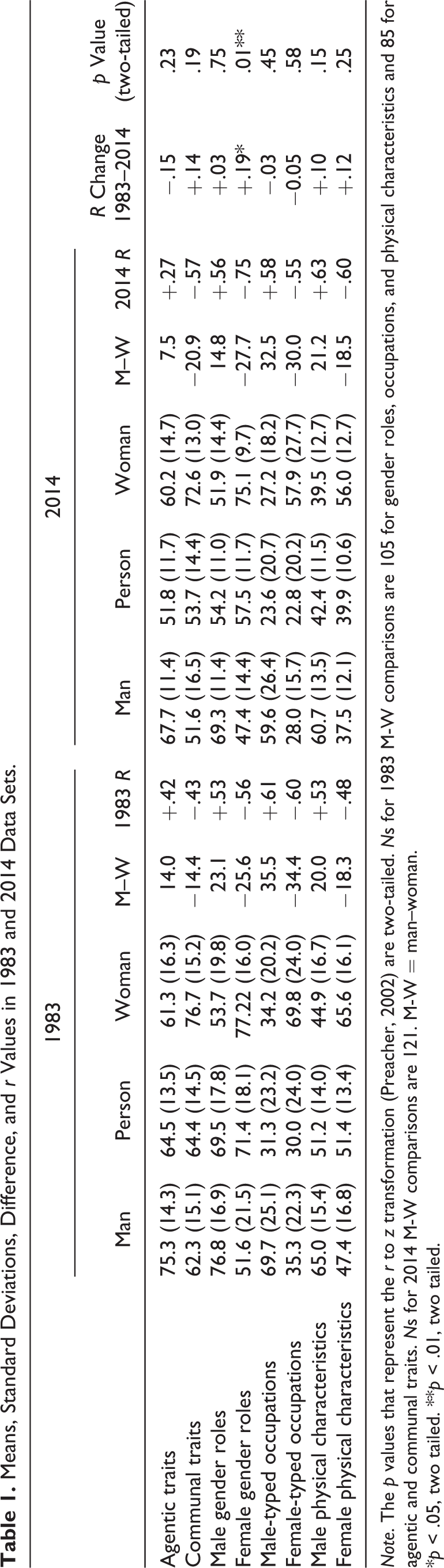
Note. The p values that represent the r to z transformation (Preacher, 2002) are two-tailed. Ns for 1983 M-W comparisons are 105 for gender roles, occupations, and physical characteristics and 85 for agentic and communal traits. Ns for 2014 M-W comparisons are 121. M-W = man–woman.
*p < .05, two tailed. **p < .01, two tailed.
Assessment of Gender Stereotyping Today
The main goals of the present study were to (a) understand the extent of gender stereotyping today and (b) assess if beliefs about men and women have changed or remained the same from the past. To address the first question, we computed a one-way multivariate analysis of variance (MANOVA) to compare judgments of man and woman targets on each component in the 2014 data. There were overall man–woman differences on the components, F(8, 116) = 59.64, p = .0001, Wilks’s Λ = .20, partial ω2 = .50. The man–woman differences were statistically significant on each of the individual components: agentic traits, F(1, 123) = 15.54, p = .0001, partial ω2 = .091; communal traits, F(1, 123) = 61.10, p = .0001, partial ω2 = .33; male gender roles, F(1, 123) = 56.75, p = .0001, partial ω2 = .31; female gender roles, F(1, 123) = 158.69, p = .0001, partial ω2 = .56; male-typed occupations, F(1, 123) = 62.57, p = .0001, partial ω2 = .33; female-typed occupations, F(1, 123) = 56.75, p = .0001, partial ω2 = .31; male-typed physical characteristics, F(1, 123) = 81.41, p = .0001, partial ω2 = .39; and female-typed physical characteristics, F(1, 123) = 69.39, p = .0001, partial ω2 = .35. These results provide evidence that stereotyping is very strong today.
As seen in the 2014 data in Table 1, participants strongly stereotyped men and women on the majority of gendered components as indicated by large effect sizes on seven of the eight components. With the exception of agentic traits (r = +.27), all of the other effect sizes were .55 or higher. Specifically, the effect sizes of male-typed components ranged from r = +.56 (male role behaviors) to +.63 (male-linked physical characteristics), and effect sizes of female-typed components ranged from r = −.55 (female-typed occupations) to r = −.75 (female gender roles). In sum, participants perceived strong differences between men and women today across all gendered components, moderate stereotyping on agentic traits, and very strong stereotyping on female gender roles.
Present Versus Past Stereotyping
We assessed how today’s stereotyping compares to the past, using the r to z transformation recommended by Preacher (2002) to compare the two data sets.
Traits
As seen in Table 1, perceptions of gender trait differences remained consistent and strong between the two time periods: Women continued to be rated as more communal than men, and men continued to be rated as more agentic than women. A comparison of these effect sizes for agentic traits (r = +.41 in 1983 and r = +.27 in 2014) indicates no evidence of stereotype change across the two time periods ( p = .15), despite the weaker effect size in the 2014 sample relative to other components. There was no significant change between the two time periods on communal traits (r = −.43 in 1983 and −.57 in 2014, p = .19). An analysis of the individual traits at both time periods indicated that 15 of 16 woman versus man comparisons yielded significant differences at the .05 level in 1983—only “active” was not gender differentiated in the past. In 2014, four traits did not show significant gender differences: “active,” “stands up under pressure,” “makes decisions easily,” and “never gives up easily.”
Role behaviors
Ratings of female gender role behaviors showed greater differentiation in 2014 (r = −.75) than in 1983 (r = −.56); the r to z transformation indicates that this is a significant increase in gender stereotyping on female gender role behaviors ( p = .01). It appears that this difference is primarily due to decreased variability in the 2014 judgments that men and women would carry out female gender role behaviors. By contrast, ratings of the male role behaviors showed no evidence of change (from an r of +.53 in 1983 to an r of +.56 in 2014, p = .75). An analysis of the individual role behaviors (with α at .05) at both time periods shows that 21 of the 25 female- vs. male-role comparisons were significantly different from one another in 1983, and 22 of 25 were significantly different from one another in 2014. In 1983, the nonsignificant role behaviors were “runs the home,” “defers to the judgments of others,” “source of emotional support,” and “plans for the future.” In 2014, the nonsignificant differences were “assumes financial obligations,” “makes major decisions,” and “handles financial matters.” Thus, in an analysis of the individual items, women and men were perceived to be more equally engaging in financial role behaviors in 2014 than in the past.
Occupations
Female- and male-typed occupations showed strong differentiation between both women and men and were consistent across the two time periods as indicated by rs above .50. More specifically, female- and male-typed occupations in 1983 showed a strong difference between women and men (rs of −.60 and +.61, respectively). In 2014, those differences remained nearly as strong (rs of −.55 and +.58, respectively). A comparison of these effect sizes for female occupations and male occupations indicated no evidence of change over time ( p = .58 and p = .45, respectively). Analysis of individual occupations indicated that 24 of 25 were significantly different in 1983 at the .05 level (only “bookkeeper” was not significantly differentiated for women and men); in 2014, 20 of the 21 were significant (only “postal worker” was not significantly differentiated between women and men).
Physical characteristics
Estimates of female and male physical characteristics remained distinct across the two time periods. In 1983, the judgments of female and male physical characteristics yielded an effect size of r = −.48 and +.53; in 2014, the effect sizes were −.60 and +.63. There appears to be no change in stereotyping across the two time periods on male physical characteristics ( p = .15) or female physical characteristics ( p = .25). Analysis of the individual physical characteristics showed that 24 of the 25 traits were distinct between women and men in 1983 (“well-built” was not differentiated) at the .05 level; in 2014, 22 of the 25 physical characteristics differed significantly at the .05 level between women and men (“physically fit,” “thin,” and “long legs” were not differentiated).
Additional Analyses for 2014 Sample
Age
The 1983 sample was limited to college students, whose average age was probably around 20; in contrast, participants in the 2014 study ranged in age from 19 to 73. Although the differences between the 1983 and the 2014 findings are minimal, suggesting that age differences are not critical, it is possible that the one difference between time periods that we did observe, stronger gender stereotyping on female gender role behaviors in 2014 compared to 1983, could be due to age differences between the two samples and not to a shift in stereotypes about men and women per se. In addition, the availability of a full-spectrum age range in the 2014 sample allows us to ask if age has any systematic relationship with gender stereotyping. We addressed these questions by computing a series of regression equations to assess the Target Gender (man, woman) × Age interaction on each of the stereotype components. None of the interactions was significant ( p > .32). Thus, it appears that the observed increase in female gender role stereotyping between the two time periods was not related to age differences between the two samples, nor did age show any systematic relationship to beliefs about gender characteristics.
Participant gender
Although no participant gender analyses were reported in the original Deaux and Lewis (1983) study, we assessed the possibility that participant gender might have influenced gender stereotyping. A Participant Gender × Target Gender MANOVA was computed on all eight stereotype components. Results indicate neither main effects nor interactions on communal traits, agentic traits, male physical characteristics, female occupations, or male occupations ( p > .08). However, there was a main effect of participant gender on judgments of female physical characteristics, F(1, 125) = 9.488, p = .003, ω2 = .06, with male participants estimating a higher likelihood that women had female physical characteristics than did women. Two significant interactions involving participant sex and gender role judgments were also significant. In ratings of the male gender role behaviors, men differentiated more between man and woman targets than did women, F(1, 125) = 7.570, p = .007, ω2 = .05. In ratings of female gender role behaviors, in contrast, women differentiated more between the man and the woman targets than did men, F(1, 125) = 16.97, p = .0001, ω2 = .11.
Person condition
Although not central to our analyses, the person condition produced probability judgments that were in between man and woman likelihood ratings on five of the eight components in the 2014 data (compared to six of the eight in the 1983 data). Inspection of the means in Table 1 reveals no systematic patterns in comparisons of the person condition to either man or woman targets.
Discussion
Over 30 years ago, Deaux and Lewis (1983) reported strong stereotypes of women and men—not only on traits but also for social roles, occupations, and physical characteristics. In the current study, we continued to find strong stereotyping and a great deal of consistency with the stereotyping reported in the past. Despite differences in samples and in time periods, there was virtually no difference in the degree to which beliefs about typical men and women were differentiated on agentic and communal traits, male gender roles, male and female occupations, and male and female physical characteristics. The one exception was a significant increase in stereotyping on the female gender role; however, this change appears to have occurred because contemporary judgments on this component were less variable than they were in the past, rather than being due to any marked change in mean likelihood ratings.
We entertained competing predictions regarding changes in stereotypes over time. According to SRT (Eagly, 1987), we would expect that the real changes in men’s and women’s occupation of roles in the home, workplace, and in sports would produce a lessening of gender stereotypes today as compared to the past, particularly for women (Croft et al., 2015). But we did not find evidence of substantial stereotype change, in spite of the societal changes and even though attitudes toward male and female roles have become less traditional over time (Spence & Hahn, 1997; Twenge, 1997a). A similar lack of parallelism is seen between the consistency of gender stereotypes found here and analyses of self-stereotyping that have shown women reporting more agentic selves in more recent as opposed to earlier times (Twenge, 1997b). Perhaps cultural lag, as suggested by Diekman, Eagly, and Johnston (2010), is most likely to manifest itself in the more abstract, less specific, and less self-referent domain of trait attribution to others.
Another possible explanation for the divergence between stereotypes assessed here and the self-ascriptions and gender role attitudes assessed by Twenge (1997a, 1997b) and by Spence and Hahn (1997) could be methodological rather than substantive, associated with a difference in the time periods covered by the different data sets. In the case of the cross-sectional comparisons of AWS, the period covered was generally from the 1970s (early in the second wave of feminism) to the late 1980s and early 1990s. In contrast, our period of comparison was the early 1980s versus the second decade of the 21st century. Thus, it is possible that change in gender-related attitudes and stereotypes may have neared a plateau by the mid-80s and that our current study assessed a period of relative stability after a more active time of change. Other data sets may become available that could represent the full range from the early 1970s to the present. If not, we can only recommend doing additional studies in the future that will allow us to continue to monitor the change or stability of gender-related attitudes.
Theories that emphasize processes of confirmation bias and self-fulfilling prophecies provide greater support for our findings of little change in gender stereotyping. Given the extensive use of gender categories and the seeming utility of differentiating between women and men, people may be resistant to change their stereotypes to any significant degree. The ease with which people are able to confirm gender stereotypes by selectively finding consistent exemplars (e.g., Rothbart & Park, 1986) or by misremembering gender atypicality as more typical than it actually was (Fyock & Stangor, 1994) contribute to stereotype stability and maintenance. Further, even when women are making choices inconsistent with their expected roles, backlash and status incongruity theory (Rudman et al., 2012; Rudman & Glick, 2001) suggest that the women will engage in behaviors that are stereotype-consistent in order to avoid negative evaluations.
Also consistent with our findings is evidence for the high degree of essentialism in beliefs about gender (Croft et al., 2015; Prentice & Miller, 2007). To the extent that people believe that the basic characteristics of women and men are inherent to the category, then evidence of more peripheral changes in behaviors is unlikely to shape beliefs in the basic attributes. Suggestions of a cultural lag between societal changes and gender beliefs (Diekman et al., 2010) are also consistent with the stability that we observed.
In summary, there appears to be more support for stereotype maintenance via confirmation bias, cultural lag, backlash, and essentialist categorical beliefs, despite the movement toward more similar roles and behaviors between men and women. From a theoretical perspective, it is important to understand more about the processes and moderators associated with stereotype maintenance in the presence of change. Contrast and assimilation effects within a Shifting Standards approach (e.g., Biernat & Manis, 2007), explaining counterstereotypical behavior as exceptions to the rule (Wilder, Simon, & Faith, 1996), or the tendency for highly prejudiced people to explain away stereotype inconsistent information (Sherman, Stroessner, Conrey, & Azam, 2005) could all be the basis of useful research questions that might expand theory about when and where gender stereotypes will change. Such an approach would also be helpful in further developing the cultural lag hypothesis (Diekman et al., 2010).
Limitations
Although the present data offer an illuminating window into the changes and, more often, the lack of changes that have occurred in gender stereotypes over the past three decades, some cautions should be acknowledged. First, our target categories man, woman, and person may be limited in their generalizability. On the one hand, man and woman are general and inclusive categories for gender stereotypes and have been used in the majority of research studies. At the same time, the work on intersectionality makes a strong case for the importance of considering the intersections of various categories, both in terms of self-defined identities and in terms of stereotypes (Cole, 2009; Ghavami & Peplau, 2012; Greenwood, 2012). As Ghavami and Peplau (2012) showed, for example, combinations of gender and ethnic categories yield stereotypic elements that can diverge from both gender and ethnic categories taken alone. Further, because no additional features were specified in our instructions, we do not know what specific image our participants were considering when they answered the questions. At minimum, this uncertainty is likely to create some unexplained variability in the data. Researchers interested in how the stereotypes operate in an intersecting manner would want to consider the conditions under which the stereotypic elements are stronger for some subgroups of women and men than for others.
The unmatched participant samples in the two studies is also a potential concern. The 1983 report was based on data collected from college students at a large Midwestern public university; the current study was based on a more diverse sample of U.S. residents, with a greater range of age, education, and ethnicity and broader geographic representation. With regard to age, our analyses indicate that it did not appear to be a factor in the endorsement of gender stereotypes. Certainly, a comparison between samples with the same demographic characteristics would be valuable. However, the demographics of the Midwestern University in the 1980s study are likely to have changed substantially in the 30-year period, thus making it difficult to create a truly equivalent sample.
A strength of the current study is the greater diversity in the national sample that we used, thus arguably offering a more representative depiction of gender beliefs in the United States today. At the same time, it is striking how much similarity there was between the two samples, despite differences in sample characteristics. Such consistency makes a strong argument for the generality and persistence of gender stereotyping, which is a major take-home message of this report.
Practice Implications
The results of our study suggest a surprising durability of basic stereotypes about women and men over the past three decades, not only in the global traits of agency and communion but in other domains such as physical characteristics, occupations, and gender roles as well. These results are perhaps surprising, given the progress that women have made in fields previously dominated by men, such as law, medicine, business, and sports, as well as evidence that a wide array of sex differences are small or highly context dependent (Hyde, 2005). The persistence of gender stereotypes, despite some progress toward egalitarianism needs to be recognized by all those who make judgments and choices regarding the potential and/or the performance of women and men. Evidence that some women have “made it” does not rule out the operation of gender stereotyping. Opportunities for gender discrimination are abundant, and, as Valian (2007) has observed, mountains can emerge from a piling on of molehills, that is, a succession of small discriminatory events can have large consequences.
In the face of these challenges to fair treatment, how is the practitioner to operate? A first step is constant vigilance and an awareness that gender stereotypes are deeply embedded in our culture. For those in a position to hire and evaluate women and men, it is important to develop explicit practices that put a premium on a full range of job-relevant information about a candidate and to give practitioners adequate time to take this information into account when making a decision (Steffens & Viladot, 2015). Selection criteria need to be specific and made explicit in advance of decision-making, with an attempt to eliminate those criteria that might in and of themselves suggest a lack of fit between a candidate and a position solely on the basis of gender (Heilman, 1983, 2012). Workplaces also need to be considered for the possible gendered cues that they emit, as those cues not only provide a climate in which stereotypic judgments are more likely but also create threats to identity that can discourage women and men from entering a particular field (Steele, 2011). Such cues can also affect the performance of women and men when they are in a noticeably gendered position.
Those engaged in advisement or therapy should also be aware of how the pervasiveness of gender stereotypes can affect the individual goals and aspirations of their advisees and clients. Even those women or men who explicitly describe themselves as free of gender stereotypes may be, because of the depth and durability of gender stereotypes, implicitly influenced by them (e.g., Rudman & Glick, 2001). The possibility of these nonconscious beliefs influencing people’s choices and their reactions to the actions of others needs to be considered and dealt with by practitioners, even among those clients who explicitly express egalitarian beliefs. In sum, stereotypes may persist, but with appropriate actions, their influence on important decisions can be minimized.
Conclusions
Changes in the activities and representation of women and men in society have unquestionably occurred since the early 1980s. Nonetheless, those changes apparently have not been sufficient to alter strongly held and seemingly functional beliefs about the basic social category of gender, where a variety of psychological processes may be at work that lead to the continued maintenance of gender stereotypes. An awareness of the durability of fundamental stereotypes coupled with continued vigilance as to their possible influence are desirable measures for all to take.
Footnotes
Acknowledgment
Thank-you to Don Carlston, Amanda Diekman, Madeline Heilman, Alison Ledgerwood, So Yon Rim, and Michael Sargent for feedback on various aspects of this article. Special thanks to Ashley Lemoncelli, Chris Mericle, and Kurt Schroeder for their assistance with data collection. We are grateful to the late Janet Taylor Spence, who was not able to give us feedback on this paper in her final weeks, but who gave us a lifetime of inspiration.
Declaration of Conflicting Interests
The author(s) declared no potential conflicts of interest with respect to the research, authorship, and/or publication of this article.
Funding
The author(s) received no financial support for the research, authorship, and/or publication of this article.
References
Supplementary Material
Please find the following supplemental material available below.
For Open Access articles published under a Creative Commons License, all supplemental material carries the same license as the article it is associated with.
For non-Open Access articles published, all supplemental material carries a non-exclusive license, and permission requests for re-use of supplemental material or any part of supplemental material shall be sent directly to the copyright owner as specified in the copyright notice associated with the article.
