




Abstract
Minority stressors encountered by lesbian, gay, and bisexual (LGB) women are inherently connected to contextual experiences. Although there is a growing body of research on the benefits of gaining political rights and the costs of their denial, little research has focused on the effects of access to LGB-affirmative resources. In the current study with 1,017 women in same-sex relationships, we created profiles using latent class analysis to characterize the contexts in which participants were raised and the contexts in which they lived at the time of the study. We examined differences in interpersonal relationships, internalized heterosexism (IH), and outness across these profiles. Class 1 (28%) included participants who always lived in affirmative contexts with LGB-supportive resources. Class 2 participants (28%) always lived in more heterosexist contexts with few resources. Class 3 participants (44%) originally lived in more heterosexist contexts with few resources but shifted to more affirmative contexts. Class 3 individuals had greater social support and lower IH than Class 2 participants. Classes 1 and 3 had greater outness than Class 2. This study provides evidence linking IH to the lack of contextual supports. Our data also suggest that the quality of relationships for LGB women may remain strong even in heterosexist contexts. Actions that increase affirming resources will provide avenues for more positive identity development and interpersonal relationships for LGB individuals. Online slides for instructors who want to use this article for teaching are available on PWQ's website at http://journals.sagepub.com/page/pwq/suppl/index .
Keywords
Researchers have demonstrated that lesbian, gay, and bisexual (LGB) individuals, compared to heterosexuals, are at increased risk of mental health issues, such as depression, anxiety, and suicide attempts (King et al., 2008; McLaughlin, Hatzenbuehler, Xuan, & Conron, 2012). In addition, some research shows that bisexuals may experience higher rates of mental health concerns than lesbian or gay individuals (e.g., Jorm, Korten, Rodgers, Jacomb, & Christensen, 2002). However, researchers often explain these mental health disparities as the results of minority stress, which refers to the social stressors related to stigma and discrimination that are experienced by LGB populations (Meyer, 1995, 2003; National Research Council, 2011). Minority stress that is specific to LGB populations includes distal components (e.g., prejudiced events such as harassment, discrimination, and victimization) and proximal components (e.g., perceived stigma, concealment of one’s sexual orientation, and internalized homophobia; Meyer, 1995, 2003). Internalized homophobia is a minority stressor that has gone by many names in the literature, including internalized homonegativity, self-stigma, and internalized heterosexism (Herek, 1996; Herek, Gillis, & Cogan, 2009; Puckett & Levitt, 2015; Szymanski, Kashubeck-West, & Meyer, 2008). We use the term internalized heterosexism (IH) to acknowledge the ways that this minority stressor is connected to systemic oppression encountered by sexual minority men and women, rather than a solely internal dynamic (see Puckett & Levitt, 2015 for further review and distinction in terms).
Researchers have begun to explore the types of environments that promote more positive development for LGB individuals and fewer experiences of minority stress, yet they have mostly focused on political shifts and changes in the law regarding LGB equality (e.g., Hatzenbuehler, McLaughlin, Keyes, & Hasin, 2010). Research is needed to determine how individual community-level access to affirmative resources may be related to minority stress and well-being. We explored the experiences of LGB women to determine how living in contexts that varied in LGB-affirmative resources and supports may be related to minority stressors of IH and outness. We examined structural stigma (e.g., presence of nondiscrimination policies), community-level stigma (e.g., religious organizations publicly condemning LGB and transgender [LGBT] individuals), and access to affirmative spaces (e.g., LGBT support groups). We also explored how these contexts are related to social support and relationship satisfaction/equality, which may be important to buffering negative outcomes of minority stress.
Experiences of Stigma in the Lives of LGB Women
Sexual orientation–based stigma can manifest in many different ways, on both cultural and individual levels (Herek et al., 2009). Herek and colleagues (2009) reviewed the literature on sexual orientation–based stigma and reported that heterosexism in the cultural realm results in structural inequalities, such as restricted legal rights and protections for LGB populations. On the individual level, this can be experienced as enacted stigma (e.g., verbal harassment and victimization), felt stigma (e.g., expectations of rejection), and internalized stigma. We posit that community-level stigma might be understood as occurring at the intersection of the structural and individual levels.
Structural Stigma and Minority Stress
Political and legal restrictions of rights for LGB individuals are one form of structural stigma, which has been the focus of the majority of research that has examined the influence of contextual climate on minority stress and well-being. Prior research has established that anti-LGB legislation can have a negative effect on the emotional well-being of LGB individuals (Hatzenbuehler et al., 2010) and their relationships (Levitt et al., 2009; Maisel & Fingerhut, 2011; Rostosky, Riggle, Horne, & Miller, 2009; Russell, 2000), and can affect the well-being of family members of LGB individuals (Arm, Horne, & Levitt, 2009). Other research has shown mixed support for the negative effects of marriage recognition campaigns on the quality of romantic relationships, finding that the campaigns brought some couples closer together, whereas others experienced increased relationship tension (Maisel & Fingerhut, 2011).
Progressive legislation, such as inclusive nondiscrimination policies, may provide LGB individuals with more supportive contexts. For example, Riggle, Rostosky, and Horne (2010) found that LGB individuals living in locations with inclusive nondiscrimination protections received fewer negative messages about being LGB and heard more positive messages about LGB identities. These individuals had greater levels of self-disclosure of their sexual identities, more social support, and less IH than individuals in areas without inclusive nondiscrimination protections. Although the movement for inclusive nondiscrimination policies has been ongoing, public attention to these legislative policies and other issues has increased recently, such as parenting laws and restrictions on the use of reparative therapy in different states (for an overview of state and national legislation related to sexual and gender minorities, see Human Rights Campaign, 2015).
While structural stigmas can affect LGB people at the state or national level, such stigma can influence individual community dynamics as well. For example, Levitt et al. (2009) found that LGB individuals in states which passed marriage bans reported feeling marginalized and stigmatized both politically and by their communities. In addition, LGB individuals may feel alienated in the aftermath of having their rights restricted (Rostosky, Riggle, Horne, Denton, & Huellemeier, 2010). These structural and institutionalized forms of stigma may set the tone for communities, by challenging or normalizing the oppression and stigmatization of LGB individuals, and also likely influence the presence or absence of affirmative resources. Even now, with same-sex marriage being recognized within the United States, communities may still struggle to provide supportive resources and may see a rise in homophobia, such as continued backlash via legislative efforts to ban recognizing these marriages.
Community-Level Stigma and Minority Stress
In assessing contextual influences beyond the political realm, researchers have focused primarily on school (Kosciw, Greytak, & Diaz, 2009; Kosciw, Palmer, Kull, & Greytak, 2013) and workplace climate (Smith & Ingram, 2004; Velez, Moradi, & Brewster, 2013; Waldo, 1999). For example, Kosciw, Palmer, Kull, and Greytak (2013) demonstrated both the negative impact of victimization on academic performance and self-esteem among LGBT youth, and the potential for school-based supports, such as the presence of gay-straight alliance (GSA) clubs, supportive teachers and staff, antiharassment policies, and LGBT inclusive curricula to improve these outcomes.
Beyond policies and resources, community-level violence also may be predictive of mental health for LGB individuals. For example, Duncan and Hatzenbuehler (2014) examined rates of LGB hate crimes in Boston in relation to adolescent suicidality. They found that LGB adolescents living in neighborhoods with higher rates of LGB hate crimes had greater levels of suicidality and were more likely to report suicide attempts than LGB adolescents in neighborhoods with lower rates of LGB hate crimes. In addition, suicidality was not associated with community-level rates of non-LGB-related violence. Overall, being in a more affirmative neighborhood may promote more positive development for LGB individuals, whereas communities with more violence toward LGB groups may result in greater psychological distress among LGB individuals.
Broadening the research examination of types of community-level manifestations of stigma, Oswald, Cuthbertson, Lazarevic, and Goldberg (2010) included such elements as “religious and political affiliations, legal rights, workplace opportunities and policies, and the presence of GLBT community members and services” (p. 215). Hatzenbuehler (2011) explored community climate at the county level, which included school-related factors (e.g., percentage of schools with GSAs, LGB-specific antidiscrimination policies), as well as community-related factors (e.g., proportion of same-sex couples, registered Democrats). He found that unsupportive social environments, compared to supportive environments, predicted greater risk of suicide attempts among LGB youth.
Individual and Interpersonal Implications of Minority Stress
While stigma manifests on structural and community levels, it also appears on the individual level. Internalized stigma, or IH, occurs when an LGB person internalizes negative feelings and homophobic attitudes toward themselves and others who are sexual minorities, as a product of living in a heterosexist environment (Shidlo, 1994). Many studies have revealed fairly consistent relations between IH and negative mental health outcomes (D’Augelli, Grossman, Hershberger, & O’Connell, 2001; Frost & Meyer, 2009; Greene & Britton, 2012; Herek et al., 2009). For instance, Newcomb and Mustanski (2010) meta-analyzed 31 studies, with a total of 5,831 participants and found a small-to-moderate relation between IH and mental health problems, including anxiety and depression.
While the connection between IH and psychological distress is evident in a number of studies, researchers have yet to explore in depth which types of structural or community-level characteristics may result in increased IH. In addition, while IH has a clear connection with psychological distress, this relationship can vary across contexts. Goldberg and Smith (2011) have shown that individuals with higher levels of IH have a more drastic increase in depression symptoms when living in anti-LGB contexts, whereas affirming contexts were associated with decreased depressive symptoms even for individuals with high IH. It is likely that less affirmative contexts promote greater IH, given that IH is defined as an experience embedded within a heterosexist environment. In the current study, we evaluated how shifts from less to more affirming contexts affect IH.
Another minority stressor that is experienced by LGB groups is identity concealment, also referred to as “outness,” or the degree to which someone has revealed to others their sexual identity. Researchers have tended to emphasize the benefits of outness to mental health (e.g., Morris, Waldo, & Rothblum, 2001) and the costs of identity concealment (Meidlinger & Hope, 2014). Even so, there may be more nuances to this association that are frequently overlooked. For example, research demonstrates that the benefits of outness to mental health may be group-specific (e.g., bisexual individuals may have greater suicidality when they are out, in comparison to lesbian women who may have less suicidality; Koh & Ross, 2006). And the benefits of outness may be context dependent (Legate, Ryan, & Weinstein, 2012). The current study adds to the minimal research on outness and its connection to contextual experiences.
Role of Social Support
Given the stigmas that are faced by LGB individuals, social support (i.e., various types of support provided by other people in one’s life that help decrease stress; Gerrig & Zimbardo, 2002) can be important to buffering the negative outcomes of heterosexism and homophobia. The role of social support in predicting well-being among LGB individuals and protecting against the ill effects of sexual minority stressors has been explored extensively (e.g., Button, O’Connell, & Gealt, 2012; Graham & Barnow, 2013; Rothman, Sullivan, Keyes, & Boehmer, 2012; Teasdale & Bradley-Engen, 2010; Williams, Connolly, Pepler, & Craig, 2005). In particular, positive intimate relationships may be an important protective factor against psychological distress (Blair & Holmberg, 2008; Graham & Barnow, 2013). While researchers have demonstrated that social support and relationship satisfaction are important to mental health (Blair & Holmberg, 2008; Button et al., 2012; Graham & Barnow, 2013; Rothman et al., 2012; Teasdale & Bradley-Engen, 2010; Williams et al., 2005), identification of the contexts that promote or negatively impact these protective factors is needed. In the current study, we explored how community-level characteristics (including structural stigma, community-level stigma, and access to affirmative spaces) may relate to general social support as well as romantic relationship characteristics.
The Current Study
In the current study of LGB women (all of whom were in relationships at the time of the study), latent classes were created to characterize contexts that participants originally lived in, and contexts that they lived in at the time of the study. In assessing the supportiveness of these contexts, we included aspects across the various levels of stigma, including structural (e.g., inclusive nondiscrimination laws) and community-level characteristics (e.g., presence of LGBT bars, seeing LGBT couples holding hands). We extended previous work by examining how changes over one’s lifetime may relate to minority stress and interpersonal relationships; previous research has primarily examined the influence of one’s current context. We examined relations between participant classes and IH, outness, and social support as well as how class membership related to relationship satisfaction and relationship equality. We sought to understand how community climate and access to LGB-affirmative resources may influence these variables, which have been demonstrated to be important determinants of mental health in previous research with LGB individuals. We hypothesized that groups who had more access to affirming contexts would have less IH, greater outness, greater social support, greater relationship satisfaction, and greater relationship equality.
Method
Participants
A total of 1,071 participants accessed the online survey. Due to missing data on some measures in this study, we excluded 54 participants from the analyses. The final sample included 1,017 LGB women (because some participants identified as gay women, the acronym LGB is used in this study; 99.7% female and 0.3% intersex) who were in a same-sex relationship at the time of the study. Ages of participants ranged from 18 to 70 years (M = 33.85, SD = 0.29), with an average income of US$30,000–40,000 per year. On average, at the time of the study, participants were in their relationships for 4.33 years. Most participants identified as White (84.4%). The rest of the participants were African American (3.9%), Latina (3.4%), biracial/multiracial (3.4%), Asian/Pacific Islander (2%), Native American (0.7%), and participants who identified as “other” (2.2%). In terms of education, 4% of the sample had a high school diploma or less, 30.2% had some college education, 31.3% had a college degree, and 34.4% had a master’s degree or higher. Most of the sample identified as lesbian/gay/homosexual (78.8%), with other participants identifying as bisexual (14.4%), women-loving-women (6.6%), or “other” nonheterosexual labels (0.2%).
Measures
Demographics and context
Participants completed demographic questions assessing age, gender, sexual orientation, income, race and ethnicity, education, relationship status, and length of relationship. Participants answered questions about the context in which participants originally lived and where they lived at the time of the study. We identified examples of supports and resources during a support group of LGB youth and a focused discussion with 10 LGB adult researchers and allies. The most common resources were then selected for the study. These 10 items included the acronym LGBT; this is the term often used in reflecting on aspects of experiences within community settings (e.g., LGBT support groups). We asked participants to indicate if their past (10 items) and current (10 items) location had any of the following: an LGBT bar or nightclub, LGBT sports team, LGBT pride march, LGBT couples holding hands in public, LGBT supportive places of worship, laws to protect against discrimination based on sexual orientation, religious organizations publicly condemning LGBT people, reparative therapy groups, an LGBT support group, and other support resources for LGBT people (these items also are represented in Figure 1). In most cases, we coded each item as 0 if the resource was not available and as 1 if it was available in the locations participants lived—with 1 indicating that the context was more affirming in some way. For the items assessing the presence of anti-LGBT contexts, religious institutions that publicly condemn LGBT people, and reparative therapy groups, we scored these items, so that a 0 indicated that these organizations were present in the locations participants lived and 1 indicated that they were not present. Similar characteristics have been used to create an index of community climate in previous research (e.g., Oswald, Cuthbertson, Lazarevic, & Goldberg, 2010). In addition, this allowed us to examine how stigma across multiple levels influence the experiences of LGB women, such as structural and community levels, and access to LGB-affirmative resources. The α levels for the measure of contexts participants originally lived in and the contexts where they lived at the time of the study were .90 and .89, respectively.
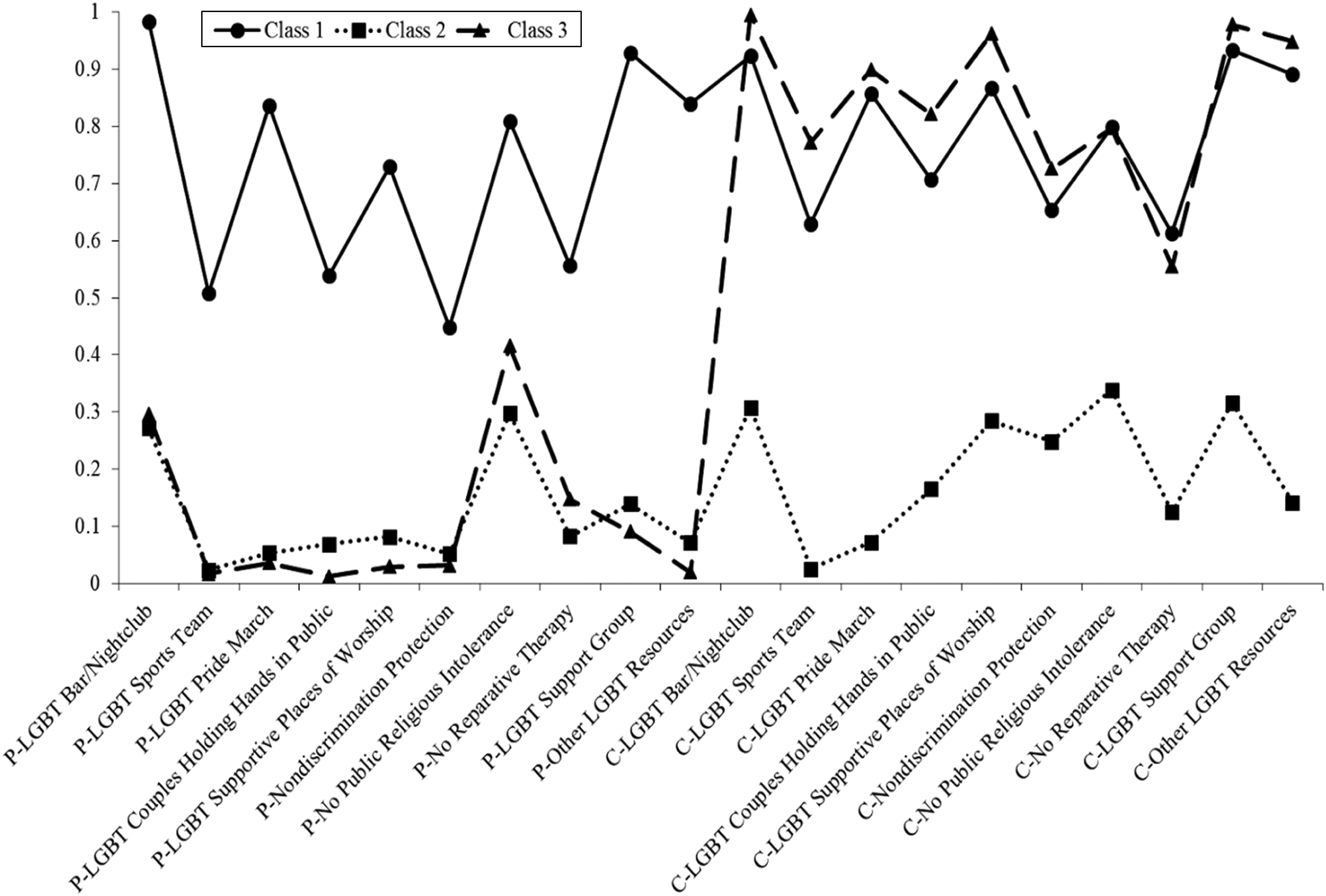
Estimated probabilities of context characteristics for a three-class model. P = past context/context of origin; C = current context living in at the time of the study.
Outness
One item developed by the researchers (“I am out to …”) assessed overall how out participants were to others about their sexual orientations. Scores ranged from 1 (out to no one) to 6 (out to all friends and family), with higher scores indicating greater levels of outness. Similar 1-item measures have been used to explore outness in previous LGB research (e.g., McGarrity & Huebner, 2014).
Social support
The Multidimensional Scale of Perceived Social Support (Zimet, Dahlem, Zimet, & Farley, 1988) was used to assess participants’ current social support. This scale includes 12 items that measured social support across the domains of family, friends, and significant others, and researchers have found it to be a reliable measure (α = .88; Zimet et al., 1988). For example, participants answered how strongly they felt supported on items such as “My family really tries to help me.” We created a scale score by averaging responses across all items. Response options ranged from 1 (strongly disagree) to 5 (strongly agree), with higher scores indicating greater social support (current study α = .92).
Relationship satisfaction
We used the Locke–Wallace Marital Adjustment Test (MAT; Locke & Wallace, 1959; original study reliability coefficient = .84) to assess relationship satisfaction. This scale includes 15 items (e.g., “Do you ever wish you had not started this relationship?”), which measured how satisfied participants were across areas such as finances, affection, and sexual relations. Response options ranged from 1 (always disagree) to 6 (always agree). Originally developed for other-sex couples, researchers have found the MAT to be a reliable measure of relationship satisfaction with same-sex couples and have used it since early research with same-sex couples (e.g., Gottman, Levenson, Gross, et al., 2003; Gottman, Levenson, Swanson, et al., 2003), in more current studies with same-sex couples (e.g., Holley, Sturm, & Levenson, 2010), and with heterosexual couples (e.g., Biesen, Schooler, & Smith, 2015; Halford, Owen, Duncan, Anker, & Sparks, 2014). We created a scale score by summing responses, with higher scores indicating more relationship satisfaction. The Cronbach’s α in the current study was .78, which is similar to other current studies that have utilized this measure of relationship satisfaction (e.g., α = .75; Halford et al., 2014).
Relationship equality
We used the Kurdek Current Relationship Equality Survey (Kurdek, 1995; original reliability coefficients ranged from .86 to .91) to assess equality within participants’ relationships. This scale includes 8 items measuring perceptions of power in the relationship, including such areas as investment of time in the relationship, commitment to working out problems, and being treated with respect. For example, participants indicated how much the following item was true about their relationship: “All things considered, my partner and I contribute an equal amount to the relationship.” Responses were measured on a scale from 1 (not at all true) to 9 (extremely true). We created a scale score by summing responses and higher scores indicated greater relationship equality (current study α = .94).
IH
We used two measures of IH in this study because of the measurement issues that have been previously identified in the literature (see Szymanski et al., 2008 for an in-depth review). Examining results across two measures provided more confidence in our findings about IH. We used two subscales from the Lesbian Internalized Homophobia (LIH) Scale (Szymanski & Chung, 2001), the subscale measuring personal feelings about being lesbian/bisexual and the subscale measuring attitudes toward other lesbian/bisexual women (original α in the measure development study = .79 and .77, respectively). The two subscales included items about participants’ feelings about their sexual orientations, such as feeling comfortable with themselves, self-hatred related to same-sex attraction, and negative judgments about other LGB women. For example, participants indicated the degree to which they agreed with the statement, “As a lesbian/bisexual, I am loveable and deserving of respect.” The original scale was developed for lesbians and we revised wording to reflect the inclusion of bisexual participants where appropriate. Responses were measured on a scale from 1 (strongly disagree) to 7 (strongly agree). We calculated a scale score by averaging responses, with higher scores indicating greater IH (current study α = .89).
In addition, we used the Nungesser Homosexuality Attitudes Inventory—Personalized Homonegativity Subscale (NHAI; Shidlo, 1994) to measure IH (original α = .90). This scale includes 15 items focused on comfort with one’s LGB identity (e.g., feeling depressed when thinking about sexual orientation). For example, participants indicated how much they agreed with the statement “I wish I were heterosexual.” We revised the wording of the scale to reflect the inclusion of bisexual and lesbian participants. Responses were measured on a scale from 1 (strongly disagree) to 4 (strongly agree). We created a sum and higher scores indicated greater IH (current study α = .78).
Participants and Procedures
To be eligible for the study, participants had to be at least 18 years old, identify as an LGB woman, and be in a same-sex relationship (not limited to monogamous relationships) for at least 6 months at the time of the study. Participants were not compensated for their participation. Using a multipronged 6-month recruitment effort through e-mail and phone, we reached out state by state to nonprofits and groups that served LGB individuals, as well as listservs, and contacted groups and individuals at least 3 times with invitations to participate. We also recruited participants through e-mail lists and advertisements on websites that were frequented by LGB individuals. All participants who met criteria for the study were allowed to access the survey. Through these recruitment efforts, we obtained participants from 48 different states and Washington, DC. After accessing the online survey, participants were provided with information about informed consent and either agreed or declined electronically.
Statistical Analysis
Data were analyzed using SPSS Version 19 and MPlus, Version 6. We selected a latent class analysis because this method identifies patterns in responses that characterize classes/groups of individuals with similar experiences (Masyn, 2013). We created profiles to characterize the supportiveness of the locations where participants originally lived (10 items identified through the focus groups), where they lived at the time of the study (the same 10 items), and shifts to more or less progressive contexts (defined by those with fewer or greater LGBT supports in the place they were living) across the lifetime. We tested a series of models with increasing class numbers to find a model that best fit the data. Evaluating model fit involved several methods, including comparison of fit statistics and the substantive and interpretive quality of the classes, which we describe below (see Masyn, 2013; Wang & Wang, 2012 for additional information on latent class analysis). First, a series of fit indices were evaluated, including the Akaike information criterion (AIC), Bayesian information criterion (BIC), adjusted BIC, log likelihood, and entropy values. In evaluating model fit, classes with lower AIC, BIC, and adjusted BIC values as well as higher entropy values better fit the data. In addition, the probability of endorsing each item was assessed for class homogeneity and class separation. Last, the substantive meaning and interpretative quality of the classes was also evaluated. Taken together, we used these analyses to determine the class solution that was thought to best represent the data. We then examined differences across these classes on minority stressors and interpersonal relationship variables.
Results
All variables were screened for normality and the NHAI was log transformed. Correlations and descriptive statistics are available in Table 1. For the latent class analysis, Table 2 contains the fit statistics for models ranging from one to three classes. The log likelihood, AIC, BIC, and adjusted BIC decreased with the addition of each class indicating improved model fit. While the four-class solution contained slightly better values on these fit statistics, substantive meaning of the classes decreased after the three-class solution. Examining the item probabilities across the three- and four-class solutions revealed that the three-class solution profiles were more substantively meaningful, with greater class separation and improved class homogeneity. Therefore, we determined that the three-class solution was the best fit to the data (see Figure 1 for the estimated probabilities for item endorsement).
Descriptive Statistics and Correlations.
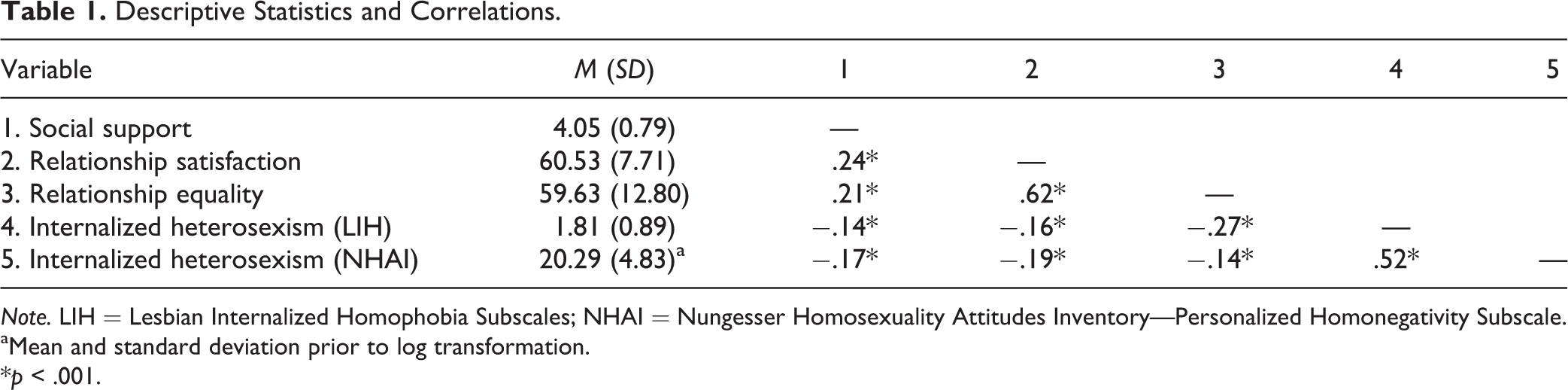
Note. LIH = Lesbian Internalized Homophobia Subscales; NHAI = Nungesser Homosexuality Attitudes Inventory—Personalized Homonegativity Subscale.
aMean and standard deviation prior to log transformation.
*p < .001.
Fit Criteria for Latent Class Analysis Models.

Note. AIC = Akaike information criterion; BIC = Bayesian information criterion.
Class 1 (n = 284; 27.77%) included participants who originally lived in relatively supportive contexts and continued to live in supportive contexts at the time of the study. In both their context of origin and where they lived at the time of the study, these participants had a high probability of endorsing access to LGBT bars, LGBT pride marches, supportive places of worship, LGBT support groups, and other LGBT resources; they were likely to not live in places characterized by religious intolerance of LGBT people. This group also had a high probability of seeing LGBT couples holding hands in public in the contexts they lived at the time of the study.
Class 2 (n = 281; 27.68%) included participants who lived in less affirmative contexts with few resources both in their context of origin and at the time of the study. These participants had a low probability of endorsing access to LGBT bars, LGBT sports teams, and LGBT pride marches in their contexts of origin. They were less likely to see LGBT couples holding hands in public or to have LGBT supportive places of worship, inclusive nondiscrimination policies, LGBT support groups, and other LGBT resources. They reported a higher likelihood of having reparative therapy groups or experiencing religious intolerance of LGBT people in their location. These probabilities continued to shape class membership in relation to the contexts participants were living in at the time of the study with the exception of LGBT bars, LGBT support groups, and religious intolerance of LGBT people. Overall, these participants had fewer supportive LGBT resources and lived in less affirmative contexts, both in their context of origin and where they lived at the time of the study.
Class 3 (n = 452; 44.55%) was the largest class and included participants who lived in less affirmative contexts with few resources in their context of origin but shifted to living in more affirmative contexts at the time of the study. This shift occurred in gaining access to LGBT bars, LGBT sports teams, LGBT pride marches, seeing LGBT couples holding hands in public, having supportive places of worship, nondiscrimination protections based on sexual orientation, LGBT support groups, and other LGBT resources.
With Class 3 as the reference group, we examined whether demographic variables of age and income predicted class membership. Income did not significantly predict membership in Class 2 (OR = .03, p = .43) or Class 1 (OR = −.02, p = .70), relative to Class 3. Also, while age was not a significant predictor of membership in Class 2 relative to Class 3 (OR = .01, p = .11), it was a significant predictor of membership in Class 1 (OR = −.04, p < .01). Individuals who were younger were more likely to be members of Class 1 than Class 3.
Both Class 1, M = 5.21; χ2(1) = 7.49, p < .05, and Class 3, M = 5.28; χ2(1) = 14.16, p < .05, had higher levels of outness than Class 2, M = 4.93. Class 3, M = 4.10, had greater social support than Class 2, M = 3.96; χ2(1) = 4.96, p < .05, although there were no significant differences with Class 1. Class 2, M = 0.14, had higher levels of IH than Class 3, M = 0.11, on the NHAI, χ2(1) = 14.01, p < .05. In addition, Class 2, M = 1.92, had higher levels of IH than Class 3, M = 1.75, on the LIH, χ2(1) = 5.10, p < .05, although there were no significant differences with Class 1 on either measure of IH. Also, we found no differences in relationship equality, χ2(1) = 1.65, p = .44, or relationship satisfaction, χ2(1) = .44, p = .80, across the three classes.
Discussion
Context can play a major role in shaping the life experiences of LGB individuals. Across history, there have been major social and political shifts that have benefited the mental health and well-being of LGB populations (Andersen & Fetner, 2008; Sherkat, Powell-Williams, Maddox, & de Vries, 2011), including advancements in marriage equality. Although these broader shifts influence access to resources, less research has been conducted on how changes in community-level resources can influence the lives of LGB individuals. This study revealed that examining changes in access to supportive community resources, in addition to structural stigma that may manifest on the community level, can be important to understanding experiences of minority stress for LGB women.
The latent class analysis indicated that most LGB women shifted their residences over time to have access to more resources. Because this study is cross-sectional and utilized a convenience sample, we cannot draw inferences at the population level. Even so, it is likely that this trend may be reflected in the larger population, given general shifts toward higher levels of visibility and acceptance for LGB individuals and relationships (Andersen & Fetner, 2008; Herek, 2006; Pew Research Center, 2013a, 2013b). For example, we found participants who always lived in contexts with more LGB-affirming resources (members of Class 1) tended to be younger than participants who shifted from low to high access to LGB-affirming resources (members of Class 3), which may be indicative of this general shift.
LGB women who shifted to more affirmative contexts had better overall outcomes, including higher levels of social support, less IH, and more outness, than those who stayed in a more heterosexist setting. A shift to a more affirming climate can both facilitate positive development and potentially ameliorate the impact of marginalization and minority stress experienced in negative climates. For example, while growing up in a heterosexist context resulted in higher levels of IH, shifting to a more progressive area may have provided corrective experiences; individuals in this class appeared to develop more positive views of themselves. Given the relation between IH and psychological distress (Newcomb & Mustanski, 2010), identifying factors that can buffer these negative outcomes can provide further understanding of the conditions under which IH develops, which is critical to decreasing mental health disparities among LGB populations. In addition, higher levels of social support (Graham & Barnow, 2013; Meyer, 2003) and outness (Legate et al., 2012; Morris et al., 2001) have been associated with less psychological distress and creating more positive contexts appeared to be associated with these protective factors.
Although the three classes identified in this study differed in their experiences of minority stress, their relationship satisfaction and equality remained high across all of the groups. These results suggest that relationship quality may not be affected, even in contexts that are characterized as more heterosexist and that lack affirmative community resources. Despite the negative effects that stigma and minority stress can have on intimacy, previous researchers have found that same-sex couples are often able to maintain successful intimate relationships (Connolly, 2005; Frost, 2013). Given that these relationships can serve as a protective factor against psychological distress (Blair & Holmberg, 2008; Graham & Barnow, 2013), it is important to note the resilience in relationship satisfaction and equality these women reported even in less affirming climates.
Limitations and Future Research
Even though our research provided insights into the role of context on minority stress and relationships among LGB women, there are limitations to our study. The majority of our sample was well educated (with over 50% of the participants having attained a college degree) and primarily White, with limited representation of ethnic or racial minorities. As a result, we were unable to conduct analyses specific to each of the ethnic or racial minority groups in the sample. Research team members were asked to prioritize LGB organizations and communities serving people of color during recruitment; however, the lack of women of color in the sample is a limitation. Web-based sampling typically draws in self-selected participants who report high levels of education and income as well as higher percentages of White respondents than the general population (see Riggle, Rostosky, & Reedy, 2005 for a discussion of online research with LGB communities). Additional research would be beneficial, as multiple minority statuses, such as race and sexual orientation, may be related to greater stigma, which can result in more mental health issues (Bowleg, Huang, Brooks, Black, & Burkholder, 2003; Stanley, 2004). It also may be helpful to consider the innovative social network strategies used by other researchers in the field, in order to better reach and represent the experience of multiply marginalized groups (Hwahng, 2013; Scheim & Bauer, 2014).
Also, our use of a single item to measure outness is a limitation; future research may benefit from more complex measurement of this construct. For example, future research may examine outness within various contexts or acts of disclosure and how these relate to supports where one lives. And, finally, although there was not a latent class characterized by shifts from progressive to less affirming contexts, this is an experience that some LGB women undoubtedly have. Further examination of the experiences of women in this category would provide valuable information on how shifting to contexts with a lack of resources may increase minority stress. Although this class was not evident in our sample, future research may reveal such a group, given that some women may face different circumstances that would take them to less affirming areas (e.g., job transitions). In addition, the sample potentially suffered from self-selection bias and was composed of high functioning individuals. Lastly, participants may have experienced challenges in remembering information about the locations they originated from.
Despite the limitations, the current study contains many areas of strength. The use of latent class analysis is a novel way of exploring shifts in contextual experiences and how these changes relate to intrapersonal and interpersonal experiences of sexual minorities. This approach allowed us to create unique groups or classes based on participants’ experiences. Latent class analysis has been minimally used so far within LGB-focused research to examine areas such as identity formation of LGB adolescents (Bregman, Malik, Page, Makynen, & Lindahl, 2013) and profiles of suicide patterns in adolescents (Jiang, Perry, & Hesser, 2010). Our study builds on the use of latent class analysis with LGB samples to provide a more nuanced examination of how changes in one’s context may influence experiences of minority stressors as well as interpersonal relationships. Our study reveals that changes in contexts may ameliorate the effects of previously living in a less affirming context. Another strength of our study is the large sample size of LGB-partnered women. In addition, our study included two measures of IH. Because of the limitations of individual measures of IH (see Szymanski et al., 2008 for a review), the use of multiple measures is vital in understanding the complex and changing feelings and behaviors that are typically associated with IH.
The findings of this study highlight the significance of community-level resources in relation to minority stress for LGB women and the potential resilience of women’s relationships, an overlooked area of research. Future longitudinal research is needed to explore determinants of access to resources and what predicts trajectories of access across the lifetime. Future work should further examine the coping strategies utilized by LGB women to manage minority stressors. Researchers could also explore how different community-level resources relate to mental health outcomes and serve as potential mediators or mechanisms underlying how access affects well-being. One area that could be examined in more depth is how benefits or challenges to outness differ across different types of contexts; this would be especially useful, given the mixed findings in previous research. Research that separately examines the experiences of lesbian and bisexual women may reveal different ways that affirmative resources buffer the impact of minority stress for each of these groups. Also, women may experience sexism in addition to heterosexism; researchers would benefit from taking this into account in assessing the role of context in relation to minority stress. Last, while this study did not include transgender participants, studies examining the role of context in the manifestation of minority stressors in the lives of transgender individuals are greatly needed.
Practice Implications
Our results have important implications in the political and clinical realms. Given that LGB-affirming climates were associated with increased social support, outness, and decreased IH, advocating for legal protections can support sexual minority clients’ resilience and mental health. Our results highlight the importance of mental health professionals being aware of and facilitating connections between LGB clients and affirming community resources. LGB clients may also need to find ways of coping within less affirming contexts, as more affirming resources might not be forthcoming. Mental health professionals can assist their clients in a number of ways and from a variety of approaches. For example, interventions may focus on helping clients to incorporate an understanding of the systemic forces that have an influence on their lives and well-being, which can be helpful to decrease self-blame and internalized stigma (e.g., Puckett & Levitt, 2015; Russell & Bohan, 2007). Interventions also may help clients develop flexibility in responding to their experiences and improve their abilities to detach from negative thoughts, which has proven useful in managing IH (Yadavaia & Hayes, 2012). This flexibility could be useful in less affirming contexts, given that clients may not be able to immediately change their surroundings, but instead must learn ways of coping and persevering in the face of challenges that they encounter.
Conclusions
Our study is relevant to recent legislature passed to strike down anti-LGB laws, such as marriage bans, recent rulings in favor of marriage equality, the Supreme Court’s decision on this issue, and progress in gaining nondiscrimination protections in individual states. Our findings demonstrate clear benefits for LGB individuals in climates with more resources and greater visibility of LGB communities. Our study supports activism, social change, and the need for funding efforts to increase access to LGB-affirmative contexts as well as challenging anti-LGB legislation that may be put forward. These changes are needed beyond political changes, to ensure that LGB individuals are provided with affirming and positive environments and supports. Progressive action to achieve full equality will provide spaces where LGB individuals can develop more positive views of themselves and greater identity pride, so that they can flourish in their interpersonal relationships.
Footnotes
Declaration of Conflicting Interests
The author(s) declared no potential conflicts of interest with respect to the research, authorship, and/or publication of this article.
Funding
The author(s) received no financial support for the research, authorship, and/or publication of this article.
References
Supplementary Material
Please find the following supplemental material available below.
For Open Access articles published under a Creative Commons License, all supplemental material carries the same license as the article it is associated with.
For non-Open Access articles published, all supplemental material carries a non-exclusive license, and permission requests for re-use of supplemental material or any part of supplemental material shall be sent directly to the copyright owner as specified in the copyright notice associated with the article.
