



Abstract

Teaching complex social topics in undergraduate classrooms has become more contentious since the 2016 presidential election and the rise of information illiteracy and fake news. Information literacy, a learner’s ability to determine when they need information and how to locate and critique information based on its source and purpose, is a key component of scholarly development (Association of College and Research Libraries Board, 2015). Ironically, as access to information increases, misconceptions about current events and public policy also increase (Klurfeld & Schneider, 2014). Students are increasingly suspicious of even well-reputed fact-checking organizations meant to buffer against fake news (e.g., Snopes, PolitiFact) when the organizations report findings with which students disagree (Journell, 2017). Access to distorted and incorrect information about socio-psychological issues (e.g., gender identity, institutional racism), alongside poor information literacy, poses a significant problem for psychology educators whose learning objectives often center on multicultural competence; accurate reading and interpretation of news about psychological studies; and critical thinking about mental health, community intervention, and prevention policies.
Venner and Verney (2015) proposed motivational interviewing (MI), an approach to behavior change designed to address health patient behaviors (e.g., substance use cessation; Miller & Rollnick, 1991), as a method for teaching multicultural concepts to graduate psychology students. MI posits that an individual changes when they identify reasons for change. The individual becomes more resistant to feedback when an authority (e.g., therapist, educator) tells an individual their behavior is wrong. The individual will further entrench in their current beliefs, regardless of whether these beliefs align with facts.
MI, constructivism, and information literacy paradigms all assume that learning (i.e., attitude, cognitive, or behavioral change) involves an active learner who constructs their own understanding regarding a particular topic. I propose an integration of MI and constructivist learning theory to facilitate learners’ critical consumption and application of psychological concepts, that is, information literacy. This integration will assist learners and educators with course objectives often regarded as controversial, unappealing, and/or difficult to teach.
Motivational Interviewing
I focus on the following MI concepts: the spirit of MI, readiness for change, and promoting change talk (i.e., an openness to alter their behaviors or beliefs). MI spirit stands in contrast to the righting reflex, an expert’s desire to immediately correct the learner’s stated opinion, interpretation, or attitude, and instead promotes collaboration and empathy toward the learner. According to MI, these instances of “righting” when a learner has not fully bought into a new concept can cause the learner to retreat further into their original belief or opinion. Educators often feel a desire to engage in righting to assert expertise, correct misinformation, and move on in a way that appears more efficient than learner-facilitated discussion or exploration. For MI to be effective, the educator needs to embody the spirit of MI to facilitate four pillars: partnership, acceptance, compassion, and evocation for learners (Miller & Rollnick, 2013).
In the classroom, partnership requires a collaborative exploration of learners’ prior experiences and beliefs about a particular topic. Acceptance emphasizes learner autonomy in the learning process and an understanding of learner experiences. Compassion is a commitment to safety for all learners in the environment (Venner & Verney, 2015). Acceptance and compassion of learner viewpoints grow potentially difficult on certain concepts, particularly multicultural issues, and will be discussed in detail via a case example later. Evocation resembles the Socratic method of teaching, wherein the educator draws out the learner’s thoughts on a particular topic (Venner & Verney, 2015). In the classroom, evocation becomes a pre-assessment to understand a learner’s current motivation and knowledge on a subject.
A learner’s level of motivation on acquiring new information affects the extent to which the learner will meaningfully learn said information. Learners who have low motivation are less likely to practice good information literacy as their desire to maintain their scheme will lead to a conclusion that they do not need additional information about a source and do not need to critically examine where their current information is coming from. In their stages of change model, Prochaska, Norcross, and DiClemente (2013) propose that tailoring interventions to an individual’s level of readiness to change makes change more likely. In Stage 1, pre-contemplation, the learner sees no need to acquire new information or challenge their existing scheme (e.g., a learner enters a psychology of gender course with a passive acceptance of traditional gender roles and unawareness of sexism). In Stage 2, contemplation, the learner realizes they should learn new information or accommodate their scheme but has not made a commitment to do so. For example, a student enrolled in a multicultural psychology class recognizes they should attend to multicultural issues but is not ready to acknowledge how multicultural concepts, such as intersectionality or institutional prejudice, has affected their life. Moreover, they may not have the educational or cognitive resources to do so. In Stage 3, preparation, the learner has voiced intent to acquire specific information and develops a plan of how they will do so (i.e., recognition and readiness to access new information and apply it or be more critical of current information sources). By this stage, learners should be able to articulate why new information is meaningful. In Stage 4, action, the learner actively accommodates their schemes for new information and is critical about where and how they are acquiring new information (i.e., literacy; is able to describe how institutional prejudice or intersectionality relate to their life) and uses these concepts to account for ongoing experiences for themselves and others. In the final stage, maintenance, the learner independently applies their changed schemes and information literacy behaviors to novel situations (e.g., the learner can describe how gender roles and norms or institutional barriers affect new experiences for themselves or others).
Two means of promoting change are rolling with resistance and developing discrepancy (Miller & Rollnick, 2013). In a clinical setting, rolling with resistance acknowledges the client’s preference to maintain the status quo (e.g., “for you, alcohol is a way to de-stress”). Developing discrepancy involves repeating client’s statements that indicate a desire for change and contrasting them with the client’s status quo statements (e.g., “alcohol helps you de-stress, and I also hear you say it leads to you being late for work, which then makes you more stressed”). Within a classroom, rolling with resistance does not mean repeating or validating incorrect information (i.e., schemes); it means acknowledging a learner’s personal experiences that established their scheme (e.g., “It seems important that hard work accounts for your family’s success and difficult to acknowledge how privilege may have played a role. What does it mean to you that your family worked hard for their success?”). Developing discrepancy then involves collaboratively exploring the learner’s personal experiences alongside newly presented ideas. From an information literacy perspective, this involves assisting the learner in exploring the source validity of where the learner is getting their information (e.g., “Some of the family experiences we’ve covered today show families working hard but continuing to struggle. How can we account for this?”). Assessing learners’ stages of change and working with each stage is described in detail with an example course objective and assignments at the end of the article.
Constructivism
Constructivism assumes learners create information through personal experience and their environment (Jones & Brader-Araje, 2002) and store the information internally in schemes or mental maps. Thus, learners enter classrooms with established schemes based on personal, meaningful experiences. From an information literacy perspective, this reflects a tendency to rely on anecdotes and specific examples rather than reliable, more meaningful, or representative data.
When a learner places new information in a pre-existing scheme with no change to the basic structure or content of the scheme, this is assimilation (Jones & Brader-Araje, 2002). When a learner encounters new information and realizes this information does not fit into an existing scheme, they can either (a) create a new scheme for this information or (b) alter their existing scheme to accommodate the new information. The process of altering schemes is accommodation (Jones & Brader-Araje, 2002). As social psychologists have long noted, individuals prefer heuristics that allow them to take new information and place it atop old knowledge (i.e., assimilation through confirmation bias; e.g., see Del Vicario et al., 2016), as this requires less cognitive effort than reconciling old and new information. For example, many people conflate gender and sex, seeing these two distinct constructs as a single scheme: gender/sex rather than a gender scheme and a sex scheme. These learners are hesitant to absorb new information regarding the psychology of gender. Learners with a gender/sex scheme will face more challenges with such course material, as their pre-existing schemes that gender and sex are the same will make it difficult to approach gender non-binary issues in a curious and open-minded manner.
Learners often need an incentive to accommodate rather than assimilate, which can come from presenting information that contradicts a learner’s current scheme. Disequilibrium is a contradiction between a person’s exposure to new information and what that person already knows or believes to be true. It incentivizes people to change their existing scheme to accommodate the new information, thus reducing disequilibrium (i.e., cognitive dissonance, see Elliot & Devine, 1994). Often, learners need an opportunity to discover how their current scheme contradicts a particular idea or does not explain a new situation.
Promoting Change
Bruning et al., (2004) identified action steps to assist learners in accommodating schemes to include new course information. Successful accommodation of a scheme requires (1) presentation and recognition of current and new schemes, (2) an opportunity to test the old scheme in new situations and wrestle with its utility (promoting disequilibrium), (3) presentation of the new scheme with multiple examples, and (4) perceived utility of the new scheme (Bruning et al., 2004). Educators can use MI techniques to facilitate these steps outlined to promote scheme accommodation and a more sophisticated exploration of available information about a topic.
Step 1 parallels MI’s evocation: a collaborative exploration of what the learner finds attractive or positive about their current scheme (i.e., why the current scheme is preferable and the learner wants to maintain the status quo). Educators may need to roll with resistance by acknowledging where the learner’s current scheme is in relation to course material. Step 2 aligns with MI’s developing discrepancy to promote change talk and recognize their current scheme is not useful. Educators should give learners multiple opportunities to test prior schemes’ usefulness at explaining new information. Steps 3 and 4 involve presentation of the new course material and are congruent with the planning stage of behavior change: identifying new information and recognizing its utility over original schemes. When possible, educators should enact Steps 3 and 4 after learners have exhibited some change talk during Steps 1 and 2. However, most course content begins at Step 3: presentation of new material. Without addressing Steps 1 and 2, learners may discount the new material or incorrectly assimilate it atop old, possibly incorrect, information.
Reframing Course Objectives
When educators encounter student amotivation, preference for the status quo, and/or resistance, frustration arguably increases and self-efficacy around effective teaching decreases. Course objectives reflect high expectations for learners to integrate a large amount of new material successfully into their knowledge base and to use this new information effectively. Unfortunately, course objectives often skip crucial steps according to MI, constructivist, and information literacy principles: a collaborative analysis of the utility of the learner’s current schemes, increased educator and learner awareness of where the learner currently is in approaching the subject at hand, and where the learner is getting their information. Without explicit recognition of such steps, educators understandably become frustrated with the apparent lack of engagement, academic progress, and information literacy in some learners throughout the semester, and learners, likely perceiving the new information as less useful than their existing schemes, become even less motivated.
Educators can re-work course objectives by explicitly recognizing the preliminary steps—evocation of learner schemes and assessing learners’ motivation for and stage of change—in tougher classroom topics. If learners are in pre-contemplation or contemplation stages, adding in course time for additional exploration will make it easier to roll with resistance (when appropriate) without feeling frustrated or pressed for time. This may result in reducing the amount of material covered in favor of students learning fewer concepts more meaningfully. When educators re-examine their course objectives through this framework, they are less likely to become frustrated with learners. Reducing frustration will reduce burnout and will maintain an opening for educator-learner collaborative exploration of old and new schemes alike. While very difficult, when educators can re-evaluate their course objectives to meet students where they are, the classroom will likely become more collaborative and open and learners will maintain new schemes more effectively.
Teaching Institutional Racism: An Example
Educators teaching about institutional racism often encounter learners whose scheme for success includes the meritocracy myth (i.e., a person’s attitude and effort determine their level of success in a system with no regard for privilege or institutional barriers; McNamee & Miller, 2009). Endorsement of meritocracy is often linked to family stories of ancestors who worked hard to achieve their success, meaning these schemes are often highly personally relevant and emotion-laden. This can result in discounting the very real occurrences of institutional racism in the United States. Educators who begin their lesson with definitions of institutional racism risk learner disregard for these critical concepts, as they are starting at Step 3 rather than Step 1 of Bruning (2004) and associate’s model and assume their learners are in the action stage of change (see Figure 1). Educators may instead explore learners’ current schemes for privilege and racism by inviting learners to reflect on how they perceive people can achieve success and social mobility, thereby meeting the learner where they are. Educators can then use a variety of methods to introduce new scenarios (e.g., documentaries, class speakers, peers’ sharing of experiences) and ask the learner to explore how or whether their current scheme accounts for the new scenarios (contemplation stage). Rather than an educator firmly stating that the learner’s original scheme is incorrect, the educator can collaboratively explore the learner’s scheme and how it might contradict new experiences. In this way, the learners are invited to struggle with such discrepancies at their own pace. Reflection papers that explicitly solicit the learner’s personal experiences are helpful, as the learner can explore these confusions and contradictions privately. As the learner increases their awareness that their current scheme is not adequate, the educator can reflect the learner’s change talk back to them and slowly introduce the lesson’s objective (e.g., institutional racism, planning and action stages) as a solution and scheme that does account for all examples (Bruning et al.’s, 2004, steps 3 and 4). Educators can then encourage learners to evaluate where they are obtaining information as they move forward in developing their new schemes (i.e., information literacy). Figure 1 demonstrates progression from the preparation to maintenance stages of change on the topic of institutional racism and the myth of meritocracy, including example learner statements at each stage.
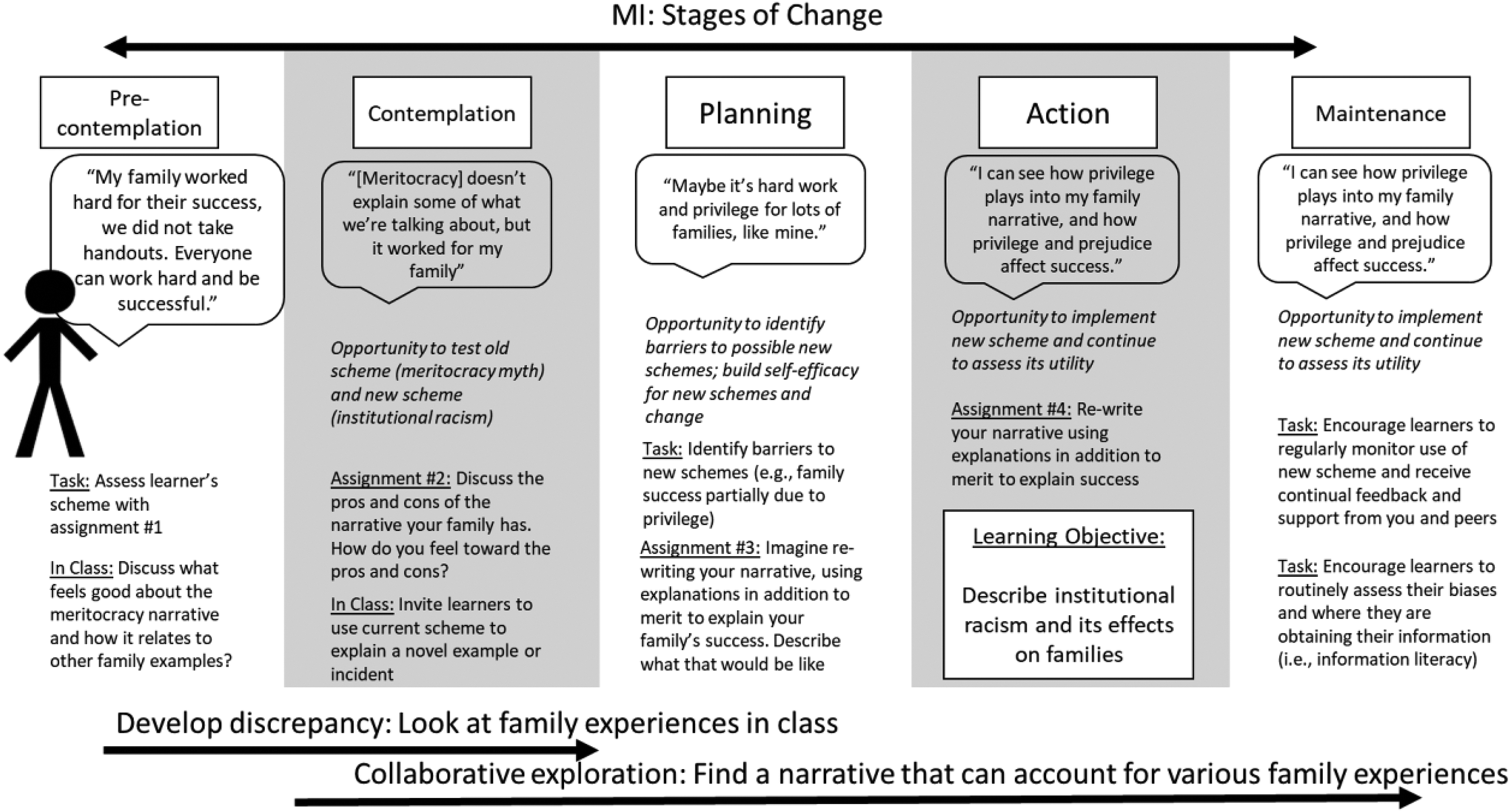
Visual representation of teaching on institutional racism while integrating motivational interviewing (MI), constructivism, and information literacy.
Assessing Stage of Change With Assignments
As noted above, constructivist teaching begins with an assessment of learners’ current schemes, a procedure that aligns with assessing a learner’s stage of change. Assessments should include learners’ attitudes toward a topic as well as their current knowledge base, as a learners’ perception affects their motivation to learn new or different ideas. Instructors can begin with an open-ended homework assignment (and then follow with multiple choice quizzes to assess concrete knowledge if desired) to determine their current schema (Figure 1). After reviewing all the learners’ papers, the instructor has an idea of how each learner relates to ideas of meritocracy and institutional privilege. The assessment should be followed up with a class discussion, again relying on open-ended questions. Depending on the class composition (e.g., Are these graduate or undergraduate students? Have the students taken courses together before?), the instructor can ask learners to volunteer their own family reflections but should also come prepared with vignette examples of different families and family narratives. I recommend real-life examples because they are more difficult for learners to dismiss (the book, The Other Wes Moore, is a personal favorite; Moore, 2011). Reflection assignments should be ongoing and progress through stages of change, with discussion and lectures in between assignments.
Example course objective
Challenge the meritocracy myth and introduce idea of institutional racism and privilege.
Example assessment #1
(To be given at the beginning of unit). Families have narratives that explain their successes and struggles. For example, there may be a “hero” in your family who contributed to your family’s successes, like a single mother or a hardworking adult. How does your family explain their success? How does your family explain their struggles? Follow-up assessments and assignments to Assessment #1 are listed in Figure 1. Assignments can be tailored to also address where learners developed their original schemas as a way to integrate information literacy.
Example discussion
Did families tend to attribute successes to internal (e.g., family members, religious beliefs/values) or external (e.g., access to health care, public policy) factors? What about struggles? Why? The instructor can align some of these attributes to ideas of meritocracy, institutional racism, public policy, and so forth, and invite learners to comment on why families might gravitate toward a particular narrative. MI emphasizes the importance of open-ended questions, which encourages exploration.
Addressing classrooms with learners of varying stages of change
Instructors will almost certainly work with classes comprising multiple stages of change. In addition to setting ground rules for class discussion, instructors can determine the stage of change composition of the class with initial assignments. Instructors should consider what learner statements they are going to challenge directly and what statements they may allow peers to challenge or explore the learner’s statements. This should be weighed in consideration with the classroom climate: Do the students appear comfortable challenging each other? Is there a monopolizer (and what is their stage of change)? When possible, learner self-efficacy should be supported: When a learner receives the message that they as a person are wrong, rather than their statements being incorrect, they are likely to shut down and remain in their current stage of change. Giving feedback about and exploring learner statements rather than giving feedback about learners themselves assists learners in understanding what they should explore.
Summary
Integrating MI, constructivism, and information literacy considerations into course lessons and objectives is helpful when addressing difficult and emotion-laden topics. Such an approach assists learners in internalizing course material and assists educators with stress related to teaching difficult topics.
Footnotes
Declaration of Conflicting Interests
The author(s) declared no potential conflicts of interest with respect to the research, authorship, and/or publication of this article.
Funding
The author(s) received no financial support for the research, authorship, and/or publication of this article.
