




Abstract
Sexual objectification and Jezebel stereotype endorsement, a racialized characterization of Black women as promiscuous, have been linked to harmful violence attitudes toward women. Although Black women’s experiences of sexual objectification may be compounded by racialized stereotypes, research has yet to examine how these processes intersect to influence justification of intimate partner violence toward women. This study fills this gap in the objectification literature by examining associations between interpersonal sexual objectification, endorsement of racialized stereotypes, and justification of violence toward women in a sample of Black men and women. Participants were 432 Black Americans who completed an online survey. Among Black men, we found that greater objectifying behaviors and greater endorsement of the Jezebel stereotype were associated with greater justification of violence toward women. We did not find evidence of an interaction between these two processes. Among Black women, we found an interaction between objectification experiences and stereotype endorsement, such that justification of violence was highest for Black women who endorsed the Jezebel stereotype and had more frequent experiences of sexual objectification. Violence prevention work, such as perpetrator rehabilitation programs and victim support groups, should explicitly address how stereotypical images of Black women impact their experiences of violence.
Sexual objectification of women is pervasive in Western society (i.e., the United States, European countries, and Eurocentric influenced places) and is theorized to manifest in three contexts: visual media that depict objectification in interpersonal social encounters, visual media that focus on women’s body and their body parts, and actual interpersonal and social encounters (Fredrickson & Roberts, 1997). The adverse consequences of sexual objectification are far-reaching, with evidence linking it to increased body shame, anxiety, and preoccupation with bodily appearance instead of internal bodily functions; in turn, these outcomes are associated with poorer mental health such as depression, eating disorder symptomatology, and sexual dysfunction (for a review, see Moradi & Huang, 2008). In addition, research suggests that sexual objectification is associated with self-objectification, which occurs when women internalize an outsider’s perspective on the self—in other words, they see themselves as objects to be evaluated based on their appearance (Fredrickson & Roberts, 1997). To date, most research has examined the impact of sexually objectifying visual media on these outcomes (for review, see Ward, 2016).
However, recent research has begun to examine the consequences of interpersonal sexual objectification, which refers to the evaluation of women’s bodies during social interactions. These experiences can occur on a continuum from more subtle, insidious behaviors, such as the objectifying gaze, to more egregious and harmful behaviors, such as street harassment and sexual violence and rape, all of which have documented negative consequences for women (Fredrickson & Roberts, 1997; Rudman & Mescher, 2012). Although women (Kozee et al., 2007) and men (Davidson et al., 2013) can be sexually objectified and sexual objectifiers (Strelan & Hargreaves, 2005), most studies have focused on the implications of men’s sexual objectification of women given that men report more interpersonal sexual objectification perpetration than women (Gervais et al., 2018). Furthermore, there is evidence that women experience more adverse consequences of interpersonal sexual objectification than men (Gervais et al., 2011; McKinley, 2006; Saguy et al., 2010).
Despite a robust literature on the consequences of objectification for women, much of this knowledge is based on research conducted with predominately White samples (Moradi & Huang, 2008). The dearth of empirical studies using diverse samples may leave gaps in our understanding of how sexual objectification impacts women at different social locations. For instance, theoretical perspectives on sexual objectification posit that racialized stereotypes about women of color as animals and sexual objects may exacerbate the negative consequences of sexual objectification (Fredrickson & Roberts, 1997). Thus, it is critical to consider how specific racial stereotypes about women of color, which are connected to their identities as both women and racial/ethnic minorities, intersect with sexual objectification, particularly their experiences of interpersonal sexual objectification. Research has yet to empirically test associations between racialized stereotypes, interpersonal sexual objectification, and violence toward women. In this study, we examine whether the Jezebel stereotype, a historical characterization of Black women as sexually promiscuous, moderates the potential association between interpersonal sexual objectification and justification of intimate partner violence toward women. We also examine this relationship in a sample of Black women and men.
Interpersonal Sexual Objectification and Violence Toward Women
The perpetration of sexual objectification toward women is associated with several adverse outcomes, including physical and sexual victimization (Rudman & Mescher, 2012; Vasquez et al., 2018). Moreover, evidence suggests that interpersonal sexual objectification is related to violence against women and that this link may be related to the denial of women’s personhood. Indeed, objectification is argued to dehumanize women and to contribute to the perception that they are objects for the consumption and use of others (Gervais et al., 2012; Haslam, 2006; Loughnan et al., 2010; Loughnan & Pacilli, 2014). Several experimental and correlational studies support this claim (Heflick et al., 2011; Loughnan et al., 2010). For example, research shows that objectified women are perceived as more animal-like than non-objectified women (Morris et al., 2018).
As it relates to sexual violence, Rudman and Mescher (2012) found that men who implicitly associate women with animals reported a greater willingness to engage in sexual harassment and rape toward objectified targets and reported more negative attitudes toward female rape victims. Additionally, correlational research has shown that men’s self-reported perpetration of sexual objectification is associated with greater acceptance of sexual violence toward women. Specifically, using the Interpersonal Sexual Objectification Scale–Perpetration Version (ISOS-P), Gervais et al. (2014) found an association between college men’s heavy drinking, perpetration of sexual objectification, and sexual violence such that heavy episodic drinking accounted for the relation between greater sexual objectification perpetration and more sexual aggression. Additionally, research shows that sexually objectifying women is related to harmful violence attitudes, including victim-blaming beliefs (Loughnan et al., 2013), and lower willingness to help objectified women when they experience violence (Gramazio et al., 2018; Pacilli et al., 2017).
Although there is evidence of a link between interpersonal sexual objectification and sexual violence, less work has examined whether interpersonal sexual objectification is associated with negative perceptions of women who are victimized by an intimate partner. Intimate partner violence (IPV) is defined as the use of violence, including physical, emotional, sexual, economic, or psychological violence, by a current or former intimate partner (Jewkes, 2002). Given that approximately one in four women report having experienced severe physical violence from an intimate partner in their lifetime and the plethora of negative consequences resulting from IPV, it is critical to investigate this association (Centers for Disease Control [CDC], 2012). It is possible that the dehumanizing consequences of interpersonal sexual objectification may extend to greater justification of violence when women are victims of IPV. Moreover, the majority of the sexual objectification literature has focused on predominately White samples, limiting our understanding of Black women’s sexual objectification experiences and the sociocultural factors that influence these experiences (Moradi & Huang, 2008). Given these gaps in the literature, this study examines the connection between interpersonal sexual objectification (both objectifying behaviors and experiences of objectification) on IPV attitudes. Further, we also consider how unique historical stereotypes about Black women that are both racialized and gendered may influence this link.
Understanding the Objectification of Black Women Through a Gendered Racism Lens
The scarcity of research on how sexualized stereotypes impact Black women’s experiences of sexual objectification may hinder our understanding of the consequences of objectification for this population, particularly because there is evidence that Black women may be perceived as more sexual than White women. For example, Black girls are perceived as more knowledgeable about sex compared to White girls, with the perceived differences beginning as early as age 5 (Epstein et al., 2017). Similarly, using eye-tracking software, Anderson et al. (2018) found that White participants focus more on the sexual body parts of Black women targets to a greater extent than White women targets. These findings suggest that race impacts women’s susceptibility to being sexually objectified. Furthermore, the consequences of sexualization on victim-blame may be influenced by societal stereotypes of Black women (e.g., being hypersexual and promiscuous). For instance, Black female victims of violence may be judged as more culpable for their victimization than White female victims of violence (Dupuis & Clay, 2013; Esqueda & Harrison, 2005; George & Martinez, 2002; Harrison & Esqueda, 2000). For example, Black rape survivors are considered more sexually promiscuous than White survivors and attributed more blame for their victimization (Donovan, 2007). Additionally, people may be less willing to intervene to help Black women when they experience violence (Katz et al., 2017).
It is possible that historical stereotypes about Black women as promiscuous may contribute to societal justification of violence toward them and less willingness to intervene when they are victims of violence. In this study, we examine the effect of the Jezebel stereotype, which depicts Black women as promiscuous, hypersexual, and seductive (Collins, 2000; Gillum, 2002). Although characteristics of the Jezebel, such as being hypersexual, can be targeted at women from all racial ethnic backgrounds, the Jezebel stereotype has been used to historically denigrate Black women (Collins, 2000; Jewell, 1993). In the antebellum South, Black women and their bodies were exploited in the most perverse and horrific ways, including being completely exposed and examined on auction blocks, being forced to breed, and being raped by both slave owners and enslaved men (Collins, 2000; Littlefield, 2008; Stephens & Phillips, 2003; West, 1995). Portraying Black women as Jezebels contributed to the belief that Black women were sexually available aggressors seeking to fulfill their animal-like desires instead of non-consenting victims (Collins, 2000; Jewell, 1993). Further, there were no laws to protect Black women against these abuses, and slave owners often used the Jezebel stereotype to justify the use of violence against them (Collins, 2000). Thus, the Jezebel stereotype functioned to legitimize the dehumanization of Black women, reinforced the construction of the Black female body as an expendable object used for the pleasure and profit of others, and worked to maintain patriarchal constructions of White womanhood through the denigration of Black women (Collins, 2000, 2004; Crenshaw, 1989; hooks, 1992; West, 1995). Moreover, there is evidence that contemporary media representations of Black women closely mirror 19th-century stereotypes about Black women’s sexuality and have consequences for how Black women are perceived and treated today (Collins, 2000; hooks, 1992; Jerald et al., 2017; Roberts, 1999; Stephens & Phillips, 2003; Tyree & Kirby, 2017). Taken together, theory suggests and research supports that racialized stereotypes about Black women’s sexuality are intricately linked to their objectification.
Racialized Sexual Objectification: Considering Black Men and Women
The historical stereotyping of Black women as less than human in a White patriarchal society creates unique objectification experiences for Black women. As we have argued, the objectification of Black women has been connected to historical racialized characterizations of their sexuality (i.e., the Jezebel stereotype) as expendable sexual objects for the profit of others (Collins, 2000). Importantly, the impact of these stereotypes may shape within-group interpersonal interactions between Black men and women. Further, the perpetration of violence toward Black women may reflect patriarchal systems of power and privilege, which may be influenced by sexual objectification and endorsement of racialized stereotypes. Therefore, it is important to examine the relationship between interpersonal sexual objectification experiences (i.e., the act of treating others as a sexual object or being treated as a sexual object) and Jezebel stereotype endorsement (i.e., racialized beliefs that reduce Black women to their body parts and sexual functioning) on violence perceptions in Black samples.
Although men from marginalized racial/ethnic groups may have a disadvantaged status in comparison to White men, they may still use their male privilege to exert power over women within their own communities (Cole & Guy-Sheftall, 2009). For example, research on street harassment, defined as a form of sexual terrorism that involves hostile interpersonal interactions focused on women’s bodies that occur in public places, suggests that being objectified in this manner may be a precursor to violence targeted at women (D. Davis, 1994). Particularly, the street harassment of Black women by Black men detrimentally affects Black women, sometimes having fatal consequences (e.g., the death of Sakia Gunn; Fogg-Davis, 2006). Thus, from a patriarchal lens, it may be possible that Black men who engage in behaviors that exert power over women, such as sexually objectifying women, may also endorse racialized stereotypes about Black women, and evidence suggests that both factors affect negative violence attitudes toward women. Furthermore, Black men’s endorsement of the Jezebel stereotype about Black women is associated with greater justification of violence toward them (Gillum, 2002). Taken together, it is possible that Black men’s engagement in sexually objectifying behaviors is related to greater justification of violence toward IPV victims and that this association might be exacerbated by endorsement of the Jezebel stereotype about Black women. However, research has yet to examine these associations.
To date, psychological research linking interpersonal sexual objectification to violence toward women has focused almost exclusively on the association between men’s objectifying behaviors and greater perpetration of violence and negative attitudes about victims. Therefore, the investigation of whether women’s experiences of being objectified are related to negative violence attitudes, such as justification of violence, is largely unexplored. Given that women are frequently objectified and that the experience of being objectified is related to a plethora of adverse outcomes, this avenue of research may be fruitful. In this study, we examine the association between women’s objectification experiences and their justifications of IPV toward women. Although this is the first study to examine these associations, prior research supports the links in our model. For instance, there is evidence that some Black women may endorse justifications of violence toward ingroup members (Blackmon et al., 2017). In addition, scholars have theorized that Jezebel stereotype internalization is related to unwillingness to acknowledge violence for Black women survivors of violence (West, 1995).
Why might the experience of sexual objectification and endorsement of the Jezebel stereotype influence Black women’s justifications of violence? Calogero and Tylka (2014) argue that sexual objectification is a system justification ideology that subjugates women in order to maintain gender inequality, which may mean that women may support and defend the status quo (i.e., justify violence toward women, particularly if they are perceived to behave in stereotypic ways). Relatedly, belief in a just world is a system justification ideology that posits that people have a need to believe that the world is fair (Lerner, 1980). Thus, it is possible that when explaining an IPV situation, women may use racialized stereotypes to support violence justification in order to restore their belief that the world is just (Lerner, 1980). Moreover, when these beliefs are coupled with endorsement of the Jezebel stereotype about their group, Black women may have heightened justifications of violence. Thus, we conducted an exploratory analysis to examine these associations.
This Study
In this study, we examined the relations of sexual objectification, Jezebel stereotype endorsement, and their interaction on justifications of IPV toward women. In doing so, we extend the objectification literature in several ways. First, because most studies have focused on linking objectification to sexual violence, our study builds upon existing literature by linking sexual objectification to harmful IPV attitudes, such as justifications of IPV. Second, given that the extant literature examining the objectification-violence link has mostly focused on predominately White samples, our study sought to examine whether this association replicates in a Black sample. Third, theorizing on objectification posits that some women’s experiences of sexual objectification may intersect with other forms of oppression, including racism, yet few studies have examined this intersection, particularly the moderating role of racialized stereotypes. Thus, one of our central goals was to examine whether racialized stereotypes about Black women influence the association between sexual objectification and justification of violence toward women. Drawing on objectification theory and prior empirical findings, we hypothesized the following:
Our analysis of these factors among Black women was exploratory because of several gaps in the literature. To date, studies have not empirically examined the association between Black women’s interpersonal sexual objectification experiences and endorsement of racialized stereotypes. Further, there is no research examining connections between Black women’s interpersonal sexual objectification experiences and justification of violence toward women. Thus, to extend our understanding of the consequences of interpersonal sexual objectification for objectified Black female targets, we conducted an exploratory investigation as a first step toward testing whether greater experiences of objectification among Black women are associated with victim-blaming beliefs, such as justification of violence, and whether this association is moderated by their endorsement of racialized stereotypes. We posed the following exploratory research question:
Method
Participants and Procedures
A total of 432 Black participants completed an online survey. Participants for this study were recruited through a Qualtrics panel. Inclusion criteria included identifying as a Black woman/man and heterosexual. Of the 432 participants, 7 participants were removed for failing to respond to one or more scales, yielding a final sample of 425 participants. Of the remaining participants, an analysis of missing data showed that 100% of the remaining participants had no missing data. Thus, the final sample included 425 Black heterosexual participants (210 men and 215 women). In the final sample, participants ranged in age from 18 to 74 years (M = 31.04, SD = 8.98). Male participants ranged in age from 18 to 64 years (M = 30.80, SD = 8.69). Female participants ranged in age from 18 to 74 years (M = 31.27, SD = 9.25). For men, the majority of participants had a 4-year college degree (35.4%) and had an annual household income between $20,001 and $40,000 (25.8%). In the sample of men, 54.5% were single, 5.3% were in a relationship but not cohabitating, 10.5% were in a relationship and cohabitating, 1.9% were engaged, 23.9% were married, 1% were separated, 2.3% were divorced, and no participants were widowed. For women, the majority of participants had a 4-year college degree (42.3%) and had an annual household income between $20,001 and $40,000 (31.2%). In the sample of women, 44.7% were single, 7.9% were in a relationship but not cohabitating, 13% were in a relationship and cohabitating, 4.2% were engaged, 25.6% were married, 1.9% were separated, 2.3% were divorced, and less than 1% were widowed. Approximately half of male (49%) and female (66.4%) participants resided in the Southern region of the United States.
Once institutional review board approval was obtained, participants were recruited through Qualtrics. Participants were informed that they were recruited to participate in an investigation about media consumption and social attitudes. After reading the informed consent and agreeing to participate in the study, participants began the study which lasted approximately 30 min. Participants who chose not to participate in our study were redirected to a thank you page. Participants were compensated directly by Qualtrics for their survey completion. Participants were debriefed at the end of the survey.
Measures
Interpersonal sexual objectification
In the objectification literature, interpersonal sexual objectification has been examined in two ways such that researchers focus on perpetration or victimization of interpersonal sexual objectification. The Interpersonal Sexual Objectification Scale (ISOS) was developed to examine women’s self-reported experiences of being objectified (Kozee et al., 2007) and was later used to examine men’s experiences of being objectified (Davidson et al., 2013). In order to assess self-reported perpetration of objectifying behaviors, Gervais and colleagues (2018) modified the ISOS to create the Interpersonal Sexual Objectification Scale–Perpetration Version (ISOS-P). Accordingly, the ISOS-P content mirrors the original ISOS measure yet revises item wording to focus on perpetration rather than victimization (Gervais et al., 2018).
Men
Men’s objectifying behaviors were measured using the body gazes and body comments subscales of the modified Interpersonal Sexual Objectification Scale–Perpetration Version (ISOS-P; Gervais et al., 2018). As recommended, we modified the gender-neutral scale items to focus on sexually objectifying behaviors targeted at women in the past year. Sample items (modified language italicized) include “How often have you stared at a woman’s breasts when you are talking to her?” and “How often have you made inappropriate sexual comments about a woman’s body?” Participants responded to 11 items on a 5-point scale ranging from 1 (never) to 5 (almost always), with higher scores indicating greater engagement in sexually objectifying behaviors toward women. Gervais et al. (2018) found support for the structural validity of the ISOS-P through exploratory and confirmatory analyses, good internal consistency (α = .90), and construct validity (for men, the ISOS-P was positively correlated with other-objectification, body surveillance, ambivalent sexism, enjoyment of sexualization, and perpetration of sexual violence). For this study, Cronbach’s α for the male sample was .91.
Women
Women’s interpersonal sexual objectification experiences were assessed using the Body Evaluation subscale of the Interpersonal Sexual Objectification Scale (ISOS; Kozee et al., 2007). In this study, women responded to 11 items asking them to indicate their experiences of having their bodies evaluated. Participants were instructed to respond to each item by reporting experiences within the past year. Items are rated on a 5-point scale ranging from 1 (never) to 5 (almost always). Example items include “How often have you noticed someone staring at your breasts when you are talking to them?” and “How often have you overheard inappropriate sexual comments made about your body?” Higher scores indicate greater self-reported experiences of being sexually objectified in interpersonal situations. The structural validity of the ISOS has been supported through exploratory and confirmatory factor analyses in a sample of college women (Kozee et al., 2007). Supporting construct validity, the ISOS was positively related to sexist discrimination, sexist degradation, self-objectification (body surveillance and internalization of the thin-ideal), and body shame. Additionally, self-objectification fully mediated associations between ISOS scores and body shame. Moreover, the ISOS was not associated with socially desirable responding. The ISOS has been previously used with a sample of African American undergraduate women and demonstrated good internal reliability (α = .93; L. B. Watson et al., 2015). For the present study, Cronbach’s α for the female sample was .91.
Jezebel stereotype endorsement about Black women
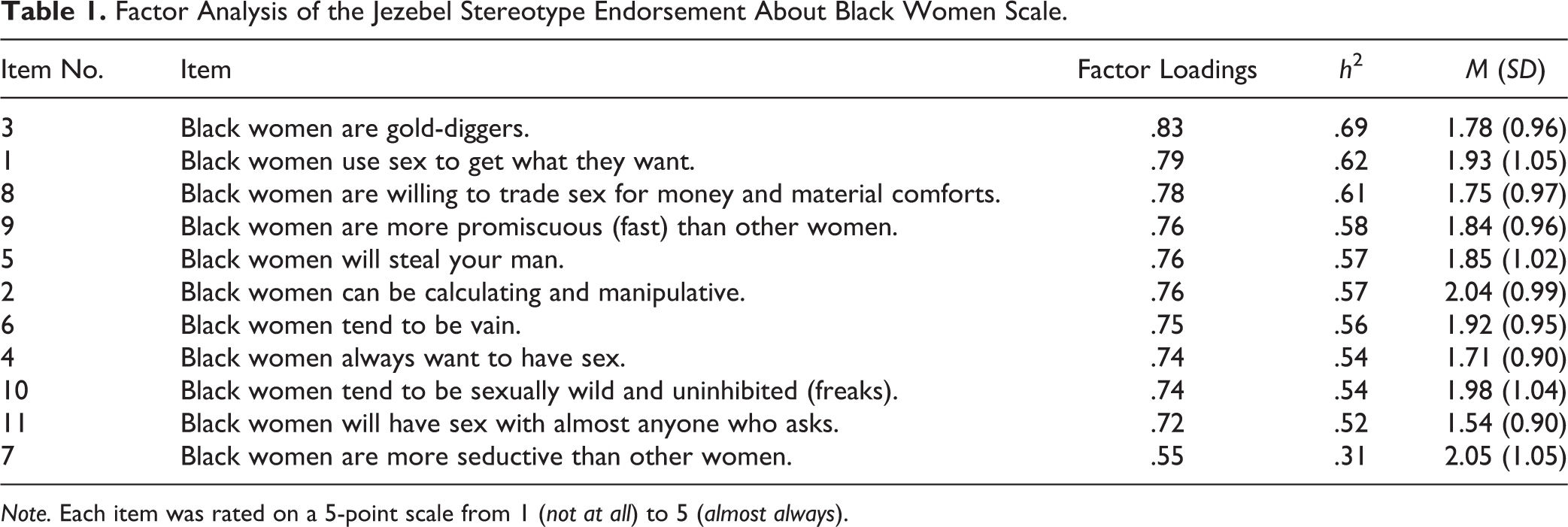
To assess the extent to which participants endorse the Jezebel stereotype about Black women, we used an 11-item scale whose items reflect the hypersexual, manipulative, and promiscuous nature of the Jezebel stereotype. All items are located in Table 1. Each of the items starts with “Black women are” instead of “I am,” therefore allowing both women and men to reply. Participants were asked to indicate their level of agreement with each statement on a 5-point scale 1 (not at all) to 5 (almost always). Mean scores were computed across the items such that higher scores indicate greater endorsement of the Jezebel stereotype.
Factor Analysis of the Jezebel Stereotype Endorsement About Black Women Scale.
Note. Each item was rated on a 5-point scale from 1 (not at all) to 5 (almost always).
In creating this scale, we used 4 items from the revised Stereotypic Roles of Black Women Scale (Thomas et al., 2004; Townsend, Thomas, Neilands, & Jackson, 2010), which was initially developed just for girls and women, and developed an additional 7 items from theoretical and empirical research on the Jezebel stereotype (Brown Givens & Monahan, 2005; Ladson-Billings, 2009; Stephens & Philips, 2003). To establish structural validity for this 11-item measure, we conducted an exploratory factor analysis using principal axis factoring with promax rotation. The Kaiser–Meyer–Olkin value was 0.95, and the Bartlett Test of Sphericity was statistically significant (p < .001). Therefore, the data were suitable for factor analysis. Results of the analysis indicated one factor was extracted with an eigenvalue of 6.54, explaining 59% of the total variance. All other eigenvalues were less than 1. Table 1 lists the items, factor loadings, communalities (h 2), means, and standard deviations for the Jezebel stereotype. Factor loadings ranged from .55 to .83. In the present study, Cronbach’s α was .93 for male participants and .93 for female participants.
Justification of Violence Scale
To assess the extent to which participants condoned IPV toward women when they behave in stereotype-consistent ways, we used the Jezebel and Matriarch subscales of the Justification of Violence Scale (Gillum, 2002). These subscales ask participants to indicate their level of agreement with the use of physical force by a male partner against a female partner when she behaves in a stereotypical manner. Specifically, the subscales portray victims engaging in behaviors characteristic of the Jezebel and Matriarch stereotypes (i.e., the belief that Black women are overly aggressive and emasculate Black men). It is important to note that although the subscales are named Jezebel and Matriarch, these subscales differ from the Jezebel Stereotype Endorsement measure because they do not ask about perceptions of Black women possessing stereotypical traits. Participants responded to 20 items (8 on the Jezebel subscale, 12 on the Matriarch subscale) using a 6-point scale of 1 (very justified) to 6 (very unjustified).
All items across subscales asked participants to indicate “How justified do you think a man is to hit his woman if she…” The Jezebel subscale asks for justifications of violence when a female IPV victim acts in ways consistent with the Jezebel stereotype. Sample items from the Jezebel scale include “makes him feel sexually inferior to other men” and “is sexually unfaithful.” The Matriarch subscale asks participants to indicate how justified a man is to hit his female partner if she acts in a way consistent with the Matriarch stereotype. Sample items from the Matriarch subscale include “tries to dominate the relationship” and “talks down to him.” Because the Jezebel and Matriarch subscales were highly correlated (r = .88, p < .001 for the male sample and r = .90, p < .001 for the female sample), we followed the recommendations of Gillum (2002) and reverse-scored items and then averaged all items together. For the Justification of Violence Scale, higher scores indicate greater justification of IPV toward women when they act in stereotypical ways. The scale was originally normed with Black men and demonstrated good internal consistency (α = .98) and construct validity (Gillum, 2002). In this study, Cronbach’s α for the male sample was .98. Although this scale has not been previously validated with Black women, the relatively high Cronbach’s α in our sample demonstrates good internal consistency (α = .99).
Statistical Analysis Plan
Prior to testing our models, we examined our data for regression assumptions (Kline, 2005). There were no univariate outliers observed in the data. To assess for normality, we used the recommended cutoffs of skewness < |3| and kurtosis < |10| (Weston & Gore, 2006). All variables met the assumption for normality. Multicollinearity was not a problem based on the absolute values of the correlations less than .90 and variance inflation factors less than 10 (Field, 2013).
To test the association between interpersonal sexual objectification, Jezebel stereotype endorsement, and their interaction on justification of IPV, we conducted two hierarchical multiple regression analyses, one for the male sample and one for the female sample. For both samples, the dependent variable was their justification of violence toward women. Given prior findings that women are frequently objectified by men and suffer heightened consequences, we decided to examine the objectifying behaviors of men and the objectification experiences of women (i.e., Black men’s engagement in objectifying behaviors using the ISOS-P and Black women’s experiences of being sexually objectified using the ISOS). With both samples, we examined whether Jezebel stereotype endorsement (i.e., perceiving Black women as intrinsically hypersexual, deviant, and manipulating) strengthened the link between interpersonal sexual objectification and violence justification. For both samples, in Step 1 of the analyses, the sexual objectification variable (objectifying behaviors for men and objectification experiences for women) and Jezebel stereotype endorsement were included. In Step 2 of the analyses, we included the Sexual Objectification × Racialized Stereotype interaction. As recommended by Aiken and West (1991), all variables used to compute interaction terms were centered.
Results
Preliminary Analyses
To examine whether Jezebel stereotype endorsement and justification of violence differed by sample, we conducted independent samples t-test. There was a significant mean difference in Jezebel stereotype endorsement for Black men (M = 1.99, SD = 0.76) and Black women (M = 1.73, SD = 0.72), such that men reported greater endorsement of the Jezebel stereotype than women, t(423) = -3.70, p < .001. Men (M = 2.19, SD = 1.35) also reported higher scores than women (M = 1.71, SD = 1.16) on the Justification of Violence Scale, t(410.12) = −3.93, p < .001. Descriptive data, including skewness and kurtosis, are presented in Table 2, and bivariate correlations are presented in Table 3.
Means, Standard Deviations, Skewness, and Kurtosis for Study Variables.

Correlations Between Study Variables.
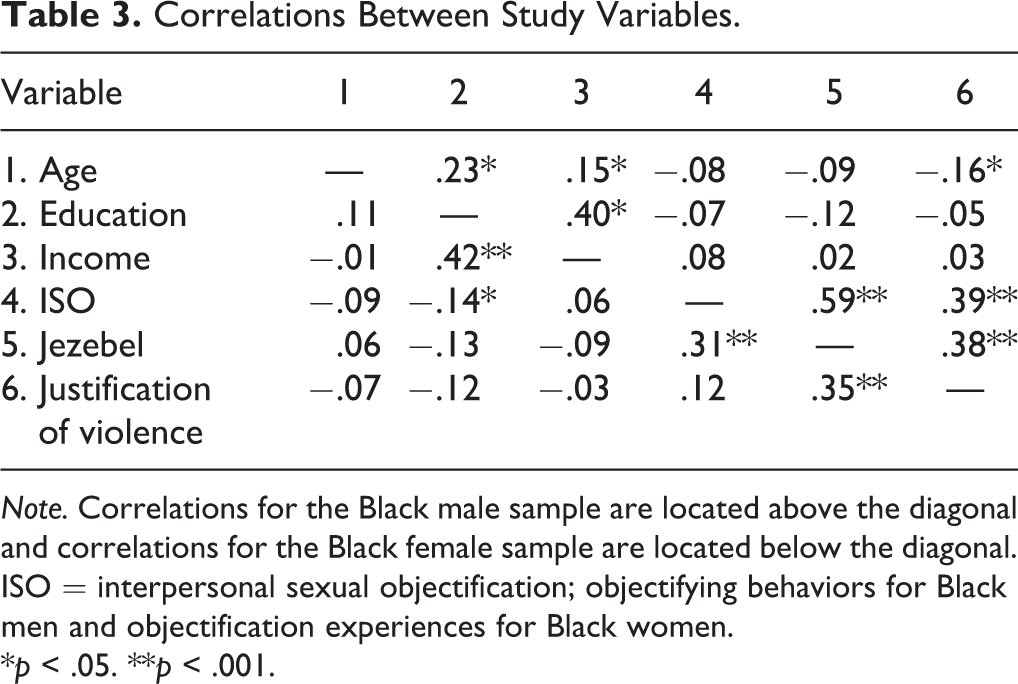
Note. Correlations for the Black male sample are located above the diagonal and correlations for the Black female sample are located below the diagonal. ISO = interpersonal sexual objectification; objectifying behaviors for Black men and objectification experiences for Black women.
*p < .05. **p < .001.
In order to identify possible control variables for analyses, correlations were tested between the dependent measure (justification of violence), the two predictor variables, and sociodemographic variables, including age, highest level of education obtained, and annual household income. Results are provided in Table 3. In the sample of Black men, only one sociodemographic variable (age) was significantly correlated with the outcome variable justification of violence. For Black women, results from the bivariate correlations indicated that none of the sociodemographic variables correlated with the outcome variable justification of violence. Because the inclusion of demographic variables as covariates did not change the results of the analyses, the covariates were excluded from analyses.
Black men
In Step 1, objectifying behaviors and stereotype endorsement accounted for approximately 18% of the variance of justification of IPV violence, and the model was statistically significant, F(2, 207) = 23.33, p < .001. Men’s objectifying behavior and their stereotype endorsement were significant predictors of justification of violence (see Table 4). Specifically, there was a positive association between objectifying behaviors and justification of violence, and a positive association between stereotype endorsement and violence justification. The more men engage in behaviors that reduced women to their body, the greater their justifications of IPV when victims behave in stereotype-consistent ways. Likewise, endorsing the Jezebel stereotype of Black women related to men’s condoning IPV. In Step 2, the inclusion of the objectifying behaviors and stereotype endorsement interaction yielded a significantly predictive overall regression equation, R 2 = .18, F(3, 206) = 16.66, p < .001. However, the objectifying behaviors and stereotype endorsement interaction was not significant (see Table 4). Thus, we found evidence of a main effect of objectifying behaviors and stereotype endorsement but did not find evidence that stereotype endorsement moderated the relation between objectifying behaviors and justification of IPV.
Results of Hierarchical Regression Analysis for Black Men’s Justification of Violence.

Note. N = 210. VIF = Variance inflation factor.
Black women
In Step 1, objectifying experiences and Jezebel stereotype endorsement accounted for 12% of the variance in IPV justification toward women, F(2, 212) = 15.15, p < .001. Results are provided in Table 5. For Black women, experiences of objectification were not significantly related to greater justifications of violence. However, there was a significant main effect of Jezebel stereotype endorsement on justification of violence, such that greater endorsement of the Jezebel stereotype was related to greater justification of violence toward IPV victims when they behave in stereotype-consistent ways. However, this main effect was qualified by a significant Sexual Objectification Experiences × Jezebel Stereotype Endorsement interaction, R 2 = .14, F(3, 211) = 13.33, p < .001; see Figure 1). Simple slopes analysis showed that there was a positive association between objectification experiences and violence justification for women who reported greater endorsement of the Jezebel stereotype (b = .23, SEb = .11, β = .18, p = .05). However, objectification experiences were not significantly associated with violence justification for women with lower stereotype endorsement (b = −.21, SEb = .11, β = −.17, p = .07). Thus, we found that women’s stereotype endorsement moderated the relations between objectification experiences and violence justification toward women.
Results of Hierarchical Regression Analysis for Black Women’s Justification of Violence.
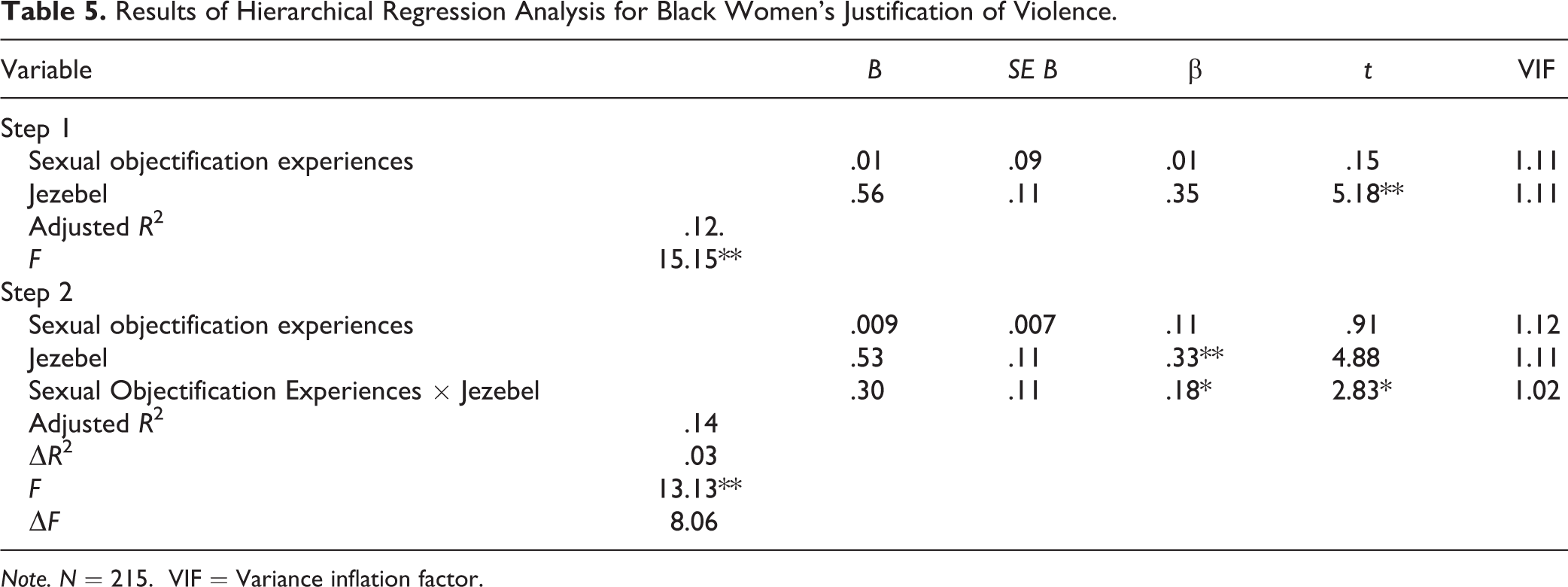
Note. N = 215. VIF = Variance inflation factor.

Black women’s objectification experiences and Jezebel stereotype endorsement on justification of violence toward IPV victims. Means are plotted 1 SD above and below the sample mean. Justifiction of violence was measured on a scale from 1 (very unjustified) to 6 (very justified).
Discussion
The findings of our study contribute to the growing body of literature documenting the adverse impact of interpersonal sexual objectification on physical and sexual violence toward women (Gervais et al., 2014; Loughnan et al., 2013; Rudman & Mescher, 2012; Vasquez et al., 2018). We found that Black men’s sexually objectifying behaviors and their endorsement of the Jezebel stereotype were both associated with greater justifications of violence toward women. Further, we found that Black women’s endorsement of the Jezebel stereotype moderated the association between their objectification experiences and justification of violence. Specifically, we found that objectification experiences were associated with greater justification of violence for Black women who were high in stereotype endorsement, but these experiences were not associated with justification of violence for Black women low in stereotype endorsement. These results extend prior research linking objectifying behaviors and violence to include factors relevant to diverse groups of women, such as racialized stereotypes. Moreover, these findings provide evidence that the objectification-violence link extends to IPV victims, which is an area that is understudied in the objectification literature.
Our findings point to several avenues for future research on objectification. A novel aspect of the current work was examining the association between racialized oppressive imagery and justification of violence toward women. Previous theorizing on objectification has suggested that the impact of sexual objectification may be exacerbated by racialized stereotypes about women of color (Fredrickson & Roberts, 1997), yet research is scarce on how these stereotypes interact with objectification. We found that interpersonal sexual objectification and stereotype endorsement were associated with justification of IPV toward women but in different ways for the men and women in our study. Consistent with our hypotheses and prior research (Gillum, 2002), Black men’s stereotype endorsement was associated with greater justification of violence. However, stereotype endorsement did not moderate the relation between objectifying behaviors and justification of violence. For Black women, we found that frequent and disruptive sexually objectifying experiences are not enough to elicit justification of IPV. However, when these experiences are coupled with greater Jezebel stereotype endorsement, Black women report greater violence justification. Taken together, these findings suggest that the objectification-violence link may be impacted by other forms of oppression, such as racialized stereotypes. Thus, racialized stereotypes may be an important part of Black women’s objectification experiences, which is overlooked in the objectification literature.
Our findings also highlight the importance of examining how the Jezebel stereotype influences justification of violence. We suggest that one of the reasons why objectification and racialized stereotypes about Black women are associated with greater support of violence toward women is because Black women may experience a “double dose” of dehumanization via interpersonal sexual objectification and racialized stereotypes such as the Jezebel. Much research supports that sexualized women are dehumanized (Heflick & Goldenberg, 2009; Heflick et al., 2011; Loughnan et al., 2010). However, there is no empirical evidence showing that the Jezebel stereotype is dehumanizing, although this characterization likens Black women’s sexuality to animals. Because we did not manipulate the Jezebel stereotype to determine whether the stereotype is dehumanizing, we argue that more research is needed to determine whether perceiving victims of violence through the lens of the Jezebel stereotype reduces their personhood. For example, future studies may manipulate dehumanization using a Black and White female target and assess participants’ perceptions of the target’s promiscuity and uniquely human attributes and whether these perceptions impact victim-blaming attitudes.
Additionally, because we examined Black women’s justifications of violence, future research should investigate whether the underlying processes are the same for men and women. Indeed, past research shows that underlying mechanisms for dehumanizing objectified targets differed by gender despite similar patterns of results (Vaes et al., 2011). Thus, researchers should also examine psychological processes that may explain ingroup victim-blaming beliefs. For example, research on the “black sheep effect” shows that people may derogate ingroup members when they behave in undesirable ways to maintain a positive social identity (Marques et al., 1988). Specifically, Schmader and Lickel (2006) showed that compared to White students, Latinx students felt more shame and greater motivation to distance themselves from ingroup members when they behaved in undesirable ways. Relatedly, the derogation of ingroup members may be particularly prevalent when ingroup members are perceived as possibly confirming negative stereotypes about the group. For instance, research on collective threat shows that fearing that an ingroup member will confirm negative stereotypes of one’s group is related to lower self-esteem, lower self-efficacy, and desire to distance oneself from one’s group (Cohen & Garcia, 2005). Thus, it is possible that Black women may derogate ingroup members who reinforce negative stereotypes about their group even when they are victims of violence. Furthermore, this derogation may be particularly heightened for Black women who already endorse negative racialized stereotypes about their group.
Future research is also needed to explore how the Jezebel stereotype impacts Black women who experience physical and sexual victimization. Previous research has found that Jezebel stereotype endorsement is associated with justification of violence among Black men (Gillum, 2002). The current work replicates this finding and shows that among Black women, higher endorsement of this stereotype is linked to greater justification of violence when coupled with greater objectification experiences. This finding is consistent with previous research on the damaging effects of the Jezebel stereotype. For example, there is evidence that Black women’s endorsing of the Jezebel stereotype is linked to adverse health behaviors, such as binge drinking, marijuana use, and risky sexual behavior (S. Davis & Tucker-Brown, 2013; Peterson et al., 2007; Townsend et al., 2010; Wallace et al., 2011). Moreover, studies have found that Jezebel stereotype endorsement is related to lower relationship satisfaction between Black heterosexual couples and negative body image (Fisher & Coleman, 2017; Peterson et al., 2007). Thus, it is possible that our findings have implications for how Black women are perceived when they experience victimization, how Black women respond to experiences of victimization, and how Black women engage with each other for support when they experience violence. These are fruitful avenues for future research.
Finally, our findings point to an additional need to examine and address potential sources of these racialized and gendered stereotypes, especially the media. Scholarly analyses have been especially critical of hypersexual portrayals of Black women in music videos and reality TV programs (e.g., Stephens & Phillips, 2003; Ward et al., 2013; West, 2008). However, these portrayals likely extend to other media, including movies and social media, where sexualization and social comparison are common (e.g., Ramsey & Horan, 2018). In one of the few studies to test media effects on Jezebel beliefs, Jerald et al. (2017) found that heavier media consumption among Black adults was associated with stronger support of the Jezebel stereotype, and more so among men than women. In light of findings that the Jezebel stereotype is prevalent and that Black women and men are aware of this stereotype (Gillum, 2002; Mastro, 2015; L. B. Watson et al., 2012), an important next step would be to work to reduce its presence and impact. Future studies may want to investigate the attributes and effects of interventions that could aid both in dispelling these stereotypes and promoting more diverse representations of Black women.
Limitations and Future Directions
Despite the novel contributions of our study, there are some limitations that warrant discussion. First, because these are correlational data, we cannot imply causation. Sexual objectification may cause greater endorsement of victim-blaming beliefs or victim-blaming beliefs may cause greater engagement in sexual objectification. However, given past experimental research indicating that greater engagement in sexual objectification causes aggression toward women, it is likely that sexual objectification impacts justifications of violence. Moreover, the positive association between sexual objectification (both objectifying behaviors and objectification experiences) and justification of violence may be driven by an unobserved third variable, such as hostile sexism. Additionally, qualitative data may provide additional insights on the data to contextualize and support the findings. Given that the means for violence justification were relatively low for both Black men and Black women, qualitative data may also provide an understanding of how these justifications impact Black women. Second, our analyses among Black women were exploratory, given the lack of research on this issue among women. Thus, additional research is needed to determine whether these findings replicate in other comparable samples of Black women. Third, although we surveyed heterosexual adults across the nation, the generalizability of the sample is limited because outcomes may differ for Black women at different social locations due to sexual orientation, ability status, and actual IPV victimization. For example, Black lesbians may deal with additional oppressive imagery related to their sexuality that may impact their interpersonal sexual objectification experiences (Bowleg et al., 2003). Finally, these results may differ for different racial/ethnic groups of women who may have to confront different oppressive stereotypes about their groups. For instance, Latina women may have group-specific stereotypes, such as the domestic or the feisty Latina, that affect their experiences of sexual objectification (Ghavami & Peplau, 2013; López & Chesney-Lind, 2014).
Future research can benefit from understanding how other stereotypes about Black women, such as the Strong Black woman (N. N. Watson & Hunter, 2015, 2016), impact their experiences of objectification. It is possible that non-sexual stereotypes do not have the same association with interpersonal sexual objectification and may result in different outcomes. Additional research may be needed to address other negative consequences in addition to justification of violence as a result of interpersonal sexual objectification experiences infused with racialized stereotypes. It is likely that some findings replicate, such as perceiving the victim as suffering less, and that new findings emerge.
Practice Implications
These findings highlight the need to employ culturally adaptive IPV prevention and intervention efforts that address the impact of stereotypical images of Black women (Gillum, 2008). For instance, we replicated the finding that Black men’s endorsement of the Jezebel stereotype was positively associated with justification of IPV (Gillum, 2002) and extended these findings to show that Black men’s objectifying behaviors were also associated with violence justification. IPV prevention efforts can work to highlight how racialized stereotypes and objectifying behavior influence violence attitudes. Further, IPV interventions can work to disrupt these dehumanizing ideologies and behaviors among perpetrators of violence by implementing curricula designed to increase their awareness of stereotypes about Black women, by discussing how these images impact their judgments and treatment of Black women, and then by collaboratively work with Black men to activate this awareness when interacting with Black women. Acquiring this knowledge and putting it to practice may contribute to more healthy relationships. Moreover, this curriculum can be combined with standard violence prevention strategies (i.e., anger management) to reduce the detrimental impact of these stereotypes. Our work also has implications for advocates, educators, and practitioners who work with Black female victims of violence. Advocates and practitioners may examine and discuss stereotypical beliefs about Black women. For Black women victims of violence who endorse stereotypical beliefs about their ingroup, it will be important for educators to challenge these stereotypical beliefs that these individuals hold.
In conclusion, women at different social locations may have unique experiences of interpersonal sexual objectification, and these experiences warrant psychological investigation. Specifically, examining the unique sexual objectification experiences of women of color is critical since their experiences may intersect with other forms of oppression. Our work underscores the importance of including diverse samples in sexual objectification research, elucidates additional detrimental consequences of interpersonal sexual objectification, and highlights the importance of oppressive imagery in shaping Black women’s experiences of violence.
Footnotes
Declaration of Conflicting Interests
The author(s) declared no potential conflicts of interest with respect to the research, authorship, and/or publication of this article.
Funding
The author(s) received no financial support for the research, authorship, and/or publication of this article.
