



Abstract
History has shown that people who embody responsibility-focused power have been credibly accused of sexual harassment. Drawing from power-approach and moral licensing theories, we present two complementary studies examining how responsibility-focused power triggers moral licensing, which, in turn, decreases perceptions of sexual harassment (Study 1) and increases intentions to engage in sexual harassment (Study 2). In Study 1, 365 participants read a scenario of a man embodying responsibility-focused power, self-focused power, or low power (control) and then read a case about the man’s alleged sexual harassment against a subordinate. Findings illustrated that moral crediting mediated the effect of power construal on false accusation judgments. In Study 2, 250 participants were primed to experience responsibility-focused power or low power. Responsibility-focused power increased sexual harassment intentions through effects on communal feelings and moral crediting. Based on these findings, we develop a new theoretical perspective on why sexual harassment occurs and why people deny perceiving it. We provide practical recommendations to organizational leaders for developing interventions, such as training, that may disrupt effects of power and moral licensing on sexual harassment intentions. We also encourage public discourse on the harms of harassment that supposed “good people” commit.
Sexual harassment continues to be a significant social problem affecting 50%–80% of women globally and about 10%–33% of men (Ilies, et al., 2003; McDonald, 2012; McLaughlin et al., 2012). The recent #MeToo movement when high-profile men (and some women) were publicly called out for engaging in sexual harassment and related conduct has led to an increased interest in addressing the root causes of sexual harassment (Anderson & Toor, 2018). These high-profile perpetrators were both powerful and, in several cases, widely admired, raising the question of why supposed “good people” sexually harass.
Power has been at the center of most discussions, theories, and definitions of sexual harassment (Bargh et al., 1995; Cleveland & Kerst, 1993; McLaughlin et al., 2012; Popovich & Warren, 2010; Wilson & Thompson, 2001). Although men’s masculine hegemony serves as the social structure that arguably pervades all forms of gender-based subjugation, including sexual harassment, more specific theoretical explanations are needed to explain what motivates specific instances of sexual harassment—that is, what are the proximal explanations for sexual harassment (Chawla et al., 2021)? Several years ago, Bargh et al. (1995) demonstrated that unconscious priming of power increased sexual attraction, especially among men with a propensity to sexually harass. More recently, Stockdale et al. (2020) conceptually replicated and extended Bargh et al.’s (1995) study by priming people to see themselves as managers and enacting their power in a self-serving manner. Both men and women primed to feel powerful in an egocentric way reported feeling more sexy and powerful, which, in turn, increased their intentions to sexually harass.
Power has also been examined as a source of responsibility to show how power may benefit others (Tost, 2015; Scholl et al., 2017). For example, Chen et al. (2001) found that leaders with communal goals used their power to achieve outcomes benefitting others and not just themselves. Similarly, Hershcovis et al. (2017) found that powerful people were more likely than others to intervene when they witnessed incivility toward their subordinate. Yet, Stockdale et al. (2020) found that priming participants to see themselves as powerful in the service of others also increased intentions to sexually harass, through its effects on communal feelings toward others. Hence, power that is experientially self-serving or is in service to others (i.e., responsibility-focused) may potentiate sexual harassment drives.
In the current set of studies, we explored the responsibility-focused form of power on sexual harassment perceptions and intentions. Our research offers a new lens on sexual harassment, which has previously focused on negative characterizations of perpetrators (e.g., Pryor, 1987). However, history has shown that people who enact power in a responsible way to look after and protect others also engage in nefarious behavior, such as sexual harassment. For example, the #MeToo movement and other high profile media stories saw “heroes” credibly accused and, in many cases, convicted of serious sexual misconduct, such as actor and philanthropist Bill Cosby (“America’s Dad”); former United States (U.S.) gymnastics team doctor Larry Nassar; humorist and radio host Garrison Keillor; countless priests and other religious leaders; and many others. Similarly, accusations of sexual harassment and related misconduct against popular leaders, such as U.S. presidents Bill Clinton and John F. Kennedy, were difficult for an admiring public to believe. The current research does not wrestle with the veracity of these claims. Rather, we aim to address a more general question of how seemingly “good people,” that is, people who seem to embody responsibility-focused power by using their position to benefit others, can be motivated to engage in harassing conduct as well as be excused by others for such conduct. Thus, in the present studies, we examined how observers’ perceptions of an individual’s embodiment of responsibility-focused power influences their judgments of the seriousness and culpability of the individual’s alleged sexual harassment (Study 1) and how personal experiences of responsibility-focused power affect intentions to engage in sexual harassment (Study 2). We sought to extend our understanding of how responsibility-focused power may influence such sexual harassment outcomes by investigating moral licensing processes as an explanation. Given that gender is a central construct in previous sexual harassment research (O’Connor et al., 2004; Rotundo et al., 2001), we also explored how gender differences among participants may affect moral licensing and sexual harassment outcomes directly and how participant gender may interact with power construal on these processes.
Power-Approach Theory
Power-approach theory (Keltner et al., 2003) builds on previous research and theory (e.g., Kipnis, et al., 1976) on how possessing power activates cognitive, behavioral, and emotional systems that collectively motivate uninhibited, goal-seeking, and self-focused behaviors and thoughts. Left frontal brain activity, which has been associated with achieving personal goals, increases when people are primed to remember a time when they felt power over others (Boksem et al., 2012). When empowered, people seek goals that are self-relevant (Anderson & Berdahl, 2002), even if they may appear to be (or are) beneficial to others (Guinote, 2017; Guinote et al., 2012). Feelings of powerfulness are associated with positive affect but not with negative affect (Galinsky et al., 2003). Power increases gambling, other risk-taking behaviors, and actions to remove annoyances (Galinsky et al., 2003). Powerful people overestimate how much they think others regard or understand them and underestimate others’ emotional states (Galinsky et al., 2006, Study 2a; Gonzaga et al., 2008); yet they have more authentic (consistent and coherent) views of themselves (Kraus et al., 2011). Powerful people regard others in a more instrumental, objectifying fashion compared to those with less power (Gruenfeld et al., 2008). Men who are high in need for power express greater intention to seek uncommitted sexual encounters (Hofer et al., 2010; Kunstman & Maner, 2011), and, as noted above, subconsciously priming power increases automatic associations with sex among men with proclivities to sexually harass (Bargh et al., 1995).
Power is also associated with responsibility, which evokes positive, prosocial behavior, and related cognitions. Empowered individuals with communal orientations allocate tasks to subordinates more equitably, display fewer racist attitudes (Chen et al., 2001), and intervene to protect subordinates from harm (Hershcovics et al., 2017). Powerholders primed with other-focused, communal reminders rate their responsibility toward subordinates higher than those primed with a self-focus (Scholl et al., 2017), especially when they identify strongly with the social group in which subordinates belong (Scholl et al., 2018). Situations that mobilize powerholders to enact pro-social, communal behaviors, consistent with the responsibility motive of power, are those where powerholders are reminded of their responsibility to care for others (Magee & Langner, 2008), have a strong prosocial orientation (Côté et al., 2011), or are in positions within their organization that require responsibility over others (Tost, 2015).
Despite the personal and collective good that responsibility-focused power creates, it may hold a dark side. Hershcovics et al. (2017) found that responsibility-focused leaders engaged in actions to protect an underling, which could be considered a communal behavior, but they did so for a self-centered reason: to protect their status. The communal acts and feelings that flow from responsibility-focused power may trigger a moral licensing effect and unleash transgressive behavior, such as sexual harassment. Page and Pina (2018) reported positive relations between measures of moral disengagement and sexual harassment proclivities suggesting that sexual harassment may occur when individuals do not perceive harassment as a moral problem.
Moral Licensing
Moral licensing theory posits that people psychologically balance their views of themselves and of admired others to maintain a consistent moral valence (Effron & Monin, 2010). When individuals engage in, imagine themselves engaging in, or observe others to whom they are attached engaging in morally good deeds, they experience a surplus of moral credit that can be spent on transgressive behavior (Ahmad et al., 2021; Cascio & Plant, 2015; Jordan et al., 2011; Kouchaki, 2011). Seeing someone publicly act to denounce adolescent drug use can excuse perceptions of that same person engaging in sexual harassment, for example (Effron & Monin, 2010). Similarly, recalling one’s own past moral actions decreases subsequent moral activities and prosocial intentions and increases cheating (Jordan et al., 2011).
Priming moral thoughts can also lead to moral licensing. Priming activates mental representations in often unconscious ways, which affects subsequent cognitions and behaviors (Bargh, 2006). For example, Sachdeva et al. (2009) primed research participants’ moral self-concepts by having them copy and think about words associated with positive (e.g., caring, generous, and fair), negative (e.g., disloyal, greedy, and mean), or neutral traits (e.g., book, keys, and house), and then instructed them to write a self-narrative using the words they had copied. Participants primed with the positive words were least likely to make a charitable contribution or engage in cooperative behavior.
Moral licensing is said to occur when a subsequent behavior or behavioral intention following a prior good deed (or recalling a prior good deed) is more transgressive than would have been observed had the prior good deed not been committed, recalled, or imagined. Furthermore, a strong test of moral licensing is demonstrated when subsequent behavior following a prior bad deed is less transgressive than a control condition (Mullen & Monin, 2016). Hence, support for moral licensing can be found when a negative linear relation exists between the valence of the prior behavior or prime and the valence of the subsequent behavior. We label this process a moral licensing effect.
Moral licensing processes may also be evident if measures of the underlying forms of moral licensing mediate relations between power construals and sexual harassment judgments. One form is moral crediting, defined as an internalized mental balance of a person’s good and transgressive acts. Lin et al. (2016) explained that transgressive (e.g., unethical) behavior may be licensed when an individual perceives that they possess (or they perceive a focal person as possessing) a surplus of moral credits, as if they have abundant deposits in a moral bank account that can be spent on transgressive behavior without depleting the bank. For example, a boss who is known to stand up for their employees may be excused for yelling at a subordinate because they are otherwise a good boss. Lin et al. (2016) measured the perception that one has a surplus of moral credits with a 5-item scale that demonstrated good psychometric properties. Hence, we argue that perceivers may rate a person who embodies responsibility-focused power high on this measure of moral crediting, which, in turn, may be associated with lenient perceptions of the person’s alleged sexual harassment. We label this process the indirect effect of moral crediting.
A second form of moral licensing is moral credentialing, defined as beliefs in one’s (or another’s) moral self-regard (Lin et al., 2016). In other words, the actor’s transgressive behaviors are regarded as morally acceptable (Effron & Monin, 2010), as if they had a certificate deeming their moral virtues. An example is perceiving a boss’s angry behavior, such as yelling or swearing at a subordinate, as legitimate because the boss is considered to be a moral person (Lin et al., 2016). Moral credentialing is a nuanced process as, as it depends on the extent to which the transgressive act is ambiguous. Moral crediting (balancing) can occur when the transgression is either blatant or ambiguous (Effron & Monin, 2010). For the current research, we focused on moral crediting (however, see the online supplement at https://osf.io/25hvd/ for analysis of a moral credentialing measure used in both studies).
Participant Gender Differences
Gender has been a leading variable of interest in sexual harassment research. The jurisprudence of sexual harassment law was grounded in feminist analyses of how sexual harassment constituted sex discrimination (MacKinnon, 1979). Studies on gender differences were among the earliest psychological research examining perceptions of sexual harassment (e.g., Gutek, et al., 1983), which still attracts attention in the current era (e.g., Kessler et al., 2020). Because women are more likely than men to be targets of sexual harassment (National Academies of Science, Medicine, and Engineering [NASEM], 2018), women’s attitude toward other women is less sexist than men’s (Glick & Fiske, 1996), which, in turn, is associated with sexual harassment perceptions (O’Connor et al., 2004). Further, women are more likely than men to put themselves in the position of targets when judging the severity of sexual harassment (Wiener & Hurt, 2000), and women are more sensitive than men to perceiving conduct as sexually harassing (Rotundo et al., 2001).
There are also robust gender differences in perpetrating sexual harassment. Surveys estimate that almost 90% of women’s sexual harassment experiences are perpetrated by men and about 50% of men’s experiences are perpetrated by other men (NASEM, 2018; Magley et al., 1999; Rosenthal et al., 2016; Stockdale et al., 1999). Men report greater intentions to engage in sexual harassment than do women (Perry et al., 1998), which we expected to replicate in this research.
We also explored whether power may affect men and women differently, regarding sexual harassment intentions, and whether there are gender differences in moral licensing. Possessing power appears to have stronger effects on approach-related non-verbal behavior (e.g., greater eye contact and expansive posture for men than women; Gonzaga, et al., 2008). Lacking power, on the other hand, is associated with relational and communal behavior, such as connecting oneself to others (Rucker & Galinsky, 2016). Social groups who traditionally lack power, such as women, are more oriented toward communal actions, whereas people belonging to groups who traditionally hold power, such as men, are more oriented toward agentic behavior (Rucker & Galinsky, 2016; Rucker et al., 2018). This research suggests there may be gender differences in how and to what degree embodying power will mobilize emotional and psychological processes that impact harassment perceptions and intentions, but the direction such processes will take is unclear. Men may respond more strongly to power priming in general, but responsibility-focused power priming may have particularly strong effects on women’s communal feelings, which could spur moral licensing effects. Finally, although two meta-analyses on moral licensing research have been conducted, gender was not examined as a moderator in either study (Blanken et al., 2015; Simbrunner & Schlegelmilch, 2017); therefore, we explore gender as a potential moderator of power embodiment and moral licensing effects on sexual harassment perceptions and intentions.
Overview of the Current Research
In sum, our research examined whether and how seemingly “good people” (people who embody responsibility-focused power) can be motivated to engage in harassing conduct as well as be excused by others for such conduct because of moral licensing influences. In two vignette studies, we investigated the role of moral licensing, its connection to responsibility-focused power embodiment (compared to other power construals), and sexual harassment outcomes. We also examined participant gender as a direct predictor of moral licensing and sexual harassment outcomes and as moderator. We intend to advance the current literature on both sexual harassment and moral licensing through examining both observer’s willingness to morally license another person’s transgression (Study 1) as well as moral-licensing effects on intentions to engage in sexual harassment (Study 2).
Study 1
In Study 1, we examined whether perceivers would be more lenient in their judgments of an alleged harasser who had been previously described as embodying responsibility-focused power compared to self-focused egocentric power or a control condition. We examined sexual harassment judgments that are consistent with previous research, such as the perceptions of the severity of sexual harassment, which signal the level of concern perceivers have about the behavior (Bhattacharya & Stockdale, 2016; Gutek et al., 1999; O’Connor at al., 2004; Osman, 2007; Wiener et al., 2010). We also examined psycho-legal judgments of guilt and the credibility of the accuser (i.e., whether she is making a false accusation; Bhattacharya & Stockdale, 2016; Gutek et al., 1999), as well as organizationally relevant judgments of the type and degree of sanctions, if any, recommended for the accused perpetrator. We expected that either directly or through moral crediting ratings, judgments would be more lenient against perpetrators embodying responsibility-focused power, followed by the control perpetrator, and harshest for those embodying self-focused power. In Study 1, we tested the following general hypotheses:
H1 (moral licensing effect): There would be a linear trend of the means of sexual harassment judgments such that (a) sexual harassment severity, (b) guilt, and (c) punishment severity would be lowest in the responsibility-focused power condition followed by the control condition and highest in the self-focused power condition. This trend would be opposite for (d) false accusation judgments such that false accusation judgments would be highest in the responsibility-focused power condition followed by the control condition, and lowest in the self-focused power condition.
H2: There would be a linear trend of the means of moral crediting such that moral crediting would be lowest in the responsibility-focused power condition, followed by the control condition, and highest in the self-focused power condition.
H3: There would be an indirect effect of the power construal conditions on sexual harassment judgments, namely, (a) sexual harassment severity, (b) guilt, (c) punishment severity, and (d) false accusations through moral crediting.
H4: Compared to men, women would judge the sexual harassment scenario as more severe, rate the defendant to be more guilty, rate the accuser lower on false accusation judgments, and recommend more severe punishment for the accused perpetrator.
We made no predictions about whether there would be gender differences in participants’ tendency to engage in moral crediting or whether gender would moderate the indirect effects proposed in H3 because of a dearth of research on gender differences in moral licensing effects (Blanken et al., 2015; Simbrunner & Schlegelmilch, 2017). Accordingly, we advanced the following research question:
Research Question 1: Would participant gender moderate (a) effects of power construal condition on moral crediting and sexual harassment judgments or (b) the indirect effect on sexual harassment judgments through moral crediting?
Method
Participants
Demographic Characteristics of the Samples in Studies 1 and 2.

Note. LGBQ = Lesbian, Gay, Bi/Pan-Sexual, Queer (transgender status was not measured).
aPercentages exceed 100% because participants could choose more than one category.
Materials and Measures
Complete copies of all measures and stimuli are provided in the online supplement at https://osf.io/25hvd/.
Power Construal
We manipulated how the power of the focal actor was construed with scenarios describing a mid-level manager. Because most (but not all) sexual harassment incidents are perpetrated by men against female targets (NASEM, 2018), our scenarios were similarly structured. Before reading the sexual harassment scenario, participants read a description of Troy—a mid-level manager in a U.S. pharmaceutical company who is conducting performance evaluations of subordinates. In the responsibility-focused power condition, Troy is described as having been awarded by the company for being an excellent leader and mentor, having recently pitched an initiative that would benefit his subordinates, and deciding to provide extra support and mentoring to a struggling employee. In the self-focused power condition, Troy is described as having been recognized at an end-of-year party for being “most likely to promote himself,” having recently pitched an initiative that would boost his own chances of promotion, and deciding to terminate a struggling employee. In the control condition, responsibility and self-focused cues are removed. Troy is described as a mid-level manager who receives a small bonus for reaching firm-wide goals. He listens to a strategic proposal to make the firm more profitable and puts off evaluating the performance of a struggling employee. The priming scenario and its variations read: Troy Smith is a mid-level manager at a U.S. pharmaceutical company. Last year at the firm’s end-of-year party, Troy was given an award by the company for being an excellent leader and mentor. ( After the meeting Troy finished performance reviews of his direct reports. One of them had been off the mark all year and hadn’t been hitting their numbers. Troy decided that he was going to give this employee extra attention and mentoring so they had a better understanding of how to leverage their talents. Mostly, Troy knows how important it is in the firm for leaders to take personal responsibility for the professional development of their mentees. Troy feels a particular responsibility to mentoring his junior employees. (
Sexual Harassment Scenario
A synopsis of a sexual harassment allegation adapted from Bales v. Wal-Mart Stores, Inc. (1998) served as the stimulus on which participants’ judgments were measured. A similar version of the scenario has been used in prior research on sexual harassment perceptions (Bhattacharya & Stockdale, 2016; see the online supplement for a verbatim copy of this scenario) and describes an allegation of unwanted sexual attention of a female employee, “Alicia Johnson,” by her supervisor, “Troy Smith.”
Moral Crediting
Moral crediting was measured with a 5-item moral crediting measure (α = .97) adapted from Lin et al. (2016). Items were re-worded to ask participants if they credit the behavior of the initiator, not their own behavior, as the scale was originally designed. For example, the item “Each good deed I performed added to my moral credit” was changed to “Each good deed Troy performed added to his moral credit.” Another item read “Troy earned credit for performing good behaviors.” Participants rated their agreement with each statement on a 5-point Likert scale from 1 (strongly disagree) to 5 (strongly agree). Alpha in the present sample was .86.
Sexual Harassment Judgments
Sexual harassment perceptions were measured with an adapted version of the sexual harassment perceptions subscale from Bhattacharya and Stockdale (2016). Three-item scales measured severity (e.g., “The alleged harassments that Alicia claimed happened to her in the scenario are very threatening”); guilt (e.g., “After reading the scenario, I definitely think that Troy sexually harassed Alicia”); and false accusations (e.g., “Alicia’s accusations against Troy were mostly false”). Participants rated their agreement with each statement on a 5-point Likert scale from 1 (strongly disagree) to 5 (strongly agree). Bhattacharya and Stockdale (2016) reported alphas of 0.89, 0.94, and 0.92 for their versions of these scales, respectively. Alphas in the current sample were 0.77, 0.78, and 0.92, respectively.
Punishment was assessed with two items. The first, punishment choice, asked participants to indicate which punishment, if any, the organization should take against Troy following this complaint. The list included no action, issue a verbal warning, issue a written warning, require Troy to attend training, demote Troy, and fire Troy. The second, punishment severity, had participants rate on a scale of 1 (not at all severe) to 10 (very severe) how severe the punishment was that they selected for Troy.
Other Measures
Manipulation checks included questions about which award Troy received and what type of complaint Alicia had against Troy. Demographic characteristics were also assessed.
Procedure
The entire study was conducted online using the Qualtrics survey platform. Participants read an informed consent statement and indicated whether they agreed to participate in the study, and then completed qualification questions (age and U.S. location). Next, they were randomly assigned to read one of the three power construal scenarios. After reading their respective scenario, participants completed the moral crediting measure and answered an open-ended item about their impressions of Troy. Thereafter, they read the sexual harassment scenario and completed the sexual harassment judgments, and a demographic questionnaire. Approved participants were compensated $1.00 in Amazon credit.
Results
Preliminary Analyses
Means and Standard Deviations of Moral Crediting and Sexual Harassment Judgments by Power Construal Condition and Participant Gender; Intercorrelations among the Ratings by Participant Gender and Reliability Estimates.
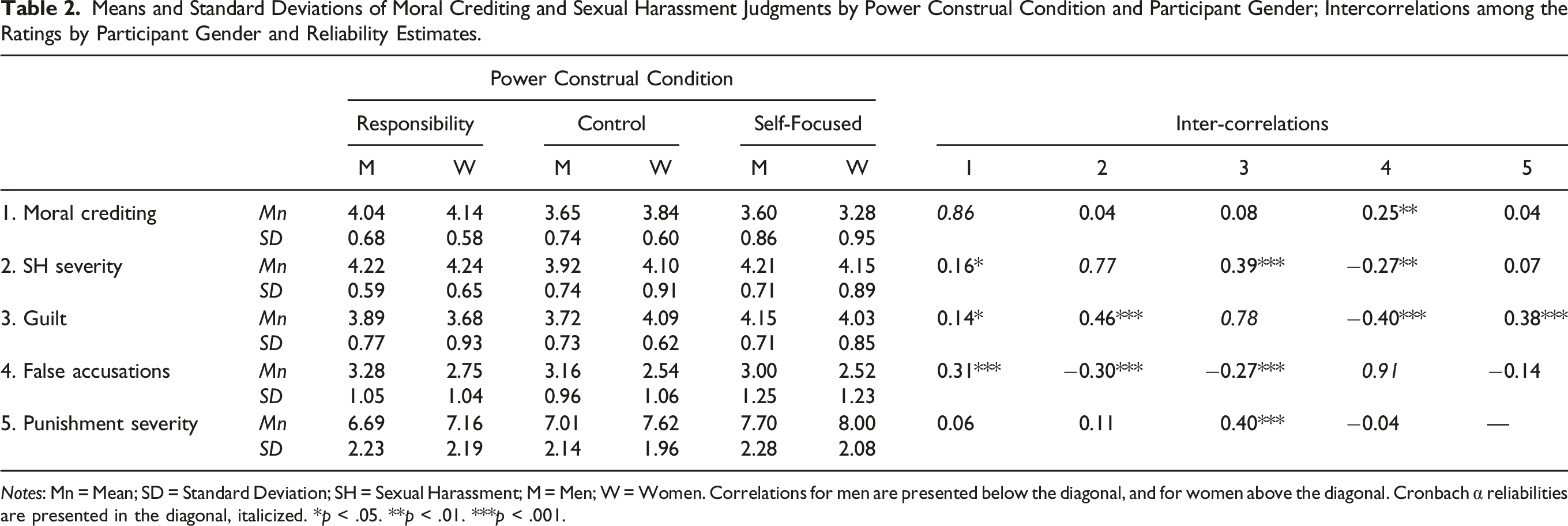
Notes: Mn = Mean; SD = Standard Deviation; SH = Sexual Harassment; M = Men; W = Women. Correlations for men are presented below the diagonal, and for women above the diagonal. Cronbach α reliabilities are presented in the diagonal, italicized. *p < .05. **p < .01. ***p < .001.
Hypothesis Testing
We tested hypotheses related to the moral licensing effect and participant gender effects (except for the indirect effects) with a 3 (power construal condition) × 2 (gender) MANOVA with planned linear contrasts on the power construal factor. The multivariate effect of power construal was significant, Wilks Λ = 0.82, F (10, 706) = 7.38, p < .001. The multivariate effect of gender was significant, Wilks Λ = 0.92, F (5, 353) = 5.91, p < .001. The multivariate power construal × gender effect did not meet conventional standards of statistical significance, Wilk’s Λ = .95, F (10, 706) = 1.79, p = .059.
There were significant linear contrast effects for power construal on guilt judgments, F (1, 360) = 9.24, p = .003,
To examine the indirect effects of power construal condition on sexual harassment judgments (H3a through H3d) and the potential for gender to moderate these indirect effects (Research Question 1), we conducted moderated mediation analyses on each sexual harassment judgment variable using Hayes’ (2018) PROCESS macro for SPSS version 3.5. Indirect effects were estimated with bias-corrected bootstrapping with 5000 resamples, such that statistical significance was established if 95% confidence intervals of those sample estimates did not include 0. Gender was tested as a moderator on the path between the power construal conditions and moral crediting, and the direct path between power construal conditions and the sexual harassment judgments. The indirect effect was also examined separately for women and men.
Study 1 PROCESS Results for the Direct and Moderating effects of Power Construal on Moral Crediting and Sexual Harassment Judgments.
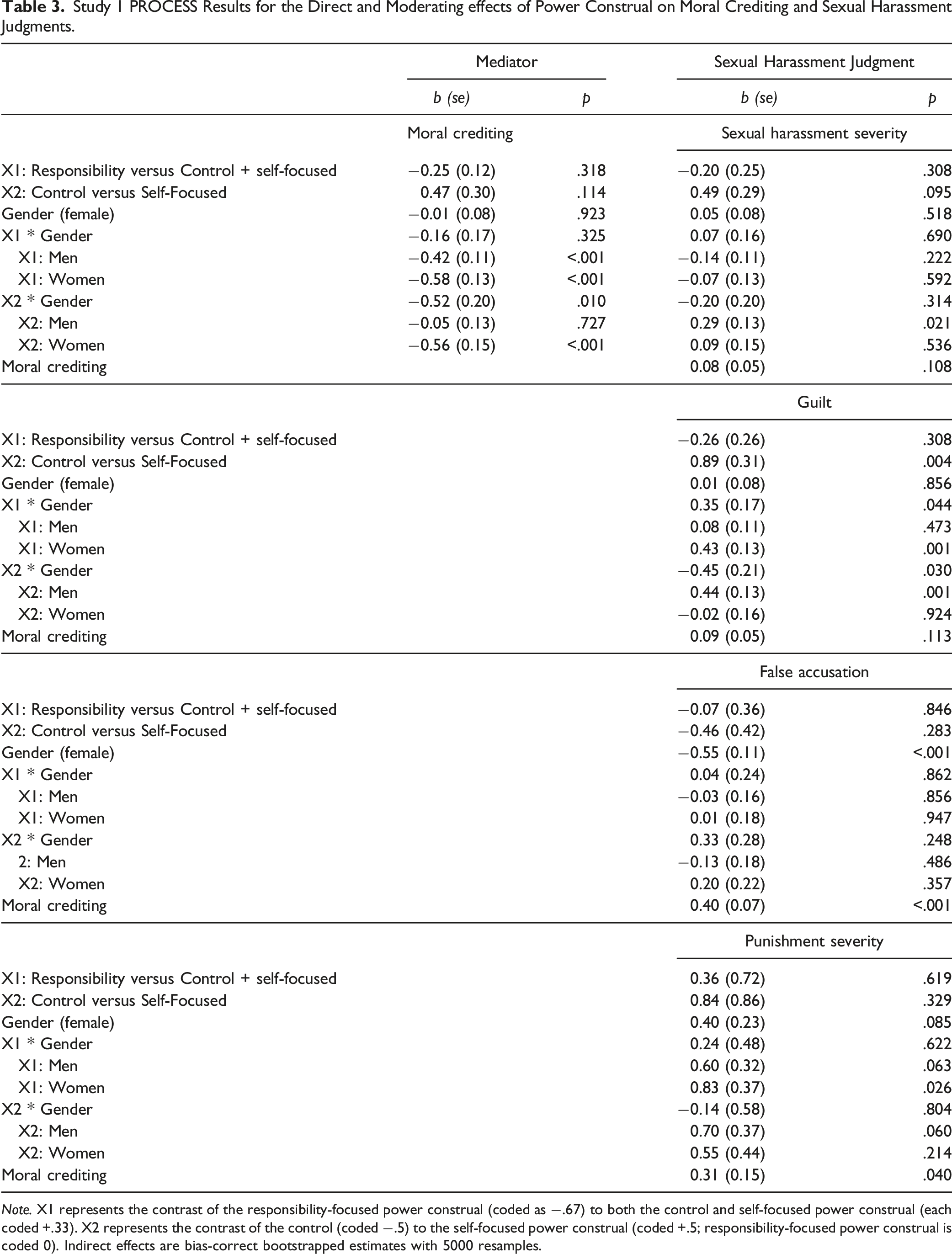
Note. X1 represents the contrast of the responsibility-focused power construal (coded as −.67) to both the control and self-focused power construal (each coded +.33). X2 represents the contrast of the control (coded −.5) to the self-focused power construal (coded +.5; responsibility-focused power construal is coded 0). Indirect effects are bias-correct bootstrapped estimates with 5000 resamples.
Study 1 Indirect effects of Power Construal on Sexual Harassment Judgments through Moral Crediting, Moderated by Gender.

Notes: X1 compares the responsibility-focused power construal (−.67) to both the control and self-focused power construal (each .33). X2 compares the control construal (−.5) to the self-focused power construal (+.5). b= effect coefficient; CI = Confidence Interval.
Participant gender moderated the path between power construal conditions and moral crediting (see Table 3). This interaction was found on the X2 contrast, such that women’s moral crediting ratings were lower in the self-focused power construal condition compared to the control condition. There was no difference in men’s moral crediting ratings in these two conditions. On the X1 contrast, there were no significant gender differences. Both women and men had lower moral crediting ratings in the control and self-focused power construal conditions than in the responsibility-focused condition (see Table 2 for the means of moral crediting by power construal and participant gender).
Even though gender moderated the X2 contrast on moral crediting, there was no evidence that gender moderated the indirect effects of moral crediting on three of the four sexual harassment judgments: sexual harassment severity, guilt, or punishment ratings (see Table 3). On false accusation judgments, there were significant indirect effects of power construal condition through moral crediting, which was moderated by participant gender. On the X1 contrast, both men and women had lower moral crediting ratings of the perpetrator in the control and self-focused power construal conditions than in the responsibility-focused condition. Moral crediting, in turn, was positively associated with false accusation judgments. Said differently, participants morally credited the responsibility-focused power perpetrator more than the control or self-focused power perpetrator, leading them to perceive that the accuser was making a false accusation against him.
The indirect effect of the X2 contrast on false accusations was significant for women but not for men. Women’s moral crediting ratings of the self-focused power perpetrator were lower than their ratings of the control perpetrator, which led to higher false accusation judgments against the control perpetrator than the self-focused power perpetrator. Together, these findings partially supported H3 regarding false accusation judgments (H3d), and they partially answered the question of whether gender would moderate the indirect effects of moral crediting on sexual harassment judgments (Research Question 1b).
Supplementary Analyses on Punishment Choice
The percentage of each punishment option selected for Troy by power construal condition are provided in Figure 1. Notably, participants were most likely to select “fire Troy” and least likely to select “no action.” However, selecting “fire Troy” was much more prevalent for those who were exposed to the self-focused power prime and least prevalent for those exposed to the responsibility-focused power prime. This pattern was reversed for the least severe punishments, “written warning,” “verbal warning,” and “no action.” The linear-by-linear Chi-Square goodness of fit test on punishment choice by power construal condition was significant, χ2 (1, N = 365) = 12.33, p < .001. Study 1 Percentage of Participants Selecting each Punishment by Power Priming Condition.
Discussion
We found qualified support for the effects of how the alleged perpetrator’s power embodiment affects judgments of sexual harassment. First, power construal affected moral crediting ratings in the hypothesized direction, such that moral crediting ratings were highest in the responsibility-focused power construal condition and lowest in the self-focused power construal condition. Second, through moral crediting, participants were most likely to believe that Alicia, the accuser, was making a false accusation judgment when Troy embodied responsibility power, and least likely to do so when Troy embodied self-focused power, although the effects varied slightly by gender. Third, we found support for a moral licensing effect of power construal on guilt judgments and the punishment rating. Participants tended to judge Troy as least guilty, and they rated the punishment applied to him as least severe, when Troy was construed as embodying responsibility-focused power compared to the other power construals. Both guilt judgments and punishment severity ratings were most severe for the self-focused power construal condition compared to other construals, confirming the linear relation between the responsibility-focused, control, and self-focused construals on these judgments, consistent with moral licensing theory (Mullen & Monin, 2016). Finally, participants were more likely to select the most severe punishment, firing Troy, when he was construed as embodying self-focused power and most likely to select the least severe punishments when Troy was construed as embodying responsibility-focused power. The pattern of these results is consistent with moral licensing effects (Mullen & Monin, 2016).
Contrary to past research, we did not find gender differences in most of the sexual harassment judgments except for false accusations where women were less likely than men to blame the accuser of making a false accusation. Furthermore, the indirect effect of power construal on false accusation judgments through moral crediting was stronger for women than for men. Altogether, participant gender main effects and moderating effects were weak, suggesting that the historical gender difference in sexual harassment perceptions may be dwindling and that moral licensing processes may be similar for men and women.
Our research suggests that “good guys,” that is, those who embody responsibility-focused power, who sexually harass may benefit from moral licensing. Although enacting responsibility-focused power did not lower ratings of the severity of the harassing conduct, it did appear to absolve this initiator from guilt. Furthermore, through moral crediting, the responsibility-focused initiator gave credence to the belief that the accuser was making a false accusation. Past research on moral crediting, the form of moral licensing measured in this study, has found that when the moral behavior and the transgression are in the same domain, moral crediting did not occur because the transgressive acts were seen as hypocritical (Effron & Monin, 2010). In the responsibility-focused power condition of the current study, Troy’s enactment of responsibility-focused power primarily focused on mentoring and creating a “best place to work.” Although his alleged sexually harassing conduct happened in the same domain as his work, participants may not have perceived it be in the same behavioral domain (e.g., harassment vs. mentoring). This may suggest that domains must be very similar (e.g., both in sexual harassment) to elicit hypocrisy, otherwise moral crediting may be robust.
To further our inquiry on the effects of responsibility-focused power on sexually harassing conduct, in the next study we examined the effects of this form of power on actors’ behavioral intentions. Specifically, we sought to replicate Stockdale et al.’s (2020) finding that responsibility-focused power, compared to other conditions, increased intention to sexually harass, and to better understand the mechanisms by which this operates. Stockdale et al. (2020) speculated that moral licensing may have accounted for the effects of responsibility-focused power increasing sexual harassment intentions. This study directly tests for moral licensing effects.
Study 2
In Study 2, we turned our attention to understanding how responsibility-focused power embodiment motivates intentions to engage in sexual harassment. Again, we drew on power-approach and moral licensing theories. Feeling powerful, even in a responsible way, stimulates the behavioral activation system, mobilizing cognitive, affective, and behavioral responses (Keltner et al., 2003). Feeling powerful in a responsibility-focused way should trigger communal feelings, that is, warmth toward and connection with others (Stockdale et al., 2020). As we theorized above, such communal feelings should trigger moral licensing (operationalized as moral crediting in the current study). Moral crediting, in turn, is hypothesized to increase the likelihood of engagement in sexual harassment.
Although many different priming methods have been used in past research testing power approach theory (e.g., Galinsky et al., 2003; Guinote & Vescio, 2010), we followed Tost’s (2015) recommendation to include a structural element, such as being in a supervisory position, to incur a sense of responsibility. Therefore, participants read a scenario, which prompted them to take on the perspective of a mid-level manager. To that, we added cues to enhance a responsibility-focused form of power. These cues were downplayed in the control version of the scenario. Fong and Tiedens (2002) used a similar prime in their study of the effects of power on women.
We examined whether the embodiment of responsibility-focused power and communal feelings that flow from such power enhances communal feelings and morally credits such individuals to sexually harass. This research extended Stockdale et al. (2020) to specifically examine whether moral licensing accounts for why people who embody responsibility-focused power express greater intentions to engage in sexual harassment, compared to a control condition. Although we hypothesized gender differences on intentions to engage in sexual harassment, we explored whether the paths from power priming to intentions to engage in sexual harassment would be moderated by gender. We tested the following hypotheses:
H5: Men would report stronger intentions to engage in sexual harassment than women.
H6: There would be a serial indirect effect of responsibility-focused power priming (vs. control) on intentions to sexually harass through communal feelings and moral crediting, such that responsibility-focused power (compared to the control) would increase communal feelings, which in turn would increase more crediting, thereby increasing intentions to sexually harass.
Research Question 2: Would participant gender moderate the indirect effects of responsibility-focused power on sexual harassment intentions through communal feelings and moral crediting?
Method
Participants
Participants were 494 adult Amazon Mechanical Turk (MTurk) workers residing in the U.S. who were working at least part-time and agreed to participate in this study for $2.00 of Amazon credit. As with Study 1, we closely inspected our data for evidence of poor or inappropriate respondents. Following recommendations from CloudResearch® (Litman et al., 2020), we included an open-ended cultural check question that U.S. residents should know but not others. We also had two knowledge-based manipulation check questions. We eliminated 172 (34.8%) participants who responded to open-ended questions nonsensically and one participant who took the survey twice. Of the remaining 321 participants, 71 (14.3%) missed one or both manipulation checks, therefore these participants were removed. The proportion of participants who failed a manipulation check did not significantly vary by levels of the independent variable (power priming), χ2 (1308) = 1.24, p = .267. Our final sample was 250. This sample had no evidence of long strings (Curran, 2016), nor did it have missing values. Demographic characteristics of the final sample are displayed in Table 1.
Measures and Materials
The online supplement provides all the measures and stimuli that are not published elsewhere.
Power Primes
In this study, we primed participants to imagine themselves embodying responsibility power by asking them to read a scenario in which they were prompted to imagine themselves as the focal individual in the scenario. The scenario evoked a sense of care and responsibility toward others (such as the participant’s pet, their work team, their organization and its clients, and a struggling employee), structural power (being a supervisor), personal effectiveness (pitching a convincing proposal to senior leaders), and sociability (having an iced tea with coworkers at the end of the day). The control scenario evoked only structural power. Our priming scenarios were copies of the responsibility-focused and control scenarios found in Stockdale et al. (2020) and in the online supplement.
Communal Feelings
To assess communal feelings, we adapted and modified items from the Communal Goal Orientation Scale (Diekman et al., 2011) to have participants rate each feeling about themselves after reading their randomly assigned scenario. Specifically, participants rated the extent to which they felt caring, helpful, connected to others, altruistic, and responsible for others on a Likert-scale from 1 (very slightly or not at all) to 5 (very much). Stockdale et al. (2020) reported an alpha of 0.80. In the present study, alpha was 0.82.
Moral Licensing
As in Study 1, we operationalized moral licensing as moral crediting, which was measured on a 5-item scale developed by Lin et al. (2016), who reported an alpha of 0.97. Participants were instructed to think about the scenario they had just read while answering the five statements, for example, “Acting good built up my account of moral credits” on a scale of 1 (strongly disagree) to 5 (strongly agree). Alpha in the current sample was 0.93.
Sexual Harassment Intentions
Participants completed a shortened version of the Workplace Crush Scenario instrument (Williams et al., 2017). The instrument presented a scenario in which the participant imagined working with a coworker, Melanie (if the participant is a heterosexual man or lesbian) or Matt (if the participant is a heterosexual woman or gay man), on whom they had an unreciprocated crush. Participants completed items indicating the extent to which they would engage in various innocuous and harassing behaviors toward Melanie or Matt. The original instrument contained 42 items, which was shortened to 14 items using a domain sampling approach (selecting items that covered various domains of innocuous and harassing conduct; see Stockdale et al., 2020). Ten items measured intentions to engage in unwanted sexual attention, such as “I will wink at Matt/Melanie during work meetings” and “I will offer Matt/Melanie a workplace perk in exchange for sex,” to which participants indicated their likelihood to engage in the behavior on a scale from 1 (not at all likely) to 7 (very likely). Following Stockdale et al. (2020), these items were averaged to form the Sexual Harassment Intentions Scale. Stockdale et al. reported an alpha of 0.93. In the current study, alpha was 0.92. The remaining four items on this scale measured innocuous behaviors and were not analyzed for this study.
Control Variable
Stockdale et al. (2020) measured sexy-powerful feelings, which was positively correlated with communal feelings (rs = 0.54 and 0.56) in their study of power priming on sexual harassment intentions. We included this measure as a control variable to isolate the effects of communal feelings on moral crediting and harassment intentions. This scale contains nine items derived from Diekman et al.’s (2011) agentic goal orientation scale (e.g., powerful, competitive, and deserving recognition), plus four items measuring sexy feelings (e.g., sexy and attractive). Stockdale et al. (2020) found that these items loaded on a single factor in a principal axes factor analysis. α = 0.92. Similarly, we found a one-factor solution accounting for 49% of the variance with loadings ranging from 0.64 to 0.79. Alpha for the current sample was 0.90.
Other Measures
Manipulation checks included two knowledge questions about respective priming scenarios. Demographic characteristics were also assessed.
Procedure
Participants completed the survey online through the Qualtrics platform. After answering qualification questions, they were randomized to a control (no power) condition or a responsibility-focused power priming condition. Participants were instructed to read their respective scenarios. This page of the online survey was programmed not to advance for at least 30 seconds to help assure that participants would read the scenario. After priming, participants completed follow-up questions about their feeling states (positive and negative affect, communal feelings, and sexy-powerful feelings) and the moral crediting scale. Next, participants were randomized by their gender and sexual orientation into a version of the Sexual Harassment Intentions Scale that corresponded to the likely gender of a romantic partner (participants identifying as bi-sexual were randomly assigned to either the Matt or Melanie version of the Workplace Crush Scenario). Finally, participants completed demographic items.
Results
Preliminary Analyses
Study 2 Means and Standard Deviations of Study Variables by Gender and Power Priming Condition, Inter-Correlations, and Reliabilities of Study Measures.
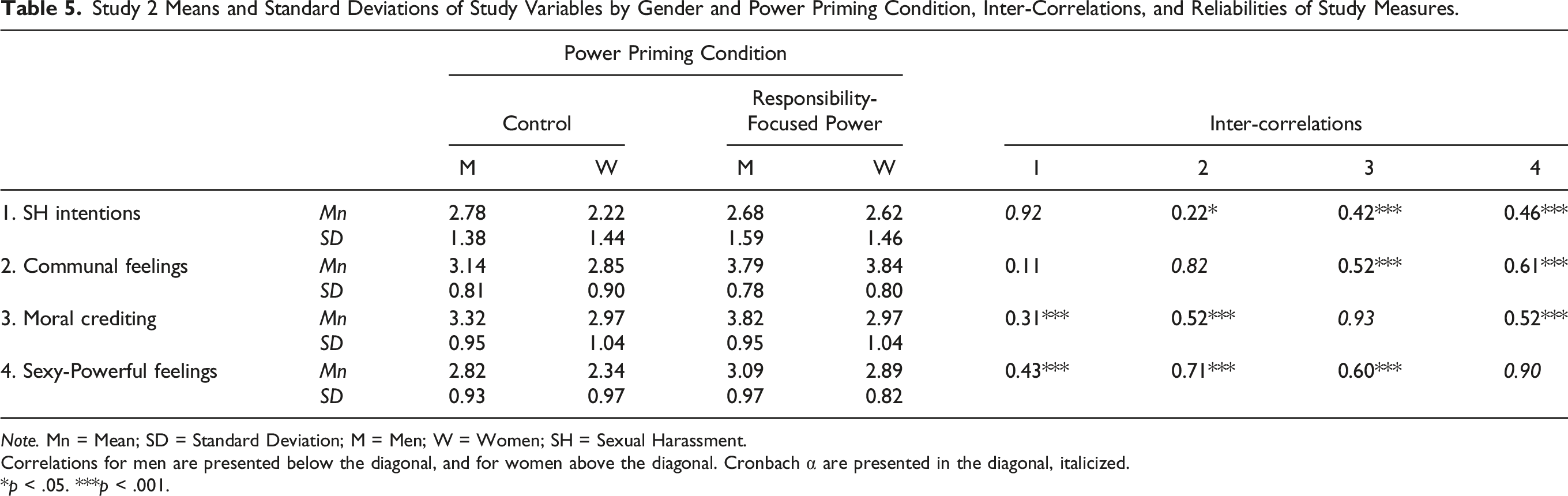
Note. Mn = Mean; SD = Standard Deviation; M = Men; W = Women; SH = Sexual Harassment.
Correlations for men are presented below the diagonal, and for women above the diagonal. Cronbach α are presented in the diagonal, italicized.
*p < .05. ***p < .001.
Hypothesis Testing
The hypothesized gender difference on sexual harassment intentions (H5) was not supported. Men’s intentions to engage in sexual harassment (M = 2.74, SD = 1.47) were slightly higher than women’s (M = 2.46, SD = 1.46); but not significantly so, as tested by a one-tailed t-test, t (248) = 1.46, p = .074, Cohen’s d = 0.19. The research question of whether gender would moderate indirect effects of responsibility power priming (vs. control) on sexual harassment intentions was assessed with the PROCESS models discussed below.
We ran a serial mediation model in which gender moderated each of these paths using Hayes’ (2018) PROCESS macro for SPSS (version 3.5) with 5000 bootstrap samples. Gender did not moderate the path between power priming and communal feelings (b = 0.24, SE = 16, t = 1.44, p = .150), nor the path between power priming and moral crediting (b = 0.05, SE = 0.20, t = 0.24, p = .809), nor the path between power priming and sexual harassment intentions (b = 0.46, SE = 0.33, t = 1.38, p = .169). Therefore, we computed a serial mediation model without gender. The path diagram for this model is shown in Figure 2. This figure shows that those in the responsibility power priming condition (vs. control) rated their communal feelings higher, which in turn increased moral crediting beliefs about themselves. Moral crediting, in turn, increased intentions to engage in sexual harassment. This serial indirect effect was significant as shown by the 95% confidence intervals not passing through 0. There was no evidence that responsibility power priming (vs. control) directly influenced sexual harassment intentions, controlling for its effects on communal feelings and moral crediting. H6, in its entirety, was supported. Study 2 Path Coefficients for the Serial Mediation of Responsibility Power Priming (Vs. Control) on Sexual Harassment Intentions Through Communal Feelings and Moral Crediting, Controlling for Sexy-Powerful Feelings.
We found an unexpected indirect effect between responsibility power priming on sexual harassment intentions through communal feelings, controlling for moral crediting (see Figure 2). This finding suggested that embodying responsibility-focused power and communal feelings may have a protective function against sexual harassment consistent with other research on responsibility-focused power (Chen et al., 2001; Hershcovics et al., 2017; Tost, 2015). In sum, our results suggested that participants who were primed to experience responsibility-focused power were more likely to engage in sexual harassment, but only when their communal feelings gave rise to moral crediting.
Discussion
People who are primed to think of themselves as embodying responsibility-focused power license themselves to engage in sexual harassment. This effect occurred indirectly through communal feelings and moral crediting. Specifically, our results from Study 2 showed that participants who felt responsible power are more likely to engage in sexual harassment but only when their communal feelings are associated with their moral crediting beliefs. Interestingly, when moral crediting was controlled for, the indirect effect of communal feelings was negatively associated with sexual harassment intentions. This finding suggests that responsibility-focused power may have complex effects on transgressive outcomes, such as sexual harassment. Such power appeared to morally license one to sexually harass, but it may also have had a protective function, which the literature on responsibility-focused power has suggested (Chen et al., 2001; Hershcovics, 2017; Tost, 2015). Future research may want to address the vagaries of responsibility-focused power.
Further, we did not find any evidence that gender moderated the influence of our power priming manipulation on communal feelings, moral crediting, and sexual harassment intention, suggesting that the effects of power and moral licensing are robust for both men and women. Similarly, Dinh and Stockdale (in press) found that both self-focused and responsibility-focused power priming (vs. control) had robust effects on sexual harassment intentions for individuals identifying as lesbian, gay, bisexual, or queer.
General Discussion
Taken together, our studies demonstrated that seemingly “good people,” that is people who embody responsibility-focused power, licensed themselves to sexually harass, and perceivers morally licensed their harassing conduct. These studies advance our understanding of why sexual harassment may be persisting despite decades of attention to this issue in both the academic literature and in the popular press and social media, such as with the #MeToo and #TimesUp movements. The prototypical predaceous, egocentric perpetrator, such as the self-focused powerholder depicted in Study 1, is easily identified as a harasser, and indeed is more likely than less-powerful people to harass (Stockdale et al., 2020), but our research demonstrated that the less prototypical powerholder who embodies responsibility-focused power and feels warm and caring toward others was also licensed to harass.
Theoretical Implications
Our studies add to the body of research examining proximal effects on harassment. Previously, the literature has demonstrated contextual influences on the likelihood that sexual harassment will occur in a particular workplace. Specifically, employees (especially women) in male-dominated contexts and work environments that tolerate sexual harassment are more likely than others to experience sexual harassment (Fitzgerald et al., 1997; Willness et al., 2007). Furthermore, when individuals perceive a threat to their standing in the gender hierarchy, those with a proclivity toward sexual harassment demonstrate a greater likelihood of engaging in sexual harassment, particularly gender harassment (Berdahl, 2007; Dall’Ara & Maass, 1999; Maass et al., 2003). Our research suggests another mechanism that both motivates sexual harassment and diverts its blame: moral licensing. This mechanism does not rely on environmental conditions, such as a male-dominated or tolerant work environment, nor on threats to male privilege, but future research should examine whether feelings of power are heightened under such conditions. However, for moral licensing effects to occur, potential perpetrators must feel that they have engaged in morally laudable behavior, such as responsibility-focused leadership. As such, we encourage training programs that foster ethics, mentorship, and allyship to warn trainees about the potential for moral licensing to undermine benevolent intentions of such programs.
Our research focused on moral crediting as the mechanism that caried the effect of responsibility-focused power toward sexual harassment perceptions and conduct. As Tost (2015) has theorized, power gives rise to both self-focused and other-focused (responsibility) motives, which may produce both self-serving and other-serving thoughts and actions. Tost (2015) contended that dual-process models of cognition are relevant to understanding power. An automatic, nonconscious form is evoked by stimuli, such as status symbols and control over valued resources, which activates associations between power and self-relevant and approach-related cognitive nodes. A more effortful, conscious form emanates from social and cultural expectations that link power with duty to care for others. Moreover, Tost (2015) argued that both forms of power can be simultaneously activated. For example, supervisors and organizational leaders are surrounded by trappings of power, such as bigger offices, asymmetrical control of resources, and the ability to evaluate others consequentially, which may prime automatic, self-focused construals of power, but their duty to guide, mentor, and support their employees activates a conscious, responsibility motive as well. Hence, powerholders could see themselves, and be seen by others, as consciously displaying a responsible, moral visage. However, because their power disinhibits hedonic goal seeking, they may also engage in profligate activities, such as sexual exploitation (Gruenfeld et al., 2008; Kuntsman & Maner, 2011).
Practice Implications
Interventions should focus on disrupting the effects of moral crediting. Such interventions could target the link between power embodiment and moral crediting, or the link between moral crediting and sexual harassment perceptions and behavior.
Moral licensing effects can be tempered by making the perceptual link between former behavior, or one’s global moral self-view, and the wrongness of the potential transgressive behavior more salient. Concreteness (unambiguous transgressive behavior) and hypocrisy (seeing transgression as clearly antithetical to one’s moral self-view) counteracts moral licensing tendencies (Susewind & Hoelzl, 2014), increasing the salience of the harm of transgressive behavior, connecting it to domains of behavior in which one has behaved commendably (Effron & Monin, 2010), and by making organizational values for fair and just treatment of others salient (Effron et al., 2015). Carefully constructed training programs may increase perceptions that transgressive behavior is hypocritical and thus reduce moral licensing and subsequent sexual harassment intentions. Such training would be effective, we presume, if it increases trainees’ empathy with the harms of sexual harassment, making this transgression more concrete, and increasing trainees’ commitment to their organization’s ethical values to treat others justly. Empathy, and its close cousin, perspective taking, may also help to mitigate harmful effects of both self-focused and responsibility-focused power. Although empathy training is not always effective, especially among men in some circumstances (Hines et al., 2019), meta-analyses show overall positive effects (Teding van Berkhout & Malouff, 2015). We encourage the development of such interventions and training programs. In addition, enhanced media attention through continuation of #MeToo and #TimesUp may also alert the public to the harms of harassment that supposed “good people” commit.
Limitations and Directions for Future Research
Although our research found robust effects of responsibility-focused power on moral licensing, which in turn diverted the blame for sexual harassment from the perpetrator to the accuser (Study 1) and increased intentions to engage in sexual harassment (Study 2), both studies were conducted under artificial conditions. Scenarios were used to both prime participants in how to perceive the power embodiment of a would-be harasser (Study 1) and to prime their personal feelings of power (Study 2). Furthermore, a scenario was used to solicit judgments of sexual harassment. The use of scenarios as power primes is a somewhat novel approach (but see Fong & Tiedens, 2002), nonetheless we noted that priming participants to feel responsibility-focused power (vs. control) in Study 2 was positively associated with positive affect, which is consistent with power-approach theory. Our use of a scenario to elicit judgments of sexual harassment was consistent with Aguinis and Bradley’s (2014) best practice recommendations for paper-people style experimental vignette methodology. Accordingly, such methods are important to test causal mechanisms for behavior that may otherwise be unethical or difficult to observe naturally, such as sexual harassment. Nonetheless, although the power scenarios in both studies were realistic, they differed on several elements. Therefore, future research may consider using different priming mechanisms to see if effects of power on moral licensing and sexual harassment are robust.
In addition, because data for both Study 1 and Study 2 were collected during the COVID-19 pandemic, we could not execute an in-person laboratory study to observe potentially harassing conduct (e.g., Maass et al., 2003; Pryor, 1987). We encourage future research that will examine the generalizability and external validity of our theoretical prospects regarding responsibility-focused power and moral licensing in natural settings, such as organizations, and with behavioral measures of harassment and other forms of misconduct, including unethical behavior, incivility, and counterproductive work behaviors (e.g., Loi et al., 2020).
A third limitation is that we had a cross-sectional design and did not establish temporal precedence between the measurement of the mediating variables and the dependent variables (sexual harassment judgments or sexual harassment intentions; Maxwell & Cole, 2007). Participants may have, for example, judged the responsibility-focused version of Troy, in Study 1, as least guilty (among other judgments), and the self-focused version as most guilty, and then justified those ratings due to moral crediting. This interpretation remains theoretically and practically interesting, however. Similarly, responsibility-primed participants in Study 2 who felt empowered to engaged in sexual harassment, compared to control participants, may have justified their actions by morally crediting themselves—again, an interesting interpretation. Nonetheless, we encourage longitudinal field research to better understand the causal mechanisms of power embodiment and moral licensing on sexual harassment and other related misconduct. Recent research using experience sampling designs to test moral licensing effects appear promising (Loi et al., 2020). Moreover, if feasible, future research may consider experimentally manipulating communal feelings and moral crediting to examine their causal influences on sexual harassment intentions.
Conclusion
People who perceive themselves, or who are perceived by others, to embody laudable, communal power in which they have demonstrated responsibility toward others may be morally licensed to sexually harass. Across our two studies, we found that (a) observers morally license sexual harassment perpetrators who have been construed as embodying responsibility-focused power, compared to other forms of power or control conditions, by judging their alleged harassing conduct leniently; and (b) embodying responsibility-focused power, compared to a control, triggered a path to sexual harassment intentions through communal feelings and moral crediting. Controlling for moral crediting, however, showed that responsibility-primed participants (vs. control) with communal feelings were less likely to engage in sexual harassment. Hence, interventions addressing moral licensing may not only quell such impulses but may also increase the likelihood of protecting potential targets from harm. In sum, our research sheds light on why purportedly “good people” who embody responsibility-focused power engage in harassment and why, perhaps, we have let them get away with it for so long. Interventions to disrupt effects of moral licensing are needed to effectively address the tenacious problem of sexual harassment.
Footnotes
Declaration of Conflicting Interests
The author(s) declared no potential conflicts of interest with respect to the research, authorship, and/or publication of this article.
Funding
The author(s) received no financial support for the research, authorship, and/or publication of this article.
Authors’ Note
The studies reported in this manuscript were based on Masters’ theses completed by the first two authors under the supervision of the third author at IUPUI. Laurel Mikalouski is now with Accenture, Chicago.
