




Abstract
This article examines the marriage market of Argentine traditional families in the period spanning from 1900 to 1940, based on a sample of 550 marriages and the analysis of their social and cultural patterns. The timeframe chosen includes the period of greatest splendor of these families in Argentine society (roughly between the year 1900 and the mid-1910s) as well as the years that saw the demise of their influence (the 1920s and 1930s). The aim is to shed light on the relationship between marriage patterns and the rise and fall of traditional elites, an issue that has so far been neglected by Argentine historiography.
Keywords
The aim of this article is to provide a picture of the marriage patterns of traditional Argentine families between the 1900s and 1940s.
Insight on the trends of these families’ marriage practices over that timeframe is important for several reasons. The main reason is that from the late nineteenth century these families formed Argentina’s high society, achieving a height and dominance that lasted at least until the mid-1910s. These families can be grouped into three major branches: Buenos Aires families dating back to colonial times; families founded by immigrants and foreigners who had moved up the social ladder in the first two-thirds of the 1800s; and families from the interior provinces. But it was not until the 1880s that these different branches strengthened their ties, in line with Argentina’s process of economic and political integration. The last to join the cast of high society were the families from the interior provinces, whose members formed the core of the new political party in power—the Partido Autonomista Nacional—leading them to settle in Buenos Aires in the early 1880s. As a result, roughly from 1880 to 1910, these families came together as a collective actor, they forged a common identity that combined aristocratic elements with the belief that they formed the country’s traditional and foundational core (the patrician class), and they enjoyed a belle époque fueled by the economic prosperity that followed the crisis of 1890 and which positioned these families at the top of the social ladder. 1
Starting in the mid-1910s, and over the 1920s and 1930s, a new scenario would gradually take shape through a number of dramatic changes. Political developments (the 1912 electoral reform that introduced universal male suffrage, compulsory voting, and the secret ballot, and the victory at the polls of the Union Cívica Radical party in 1916 after thirty-six years of Partido Autonomista Nacional hegemony), economic transformations (the difficulties faced by the rural sector), and cultural and social advancements (the expansion of education, the metamorphosis brought on by immigration, and the emergence of the middle class) combined to gradually push traditional families out of the central role they occupied in the composition of Argentina’s elites. 2
Tracing a picture that spans the first four decades of the twentieth century will therefore serve to put into perspective the years in which traditional families exercised their greatest influence and the timeframe in which their influence waned. This article builds on the premise that the study of marriage practices over the years 1900 to 1940 can provide insight for understanding how this social actor addressed the effects of a scenario that altered its place in Argentine society.
This article also seeks to provide hypotheses and elements that can be used to examine the marriage practices of other Latin American elites. The permeability of Argentina’s upper class until well into the nineteenth century, its definite consolidation in the last decades of that century, and the resulting heterogeneity that characterized its members, as noted above, make this social group unique in comparison to some of its Latin American counterparts, whose composition and marriage market were more closed, stable, and homogeneous until the turn of the century. 3 The results presented below will hopefully open up possibilities for future comparative studies and encourage discussions over existing research conducted by other historiographies focused on the study of Latin American elites and their marriage markets.
The Problem: Marriage Patterns and Social Reproduction of the Elite Classes
Previous Argentine historical studies on the country’s elites have had two main characteristics. 4 On one hand, the vast majority of these studies have focused on the colonial period and the nineteenth century. 5 The reason for the preference for these two periods is probably that the leading role that such social actors played in the history of Argentina—their importance in shaping the course of the nation’s history—is undoubtedly more relevant for research covering those years than it is for studies that address the “democratic” Argentina of the twentieth century. 6 The very dynamics of the changes that took place in the first three decades of the 1900s forced these elites out of the leading position they had occupied in society. However, the inexorable decline that marked this scenario, and the way these social groups—dominant until the Centennial of the May Revolution (1910)—experienced that decline have not yet attracted a great deal of attention among historians. 7
The other characteristic of Argentine historical studies on the subject is that research has focused primarily on political and economic history, as well as on the history of ideas. Far fewer studies have addressed more socially centered issues (sociability, composition, identities), which are most likely to be included as secondary concerns in texts focusing on political or economic problems.
Marriage patterns, in particular, have often been addressed in studies dealing with the implementation of businesses and companies or the development of political groups. These studies, then, are mostly found in historiography of the colonial period and nineteenth-century Argentina (especially the first half), and they are characterized by the wide range of methodological strategies applied—from family histories to network approaches. 8 The studies that deal more thoroughly with social aspects of the country’s elites in the nineteenth century do not necessarily address marriage patterns, as they focus on other matters such as social interactions. 9 Thus, the most abundant literature on problems similar to the one at hand are studies centered on mass immigration at the turn of the century, in particular those that examine the pace and forms of integration of immigrants into Argentine society, for which marriage patterns are a key element of analysis. 10
The lack of historical studies on the marriage practices of Argentina’s elites in the late nineteenth and early twentieth centuries is surprising considering how critical this element is for exploring how the elites faced their social reproduction in a structurally transformed society. The theory of elites and certain evidence contributed by the above historiography, as well as data provided by research on other national cases, offer suggestive alternatives for studying the relationship between the elites’ marriage market and its social reproduction. Briefly, the theory of elites, in particular as formulated by Pareto, posits that when a dominant elite is excessively closed to outside elements it becomes rigid and thus weakens itself, and that it is necessary for it to open itself up, albeit gradually and in a controlled way, in order to renew itself and remain healthy. 11 This has been proven in the case of Argentina’s elites, both during the colonial period and following independence: during the viceroyalty period, the incorporation of new members, generally through women, was a widely accepted practice among Buenos Aires’ merchant elites and also (although more moderately) among the elites of the provinces, and this renewal of ranks was considered critical for the preservation of their economic position. 12 At the same time, the greater rigidity of Buenos Aires’ traditional sectors earlier in the colonial period undermined them socially, economically, and even politically, as it prevented the incorporation of new affluent elements. 13
Research on turn-of-the-century elites in other countries reveals that as their marriage markets opened up to outsiders (in itself a symptom of social decline) these elites lost strength as a social group, although this did not necessarily lead to the decline of all its members. Instead, the social and economic survival of these members—facilitated by exogamy—occurred simultaneously with the blurring of their identity as a group, caused precisely by the flexibilization of the marriage market. The British aristocracy of the interwar period is a typical example in this sense. Some of its members were able to avoid financial ruin by marrying into wealthy families from the United States, but in exchange they sacrificed certain criteria for admission into the aristocracy, and went on to become part of a more plutocratic and less aristocratic elite. In this sense, the endogamy that had prevailed until the late nineteenth century corresponded to an elite that was sure of it position and did not find it necessary to open up to outside members to renew itself. 14 Other aristocratic elites responded to a similar scenario (namely, the rise and consolidation of the bourgeoisie) by closing themselves up completely and so their development took a different course: a gradual, but inexorable, ostracism, as they cut themselves off from the new ruling classes, despite the brief attempts at opening up after World War I. This is the case, for example, of the Piedmontese nobility. 15
Consequently, the suggestions offered by both theory and historiography show a wide range of possibilities. Exogamic tendencies could have been crucial for the survival of an elite, but they could have also influenced—or even caused—its downfall. Endogamy, for its part, tends to be functional to a consolidated group, but it can also trigger its decline if it results in a group excessively closed to outsiders.
Are any of these variants present in Argentina’s elites? The following pages will attempt to answer this question. However, this first requires having a clear idea of what the situation was like toward the year 1900, so as to specify the starting point of the study. By then the marriage practices of Argentina’s elites had taken a dramatic turn away from the practices that had prevailed until the last quarter of the nineteenth century, when moderate exogamy (recurrent, according to several studies noted above) had given way to marked endogamy between the three elite branches (colonial Buenos Aires families; early immigrant and foreigner families; provincial families). 16
There are thus two issues to be discussed. First, did the marriage market of traditional families change from the prewar belle époque years to the interwar period? And, are these marriage practices and the position such families occupied in Argentine society from 1900 to 1940 connected in any way?
Sampling
A sample of 550 marriages distributed from 1899 to 1944 was used for this investigation (see Table A1 in Appendix A). A few clarifications are necessary to understand the scope of the arguments that may be inferred from the sample and the sources used.
With respect to the sample, all the cases selected are marriages in which one or both spouses have a surname belonging to one of the traditional families. These include surnames that meet a number of criteria: they are present in the memberships of the “elite” clubs of the period (Club del Progreso, Jockey Club, Círculo de Armas); are on the guest lists of emblematic traditional high-society events, published in the press; and are featured in genealogical works that reconstructed “Buenos Aires high society.” 17 The cases were thus selected based on a specific variable: social/family origin. Again, and at the risk of being repetitive, this variable was chosen with the aim of identifying individuals who featured prominently in the composition of Argentina’s elites up until the Centennial, and who by then were members of the country’s most prestigious social class, which was synonymous with high society. Second, this selection makes it possible to gauge the weight the symbolic capital of a “traditional” surname had and maintained over the chosen period, significant because of its uniqueness in an immigrant society (and which was also a key identifying aspect of traditional families). It should be noted in this sense that certain surnames were left out because while they could rightly be included within the country’s traditional high society, they could just as well be found outside that circle (e.g., the surname “Fernández”). Like any sample, this sample has certain biases, which are pointed out below to avoid possible interpretative implications.
First, because the object of study are elite groups it may reasonably be assumed that the sample is biased toward endogamy, as this is likely to be the most recurrent behavior of high-society individuals and/or families. In a sense, the sampling criteria cannot be fully separated from the object of analysis. For example, if the starting point for the timeframe chosen were different (1860 instead of 1900), the marriage patterns of the cases studied would probably differ, as a result of the different position occupied by these families at that earlier time. In sum, choosing as the starting point for the study the moment in which these families were at their height may entail a bias in the portrayal of their marriage practices that cannot be ignored. But the study’s emphasis is not on “discovering” endogamy. Rather it seeks to examine the pace of exogamy and identify the moment in which it emerged.
Second, the cases analyzed here were chosen based on a variable factor, as it is a social position, as opposed to nationality, for example, which is a constant factor. 18 This means that two aspects need to be taken into account: whether the social position of an individual or a family changed between 1900 and 1940; and whether the attributes or qualities that determined high social status were modified in the 1900–1940 period. It may be difficult to establish, then, whether what emerges as endogamy (or as exogamy) was indeed that, or if instead it merely reveals phenomena that is present in the sample as a result of the criteria chosen (a problem that would have also arisen if other criteria or characteristics had been chosen to delimit the universe of analysis). For example, there may have been unions that connected individuals and families with similar social standings but with different family and social backgrounds; or, conversely, individuals or families who, despite having diverse economic and social status, could have formed links based on certain common identity features, such as family origin. As will be seen below, the sample is not so absolutely opaque that it obscures these historically plausible possibilities, which contemporary portrayals of high society and high-society life also shed light on. Thus, in developing my arguments I will repeatedly contrast data obtained from the sample with qualitative sources to overcome the sample’s limitations.
Third, the cases were taken from society guides of the era, such as Libro de Oro, Guía Social Palma, Anuario Social (see Appendix A). These guides obviously did not publish all the weddings held on a given year, only those of individuals from families the guides’ authors considered socially important. As noted, this may result in an overrepresentation of endogamy in the sample, and thus it is first of all necessary to identify when exogamy was introduced and the pace at which it was introduced. This possible bias of the sources must be taken into account but without putting too much weight on it. The fact that the lists grew considerably over the period suggests that the criteria for inclusion in the guides were somewhat flexible. While a late nineteenth-century guide featured 800 families, by the end of the 1920s that number had soared to 4,000. The flexibility of the criteria could well have been motivated by a commercial aim, as the magazines sought to increase the number of subscribers. In other words, the production of these guides appears to have combined social and marketing criteria, thus revealing that the universe covered was not exclusively limited to members of the elite classes but also included families with a certain reputation and prestige who did not necessarily belong to the highest sectors of Argentine society (in turn, suggesting that the endogamous trend was not too categorical). The weddings covered by these guides were therefore not limited to members of traditional families, especially as time advanced. This, however, does not affect the results obtained, as not all the weddings listed were included in the sample, only those in which at least one of the spouses could be linked to a traditional family (this explains why the number of weddings listed on Table A1 varies from year to year). Moreover, some years the guides featured weddings from the year prior to publication, and others announced the weddings that were to be held the following year. In this last case, not all the weddings announced actually took place, but even so they still provide information on selection patterns. Finally, the guides are not very good sources for generational data, as no information is given on the ages of the spouses.
Despite these limitations or silences—duly contemplated to avoid swaying balance toward one or another interpretation—both the sources and the sampling criteria provide relevant empirical data to develop a general and perspective view of the marriage patterns of traditional Argentine families in the first four decades of the twentieth century.
Trends
From Endogamy to Gradual Exogamy
The first aspect to be noted is that there appears to be a turning point in the mid-1910s. The predominant practice until that time was endogamy, or marriages between members of the three branches of traditional families. Starting in the mid-1910s, exogamy increases, and in the 1920s, 1930s, and 1940s endogamous marriages never exceed 50 percent of the cases in the sample. Moreover, the drop is gradual, not abrupt: from figures close to 48 percent in 1917 and 1924, endogamous unions are down to a fourth in 1935 and a fifth in 1944 (this evolution is only tempered by a rise in 1941 to almost 41 percent—see Table A1).
The advancement of exogamy is also evidenced by other data obtained from the sample, such as the surnames of spouses of exogamous marriages. As the bulk of overseas immigration at the turn of the century was from Spain or Italy, surnames of Spanish and Italian descent would mean that they belonged to new families or individuals, that is, recently risen from humble origins. However, a little over 60 percent of exogamous spouses in the sample cases have an Italian or Spanish surname (see Table A2). Moreover, the movement from endogamy to exogamy is accompanied by a predominance of this kind of exogamous marriages: at the start of the period, in 1899, when endogamy is prevalent, exogamous spouses with north European surnames are slightly more numerous than those with Spanish or Italian surnames (13 against 10); at the end, in 1944, when exogamy is more widespread, exogamous marriages of individuals with Italian or Spanish surnames vastly outnumber (43 to 21) those of individuals with north European surnames (see Table A2). While an individual’s social position cannot be conclusively determined merely from the profile suggested by the origins of his or her surname, it should be noted that this conclusion was drawn in view of the difficulty in obtaining information on exogamous spouses (particularly for marriages in the 1930s and 1940s) from the sources consulted. If this information gap—this “anonymity”—is taken as an indication of social importance, in those years exogamous spouses do not appear to come from new and rich, or powerful, families. Consequently (but again tentatively), by the 1930s and 1940s, it is likely that the marriages that were exogamous based on the origin of one of the spouses included a large number of marriages to individuals who were not at the top of Argentina’s social pyramid. The question, then, is why did this change occur? What caused the shift from endogamy to exogamy?
A first plausible explanation is that the contrast between the two behaviors has to do with the change in social situation of the families considered: during the prewar belle époque period, and as a reflection of their height and splendor, traditional Argentine families were endogamous; the gradual decline that affected them from the 1920s to the 1940s was, instead, marked by a slackening of that behavior, by a shift toward exogamy. 19
While it is evident that these families underwent a complex political and economic reconfiguration in the interwar years, determining how this reconfiguration affected their marriage practices would demand an analysis beyond the scope of this article. However, around 1910 there was a significant cultural transformation that can be clearly linked to the change in marriage practices: the aristocratic world inherited from the nineteenth century gave way to a more de-structured scenario.
In the twenty years before World War I, society life had actually been strongly regulated, especially for women. The aristocratic aspirations of Argentina’s elites of the time led them to abandon the relatively spontaneous and informal codes of relationship (that would later be remembered with nostalgia by some when the new trends started to take root 20 ) and adopt more rigid protocols. Behaviors and relationships began to be driven by etiquette and governed by conventions that gradually imposed the belief, for example, that it was indecent for a man to strike a conversation with a society lady on the street. In this new scenario, as a contemporary woman said, “it was unthinkable for us to go out alone with a young man; chaperoning was a mandatory institution.” 21
The new codes of behavior were local replicas of European practices, and were, therefore, far from being peculiar to Argentina. The tight control over women, for instance, was in line with the misogyny that was characteristic of the Western world in the 1800s. Nonetheless, observers from those years noted that while high-society life in Buenos Aires was not as corseted as in Europe, it was more rigid than in other new societies, like the United States: “There was an unimaginably vast difference between the freedom enjoyed in social intercourse by unmarried girls in North America and the restricted life of young Argentine women.” 22
This hermetic and strict social world (examined elsewhere by me 23 ) seems to have come in response to a search for preservation in the face of an effervescent society radically changed by immigration (which posed the threat of the interloper, a recurring figure in the literature of the time), but it was more the expression of a turn-of-the-century elite who, as a result of an unprecedented economic prosperity and a lifestyle that combined aristocratic aspirations with plutocratic behaviors, felt secure in the social position it occupied and did not feel it necessary to open up its ranks to new members. The relationship between a closed and rigid social life and endogamy is even clearer in view of the fact that toward 1900, marriages were no longer arranged by parents and were rather the result of individual choices. As another high-society girl accurately observed, “A young woman was expected to marry the man of her choice, but she had to pick her spouse from among a circle of admissible candidates.” 24
The sample, as noted above, coincidently reveals a prevalence of endogamy until the 1910s. However, this prevalence is not very conclusive, as from 1899 to 1912 it never exceeded 60 percent (Table A1). The lack of testimonies showing a high society inefficient in “closing the circle” (the prevailing diagnostic was, on the contrary, that the elite was successful in restricting its social world and reproducing within its borders) suggests that that circle was formed by more than just members of the three branches of traditional families. In other words, it is tempting to think that other attributes or assets, besides traditional Argentine origin, were taken into account to be accepted into the Centennial elite. The sample shows that a nobility title and European extraction were two of these attributes: it includes marriages between members of the elite and Old World nobles (often members of the diplomatic corps stationed in Buenos Aires), for example, Eleonor Martínez de Hoz’ marriage to Baron V. Bussche-Haddenhauser in 1899, or Maura de Drysdale’s to Count Bottaro Costa in 1904. 25 These marriages to individuals outside the circle of traditional families actually strengthen the hypothesis of the preponderance of social endogamy: a marriage to a European noble was not a symptom of decline; on the contrary, it was a sign of consolidation of status (before society as a whole, and also within the elite).
The high society ineffective in closing its borders and controlling behaviors emerges after World War I. After the war, there was a radical change in cultural coordinates (once again in line with developments in the rest of the Western world). New trends in consumption (jazz and tango music; moving pictures; more sensual fashions), new technologies (the automobile), and new reference points (the United States over Europe) heightened generational differences, causing a rupture. The aristocratic world of the nineteenth century was eclipsed by the “modern” 1920s. The difficulties the older generations had in controlling the young, the independence with which young people lived their lives and the contrast in how they behaved, the way they moved and held themselves and their relationships with each other (more intimate, less formal) form a picture that is repeated in portrayals of high society in the 1920s. This was evidenced in warnings that cautioned about “the impetuousness of this new generation [. . .] these young people who flee from our parlors, scorning society with girls of their own class.” 26
In the 1930s, the diagnosis was even more categorical. For young people, the spaces that had framed social life in the first decades of the century now represented everything that was obsolete, they were seen as vestiges of the past. In 1935, the president of one of the most exclusive clubs in the city, the Círculo de Armas, expressed this generational difference on occasion of the institution’s fiftieth anniversary: “The new diversions, the interest in outdoor sports, the thrill of speed and heights, the lure of the most intense and less innocent pleasures have done away forever with the solemn refined ways of our traditional salons, with the witty debates and lively conversation that our elders delighted in.” 27 Though it is possible that these changes were blown out of proportion or overly highlighted, as often happens when people are convinced they are experiencing the end of an era, the new trends eroded a number of conventions that had guided the life of traditional families since the late nineteenth century.
In this context of cultural mutations, one change was particularly important for the subject of this study: the shift in the notion of what constituted a “good marriage.” In the 1920s and 1930s, the references to family origins as acceptable credentials to earn a place in the marriage market of traditional families coexisted with (and were sometimes superseded by) other traits or aspects, such as “a good name, a respectable family, a sizable fortune, a university degree, good work habits and no vices.” 28 As this quote suggests, a “good name” no longer necessarily alluded to patrician origins, but rather to the notion of merit and respectability. It was, of course, common to associate respectability with traditional social origins. The most respectable families were precisely those with a proven continuity of virtue from generation to generation. However, this association was not without certain changes: old family names were not prestigious just or even primarily because they indicated membership to a foundational, and therefore exceptional, group (the patricians), but because they condensed certain values recognized by all of society. Moreover, respectability was gradually disassociated from social extraction. Individuals could now be considered virtuous and respectable even without belonging to one of the old families, gaining that position merely as a result of their own efforts. Virtue thus referred not to a social condition but to a personal trait. 29 In this scenario, then, membership to an old family became less important as a social and symbolic asset. While it was still important and prestigious to belong to one of these families, it was not an essential prerequisite for prestige.
Consequently, the shift from endogamy to exogamy can be contrasted with these cultural mutations: the erosion of canons that had shaped high-society life until the mid-1910s, and the adoption instead of more permissive or tolerant criteria, if such a word can be used. Thus, what could have been scandalous in 1900 was no longer so (or was less so) in the 1920s and 1930s. Therefore, while exogamy entails a significant change in behavior, it should not be seen as something strictly traumatic, as it was not a practice that necessarily went against prevailing conventions, but rather involved behaviors that translated new codes, standards, and criteria. The decline of the endogamous high society (and, perhaps even more, its distension as a social group) was not necessarily the result of misbehavior on the part of younger generations, as was often noted by contemporary observers, but of the inexorability of a profound cultural transformation.
The emergence and advancement of exogamy (although not its implications) must be considered in their proper dimension, not only because the practice resulted from broader cultural changes but also because of its true scope. The sample reveals certain nuances that should not be overlooked. One such nuance is that exogamy is higher among women than among men. Throughout the entire period, except in 1935, exogamous marriages were always more numerous among elite women than among elite men (see Table A2). On the other hand, the rate of male endogamy is consistently greater than the rate of female endogamy (Table A3), both when endogamy was the prevailing practice and when the scenario tended toward exogamy (except, again, in the year 1935).
These tendencies can be seen as accompanying, rather than running counter to, dominant conventions in traditional families. For a “young lady,” marrying a man of merit, however “new” to high society, did not necessarily mean she was not marrying well. It was however considered inappropriate for an elite man to marry a woman from outside high society, as it was desirable for the wife to have the same social background as her husband since she would be in charge of raising and socializing the children, who would have to be educated in the dominant traditions and customs. 30 At the same time, the fear of “spinsterhood,” which was more pronounced among and disgraceful for women, may have also contributed to the greater incidence of exogamy among women and to the fact that such a practice was not necessarily scandalous or synonymous with the decline of traditional conventions (as it was better to marry anyone than not marry at all). However, the scope of this possibility cannot be gauged due to the limited generational data provided by the sources consulted for this study.
Another nuance of the exogamous trend arises from cases that, while insignificant in statistical terms, are illustrative. On one hand are the cases of exogamous spouses who, while not belonging to any of the three branches of traditional families, nonetheless came from families that in the Argentina of the 1930s and 1940s had achieved a significant position in some area of society life. This is the case, for example, of individuals with surnames like Repetto or Dickmann (connected with leading political figures) who, during these years, married individuals with surnames belonging to traditional families.
Another type of exogamous spouses—who appeared in the 1930s and 1940s (which is when this practice became markedly dominant) and were hardly seen in the 1900s, 1910s, and 1920s—are those who for the sake of clarity will be referred to here as spouses with “compound surnames.” These are individuals with one surname associated with traditional families and another surname that clearly does not belong to these families (e.g., Canale Demaría, Parodi Cantilo, Barruti Lanús, Soldatti Posse, and Cichero Ayerza, to name a few). These cases—which appear gradually and thus may have accompanied the gradual advancement of exogamy that emerges from the sample—have a very peculiar aspect: they evidence an openness, occurring in the generation prior to that of the spouse (which is why they are included among exogamous marriages), but at the same time they involve individuals with a certain familiarity with high society, or, at the very least, individuals who are not complete outsiders in that world. Interestingly enough, in the 1930s and 1940s most spouses with “compound surnames” were women. In other words, when exogamy becomes the prevailing practice, in its most moderate form—that is, marriage to individuals with “compound surnames”—it was more widespread among men than among women with traditional surnames. This trend, therefore, can also be viewed as a reflection of the survival of the most entrenched conventions (in this case, the fact that male exogamy was more frowned upon than female exogamy). Another suggestive aspect of “compound surname” cases is that in 1935, 1941, and 1944, the new component in the compound surname is the father’s surname and the traditional one is the mother’s. This reveals that the conventional pattern noted above existed a generation earlier (in the generation of the spouse’s parents): it was a woman from a traditional family who married someone outside the group. In sum, in the 1930s and 1940s most spouses with “compound surnames” were women who were, in turn, daughters of women from traditional families married to men from outside traditional families.
“Compound surnames” thus indicate just how gradual the shift toward exogamy was. As marriages were only “moderately” exogamous, traditional conventions did not die out suddenly, despite the voices raised in alarm. Moreover, choosing a spouse from a sector of society that was not completely unconnected with traditional circles was still expected or approved behavior (especially among men).
Nonetheless, the relative weight of “compound surnames” must be considered in order to put the trend into perspective. Exogamous marriages with compound surname spouses maintained a more or less similar relative significance throughout the 1930s and 1940s, without ever being predominant: 19 out of a total of 63 exogamous marriages in 1935; 12 out of 50 in 1941; and 13 out of 64 in 1944. Not only were there relatively few of these marriages, other indicators—such as the prevalence of Italian and Spanish surnames, and the “anonymity” of these cases—suggest that when exogamy became the prevailing practice among traditional Argentine families, it tended—within a gradual and qualified growth—to connect members of traditional families with individuals who were relative newcomers to high society, or who were at least not very familiar with the universe and social world their husbands or wives came from.
From Endogamy to . . . Endogamy?
As noted above, the shift in marriage practices was in step with a marked transformation in other aspects of culture, which relaxed relationship criteria and patterns. It also accompanied political and economic changes, which added—perhaps even imposed—motives for tempering the upper class’ elitist aversions and its tendency to close itself off.
These circumstances help elucidate why traditional families moved from endogamy to exogamy. However, this does not explain why there were people interested in marrying into traditional families. The existence of exogamous spouses is precisely the indicator that reveals that such an interest existed (a fact that must be highlighted, as the decline or loss of influence of these families could have resulted instead in “imposed endogamy,” that is, marrying within the group due to a lack of interest from outsiders).
This raises two very interesting questions. One is whether marrying a member of a traditional elite family was still as advantageous in interwar Argentina as it had been before. Was there anything to be gained from it? A conclusive answer to this question would naturally demand a thorough family-by-family analysis, and would need to take into account that marriage decisions are not always determined by merely materialistic motives, because people do fall in love. When placed in perspective and considered as a whole, there is no question that traditional families continued to play a significant role in politics, the economy, and even cultural affairs, and that they did not suffer a definite and abrupt decline in Argentina’s democratic era. However, as I have examined elsewhere, the practice of marrying into a traditional family as a way of moving up the social ladder diminished in the 1920s through the 1940s as compared to the belle époque period of prewar Argentina. This was not only due to some of these families’ decline; it also had a more structural reason: the very transformation of Argentine society. The increasing complexity that affected all areas of social life (politics, culture, the economy) was translated into the opening up of unique channels and spaces outside the control of the traditional elite, which individuals could use to advance socially and make a place for themselves in these areas (from political parties to salons and intellectual circles). 31
If marrying into a traditional elite family in interwar Argentina was not as advantageous as before, a different approach is necessary to explain the persisting interest in such marriages among outsiders, or, at the very least, additional, and complementary, factors must be contemplated. The second question raised, then, is: What image or representation of the country’s traditional upper class circulated in interwar Argentina? What reputation did this class enjoy?
The historiography that has dealt with this issue provides an ambiguous picture. On one hand, the upper classes’ politics (its increasingly intransigent antidemocratic positions) and economic decisions (the shift from production to rental income, in the case of the landed elite, which out of all of Argentina’s affluent sectors in the 1920s and 1930s was the most closely connected with traditional families) during this period contributed to discredit them in the public eye. 32 Also, its ostentatious lifestyle did not sit well with a society in which thriftiness, hard work, and respectability were gaining ground as guiding values, fueling a moral criticism that circulated in the press and spread to various cultural expressions, from literature to tango. 33 There was, however, another side to this, as the traditional elite continued to radiate a symbolic prestige. It was still synonymous with distinction and high status. This is illustrated by the references to this social circle found in the advertisements of certain products, which sought to distinguish their brands by association. 34
The symbolic prestige radiated by the traditional elite—its standing as a reference group in terms of status and prestige—did survive, even if it waned with time. “Compound surnames” could be seen as expressions, in the sample, of this surviving status. The very existence of such names reveals the interest in maintaining a referentiality to traditional high society (represented by the mark of identity signified by the surname). But the fact that they were a minority of exogamous marriages suggests that referentiality was not a very widespread or valued aspiration.
In developing the above arguments it was assumed that all traditional families maintained a high social position. However, this was not necessarily the case for every family. While no causes can be inferred from the data used for this study (besides such well-known causes as the impact of the Great Depression on landed families), the sample again offers some signs that can be connected with the decline of traditional families. One of these signs is the “anonymity” of the vast majority of the exogamous spouses in the 1930s and 1940s.
The lack of information on these spouses can be taken as an indication of the situation of the individuals with traditional surnames who married them. In other words, it could reasonably be held that these marriages joined families that were in relatively similar socioeconomic conditions, whose differences had more to do with their origin and extraction. For example, and for the sake of illustration (perhaps to the detriment of analytical rigor), they could have been marriages between middle-class immigrants and individuals from traditional families.
Two very interesting phenomena can thus be inferred from this kind of unions. First, socially these marriages would be considered endogamous, not exogamous, because they connected families with similar socioeconomic conditions, differing only in their family origins. This endogamy, however, does not conceal two significant phenomena (rather it evidences them): the declining role of some of the traditional families, and the diminishing importance given to family origin as a mark of identity and, more generally, as an attribute of social stratification (which can very well be interpreted as proof of the limitations of immaterial attributes in a capitalist society). That is to say that by the 1930s, having a traditional surname was no longer a strong enough asset to gain a place among Argentina’s elites, or at least it was not in itself a quality that would have encouraged traditional families to marry among themselves.
Second, the decline of some traditional families may have paradoxically contributed to maintain the symbolic prestige radiated by these families as a whole, as traditional surnames, instead of alluding to an increasingly discredited elite, became an asset that could be acquired to gain distinction in the world of the middle classes. Thus, these traditional families were able to preserve their (symbolic) significance even as they were disappearing as a collective actor, due to the diaspora that affected them under the upward and downward mobility of interwar Argentina.
Conclusions
One conclusion that can be drawn from the sample is that at the start of the 1900–1940 period, traditional social origins weighed significantly in spouse choice among traditional families (the fact that endogamy prevailed among these families is the main evidence of this importance). But by the end of that period, it was no longer a significant factor. The diminished importance of this asset, however, should not necessarily be seen (or at least not in all cases) as a shift from endogamy to exogamy, as in the 1930s and 1940s members of traditional families married individuals whom they considered their social equals, as they had done at the turn of the century (even if they had to do so reluctantly, as was most likely the case among families who had moved down in the social ladder). Exogamy, which is evident when the family origins of the spouses are considered, would not be such if other criteria had been considered. There were, after all, other assets that could compensate for or were just as strong as traditional surnames, most importantly, economic assets, but also social assets, among which the most important during interwar Argentina was probably respectability. Something similar happened during the belle époque years: social endogamy was more pronounced than what can be inferred from the number of marriages within traditional families (never over 60 percent) because there were also marriages to individuals who were social equals, or who served to ratify the elite condition of traditional Argentine families despite not being of patrician descent (this was the case of European nobles). In this sense, another conclusion is that it is difficult to identify all the criteria and factors that influence a person’s choice of spouse, as these changes in line with the transformations in society and the position people occupy in it.
It could be inferred that the importance of social origin as a determining factor in marriage trends is actually the result of the sample studied here and not necessarily a “real” phenomenon. That is, that the members of the elite married within their group at the beginning of the period studied but also at the end of that period, only that as elite groups were reconfigured over this period, the predominance of traditional surnames in the marriage market diminished as the composition of affluent sectors was renewed. Similarly, surnames were a mark of identity of Argentine elites as long as there were objective conditions for it, that is, when traditional families dominated the social universe of these elites. Once they no longer prevailed, the importance of traditional surnames also declined.
This picture while plausible obscures certain nuances. Most importantly, it underestimates the importance of the social background and of traditional surnames, as these were a central factor in the establishment and identity of traditional families as a collective actor at the turn of the century. Their diminished importance as a criterion for choosing a marriage partner needs to be highlighted as a phenomenon that is itself significant. That is, marrying a person from a different social background may not have constituted an exogamous marriage, in the strict sense; not even a conduct that could be associated solely with a decline in social status. That would have been the case with traditional families that maintained their high social status and mixed with the new elite families (a behavior, however, that is not significant in the sample, as can be inferred from the anonymity of the spouses from nontraditional families, which is a probable sign of their scarce social influence). But with these new patterns and conducts, traditional families relaxed their mutual relations in a scenario in which their paths diverged (possibly fueling the relaxing of relations). Thus, some families survived individually in renewed elites, while others declined. Consequently, it is valid and plausible to argue that elite families married among themselves both at the start and at the end of the period studied, but that this may be misunderstood because the composition of the elites and the criteria used to determine what an elite was had changed. This conclusion, however, obscures a phenomenon that must be highlighted: the loss of mutual relations between traditional Argentine families and even their declining role as a collective actor (which they had had at least until 1910).
A second nuance also has to do with the weight that social origins had in shaping the identity of traditional families. As argued above, there were cultural changes during the first postwar that probably made these families more permeable than they were during the belle époque, in the early years of the twentieth century. However, the pace of these changes was gradual (exogamous marriages, for example, were more common among women, in line with the most traditional conventions) and their advancement met with some resistance. In this context, and despite a tendency toward change more than toward the preservation of behaviors and cosmovisions, affluent traditional families could hardly have rapidly abandoned one of the most deeply rooted and unique pillars of their identity—traditional surnames—unless the circumstances demanded it.
From this perspective, marriage between individuals from different social backgrounds, as a growing trend, may plausibly be said to have been a more common practice among the traditional families that had lost social status than among those who maintained their place among Argentina’s elites. A hypothesis that needs to be further explored in this sense is whether in the 1930s and 1940s the marriages that were endogamous because of social origin (a minority in the sample) occurred among traditional families that retained their economic or political power. This is an interesting possibility because it could mean that the marriage market of Argentine elites—as their ranks were renewed and despite a general trend that diminished the importance of social origin—suffered a segmentation that had been minor in the first decade of the twentieth century, when their composition had been more homogeneous. The marriage market of traditional elite families may also be seen as differing from that of the traditional middle-class families. For the former, social origin would not have lost importance quickly due to an interest in safeguarding a symbolic distinction into renewed elites; while in the middle classes, marriage to members of new families would probably have been a practice more rapidly accepted, or at least more common (and perhaps more imposed than among families that practiced it but maintained an elite position).
The sample—despite the limitations noted above—reveals evidences that point to the reconfiguration of the elites, and the diaspora of traditional families in interwar Argentina. In this sense, one of the most suggestive conclusions that may be drawn from this analysis is that this diaspora could have helped preserve the symbolic significance of the identifying pillars of traditional families, even after they had lost substance as a collective actor. The elite families that swelled the ranks of the middle classes caused traditional origin—which had been a key identifying characteristic of elite families—to become disassociated from its close or exclusive reference to the dominant classes, which were increasingly losing legitimacy in the eyes of society. “Compound surnames”—which were statistically marginal but suggestive because they appear in the 1930s and 1940s—are an indication, in the sample, that traditional surnames still played a role as a symbol of prestige. Therefore, the persisting force of this symbolic asset in Argentine society (or its slow agony), which had been a very strong mark of identity among traditional families, may be explained not only by the fact that it represented an elite condition but also by the decline of a segment of Argentina’s traditional families in the interwar period.
Footnotes
Appendix A
Endogamy Rates
| Years | Men (%) | Women (%) |
|---|---|---|
| 1899 | 79.50 | 71.40 |
| 1904 | 72.70 | 69.50 |
| 1912 | 78.70 | 72.50 |
| 1917 | 68.18 | 62.50 |
| 1924 | 68.25 | 63.23 |
| 1935 | 39.28 | 43.13 |
| 1941 | 61.01 | 57.14 |
| 1944 | 42.22 | 33.30 |
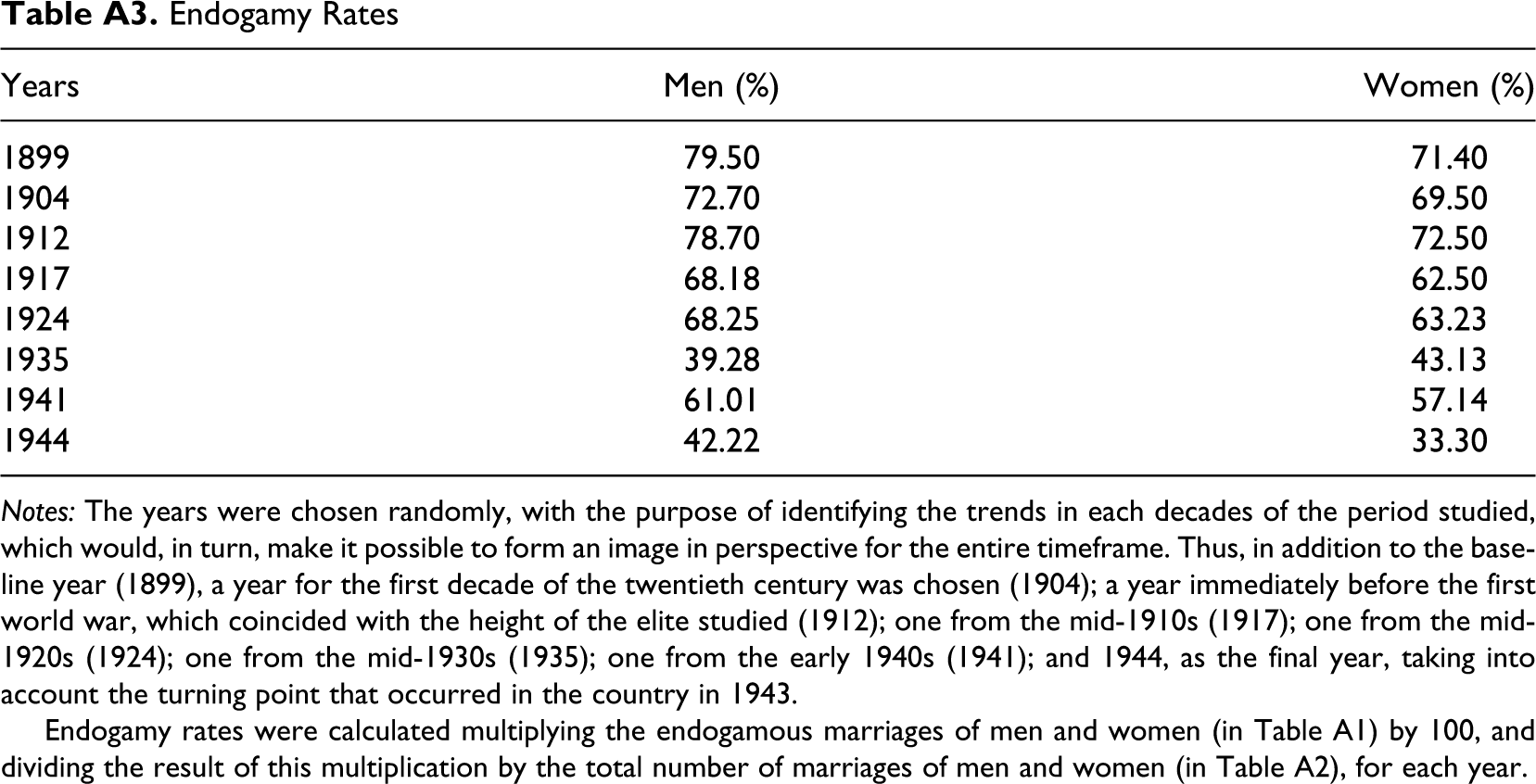
Notes: The years were chosen randomly, with the purpose of identifying the trends in each decades of the period studied, which would, in turn, make it possible to form an image in perspective for the entire timeframe. Thus, in addition to the baseline year (1899), a year for the first decade of the twentieth century was chosen (1904); a year immediately before the first world war, which coincided with the height of the elite studied (1912); one from the mid-1910s (1917); one from the mid-1920s (1924); one from the mid-1930s (1935); one from the early 1940s (1941); and 1944, as the final year, taking into account the turning point that occurred in the country in 1943.
Endogamy rates were calculated multiplying the endogamous marriages of men and women (in Table A1) by 100, and dividing the result of this multiplication by the total number of marriages of men and women (in Table A2), for each year.
Sources
Acknowledgments
The author would like to thank Paula Bruno, Eduardo Míguez, and Hernán Otero for their insightful observations and generous comments to this article.
Declaration of Conflicting Interests
The author(s) declared no potential conflicts of interest with respect to the research, authorship, and/or publication of this article.
Funding
The author(s) received no financial support for the research, authorship, and/or publication of this article.