




Abstract
This study utilizes the Taiwan colonial household registration data to study the cause of uxorilocal marriage in Taiwan during the period of Japanese colonial rule and, simultaneously, to compare the prevalence of uxorilocal marriage in urban (Taipei) and rural (XinChu) communities. The socioeconomic status of the bride and groom’s family, and ethnic and urban–rural differences are the main issues in this research. In addition, the viewpoints of Wolf and Huang and Pasternak will be rechecked vis-à-vis regional differences. The results of this study will be presented by statistic analysis and geographic information system. In Taiwan, compared to major and minor marriage, uxorilocal marriage had a higher ratio in Taipei and XinChu. In uxorilocal marriage, the age of brides and grooms is older in Taipei than in XinChu. In addition, our research indicates either daughters or adopted daughters, if they had fewer siblings or no brothers, had a higher probability of entering into uxorilocal marriages. Moreover, uxorilocal marriages were found to be less prevalent in later birth cohorts while ethnic groups and parent’s marriage types had no direct effect on uxorilocal marriage.
Keywords
Introduction
Living with older parents, either of husbands’ or of wives’, becomes an economic and rational choice for a couple again in the present decade. 1 This living arrangement has no relationship with virilocal and uxorilocal marriage, but it reminds us to rethink the advantage and dilemma of uxorilocal marriage. Shuzhuo Li et al. 2 has published several articles about cultural transmission, the advantages to older parents, and family division of uxorilocal marriage in rural China. 3 Uxorilocal marriage was a kind of special marriage type in, but not exclusive to, Chinese society. 4 Regional and cultural differences directly affect the acceptance of uxorilocal marriage for citizens. In the Taiwanese hierarchical kinship system, uxorilocal marriage was not held in high esteem by both the groom’s and the bride’s family. Several variations of this type of marriage existed, because the parents of both parties tried their best to strike a balance between carrying on their own line and maintaining social values. 5
In the past, most Taiwanese parents did not like to see their precious son (there was a preference for sons) be married into another family. Once a man abandoned his father’s surname and married into his wife’s household, it would be very difficult for him to keep and exercise his rights within his natal family. His chances to inherit his parents’ property were small and those of his children were even smaller. 6
The status of sons in uxorilocal marriages is similar to daughters in virilocal marriages. His brothers would treat him as an outsider because he was sold to his father-in-law. This was so, even though, in some cases, sons in uxorilocal marriages were more willing to give financial support and housework help to their natal family than sons in virilocal marriages. 7 In contrast, in his wife’s family, he is a dependent son-in-law, because his parents-in-law pay him to be married into the family for his labor force and his children. In certain extreme situations, the brought-in son-in-law would run away, either by himself or with his wife and children.
Studies of uxorilocal marriage have noted two reasons and functions: one is to “continue the bloodline” (a family issue) and the other is “labor force” (economic issue). Arthur Wolf has divided uxorilocal marriage into two categories as follows: contingent uxorilocal marriage and institutional uxorilocal marriage. 8 When a couple has no son, they will tend to let their daughter call in a husband; this is a “contingent uxorilocal marriage.” The idea of contingent uxorilocal marriage is to maintain the kinship of the father of the bride: more than one-third of the women in an uxorilocal marriage had no brother to carry on their father’s line. 9
“Institutional uxorilocal marriage” is similar to contingent uxorilocal marriage in some ways but had “labor force” as its main purpose. When a family had a shortage of labor, parents would also choose uxorilocal marriage for their daughters. Burton Pasternak claims that uxorilocal marriage would have different purposes and motivations in different regions. In rural areas, especially for farmer families, uxorilocal marriage was a way to getting labor needed for farming. 10 However, Shuzhuo Li et al. conclude that contingent and institutional uxorilocal marriages can coexist in a rural area where is “a weak patriarchal family system, lack of dominant family clans in villages and relaxed village regulation of uxorilocal marriage.” 11
In this article, the main purpose is to figure out the mechanism of uxorilocal marriage. Would it have decisive regional differences? What are they? In order to study the regional effects, we selected Taipei (urban) and Xinchu (rural) as our research areas. In the colonial period, Taipei was a business city, and most of citizens were Taiwanese (Min Nan). In contrast to Taipei, farming was the main economic activity in Xinchu, and the major ethnic population was Hakka. We estimated the purposes and motivations of uxorilocal marriages in these two areas by frequency analysis and logistic regression analysis with several factors: marriage ages, personal status (adopted child and own child), sibling compositions, socioeconomic status, and regions.
Data
The data on which we base our research are from the digital household register database constructed by the Program for Historical Demography (PHD) of Academia Sinica of Taiwan. The Taiwanese data originated from the Japanese household registers. From the registers, we selected the records on DaDaoCheng (大稻埕) and MengJia (艋舺; see Figure 1), the two small river port towns that became part of Taipei city in the nineteenth century. The towns housed few if any Japanese, and combined small-scale production and commerce with residences varying from mansions to warrens of tiny rented rooms. DaDaoCheng and MengJia are located on the central Taipei basin (Hong 1983). 12

The collection of household registers in Taiwan, by PHD.
Because of its successful tea trade, MengJia was Taiwan’s third largest and richest city in the mid-nineteenth century. After the nineteenth century, the tea industry shifted from MengJia to DaDaoCheng, because the local residents of MengJia protested against the unfair treatment of the tea companies. 13 MengJia, therefore, lost its business power and interests and DaDaoCheng took its position. In this research, DaDaoCheng and MengJia will both be referred to as “Taipei.”
The flourishing tea business had a great impact on the social structure of Taipei. Girls were no longer confined to work in the households. They could find work and earn their own income, for example, by picking tea. Arthur Wolf and Hill Gates (2005) stated that Taiwanese parents in this part of the country kept their daughters home, withholding them from marriage so that the household could still benefit from their daughters’ earnings. 14
In the “Xinchu” database, PHD collected household registers of three townships in Xinchu during the colonial period: ChuPei(竹北), BeiPu(北埔), and Ermei(峨眉). In this research, ChuPei, BeiPu, and Ermei will be referred to as “Xinchu.” Generally, most Hakka lived in mountain areas (see Figure 1), and the main economic activity in these three Hakka townships was farming. Unlike Taipei, these three townships did not develop as a business city because of its geographic characteristics. 15 This economic type also had effects on the status of Hakka women in society and the family. Compared to Min Nan women, Hakka women lost their name when they are married; they would be known as the wine of their husband. 16 In addition, most of Hakka women had to farm and did not bind their feet.
Table 1, showing the population structure of Taipei and Xinchu, indicates that the size and structure of population were similar to each other although, as mentioned previously, the main ethnic group was Min Nan in Taipei and Hakka in Xinchu. The distribution of marriage types is similar between Taipei and Xinchu. 17 Whether in Taipei or Xinchu, for male or female, uxorilocal marriage represented the smallest number among three marriage types (major, minor, and uxorilocal marriage). But women had higher chances of calling in a husband in Taipei than that in Xinchu. This directly related to women’s economic ability and parents’ attitude. In Taiwan, the age at marriage varied according to the type of marriage and regional customs. 18 Generally, the mean age at marriage was higher in Taipei than that in Xinchu for each type of marriages.
Population Distribution.
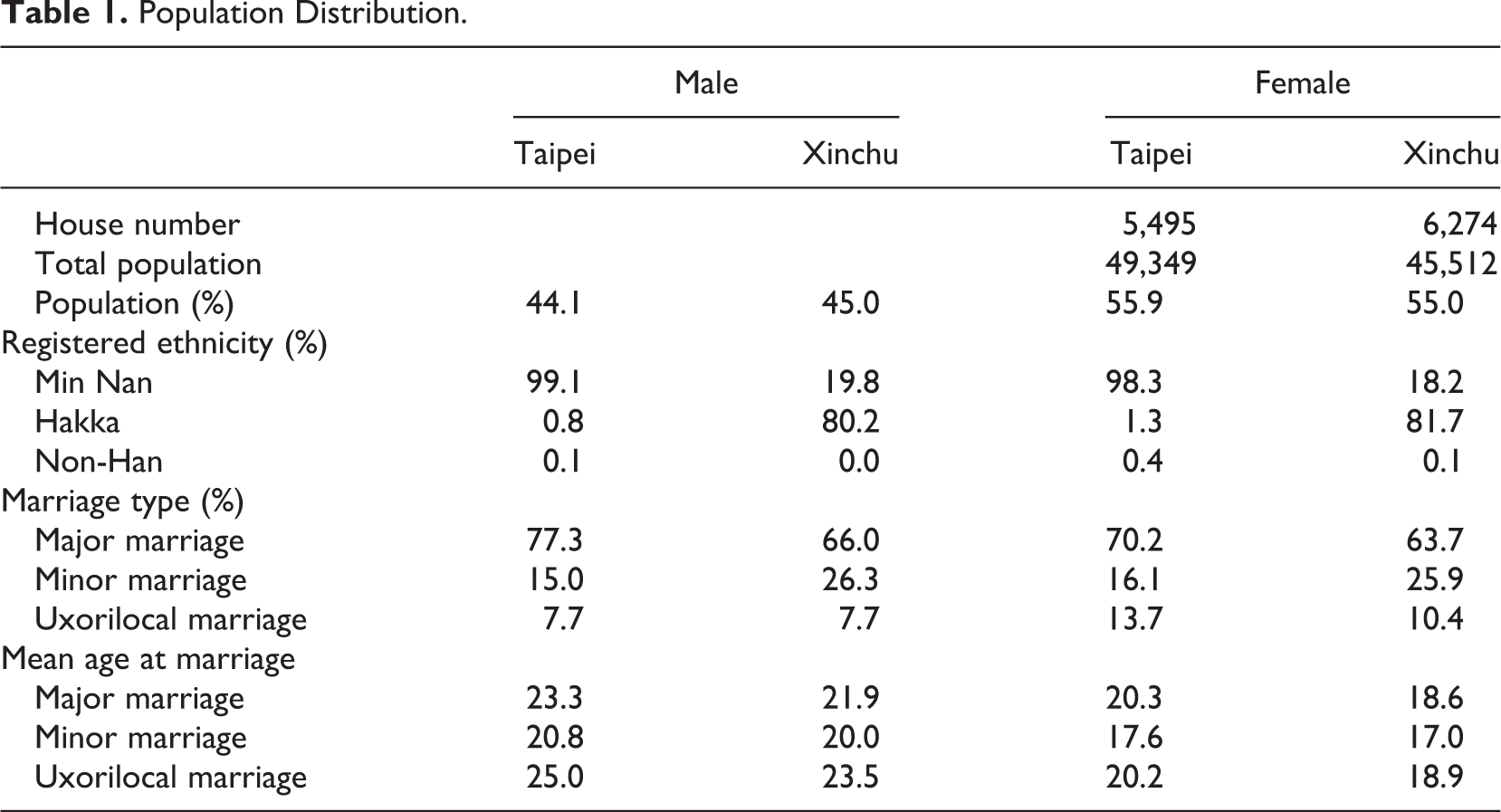
In the period of Japanese occupation, Taipei was one of the richer and more industrialized cities of Taiwan. The growth of the economy became one of the factors causing a delay in marriages, 19 as parents preferred their children to have a job before they got married. With respect to gender differences, women married earlier than men. Both Barclay and Wolf and Huang have discussed this phenomenon by examining the cultural effects and population structure. Barclay focused on the demand of descendants, and the other researchers paid attention to the shortage of women. 20
For women in Xinchu, the difference in the age at marriage between the different types of marriage was small; the mean age in the major and uxorilocal marriages was almost the same. In Taipei, the mean ages at marriages for women show a bigger gap than women in Xinchu. However, because of the nature of the minor marriage, whereby the bride was adopted young as a little daughter-in-law and had to fulfill her duty as wife soon after her menarche, 21 the age at marriage for both the groom and bride was lower than those in major and uxorilocal marriages in Taipei and Xinchu. For men, the age at marriage for uxorilocal marriage was the highest (around 2 years higher). For men, accepting an uxorilocal marriage was the last alternative. If they had the ability to have a major marriage, they would prefer that over an uxorilocal marriage. 22
Parents who only had daughters preferred at least one of them to marry a groom into the family, and would like to have at least one grandson to take their surname, in order to carry on the line of the bride’s father. The arrangement of an uxorilocal marriage varied, depending on the negotiations between father-in-law and son-in-law. Thus, the contracts of an uxorilocal marriage were conducted in various ways. Often, it was a trade of the surname. But the more rights the groom gave up, the more money he was given by the bride’s parents. According to Wolf and Huang’s field notes, “if a groom took his father-in-law’s surname, and accepted all the duties of a son with respect to his wife’s parents,” he does not need to pay anything for the wedding and would even get a “groom price.”
In these cases, where the groom was married into a bride’s family but gave some of his children his own surname instead of that of his father-in-law and would live in the bride’s household until his parents-in-law passed away, he was called “half-called-in” (“Pua:-Chiou,” 半招), and the form of marriage was named “Pua:-Ciou-Chua” (半招娶). For this kind of uxorilocal marriage, the groom’s family did not necessarily pay a bride-price but only paid with cakes or with a reduced bride-price.
There was another type of contingent uxorilocal marriage that is more complex. A childless couple could adopt a daughter. When the adoptee reached a marriageable age, the foster parents could find her a husband that would marry into the family. In this situation, grooms were “half-called-in son” or “called-in son” (“chiou-e,” 招的), but some of them would change their status to adopted son after a couple of years. As the groom became the adopted son and took his foster father’s (or, in the initial stage, his father-in-law’s) surname, the adopted daughter became the daughter-in-law, and all of their children naturally remained in the foster father’s line.
Result
Frequency Analysis
Based on the previous study of uxorilocal marriage and the characteristics of the population in the Taipei and Xinchu database, we set three variables to study the relationship between uxorilocal marriage and family composition. Meanwhile, we compare the regional differences.
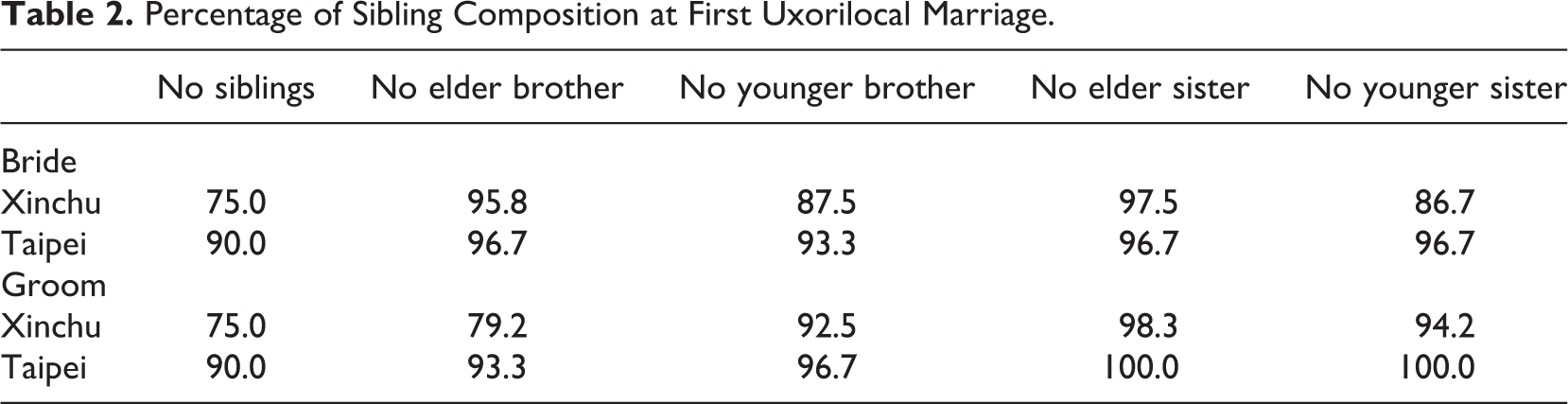
The first direct way to check the purpose of uxorilocal marriage is by looking into the sibling composition of the bride. We assume that no sibling is a major reason for a woman to have an uxorilocal marriage, because she has to take the responsibility of maintaining the family line. Table 2 shows that 90 percent of uxorilocal brides in Taipei did not have siblings. This ratio is much higher than the uxorilocal brides in Xinchu (where it is 75 percent). This is first evidence about regional difference and also gives a hint that “maintaining the family line” was the major reason for uxorilocal marriage in Taipei but not in Xinchu. As for the groom, it is odd that many of them did not have siblings, either, when they married into the bride’s family. Normally, a man would be more treasured to his parents when he is the only child, and his parents would have a hard time accepting an uxorilocal marriage. Does it imply that these men did not live together with their parents or their parents had already passed away?
Percentage of Sibling Composition at First Uxorilocal Marriage.
In order to study the parents’ effect on uxorilocal marriage, we checked the living status of parents of brides and grooms. 23 Table 3 shows that the percentages of living together with parents are similar in Taipei and Xinchu. Obviously, whether in Xinchu or Taipei, the ratios of living together with parents are higher for brides than for grooms. It shows that most of the grooms did not live together with their parents when they chose uxorilocal marriage. To sum up, parents did have the power of decision over their children, but it worked differently for brides and grooms. For a bride, parents played a supportive role in her uxorilocal marriage, or they asked her to accept it. But for a groom, the resistance was decreased when the parents did not live together with him.
Percentages of Lived Together with Parent at First Uxorilocal Marriage.

Table 4 shows the personal status of bride and groom when the uxorilocal marriage took place. It shows that, in Taipei, almost 80 percent of brides were adopted daughters. It means the uxorilocal marriage was highly connected with the “continuation of bloodline” in the city. However, this phenomenon did not happen as frequently to Hakka women in Xinchu. In other words, the uxorilocal marriage in Xinchu did not aim to maintain a family line but to provide labor force. This presents us with the first regional difference. As for the grooms, the adopted son was a treasure to their adoptive parents and would not be willing to accept an uxorilocal marriage. Therefore, most men who accepted the uxorilocal marriage were not adopted sons in either Taipei or Xinchu.
Personal Status at First Uxorilocal Marriage.

After studying family composition, we checked the latest address of each bride and groom before she or he entered an uxorilocal marriage. In Taipei, the first two concentrations of places where uxorilocal brides lived are ChaoTongJie (朝東街, 27.7 percent) and HuanCiShiJie (歡慈市街, 22.5 percent; see Figure 2). More than half of the uxorilocal marriages in Taipei happened in households located on these two streets. ChaoTongJie was one of the important streets for the tea business and HuanCiShiJie was a famous red-light street in the colonial period. Although the economic activities were different for these two streets, both had higher working opportunities for women. We speculate that a better economic opportunity was a significant factor for women to participate in an uxorilocal marriage.
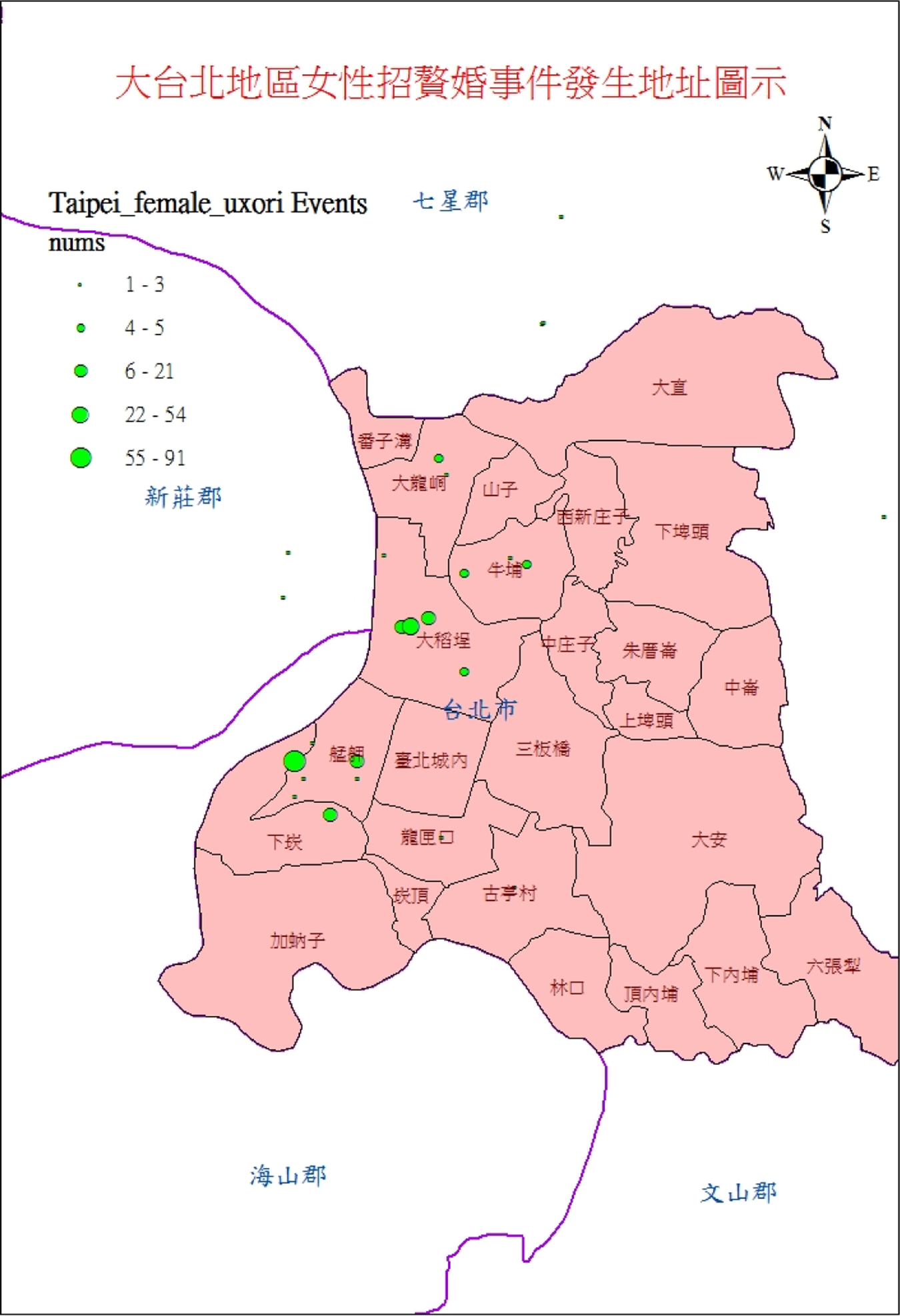
The distribution of uxorilocal marriage in Taipei by women.
Because the data on women’s occupation was dropped from the household registers, we cannot directly check their economic status. However, combining the above-mentioned statistic results, it is reasonable to think that many adopted daughters who lived in HuanCiShiJie married a call-in husband. There are two possible scenarios. First, the mothers of uxorilocal brides were prostitutes and adopted them to maintain a household. Second, these uxorilocal brides were prostitutes themselves, and when they had sufficient financial resources, they called in a husband.
As for the grooms, most of them lived in northern Taiwan before they married into the bride’s family (see Figure 3). We assume that due to the stigma of uxorilocal marriage, most of grooms would come from other cities in order to avoid gossip. For these grooms, more than one third of them lived in ZhwengChuJie (鐘厝街, 15.1 percent), HuanCiShiJie (10.8 percent) and ChaoTongJie (朝東街, 9.6 percent). ZhwengChuJie and ChaoTongJie were both located in the tea-business area, and HuanCiShiJie was the main street of the red-light district. As we mentioned above, most grooms did not live together with their parents. In the colonial period, marriage was not based on love between brides and grooms; parents and marriage matchmakers played key roles. Therefore, we speculate that these grooms moved into Taipei for work and had a geographic advantage for uxorilocal marriage.
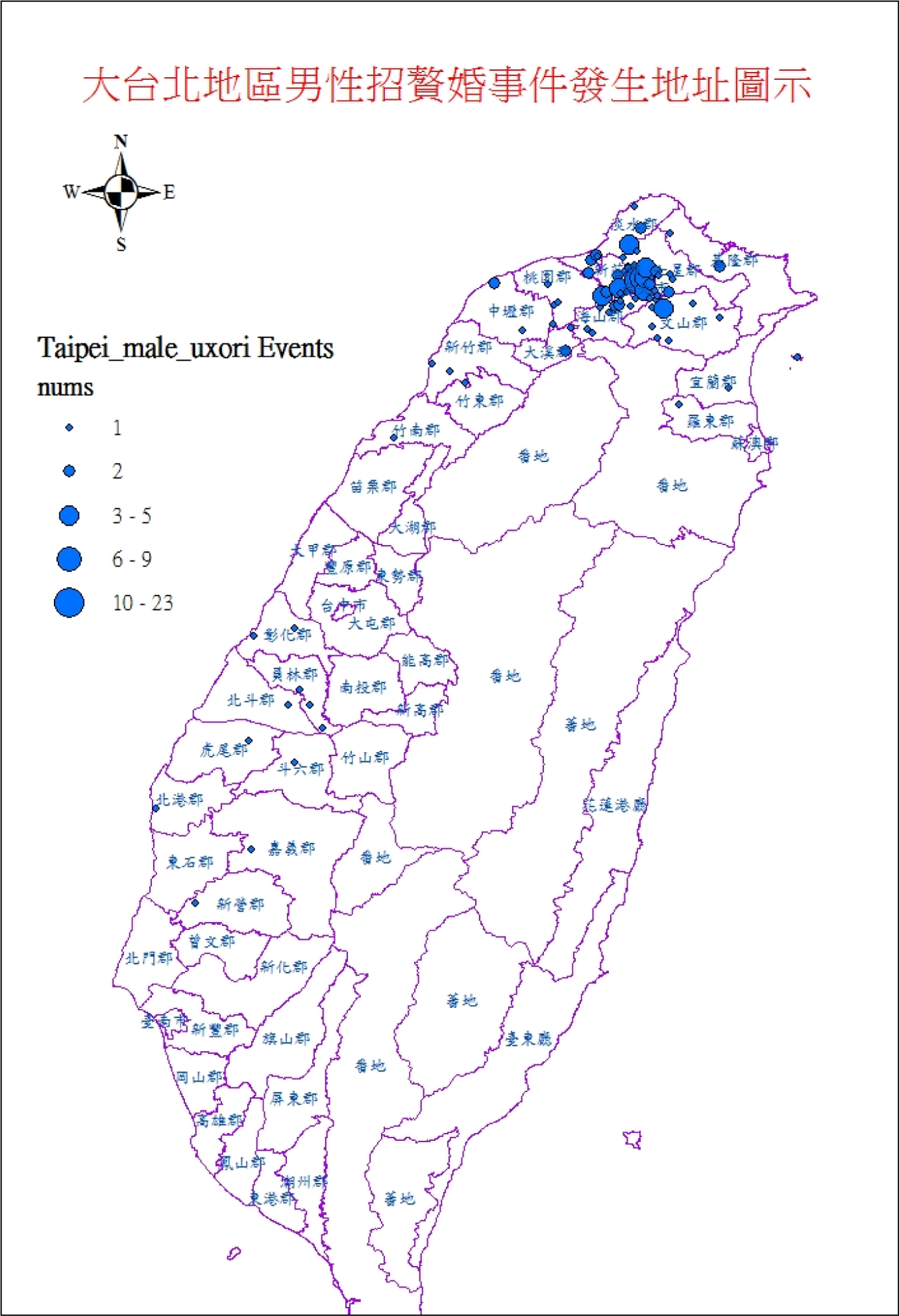
The distribution of original living place of uxorilocal groom in Taipei.
Similar to Taipei, the major locations where uxorilocal marriage took place were the main economic activity areas in Xinchu: BeiPu (北埔, 31.5 percent) and MaoErDingBaZiKwu (貓兒錠拔子窟, 9.6 percent; see Figure 4). BeiPu is located in mountain areas, and was a strategic point in the colonial period and an area famous for tea farms. As for MaoErDingBaZiKwu, it was a flourishing seaport in Xinchu. The economic structure and working opportunities for women of these two major locations of uxorilocal marriage in Xinchu were similar to Taipei. In Taipei, tea picking at factories was a popular work for women to make money, however, in Xinchu, women worked not only in factories but also in tea farms, which required a larger labor force. Therefore, combining the above statistical results from Xinchu, it is reasonable to conclude that labor force was a major motivation of uxorilocal marriage in Xinchu.
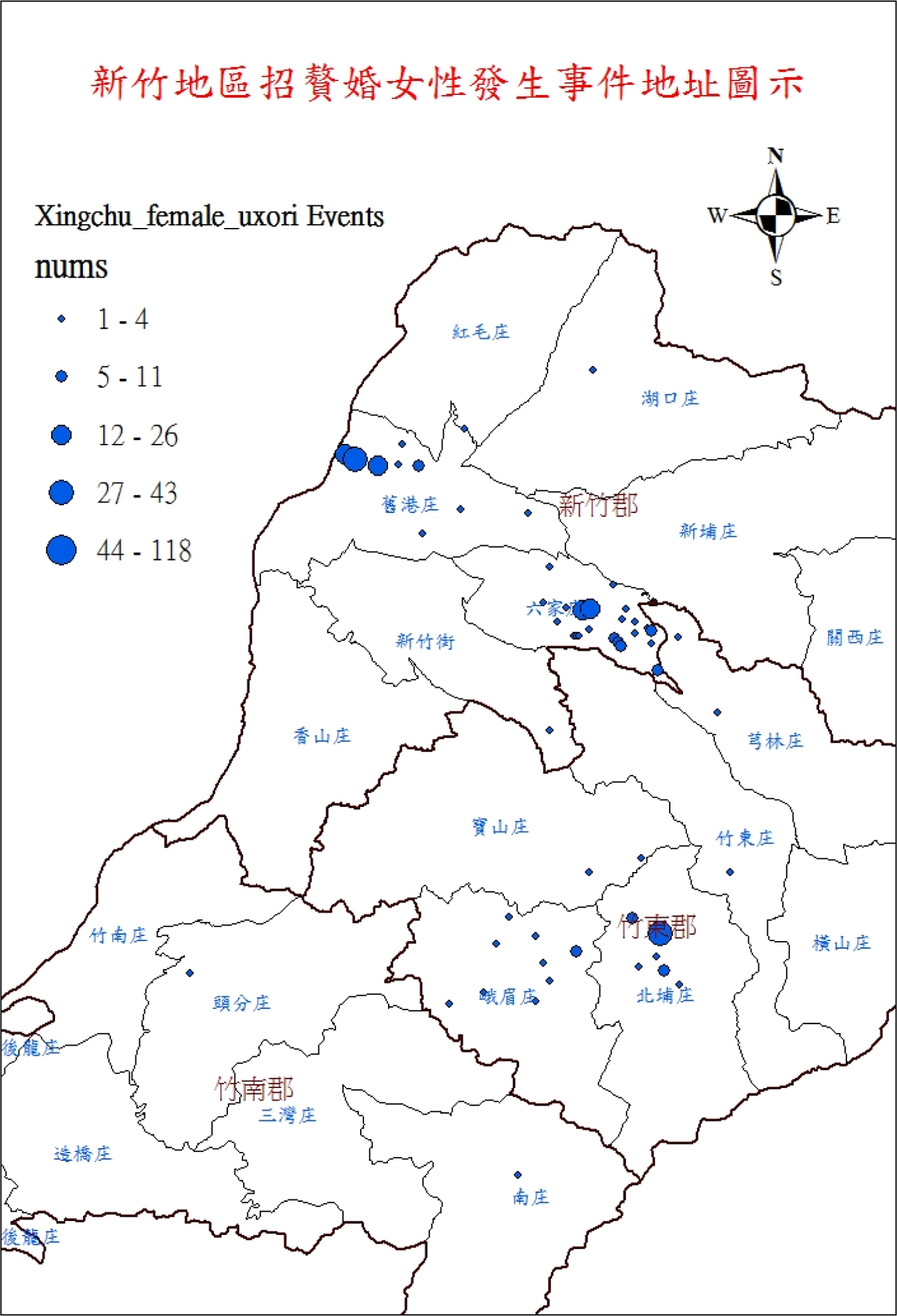
The distribution of uxorilocal marriage in Xinchu by women.
The distribution of last place of residence before marriage of uxorilocal grooms in Xinchu did not present a cluster phenomenon (see Figure 5). The most common two places where uxorilocal grooms lived were BeiPu (北埔, 9.8 percent) and MaoErDingBaZiKwu (貓兒錠拔子窟, 3.4 percent). It is not difficult to understand that labor force was very important in a port and at a tea farm. These men moved to Xinchu and entered uxorilocal marriages, which is not the same as in Taipei. Most uxorilocal grooms lived in Taipei already, before they agreed to an uxorilocal marriage.
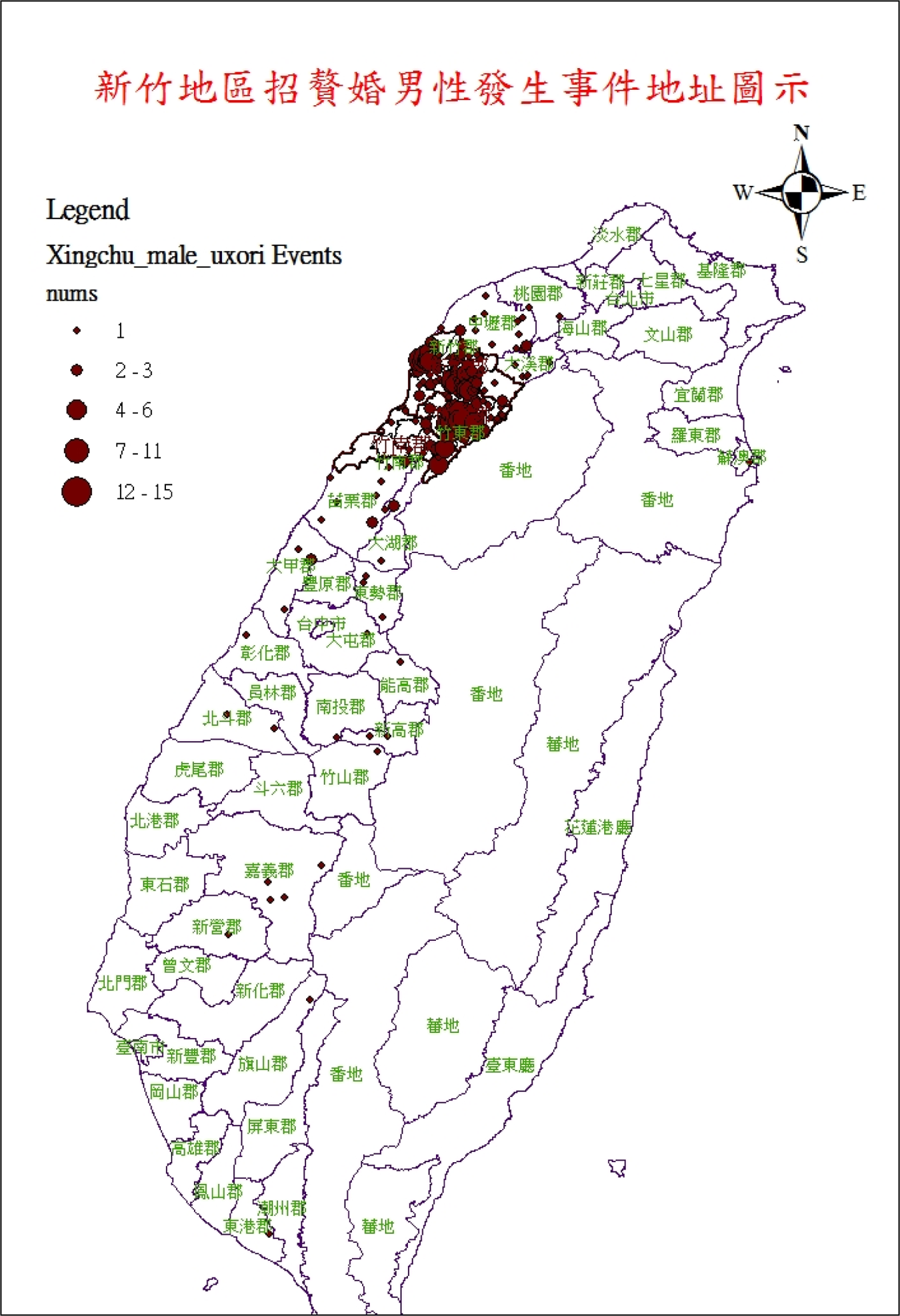
The distribution of original living place of uxorilocal groom in Xinchu.
Multiple Regression Analysis
As for the advanced interpretation, the logistic regression is applied to estimate the effect of variables (see Table 5). Due to the research question—why did women choose to marry-in a husband?—we selected only those women who had ever married for the research sample, and we observed only their first marriage. There remained 7,138 women in this logistic analysis. We first set “marriage type,” “marriage age,” and “ethnicity” to discover regional differences. In Taipei, the percentage of uxorilocal marriage was higher than in Xinchu, and the main ethnicity was Min Nan. Compared to Xinchu, the main economic activity was not farming in Taipei, and women married later.
Distribution of Women at First Marriage by Areas.
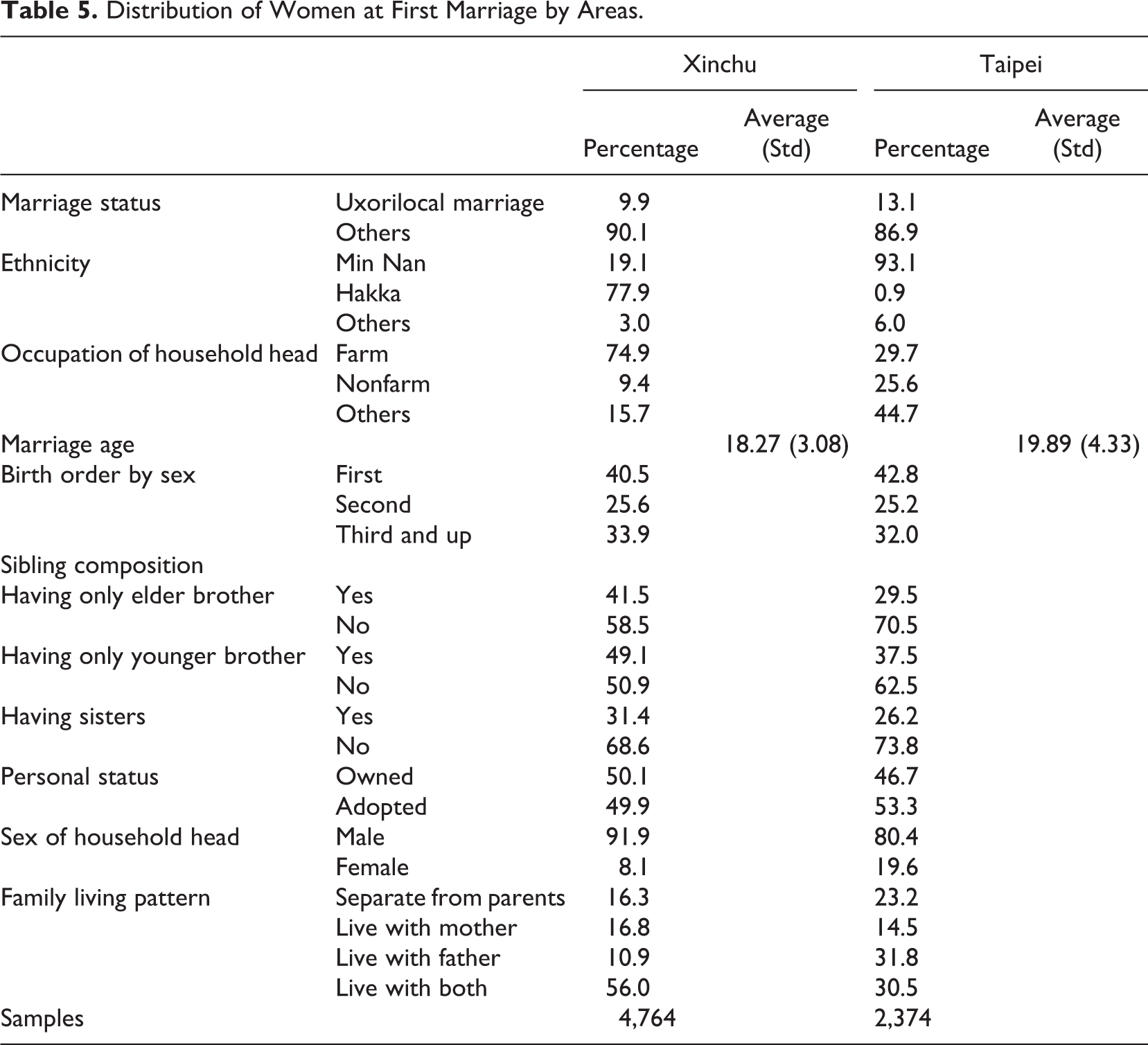
Furthermore, “birth order by sex,” “personal status (owned or adopted daughter)” and “sibling composition” were checked to uncover the responsibility of maintaining the bloodline and labor force. The birth order by sex presents a similar distribution in Taipei and Xinchu. However, the sibling compositions do not show similar patterns, and more women were adopted daughters in Taipei. Finally, we used “sex of household head” and “family living pattern” to estimate the parental/senior duty and authority. Clearly, more female household heads existed in Taipei and more daughters lived together with parents in Xinchu. The further interpretation is given in the following section with Table 6.
Logistic Regression Analysis of the Determinants of Uxorilocal Marriage in Taipei and XinChu.

Note: N = 7,138. AIC = Akaike information criterion; BIC = Bayesian information criterion. Exponentiated coefficients; standard errors in parentheses.
Although the percentage of uxorilocal marriages is higher in Taipei than in XinChu, we do not find significant regional effect in the logistic regression model (see model 1, Table 6). Ethnicity was significant, however, as Min Nan women were more likely to call in husbands. In model 2, Table 6, where we controlled the sibling compositions, the effect of ethnicity became stronger. This implies that the sibling preference has higher influence on uxorilocal marriage in the Min Nan community. Especially when a woman has an elder brother, it is much less likely for her parents to arrange an uxorilocal marriage for her. In addition, the birth status of daughters is a significant factor to uxorilocal marriage. Biological daughters have a greater chance of having an uxorilocal marriage than adopted daughters do. After all, biological daughters can maintain their bloodline in reality, not just by preserving a surname.
With respect to the household compositions, we set three factors, that is, gender of household heads, family living patterns, and occupations of household heads. As for the female household heads, it is interesting to note that many of them had adopted daughters and lived without a coresident man. Therefore, labor force and maintaining the bloodline both become motivations for them to arrange uxorilocal marriage for their daughters. Female household heads were more likely to arrange for an uxorilocal marriage than male household heads were. Parental power also played a decisive role in marrying-in a husband. Living with parents, either one or both of them, is a very significant factor for daughters to enter an uxorilocal marriage. If we consider the labor power issue, model 2 shows evidence that nonfarming families were more likely to call in a son-in-law.
Based on these surprising findings concerning regionalism and the gender of household heads, we further multiply these two factors to check their influence on uxorilocal marriage (see model 3, Table 6). It appears to be strongly significant. The first thing we observe is that the gender of household heads has a stronger effect than regions do. Figure 6 provides us a complete view of these multiple factors. More female-headed households had uxorilocal marriage records in Xinchu, which leads to this result.

Adjusted probabilities for uxorilocal marriages in Taipei and XinChu.
Discussion
In this article, we discuss the regional influences on uxorilocal marriage in Taipei (urban) and Xinchu (rural). Within the similar population structure of the database, we observe that marriage behavior was highly related to the local economic activities. Moreover, local economic activities reflected geographic characteristics and local culture. Different marriage types have different motivations and functions in Taiwan, and even the same marriage type presents differences between different regions.
In Taipei, an urban area, the main purpose of uxorilocal marriage was to “maintain the family line,” and most brides were adopted daughters. The parents’ power and daughter’s economic ability were important factors that led to an uxorilocal marriage. These marriages clustered in a red-light street and tea-business area. Furthermore, the grooms worked in these areas first and then later accepted uxorilocal marriage.
In Xinchu, a rural area, the main purpose of uxorilocal marriage was “saving labor force,” and adopted daughters were not the major bride group to call in a husband. The parents’ parental power and heavy labor were important factors that led to an uxorilocal marriage. These marriages clustered in a tea-farm area and a seaport. In addition, these grooms firstly agreed to accept uxorilocal marriage and then married to Xinchu. According to the logistic regression analysis, it is clear that region did not play a significant role in uxorilocal marriage. The gender of household head, moreover, had a more decisive influence on marriage strategy, rather than did regions and occupations.
Footnotes
Acknowledgment
The authors would like to thank Yu-Lin Huang for his help in the database management, and the Program for Historical Demography at Academia Sinica to make the household registers available. We are grateful to members of the editorial committee of this journal for their comments.
Declaration of Conflicting Interests
The author(s) declared no potential conflicts of interest with respect to the research, authorship, and/or publication of this article.
Funding
The author(s) received no financial support for the research, authorship, and/or publication of this article.