




Abstract
From a historical sociology and gender studies perspective, this article sets out to explore the representations and the public discourse surrounding women’s role in society and in the family, through the lenses of the late nineteenth-century Romanian feminist press. As elsewhere in Europe, the feminine ideal of that era emphasized motherhood and the dichotomy between public and private spheres in the construction of gender relations. At the same time, the feminist discourse provides a privileged window on the “idealized” model of the family and the distribution of gender roles, but it also allows researchers to capture the tensions between dominant and minority representations of femininity. This kind of discourse and public position create at the time the conditions of possibility for further social change. Hence, a content analysis of Femeia română magazine is of particular heuristic value, due to its longevity, but also to the personality of its founder.
Women, the family, and feminism are topics that have already been visited many times in Western historiography, from different theoretical and methodological perspectives, which showcase their complexity as well as their centrality for understanding past and contemporary societies. 1 Before 1989, Romanian social scientists and particularly historians were mostly interested in some variant of “traditional family history.” 2 The fall of the communist regime constitutes a point of departure for the revitalization of the field through the emergence of new research topics and innovative theoretical and methodological approaches. The history of the family, legal, and demographic studies; the sociology of matrimonial and patrimonial strategies; women’s history and gender studies; sexuality; as well as increasing acknowledgment of the impact of medicine upon social life (its “medicalization”) are the themes that have launched a new era in postcommunist Romanian historiography. 3
In this context, the nineteenth century appears as a time when Romanian society was confronted with fundamental social, political, cultural, and economic transformations, leading to a reconfiguration of the established social and political roles and hierarchies. These transformations are essential for understanding subsequent social phenomena, as most of the future relationships, interactions, and social representations find their roots in this century of profound upheaval. The analysis of the social and political construction of gender has a significant heuristic value when grappling with these transformations. 4 From a theoretical angle that combines historical sociology and gender studies, this article sets out to explore the representations and the public discourse surrounding women’s role in society and in the family, through the lenses of the late nineteenth-century feminist press.
Method
The analysis developed here will concentrate on a discourse-driven normative approach, while placing each discourse in the context of its production and corroborating it within the context of its time and with the intentions of person who conceived and/or delivered it. 5
The representations summarized above make up the ideological and normative framework within which one should place and understand the institutions of the family and gender roles of nineteenth-century Romania. In the light of their implicit conservatism, many issues may appear as an extension of existing representations and social roles. Beyond the similarities and the elements of continuity, it is important to remember the new arguments and new norms that emerged in the nineteenth century, and to relocate them in the context of their production. On the one hand, this contextualization provides the only opportunity to understand the breakthroughs and changes that occur at this time (e.g., women’s access to education, their participation in specific aspects of the public sphere, including charitable organizations and certain professions deemed “appropriate” for them). 6 In time, these first steps led to greater opportunities (hence, the transition from women’s involvement in women’s charities to the creation of feminist associations). 7 On the other hand, a detailed analysis of this ideological and normative horizon is essential for understanding the public stands taken by women, to better understand the emergence of feminist ideas and of a feminist movement in Romania. External influences undoubtedly played an important role in this area (given that the Romanian feminist press publicized information about feminist ideas and actions in the United States and Europe—primarily France, England, and the Nordic countries—shows the diversity of available arguments) and reveals the influence of these ideas on the beginning of Romanian feminism that is similar in many respects to European feminisms.” 8 Nevertheless, I argue here that the type of arguments used by Romanian women to voice their demands remained greatly indebted to the dominant national social and political representations of gender norms. The difficulty of analysis consists of discerning the incorporation of these dominant representations and the pragmatic use of rules and patterns that can turn against the original ideological meaning; discourses often reproduce the cultural values and norms of the time (i.e., linked to the national ideology) although these norms and values often end up by being questioned. Education is perhaps the most telling example. Promoted by the political elites for political and ideological reasons (mostly related to nationalism), 9 women’s access to education can be seen as a “Trojan horse” 10 that opens the door to information and allows women to reach an intellectual level comparable to that of men and to develop the capacity for autonomous critical thought and a well-informed public voice.
Therefore, feminist discourse grants privileged access to a more satisfactory analysis of the “official” model of family and gender roles: it allows researchers to capture the tension between dominant and minority systems of representation. How do women, especially women who are familiar with feminist ideas, perceive women’s role and place within society? What is the relationship between tradition and modernity, between an authentic “Romanian voice” and a repetition/imitation of discourses largely imported from abroad? What are the most common elements of criticism, demands, and change that emerge within the nineteenth-century Romanian feminist press? These questions will be addressed on the basis of a content analysis of a magazine that was founded and run by a group of women in Bucharest in 1878: Femeia română: ziarul social, literar şi casnic (Romanian woman: A social, literary and domestic magazine) and which continued to appear in print until 1881, with small interruption periods and total amount of 230 issues. 11
The main hypothesis of this analysis is that, although it undoubtedly started from a position that was close to the “dominant” political representation of femininity and gender relations, according to which the family represents the basic unit of society and women are destined to be devoted wives and mothers, this magazine gradually became a space for debate, opening its’ columns up to a variety of “voices,” some of which were able to outline alternative models of gender relations in the Romanian context. The presence of Maria Flechtenmacher as founding editor of the magazine, coupled with her own personal and professional trajectory, is “practically revolutionary,” 12 since she personifies the transcendence of the rather restrictive norms of femininity of the time.
The Historical Context: Families as the “Fundamental Cell of Society” and Women as “Angels of the Hearth”
Western modernization, more specifically under a marked French influence, along with the vituperative critique of the oriental model of social organization, as well as corresponding social and political regime, along with the foundation of the first Romanian national state and the reconfiguration of social hierarchies, implied important changes for the social representations and practices of nineteenth-century Romania, provoking a disruption of the existing social order. Thus, in Romanian historiography, this period is often associated with terms like “crisis” and “moral disorder,” which seem to be particularly associated with a crisis of sensibility, a crisis of marriage, the liberalization of intimate relationships, and a multiplication of domestic disputes (i.e., the growing number of divorces among the upper classes). 13 In the second half of the nineteenth century, this moral disorder, fueled by an evermore coherent nationalist ideology, lead to the redefining of many social institutions and relations, among which gender roles within the family enjoyed a privileged position. 14 Although the terms and arguments used varied, liberals, conservatives, and even the socialists maintained that the family was “the basic cell of society,” 15 one that was essential for the recovery and progress of the “Romanian nation.” A fierce criticism of arranged marriages and of large age differences between partners, an exaltation of marriages of love and of conjugal harmony, a new definition of romantic love, of the child’s place within the family and in society, were concerns that arose both at the ideological and at the legal level and which are linked to the redefinition of gender relations and norms.
Within this ideological time frame, motherhood becomes a central element of the “(re)newed feminine ideal” 16 ; the medical discourse interpretation of motherhood as woman’s “natural destiny” thus combined with the political discourse of motherhood as a “civic” and “national” duty. 17 Gender roles and relations were interpreted from the perspective of seventeenth- to eighteenth-century Western medical and political philosophy: men and women were portrayed as different (an “incommensurable” difference, as evidenced by the medical literature of the time) but nevertheless as complementary. 18 This notion of complementarity was seen as central to conjugal “harmony,” because men and women are each designed to fulfill their specific biological and social roles: the man was to be in charge of public affairs and politics, he was to provide for the family’s living expenses, and the woman was to be his “minister of the interior,” the “guardian angel of their home,” as she administrated the “private” domain (according to the modern opposition between the public and the private sphere). 19
It should be noted that, although these ideas undoubtedly underpinned the official ideological model of femininity (and masculinity) during the period, the reality of nineteenth-century Romania is far more complex. Firstly, before the nineteenth century, oriental cultural norms and practices had an infinitely greater influence on social elites (the boyars’ class, 20 who had direct links with foreign rulers and courts) than on farmers (who represented 90 percent of the Romanian population). 21 Secondly, the oriental influence also depended on the specificities of the Romanian Principalities. Thus, while it is true that some of the testimonies of foreign travelers 22 at the end of the eighteenth century and early nineteenth century speak of the segregation of the male and female spaces, of arranged marriages, and of girls peeping through the gilded bars of a harem to catch a first glimpse of their future husbands, 23 it is also true that divorce was already accepted in all of the Romanian Principalities and that the legal regime of inheritance granted Romanian women a privileged status in comparison to those in force in many Western societies. 24 Under the influence of the Western cultural, legal, political, and economic models, it could be argued that the legal status of Romanian women was actually set back to some extent. 25 However, Western influence also allowed the definition of a new social and even political status for Romanian women and, as we shall show below, it laid down the prerequisites for triggering women’s emergence into the public sphere.
Finally, all the norms and rules mentioned so far mostly concern the cultivated and wealthy urban classes (the only sectors of the population that were literate and receptive to change), which were often called to act as a role model for the illiterate rural population. Undoubtedly, social practices at the time varied greatly between social groups, and these rules may yield different results depending on different cultural, economic, or social factors.
Feminine/Feminist Press
In modern societies, the written press is one of the privileged spaces for taking a stand in public debates, and women quickly understood the symbolic and practical importance of this media. The first Romanian newspapers/magazines appeared in the early nineteenth century 26 ; as early as the 1840s, women published translations, and later literary creations, in those newspapers that accepted their contributions. The first newspaper for women, founded and run by a woman, appeared as early as 1865. 27
On the basis of the classification proposed by Evelyne Sullerot, 28 several types of printed materials published by women and for women can be distinguished: (a) newspapers/magazines that were produced by a group of women and that addressed a wide range of issues and readerships, (b) newspapers for women but written largely by men, (c) newspapers about women (which even tackle the issue of their political rights) written by men for men, (d) newspapers written by women and intended primarily for women. All except the third category of newspapers can be found in various formats in late nineteenth and early twentieth-century Romania. The number of publications intended for women and those publishing women’s points of view increased during this period and became quite diverse in nature: from newspapers that deal exclusively with embroidery 29 or fashion, 30 to those that give advice about personal and family health, 31 home economics, 32 to those that espoused feminist ideas and asserted the civil and political rights of women. 33 All these publications played a decisive role in shaping the networks and social spaces that would prove vital to the advent of a “gender consciousness” 34 in the Romanian context.
Femeia română (Romanian woman) magazine was published at the initiative of Maria Flechtenmacher. Several aspects of this journal make it an interesting case study for understanding the role of women and the family in the society of its time. First, it is one of the longest running magazines published by a woman; secondly, it can be considered as the first feminist magazine in Romania 35 ; and, finally, it was created at the initiative of a woman but would bring together the contributions and voices of men and women. The magazine appeared regularly, twice a week (on Thursdays and Sundays) between 1878 and 1881 (with only a few missing numbers during four years of existence). Furthermore, its’ founder’s original career undoubtedly contributed to propelling her into the public arena. 36
In terms of format, data are summarized in the table below:
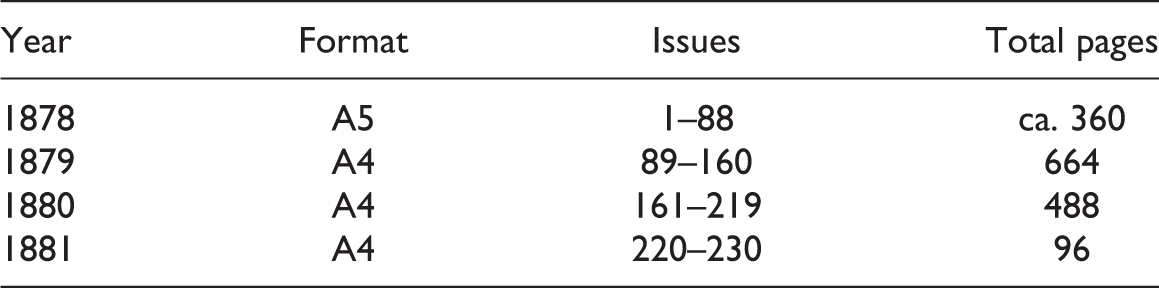
During the first year, the journal doesn’t encompass continuous counting of pages (as it is the case in the following years when each issue has four pages in average).
As shown by the number of pages, the content of the journal was quite impressive, and the fields covered were quite varied. During the first year, Maria Flechtenmacher wrote the front-page editorial, which dealt with various topics related to the education and role of women in society. The other permanent sections were a brief collection of news from the foreign press (these are often political news stories on topics linked to international relations), a section for hygiene issues, another tackling scientific topics; another section brought together articles on religion; a permanent space was dedicated to dialogue with, and feedback from, the readers, often publishing letters received by the editor; lastly, there was the usual feuilleton (a short story in sequels, specific to newspapers/magazines of the time) and a final section with cookery recipes, particularly for newlyweds. As of the start of the second year, articles on science, religion, or hygiene became increasingly rare; they were replaced by a section on women’s rights, which presented the agenda and a summary of the meetings and debates of a number of international women’s associations. Femeia română also took to publishing poems (mostly written by women) as well as more frequent news articles with a socialist tone.
However, during the final year of its’ existence, the themes tackled by this article became more accommodating of the official missions entrusted to women. Nevertheless, as the publication grew “older” and more established, the number of contributors increased, ultimately including public figures with manifest socialist leanings. Therefore, with time, the underlying militant tone became more visible: this complex evolution serves to illustrate the tensions around competing conceptions of the role and place of women within the family and society that were present within Romanian society at that time.
The Magazine’s Mission: Educating Romanian Women
A mission statement published in the first issue speaks about the aspirations of this publication: Femeia română will be the symbol of your wives and sisters. What we have sought to create is a simple emulation of women’s spirit; not in order to take men’s place, which would imply concern about who should then care for the children. […] Therefore, this adult school does not offer its’ services to those who are already very experienced and knowledgeable, but is open to those who may find it useful and enjoyable at the same time. Femeia română, who is mother and wife, who has 40 years of experience, who knows what is evil and what is good, who moreover has already learned how to rear a child, how to cook, and how to clean floors, and how to learn by herself what nobody was there to teach her.
37
When I decided to set up and to put into practice my ideas for a household management literary magazine—something that was entirely missing in our country—naturally I spoke to several well-known people, who found nothing better to say than that my idea was good and useful, but what a pity that good ideas never receive support and are seldom encouraged! … And indeed they spoke the naked truth, since precisely those people did not help me in any way.
39
The educated urban upper classes were thus the obvious target audience of Femeia română. The letter’s page would warrant a sociological study in itself. Apart from a few local notables, the majority of the contributions were from women, with an overrepresentation of primary school teachers and kindergarten staff.
However, the journal had a fairly wide distribution, according to information found in its pages. Data about the print run were only available in the magazine itself, which boasts almost 200 subscriptions after the first two months; in the second year, Maria Flechtenmacher speaks of a target of 1,000 subscribers, 42 which is quite unrealistic, considering that at that time Romania did not have a very large daily press readership. 43 An article published in Femeia română during the third year proved, in fact, more pessimistic, recognizing that the number of subscribers remained constant at 200, due to enduring material and ideological obstacles: “For a magazine of this kind, with no clique and no party, to function, it ought to have three or four foreign journals that subscribe to it, it would need contributors who can enrich it with assorted ideas, it would take an administration, an operational printing press and enough paper. Well, all these cost money, especially in our country, where nothing is done without an ulterior motive, where women have no time to write, and where men do not allow them such hobbies.” 44 This statement casts light on the low interest and even hostility of the authorities toward an editorial project increasingly embracing the cause of women.
However, in the context of the time, the effervescence that transpires from the readers’ letters to the editor and the fact that the magazine was published for over three years show that it had public support, so we can assume at least some level of impact, comparable to other journals which stop being published after one to two years. In addition, the number of readers, unlike the case of major daily newspapers, is generally low. 45
The following sections address two issues can be directly linked to the object of this study: the discourse developed over time in this publication in relation to women’s role in society and within the family. In both cases, special attention is paid to references made to women’s education, which is a key element in the transformation of women’s social and political status. This thematic grid will be systematically applied to the contents of the publication under focus, in order to capture the dynamics between elements that reflect the hegemonic visions of the era and those that sketch out alternative visions for women’s emancipation in Romania.
Woman as Mothers: The Pillar of Social Progress
The issues published during the first year of Femeia română were quite conformist; the role of women in society fits the prevailing social norms almost perfectly: women have a duty toward both society and the family and should be encouraged to perform these duties to the best of their abilities. To reach that aim, education is vital, because women must be able to understand the importance of their “noble mission”: “If you seek to live in a cultivated and refined society, you must give access to culture and education to those who will become mothers.” 46 To help Romanian women to better understand the role they were supposed to play in society, Maria Flechtenmacher published a series of portraits of famous women, for instance, those taken from Saint-Beuve. Most of these role models illustrate the influence of French ideas on the literate classes of Romanian society. Other countries are mentioned—Germany, Italy, and the United States—to show how “social justice” had proliferated in the civilized world and how “women must be educated, to remove them from their state of idleness.” 47 An article entitled “Women’s mission” clearly sums up all the tendencies of the magazine during its first year of publication: women are entrusted with the education of future generations, because only they, by the warmth with which God has endowed them, can become perfect teachers. 48 In other contemporary pieces, being “affectionate” is an upshot of women’s “psychology” and medical doctrine often serves to explain “women specificity,” gendered differences always implying hierarchical features. Religious references are also present, indicating continuity with the traditional representation of women’s moral duties. However, it was made clear that, in order to live up to this religious, biological, social, and patriotic destiny, women needed training: with education and a chain of inspiring examples to follow, they could perfect the virtues of their soul and better fulfill their contribution to social progress. The complementarity of roles and the importance of the national patriotic ideal are important vectors for women’s role in society. Women are thus included in the political project of the construction of the nation and their qualities are recognized as social virtues (and, within certain limits, as civic virtues). 49 This gain in legitimacy is however accompanied by a whole parcel of norms and rules that women must learn and respect in order to live up to the role that had been assigned to them. 50 Paradoxically, with fewer rights ….
Nevertheless, the right to education was one of the few rights that (upper class) Romanian women had already earned. It was to remain perhaps the most subversive element in the history of women and of the feminist movement. In Femeia română’s second year, the discourse surrounding women’s role in society became more intimately linked to their education and active participation in a wider range of social spheres. In the name of the mission entrusted to them—and this is one of the unexpected effects of the new role assigned—a claim to women’s intellectual and economic autonomy was explicitly laid. The magazine stresses the need to create vocational schools and industrial workshops for girls and women, and several issues debate the question of secondary schools for girls. In early 1879, the claims for increased autonomy for women take on clearer feminist overtones: We ask for education in order to put us in possession of our conscience as human beings; they say, ‘we give you as much as you need’; they think that we are given enough so as to not be complete slaves! We ask for recognition for our legitimate right to dispose of our person and property: they say ‘how reckless of you, you will not be able to take better care of them than your husband already does’; Quite so—surely, when that happens, our goods would no longer be selfishly used by them! We ask that the recognition of perfectibility—which is not denied to us—be sanctioned by law—they claim it is against national interests (la raison d’État)! Let us observe that such reasoning becomes problematic, once it tacitly consents to the subjugation of an individual in society, however weak she may be. […] A woman, no matter how smart, no matter how educated, no matter how generous, cannot enter the temple of justice, nor is she allowed to serve society as a member of parliament, as minister, as an engineer, finally in every way that is permitted to men.
51
A series of editorials entitled “Women in the family and society” clearly express the emergence of alternative representations and their political stakes.
53
It is difficult to select quotations, since the arguments are very compelling and demonstrate deep knowledge of the official model of femininity, but also of the arguments and theories that underlie it, and substantiate the capacity (one could say, the sociological proficiency) to analyze the mechanisms that produce social and political hierarchies: For women no less than for men, freedom and exercise of the law are not in the slightest way incompatible with their private duties […]. Does anyone seriously think that if women enjoyed the right to vote, they would suddenly begin to neglect their households so as to deal exclusively with politics? Do you see men leaving their businesses behind and forsaking the obligations of their status in the name of political involvement? […]. We have every right to believe that women will do neither better, nor worse.
54
Motherhood and the Family: Women’s Dual Destiny
Family, the fundamental social institution for the ideology of the time, confined to the private sphere by the liberal-bourgeois (public/private) dichotomous representation, is seen in the normative discursive production of the time as women’s “temple.” Presented as loving wives and devoted mothers, with the “noble role” of ensuring harmony in their homes, “planting love in their children’s souls” and making sure that they are well cared for and receive a proper education. 55
Femeia română does not question the association of women’s destiny with motherhood nor the social importance thereof. As mentioned before, the first year of publication is rather conservative and conformist in topic and tone. In the first few issues, the importance of the family and the distribution of family roles are accepted; men are recognized as “the heads of the family,” because they provide the money for maintenance and support. But there are also calls for a symbolic recognition of the woman’s place, as “the soul of the family” whose mission it is “to ennoble sentiments and to revive the senses.”
56
The editorial in issue no. 11 is critical of boarding schools for upper-class girls, because they teach their students to delegate their maternal mission, by confiding the care of their children to others.
57
Encouragements to women not to marry are also condemned. For example, the same editorial praises religious norms: An unmarried woman is a woman lost. This woman is excluded from the world of those married is poorly seen by honourable society, and is even scorned by communist men, who are otherwise against the order of things, and against the norms established by religion with such ample understanding. What is then the unmarried woman? […] She cannot give society any children, who would in turn become citizens and mothers! Why does society find her insufferable and reject her with such contempt? […] Because both man and woman, without the state of marriage—which, according to Liberal ideas, is just one form of social life—lead a life without rules. […] You will retort: but a man and a woman who are married (in church), do they not separate when they so please? Yes, unfortunately! And that thanks to laws set by people, not religion, because religion says: “the woman will leave her father and mother, and will follow the husband given to her by the Church, for better or worse!
58
In its’ second year, the journal becomes more polyphonic and allowed the expression of more diverse ideas about the role of women in the family. For example, in a series of articles on “Women’s Rights” signed by Paul Scorţeanu
60
claimed “women’s empowerment” in the very name of their maternal roles: […] we assigned women a social role that is far superior to that granted to them from the noisy parliamentary tribunes: remember that the columns of this magazine proclaimed that motherhood is women’s most valuable task. Yes, we ask for mothers, conscious mothers who are able to give society useful citizens, mothers with deep awareness of the laws that govern our society, in short mothers who do not abandon their children’s education to chance; for this precise purpose we have claimed women’s empowerment, as a sine qua non condition for success. […] Free mothers, this should be the watchword of modern times.
61
From the recognition of man’s patriarchal authority within the family, this line of argument ends up claiming the “equality between man and woman” in the family, “based on equality of duties.” The argument is similar to the famous deduction by Olympe de Gouges
62
: Equal responsibility entails equal rights. The child is inferior to man, and this becomes an excuse for misdeeds that are never accepted for adults; children’s crimes are not punished in the same way as adults’ offenses. Where women are concerned, the law requires the same observance and in cases of transgression, however, it accepts neither weakness, nor claims of ignorance when dealing punishment.
63
However, the tone of the articles varies between radical criticism on the one hand and more deferential and restrained support of the official model of femininity on the other. In general, the role of mother is supported without reservation, and the institution of the family is rarely criticized. However, the contributors do request that motherhood and the family be reconceptualized on an equal basis. In support of the equality, Femeia română even quotes a text by John Stuart Mill, stating that equality between spouses is essential not only for their happiness but also in order “to turn daily life into a school for moral education.” 65
Once again, education appears as a crucial factor in the deconstruction of gender, and Maria Flechtenmacher shows remarkable awareness of the importance of access to knowledge in the process of women’s emancipation: “You have allowed us to enter your libraries and to browse through your books, of which you were unable to take sufficient advantage, and today you are trying to block us out, like Eve from the tree of happiness? Well, too bad! […] Today we are not willing to return to a past that separated us from our husbands and from our children.” 66 Knowledge, science, and public debate are indeed central to the balance of power in modern democracies, and the quoted article reflects an impressive degree of development of the feminist thought.
Free Mothers and Equal Wives
“Free mothers” and “equal wives” seem indeed to be the expressions that summarize beautifully the subversive capacity of the interpretation given to the official norms and precepts and their consequent transformation into claims for women’s emancipation. Making a shy start, then oscillating between vehement critique and the partial acceptance of the feminine ideal elaborated by contemporary ideologies, Femeia română is an exceptional source for the study of social dynamics and of competing models of social representations. In fact, an article published at the end of the third year of the publication, taking stock of its accomplishments and setbacks, underscores the dynamic nature of the topics covered in Femeia română: starting as a family magazine, which suitably covered only family-related issues (because for the rest, the time was not yet ripe), it became a magazine for women’s empowerment: […] essentially an organ for women’s emancipation, it has an historic mission: to spread the idea, to gain supporters, new and ever more numerous militants, preparing the ground on the theoretical level, and as much as possible in practice, for the wide acceptance of this idea as indispensable and realistic.
67
Footnotes
Declaration of Conflicting Interests
The author declared no potential conflicts of interest with respect to the research, authorship, and/or publication of this article.
Funding
The author received no financial support for the research, authorship, and/or publication of this article.