



Abstract
The present work analyses fraternal relationships among Spanish naval officers during the eighteenth and nineteenth centuries. The main aim of the article is to understand the important role played by siblings and the changes undergone by fraternal links over time. In order to do this, the article addresses three objectives: characterizing fraternal ties in the Spanish naval officer corps, analyzing fraternal relationships in relation to other family links and to the officer corps’ professional context, and exploring how siblinghood transformed during these two centuries. The main source of information used in this work is the testaments signed by naval officers in Spanish navy bases. The article is divided into two parts, dealing with quantitative and qualitative issues, respectively. The first part examines the proportion of naval officers who had siblings, while the second part studies the kind of relationship that existed between them; three kinds of relationship are proposed: vertical ties, horizontal links, and secondary relationships.
The present article analyses the role played by fraternal relations in the life of Spanish naval officers in the eighteenth and nineteenth centuries. I intend to look at this topic from a broad perspective, trying to characterize these relationships—types, uses, modes—and to trace their development and changes over time. Therefore, the article’s three main aims are as follows: characterizing fraternal ties in the Spanish naval officer corps, examining how siblinghood related to other family relationships, such as parenthood or matrimonial links, and exploring how siblinghood transformed during the eighteenth and nineteenth centuries. Those centuries witnessed considerable social change, and siblinghood played a significant role in these transformations; it is thus important to understand the reconfiguration of sibling relationships, which to a large extent depended on specific circumstances and social setting, family context, and so on. There is little doubt that the naval officer corps stands out as an uncommon social group—extreme geographic mobility, long periods of absence, and great distance from relatives—but also that they constitute an interesting section of the population through which it is possible to study different dimensions of fraternal relationships. For instance, the great distances that frequently separated naval officers from their relatives led them to express themselves in writing in a remarkably open and explicit manner.
When the History of the Family became a major topic of study in the 1960s, 1970s, and 1980s, fraternal relationships were generally paid little attention, as research interests focused on households and family typologies, and the stress was on the vertical dimension of kinship, that is, intergenerational rather than intragenerational ties. By the late 1980s, it was clear that the study of siblinghood as a historical subject faced two key problems: there is very little evidence with which to characterize sibling relationships, and historiography has tended to adhere to stereotypical views that emphasized intersibling rivalry and hostility. Linda Pollock was one of the first scholars to challenge this approach, questioning the widespread idea that younger brothers necessarily felt bridled and frustrated. 1 In 1992, the journal Continuity and Change published a monographic issue, edited by Richard Wall and Lloyd Bonfield, 2 on the “Dimensions of Inequalities among Siblings.” In 1993 and 1994, the Italian journal Quaderni Storici published two very interesting issues—especially volume 28, number 83 (2), 1993—that, through several case studies, encouraged the prevailing historiographical approach to the issue to be revised. 3
According to Leonore Davidoff, 4 siblinghood is a very complex problem because it is affected by multiple variables: the nature of the relationship, genders, life courses, economic resources, social status, and so on. Davidoff argues that during the eighteenth and nineteenth centuries, sibling relations were intense, especially among the middle class: “brothers and sisters are life’s longest relationships. Even if siblings have been taken very different trajectories, they usually remain connected by an invisible link that transcends time and distance.” 5 Current historiographical trends to emphasize reciprocity and support among siblings as well as conflict, tensions, and hostility; 6 it is obvious that brotherly relationships came in different guises and that there were conflicts and cooperation. Amy Harris points out that the turning point can be placed in the eighteenth century, when siblings “encountered hierarchical understanding of their relationships that emphasized birth order and male privilege, but they also encountered powerful reminders that they were equals—which they should share and share alike.” 7
In the 2000s and 2010s, the problem was approached from a wide variety of perspectives. For instance, Naomi Miller and Naomi Yavned proposed the gender approach, 8 and C. Dallet Hemphill focused on the American case. 9 In addition, two long-term studies must be mentioned in this overview: Benedetta Borello’s Il posto di ciascuno. Fratelli, sorelle e fratellanze (XVI–XIX secolo), 10 and Siblings Relations and the Transformation of European Kinship, 1300–1900, edited by Christopher Johnson and David W. Sabean. 11 They argue that, between 1750 and 1850, European families underwent a radical transformation, during this period, which was characterized by market expansion, industrialization, the formation of the bourgeoisie and civil society, the political ascent of the liberal State and nation building, “marriage became more endogamous and inheritance more equal.” 12 Furthermore, they claim that the eighteenth and nineteenth centuries witnessed the emergence of a “sibling-based kinship order.” That is, there was “a fundamental change in the nature of sibling relationships, in which emotional ties and instrumentality were reconfigured and outfitted with a new language of sentimentality (…) and a new dynamics of functionality, replacing the formal logics of lineages with the flexible practices of kindreds.” 13
This article tries to examine fraternal relationships in Spain, an interesting branch of family history which has been paid little attention to date. Although over the last thirty years many works and research groups have studied kinship and families in early modern and modern Spain, 14 brother and sisters—and their relationships—constitute an underexplored topic or, at least, one which requires more in-depth research. Siblings often feature as a secondary question, mixed with other issues, such as power strategies, household typology, family trajectory, and professional analysis. 15 Few exceptions exist, 16 although we may mention Llorenç Ferrer’s works on Catalonian families. Ferrer emphasized the position of the younger siblings in rural family strategies, which was determined by the sole heir inheritance system. It was common for younger brothers to remain celibate, but changes occurred in the nineteenth century created new conditions, making sibling relationships more complex. 17 In any case, the subject of these studies is not fraternal relations per se, but problems concerning inheritance systems and their solutions.
The idea that fraternal relationships became closer during the eighteenth and nineteenth centuries is generally accepted, 18 but this work aims to examine the reconfiguration of “instrumentality” among siblings and to analyze how the “new dynamics of functionality” replaced old models among the Spanish naval officer corps between 1730 and 1900. In the early eighteenth century, this group underwent radical reforms and became one of the most professionalized bodies in Spain. 19 Naval officers chiefly came from the petty and medium nobility, 20 although, after the severe crisis suffered by the institution in 1800–1840, the Naval College started accepting cadets from the middle classes. As such, the history of the Spanish naval officers in the eighteenth and nineteenth centuries can be divided into four periods: first (1710–1760), the progressive process that led to the formation of the officer corps; second (1760–1800), the rise and apogee of the naval officer corps; third (1800–1840), the decline and deep crisis suffered by the navy; and fourth (1840–1900), the resurgence and adaptation of the naval officer corps to a new social reality. This article is the first attempt at combining fraternal relationships and military officers and one of the first to explore the role played by family relationships in the life of navy and army officers. 21
The behavior of naval officers and their family relationships must be analyzed from two different perspectives: professional organization and legal system. Within the process of transformation undergone by Spanish navy throughout the eighteenth century, the Monarchy increased their control over the officer corps. This supervision was not only professional—training, commission, or wages—but also personal, including family issues. In order to marry, for instance, officers had to request a royal license until 1873. Only captains or officers of a higher rank could apply for this license; the other ranks could only marry if the bride and groom could declare having a certain amount of money, 60.000 reales. Naval officers also had to request permits for traveling or return to their places of origin—permits which, from the second half of the eighteenth century, became harder to get because of the increasingly restrictive regulations. Beyond these, the institution did not impose further control or limitations upon the officers’ family life. It is important that the legal framework is clarified as well. Naval officers were subject to the Castilian inheritance system, which was characterized by the inheritance being equally distributed among all siblings—although one-fifth could be freely bequeathed—on the condition that family was not subject to a mayorazgo—entailed estate. 22 The Spanish Civil Code was not issued until a very late date (1889), and it did bring about major changes anyway: the principle of equal inheritance was confirmed and widows acquired more legal rights. 23
The examination of fraternal relationships is based on the analysis of testaments, which means that the study focuses on sibling links during the adult life of naval officers. An extensive collection of testaments found in naval bases—Cádiz, San Fernando, Cartagena, Ferrol, and Madrid—and dated to between 1730 and 1900 was examined. The total number of testaments consulted is 1,230, comprising 793 naval officers.
24
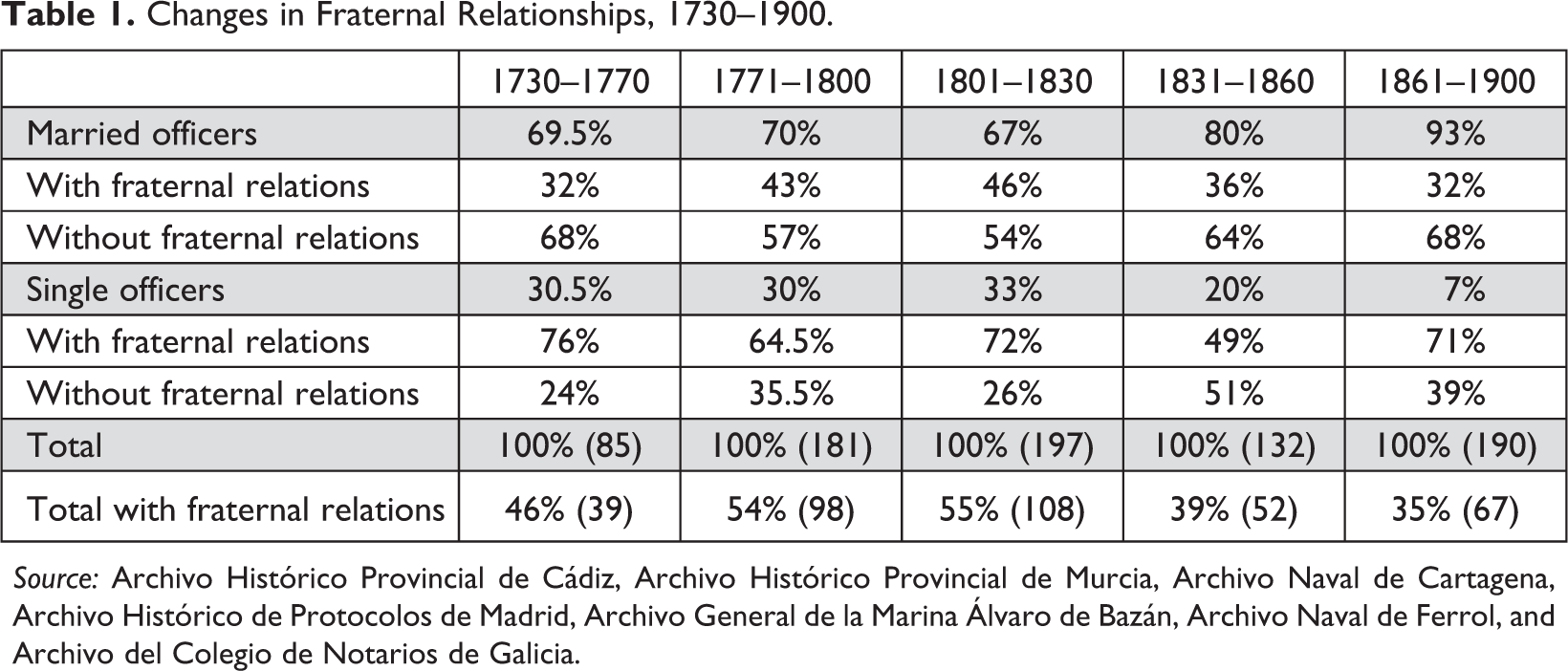
However, this documentary source has some limitations, and they must be made clear. Testaments generated automatic legal bonds, for instance, the position of herederos forzosos, heir apparent, but in the Castilian inheritance system, siblings were not compulsory heirs under any circumstance—except for mayorazgos in which the younger sibling was the only possible heir. This means that most cases in which naval officers mentioned their brothers and sisters were expression of a personal choice—although, obviously, informal patterns of obligation existed. As the legal system did not change until 1889, testaments changed little throughout the period under analysis, and even the changes introduced to the system in the 1890s were of little relevance. The information provided by testaments is rich and diverse: the role assumed by the siblings and the authority that they amassed; the way inheritances were allocated, not only to whom but also how; the expressions used to refer to the siblings; the siblings’ connections with other relatives; and so on. In addition, it is worth stressing that conflicts are largely absent—internecine family difficulties seem to revolve around the parents/children relationship but that is beyond the scope of this study. The methodology for examining the reconfiguration of fraternal relationships and the changing role of siblinghood was twofold (see Tables 1 and 2): a quantitative inquiry based on the data provided by the testaments and a qualitative analysis of selected cases. Relations of siblinghood were divided into three categories
25
:
Vertical relationships: Those which show a clear difference of power, authority, economic resources, and/or social status among siblings. Two subcategories may be distinguished: first, links that fall within the lineage model, in which the elder brother exercises the leadership within the family, and second, ties of economic support because of the vulnerable position of one or several of the siblings.
Horizontal relationships: Those established between equal individuals, that is, exchange, reciprocity, mutuality, cooperation, and collaboration among siblings who held a similar position in the family hierarchy. I make a difference between general horizontal relationships and those which were specifically economic in nature—property-sharing, common economic interest, and distribution of resources.
Secondary relationships: Those which involve some links between siblings, generally of an emotional character, but which were less important than other kinds of relationship. For instance, it was common for officers to bequeath their sibling some item—such as uniforms, personal objects, clocks, furniture, and so on. In other words, secondary relationships show that there was a bond existed, but that the siblings did not share common challenges, interests, or properties. Changes in Fraternal Relationships, 1730–1900.
Source: Archivo Histórico Provincial de Cádiz, Archivo Histórico Provincial de Murcia, Archivo Naval de Cartagena, Archivo Histórico de Protocolos de Madrid, Archivo General de la Marina Álvaro de Bazán, Archivo Naval de Ferrol, and Archivo del Colegio de Notarios de Galicia. Changes in the Typology of Fraternal Relationships, 1730–1900.
Source: Archivo Histórico Provincial de Cádiz, Archivo Histórico Provincial de Murcia, Archivo Naval de Cartagena, Archivo Histórico de Protocolos de Madrid, Archivo General de la Marina Álvaro de Bazán, Archivo Naval de Ferrol, and Archivo del Colegio de Notarios de Galicia.

Data and General Outlook
Before going into further detail, it is necessary to briefly introduce the social group to be analyzed and some of its basic features. It is important to distinguish between married and single naval officers, 26 as marital status appears to be an important variable in the way they behaved toward siblings. The proportion of married officers remained stable during the eighteenth century—69.5 percent in 1730–1770 and 70 percent in 1771–1800. In the nineteenth century, the proportion of married officers rose inexorably, after a small decrease in the first third of the century—1801–1830, 67 percent; 1831–1860, 80 percent; and 1861–1900, 93 percent. Conversely, the proportion of single officers remained stable for a century—1730–1830—before dropping sharply. In 1831–1860, 20 percent of naval officers were single, against 7 percent in 1861–1900.
Between 1730 and 1770, married officers who had relations with their siblings were a significant group, but they were not in the majority—32 percent. During this period, most family bonds linked naval officers with their wives, children, and other naval officers. The professional colleagues often played brotherly roles, as they were in left charge of dealing with very intimate and personal matters. This should not be surprising: it was a formative period for the Royal Navy, which underwent major reform in the 1710s. 27 Naval bases, located in Cádiz, Ferrol, and Cartagena, grew progressively throughout the century, and the officers came from very different points of the Peninsula. 28 In contrast, 76 percent of single officers maintained links with their siblings. Therefore, almost half of all the officers—46 percent—had some kind of relationship with their siblings, which demonstrates the importance of this family bond. Other family ties feature in similar proportions: for instance, 47 percent of naval officers had a relationship with their parents.
Vertical relationships based on lineage, that is, those framed within traditional family settings—power, wealth, and status are transmitted through the central kinship line—attested for 18.5 percent of all naval officers, which indicates the decreasing strength of this traditional framework among the studied individuals. Although the causes for this are multiple, it is possible to argue that the professional duties of naval officers clashed with the needs of this family model, regardless of whether the officer was the head of the household or simply a younger brother; 29 constant and long voyages hardly facilitated the governance of an extended family. It is also possible to point out that, within vertical relationships, links that entailed economic support from the leading sibling—his obligation as head of household—amounted to 14.8 percent of the total. Horizontal relationships were the most common among siblings, especially relationships that were based on equality and reciprocity in terms of trust and personal attachment. This type of bond is attested for 40 percent of all naval officers. Finally, 18.5 percent of officers shared economic interests with their siblings.
Between 1771 and 1800, some interesting changes occurred. During this period, the Spanish navy and its officers flourished and their authority within the state apparatus increased. 30 The proportion of officers who had links with their siblings increased to 54 percent. This growth was also significant among married officers—from 32 percent to 43 percent—a fact that can only be understood if it is put it in relation to three phenomena. First, during this period, relations between married officers and close and distant relatives increased. For example, 25 percent had close ties with cousins and uncles, and almost two-thirds had a close relationship with their wives, parents, children, and siblings. 31 It may be said that the closing decades of the century witnessed the expansion of family ties among navy officers. Second, the consolidated naval cities became interesting social hubs. 32 The construction of naval bases led to an increase in the population of these cities, 33 and in general, officers lived closer to their relatives, which contributed to a more fluid relationship. Third, increasing links with siblings can be explained, in part, by the fact that many officers had brothers who were also officers, increasing their ties and interdependence. An illustrative fact is that 40 percent of the midshipmen of the 1770s, 1780s, and 1790s had a brother who was also a midshipman. Conversely, the relationships between single officers and their siblings decreased, although the figures remain high—64.5 percent.
During this period, vertical relationships became slightly less frequent—from 33.3 percent to 27.4 percent—while horizontal relationships increased to 65.4 percent and secondary ties remained stable around 7 percent. The decrease in vertical relationships was caused by the loss of strength of the agnatic lineage model. As the qualitative analysis will show, family relationships in the period 1771–1800 were substantially different because the traditional family model had practically disappeared. In contrast, the proportion of cases characterized by a relationship of economic dependency remained at 14.2 percent. The growth of horizontal relationships among siblings is due to the increasing importance of reciprocal ties. It should be stressed one more time that, during this period, relevant family relationships multiplied: the officers kept closer ties with a wider array of relatives, and siblings became a key factor in the management of all manner of personal and private matters.
The period 1801–1830 witnessed both continuity and change. Proportions remained stable, at least in appearance, while fraternal relationships may be said to have been particularly close, reaching an all-time maximum: 55 percent. The proportion of married officers who had ties with their siblings was 46 percent. The first third of the nineteenth century was a period characterized by multiple relationships with a broad spectrum of relatives, especially parents, wives, children, brothers, uncles, cousins, and nephews. The same goes for single officers; the proportion of single officers who had ties with their brothers and sisters reaches 72 percent. However, it may be argued that this continuity is merely apparent, due to shifts in the nature of sibling relationships during this period. The proportion of vertical relationships dropped to 21 percent, which means that the agnatic line model kept losing ground in the early nineteenth century. Economic patronage links increased slightly, owing to the long and severe crisis suffered by the Spanish navy from the 1800s to the 1840s. 34 Naval officers suffered the most because the resources allocated to the naval institution were minimal; throughout the first third of the century, it was common for officers not to receive their salary in time—the payment of wages was often delayed, and complete defaults were not rare—and the pensions granted to widows and orphans were also problematic. 35 Horizontal relationships increased and reached maximum figures; 73 percent of the officers had links of reciprocity and trust with their siblings. It should be noted that the number of economic ties increased considerably—from 16.6 percent to 23.8 percent—and this can be explained by the precarious economic position in which the group lived. Because of this, the sharing of wealth became an ever more acute necessity, and new formulas had to be devised. The importance of fraternal relationships in this period is illustrated by the small proportion of secondary ties; that is, only 6 percent of the officers had further links with their siblings.
The period 1831–1860 witnessed both quantitative and qualitative change. This was a period of reform and modernization for the Spanish navy, 36 in the context of broader transformations, with the definitive decomposition of the Ancien Régime and the emergence of a new society—although some continuities are also attested. 37 In general, relationships with siblings decreased: only 36 percent of married officers recorded their relations of siblinghood in their testaments. Concerning the proportion of single officers who had some relationship with their siblings, although it remained high—49 percent—it still represented a sharp drop from the previous period—72 percent. This phenomenon must be contextualized in a broader familial framework. From the 1840s onward, relationships with relatives were changing in nature; officers did not have numerous links with parents, wives, children, brothers, uncles, cousins, and nephews; hereafter, ties would be largely limited to what is usually referred to as “conjugal family,” that is, the officer’s wife and children. 38 The types of relationships were changing during this period: vertical links remained stable—25 percent—while horizontal relationships slightly decreased—66.6 percent—and secondary ties increased—8.4 percent. Within vertical relationships, the process, which began at the beginning of the eighteenth century, was becoming more acute: lineage-based links disappeared and ties of economic dependency increased, reaching 22.9 percent. Within horizontal ties, the increase in reciprocity relations—54.1 percent—and the decrease in economic ties—12.5 percent—is worthy of note.
By and large, the data for the period 1861–1900 confirm this broad process of change. In general, relationships with brothers and sisters decreased to an all-time low: 35 percent. Although 71 percent of single officers had close relationships with their siblings, this is of little significance because single officers had become a small minority. Among married officers, only 32 percent express fraternal ties in their wills and this can be partly explained by the fact that family relationships during this period largely revolved around the conjugal family—the family relations of 63 percent of married officers were limited to wife and children. Vertical relationships among siblings were minimal—16.3 percent—and almost all of them involved economic patronage links. Horizontal relationships reached a maximum at the end of the century: 70.5 percent; within this category, correspondence, mutual support, reciprocity, and interdependence were present in the lives of 60.7 percent of naval officers. In addition to revealing the strength of fraternal relationships, the data for this period indicate a new phenomenon: the increase in secondary relationships—13.2 percent—which is a direct consequence of the consolidation of the conjugal family model.
Vertical Relationships
During the eighteenth century, a small proportion of family relationships were based on a traditional model, that is, one in which a hierarchical lineage was led by an elder family member. The percentage for the period 1730–1770 is not very high—18.5 percent—but is still significant. In most of the cases found, young naval officers were under the authority of an elder brother and worked for the interests of the family. We can illustrate this with three brief examples. The lieutenant José Caamaño, who was single and childless, stipulated in 1738 that his brother Juan Antonio, Lord of Roselle, should be put in charge of all his affairs. As the head of the family, which operated within a strict hierarchical system, the older brother was appointed heir to all his properties and executor of the testament before a notary public. 39 In another case, the young Sublieutenant Antonio Rojas Contreras, who was single and childless too, gave a power of attorney to his elder brother in 1742. The latter was Pedro Rojas, Marquis of Villanueva del Duero, Lord of Villamiel, Knight of Calatrava, and Councilor of Jaén and Toledo. The power exercised by the older brother over Antonio was overwhelming: Pedro was responsible for executing the testament and was also the sole heir to his properties. 40 Finally, Miguel Esteban de Torres Cuevas gave a power of attorney to make a will in 1768, indicating that he was married but had no children. In a special clause, he stated “as the second son of my father, I am immediate successor of the estate and mayorazgo of the current Viscount of Irieste, José de Torres my brother, who to date has produced no legitimate heir.” 41 The testament is entirely focused on the survival of the lineage, and Miguel’s relationship with his brother was also determined by this aim.
Fraternal relationships that were inserted within the lineage system varied according to a number of variables: how the leadership of the household was exercised, the life courses of officers, and their marital statuses were all significant factors. However, throughout the eighteenth century, this family model slowly declined, leading to the emergence of new types of family, characterized by more horizontal relationships. 42 The process was very complex, marked as it was by a constant ebb and flow of factors of continuity and change. The Rodríguez de Valcárcel is a good illustration (Figure 1). This Sevilian family had traded with the Indies during the second half of the seventeenth century, and during the eighteenth, they had made great efforts to become part of the Sevillian aristocratic oligarchy; they eventually became one of the most important families in the city and were granted the Marquisate of Medina in 1691. 43 The generation born between 1689 and 1703, the Rodriguez de Valcárcel Tous de Monsalve, are very illustrative of the transformations that were under way during that period: the firstborn, Ignacio, was the head of the household and adopted the traditional accoutrements of the nobility, holding the marquisate, entering the city council, and owning the estates of the family; the second born, Alonso, was an important merchant with the Indies, an activity that the family was still very active at; and finally, the younger brother, Antonio, joined the navy as a midshipman and became a naval officer. The first two brothers married and the last one was single. In 1742, when Antonio made a power of attorney to make a testament, he totally yielded to his older brother, who was not only entrusted of making the testament but was also made sole executor and universal heir; 44 a classic formula of centripetal forces revolving around a central family line. The following generation, however, behaved quite differently: the ties that linked the Rodriguez de Varcárcel Vargas siblings, Ignacio’s sons, and the siblings Rodríguez de Valcárcel Jácome, Alonso’s sons, who lived between the second quarter and the end of the eighteenth century, were much more horizontal in nature. 45
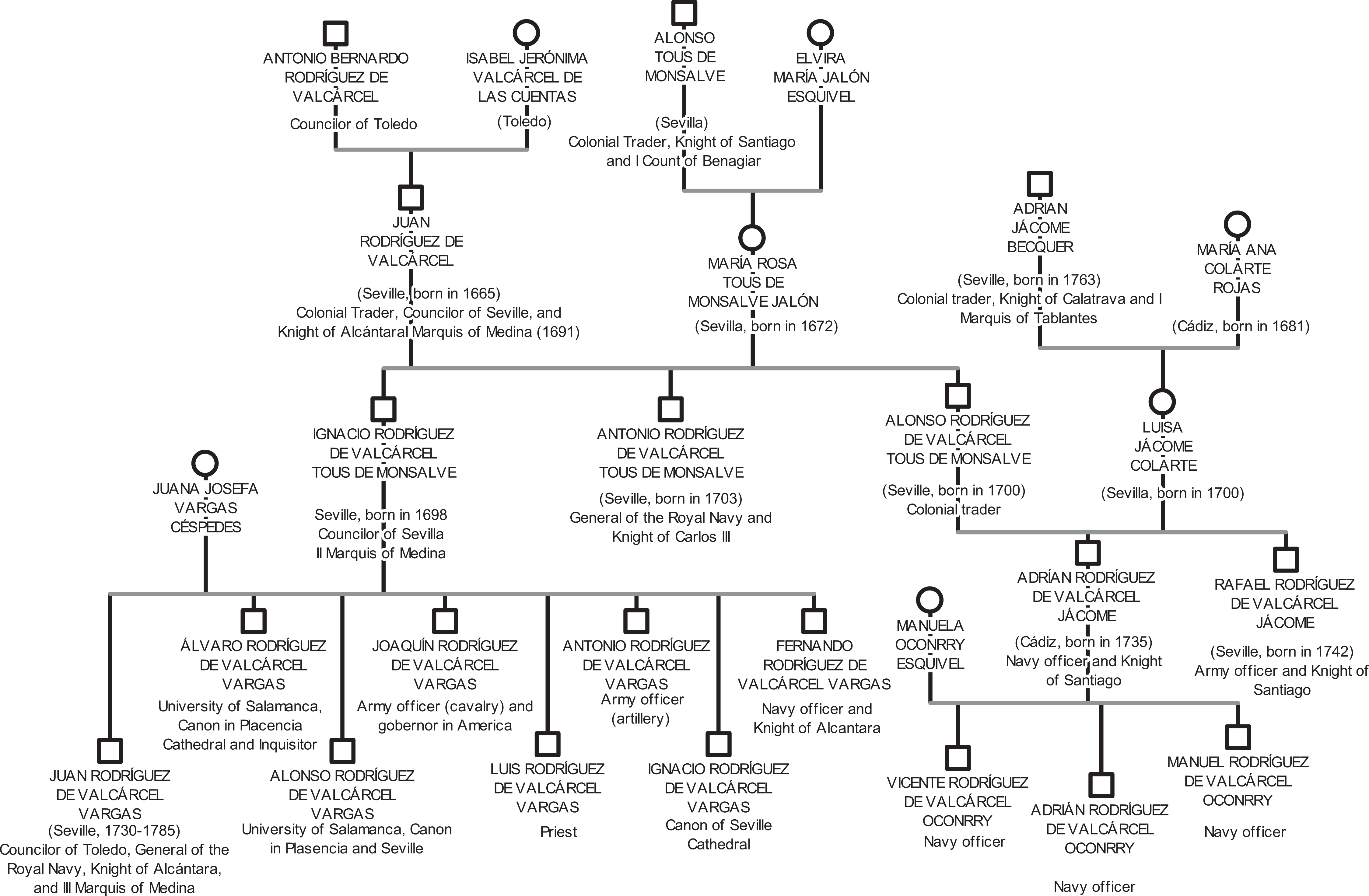
The Rodríguez de Valcárcel family tree.
During the last third of the eighteenth century, the percentage of these relationships decreases slightly—13.8—while a crucial qualitative change was taking place. The vast majority of fraternal relationships that can be framed under the lineage model were slowly turning into a more horizontal structure. The authority, power, and preponderance of the head of the family began being replaced by a complex map of relationships that tended to emphasize reciprocity. The example of Captain Gonzalo Cañas Trellez effectively illustrates this process. This unmarried officer, who made his will in 1775, came from a distinguished family: the Dukes of Parque. His older brother Manuel Joaquín was indisputably the head of the household; he was also gentleman of his Majesty’s Chamber and Captain of the Royal Guard. The increasingly horizontal nature of the family ties is shown by small details: Gonzalo, instead of appointing his elder brother as sole executor, appointed six executors, three of whom were his brothers—the aforementioned Manuel, Salvador, who was a Lieutenant Colonel, and Francisco, who was a presbyter—all of whom had the same power over the will. Also, Gonzalo’s inheritance did not revert to the family’s central line, but in equal measure to all his siblings, in total, they were nine brothers and sisters. 46
During the closing decades of the eighteenth century, the lineage model finally collapsed, and by the first third of the nineteenth century, hardly any fraternal relations were governed by the framework. Percentages indicate that the model was now fairly marginal, although some echoes of it continued resonating throughout the century. The other main type of vertical relationship is based on economic support and custody exercised by one sibling—generally male, older, wealthier, and with a higher social status—over his more vulnerable and poorer younger siblings. It is important to point out that this type of relationship differed from that which characterized the lineage model because it was not exercised in an authoritarian and hierarchical way; much to the contrary, this form of protection was increasingly framed in terms of reciprocity, although the vertical nature of the relationship cannot be denied, as it rested on the elder siblings’ obligations and responsibilities and, obviously, on differences in economic and social status. The main variables in this type of relationship were: gender, wealth, and marital status. Gender was an especially important factor because 75 percent of these vertical relationships during the eighteenth century involved the protection of a sister—usually single and without resources—by a brother.
Relationships of economic dependency and other forms of support among siblings multiplied and adopted different formats, which to a large extent accommodated to the life courses of the siblings and the events that changed the shape of families over time. Sometimes, due to the youth of some naval officers, the older brothers behaved like true fathers, but without adopting an excessively authoritarian role. 47 For instance, in 1738, the young Sublieutenant Juan de Celis Aguinaga gave a power of attorney to his brother-in-law, José Ortega, to make his testament, naming his sister José Ortega and his nephew José Ortega Celis as heirs. 48 Lieutenant Pedro Ponce de León de la Cueva, although appointing his father as one of the executors and sole heir—as required by law—his testament was full of references to his siblings, whom he wished to protect (although he established some conditions). He stipulated that his siblings Luis, Isabel, and Catalina be his heirs after his father’s death. 49 Years later, in 1769, Pedro’s siblings referred to him in their testament by saying “Pedro Ponce de León, my brother, is to receive 150 doubloons by way of legacy, which he will take in addition to the part of the inheritance that he is entitled to, in recognition of all that he has done to assist me and the affection that I feel for him.” 50
In other cases, these relationships had different connotations because directly aimed to benefit those who were less affluent and economically more vulnerable. This form of protection arose not out of a feeling of obligation, but as a genuine expression of affection. For instance, Captain Manuel Emparán, despite being married and having onerous family obligations—although he had no children at that time—claimed in 1802 that “it is my will to help my less affluent siblings, and I give to my sister María Ascensiónm 4,000 duros in cash and the rest in paper, and the rest will be distributed among my siblings Francisco José, María Antonia and Ignacio.” 51 General Aníbal Tolomelo Casoni, for his part, was single and wanted to appoint his brother Nicolás as usufructuary heir—Anibal’s property would pass to Nicolás’s children—but he pointed out that “should my brother, Cardinal Felipe [referring to Cardinal Filippo Casoni] find himself in need because of the circumstances, I want my brothers to equally enjoy the expressed usufruct.” In addition to this, General Casoni stipulated that if his two sisters, who were nuns, were alive at the time of his death, they each should be given 50 libras per year. 52
The most common form of economic support had the brothers, regardless of marital status, acting as protectors to their sisters, who were often quite destitute. This form of solidarity should be understood within a dense mesh of broader family links. For instance, in 1768, the naval officer Juan Antonio Gaztelu, who was single, wanted to appoint those members of his family which, in his opinion, were most exposed to poverty, as heirs. His primary heirs were his sisters Juana and María Josefa, both of whom were unmarried—“de estado doncella”—and should they be dead, his property would go to his elderly uncle, Antonio Antonio Jaureguizuria. Only if all of these were dead, was his other sister, Maria Ventura, who was married to Juan de Altuna, to become his heir. 53 This sort of arrangement was quite frequent and can be interpreted as part of an intertwined system of mutual protection, which was especially usual among brothers and sisters.
During the nineteenth century, vertical relationships chiefly involved protection bonds. This type of relationship increased and intensified during the first half of the century, especially in the period 1831–1860, owing to the economic difficulties suffered by many naval officers and their families. Delay in the payments of wages and pensions was an increasingly common phenomenon in the 1810s, 1820s, and 1830s, causing real distress. This was a problem not only for the officers, their wives, and their children but also for all family members who depended financially on them. The properties and economic assets owned by naval officers—often shared with their siblings—became very important, as they often were the officers’ main source of income. Although specific cases varied widely, in 68 percent of cases, protection relationships involved a brother lending their support to a sister, which is a smaller percentage than recorded for the previous century. However, during the last third of the century, this type of relationship increased again, amounting to 77 percent of all vertical relationships.
Life courses are crucial in understanding these forms of support among siblings. During the youth and early adulthood of his siblings, and in the absence of marital or parental obligations—although this was not necessarily the case—the oldest brother naturally extended his protection and guardianship over his younger brothers and sisters. For instance, the example posed by Antonio Sotelo demonstrates that protection toward younger brothers also occurred if they were married. In 1835, Antonio stated having married Francisca de Paula Rivera, who at the time lived in Ferrol while he was in San Fernando, and having five minor children with her. Despite having all these family responsibilities, a clause recorded that “I have been sick for many months in the house of my brother Juan de Dios Sotelo, whose brotherly love has led him to assist me and to provide as much help as he can, to this day.” 54 In another example, Joaquín Balas, a young midshipman who made a testament in 1847, had been morally and materially supported by his brothers, for he was an orphan. His brother Juan, who lived in Cuba, had given him 5,000 reales, which Joaquín did not need to return, as they were intended to provide him with a career. He also mentions his siblings Manuel, Irene, and Juana, although it is his brother-in-law Bernardo Oger who stands out, as he managed several of Joaquín’s accounts, helped him in different ways and eventually became his executor. 55
Most naval officers showed special concern for sisters. Whether single, widowed, or even married, sisters were much more dependent on others than brothers, although they were often used to forward family strategies. 56 For instance, in 1862, the officer Francisco Villavicencio, despite being married, ordered that his sisters María Dolores and Paz, who were married, receive half of his property. His testament expresses how concerned he was about the welfare of his sisters. 57 Something similar happened in 1897, when Rear Admiral Domingo Castro Pérez, who was married and childless, divided his property between his wife and his unmarried sisters in the following way: to his wife he left the cash and bank notes issued by the Bank of Spain, half of the furniture and other heirlooms, and to his sisters María Mercedes and María Josefa—who were also testament executors alongside his wife—he left the other half of the furniture and other assets. 58
Although the specific circumstances vary greatly, officers generally showed special concern for their single sisters, as many testaments confirm. In 1848, Brigadier Eduardo Mosquera, who was single and had no heir, appointed his sisters Dolores and María Inés as his only heirs; the fact that Eduardo emphasized the expression “single sisters” should be noted. In other instances, being single was an obligatory condition for the officers’ sisters to become their heirs. A case in point is that of Lieutenant José María Tirado Yorvas who in 1891 appointed his sisters Belén and Carmen as heirs, “as long as they are single.” 59 The property conveyed by the testament was not negligible: “obligations from the Treasury of Cuba (issuance 1886), 25 shares of the Cadiz Cooperative Society of Gas, and a life insurance policy for 25,000 pesetas by an American company that are deposited with the mercantile house of the Aramburu brothers.” Along with this, there was a special clause in which Francisco Aramburu, who was a close friend and someone in José Maria’s total confidence, as well as the executor of the will, was asked to “look after [José Maria’s] sisters.” 60
Horizontal Relationships
Horizontal fraternal links were the most common kind of relationship throughout the period under consideration. As such, it is fair to say that, despite the multiple transformations undergone by family structures, these bonds of siblinghood remained quantitatively stable. However, despite this apparent stability, horizontal fraternal relationships changed significantly over time as new types of family emerged. During the eighteenth century—periods 1730–1770 and 1771–1800—these relationships became increasingly common, especially those which were framed in terms of reciprocity and equality—from 40.7 percent to 48.8 percent. This fact must be related to two broader phenomena: first, the decline of the lineage model and vertical relationships; axial family lines and the role of the head of kindred were losing ground. It must not be forgotten that all eighteenth-century Spanish naval officers came from the middle and lower strata of the nobility—local oligarchies and secondary lineages traditionally devoted to the royal service—which were a social group among which social change was to be especially significant. 61 Second, naval officers kept more family links than ever before during this period, especially with those who were closest in kindred—parents, brothers, wife, and children—but also with others—uncles, cousins, and nephews.
The model of family that was to dominate the second half of the eighteenth century was characterized by increasing and more reciprocal bonds of siblinghood: sharing needs and challenges became a central element in the lives of the members of the naval officer corps. But what do horizontal fraternal relationships entail? The evidence examined reflects personal attachment, reciprocal interests, and common strategies followed in a spirit of equality, mutual aid, economic interdependence, and constant negotiation; and all this occurred within a general climate of trust, affection, and intimacy that went hand in hand with a greater degree of individuality. The intensification of personal relationships among siblings projected into the multiple roles that officers and their relatives were to play in each other’s lives, especially when they were appointed as executors of one another’s testaments. Entrusting the management of all personal and private affairs to someone after death is not only a sign of closeness but also of trust. For instance, in 1780, Rear Admiral José Solano and his wife Rafaela Ortiz de Rozas appointed each other as testament executors, a role which they shared with their respective brothers, Alonso Solano and Ignacio Ortiz de Rozas. As such, the brothers were given a say in the most intimate affairs, which shows a great degree of interdependence 62 . Equally suggestive is the case of the marriage formed by Francisco Javier Winthuysen and Petrolina Pineda, who in 1779, named each other as executors, alongside Francisco’s brothers José Pineda, Crisanto Miguel Winthuysen, and José María Winthyusen. 63
Males clearly dominated this type of relationship—88.4 percent—although sisters did not always assume a secondary or passive role. 64 A case in point is that of Lieutenant José Angulo Idiáquez, who was single and appointed his sister María del Carmen as executor, followed by her husband and finally their aunt Micaela Idiáquez. 65 Sisters often played an important transversal role in family strategies. In 1791, José María Navarro Torres, who was single, gave his sister María del Carmen a special power of attorney to make his testament and, in addition, appointed her as his manager and main agent. She, who was married to José García Hidalgo and lived in Madrid, would be entrusted with an unspecified legacy that was to be given entirely to Martínez Vicente Daoiz Quesada, her uncle, so that, together with 10,000 reales, “he could invest them with the stated purpose, without needing to express it directly or indirectly.” 66 When he made his will, this officer expressed his desire to protect all his siblings and other relatives, before listing them: his sister Gerónima, a nun; the aforementioned María del Carmen, his executor and agent; María Amparo García Hidalgo Navarro, his niece, María del Carmen’s daughter, a schoolgirl in a convent; his nephew Bartolomé García Hidalgo Navarro, naval Sublieutenant; and his three brothers, Bartolomé, member of the College Santa María de Jesús in Seville, Vicente, second Lieutenant in the Army Artillery Corps, and Joaquín, cadet of the Ferrol Regiment.
In addition to bonds of protection and support among siblings, fraternal links remained one of the most important power factors. Common interests, strategies, and actions aimed not only to improve the family’s standing but also to promote the individual aspirations of its members. 67 Sometimes, propping up one’s siblings’ social position was almost seen as an obligation that sprang out of the increasingly horizontal family links. In this regard, the Castilian inheritance system, which encouraged an equitable allocation of heirlooms, played an interesting role: while it allowed distributing one’s property among all siblings, it forced them to cooperate, because those goods were often indivisible or difficult to separate. That is, egalitarian inheritances played against privileging a specific lineage and reinforced the already strong fraternal relationships even further—although it could also be the source of conflict. 68 For instance, in 1765, Diego Ricardos Campaña owned a quarter of a house in Cádiz, while the other three quarters were owned by his sisters María Josefa, Rosalía, and Juana Teresa, who lived with their uncle. These siblings also shared another urban property in Cádiz and the rest of the properties bequeathed by their uncle and their father. 69 In 1759, Captain Gerónimo Cabeza Tiroco stated that his brother Juan José, a captain in the Navarre Infantry Regiment—which at that time was garrisoning Cádiz—had been given fifty gold doubloons in order to settle his accounts with the treasury of the Marine Brigades. This suggests that these brothers totally trusted each other on economic matters, which was not at all rare in the second half of the eighteenth century and indicates how important fraternal ties were for family strategies and, in general, for the forging of power networks. 70
Members of the naval elite who also belonged to the Cuban oligarchy in the eighteenth century deserve special mention. Some of these families turned their membership of the naval officer corps into an excellent vehicle to channel their relations with the Peninsula, especially to connect with the families that formed the metropolitan elites. In this instance, brothers played a crucial role in forwarding family strategies, and fraternal relations thus became veritable Atlantic bridges. 71 For instance, Lieutenant Rafael Zequeira Palma came from one of the most prominent Cuban families but remained in Spain for the rest of his life because of his professional duties. 72 In 1802, by which time Rafael was married to an Andalusian woman with whom he had had three children, he declared to be in possession of a power of attorney for the remarkable amount of 20,000 pesos fuertes. His elder brother, the count of Lagunillas Juan Zequeira Palma—one of Havana’s key social players in the second half of the seventeenth century—was appointed as “his agent.” The list of Rafael’s testamentary executors eloquently expresses the weight of fraternal relationships: the aforementioned Juan, his brother José, a naval captain, and his brother-in-law Gabriel Aristazabal, at the time General of the navy and one of the most outstanding officials in the Spanish state apparatus. 73
Finally, it should be noted once more that, in addition to economic power and strategic interests, many fraternal relationships were based on genuine affection and reciprocal emotional bonds. 74 General Federico Gravina, for instance, had his father as heir apparent, although he bequeathed a third of his property to his brother Pedro “for the affection and love I feel for him,” while asking him to take care of their brother Mariano. 75 Naval General Antonio Luis Real Lombardón, who was single and had no children, appointed his sisters María Margarita and María Francisca as heirs and, in addition, gave them a Signum Crucis in a silver reliquary “to show my affection.” María Margarita also received a painting depicting the Ecce Homo and María Francisca a gold watch and four paintings of the Virgen de los Dolores and San Francisco. 76
Although fraternal relationships tended to decline in general throughout the nineteenth century, horizontal relationships rose sharply in relative terms. That is, even though fewer officers had relationships with their siblings, those which existed were closer, owing to greater degrees of reciprocity and interdependence. In any case, the phenomenon is more complex than this, because these changes also affected the relationship between naval officers and family members other than siblings. 77 The most important factor in this regard is the development and reinforcement of the “nuclear family,” that is, the one which consisted of the spouses and their children. This model was advocated by various sectors of public opinion, and from the 1840s onward, naval families began to effectively revolve around this nucleus. As a result, the crucial bonds were those among officers, their wives, and their children, which do not necessarily mean that their relationship with other family members vanished. They merely changed, yielding to the growing strength of the marital nucleus. Many works have pointed out that the nineteenth century was a period in which fraternal relationships became stronger than ever. Although the evidence examined in this work generally supports this argument, my aim is rather to highlight that this general trend encases a wide variety of specific situations. 78 For this reason, this section emphasizes this variability, including balanced reciprocal ties, bonds which were determined by the nuclear family structure, and the so-called secondary relationships.
The first third of the century was characterized by continuity: siblinghood looked pretty much as it had done during the eighteenth century, probably because it allowed better managing and organizing of family strategies, as well as individual needs, that is, fraternal relationships were important in adopting economic strategies, both within the family and outside of it. For example, in 1841, General José Rodríguez de Arias Álvarez Campana claimed to own the fifth part of three houses in Cádiz, bequeathed by his father, along with his brothers and sisters. Interestingly, through inheritance and purchase, the General ended up fully owning these properties. 79 The example posed by Francisco de Paula Sevilla León and his siblings also illustrates the role of siblings in channeling personal business and economic strategies. This officer, who was also the commander of the Cádiz harbour, underlined the importance of his brothers, to whom he had entrusted a deposit of 6,000 pesos and 100,000 reales from the sale of a house. 80
From the 1840s, horizontal fraternal relations can be divided into close links and bonds subordinated to the marital nucleus. The first type was characterized by affection and a high degree of interdependence among siblings. For instance, in 1869, Admiral Ramón Pery Ravé, who was widower and had a married daughter and two single sons, bequeathed 200 escudos to each of his sisters, María del Carmen, María de las Angustias, María Cecilia, Victoria, Soledad Joaquina, and María Mercedes, “in token of my sincere affection for them.” 81 However, the closeness of siblinghood often went beyond emotional links 82 and it also became manifest in common family strategies. 83 In most cases, siblings were regarded as trusted equals, worthy of support. This is the reason behind siblings remaining the preferred testament executors, regardless of the marital status of the testator.
For instance, the officer Joaquín Rodríguez de Rivera, despite having a wife and children, declared in 1885, having several current bank accounts jointly with his sister María Rodríguez de Rivera, “who will be entrusted with the valuables deposited in the Bank of Spain.” Notwithstanding this, his appointed executors were his wife and his brothers Manuel and Enrique, an army brigadier and a naval captain, respectively. 84 The marriage formed by Juan Salomón Casters, brigadier of the Navy, and Carmen Enrile Méndez de Sotomayor made a common testament in 1875, in which they claimed to have no children, and which eloquently demonstrated, by stating the numerous issues that they managed jointly with their respective siblings, the importance of fraternal relations in the daily life of many families. For example, Carmen claimed to share the ownership of a house in Cádiz with her brothers, who lived in Mexico, and stated her wish that her part be given to her brother Francisco de Paula. The appointed executors were, among many others, Manuel and Joaquín Enrile, Carmen’s brothers, whose children were to be made heirs should Manuel and Joaquín be dead at the time of Carmen’s death. 85
The conjugal nucleus began to monopolize some functions and tasks that had previously been shared by other relatives. In most cases, widows became the main, and often only, executor, as well as the beneficiary of the assets which the officer could bequeath freely. They were also responsible for managing their husbands’ legacies, projects, and personal affairs; illustratively, in the period 1861–1900, 63 percent of naval officers adhered to this family model. The so-called subordinate horizontal fraternal relationships changed as a consequence of this ever increasing phenomenon. This does not mean that siblings became less important but that they adapted to a new family structure constructed around the conjugal nucleus. In other words, personal relationships with siblings were still the norm, but siblings were no longer put directly in charge of the affairs of the spouses. This may be illustrated with the example posed by Gabriel Pita da Veiga Jolloso, who in 1865, ratified his testament—he had married twice and had several children of both marriages—in which he yielded the usufruct of the fifth of all his property to his second wife, despite the fact that this property legally belonged to his youngest daughter. His brother Juan was mentioned only in connection with two issues: he would be the guardian of his first daughter, should the grandmother of the child be dead, and the second executor of his testament. 86
In 1893, Lieutenant Enrique Ramos Azcárraga declared being married to Rita Berriu and having no children. His wife was appointed as his main executor as well as his sole heir, but only in case of childlessness. However, the final clause established that, should his wife remarry and have children, the heirs would be his siblings in the following way: half of his property was to go to his brother José, or his children if he was dead, and the other half to his sister Carmen Ramos Azcárraga, a nun of the Sacred Heart. 87 The case posed by Lieutenant Federico López Aldazábal is especially illustrative of the latent nature of sibling relationships during this period. Federico married Lucia Oliera Mendoza, with whom he had eight children. When he made his testament in 1902, one of the clauses stated the following: “I entrust my brothers Demetrio, Ubaldo and Alfonso, whom I fully trust, to cash my current credit in favour of my heirs.” 88 His brothers Ubaldo and Benjamin were also appointed tutors of his children in the event of his wife’s death.
One of the most significant consequences of the centrality of the conjugal nucleus was an increase in secondary fraternal relationships. These links increased twofold in the course of the century—from 6 percent to 13.2 percent—but they should not be understood as synonymous of total estrangement. Pelayo Llanes’s 1888 testament is paradigmatic in this regard. According to his will, he was married and had a son called Pablo, who was made his main heir, although Pelayo’s wife would receive one-fifth of the property that he could bequeath freely. Although the couple was obviously very close, this officer bequeathed one personal heirloom to each of his brothers, to be chosen by his wife. 89 Lieutenant Pablo Marina Bringas’s presents a similar case: in 1886, he declared the following: “I ask my wife Maria de los Angeles Amiriola to give a personal item of mine to each of my siblings, Julia, Rita, Ángeles, Tomás, Eugenia Marina Bringas, as well as my nephews and their father, Ubarcio Mercader, so that they may remember me.” He also gave his brother Tomás his personal library, weapons, and other items. 90 Secondary relationships were, by and large, characterized by reciprocal emotional bonds but not by interdependence, the wife being the key and essential agent in the will.
Conclusions
Instead of focusing on specific issues regarding siblinghood, I have tried to examine the transformation of the relationship during the eighteenth and nineteenth centuries. The case posed by Spanish naval officers allows revising the starting hypothesis: although historiography generally agrees that, during this period, siblings were linked by dense relationships and that these were mostly of a balanced and reciprocal nature, this article has sought to highlight how these relationships changed in response to broader social phenomena. The quantitative analysis shows that during the period under consideration, the proportion of naval officers involved in fraternal relationships decreased—46 percent in 1730–1770 and 35 percent in 1861–1900—although this was not a lineal process. Fraternal relationships among naval officers appear to have been especially strong between 1770 and 1830. If the naval officers are divided according to marital status, some interesting features emerge. The percentage of married officers involved in significant relationships with their siblings was the same at the beginning and the end of the period under scrutiny—32 percent—that is, under one-third of the total. These relationships became more common during the period 1771–1830—43–46 percent—as did other family relationships. On the other hand, single officers were more likely to have significant fraternal relationships—this is attested for around 70 percent of the total. The relevance of this group, however, as the percentage of single officers, fell continuously during the nineteenth century.
The main question to be asked is: how did fraternal relationships change during these two centuries? During this period, three major phenomena occurred: vertical relationships decreased from one-third to 16 percent; horizontal links increased, especially during the nineteenth century; and, secondary ties remained marginal until the last third of the nineteenth century. Beyond these general conclusions, the changes undergone by family relationships were much more complex. For instance, relationships encased by the lineage model waned during the eighteenth century but disappeared in the following century, while relationships that were horizontal in nature became more common. Protection-based vertical relationships were heavily determined by age, marital status, and, especially, gender. Brothers tended to provide for their vulnerable sisters, especially during the first half of the nineteenth century, which was characterized by economic strain owing to the crisis suffered by the navy and Spanish society at large. There is little doubt that horizontal relationships dominated fraternal links during these two centuries. Perhaps, the most relevant changes were those which affected this type of relationship: from 1730 to 1830, family structures tended to become more horizontal and to promote links with a wider array of relatives, including parents, wives, children, brothers, uncles, cousins, and nephews. From the 1840s onward, the family relationships of naval officers underwent a radical transformation because of the consolidation and ultimate centrality of the conjugal model. As a result, fraternal relationships had to adapt, and in most cases—70.5 percent—they were to be characterized thereafter by reciprocity and equality ties subordinated to the new central role of the nuclear family.
Footnotes
Declaration of Conflicting Interests
The author declared no potential conflicts of interest with respect to the research, authorship, and/or publication of this article.
Funding
The author disclosed receipt of the following financial support for the research, authorship, and/or publication of this article: This work was supported by Project “Entornos sociales de cambio. Nuevas solidaridades y ruptura de jerarquías (siglos XVI-XX)”, HAR2017-84226-C6-1-P, Ministry of Science, Innovations and Universities.