



Abstract
Between 1840 and 1900 thousands of German governesses resided in English middle-class homes. As employees they were subject to domestic authority, which lay mainly with the mother. This study uses the memoirs, advice books, essays and letters of governesses, pupils and employers to analyze how domestic authority operated in individual households. It concludes that domestic authority was powerful but open to challenge and modification. It also demonstrates that mothers were important filters of German culture, that minor differences in English and German domestic styles caused conflicts and that knowledge transfer was a piecemeal and selective process.
Keywords
Between 1840 and 1900 thousands of young German women crossed the channel to take up governess posts in England. Most found work as resident teachers in the homes of the middle class where, as foreigners, educators and employees, they introduced a new element. Royalty and the aristocracy had employed German governesses since the early eighteenth century when the Hanoverian dynasty acceded to the British throne, but it was only after Queen Victoria’s accession in 1837 that they came in significant numbers. The Queen’s obvious devotion to her own Hanoverian governess, Baroness Louise Lehzen, did much to popularize the idea that a German governess was a desirable addition to a household. Once Victoria became a wife and mother, the first family of the land became an icon of bourgeois family life and the model for a socially aspiring and increasingly affluent middle class. Secure in their financial position and keen to establish their cultural credentials, many members of the middle class looked to Germany for a supply of governesses to educate their daughters and pre-school-age sons. By the 1850s a knowledge of the German language and literature had become “an essential part of every fashionable [girl’s] education,” and by the 1870s the resident German governess was “an ordinary feature of English home life.” 1 She became a part not only of children’s upbringing but also of household life and the middle-class cult of domesticity. She also became subject to domestic authority, to the will of those who operated the “mechanisms of control” which regulated the household. 2 They had “the right and power to command…exact obedience…[and] judge” German governesses. 3
This article explores the ways in which domestic authority was exercised over and challenged by German governesses living and working in English middle-class homes. In doing so, it examines the following questions. How did the cult of domesticity act as a source and justification for domestic authority? What did authority consist of and where was it located? How did it operate in directing the role and activities of German governesses and what strategies did governesses use to cope with it? How open to challenge was it, and were there specific areas of contestation? Did the presence of a German governess result in any modification of the household culture? Answering these questions calls for an analysis of what Delap, Griffin, and Wills have termed the “micropolitics” of individual households. 4
The “life writing” 5 of German governesses gives unique insights into how domestic authority operated in the home setting. Caine defines it as “any form of writing which involves a construction of the self.” 6 The memoirs, articles and advice books of the eight German governesses studied here involve if not a reconstruction at least a modification of their selves as they absorbed and processed their experiences of living in an English household. Their accounts are not only self-revelatory, they also illustrate their relationships with “significant others” and therefore contribute to a “collective” biography of the family and household. 7 They reveal some key features of domestic authority: how nationality, both German and English, affected household relationships; how knowledge transfer in large part depended on the power and personal relationships of those involved; and how domesticity, a Europe-wide concept and practice, was not homogenous but culturally sensitive and variable.
Interpreting any piece of “life writing” requires a consideration of the author’s motivation. Some governesses simply wished to record an English chapter in their life stories. Franziska Tibertius came to England in 1870 intending to polish her English before taking headmistress examinations and opening her own school in Germany. While teaching in Suffolk, however, she decided to take up medicine instead and became one of the first women to practice in Germany. 8 The political activist Malwida von Meysenbug arrived in London a step ahead of the Berlin police, who were arresting supporters of the 1848 revolution. She took a series of teaching positions before joining the Euston square household of the Russian refugee, Alexander Herzen, as governess, household manager and surrogate mother to his daughters. 9 In 2002, Tom Stoppard recreated her as a character in “Salvage,” the third in his trilogy of plays, The Coast of Utopia, about the community of political exiles in mid nineteenth-century London. 10 Other governesses wanted to record primarily their life’s work. Eleanore Heerwart came to England in 1861 to introduce Friedrich Fröbel’s educational philosophy and methods. She established kindergartens and for many years was principal of Stockwell Training College in London, which trained teachers in his pedagogy. 11 Amanda Meyer and Mathilde Lammers wrote for prospective governesses to give them the benefit of their own English experience. 12 For a few, their writing was a cri de coeur. The anonymous “Marie” published a dramatized account of the injustices she suffered at the hands of English employers. 13
The author’s reason for putting pen to paper affected format and style of writing. Franziska Tibertius, Malwida von Meysenbug and Eleanore Heerwart produced lengthy autobiographies in a sophisticated style capable of conveying the complexities of their lives and thoughts. Mathilde Lammers’s advice book clearly delivers detailed factual information, as does H. Z. König’s. 14 “Marie” wrote a long tract in a frenzied, hyperbolic style to relieve her indignation and arouse that of her readers. Whatever the style or intent, their personal stories record their experiences with immediacy and authenticity. When Carla Wenckebach, appalled by the gloom and boredom of British Sabbatarianism, wails “I hate the English Sunday as I hate cod-liver oil and fancywork!”, the reader can sympathize. 15 They also illuminate the writer’s character, which is relevant when trying to deconstruct and explain human relationships. Carla’s narrative reflects her quixotic and critical nature, Marie’s her feeling of victimhood and love of melodrama, and Eleanor Heerwart’s her incandescent faith in God and Fröbelian philosophy. As narratives that are consciously and unconsciously comparative, they offer the views of “outsiders” and of foreigners fresh to the English “cult” of domesticity. Hence, they provide a perspective which no English governess could.
Life writing is biographical as well as autobiographical, 16 and important sources for this study are the autobiographies, biographies and diaries of those who employed or were educated by German governesses. They provide the “insider” view and illustrate the complex patterns of domination/subordination created by the ideology of domesticity and implemented by domestic authority. Employers’ accounts reveal how domestic authority was shared by parents and how parental expectations of the German governess differed from one family to another. Pupils’ memoirs describe what it was like to be under her authority. Written in retrospect, they nevertheless recall with the full force of childhood emotion their love or hatred, respect or contempt for their governess. Children were sometimes caught between two authorities (parents and governess) and had to find ways to cope. All accounts—governess, employer and pupil—have to be carefully interpreted, since memory is unreliable, nostalgia powerful, prejudice pervasive and misperception common. As a body of material, however, they are invaluable since they represent three different perspectives on domestic authority, namely that of governess, pupil and employer.
The theoretical foundation of this article rests on Karl Deutsch’s theory that there are three defining elements to any culture: (a) “content (information, values, customs)” (b) “an institutional system through which the content is communicated” and (c) connectedness between system and content and between them and “the surrounding society.” 17 This cultural model can be applied to households employing German governesses: first, in terms of the ideological content of the workplace, which was the cult of domesticity; second, in terms of the institutional system, which was the hierarchical, authoritarian household; and third, in terms of the interaction between the ideological, institutional and external, namely domesticity, the household and the imported German governess. Accordingly, this study is organized around these three interlocking themes: the ideological (the cult of domesticity), the institutional (the household as the setting for the practice of the cult of domesticity) and the personal (the experiences of household “outsiders” and “insiders”). This triangular approach relates the perspectives, impressions and actions of governesses and employers to the cultural values and expectations of the domestic ideal. Each governess’s experience was, of course, unique, but their writings uncover a number of common themes: the power of domestic authority to direct everyday life; the various degrees of authority exerted; the kaleidoscopic patterns of dominance/subordination relationships within the household; the presence of specific areas of conflict which demanded resolution such as religious practice, social etiquette and child raising; the challenges by governesses to the conventions of domesticity; the assertion by some governesses of their own authority; and the response of domestic authority to requests for reviewing, revising and modifying its rules of conduct.
Whereas resident English governesses have attracted their share of research attention, German governesses who taught in English homes have almost escaped notice. 18 Irene Hardach-Pinke's brief study, valuable though it is, touches only on domestic authority and its role in the governess–employer relationship. 19 Wolfgang Gippert and Elke Kleinau analyzed the reactions of twenty German governesses to English domestic authority and found that the experience led not to mutual understanding and empathy but alienation and a greater allegiance to their own country. 20 In her seminal study of English resident governesses M. Jeanne Peterson suggested that foreign governesses felt less demeaned than English ones because, ignorant of the niceties of English manners, did not realize they were being slighted. 21 This conjecture is not borne out by the evidence of governesses in this study. Little, then, is known about how German governesses fared in English domestic life. Researchers have investigated gender and social class as significant aspects of home education, but nationality, “which often played into this dynamic,” has been largely overlooked. 22
The Cult of Domesticity as the Source of and Justification for Authority
When German governesses entered the “houses of strangers,” 23 they were also entering the middle-class home, which was the site and symbol of the domestic ideal. The term “middle class” implies that it was monolithic when in fact it had a wide compass “stretching from rich rentiers who hobnobbed with royalty to modest clerks and shopmen who shaded off into the elite of the working class.” 24 German governesses were employed by the upper middle class (the so-called “beerage” of extremely wealthy industrialists and financiers), the middle middle class (professionals such as physicians, surgeons, lawyers, clergymen and businessmen) and the lower middle class (such as private schoolmasters and schoolmistresses, widows on modest annuities, and small-scale farmers). For the purpose of this article, though, the term “middle class” is more apt than “middle classes.” One reason is that it clearly locates its members midway in the social hierarchy between the upper class, which had employed foreign governesses for centuries and the lower class, which did not employ them. A second is that it connotes “a certain status or quality common to all those who ranked between the gentry and the working class in the social hierarchy.” This quality accrued from “an income above a certain minimum, a particular occupation or calling, education beyond simple literacy, recognized religious affiliations, a certain style of home and the employment of at least one servant—in short, the wherewithal to lead a comfortable life.” 25 These were the characteristics of the middle class which German governesses, who were mostly from the educated middle class (gebildete Bürgertum), would have recognized and identified with.
A fabrication of the middle-class imagination, the cult of domesticity “transformed family from a fact into an ideology.” 26 Of course, the family unit pre-dated the Victorian period, but as the middle class grew in numbers, confidence and influence from the 1840s, it idealized and ritualized family life in accordance with the values it held dear: religion, morality, paternalism, maternalism, materialism, division, hierarchy, respectability, privacy and exclusivity. With its characteristic optimism and vigor it took “the ancient institution of the family [and] invested it with new powers and assigned new roles to its various members, in accordance with [its] social and moral philosophy.” 27 In order to re-make the family and home in its ideal image, it sanctified them as quasi-religious institutions. It endorsed patriarchal authority but gave to the mother authority over the domestic realm. It formalized and ritualized the master/servant relationship. It elevated the material and sentimental side of home life—houses, furnishings, possessions—to new importance and, like the German Bürgertum, used them to construct a sanitized family narrative replete with objects of memory symbolizing continuity and remembrance. 28 The concept of home took on multiple meanings: sanctuary, nurturer, educator, comforter and workplace. To fulfill these layers of meaning, it mingled public with private and brought within its walls non-family members to run the household and educate the children. 29 Yet opening the home to outsiders entailed the risk of unwanted influences. To guard against this, homes were run as authoritarian regimes “whose routines were rigidly controlled and stage-managed in a consuming effort to demonstrate its occupants’ conventionality, conformity and moral standing.” 30
These regimes were not meekly accepted by all household members. Rather than oases of unruffled calm, Victorian households were “arena[s] of active negotiation” which “involved a complex interaction between culturally sanctioned hierarchies of power.” 31 The “cult” of domesticity aimed to produce in the private home a kinder, gentler version of public life. But in reproducing structures such as the social class system and the male/female division of labor, the home inevitably imported the tensions inherent in these concepts. As Jane Hamlett has shown in use of domestic space and Margaret Beetham in access to reading material, authority did not go unchallenged. As Hamlett put it, “domestic practices negotiated and resisted these hierarchies as much as they reinforced them.” 32
The household contained two power dimensions: one a fixed, linear line of patriarchal authority that ran like a spine down the body of the household from its head and the other a pulsing arterial web of peripheral relationships which made authority a matter of continual conferment and redefinition. Crossing boundaries—national, linguistic, cultural, public/private—was literally and metaphorically what German governesses did when they joined an English household. They not only had to gain entry to the homes of cultural and linguistic “others” and live amicably among them, they also had to penetrate an unfamiliar, idiosyncratic and opaque ideology of domestic life. Tensions were inevitable as they sought to establish, maintain or improve their position in a constantly changing household landscape.
No clear consistent link seems to have existed between governess treatment and the class position, wealth, cultural capital or geographical location of the employing family. How domestic authority was exercised and received depended in large part on the “chemistry” existing between governess and employer. Some reacted to each other explosively; others neutralized friction by avoiding confrontation. Presumably, shared language and culture eased the integration of German governesses into German homes, but the research on this remains to be done. There is evidence, though, that working for a wealthy family of high standing was no guarantee of luxury treatment, as Carla Wenckebach found while shivering with cold and hunger in the castle of a Scottish aristocrat. Superior education or respectability of occupation was no guarantee either. Franziska Tibertius was astounded to find that her employer, an Anglican clergyman in a Suffolk village, had little general and theological knowledge. As for location, Margarethe von Ende found herself in the windswept Welsh outpost of Anglesey, but the warmth of the MacKenzie family made up for it and she came to love the landscape. A surprising feature of German governesses was that about half took posts outside London. In the industrial towns, ports and farming villages of the North-West, Lancashire and Yorkshire, they encountered many foreign workers employed as household servants. In these multicultural provincial households, German governesses may have been spared the bigotry that could exist in the households of the capital where servants were mainly British—English, Scottish, Irish and Welsh. Very large households throughout the country employed dozens of servants, and so the governess could expect to have her laundry done and meals brought to her room. Most governesses, though, worked in homes with only a few servants and could not enjoy such treatment.
The Household as the Setting for Domestic Authority
The average middle-class household was large, hierarchical and socially divisive. The author’s survey of 120 entries in the decennial censuses of England from 1851 to 1901 shows that German governesses were employed across the country and across the range of middle-class professions. Clergymen, solicitors and barristers, physicians and surgeons, merchants and bankers, scientists and engineers, writers and architects, businessmen and farmers, schoolteachers and professors were their major employers. Anglican clergymen, who had many daughters but modest means, often hired governesses as cheap alternatives to school fees. Helene Adelmann, later to found the Association of German Governesses in England, gave good value for money to Rev. O’Flaherty in Capel, Surrey, as his family comprised Mary (twenty-two), Barbara (nineteen), Kathleen (eighteen), Alice (seventeen), Thomas (fifteen), Dora (fourteen), Annie (twelve), Jean (nine), Emma (six), Edith (five), Jessie (three) and a niece Mary (sixteen). The only servants were a cook, nurse and housemaid. 33 The cotton spinner Benjamin Murray hired Jane Adda Homes to teach his four daughters and two sons under the age of eleven in their home in Ardwick, Manchester. 34 The country solicitor Henry Wheeler of Tabley Superior, Cheshire, employed Anna Combeeker to educate his four children under ten. 35 Governesses could find themselves working in a modest suburban house, a rambling rectory in an isolated village, a London town house or a large country mansion like Benthall Hall, Shropshire, where Mathilde Lihn was governess to the children of George Maw, a tile manufacturer (Figure 1). 36

Benthall Hall, Shropshire. Source: Author’s photograph.
Of those households employing a German governess, nearly three-quarters comprised a nuclear family of two parents and two to five children. Virtually all had at least one servant. Very wealthy families could have as many as thirty-two. Just over one in ten homes also housed relatives such as grandparents, aunts, nephews, nieces, in-lawsl and so on. German governesses had anything from one to six or more charges, mainly girls, but also little boys. Margaretta Drechsler had only one pupil, the thirteen-year-old daughter of Charles Lane, vicar of Wheelock, Cheshire, but more typical was Clara L. Link, who coped with the two sons and two daughters (aged twelve, eleven, ten, and seven, respectively) of Thomas and Margaret Harrisson of Bebington, Cheshire. 37 In their Wandsworth home, Philip and Margaret Lawrence had fourteen children, of whom ten were between five and eighteen. The nursery governess, Marguerite G. T. Festoy, only seventeen, was responsible for six of the children under twelve. 38 In 23% of the families surveyed, one or both parents were of German birth or heritage. The industrial towns of the North-West and Yorkshire had concentrations of Germans, many of whom were affluent businessmen like the export merchant Otto Horkheimer of Manchester, who employed Fanny Stottenhoff for his six children. 39 Slightly more than 10% of households included foreigners other than German governesses: cooks, nurses, tutors and apprentices from France, Switzerland, Ireland and Germany. In Edward and Elizabeth Lange’s household in Withington, Lancashire, the three children under five were cared for by twenty-year-old governess Maria Ramp and an Irish nurse of sixteen, Eliza de Cautillon. 40
The format used by enumerators to classify German governesses indicates that, like English governesses, their position in the household was indeterminate. 41 Entries were in descending order of authority with the head of the household, normally father, at the top followed by wife, children and other relatives. German governesses were usually listed after family members but before domestic servants like cooks and housemaids. This position indicated the unique and solitary household position of governesses engaged as educators. Those hired as nursery maids were categorized lower down among the domestic servants. This order reflected the hierarchy within governessing itself. At the top were “finishing” governesses or Kulturgouvernanten, who comprised a socially and culturally sophisticated elite engaged to “polish” teen-age girls for their social débuts. Next came the gebildete (academically and sometimes professionally qualified) governesses who taught girls of schoolroom age (five to sixteen) and pre-adolescent boys. At the bottom were the nursery maids who cared for very young children while teaching them colloquial German.
Census returns, then, indicate where a German governess was placed in the social scheme of things in a particular household. But the bald fact does not tell the whole story. For one thing, flexibility was built into household status. Households were not “immutable structures,” 42 but communities where power and authority were continually being asserted, challenged and redefined. This state of flux gave room for maneuver by an employer who could raise or lower the governess’s nominal status by signaling approval, disapproval or indifference in gestures of friendship, animosity or disregard. If a governess found favor with her employer, she was drawn into the family circle and given privileges such as dining en famille and being introduced to guests. Anna Mues was so much at ease with the older Tindal daughters that she used the familiar du form with them, as she would with sisters. 43 If a governess were out of favor, she would be treated with cool indifference 44 and distanced from the family by exclusion from activities, relegation to her room and slighting references to her in front of company and children. Governesses were often struck by the paradox that England, the land of freedom and tolerance, had a society bound by narrow convention and bigotry. They resented being snubbed socially and belittled personally. Thekla Lennart felt that she was so low on the social scale that the family avoided contact with her, and Carla Wenckebach was aggrieved when introduced impersonally as “the Fräulein” or faulted for her English. 45 Governesses could, however, work their way into employers’ good graces by proving themselves efficient, trustworthy, lady-like and willing to “fit in” with English ways of doing things. Learning English table manners was a good way to earn approval, since eating peas off a knife and dipping a roll into soup raised shocked eyebrows. So did tactlessness, bad temper, and “showing off,” behavior for which German governesses were known. 46
The schematic format of census returns also fails to show how the lines of domestic authority scored the household landscape. The pathways were not linear patterns of dominance/submission but a web of interlocking human exchanges in which authority was obeyed, subverted, avoided, undermined or negotiated in an atmosphere of willing cooperation, passive resistance or strenuous objection. A German governess, like an English one, had to relate to other household members: the adults and children of the family, the servants and, if she were permitted to meet them, visitors. One who had worked in many Western European countries, Meta Wellmer, noted that it was very difficult to relate to the brothers and sisters of her pupils and to the “better class” of servants in the house. 47 A governess’s status gave her authority over her charges but not their siblings, who were “family.” The higher servants, who often earned as much as the governess, had their own well-defined sphere of authority, a hierarchy whose “differences of rank [were] held just as sacred as those of high society.” 48 The governess, then, was in the anomalous position of being simultaneously “under” and “in” authority. Her every interaction required an awareness of the social status of those she was dealing with and an appropriate adjustment of her degree of authority to theirs. She was continually repositioning herself vis-à-vis others. One moment she may be following the orders of the mother, another asserting her authority over the schoolroom and the next accepting the authority of the nurse over the very young children.
Positioning herself in relation to servants hinged on a governess’s occupational type. If a gebildete or Kultur governess, she was superior to the domestic servants; if a nursery maid, she was one of them. But, again, nominal status could be misleading. Domestic servants tended not to give the governess due respect because she was neither English nor “family.” She often met with silent insolence and obstructiveness from maids. Outright challenges to her authority came from the nurse, usually an Englishwoman. Nanny was a powerful figure in the lives of young children, who were often closer to her than their own mothers. In the nursery, her authority was subject only to the parents'. Ideally, the nursery and schoolroom were separate entities but in reality the boundary between them was porous, and authority was not always clear-cut. The normal age for crossing from nursery to schoolroom was five, but children up to eight or so often remained under nanny’s general care. This arrangement led to overlapping of authority and clashes fueled by jealousy and possessiveness. Malwida von Meysenbug had not been in the Herzen household long when she became envious of the girls’ attachment to their nurse and had her dismissed. 49 Occasionally, physical tugs-of-war broke out. Little Eddie Carbery's nurse kept snatching him back from his governess Miss Moll to whom he had run for comfort. 50 Nursery governesses, as very young, often country girls with little education or experience, were inferior to nanny. There was at least one case, though, of a nursery maid defying a governess. When she knew that Miss Moll was punishing Mary Carbery for forgetting a historical date by depriving her of supper for two weeks, she crept up to Mary’s room after dark to leave a plate of bread and butter by her bed (Figure 2). 51
Miss Moll. Source: Mary Carbery, Happy World. The Story of a Victorian Childhood (London, UK: Longmans Green, 1941), between pages 66 and 67.
The German governess might believe she was on an equal footing with her peers only to find that the governess sorority had its own pecking order. Those working in royal and aristocratic households formed exclusive social “sets” 52 and had little to do with those toiling in middle-class homes. Kulturgouvernanten were the elite of the profession and considered themselves a cut above nursery governesses. Even between governesses of similar status professional pride could create a relationship strained by competitiveness. They were not above using their pupils in games of one-upmanship. When Fräulein Schwartz brought her pupils to visit the Carbery girls, she had one of them translate French verse, knowing full well that neither Miss Moll nor her pupils were able to do so. To prevent further humiliation, Miss Moll called an early end to lesson time. 53
A German governess was expected to defer to the mother and the even higher authority of the father. But she was not without authority herself. As a native speaker with formal secondary schooling and often pedagogical training and musical skill, she had a rarity value, since few English governesses could offer that combination. Moreover, as a representative and conveyor of a “high” foreign culture, she brought a valuable social cachet to any household. German governesses had more “snob value” than English governesses because they were tokens of cosmopolitanism and intriguing conversation pieces. 54 Furthermore, their education and training were better than those of English governesses, of whom by 1861 only a few had graduated from Queen’s or Bedford Colleges founded in London in the 1840s. 55 As a result, her market value was well above average. In Josephine Butler’s estimate, nine of the ten English governesses in the 1860s earned less than £50 p er annum, with nursery governesses paid anything from £20 to nothing at all. Posts offering £70 and up, “the prizes of the profession,” were few and far between. 56 German, like English, nursery governesses were at the bottom of the pay scale, but the average salary of well-qualified schoolroom governesses was £60–100, and almost half of all the posts found by the Association of German Governesses in England paid between £80 and £140. 57 Anna Mues earned £60 when she worked for the Bass brewing family in Kent and £90 for the Tindals. 58 A Kulturgouvernante in a wealthy home could command up to £120. 59 A Hanoverian accent, the ability to teach piano and singing, years of experience, recognized qualifications and glowing testimonials were well rewarded. A Swiss Protestant governess advertising in The Times asked £80–100 because she had it all: experience, a strong reference, fluent French (diplômée), English, North German, superior music, singing and drawing. 60 Another governess styled herself as an experienced German diplômée with “excellent music and drawing,” a “clever linguist” (“perfect French, German, English”), and a “delightful and sympathetic companion” to her pupils. She valued her talents at £90–100 p.a. 61
A governess’s solid educational credentials gave her another source of authority. English parents recognized that German governesses had had formal schooling far superior to the home education given to most English girls. The art critic Anna Jameson, who knew Germany firsthand, found girls there were “taught regularly, systematically, patiently, conscientiously . . . . Everything is taught, and everything is taught well.” 62 Private and municipal higher girls’ schools proliferated between 1840 and 1890, and the Luisenstiftung founded in Berlin in 1811 to give an eight-year governess training course was the first of many Lehrerinnenseminaren, for example, at Callnberg, Paderborn, Posen, Droyssig, Hanover, Braunschweig and Leipzig. 63 In England, private girls’ schools were uneven in quality, although mediocrity was the norm. There were exceptions such as Princess Helena College in London which specialized in educating future governesses, St. Brandon’s in Gloucester, St. Mary’s Hall in Brighton, 64 Miss Hannah Pipe’s in London, and the Procter sisters’ in Darlington. 65 The founding of Queen’s and Bedford Colleges in London in the 1840s, North London Collegiate and Cheltenham College in the 1850s, and the Girls’ Public Day School Company in the 1870s were initiatives to “catch up” with the academic and pedagogical standard set by German governesses, but progress was slowed by the divisiveness of parental and public opinion about the wisdom of giving an academic “boys” education to girls.
A modicum of authority also accrued to the governess from her role as surrogate mother. In wielding it, however, she had to be careful not to trespass on the love between the mother and child, which the domestic ideal regarded as practically sacred. In other words, she was expected to be emotionally detached from her pupils yet act in loco parentis, which nominally and legally gave her parental authority. As a woman, she was also considered to have a “natural” authority over children, which allowed her to play a maternal role. Her degree of authority varied depending on circumstances. In the absence of the parents her authority increased; in their presence it decreased; and if she were overruled or scolded by a parent it was severely undermined.
Matriarchal Authority
Where did authority, the power to exact compliance, lie in the Victorian household? Until the mid-1800s it was given to the male head of the household. In the second half of the nineteenth century, though, this clear-cut designation of authority blurred in the face of industrial, economic and social change. The delineation of private and public spheres, the separation of home from workplace, the emphasis on the family as a civil institution, a growing movement for women’s rights and a new role for women as guardians of virtue gave them increasing authority in the domestic sphere. This is not to say that husbands and fathers were disempowered since the patriarchal principle survived, though weakened, throughout the Victorian period. 66 The male head of household had legal, political and financial authority; the wife domestic and moral. Her task was to police “the slippery boundaries between private and public, the domestic and the workplace.” 67 By having the power to exclude “undesirable” people and influences from the household, she extended her authority beyond the domestic where ideally it was “secret, unobtrusive, and unobserved.” 68 Her role was to interview and engage governesses, specify the requirements of the job and supervise their work. Fathers provided the wages and the final say on hiring and firing. Jane Harrison's, for example, refused to hire a foreign governess because “all foreigners were Papists, and all Papists were liars….” 69 Usually, though, fathers were called upon to exert authority only when the governess had proved unsatisfactory and had to be let go. Charles Darwin sacked the ungovernable Mme Grut, and Albert Reitlinger fired Minna Williams who took her revenge a few days later by returning to the house and stealing his wife’s furs and jewels. The police did not catch up with her until she sold some of the loot in New York. 70
The Exercise of Domestic Authority
As with so much of Victorian life, contradiction abounded in the concept of home. It was idolized as a peaceful sanctuary which needed defending from “dangerous” extraneous influences that did not fit the English ideal of domesticity. This defensive stance meant that a household “could resemble less a haven than the headquarters of a military campaign.” 71 Employers were in command of the field but had to deal with mutinous behavior from family and servants, incursions from foreign elements and dissension among the ranks. All these problems had to be resolved with a statesmanlike firmness and tact if household life were to conform to the English model, however impossible its “exacting standard.” 72 The home was a theater, and the wife or mother a director who set rules concerning behavior, duties, etiquette, dress, status, rituals, routines, access and so on. 73 These features of domestic life defined not only its social status but its Englishness. German governesses entering the home were a potential threat to its “purity,” and mothers used various mechanisms to limit their influence on English domestic values and practices.
A crucial means of control was the mother’s power to decide whether the governess should be treated as an employee, daughter, guest or friend. In England, governesses were normally considered employees first and foremost, and the relationship was placed on a commercial footing formalized by rules of conduct. 74 This was in contrast to Germany where the custom was to treat home governesses like elder daughters with the physical and emotional closeness that implied. 75 Some English employers were well aware of this difference in customs, as Thekla Trinks found to her delight when she wrote to a prospective employer in Ireland to inquire what her household status would be. The mother wrote back that “the lady who instructs my children shall find in me a friend, and I wish her to be happy in my home.” 76 In so readily proffering friendship, Lady St. John was unusual. As a rule, the English preferred to keep their employees at a distance, at least initially. H. Z. Konig found that they warmed to her slowly but once the bond was made, it was firm. 77 Amanda Meyer, Carla Wenckebach, and Thekla Lennart found the gulf between governess and family too deep to bridge. 78 Carla commented tartly on this idiosyncrasy: “Among the English, the title of governess just raises you above the servile class without admitting you into the sphere of those who can afford to pay for your services.” However, Carla qualified her remark by owning that some English ladies were “justified in their peculiar treatment of governesses, because so many ill-bred and uneducated women had smuggled themselves into the profession.” 79 Even cultivated governesses complained of their marginalization within the household. Amalie Bölte, who held a succession of posts in well-heeled London families, thought that English homes lacked “the simple domesticity of our German family life.” She hated the snobbery, posturing and obsession with conformity which caused her to feel as if she were “walking on glass” and always had “to appear to be what I was not.” 80
The live-in governess could expect to find herself confined to teaching and supervisory duties and excluded from the social life of the family. 81 Some parents had as little as possible to do with her. The Carberys had so little contact with Miss Moll that they failed to realize she was abusing the children physically and emotionally. 82 Yet there were cases of governesses being fully involved in family life and forming friendships with employers, pupils or their siblings. Camilla Ludwig, governess to Charles and Emma Darwin’s large brood at Down House, became a valued friend for her devotion to the children and help to Charles in translating German. 83 Lonely governesses, bereft of congenial adult company, sometimes turned to their pupils for emotional support as did nineteen-year-old Carla Wenckebach, who found a friend and ally in her fifteen-year-old pupil. A mark of their affection was their invention of nicknames for each other: Carla was “Young Bear,” and the girl was “Young Sylph.” 84 The hard-hearted Miss Moll showed little affection for Bee and Sybil Carbery but adored their little brother Eddie and was so affected by his death that she left the family employ. 85 A governess’s association with one family might span decades as was the case with Mathilde Volckhausen. In the early 1860s, she was governess to the children of Frederick and Nina Lehmann. Twenty years later, she was living in the Berkeley Square home of her former pupil Rudolf Lehmann, now twenty-five. 86 Friendships could, however, have damaging repercussions on family life. The one between Rosa Poplawska and the wife of the educational reformer Sir James Kay-Shuttleworth destroyed the marriage, since the two women left England to live together permanently on the Continent. 87
The allocation and sharing of physical space with the governess was another means used by employers to assert their authority. In most cases, a governess was given her own furnished bedroom, a private space to retire to when her work was done. It could be Spartan like Carla Wenckebach’s “miserable rat-hole of a room with its dim skylight and sooty walls, its shaky, scant furniture, and the heavy packing-boxes which served to keep out the squeaking, fighting vermin.” 88 Or it could be extremely comfortable like Margarethe von Ende’s accommodation on the MacKenzie’s luxurious Holyhead estate. 89 The schoolroom, usually located on an upper floor or in a wing of the house well away from the public rooms, was the governess’s domain 90 yet it was not for her exclusive use. It might be shared with other governesses or tutors, “invaded” by her employer or the children’s relatives, or do double duty as a parlour or dining room. Miss Moll was irritated but powerless to object when Mary Carbery’s aunt invited herself into the schoolroom and proceeded to compare Mary’s educational progress unfavorably with her own daughter’s. 91
As for the family and public rooms, the drawing room was one to which the governess had to be invited. She could be asked to bring the children there to meet visitors, play the piano as evening entertainment or simply join the family and guests after dinner. The dining room, symbolically important as the space where the domestic ideal of loving and nurturing family life took place, had its own rules of admission. The governess could be excluded altogether or have daytime meals but not dinner there. Dining with the family was the ultimate sign of acceptance. This meant she had been judged to be dinnerfähig, that is, sufficiently au fait with English manners not to embarrass the family by holding the fork in the right hand, dipping a roll into the soup, 92 speaking out of turn or correcting others’ mistakes. This accolade was given by Mrs. Tindal to Anna Mues and by Mrs. Sidney to Thekla Trinks. Thekla’s first employers, the St. John’s, withheld the invitation to dinner but showed their respect for her in other ways. At the lunch table, she was served after the eighteen-year-old daughter but before the sixteen- and eight-year-olds. She was also introduced to visitors and spent her evenings in the drawing room. 93 A professional London family, the Marshalls, was broad-minded enough to ask their “unconventional” Swiss governess Mme Noël to dine with them, although her conversation broke the customary “no politics” rule as she rhapsodized about the virtues of communism. Perhaps that is why her request for a raise in her £60 per annum salary was not granted. 94
Regulating the use of the governess’s time was another controlling strategy. Time management was an important part of mothers’ domestic authority. Complex and overlapping patterns of time—seasonal, cyclical, and clock—ordered household life. 95 A governess’s time had to be synchronized with that of the other household members so that the domestic routines ran smoothly. Mothers in effect “owned” the governess’s time and decided how much of it “belonged” to the family and how it should be used: teaching, supervising, chaperoning, entertaining, going on excursions, visiting, traveling and so on. Sundays were usually work days for governesses in the sense that they were expected to attend church with the family and supervise the children’s activities. Most resident governesses found the demands on their time excessive, and it was not until the late 1800s that they were being given more free time, often all or part of Sunday and a half-day in the week. 96 If governesses were overworked during most of the year, holidays (July–September and December–January) often brought idleness. A lucky few would be included in the family’s plans and travel abroad or in Britain, but most were victims of the “deplorable habit” of letting them go temporarily or permanently. 97
Another area in which mothers could exert their authority was the pedagogical work of the governess. Some took a close interest and continually intervened. However, most stipulated what they wanted taught and left it at that. Although some parents wanted every conceivable subject, 98 the majority were content if the governess taught fluency in German and French, piano, drawing and “proper” behavior. 99 Few English parents wanted their daughters to acquire a profound knowledge of German culture in case they became “bluestockings” and therefore less eligible on the marriage market. 100 Sarah Stickney Ellis observed that “Ladies are satisfied with the verbal mastery of languages” and do not seek to use them to unlock “vast storehouses of knowledge.” 101
As for teaching methods, most parents rejected the pedagogical theories of Friedrich Fröbel and J. H. Pestalozzi as too radical. 102 Victorians believed that children were tainted by “original sin” and the purpose of education was to eradicate that sin through a redemptive process of moral training and hard work. Fröbel and Pestalozzi, in contrast, regarded children as innately good and the purpose of education to bring this inner goodness to fruition by cultivating the bud to full flower. Whereas Victorian education sought to inculcate adult knowledge and behavior in the child, Fröbel and Pestalozzi valued and fostered the instinctive capabilities of the child. Discipline, authoritarianism, coercion and inequality characterized Victorian schooling. Gentleness, sensitivity, patience and equality characterized the methods of the child-centered pioneers. In short, the progressive German methods seemed impractical to an English middle class that prided itself on its rationality, productivity and efficiency. It tended to prefer the less taxing English method, which required memorization and recitation rather than real understanding of textbook material. 103
Areas of Contention between Governesses and Employers
Governesses had little leverage over employers because they lived under threat of dismissal. Nonetheless, positioning themselves vis-à-vis domestic authority was essential to establishing their household identity and maintaining their self-esteem. 104 Therefore, they had to tread a fine line between obedience to their employers’ wishes and assertion of their own needs and desires. Clashes were apt to arise when the governess believed her personal or professional integrity was being assailed. In those cases, she could resort to direct confrontation, passive resistance, grudging compliance or assertion of her professional authority. The main points of conflict involved the governess’s religion, space, time and pedagogy.
Religious Practices
Most employers were Anglican or Dissenting and most governesses Lutheran, although their number included Jews, Roman Catholics, atheists and freethinkers. Whatever their spiritual convictions, they were expected to fall in with the family’s religious observances, which were many and inescapable: church attendance once or twice on Sundays, daily household prayers, grace before meals and so on. Many governesses were surprised at how religion as a social institution was so much a part of English life. In Germany, piety was mainly a private virtue, and some governesses believed the English paraded it publicly as a matter of show. Malwida von Meysenbug thought it was “not rooted in a deep belief but was simply a matter of ‘respectability’.” She pointed out the hypocrisy of a Parliament which closed the Crystal Palace and museums on Sunday yet allowed the pubs to open. 105 Carla Wenckebach also believed that for all the “apparent piety” of the English, their worship was perfunctory. 106 The existence of racial and religious discrimination in a country that professed Christianity seemed incongruous to German governesses. The Jewish governess Rebecca Solomons had to endure the racial taunts of her pupils as she walked through Hyde Park. 107 Johanna Kinkel, a Catholic who converted to Protestantism on her marriage, thought the English went to extraordinary lengths to root out religious non-conformity, especially “Papism.” 108 Sectarianism and the ill-feeling it engendered also seemed to some governesses an unnecessary evil. Eleanore Heerwart took pride in the fact that her Dublin household brought together Lutheran, “Independent,” Baptist, Anglican and Catholic in happy coexistence. 109
However, it was not discrimination or sectarianism that governesses complained about the most; it was Sabbatarianism. Many Lutheran governesses were employed by clergymen who strictly observed the Anglican and Presbyterian Sabbath. In Germany, Sunday was a day largely spent “in cooking, in dressing, in talking, perhaps in walking a little if the weather be fine, in dining, and coffee-drinking, in gossip and supping; but no outward token of religion graces any of these occupations or pastimes.” 110 For governesses used to enjoying their Sundays the solemn mood and the prohibition of fun were boring and depressing. The frequent churchgoing was a Calvary to many. Carla Wenckebach was scathing in her criticism of the Scottish church she had to attend: “Here one goes to church twice, or even three times, to hear an elegantly-shirted clergyman read (yes, read!) his indifferent sermons that are too high-flown for the plain to understand and too stupid for the educated to enjoy.” 111 Franziska Tibertius hated “keeping Sunday” so much that she turned down a job offer from a Scottish landed gentleman when he told her the family were Sabbatarians. 112
The Governess’s Space
In most homes, the governess’s space comprised the schoolroom and her bedroom. She entered the family reception and dining rooms by invitation only, and the kitchen and servants’ quarters were out of bounds. For German governesses brought up with a strong sense of family affection and belonging (Familiensinn), as most were, her room felt a lonely enclave. 113 Despite warnings from experienced governesses that pouring out their misery in letters home would upset their loved ones, many did so. 114 Visits by relatives and friends could relieve the loneliness for a time, but many employers insisted that the governess have no life outside her work and refused to grant this favor. There were exceptions. The kind-hearted MacKenzies welcomed many of Margarethe von Ende’s relatives to their home and gave her opportunities to be alone with her suitor Friedrich Alfred Krupp. 115 Miss Moll was allowed by the Carberys to welcome her sister (“large and stern”), her handsome cousin and her friends the “quiet, meek” Dietrichs and the Vanderberg family, all seven of whom were “large and muscley.” 116
If for some governesses the schoolroom was a prison, for others it was a refuge. H. Z. König welcomed the private space as somewhere to unwind in the evenings and prepare lessons for the following day. 117 Some governesses fought hard to preserve the schoolroom as their sole domain. Carla Wenckebach found that it was used “in cold weather [as] a dining room, parlour, reception room, all in one.” She complained that the “oasis of her life, her teaching hours” were disturbed constantly by domestic squabbles or Mrs. “Mutton-Potts’s” repeated interference. Polite requests for a change were ignored. Unable to bear the disruptions any longer, she gave her employer an ultimatum: “…if you won’t give me a decent, quiet place to teach in, I shall break my contract and leave you to-morrow in spite of bad roads.” 118 She got her way (Figure 3).

Carla Wenckebach. Source: Margarethe Müller, Carla Wenckebach: A Pioneer (Boston, MA: Ginn, 1908), opposite page 197.
The Governess’s Time
Most resident governesses found the job made heavy demands on their time. 119 If not giving lessons, they were supervising study, eating, walking, visiting or traveling in Britain or on the Continent. Some found that employers disregarded the terms of the contract and added extra duties to their workload. Carla Wenckebach, hired to teach the daughter, was incensed when Mrs. “Mutton-Potts” also required her to teach her son to read. In return, an angry Carla demanded a desk, mirror and rug for her sparsely furnished bedroom, which her miserly employer reluctantly supplied. 120 Other employers were generous with time. Margarethe von Ende found she had enough free time to take long walks, draw, study and reflect. 121
Most governesses wanted the evenings to themselves, but sometimes they were given handwork such as sewing. One nursery governess looking for work stressed her skill with a needle. 122 More usual was the expectation that the governess perform after dinner for family and guests or accompany dancing. Some like the musically proficient Franziska Tibertius were delighted to do so, but many balked at being used as “a convenient music-box.” 123 Thekla Trinks dreaded the prospect of playing for “company,” and when asked by Mrs. Sidney one evening to play for them, she sat down at the piano with trembling fingers. Both the Hungarian caprice and Schubert piece she pounded out with heavy pedal were met with dead silence. Mrs. Sidney saved Thekla from further embarrassment by asking her nineteen-year-old daughter Maria to play Mozart, which she did beautifully to warm applause. 124
If assisting with musical evenings were an imposition, being laid off during holidays was a real hardship. Governessing was insecure enough without the common practice of dispensing with the governess’s services for two to four months at a time. Some employers attempted to fill the gap by finding temporary work for their governess, as did Miss Fanny Edwards of Brighton who was “anxious” to find a holiday post for her excellent governess. 125 Most left the governess to her own devices, which meant finding a short-term position (often unpaid), returning home to the Continent, or paying for lodgings. 126 When Dorette Mittendorf took an unsalaried post in Brighton for a few weeks, she could not afford the return fare to London without selling some of her possessions. 127
Pedagogy
Pedagogy and discipline sparked disagreements between mothers who were interested in what went on in the schoolroom and governesses who were earnest educators. Not all governesses were qualified or eager to teach to a high academic standard. Nursery governesses like Louise Creighton’s Fräulein Brünn taught habits of tidiness, method, and punctuality rather than anything intellectual. 128 Even schoolroom governesses were of uneven quality: some were uncultivated and ignorant 129 and others offered only “ridiculous pedantry and formal schoolbook knowledge.” 130 It was the governesses with advanced education and training who crossed swords with employers about their pedagogical methods. Tensions arose because English and German aims and methods of education differed fundamentally. A German teacher in London in the 1870s, watching a painter marble a chimneypiece, likened the process to English education: “The education of youth consists in this—first reducing the minds to a dull, dead, monotonous tint of indifference and intellectual paralysis, and then spurting over them a spray of disjointed facts; some stick; many are lost, but it matters not—all are worthless and the result is a vulgar blotch…. English instruction kills the intellect, petrifies it [and] only allows memory to live,” but German aims to facilitate the natural process of learning so that the child accumulates, sorts, assimilates, transforms, and utilizes knowledge. In short, he learns to think. 131
He was not alone in condemning the superficiality and haphazardness of English education. Carla Wenckebach lamented the “rotten methods of instruction” which turned learning into “a game of set questions and answers which prevent the teacher not only from developing the logical faculties of his students but also from inspiring an interest in the subject taught.” 132 Malwida von Meysenbug bemoaned the fact that “minds capable of development [were] driven by the dull routine of study into indifference to any real understanding.” 133 Yet when they tried to use the enlightened methods of Fröbel and Pestalozzi, parents objected. Carla, fired by enthusiasm for the modern method, was taken aback when her employer insisted on using the English method of memorization and regurgitation. This was because it made the dull boy, who had a good memory, seem brighter than his intelligent older sister. Refusing to be defeated, Carla persuaded the mother that the two should be taught separately; thus, “methods made in Germany were tacitly allowed to crowd out the native article.” 134 The stubborn Carla met her match with her next employer. Mrs. “Mutton-Potts”' “aggressive pedagogy” prompted a stormy response from Carla: “You may educate your children as you damn please, but during lessons I demand sole authority over them.” She threatened to resign if her “confounded interference” did not stop. But it continued with instructions to teach the children to play “only lively tunes in the major key,” which meant Carla’s classical training was wasted on everyone but the parson, who “as ill luck will have it, wants to marry me.” Moreover, Mrs. “Mutton-Potts” forbade the telling of “heathenish lies” such as fairy stories and legends. When Carla, in an attempt to lighten the gloom of the house at Christmas, did so, a scene ensued and she resigned. 135
A few governesses were fortunate enough to see eye-to-eye with employers about pedagogy. Malwida von Meysenbug, who had run a Fröbelian school in Hamburg, found a kindred educational spirit in the philanthropist Mrs. Julie Salis-Schwabe, who was a great supporter of Fröbelian education. She wrote back in answer to Malwida’s letter of application that she “had long yearned for someone who thought thus….” 136 Such happy accord was exceptional. More usual was Carla’s sense of frustration and Amanda Meyer’s longing for a word of appreciation from employers. 137
Conflicts sometimes arose over the issue of discipline. German governesses found that middle-class English children, raised to be confident and self-reliant, had an independence of will and mind unusual in German youngsters who were taught submissiveness and humility. 138 Parents were often unaware of their children’s misbehavior in the schoolroom and when told of it passed it off as merely high spirits and self-assertion. The wisest governesses concluded that coercion did not work with English children. 139 Others dispensed corporal and other harsh punishments liberally. Miss Moll, who saved her charms for the Carbery parents, jabbed their children in the head with a slate pencil, pinched their arms, deprived them of food and confiscated their treasured possessions. The children were too terrified to tell their parents who did not notice “how pale and anxious our faces are.” 140 In some cases, it was the governess not the children who suffered. Naughty ones could make her life miserable by truculence, childish tricks like putting live crayfish in her bed and mice in her tea caddy, drawing rude pictures or chasing her with a red-hot poker. 141 Sometimes, parents and governesses joined forces in trying to instill discipline, as did Margaret Fountaine’s mother and Fräulein Hellmuth. But even joint governess–parental authority could not curb a free spirit like Margaret who was habitually and unapologetically late for family prayers. 142 A frequent complaint by governesses was that the punishments they doled out were revoked by overindulgent parents. 143 Being overruled in this way undermined their authority with their charges and made discipline even more of a problem.
Employer–Governess Confrontation: A Case Study
Charles and Emma Darwin’s experience with a German governess they hired for their brood illustrates some strategies used by employer and governess to defuse potentially explosive conflicts. Mme Grut had been with the Darwins only a few weeks when tensions surfaced. Voluble and tyrannical, the governess would not listen to Emma’s directives, so Emma wrote her “a stern but just note” which kept the peace for a while. But when two of the Darwin children reported to their mother that Mme Grut was being far too hard on their seven-year-old brother Horace, Emma reproved the governess, who accused her of failing to realize how naughty her children were. This set-to apparently cleared the air and left Emma believing that “we are the best of friends now (Figure 4, 5).”
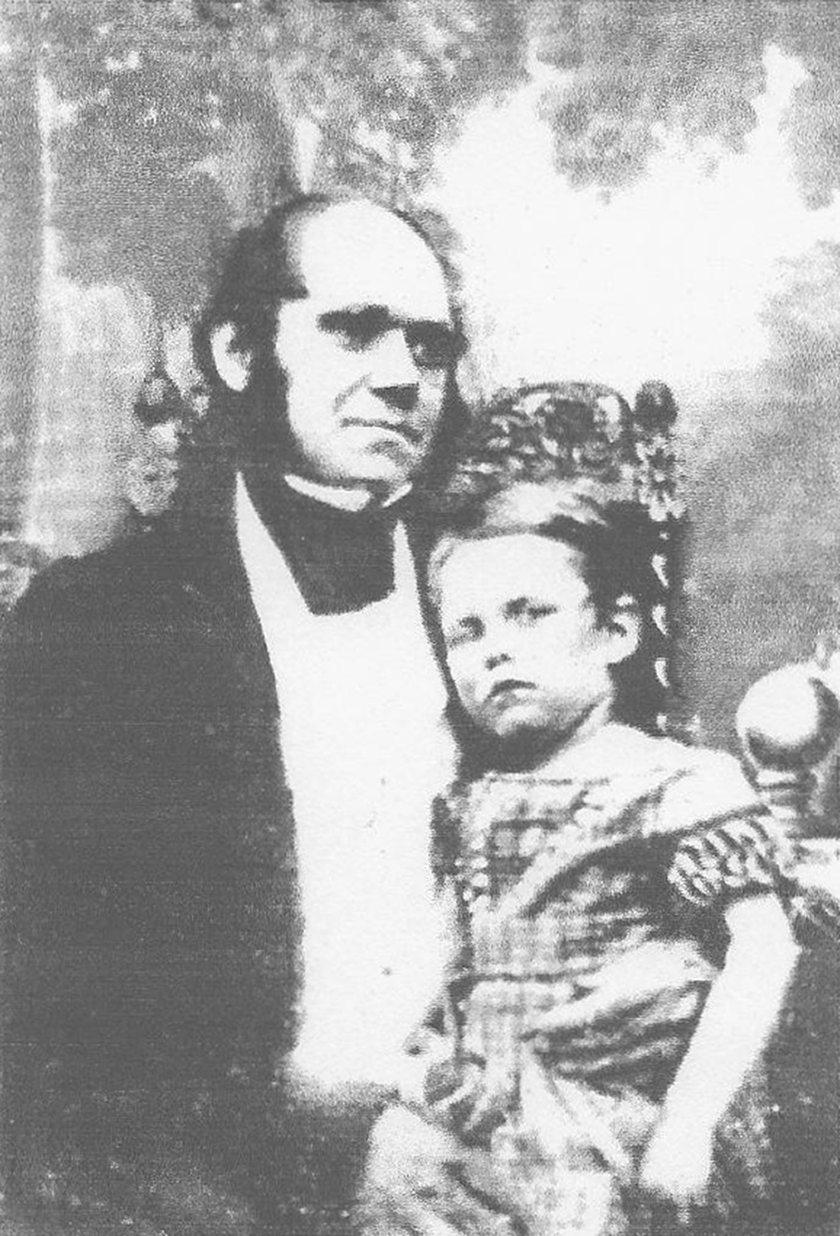
Charles and William Darwin. Source: https://upload.wikimedia.org/commons/5/57Charles_and_William_Darwin.jpg.

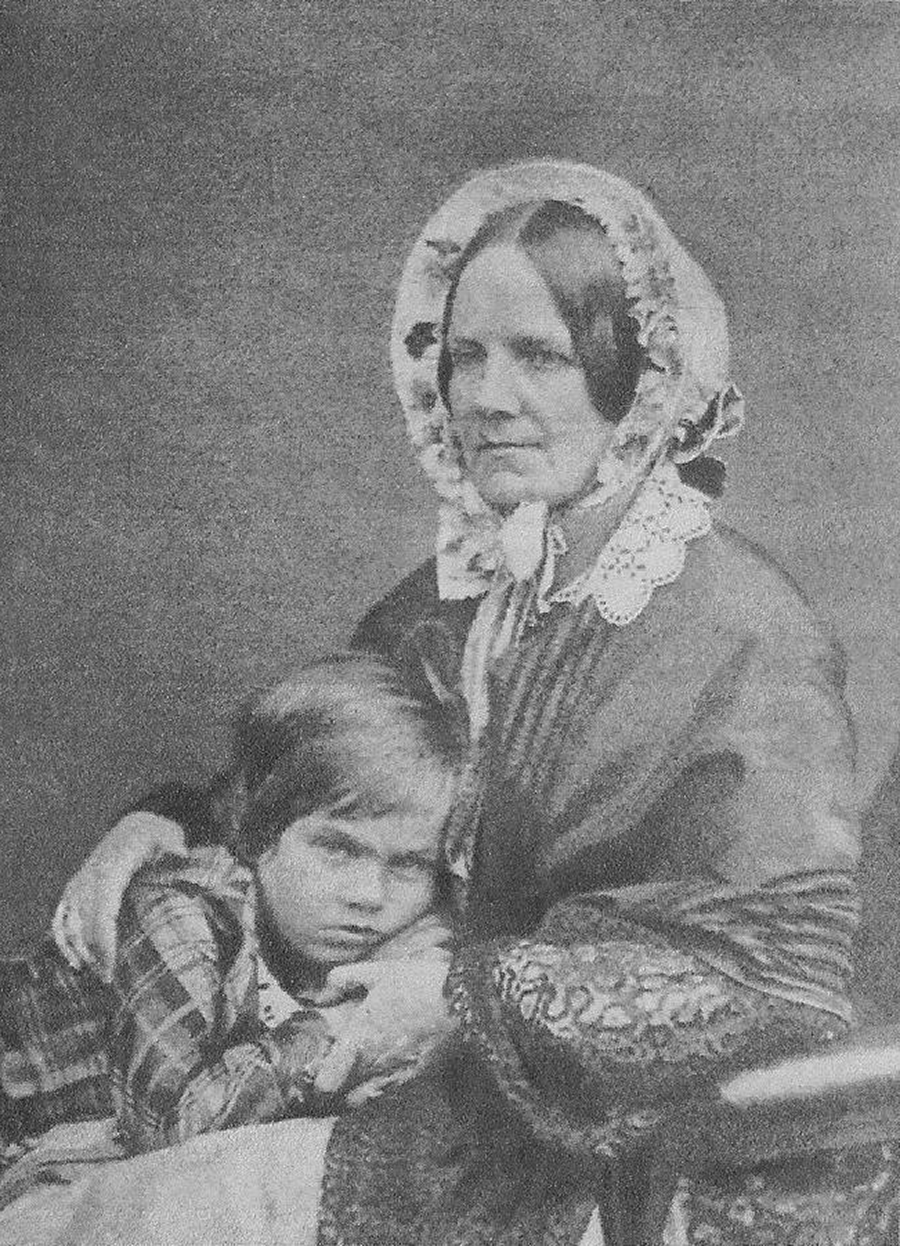
Emma and Leonard Darwin. Source: https://commons.wikimedia.org/wiki/Charles_Darwin.
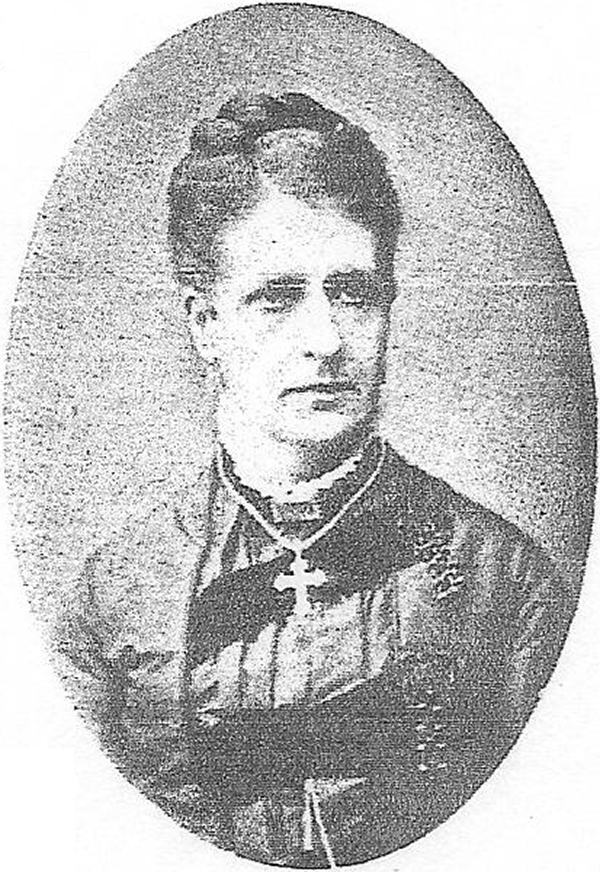
But at the breakfast table one Monday morning, Emma requested some changes to Horace’s lessons. Mme Grut was annoyed, as she saw it as a challenge to her authority, which was immediately brought into question by fifteen-year-old Henrietta. She took the opportunity to bait the governess by telling her that her translation of “s’éloigner” as “to ramble” was incorrect. At her employer’s breakfast table, Mme Grut had to content herself with a sarcastic retort to the effect that Henrietta must know better than the dictionary (Figure 6).

Henrietta (“Etty”) Darwin. Source: Alison Pearn, “Unpublished journal offers new take on Darwin’s daughter.” Darwin Correspondence Project, University of Cambridge. http://www.cam.ac.uk/taxonomy/term/3712/feed.
But that evening, on her own territory the schoolroom, she angrily berated Etty and the other children for hurting her feelings. Etty told her parents, who decided Mme Grut (whom the family had nicknamed “the brute”) had to go immediately. Charles wrote her a letter of dismissal including her wage of £33 and took it to the schoolroom where she tossed it aside, demanding board and lodging expenses. Darwin demurred. She accused him of ungentlemanly behavior and threatened legal action. Darwin retired from the fray. Later that evening she sent a note down that she would leave in a few days. She did, but left the Darwins fearing a lawyer’s letter. None came. 144
This domestic drama highlights some key points about authority: that not only employers but also their children challenged governess’s authority; that initial clashes could be defused by strategies like note-writing and face-to-face discussion; that territory was important in establishing authority; that the professional employer–governess relationship could break down under the weight of personal attacks on the family’s character; and that patriarchal authority was the ultimate power in the household.
Acceptance, Negotiation, or Rejection of Domestic Authority by Governesses
The governess’s task was to navigate between the various household members—parents, children and servants—without rocking the boat. Most governesses, mindful of which side their bread was buttered on, took Theodor Fontane’s advice to his daughter Meta when she took up governessing: “Those who serve must obey in silence.” 145 Some were less acquiescent and negotiated conditions of service with their employer. A few rejected the yoke of domesticity as intolerable and escaped it one way or another.
Complying with domestic authority was not burdensome for some fortunate governesses because it was wielded with tact and consideration. Margarethe von Ende’s employer, Admiral MacKenzie, was a “genial and kind gentleman,” 146 and his home was for Margarethe a welcome release from her mother’s tyrannical domestic regime. She accepted the family’s routine even if it was not to her liking. For example, she admitted that she accompanied the family to church just for the sake of a walk, which would otherwise have been taboo on Sunday. 147 Anna Mues recalled her four years with the Bass family as the happiest of her life. 148 Thekla Trinks found an understanding employer in Mrs. Sidney when she apologized for her poor piano playing. Assiduous practice by Thekla and Mrs. Sidney’s tactful solution of having her play for after-dinner dancing instead of an attentive audience solved the problem. 149
Those who found domestic rule tiresome developed various strategies to cope with it. One mitigated the boredom of the Litany of the Anglican service by reading sub rosa a book similar in size and binding to the Book of Common Prayer—Lessing’s romantic play Emilia Galotti. She listened to the sermon, though, as a means of improving her English. 150 Not a few avoided religious and racial tensions by passing themselves off as Protestants, as did Eleanor Marx. 151 Others turned to writing to relieve the strain of domestic obedience. Thekla Lennart started a diary, Sophie Kober wrote letters home, and Amalie Bölte wrote semi-autobiographical novels about the trials of governessing in England. Still others made silent protests against their treatment. To disprove the English stereotype of Germans as physically dirty, Thekla Lennart made a point of carrying the water for her bath in full view of the family. 152
A few governesses were bold or angry enough to challenge domestic rule outright and win concessions from employers. Carla Wenckebach used professional authority and artful manipulation to get her employer’s permission to use modern pedagogy for her daughter. Malwida von Meysenbug appealed to Mrs. Salis-Schwabe as a fellow German and liberal thinker to grant her exemption from family prayers. For those unwilling or unable to remonstrate with their employers, their situations could become untenable, and they sought only to escape domestic authority. Some simply resigned. Dorette Mittendorf felt she had no choice but to give up her post in Brighton because her fifteen-year-old male pupil was uncontrollable. 153 The feisty nineteen-year-old Carla Wenckebach found herself at odds repeatedly with the mothers of her charges, clashing about teaching methods, aims and content. She left both positions in high dudgeon, concluding that governessing “yields neither the authority nor the independence which is needed for the exercise of one’s own power.” She felt she had made “every attempt to render my position…more dignified [but] the duty of self-respect forces me to give up this thankless task.” 154 Disillusioned and disappointed, she returned to Germany. Other governesses avoided “living-in” posts. When the political and social activist Malwida von Meysenbug arrived in London in 1848, she recoiled from being a home governess because she thought it would reduce her to “something between master and servant, with limited social consideration, the narrowest horizon of pleasures and recreation, and an immoderately long list of tasks and duties.” 155 In preference, she resorted to the peripatetic life of a daily governess who lived in lodgings but gave lessons in pupils’ homes. In her memoirs, she writes feelingly of the low pay, of the misery of waiting for London omnibuses in the rain and cold. of sitting packed inside with other dripping passengers and snatching a quick lunch from a bakery. Eventually, Malwida agreed to join the Euston square household of the Russian émigré Alexander Herzen provided that she come not as governess but as companion and mentor to his two daughters. 156 Sadly, a few governesses became tragic casualties of English domesticity. Young and beautiful Sophie Kober went to Newcastle-upon-Tyne in 1888 as governess in a professor’s household and found her life there intolerable. She wrote to her parents detailing her deep unhappiness and desire to come home, but on November 21, 1890, she received a reply urging her to stay. Later that same day, she left her employer’s house saying she was going out to post a letter and drowned herself in the Tyne. 157
Impact of German Governesses on English Domestic Authority
Did the presence of a German governess have any substantial impact on English domestic authority and the way it operated? On the whole, domestic authority mediated through mothers and, on occasion, fathers was robust. It could ultimately deal with any challenge to it by dismissal, as in the case of Mme Grut. However, the rigid rule of domesticity could be loosened if a governess remonstrated. For example, Carla Wenckebach was allowed to use modern teaching methods and Malwida von Meysenbug to exercise her freedom of conscience. These exceptions did not bring substantial change to the household’s routines, rules or hierarchy, but they do demonstrate two important points about English domestic ideology. The first is that it could integrate foreigners without compromising its essential values and practices. The success of the process of accommodation depended on the perceptions and personalities of the actors involved. 158 A figure in authority might run a tight regime or a benevolent one. A figure under authority might accept it with good grace or reject it with indignation. The second point is that the discrepancies between the English and German domestic cultures were significant enough to cause conflicts. For example, the English fussiness about shades of social difference seemed needless hairsplitting to many governesses, and the English practices of regular churchgoing and Sabbatarianism drew criticism from those governesses brought up on private prayer and Sunday amusements.
If the structure and routines of household life were largely immune to the presence of German governesses, its culture was not. It became less Anglo-centric and more oriented to the Continent. The German language and to a lesser extent its literature were brought into the home to raise its cultural tone and social standing. Because governesses “talked” the language into their charges, it was spoken and heard well beyond the schoolroom. It became fashionable to sprinkle English speech and writing with German phrases. Literature, too, made its mark. Fräulein Pape got her pupil Patience Cockerell so interested in early German poetry that when she received the birthday gift she had asked for—a German dictionary—she became so engrossed in a poem by Walter von der Vogelweide that she forgot the invitation to tea at her friend’s house. 159 It became commonplace to send older girls to German boarding schools like Fräulein Brendecke’s in Hanover and the Misses Wegener’s in Dresden. 160 For very young children, a nationwide network of kindergartens was established, as were training colleges in Fröbelian philosophy and methods. Pestalozzi’s concept of graded “object lessons” found their way into textbooks such as Elizabeth Mayo’s Lessons on Objects as given to Children between the ages of six and eight in a Pestalozzian school at Cheam, Surrey (1830) and into language teaching methods. 161 German books and travel guides such as Baedeker’s appeared among the possessions of the middle class, and touring Germany for pleasure and cultivation was facilitated by companies like Thomas Cook.
Governesses were also instrumental in bringing German music into English domestic life. Talented musicians like Johanna Kinkel helped to raise the standard of music teaching, composition and appreciation. Some governesses inspired their pupils to become professional musicians. Ethel Smyth, a composer of operatic and sacred works performed at Covent Garden, the Metropolitan in New York and other famous venues, credited her governess with introducing her to classical music. 162 Queen Victoria and Prince Albert loved German music, and German governesses brought it from the royal into the middle class drawing-room, where its moral and romantic qualities earned approval. 163 Handel’s Oratorios, Bach’s Cantatas and other sacred pieces could be played with a clear conscience on the Sabbath, as could Luther’s hymns, many of which were translated by Catherine Winkworth. The music of the greats like Bach, Weber, Mendelssohn, Schubert, Beethoven and Brahms became part of the repertoire of amateur and professional pianists and singers. Mendelssohn’s “Fantasia on an Ancient Irish Air” and Schubert’s Lieder were among the favorites.
Conclusion
The experiences of German governesses reveal several important features of English domestic life. First, domestic authority was powerful but not absolute. A few governesses resisted it outright when their religious beliefs, treatment, role or pedagogy were incompatible with English domestic practice. When they did, domestic authority showed itself open to challenge and capable of minor modification. Second, these accounts show mothers and governesses in a new light. The role of mothers as household managers and moral guardians is well known, but the evidence examined here shows that many took on a self-appointed role as protector of English domestic values by filtering out “undesirable” German influences: unorthodox religious practices, relaxed social class attitudes and “modern” Continental pedagogy. At the same time, they opened the doors of English homes to the German language, literature, music and “direct” method of language teaching. As for governesses, they too are shown in a new light, for they were not the helpless, hapless victims of circumstance pictured in the stereotype of the English governess. Some took an active role in defining their work and status in the household. A third significant point is that nationality deeply affected the collective experience of governesses, families and households. Differences in the German and English styles of domesticity, though minor, were sufficient to create tensions. They could also act positively to make both nationalities sensitive to cultural differences. Finally, governesses’ writings highlight the importance of the human factor in the process of cross-national knowledge transfer. The knowledge they brought to English households was filtered by domestic authority, which admitted the German language, literature, music and “natural” language learning but not German Lutheranism, intellectualism or social class attitudes. Domestic authority, embodied in mothers, was crucial in defining their children's education and in selecting aspects of German culture to assimilate into English domestic life.
Footnotes
Acknowledgments
The author would like to thank Dr. Barry Doyle, editor of Cultural and Social History, for directing her to Rachel Rich’s article. V. E. Innes Rorke deserves similar thanks for drawing the author's attention to the work of Dr. Alison Chapman. A debt of gratitude is also owed to Dr. Judith Evans Longacre for her help in obtaining materials and proofreading a draft of the article.
Declaration of Conflicting Interests
The author declared no potential conflicts of interest with respect to the research, authorship, and/or publication of this article.
Funding
The author received no financial support for the research, authorship, and/or publication of this article.