



Abstract
This article examines an arranged marriage between a seven-year-old Inka girl and an adult Spanish man, and the prosecution that followed. Historians of marriage in the early modern Hispanic world have found broad support for the principle of free consent, which underlay Catholic marriage law and prohibited child marriage. Child marriage was legally invalid and rare. Yet, in this case none of the participants, whether Spanish or indigenous, in favor or opposed to the marriage, considered child marriage to be wrong in itself. The marriage of a child provided members of two ruling castes (colonial elites and colonized Inkas) a shared space for family alliance.
Keywords
In 1565, three decades after the Spanish invasion and conquest of Inka Peru, Beatriz Coya was living in a convent in Cuzco. Her parents were an Inka prince and princess who had accepted Spanish rule. When her father died in 1561, Beatriz inherited the encomienda which he had held: a quasi-feudal property, consisting of a community of tribute-paying Indian subjects. Still a toddler, she became one of the richest people in Peru. At age five, she was placed in a convent, to be married to a candidate chosen by the Crown when she came of age. But shortly before her seventh birthday, Beatriz’s mother, named Kusi Warkay, 1 came to the convent, took her away, and placed her in the home of a wealthy Spaniard, Arias Maldonado. Several months later, with her mother’s consent, and in the presence of prominent citizens of Cuzco, Beatriz was married to Arias’s brother, Cristóbal, aged twenty-four. The night of the ceremony, Cristóbal later claimed, he had sexual intercourse with the seven-year-old girl to consummate the marriage. 2
When news of the wedding reached the corregidor (Spanish local magistrate) in Cuzco, he imprisoned the bridegroom and his brother, put Kusi Warkay under house arrest, declared the marriage void, and returned Beatriz to the convent. In the charging document against Cristóbal, the prosecutor referred to the sexual violation of Beatriz: “he says that he deflowered the said doña Beatriz, a seven-year-old girl, making the crime more atrocious.” 3 This language resembles what one would find in a criminal prosecution for estupro, usually translated as rape, defined as deflowering a virgin by force or deceit. 4 Any sexual encounter between an adult man and a girl younger than twelve was generally assumed to be estupro, a serious crime.
But the prosecutor did not charge Cristóbal with estupro. Estupro within marriage—even an illicit marriage—was a contradiction in terms. Instead, he cited the sexual violation of Beatriz as an aggravating factor to the real offense, which was breaking the conditions which the corregidor had placed on Beatriz’s custody. This reflected the corregidor’s primary grievance: that Kusi Warkay and the Maldonados had usurped the Crown’s prerogative to choose Beatriz’s husband. The corregidor kept Arias and Cristóbal imprisoned for months and repeatedly interrogated almost everyone who had been present at the wedding. He ultimately sent the brothers to Spain where they were convicted, fined, and banned from returning to Peru. The case generated a trial record of 728 double-sided folios, including as much negative and discrediting information about the brothers as the prosecutor was able to assemble. But, apart from one line in the charging document, and Cristóbal’s own statements, there was almost nothing in the record about Cristóbal’s alleged sexual intercourse with a seven-year-old girl.
The early modern Christian world was poised between two models of marriage, sometimes called the consensual and social models. Canon law held that marriage was formed by the free consent of two individuals, was impossible without their consent, and required nothing except their consent. 5 Outside the framework of legal theory, however, many people subscribed to a model of marriage—the social model—as a process involving multiple stakeholders. In this model, the right to decide on a marriage belonged not just to the bride and groom but also to their parents, employers, and other influential people in their lives. Both models jostled and competed as they jointly influenced the practice of marriage. Legal doctrine gradually modified popular practice, and traditional practice forced adjustments in the law.
The consensual model implied that children could not marry because they were not mature enough to give or withhold consent. The social model, on the other hand, called for giving parents and guardians the option to arrange children’s marriages. Reflecting this ambiguity, canon law prohibited child marriage but made certain exceptions. Lawyers asserted that some children were precocious; to enact the fiction that an underage girl was capable of consenting to marriage, the law required that she consummate the marriage sexually. This fact likely explains both why Cristóbal insisted that he had sexual intercourse with Beatriz, and why the prosecutor ended up virtually ignoring the question.
There is a large literature on marriage choice in the early modern Christian world. In Spain and Spanish America, historians have emphasized the hegemony of the discourse of consent and the acknowledged right of young people to choose their own spouses. But Beatriz’s case is different from the ones that historians have generally examined. The witnesses and lawyers whose voices are heard in the trial—including Kusi Warkay, Beatriz’s mother—said almost nothing about Beatriz, spousal consent, or child marriage. In contrast to the historiography, this trial shows a social model of marriage, not a consensual one, as dominant and accepted in Cuzco in 1565.
Of course, this was not a typical marriage. It was a royal marriage—of a sort—and subject to different rules and expectations than other marriages. Participants and observers would have seen it as exceptional, and it also raised different issues for Crown officials. This marriage is significant not because it typifies marriage patterns but because it is a rare example of a well-documented child marriage, at an important historical juncture. It reveals the attitudes toward child marriage held by a segment of the colonial elite, at the intersection of the Spanish and Inka worlds, at the very moment when the Council of Trent was reaffirming the centrality of consent in marriage.
Neither Beatriz Coya nor her mother is an unknown figure to historians. They were near the center of colonial politics, due to the fraught relations between the colonial Spanish administration and the independent Inka enclave of Vilcabamba, from 1558, when Kusi Warkay and her husband left Vilcabamba and accepted Spanish authority, to the final destruction of independent Vilcabamba in 1572. During this period, the Spanish governor tried to arrange a marriage between Beatriz and her cousin Quispi Titu, a young prince in Vilcabamba, as a diplomatic inducement to the Vilcabamba leadership. Mother and daughter make their appearance in virtually all of the contemporary chronicles, in the general historiography of Peru, 6 and in the large and growing literature on the colonial Inkas. 7 Recent work by Sara Vicuña Guengerich has analyzed Kusi Warkay’s career and choices with great acuity. 8 Even Beatriz’s face (as imagined by a later artist) is familiar from a widely reproduced colonial painting documenting her second and final marriage, in 1573, to the grand-nephew of the founder of the Jesuit order. 9 But in contrast to her celebrated second marriage, her first, brief marriage to Cristóbal Maldonado is an obscure episode. Historians have treated it as inconsequential, in the literal sense: it had no effect on the larger, political narrative. 10
The focus in this article is not politics or diplomacy but marriage. In what follows, I begin by telling the story of Beatriz’s and Cristóbal’s wedding. I then examine the phenomenon of child marriage in early modern European law and practice, and the relationship between childhood and marriage among the pre-Conquest Inka elite. Finally, I return to Beatriz’s story, to ask how the participants in this 1565 wedding understood child marriage in the light of those two traditions.
My argument is that while sexually consummated 11 child marriage was not normal, either in the early modern Hispanic world or (as far as we can tell) in Inka Peru, it was not shocking to the people who attended Beatriz’s and Cristóbal’s wedding—and it did not even seem to them the most salient feature of the wedding. The suggestion in the charging document that having sex with a young child was an atrocious act, even under cover of marriage, was available in early colonial Peru as a rhetorical argument, but it did not have much legal or cultural purchase. The people involved in the story did not see Beatriz as a victim or even as the most important protagonist in the story, which they saw as being a drama about the relationship—played out through law, gender, race, and social station—between Kusi Warkay and Arias Maldonado. They saw the marriage as being less about the bride and groom than about her mother and his brother, who were the heads of their respective families. In spite of the fact that child marriage was illegal, and its sexual consummation could be framed for rhetorical purposes as “atrocious,” the witnesses and lawyers in this trial generally treated it as unremarkable. The participants in this wedding operated with a model of marriage as clan alliance, which was shared by both Castilian and Inka elites, and for which child marriage was a natural corollary.
The Wedding
Beatriz’s grandfather, Kusi Warkay’s father, was an Inka prince named Manko Inka. At the time of the Spanish invasion in 1534, Manko Inka first sided with the Spanish, then fought them, and finally—as the Spanish consolidated their control over the erstwhile Inka empire—he led a group of Inkas to found an independent enclave in the tropical valley of Vilcabamba, outside Spanish control (See map at Figure 1). When he died, his son Sayri Tupa succeeded him, then negotiated an accommodation with the Spanish. 12 In 1558, Sayri Tupa and his sister-wife Kusi Warkay (Inka royalty frequently married half-siblings) moved to Cuzco. They accepted Spanish authority and Christianity in exchange for an encomienda—that is, lordship over a population of tribute-paying Indian subjects—and the honor and prestige due to royalty. 13 But within three years of their arrival in Cuzco, Sayri Tupa was dead, probably poisoned by a rival. The encomienda passed by inheritance to his daughter Beatriz, which meant, for all practical purposes, to her future husband. Then, for reasons that are unclear, Cuzco’s corregidor took away Kusi Warkay’s guardianship over her daughter. 14 Beatriz was placed in Cuzco’s Santa Clara convent. 15
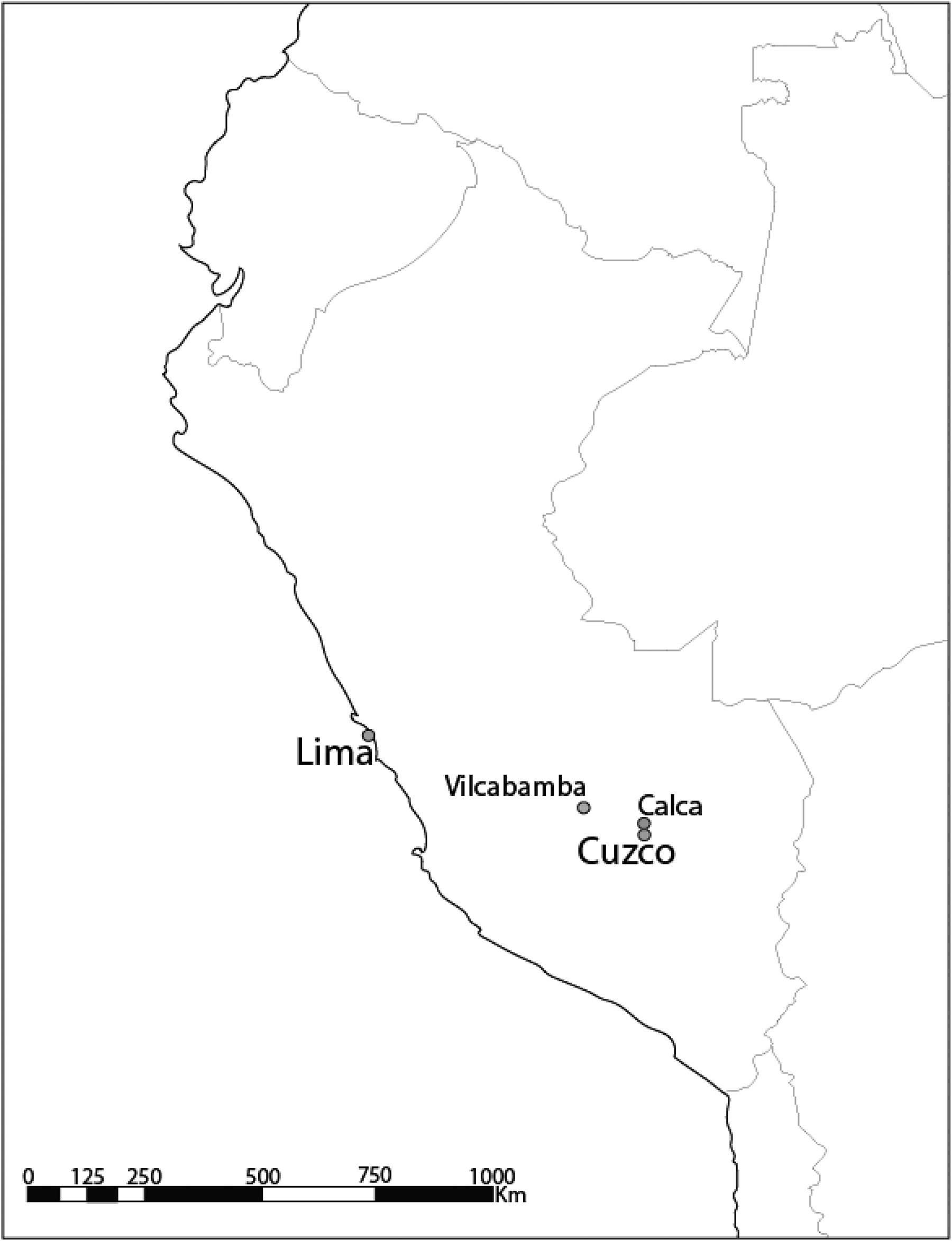
Locations named in text (Shown with modern national borders to orient the reader). Due to the peculiar topography of the central Andes, the deep tropical valley of Vilcabamba was close to highland colonial settlements but virtually inaccessible to horse-mounted Spaniards.
Kusi Warkay, who was about twenty and spoke Quechua, not Spanish, was left vulnerable and isolated. Previously, as Beatriz’s guardian (tutora), she had administered the encomienda and received an annual stipend of 3,000 pesos. This was reduced to 1,000 pesos, and most of the servants and retainers who had come with her from Vilcabamba left. Although kin to much of Cuzco’s Inka and mestizo elite, and known by the title Coya, 16 or queen, she was an outsider. Her and Sayri Tupa’s arrival had upset the balance of power in Cuzco; Sayri Tupa was generally believed to have been poisoned by indigenous rivals, possibly including some of his own relatives. 17 Kusi Warkay had no way of knowing whom to trust. She formed a friendship with a wealthy Spanish family, with an encomienda which bordered on Beatriz’s : Arias Maldonado, his wife Isidora, and his younger brother, Cristóbal. Cristóbal Maldonado was a thuggish young man, who picked fights wherever he went, and had been accused of raping the daughter of a prominent Spaniard. 18 She also became close with Juan Maldonado (not related to Arias and Cristóbal 19 ), the mestizo son of another encomendero and an indigenous mother (See the chart of family relationships at Figure 2). And she relied on her cousin Pedro de Bustinza, the son of an aunt with a Spanish man, who successfully sued to become Beatriz’s guardian. 20
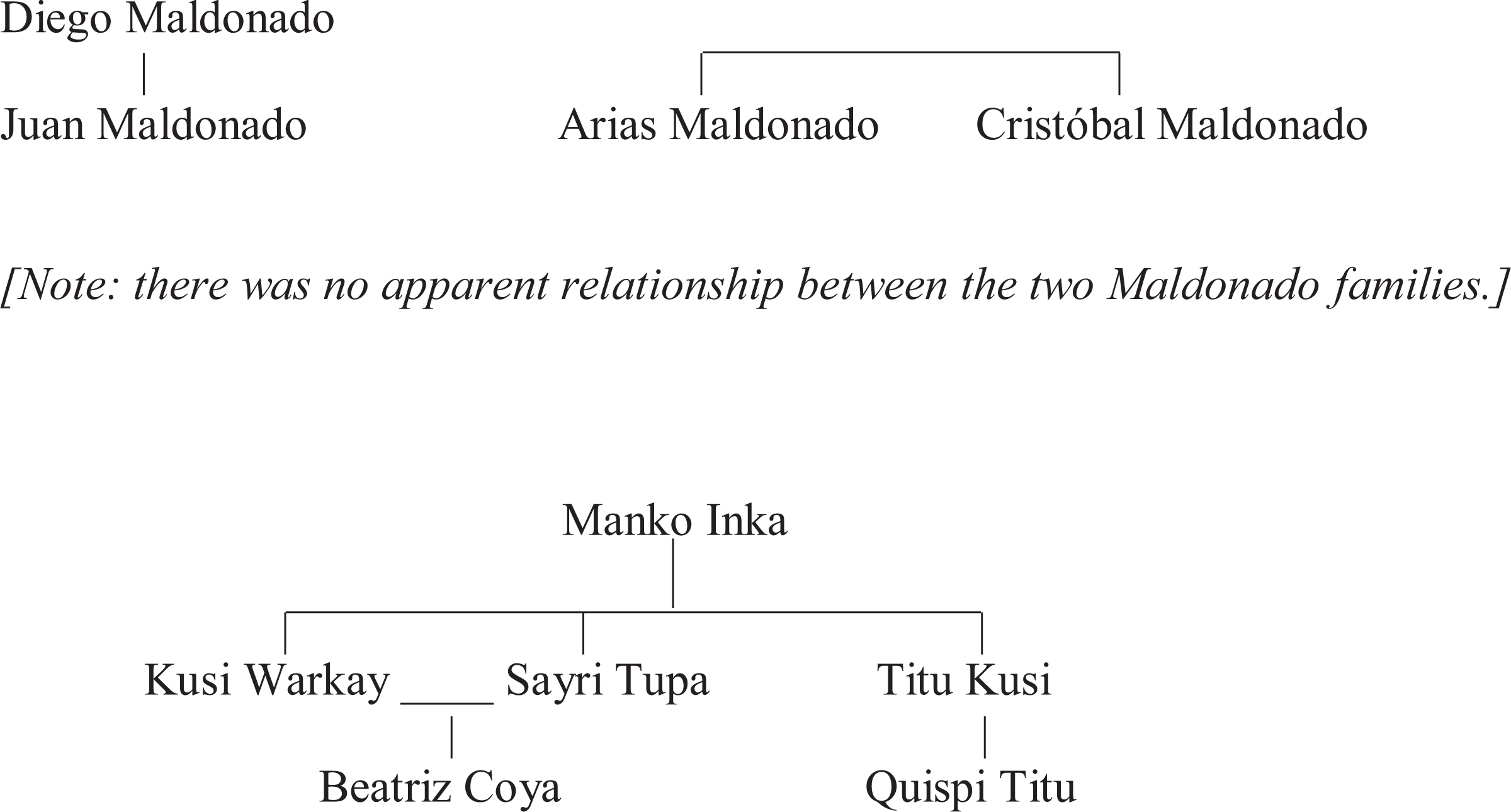
Principal characters’ family relationships.
Beatriz was growing from a toddler to a child outside her mother’s care. In the convent, she was surrounded by young women who had been separated from their own families, so she probably received attention and affection, along with regular visits from her mother. But when she came down with intestinal worms, Kusi Warkay came and took Beatriz away—perhaps with the tacit permission of the Mother Superior or perhaps (one witness claimed) by bribing the convent’s doorkeeper. 21 Kusi Warkay did not bring Beatriz to her own home but to the house of Arias and Isidora, placing her in their care. A doctor visited her there, treated her, and she began to grow stronger. 22 The Maldonados brought Beatriz with them when they moved between their Cuzco mansion and their country home, in the village of Calca on their encomienda in the mild, green Yucay valley. An indigenous servant, whose name we do not know, took care of Beatriz during the days. Kusi Warkay did not bring her daughter back to the convent. She said that the reason why Beatriz had gone to the convent was “to learn her prayers” and that she could learn them equally well in the home of a respectable, Spanish, Christian couple. 23
The governor of Peru, Lope García de Castro, had a plan for Beatriz: to marry her to her cousin Quispi Titu in Vilcabamba and at last neutralize the political threat from that quarter. This had been the original purpose of enticing Sayri Tupa and Kusi Warkay to Cuzco, but Castro’s predecessor, who arranged that deal, had miscalculated: Sayri Tupa’s brother Titu Kusi had simply taken his place, and Vilcabamba remained independent and hostile under another king. Titu Kusi’s soldiers carried out a number of raids on Spanish property in the early 1560s. Castro’s emissaries tried to negotiate a new deal, offering more concessions in exchange for placing Vilcabamba under Spanish control. A key element was marriage between Beatriz and Titu Kusi’s son, who was about the same age. Her encomienda, which would become his, would thus achieve its original purpose of resolving the threat from Vilcabamba. The encomienda represented more than just the income it provided: the Yucay valley contained the royal estates that were the personal possessions and symbolic home of the Inka dynasty. Furthermore, marrying close relatives was an ideologically important dynastic tradition, 24 and Castro’s acceptance of it may itself have been one of the inducements he hoped would tempt Titu Kusi. But this was not Kusi Warkay’s plan for her daughter, and it is possible that learning of the proposal was what prompted her to remove Beatriz from the convent. 25 The corregidor did not force Beatriz back to the convent but rather placed her in Arias and Isidora’s home in depósito—a legal process by which a woman was held in protective custody, usually pending the resolution of a marital dispute. He formally bound Arias to keep Beatriz safe for the proposed Vilcabamba marriage. 26
On Saturday, December 16, 1565, Kusi Warkay traveled the six leagues from Cuzco to Calca to spend several days with her daughter and the Maldonados. Over the next few days, others began to arrive, mostly members of Cuzco’s mestizo elite. Later, Kusi Warkay said that Pedro revealed the plan to her in Calca, while he said she was the one who revealed it to him: Beatriz would be married to Arias’s younger brother Cristóbal, a man older than Kusi Warkay herself. But based on the welter of conflicting testimony, it seems that both had already discussed the scenario with Arias. After the marriage, Kusi Warkay would receive a generous income from her son-in-law Cristóbal. Pedro, as Beatriz’s guardian, would receive some financial compensation as well. With two rich encomiendas near Cuzco, the Maldonado brothers would become the most powerful bloc in the region, and Kusi Warkay and Beatriz would be part of the family. But if she had agreed to it, she now had doubts about the plan.
Why was Beatriz’s marriage Kusi Warkay’s decision to make? On the one hand, according to canon law, the only consent that mattered in forming a marriage was that of the two spouses. On the other, the secular law of Castile, like other European countries, gave the power to arrange a betrothal to a minor’s father or guardian (tutor or curador). Sayri Tupa’s will had designated his wife as their daughter’s guardian, 27 which was the usual practice in the Hispanic world, 28 but the corregidor had taken away her guardianship. Her current guardian was Pedro, but his powers extended over her property—not her marriage, which governor Castro claimed, on behalf of the Crown, the right to determine. In Spain, it was not normal for Crown officials to assert control over individuals’ marriages, but in Peru, it had become increasingly common to do so for women and girls inheriting encomiendas, especially when they were indigenous. 29 But during the six days that Kusi Warkay stayed with Beatriz and the Maldonados in Calca, it appears that almost no one challenged the premise that it fell to Kusi Warkay—not Beatriz, not Pedro, not the Crown—to decide Beatriz’s marriage.
In Calca, more guests arrived. Pedro had brought sweets and candy for a celebration and tried to create an atmosphere of gaiety. The documents we have do not tell us what Kusi Warkay (or anyone else) said to Beatriz. Pedro, Arias, and Cristóbal tried to persuade Kusi Warkay to approve the marriage, but she was unable to make a decision. She later said that she asked Pedro, “Isn’t she too little to be married?” He replied “that among the Spanish they married them very young and they loved each other greatly.” 30 Many of the guests reported seeing Kusi Warkay crying, in the garden, in the village plaza, in the village church.
The last to arrive, on Wednesday, was Juan Maldonado. Juan was the son of Diego Maldonado, known as el Rico, the richest of the surviving “first conquistadors”—the Spaniards who had invaded the Inka kingdom three decades earlier. Almost all the conquistadors had mestizo children, and almost all those children were illegitimate, even when their parents formed a stable household. 31 Juan rode fine horses and dressed as well as or better than anyone who came to Calca for Beatriz’s wedding. At some point, he also became Kusi Warkay’s lover although we don’t know whether this relationship had yet begun. But, as an illegitimate son living in his father’s house, Juan was not in a position to offer her a home. Privately, he told Kusi Warkay not to marry her daughter to Cristóbal. “Everyone here is out for his own interests, not for yours,” he told her; “be careful.” 32
The next day was Thursday. There are several versions of what happened that day; the most detailed is that of Juan’s mulatto servant, Luis Enríquez. Juan had spent much of the night in the patio of the house with Kusi Warkay and her two servants, talking quietly. He came out in the morning and told Luis that she and Beatriz would return with them to Cuzco, aborting the planned marriage. But as Kusi Warkay was following him out the door, Arias grabbed the edge of her lliclla, the woven Inka mantle she wore over her shoulders, saying, “Come into the house, Coya.” 33 He reminded her that she had once told him to take whatever decisions he thought best, for both her and her daughter. What had changed? As the guests stood around watching and listening, Kusi Warkay asked him to discuss it in private, but he replied that he was sick of endless secret negotiations—“we are all at home here, we can as well discuss it here.” 34
As they talked, an Indian man arrived with the news that twenty men on horseback were approaching. Arias and Cristóbal jumped to the conclusion that Juan had sent for friends from Cuzco to seize Beatriz by force. Arias shouted to his servants and friends to grab swords and harquebuses and head them off at a near-by bridge, and Cristóbal drew his sword on Juan. But the twenty horsemen turned out to be only a train of llamas heading to market. Juan was livid with rage, saying that if Arias and Cristóbal wanted to murder a guest in their own home, he was ready to fight all of them at once. Arias was exasperated, telling Juan that Cristóbal was a fool; no one was going to murder anyone; if Kusi Warkay had decided against the marriage, she and Beatriz could return with Juan to Cuzco. He knew that an attack on a guest would dishonor him, not to mention open him up to legal prosecution. “I have never been so humiliated in my life,” he told Juan; “I would rather pull out my own eyes than offend you.” 35 First, he proposed, they would have lunch, and then he himself would ride alongside Juan, Kusi Warkay, and Beatriz, escorting them to Cuzco. The uncertainty seemed to be resolved at last. The wedding was off, but so was the family-like relationship between Arias and Kusi Warkay; with all cordiality, he was expelling the Coya and her daughter from his house. While Arias, Cristóbal, and the guests went inside for lunch, Juan found Beatriz and told the frightened girl to go to her mother. 36
Then Kusi Warkay suddenly, quietly, approached Arias and indicated that she would approve the marriage after all. And just as suddenly, Arias was all bonhomie, praising Kusi Warkay and embracing Juan. 37 With a grim face, Juan gathered his things and left. 38 The ceremony took place quickly. The priest, Beatriz, and the servant who cared for her entered the room. When doña Isidora tried to take young Beatriz’s hand, “the girl began to cry and hugged the servant and did not want to come.” 39 Pedro read a document in Spanish signed by Cristóbal, promising Kusi Warkay an income of 3,000 pesos a year; Kusi Warkay said in Quechua that she did not understand and started to cry again herself. The priest read the short wedding service. He asked whether anyone knew any reason why the marriage should not take place; no one spoke. He asked Cristóbal and Beatriz whether they wished to be married; he said yes and, according to some witnesses, she did, too. Some of the guests called out the traditional formula marking a marriage, para en uno son los dos—“the two are as one.” 40 That night, after dinner—at least, so Cristóbal later reported to anyone who asked—the marriage was consummated. 41
As the guests left, Pedro asked Kusi Warkay for a gift or payment for his efforts in bringing about the marriage. She referred him to Cristóbal, who put him off with vague promises. Pedro left, frustrated and angry. By the time he reached Cuzco, news of the marriage was already circulating. The next morning Pedro found himself called to discuss the matter with the city’s corregidor. 42
Arias and his associates knew that the corregidor would not be happy with Beatriz’s marriage to Cristóbal, but they did not understand just how angry he would be, and how seriously he took Governor Castro’s plan of a diplomatic marriage for Beatriz. Among Cuzco’s encomenderos—the Maldonados and their friends—it was accepted wisdom that the Vilcabamba problem had no diplomatic solution; eventually, they thought, the Spanish would have to invade and conquer Vilcabamba. Arias and Cristóbal seem to have assumed that the corregidor would accept the marriage as a fait accompli. Instead, he saw the marriage as a crime to investigate and punish. After questioning Pedro de Bustinza, he went with his bailiff and scribe to Calca to arrest the brothers. Alerted in advance, Arias fled down the valley and camped out with some companions in a mountain gorge, while Cristóbal and Beatriz hid in an upstairs room in his brother’s house. It took a day and a half for the corregidor to track everyone down. He jailed both brothers, placed Kusi Warkay under house arrest, and returned Beatriz to the convent on Christmas day. 43
Child Marriage in Early Modern Europe
Child marriage flouted the central principle of the Catholic law of marriage: that of free, mutual, and mature consent. According to the consensual model of marriage, marriage is created by the consent of two individuals and requires virtually nothing else: families, social superiors, and political rulers had no say in the matter. 44 This was a radical social principle, which was never fully implemented in medieval Europe, or anywhere, then or later. The consensual model conflated sexual maturity and mature judgment. Before puberty (legally defined as age twelve for girls and fourteen for boys), a person was too young either for sex or for rational decision-making. Inevitably, though, some parents would seek to marry their children before these ages. The consensual model required adults who want to arrange a child marriage to pretend that the child was sexually as well as psychologically precocious—with tragic results for many children.
Church lawyers and popes developed the consensual model of marriage in the twelfth century and aggressively enforced it in the ensuing centuries, through church courts that successfully established jurisdiction over most marriage disputes. But in actual practice, the consensual model was forced to compromise with lay understandings of marriage. Outside the abstract logic of the law, a marriage was suspended in a dense network of other relationships, and many stakeholders—parents, larger kin groups, political authorities, and social superiors—claimed a voice in arranging the match. A marriage typically proceeded in several stages involving negotiation, betrothal, dowry, priestly blessing, and consummation, with room for ritual acts and legal agreements at each point. In the traditional view, marriage was not individual but kin-mediated, not instantaneous but multistage, not indissoluble but open to various kinds of separations. There was a great deal of variation in local lay understandings of marriage, but we can collectively refer to them as the social model. 45
The biggest problem that the consensual model created was what were called clandestine marriages: those carried out in private, without priest, or witnesses. According to medieval canon law, such marriages were valid, but they were also impossible to prove or disprove. The Council of Trent issued a decree on marriage in 1563: henceforth, to be valid in Catholic law, a marriage had to be carried out by the designated priest, in the presence of witnesses, after giving advance public announcement (banns) in church for three successive weeks. 46 However, the assembled theologians declined to restrict free consent in other ways, such as requiring parental approval for marriages. The Council of Trent thus limited but also reaffirmed the consensual model of Catholic marriage. 47
The social model of marriage, unlike the consensual one, had a logical space for child marriage. If parents had as great or greater say in the match as their child, they might begin planning it while the future spouse was learning to walk and talk. If a marriage took place in stages, someone might begin marriage before puberty but not start having sex till several years later. Forms of the social model, and pressure toward child marriage, were found in all classes. But when there was significant property at stake, or inherited political power, parents and other authorities had the means to exert pressure to accommodate child marriage within the law.
The most significant compromise between the consensual and social models of marriage lay in the practice of betrothal. A ceremony of betrothal was much like that of marriage, except that the spouses’ mutual agreement was framed in the future tense: what lawyers called verba de futuro, words of future consent, rather than verba de praesenti, words of present consent. According to a legal doctrine known as “presumptive marriage,” a betrothed couple who had sexual intercourse automatically converted future consent into present consent and became married. The distinction between betrothal and marriage was blurry, with the two terms often used interchangeably. Betrothal thus undermined the logic of the consensual model, with its single shining moment of explicit, irrevocable consent.
Betrothal also blunted the prohibition on child marriage: a child could not marry before age twelve (for girls) or fourteen (for boys), but could be betrothed starting at age seven. Throughout Christian Europe, parents frequently betrothed prepubescent children. In a lawyer’s eyes, the ceremony between Cristóbal Maldonado and Beatriz Coya might be interpreted not as an illegal marriage but as a legal betrothal: the law provided that if a child gave words of “present consent” (as Beatriz did in this ceremony), they should be interpreted as future consent. 48 Children had the theoretical right to break the engagement when they reached twelve or fourteen, but that was uncommon, especially since there was no requirement to affirm the marriage legally when a child reached puberty. When they came of age, betrothed children might have a regular marriage ceremony or (according to the doctrine of presumptive marriage) they might simply begin sexual relations and married life. 49
There were other legal avenues for a child to become fully and indissolubly married before turning twelve or fourteen. One was through a papal dispensation, although in this period that was available only to royalty and the highest ranks of the aristocracy. 50 More broadly, a child who reached puberty before the canonical age, or who was “almost” at puberty (proximus pubertati), could be married. 51 (In fact, the average age of menarche in medieval and early modern Europe was almost certainly later than twelve, and many girls had their first periods in their late teens, but there do not seem to have been cases in which a marriage was annulled because a twelve-year-old wife had not yet reached puberty. 52 )
Most startling of all, the very fact of sexual intercourse was taken as evidence of maturity, according to a legal principle adopted from Roman law, malitia supplet aetatem—“malice makes up for age.” The principle had its roots in criminal law, in which children who committed crimes without understanding the consequences of their actions were not held responsible, but those who did understand what they were doing—who acted with “malice”—could be treated as adults. 53 Malice may seem like a strange word to apply to a child abused by an adult, but it does resemble the well-known logic by which a woman who has been raped is ipso facto sexualized and therefore must have consented to sex. In any case, the assumption that sexual intercourse indicated maturity, combined with the fact that betrothal followed by intercourse constituted marriage, created a loophole for establishing legal marriage with a child—one which Cristóbal Maldonado sought to exploit. 54
Not everyone agreed with this logic. One medieval jurist, Azo of Bologna (c. 1150–1230), pointed out that other impediments to marriage were not nullified by sexual intercourse: having sex did not make it permissible to marry a cousin or a nun. In fact, he argued, a man who had sexual intercourse with a prepubescent girl under color of betrothal or marriage should be prosecuted for rape. 55 I have not found any other text suggesting that consummating a child marriage was equivalent to rape. (In Cristóbal Maldonado’s charging document, the prosecutor hinted at an equivalency but did not state it.) Outside the context of marriage, however, child rape was seen as a serious crime. Historian Garthine Walker has found that both the definition and the prosecution of rape in early modern Europe were variable and inconsistent, but “child rape formed the largest category formally prosecuted, had the highest conviction rate, and resulted in the severest sentences.” 56 But since there was no conception of marital rape in medieval and early modern Christian thought, it is perhaps not surprising that nobody described the alleged sexual abuse of Beatriz as rape.
A number of authors argued that regardless of the law, women should not marry until their late teens, when they had the strength to bear a child. 57 Some gynecological manuals claimed that conception was not yet possible for several years after menarche, others that it was possible but dangerous to the mother and child. According to one widely read medieval treatise, a wife was unlikely to bear a healthy child before age twenty. 58
It is difficult to estimate the actual incidence of underage marriage in early modern Europe. Such marriages appear in the documents most often in the form of nullity suits: appeals to an ecclesiastical judge to nullify a marriage because of an impediment—in this case, because one or both spouses were underage. In such suits, typically, the same parents or guardians who had arranged an underage marriage were now trying to back out of it because a more advantageous one presented itself or because the circumstances that made the marriage desirable had changed. 59 Where such suits appear in the archives, therefore, we can assume that many more child marriages took place than were challenged in court. Historians have reported such cases in some regions but not in others. It is hard to know, however, whether that reflects variation in the actual practice of child marriage, in the availability of annulment (canon law was uniform but its implementation was not), in archival preservation, or even in historians’ research interests.
There is considerable documentation of child marriage in Italy, especially in northern Italian cities where unions of teenaged brides with much older men were normal. Historians have reported cases of brides younger than twelve for fourteenth-, fifteenth, and sixteenth-century Lucca, Bologna, Padua, and Venice. 60 In virtually every case, the bride’s lawyer asserted that she was underage, that she had been subjected to extreme and violent coercion, which she had resisted with every effort of which she was capable, and that the marriage had not been consummated. 61 A marriage that had been sexually consummated, no matter how young the bride was, was difficult to annul. 62
There is a large literature on marriage on early modern Spain, 63 but historians have not reported evidence of child marriage in the ecclesiastical archives. In contrast to Italy and northern England, Spanish archives preserve relatively few nullity suits for any cause (the archdiocese of Seville, e.g., has only six for the entire seventeenth century 64 ), and few or none for underage marriages. However, given significant cultural commonalities between Spain and Italy, it is likely that child marriage was a more widespread phenomenon in early modern Spain than is suggested by the evidence that has so far come to light. 65
For Peru, there is documentation of underage marriages in situations like Beatriz’s: cases of young girls who inherited encomiendas or who married elderly encomenderos in the expectation of doing so. Several factors made such marriages more likely. One was that encomiendas, which were central to the early colonial economy in Peru, generated constant political turmoil, as factions of encomenderos rebelled or threatened to rebel against the crown. Another was that the rules of encomienda inheritance were uncertain and contested. An encomienda was a feudal grant which in Peru was typically given for two lives: that of the grantee and that of his legitimate, male heir (It would then revert to the crown, to be given to a new claimant at the viceroy's discretion). But in order to encourage encomenderos to form legitimate marriages, the crown widened the circle of heirs, allowing a daughter to inherit when there was no son and a widow to inherit when there was no child. The possession of an encomienda by a woman was considered a legal fiction. Heiresses to encomiendas were expected to marry quickly, so that a man could exercise the military functions of the role, and viceroys regularly pushed encomenderas into marriages not of their own choosing. This turbulent milieu, in which legitimate marriages were relatively rare, and violent death, political arrest, and expropriation were common, led to questionable marriages. 66
In one scenario, an aging encomendero illegally sold his encomienda to another family by marrying a designated wife—the younger she was, the more years she could potentially hold the encomienda—who after his death would be free to remarry. In exchange for the fake marriage, the aged husband would receive cash, which he might transfer to a mistress and illegitimate children or to relatives in Spain. A viceroy described this practice to the king: People who have daughters of six or seven years, older or younger, bargain with the encomenderos (although they may be impotent and very old) to marry…(although [the girls] may be younger than seven years old), and because they do it in exchange for giving them the money which they agree on, they marry without any thought of [real] matrimony on either side, but only…for the purpose of defrauding your Majesty.
67
Liliana Pérez Miguel’s research on female encomienda holders provides concrete examples of child marriages from Peru in the 1550s. One was that of Maria de Robles. Her father, encomendero Martin de Robles, was close friends with fellow-encomendero Pablo de Meneses. After a feud between them, the two made up and sealed their renewed friendship by betrothing Maria, aged six or seven, to the sixty-year-old Pablo. After Pablo’s death, Pablo’s nephew inherited his encomienda by marrying Maria, his uncle’s “widow,” now aged ten. Another such wife was Ana de Villegas, also ten years old. After the death of her father in 1556, her guardian was prosecuted for involvement in political sedition. In order to save his own neck, Ana’s guardian arranged her marriage to the adult nephew of one of his judges. According to one source, the marriage was consummated immediately. 68
The requirement to consummate child marriages was, in a sense, paradoxical. Adults, unlike children, did not have to have sexual intercourse to become married: psychological consent, rather than any physical act, created the relationship. That was the essence of the consensual model of marriage. 69 But for children, canon lawyers closely linked the maturity of the mind with the maturity of the body. 70 According to canon law, a girl younger than twelve or a boy younger than fourteen who is betrothed, then has sexual intercourse with his or her spouse, is legally married, and there was no explicit minimum age for this. 71
In 1566, the princess and prince of Éboli arranged their five-year-old daughter’s marriage to a teenaged duke. Initially, the wedding contract stipulated that the couple be betrothed when she was seven and married when she was twelve—the earliest legal dates—but the families then obtained a papal dispensation for her to marry even earlier, at the age of ten years and six months. According to the dynastic record, “the union was made and consummated, the Duchess’s judgment and discretion making up for…the short number of her years.” 72 According to the peculiar logic of the consensual model, what justified the early marriage was the child’s “judgment and discretion,” but what substantiated those intellectual qualities was sexual intercourse. The capacity for sex indicated the capacity for judgment.
Inka Royal Marriage
[The Inka king Wayna Capac learned that his wife’s sister] had given birth to a daughter. When Wayna Capac heard this he said: “That is my mother and I want her for myself.” He immediately ordered preparations made because, as soon as the four days were over, he wished to celebrate a great fiesta for that girl.…[One year later,] he commanded that she be [his son Atawalpa’s] wife if she lived, because on their fathers’ side they were cousins; and on their mothers’ side they were first cousins because their mothers were sisters. (Juan de Betanzos, Suma y narración de los Incas 1557)
73
Historians consider Juan de Betanzos’s Inka chronicle one of our richest sources for Inka mentalities. Betanzos was a Quechua interpreter whose wife, an Inka noblewoman named Angelina Yupanki, had been married as a girl to the Inka prince Atawalpa. She was, we assume, the main source for Betanzos’s Inka chronicle, and one of its apparent objectives was to glorify her family. In the passage quoted above, the infant girl is Angelina Yupanki, being chosen by Inka king Wayna Capac to marry his son. She married Atawalpa as part of the ceremony at which he became king, becoming his piwiwarmi (principal wife); she was ten year old. 74
In fact, most of the factual information in this passage is false. Angelina’s actual genealogical relation to the royal line was more tenuous; she was one of Atawalpa’s secondary wives not the piwiwarmi; it is unlikely that Atawalpa’s father, Wayna Capac, celebrated her birth, if he even knew about it; and Wayna Capac may not have intended Atawalpa to be his successor. 75 What we learn from the passage is not what actually happened but what Inka people considered a fitting origin for a king’s principal wife. While Betanzos’s book is not an unmediated document of Inka thought—he and Angelina lived in the colonial world, and his motive for inflating her status was to leverage it for possible rewards from the Spanish Crown—it comes closer to that than most other sources. The evidence for its authenticity, arguably, is its sheer strangeness: in this passage, Wayna Capac describes the newborn girl as his own mother and as the object of his own desire. We lack tonal context: was the comment meant to be playful, humorous, solemn? Betanzos portrayed the king discursively sexualizing the infant (“I want her for myself”) while imagining her, simultaneously, as a member of three different generations. The passage speaks to a certain imaginative play surrounding genealogy and sexuality. It also tells us that royal marriages were arranged well in advance, that a king was supposed to marry a relative, and that he might marry a ten-year-old.
It is difficult to compare Spanish and Inka marriage practices because the sources we have are so heterogeneous. For the Inkas, we do not have sources directly comparable to European law codes or legal records. 76 Our textual sources for Inka history are all from the invasion and colonial eras; they include dynastic chronicles such as Betanzos’s, treatises of various sorts, and historical information in legal documents, such as claims made by indigenous elites for traditional privileges and property. Most of these documents deal with themes of genealogy, royal succession, and marriage, but scholars differ sharply about how to interpret them. 77 In spite of the sources’ ambiguity, they suggest some conclusions about children and marriage.
It seems clear that within the Inka elite, marriages were arranged through negotiation within and between the various royal clans—lineage groups, sometimes called panacas, which were linked to different royal ancestors—to which most of Cuzco’s high elite belonged. 78 Scholars debate the origin and nature of these clans: the traditional view, based on Spanish chronicles such as Betanzos’s, was that each generation created a new royal clan, with the previous king’s many children (apart from the one son who became his successor) forming a corporate entity that controlled his property and his mummified body. Other scholars argue that the full complement of ten or twelve royal clans evolved together and that the chronicles’ genealogies were not meant to be understood as straightforward chronological narratives. In either case, it is clear that the royal clans owned property collectively and that they controlled, at least to some extent, their members’ marriages. A Spanish soldier at the time of the invasion recalled helping an Inka ally to arrange his marriage to a Cuzco noblewoman. He went to get permission from the woman’s guardian, and until the last minute did not realize that the man he was visiting—the ancestor and head of her clan—was a mummy, not a living person. The Spaniard was shocked to find himself talking to a “bundle” (bulto, a wrapped object) in a litter, who—through the mouths of both a male and a female attendant—consented to the marriage. 79 Inka marriages, like elite European marriages, were arranged by family heads for purposes of family strategy, whether alliances between clans or factions or consolidation of assets and power. We do not hear any evidence of an expectation of individual choice or consent by the spouses. In other words, the Inkas shared with the European elite the social model of marriage, but it did not face competition from the consensual model.
It also seems clear that kings, and probably other members of the elite, married close relatives. This is another area of scholarly controversy. The Spanish chronicles say that the later Inka kings married their sisters, but “sister” may have designated any female relation or (some think) may have been fictive. 80 It is true that Quechua sibling terms could also designate other relations, such as cousins; on the other hand, the chronicles—seemingly to avoid ambiguity—are explicit and emphatic that each of the later Inka kings married a daughter of his own father and mother or of his father with another wife. Many scholars accept, as I do, that several Inka monarchs did in fact marry their sisters. 81 Inka kings had many wives and children, and almost every generation of the dynasty saw struggles over the succession. Sibling marriage may have been a strategy to avoid this, by clarifying the office of piwiwarmi and establishing primacy among possible successors. 82 If so, it was unsuccessful, in part because the piwiwarmi did not necessarily have surviving sons. Catherine Julien argued that the high Inka elite came to value maximizing descent from the dynasty’s founding couple and that having a parent who was not from this charmed circle compromised one’s status. Inka lords’ children with non-Inka wives were described in the chronicles as “bastards.” 83
Uncertainty about the nature of royal sibling marriage and the royal clans—basically, uncertainty about how to read sources such as Betanzos’s chronicle—make the details of Inka royal politics hard to reconstruct, but there is consensus about its broad shape. Late Inka kings had dozens of wives, including noblewomen from conquered or annexed nations, Inka women from the various royal clans, and possibly their own full or half-sisters. Throughout a king’s reign, the royal clans jockeyed for influence in arranging his future marriages, and his wives competed to advance their respective children. After his death, in spite of efforts to ensure a smooth succession, rival princes competed to succeed him, meaning that their mothers and maternal clans negotiated for legitimacy and support within the Inka elite, as they had throughout the king’s reign. In this process, women play a key role as kingmakers, whether in arranging marriages or advancing their children’s interests, brokering relationships within and between clans. To a large degree, Inka royal politics were marriage politics. 84
What about child marriage? We saw that Betanzos’s chronicle had Angelina marry Atawalpa at age ten, which presumably either was accurate, was considered appropriate and plausible, or both; his age is unclear, but he was probably in his late teens. In general, though, Inka sources do not imply the large age disparities between (older) husbands and (younger) wives which were characteristic of the southern European elite. On the contrary, there was a discourse of male and female age cohorts marching in parallel step through the life cycle. Girls and boys went through a series of parallel phases: wawa (baby), warma (young child, starting around age two), p’asña/maqt’a (girl or boy, around age seven) and sipas/wayna (adolescent, starting at puberty), before becoming women and men (warmi/qhari) at marriage. 85 This schema comes from Quechua dictionaries and is accordingly abstract and idealized, but it matches, for instance, the more concrete information we have about the aqlla (chosen ones): girls whom officials selected for state service around age seven, and then later tracked, in late adolescence, either for lifelong state labor or to be given as wives to favored subjects. In Inka culture, marriage was conceptually inseparable from adulthood: in theory, you became an adult when you were married and vice versa. 86 This might be early—Kusi Warkay and Sayri Tupa, for instance, were apparently married in their mid-teens—but did not come before puberty.
Inka sources do not refer to adults having sex with children, either within marriage or outside of it. Absence of evidence is not evidence of absence, of course. But Andean culture has never drawn the strict equation between marriage and sex that Christianity does. As we saw above, the logic of the consensual model in European canon law led to the requirement that child marriages be consummated sexually. There is no indication that in Inka child marriages, an adult husband had to rape a child wife in order to legitimate the marriage.
Andeans had good reason to see Spanish men as sexually predatory, including toward young girls. From the beginning of the Spanish invasion, they raped indigenous women wherever they went, often taking them as sexual slaves. Spaniards sometimes took high-status women as long-term concubines and recognized the children those women bore them but virtually never married them. 87 Andean sources sometimes describe Spanish men in animal-like terms, seizing Indian women with violence, unable to control themselves. We know of one case of an Inka child with parallels to Beatriz’s, from a story about Kusi Warkay’s father, Manko Inka, told by her brother, Titu Kusi. The girl, named Inquil, lived in Manko Inka’s household in the 1530s while he was still an ally to the Spanish. She was a companion to his principal wife, Cora Ocllo, and he apparently intended to make her one of his secondary wives. But when Gonzalo Pizarro demanded Cora Ocllo as his own concubine—one of a series of escalating insults that eventually pushed Manko Inka to escape Spanish control—the Inka instead gave him Inquil, dressed like Cora Ocllo, and fooled Gonzalo into thinking that it was her. “Before everyone’s eyes and without seeing anything else, he went up to her in order to kiss and embrace her…. As she saw herself being grabbed by a man whom she did not even know, she began screaming like a mad person.” 88 She became the concubine of Juan Pizarro 89 and bore him a daughter who would have been living in Cuzco in 1565. It is unclear how old Inquil was at the time she was given to Pizarro, but later witnesses described her as very young (muy muchacha) and implied that Manko Inka did not consider her old enough yet to marry—though she was old enough to be raped by a Spaniard. Growing up in Vilcabamba, Kusi Warkay would likely have heard Inquil’s chilling story, and she may have met Inquil’s daughter in Cuzco. 90 Perhaps, when Pedro de Bustinza told her that marrying children was normal for the Spanish, and that they loved them deeply, she thought of Inquil. 91
The Meaning of Beatriz’s Marriage
The previous two sections looked at child marriage in European and in Inka tradition. This section will look at how the participants and guests at Beatriz’s wedding understood her marriage, as documented in the trial record. 92 I argue that they did not really see it as being about her at all. The important participants in the wedding were not the bride and groom but Kusi Warkay and Arias Maldonado, the respective heads of the two families.
Almost immediately after their arrest, the corregidor began a criminal trial against the Maldonado brothers. He served as judge, in an adversarial procedure involving a prosecutor, who was one of the corregidor’s officials, and defense lawyers retained by the defendants. The charges were that the Maldonados used force and threats to affect the marriage, that they broke the terms of Beatriz’s depósito in Arias’s house, and that they subverted Crown diplomacy.
The criminal charges against Cristóbal did not include any crime of sexual violence against Beatriz; as we have seen, the prosecutor invoked Cristóbal’s statement that he had had sex with Beatriz as an aggravating factor but not as a crime in itself. To readers today, the act that we could call rape of a young child seems central to this story, shocking, and irreducibly criminal, but to the witnesses and lawyers in this trial, it did not. In early modern Europe and the Hispanic world, child rape was severely punished, in cases that involved incest, severe bodily harm to the child, or both. But the rape of a young girl did not evoke the visceral shock associated with sodomy or bestiality. 93 Child rape was not a “crime against nature,” a breach of the natural order, but simply an act of violence against the child’s body and her honor. Judges often accepted monetary compensation toward the victim’s future dowry as sufficient punishment. 94 Whatever happened between Cristóbal and Beatriz does not seem to have seriously injured her body, and marital sex did not injure a wife’s honor. If the prosecutor considered deflowering a seven-year-old “atrocious,” there is no evidence that anyone else thought so. Cristóbal’s statement that he had sex with Beatriz was in no sense a confession or admission; it was a claim in his own interest.
For that very reason, we should not assume that it was true. Neither Cristóbal nor the prosecutor asked for Beatriz to be examined by a doctor or midwife to see whether she was still a virgin. The fact that Cristóbal did not request this may be evidence that they had not consummated the marriage—though it is also possible that such an examination was simply not common in this jurisdiction in this period. 95 Cristóbal may have judged that spending the night with the child allowed him to claim to have consummated the marriage without actually having to do so. It is even possible that the guests understood this. We simply do not know.
Sexual consummation was an important proof of the marriage’s validity, which Cristóbal was keen to assert. However, this trial did not directly examine the marriage’s validity; that was a matter for the diocese’s ecclesiastical judge. The corregidor had no jurisdiction over the question but simply asserted that the marriage was void. 96 The Maldonados and their lawyer did not try to prove what would have been at issue in an ecclesiastical trial of the marriage’s validity: that Beatriz was precociously mature in body and mind. On the contrary, they took it for granted that she was not. Cristóbal expressed concern “that since she is a child they may persuade her with gifts or by fear not to tell the truth.” 97 There was just one moment in the whole trial where a witness described Beatriz as grown-up. A witness testified that on the day after the wedding, Pedro de Bustinza told him “that the said Cristóbal Maldonado had already slept with his wife, and this witness asked him whether she was ready for that, and the said Pedro de Bustinza said that she was now a young woman and able to govern her house.” 98 It is not clear how to interpret this secondhand statement. If Bustinza in fact said it, he may have meant it at face value or as a rather chilling joke. In any case, it stands out in the record of the trial as the only moment when anyone articulated the claim that Beatriz was mature enough for marriage.
There is reason to believe that, at the time she was separated from him, Beatriz considered herself Cristóbal’s wife and wanted to be reunited with him. Cristóbal wrote to the corregidor, “When your honor took doña Beatriz Coya, my spouse and wife, from the house of Gerónimo de Costilla [where she had stayed immediately after the Maldonados’ arrest] to the convent…she went weeping and shouting that they should not take her to the convent, that she was married.” 99 The corregidor did not contradict it. Given that Cristóbal was addressing the person who controlled his fate, and making a claim about something that person had himself witnessed, this seems to be a rare piece of testimony that we can feel confident is true. 100
At the beginning of the trial, both Cristóbal and the prosecutor specifically asked that Beatriz not be questioned. Probably, neither felt sure of what she would say. Not surprisingly, Cristóbal worried she would be coached by those who were questioning her. But the prosecutor, too, must have considered her testimony a gamble because he could not feel sure of the Abbess’s loyalties; during a period of the trial, in fact, she seemed to be taking the side of the Maldonados. Only after the passage of a year, when the Maldonado brothers were about to be transferred to Spain, did the corregidor go to the convent and question Beatriz. By this time, the prosecutor had decided that no intercourse had taken place. Speaking through a Quechua interpreter, Beatriz, now eight, confirmed this. 101
What is striking, overall, is how seldom Beatriz appears in the documentation. The witnesses, including Kusi Warkay, described interactions between the various adults without mentioning Beatriz’s whereabouts, let alone her feelings. Just as Beatriz was not the real protagonist of her own marriage, so, in a sense, Cristóbal was not either: the witnesses described him blundering around, issuing threats, chastised by his brother for “childish” behavior, and often excluded from the important conversations. Pedro, who was Beatriz’s legal guardian, also appeared irrelevant to the marriage decision, his role seemingly limited to advising Kusi Warkay and acting generally as a translator and go-between. In most contexts, the words and actions of these three individuals (the bride, her guardian, and the groom) were the most important elements for assessing a marriage’s validity. Here, though, those three individuals’ consent was not treated as crucial. Rather ingenuously, Cristóbal told the corregidor: “As long as King Philip has reigned, no man has been imprisoned for marrying with the consent of his wife’s relatives and his own [relatives], except me alone.” 102 What authorized a marriage, most of the participants in this trial seemed to believe, was not the consent of the spouses but of their families.
The person whose consent seemed to matter most, whose behavior and conversations were analyzed in minute detail by witnesses and lawyers alike, was Kusi Warkay. What drove her to accept the marriage, according to the testimony presented, was her poverty and isolation. To some, it seemed that she was selling her daughter: Cristóbal gave her a written, notarized guarantee of 2,000 pesos annually. But money was only part of the appeal of the match for Kusi Warkay. She was seeking incorporation into a powerful kinship group. One witness testified that she said: “I have no relatives to act for me.” 103 According to another, she said that she “lacked protection and kin [favor y deudos] and therefore had wanted to marry her daughter with the said Cristóbal Maldonado through whom she obtained kin and protection.” 104
Kusi Warkay’s partner in the negotiation was not Cristóbal but his brother Arias Maldonado, the head of his family. Kusi Warkay told Pedro (he testified) that Cristóbal was immature and roguish [mozo y travieso] but his brother Arias was “a man of honor, a gentleman and a mature man, and he will treat me well and will treat my daughter like his own.” 105 Pedro told her that she should follow Arias’s advice, saying, “we hold him as our lord and father and he manages our affairs.” 106 According to one witness, she said to Arias: “You are my father and brother; I know no other father or mother except you and the señora doña Isidora; my daughter is in your house, and the day I gave her to you, it was so that you would do what you thought best with her and with me.” 107 Arias, likewise, promised Kusi Warkay an open-ended family relationship. Euphoric at the moment of the marriage, he told the interpreter, “tell the señora Coya here that she and Juan Maldonado have done what they promised and that from here forward I will hold her as my mother and will manage her affairs better than my own.” 108
Juan Maldonado was the third partner in the negotiation. He was not related to either side, but Kusi Warkay trusted him, and they either were lovers or became so later: they eventually had two children together. He strongly opposed marrying Beatriz to Cristóbal, but his reasons are unclear, apart from his warning to Kusi Warkay not to trust Arias and Cristóbal. (He did not, for instance, say that child marriage was wrong.) Several witnesses claimed that he, along with Kusi Warkay, had approved the planned marriage to Cristóbal at an earlier date. According to one witness, Juan now wanted to marry Beatriz to someone else, a young mestizo man named Pedro Altamirano, who was associated with his own family. According to this witness, Kusi Warkay rebuked Juan: I know well that Juan Maldonado has deceived me, and for many days he has said and urged that we marry my daughter doña Beatriz with Altamirano, and that is why he wants to take me to Cuzco. I am not going to marry my daughter to a mestizo, but with gentlemen [caballeros], like Cristóbal Maldonado.
109
Kusi Warkay’s alleged rebuke raises the issue of race and, especially, of mestizaje. Race is a vexed concept for colonial Latin American historians. Many have argued that a discourse of race did not exist in the sixteenth century. Others respond that, even in the absence of a well-developed discourse, the contempt which Spaniards expressed for Native Americans and Africans certainly looks like racial prejudice. 110 One early modern language for understanding racial difference was that of honor and dishonor. 111 The stigma Spaniards imputed to Indians resembled that of the low-born, the illegitimate, the immoral and disgraced, the descendants of Jews, Moors, and heretics. A feature of honor is that its sources are heterogeneous but commensurable and can cancel each other out: royal favor can erase the shame of low or illegitimate birth, while high birth can neutralize shameful behavior. As with other kinds of dishonor, that of indigeneity could be neutralized by other factors such as wealth, status, and position. 112 Within this framework, it is natural for members of royal families to get a pass from racial stigma. During the Maldonados’ trial, no witness referred to Beatriz or her mother as “Indian” or remarked that this was a marriage between an Indian and a Spaniard.
Was it one? Were Kusi Warkay and her daughter, in fact, “Indian”? That is not an easy question to answer. In some contexts, indio was used as a synonym of tributario, tributary: indigenous commoners legally bound to pay tribute as members of a conquered nation. Those who were exempt from those humiliating demands—kurakas or provincial lords, and high-ranking members of privileged groups such as the Inkas—were analogous to Castilian nobles. They used the honorific don or doña and held the status of señores naturales, natural or native lords. To Spanish eyes, doña Beatriz and her mother may not have been “Indians.” But they were almost certainly naturales, “natives.” And there was a distinction there. Many of the conquistadores had long-term, marriage-like relationships with Inka noblewomen, but they very seldom married those women legally—a distinction that reflected the honor gap between the conquerors and the conquered.
The term mestizo was a slur, in large part, because it implied illegitimacy. The categories of illegitimate and mestizo were understood to be virtually coterminous. This was characteristic of honor differentials: for an honorable man, it was natural to cohabit with a less-honorable woman, and even to make a stable family with her, but to marry her would dishonor him. Not just Juan Maldonado, but many other guests at Calca were mestizos, and all of these were illegitimate. They did not necessarily experience this status as shameful: wealth, a noble parent, and solidarity with Cuzco’s other high-ranking mestizos might neutralize the dishonor of illegitimacy. 113 But even for a rich and respected person, illegitimate birth meant that one’s honor was never entirely secure. 114
For members of the Inka royal clans, the Spanish terms mestizo and bastardo (bastard) had an additional meaning: the children of Inka lords with non-Inka mothers. 115 Among their many wives, Inka kings married the daughters of provincial lords, but their sons with those wives could not succeed to the monarchy. Kusi Warkay had been raised within the traditional ideology of Inka royal marriage; her mother, and she herself, had each married their brothers. At this very moment, the Spanish governor was trying to arrange Beatriz’s marriage to her cousin in Vilcabamba. 116 Yet in Calca, Kusi Warkay rejected that Inka royal marriage in favor of an outmarriage which would, potentially, make her the grandmother of mestizos.
Inkas and Spanish nobles, both elites preoccupied with genealogy, had parallel value systems, each of which equated outmarriage with dishonor. Yet there was a compelling logic to the marriage of Beatriz and Cristóbal. What Kusi Warkay and Arias wanted to achieve was a marriage that would link the two encomiendas, Beatriz’s and Arias’s, into a bloc that would be the most powerful in Peru. Governor Castro keenly wanted to avoid exactly that: he complained that the Maldonado brothers felt that “all Peru is little for them,” and with the joining of the two encomiendas, they would be “so powerful that no one in Cuzco can resist them.” 117 The documents do not make clear what Kusi Warkay considered to be the pros and cons of the proposed royal marriage in Vilcabamba; it is possible that indecision about that other option may have been what kept her weeping in the Calca church rather than scruples about putting her seven-year-old in Cristóbal’s marital bed. But if the marriage to Cristóbal had succeeded, Kusi Warkay as well as her daughter would have been part of a very powerful clan.
This perspective shows Kusi Warkay as a stronger figure than the trial document portrays her. In much of the testimony, including her own, she appears as a helpless and indecisive widow. She may, indeed, have felt vulnerable and uncertain. But she was attempting an audacious and risky power play, choosing to link her late husband’s encomienda to one power bloc, the Maldonado family, rather to another, Titu Kusi’s family in Vilcabamba. This was in line with the traditional role of high-ranking Inka women as alliance brokers and kingmakers.
In January and February, 1566, while the Maldonados’ trial took place in Cuzco, governor Castro monitored the situation from a distance in Lima, with growing frustration. The case against them was not actually very strong. Although Arias had put Kusi Warkay into a painful position, he had clearly and publicly given her the option to take her daughter and go. As for the diplomatic matter, Arias happened to be friends with one of the men—a fellow Cuzco encomendero—who had led the negotiations with Vilcabamba, and he testified that Titu Kusi was stringing out the negotiations with no intention of following through. 118 His lawyer argued that Beatriz’s depósito had lapsed by the time of the wedding. Moreover, the royal prerogative to choose husbands for orphaned heiresses had a weak basis in the law and was often critiqued as an abuse of power. As the case dragged out over several months, the brothers’ lawyer got them moved to comfortable house arrest in the homes of wealthy friends. Elite opinion in Cuzco was on their side.
It looked as if the case against them would fail, after which ecclesiastical authorities would probably demand that Beatriz and Cristóbal, as wife and husband, be reunited. Governor Castro wanted to intervene directly in the trial, but it was outside his jurisdiction. 119 However, Castro found a solution. According to a report he made to the king, he learned from reliable sources of a conspiracy to assassinate him, led by the Maldonado brothers and involving a number of other men with whom Castro was having problems. As he wrote to the king, with plots such as these, it is difficult to establish all the facts, and it is wise to avoid publicity, so instead of investigating the alleged conspiracy, he quietly rounded up those under suspicion and sent them to Spain. 120 (Very likely, no such conspiracy existed. 121 ) There, away from the influence of Cuzco’s encomendero class, the Council of the Indies summarily concluded the case against the Maldonados, sentencing Arias to a fine of 10,000 ducados, and both brothers to permanent exile from the Indies. 122
Beatriz’s and her mother’s careers continued long after the episode in Calca. Kusi Warkay had two children with Juan, married a Spanish man named Juan Hernandez Coronel, and became an influential member of indigenous Cuzco society. It is not clear whether she ever saw Beatriz again. In 1572, when Beatriz was fifteen, the viceroy Francisco de Toledo removed her from the Santa Clara convent and married her off—not to her cousin in Vilcabamba, as governor Castro had planned, but quite the opposite. The viceroy married her to his trusted aide Martín García de Loyola to reward him for leading an invasion of Vilcabamba that destroyed the last bastion of Inka autonomy and killed or imprisoned her relatives there. Beatriz accompanied her husband to his next post as governor of Chile. Remarkably, at some point before Loyola’s death, Cristóbal Maldonado received royal permission to return to Peru in order to sue for the return of Beatriz, claiming that their 1565 marriage was legitimate and indissoluble. His suit failed, and that was his last intervention in her life. She died in 1600, aged forty-two. Her own daughter, Ana, was educated in a convent in Lima; in Beatriz’s will, she wrote that she had promised God that Ana would become a nun, but that Ana had the right to make that decision for herself when she came of age. Beatriz wanted for her daughter, at least, the right to withhold her consent to marriage. 123
Conclusion
Historians have often looked at marriage in early modern Europe through the prism of what might be called the Romeo-and-Juliet scenario: conflict between elite parents and youthful but grown children over marriage choice. In a widely cited 1985 article in the Journal of Family History, Patricia Seed showed that in colonial Mexico, church courts consistently sided with young people who wanted to marry over their parents’ objections. 124 Furthermore, witnesses in court records generally sympathized with star-crossed lovers rather than with their frustrated parents, suggesting that society at large accepted the consensual model of marriage. The facts she presented were familiar to legal and church historians, but she drew attention to how they challenged a conception of the Catholic Church as a straightforwardly patriarchal institution. They also challenged, at least implicitly, an older social-science-oriented historiography of marriage as family strategy that treated individual desire as epiphenomenal. Her framing of the question created a template which other historians have followed up to the present, establishing similar results for other parts of Spanish America 125 and Spain itself. 126 (This is in implicit or explicit contrast with the putatively more patriarchal culture of marriage choice in the Protestant countries, France, and Italy.) To historians, the discovery of love in marriage 127 can seem perpetually new, even revisionist. 128 In fact, the triumph of love and freedom over repression has become a familiar narrative in the historiography of marriage in the Hispanic world.
The narrative is misleading, however. It is true that the consensual model was at the heart of the canon law of marriage, both before and after the Council of Trent, and Spanish ecclesiastical judges took it seriously. But the respect accorded to elite individuals’ emotional self-determination in church courts was not part of a larger, seamless web of personal autonomy. In the wedding of Beatriz Coya and Cristóbal Maldonado, both those who arranged the wedding and those who intervened to reverse it—indigenous, mestizo, and Spanish, lawyers as well as non-lawyers—shared a broad consensus that the bride’s age and consent were simply not relevant to the marriage. Rather, the questions at hand were, first, whether the bride’s mother, as head of her family, had consented freely to the marriage or been coerced, and second, whether her mother or the Crown should have the final authority in disposing of Beatriz’s hand. In spite of the real authority that the consensual model had in the sixteenth-century Hispanic world, it coexisted with a robustly held social model of marriage.
Marrying a young child was not normal in either Spanish or Inka culture, but it was not shocking or transgressive, either. The jurisprudence of mature consent, which seemingly protected children from marriage, had the unintended consequence of requiring an adult who married a child to consummate the marriage at once in order to demonstrate that the child was precociously mature and capable of consent. Cristóbal was clearly aware of this requirement, and his claim to have had sexual intercourse with Beatriz may have been (and the wedding guests may have assumed it to be) a legal fiction. Or it may have been real. Sexual intercourse with a child was not understood, as it is today, as an act horrific in itself and psychologically devastating to the child; rather, it represented an affront to the child’s virginity and honor (especially with respect to a girl’s future marriageability) and possible physical damage to the child’s body. In the context of marriage, on the other hand, sex was not dishonoring, and if it did not result in serious physical harm to the child, it may have seemed unproblematic to those who knew of it. In Cuzco in 1565, the marriage of a child seemed to the participants in this episode to be the best mechanism to allow members of two powerful groups (Spanish encomenderos and colonized Inkas) a shared space for political alliance.
Footnotes
Acknowledgments
I want to thank Sara Vicuña Guengerich for sharing with me her ideas and knowledge about the historical figures discussed here, and John Demos, James Green, and Margaret Hunt for their guidance and encouragement. Along with my colleagues at Brown University and the University of Uppsala, I am grateful for advice and feedback from Donato Amado, Bruce Carruthers, Grace Coolidge, Nicanor Dominguez, Christine Ekholst, Benjamin Madley, Kerstin Nowack, Liliana Pérez, José Carlos de la Puente, Sohini Ramachandran, Moshe Sluhovsky, and Maria Ågren—among others. I thank Parker VanValkenburgh for the map, and Adrian Masters for generously sharing digitized archival documents.
Declaration of Conflicting Interests
The author(s) declared no potential conflicts of interest with respect to the research, authorship, and/or publication of this article.
Funding
The author disclosed receipt of the following financial support for the research, authorship, and/or publication of this article: The Humanities Research Fund, Brown University.