



Abstract
The historical–demographic heritage of the Ottoman and Austro-Hungarian empires’ rule in Serbia created different models of collective and private life, which had particular influence on marriage patterns. Sremska Mitrovica and Šabac were subject to different marriage policies as jurisdictions separated by the Sava river with specific historical contexts, and together they represent the differences across the border between two empires, whose legacies have lasted until today. Data based on marriage registers from these areas were statistically analyzed by the SPSS software package. This article analyses these differences through data on discrepancies in crude marriage and divorce rates, the first marriage age, and the homogamy of marriages based on the spouses’ geographical origin.
The development and regulation of marital relations in Serbia largely followed the discourse in other European countries, especially with regard to marriage jurisdiction, but there were also local deviations involving the creation of specific models. These models were created as a result of specific historical and demographic conditions, and the greatest trace was left by the period of social development during the Ottoman and Austro-Hungarian empires. This geopolitical, economic, cultural, social, and demographic momentum influenced contemporary and long-term development, meaning that the (ethnically) same nation split across two settlements separated by the Sava River showed different demographic trends for decades later. Sremska Mitrovica and Šabac are settlements which, with their important position on the border between two empires, experienced these changes whose influence can be traced to some extent to the present day. Although marriage variables are increasingly adapting to modern and almost universal conditions, historical–demographic heritage has nevertheless contributed to a significant difference between these two settlements.
Historical and Theoretical Background
Sremska Mitrovica and Šabac are the administrative centers of the two municipalities and neighboring areas with the same names (Srem and Mačva), formed under different conditions. In antiquity, Mitrovica was one of the Roman capitals—Sirmium. Later, they played equal roles due to their position on the river, becoming parts of two different countries.
In 1699, with the peace treaty of Sremski Karlovci, 1 the Srem area was divided so that the area northwestward from the line of Stari Slankamen—Morović belonged to the Habsburgs, and southeastward from that line to the Ottomans. 2 Thus, the two settlements belonged firstly to the Ottomans.
The Ottomans stayed in Mitrovica until 1718 and the Požarevac Peace Treaty, 3 when the whole of Srem fell under Austrian rule. From then, a new period of development in civil society began.
The Austrians held Šabac for a short time, in 1695 and between 1717 and 1739 when they built the outer walls of the city which they later had to demolish in 1739 when handing over the town to the Ottomans. The Austrian army conquered Šabac again in 1788, but after three years (1791), it was returned to the Ottomans. 4
The Sava river basin became a bridge connecting the Habsburg Monarchy and Kneževina Serbia (the Principality of Serbia; Figure 1), and a significant part of the trade between the two was carried out through Šabac.
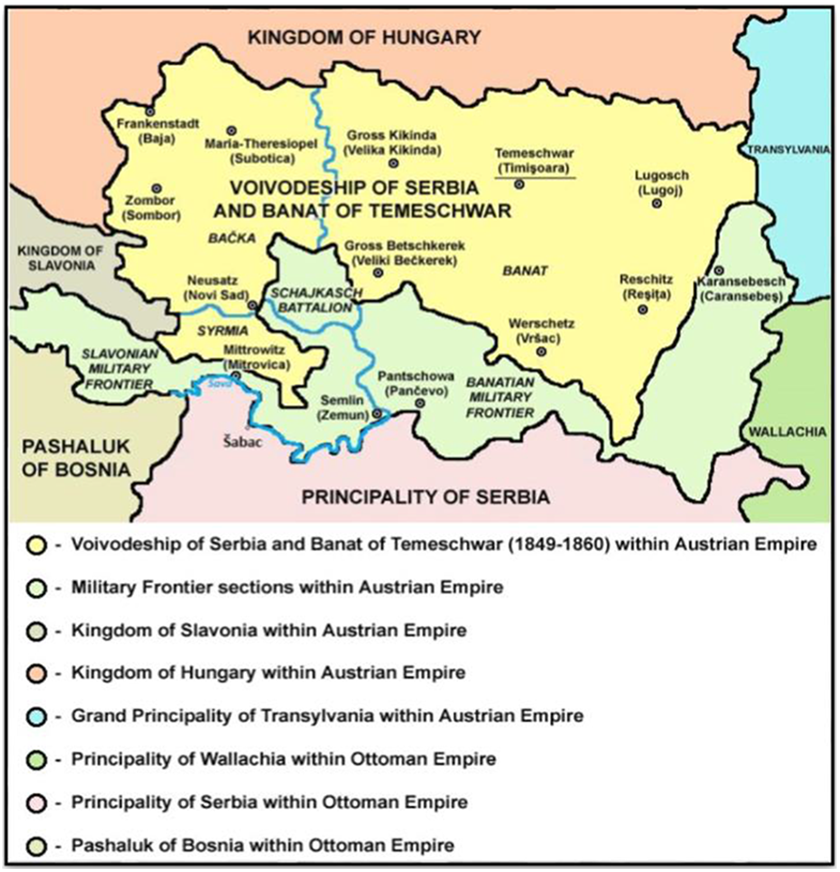
The geographical location of Sremska Mitrovica and Šabac in a historical background. Source: http://corbiialbi.ro/images/poza11.jpg.
The final and complete liberation from Ottoman rule, for Šabac as well as Serbia, was achieved in 1867, when the last Ottoman soldier left the fortress on the Sava River. The second half of the nineteenth century in Šabac was marked by rapid development. This was also reflected in the population, when the immigration of many craftsmen in this border region was recorded. 5 After that, Mitrovica became a part of the dual monarchy of Austria–Hungary, whose neighbor was the small and undeveloped Serbia. The population of Mitrovica included Serbs, Hungarians and Croats, and the cultural institutions were developed to embody these characteristics and the status of a military territory. The rule of the city by the military authorities was abolished in 1881 when Mitrovica achieved the status of a free royal city.
The above events and the historical framework from the seventeenth to the end of the nineteenth century, and even later, to the beginning of the twentieth century, testify to the importance of these settlements for the two great empires which shared so many similarities and at the same time manifested so many differences, resistance, and adjustment, in a specific set of geopolitical circumstances. This was a sufficient benchmark for the question of the influence of the historical and demographic heritage to be posed in order to find a connection through a comparative but also quantitative and statistical analysis of the sources, which nobody has written about in Serbia to our knowledge. However, the limitation of this field and type of research is the lack of comparable sources and their discontinuity in an earlier period of time, as well as the lack of similar data sources in many other settlements in Serbia for the same period, needed in order to do a comparative analysis of a larger area.
Historical sources show that, during the nineteenth century, Serbia had the highest marriage rates in Europe (compared to other European countries for which statistics are available). The mean marriage age was the lowest, the average duration of a marriage was the shortest, and the divorce rate was high. 6
Early systematic studies were related to the demographic aspects of marriage and family, when one of the most influential works in this field emerged, an article written by John Hajnal. 7 Based on the marriage age, the size of the household, and other parameters, Hajnal singled out two basic models of marriage, which in his opinion existed in Europe until the Second World War. He distinguished between the European and non–European regimes, which were separated by the Trieste–Leningrad line. He found that westward of the line, the mean marriage age at the time was very high (a large number of women remained unmarried), while eastward of this line, the situation was different. Laslett 8 provided a somewhat coherent typology of the marriage patterns of early modern Europe based on household structures. He divided Europe into four regions: the West European, West/central or middle, Mediterranean, and East European.
Based on the (first) marriage age of the spouses, Elizabeth Abot 9 distinguishes three patterns in Europe: Western, Eastern, and Mediterranean. According to the Western model, men and women married relatively late, the differences in age were small, and they mostly established nuclear families. The Eastern pattern was completely different. People mostly married at a young age and joined existing households, usually the groom’s. Such households consisted of several married couples who were mostly related. The Mediterranean pattern was characterized by young brides married to older men, and, as in the Eastern pattern, these couples remained within their households as joined members. This type differs from the Eastern pattern by the age of spouses. In particular, only men of an older age inherited a part or all of their father’s property, and then often took the position of the head of the family and the household. Then they were “desirable” for marriage.
The age of the spouses, the brides especially, has lately become the focus of many research studies. As Shaw 10 notes, the age of brides is one of the most important factors in determining the fertility rate in some populations, and affects both the shape and the size of the family, and the relationships between mother and children, husband and wife. The age of the bride reflected both the position and the role of a woman in society, which can, in a certain way, be viewed from the same perspective even today.
Van de Walle, 11 Demeny, 12 and Sklar 13 investigated regional differences in marriage and thereby greatly contributed to understanding the links between related demographic variables. Coale and Watkins 14 conducted a long-term fertility study in Europe, pointing out that control of marriage is an important mechanism and common denominator of fertility decline in European provinces. In the case of Balkan countries, marriage patterns were firstly researched by Botev. 15 He focused his work on Bulgaria, Greece, Romania, and Yugoslavia, stressing the influence of the Ottoman Empire on these countries during the nineteenth century. The initial historical–demographic assumptions are largely based on the work of Hammel. 16 He analyzed the influence of the zadruga on marriage and birth, since this type of organization of the household was dominant during the nineteenth century on the territory under Ottoman rule. With the transformation of the zadruga, the patterns of marital and reproductive behavior also changed.
One of the important categories for the study of marriage is homogamy. It represents the frequency of marriages that are made between persons with certain common characteristics (social, physical, mental), while heterogamy is the opposite phenomenon. The phenomenon of marriage between persons belonging to the same group (clan, tribe, caste) is called endogamy. In a wider sense, this term denotes the occurrence of marriage between persons belonging to a closer group (formed according to geographical, social, religious, or other characteristics). The opposite phenomenon, when the choice of a spouse outside the group is possible and allowed, is called exogamy. 17 Considering the geopolitical conditions and the development of society in separate systems, and the long-standing border status of Sremska Mitrovica and Šabac, this indicator is one of the most important precisely because it will show the influence of this legacy on the openness or closeness of the population.
Gavalas and Tscheulin 18 analyzed marriage patterns in Germany in 1900 and explained many differences according to the diverse history of its numerous constituent states and territories, with different linguistic, religious, and cultural characteristics. They noted that geographical variations in marriage patterns imply different cultures and different social, economic, and demographic structures. In agricultural areas, there were more joint family households, and a great part of the diversity in marriage patterns is due to the Slavic traditional community called zadruga. Therefore, understanding the historical context is vital for understanding the different demographic trends of any area.
Who’s Pulling the Strings: Society, the Regime, Church, or Perhaps Love?
In Serbia, until the thirteenth century, marriages were concluded according to old national customs, without church blessings, and there were deep-rooted beliefs that marriage was a part of customary law, an agreement between two families and that a church blessing was not necessary. After the creation of the independent Serbian Church, at the beginning of the thirteenth century, more intensive work on the introduction of the church sanctioned marriage began in Serbia, and from the second half of the fourteenth century, only church marriage was considered legitimate. 19
Serbia falling under Ottoman rule did not formally change the marriage policy. Jurisdiction over this was still held by the Orthodox Church, and each sultan issued orders prohibiting the interference of state officials in the scope of church affairs. However, in spite of this, many conquerors could not resist interfering with the marriage issues of their Christian vassals. Due to incessant wars and migration, the influence of the church was weakened, and the resolution of disputable issues followed the national needs more than the canonical regulations.
The circumstances in the Habsburg monarchy were different. The role of the church in shaping the family was strengthened only after the Great migration of the nations, in 1690, when the Metropolitanate of Karlovci 20 carried out rigorous religious reforms. At the same time, the Austrian state authorities tried to impose the values preached by the Catholic Church on the Orthodox population, especially the sanctity of the marriage bond. However, during both the Ottoman and Austrian administrations, even Serbian priests were very rigorous regarding divorce, which they allowed only in case of adultery. The marriage union was considered a basic social unit, so the church, in accordance with state policy, tried to preserve it at all costs. 21
In the legal regulations of the second half of the eighteenth century, the family was regarded as a regulated legal union, which was ultimately enacted in the Law on Marriage of Joseph II, 22 published in Serbian in 1786. Nevertheless, after his death, marriage relations fell once more under the auspices of the church and spiritual laws. 23
In Serbia, in that period, the dominant family form was a zadruga. This is a large, patriarchal family, where several generations, connected by common family property, lived and worked together. Since the zadruga had a primarily economic function, marriage was seen as a means to increase the workforce of the family by the birth of as many children as possible. 24
The Ottoman authorities did not interfere with the structure of the family, leaving it to the institution of the church, as long as this did not reduce the tax they paid. In the areas of the Habsburg Military Border, 25 the traditional form of zadruga established in the sixteenth and seventeenth centuries was maintained, and its survival and functioning was encouraged by the state. Military authorities prescribed the relations that were supposed to ensure the stability of the zadruga on several occasions, as they enabled the better organization of providing food for the population and individuals for military service. 26
At the end of the eighteenth century, the zadruga underwent a crisis in the Monarchy, as the private ownership of certain members of the zadruga began to strengthen. Such a trend in Serbia (at the time) started only during the last decades of the nineteenth century, mainly for economic reasons, similar to those in the Habsburg monarchy.
These trends are also related to the settlements of Sremska Mitrovica and Šabac. The settlements had different statuses and religious structures. In Šabac, the population was predominantly Orthodox, while Mitrovica had a considerable Catholic population, and even the Orthodox population was in some way constrained by the canons of the Catholic Church and that way of life. Differences can be observed in the values of the fertility rate and the marriage rate. Šabac (also at the beginning of the twentieth century) was characterized by the spirit of cooperative life and the existence of families with more members, while in Mitrovica the zadruga disappeared much earlier and life in a contemporary, urban, nuclear family with fewer children become common.
During the nineteenth century in Serbia (the Principality of Serbia), marriage policy was one of the most important segments of internal politics. That period saw the increasing importance of marriage divorce legislation, which shows that the then political elite considered marriage as a public institution, not an individual issue. Marriage stability was seen as the key to a stable social order. 27 The role of the state jurisdiction was absolutely dominant at the time of the first reign of Prince Miloš. 28
Marriage regulations passed during the nineteenth century can essentially be divided into two groups. One group includes regulations that regulate marriage from its conclusion until the end of its existence. It determined precise rules, such as the marriage age, the way in which marriages are made and divorces obtained, and the duties of the spouses. The second group of regulations was directed against marriage abuse, such as abduction and purchase of girls, arbitrary abandonment of spouses, unmarried cohabitation, extramarital relationships, and murder of extramarital children. Many regulations testify to the state’s efforts to subject marriage to its control, but also to the resistance of society to such a policy, as it did not want to give up traditional marriage customs. 29 Many principles were maintained until 1895, when the obligatory civil registration of marriage was prescribed. From 1946 registration in marriage registers kept by the registrars, that is, the official state administration and statistics began.
Attitudes to marriage as an institution, as well as to the relationships within marriage, slowly changed until the mid-twentieth century. Joining the marriage union remained high on the list of priorities and was a sign of social “maturity.” Marriage was supposed to “provide” emotional fulfillment, social and material promotion, especially in urban areas, in which social stratification posed higher demands in the choice of a spouse.
The Constitution and the Basic Law on Marriage and Family Relations was adopted in 1946, and it recognized only civil marriages as valid, leaving open the possibility of repeating the ceremony under religious regulations after the civil marriage. Church marriage lost its significance and was characterized as socially unacceptable due to the dominant role of the Communist Party of Yugoslavia and the bureaucratic regime in all spheres of society. During the 1990s, and especially at the beginning of the twenty-first century, the number of marriages that were made before both the registrar and the priesthood increased again. In line with the trends that came from “Western” cultures and the promotion of religious tourism, in a way it became popular to have a church marriage, especially in monasteries throughout Serbia.
In Serbia today, marriage is defined and determined by the Family Law of the Republic of Serbia, which was adopted in 2005. Although this law was passed in the rather recent past, it quickly came under public scrutiny as a result of current trends. A new draft of the law is currently under consideration for approval. The roles of men and women have become more similar in education, employment, economic independence, careers, and families, which has led to a different notion of marriage and the acceptance of different values. Young people have a pronounced desire for independence and self-fulfillment, both through work and through the various arrangements of family and marriage forms, and there is a greater tendency to experiment with different life practices in joined life, when compared to previous generations.
Data and Methodology
Within historical demography, the most important source of data on vital events are the registers of births, deaths, and marriages. Their content differs from one country to another, even at the level of regions and settlements, but it is evident that the amount of information and data has increased over time. 30
The registers on the territory of Serbia under the Hungarian administration were part of the church registration until 1895 (parish registers), when the mandatory civil registration of marriages, births, and deaths began (civil registers). On the territory of Serbia, outside of these frameworks, vital statistics were taken over by the state in 1946, from which time unified registers have been kept. Primary data sources are the marriage registers in Sremska Mitrovica for the period from 1900 to 2011, and the marriage registers in Šabac for the same period. Additional data sources include the publications of official national statistics (in Serbian and Hungarian) for the following censuses: the Population Census in the Kingdom of Serbia (1900, 1905), the Census of Population and Domestic Cattle in the Kingdom of Serbia in 1910, the Population of the Socialist Republic of Serbia (1834–1953), Magyar statisztikai közlemények 1900: Népszámlálása, a népesséeg általános leirása községenkint, Magyar statisztikai közlemények 1910: Népszámlálása, a népesség főbb adatai községek és népesebb puszták, telepek szerint, and the population censuses carried out after the First World War on the territory of Serbia (1921, 1931, 1948, 1953, 1961, 1971, 1981, 1991, 2002, and 2011).
The data from the marriage registers are analyzed on an annual basis. They include the absolute and relative numbers of marriages, the age of the grooms and brides at the time of marriage, and the geographical origins of the spouses. The data on divorce rates were obtained based on the notes in the registry of marriages, which are entered in the case of divorce, and they include the total number of divorces on an annual level and crude divorce rate (hereinafter CDR). All of the parameters were processed for the entire population for the period between 1900 and 2011 in both settlements. In addition to the listed databases, data obtained from population censuses as well as data from statistical yearbooks were used.
At the beginning of the studied period, both settlements had a similar population (in 1900, Sremska Mitrovica had 11,510 inhabitants and Šabac had 10,472), 31 but the demographic trends were influenced by historical–demographic heritage and different factors. This led to the disaggregation of the population number trends. According to the 2011 census, Sremska Mitrovica had about 37,751 inhabitants and Šabac about 53,919. 32
The data were processed and analyzed using a comparative approach, primarily demographic techniques, which implied the separation of the crude marriage rate (hereinafter CMR) and CDR and the population number as an indirect variable obtained by the method of exponential growth. CMR and CDR were calculated on an annual level as the number of marriages/divorces recorded in a given year per 1,000 inhabitants in the same year. In order to obtain the mean age of the spouses, the arithmetic mean was used. The arithmetic mean is the most commonly used indicator of mean value, and in this case, it was obtained by adding all the ages (years) at the time of marriage (total and by gender) and dividing them by the total number of marriages.
Since the analysis of all the indicators began from the historical–demographic and geographical diversity of Sremska Mitrovica and Šabac, homogamy was analyzed in the context of the geographical origin of the spouses. Depending on the place of birth of the spouses, a classification was made according to Lepage, 33 who distinguishes four groups: SS—both spouses born in the same place where the marriage was concluded; SM—the groom born in the same place and the bride outside the place; MS—the bride born in the same place, and the groom outside the place; and MM—both spouses born outside the place where the marriage was concluded.
In this sense, the homogamy index (I) is the ratio of marriages between spouses born in the place where marriage is concluded and marriages between spouses born outside of the place of marriage and is calculated using the formula: 34
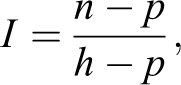
wherein:
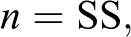



where N = total number of marriages.
The value of the homogamy index can range between −1 to 1, whereby the index closest to the value 1 indicates the closeness of the population (endogenousity), and vice versa (exogenousity). 35
For the synthesis of the results, the linear regression model was used, as well as Pearson’s correlation coefficient (at level α = .05), the determination coefficient, and a scatter diagram which displays data as points, where each point contains one value from both variables. Using this plot, it is possible to show the degree of correlation between two variables based on the concentration and distribution of points. 36 All of the analyses were carried out using the SPSS version 20 software package (IBM SPSS Statistics version 20). 37
Results and Discussion
After 1918, both settlements belonged to the same country and society, but the intensity of adjustment was significantly different. Trends of marriage were in many ways opposite, descriptively and statistically, reflecting the traces of the historical and demographic heritage of the empires whose integral part they were.
How Often Was “I Do” Pronounced?
The total number of marriages in the period 1900–2011 in Šabac was 25,008, while in Sremska Mitrovica, it was three times smaller at 8,731. The annual average number of marriages in Šabac was 225, while in Mitrovica, there were only 79 marriages. The average CMR in Šabac was 8.96‰, while in Mitrovica it was 4.49‰, which is almost half that number.
At the beginning, CMR (Figure 2) was high in both settlements, with the tendency of growth, which was a continuation of the trends which began at the end of the nineteenth century (and in demographic terms it can be characterized as the long nineteenth century). At that time, Serbia had the highest CMR in Europe, and the Šabac and Valjevo districts can especially be singled out in this regard. Such trends are largely the result of the marriage policy of Prince Miloš. At the same time, Mitrovica was a provincial border town with a different religious and ethnic structure and without the major interference of the state in marriage relations, especially in the Orthodox population.
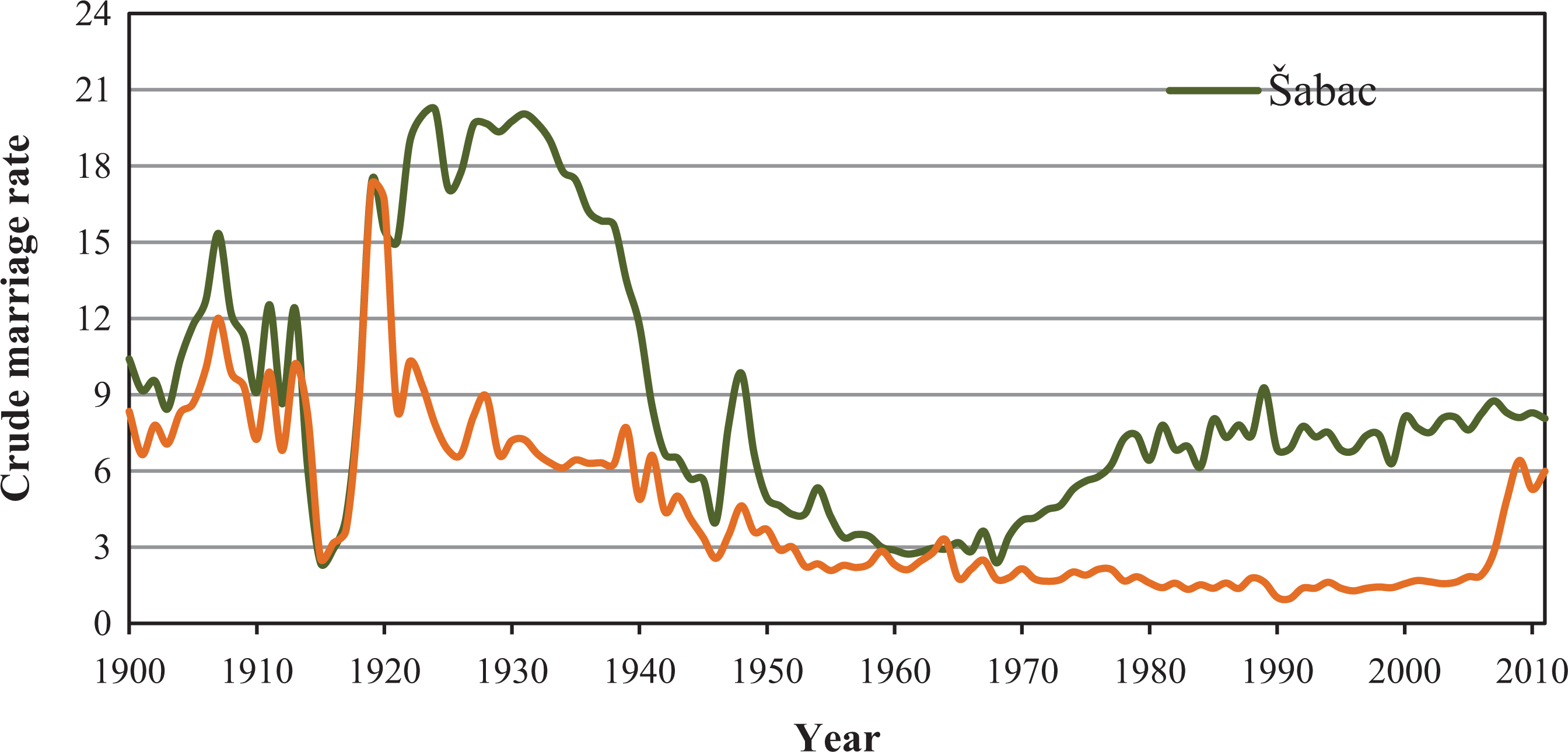
Crude marriage rates in the period 1900 to 2011. Average number of population is estimated using linear interpolation between censuses. SORS = Statistical Office of the Republic of Serbia. Source: Marriage registers for Sremska Mitrovica and Šabac (1900–2011); the Population Census in the Kingdom of Serbia (1900, 1905), the Census of Population and Domestic Cattle in the Kingdom of Serbia in 1910, the Population of the Socialist Republic of Serbia in 1834 to 1953, Magyar statisztikai közlemények 1900: Népszámlálása, a népesséeg általános leirása községenkint, Magyar statisztikai közlemények 1910: Népszámlálása, a népesség főbb adatai községek és népesebb puszták, and telepek szerint; and the population censuses carried out after the First World War on the territory of Serbia (1921, 1931, 1948, 1953, 1961, 1971, 1981, 1991, 2002, and 2011).
The First World War brought a sharp decline, followed by a very intense increase and equalization in the values of marriage rates. In Mitrovica, this only lasted until 1919, when the maximum of 17.26‰ was recorded, while Šabac continued to increase, and the maximum value was reached in 1924 (20.21‰). The largest difference was recorded in 1932, when the CMR in Šabac was 19.68‰, and in Mitrovica was 6.68‰. At the beginning of the 1940s, the values were almost identical, only to undergo a sharp decline during the Second World War, followed by a sharp increase, or compensatory period, as many marriages were postponed for a “happier peacetime.”
A new, demographically specific moment began in 1960, when completely opposite trends were noted. As Solarević and Đerčan 38 note, in this period, the differences in the population size became the greatest. The level of fertility was significantly higher in Šabac, which confirmed the importance of marriage for fertility in an environment that fostered traditional attitudes toward marriage, the desire for family extension, and the preservation of one’s own demographic potential. At the same time, Sremska Mitrovica became a settlement with two-thirds of the autochthonous population without its own demographic progress, reducing its potential for sustainability. The period of slight decline and stagnation lasted until 1966. In the period 1970 to 2005, the marriage rate in Šabac was three times the size of the marriage rate in Mitrovica.
Arsenović et al. 39 pointed out that the main reasons for a declining CMR are new conceptions and perceptions of marriage as a union between two people, which is reflected through the highest first marriage age.
What Is the Right Time for Marriage?
Considering Hajnal’s division and the separation of marriage patterns by Elizabeth Abot, both settlements could be classified as belonging to the Eastern models at the beginning of the studied period, before moving through a transitional model, only to take the shape of the Western pattern. The lowest mean age recorded in 1900 in Sremska Mitrovica as 21 years, and in Šabac only 19.9 years. Figure 3 shows that the differences at the beginning of the period were small and negligible, but after 1920, they became more prominent, and eventually the age of the brides in Sremska Mitrovica reached the age of grooms in Šabac (Figure 4).
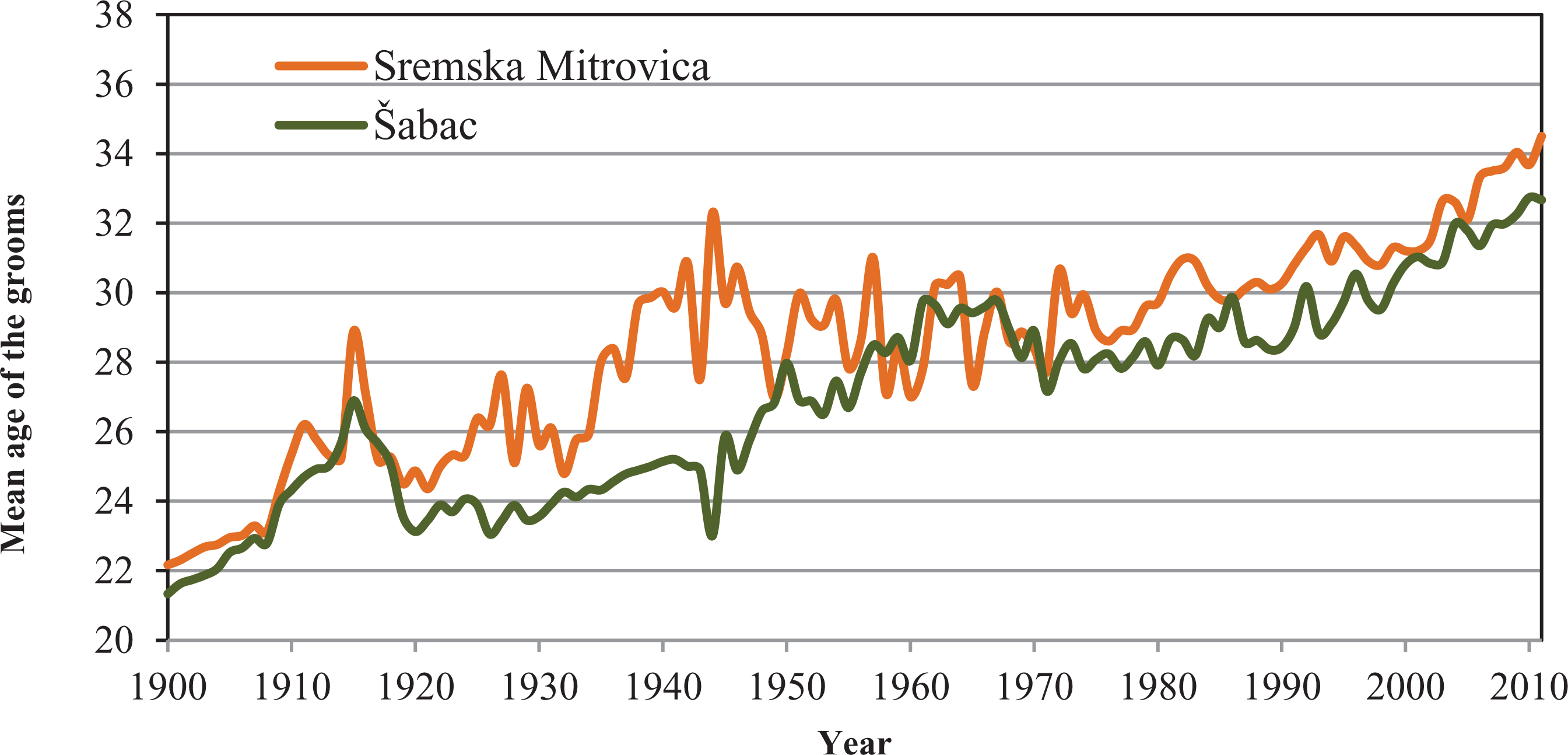
The mean age of grooms in the period 1900 to 2011. Source: Marriage registers for Sremska Mitrovica and Šabac (1900–2011), Statistical Office of the Republic of Serbia.
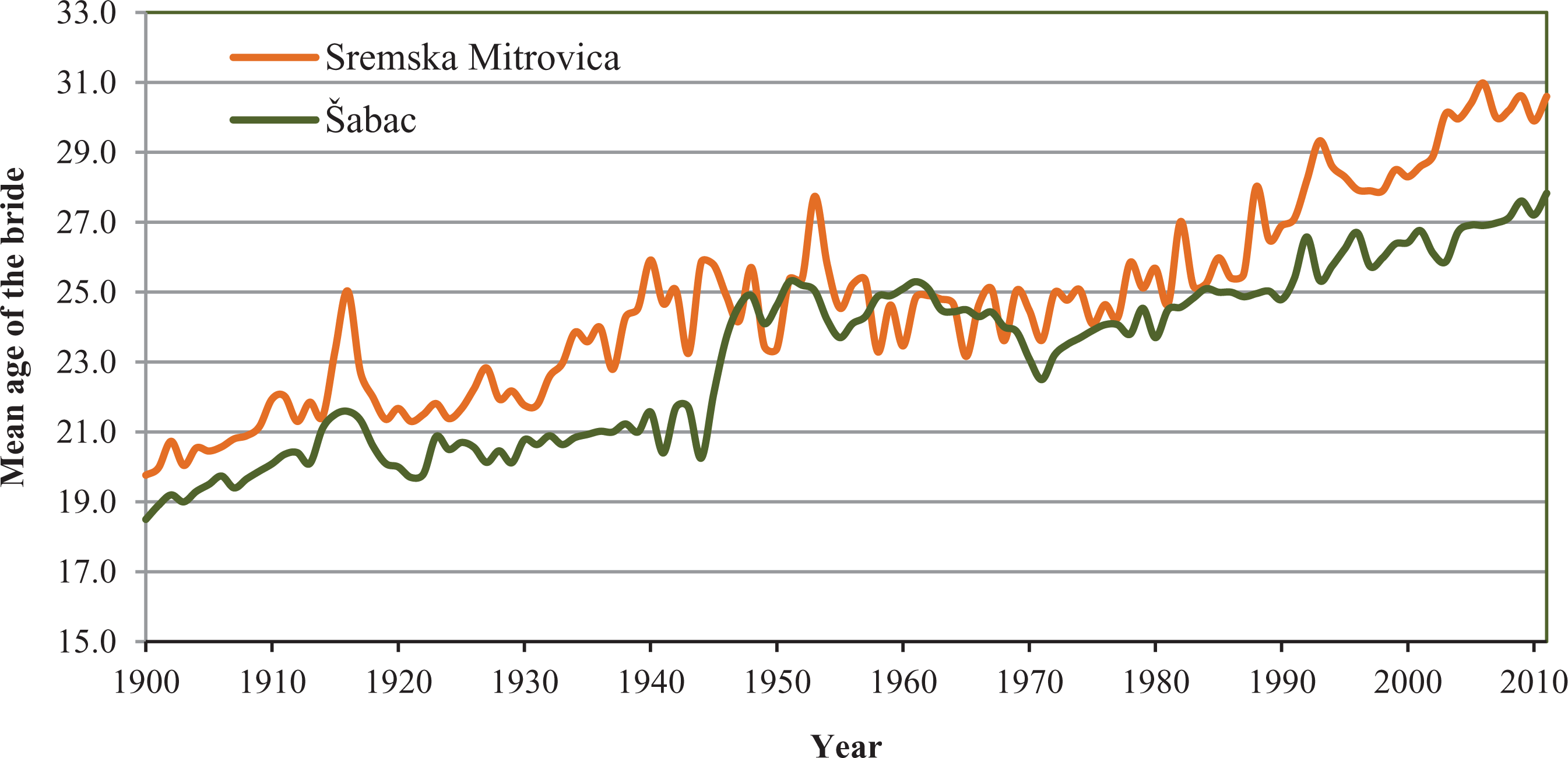
The mean age of brides in the period 1900 to 2011. Source: Marriage registers for Sremska Mitrovica and Šabac (1900–2011), Statistical Office of the Republic of Serbia.
During the studied period, the mean age of the grooms was often dependent on occupations that were at some moment most prevalent. When men were trained to be craftsmen or stayed on the farm as farmers, it was “desirable” to marry at a young age, establish a family, develop a business, and improve the household. Such a trend was especially applicable to Šabac, while in Mitrovica the prevalence of border occupations (such as frontierguards) played a great role, which often made it difficult for a young man to conclude a marriage until his service was done. With the advent of new occupations and the development of the economy and society, the duration of education and professional development was prolonged, jobs from secondary and tertiary sectors were increasingly sought, and the “appropriate moment” for marriage was postponed until later in life.
The mean age of the brides (Figure 4) was very low at the beginning of the period, which testifies to the universality of marriage at the time: it was 19.8 years in Sremska Mitrovica, and in Šabac only 18.5 years. By the end of the period, the values rose to 27.8 years in Šabac and as high as 30.6 years in Sremska Mitrovica.
The mean age of brides has a particularly important role when seen from the perspective of reproduction, since the fact that there is still a pattern in the society of Serbia, where girls firstly want to get married and then at some point in time become mothers. The mean age of brides in the first half of the twentieth century was within the age cohorts of the first and second five-year reproductive periods, the time from marriage to childbirth was shorter, and thus the number of children born toward the end of the reproductive period was higher. The differences are more pronounced over the last two decades of the studied period and at the same time coincide with the trend and differences in mean age for childbearing. The situation is much less favorable in Sremska Mitrovica, where at the beginning of the twenty-first century the mean age of brides enters the cohort of thirty to thirty-four years, which represents the last cohort within the optimal reproductive period (twenty to thirty-four years). Considering that the time that elapses to the birth of the first child within marriage is longer, it is certain that in the majority of marriages, only one child will be born. In Šabac, such a model of transition “lags” and still allows the greatest birthrate within the cohort of twenty-five to twenty-nine years. 40
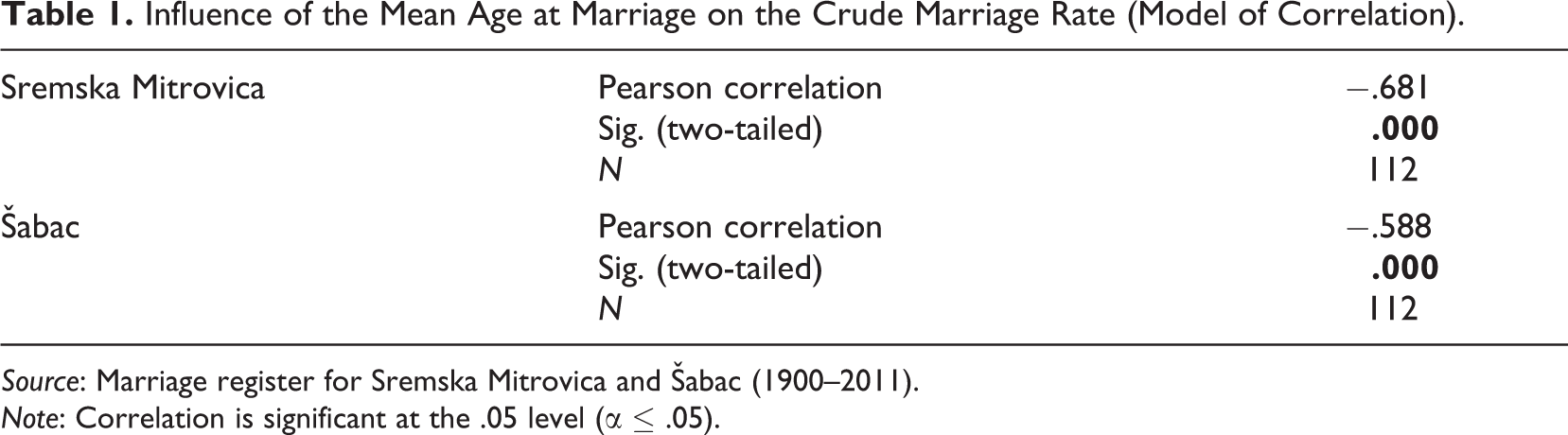
The statistical expression of the influence of the mean marriage age on the CMR (Table 1) gives a negative correlation, that is, a regression model in which the mean age negatively affects the marriage rate.
Influence of the Mean Age at Marriage on the Crude Marriage Rate (Model of Correlation).
Source: Marriage register for Sremska Mitrovica and Šabac (1900–2011).
Note: Correlation is significant at the .05 level (α ≤ .05).
The correlation coefficient between these variables shows a moderate negative value in Šabac, while in Sremska Mitrovica, this value is high, and it was found that entering later into marriage in this settlement negatively affects the overall nuptiality.
In Sremska Mitrovica (Figure 5), there is a close linear relation between these variables, and based on the determination coefficient (R 2), the conclusion is that as much as 46 percent of the variability in the CMR can be explained by the change in the mean marriage age. In Šabac (Figure 6), a smaller conditionality is observed which is the result of a lower mean marriage age in this settlement throughout the studied period.
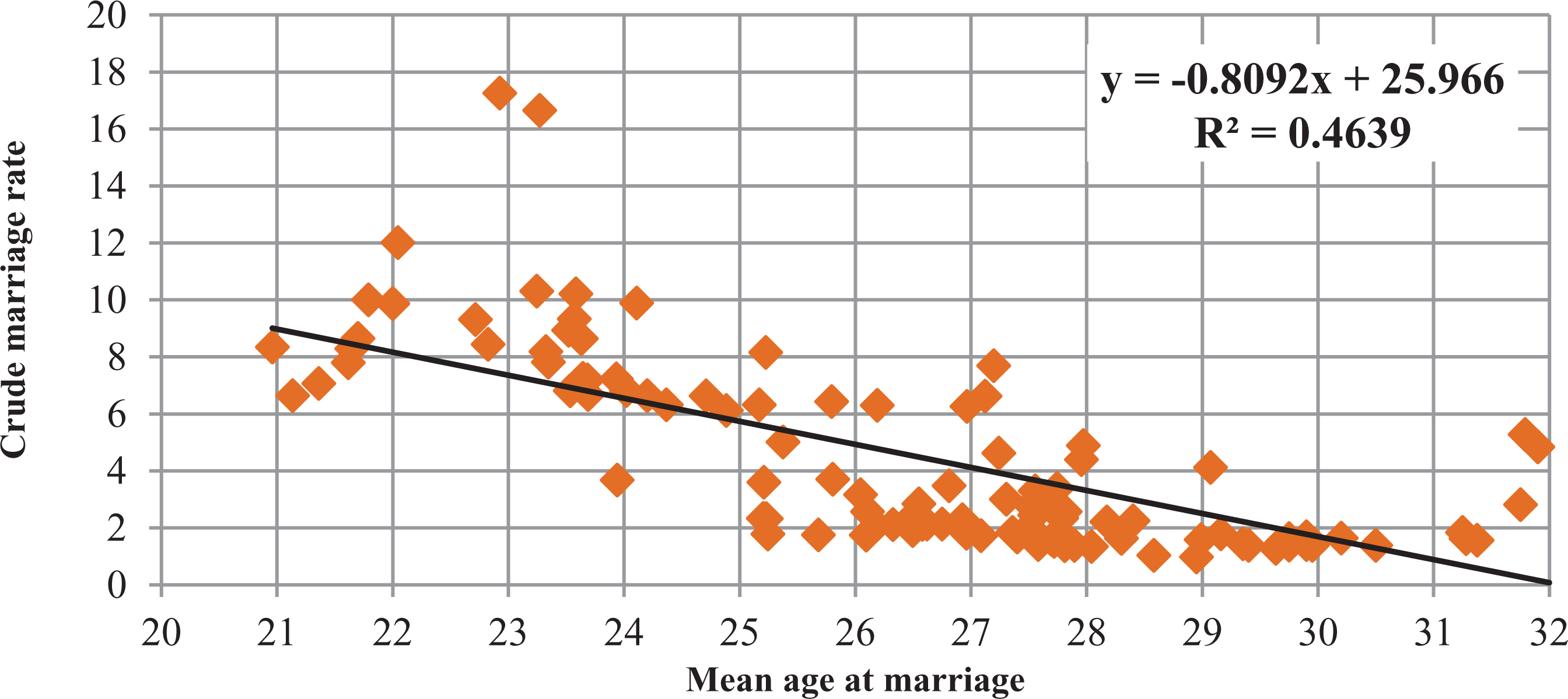
The influence of the mean marriage age on the crude marriage rate in Sremska Mitrovica, 1900 to 2011 (linear regression model). Source: Marriage registers for Sremska Mitrovica (1900–2011), Statistical Office of the Republic of Serbia.
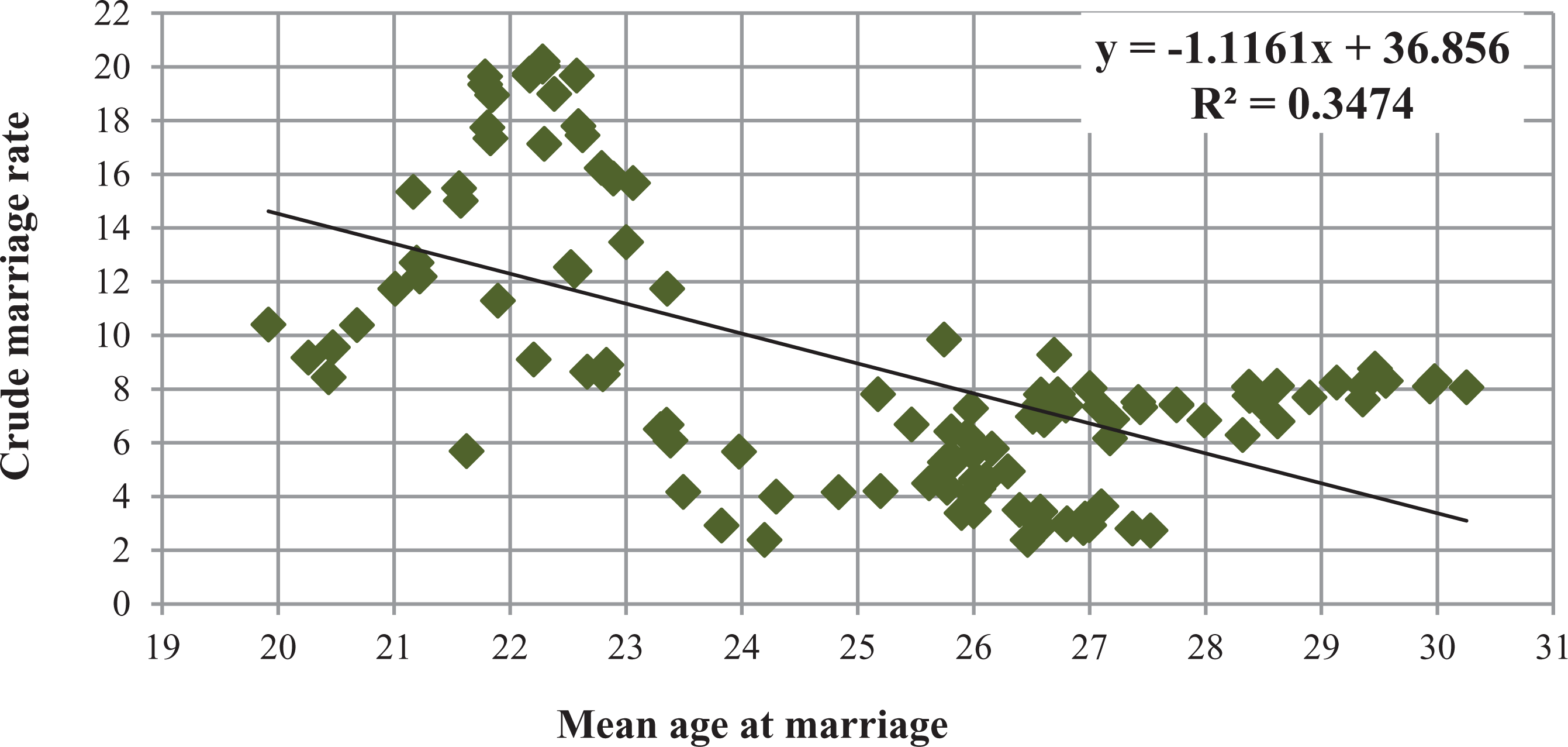
The influence of the mean marriage age on the crude marriage rate in Šabac, 1900 to 2011 (linear regression model). Source: Marriage registers for Šabac (1900–2011), Statistical Office of the Republic of Serbia.
The coefficient of determination indicates that 34 percent of the variability in the CMR in Šabac can be explained by the variability in the mean marriage age. A statistical significance exists, but to a lesser extent than in Sremska Mitrovica.
Certainly, the age at which people entered into marriage at the beginning of the period was earlier in both settlements, because it depended mainly on the decision of the parents and customs of the social community, and was much less influenced by individual desires. Marriage, as a union, was primarily treated as an economic community and a framework that would enable the survival and development of the household and offspring. Over time, the way of life changed, and the economy gained a new dimension that did not depend on the workforce. The market demanded new occupations for which both boys and girls were trained, and the importance and participation rate in university education increased, which became at some point a matter of prestige. Instead of formerly becoming young craftsmen and capable housemakers, those who wished to be more desirable and acceptable obtained a higher level of education, and mainly trained for work in offices, smaller groups, and even individual work. In such conditions, a person increasingly worked, studied, and lived alone, and the need for a joint life decreased, contacts with wider groups became reduced to a minimum. This was in contrast with earlier periods when people socialized, worked, and lived in a group, a larger collective, within which the chances for identifying potential marriage partners were incomparably greater.
Devedžić 41 notes that the importance of marriage for the level of fertility is reflected in the fact that most of the births in Serbia are still being realized within marriages. It could be said that marriage represents the social framework of reproduction, because in a large part of the human population it represents some type of permission to start procreation. The marriage age is particularly important for women, because it indirectly point to the utilization of the fertile period and capacity. However, attention has been paid to changes in patterns in recent years, when marriage has increasingly lost the role of the framework for human reproduction and is directed more towards the individual achievements of partners within the community.
How Far to Go To Find the Chosen One?
Considering the classification done by Lepage, 42 the analysis includes marriages in which at least one or both spouses were born in Sremska Mitrovica or Šabac. Marriages where the place of residence of both spouses is outside the studied settlements were not included in the analysis because they cannot be taken as adequate indicators of marriage status or the homogamy of the marriages of these settlements (they are not a part of the observed population).
Figure 7 is one of the figures that best represents the assumed differences of these two settlements. The closer the homogamy index is to the value of 1, the greater the closeness of the population (the endogenousity), and vice versa (the exogenousity). During the studied period, both settlements showed very different characteristics of marriages based on the place of birth of the spouses. Sremska Mitrovica can be characterized as a very exogenous settlement almost throughout the whole period, while for Šabac different trends have been observed, especially since the second half of the twentieth century, when it can be classified as an endogenous settlement.
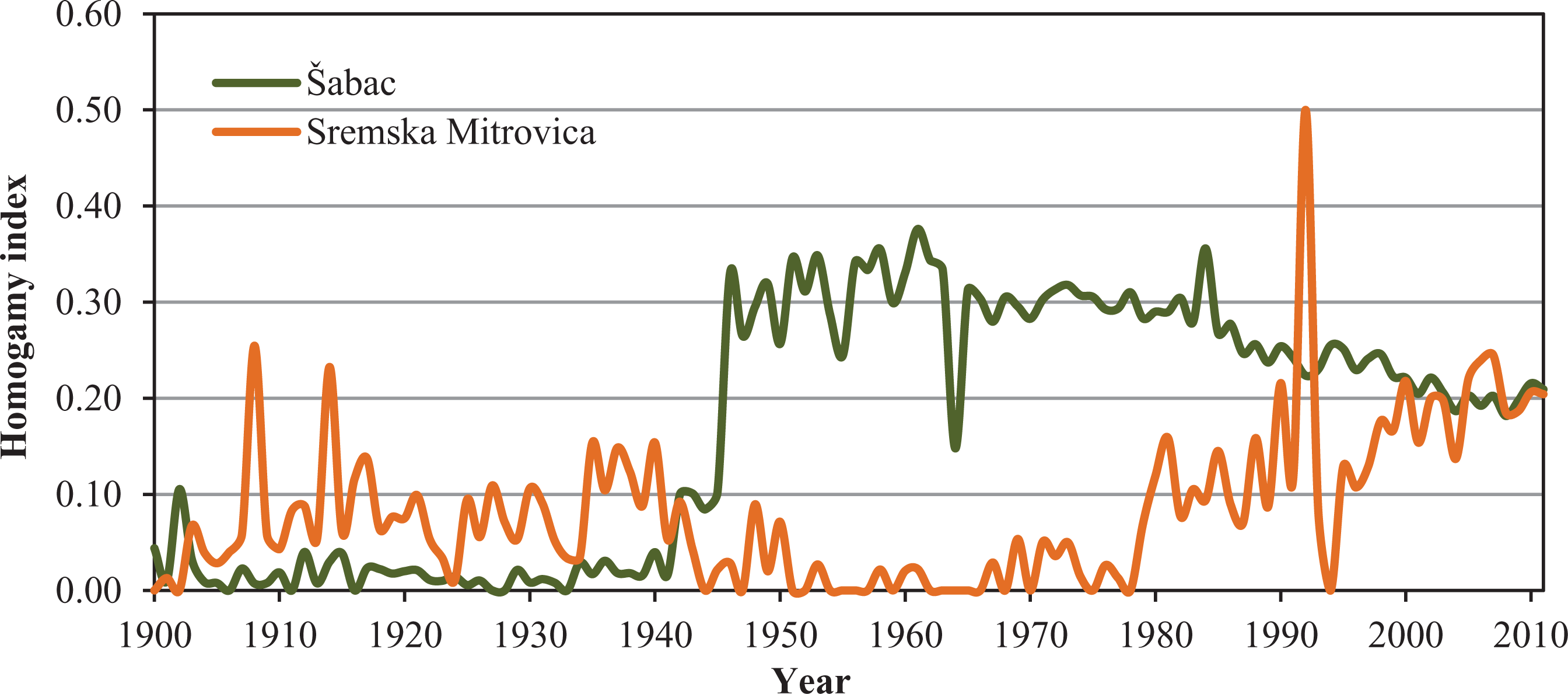
The homogamy index in the period between 1900 and 2011. Source: Marriage registers for Sremska Mitrovica and Šabac (1900–2011), Statistical Office of the Republic of Serbia.
At the beginning of the period, the homogamy index in Mitrovica was double and even triple that in Šabac due to the ethnic and religious diversity of the population in that settlement. There was no interference within the settlement or with neighboring settlements, so marriages were mostly concluded among members of the same religion and from the same place.
After the Second World War, the situation changed completely. Sremska Mitrovica became a more open settlement, more extensive migration to these parts began, and there were marriages in which spouses originated from different settlements, regions, countries, mostly from the present-day Bosnia and Herzegovina.
Since the mid-1980s, there have been new changes. The waves of migration into Mitrovica decreased, generations born after the first wave were the population whose place of birth was Mitrovica, and the homogamy index began to increase. This trend was interrupted in the mid-1990s, when a new wave, this time of refugees, swept this settlement and moved to other parts of Srem. This led to a reduction in the homogamy index, and soon after that wave it increased again. At that time, the homogamy index gradually decreased in Šabac, because this settlement was strongly developing in economic terms, and it attracted the population from neighboring smaller settlements, mostly due to education and work. Interaction between the settlements was higher, leading to an increase in the number of marriages in which at least one of spouses was not born in Šabac.
Since 2000, the values of the homogamy index have become uniform in both settlements, which means that both settlements can be characterized as relatively open. The reason for this is the fact that these are urban settlements, municipal centers, and regional centers, as such attract the population of surrounding settlements and municipalities. There are more and more marriages in which brides are from other settlements, and vice versa. The female population goes to school and college in larger urban centers, where they make contact with male populations from other settlements, so it is not rare that in concluded marriages the groom is born outside Sremska Mitrovica and Šabac. Earlier marriages were concluded in places where the brides came from (it was a traditional custom), so the number of marriages at the beginning of the period showed a significant share of the MS type (the bride born in the place where the marriage was concluded), since most (Orthodox) inhabitants in both settlements adhered to such a custom. Later, the trends changed, the customs became less dominant, and this type of marriage became less represented.
Figure 8 confirms the previous conclusions, since it is noticeable that throughout the studied period in Šabac the most common type of marriage is SS (the largest number of marriages were concluded between spouses born in Šabac). In the first half of the period, both settlements recorded a high share of this type, especially Sremska Mitrovica, with values of over 90 percent and even up to 100 percent, which confirmed the closeness of the population of this settlement at the beginning of the period. Contrary to this trend, since the second half of the 1940s, the share of this type decreased below 20 percent and even below 10 percent, which means that the highest number of marriages were made between spouses of whom one was born outside this settlement.
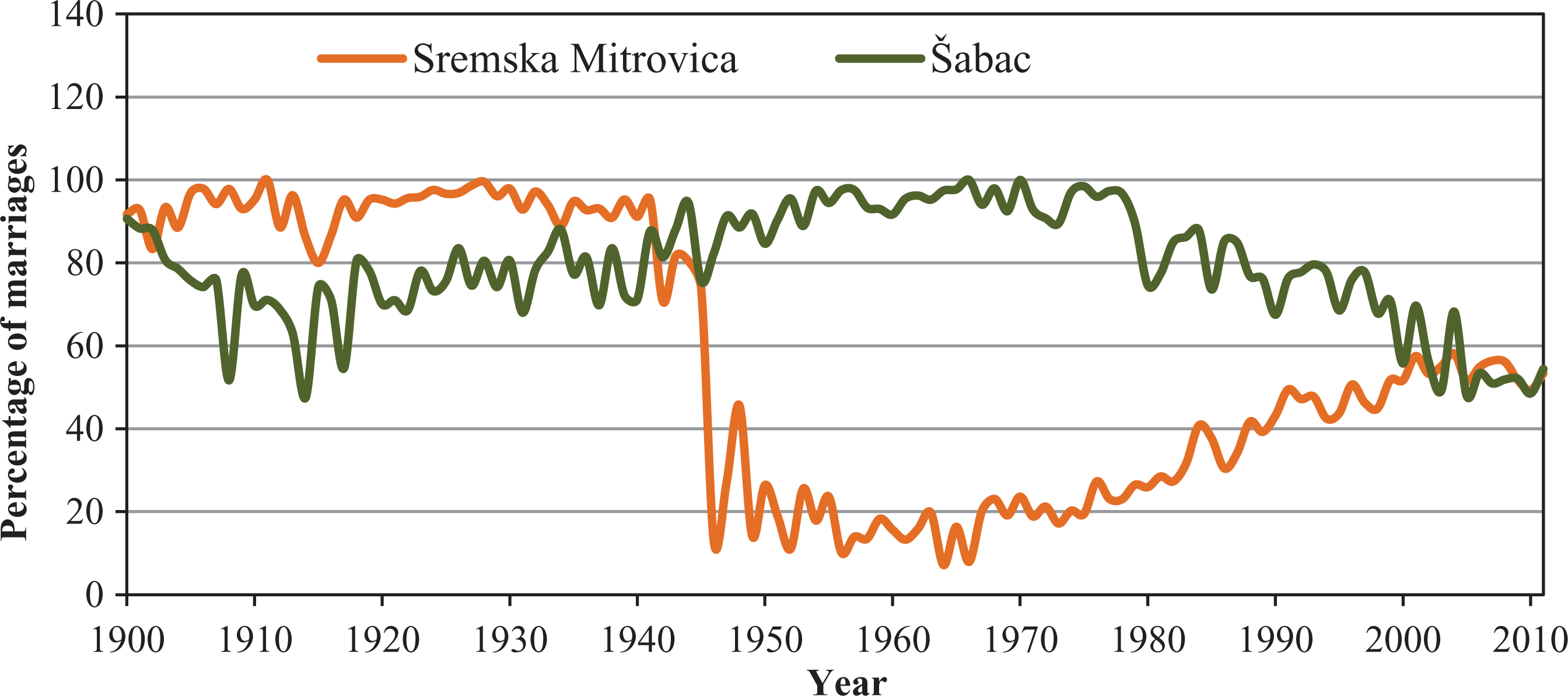
The percentage of marriages in which both spouses were born in Sremska Mitrovica or Šabac, 1900 to 2011. Source: Marriage registers for Sremska Mitrovica and Šabac (1900–2011), Statistical Office of the Republic of Serbia.
Since the beginning of the twenty-first century, the occurrence of marriages outside of the place of residence of both spouses was more frequent, due to the organization of both civil and church marriage ceremonies and rituals in more attractive locations, often outside the spouses’ place of birth and residence.
These tendencies can be seen from another perspective. Namely, if a settlement is open, it could theoretically positively affect demographic development and vice versa; however, this was not the case in these settlements. With the assumption that migration is an important development opportunity for the population in Serbia, the example of Mitrovica shows the exact opposite. Although migration gave the initial impulse for this settlement to develop, it was short-lived and unsustainable, so the number of inhabitants increased to some extent, while migration in Šabac was not crucial for the development of the settlement. However, the natural increase and fertility rates were the components that made a difference in the demographic development, which is therefore more sustainable.
“…Till Death Do Us Part?”
Divorce is an important indicator of the situation in the society, a reflection of the political, economic, cultural, and social conditions. Divorce can be understood as the point of culmination in the conflicting interests of the individual and the interest of the community, the group (marriage), caused by adopted social and individual norms.
Most years, Sremska Mitrovica had higher CDR value than Šabac, as much as twice its size (the period from the late 1920s to the end of the 1940s). The greatest oscillations are shown in Figure 9 in the decade before the Second World War, during and immediately after the war.
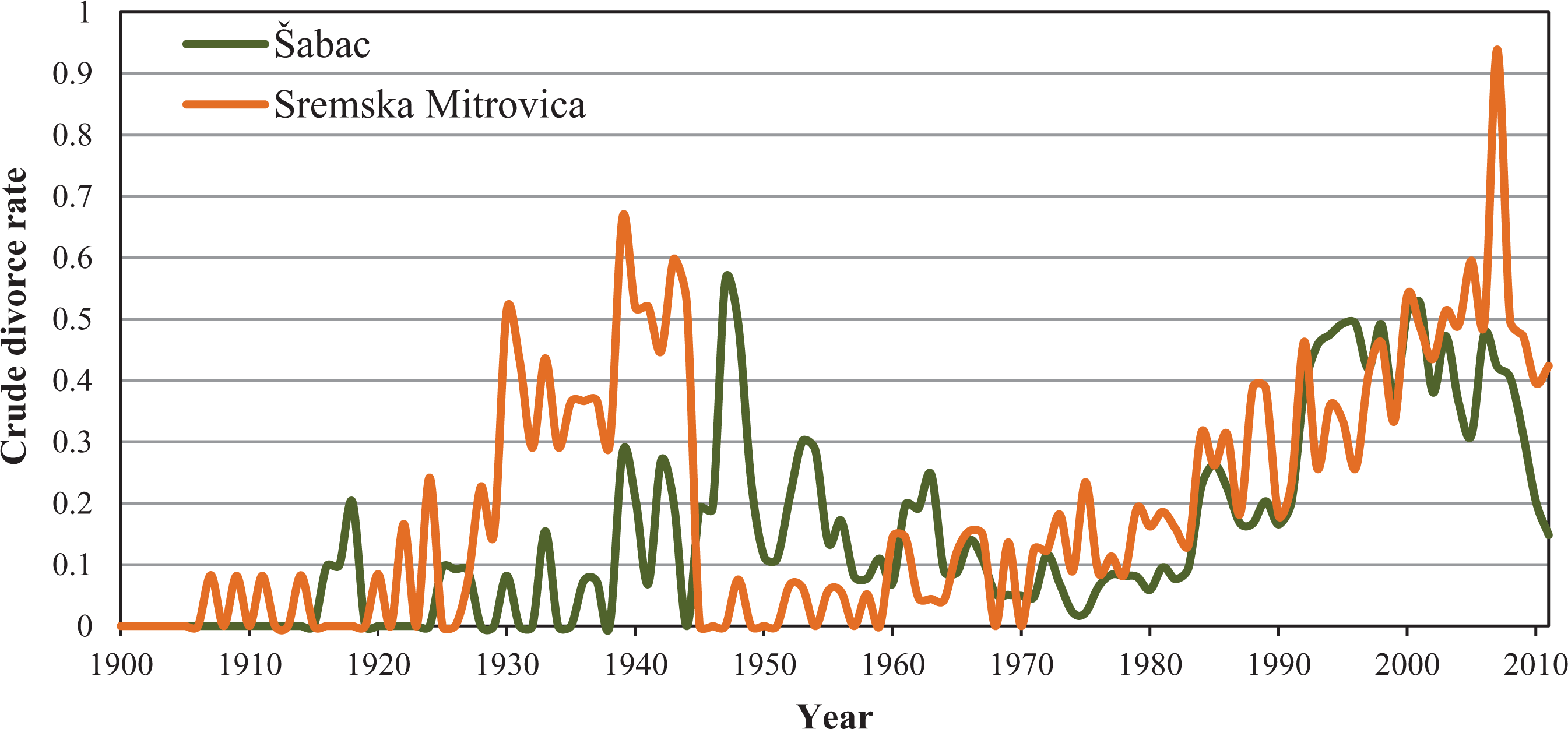
Crude divorce rates between 1900 and 2011. Source: Marriage registers for Sremska Mitrovica and Šabac (1900–2011), Statistical Office of the Republic of Serbia.
The prewar years were at the same time the years between two wars and the years of the great economic crisis during the 1930s, which affected the social order and created difficult conditions for the survival of the family, marriage, employment, and socioeconomic status. The war inevitably caused a distortion of the system and society, especially given the fact that Sremska Mitrovica was a part of the Independent State of Croatia (ISC) in the period 1941 to 1944, and many marriages ended because of the different ethnic and religious affiliation of the spouses. As early as 1945, no divorce was recorded, which is the case with some other years, and since 1970 (the last year when no divorce was recorded), the CDR increased and peaked in 2007 (thirty-six divorces, 0.94‰).
The highest total number of divorces in Šabac was recorded in 2001, a total of twenty-nine divorces, or 0.53‰. The higher CDR in Šabac after the Second World War is a consequence of the economic and social crisis, and the resulting chaotic situation in many spheres of society. After 2006, the number of divorces gradually declined in both settlements; however, the situation was significantly more intense in Šabac. The reason is the cultural heritage, the spirit of tradition, communion, and customs, while in Mitrovica the population is constantly striving to accept something new, modern, with a tendency for change, which is not necessarily positive. At a time when the total number of marriages increased in both settlements, the number of divorces also increased, which testifies that it became easy to “enter” into marriage, but it was even easier to “get out” of it.
Conclusion
Conquering separate parts of Serbia, the Austro-Hungarian Empire and the Ottoman Empire directed the life and work of the people in these areas, acting in geopolitical, economic, cultural, social, and demographic contexts. The impacts of this were the strongest in settlements on their borders, as important geostrategic points. Separated by the Sava River, the inhabitants of Sremska Mitrovica and Šabac adapted their social and private lives to such conditions. Analyzing the civilizational and legal determinants of marriage and putting them in the context of modern conditions, conclusions can be drawn about the existence of two different models.
The higher CMR in Šabac is the result of previous actions of the state in marriage policy and the development of a settlement with traditional characteristics, in a high-fertility area, almost homogeneous in terms of ethnic and religious structures, and with multimember households. During that time, Sremska Mitrovica developed as a provincial border town with a different population structure and without the major interference of the state in marriage relations, especially in the Orthodox population. Even modern developments did not erase these effects completely.
The mean age of spouses confirmed these differences. As craftsmen and farmers, in Šabac, young people married earlier, while in Mitrovica, border occupations played a great role in postponing the entry of young men, frontierguards, into marriage. Following developments in the economy and society, education, and training, marriage was postponed until older ages in both settlements. Brides entered marriage under similar conditions, and their ages reflected the (non)achievement of their demographic potential.
The homogamy of marriages according to the spouses’ origin showed the greatest differences, distinguishing Sremska Mitrovica as a very exogenous settlement almost throughout the whole period, while for Šabac, a different trend was observed, especially from the beginning the second half of the twentieth century. The cultural heritage, spirit of tradition, and communion caused a lower CDR in Šabac, while in Mitrovica, the population more easily accepts something new and modern, with a tendency toward changes, which are not necessarily always positive. In the periods when the number of marriages grew in both settlements, the number of divorces also increased, which indicates that in modern times it is easy to enter into marriage, but it is even easier to end it.
At the end of the twentieth and the beginning of the twenty-first century, there was a homogenization of trends, but still not with the equal intensity, precisely because of the legacy of the historical–demographic development. In modern times, although quantitatively less pronounced, it qualitatively gives “enough time” for recognized trends to be directed toward demographically sustainable development, especially from the perspective of reproductive norms.
In accordance with the results of this article, a recommendation for future research is to analyze the historical and demographic heritage of other settlements which are not geographically close and which belonged to different regimes. This would enable a further comparison and give a greater contribution to the research of the border effect and the effect of the community on the demographic development of settlements over the (same) extended period of time.
Footnotes
Declaration of Conflicting Interests
The author(s) declared no potential conflicts of interest with respect to the research, authorship, and/or publication of this article.
Funding
The author(s) disclosed receipt of the following financial support for the research, authorship, and/or publication of this article: This article is part of the Project Number 142-451-2356/2018-03 funded by the Provincial Secretariat for Science and Technological Development of Vojvodina Province, the Republic of Serbia.