



Abstract
Childlessness was a widespread concern for late medieval couples. In the southern French diocese of Maguelone, an average of 43 percent of fourteenth- and fifteenth-century urban testators and of 25 percent of rural testators had no children alive although they were or had been married. This article investigates, first, patterns of childlessness in time and space based on the analysis of close to 1,100 wills. In a second time, the focus shifts toward the causes of childlessness, understood as resulting from both the death of children and issues of infertility. A series of factors, some environmental, other due to the nature of sources, explain why urban couples exhibit higher rates of childlessness than rural couples. The last section of this article explores the consequences of the absence of children on the transmission of estates and on support for the elderly.
And God said to them: Be fruitful and multiply, and replenish the earth.” Genesis 1.28
A Biblical injunction, procreation was a significant concern for medieval couples, even more so than contraception. 1 Studies of medieval fertility and birth rates took off in the 1970s and 1980s in the advent of historical demography. 2 Medieval demographers demonstrated that the Black Death and other outbreaks took a hard toll on late medieval households. But while research on medieval English demography is in a phase of renewal, fueled by the works of bioarcheologists who further our understanding of fertility, mortality patterns, and population dynamics, France lags behind. 3 This article gathers fruitful bioarcheological and historical findings in order to deepen our understanding of patterns of childlessness.
Throughout this article, childlessness will refer to families who have lost children to death and to families who have never had children. The coalescence of these two different realities results from limitations posed by testamentary sources, the foundation of the research. Wills rarely allow us to disaggregate the two types of childless testators. 4 Mainly based on the analysis of wills spanning c. 1300–1500, this article looks at the diocese of Maguelone, in Lower Languedoc. The communities of the diocese were as diverse as its landscapes, which ranged from coastal towns and isolated hamlets to mountainous strongholds and agricultural settlements (see Figure 1). As a result, this study comprises a variety of different communities. The largest one being Montpellier, a populous city of about 35,000 inhabitants before the Black Death. 5
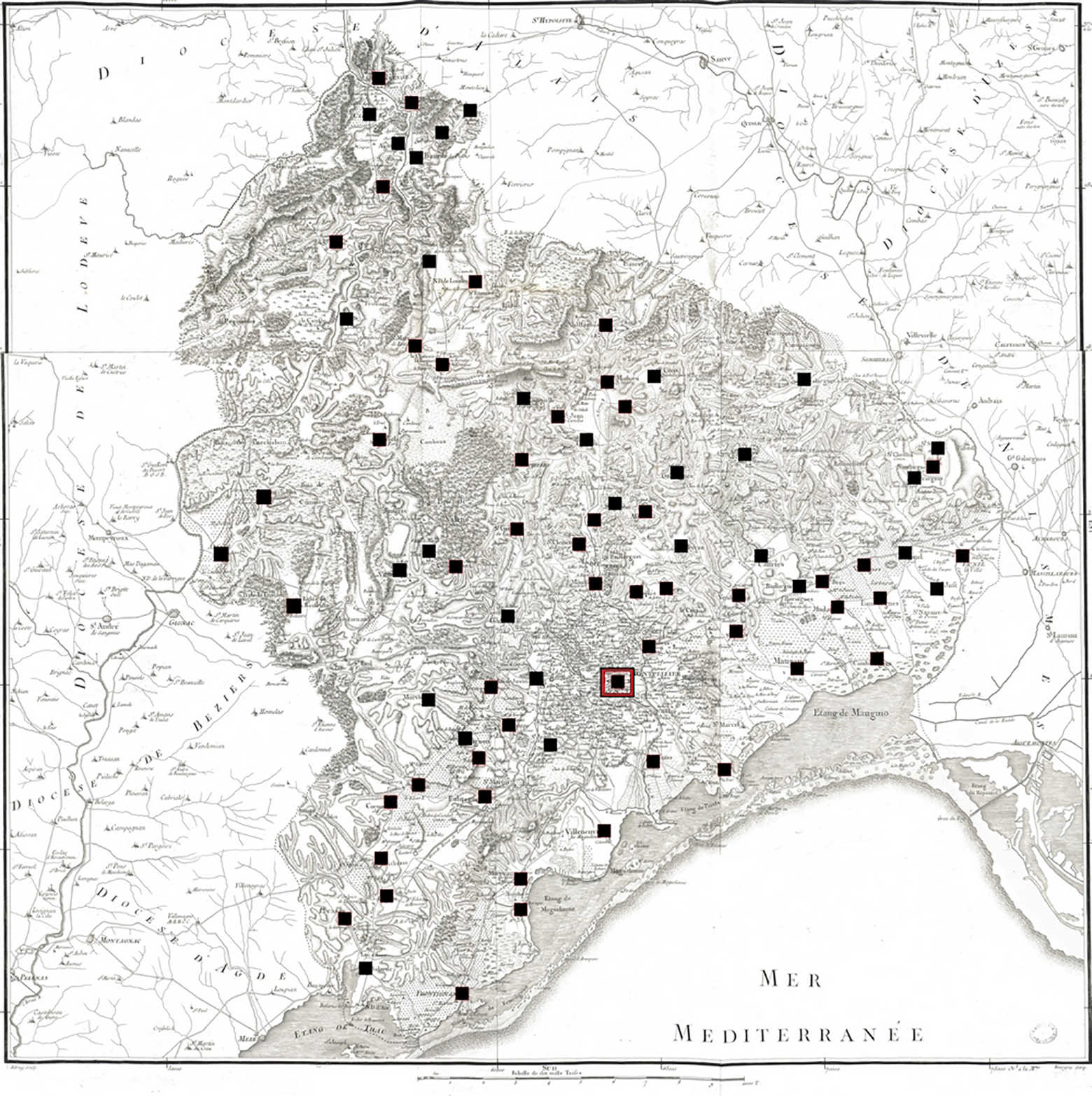
Communities of the diocese of Maguelone that yielded wills (framed block: Montpellier). Map of the Montpellier diocese, from César-François Cassini de Thury, Étienne Mignot de Montigny, and Louis Capitaine, Carte des diocèses de la province du Languedoc (Paris, 1781).
Between the large urban center and the isolated hamlets were villages and towns which degrees of “rurality” and of “urbanity” cannot be assessed with certainty. Distinguishing what constitutes a town from a village still poses challenges to historians. 6 When discussing the nature of Lower Languedocian rural settlements, Reyerson, Larguier, and Bourin note that “the difference between castra, small towns and cities is not clear. An urban flair lingers everywhere.” 7
In Lower Languedoc, many communities were walled and looked like towns. Most were self-governed in the manner of the largest southern local cities. 8 Within the diocese of Maguelone, rural communities were tightly connected by intricate networks of exchanges that did not necessarily involve the city of Montpellier. 9 Some settlements of the diocese were indisputably more urban than others. Ganges, in the north of the diocese, as well as Lunel and Mauguio, in the south east, are examples of local small towns. But these larger communities yielded too few cumulated wills to allow a statistical analysis that would be significant and reliable. 10
Testamentary sources have been widely used by historians working on medieval populations in spite of the issues they raise in terms of demographic accuracy and statistical significance. 11 Firstly, the testamentary sources we have only represent a portion of the sources produced during the medieval era. However, the ratio of sources preserved compared to the sources produced (and lost) is impossible to assess. Secondly, not all the members of a given population drafted a will. Again, the ratio of people with a will compared to the ratio of people without a will remains unknown.
Notarial documents expanded at a fast pace during the twelfth century and the Roman law “renaissance,” but preserved documentation is scarce until the late thirteenth. 12 In the early fourteenth century, still, most of the testaments recovered in the diocese of Maguelone pertained to the local elite—nobles and wealthy merchants. The democratization of notarial practices was underway but only unfolded in the aftermath of the Black Death. 13 Testamentary sources do not reflect the sociodemographic composition of a population—those for whom a will was an extravagant expense are not represented in the corpus, neither are those who died intestate—but they are among the best sources available to grasp a glimpse of the lives of late medieval people. 14
The corpus is composed of 1,072 testaments drafted between 1300 and 1500 for the laity of the diocese of Maguelone. Nearly 450 wills pertained to inhabitants of the small towns, villages, and hamlets of the diocese. I have strived to cover as much ground as possible in the diocese by collecting wills from all areas. 15 For Montpellier, all available notarial records and testamentary charters preserved prior to 1400 were consulted. 16 For the fifteenth century, I have sampled the hundreds of Montpellier records available. 17 No testament was found from the early summer 1348, when the plague was first mentioned in Montpellier, to September 1351.
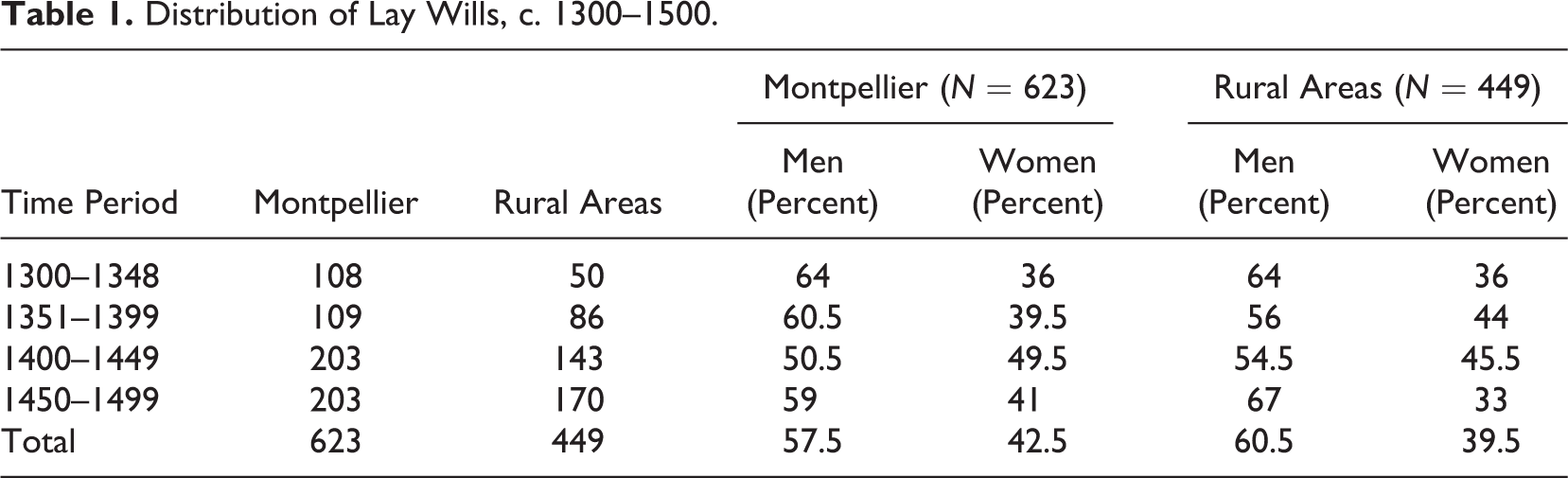
In terms of the gendered distribution of wills, men had the upper hand both in Montpellier and in rural areas although the century following the Black Death saw an increase in women testators (Table 1). 18 According to the 1204 customs of Montpellier, married women without children needed the consent of their relatives to make a will. 19 This rule was seldom followed from the late thirteenth century; women in Montpellier and in the countryside enjoyed great freedom of action. 20
Distribution of Lay Wills, c. 1300–1500.
Testators received a “married,” “once married,” or “never-married” label. Within the married and once-married testators, I distinguished between those with children or children-to-be-born, and the childless testators. 21 As we shall see, if a majority of laypeople were and had been married by the time they drafted their will, many had no children alive to whom they could pass down their possessions. In Montpellier, an average of 43 percent of married and once-married testators was childless. The ratio was lower in rural areas, with an average of 25.5 percent of unfruitful unions. This article argues that the higher rates of childless couples in Montpellier may be explained by different ages at will in the city and in rural areas, as well as by higher rates of childhood mortality in the city and lower urban female fertility. The last section explores the impacts of childlessness in terms of transmission of estates, fosterage, and support for the elderly.
Data: Patterns of Marriage and Fertility
Testaments only provide a snapshot of a testator’s kinship and offspring at a given time. The data they yield can vary from one place to another depending on local testamentary practices and customs. While rural testators seem to have delayed the age at which they drafted their will, the people of Montpellier had a different approach to the question and visited notaries much earlier in their life. Data collected on nuptiality and fertility rates reflect this difference between Montpellier and the countryside.
Nuptiality Rates
Nuptiality rates run high in late medieval European societies. Marriage was the sacrament par excellence of the laity and the only way to beget legitimate offspring. In Tuscany, where the 1427 catasto yields reliable and thorough demographic data, only 4 percent of Florentine and 2 percent of rural laywomen reached the age of fifty without marrying. 22 Languedocian testamentary sources are much less detailed than fifteenth-century Tuscan fiscal documents but show comparable results. Among the c. 1300–1500 urban and rural lay female testators, 4 percent had never married. 23 High rates of marriage among women are tied to the fact that women usually waited until the reception of marital assigns or the inheritance of their husband to distribute their assets among family members. 24
Masculine nuptiality rates appear quite low at first glance, with 14.5 percent of rural laymen and nearly 20 percent of urban men who do not seem to have married by the time they made their will. 25 Ratios may be skewed by the way in which notaries identified their clients in the preamble of testaments. While women were named through the marital bond (Mary, wife or widow of John Smith), men tended to be identified by their first and last names as well as by their occupation in cities and towns (John Smith, carpenter). 26 In rural areas, men’s first and last names usually sufficed to identify them, probably because communities were smaller. 27
Knowledge of a man’s marital status thus comes from second-hand information, such as their desire to be buried with their late wife; a bequest toward their spouse; the mention of offspring. This gendered system of identification leads to the underrepresentation of widowers, and potentially of married men, in the corpus, especially if they were childless. 28 In parallel, because women awaited their marriage to make a will, married and widowed women are overrepresented in the female corpus.
If nuptiality rates among men of the diocese were probably higher than what testaments suggest, this statement should be nuanced with regard to the age of the testators. Some 15 percent of urban masculine wills were made by young unmarried men—twice as many as in rural areas (7 percent). 29 Wills of young men represent two-thirds of the unmarried wills in Montpellier (66 percent) and nearly half of the unmarried wills in rural areas. 30
An example of such young and unmarried testator is Johan Veyssier, a ploughman from the diocese of Clermont, immigrant to Montpellier. 31 In his 1450 testament, Johan Veyssier made universal heirs his father and mother, who had stayed in his home town and left 5 sous to his unnamed brothers and sisters. 32 Johan bequeathed all his clothes to a baker and to his wife as a reward for their services—he was laying ill in their house when the will was drafted.
These young men, many of whom were immigrants like Johan, would certainly marry later on. Unless the rules of intestate inheritance suited them, they could then remake a will that would include their spouse and offspring. Instances of will redrafting are however rare. 33
Widows and widowers who had not (yet) remarried represented more than a quarter of the married and once-married testators, both in Montpellier and in the small towns, villages, and hamlets of the diocese (respectively 28.5 percent and 26 percent). 34 Remarriages may have been more frequent in Montpellier or were more frequently mentioned in urban wills (10.5 percent of the unions) than in rural areas (7 percent). 35
In total, widows and widowers, remarried or not, amounted to nearly 40 percent of the married and once-married testators in Montpellier and to one-third of married and once-married testators in rural areas. Ratios of widowhood and remarriages in the diocese are comparable to testamentary data compiled for Mende (c. 1290–1470) and Alès (c. 1340–1460) by Cécile Béghin. 36
In Montpellier, from c. 1300 to c. 1500, an average of 43 percent of married and once-married testators was childless; the ratio was lower in rural areas, at 25.5 percent. 37 Testamentary data collected in southern French towns show rates of childless testators comparable to those in villages and towns of the diocese of Maguelone. 38 In Alès, c. 1340–1460, about a quarter of married and once-married testators were childless; 20 percent were childless in the town of Mende (c. 1290–1470). 39 Philippe Maurice’s research in testaments of small communities of Gévaudan yielded very few childless unions, usually below 10 percent. 40 In big and populous cities, childlessness was more widespread than in rural areas, even in towns, where families were generally larger. 41
Childless Couples to the Black Death
From c. 1300 to c. 1325, about 20 percent of the Montpellier married and once-married testators had no child who were alive or about to be born (see Figure 2). 42 For the same period of time, all rural testators who had been and were married had children who were alive at the time they made their will. 43 This does not signify that all rural married people had children but rather testifies to diverging attitudes toward testamentary practices in the city and in rural communities.
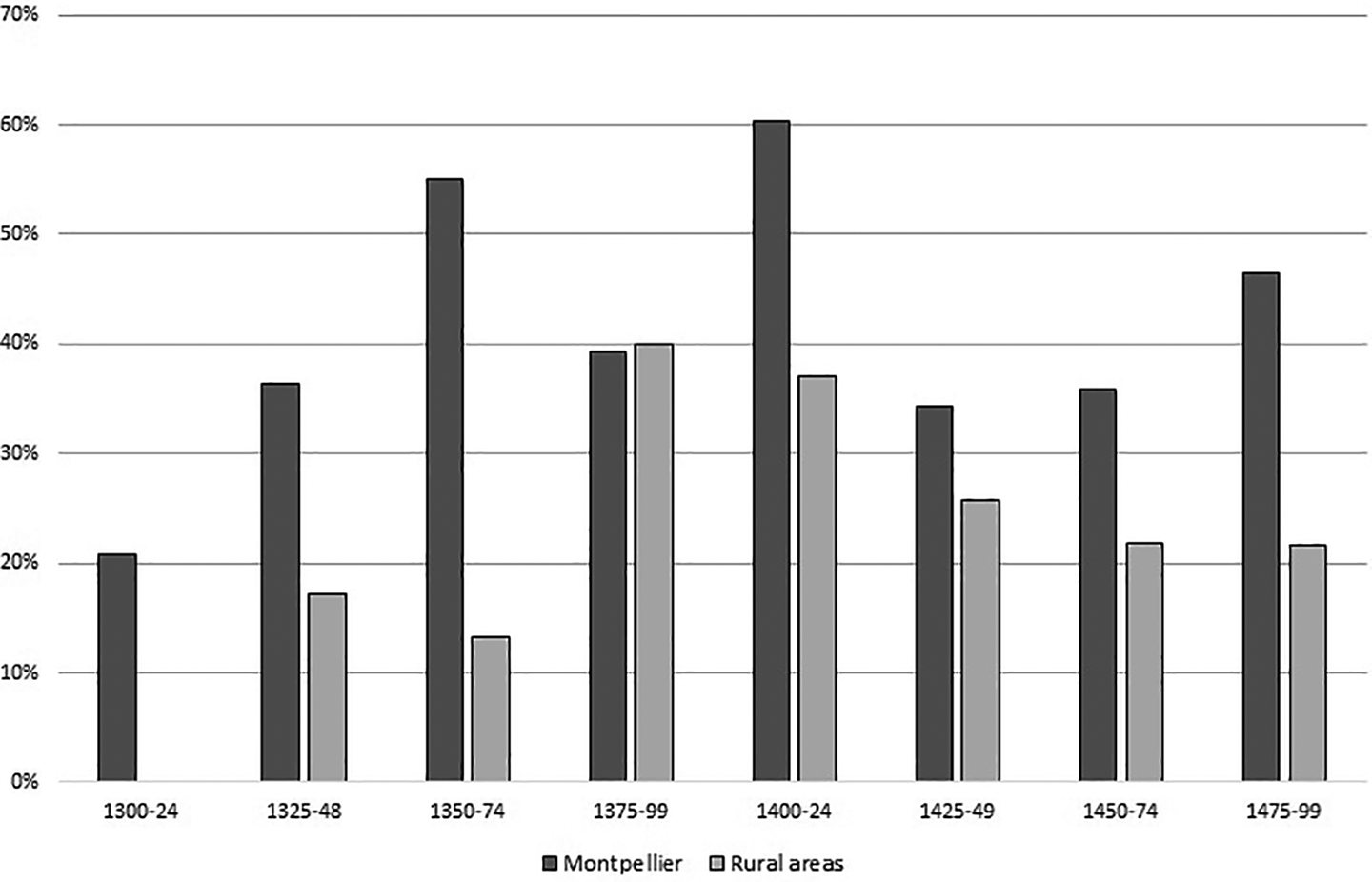
Childless married and once-married testators in urban and rural wills (c. 1300–1500).
Rural testators tended to go to a notary to draft their will when they had legitimate heirs to whom they would transmit their estate, while the people of Montpellier did not wait as long. A testimony to that later age at will is the familial coefficient (the average number of living children per marriage). In rural areas of the diocese of Maguelone, the familial coefficient was high between 1300 and c. 1325, with an average of 3.8 children per couple. In comparison, the familial coefficient in Montpellier was at 2.2 children per family during that same period of time.
However, many wills preserved for the early fourteenth century had been produced for the social elite, usually more endowed with children than humble people. 44 Members of the social elite were also underrepresented in the ranks of childless testators. Higher numbers of elite testators in the corpus half of century before the first plague might inflate the familial coefficient, with ratios of childless testators driven down by the same factor.
Ratios of childless couples rose noticeably in Montpellier during the twenty-five years preceding the Black Death, up to 36.5 percent (see Figure 2). 45 The familial coefficient thus declined to 1.4 children, below the threshold of population renewal. In towns and villages too, the ratio of childless unions augmented after 1325, getting close to 20 percent. 46 This augmentation was concomitant to a plummeting rural familial coefficient, with an average of 2.8 children per family between 1325 and 1348 (see Table 2).
Familial Coefficient (c. 1325–1400).

A telling example of these plummeting ratios comes from a series of wills pertaining to the Salendre family, who inhabited the village of Sauve, very close to the diocese of Maguelone. 47 On June 10, 1347, Pierre Salendre, head of the family, drafted his will in a state of illness. 48 He bequeathed to his two adult sons and to his son-in-law, widower of Pierre’s daughter. Pierre was then married to Garcende, the mother of their three children, and was the grandfather of two grandchildren. He died within twenty days of drafting his will.
On June 30, Pierre and Garcende’s son Guilhem drafted his will, he too in a state of illness. 49 He died within four days. His brother Rufus died in the same time span. 50 Having lost her husband and her two sons, Garcende drafted her will on July 3, 1347. 51 She made one of her grandchildren, named Garcende in her honor, her universal heir. 52 But one month later, on August 8, the testatrix drafted a second will, following the devastating death of her two grandchildren. 53
In the course of two months, Garcende had lost her husband and all of her surviving descendants—her two sons and her two grandchildren. These dramatic events were not yet tied to the plague but strongly suggest that epidemics might have been running their course in Lower Languedoc before it began, wreaking havoc in the Languedocian families. 54
The apparent reduction of the size of families between 1325 and 1348 results of overlapping factors. More frequent food shortages and a surge of epidemic diseases in the overpopulated cities and towns could have lowered the size of households before the first plague struck. 55 But the social elite, still overrepresented in the corpus, was relatively sheltered from such catastrophic events. 56
On the eve of the Black Death, while an average 36.5 percent of the married testators of Montpellier were childless, only 20 percent of couples from the merchant milieu were without offspring. 57 On the other side of the social ladder, 40 percent of Montpellier artisanal and peasants families were without children. 58 The inflation of childless families after 1325 reflects the dire familial situations of the humble inhabitants of the city at the eve of the Black Death. The precarious living conditions of the urban population laid the groundwork for the devastations of the first plague.
The First Plague and the Late Fourteenth Century
The Black Death struck Montpellier and the diocese of Maguelone in the early summer of 1348. From the years 1360s, several successive epidemics wreaked havoc in the diocese, challenging the demographic upturn. The plague became endemic in conjunction with recurring food shortages and attacks from companies of mercenaries of the Hundred Years’ War. 59
Between c. 1351 and c. 1375, 55 percent of the Montpellier testators who were and had been married were childless (see Figure 2). 60 The Montpellier familial coefficient plunged to 0.7 children per family, a minuscule number—although, admittedly, data are scarce with only 20 wills of married and once-married individuals. 61 Yet, in the populous city of Marseille, 56.5 percent of the c. 1340–1360 testators were childless, a ratio comparable to Montpellier. 62 In the towns of Mende or Alès, postplague wills also testify to an increase of childless testators right after the Black Death (Figure 2). 63
Looking at comparable data for Pisa, where 55 percent of the c. 1340–1400 testators were childless, Sylvie Duval links the low ratio of testators with children to an implicit agreement with the intestate rules of succession. She wrote that “having descendants reduced the propension of drafting a will” although not completely eliminating it. 64 Duval, therefore, contends that childless testators were more prone to will drafting because they did not adhere to the local intestate rules of succession framing the distribution of inheritance of childless individuals. The more transgressive a testator’s choice of universal heir was, the more necessary a will would become. 65
Duval’s compelling hypothesis would explain the staggeringly high rates of childless testators in Montpellier or Marseille right after the plague, as well as in Montpellier during the early fifteenth century. But the towns and villages of the diocese of Maguelone reveal a very different picture. The ratio of childless testators lowered to 13.5 percent in the twenty-five years following the Black Death. 66 This suggests that the rural people who drafted their will in these troubled times tended to do so only if they had children. After the 1375s, rural childless individuals finally turned to a notary and started drafting their wills. Then, childless individuals neared 40 percent of rural testators, a very strong increase from the low 13.5 percent that preceded (Figure 2). 67
A clearer sign of the impact of the plague on the country of the diocese is a significant plunge of the rural familial coefficient (see Table 2). From 2.8 children per family before the Black Death (including 17 percent of childless couples), the familial coefficient dwindled to 1.9 children per family between c. 1350 and c. 1375 (in spite of a low rate of 13.5 percent of childless families). The familial coefficient continued to plummet toward the end of the fourteenth century, with an average of 1.5 children per couple between 1375 and c. 1400.
Despite the ratio of rural childless testators being puzzlingly low after the plague and suddenly rising after 1375, urban wills show the opposite trend (see Figure 2). Exceeding 50 percent right after the Black Death, the ratio of childless unions lost close to fifteen points between 1375 and c. 1400. 68 It would gain twenty points between 1400 and c. 1425. The peculiar Montpellier 1375–1400 data set is quite difficult to interpret. Because the ratio of childless testators was on the rise since the early fourteenth century and continued expanding into the fifteenth century, it is doubtful that it plummeted that much between 1375 and 1400. Plagues and food shortages still wreaked havoc in the depopulated city. 69
Overall, the archives of the diocese of Maguelone yield results that are relatively in tune with data collected in various areas of Southern France. Everywhere the average number of children per family declined brutally after the Black Death (Table 2). 70
In the Provençal town of Manosque, the familial coefficient fell from 1.7 before the plague to 1.1 between c. 1350 and c. 1370. 71 In Mende, from 3.6 children per family before the plague, figures were down to 1.4 in the twenty years following the first epidemic; they plummeted at 0.7 between 1380 and 1390. 72 The Black Death and the subsequent epidemics had devastated the diocese of Maguelone and inflicted a serious blow on families, as they did in the rest of southern France.
A feature of postplague wills, however, is the democratization of testamentary practices. 73 It is possible that the number of childless and married individuals also increased due to the larger presence, in the corpus, of poor and decimated families.
A Contrasted Fifteenth Century
While the rate of childless marriages remained high in rural areas between 1400 and c. 1425, at 37 percent, childless married and once-married testators in Montpellier were more numerous than ever, making 60 percent of the married and widowed cohort (see Figure 2). 74 The familial coefficient plunged to 0.8 in the city (against 1.4 children per family in rural areas, see Table 3). 75
Childless Testators and Familial Coefficient (Fifteenth Century).
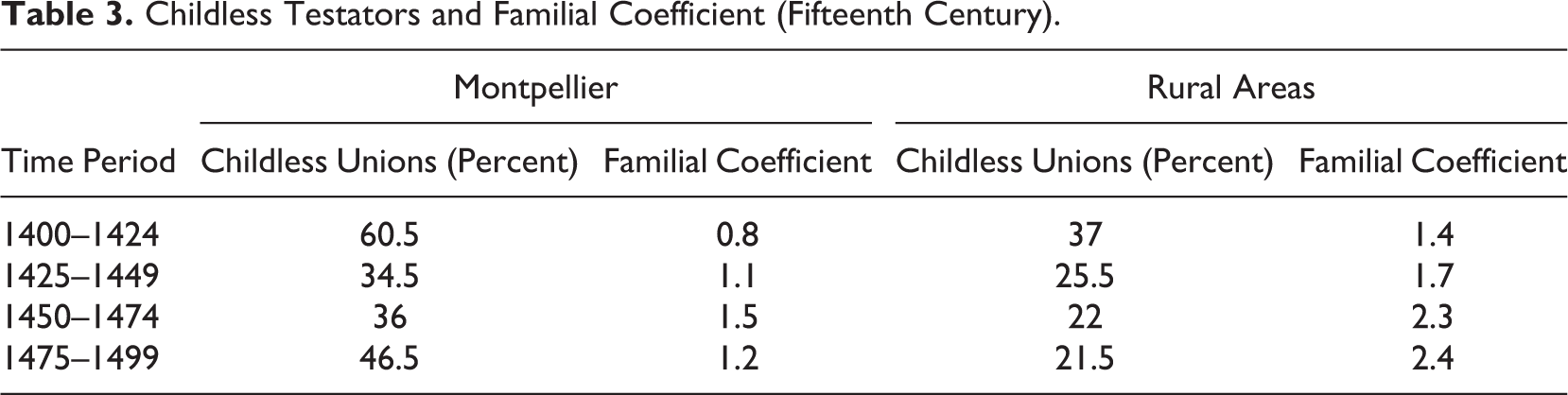
Similarly, in Mende and Alès, ratios of childless testators augmented in the early fifteenth century. Cécile Béghin found that 44 percent of the 1420–1430 Mende testators were childless—a 17 percentage point augmentation in comparison with c. 1350–1410—while in Alès, the ratio of childless testators increased from 18 percent in the late fourteenth century to 28 percent in the 1420s (Table 3). 76
Such high ratios of childless testators and low rates of familial coefficients can only be explained by intertwined hypotheses. Plagues and food shortages continued the course they had started in the late fourteenth century, impacting negatively female fertility and killing children from humble and poor families in large numbers. 77 The early fifteenth century was an enduring time of crises in the diocese, with the population of Montpellier declining until c. 1440. 78
The early fifteenth century was also marked by important migratory movements in the diocese of Maguelone, with 41 percent of the 1400–1425 Montpellier testators who had moved to the city recently enough to be identified as migrants. 79 Many of them seemed to have drafted their will shortly after their marriage and before having children, increasing the ratio of childless testators in the corpus. 80
As soon as c. 1425, families everywhere grew considerably larger (Table 3). In Montpellier, childless couples were fewer until c. 1475, the familial coefficient augmented accordingly, “rising” to a still low 1.5 children per family between 1450 and 1475. In villages and towns of the diocese, the ratio of childless people lowered to the end of the fifteenth century, nearing 20 percent in its last quarter. 81
Therefore, demography may have gradually improved from 1425 onward. The rural familial coefficient rose from 1.8 children per couple between c. 1425 and c. 1450 to 2.4 children per couple at the end of the fifteenth century. In the small coastal towns of Mauguio, the late medieval familial coefficient was as bountiful as in the rest of the rural diocese. 82
But, in Montpellier, the last quarter of the fifteenth century was typified by a swell in childless testators, up to 46.5 percent, and a parallel decline of the familial coefficient, down to 1.2 children per family (Table 3). 83 Changes might have been connected to a new wave of epidemics and food shortages mentioned by a series of sources. 84 Mende experienced a comparable situation, with a recession of the familial coefficient in the 1480s, attributed by Philippe Maurice to an upsurge of epidemics. 85
Data suggest improving demographics from 1425 onward, with a “baby boom” from c. 1450 both in Montpellier (where the threshold for population renewal was not reached) and in rural areas (where it was c. 1450). This demographic upturn attested from the middle of the fifteenth century also concerned Provençal towns, such as Brignoles, the city of Lyon, or the Gévaudan region. 86 Although data cannot be taken at face value, the trends we can extrapolate from the analysis of wills confirm broader population patterns observed both in local fiscal documents and in other areas of southern France. 87
Causes of Childlessness
Studies in the field of bioarcheology enable medievalists to better understand patterns of infant and child mortality, of delayed marriage and of fertility. Drawing on these recent findings, this section explores whether living conditions and social practices specific to urban centers could explain the smaller size of Montpellier families, as opposed to those in rural settings.
Infant and Child Mortality
Commenting on the dwindling familial coefficient of Manosque after the Black Death, Andrée Courtemanche wrote that infant mortality, more than declining birth rates (dénatalité), could explain the catastrophic demography of the provençal town in the late fourteenth century. 88 But estimates of child mortality are elusive for the medieval era, ranging from 30 percent to 50 percent of births, with geographical, chronological, and socioeconomical variances. 89
Dead children were sometimes mentioned in the preamble of testaments when a testator asked to be buried with their deceased offspring. In her 1476 will, Anthonia, the widow of a ploughman of Montpellier remarried with a leather currier of the city, asked to be buried with her two babies or young children (pueri), the only offspring she mentioned in the document. 90 The peak of mortality for children usually occurred before the age of five. In late medieval Tuscany, books of death show that 40 percent to 50 percent of the deceased listed had not reached adolescence yet. 91
Unlike what the above example suggests, mentioning a dead child does not equate mortality during childhood. A number of childless testators had raised their children and brought them into adulthood before they died. Some testators were childless but had grandchildren. 92 Alamanda, the widow of Johan Louvier of Montpellier, had lost her daughter Petronilla at the time she made her will in September 1351; although childless, she had four grandchildren—two boys and two girls. 93 Likewise, the testator Guilhem Salas the Elder, from the castrum of Laroque-Aynier, had lost his children but had three adult grandchildren to whom he passed down his estates in 1414. 94
Regardless of the age at which children died, mentions of their past existence remain scarce in testaments. Testators were more likely to name the living than the dead, leaving much uncertainty concerning their offspring. I was only able to connect 14.5 percent of urban childless testators to the loss of their children and a higher ratio of 19.5 percent in the rural areas of the diocese. 95 Figures represent a minimum of child mortality, mainly corresponding to burial requests with dead children. Given the nature of the sources, it is impossible to further set apart testators who had lost their children from testators who never had any.
The first epidemic of plague, c. 1348, did not affect children more than the others, but subsequent epidemics made more victims among the youth. 96 The Montpellier chronicle, entitled Petit Thalamus, suggests that child and subadult mortality increased during epidemics. 97 The late fourteenth and early fifteenth century were the theater of endless cycles of epidemics, attested continuously from 1396 to 1398, 1404 to 1409 and 1413 to 1415. 98 The time frame of these epidemics matches the highest rates of burial requests with a dead child—or with dead children—in urban and rural wills alike.
In 1384, for instance, the Thalamus scribe reported an “epidemic of bumps” (empedimia de bossas, maybe the bubonic plague) during which died “children small and big, many notable old men, and women, young especially, of this city.” 99 In 1391, a “pestilence of bumps, fevers and death” killed “numberless children and young people and some older people.” 100 In 1396, an epidemic of “picota” (perhaps smallpox) spread in the entire province of Languedoc, causing the death of many children and adults of Montpellier, the scribe wrote. 101
Archeological diggings of the cemetery St. Côme and St. Damien in Montpellier have yielded proof of the presence of Yersinia Pestis in medieval human remains. 102 The plague bacterium was identified in a burial where two adults—a man and a woman—had been simultaneously buried with a child aged around eight to ten. 103 However, archeologists working on St-Côme and St-Damien did not recover enough infants’ and children’s complete skeletons to conduct precise assessments of rates of early age mortality in the city. 104
Burial records from Siena show a steady increase of victims of plagues age twelve and less in the late fourteenth century, rising to a staggering 88 percent during the 1383 epidemic. 105 At the turn of the fourteenth and fifteenth centuries, underage victims still represented nearly two-thirds of the Sienese burials. 106
Children also “faced disproportionate risks of mortality during famines” in particular in the years following their weaning, when their immune system was still weak. 107 Food shortages were a recurrent concern in Languedoc from the early fourteenth century onward, with province-wide famines attested in 1374–1375, 1419–1420, 1430–1433, 1456–1458, and 1480–1483, on top of local food shortages. 108
Infant and child mortality was thus exacerbated at times of epidemics and famines, endemic in the diocese of Maguelone since the beginning of the fourteenth century. When the cycle of crises was the most intense, it is reasonable to assume that infant and child mortality rose drastically. 109
Medieval sources usually describe epidemics as socially undiscriminating—killing the rich and the poor alike. But scientific evidence has shown that physical frailty, caused by malnutrition, prior infections and traumas, increased risks of mortality, especially during epidemics and famines. 110 As a result, poor populations had a much shorter life expectancy than the wealthy. The poor died in larger numbers when a plague or a famine struck. 111 Ultimately, young victims of plague and famines were primarily (but not exclusively) the children of nonelite families.
Another social differential is that mortality risks were probably higher in medieval urban centers than in rural areas. Compared to rural inhabitants, urban dwellers in England had a shorter life expectancy and faced higher risks of mortality. 112 Women, in particular, were more at risk in urban settings. 113 Urban centers were characterized by what bioarcheologists call the “urban pathogen load,” enhanced by insalubrity and promiscuity. 114 Yet, life in rural environments was also harsh and came with its own risks. 115
Bioarcheologists therefore suggest that infant and child mortality was higher in cities than in the country due to inherent risks of urban living—malnutrition, overpopulation, and low hygiene. Poor populations, who faced higher risks of mortality, also concentrated in cities where epidemics spread faster. Infant and child mortality were certainly important factors explaining the high rates of childless families in the second half of the fourteenth century and in the early fifteenth century. However, it remains impossible to assess how many.
The Elusive Age at Marriage
A later age at marriage in the city than in rural areas could also explain the higher rates of childlessness and smaller familial coefficient in Montpellier. If women married in their mid-twenties, for instance, they would have fewer pregnancies than women marrying in their late teens. 116 It is worth noting that young women marrying in their teens probably weren’t fertile enough to carry out healthy pregnancies; fertility occurred in late medieval women around the age of twenty. 117
But sources informing on the age at marriage in Montpellier are limited in number and in scope. 118 Rural data are even more scarce and do not enable us to assess whether rural marriages occurred earlier, later, or at the same period of time than in Montpellier. 119 Two factors, however, could have delayed marriage in the city and deferred the age at which urban women bore their first child. 120
First, the “life cycle service,” that kept the youth away from marriage, was probably more common in the city than in rural areas. 121 Second, the immigration of young workers, known to have delayed marriage, was more prevalent in cities. 122 The “life cycle service” refers to the custom of placing children and teenagers in service outside of the family home. 123
In England, correlations between youth service and later age at marriage go back to the late thirteenth and early fourteenth century. 124 In Mediterranean cities, youth service and apprenticeship were as widespread as in England. 125 There, the life cycle service could have also deferred marriage, as it did in Florence for young women of the middling milieu. 126
Montpellier work and apprenticeship contracts suggest that tradesmen of the city were ready to marry in their early or mid-twenties, after the completion of their professional training and once they had started earning a living. 127 In wills, fathers and mothers who made the inheritance conditional to having reached a certain age held that their sons would inherit once they reached twenty-five years old; others placed their sons under guardianship until they turned twenty-five. 128
Information on the female average age at marriage is even more elusive. 129 Young women from Montpellier, who worked as servants or apprentices, may have married at around age twenty, give or take a few years. 130 However, well-off young women married at a younger age than humble and middle-class women. 131 Comparable to Montpellier, the Dijon, Burgundy, age at marriage for working-class women was at twenty to twenty-one years old in the late fifteenth century; similarly, in Gévaudan, most marriages occurred after women had reached twenty years of age. 132
Evidently, artisanal work and patterns of service are attested in villages and towns of the diocese of Maguelone, where they also might have pushed back marriage. 133 But apprenticeship and service work were more widespread in Montpellier, a city that still counted more than 10,000 souls in the late fourteenth and fifteenth centuries and where more than a hundred different craft guilds offered training and work opportunities. 134
Immigration, more prevalent in cities than in rural settings, was another factor deferring marriage for the youth. 135 Because it took migrants more time to establish themselves in life than locals, immigrants to Montpellier exhibited much higher rates of (premarital) celibacy than testators who were natives to the city. On average, 27 percent of immigrants were not yet married when they drafted their will, against less than 10 percent of the city’s natives. 136
Higher rates of celibacy suggest the migrants’ relative youth, who probably drafted their will earlier in life than the Montpellier natives. Among the newcomers to Montpellier, about a third came from the diocese of Maguelone. 137 It remains unclear as to how migration patterns impacted the rural demography. However, these young men and women were especially numerous in the early fifteenth century, when immigration to Montpellier was at its apex. 138
Fertility Patterns
Low fertility rates are another explanation to the large numbers of childless families in Montpellier. But fertility and infertility are “virtually unapproachable, other than by indulging in a series of hypotheses,” warns Christiane Klapisch-Zuber. 139 However, environmental factors, such as repeated episodes of epidemics and food shortages, are known to have a detrimental effect on female fertility. 140 Low fertility and delayed puberty testified to harsh living conditions, malnutrition especially, exacerbated in urban settings. 141
Herlihy and Klapisch-Zuber have observed differences in fertility between Tuscan rural and urban women. 142 From their mid-twenties onward, Florentine women experienced a gradual decline in fertility while rural women still bore numerous children. 143 The gap between urban and rural women grew as the years passed. If most Florentine women had their children between the ages of twenty and thirty-four, the window of fertility of rural women extended to their late thirties. 144 As in Tuscany, rural women of the diocese of Maguelone might have been more fertile than urban women and for a longer period of time.
But not all rural women or urban women were equally infertile. In Florence and, more broadly, in Tuscany, wealthy women were more fertile and for a longer period of time than humble and poor women. 145 Anemia and frailty hampered women’s fertility by causing amenorrhea and ovulatory failure while augmenting risks of miscarriage and lowering women’s chances of carrying healthy pregnancies. 146 Problems of fertility were probably also more widespread for poor and humble women of the diocese of Maguelone, who suffered more from episodes of hunger and diseases than elite women.
In theory, medieval female fertility could have extended, like today, to the women’s late forties. Indeed, medieval physicians observed that menopause occurred when women were about fifty. 147 But the five years leading to menopause are usually marked by a strong decline in fertility, due to irregular ovulation and menstruation, with a loss of reproductive capabilities from the age of forty years old. 148 Rampant malnutrition could have, however, pushed down that age. 149
Breastfeeding is another factor that reduced fertility by spacing out births. 150 In the diocese of Maguelone, the hiring of wet nurses residing with their employer seems to have been limited to elite families who could afford the hefty salaries wet nurses received. 151 Externalizing breastfeeding enabled elite families to accumulate more pregnancies during the wife’s fertile years. 152 Assumedly, most nonelite mothers able to breastfeed their children did so, hence limiting the number of children they could bear.
Sources from Montpellier and the neighboring communities indicate that maternal breastfeeding usually spanned eighteen to twenty-four months. 153 Guilhem Cornut, for instance, an inhabitant of the village of Cournonterral, provided in his 1490 will that if his wife was pregnant, she should breastfeed their child for two years and would receive 15 livres tournois for her milk. If she refused, she would only get 2 livres tournois. 154
A number of archival-based and bioarcheological-based evidence concur to say that urban testators may have had fewer children than rural testators because of harsher living conditions in the city and delayed age at marriage due to immigration and work patterns. Environmental and social factors that had a detrimental effect on fertility and on children’s life expectancy piled up in urban settings, explaining the Montpellier higher rate of childless couples and the lower familial coefficient. 155
Age, Gender, and the Medieval Household
Testamentary sources yield complementary information on patterns of childlessness, nuancing the data their statistical analysis has yielded and putting flesh on the anonymous bones bioarcheologists study. Wills shed light on the childless testators’ identity and life circumstances, bringing more personality to data sets and scientific findings. The confrontation of testamentary sources with bioarcheology illustrates the limits and strengths of wills with regard to demographic history.
The Typical Childless Individual
Whether in Montpellier or in rural areas, the typical childless testator was an artisan or a ploughman. While some 40 percent of the city’s artisanal and farming families were childless, the ratio was the lowest for the nobility and the commercial elite, at 23.5 percent. 156 Likewise, in rural areas, only 11.5 percent of the elite families were childless, against more than a quarter of artisans, farmers, and ploughmen. 157 In wills, elite families also counted more children than humble households. 158
Members of the commercial elite of Montpellier were overrepresented in families of five and more children; while in rural areas, the nobility had an edge in families of six and more children. 159 As established, better living conditions in wealthy households increased life expectancy and fertility. Wealth lowered infant and child mortality, while the hiring of wet nurses enabled couples to have closer-in-age children. 160
In Montpellier, one of the testators with the most children was the money changer Jean Palmier, who drafted his will in 1324. He had five sons and two daughters. 161 Among the largest rural families was Helis de Rupperie Livida’s, a lady married to the nobleman Pierre Daurioli. 162 She lived in the town of Ganges where she had raised four sons and two daughters.
The typical Montpellier female childless testator was from the middle- or working-class. She was widowed between c. 1300 and c. 1400. In the first half of the fifteenth century, she was a married woman. 163 In the towns and villages of the diocese, the typical childless woman was married when she made her will. 164 Childlessness was indeed a feminine testamentary feature.
In rural towns and villages, data go back and forth between childless men and women, with a fifty-fifty gross total—although women only represented 39 percent of the testators. 165 In Montpellier, more than half of the married and once-married childless testators were women (55.5 percent on average, with a peak at 62 percent between c. 1350 and c. 1400). 166 However, women only made up 42.5 percent of the testators. Women were overrepresented in the ranks of childless testators.
Female testators were also more likely than male testators to be childless. In Montpellier, half of the c. 1300–1500 married and once-married female testators were childless, as opposed to 36 percent of male testators. 167 In rural areas, 31 percent of the married and once married female testators were childless, against 21 percent of the rural male testators. 168 Female testamentary practices diverged from male insofar that women drafted a will once married or, preferably, once widowed, regardless of whether they had children or not. 169
In rural areas, the typical male childless testator was a widower, who may have lost his wife and newborn during childbirth or shortly after. 170 In some English cemeteries, female peak mortality coincided with their window of fertility. Most female remains belonged to women who died in their twenties to mid-thirties, maybe due to complications at childbirth. 171 But, in the city of Montpellier, the typical childless man was married when he drafted his will. 172 He might have been relatively young and only recently married, as the next section contends.
Young Testators and Established Families
Looking at the composition of families in the seneschalsy of Beaucaire, Cécile Béghin noted that among the Montpellier testators who had an offspring, roughly 50 percent had immature children (either in pupillari etate or not married yet) and another 50 percent had adult children. 173 In Mende and Alès, however, only one-third of the children mentioned in wills were immature or not yet married, the two other thirds being adult (married) children. 174
Béghin concludes that the Montpellier testators were younger than testators living in less urban settings at the time they made their will. In accordance with Béghin’s findings, wills show that rural testators were older than the Montpellier testators. 175 Ratios of testators who had grandchildren were much higher in rural communities than in Montpellier (18 percent of married and once-married testators in rural areas, against 8 percent in the city). 176
In parallel, young testators made up 23.5 percent of male testators in Montpellier against 11 percent of male testators in rural areas. 177 Likewise, young women represented 11.5 percent of the female urban testators and 6 percent of the rural female testators. 178 Figures rose in the early fifteenth century, at a time when immigration of young workers became more prevalent in sources. 179
In other words, families were larger in rural communities than in the city. In rural areas, families of six or more children represented 8.5 percent of families with children but only 4 percent of their urban counterparts. In a mirror effect, more than 40 percent of the fruitful testators of Montpellier had only one child alive at the time they made their will, against 27 percent of rural testators, whose families counted many more children. 180
The largest family was Johan de Cortesio’s, inhabitant of the parish of St. Étienne de Cazevieille in the 1430s. 181 Cortesio had ten living children: four adults (Johan, Petronilla, Raymond, and Catherine), four teenagers (Pierre, Bernard, Agnès, and Magdalena), and two underage children (Johanna and Étienne). Probably married at least twice, Cortesio also had a stepdaughter and a baby on the way. His wife, Yssela, was pregnant at the time Johan made his will; this was her second marriage, and she had a daughter named Mongeta from a prior union. 182
While higher child mortality risks in cities partially explain the data presented above, testamentary sources also point in the direction of a later age at will in rural towns and villages than in Montpellier, pushing the rural ratio of childless unions down and the familial coefficient up. Reciprocally, the relative youth of the Montpellier testators, when compared to rural areas, drove the ratio of childless unions up and the urban familial coefficient down.
These observations serve as a reminder that wills only provide a snapshot of a person’s life and of a given population, a snapshot influenced by local customs governing testamentary practices. The data we, as historians, collect depend on the nature of the sources we examine and, ultimately, reflect the traditions fueling their production.
Mutable Households
Families expanded and reduced with years passing. The plasticity of medieval households largely escapes testamentary sources, characterized by their stillness in time. 183 A childless married couple might beget children after the drafting of a will; a widow or a widower might remarry and have offspring. Unfortunately, evidence of will-remaking is scarce in the corpus. 184
A telling example of the mutable nature of households comes from accounts drafted between 1441 and 1444 for Bernard Thomas, a merchant of Montpellier. 185 In 1441, Bernard lost his father, his mother, his wife, and his son, assumedly from an epidemic. Sometime later, Bernard married off his surviving daughter with a lofty dowry of 400 livres tournois. He then remarried to an unnamed woman (“the daughter of Johan Bastier”), who died shortly after leaving behind “a young girl, age one month,” for whom the merchant hired a wet-nurse during two years. 186 Bernard quickly moved on with his life and had married his third wife by 1444.
Despite their limitations, wills suggest that the more a testator contracted marriages, the more chances they had of having children. In Montpellier, while only 56 percent of married testators had children, the ratio jumped to 73 percent in the case of remarried testators. 187 In rural areas, the increase was less dramatic but still noticeable, going from 75.5 percent of married testators having children to 78.5 percent in the case of remarried testators. 188
Likewise, a couple with a child might become childless at some point in their life. Anthonia Maurania’s two successive wills perfectly illustrate this. In 1396, the inhabitant of the town of Lunel distributed her goods to her sister-in-law, her stepdaughter from her husband’s first marriage, and to her friends. Anthonia made her daughter, Margarita, her universal heir. 189
Twenty years later, Anthonia drafted a second will. 190 All her bequests, but one, were directed toward religious and charitable institutions. The only personal bequest she made was to her husband, who would receive a vineyard. Anthonia made universal heir the “basin” of the souls of the purgatory of the church Notre-Dame du Lac. In between the two wills, Anthonia’s daughter had seemingly died. 191
What wills tell about childlessness depends in a large part on the testators’ demographic profile and on the stage in life they had reached when they drafted a testament. Local testamentary practices and customs, framing the transmission of the estate and what testators were the most inclined to say to a notary, impact the content of these documents.
Wills reaffirm a number of conclusions made by bioarcheologists: urban life was detrimental to children’s life expectancy and women’s fertility; and poor individuals were more likely to be deprived of children than the wealthy. But the rather dramatic data collected for the city of Montpellier also result from the overrepresentation of young testators and of childless widows in the corpus.
Likewise, rural data might be skewed by a later age at will and a tendency, up to the late fourteenth century, of drafting a will preferably when one had children. In that context, the inflated rural familial coefficient contrasts even more with the staggeringly low urban numbers.
Assessable Consequences
Assessing the consequences of childlessness is challenging. Demographic impacts of the high ratios of childless testators are difficult to precisely appraise. On the one hand, information on the population of rural areas of the diocese is very limited. 192 Although, the analysis of wills suggests that population may have contracted in the late fourteenth and early fifteenth century, before expanding during the “baby-boom” of the mid and late fifteenth century.
On the other hand, Josiah C. Russell’s population estimates for fifteenth-century Montpellier are problematic. 193 But the trends Russell extrapolated are confirmed—although nuanced—with other sources. There is evidence of a dramatic demographic plunge in the city from the Black Death to the mid-1430s, a time when the ratio of childless testators was extremely high. 194 A period of demographic growth followed, which slowed down at the end of the fifteenth century. The late fifteenth-century decline unfolded in less dramatic terms that Russell contended. 195
If demography largely eludes notarial sources, wills and other contracts shed light on the circulation of estate, adoptions, and various living arrangements aiming at compensating for the absence of children. One of the challenges at hand is to appraise if families responded differently to the death of children and to infertility—two factors that had a similar looking result (no children) but that may have caused different reactions to individuals, both emotionally and practically. While no testators said they were infertile, a handful mentioned their dead children. But such wills are too few to enable a solid statistical analysis of their testamentary practices. 196
Spouses as Universal Heirs
The universal heir receives the bulk of the testator’s estates, minus other bequests enumerated in the will. Several individuals at once or even the Church could be named universal heirs. If they had children, they would often be the ones chosen by testators to be their heir (or heirs). The custom was overwhelmingly followed in rural areas (96.5 percent) but a little less in Montpellier (90.5 percent). 197 In the absence of children, testators had to make other choices.
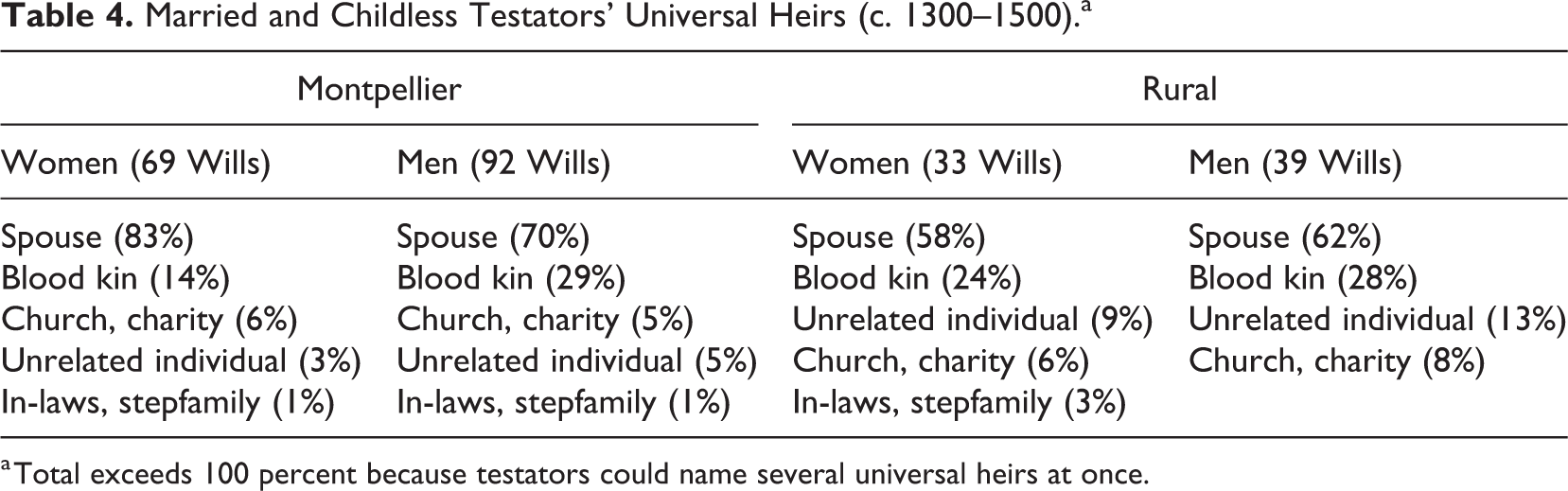
On average, spouses represented half of the childless testators’ universal heirs. 198 But that average includes widows and widowers who had no spouse to bequeath to. If married (or remarried), testators tended to make their spouse their universal heir, as did three-quarters of married and remarried childless testators from Montpellier, as well as 60 percent of the married and remarried rural testators (see Table 4).
Married and Childless Testators’ Universal Heirs (c. 1300–1500).a
a Total exceeds 100 percent because testators could name several universal heirs at once.
“Without children, the nuclear family remained a fragile, temporary construct,” writes Francine Michaud concerning burial requests in preplague Marseille. 199 Michaud’s observation applies to the transmission of estate in rural areas of the diocese of Maguelone, where the surviving spouse of a childless testator was far from systematically chosen to be the universal heir.
In Montpellier, the situation was different and the conjugal bond prevailed. But, if the living spouse of childless testators had greater chances to inherit in Montpellier than in rural areas, it was especially the case when the spouse at the receiving end was a man (Table 4). 200 Montpellier childless wives were more likely to make their spouse universal heir (83 percent) than childless husbands (70 percent). 201
The wives, who were not named universal heirs, were still included in their husbands’ will, both in Montpellier and rural areas. Besides giving back the dowry to their wives, most husbands, concerned for their wives’ sustenance, left them either an extra sum of money or alimonies. 202
Married but childless men from Montpellier and from rural areas were more prone than female testators to return their estates to their kin (although rural women did so at twice the rate of urban women). Men were careful to bring back their wealth to their original family, more so than women whose dowries, especially in towns and cities, were less estates-based than men’s marital assigns. 203
Urban and rural testators, whose children had died in adulthood, usually favored their grandchildren over their surviving spouse to be their universal heir. 204 By passing on the bulk of their estates to their second-generation descendants, these testators respected the customary paths of estates transmission, down the lines of descent.
Childless testators, married and widowed as we shall see, also gave more importance to their affine—their sons- and daughters-in-law, their siblings-in-law, but also their stepparents and stepchildren. Across the diocese, all lay testators considered, between 1.5 percent and 2 percent of them, made an in-law or a step-kin their universal heir. 205 The ratio doubled for childless testators and reached 6.5 percent to 7 percent when testators were both childless and widowed.
Heirs of Childless and Widowed Testators
A common feature of urban and rural childless testators is that of greater diversity in the choice of the universal heir when their spouses died. Widowed and childless testators still preferred to pass on their possessions to their blood kin, either horizontally (to their siblings, a choice predominantly made by men) or downward (to their nephews and nieces, usually women’s choice). 206
Both men and women sent back their estates to their blood family, though at much different rates in the city and in the countryside (Table 4). Only one-third of the urban testators chose their universal heir among their blood kin, against half of the rural testators. It is possible that ancestry and the agnatic line of descent had a greater weight in rural testamentary practices than in the city, maybe because wealth relied more on land property in the countryside. 207
But it is also possible that many urban testators experienced a greater degree of estrangement from their kin—one-quarter of the Montpellier testators were newcomers to the city—which complicated the remittance of the inheritance. Finally, higher rates of mortality in Montpellier could also have played an important role, reducing the size of families and diverting the transmission of estates away from what remained of the testators’ blood kin.
Individual circumstances also could have trumped well-established testamentary customs. Johanna, the daughter of a late notary of Montpellier and the widow of a man from the coastal town of Frontignan, is a perfect example of this. In her 1378 will, she enumerated a long list of religious and charitable bequests and gave small sums of money to various women of Frontignan, probably friends of hers. 208
Johanna had a brother in Montpellier who received some money as well as a niece to whom she bequeathed a substantial sum for her marriage. Yet, maybe because she was at odds with her brother, Johanna dug farther away in her family tree to find her universal heir, her cousin’s son named Jacob.
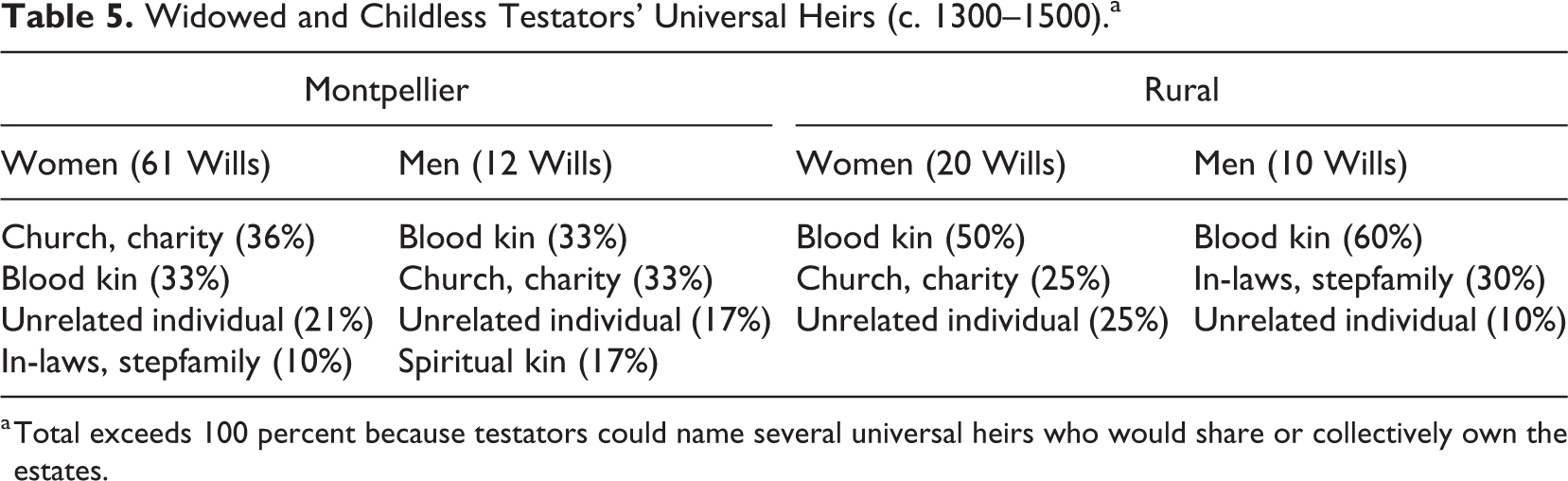
A clear feature of childless and widowed individuals’ testamentary choices is the importance they gave to unrelated individuals and to the Church when choosing their universal heir (see Table 5). Childless and widowed urban testators, men and women alike, put their kin on equal footing with the Church when it came to passing on their estates.
Churchmen, religious, and charitable institutions saw their chances of inheriting the bulk of one’s estates rising when a testator was childless and even more so when testators were childless and widowed (except maybe for rural men, but data are scarce). 209 Urban widows and widowers without children were the most prone to name the Church or a churchman their universal heir, at rates four times higher than the city’s average (Table 5). 210
Widowed and Childless Testators’ Universal Heirs (c. 1300–1500).a
a Total exceeds 100 percent because testators could name several universal heirs who would share or collectively own the estates.
In Montpellier, the ratio of clerical, religious, and charitable universal heirs goes from an average of 8.5 percent when considering all lay testators, to 15 percent for childless testators in general, and to 35.5 percent for childless and widowed testators (Table 5). 211 In parallel, if only 4 percent of lay rural testators made the Church their universal heir, 10 percent of childless testators did so, a ratio increasing to a relatively low 16.5 percent in the case of childless and widowed individuals. 212 Testators turned to the Church and focused on their salvation once the conjugal unit had completely disintegrated. 213
Finally, childless testators were more likely than the average to transmit the bulk of their possessions to unrelated people (Table 5). In Montpellier, all lay wills considered, only 6.5 percent to 7 percent of universal heirs were unrelated to the testators. 214 In the case of widowed and childless testators, the ratio climbed to 20 percent both in Montpellier and in rural areas. 215 Unfortunately, next to nothing is known about these people’s relationship to the testators. Notaries only wrote down their names and sometimes their occupations.
Ermessende, the widow of Guilhem Boneri from the village Les Matelles, drafted her will in 1430, the day after Christmas. 216 Her only personal bequest was the institution of an heir. In all appearance poor and isolated, Ermessende gave her meagre goods to Johan Boqueti and his wife, Catherine, two inhabitants of Les Matelles. Ermessende was not related to them. However, she was ill when she drafted her will, which she did in the couple’s house. It is possible that Ermessende was living with them.
Another example comes from a donation causa mortis, contracted by Johannetta, the widow of Bernard Ricard, a gardener in Montpellier. 217 A contract similar to a testament, a donation causa mortis had similar outcomes. 218 Johannetta donated all her possessions to Rixenda, the wife of a butcher, except for 6 livres tournois she set aside to draft her will. The donation continued with the content of the will. Johanetta assigned the 6 livres for her burial and the salvation of her soul. She gave some of that money, “for the love of God,” to a young unrelated woman and made her universal heir the said Rixenda.
The donation itself yields details about the relationship these women shared and incorporates a number of conditions Rixenda should fulfill to receive the promised inheritance. First, Johanetta had to explain the donation. In a formulaic sentence, the notary wrote that the donatrix gave her estates to Rixenda because of the “intimate love and cordial affection” she felt for her; the donation was also a reward for the “numerous and diverse services” Rixenda had rendered and was still rendering. 219 Although standard, these sentences reflected an existing bond between the two women, where Rixenda was offering support to Johannetta.
In order to receive the donation upon Johannetta’s death, Rixenda had to provide for Johannetta’s needs whether in good health or ill. 220 The contract was drafted in Rixenda’s house where Johannetta would move into if she was not already living there. As shown in this example, some of the unrelated universal heirs seemed to substitute for the absence of adult children, living with the testators, and caring for them while elderly or sick.
Adoption, Fosterage, and Living Arrangements
According to the archives of the diocese of Maguelone, individuals deprived of children actively seeked out the presence of substitute heirs in their house. Childless testators, for instance, would make more room in their will for the children born of the precedent union of their spouse. 221 Stepdaughters and stepsons only appeared as universal heirs of childless stepparents.
Johan Costa, inhabitant of Lattes, only made religious bequests in his 1457 will, before transmitting all his estates to Johan Aymeri, his stepson (fillastrum meum). 222 The testator’s wife, also the stepson’s mother, was not mentioned in the will. Despite her certainly having passed away, the bond between the childless stepfather and the orphaned stepson had remained strong.
Evidence shows that childless testators and people estranged from their children invested in children of their kin. 223 In Montpellier, as we shall see, some took in foundlings, promising to raise them as if they were their own children. 224 Others, across the diocese, looked for support and care as soon as old age came, striving to convince younger people to come live with them. 225
The city of Montpellier funded the care of foundlings and orphans through a threefold system. 226 Infants and young children were given away to salaried wet nurses. Toddlers and children were entrusted to male and female “nurses” (i.e., foster families) who cared and fed the children usually for a lower salary. 227 Finally, some children—maybe awaiting to be placed in a foster home or too old to be placed—were kept at the Montpellier hospitals, particularly at Notre-Dame St. Éloi. 228 Some foundlings were later placed in apprenticeship and married off at the city’s expenses. 229
Some foster families may have taken in foundlings for financial reasons—although the pay was low, it was an opportunity to have an extra pair of hands working around the house. But others, I have argued, may have longed for a child and accepted a foundling with gratitude and joy. 230 Such families went insofar as to keep the child and put an end to the financial transaction with the consulate. 231
The squire and stock maker, Johan Champene, is an example of a foster parent who may have longed for a child. In March 1456, the consuls of Montpellier placed a foundling boy under his care and without any compensation. 232 Champene promised the consuls that he and his wife would raise the boy; send him to school so that he would learn to read and write; and, later, teach him the trade of stock making. 233 If the child were to behave “as a son should toward his father and mother,” Champene would reciprocate “as a father toward a son,” ultimately giving him a portion of his estates.
Examples informing on the voluntary fosterage of children are, however, scarce in the diocese of Maguelone, unlike notarial contracts framing adoption-like procedures. Medieval adoption—usually called affiliatio or receptio in filium—did not create true familial bonds between the adoptive parents and the adoptee—only God could. 234 Therefore, medieval adoption created a fiction of filiation, framed by extremely complex rules that jurists and canonists had elaborated. 235
Notarial practices readily and easily circumvented that legislation. 236 Archives for the diocese of Maguelone, as in the rest of the Mediterranean area, are wealthy of contracts that had comparable effects to an adoption. 237 But because notarial contracts could only involve individuals with legal capacity, adoption-like contracts only occurred between adults.
In adoption-like contracts of the diocese of Maguelone, all the adoptive parents were childless; some of them were widowed and childless women. 238 The nature of their childlessness is unknown, but, in Italy, adoption seems to have been more widespread among infertile couples than couples whose children had died. 239
The adoption of adult children, filling the void of childlessness, translated anxieties related to isolation and old age. 240 Being childless was especially problematic when people grew old and could no longer look after themselves. 241 With adult children traditionally taking care of their older parents, finding a dotting caregiver could be challenging for childless older individuals. In some cases, familial solidarities were strong enough to alleviate one’s concern about old age. 242
Many testators, like the Frontignan merchant, Jacob Luc, made caring arrangements for potentially isolated relatives. Jacob Luc specified in his 1414 will that if his brother-in-law predeceased his sister, Jacoba, the said Jacoba was to move into his house. 243 At her brother’s home, Jacoba would receive everything she needed, in health or illness, until her death. Jacoba was seemingly childless; her brother did not mention any nephews or nieces in his will.
For childless and isolated individuals, a number of legal mechanisms were available to secure support in their old age. Among these legal tools were the donation of goods (donation inter vivos or donation causa mortis), contracts known as affrèrements, and the testamentary institution of universal heirs. 244 However, most implied that the elderly had enough resources to make the living arrangements appealing enough to the caregiver.
Bernard Verveti, an inhabitant of the parish St. Martial d’Assas, was a childless man when he made his will in 1462. 245 His son, Arnaud, had died in adulthood, leaving behind a young daughter, Bernard’s granddaughter. Bernard and his wife, Mengeta, were growing old and concerned about their future. Bernard made universal heir his nephew, Stéphane, who lived in a nearby parish, but the inheritance was conditional to Stéphane moving in with his uncle and providing to all his needs so long as he lived. 246
Financial means and the reliance on familial solidarities were essential to cure the issues childlessness created for the elderly. For those longing for the laughters and concerns that come with children, fosterage may have been a solution.
Conclusion
Based on the analysis of wills and notarial contracts, this article ambitiously aimed at illuminating the lives of late medieval childless individuals. This study has hopefully demonstrated how the coalescence of bioarcheology, and more “traditional” medieval studies can shed light on areas that archival sources often leave in the shadows of history.
But the same archival documents carry an inherent bias, challenging to demographic research. Testamentary practices changed in time and diverged from cities to villages, impacting the results of any statistical study. While rural testators seemed to have preferred making a will once they reached a mature age and once endowed with children, some urban testators may have drafted a will at higher rates if childless. 247
Yet, childlessness emerges as a relatively common feature of the households of the diocese of Maguelone, especially so in the city of Montpellier. Higher ratios of childless married testators in the city could result from three overlapping factors. First, different testamentary practices in the city and in rural areas may have driven the urban familial coefficient down and the ratio of childless marriages up, working in the opposite direction in rural settings.
Second, environmental factors specific to the city could have lowered female fertility and augmented risks of child mortality. Third, it is possible that the urban work culture and the large urban immigrant population delayed marriage, thus reducing the women’s window of fertility. Childlessness was, however, not as much of an issue for wealthy households, which appear in sources with a larger number of children and lower rates of childless marriages.
More research needs to be done in the rural areas of the diocese of Maguelone to appraise potential differences between hamlets and small towns and assess their degree of closeness to urban and rural data sets. 248 In the same vein, there might have been variances among the demographic profile of coastal and mountainous communities, which could be explored through the analysis of an expanded corpus of wills. 249
While data compiled from testaments are not to be taken at face value, it probably correlated with broad demographic trends. The late fourteenth and early fifteenth century was a time of acute crisis for the whole diocese. Rural towns and villages may have seen their population grow from the mid-1420s, but, in Montpellier, the demographic upturn was only visible in testamentary sources from c. 1450. The “baby-boom” that unfolded in communities of southern France from the second half of the fifteenth century (with geographical variances) also occurred in the diocese of Maguelone.
In terms of transmission of estates, spouses were the main beneficiaries of childless testators. Once widowed, childless testators had to consider at a broader scope their kinship to find a suitable heir. Although testators usually favored their kin, following well-entrenched customs, widowed and childless women were drawn toward the Church, preparing for the journey that would reunite them with their loved ones. Many others found heirs outside of their family. Testamentary freedom ran large for the inhabitants of the diocese.
Childlessness posed other challenges to individuals. One that is difficult to access in testamentary sources is the psychological impact of childlessness and/or of losing a child; a topic better informed by literary sources and books of miracles. 250 Some may have forlorn a child, an impetus to take in fosterage of a foundling, to raise them and give them a portion of the inheritance. Ultimately, childlessness raised concerns about the degradation of one’s capabilities in a state of isolation. Old age and solitude gave more urgency to finding support, either in the kin group or with unrelated individuals. Wills testify to anxieties about old age and isolation, exacerbated by the absence of offspring.
Footnotes
Acknowledgments
I thank the anonymous reviewers whose insightful comments have improved this article.
Declaration of Conflicting Interests
The author declared no potential conflicts of interest with respect to the research, authorship, and/or publication of this article.
Funding
The author disclosed receipt of the following financial support for the research and/or authorship of this article: This research was supported by the Social Sciences and Humanities Research Council of Canada.