



Abstract
In the Arab world, the recognized children of elite men and slave women could adopt the status of their father, ignoring the slave origin of the mother, owing to a system of patrilineal transmission. This regime co-existed with negative stereotypes toward slaves and blackness, despite the very fact that—as this study of notable families in Tetouan between 1859 and 1956 demonstrates—skin color was not the determinant factor to form part of this group. Rather, it was based on the social definition of filiation, leading to legal disputes between family members to delineate the boundaries of kinship.
La tteq b wuld l-ama alu ikun ‘ama.
Don’t trust the son of a negro wife (legal concubine), even though he is blind. 1
Slavery is an extreme form of inequality and alienation. The literature on slavery in Islam contains a long debate about the allegedly more lenient situation surrounding these power relations. 2 These discussions address the existence of the rules laid down in Islamic law establishing that slave women who have children with their owners are to be freed upon his death, and that the children are automatically manumitted. Negative perceptions toward slavery and blackness, erroneously considered equivalent, 3 gave shape to an ambiguous image of the children of slave women, but the system of patrilineal transmission meant that these children adopted their father’s status regardless of their skin color, as El Hamel has also maintained. 4 The kinship and marriage system regulated by Islamic law allowed for some degree of social advancement or mobility for slaves, without altering the structure of inequalities or the transmission system due to patrilineal rules, with the paradox that in Maliki law, the transmission of slavery is matrilineal. 5 In fact, the closest slave established a type of relatedness 6 that extended after manumission in a client relationship known as walā’. To contribute to a better understanding of these local diversities, I present a case study of the city of Tetouan, focused on the marriage practices of the Tetouan elite and their unions with slave women between the late nineteenth and first half of the twentieth century. These unions produced children and this study investigates the position of these women and their offspring. Using interviews with the descendants of these families, Arab documents on slavery (ḥabūs 7 and freedom documents) and outside colonial sources, I will reconstruct 1) marriage practices and the types of unions with slave women that occurred in Tetouan; 2) the status of recognized children and the perception of them; and 3) the existence of claims and litigation related to paternity or the right to inheritance that demonstrate the agency exercised by the actors involved and the tensions to define the field of kinship.
An extensive body of literature published on slavery and Islam has established the dimensions of servitude as a pattern of power and a relationship of proximity. 8 In these power relations, gender and the filiation system play a central role in determining the boundary of kinship between the free and the enslaved. The paradox is that male slaves cannot marry free women, although many freedmen secured positions of power and some degree of autonomy as armed troops, one example being the bujāra soldiers in Morocco. 9 By contrast, some female slaves who began as domestic courtesans became mothers in upper-class groups. 10 However, this was possible precisely because of a dominant ideology of procreation, where men transmit status with the metaphor of the seed, for which women are the receptacle. 11 The recognized children of female slaves, in turn, become transmitters of the status of their free fathers, irrespective of their phenotype or physical appearance. 12 This is seen in the case of the sultans themselves, many of whom were sons of slave women.
My fieldwork is based on interviews conducted intermittently between 2012 and 2019 with 40 people from Tetouan families who had female servants of slave origin. 13 For the study of marriage patterns, I analyzed the genealogies gathered by Abū Bakr Binnūna, the son of the founder of nationalism in the northern zone of Morocco, ‘Abd al-Salām Binnūna, in his unpublished work ‘Ā’ylāt Tiṭwān [Families of Tetouan]. The material includes genealogical lines with the names of people and their ties. Although they cite earlier origins, most of the genealogies are only detailed between the late nineteenth century and 1980–1990. For the study of the last wills and testaments of manumitted slave women and certificates of freedom, I consulted the documents in the Dawud Archive and the bequests (ḥabūs) in some zawāyā (Sufi prayer rooms, sing. zāwiya) belonging to Muslim orders in the city. These local sources were supplemented by the outside perspective offered by colonial travel writings and documentation from the Spanish Protectorate administration in Morocco. 14
The appearance of new sources and the consideration of the counterpower of so-called subaltern groups 15 should not disguise the constrictions of social action by conscious and unconscious mechanisms of power, shaped by elements both material and symbolic, including kinship structures, gender and social class and understood as systems of social classification. 16 The mustawlida, or slave mother, and her children, awlād al-khādm (“children of the slave woman”), moved in this dialectic. The argument that underpins this work concerns the question of how it was possible that the status of high-ranking officials and highly esteemed members of the Tetouan bourgeoisie was not determined by the slave origin of their mothers. The answer lies in a system of patrilineal descent that made it possible to overcome negative stereotypes about slavery and the descendants of slave women, despite the importance of female ties in Arab kinship which were displaced from official kinship. 17 For this reason, claims of paternity and the “kin who count” were crucial when recognition was not granted; exclusion from the lineage produced the stigma of slave origin. At the same time, the role of free women and their offspring was important when it came to recognizing or rejecting the children of concubines, but this was possible above all in a changing historical context, with the transition from the pre-colonial to the colonial period, at a time of uncertainty in the face of European influence and the transformation of a legal framework that would gradually limit the conditions of slavery.
Marriage Practices and Social Context
The main characteristic of the social group studied here is that it was urban and middle to upper class, comprising merchants, local government professionals or Makhzen officials of prestigious religious descent, primarily from the Andalusian diaspora expelled from the Iberian Peninsula between the fifteenth and seventeenth centuries, along with other immigrants from Algeria who arrived in 1830. 18 One of the group’s reproductive mechanisms over time was undoubtedly matrimonial endogamy, in much the same way as other contexts such as Tunisia, 19 accompanied by a fundamental common origin ideology. 20 This elite group was, indeed, the one that acquired the largest number of male and female slaves in the city. The slaves came through a number of channels, whether purchased in external markets in cities like Fez or Marrakech, although there was a local market until the early twentieth century, or obtained from nearby villages in the Jebala region. Even though most arrived from West Africa, beginning in the late nineteenth century when the trans-Saharan route ceased to function, they were kidnapped in southern Morocco. Some slave women were Circassian, the preferred choice for wives in cases like the Brīsha family, analyzed in more depth below.
The status of slave women and their descendants was determined by the end of slavery in Morocco, although the process was ambiguous. In 1922, a circular was issued in the French Protectorate zone that prohibited the slave trade and facilitated manumissions, but slavery was not abolished during the colonial period. 21 The main reason for this was that the elites who had adapted themselves to the colonial political structure had slaves or freedmen in their homes or, as seen below, had married female slaves. As a result, the colonial status quo did not openly dismantle local kinship structures and respected the Islamic legal order underpinning them. Instead, other factors brought changes to the family ideology, such as Islamic reformism, with its criticism of arranged marriages and excessively expensive weddings, 22 and the first women’s movements. 23
However, the endogamic patterns of the Andalusian elite remained in place for a long time. In fact, marriage with female slaves was closely connected to an element of the male elite that held positions in the Makhzen and were accompanied by female slaves on related trips that Tetouan wives were not prepared to accept. In Tetouan itself, monogamy predominated, and Tetouan spouses were very reluctant to accept co-wives, to the point of including this condition in their marriage contracts. Generally speaking, women depended on their male relatives and husbands, were unequal to their husbands and excluded from the public sphere. At the same time, however, recent historical scholarship and new gender focuses have shown that women were also actively involved in business, the transfer of assets and various conflicts inside families. 24
Three paths were available to female slaves with regard to alliances: 1) remaining single (with or without sexual relations with their owners); 2) marriage or unions with other slaves or freedmen; and 3) unions with the owner, which bequeathed the status known as umm al-walad upon them. 25
Most of the female slaves and domestic workers mentioned by informants during the fieldwork lived and died without marrying. It was assumed for the sake of family honor that this single status amounted to virginity 26 although the role played by many female slaves in the sexual initiation of the men of the house is known. 27 One pertinent intimation of this arose during an interview, when an informant explained that he saw his tata’s casket carried under the shoulders of the pallbearers. 28 As her virginity had been determined by the women who washed the cadaver, she was transported in this way; the na’ash (coffin) of a virgin is carried under the shoulders, while a married person or non-virgin is carried over the shoulders. 29
Marriage between slaves was another possibility, and one that represented a practical advantage for the owners. As French military officer Paul Odinot noted in reference to Fez, “a lord who formerly was the master of a black male slave joined him with a slave woman of the same race, as in this way their children would also be slaves, without him having to shell out any money.”
30
These marriages between slaves transformed over time, and when freeing slaves began to be more widespread in the 1910s and 1920s in cities like Fez,
31
the freedwomen were also married to freedmen. However, clientelism with former owners continued, and they often acted as marriage guardians. As these women had arrived as slaves at a very young age and were separated from their birth families, the owner family performed the functions of the walī, or guardian. The grandson of a slave woman in Tetouan recounted how, when the woman reached the age of marriage, the owners, from the Baqqālī family, served as guardians for her union with a man who was also of slave origin bought by the Labbadī family. This account demonstrates that families also negotiated the marriages of their slaves, establishing links and exchanges through them. In fact, the couple, who married according to the Muslim rite in the 1940s, settled down in a house provided to them by the owner families halfway between their two houses, where they continued to work as domestic servants. In this way, the arranged marriage served to reproduce domestic labor, and they continued to work at the service of the dominant group.
32
It is also true that according to Islamic law, the offspring of these marriages belonged to the owner of the female slave and not to the owner of the male slave. In another case described by an informant, the owner family, which was connected to a minister in the colonial Makhzen of the khalīfa
33
acted as the marriage guardian and met the costs of the slave woman’s wedding. She first married a black makhaznī, a soldier from the khalīfa’s guard, although she later divorced him and “married a white man.”
34
In a similar example, Aḥmad explained how years ago, in the 1980s, he had spoken to ‘Anbar, a slave woman from the Bin ‘Ajība family, who was free when they spoke. She had been bought in Marrakesh, but years later, the family who acquired her paid her wedding expenses and the ṣadāq, or marriage dowry.
35
With particular regard to the ṣadāq, I wish to mention a phenomenon that I have not found in the literature and that refers to the perception that some domestic servants had regarding the money that their owners paid for them. According to these women, this money was a type of dowry, a ṣadāq like those paid as part of a marriage contract. The narrator in this case was an eighty-year-old woman whose parental home was inhabited by two slave women. The informant had a close relationship with the slaves because, despite being free, she also found herself in a marginal position as an adopted daughter: When they were talking to each other about their owners, they said that the money paid to buy them, that money was like the ṣadāq, the money that you give to get married. They said that it was like being the owner’s wife. But they can’t say that he is their husband. They said that what their owner had paid was a ṣadāq, as if they had been married, what he paid the seller.
36
The third possible path for female slaves, and the focus of the following pages, was marriage with the owner or another free man in the house. In truth, these marriage patterns for slave women were not the product of a matrimonial strategy of the women themselves, but depended on the marriage model of the hegemonic class, which was characterized by monogamy and class endogamy, although the Muslim legal framework allowed for up to four wives and an unlimited number of concubines (jāriya). In the family case studies we will see that recognized procreation with slaves took place in about a quarter of the lineages and that monogamy or successive marriage was in fact the preeminent practice, although a significant part of the elite also resorted to polygyny.
Umm al-walad: The Ambiguous Status of Slave Mothers
The status of the slave women who gave birth to children fathered by their owner or other men in the house is not easy to explain. Their position was ambiguous according to the provisions of Islamic jurisprudence (fiqh), 37 regarding their recognition as mothers by the father/owner; regarding their recognition as wives; and regarding their status as a free person. 38 The slave mother who had offspring with her owner—provided that this was recognized—was legally referred to as an umm al-walad (“mother of the child”), 39 and in Tetouan documents as mustawlida. In theory, according to Maliki fiqh, 40 sexual access to female slaves was limited to the owner alone, not to co-owners or non-owners, although it is known that in practice this access extended to other men in the house. The owner also had legal access to his slaves’ daughters, as long as there were no blood ties between the owner and those slave women. Here, prohibitions related to proximity and milk kinship applied concerning the proscription of engaging in sexual contact with a slave woman and her daughters or having sex with two slaves who were sisters. In these cases, the principles concerning the prohibition of incest observed by François Héritier were complied with. 41
Once the slave mother had given birth to a descendent recognized by the owner, she acquired a set of rights: 1) the owner could not sell the slave woman or transfer her, but only give her in marriage; 2) the owner could not use her services or offer them to another person; 3) the slave woman was legally freed upon the death of her owner; and 4) the offspring of this mating was recognized as if they had been born to a woman married with a marriage contract.
Consequently, the key element that decided the slave woman’s right to acquire new status for herself and her offspring was the recognition of paternity on the part of the owner, or iqrār. This could be done indirectly, by recognizing sexual relations with the slave woman, or directly, by recognizing the child as his own. The man also had a legal opportunity to revoke paternity, by reciting a formula known as istibrā’, which consisted of imposing a period of abstinence on the woman after menstruation and waiting for half a year, the minimum time for gestation recognized by Maliki law. Gestation as conceived by this particular school is long, up to five years due to the concept of the rāqid, or “sleeping child.” 42 Consequently, a mother could claim filiation between her child and the owner if the baby was born within this maximum five-year period after the father’s death. In cases of conflict, the law reserved the slave mother or her descendant’s right to present evidence that the owner had confessed to having relations with the slave woman at some time. The final part of this article provides a detailed analysis of a specific case with these characteristics.
The formula for direct recognition underwent several changes. Before the Protectorate period, the owner only had to recognize the child as coming from his family, thus converting the slave woman into an umm al-walad. 43 With the arrival of the Protectorate, the fuqahā’ instituted some changes. The treaty between France and Morocco establishing the Protectorate in 1912 continued to respect local legislation, which distinguished between free men and slaves. However, in the French zone, the colonial authorities introduced changes in the 1922 circular mentioned above: 44 the manumission of slaves who apply for freedom; the prohibition of accepting any notary certificate from an ‘adl that certifies the possession of a slave; and the strict application of Maliki law with regard to concubinage. Concerning manumission, the circular also established that the children of slave women not recognized by their owners were to be given the right to demand their freedom and status as legitimate children. In the Spanish Protectorate, where Tetouan was the capital, I have not been able to find any analogous regulations, but the empirical cases that I have studied suggest that similar measures were adopted.
The main legal effect of this change was that the recognition of paternity no longer relied only on the principle of taʾabbī (the direct recognition of paternity), but also istilḥāq (legal recognition based on a paternity claim made by a child without lineage). 45 Despite these changes, however, the inaction of the colonial authorities allowed slavery to continue informally.
In the cases of the unions between owners and slave women that I gathered from oral histories in Tetouan, the owner could recognize the children with or without a marriage contract. As a rule, slave women were always manumitted before being married by their owners, and sometimes their manumission was their brideprice. Upon the death of the man, the slave woman was given her freedom, whether or not this was included in the deceased’s will. In neither case did the freed slave woman have a right to inheritance, although she did receive the support stipulated in the will. Any recognized children were to be maintained by the father and upon his death, they inherited the corresponding part established by fiqh.
46
In the analyzed documents from the ḥabūs, various testaments include bequests of money to free slave women or for the mustawlida.
47
Women also bequeathed part of the third (thuluth) in their wills to manumit or maintain slaves of their own or belonging to other people: “Ruqayya, daughter of the merchant al-Ḥājj Aḥmad al-Arzīnī al-Tiṭṭāwnī (…) of her inheritance (…), of a third, uses this to free two slaves [amatan], one her slave Mabrūka and she will give her 50 mithqal [a coin].”
48
In some cases, the man recognizes having more than one mustawlida, and leaves money to support the manumitted slave mothers and their children, as in the case of M’ḥammad bin al-Ḥājj ‘Abdallāh Khaṭīb: And all the female slaves on his property will be freed on the day of his death, and Yāqūt will be given 100 mithqal and Brīka 50 mithqal and Mbrīka the same, and Khadīja and Raḥma will both be given 30 mithqal, and his eldest mustawlida, Mbārka, the mother of ‘Ā’isha, will be given 100 mithqal.
49
Marriages and Other Unions with Slaves
Although most middle- and upper-income families in Tetouan had female servants of slave origin during the first half of the twentieth century, only some of the women ended up married to a man in the owner family, despite the fact that many were forced to engage in sexual relations with them and also bore unwanted or unrecognized children. The case of Tetouan is quite similar to that of Fez. The high status of the families was linked to owning slaves who lived in the house and to the practice of concubinage. 51 In Tetouan, some families had no objection to recognizing these sexual unions, while others hid them discreetly, as in the following example. Sallām Ziū-Ziū married ‘Ashūsha Ziū-Ziū, but some of his descendants told me that he had three slave women: Fāṭima, Yāsmīn and a third, who was the mother of the descendants. They do not remember her name, because “they did not want to tell these things, and the name of that slave wasn’t part of the family information.” 52
After analyzing the 88 family genealogies described by Abū Bakr Binnūna, 53 I was able to conclude that the generation born in the late nineteenth century was the last to practice recognized unions with female slaves, until the first third of the twentieth century. The interpretation of this change requires a more extensive space than we have in this article, but from my point of view it would be a combination of factors that provoked a change in mentalities, caused not only by the new colonial legislation that would limit slavery but also by a transformation in domestic units and family structures following the emergence of new ideologies such as Islamic reformism or nationalism, which proposed new notions of family and citizenship. What most stood out from this analysis, however, is the fact that 19 of the 88 families contained a union with a slave woman from the late nineteenth century. In other words, almost a quarter of this selection of families had recognized children of slave women in one or more of their branches, and some high-ranking families contained significant examples of unions with two, three, four or even eight slave women, as in the case of Aḥmad Arkayna. To give an idea of these practices, I selected some of the most notable cases from families whose ranking is comparable, headed by important merchants and holders of high Makhzen positions.
One of the most powerful extended family networks in Tetouan revolved around the Brīsha family in the late nineteenth century and its marriage alliances with other families, such as the Binnūnas, Madīnas and Ṣaffārs. The Brīsha family, which came from Meknes, 54 had three particularly notable brothers, because of their political and economic power: Ḥājj ‘Abd al-Karīm, Ḥājj al-‘Arbī and Ḥājj Muḥammad (see Figure 1). Al-‘Arbī Brīsha brought Circassian slave women to Morocco, some of whom had been commissioned by Sultan Hasan I himself in 1874. 55 Two of these Circassian slaves were the respective mothers of two future sultans, Mawlay ‘Abd al-‘Azīz and Mawlay Yūsuf. In 1878, he sold Rosa and Kanza, two Circassian slave women appreciated for their musical gifts, to the local holy man ‘Abd al-Salām ibn ‘Alī ibn Raysūn (1801–1882). 56 As a reward for their services, Ḥājj al-‘Arbī and his brothers were given various positions. Ḥājj al-‘Arbī was appointed administrator of ports and governor of Casablanca and Chaouia, in addition to his position as a merchant. Ḥājj ‘Abd al-Karīm, in turn, was appointed administrator of customs, before being named Moroccan ambassador to Madrid and Berlin. 57 Al-‘Arbī did not only serve as a broker and merchant, however. He himself took one of the Circassian women as his umm al-walad. Ḥājj al-‘Arbī Brīsha had four wives: (1) Iqbal, who took the name Fāṭma Sarkisa, a slave of Circassian origin renowned for her musical skills, who was the favorite wife for a long time, although she was also punished by her husband for playing the piano at one of al-‘Arbī’s musical gatherings with his friends 58 ; (2) al-Yāsmīn, also of slave origin; (3) Safia, of slave origin, the mother of Muṣṭafa and ‘Abd al-Wāḥid, who would hold positions in the Makhzen palace of the khalīfa during the Spanish Protectorate; and (4) Khaddūja Najjār, from a Tetouan family, whom he divorced. 59
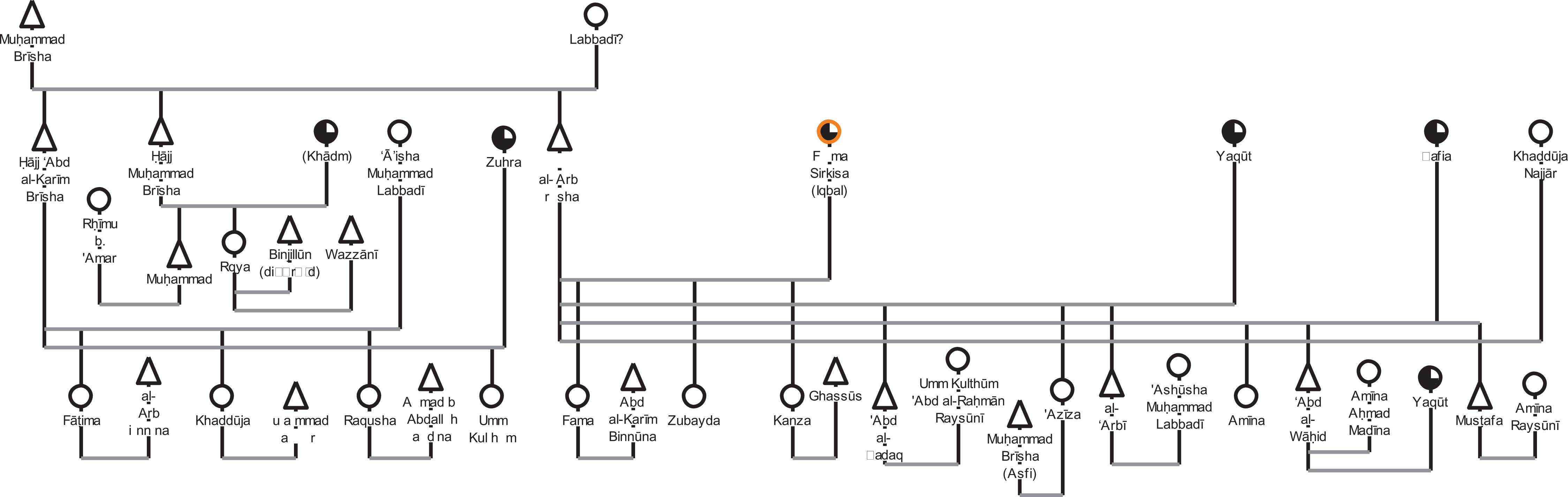
The Brīsha family.
The second brother, Ḥājj ‘Abd al-Karīm Brīsha, had two wives. The first was ‘Ā’isha Muḥammad Labbadī, who came from another powerful family in the city, while the second was a slave woman named Zuhra. ‘Abd al-Karīm Brīsha had no male children and the three daughters from his first free wife were the beneficiaries of his great fortune. And the third brother, Ḥājj Muḥammad Brīsha, had two children also with an umm al-walad.
Another line of the Brīsha family also contained a case of a union with a slave woman. Muḥammad bin Muḥammad bin ‘Abd al-Salām Brīsha, who was given the position of pasha of Tetouan in 1927, married both a woman from the ‘Aṭṭar family and a slave named Juhra. 60 Moreover, ‘Abd al-Wāḥid Brīsha, the son of the slave Safia and chamberlain of the palace of the khalīfa during the Spanish Protectorate in Morocco, was married to a woman from the Madīna family, but also took a slave, al-Yāqūt, as his second wife.
Another family with ties to important positions in Tetouan was the al-Ḥājj family. During the Protectorate era, the position of pasha was filled by Muḥammad al-Ḥājj. When the first khalīfa in the Spanish zone died in 1923, al-Ḥājj temporarily led the khalifate. Muḥammad al-Ḥājj was a member of the Makhzen and wed several slave women (see Figure 2). One of his descendants recounted that his khādm great-grandmother came from the Sus region and another of the co-wives of slave origin came up from “Sudan” [West Africa]. 61 The first free wife, who he divorced, belonged to another of the city’s principal lineages, the Binnūnas. The following wives were of slave origin: Sa‘da, Juhra, al-Yāsmīn and Zayda. Their descendants included, most notably, Sallām al-Ḥājj, who was also a pasha. These slave descendants maintained their high rank, marrying women from elite groups, like the daughters of the slave woman Sa‘da. Fama married Aḥmad Labbadī, and Fuṭṭūma wed Ḥājj Muḥammad Binnānī, a high civil servant who was, in turn, a descendent of the slave woman Maḥjūba.
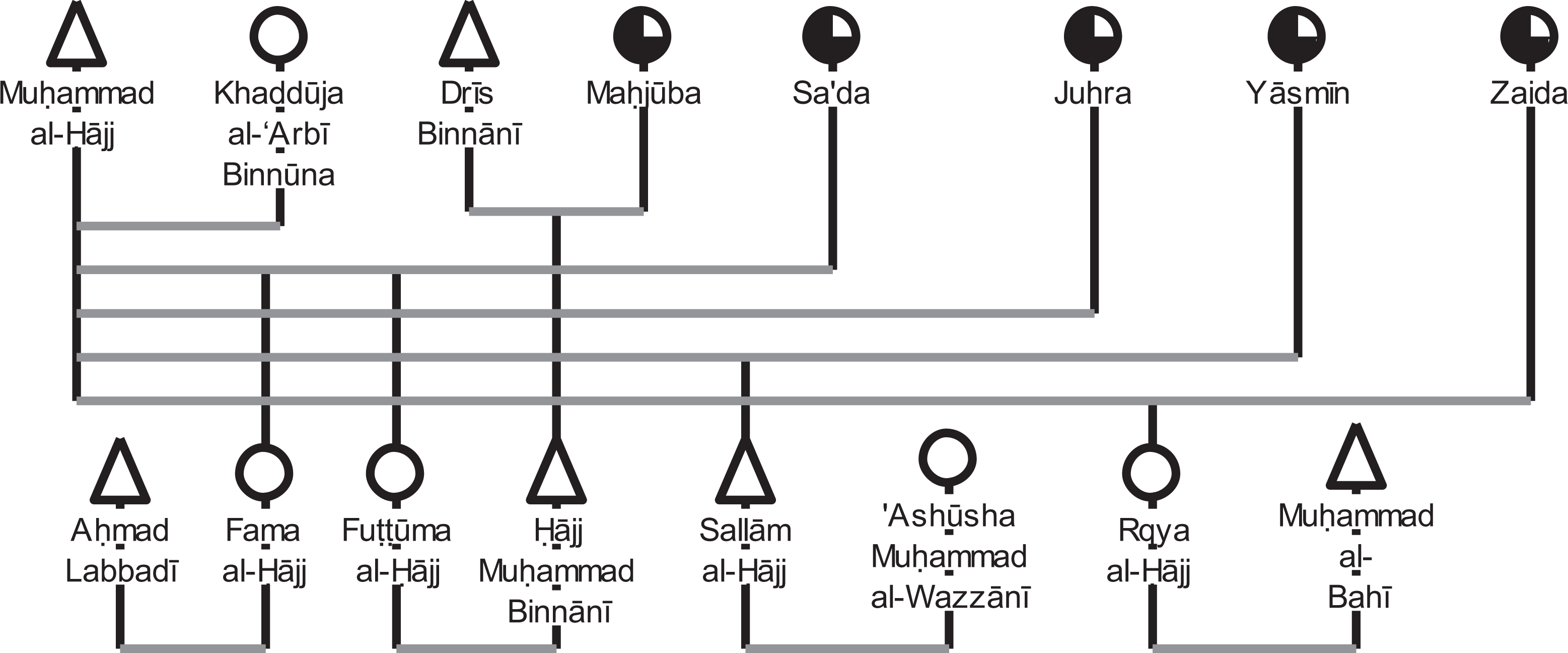
The al-Ḥājj Family.
It is no coincidence that the Arkayna family of Andalusian origin 62 was one of the families most often cited by informants when discussing families with domestic slave women. This was one of the families with the most umm al-walad. In reality, this practice was concentrated around one person in the lineage, the eminent Aḥmad Arkayna, a man of great power both in Tetouan and Morocco in general. Born in 1851, he was the Moroccan sultan’s ḥājib, finance minister when the Protectorate was established and later the grand vizier of the government of the khalīfa from 1922 to 1925. In his description of this figure, Isaac Muñoz attributes a “mixed origin” with slave ancestry to him. 63 Other sources introduce Aḥmad as the son of Muḥammad Arkayna, the head customs administrator, and a slave woman. Therefore, this pattern existed in this family with very close ties to senior officials in the Makhzen. Aḥmad Arkayna died in 1928 and was buried in the Ḥarrāqiyya zāwiya, a place of honor for high-level authorities. 64 During his burial, several of his slaves were freed, as stipulated in his will. Aḥmad Arkayna had nine wives (see Figure 3), of whom only one appears with a surname, Binjillūn, although we do not know if these eight women were all legal wives or if there were successive marriages. These eight women were of slave origin, as indicated by their names: Zuhra, Mbārka, Raḥma, Umm al-Khayr, Rābḥa, al-‘Anbar, al-Ghāliya and Maḥjūba.
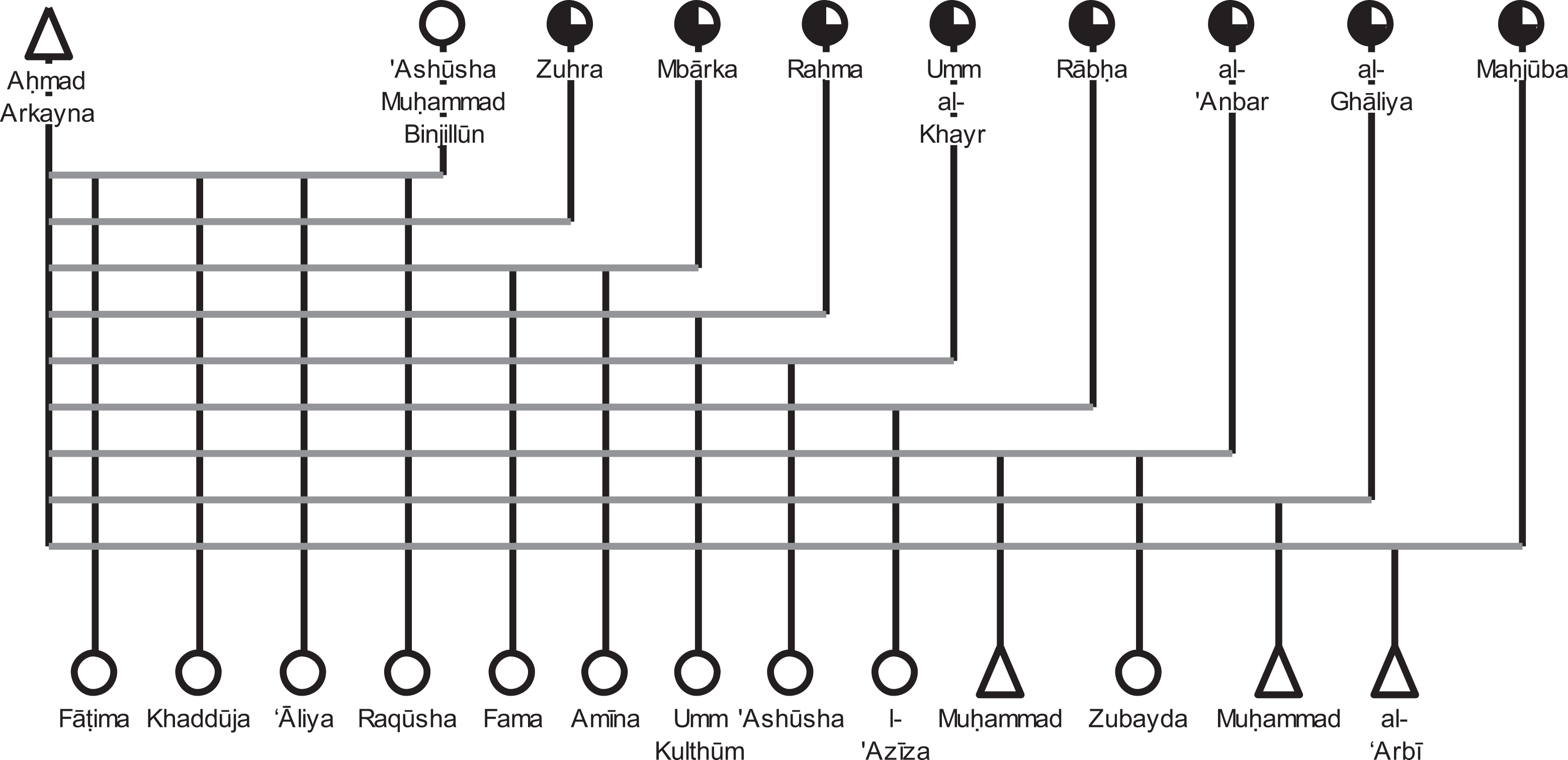
The Arkayna Family.
The Binnānī family comes from Fez. Ḥājj Drīs Binnānī was the family member who had several children with some khdam. He also held influential positions, including that of customs amīn or administrator, and his sons, Ṭayyib and Aḥmad also filled important diplomatic and customs positions, while ‘Abd al-Salām became head of the regional court of Tetouan in 1957. Drīs Binnānī had six wives, all of slave origin except for the third one, who also came from the Binnānī family (see Figure 4). He had children with all of them, seven sons and six daughters. The first son married a daughter of Muḥammad al-Ḥāŷŷ and his wife of slave origin named Sa’da. The names of his wives leave no doubt about their origins: Maḥjūba, al-Yāqūt, Mas‘uda, al-‘Anbar and Zuhra.
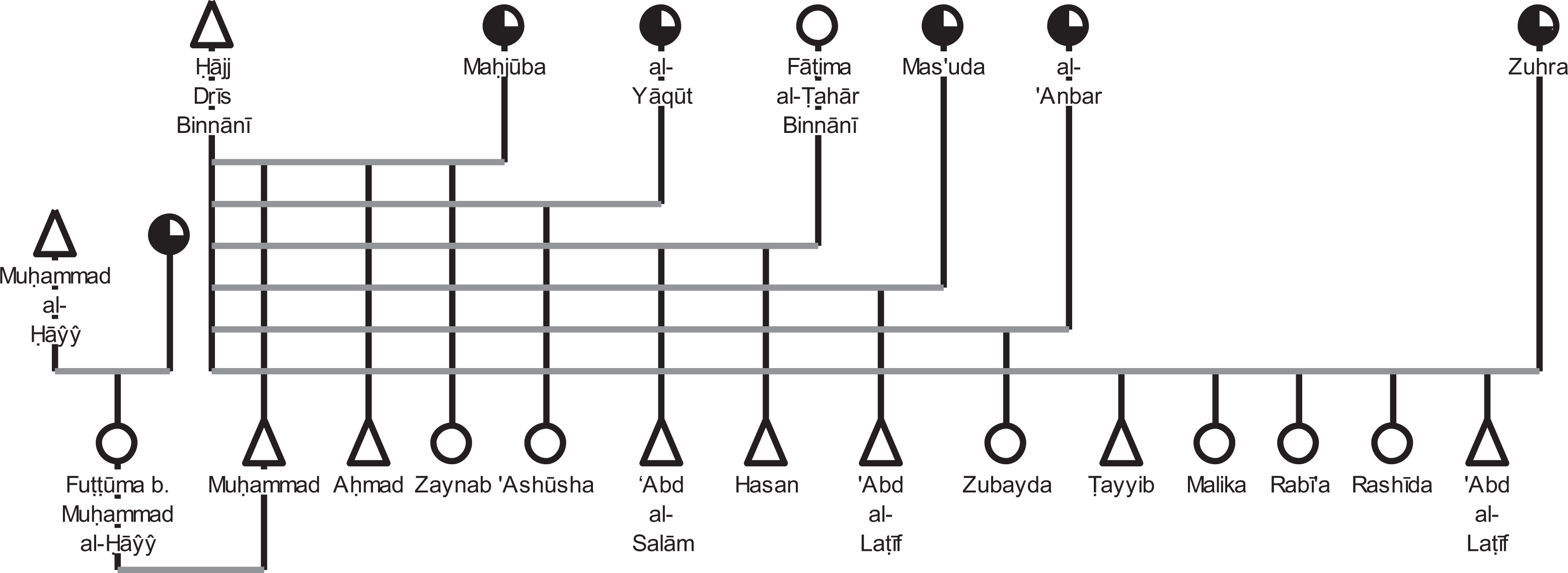
The Binnānī Family.
In this sample of 88 Tetouan families, at least one man married one slave woman in 20 of them, and I have found 23 cases of men married to a total of 40 slave women. As a result, it is possible to make some observations about marriage patterns involving slave women. By social status, this practice was most prevalent among the higher-level classes (10 out of the 20 families), both in economic and political terms, for instance the influential al-Ḥāŷŷ, Khaṭīb, Arzīnī, Arkayna, ‘Aṭṭar, Labbadī, Brīsha, Raysūnī and Binnānī families. Four of these families are distinguished by the large number of married slave mothers: al-Ḥāŷŷ, Arkayna, Brīsha and Binnānī. The other cases are related to mid-level families. These data show that in the case of the upper and middle classes, physical appearance was not necessarily a relevant factor in defining status but was rather marked by aspects of power, recognition and descent.
Recognized unions with one slave woman were the most common, and unions with more than two slaves more unusual. Among the 23 men married to slave women, the total number of co-wives was 25, and in three of the cases, the man wed only slave women and had no free wives. The predominant pattern in terms of the status of the first wife was to first marry a free woman (15 cases, twice that of the eight first marriages with a slave woman). Regarding the reproductive role of wives of slave origin, 75 per cent (40) had offspring with their owner husband. The number of children per woman in the sample indicates that the status of free or slave was significant, at least with regard to recognized children. Women of free origin had an average number of 2.5 children, while slave women had an average of 1.4, although some caution is required here, since many informants during the fieldwork hinted at the existence of unrecognized descendants, abortions and movements of slave women between different domestic units and owners. Finally, the names of the women of slave origin have been key in identifying their status, given the practice of calling them by special names related to blessings or beauty. The names of the 40 slave women in the sample are Juhra (beautiful), Fāṭima (unique), Yāsmīn (jasmine), Raḥma (merciful), Zuhra (beauty), Mas‘uda (fortunate), Yāqūt (precious stone), al-‘Anbar (amber), Zayda (abundance), Maḥjūba (covered by a veil), Sa‘da (happiness), Mbārka (blessed), Umm al-Khayr (mother of goodness), Rābḥa (winner), al-Ghāliya (precious), Marzūqa (fortunate), Zubayda (gift), Fatḥ Zahār (opening flower), Mabrūka (blessed) and Sitra (tree in heaven).
Reading these data raises a central question about the relationship between social structure and marriage practices. If marriage alliances structure group ties in the form of endogamy or social mobility, under what circumstances did a hypogamic marriage with a slave woman occur and why? There are several potential hypotheses to explain these practices, because the situations themselves were truly diverse. In some of the cases, the woman’s role as a reproductive resource came into play; as the first free wife was unable to have children, the man had them with the slave woman.
65
It is also possible to adduce sexual stereotypes, transmitted through the dominant androcentric viewpoint that characterized “black” women as providers of pleasure, sexual vigor or prophylaxis. Marriage could also seal bonds of fidelity and proximity with the slave woman. Such is the case of Raḥma and ‘Alī Sallawī, a man who descended from a Makhzen family and who worked with the ḥabūs
66
who was kidnapped in 1921 and taken to the Banī ‘Arūs kabyle. During his kidnapping, he was accompanied by his slave woman, Raḥma: His faithful slave woman Raḥma, who had grown up with him, did not want to leave him and followed him into captivity. After he was freed through my efforts, he returned to his house in Tetouan after a rather long time. He then married his slave woman as a reward for how well she had conducted herself with him, leaving her all of his goods upon his death [there were no descendants].
67
“Son of a Slave!” Perceptions of the Descendants, between Class and Color
Despite the fact that physical appearance and skin color were not bearers of status in a slave woman’s descendants, as demonstrated by the very sultans themselves, slave origin was not free of ambiguous concepts. The debates in the literature reflect the stigma projected onto the slave condition and the negative perceptions surrounding blackness. The interviews conducted with the Tetouan families sheds some light on the matter. According to some informants, marriage between a high-status man and a slave woman was frowned upon, as demonstrated by some local proverbs, for instance: “everything comes to an end, the celebrations, everything ends and a slave stays in bed.” 73
However, beyond this image, when a person of status was involved, even if he was the son of a slave woman, these types of views were relegated to the background: “it was not the done thing. But at the same time, it happened. In the Dillirū house, an eminent family, she gave Arkayna a girl; he’s black and the son of a slave woman…but he was the son of the grand vizier!” 74 In other words, status, prestige and various kinds of social and economic capital could be more important than a dark phenotype or slave origin.
In the current social perceptions of slavery in Tetouan, some people stress that being the son of a slave was not a problem, while others observed that there could be a stigma attached. In one interview, an informant gave an indication of how this status could have consequences for one’s prestige and recognition. One member of the Bin ‘Abūd family came from the al-Jadīda branch, which had a khādm known as ‘Anbar. When one of the brothers was appointed muḥtasib during the Protectorate period, “here in Tetouan, they said, ‘why does the market clerk have to be the son of a khādm?’” 75
At times, non-recognition of paternity, in particular, intensified the derogatory attitude toward slave men and women, as in the following example.
76
The story of Fatḥ Zahār was told to me by a descendent of Mawlay Ṣaddīq Raysūnī and member of an important sharif family. Mawlay Ṣaddīq was a judge in Qsar al-Kabīr who held the position of finance minister in the Protectorate until 1926. He had a concubine, who died in 1969: She was from the Taut family. I think her name was Fatma Taut. But we used another name [Fatḥ Zahār], out of respect. Her father was well known. But her mother was African, black, a slave, and since her father did not accept her, he sold her and her mother. My great-grandfather [Mawlay Ṣaddīq Raysūnī] bought her.
77
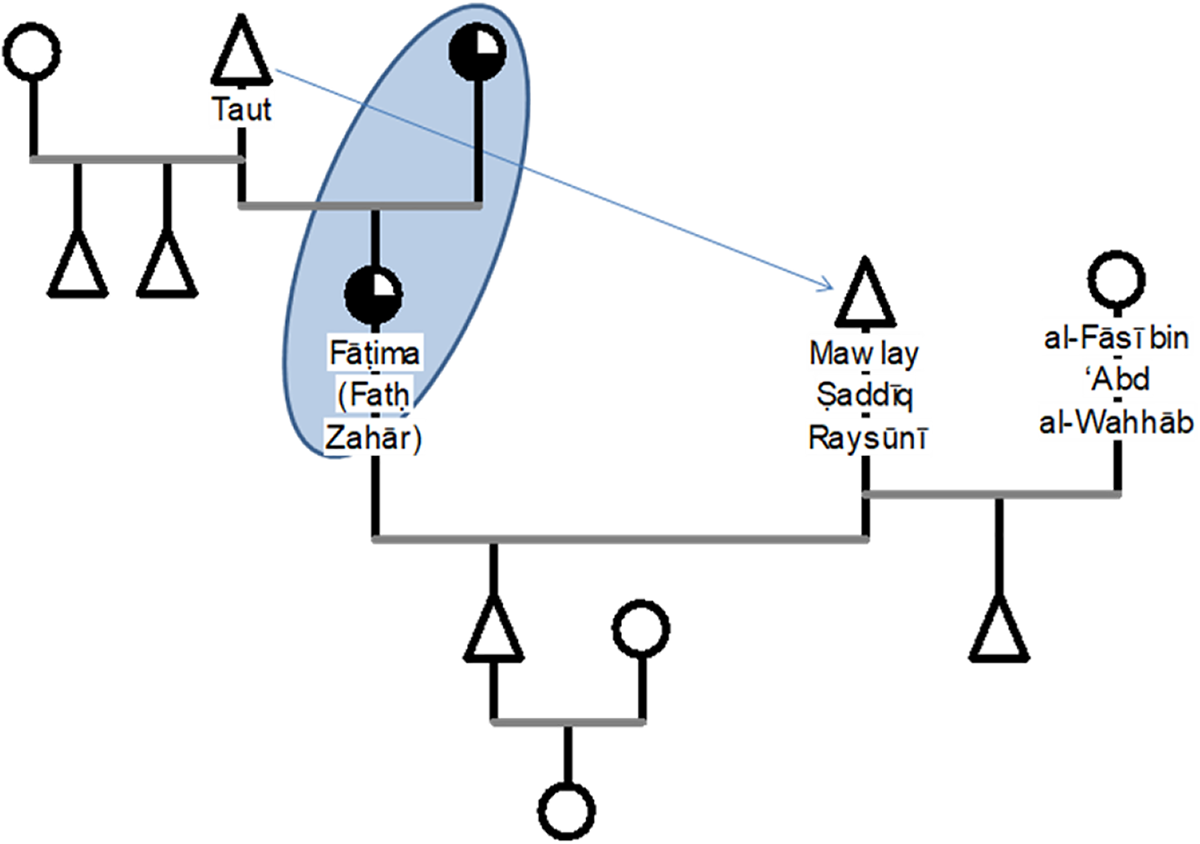
The Raysūnī Family.
The informant, who knew her, commented on the woman’s perception of herself: “She told us, ‘I come from a mother the colour of coal and she was a slave’, she said.” 78 Fatḥ Zahār was always burdened by this complex and accused her own father of not having recognized her and, above all, having sold her. Despite her comfortable social position, the complex related to her slave origin strongly affected not only her feeling of belonging, but also the position of her body in the home space:
She herself felt like a slave. She sat here on the ground and put a rug on the ground.
Where did she put it?
Right here. She sat down [on the first floor of the house, to one side of the step, outside the living room, in the central patio], she put a rug down under the step and that’s where she prepared her tea and whatnot. Because she felt like a slave. And if there were visitors and a lot of people around the table, she would leave (…). And she often ate with the women working in the kitchen. Because that was part of her earlier culture. 79
To contrast these ambiguous views, I had the opportunity to speak with some descendants of slave women, and their accounts seem pertinent here, as they reveal the existence of conflicting attitudes, from proud to traumatized, demonstrating their polysemic interpretations. In Tetouan, I met with the grandson of a judge 80 from one of the city’s learned families. My companion told me his own story, also determined by his phenotype and physical appearance. His skin color was darker, an inheritance from his paternal grandmother of slave origin. His grandfather had been the chief magistrate in Tetouan and his first wife was from the city. As there was no offspring during the early years of this marriage, Aḥmad married a slave woman in the house named Sa’da, who was recognized as his wife when she gave birth to two children. Shortly afterward, the first wife became pregnant to everyone’s surprise, and went on to have five children. Sa’da and her children lived in the same house, but in a room separate from that of the first wife. The effects of this family origin were still raw in the present, as in the case of another individual who spoke of frequently hearing cries of uld al-khādm (“son of a slave”) from the stands as he played on the football pitch.
In contrast to this account in which the informant recognized the slave status of his grandmother, I had a chance to go for a stroll and converse with the grandson of a slave woman and one of the highest authorities in the Makhzen. My attempts to bring up the topic of marriages with slave women were unsuccessful. 81 When I crossed the data from this meeting with the observations of other people, I discovered that this informant had also been subject to contemptuous comments, and that people had shouted “son of a slave” at him in public as well.
The very definition of “descendent of a slave woman” is also debated. In the following case, for instance, while some individuals told me that ‘Abd al-Salām was the grandson of a slave woman, ‘Abd al-Salām himself presented another version. Although the informant, who was born in 1929, has a white phenotype, his now deceased brother had very dark skin. As I maintained a friendly relationship with this person between 2011 and 2019, I was able to follow these contrasting views over time. Outside the family, this woman was referred to as a khādm, and he as the grandson of a slave woman, as also set out in a document at the Delegation of Indigenous Affairs, where his father is listed as the “son of Ḥāŷŷ M’ḥammad and a slave woman.” 82 All of this, however, conflicts with the family’s own definition, which presents her as a servant, but not as a slave: “my grandmother was not al-khādm. No, the khādm, the one they bought, they sold earlier…they were slaves. It’s very sensitive subject (…) she was not al-khādm. The only thing khādm about her was her colour, she was very brown. Her name was Zayda. I don’t know what her surname was.” 83
This ambiguous terrain of perceptions, labels and systems of social classification was expressed in the legal sphere above all, where paternity claims and inheritance rights were argued. The informants indicated that these cases were rare, which is quite likely, but some sources said that many cases were supressed or excluded directly.
Conflicts, Lawsuits and Paternity Claims
Families with the highest economic, political or religious status had the most slaves, and some of them stood out because of the existence of children who were the fruit of sexual relations between female domestic servants and their owners. However, the children born out of these relationships were not always recognized by their fathers, at least in legal terms. The reasons for this non-recognition were many: ignorance of the facts, material interests, to avoid dividing the inheritance, symbolic questions or to avoid the dishonor of having the son of a slave woman in the family. The significant body of documents available related to the southern French Protectorate 84 serves to orient the analysis of the northern zone. What follows is a study based, firstly, on oral sources and then on the documentation from a 1947 trial.
The extended Raysūnī family mentioned above, made up of a number of long branches between Banī ‘Arūs and Tetouan, endured several conflicts. Thanks to my conversations with an informant, I have been able to reconstruct some of these concealed relationships. This individual’s paternal great-grandfather had several children with a khādm, but most were not recognized. However, in other branches of the family, social relations developed that merit attention. There are several cases where the children of slave women took the surname Raysūnī, but do not appear in any legal document as legitimate children, such that they had no formal right to inherit. The outcome of each case depended on the benevolence of the parties involved, such as the family member of one source who decided to recognize his half-siblings in the distribution. In fact, the situation was so unique that it was only when he turned 16 that this informant found out that many of his “uncles,” who he treated as such, were not really relatives in legal terms. The children of the slave woman who were given the family surname and treatment, but were not legitimate heirs, appear in Figure 6 as (1) and (2). They were the children of a slave woman named Awida, a gift from the most illustrious member of the Raysūnī family, sharīf Aḥmad Raysūnī, to his brother. Awida, who had been bought, began to serve the brother as a young girl. Years later, in the new house, she had relations with her owner’s son, with whom she had a son and a daughter, but she was not recognized as a legal wife.
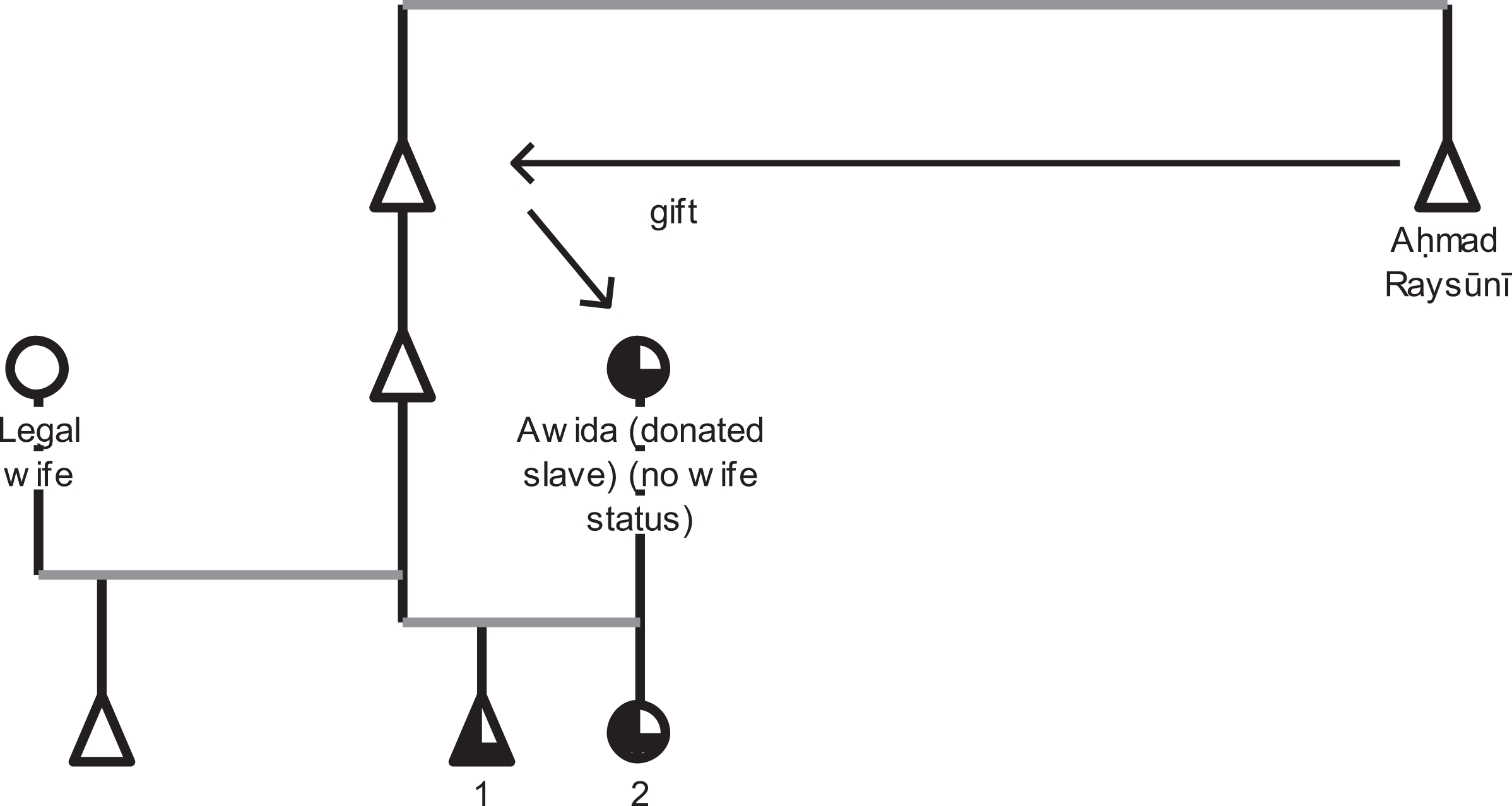
A case of non-recognition.
Although many families included slave women in the division of the inheritance and the ḥabūs assets, as I have shown, a great many others did not recognize these rights. However, even when former slaves were included in the inheritances, conflicts could arise if the woman’s descendants appeared to claim the right to their share upon the death of the slave woman or her owner. Generally speaking, the main conflict was due to resistance on the part of recognized children and co-siblings to accept the rights of the descendants of the khādm. Litigation over the recognition of descendancy had dramatic connotations for the affected parties that continue into the present. Indeed, I asked one of my informants to make contact with a case with these characteristics, but it was impossible. 85 The case concerned Fāṭima, from a notable family with a high economic status. She did not want to talk, because of the trauma involved in reliving her own family’s rejection. Fāṭima had very dark skin, to the extent that the question of phenotype plays an important role in this case, not as a direct element of classification, but as clear evidence of a conflict of interests.
Another source recounted the story of a case that went in a different direction concerning an upper-middle-class family in which the man had several children with his legal wife and one child with a slave woman. As he did not recognize either the woman as his wife or his natural child, they were excluded from his inheritance. However, since his siblings considered him part the family, they decided to share their inheritance with the child. 86
A different strategy was employed by a family that adopted the illegitimate daughter of a slave woman to keep up appearances and not leave her defenseless. The slave woman, named Juhra, had been bought by the family and she came from the Sus. During her time in the house, Juhra was impregnated by a family member, but the family chose not to recognize her daughter, instead choosing another route. When the daughter of the slave woman was born, the family adopted her and named her Rḥīmu. Islamic law does not recognize full adoption, and the adoptee is not given the surname of the adoptive family or have the same inheritance rights. 87
Another strategy was to send the concerned parties away from Tetouan. One informant recounted the following case, which occurred in his family in the 1920s. A slave woman who was living in the house became pregnant by the owner’s son. When the son married a woman from Tetouan upon the condition that he would no longer see the slave woman, the family sent her to Fez with her young son. Years later, after the death of his natural father, the son of the slave woman arrived in Tetouan, visited the family and claimed filiation and the right to inherit from his father. However, the children of the free wife did not recognize this right and they went to court. During the trial, which took place in the 1970s, the qāḍī accepted the testimony of a family member who declared: …that he went one day to the Tetouan cemetery where he came across the boy’s father, and the boy was with his father, and he asked him, who is this child? He said, “uldī [my child].” Then, for the qāḍī, this testimony meant that the father had recognized the child and he thus fully agreed with him and granted him all his rights, and did not treat him as a bastard.
88
The following example comes from the Dfūf family. This conflict occurred when a group of siblings did not recognize the son of a slave woman, named ‘Allāl. The case was known in Tetouan, because the child moved to Tangier, where he became a photographer. His father was the most renowned patrician in the family, Ḥāŷŷ al-‘Arbī Dfūf, a Dutch consul-protégé, a position he combined with several brokerage businesses. He had two children with one wife and, according to the oral version, two other unrecognized children, one of whom was the photographer. The conflict broke out upon the death of Ḥāŷŷ al-‘Arbī Dfūf, when the time came to divide his inheritance, and the son who had settled in Tangier—and had also adopted the family name—came to claim his rights.
In a quite different case, the claim did not come from the children, but from the man’s high-ranking first wife, who refused to recognize the inheritance rights of a slave woman and the children that she had borne her owner. The father was a well-known historical figure, the pasha of Tetouan, ‘Abd al-Karīm Labbadī. While married to Khaddūja, he later had two other children with Fāṭima, a slave woman. 90 According to an informant, the first wife would not recognize the inheritance rights of the concubine’s children after the death of the father and did everything possible to block their access to the assets during her lifetime. We do not know the legal mechanisms that Khaddūja used to temporarily stop the handing over to Fāṭima and her children of the part that Labbadī had indicated in his will, but it was not until the first wife died that Fāṭima’s children were able to inherit. 91
By contrast, some notables, such as the nationalist and reformist faqīh Muḥammad Ṭnāna, helped slave women and the unrecognized descendants of slaves, either with money or by defending the rights in court. 92 In another case, Fuṭṭūma, the dark-skinned daughter of a khādm, was not recognized by the children of her high-ranking father’s free wife, who refused to distribute her inheritance. She was left with nothing and sought help from Judge Afaylāl. In the end, the last grand vizier of the Protectorate, Aḥmad al-Ḥaddād, paid for her studies and she eventually became a teacher. 93 As in the case of Ṭnāna, al-Ḥaddād’s attitude is framed within a context of the emergence of Islamic reformism in the city of Tetouan itself, with a religious and political ideology that placed limits on ancient practices such as slavery and stressed the importance of educating children, including girls. Another source emphasized the agency of some slave women, who turned to our informant’s grandfather, the qāḍī al-quḍāt, or the judge of judges. 94 In these claims, the slave women asked for their relationship to the owner to be made official as a marriage in cases of sexual abuse or when they were expecting his child. At times it was not a slave woman who presented the claim; the occasional legitimate wife was also known to file a complaint in order to keep her reputation intact.
A Trial over a Claim: The ‘Udda Case
To end this article, I present a trial that took place between 1945 and 1949 on the paternity of a man who had a child with a slave woman named Masiada. The litigants were the daughter of the legal wife, who challenged the slave woman’s son’s claim to be recognized and receive the rights deriving from this recognition. The analysis of the case is based on the Judgment of the Court of First Instance in Tetouan, ratified in 1949. 95 The ruling was made in response to a lawsuit filed in 1945 by Fāṭima bint al-Ḥāŷŷ ‘Abd al-Salām ‘Udda against Ḥāŷŷ Sa‘īd bin al-Ḥāŷŷ ‘Abd al-Salām ‘Udda. To determine the pertinent jurisdiction, the Spanish judge invoked the ḍahīr (decree) of June 1, 1914, which established that questions of personal status and succession be handled by Moroccan courts, except when non-Moroccan parties were involved in the litigation. 96 In the end, the case was tried by a Spanish court, because Fāṭima had French nationality, but the Islamic regulatory system of the Maliki school, which was predominant in the zone, was applied.
The conflict arose when Fāṭima refused to recognize her co-brother, the son of a slave woman, Ḥāŷŷ Sa‘īd. The lawsuit was brought by Fāṭima on December 30, 1945 and in it, she challenged Ḥāŷŷ Sa‘īd’s claim to be her recognized brother and an heir. At the time, Ḥāŷŷ Sa‘īd was married, a muezzin and living in Tetouan. This ruling contains interesting details that make it possible to trace the trajectory of a slave woman and her son, the apparatus used to determine paternity, the rights and effects linked to recognition, as well as the mechanisms behind inheritance and freedom. The actors involved and their relationships are presented in Figure 7.
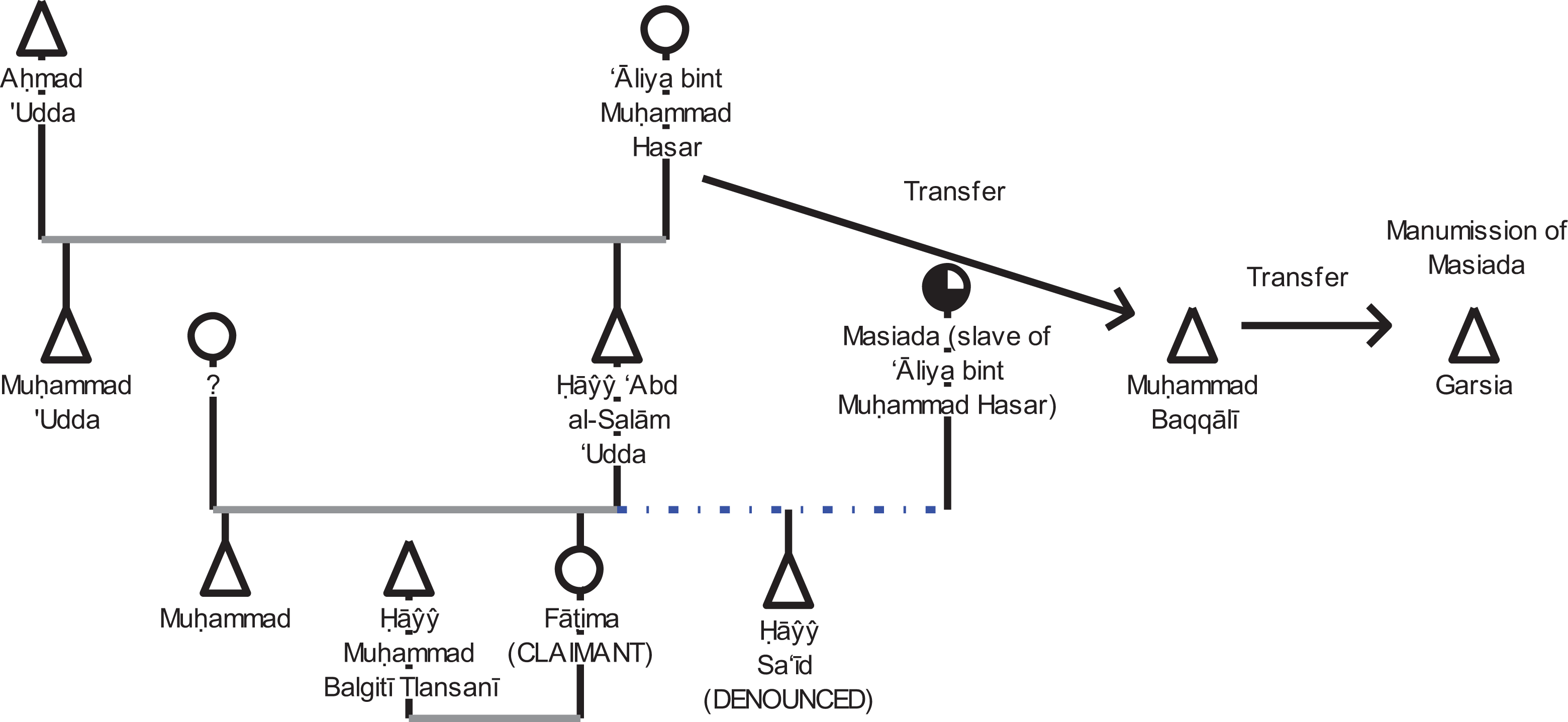
Litigants in the trial.
The documentation submitted by Fāṭima, the plaintiff, establishes that Ḥāŷŷ ‘Abd al-Salām’s mother ‘Āliya sold Masiada to Si Muḥammad al-Baqqālī, who, in turn, sold her to a Muslim man from the Garsia family, who manumitted her. In 1903, ‘Āliya stipulated in her will that the son of her slave woman Masiada was to be freed and given a sum of 20 duros. This testament complicated the lawsuit, because ‘Āliya recognized ‘Abd al-Salām’s paternity of Sa‘īd. However, after first recognizing his son before two notaries in 1909, ‘Abd al-Salām denied his paternity. We have no further information on this, but this case shows how subjects handle the legal arena according to changing interests, even though Malikian law did not allow this denial of paternity already legally recognized. 97 Therefore, the primary objective of the entire trial was to determine whether ‘Abd al-Salām was Sa‘īd’s father and if he had recognized him as his son. The evidence was contradictory. In his will, ‘Abd al-Salām did not mention Sa‘īd as an heir, but he did bequeath his ḥabūs goods to him to recite the Qur’an at his tomb every Thursday and Friday, as the freedman of his mother ‘Āliya.
The documentation made available during the trial includes a Shariat legal process that had called several witnesses to clarify whether ‘Abd al-Salām had recognized Sa‘īd. These declarations contained two types of evidence: ‘Abd al-Salām’s own words, in which he admitted recognition of Sa‘īd, and public acts like the choice of a tomb in the family pantheon next to Ḥāŷŷ Sa‘īd and the wedding of Ḥāŷŷ Sa‘īd’s daughter, held in the Qādiriyya zāwiya. ‘Abd al-Salām’s appearance at his granddaughter’s wedding represented recognition of his son, Sa‘īd.
Within this complex intersection of jurisdictions, the Spanish judge understood that the battle to determine the paternity of ‘Abd al-Salām ‘Udda needed to be decided according to the procedures of Islamic justice, particularly taking into account the period known as ‘idda, 98 used to establish the identity of the natural father, and the intervention of a specialist to determine filiation with a method that used physiognomic markers 99 when no marriage had been celebrated and in cases of slavery. In the end, however, this option was discarded, because Ḥāŷŷ ‘Abd al-Salām was already dead and these procedures required that both the father and claimant be alive to make the comparison.
On May 18, 1949, the court ruled that Sa‘īd was recognized as the son of ‘Abd al-Salām, due to his own recognition, but “without any other rights than those conceded by the settlement made or any right at all to the thuluth, but the right to take his father’s patronymic.” The complete analysis of this case demonstrates that, notably, at no time during the proceedings was any reference made to the physical appearance or skin color of the parties involved—not Masiada, Sa‘īd or ‘Abd al-Salām—to determine their ties.
Conclusion: The Power of Defining Genealogy
The predominant marriage pattern among the precolonial and colonial Tetouan elite was monogamy and a class endogamy articulated around an Andalusian origin. Marriages with slaves were a minority practice, but by no means marginal since, in reality, intimate relations with female slaves were a common practice, and this sexual exploitation was an implicit part of their domestic work.
This article has shown that the principal pattern for unions with female slaves was established among high-ranking Makhzen notables, especially customs administrators and merchants, and that this pattern was also due to the resistance of Tetouan women to move away from the city. These unions between elite men and slave women are notable in that the descendants of prominent figures adopted and inherited the status and goods of their fathers, as a result of the pre-eminence of a patrilineal filiation system. But this patrilineal pattern also diminishes the existence of women of slave origin in family memory and the role played by these females, who were torn away from their families of origin. This article has rescued these women from oblivion, but not without some methodological difficulties, like the lack of direct testimonies from the enslaved and manumitted women and the biases of the constructed memory of descendants, 100 although oral history and Shariat documents have made it possible to read between the lines and find this buried past.
Alongside the patrilineal pattern that allowed the children of slave women to rise socially with respect to their mothers, an everyday understanding projected negative views onto slaves, especially if they were Black Africans. However, the paradox is that while these stereotypes had their impact on people, in the end, “class” prevailed over physical appearance and “race.” The concept of race is, nonetheless, important here, since the society of the time no longer used the euro-Western concept of race constructed during colonialism, but drew on other references that indicated geographic origin or color. These views did not invoke evolutionist scientific theories, but rather Arab traditions of geography, or the theory of climate and the humors. In this respect, the category of slave woman applied a double standard: firstly, blackness was disparaged and seen as a sign of low status, while a number of popular and androcentric theories existed about the empowering, prophylactic and even curative aspects of having sex with black women. 101
In society, filiation became a battlefield, not only to maintain the cultural features of the Andalusian group and class distinction, but also with regard to access to rights. As this article has shown, while in some cases the family name was adopted by the unrecognized children of slave women, this did not extend to inheritance rights. Although the informants gave the impression that the patrilineal system absorbed the children of slave women into the system, conflicts existed around the legitimation of belonging to a lineage. These trials reveal a power play in which each party defended their definitions of social ties and kinship, and used the resources of an Islamic regulatory system with numerous negotiation models (searching out witnesses, resorting to physiognomy, the ḥabūs, manumission), 102 although some power mechanisms also operated to limit this negotiation, such as clientelism, physical and symbolic violence and gender inequality. For instance, in the ‘Udda case analyzed here, the father initially recognized his son with the slave woman Masiada, but later disowned him under pressure from the children of his legitimate wife. Throughout the process, the actors transformed their ties over the course of their lives: Masiada, who passed through several owners before being freed, and ‘Abd al-Salām who, despite not recognizing his son, established informal and open secret forms of recognition based on rites of passage like his granddaughter’s wedding and the preparation of his tomb. The research into the trial also shows that, as Carlo Ginzburg has written, 103 the judge acts as historian and anthropologist by reconstructing relationships between people and issuing a ruling, an explanatory theory. In short, the determination of filiation was of paramount importance when determining inheritance. In fact, this battle over shares related to filiation lives on among slaves and non-slaves, as indicated by the secrecy around genealogical documents, which provide proof of the social identity and legitimacy needed to obtain rights. 104 This explains the apprehension of the custodians of documents; the open nature of genealogy can induce claims and lawsuits, especially when the distribution of assets is at stake.
Footnotes
Acknowledgment
I want to thank Hasna Daoud and Khalid Rami for their help with archival research at Tetouan.
Declaration of Conflicting Interests
The author(s) declared no potential conflicts of interest with respect to the research, authorship, and/or publication of this article.
Funding
The author(s) disclosed receipt of the following financial support for the research, authorship, and/or publication of this article: This work was supported by the Ministerio de Educación y Ciencia of Spain, under Grant HAR2013-40445-P and HAR2017-86776-P, in the frame of the AHCISP group (Antropologia i Història de la Construcció d’Identitats Socials i Polítiques), Universitat Autònoma de Barcelona.
