



Abstract
In 1901, a small group of Norwegian immigrants relocated from Minnesota to Eastern Washington. The community grew quickly, with other immigrants coming directly from Norway. The group maintained a strong Norwegian character for several decades; for example, their church continued to hold services in Norwegian until the late 1920’s. Assimilation into American society was evidenced by the names the community members gave to their children, as traditional Norwegian names were quickly replaced by more typically American monikers. This paper examines the extent to which the assignment of forenames represents the assimilation of Washington’s Selbu community into the broader American society around it.
For historians of the family, sociologists, and others examining the development of American society through successive waves of immigration, onomastics, or the study of names, has long been a valuable tool. Changes in child naming patterns can be particularly useful in understanding how the process of assimilation worked within immigrant communities. Christina A. Sue and Edward E. Telles suggest, “The study of naming practices provides a window into parental visions of the ethnic identity of their children, thereby addressing how ethnic identity is directly influenced from one generation to the next.” Similarly, in their study of the effect of cultural assimilation on the economic success of immigrants’ children, Joshua R. Goldstein and Guy Stecklov note, “First-name choice is a valuable indicator of assimilation because it can be used to measure the loss of distinctiveness between populations and integration into the mainstream…. In choosing names for their children, parents face an important trade-off between the desire to transmit their traditions to the next generation and providing children with identities that will maximize their chances of success in their new home.” 1
The process of assimilation is gradual, and is not necessarily uniform within or between immigrant groups. Richard D. Alba and Victor Nee note that among descendants of European and Asian immigrants of the nineteenth and early twentieth centuries, “assimilation is more accurately viewed as a direction rather than an end state that has already been attained.” With the gradual elimination of cultural differences between ethnic groups, the barriers that initially separate newly arrived immigrants from the mainstream culture are gradually worn down as well. Even if they lived in close-knit ethnic enclaves, immigrants’ interaction with the “Yankee” world around them affected their lives. Contact with other immigrants also brought changes in their developing cultures. Food, clothing styles, and language all changed as the immigrants adjusted to their lives in the United States. Sometimes the changes were slow and incremental, while at other times, they were very rapid, and occasionally disorienting. 2
In the early twentieth century, most immigrants to the United States sought to adjust to American norms as quickly as possible. They considered “Americanization,” or assimilation into American culture and society, essential for success in their new homeland. Costanza Biavaschi, Corrado Giulietti, and Zahra Siddique note that “cultural assimilation was instrumental to economic assimilation.” Among the various strategies that immigrants could adopt to improve their economic position, Americanization of names was a successful and popular choice. 3
Like most immigrants from Northern Europe, Norwegians had fewer obstacles to assimilation than their counterparts from other parts of the world. They were Protestant (overwhelmingly Lutheran), and their stereotypical “Nordic” appearance blended in easily with Americans whose ancestors had come earlier from Germany and the United Kingdom. They could easily replace their traditional wool clothing for cotton wardrobes representing American styles. However, their language set them apart, as did their Norwegian names, which often sounded strange to American ears. While many struggled to speak English without a noticeable Norwegian accent, changing one’s name to something that sounded American was a relatively simple act for many immigrants. And giving their children American names could help assure that the next generation’s assimilation and Americanization would proceed more easily. 4
While the popularity of names may represent changes in fashion and taste in the broader community, such changes can be particularly important for immigrants who are attempting to make a smooth transition into their adopted country. For example, Stanley Lieberson notes, “The naming behavior of blacks, Southeast Asians, Mexicans, Jews, and other ethnic and racial groups in the United States allows us to view the way tastes reflect symbolic considerations, assimilation, segregation, generation, religion, and historical practices before immigration.” 5
A small Norwegian immigrant community was centered around Selbu Lutheran Church, near La Crosse, Washington. It provides an excellent case study in which to use naming patterns to examine the process of assimilation of a Norwegian immigrant community into the surrounding “Yankee” society in the first half of the twentieth century. Church records provide a manageable list of baptisms covering nearly half a century. Supplementary resources, such as Norwegian emigration records, US census lists, and the two volumes of the immigrant publication, Selbygbogen (published by the Selbulaget in 1921 and 1931), provide additional information about most of the children’s family backgrounds. While the church provided a social setting in which the Norwegian language continued to be used widely by the older generations, the names given to children born in that community are clear evidence of the process of assimilation at work among its members (see Figure 1).
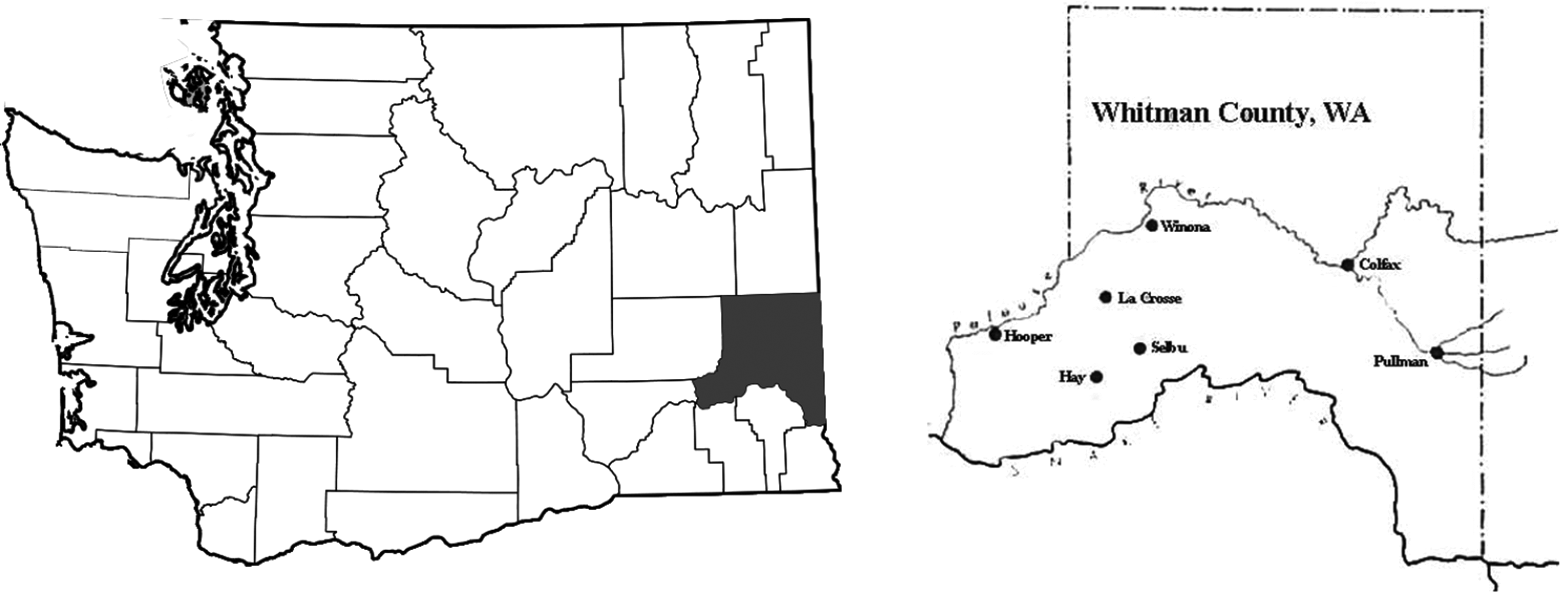
Maps of the State of Washington and Whitman County, showing location of Selbu Lutheran Church.
Classic works such as The American Language, by H.L. Mencken, and The Norwegian Language in America, by Einar Haugen, outline many of the linguistic transformations experienced by Scandinavian immigrants. Those are clearly evidenced by the naming practices of the Selbu community. Similarly, much more recent scholarship among other immigrant groups shows that the Norwegian American experience was clearly part of a much broader process that still continues within American society. For example, in a study of names given to white and black children born in New York State between 1973 and 1985, Stanley Lieberson and Eleanor O. Bell examine patterns in naming of boys and girls to demonstrate how education and race affect the formation of tastes in society. Similarly, Sue and Telles survey naming patterns among Hispanic families in Los Angeles County in 1995; their work illustrates how the processes of immigration and assimilation still exhibit characteristics similar to those seen in earlier immigrant communities. They give particular attention to how the naming process is gendered. While the current study is much more limited in scope, it draws on some of the methodology used by Sue and Telles, and others, while also illustrating trends identified decades ago by Mencken and Haugen. 6
In 1901, a small group of Norwegian immigrants relocated themselves from Minnesota to Eastern Washington. Near the town of La Crosse, WA, they founded a church, which they named for their home community in Norway: Selbu. The new immigrant community grew quickly, and maintained a strong Norwegian character for several decades; for example, the church continued to hold services in Norwegian until the late 1920’s. Yet, even in the earliest years of the community, assimilation into the surrounding American society was occurring. This was clearly evidenced by the names the community members gave to their children, as traditional Norwegian names were quickly replaced by more typically American monikers. Yet, even when they gave their children American names, they frequently continued to choose names with the same initial letter that a traditional Norwegian name would have had. Thus, they often continued a Norwegian pattern even when they were using American names. This paper will examine the extent to which children’s forenames represent the assimilation of Washington’s Selbu community into the broader American society around it (see Figures 2 and 3).

Selbu Lutheran Church, ca. 1914.
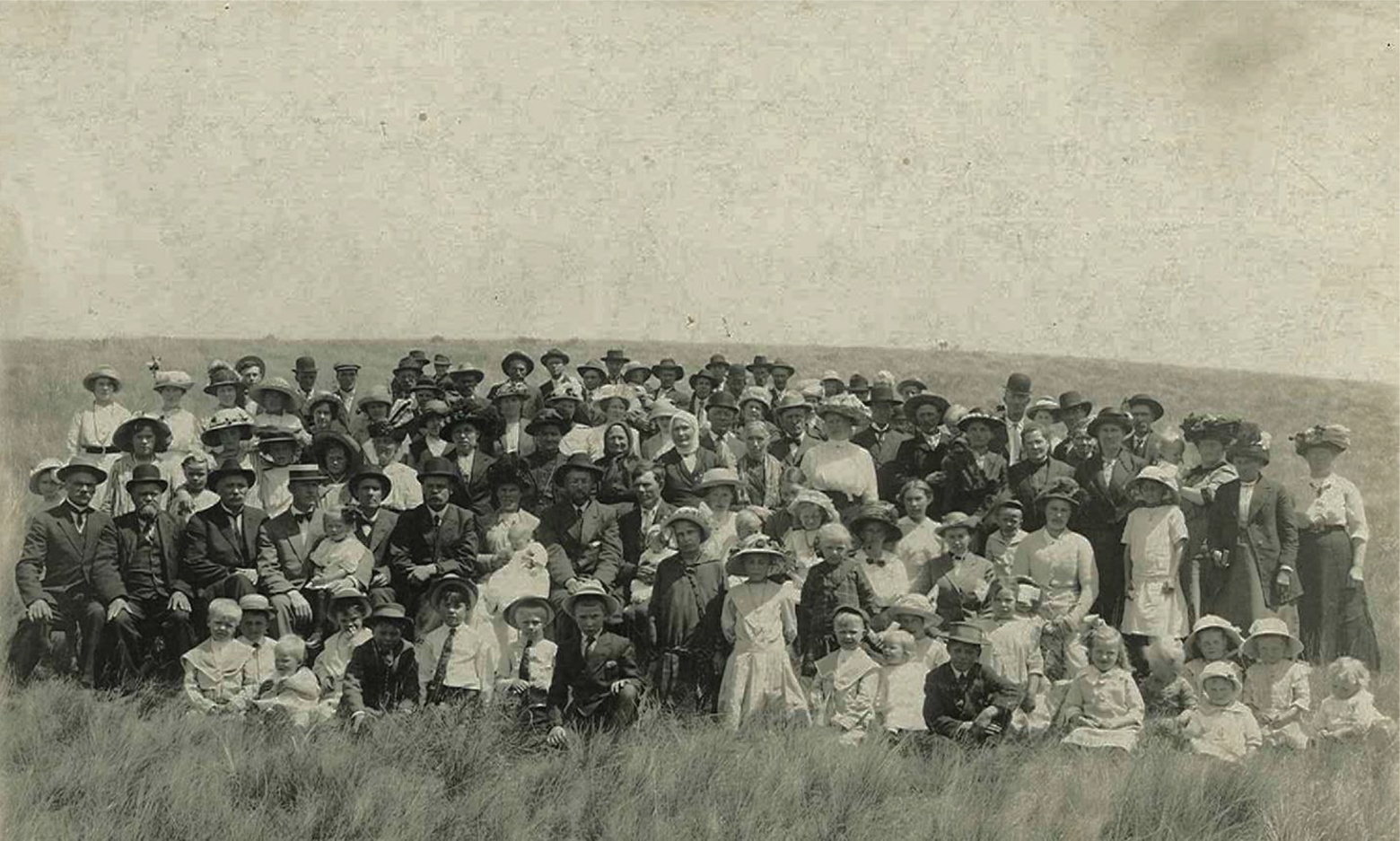
Selbu Lutheran Church Congregation, ca. 1914.
The community represents a number of characteristics of Norwegian immigrant groups in general. Its first members relocated there from other areas of the United States. They were quickly joined by friends and relatives who had also immigrated earlier. Others coming directly from Norway soon followed. This process continued until immigration restrictions were tightened in the 1920’s. Meanwhile, some settlers moved on in search of opportunities elsewhere in the United States and Canada, and some returned to Norway, in what immigration historians often refer to as the “grasshopper” experience, jumping from one location to another. Thus the length of time members of the community had been exposed to American culture, and had participated in the process of assimilation, might be only a few years, or perhaps several decades. For some, assimilation had begun long before they moved to the State of Washington. 7
Numerous studies have shown the ways in which Norwegian immigrants adapted their family names to American standards, particularly if their names contained letters not found in the English alphabet. Examples of such adaptations can be easily found in the Selbu community as well. For example, three members of the Føll family (two brothers and their cousin), ended up with three different last names in America. Christopher Føll’s sons, Ole and Martin, became Ole Christopherson and Martin Fall, while their cousin, Lars Føll’s son Steffan, changed his name to Stephen Larson. Two brothers from the Valli farm near Selbu, Norway, Ole and Johan Valli, ultimately became Ole and John Walli. Other names underwent similar transformations.
Pedro Carneiro, Sokbae Lee, and Hugo Reis examine the adoption of American names by immigrants as part of their assimilation into American society. Their sample includes immigrants from 16 different countries, who arrived in the United States between 1900 and 1930. They conclude “that a large majority of male immigrants to the United States at the turn of the 20th century adopted American names. This adoption was done soon after arrival in the country.…Our data also shows that American names were very common among female immigrants as well as among children of immigrants.” In contrast to the immigrants in their study, relatively few members of the Selbu community changed their own names, other than to accommodate the English alphabet. Unlike most of the immigrants in that study, almost of the members of the Selbu community were engaged in farming. Carneiro et al., point to labor market and other economic factors as incentives to adopt American names. While there may have been perceived economic benefits to giving their children American names, very few of the Selbu immigrants were motivated to change their own names for those reasons. 8
Both Mencken and Haugen describe different immigrant reactions to the English-speaking communities around them. As Haugen notes, “The immigrants who were thrown into contact with Americans quickly discovered that Norwegian given names also were a source of linguistic embarrassment. A man’s surname was primarily a problem of writing; but his given name was the handle by which most of his associates knew him. His fellow workers were quick to find American substitutes for monikers which they were unwilling or unable to imitate.” 9 This can be seen among the Selbu community even before the first settlers moved from Minnesota to Washington.
The first group of settlers in the community included three brothers who had come from Norway to Minnesota with their parents, Jørgen and Ingeborg Vigen, in 1872. Jørgen, Jens, and Peter, by then going by Wigen, moved to Washington in 1901; their older brother, Gunder, remained in Minnesota. By that time, the names they had given their children already reflected a mixture of Norwegian and American influences, following patterns that Haugen noted in other Norwegian American communities. The oldest brother, Gunder, had been named after his paternal grandfather. Jens had been named after his maternal grandfather. Jørgen was obviously named after his father. Use of that name was continued in the next generation by two of his brothers: Jens named his oldest son Jørgen, as did Peter. But while Jens’ son bore the patronymic middle initial “J,” Peter gave his son Jørgen the uncharacteristic middle name of Ignatius. Considering the family’s strong connections to the Hauge Synod, which was one of the more conservative Norwegian Lutheran synods, it is far more likely that the middle name was given to honor the Populist politician, Ignatius Donnelly, than that the name might refer to the founder of the Jesuit Order, St. Ignatius Loyola (Donnelly had served as US Representative and later State Senator from the district where the Wigens lived in Minnesota.) 10
Each of these cousins dealt with his Norwegian given name differently. By the time the families moved to the State of Washington, both the elder Jørgen and Jens’s son had become known as George, and they were known respectively as “George, Sr.” and “George, Jr.” 11 And although Peter’s son retained his Norwegian first name, he was generally referred to by his initials, “J. I.” 12 Other names in the community went through similar adjustments: Beret became Betsy, Gunhild was known as Julia, Tormod’s name evolved into Tom, and Bernt Marcus went by “B.M.”
By the time the Wigens arrived in Washington, their children’s names were increasingly American. For example, George, Sr.’s daughter, Esther Constance, was the first child baptized in the Selbu church, in 1903. Three years later, her brother, Chester Arthur, was baptized with a clearly American name. The first dozen names in the baptismal list (through 1906) are overwhelmingly American, with only a few “Norwegian” names: Esther Constance, Elenora Josephine, Harry Leo, Joseph Marian, Judith Geraldine, Naomi Ovida, Clarence Jerome, Chester Arthur, Clara Bertina, Janice Nadine, Josephine, and Truman Selmer. This reflects a trend noted by Ran Abramitzky, Leah Platt Boustan, and Katherine Eriksson. In their study of cultural assimilation during mass migration from Europe between 1850 and 1913, and from Asia and Latin America from 1990 to 2017, they observe that “consistent with a process of cultural assimilation,…immigrant parents gave both their sons and daughters less foreign names as they spent more time in the US, in a linear fashion for the first twenty years and slowing down thereafter. Children born after their parents had spent over 20 years in the US scored 8–10 points lower on the Foreignness Index relative to their siblings born upon their parents’ first arrival.” 13 The children baptized at Selbu Lutheran Church through 1906 were all born to parents who had been in the United States before moving to the State of Washington, some for nearly thirty years; some of the parents were born in America.
With the arrival of a group of immigrants coming directly from Selbu, Norway, in 1907, a few names appear on the list that are more predominantly Norwegian: Alma Regina, Cora Geneva, Brynhild Amanda, and Magna Gislaug. Nonetheless, Americanization of names could soon be seen both among the immigrants who had arrived directly from Norway, as well as those who had spent only a few years elsewhere in the United States. The development noted by Abramitzky, Boustan, and Erikkson can be seen in the Selbu community as names once again became more American the longer each set of immigrants had lived in America, even if the congregation retained its predominantly Norwegian character. 14
A good example of a gradual transformation can be seen in the church records. Ole Valli emigrated from Selbu in 1901, and spent four years in Minnesota before moving to La Crosse, Washington. (His aunt, Beret Wigen, had moved there with her husband Peter in 1901.) In 1907, his brother Johan Valli and wife, Anna, immigrated to La Crosse directly from Selbu, Norway. 15 When their son was born later that year, they gave him the same name as Johan and Ole’s older brother who had remained in Norway: John. The baptismal record lists the father as “John Valli.” 16 (While the spelling “John” is not widely used in Norway, numerous instances of the name can be found among the emigrants from Selbu and their families in “the old country.” The origin of the child’s middle name, Bernhard, is not known.) John and Anna continued to give their children Norwegian names: Magna Gislaug in 1909 and Astrid Josephine in 1911. For the entries for both girls, the father’s name in the register had returned to the original spelling, Johan Valli. In the 1910 US Census, it had changed again, this time to Johan Walli. In 1913, they named their son Joris Oscar. 17 Then, the father was listed as John Valli. In 1916, a son, Justin Alfred, died a month after he was born. The following year, another son was born; following Norwegian tradition, he was given the same name as the dead child. That tradition continued among Norwegian immigrants even when American names were used. The baptismal record in 1916 lists the child’s father as John Walli, which remained the name he went by until he died in 1959. 18
Ole Valli married one of the 1907 immigrants from Selbu, Karen Nervig. When their children were baptized in 1909, 1910, 1912, and 1913, the father was listed in church records as Ole Valli. But in the baptismal entry for twins born in 1915, the spelling of the last name had changed: the father’s name was then entered as Ole Walli. 19
The original congregational record book which forms the basis of this study includes baptisms from 1903 until 1950. The list contains 279 names. Of those, five were adult baptisms, of people who moved into the community, usually marrying a member of the congregation. Because those are not germane to this study, they have not been included in it. Of the 274 children baptized, there were 139 girls and 135 boys 20 ; 66 (24.1 percent) of them were born to parents who had both emigrated from Norway (36 girls and 30 boys). Among children who had one parent born in Norway, there were 109 whose fathers were immigrants, and eighty-seven whose mothers were born in Norway. There were eight children whose fathers were born in Sweden, and five with Swedish-born mothers. 21 Conversely, for children who had one parent born in the United States, there were 149 whose fathers were American born, and 174 whose mothers were. The birth country is unknown for the fathers of six children, and also for the mothers of six. There were only thirteen children (eight girls and five boys) who did not have at least one grandparent known to be of Scandinavian background.
Throughout most of the period under examination, the Norwegian character of the community remained strong. In general, members of the congregation tended to marry others of Scandinavian descent (often marrying within the congregation). Of the 149 whose fathers were American born, only 37 (24.8 percent) did not have at least one paternal grandparent who was born in Norway or Sweden. Similarly, out of 173 whose mothers were born in the United States, only 46 (26.6 percent) did not have at least one maternal grandparent of Scandinavian extraction. 22
Following the methodology used by Sue and Telles in their study of Hispanic naming patterns, each name in the baptismal records has been ranked on a continuum of relative “American-ness” or “Norwegian-ness.” They note that in their study, To capture this linguistic continuum, we measure the Spanishness of first names by relying on an ordered variable created on a scale ranging from “1,” representing the most English names, to “5,” representing the most Spanish names. Specifically, “1” refers to English names that are not translatable into Spanish (e.g., Ashley), and “5” refers to Spanish names that are not translatable into English (e.g., Guadalupe). The intermediate categories represent names that are neither strictly English nor Spanish. A “2” represents an English name that has a Spanish equivalent (e.g., Michael), and a “4” coding represents a Spanish name that has an English equivalent (e.g., Miguel). Finally, a “3” represents a name that is considered native in both languages (e.g., Andrea).
23
1 = most “American”—not translatable 2 = American with Norwegian equivalent (e.g., Irvin/Øyvind) 3 = Native in both (including slight spelling variations) 4 = Norwegian with American equivalent (e.g., Jørgen or Jurgen/George) 5 = Most “Norwegian”—not translatable.
24
There are relatively few duplicate names in either the male or female cohort. (See Appendix A for the complete list of the boys’ names.) Among the 133 boys, there are 90 discreet names. Similarly, among 139 girls, there are 108 individual given names. 25 The most popular boys’ name was John (with ten examples), followed by four Donalds and four Roberts. Six boys’ names were used three times, and eighteen were each used twice. Despite the frequency of “George” (or Jurgen) among the original settlers, only two children in the Selbu community were given that as a first name; not surprisingly each was a grandson of one of the George Wigens (Sr. and Jr., respectively). Similarly, one of J. I.’s grandsons was named Jurgen; that was the only instance of that as a first name of a child born in the community. One child had George as a middle name, and there were two boys whose middle name was Jurgen.
On the continuum of American-ness/Norwegian-ness, of those twenty-seven names that were used more than once, only one name was category 5: Ole. There were no category 4, and six category 3: John, Robert, Justin, Oscar, Paul, and Theodore. There were five category 2 names, and fifteen category 1.
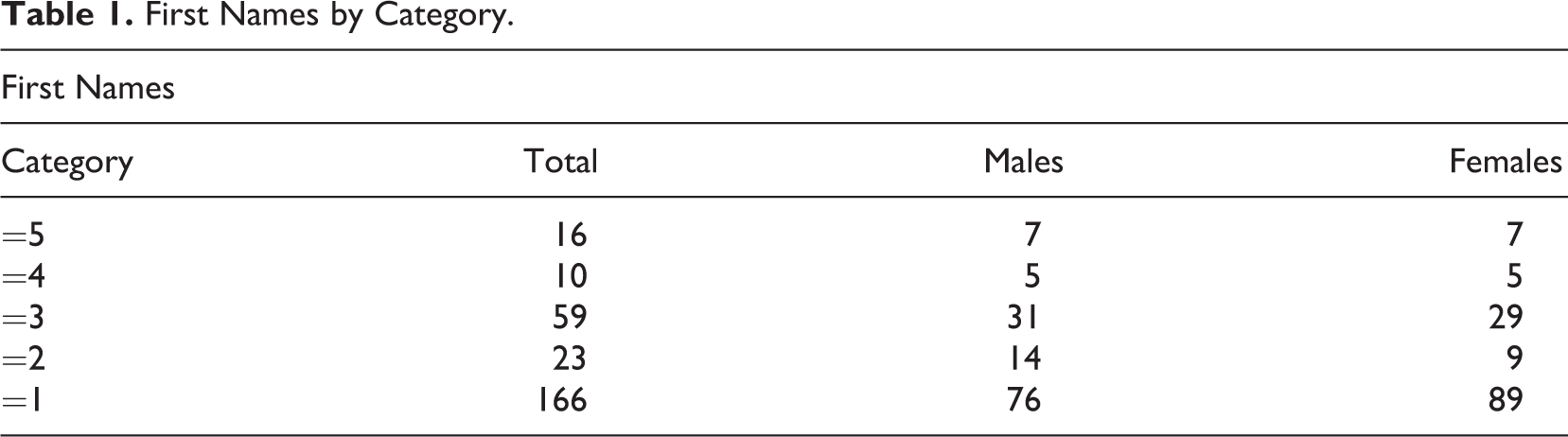
The continuum is even more markedly “American” for girls’ names. (For the list of girls’ names, see Appendix B.) The most popular girls’ name was Ruth (with five instances). No girls’ name appeared four times; five appeared three times (Bernice, Clara, June, Leona, and Norma). There were seventeen names with two instances each. Of the 23 girls’ names with multiple instances, none was a category 5 name. As with the boys, there were no category 4 names, and six category 3 names: Ruth, Alphie, Cora, Ida, Marie, and Olga. The higher percentage of American names among girls corresponds to the conclusions of other studies of immigrant naming patterns. For example, Abramitzy, Boustan, and Erikkson note that “sociologists have documented that parents are more open to new or creative names for girls, while boys tend to receive a more traditional set of names.” Similarly, Carneiro, Lee, and Reis found that among children born to immigrants, more girls than boys had an American name. 26 . Looking at the number of names in each category, the total number of names breaks down as shown in Table 1.
First Names by Category.
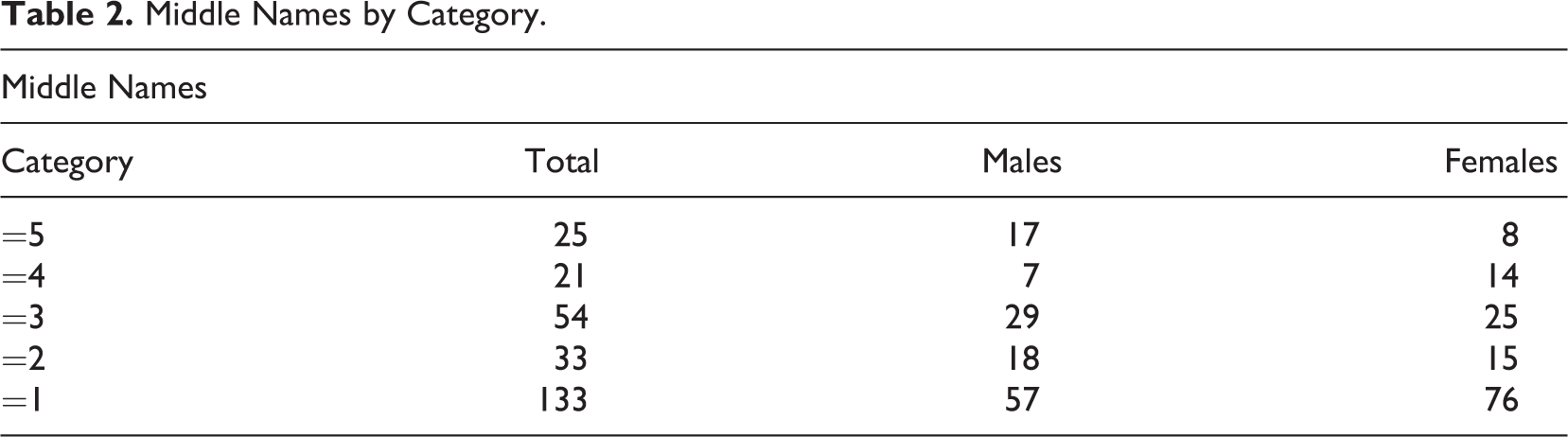
There is a similar distribution among middle names, though there is a slightly higher frequency of “Norwegian” middle names (categories 5, 4, and 3) among males, and more “American” (category 1) names among females (see Table 2).
Middle Names by Category.
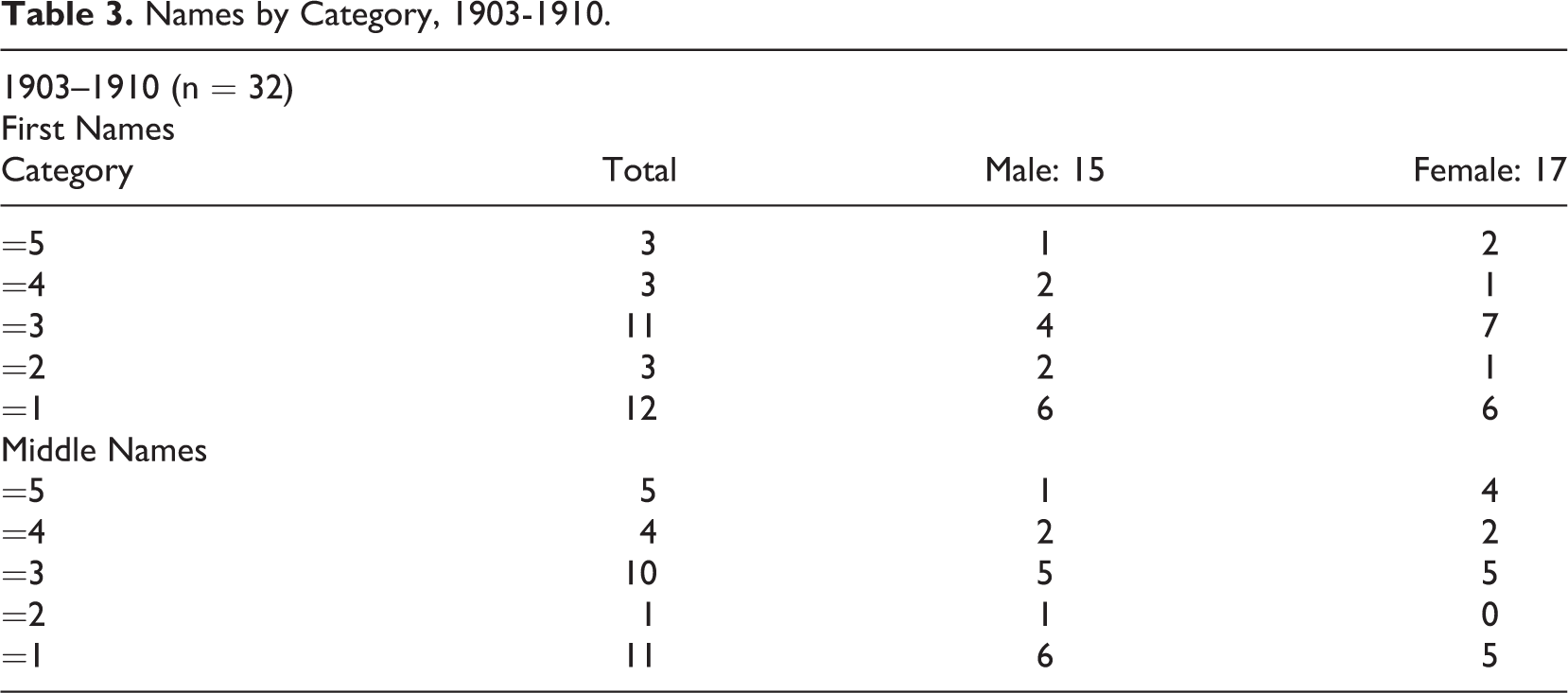
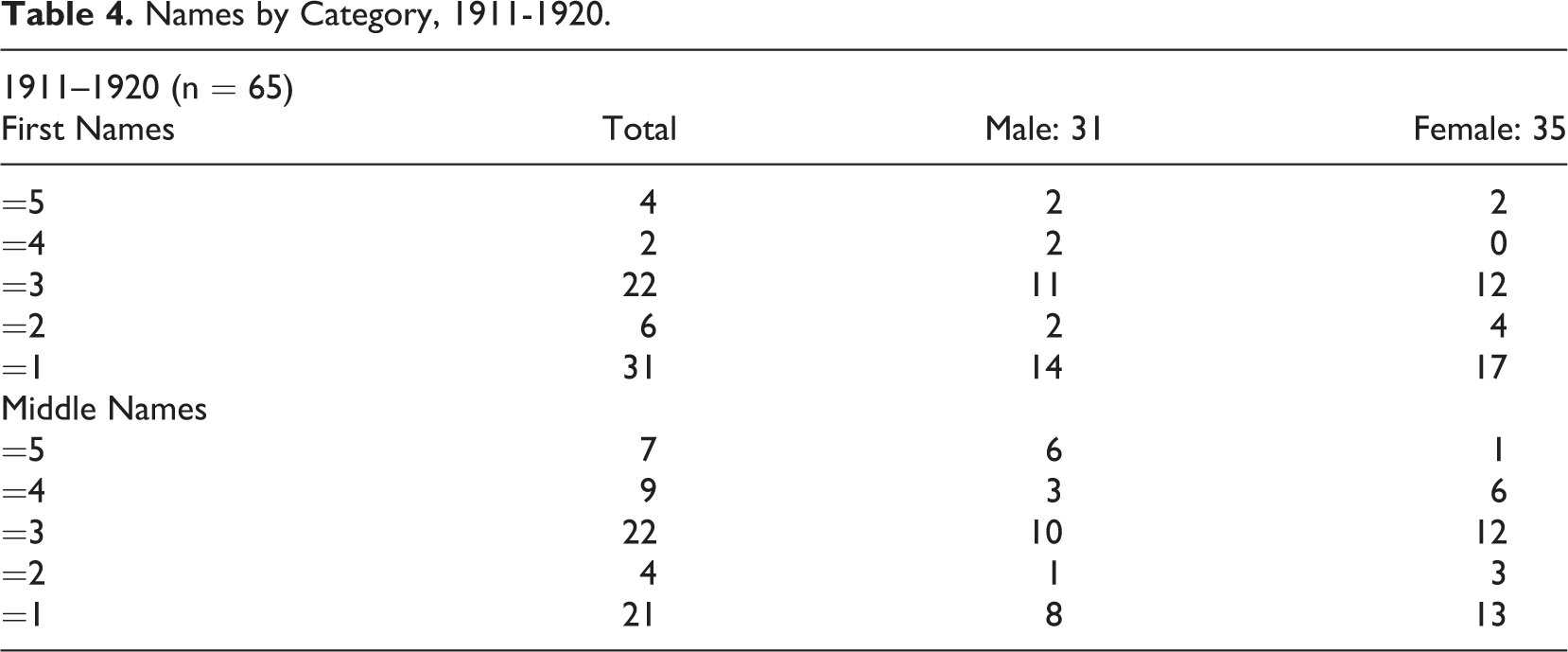
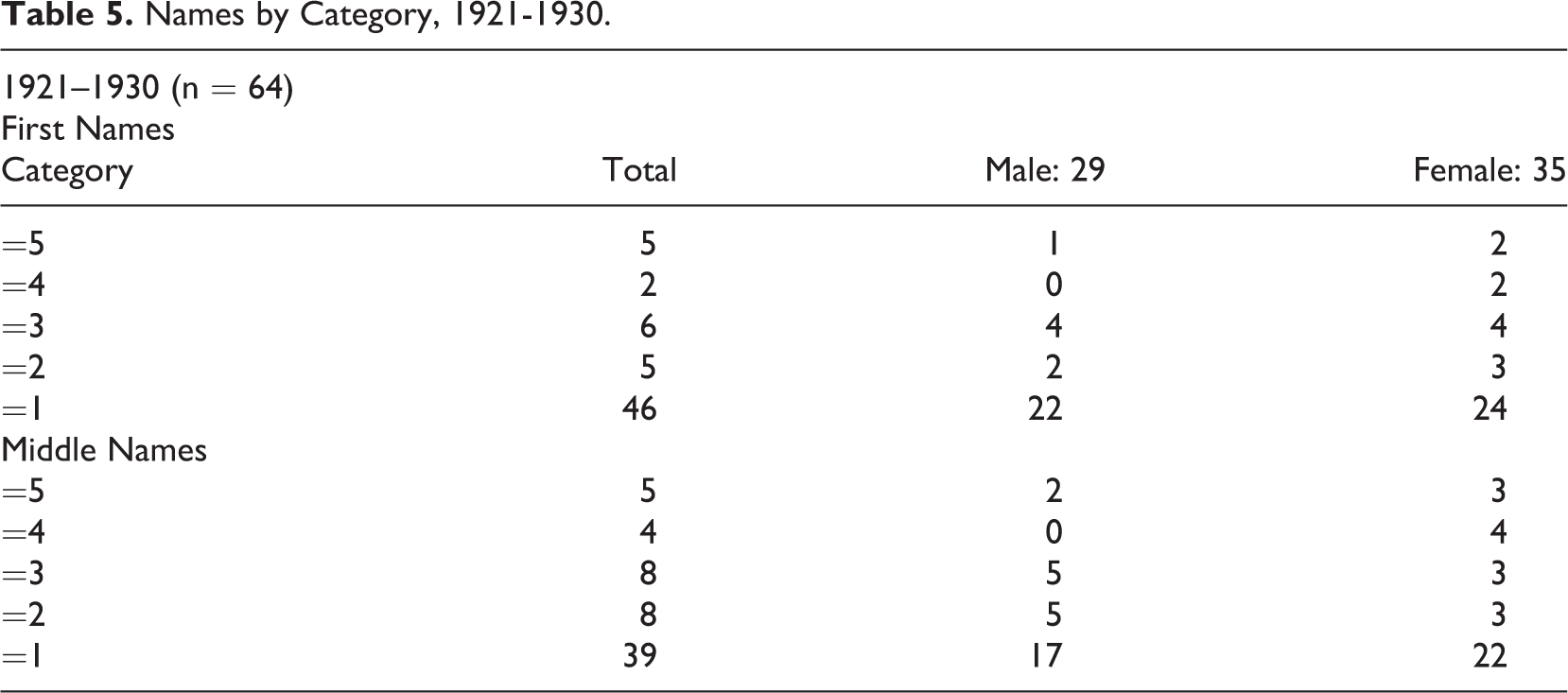
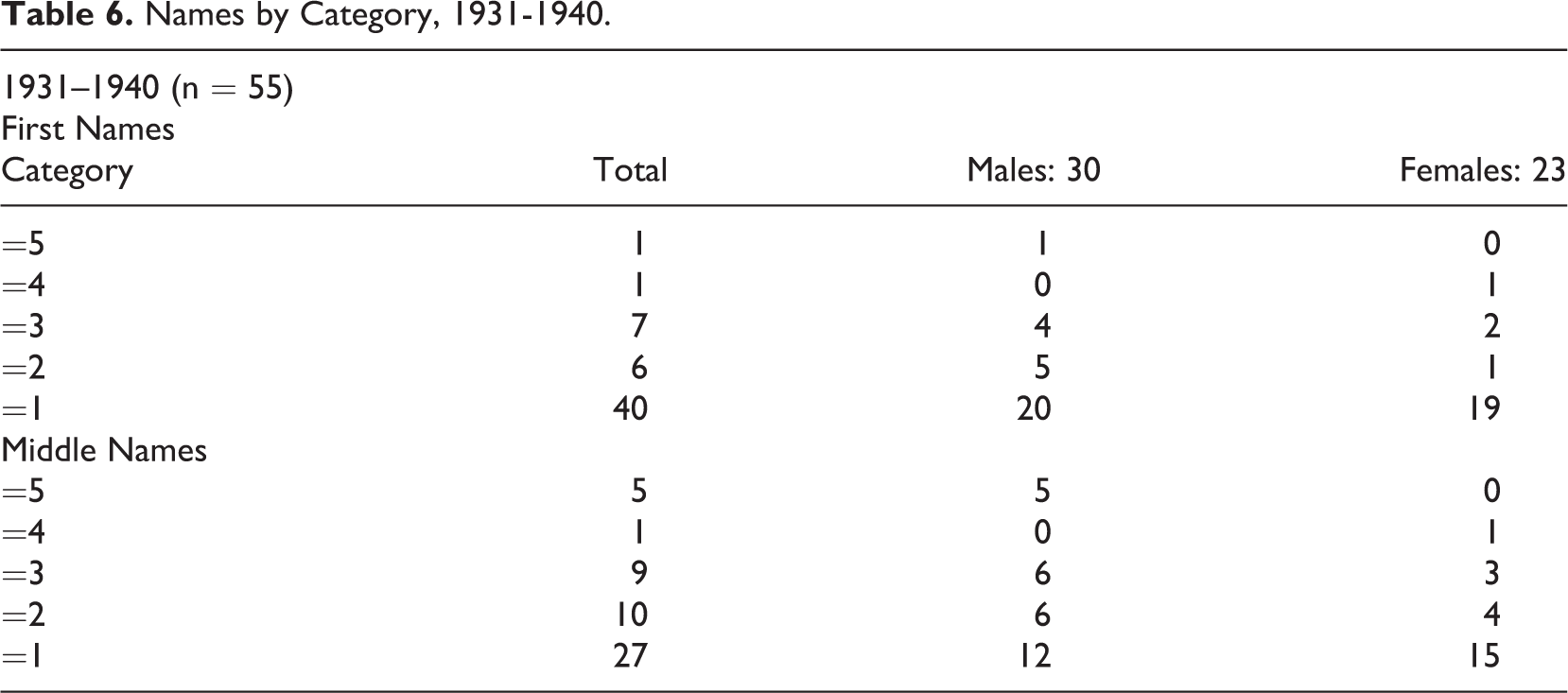
As might be expected, the frequency of “Norwegian” names declines over time. The farther removed from the immigration experience, the fewer category 5 and 4 names appear. Even though category 3 names could be “American” or “Norwegian,” they also decline in number over time. Looking at the names by decade, they break down as shown in Tables 3 –7.
Names by Category, 1903-1910.
Names by Category, 1911-1920.
Names by Category, 1921-1930.
Names by Category, 1931-1940.
Names by Category, 1941-1950.
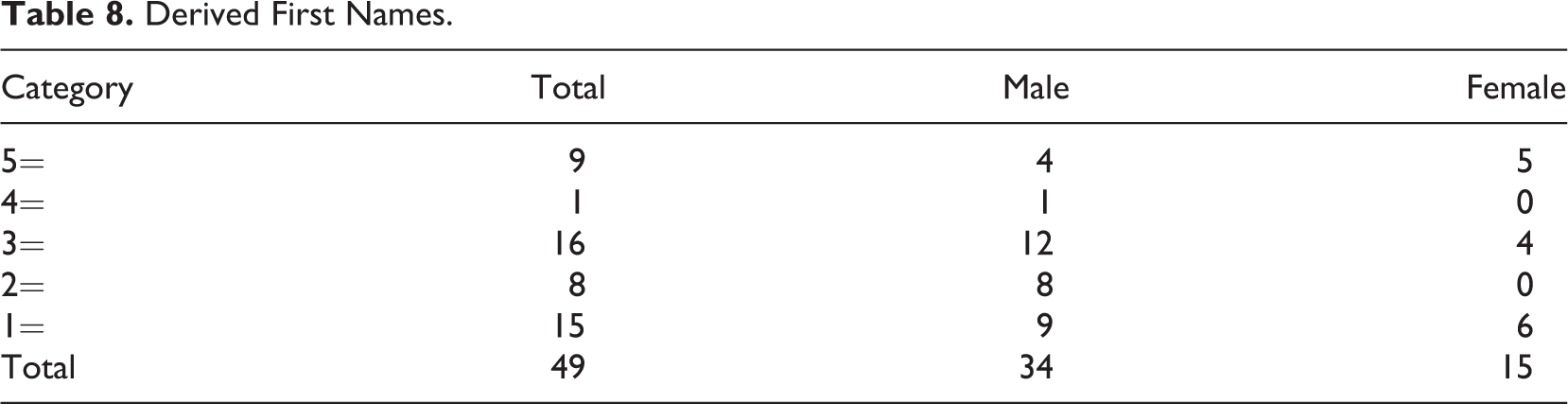
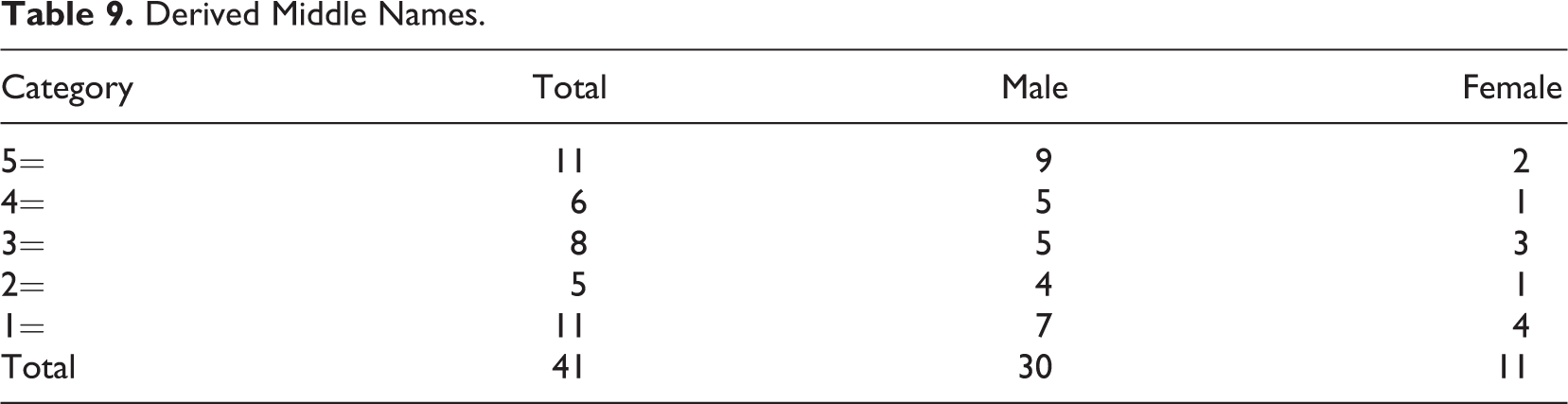
Of the 274 children baptized in the Selbu congregation, forty-nine (17.9 percent) had first names that were the same as or derived from a parent, grandparent, or other relative. That was far more common among boys than among girls, as only fifteen girls had first names derived from relatives, compared to thirty-four boys with such given names. There was a similar disparity between boys and girls who had middle names the same as or derived from the name of a parent, grandparent, or other relative: of forty-one children with such middle names, thirty were boys, and only eleven were girls. But many of such “derived” names were more American than Norwegian. For example, Tormod was known by the Americanized version of his name: Tom. He had two grandsons with the first name Thomas, and another with that as a middle name. He also had another grandson named Truman, which was probably a different derivation of his name. Another immigrant, Halvor, named his son Harry. Similarly, Beatrice Angela was the granddaughter of Beret, who was generally known as Betsy; Beatrice was, in turn, generally called Betty, and she named one of her daughters Betty Ann. For the distribution of the “derived” first and middle names by category of “Norwegian-ness,” see Tables 8 and 9.
Derived First Names.
Derived Middle Names.
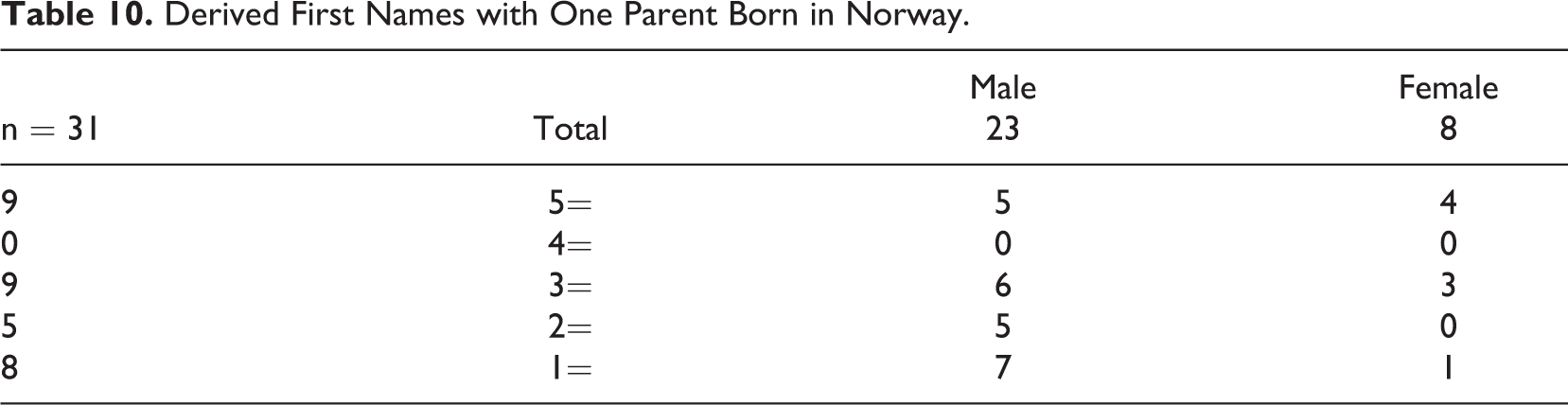
Of the forty-nine children whose first names were derived from another relative, eleven (22.4 percent) were from families in which both parents were born in Norway (nine boys and two girls). Conversely, of sixty-six children whose parents were both born in Norway (thirty boys and thirty-six girls), only eleven had first names the same as or derived from parents, grandparents, or other relatives (nine boys and two girls). Of forty-one with middle names derived from relatives, eight (19.5 percent) had both parents born in Norway, and twenty-seven (65.9 percent) had one parent who was a Norwegian immigrant (seventeen fathers, and ten mothers). (None of the Swedish families gave their children first names derived from their parents, and only 5 did so with middle names—one had both parents born in Sweden, three had Swedish born fathers, and one had a Swedish born mother. The names of the Swedish grandparents are not available.) Of the 196 children who had one parent born in Norway, thirty-one (15.8 percent) had first names the same as or derived from a parent or other relative (16 with Norwegian-born fathers, and 15 with mothers born in Norway).
It was relatively rare for children to be given the same (original or non-Americanized) name as a parent. Besides George Wigen, Jr. (who by today’s naming standards would probably be known as George II or 2nd, and whose naming predates the Selbu community’s foundation), there are only two incidences in which “Junior” appears in the group. One was the son of a non-Norwegian father (and a Norwegian American mother). The other shared his first name, John, with his father, and Junior is entered as the middle name in the baptismal record; he was known to most people as Junior, rather than John. In the case of one family with a non-Norwegian father, William Charles, and a Norwegian American mother, twin sons were named Charles William (the father’s names reversed) and Thomas Allen—Thomas being the Americanized version of his maternal grandfather’s name, Tormod. Only twelve boys and one girl shared the same first name as a parent. Four of those were named John, and four others had strongly Norwegian given names: Christian, Justin, Reidar, and Gunder. (The others were Thomas, Theodore, Stanley, and Walter.) The girl and her mother were named Tora.
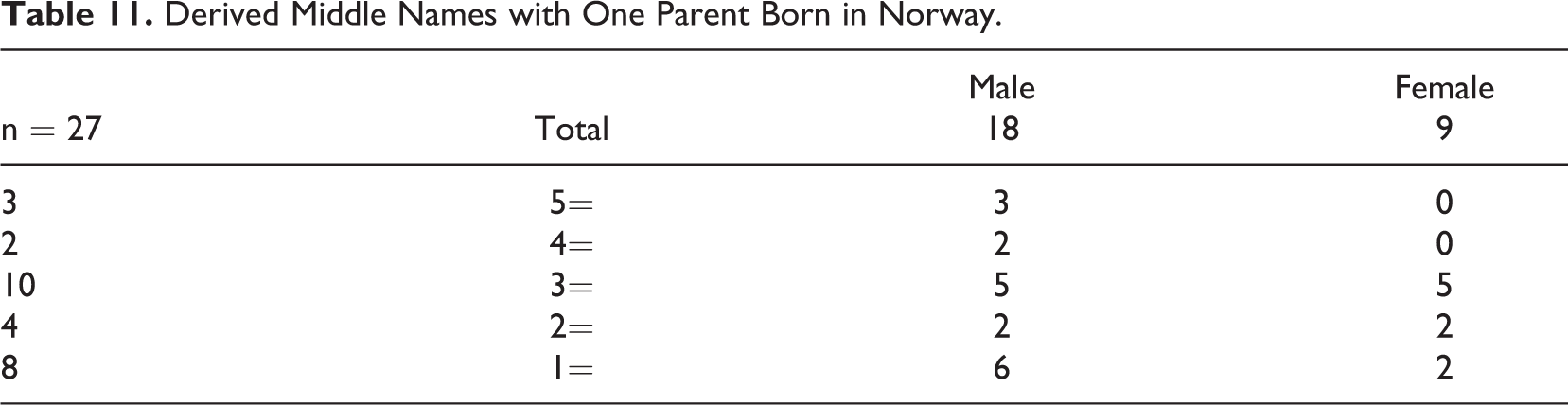
The use of “derived” names also represents a gendered character of the naming practices. Boys were more likely than girls to have either a first or middle name derived from a parent or grandparent, and a derived boy’s name was more likely to rank higher on the scale of “Norwegian-ness” than a girl’s (see Tables 10 –15).
Derived First Names with One Parent Born in Norway.
Derived Middle Names with One Parent Born in Norway.
Derived First Names with Father Born in Norway.

Derived Middle Names with Father born in Norway.
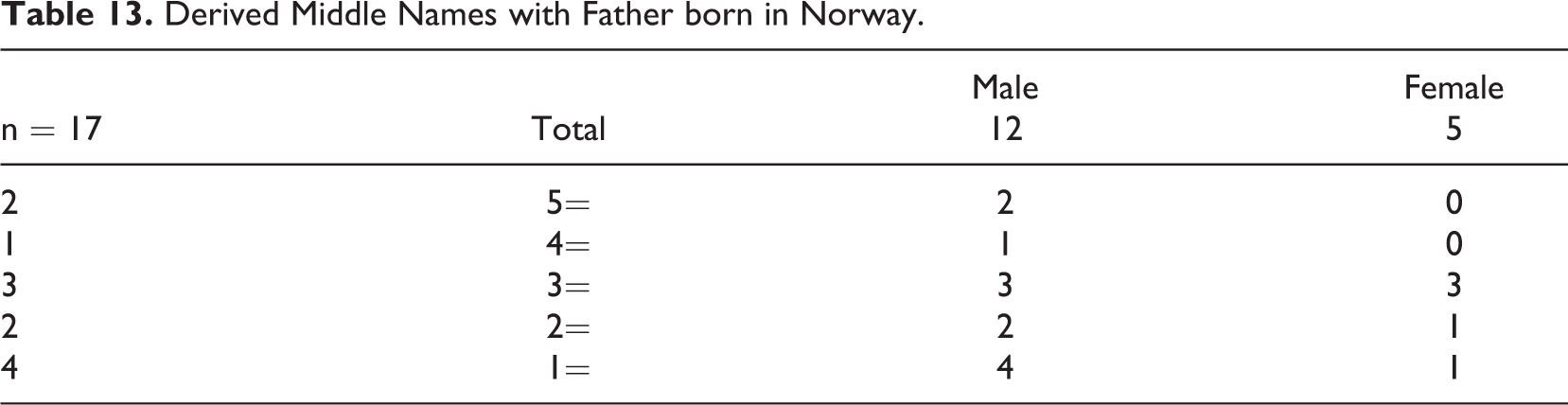
Males with Mother born in Norway for Each Name Category.
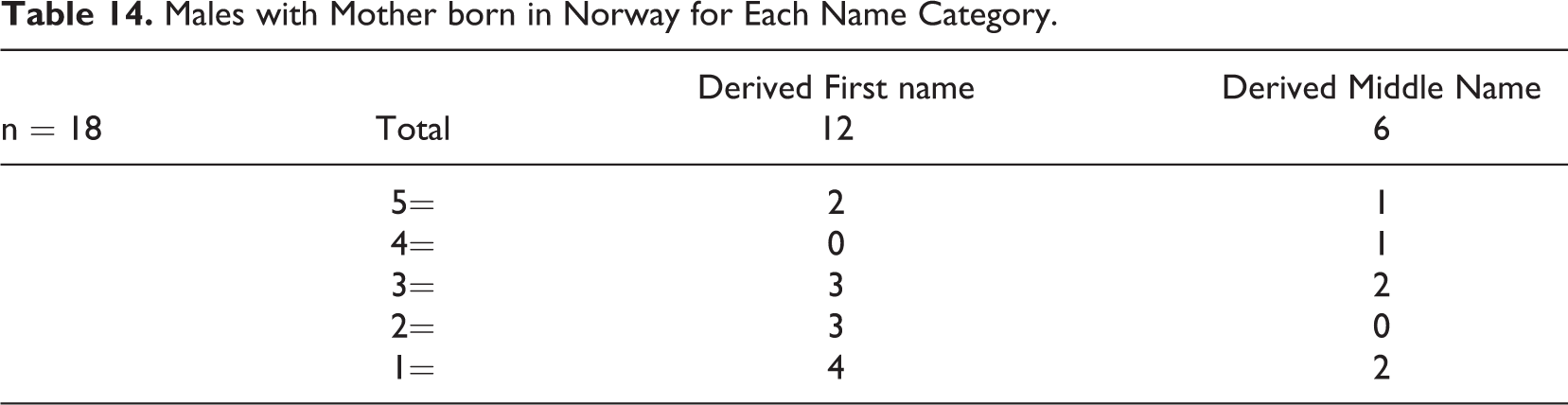
Females with Mother Born in Norway for Each Name Category.
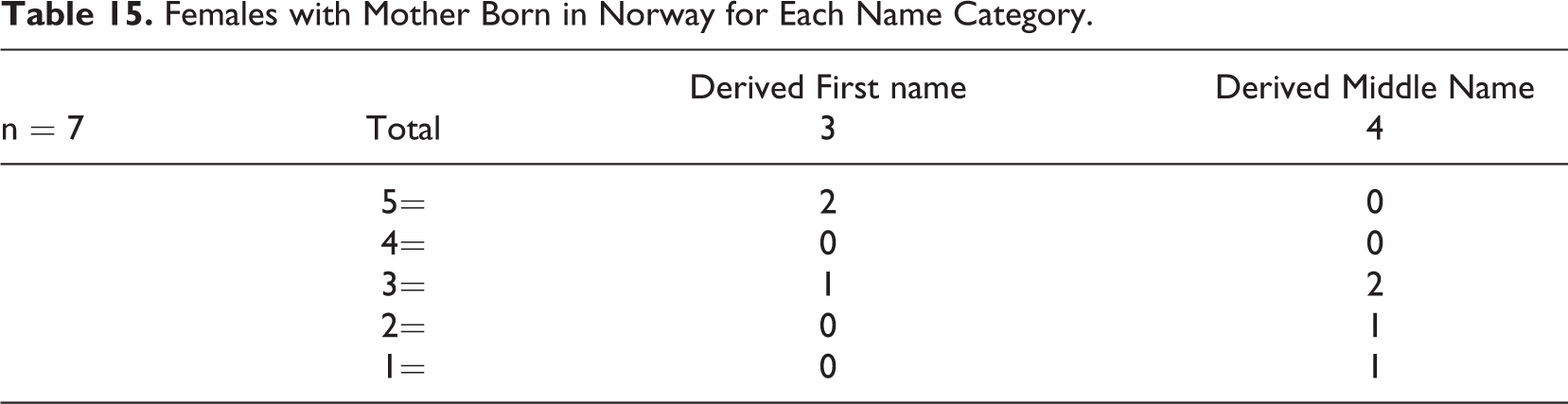
Giving children names of Scandinavian origin is not the only way that immigrants carried on naming traditions. As Haugen notes, parents often practiced what he describes as “‘alliterative naming.’ This may be defined as the substitution of an American name for a Norwegian one with the same initial letter.…It is the normal procedure of Anglicizing names.” 27
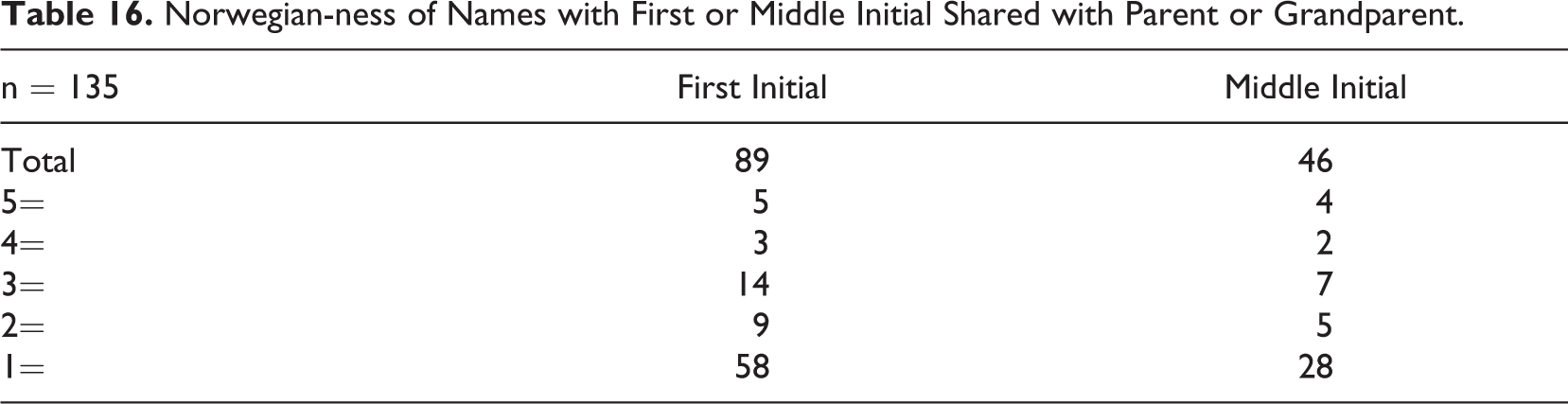
Of the 274 children baptized in the Selbu Church, eighty-nine (32.5 percent) shared a first initial with a parent or grandparent, and forty-six (16.8 percent) had middle initials that were the same as a parent or grandparent’s first initial. A few shared both initials. But for most of the children who shared initials with relatives, their names fell predominantly in the “American” end of the name spectrum. A good example is immigrant Bernt Marcus, whose son was named Byron Melbourne. The breakdown of initials by the “Norwegian-ness” of the full name is shown in Table 16.
Norwegian-ness of Names with First or Middle Initial Shared with Parent or Grandparent.
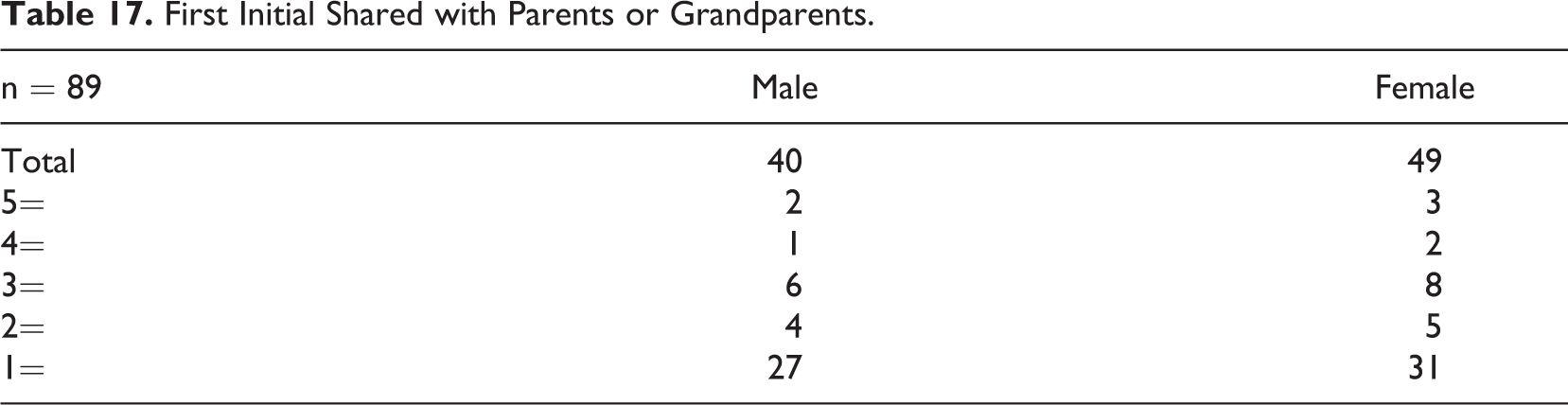
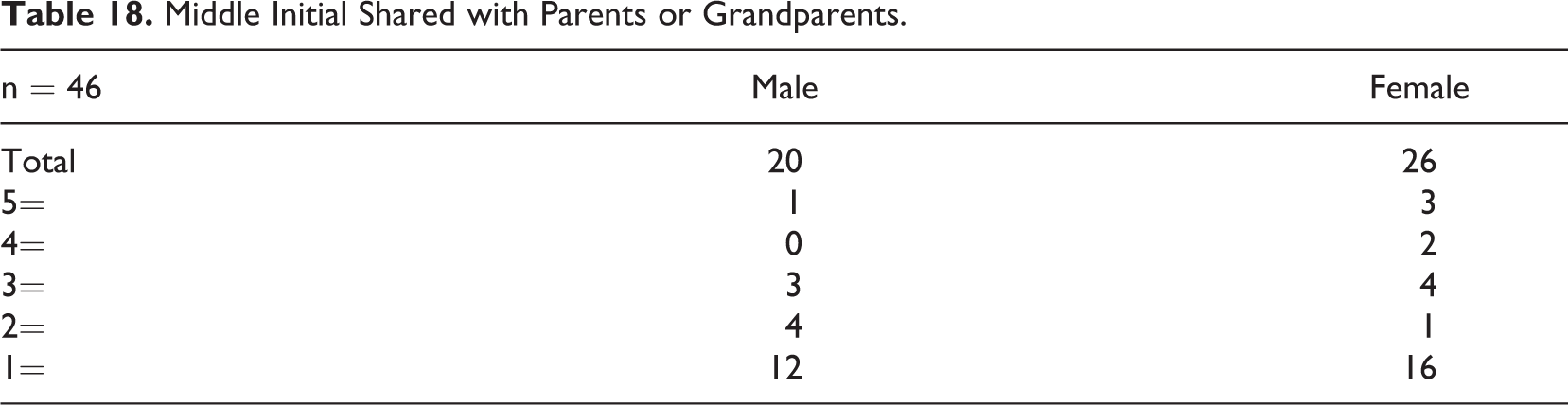
In contrast to the experience with shared names, girls were slightly more likely to share initials with their parents or grandparents than were boys (see Tables 17 and 18).
First Initial Shared with Parents or Grandparents.
Middle Initial Shared with Parents or Grandparents.
There were only thirteen children (eight girls and five boys) who did not have at least one grandparent known to be of Scandinavian background. But of that number, there were only two first initials shared with a parent or other relative, and only six shared middle initials. (The first initials were of boys who also shared middle initials with a parent. Another boy and 3 girls each shared their middle initial with a parent. Although one of the boys sharing both first and middle initials had “Norwegian” first and middle names, Manrad Fredrik, no additional information is available regarding him or his parents; thus their background is classified as “unknown.” The names of his parents, Martin and Frederikke Johanna, suggest that he was of Scandinavian heritage, and his godparents were members of the Gustafson family, who were of Swedish and Norwegian descent. Without further information, however the child’s ethnic background cannot be stated with certainty.)
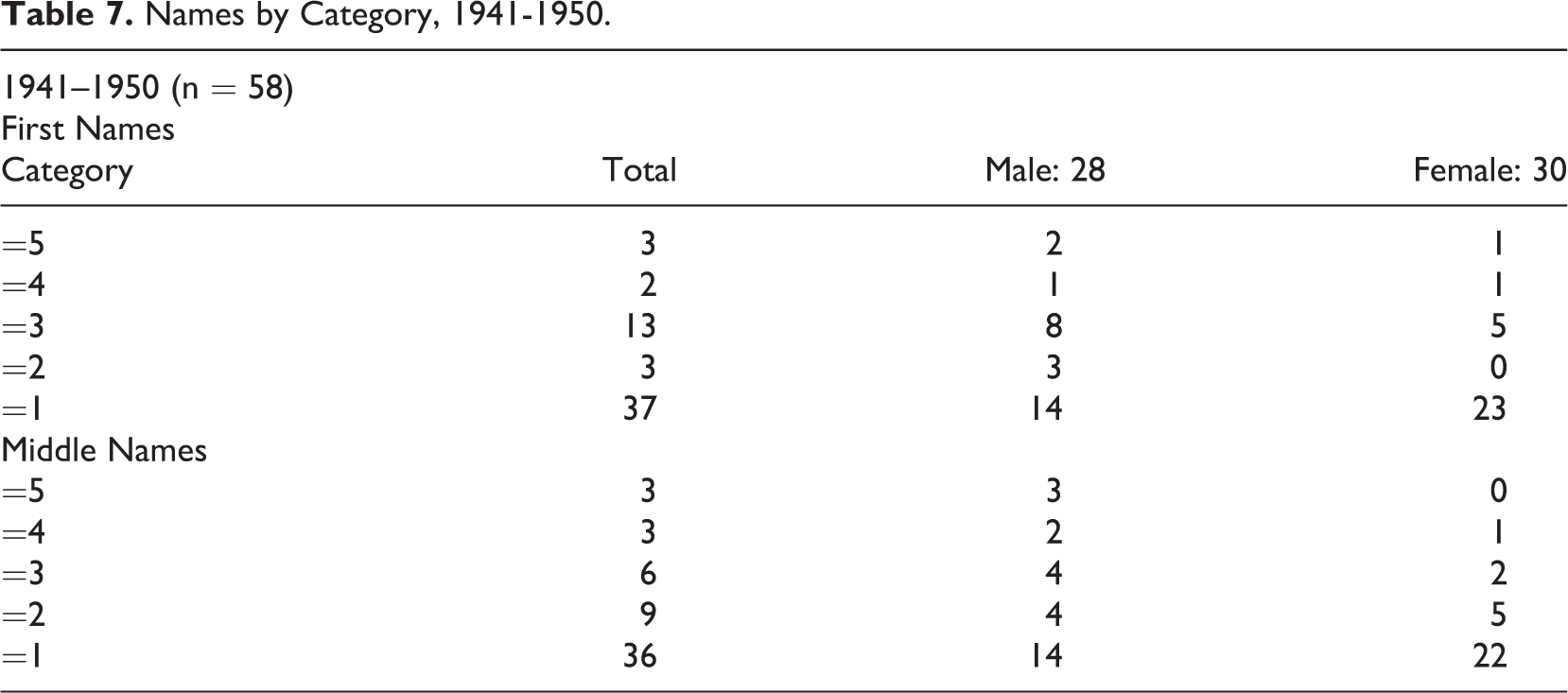
By the 1940s, relatively few members of the community were still giving their children “Norwegian” names. In the decade from 1941 to 1950, there were 58 children baptized in that decade: 28 boys and 30 girls. Only 3 children had category 5 names: Ole, Reidar, and Tora. (It is probably not coincidental that they all had at least one grandparent in the group of immigrants who arrived from Selbu in 1907.) But most of the children born in that decade had names that were at the American end of the spectrum. There was a similar distribution of middle names in that decade. Again, girls tended to have names that were more American than the boys (see Table 7).
After World War II, the Selbu community became increasingly less homogeneous. Some men returned from the war with brides whom they had met elsewhere. Others married women who had come to the La Crosse community as unmarried teachers. Women who went away to college or to work in cities like Spokane or Seattle met husbands who came from a wide variety of backgrounds. Although the church records for the period after 1950 have not been examined, anecdotal evidence suggests that the trends which had begun in the 1940s were accelerated in the coming decades, but with a slight revival of Norwegian names beginning in the 1970s.
Although there were some lingering cultural legacies evident through the 1940s, it is clear that the names used in the Selbu congregation illustrate the increasing Americanization of that community. As the group came to include more non-Norwegian members, the tendency to choose more American names increased. The use of Norwegian names, or names derived from Norwegian relatives, persisted more frequently among boys than girls. But while the names became more American, traditional Norwegian names did not disappear completely.
Footnotes
Appendix A
Appendix B
Declaration of Conflicting Interests
The author(s) declared no potential conflicts of interest with respect to the research, authorship, and/or publication of this article.
Funding
The author(s) received no financial support for the research, authorship, and/or publication of this article.
