



Abstract
Based on a database of Australian cases from 1834–1954, this article argues that abandonment was an intentional strategy intended to maximise a child's chances of survival while preserving its family's reputation. However, abandonment had the potential to expose family secrets, bringing them into the public gaze and subjecting them to interrogation. Abandonment was also used for revenge, exposing the identity of putative fathers in a demand for financial support. Through this analysis the article positions abandonment as a key site of interaction between the individual and society, and the private and the public in relation to the politics of secrecy.
Infant abandonment has an extensive history. Long a trope in literature, the foundling has, since the 1980s, attracted the attention of historians, encouraged at least in part by the development of new methodologies that facilitated the analysis of records of the institutions through which different societies managed the problem of unsupported children. These studies focused on the demography of abandonment, and the ways in which this was impacted by legislative and economic change. 1 There is no consensus in such studies as to the rationale for abandonment. Foundling hospital studies position poverty rather than shame as key motivation for mothers seeking to have their children admitted. 2 Studies drawing on inquest data tend to include the phenomenon within the broader context of infanticide, the infant's survival (at least in the short term) being seen as a matter of chance rather than intention. 3 Broader studies contradict this view arguing for abandonment as a carefully chosen alternative to infanticide, a tactic selected in the hope that it offered a chance of survival which the mother could not provide. 4 This article takes the latter view, shifting the focus of analysis from management to the notion of abandonment as a performance designed to preserve but with the potential to destroy family secrets. It argues for abandonment as a highly intentional strategy, clearly distinguishable from infanticide in most instances, which enabled the mother (sometimes in association with other relatives) to maximise the chances of survival for her child while using anonymity to preserve her reputation and that of her family. 5
The Politics of Secrecy
As anthropologist Lenore Anderson has argued, “the revelation of a secret is performative. Comprising or informing a personal narrative, conveying a secret does not simply reveal what was hidden; it reveals the politics behind it … telling a secret has a goal, such as to create intimacy, to seek forgiveness, to witness and pursue justice.”
6
This article focuses on secrecy as performance, examining cases in which wittingly or unwittingly, secrecy failed and identifying the ways in which the power of the secret was used, at different times, both to minimise the stigma attached to ex-nuptial birth, and to spread the shame beyond the maternal family in an attempt to garner financial support for the child. Abandonment, it argues, provides a window into the relationship between secrecy, stigma and shame in the context of ex-nuptial pregnancy.
7
“The social distribution of secrecy is never innocent or neutral,” Don Kulick, has observed. “It is always a reflection of relations of power and of the desire of some people to manage or control the behavior of others.”
8
This observation is particularly apposite in relation to the management of ex-nuptial pregnancy which, in most Western societies, was highly stigmatised, and brought the threat of shame to the family.
9
Secrecy, Deborah Cohen has argued, was a tool used by families to limit the impact of such shame. While the family was not the source of the stigma, its awareness of the power of the stigma led it to attempt to construct a circle of secrecy around the incident, in order to manage its impact.
10
As Anne-Marie Kilday and David Nash have noted, a family's understanding of this private shame was built upon the observation of the shame of others, the knowledge obtained through observing from a distance creating an understanding of the fate that awaited them should their efforts to maintain the family secret fail.
11
There is a sense in which secrets are destroyed at the moment of their conception, only coming into existence through their disclosure. 12 Telling or not telling become the means through which power relations are negotiated both between the family and the wider society, and amongst individual family members. 13 And “once told, even to a single person, or merely to oneself, secrets are no longer completely secret but … [come] into view as potential objects of knowledge.” 14 For secrecy to retain its power in the face of potential stigma, families have had to engage in what Carol Smart has described as “active not-knowing … a way of keeping perceived problems at bay while also being part of the operations of micro-power … a subtle choreography of secrecy management where some people learn not to ask, others create veils of confusion or are simply economical with the truth.” 15 The unexplained appearance of an abandoned infant on a family doorstep, or another location that implicated family members, threatened this façade, raising questions about the image which the family had been trying to present to the world.
Infant Abandonment in Australia
This article examines secrecy management around infant abandonment in Australia from the early colonial period through to the 1950s. Its focus is on the settler populations whose birth rate was the central concern of governments keen to consolidate their claim to sovereignty over a land previously occupied by the Indigenous population whose numbers diminished sharply in the wake of their dispossession. Despite rising concern about the high infant mortality rate amongst the settler population as it grew, Australian governments were reluctant to introduce measures that would help single mothers to support their infants, despite the evidence that early separation lay at the root of excess infant deaths. Boarding out and the other forms of payments to mothers developed initially by the states, and from the 1940s by the Commonwealth, generally excluded mothers who had had children outside marriage who were increasingly expected to surrender children to adoption. Prior to the introduction of such payments, the Australian colonies had also rejected the anonymity offered by the European foundling hospital model, which provided spaces at which infants could be deposited in secret. From the end of the nineteenth century there were a small number of institutions that called themselves foundling hospitals but they followed the British practice of demanding that the mother identify herself, as a condition of accepting the child. 16 Although these institutions did, inadvertently, become a focus for abandonment, their preference was to admit mothers with their infants at least until the child could be safely weaned. State children's departments, established across Australia in the second half of the nineteenth century, were also not authorised to accept children voluntarily surrendered by their parents, rendering abandonment as the only alternative for mothers unable to provide for their ex-nuptial infants. 17
The legislation that criminalised abandonment was as much intended to deter parents from ‘foisting their children on the state’ as it was to preserve child life. The various colonial, and later state, Crimes Acts or Criminal Codes included a clause defining the intentional abandonment of a child as a misdemeanour punishable by terms of imprisonment ranging from three to seven years. Additional clauses set a higher penalty if the abandonment resulted in death. The earliest legislation applied only to children under the age of two, although, in some jurisdictions, this was later extended to fourteen (Tasmania) and sixteen (Queensland). Crucially many jurisdictions included a proviso the prosecution had to prove that the life or health of the child had to be threatened by the abandonment, providing a means by which parents could escape conviction. 18
Rather than looking at court or institutional records, this paper draws on newspaper reports of abandonment collected in a database of 1,490 cases reported from 1834 to 1954. The cases were identified through a search of the extensive collection of digitised newspapers available through TROVE, the National Library of Australia's database, using the search terms abandon, baby, infant and foundling, with follow-up searches by name when individuals were identified. 19 Although there are gaps and silences in the TROVE newspaper database, it does, nevertheless, give access to information about the lives of people missing in more conventional sources, and allows them to be tracked beyond the immediate instance that brings them to public attention. 20 As Figure 1 shows, the bulk of the newspaper reports came from the major urban centres, reflecting both the high level of urbanisation in Australia, and the concentration of maternity facilities in those centres. However, the difference between rural and urban reports decreases by the mid-twentieth century, suggesting that the alternatives to abandonment, the most prominent of which was adoption, legalised in Australia from the 1920s, were less effective outside the major cities.
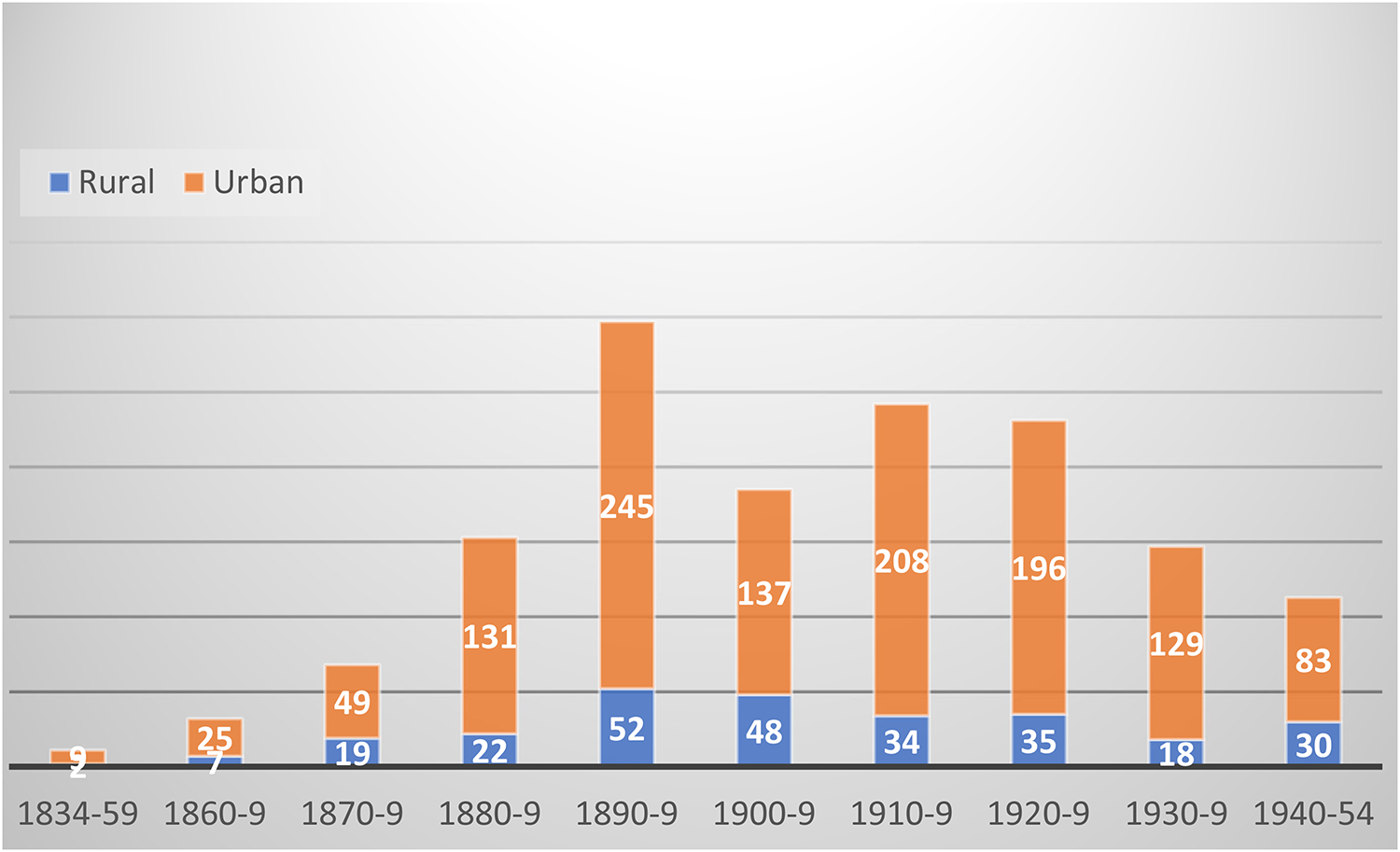
Abandonment reports by location 1834–1954.
Newspaper Reports and Public Shaming
Perpetrators were identified in 983 of the reported cases. As the population grew over time, the proportion of perpetrators identified decreased, dropping from 82 per cent in the period 1834–59 to 30 per cent a century later. The use of newspaper reports rather than court transcripts provides access to the way in which individual acts became part of the community narrative on which the stigma around ex-nuptial birth drew. More importantly they document the process through which private stigma was transformed into public shame. In the modern age, as Kilday and Nash have observed, it was the media that acted as “accusers, witnesses, judge and jury.” 21 It was in newspaper reports that the threat of public shaming became a dramatic reality. 22 Newspaper reports magnified the public humiliation implicit in a court appearance, creating a melodramatic narrative that both reflected and, at times constructed, community norms of acceptable behaviour. 23 In the process they provided a model which others could follow and a language through which they could explain their actions.
These reports typically begin with the discovery of an abandoned child, then follow the case through speculation as to the circumstances of the abandonment and attempts to identify the perpetrator to coverage of the trial and its aftermath in cases where an arrest was made. The court then becomes the site in which family secrets are made public, a place in which the community can re-assert normative expectations about the responsibilities of parents. They also provided an opportunity to challenge these expectations and the pre-conceptions on which they were based, in an attempt to minimise the damage to family reputation that disclosure had brought in its wake. The trial offered the possibility of exploring two levels of abandonment: the abandonment of a child by its mother or other caregiver, and the abandonment of the mother by the father of her child, but in most cases it was the mother as perpetrator who claimed the central focus. Initial reports tend to describe the act of abandonment as unnatural, heartless or unmotherly. Such accusations reinforced judgements about the morality and motivation of the mother. The newborn baby found in railway station waiting room in 1874, for instance, was described as victim of an “unnatural desertion” “in all probability the product of an illicit love … the mother … after hastily covering the little stranger with a portion of her clothing, abandoned it to take its chance of living or dying.” 24 However, perpetrators could use the court room to challenge such judgments by setting out the circumstances which led them to take the drastic step of abandoning their child and the reasons why they had chosen this course of action.
Family Secrets Exposed
As abandonment was a criminal offence, it always had the potential to expose the secrets it was designed to protect by bringing the private world of the family into the public gaze. When Margaret White and her father were charged with abandoning a baby in the streets of the small Victorian gold-mining town of Maryborough in 1869, between 400 and 500 people attempted to crowd into the court, attracted by the “heinous rumours” that the child was the result of incest. 25 After closing the court to the public the magistrate dismissed the case on the grounds of insufficient evidence. 26 However, it is unlikely that a subsequent newspaper report that: “there seems to be nothing but suspicion to account for the lurid character first imparted to the case” would have completely allayed community suspicions. 27
Few of the reported cases were so readily dismissed. In most instances, the investigation and subsequent court hearing dissected the inner machinations of the mother and her family, subjecting them to interrogation, condemnation and ultimately acquittal or punishment. The site of the abandonment, the way in which the child was presented, and the language of any accompanying note could be used to signify maternal affection allowing the accused women to challenge such judgements, repositioning themselves as caring mothers seeking to guarantee their child's survival, and, often, as victims of male irresponsibility. A note left with an infant abandoned near a Sydney foundling home in 1879, for example, deliberately evoked maternal feelings, describing the child as a “dear little lamb” and asking the recipient “to show it a mother's care for a mother's love it will always have.” 28 Facing the court in 1878 Sarah Bennett sought to justify her actions as an evidence of maternal love. “The reason of her unnatural conduct”, she explained, “was from dire necessity … [she] watched it till its cries attracted the attention of the people in the house, when on seeing them take it up, and knowing that it would be taken care of, she went away.” 29
Although the language of the newspaper reports became less sentimental over time, the tropes on which they drew remained remarkably unchanged as both reporters and offenders sought to reconcile abandonment with more normative notions of motherhood. Charged with abandoning her 12-week old baby in 1944, Catherine Wright sought to reposition herself as a caring mother facing mental stress. “I never meant to hurt the child,” she said. “I wouldn't hurt a hair of its head. I was not well at the time.” 30 Arrested for leaving her baby in swampland outside Brisbane in 1947, Evelyn Johnson told police that she had decided to abandon the child before she left the maternity hospital, yet by the time of her court appearance a few days later she had been transformed into a “young mother” whose maternal feelings were aroused when she was given the opportunity to “caress” her baby. 31 Whenever a child was left well-clothed and with a bottle of milk near at hand, the defence could argue for an acquittal or a light sentence on the grounds that while it had been abandoned it had not been endangered. The case for leniency was further strengthened if the accused could also show that they had remained close at hand until the child was found.
Protecting a Family's Reputation
Several strands emerge from an examination of newspaper coverage of abandonment cases, two of which relate directly to the issue of family secrecy. The first is the phenomenon of various family members colluding in the abandonment in order to protect the family reputation, a motivation identified in 44 cases between 1879 and 1953. In 1907, widow Ellen Harrison heard the unwelcome news that her daughter, Mary Ellen, living apart from her family as a domestic servant, was pregnant. 32 Mary Ellen's employer, the father of her child, gave money to Ellen to cover the confinement expenses but offered no further assistance. Anxious to keep news of her daughter's predicament from neighbours in the small rural community in which she lived, Ellen took the baby shortly after it was born, telling her daughter that she was going to arrange to put it in an institution, but instead left it in a busy lane leading to a suburban railway station. 33 Mary Ellen returned with her mother to the family home but authorities became suspicious, some months later, when she was unable to answer questions in a routine check on vaccinations. Making the link with the unidentified foundling, police charged Ellen with abandonment. 34 In passing sentence the judge noted that although she would only spend fourteen days in prison her respectability was lost forever. 35
Abandonment was also used to attempt to control who within the family could know of the child's existence. When asked to explain why she had abandoned her 16-year-old daughter's child, Sarah Jeffkins replied: “Love of my children and fear of my husband's violent temper compelled me to do what I have done.” Having failed to have the child admitted to Sydney's Ashfield Home, she decided to leave the baby nearby, outing herself when she later enquired at the home as to the health of the child. 36 This solicitude for the child earned her an acquittal but she still faced the prospect of returning to her husband, the secret she had attempted to keep now fully disclosed. 37
For some parents, the discovery of an abandoned baby near their home was the first indication that they had of their daughter's pregnancy. Seduced while she was in service, Emily Rudd gave birth in Sydney's Benevolent Asylum in 1893. 38 With her five-week-old baby in her arms she travelled back to her family home in rural New South Wales, but, overcome by shame, she left it “well wrapped in the shade” in the nearby bush. Her intention was to tell her mother, then retrieve the child, but she did not build up the courage to share her secret before night fell. Condemned as a “heartless mother” when the child was initially found, Emily's tale earned the sympathy of the court, the magistrate accepting her mother's claim that she was of “good character” but of a “melancholy disposition and simple.” 39 After serving a short sentence Emily returned to her home town where she married a local man three years later. For the Egan family in the Victorian town of Ballarat the abandonment was even closer to home when, in 1914, a neighbour called their attention to a strange noise emanating from their shed. On investigating they found a baby to which was pinned a letter entrusting it to Mrs Egan's care. 40 Police quickly arrested the Egan's 30 year old daughter Nellie, who confessed that she had abandoned the child in order “to cover up her shame, as long as she could” but wanted to place it in her mother's care. 41 Nellie's “deep affection” for her child earned her an acquittal but the reputation of her previously respectable family was tarnished by the publicity attached to the case. 42 While the children who survived abandonment in such circumstances were the most likely to be absorbed back into their mother's family via an informal adoption, the publicity surrounding their discovery ensured that their status within the family would be permanently stained
Some young parents worked together in their abandonment plans. In 1900, Melbourne law student, Ernest Levy, was hoping that his mother would be prepared to take responsibility for the child he had fathered by one of the family's servants, widow, Margaret Day. Promising that he could arrange for the baby to be brought up as a lady he set off for the family home, but, losing his courage along the way, abandoned it instead at the Salvation Army barracks. 43 Although he later told his mother what he had done, he was charged before she could offer him any help. Told that Ernest had already lost his profession because of his arrest, the court proved sympathetic and released him on a good behaviour bond, but Margaret's action in giving evidence against him at the trial, bringing private secrets into the public realm, broke the bond between the couple. 44 The Levy family did not take responsibility for the child and when Day attempted to obtain a maintenance order she was told that Ernest was no longer in the country. 45
The 1931 relationship between grazier's son, John Taylor, and the family servant Rhoda Caban, came to a similar end. Despite his parents’ disapproval, Taylor had paid Caban's confinement expenses, promising to marry her when the baby was born. However, when he came to Sydney shortly after the birth, he suggested that it would be better if they abandoned the baby and returned to their respective families. When Caban said that she wanted to keep the child, Taylor dismissed the idea and together they proceeded to the beachside suburb of Bondi, leaving the baby on a doorstep near the Scarba Home. 46 Acquitted on the grounds that the life of the child was never endangered, the couple left the court together but the romance did not long survive this experience. 47 Four years later, Rhoda was still unmarried, while John, his reputation presumably less stained, later married into another landholding family. 48
Older couples often had a greater reputation to defend in the face of an ex-nuptial pregnancy. In 1918 widow Alexandra McDermid, was anxious to protect her older children from the shame which resulted from her becoming pregnant to her brother-in-law who had been helping on her isolated sugar cane farm since her husband's death. 49 She gave birth alone and for several days hid the baby in the cane or the shed, bringing it into the house to feed when the children were at school or asleep. However, with her older children due home at the weekend she agreed to her brother-in-law's suggestion that they leave the child at the local hospital in the hope that they could return later and offer to adopt it. 50 Unfortunately the hamper in which they left the child was insufficiently aerated and by the time it was found the baby was dead. Finlay McDermid was charged with murder with Alexandra listed as an accessory, but both were quickly acquitted, the jury concluding that on such a remote farm they could easily have disposed of an infant if that had been their intention. 51 However, the extensive publicity ensured that Alexandra's attempt to spare her older children from discovering her shame had failed.
As these cases show, the use of abandonment as a means of protecting a family's reputation was fraught. Secrets held powers and once disclosed could never be not forgotten. While courts were increasingly sympathetic to the mother's plight, the judgment applied to Tasmanian Annie Proctor in 1885 that “the steps she took to save her reputation only served to blast it”, applied to many. 52 The courts were aware of this paradox and often modified the punishment in response. On sentencing Ellen Godfrey, who had abandoned her niece's child in 1908, the judge remarked that “no good would be derived from sending the woman to gaol. She had suffered the shame which the publicity of her mistake had created.” 53
There were instances, however, where families responded to the disclosure by seeking to rebuild a circle of protection around the mother and her child, creating in the process a new set of semi-secrets that they hoped could be contained. Bridget Garvey's parents, respected pioneers in their rural area, responded to the 1894 discovery that the baby found hidden in a bundle of leaves in the bush was their grandchild by supporting their daughter in court and agreeing to take both mother and child into their care. 54 Similarly surprised by news of their daughter's plight in 1923, Hannah Rawlings’ parents not only vowed to take her back into their home but were also able to work with the family of the father to negotiate a marriage. 55 In 1917, a Melbourne woman went one step further. On discovering that her husband was the father of a child abandoned at the Foundling Hospital, she stood bondswoman for its mother at her subsequent trial and agreed to provide a home for both mother and child, turning her potential shame into a reason for public approbation. 56 There is no evidence as to what the father, a soldier on active service, thought of his wife's actions, nor as to whether their marriage survived this secret becoming public. Such accommodations were fragile, dependent on a deliberate strategy of not speaking and not knowing that attempted to confine the scandal to the past.
Shaming the Father
In a second subset of cases, abandonment functioned, not as an attempt to save a family from shame but as a way of extending this shame to include the putative father and his relations. This motivation was apparent in 53 cases, the first in 1836 and the last in 1931. In such instances, secrecy became a means by which a mother could seek to redress the substantial power imbalance between herself and the father of her child. By depositing an infant on its father's doorstep, the mother was making public a relationship that had previously been private, a strategy that was particularly potent where the couple were separated by class and status. While such an action may have come as no surprise when the target was the father himself, its implications also reverberated through paternal families that were not aware of the child's existence. So common was this tactic that reports of a child abandoned at a private home were always accompanied by speculation. As a Western Australian newspaper commented in 1907 the “discovery of a strange infant” on the doorstep of a “pillar of the church” was “the hardest thing in the world for the flustered but virtuous” man to explain away. 57 In the face of such widespread suspicion, newspaper reports of such abandonments often included an explicit denial of any suggestion that the householder was related to the child.
By law an ex-nuptial child was the responsibility of its mother unless she could successfully pursue an affiliation claim against the father. Affiliation required corroboration which, given the private nature of the act, was difficult to provide. In depositing the child at the home of its father, mothers were asserting a counter-reality, trying to compel a father to recognise and take responsibility for his offspring. This practice had a very long history. It was the defence offered by Ann Harris in 1836 when she left her child in the house of controversial Sydney dance master, William Cavendish. Accused of “unmotherly conduct” she replied that the child “could not be deposited in a safer or better place than in the house of its father.” Accepting the father's assertion to the police that “he could not recognise any of his family features in the infant,” the magistrate sternly reminded Harris that by law an ex-nuptial child was the responsibility of its mother before agreeing to release her on a bond. 58 Despite the intractability of the law, mothers continued to assert similar claims across the decades. Having failed in a maintenance claim in 1873, Sarah Bensch left her child on the doorstep of the home in the Victorian regional city of Geelong where its putative father lived with his mother, defending her action by saying “no-one had a better right to take care of it than its father.” 59 Twenty years later in Singleton, NSW, Alice Gardener's statement to the court was more concise: “I only sent the baby to its father.” 60
In some instances, it was clear that the mothers had taken this course on the advice of their lawyers when attempts to get maintenance had failed. Deserted, in 1883, by the man with whom she had been cohabiting, Annie Skinner left the younger of her two children with a boy in the street instructing him to take the baby to the putative father's mother. “By instruction of the court,” the note read, “I am leaving the baby in your charge, had [sic] it is impossible for me to earn my living with him, and considering her belongs to your son Jim, no-one has a better right.” 61 When, in 1910, Amelia Smith was unable to find the corroboration necessary to succeed in her maintenance claim, she left her child with its father saying she had been advised to do so, although her lawyer denied offering such advice. 62 In neither case did the tactic succeed with both children coming under the control of the relevant state children's department after they had been abandoned.
While class differences may have encouraged mothers to seek support from the fathers of their children, they also made it less likely that their claim would succeed. When, in 1875, Mary Jane Ferris left her child with its father, grazier George Williams, she told the court that she “left the child there because he can well afford to keep it.” Williams’ defence was that the law did not oblige him to support an ex-nuptial child, an argument accepted by the judge who sent Ferris to gaol for one month. 63 Ellen Ceely received a more sympathetic response after she abandoned her child at the home of her former employer, Mrs Young, claiming that her son was the father. The charge of abandonment was withdrawn after she told the court that she had left the child there on legal advice. A maintenance proceeding then followed but although the magistrate was forced to dismiss the case when the Youngs produced evidence contesting paternity, he invited Ceely to return to the court if she found corroborative evidence. 64 It would appear, at this stage, that Ceely's family decided to withdraw from the fight, trying to contain the scandal within the family by placing the child with Ellen's brother and his wife who registered it as their own, creating in the process another set of secrets. 65
By confronting the mother or wife of the putative father, these mothers were breaching secrecy in order to share the shame with the family of the man who had abandoned them. When Anne Holt left her baby at its father's home, she constructed her action as one of love, including a note addressed to his mother which read “I know you will give him a mother's love, as he is your son's child as well as mine.” 66 In 1914, Catherine Hall was similarly solicitous when she left her child at the home of the putative father's grandmother writing “I am leaving the baby in Will's care or yours, gran. Trusting you will take care of him for my sake.” 67 Other encounters were more confrontational. For Winifred Gardiner's family, the abandonment was one part of a larger action against James Breslam, the man they claimed to be the father of her child. The two families had been neighbours at the Koo-Wee-Rup village settlement in rural Victoria, but their relationship became acrimonious once Gardiner's pregnancy was disclosed. Breslam originally offered to pay maintenance but later claimed that he only did so under duress so that his wife would not find out that he had been unfaithful. When the payments were not forthcoming the Gardiners went to Breslam's house where, in a display of street theatre, Winifred presented the child to his wife while he attempted to negotiate with her family outside. 68
Where class differences were less stark abandonment sometimes compelled families to come together to limit their now shared shame. When, in 1878, Mary Keating left her child on the veranda of its father, William Jolly's house she attached a letter explaining her actions. “The child is yours and you sed [sic] that you wood [sic] keep it and you sed [sic] you would stand your ground and pay for it so do and i that you will not hirt [sic] it, for i love it and you as Well.” Fearing that he might deny paternity she added that the baby looked like its father and she could find “people that nows [sic] that you came for me at their place.” 69 Anxious to avoid further disgrace Jolly's mother accepted Keating's claim and offered to care for the child until the two could marry. 70 Although the marriage gave security in the short term for the child, it did not provide happiness for Mary who, in the years that followed, was often forced to be the main provider for her husband and their ultimately ten children. 71
A more common outcome was for the publicity around the abandonment to provide the evidence necessary to support a successful maintenance claim. Arrested, in 1895, for leaving her child at the home of its paternal grandmother, Ada Hocking stated that the wealthy land owner had offered to maintain the child. 72 After the case was dismissed Hocking returned to court in a second attempt to gain maintenance. In an unusually combative hearing, in which both parties were represented by barristers, Hocking was accused of trying to blackmail the family but the judge was unconvinced and an order for maintenance was made. 73 In 1907 Myles McDonald chose to take a less confrontational stance. Faced with paternity allegations when a child was left with his wife, he avoided having the facts of the case more fully exposed in court by promising to maintain the child, a promise that was fulfilled when a maintenance order was confirmed two months later. 74
McDonald was wise to try and minimise the threat to his family through this disclosure. Joseph Mathieson was a leading member of the Anglican church in the Victorian rural town of Lara when, in 1886, his niece faced an abandonment charge after leaving her baby at his home. In the subsequent court hearing she alleged he was the father, a claim made more plausible when other details emerged of his drunkenness and violence towards his wife. 75 After the case was dismissed the editor of the local paper condemned the decision arguing that it only encouraged mothers to make false accusations against men while absolving themselves from the responsibility of caring for their children. 76 Although Mathieson was arrested for public drunkenness six months later, he did eventually recover his reputation and his marriage survived the allegations. 77 His niece, by contrast, was marked for life. She remained single, and rumours about her morality circulated whenever she came into the public eye. 78
Conclusion
This examination of infant abandonment as performance has cast light on the importance of family secrets and the ways in which families attempted to use them to preserve their reputation. Faced with the risk of social stigma, women abandoned their offspring, with their partners, parents and other members of their families colluding in their actions. Already stigmatised women also used abandonment to shame the fathers of their children, whose families too took action to minimise the harm. In both instances we see families coming together to recreate a circle of secrecy around their threatened shame. The cases examined in this article became public because such tactics failed to a greater or lesser extent, damaging all involved, although in line with the sexual morality of the time the cost to the mother and her family was greater and longer lasting than that faced by the fathers. While judges and magistrates continued to remind mothers that they had no right to look to the state or charitable institutions to support their children, the twentieth century saw a declining interest in charging offenders, and less enthusiasm for punishment, with most cases dealt with by diversion or a non-custodial sentence, the shame of appearing in the court considered punishment enough. But the greatest violence was done to the children, most of whom grew up apart from their families, marked by the double stigma of illegitimacy and abandonment. The small number taken back into the family were unlikely to have grown up untainted, always aware that they were the focus of the shameful secret that the family was working so hard to preserve.