



Abstract
The Women's National Abortion Action Coalition organized for abortion rights, an end to forced sterilization, and accessible birth control. From its formation in July 1971 to its demise with the January 1973 Roe v. Wade decision, it was an inclusive, far-reaching network that spearheaded the call for reproductive justice. Assembling a coalition, including high school and college students and those who called themselves Third World women (Black, Hispanic, Asian, and Native American women), the group held marches, protests, and in the fall of 1972 abortion tribunals across the country, holding men in power accountable for the oppression of women.
Keywords
Buttons, posters, and banners for a November 1971 march cried out: “Abortion: A Woman's Right to Choose.” The activists in the Women's National Abortion Action Coalition (WONAAC) used “A Woman's Right to Choose” as a rallying cry for abortion rights, an end to forced sterilization, and a demand for birth control. The embrace of this expression captured the essence of the organization, which believed that women should have sole control of their bodies and that no laws should regulate their access to reproductive technology. While this expression, “A Woman's Right to Choose,” became incredibly popular and choice defined the issue across the next fifty years, a study of WONAAC and its efforts reveal a group of committed activist women who pushed Americans to reject the practice of forced sterilization and to ensure access to affordable birth control and legal abortions. The group mobilized women nationally to embrace marches and protests, and eventually held abortion tribunals, to hold those oppressing a woman's right to choose accountable. 2

The creation of the Women's National Abortion Action Coalition in July of 1971 sparked a solid year and a half of focused activism: the group began at a conference in July 1971 and disappeared with the passage of Roe v. Wade in January of 1973. The activist organization was formed and funded by the Socialist Workers Party, with socialist and independent members. In that relatively brief period of time, women created an inclusive, far-reaching network and spearheaded the call for reproductive justice, with small, focused events, newsletters, large marches, and a culminating series of abortion tribunals held across the country.
According to one of WONAAC's founders, Dr. Barbara Roberts, the women who organized the Women v. Connecticut lawsuit decided to organize nationally around abortion. With an eye toward shaping the legal stage being set in Georgia (Doe) and Texas (Roe), the women behind the Connecticut lawsuit “sent letters to every feminist organization we could find, proposing a national coalition to mobilize support for overthrowing anti-abortion laws nationwide… The response to our letter calling for a national coalition was far greater than we had expected.” Their first 1971 New York conference attracted over 1,000 women committed to a national campaign to repeal all abortion laws. The remarkable turnout reflected the importance that abortion rights had taken on the country. The women formed WONAAC chapters in 29 states, with at least 35 affiliate groups organizing and participating at speak-outs and demonstrations. The group's goal was to achieve access to abortion across the country and around the world with a clear plan of demonstrations, information sharing, and media savvy communications. 3
Formed by the Socialist Workers Party (SWP) and the Young Socialist Alliance (YSA) with the objective of ensuring abortion access and recruiting for socialist ideology, the political origins of WONAAC proved to be a live wire. Feminist authors Judith Hole and Ellen Levine characterized the efforts of the socialists in a section of their book titled “Infiltration.” While they concluded it was unlikely that the socialists’ efforts would be successful, they believed that the SWP/YSA were the “infiltrating group” in “almost every case.” The FBI surveillance records referred to WONAAC members as Trotskyists, in reference to Leon Trotsky, who had helped form the Socialist Workers Party in 1937. While feminist author Susan Brownmiller reflected that the group's internal wrangling about overzealous socialists’ proselytizing made it ineffective, the group's outward facing reach and organization was remarkably successful. Disenchanted members and abortion rights allies may have been uncomfortable and even angry with the group's internal politics and goals, but most socialist and independent members remained committed to reproductive justice. 4
The aims of WONAAC were always both national and international in focus and included a clear, sustained effort to secure participation from high school and college students and those who called themselves Third World women (Black, Hispanic, Asian, and Native American women). The class concerns of US women who could not afford abortions were paramount in creating an argument legal abortions, and the group also sought to advance the perspectives of leaders in the welfare rights movement as well. Looking abroad, WONAAC chronicled the history of abortion legislation and access, and sought participation of women outside the US. Of particular interest, they contrasted the tremendous costs, limited providers, and expensive procedures in the United States against the abortion experience of Japan, which had “1,500,000 legal abortions,” “20,000 specially trained technicians,” and a cost of each abortion at only $15. 5
For many WONAAC women, abortion activism was not their first or only political commitment; many were also committed to the antiwar movement (Vietnam) and the Civil Rights Movement. Their commitment to the importance of securing abortion rights grew out of other activism, based on an expanding understanding of abortion's role in securing women's rights broadly and the rights of poor and working-class women in particular. Maternal mortality due to illegal abortions disproportionately affected Black and Puerto Rican women, and these racial and ethnic concerns for reproductive justice also fueled women's activism. 6
Commitment to radical, revolutionary ideas also brought some women to abortion activism, and helped give rise to WONAAC. One local, early group —Female Liberation, founded in in Boston in 1968 — had a broad agenda (self defense, minimum pay, equal distribution of housework, birth control, abortion) that they sought to advance through their newsletter “Second Wave.” The goals of Female Liberation were particularly significant, as it offered both the ideological grounding and network by the Spring of 1971 to bring women to Boston to hold the meeting that gave birth to WONAAC. 7
Some groups resisted a large, national approach and centered their group on small, limited membership to advance their goals, as was the case for small groups like Female Liberation (also known at points as Cell 16) (Boston) and The Feminists (New York City). Heather Booth, a political organizer who sparked the Jane collective, tried to forge a path merging the two movements. Booth wrote “Socialist Feminism: A Strategy for the Women's Movement” with her colleagues, and argued that it was essential to combine “the personal and the structural analysis.” Still, many radical feminists and abortion rights individuals and organizations resisted and resented WONAAC's emphasis on advancing socialism as they tried to advance their own ideological and rights struggles for women. 8
A more traditional political group, the National Women's Political Caucus (NWPC), formed at the same time as WONAAC in mid-July 1971, undoubtedly saw the group as a rival in the feminist movement and one that could compromise the movement with its socialist focus. Two co-founders of the NWPC, Betty Friedan and Shirley Chisolm, had helped create the National Organization for Women (NOW) back in 1966, with Friedan as its President until 1970. Friedan had a complicated relationship with WONAAC. In September of 1971, she claimed that a group of NOW's size and strength had to expect subterfuge from the socialists: “We are going to be infiltrated.” Some women, like Friedan, feared NOW's efforts and the broader women's movement being overtaken by the determined efforts of socialist women, bent to a different mission and absconding with their members and organizational capital. 9
NOW passed a “resolution to condemn ‘the actions of groups and organizations that act to divide and exploit the feminist movement for their own goals and purpose.’” Ultimately the SWP and the YSA went unnamed in the resolution, but WONAAC “was singled out and censured by NOW's National Board for its muscle tactics….” Some NOW leaders feared that WONAAC members were using abortion to advance socialism, a significant concern for a moderate organization seeking political and legal legitimacy in the midst of the Cold War. 10
In spite of her fears about WONAAC, Friedan remained opposed to “red baiting,” and fully committed to abortion rights. She participated in an October 1971 WONAAC news conference expressing “full solidarity for the November 20 demonstration and called on all women to join in the march.” However, Barbara Roberts characterized NOW's approach to WONAAC as “mistrust, which bordered on paranoia.” They refused to endorse the march and no NOW leadership spoke in Washington or San Francisco. Traditional and radical women eventually worked together to substantiate their belief that Socialist women, according to socialist Ruthann Miller (New York), had angled to "‘participate and provide leadership for the women's liberation movement.'" Along with others affirming in this vein, they quoted Miller as saying, "'A good number of them (feminists) will be recruited to the YSA. And this is one of our primary tasks here.'" With their assembled packet of investigative reports and damning conclusions, the SWEEP packet offered an historical analysis of motive, participants, and actions undertaken by the SWP/YSA women. WONAAC as a stand alone organization, founded by the socialists, was criticized for its narrow focus, and it was alleged the group simultaneously wanted abortion repeal to fail, wanted to use support for abortions to win people over to socialism, and fought against "Freedom of Sexual Expression" -- the rights of lesbians -- as a fourth principled demand. Women like Mary Daly, Robin Morgan, and Gloria Steinem, who had previously endorsed the group, withdrew their support. Statements read at a July 1971 press conference offered pointed condemnation: "the women's liberation movement should take priority over other movements and should not allow itself to be coopted by another other political movement or party" (Daly) and "The right to control one's own body means that entire body, not just that aspect of it that the Socialist Workers Party or any other male-left group deems freeable" (Morgan). 11 Many women's rights and abortion rights organizations were nervous about being involved with WONAAC. It is well established that Friedan and NOW initially resisted efforts of lesbians within the women's movement to be heard and recognized. Through the activism of individuals in local chapters, and leaders like Del Martin; Phyllis Lyon; Rita Mae Brown; and the Lavender Menace (later the Radicalesbians), NOW eventually embraced lesbians. NOW's second president, Aileen Hernandez, publicly welcomed lesbians as sisters proclaiming at the end of 1970, “‘Let us … spend no more time with this sexual McCarthyism.’” In 1971, NOW heralded “lesbians’ rights as women's rights.” With a media and movement focus on legal and legislative maneuvering, countless other conflicts and tensions, and remembrances of radical groups and actions, the history of the women's movement and the quest for reproductive justice reflected a streamlined past, one without WONAAC and the incredible tensions between the Women's Movement and Socialist Workers Party. 12
In one of the very first flyers announcing a “for women only” national conference on abortion, organizers called for all women “to come together” and included in that list (after campus women and before high school women) were gay women. From that very first WONAAC conference in the summer of 1971, empowered by their recent successes in pushing NOW and other groups to acknowledge and validate them, lesbians answered that call and asserted that their voices and identity should be recognized and publicly embraced by WONAAC. While historically some radical feminist groups imagined lesbian experiences or relationships in general as detrimental or oppositional to their cause, WONAAC's action-oriented mission led the group to embrace lesbians, as long as the focus remained on fighting for abortion and not on the right to sexual expression. 13
Several members described their participation in the Gay Liberation movement and asserted that as women who fought for the right to control their own bodies in every way, abortion rights was a cause consistent with both their gender and sexual identities. For some, it was more than an abstract right, it also aligned with their experiences. One lesbian, who had previously been married to a man, described how she became pregnant after being denied her birth control while in jail and then sought an abortion. Another WONAAC-affiliated woman recounted assailants who committed horrific sexual assaults in the late 1960s and early 1970s in West Philadelphia, and how she and a lesbian friend both narrowly escaped assault by a group of men. The need for abortion access was not theoretical for lesbian activists; as women, they remained vulnerable to sexual violence and therefore pregnancy. Lesbian members of WONAAC were women committed to securing the right to control their bodies and ensuring that other women could do the same. 14
Lesbians’ efforts were also a precursor to lesbians participating in debates about “health and liberation” and seeking to combine “gay and lesbian liberation with feminism” in the later AIDS crisis. Their intersectional experience as queer women led them to embrace the abortion movement. At the final victory rally in February 1973, following the January Supreme Court decisions securing abortion rights with Roe and Doe, “lesbian feminist activist” Jeanne Córdova “called upon her feminist audience to recognize the links between their fight for sexual autonomy and lesbian-feminist needs for the same.” 15
Antiradicalism and homophobia in both the national discourse and the larger women's movement likely contributed to the omission of WONAAC. Another reason for the historical exclusion of WONAAC was a double-edged sword plaguing their leadership. The compounding effects of both a socialist and a gendered discomfort with solitary, potentially self-aggrandizing leadership left WONAAC with a handful of independent (not socialist) women at the microphone and in the newspapers. No one was “in charge” that could be called on or identified as the face of the group, and that egalitarian, nonhierarchical group identity undoubtedly diminished awareness of it. Unlike Pat Maginnis, Lana Clarke Phelan, and Rowena Gurner who founded the Society for Humane Abortion, to help women access safe, illegal abortions, or Betty Friedan's clear identity as an author and women's movement leader, WONAAC relied on women like attorney Florynce “Flo” Kennedy and cardiologist Barbara Roberts, who had other employers, careers, and political commitments. “Comrade Carol Lipman,” as she is referenced in a December 11, 1971 SWP memo, rarely appeared in WONAAC media reporting, even though her title was National Women's Liberation Work Director. WONAAC was part of Lipman's efforts to advance women's liberation, but even with the flagship work, she was largely in the background publicly. Discomfort with named socialist women getting media attention proved fundamentally problematic for a group that aimed for a public presence, and the group never reconciled this tension.
Finally, the group—while it grew to have chapters in nearly half the states and managed to draw hundreds and thousands of people to events— remained fundamentally small. Just as socialism struggled to gain a foothold in the virulently hostile Cold War period, so too did signing on to be a vocal proponent of abortion rights continue to have a limited appeal. Thousands of women took to the streets to support abortion rights with signs and chants, but the number of women who identified themselves exclusively as vocal leaders in abortion rights was minute. The spotlight as abortion spokeswoman brought intense personal scrutiny that men escaped. Without the cover of “women's rights,” in which abortion was just one of the many rights women sought, abortion rights leadership remained in the hands of a few vocal women. 16
The founders of WONAAC took some fairly audacious actions and drew a great deal of support, perhaps spurred on by the urgency of thousands of women badly injured and dying from illegal abortions. While meeting for the first time in mid-July 1971, participants drafted a General Action Proposal that laid out a multi-pronged approach to winning abortion access. Grounding all of WONAAC's actions was a decision to focus solely on eliminating laws governing abortions, referred to as abortion repeal, as opposed to the earlier, initial approach of most abortion supporters, which was to reform abortion. Abortion repeal was also sharply divergent from the hopes of some adherents that the group not only make abortion available “on demand” (i.e., with no restrictions based on length of pregnancy, age of girl or woman, without permission of husband or parents, necessity of psychological evaluation, etc.), but also that abortions be free. 17
With their focus on creating national access to abortion for all women, WONAAC first began with their need to build an organization. The goal was to align members nationally around action items. First and most visibly, WONAAC called for two demonstrations, held in Washington, D.C. and San Francisco on November 20, 1971. Their other prominent and even more imminent action, however, was in the call to support Shirley Wheeler, the first woman tried, convicted, and sentenced for having an illegal abortion.
Building a Coalition
High School Women
The commitment of WONAAC to seek out and engage diverse groups of women beyond white women emerges out of the group's founding mission. In part, of course, the socialist members sought to proselytize high school women, Black women, Hispanic women, Asian women, lesbians, and other marginalized people, to sway them to socialism. While that motive may have fueled the drive, the coalition's concerted and expansive efforts to reach all women made their approach accessible, inclusive, and more far-reaching than other groups. In public demonstrations, press releases, and the pages of the socialist paper of record, The Militant, as well as the WONAAC Newsletter, the group raised awareness of the importance of forced sterilization, particularly for Black, Hispanic, and poor women. For economically vulnerable women, pregnancy often brought them to the attention of those who asserted the hospital's or the state's right to sterilize girls and women, or tried to persuade or threaten the parent or guardian of the young woman financially if she was not sterilized. 18
The vulnerability of girls to pregnancy (and venereal disease) led high school students, concerned citizens, and lawmakers in New York City to draft plans to address their needs. The organization's archives reflect their awareness of the kinds of information being disseminated and proposals being advanced. A 16-year-old high school student, Hariett Surovell, prepared a proposal on behalf of the High School Women's Coalition in May 1971, advocating that students receive birth control, abortion, and venereal disease information. She pleaded, “Ignorance is the major cause of both unwanted pregnancy and accidents related to self-attempted abortion.” To help set the context, she shared the kinds of misinformation that permeated the lives of young people, afraid to tell anyone, especially their parents. We have heard frantic questions like, ‘Will turpentine really make me lose the baby if I’m in trouble?’ or, ‘The hospital told me $540. Do you know a nurse who can do it for less.’ We hear statements like, ‘I know I don’t need to worry. I douche with vinegar afterwards’ … and, ‘I just pop a few of my mother's pills once in a while.’
19
Surovell published an op-ed in the New York Times, “Most Girls Just Pray,” which was based on her testimony before the National Commission on Population Growth and the American Future. She charged New York City's Board of Education with irresponsible handling of birth control education; the Sex Education syllabus made “no mention of contraception” and instead warned, “‘irresponsible sexual behavior may invoke conflicting feelings, lead to health hazards and result in premarital pregnancy.’” With Surovell's leadership, including the 300 members of her high school WONAAC group, girls and women engaged with city leaders, demanding access to valid information and resources to learn more. 20
As part of an emerging movement offering more detailed, age-appropriate sex education materials, a national group, the High School Student Information Center, had a slate of publications, including a packet of “Birth Control Information.” While it had an innocuous description, it included the graphic, explicit “McGill University Handbook on Birth Control, VD and abortion” created by McGill students in Montreal, Canada. Embraced by hundreds of colleges and universities across the United States, it was supplemented by “state abortion laws and laws on the medical treatment and financial aid for minors, a list of Planned Parenthood affiliates,” and more. Each of these groups prioritized getting what the NYC group titled “SURVIVAL INFORMATION” regarding contraceptives and abortion to young people. 21
WONAAC recognized the importance of reaching teenage girls who, even in a city with legal abortion, still faced tremendous hurdles. Their flyer calling women to a “High School Womens Meeting” proclaimed: “ABORTION IS NOW LEGAL … BUT JUST TRY TO GET ONE!” Written in the voice of a high schooler, it asserted, “if you’re old enough to get pregnant, you’re old enough to receive birth control information and abortion referral in the high schools.” Consistent with their aims, it promoted the march on Washington DC on November 20 and rallied girls and women to their cause: “Repeal all abortion laws, No forced sterilization, No contraception laws.” 22
Rose Weber was one such high schooler who worked with the NY WONAAC group her senior year, Fall 1971-Spring 1972 at Hunter College High School. Her unusual experience, attending a high school that was connected to a college, brought her into immediate proximity to all of the social movements sweeping the nation's college campuses: civil rights, anti-war, and the women's movement. Weber remembers her work at WONAAC as constituting “everything”: doing mailings, big parties, folding, stuffing, labeling to organizing demonstrations. There was one march in NY, I was up front with a bullhorn. Wasn’t one person in leadership, it was all egalitarian, we all had a voice … I remember there were a lot of logistics with the NY one that I handled, permits, sound system. I remember one time they sent me to pick up Betty Friedan.
23
While Weber eventually grew disillusioned with WONAAC, as they “very vigorously tried to recruit me” into socialism and were not forthright in acknowledging their socialist identity, she acknowledged that they “didn’t inject their politics into WONAAC. It was about abortion.” In working to reach young people, WONAAC used egalitarian and respectful language, including referring to the high schoolers as women, not girls.
WONAAC's efforts to mobilize young people, particularly in New York City, also resonated with an emerging trend of children's involvement in social movements in the 1960s. From the Children's Crusade in Birmingham in 1963 to the School Boycotts sweeping cities like Chicago, Los Angeles, Milwaukee, New York, and Seattle that decade, organizers began to recognize that the power and commitment of young people was a force to be tapped. For those teens who were months or years away from being drafted or were already being discriminated against in their housing, education, and opportunities based on gender, race, class or ethnicity, acting to try to change their circumstances was imperative. In a similar vein, for those teens who were sexually active and wanted to ensure people had the right to control their bodies, WONAAC's call to action may have resonated. If they were old enough to decide to have sex and to be drafted, they were old enough to decide, without parental permission, to seek out birth control and have an abortion. 24
Third World Women
WONAAC made an even more concerted effort to engage with “Black, Latina, Asian, and Native American sisters,” who allied themselves within the group as “Third World women.” Archival materials reflect a clear and conscious effort to listen to and empower women of color, which is distinctive in the abortion conversations of the period. In an “Abortion Fact Sheet” generated by the organization, the group also keyed into the deadly importance of standing abortion statutes, noting that “Asian, Black, and Chicana women were most victimized,” as they comprised “75 percent of deaths traceable to abortion.” 25 While white women and men tend to dominate our understanding of the popular discourse surrounding abortions in the pre-Roe era, WONAAC, with its socialist feminist grounding, embraced women of color as its speakers and representatives on the public stage. In public talks, debates, interviews, and written material, women of color both individually and representing groups advanced their support for abortion rights.
The women of color united in workshops at the first conference in 1971 and began to call themselves the Third World Women. Their proposal, adopted by WONAAC, declared, “We are against forced sterilization and forced motherhood. It is a woman's right to choose.” Attracting important leaders such as Hanna Takashige (Boston) and Portia Jones (Detroit), as well as Spanish American feminist Dolores Prida and Latina activist Mirta Vidal, WONAAC started with strong, diverse voices. The Third World Women advocated that all WONAAC literature would be translated into Spanish. They also encouraged the group to join in the international wave of support for revolutionary civil rights activist Angela Davis, who had been charged with attempted murder and kidnapping and imprisoned, and wanted to send a letter to express WONAAC's wish that she win bail, be freed, and join them in the fight for choice. 26
Black women advocated for abortion rights in the context of a discourse in which Black men charged that abortion was part of a genocide of Black people. Abortion proponents decried the accusation of genocide; they protested that Black women were dying under laws that kept abortion illegal, expensive, and illicit. Many black women's intersectional experience, with limited access to birth control and poor success in securing therapeutic abortions or safe healthcare, too often included attempts to self-abort and a struggle to find money to fund an abortion. Moreover, as Black women, they also faced increased risk of death in attempting their own or seeking illegal, underground abortions: death rates significantly higher for Black and Puerto Rican women nationally. 27
In response to the accusation that by legalizing abortion Black people risked racial genocide, attorney, author, and WONAAC supporter Flo Kennedy, herself a Black woman, argued that in fact the Black women maimed and murdered by illegal abortions were part of an on-going genocide. In the student newspaper at Howard University, Mary Treadwell, a Black woman, D.C. activist and Executive Director of Pride, Inc., charged of the Black abortion critics, These men have never been faced with a knitting needle or a coat hanger in the greasy back room of an urban garage, nor have they swallowed masses of quinine tablets or turpentine only to permanently endanger [their] physical well being.
While opponents like the Black Panthers and others publicly spoke out against abortion rights, many Black women like Kennedy and Treadwell worked to support reproductive justice and abortion rights. Treadwell also saw the devaluation of Black women and Black men by both the legislature and the church. She cautioned at a WONAAC press conference, “Let no church dare to define womb life to me when every day I see black life defiled, maimed and killed both physically and psychologically.” 28
WONAAC included “No Forced Sterilization” in their platform, developed at the first conference. In an early document, drafted in June 1971, “Black, Latin and Asian-American women” attending the founding meeting met together to affirm their commitment to the “struggle for control of our bodies.” They stated, “We see this as a necessary move toward our liberation as Third World Women” based on the fact that they suffered the most from “enforced motherhood.” Moreover, they noted, “We die and are injured more than anyone else as a result of the restrictions placed on abortions in every state.” 29
Two Black women, Marsha Coleman and Claytee Artz, drafted a statement titled “Black women, Chicanas, Latinas, Native American women, and Asian-American Women and the Abortion Campaign.” They placed the blame for the deaths of these women from illegal abortions squarely on “the Butcher – the United States government.” They cited a 1970 Newsweek article that nearly 50 percent of all Black women in New York who died due to pregnancy or childbirth in that city died from illegal abortions.” In all capital letters, they called out for a repeal of all anti-abortion laws, an end to forced sterilization, and accessible contraceptives, they shouted: “WE WANT THE RIGHT TO CHOOSE!” 30
Living with the knowledge that the same government that denied the right to abortion was the same one that would not provide nutritious foods, adequate education, decent clothing, housing, or pre-natal care, these women called on the government to let them control their own bodies. Abortion and forced sterilization loomed as two weapons turned on Black Americans, according to Black nationalists: on the one hand, abortion limited Black women's reproduction; on the other hand, sterilization forcibly denied Black women's ability to have children. 31 Black women in WONAAC resisted the accusation of abortion as forced upon them and genocidal. They decried efforts to “use women as guinea pigs and experiment on our bodies without our knowledge or consent,” and stood for bodily autonomy. Recognizing the power of a large, national organization, Black women defended the new organization, WONAAC, against claims that it was a “population control organization” and credited it with bringing “the issue of forced sterilization actively into public focus for the first time.” 32
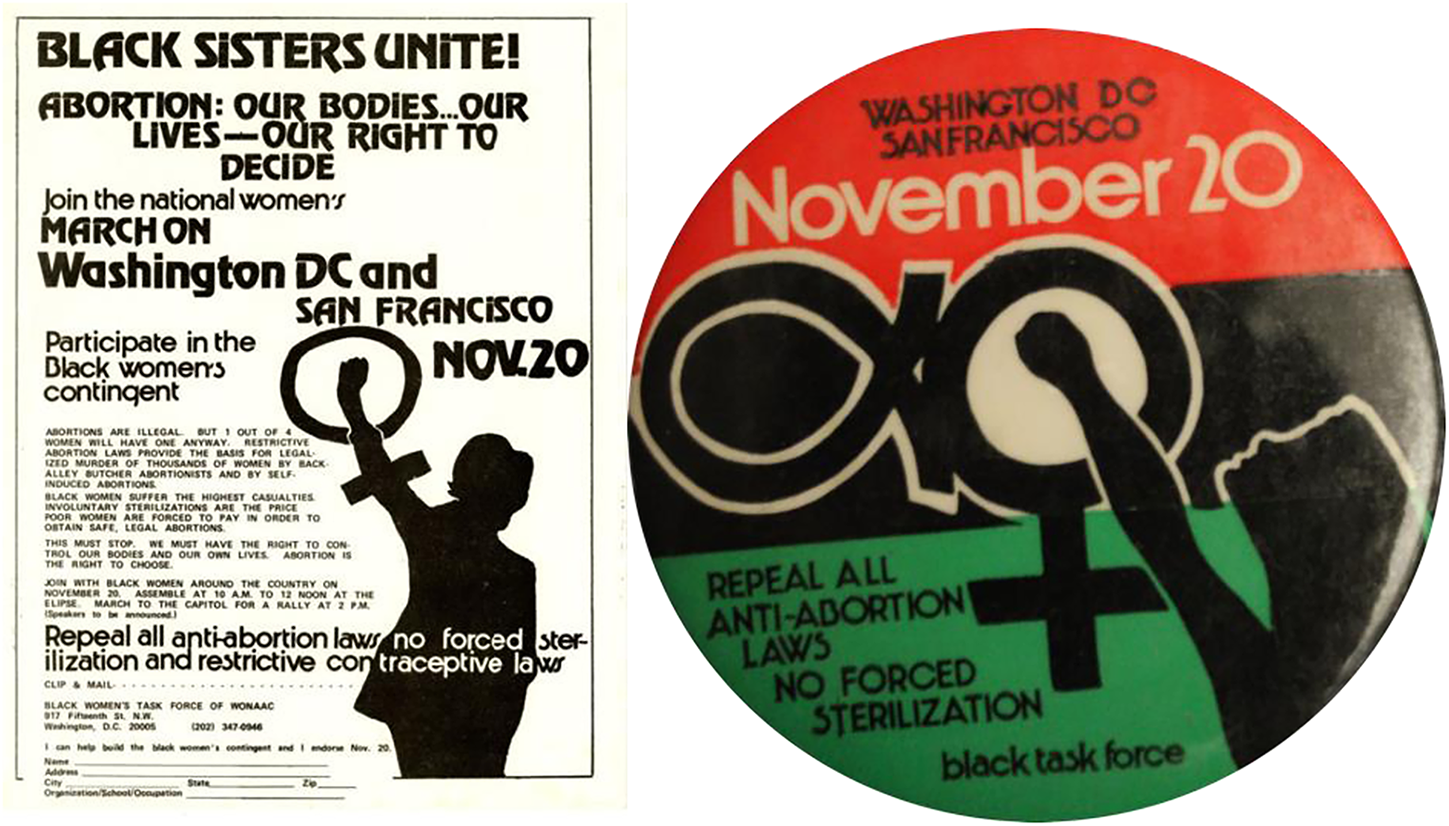
Black Women's Task Force, flyer and button 33
The Black Women's Task Force of WONAAC often asserted their racial identity as separate and a part of WONAAC. The Task Force requested an endorsement from the National Council of Negro Women (NCNW), which made a “commitment for action” resolution at their annual national convention endorsing the Black Women's Task Force and supporting the Black Women's March as part of the abortion rights march that was planned for November 20, 1971. Their support was squarely behind their Black sisters, and not given wholly to WONAAC writ large. The declaration vowed to “alert its entire membership to the subtle and devious systems that promote Black genocide,” with an eye toward saving Black women's lives. Sharing Kennedy's contention that disallowing legal abortions was killing Black women, the NCNW was joined in endorsing the Black Women's Task Force of WONAAC by over 150 individuals and organizations, including activist and politician Julian Bond; civil rights leader and candidate for Mississippi State Senate, Fannie Lou Hamer; and Elma Berrara, who had just organized the largest conference of Hispanic women ever in Houston, La Conferencia de Mujeres por la Raza. 34

San Francisco flyer for WONAAC march & rally, November 20, 1971
One of the early drafters of that Black Women's Task Force, Claytee Artz, gave a speech at WONAAC's second conference, held at Boston University in 1972. The WONAAC Newsletter ran some excerpts, along with a photo of her. She said, of her involvement: “This is how I first realized the necessity of being involved in the abortion movement. When I was in college, I gave myself an abortion, because I didn’t have an alternative. I didn’t even know of an illegal abortionist, let alone a place like New York. I was lucky because all I had to do was spend a month in bed.”
35
“Black women are beginning to think for themselves about abortion, to use their own minds, not the state and not the man's. Back in Detroit some of the women there are beginning to organize, through holding forums, meetings, talk-ins. Many women are beginning to realize for the first time that there are other Black women who feel the same way they do, and because they feel the same way, there must be even more women out there, and they’re beginning to unite.”
36
Artz articulated what those involved believed to be true: Black women were the most intimately aware of the deadly consequences of the country's abortion policies and they were doing the same kinds of organizing white women were doing, especially through what was known as consciousness raising. By talking openly, women learned that others were suffering in the same or similar ways. Beyond affirming their experiences, women began to mobilize to change things. For Black women, part of that mobilization came in organizing with other women of color. And in early flyers, trying to get women to march in Washington, DC and San Francisco, they moved beyond the general information that “One out of four women will have” an abortion or “thousands will continue to die from unsafe illegal abortions.” In all caps, they urged readers, “BLACK AND PUERTO RICAN WOMEN SUFFER A HIGH PERCENTAGE OF DEATHS FROM ILLEGAL ABORTIONS.” They appealed, “Join with Black, Latina, Asian, and Native American sisters across the country” to repeal “all anti-abortion laws, no forced sterilization, and no contraception laws.” Another flyer promoted two women speaking on “Black Women and the Fight for Abortion Law Repeal” and listed two admission costs. The general admission was $1.00; high school students could attend for just $0.50 50 cents. Reflecting WONAAC's interest in hearing the concerns of young women who also faced the terror of unwanted pregnancies, with even fewer resources and power than most women they tried to appeal to them by name and with a reduced rate. 37
WONAAC also featured a column by Marsha Coleman, a WONAAC staff member. She countered the charges of abortion as genocide for Black people when she wrote, “the campaign of women to control our own bodies has nothing in common with population control. Population control clouds the real issues of the right to decide, and divides Black and white women. The government tries to use this to discredit the whole abortion movement, among Black women.” Coleman charged the US government with “colonial racism and sexism” and declared, “we are serious in our efforts, in our fight against the misuse of our bodies by racist, anti-woman doctors.” 38

Page from a WONAAC brochure promoting the November 20, 1971 march, featuring images of speakers at the first WONAAC conference (l to r, Elma Barrera, Marsha Coleman, and Janet Wingo) (Schlesinger Library).
Hispanic women also played an important role in WONAAC. The national WONAAC group's immediate commitment to translating their materials into Spanish was a reflection of the importance they placed on reaching Spanish-speaking women. Moreover, it suggests that the organization was listening. WONAAC did not just assert the right to abortion and expect Spanish-speaking women to join their efforts; the group understood that women had complex, nuanced experiences and that to engage them in the abortion fight would necessarily demand championing their concerns as well. While the names and groups changed (Chicana, Puerto Rican, Latina, Raza, and Hispanic), the efforts to reach them and include them remained the same. Emerging out of a conference workshop, the Latina and Raza Women's proposal acknowledged that “the number of sisters involved in the pro-abortion movement is still relatively small” and tasked themselves with “growing numbers of Latinas and Raza women” in this struggle. They supported WONAAC's efforts and declared, “We will not rely on anyone but ourselves to win the right to decide whether or not we are going to bear children.” Together they hoped to expose “the evidence of the oppressive and racist nature of the current laws affecting the lives of women.” WONAAC tried to promote the conference and reach Spanish-speaking women by placing an article in the popular El Diario newspaper in July of 1972. 39
Elma Barrera, one of the endorsers of WONAAC's Black Women's Task Force, had a “Chicanas” column in a WONAAC flyer, and she too resolved, along with the participants at the national Chicana conference, that there be, “Free, legal abortions and birth control for the Chicano community, controlled by the Chicanos. As Chicanas, we have the right to control our own bodies.” Barrera, who went on to be a Houston reporter for 30 years and a state icon, with an elementary school named in her honor, was also an active member of WONAAC. Featuring Barrera and Coleman columns and photos in their brochures and pamphlets, alongside white founding member Dr. Barbara Roberts and legal stalwart Nancy Stearns, ensured the Third World Women power to shape the organization, including its goals and strategies. 40
In the third WONAAC conference, a Black feminist organization, Sisters in Struggle, urged WONAAC to focus on an “equal struggle” between the three competing demands: abortion, contraceptives, and sterilization. They wanted the group to prioritize “unwanted pregnancies on a day to day basis, rather than only in emergency situations.” However, the thrust of WONAAC's efforts were principally on abortion, with the fight to end forced sterilization and ensure access to contraceptives as secondary priorities. WONAAC recognized that doctors and hospitals frequently demanded forced sterilization of women seeking abortions, and understood that these were not separate struggles. By ensuring abortion access, they hoped to eradicate the threat of forced sterilization. Fighting against sterilization and for contraceptives remained rhetorical priorities, but the public fight to legalize abortion was the consistent, overriding concern of the larger organization. 41
One of the hallmarks of WONAAC was its commitment to research and their investigation into forced sterilization was no different. Their archival files contained a two-page fact sheet, complete with footnoted citations to their sources, which included newspaper accounts from across the country, the Harvard Law Review, and an edited volume by a doctor. Historians such as as Lina-Maria Murillo, Jane Lawrence, and Johanna Schoen helped uncover the extent of and context for sterilization in this period, including women choosing it and having it forced upon them, not only without their consent, but often without even their knowledge. But for those active members of WONAAC, they heard about these outrages in real time. Fannie Lou Hamer is quoted by WONAAC as saying in 1964 that “six of every ten Black women who were taken to Sunflower City Hospital in Mississippi were sterilized for no reason at all.” Another fact listed was that in a 1968 survey of over 500 teaching hospitals, more than half of the hospitals reported that they sometimes used sterilization as a condition for approving an abortion request. The statement concluded, after a review of other concurrent facts, that “The target of forced sterilization is the segment of our society that is already the most sorely oppressed.” The WONAAC activists knew sterilization was a national practice that targeted poor, Black, Hispanic, Native American women and it informed the organization's fight for accessible abortions and against forced sterilization. 42
From its inception, white lesbians had a voice in shaping and representing WONAAC. Gay Black women within the Black Women's Task Force also demanded to be heard and put forward a press release, “Statement of a Black Lesbian on Abortion,” decrying the “oppression of a woman who is damned three times.” It called on all women to embrace lesbians, charging them, “Fight for your Sister – with your Sisters – through your Sisters. When women become free, the Black Lesbian will gain the most.” WONAAC understood that their success in achieving their goals of reproductive justice for all meant that they not only had to strive to secure abortion rights but had to ensure that lesbians and women of color had access to contraceptives and protection from forced sterilization. 43
Cause Célèbre: Shirley Ann Wheeler
The arrest, prosecution, conviction, and sentencing of Shirley Ann Wheeler signified a new turn in the use of criminal prosecution to dissuade and punish those seeking and providing abortions. Instead of just pressuring Wheeler to identify the person who performed her abortion, so they could be prosecuted, as had happened historically, in 1971 the state of Florida went far beyond intimidating a 23-year-old North Carolina woman. In what historian Leslie Reagan characterized as “a shocking move,” they prosecuted Wheeler for having an illegal abortion. Abortion activist Lawrence Lader claimed that she was “the first woman in America known to be held criminally liable for an abortion.” Wheeler faced the maximum penalty for abortion manslaughter, 20 years in prison. Without resources or family support, Wheeler wrote to the Playboy Foundation for help and Playboy paid Cyril Means, professor at New York University Law School, to fly down and assist in her defense. However, he was only brought in as co-counsel at the eleventh hour, and a jury of three women and three men convicted Wheeler of manslaughter under a section of Florida's homicide law. The exceptional conviction drew national attention. As the nation waited on her October 1971 sentencing, WONAAC proclaimed its support, sending telegrams, petitioning the governor, and vowing to take to the streets. 44
Initially represented by a public defender and Cyril Means, the national attention led Nancy Stearns, who worked for the Center for Constitutional Rights, to represent her appeal. Stearns implored, in written materials and in person, “We are responsible for Shirley's freedom. And we are responsible for our own freedom.” Wheeler wrote to Stearns, “‘I am the first woman to be arrested on this charge and convicted.’” 45 In materials fundraising for her case and abortion rights, WONAAC appealed, “Shirley Wheeler's only crime is a crime that millions of women contemplate and tens of thousands carry out every year. Shirley Wheeler exercised her constitutional right to control her own body, to decide whether or not she would bear a child.” Helping WONAAC to raise money, feminist writer Gloria Steinem and abortion rights activist Patricia Maginnis, among others, signed a letter of appeal. WONAAC helped bring her case to the public, particularly through spokespeople who could speak to the media in local outlets. 46
Unlike famed civil rights and women's rights actions, like Brown v Board of Ed (Topeka) or the Montgomery Bus Boycott, in which organizations and individuals took care to advance and back cases with the clearest storylines and best chance of victory, the newly formed group of WONAAC found themselves supporting a complicated person in a complicated situation. Her attorney, Stearns, remarked of her client, “Shirley is a very compelling person. She's quiet and unassuming, yet very strong in her beliefs. And she's not just a middle-class kid who got in trouble. She's been through a lot of hard times.” National Director of WONAAC and frequent spokesperson for the group, Dr. Barbara Roberts described how Wheeler was blindfolded in the car taking her to the apartment where the abortion was performed. She developed complications and required another procedure, which her own doctor performed, to complete the abortion and stop the hemorrhaging. The medical examiner got wind of the case, reported her to the police and she was arrested and put in jail.
47
Wheeler's experience resonated with millions of women across the nation who had either tried to terminate their own pregnancy themselves or gone to abortionists, operating in an underworld heavy on subterfuge and cost and with limited medical authority, ease of access, and safety. In this era, approximately one million women a year sought abortions, making the cumulative number of sympathetic women and men, of all ages, races, and religions, immense.
As a wronged person, caught doing something millions had done, tortured in jail, tried in court, and cruelly sentenced for her alleged crime, Wheeler was a sympathetic figure. Her attorney, Nancy Stearns, described her as a “political prisoner.” Patsy Truxaw reported for the College Press Service that Wheeler “spent several days in jail and was shown pictures of the fetus.” They taunted her, “Here's your baby. Look at it. This is your baby.” Wheeler described the jailhouse doctor diagnosing her with vertigo, “and then he cussed me out,” “puzzling why a physician should berate her.” The prosecutors believed they could get Wheeler to flip on her abortion provider, but like thousands of women before and after her, she would not. 48
Unlike “Jane Roe,” the person at the center of the test case for the Roe v. Wade case, Wheeler's identity was made public as soon as her court case made the news in July of 1971. Like “Jane Roe,” she was the most likely candidate to be in this position: a poor woman in the South, where states aggressively continued to limit abortions, in spite of the increasing access occurring in states like New York, California, Colorado, Kansas, and Washington, D.C. Women of financial means and connections could make their way to a place where abortion was legal or pay someone legitimate to perform it, but Wheeler, like so many others, was socially and financially vulnerable. WONAAC women saw in Wheeler an everywoman with a boyfriend and a dog, whose lived experience showcased the dangers of antiquated laws and their enforcement, and offered her their support. 49
The conviction of Wheeler was, as one paper reported, a cause célèbre, which rallied people to Wheeler and to the cause of abortion. Accounts of her trial appeared in newspapers across the country, including college newspapers, and most made mention of the indignation of WONAAC and its support of Wheeler. While most accounts focused on the prosecution, conviction, and especially her appeal, the reporting occasionally delved into Wheeler's personal circumstances that led her to need an abortion. They highlighted her poor childhood: her dead mother and alcoholic father who abandoned the family, and being taken in by an aunt and uncle; being raped by two boys she knew at 18, and then giving birth to a son that resulted from that rape; a hasty marriage that lasted only a few months while the couple continued to live separately with their families; and then her to escape to Florida, where she lived with a man and took his last name. Most reports did not dwell on why Wheeler had the abortion, which she believed would endanger her life after an earlier bout of rheumatic fever and a dangerous first delivery. 50
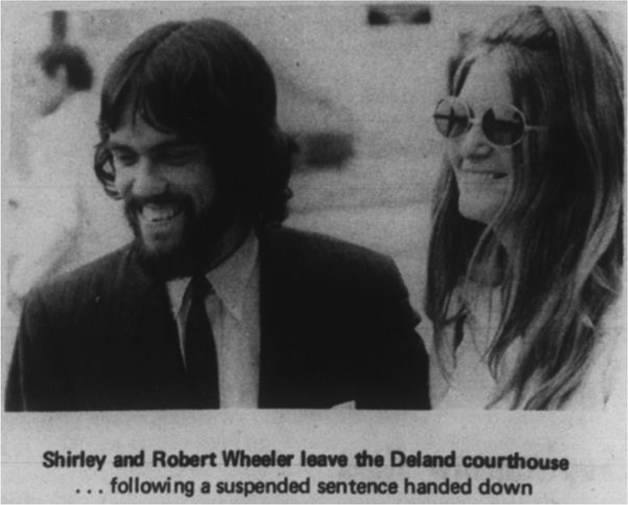
Florida Alligator, 18 October 1971 (Photo Courtesy of the University of Florida's digital Alligator Archives,” https://ufdc.ufl.edu/UF00028291/03393/images/3).
Wheeler maintained that she was charged precisely because of “her life style, because she was not wealthy and because she refused to cooperate with the police and identify her abortionist.” In spite of the prominent abortion rights attorneys brought into the case, the Florida judge not only convicted Wheeler of manslaughter for the abortion, but also sentenced her to a “barbaric” and “blatantly unconstitutional” probation. Patronizing and outrageous, women around the country learned that Wheeler was sentenced to no longer live with “the bearded young printer and taxidermist, Robert Wheeler, 23, with whom she had been keeping house the past three years.” Given one week to leave the state of Florida and sentenced to a two-year probation, she could not live alone or with another woman in Florida, and living out of wedlock with a man was against the law in Florida. She could not enter a bar. She could not stay out at night. Forced to return to North Carolina, she was required to live with a brother there. The Village Voice (NYC) reported, “Ms. Wheeler was told that the next time she goes to bed with a man, she had better make sure she has a marriage license hanging over it.” 51
One news story carried nationally sympathetically traced Wheeler's forced return home. The headline wondered: “To Be Greeted as ‘Far-Out Modern’ or Murdress? Florida Exile Returns to Small N.C. Town.” Interviewing Wheeler, her family, and local figures, the article suggested a grim banishment. Wheeler remarked, “Morganton's going to be even less tolerant than Florida. I know a lot of people think I’m a slut or a murderess.” The town's police lieutenant, Bob Lavers, sympathetically shared some of her history in the town: ‘She used to be married to an old boy named Stamey – Robert Stamey. Seems like he got into a cuttin’ with old Donkey Davis down there on the [Courthouse] square … she used to talk to us when we were on patrol … She didn’t think much of herself even then. She was all mixed up.’
5
A sixty-year-old man who was interviewed, suspected “these days nobody’ll think anything about what she did. The morals have changed so much,” as he recounted more than a dozen “daughters of this town's most prominent families have had to get married.” Premarital sex and living with a man, however, was not the extent of her actions, and the double crime of bringing ignominy to her hometown and having been convicted of having an abortion undoubtedly made her forced, public return an unpleasant one. WONAAC offered Wheeler an opportunity to travel and speak about her experience. Ultimately, the outrageous conviction and sentencing was a catalyst for Wheeler and many women around the country. They used it as a rallying cry to ensure all women's right to an abortion. 53

Dayton Daily News, 14 November 1971. Used with permission of the Dayton Daily News.
November 20 Demonstrations: DC & San Francisco
The women had clear objectives for the demonstrations, aiming to repeal “all abortion laws, against forced sterilization, and for the repeal of all contraceptive laws.” 54 Most groups that focused on abortion directed their efforts on legislative, judicial, and educational areas (conferences), most especially the National Organization of Women and the newly formed National Association for Repeal of Abortion Laws. Other proponents, like the Clergy Consultation Service and the Women's Health and Abortion Project, were actively securing women abortions. WONAAC emerged and forged another path that drew thousands of women to the cause. While they supported political and legal efforts, their primary aims were in creating public forums to demonstrate and create strong and growing support for abortion, with the shared aim of changing national abortion laws. 55
As one of the founding objectives of the group, WONAAC planned for two demonstrations to be held on November 20, 1971. Planned only four months from the group's creation, it was an audacious plan. Undoubtedly inspired by the recent efforts of women who had come together in Manhattan to hold a march to “Abolish Abortion Laws” on March 28, 1970, and then organizing the largest march in the history of women's rights, the Strike for Women's Equality on August 26, 1970, the group wanted to have a big impact. Flo Kennedy spoke at the first march, proclaiming, “There is no need for any legislation on abortion just as there is no need for legislation on an appendectomy.” Five months later, after abortion was legalized in New York, a record number of women assembled in New York City and cities around the country on the 50th anniversary of women securing the right to vote, in support of new goals of a new generation of feminists: abortion on demand, equal opportunities in education and employment, and free 24-hour day care. With a narrowed focus on abortion, WONAAC, anxious to have a national presence, attract new members, and secure legal abortions, chose one march for San Francisco and the other for the nation's capital. With flyers and buttons, the group mobilized their affiliates to bring women from around the country. 56
The Federal Bureau of Investigation was also listening and watching intently to the planning. An online collection of previously confidential files of the FBI's consistent, relentless monitoring of the group reveals that they were tracking bus rentals at cities around the country. One socialist organizer who was coordinating bus travel at her campus, the University of Indiana – Bloomington, confirms the written record in the FBI files. Paula Savich's parents received a letter, allegedly from a “concerned Indiana student,” alerting them to her political involvement with the YSA and warning that it could “reflect badly, hurt your status in the community.” Savich was convinced that COINTELPRO generated the letter. Most women were not surprised they were being monitored, given that most in their group had been previously and simultaneously involved in civil rights and anti-war activities that had also elicited governmental surveillance. 57
In addition to governmental interference, troubles with alleged red-baiting both from within and without threatened the new group in the build-up to the November marches. One of the founders, Dr. Barbara Roberts, noted that the word “Action” in the name of the group was a keyword and reflected its socialist origins, saying of the socialists, “They chose the name.” Some of the fonts on the posters might also have suggested that it was a socialist-influenced group. For many sympathetic to or aligned with socialist positions, including opposition to the conflict in Vietnam, socialism was not a deal breaker and in fact proved to be an inspiration. Paula Savich noted of her involvement, “I wouldn’t have put as much energy into it [abortion] if I wasn’t a member of the YSA, but I was fully committed to the abortion rights movement.” For those independents looking to jump into action, there were not any other nationally- and internationally-focused abortion groups that encouraged public demonstrations to challenge unconstitutional laws and ensure rights. The group was entirely woman-focused, with no men involved whatsoever. This was particularly significant for those radical feminists who sought out woman-centered spaces and others disillusioned by the experience of aggressive misogyny of anti-war and socialist movements. The financial backing of the Socialist Worker's Party and the Young Socialist Alliance also meant that there was an organizational structure in place, with an office, telephones, postage, and staff. 58
In seeking funds in support of WONAAC, Wheeler, and the Nov. 20th march, the efforts ranged from Samara Jarosh selling buttons on Chestnut Street in downtown Philadelphia to Kipp Dawson soliciting from wealthy women in New York City, some of whom she found as donors in the Opera playbills. The costs were many, with one FBI report indicating that Matilde Zimmerman made a $1,500 deposit against a $3,500 bill for five buses to ferry women from Boston to the November 20th march in Washington. With only a tiny number of staff members nationally, fund raiser was a vital position. Dawson noted that “Billie Jean King gave money, supported us.” 59
Not only did King contribute financially, she was willing to speak to the November 20th D.C. marchers. Initially heralded as a headliner, along with Shirley Chisolm, they both declined to speak after receiving a letter on WONAAC stationary that claimed to be from a disgruntled staff member 60
While it is likely that an unhappy WONAAC member sent the letter, with women publicly and angrily walking away from the group throughout its existence and heightened tensions in the women's movement , it is possible that the FBI's COINTELPRO was behind the letters. It was consistent with the FBI's practice of disruption and fostering dissent from within; the fractures were easy to exploit. The records clearly indicate that the FBI was tracking the group's movements and their admitted history of interfering with socialist groups makes it possible that the government agency was behind the letters, but some women in WONAAC and in the Women's Movement, dismayed by the priorities of the SWP/YSA, probably torpedoed the November march.. 61
The women who gathered in Washington, DC on November 20th, upwards of 1,500 to 3,500 of them, heard impassioned speakers. National project director Dr. Barbara Roberts noted, “‘If every woman who has been forced to obtain an illegal abortion marched on the Capitol on Nov. 20, we would have the largest demonstration in America's history.” Just as Pat Maginnis and other women doing abortion referrals wanted women to give back to help others, Roberts and WONAAC wanted women who had sought illegal abortions to speak up and effect change. In a speech that later featured at the beginning of the popular film, If These Walls Could Talk (1996), Dr. Roberts proclaimed to the marchers that, for the first time, women have “gathered to tell this government in no uncertain terms that we will no longer tolerate laws that degrade, mutilate, and murder women.” She decried the “fetus fetishists” and asserted that “There have been too many friends of the fetus and not enough friends of women. WONAAC is out to change that.” 62
There is also TV news footage of the San Francisco march. For several minutes the KCRA tv reel shows hundreds of women marching and chanting with a large WONAAC banner and individual posters, featuring statements like “Abortion Laws Murder Women,” “Stop the Fetus Fetishists,” and “Abortion: A Woman's Right to Choose.” An Asian woman interviewed in one clip indicates that she was marching: because of the high cost of abortion, because it is illegal, and because there are restrictions that deny poor and Black, Raza, Asian American, and Native American women that basic right. And so many times these women are driven into the hands of criminal, illegal abortionists and die. We feel that we have the most reason to oppose these laws and to have them wiped them out. We don’t think that they’re trying to protect us, but they’re denying us our right to choose.
63
Serving as a focal point for west coast women who wanted to rally for abortion rights, the San Francisco march drew hundreds of supporters, anxious to push beyond the half-measure reforms and achieve abortion access for all women.

WONAAC march in San Francisco, 20 November 1972, image from video footage shot by KCRA TV. Used with permision of Center for Sacramento History. 64
Maude Protests
A year later, on November 14, 1972, a fictional, televised event galvanized a public response, including a public call to action by WONAAC. The wildly successful television producer Norman Lear, who introduced America to Archie Bunker and George Jefferson, created a story line for his popular show Maude with writer Susan Harris. They imagined an older woman confronting an unplanned and unwanted pregnancy. While originally the story line focused on Maude's friend in this predicament, Lear recognized the power of having the star of the show carry the burden of wrestling with what to do. The setting of the show, New York City, worked especially well, since abortion had been legal and successful in dramatically reducing maternal deaths statewide since July of 1970. In the two-part episode, Maude discovered that she was pregnant and made the decision that she did not want to have another child. Maude's was the first abortion by a leading TV character. 65
Lear, however, did not think up the abortion storyline nor was he necessarily inspired by all of the social and legal changes happening around the country, and especially in New York, where abortion had been legal since July 1, 1970. Instead, he was motivated, in part, to create the episodes (it was a two-part cliff hanger) as a result of a cash prize held out by the Population Institute, a Methodist group trying to bring conversations about population control to the public. While one producer and a few reporters thought the effort was funded by Zero Population Growth, the Catholic magazine America exposed the Institute the following year to argue for a boycott of the program. 66
Most of the behind the scenes wrangling of who funded the script and why was invisible and irrelevant to the heated, public battle over the airing of the episodes. The National Organization of Women went to court with a class action lawsuit to argue that Americans living in localities served by two networks who censored the show were being harmed. WONAAC issued press releases, drew up flyers in local communities, and took to the streets to counter the orchestrated, heavily-Catholic opposition to the Maude abortion episode. They were supported, not just by those who agreed with the right to an abortion, but by those who opposed the censorship by cancellation. Thousands of people called in to their local stations or to the CBS headquarters in New York City. The Champaign, Illinois station that refused to air the episodes received 500 phone calls regarding their decision and the vast majority, 400, protested the cancellation. Mrs. Donald Woodward of Moweaqua wrote a letter to the editor of the Decatur Daily Review (Illinois) in support of airing the episodes because “A democratic society has the freedom to select what it hears or reads and to have freedom of the press, freedom of speech, etc.” 67
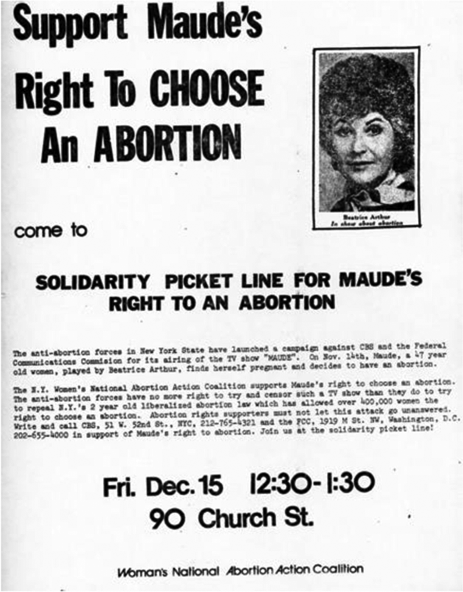
Women's National Abortion Action Coalition Records, 1969-1973, Box 3, Folder 3, “Maude” demonstration, 1972, Wisconsin Historical Society.
WONAAC's efforts blurred the line between the fictional woman and the everywoman when they pronounced in a 13 December 1972 “Press Release: Solidarity Demonstration called in support of ‘Maude's right to choose an abortion.’”
68
Not only should she have a right to choose abortion, they argued, but her dilemma and choice was important for the public to see and consider. They invited women to “Support Maude's Right to CHOOSE An ABORTION,” “come to Solidarity Picket Line for Maude's Right to an Abortion.”
69
The New York chapter also used the controversy to draw attention to their state-wide battle, noting, The NY Women's National Abortion Action Coalition supports Maude's right to choose an abortion. The anti-abortion forces have no more right to try and censor such a TV show than they do to try to repeal N.Y.'s 2-year-old liberalized abortion law which has allowed over 400,000 women the right to choose an abortion.
70
The group opposed the two Illinois affiliates in Champaign and Peoria who censored the episodes, fearing the precedent “as it was the first time any affiliate had ever refused to broadcast an episode of a recurring series.” For WONAAC, abortion visibility was central to their efforts to eliminate the restrictions on women's access to abortion. The censoring of the first show to feature a woman who considered and then proceeded to have an abortion, particularly because the Catholic church put out the clarion call to action, made it more than just fiction. Coming just months before the Supreme Court handed down their highly-anticipated Roe v. Wade decision, opponents of the abortion episodes charged that it treated the subject lightly, was aired at a time when children were watching television, and that the program did not give enough air time to those who opposed abortion. The desire to squash the discourse about abortion had to contend with the fact that the Maude character, played by Bea Arthur, was a 47-year-old grandmother going through menopause and lived in New York, where abortion was a legal, safe option.
WONAAC's desire for women across the country to see the Maude episodes, which only used the word abortion once in each of the two episodes, and to stop those trying to limit and eradicate abortion access across the country fueled their public campaign. Lear charged in an Associated Press story carried in Pontiac, Illinois that the station managers were out of touch with their viewers in the state of Illinois, asserting that “‘They’re more intelligent than you think.’” Indeed, not only did women know how to weigh whether or not to keep or terminate a pregnancy, between 1971 and 1972 more than 26,000 Illinois women traveled for an abortion, with most destined to New York City. By asserting that the procedure was safe and reasonable, “like going to the dentist,” the show was able to alert the public to the availability of a legal, safe procedure and the possibility that they could aspire to have access to locally. This was incredibly important information for the program to disseminate, as estimates of women seeking illegal abortions in 1972 range from one to two million desperate women who were seeking out expensive, dangerous, and sometimes deadly means to end their pregnancies. With the exception of the first small-market Illinois stations and the 25 affiliates who caved to Catholic pressure to not show the second part, 65 million people ultimately saw at least 30 min of the two hour-long prime-time episodes, which “represented nearly one-third of the American population.” WONAAC's subsequent protests and coverage drew even more attention to this information, and reflected a commitment to public action and disseminating important information to fight back against abortion opponents. 71
Abortion Tribunals

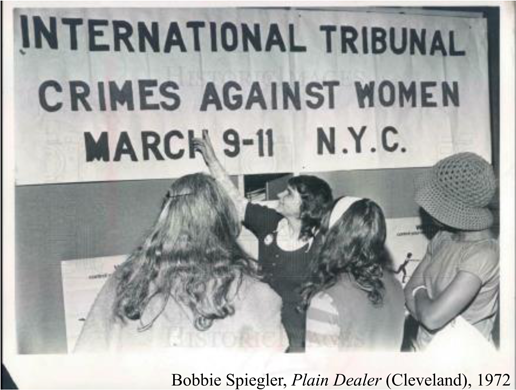
In summer of 1972, at their third conference in New York City, a group of 800 women decided on WONAAC's next action item. The organization called for an international tribunal on abortion rights. The group decided to use political theater to bring men and institutions to account, holding more than a dozen abortion tribunals around the country. How they decided to conduct these day-long tribunals is not clear, but it is evident that attorney Diane Schulder was central to their creation. Organizer Barbara Mutnick wrote a letter of thanks after Schulder's participation in the New York City tribunal and thanked her for helping WONAAC conceive of “the role of judges” (and implementing “the role to perfection”). 73
Of course, the country was familiar with tribunals, having born witness to those prosecuted and convicted in the Nuremberg Trial and the Tokyo War Crimes Trial following the Second World War. The abortion tribunals appear to have been modeled, more immediately, on the International Bertrand Russell War Crimes Tribunal held in Europe in the late 1960s and the Winter Soldiers Investigation of 1970. Russell and fellow philosopher Jean-Paul Sartre served as coordinators of the War Crimes Tribunal that investigated excessive force and war crimes in Vietnam. Those tribunals used personal testimony, as well as research and evidence to support their prosecution, and likely informed the creation of the Abortion Tribunals. 74
So too, did the efforts of the women's movement inform these historic events, according to WONAAC member Nancy Rosenstock. They followed in the spirit of what the radical feminist organization New York Redstockings organized in New York City in 1969. According to Rosenstock, “They had what at the time were called speak outs.” She noted that Susan Brownmiller reported for the Village Voice on the 12 anonymous young women who faced an audience of 300 and simply, calmly spoke about their own abortion. She recalled that GI speak outs against the war also inspired WONAAC. In addition, she reflected that the women knew hearing women's voices was effective and important: “There is a history of that kind organizing, especially by women, creative, good at expressing ourselves.” The tribunals also reflected the unique strategy of attorneys Nancy Stearns, along with Diane Schulder and Florynce Kennedy, to make the Abramowitz case predicated on all women, not just pregnant women or women who had abortions. They packed the courthouse with women and lined up 314 women to give their testimony, helping to secure legal abortion in New York, in July 1970. Kennedy and Schulder also published transcriptions of ten women deposed regarding their abortion experiences in Abortion Rap. 75
Dr. Barbara Roberts, the group's most prominent speaker and a cardiologist who also provided abortions, was working at the time for the National Institute of Health. Her travel schedule took her to cities across the country and she told tribunal organizers which cities and dates she could be available to headline abortion tribunals “with the federal government footing the bill.” With dates and locations set in place, it fell to local groups to organize the details. Most WONAAC groups organized events designed to elicit testimonies from local women, to hear from professionals about medical, political, and legal aspects of abortion, and to showcase films, displays, music, photography, and other art forms. A few cities set up “debate” events that enabled Roberts and others to advance and defend abortion rights against the invariable opponents. In the case of New York City, Roberts debated the night before the tribunal. She noted, “we depended on local chapters,” so while this was an organizational vision, it was realized by women in their cities, shaping speakers, artists, and events. 76
Women alerted local media and tried to organize pre-events to publicize the tribunals and solicit participation in them, from both women willing to testify and to attend. In Austin, Texas organizers held a Monday rally “in support Austin attorney Sarah Weddington,” who was going to argue Roe v. Wade before the Supreme Court on Wednesday. The Austin Daily Times reported that a student speaker at the rally charged: “We are trying to get it so the men in robes – in church – and in the courts – will no longer make the decisions, but we, the women, will decide what to do with our bodies.” The tribunals were sometimes held in law schools, churches, and hospitals, and crowds ranged from a few dozen to a thousand women.

Bobbi Spiegler of the Abortion Project Coalition talks with 14-year old Cleveland woman “Becky” who had an abortion at age 13. Only shown from the back in the newspaper, Becky's written testimony was read at the tribunal by someone else. Plain Dealer, October 27, 1972. Used with permission of the Plain Dealer.
Organizers solicited “big names” to speak at the tribunals and promoted their appearance in the preceding press coverage. Headlined by feminist luminaries such as historian Carol Rosenberg, psychiatrist Phyllis Chesler, and playwright Myrna Lamb, the tribunals also included anonymous testimony narrated to others or delivered with their backs turned. Admonitions to not take photographs and efforts to protect the identity of those testifying supported the bravery of those who did say, publicly, to the microphone, “I had an abortion,” Most women described harrowing, life-threatening experiences to drive home the urgency of ensuring that all women had access to safe, legal abortions. Women's stories refuted the expectation that they were irresponsible, describing failed birth control, sexual assaults, and financial exigencies. More than just a response to emergencies, though, some women testified that safe legal abortions were easy to acquire and not traumatic, and should be available regardless of the reason that women found themselves pregnant. Women decried the demand that psychiatrists ascertain their mental fitness in order to secure an abortion. 77
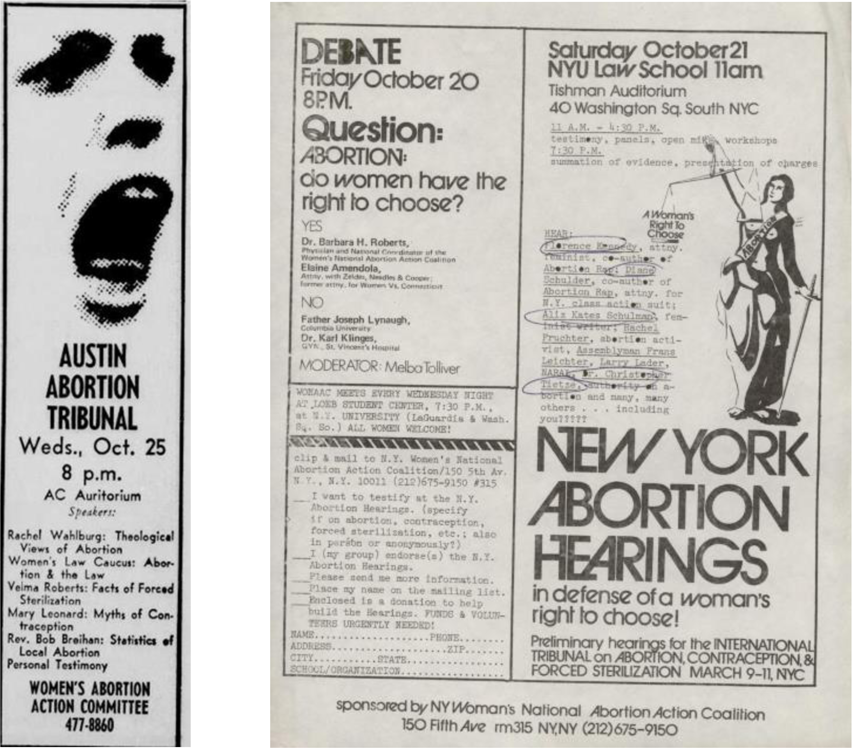
Austin Abortion Tribunal, Austin Daily Texan (University of Texas at Austin), October 25, 1972; WONAAC flyer, “New York Abortion Debate, Hearings,” October 20 and 21, 1972. 78
We have audio recordings for tribunals held in Cleveland and Houston, and some limited video recording footage from the New York City tribunal, but not all events were preserved. Women offered testimony, professional experience, and dramatic performances to illuminate the crimes being committed against women.
79
Bobbi Spiegler, who helped organize the tribunal in Cleveland, concluded of the day's proceedings: Today, we have heard testimonies from women who have been victims of laws which deny us the right to control our own bodies. We have given voice to thousands who have died alone in back alleys at the hands of butcher abortionists. We have given voice to those who could not be here today because they are suffering from self-induced abortion. We will not allow psychiatrists and doctors to determine for us how to control our bodies. We will not be misled by politicians who fuel their campaign speeches with promises for women's rights and do nothing about it once elected.
80
At the conclusion of the day-long tribunal in Houston, held on October 19, one of the judges, called out: Members of the jury, you have heard today, testimonies of these women and their testimonies of the treatment they have faced at the hands of laws, which deny women the right to control their own lives and bodies, the right to decide whether or not we bear children. You’ve heard testimony that only last year the State of Florida tried and sentenced a woman, Shirley Ann Jackson Wheeler for doing what some women in the States have won the right to do, terminate an unwanted pregnancy, which in the State of Florida was called the crime of manslaughter. You have heard and seen evidence, which demonstrates that legal abortion is safer than pregnancy.
She continued. You know that over two thirds of the American people are in favor of legalizing abortions. You have heard that there is currently on the books in Texas a law that denies women the right to an abortion and which forces over 300 Texas women each week to leave this State to seek legal abortions in other states where they are legal, and forces those women who cannot afford it into the hands of back-alley butcher abortionists, and to mutilation and possible death. You have heard the crimes committed against these women here in this court today. I would like to ask the jury what their verdict is. Those people being indicted here today are the Channel View School Board; the University of Houston Board of Regents; Crawford Martin, Attorney General of Texas; the Texas State Legislature; the Archbishop of Galveston-Houston; Chief Justice Warren Burger; and President Richard M. Nixon. Sisters of the jury, what is your verdict; are these men guilty or not guilty.
These tribunals played out similarly in places like Berkeley, California; Atlanta, Georgia; and Cleveland, Ohio. The organizers in Philadelphia, Pennsylvania issued subpoenas to Mayor Frank Rizzo and other officials “to testify about their ‘crimes against women” at the tribunal held at Pennsylvania Hospital. Their May 1972 action culminated in picketing “the Federal Building in protest of Federal anti-abortion laws.” As organizer Samara Jarosh explained, “‘It's really the Federal government that prohibits women from having abortions and prohibits high school women from getting contraceptives.’” The Federal Building was also a fitting target of their message, since in the form of the FBI, the Federal Government was indeed listening. Jill Fein who testified at the Houston tribunal that her abortion “was horrendous from beginning to end … the only thing I didn’t have was that I didn’t die,” later discovered that the FBI had been keeping her under surveillance for years. She described her “heavily redacted FBI file” as “full of my activities to fight for the right to choose.” 81
The two-pronged approach, testimony followed by public action, in cities like Madison, Wisconsin and Philadelphia may have been a trial-run in May for WONAAC's larger idea for the fall. Some of the tribunals were punctuated by marches and rallies, while others like the one in New York City, went on into the evening. A tribunal held in Hempstead, Long Island, issued indictments of nine local legislators, the County Executive, and the Catholic Church. “‘Those named in the ‘indictment’ were charged with ‘robbery in the first degree of women's rights and dignity’ and ‘attempted murder of women by preventing them from obtaining safe and legal abortions.’” 82
New York City's tribunal was the largest and with its media market, reached the most people. Indicting Cardinal Cook and President Nixon, among others, more than one thousand people participated, and more than fifty women gave testimony. Indeed, “many women who wanted to testify did not get a chance.” Florynce Kennedy, who also served as a judge, summarized the Black and Latina Women on Abortion panel, noting that the “‘denial of the right to abortion makes women slaves to their reproductive systems.’” Organizer Barbara Mutnick, writing to Dolores Frida in thanks after the event, commended her, “Your contribution to the Black & Latina Women on Abortion panel was informative and provided real motivation to non-white women to become involved in the abortion and feminist movements.” She asked Frida for more guidance, moving forward, “‘in terms of how to deal with forced sterilization and other issues particularly relevant to Latina women.’” 83
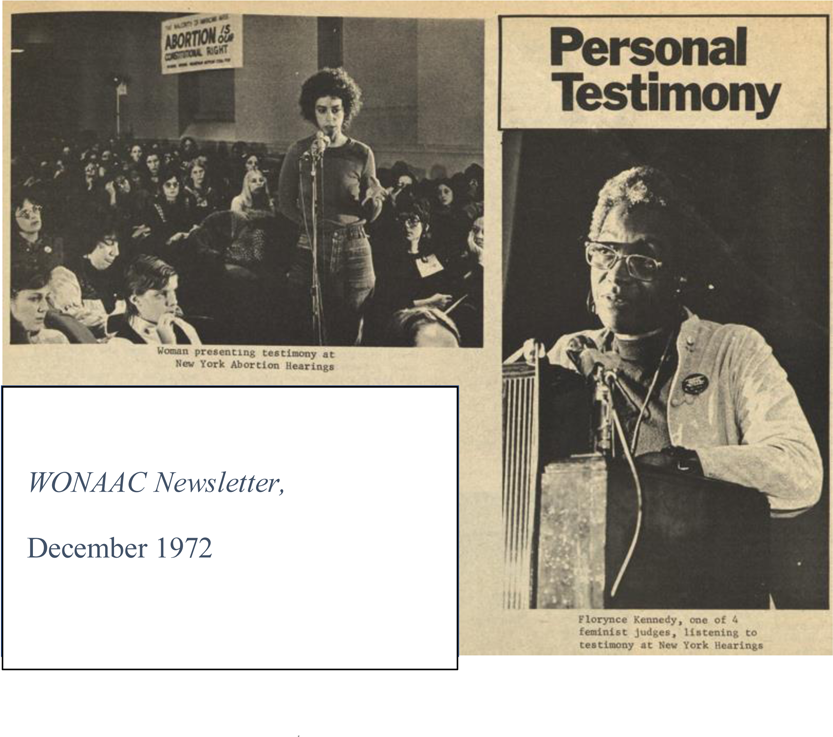
Courtesy of Schlesinger Library. 64
Beyond the speakers and panels, WONAAC also valued the power of art to both communicate ideas and viscerally connect people with the issues. The embrace of artists, playwrights, singers, and documentary movies ensured their inclusion in abortion events generally and the tribunals nationally. It was also an opportunity for artists to contribute their work to the cause. In Atlanta, after recounting snippets of women's testimony at the tribunal, the Constitution reported that, “The women testified against a backdrop of art works, depicting pregnant women, entitled ‘the Feminine Hangup’ by Atlantan Bonnie Vierthaler.” A local feminist theater group called Womansong Theater performed skits and singers “brought down the house with its rendition of ‘Free Our Sisters,’ a song written by the New Haven, Conn., Women's Liberation Band.” In a letter thanking photographer Abigail Heyman for displaying her photographs at the New York City Tribunal, an organizer enthused that they “help take away and cut across the myths associated with abortions … that they’re harmful to women, that they’re major medical operations, etc.” Heyman's photograph of her receiving an abortion, shot by her, between her legs, toward her vagina and the person performing the abortion was strikingly powerful. As one colleague reflected in Heyman's obituary, “‘As a feminist, she was not so much about marching … She took pictures that showed what the marching was about.’” WONAAC embraced art to connect the heart and the mind, and help affirm abortion rights. 84
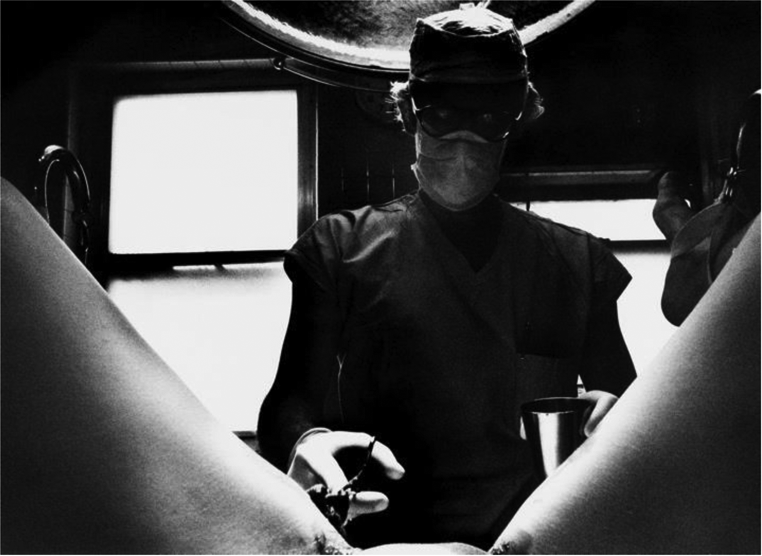
Abigail Heyman, Abortion, 1972. The handwritten statement accompanying the image in her autobiographical Growing Up Female read: “Nothing ever made me feel more like a sex object than going through an abortion alone.”
One of the hallmarks of WONAAC was how it used visibility to advance abortion rights. Fifty years later, news organizations used photos from this era featuring women marching in the streets for abortion rights, recognizable by their symbol on posters, pairing the infinity symbol with the woman symbol. If the Supreme Court had not handed down its abortion rulings in January of 1973, it is likely that these tribunals, culminating in the International Tribunal on Abortion, Contraception, and Forced Sterilization headed by Simone de Beauvoir in New York City in March of 1973, would have been recorded as vital contributors to affirming the growing support for legalized abortion. Instead of “Days of Denunciation of Crimes Against Women,” with its aim accomplished, the organization folded within months. They held the final meeting in celebration of what they had achieved, rather than as a culmination of the damning indictments they had been assembling across the country. 85
The Women's National Abortion Action Coalition gave voice to women and their abortion struggles and helped shape American popular opinion. In spite of the tensions and struggles that plagued the organization, supporters worked together to offer a unified front in the fight for abortion. The women believed that abortion should be legal and on demand, that there should be no forced sterilization, and that contraceptives should be available to all women. They organized thousands of women around the country on those principles, but with antagonism toward its socialist DNA, a system of decentralized leadership, and a short-lived existence, no one remained to tell their story. Like the women seeking abortions, the organization existed to feed an immediate need. When it was over, participants did not look back. If they had, they would have seen a coalition that achieved a remarkable feat of organization, reliant only on conferences, mail, and the telephone to connect women nationally; drew thousands of women to tribunals across the country and secured media coverage; and helped keep abortion rights in the news, visibly supported, in the vital period that it was under review in our nation's courts and the court of public opinion.
Footnotes
Acknowledgments
I am grateful to all of the women who shared their stories with me: Kipp Dawson, Samara Jarosh, Barbara Mutnick, Jill (Fein) Parks, Susan Reverby, Barbara Roberts, Nancy Rosenstock, Paula Savich, Bobbi Spiegler, Nancy Stearns, and Rose Weber. With thanks, too, to those who offered sage advice, feedback, and edits: Melissa Ziobro, Trish Maloney, Chris DeRosa, and two anonymous readers.
Thanks also to the archivists/librarians who helped make this article possible:
John Anderies, John J. Wilcox. Jr. Archives, William Way LGBT Community Center; Diana Carey, Schlesinger Library, Harvard University; Kristen Chinery, Walter P. Reuther Library, Wayne State University; Erin Harbour, The Dolph Briscoe Center for American History, University of Texas – Austin; Arik Kriha, Wisconsin Historical Society; Susan Krueger, Wisconsin Historical Society; Kate Long, Smith College, Special Collections; Jason Nargis, McCormick Library of Special Collections & University Archives, Northwestern University; Julia Teran, Case Western Reserve University Archives; Sherri Xie, Monmouth University's Interlibrary Loan
Declaration of Conflicting Interests
The author(s) declared no potential conflicts of interest with respect to the research, authorship, and/or publication of this article.
Funding
The author(s) received no financial support for the research, authorship, and/or publication of this article.
