



Abstract
We present a model of 19th Century population change in England & Wales. The model highlights contrasting demographic and economic processes in rural and urban sectors as core explanations for rural to urban migration, stemming from labor surpluses in the former and labor shortages in the latter. This massive migration transformed the geographic distribution of the population, in tandem with the economic transformation caused by the Industrial Revolution. We argue that demographic literature on historical population processes in England & Wales in the 19th Century has paid insufficient attention to the role of internal migration.
Introduction
This article presents a framework for understanding long-term population change in England & Wales, covering the 19th century. The paper presents an analysis of interrelationships between demographic and economic processes, in the rural and the urban sectors of England and Wales (referred to as England). Demographic change in each sector was quite distinct and each was strongly associated with the most important historical transformation in modern times, the Industrial Revolution. The proposed framework emphasizes a system of interrelated demographic and economic processes which unfolded in a different way in each sector.
The demographic and economic interrelationships are briefly presented here, and discussed in greater detail below. Throughout most of the 19th Century, demographic processes led to rapid natural increase in the rural population of England. This rapid rural natural growth rate led to large increases in the population in all age groups, including the working age population. In contrast, natural increase was low, around zero, in the urban sector. As a result, there were large increases in labor supply in the rural sector, compared with a non-increasing labor supply in the urban sector. These distinct demographic processes evolved in tandem with a transformation in the relative economic importance of the rural and urban sectors following the developments of the Industrial Revolution. While the economic weight of the industrial sector was increasing, that of the rural sector was declining, leading to differential growth in labor demand in the two sectors. This is exemplified by statistical series, taken from Mitchell and Deane, that show a decline in the percentage of labor in agricultural occupations, from 32% in 1831 to 13% in 1901, with continued declines thereafter. 1
Together, these demographic and economic processes led to a potential oversupply of working age population relative to economic opportunities in the rural sector, which contrasted with a potential shortage of working age population in the urban sector. The combined force of differential natural increase coupled with changing economic opportunities in each sector, led to massive rural to urban migration of millions of people during the 19th century, changing the population structure of England from a rural to an urban society. 2 Thus, the two major demographic variables of interest in the proposed explanation of population change are rates of natural increase and internal migration 3 .
Demographic Transition Theory
The role of rates of natural increase in population change was emphasized in early literature in models of demographic transition, developed during and after the second quarter of the 20th Century. Warren Thompson and his colleagues were the earliest to formulate a Theory of Demographic Transition in 1929. 4 Later, others such as Frank Notestein developed the ideas further. 5 Early formulations of transition theory were presented in terms of three stages of demographic evolution from high birth and death rates—“high balance”—to low birth and death rates—“low balance.” An intermediate stage of high rates of natural increase resulted from faster declines in death rates than in birth rates. Thompson, Notestein and others suggested that modernization processes which included a wide range of social and economic change were important correlates and causes driving the demographic transition, particularly fertility decline. 6 (Friedlander, Okun and Segal provide an in depth review of literature on the evolution of Demographic Transition Theory. 7 )
Beginning in the early 1960s, there was a shift in the theoretical focus of demographic transition towards explaining trends in the components of fertility, in particular change in marital fertility and proportions married. There was also change in the application of a variety of types of explanatory variables. Socioeconomic explanatory variables were now supplemented by cultural variables in the influential Princeton European Fertility Project (EFP), which was inaugurated under the direction of Ansley Coale. The major objective of the EFP was to collect and analyze statistical data on the levels and changes in overall fertility, marital fertility, and nuptiality, along with related socioeconomic indicators and cultural factors applying these on a large sample of European provinces. There was little resemblance between these demographic analyses and the original formulation proposed 30 years earlier. But the project was still centered around the search for explanations of the transition in human demographic behavior as before. Detailed results of the project and its findings, along with a series of valuable articles, on various transition subjects, by participants of the project appeared in a volume edited by Coale and Watkins. 8 We suggest that the role of migration in the context of transition processes was under-analyzed in this book, as well as in much of the earlier research on demographic transition. In an exceptional chapter in the book, Francine van de Walle does emphasize the multidimensional nature of transition processes and suggests that the focus should be broadened to include other demographic variables including migration. 9
During the same year that the EFP was inaugurated, Kinsley Davis delivered his presidential address at the Population Association of America (PAA) annual meeting, which was subsequently published as his Theory of Change and Responses in Modern Demographic History. 10 The major premise of his theory is that rather than focusing narrowly on changes in marital fertility, demographic transitions should be analyzed in terms of the entire range of relevant demographic changes. These include the delay of marriage, celibacy, contraception, sterilization, abortion, overseas emigration, and rural to urban migration.
Kingsley Davis attributed great importance to the role of migration in modern demographic history, arguing that rather than focusing narrowly on the demographic transition that analyzed changes in fertility and mortality, population change should be analyzed under the entire range of relevant demographic and other changes. 11 Friedlander developed this idea further with the concept that community adjustments to demographic behavior made in response to rising strain are likely to differ depending upon the ease with which the community can relieve the strain through other adjustments, for example by migration. 12 Later research followed along these lines of testing Davis’ framework in a variety of historical and more contemporary settings. 13 Friedlander and Okun present a conceptual framework building on these earlier works and broadening Davis’ ideas in a more structured fashion, which included migration as a major variable in the theory of the Demographic Transition. 14
Related research on urban transition 15 , beginning with Zelinsky's work, attempts to integrate the study of urbanization with the study of changes in vital rates of deaths and births. 16 An ongoing debate attempts to adjudicate between the ultimate demographic forces behind urbanization: earlier and more rapid declines in death rates in urban areas than in rural areas vs. positive net rural-to-urban migration. While some researchers such as de Vries, as well as Fox and Dyson, have emphasized the importance of increasing rates of natural increase in urban areas following steep declines in urban mortality 17 , others such as Bocquier and colleagues have emphasized the greater importance of net rural-to-urban migration, which is driven by economic change. 18 In this article, we note that rates of natural increase in urban areas of England are consistently lower than those in rural areas throughout the 19th Century (see Table 1), so that the role of internal migration is dominant in explaining urbanization. We emphasize the joint contribution of differential vital rates in rural and urban sectors as well as economic changes in these two sectors in explaining the high level of net rural-to-urban migration. Although we examine here the case of demographic transition in England and Wales, focusing on net rural-to-urban migration as a key factor in understanding urbanization, future research may consider the role of migration in the demographic transition and in urbanization other contexts, as has been done in previous research. 19
Urban and rural populations, birth and death rates, rates of natural increase, and migration rates, by decade and by urban and rural sectors of England and Wales, 1800–1900

Note: Based on Friedlander (1969). *Urban and Rural Populations, as Percentage of the Total Population, refer to the beginning of each decadal period.
The current paper is part of the continuing research into demographic transition which emphasizes the role of internal migration from rural to urban areas as a factor which is interrelated with differential changes in natural increase between rural and urban areas as well as changing economic structure in urban and rural areas.
Rural and Urban Population Change in 19th Century England and Wales
Different patterns in birth, death, and thus natural increase occurred in rural and urban areas, which can be seen in Table 1, as derived from Friedlander's work, and as detailed in the Appendix to that paper. 20 , 21 , 22 For further developments along these lines, see Williamson's research. 23 Rates of natural increase in the rural sector were initially high, around 20 per 1000 increasing to 25 per 1000 at mid-century and beginning to decline during the 2–3 last decades of the century. In contrast, rates of natural increase in the urban sector were around zero during the early transitional period, beginning to increase at mid-century reaching values around 10 per 1000 during the 1870s to 1900, mainly due to declining death rates as shown in Table 1. As can be seen in Table 1 (with graphical depiction in Figure 1), despite the high rates of natural increase in the rural sector, its total population size at the end of the 19th Century was only slightly larger than at the beginning of the 19th Century. Long-term rates of natural increase on the order of 20/1000 imply that—in the absence of migration—the rural population should have multiplied roughly eight-fold within 100 years; and yet, at the end of the Century, the rural population was only roughly 10% larger than at its start. In contrast, despite very low rates of natural increase, the total population in the urban sector was increasing dramatically. Rural to urban migrations were the key to transforming a small urban population which had been around 18% of the total population of England at the early stages of the demographic transition, to a majority of 72% of the English total population toward the end of transition. The extreme differences in rural and urban rates of net migration appear in Table 1 and Figure 1.
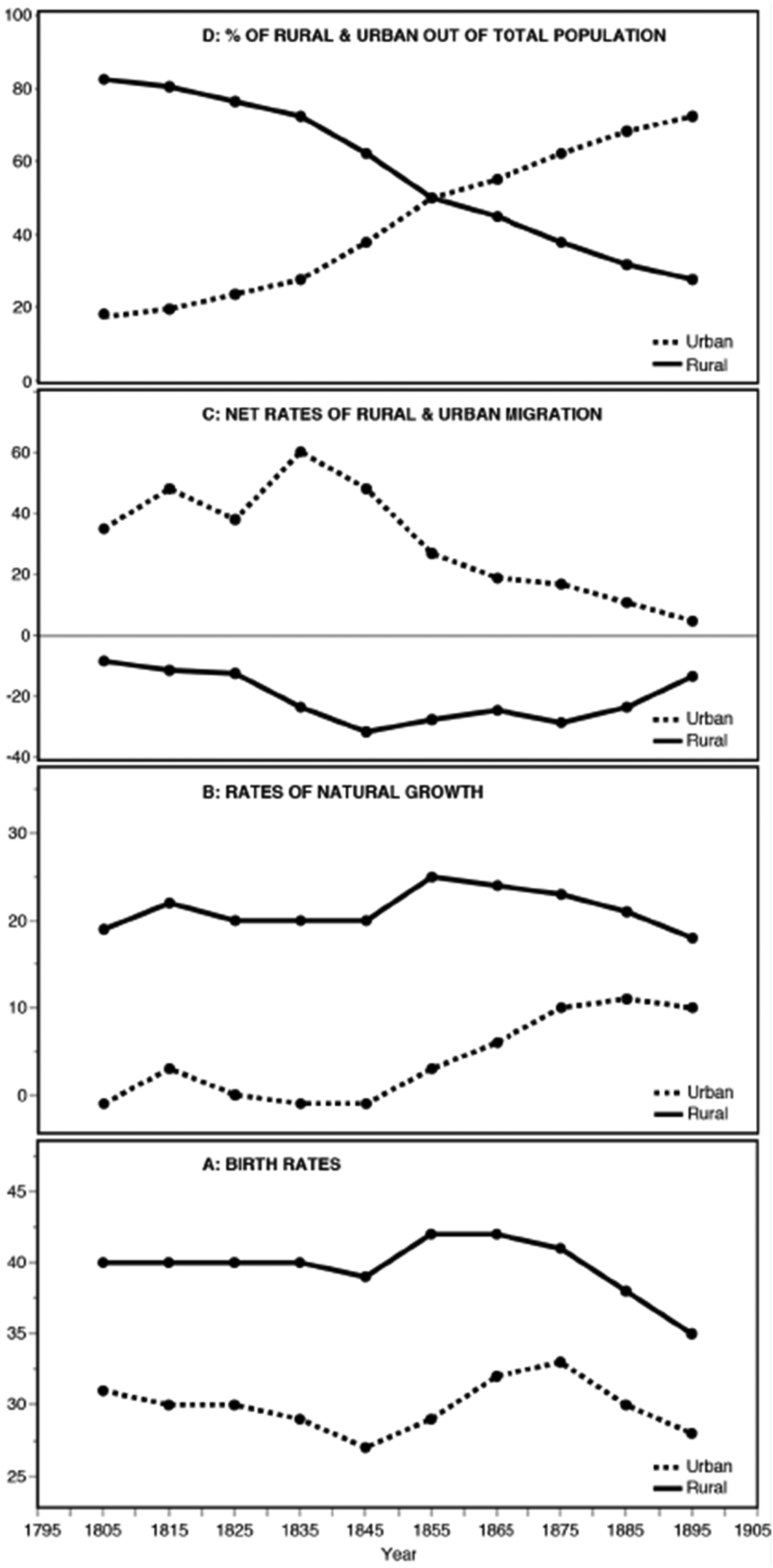
Charts A, B, C and D represent the demographic process 1800–1900.
The Proposed Framework for Understanding Population Change and the Industrial Revolution
We summarize the processes outlined above, as follows: Perhaps the most consequential characteristic of the demographic and economic processes in the rural and the urban sectors of England were their contrasting trends during the period of the Industrial Revolution. Notably, the economic significance of the rural sector was declining while that of the urban sector was increasing, leading to the changing demand for labor in the two sectors.
In addition to the long term trend of declining demand for labor in agriculture, there were temporary changes in employment due to the post war return of servicemen, fluctuations in farming output and in importation of grain, all leading to instability in incomes among the agricultural population, particularly the landless and those of the lower status occupations. 24 All these factors intensified the pressure upon persons and families in agricultural communities to leave agriculture in favor of alternative employment in occupations that were developing in association with the Industrial Revolution.
At the same time that divergent economic processes were evolving in rural and urban sectors, demographic processes in the rural sector led to high rates of natural increase, and thus growth in the supply of labor. In contrast, the urban population experienced rates of natural growth near zero, until the last quarter of the 19th century, resulting in slow growth of the labor force.
These differential economic and demographic processes—leading to excess labor supply in the rural areas and a shortage of labor supply in urban areas—provide a major explanation for the long term rural to urban migration, under the forces of the Industrial Revolution.
Thus, massive rural to urban migration transformed the geographic distribution of England's population, in tandem with the economic transformation caused by the Industrial Revolution, and changed England from a traditional agricultural to an industrializing urban society.
19th Century Rural and Urban Rates of Natural Increase and Migrations
Despite the theoretical importance of migration highlighted above, the demographic literature on historical population processes in England and Wales in the 19th Century has paid insufficient attention to the role of internal migration. This may be due in large part to a lack of comprehensive data that allows for an in depth analyses of migration flows during this period. In contrast to fairly detailed information on nuptiality, fertility and mortality 25 —which allows for construction of rates of natural increase -, data sources on migration are largely unavailable prior to publication of the 1851 Census volumes. (See Friedlander and Okun for description of available migration estimates compiled from information in these Census volumes). 26 Nevertheless, as explained above, we argue that the role of migration is too important in the population processes under question to dismiss it without looking closely at the available data and considering estimates of migration based on reasonable assumptions. In this way, it is possible to clarify the interrelationships between migration patterns and other aspects of population change. Below, we discuss in some detail what can be harnessed from extant demographic studies, in terms of migration patterns during the 19th Century.
Official estimates of national population size are available from the start of the 19th Century and before. Official National estimates of fertility, mortality and natural increase rates are available since 1838, which were published in census volumes and in Mitchell and Deane. 27 Estimates for earlier periods are included in the historical project of the English population reconstruction for the period 1541–1871 by Wrigley and Schofield. 28 The reconstruction was based on sampled parish registers containing births, deaths and marriages. National estimates of vital rates have also been produced by others, for various periods of the 19th century. 29 However, none of these sources provided migration rates or rates of natural increase for rural and urban sectors separately, which is critical for the implementation of the present study.
Beginning in 1851, Census publications provided estimates of rural and urban populations. Together with vital registration information, it is possible to estimate rates of natural increase for each sector for the second half of the 19th Century. However, classification of rural and urban areas as well as estimation of rates of natural increase separately for these areas was not included in official statistics for the decades of 1801–1851. Therefore, it was necessary to estimate these natural rates for the two sectors during this earlier period. Moreover, it was necessary to estimate internal migration between the sectors for all periods of the 19th century.
The initial step was to produce rural and urban divisions of the population estimates for each decade. Weber's study of city growth in the nineteenth century is a thoughtful analysis, covering many countries and cities with detailed information on several demographic variables. 30 Considering England, Weber arranged the cities and towns and the smaller districts by their sizes. 31 Definitions of urban and rural areas in England are complicated and change over time, as evidenced, for example, by changing definitions in official publications, related for example, to developing legislation related to existence of certain infrastructure (such as lighting and pavements) in districts. 32 In the current article, we adopt Weber's definitions of urban areas, as detailed in his Table XVIII, whereby urban areas in some periods may include even small towns with populations of only 2000 or more inhabitants if they meet certain criteria concerning infrastructure. 33 While the complexity of the definitions does not allow for exact comparisons across periods, we are not overly concerned that differences in definitions affect our conclusions. Neither are we very concerned that issues of reclassification of rural areas to urban areas due to natural growth in the former affect our conclusions regarding urbanization and rural to urban migration. As Weber argues, based in part on previous research by Price Williams, the main source of growth in urban populations during the 19th Century probably did not result from reclassification of rural settlements into small urban districts, but rather from population growth in cities of 20,000 inhabitants and over. 34
Definition of rural and urban areas enabled the estimation of the demographic components of change, in particular the rates of natural increase and migration in each area. The procedure of the reconstruction of the 19th century rural and urban populations into their components estimations of natural increase and migration has appeared and explained in an earlier article. 35 Relevant sections that are used in the present study are shown in Table 1. The Table suggests that the decennial rates of rural to urban migrations increased from the beginning of the 19th Century, reaching very high levels during the decades from 1830–1860, and declining somewhat thereafter. We suggest that the role of migration in the 19th Century differed qualitatively and quantitatively from that in previous periods, and that the evolution in the nature of migration processes in the later 18th and 19th Centuries is suggestive of meaningful change over time. 36 With the Industrial Revolution, waves of migrations occurred from rural areas to the South Wales coal mines, to the industrial north, and migrations to the London area and to other developing cities. The characteristics of these migration waves differed from migration in earlier periods which did occur, but were characterized more by, for example, to occupational and trading migrations, movements of children to other farming households, as servants, needing the increase of their labor force, children marrying who had to form their own new household and so on. Such movements were within the village or out, with some proportion of long distance migrations. These occupational changes and household “adjustment” migrations” make some contribution to pre-industrial net migration. Overall, migration movements in pre-industrial periods are described as having been relatively of low frequency, and mostly migrations from villages to larger market towns. 37
In the early 19th century, migration was turning into a complex geographic network of workforce movements from areas of low demand to destinations where demands of labor were high. Apart from the summary of estimates of rural and urban migration presented in Table 1, other research has presented migration flows among 53 counties during the second half of the 19th Century. 38 In the process of the Industrial Revolution nearly 2 million inter-county migration movements were made among the 53 counties per decade, being about 8–9% of the total population. About one third of these migrated from rural to urban counties, leaving agriculture, to join the rapidly developing urban industrial sector. 39 Moreover, about 25% of these migrations were long distance movements of over 100 miles. 40 Unfortunately, there is no way to compare these heavy migrations with the pre-industrialization migrations, because the latter were not based on quantitative evidence. Thus, it can only be assumed that around the early 19th century there was a great upturn in the overall frequency of migrations, being a major component of the Demographic Transition as defined here, in relation with the early stages of the Industrial Revolution.
Changing Rural and Urban Economic Structure and Quality of Life During the 19th Century
Beginning in the late 18th Century, and continuing throughout the 19th Century, changes in modes of production followed industrial innovations. New industries were developing, and old ones modernizing - textiles, steel, coal, pottery and others. Tertiary and service occupations were turning into growing sources of employment. The advancement of transportation was a key factor in easing mobility of people as well as in the more efficient shipping and distribution of goods and raw materials. These developments increased the long term urban demand for labor, which could not be satisfied through the urban demographic processes owing to the long term low rates of natural increase in urban areas. In contrast, conditions of the rural-agricultural population were unstable during the entire 19th century. The period since the 1780 was characterized by economists as having sharp fluctuations, and were classified into periods of prosperity and of hardship, as discussed below.
In the earlier period, the Napoleonic Wars (1792–1815) were years of prosperity for agriculture, as importation from the continent was severely cut down, raising the prices of the local products to the benefit of farmers. 41 Towards the end of that war relative prosperity turned into a period of distress for two decades, as production of grain exceeded the demand, lowering prices considerably. The suffering was widespread affecting large and small farmers, the landless and agricultural workers. Large tracts of land were uncultivated and many large farmers lost everything. Additionally, hundreds of thousands servicemen returned from the war, worsening the employment situations. 42
In an attempt to provide relief to the agricultural population, the government enacted the Corn Law in 1815. However, the law was clearly hurting the growing urban population, which led the government to repeal the law in 1846. Thereafter, the agricultural market was reopened to imports from the continent, deteriorating further the wellbeing of large numbers of agricultural families. 43
It has been argued that the period since the late 18th Century and until the middle of the 19th Century conditions during the Industrial Revolution were the most difficult in terms of living conditions in both the rural and urban areas, and that after mid-century, progress was achieved in various welfare aspects in both sectors. 44
Later, in the third quarter of the century, the “Golden Age 1850–1873”, was in general beneficial for the agricultural industry, despite the end of price protection. Prices of local products remained relatively high, which was explained by various difficulties in the grain exporting countries. Another factor explaining these improved conditions following the eighteen fifties was that many farmers succeeded in specializing in certain products, which could now be transported to the growing cities all over England, using the increasing efficiency of transportation. 45
Finally, the last quarter of the 19th century was referred to by economic historians as the “Great Depression 1873–1896”, which was said to be devastating for the agricultural industry. Local producers could not compete with cheap importation, particularly from America. It was such a damaging situation that the agriculture industry has been described as approaching an “advanced state of decay”. 46
Thus, the rural sector was subject to extreme economic fluctuations throughout the 19th century affecting particularly the lower economic sections of the agricultural population. This economic instability, and the overall decline in the economic importance of the agricultural sector during the 19th century led to the migration of millions of agricultural individuals and families, who were motivated by differential development between the urban and rural sectors, including higher wages, and/or leaving agriculture in favor of other occupations within rural areas. Under these changing rural and urban conditions—with no optimistic outlook in agriculture—and despite the hardship of migration and the difficulties of urban life described above, the decision to migrate and/or to change occupations was made by millions of rural inhabitants.
This is not to understate the hardships of migration or to glorify the standards of living in urban areas. While it has been estimated that urban wages were higher compared with those in the rural sector 1800–1850 47 , the wage gap is just one of many elements affecting the general perception of standard of living which, apparently, motivated agricultural families to leave agriculture, by emigrating or changing occupation locally. Factors such as rent for housing, food prices, education and other items of standard of living—are crucial. For example, alarming problems emphasized in the literature were the very poor housing conditions as well as pollution. In addition, health conditions were poorer in urban areas, with urban death rates much higher than those of rural areas. Thus, comparisons between rural and urban areas in terms of quality of life (health, cost of living, quality of housing, and more) is complex and cannot be reduced to one or two factors, such as wage rates. 48 What can be said, though, is that despite many problematic issues concerning the quality of life in urban vs. rural areas, rural to urban migration rates were high and increasing, at least during 1801–1850. 49
All told, on the macro level, these migrations had the function of moving the workforce from areas where their work was no longer needed to areas where their work became increasingly productive (Long, 2005). 50
Discussion
From the end of World War II and until at least the 1980s, there was probably no research issue that appeared more frequently in the demographic literature than theories and explanations of the demographic transition. The concept of demographic transition received so much research attention, as it was thought to have wide-ranging impact on social, economic and population processes, both historically and in more recent periods. The dominant theme in the early literature was the transition from high to low birth and death rates, and consequent changes in natural increase. Later, there was a greater emphasis in the literature on the reduction of marital fertility, as a key component of the change in overall fertility and thus natural increase.
The present paper highlights several concepts and terms which received little attention in previous studies of demographic transition. For example, in our consideration of demographic transition in England and Wales, we focus on the interrelationship between the Industrial Revolution and Demographic Transition—interrelationships which have not been greatly emphasized in previous research. In addition, while the degree of urbanization has been used in past research as an explanatory variable, we consider urban and rural areas as distinct and crucial structures of the population system. Within these distinct sectors, differential demographic processes occur. Migration patterns between rural and urban sectors over the long-term of a century of time are an integral part of the broader system of demographic transition and the Industrial Revolution.
In contrast, theoretical construction of many previous demographic transition studies did not emphasize migration between rural and urban areas as an important demographic variable that could be a balancing force between areas of rapid natural increase and economic decline on the one hand, and areas of slow natural increase and rapid economic development, on the other, as proposed here. Moreover, despite some emphasis in the literature described above on a range of specific socioeconomic and cultural conditions that may have been associated with a reduction in fertility—specifically in marital fertility—in England and Wales in the late 19th and early 20th Centuries, the demographic literature has not offered a macro perspective which lays out at a very broad level of the interrelationship between the Industrial Revolution and population processes in England and Wales.
Thus, the first contribution of this paper is to go beyond studies of demographic transition—which focused specifically on changes in fertility within marriage as related to specific indicators of socioeconomic status—to describe how economic changes in the modes of production associated with the Industrial Revolution were intrinsically interrelated with differential patterns of natural increase and migration rates in rural and urban areas. These differential economic-demographic patterns were a major contribution to the urbanization of England. At the most encompassing level of analytic interrelationships between economic and demographic variables lie the differentials in natural increase and migration which occurred in different economic sectors. Specific aspects of these interrelationships (e.g. the relationship between fertility and literacy) must be understood as part of a broader system of demographic and economic change. The second contribution of the current paper is to expand the original framework of the Demographic Transition system to consider changes in migration along with changes in other demographic variables, such as fertility, natural increase and mortality. Thus, the present paper offers additional elements that continue to broaden the perspective of the evolving framework of the Demographic Transition. While this paper has focused on population processes in 19th Century England, the elements of rural to urban migration in relation to demographic transition can be considered in different contexts and historical periods. 51
Footnotes
Declaration of Conflicting Interests
The author(s) declared no potential conflicts of interest with respect to the research, authorship, and/or publication of this article.
Funding
The author(s) received no financial support for the research, authorship, and/or publication of this article.
