



Abstract
In the territories of the Russian Empire populated by the Latvians, the years of the First World War (1914–1918) and the ensuing Latvian War of Independence (1918–1920) witnessed a significant transformation in the discourse on family planning and birth control. Because men were mobilized, there was a marked fall in the number of registered marriages, which meant that women had only a slim chance of marrying and planning a family. The nation's ideologues faced a challenge: how to restrain Latvian women from marriages and casual relationships with soldiers of the multi-ethnic Russian army and the occupying German army, who had been stationed in the Latvian-populated provinces since 1915, these having been separated by the battlefront. Women's demographic behavior was changing, with sexual life beginning before marriage, giving rise to a phenomenon of casual liaisons. Latvian nationalists, seeking to prevent such casual relationships in the name of the future they imagined for their people, promoted sexual restraint, which became at this time one of the strategies of the nation-building process. This article examines the wartime possibilities for marriage and the family planning associated with it and investigates the discourse of the propaganda of sexual restraint that was maintained and developed by Latvian nationalists, looking at their assessment of the situation and the principles they formulated for the appropriate (non-) use of sexuality, which in that context acted as a birth control instrument. The article looks at the role of abortion as a traditional means of birth control, and how the wartime conditions affected the number of children born outside of marriage. The research is based mainly on analyses of press materials, statistical data, and archival documents.
On 27 November 1923, a woman by the name of Anna Sirmā requested the board of Mazstraupe Parish to issue her a passport under the name Anna Gērmane, since, as she maintained, this was her real name, and she had been cohabiting with a certain Aleksandrs Sirmais. 1 It emerged that, during the First World War, in 1916, Anna had become acquainted with and lived with Aleksandrs Sirmais, but they had never married. In 1918, under the German Empire's occupation, Sirmais had arranged a passport for her, giving the surname Sirmā, which Anna would have had, if she were the wife of Sirmais. Anna asserted that, since that time, she had started making use of this erroneous passport, because she had been completely dependent on Aleksandrs. In 1920, she was also issued a passport as a citizen of Latvia under the name Sirmā, and the people of the parish regarded her as the wife of Aleksandrs Sirmais. In early 1924, Anna was charged with the criminal offence of utilizing a document containing a false declaration. Under the legislation of that time, such an offence was punishable as document forgery. 2
Anna Gērmane's actions in obtaining an identity document serving to legitimize her status as a married woman indicate that, even during the war, the norm of the early twentieth century, whereby sexual relations could be legitimized only through marriage, was so oppressive it could incite people to break the law.
Wartime Realities: Historical and Demographic Contexts
Wartime realities, such as economic dependence on men, forced women to engage in relationships that were termed “casual love,” a label that became established in Latvian parlance only in those years. 3 Gender imbalance led to intimate encounters between the occupying soldiers and local women, also in territories of Belgium and France occupied by German Army. 4 In the European countries embroiled in the war, women who became involved in such relationships were publicly castigated, sexual relations being condemned as a misconception of patriotic duty. 5 French women were accused of sexual collaboration with the enemy in German-occupied France. 6 Conversely, the Germans were concerned about relationships between American infantry soldiers and Fräuleins in the US-occupied Rhineland, 7 and about German women's relationships with prisoners of war employed on farmsteads. 8 In the German Empire, women were imprisoned for engaging in friendly relations with prisoners of war. 9 At the same time, relationships between German army soldiers and women in the occupied territories would even be recounted in German military newspapers. 10 In the context of the Finnish War of Independence and Civil War, the Finnish press commented ironically on Finnish women pining for the “departing Ivans.” 11 And in the occupied Kingdom of Serbia, the Serbs voiced criticism against the women of their nation. 12 In wartime, the sexual behavior of military personnel and civilians alike became an important issue for the state, linked to concepts of patriotism and national duty. 13 In the realm of sexuality, the soldier's patriotic duty was to avoid catching venereal diseases, whereas women were subject to the expectation of maintaining the nation's honor, which meant sexual restraint, fulfilling the role of the faithful fiancée or wife, or the loving mother. The reminder that the nation's women were to be paragons of virtue, since they had, after all, sent men to fight so that they might be defended, was applied to women not only in the Latvian lands but in all of the warring countries. 14 The linking of male honor with the responsibility and ability to defend the honor of woman (the nation) 15 gave rise to an agitated discourse in the Latvian press concerning women's behavior in marrying non-Latvian soldiers. Politically, the provinces populated by Latvians were part of the Russian Empire; accordingly, the attitude toward non-Latvian soldiers of the Russian army consorting with local women was cautious, respecting the need to maintain good relations between ethnic groups in the multi-ethnic empire. In Russia, as in the Habsburg Empire, sexuality adapted to the concept of the interests of the nation promoted not only conflict but also cooperation. 16 At the same time, Latvian commentators promoted sexual restraint, which ran counter to the Russian state's interest in increasing the birth rate.
The wartime Latvian press does not overtly discuss family planning, but the discourse may be traced from references to marriage. Essentially, the aim was that women would await the end of the war and the return of men of their own ethnic group, whom they should then marry and have many children with. Thus, the propaganda of sexual restraint was, in a sense, being advanced as a strategy of preventing reproduction. In the Latvian press, there was no discourse on birth control. The subject is broached only in references to abortions as a consequence of casual relationships. Abortion was a criminal offence in the Russian Empire and would be carried out illegally; accordingly, there is no statistical data on the number of abortions in the war years. However, the condemnation voiced by the authors of newspaper articles was essentially targeting casual liaisons rather than abortion as such.
Starting in spring 1916, the press mentions “mementos” (i.e., pregnancy) and abortion ending in death as consequences of “friendships” with soldiers from Russia struck up in the summer of 1915. 17 However, information about the birth control practices employed by women is limited to laconic news items concerning abandoned infants and infanticide, and rumors about the comings and goings of women performing abortions, dubbed “angel makers.” Latvian women had access to manuals for wives and mothers, as well as to literature on marriage published in Latvian from the late nineteenth century. 18 However, aim of these brochures was to explain the reproductive system, sexual intercourse, and the psychology of marriage, while advice on active birth control was lacking. Mostly, women depended on the birth control methods suggested by traditional medicine.
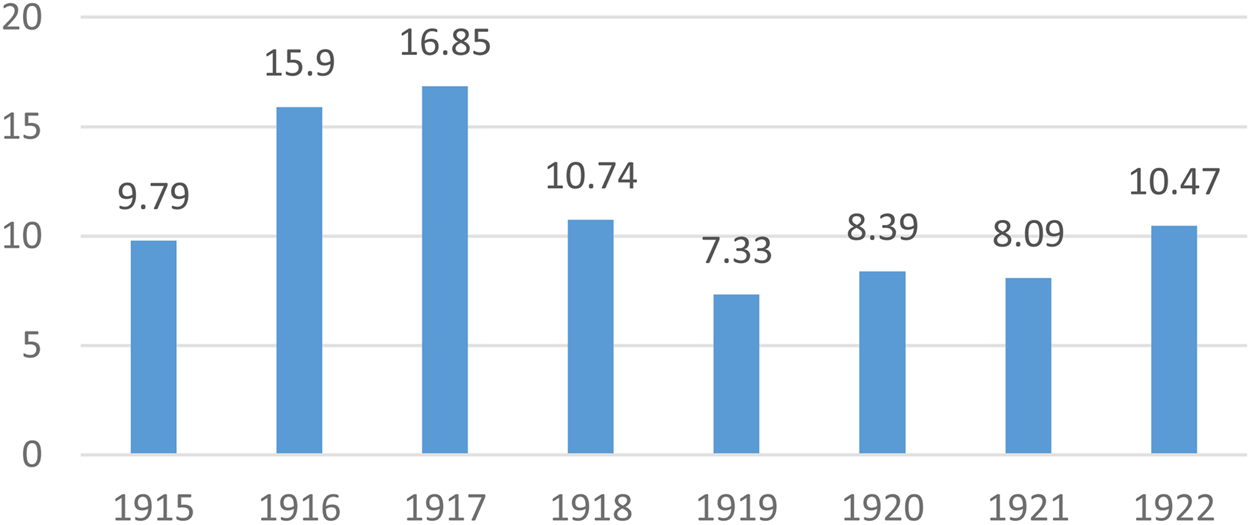
In contrast to the media of France, the German Empire and Britain, which discussed the increase in the rate of births outside of marriage and even talked of a “war babies” crisis and pronatalist politics, 19 opinion leaders in the provinces of Courland, Livoniaand Vitebsk were silent on this question. Demographic statistics for the time of the war are available only for the Latvian capital Riga. These indicate that the number of children born outside marriage in Riga increased specifically in 1916 and 1917, when the figure increased 1.6 and 1.7 times, respectively, compared to 1915 (see Table 1 “The number of children born outside marriage in Riga out of 100 children, 1915–1922”). 20
The number of children born outside marriage in Riga per 100 children, 1915–1922.

The census of 1920 showed that the number of children aged 10–20 greatly exceeded the number of those under the age of 10. On this basis, statisticians concluded that natality was extremely low during the war years, with unusually high child mortality. 21 The birth rate in Riga fell markedly in the tenth month of the war, namely in May 1915, when 112 more children died than were born, whereas in April of that year 111 more children had been born than had died. Overall, during the war years, the birth rate in Riga fell about five times. The birth rate was at its lowest in late 1917 and early 1918. 22 The marriage statistics show a similar pattern. In 1913, 4,835 couples were married, six times fewer marriages being concluded in 1916 (789), and in 1917 and 1918 marriage “was an almost exceptional phenomenon.” 23 These figures vividly characterize how the events of the war impacted on the birth rate.
These statistics reflect the military and political developments in the territory of Latvia during 1914–1920. The demographic behavior of the population was significantly affected not only by the long periods spent behind the battlefront, in the vicinity of the front and, at certain times, in the war zone itself, but also by changes of the political regime in Russia.
In summer 1915, the First World War reached the Latvian-populated provinces of the Russian Empire. The German army occupied the province of Courland, whereas the province of Livonia and the Latvian-populated part of the province of Vitebsk (Latgale) remained in the hands of the Russian Empire's forces. The front line and the trenches divided the provinces inhabited by Latvians into two zones. The German forces held Courland for a long period, the province being incorporated into the administrative region subject to the Supreme Commander of German Forces in the East (Ober Ost). Many inhabitants avoiding occupation evacuated to the big cities of Russia, but a large number remained living in the Province of Livonia as refugees. Of around 600,000 inhabitants registered in the occupied Courland before the war, the census of September 1915 shows that only around 245,000 inhabitants had stayed. The population had decreased 2.4 times. 24 Thus, from the summer of 1915, in the Latvian-populated areas not occupied by the German forces the civilian population had new neighbors, namely refugees from Courland (mainly women and children), deprived of their livelihood, as well as Russian army soldiers. For the most part, women had to find tactics to provide for their dependents in a situation of unemployment and food insecurity. As the soldiers received a regular income, various relations developed between them and the women, who thus also received material support that could be used for their families. For the most part, the couples involved in such relationships wished to avoid having children.
Another impact of the decline of birth rates related to the rise of Soviet power, because the Bolsheviks twice succeeded in establishing Soviet power for several months in late 1917 and early 1919. Before that, already after the February Revolution of 1917, processes of democratization began in society, with the election of Bolshevik-dominated institutions of self-government (soviets), and the same occurred in the Russian army, resulting in demoralization. Concurrent with the German army's offensive in the autumn of 1917, Russian soldiers began deserting the army, and there was increase in criminal offences committed by the deserters against the civilian population. At the end of November 1917, Russian army soldiers, who had become revolutionary as a result of the Bolshevik revolution, established Soviet rule throughout that part of present-day Latvia which had not been occupied by the German Empire, a move that was spearheaded by the Latvian Bolsheviks. The Executive Committee of the Soviet of Latvian Workers, Soldiers, and Landless Persons was the supreme institution of state power, introducing all of the major transformations that the Bolsheviks implemented in Soviet Russia (establishing and putting into action revolutionary tribunals and forming a Red Guard). 25 In February 1918, Soviet rule came to an end when the German army went on the offensive, and, up to the end of the First World War, the whole of present-day Latvia was incorporated into Ober Ost. The demoralization of the Russian army in 1917 also meant that there were more soldiers in the public space, who engaged in romantic and sexual encounters with local women that, in some cases, presumably led to pregnancies. It was in 1917 that the largest number of children born out of wedlock was registered in Riga (see Table 1).
Just days after the end of the war, on 18 November 1918, the Republic of Latvia was proclaimed, even though the forces of defeated Germany were still present. Already in December, Russia's Red Army invaded the new state, and the Latvian War of Independence (1918–1920) began. During the time of this conflict, a Latvian Socialist Soviet Republic existed for one year starting from January 1919, essentially a dictatorship of the Latvian Communist Party (the constitution gave the vote only to the proletariat). The area under Soviet Latvian control started to be reduced from May 1919 onward, when the anti-Bolshevik forces (German, Latvian and Russian units) attacked and liberated the Vidzeme (Livonia) region and Latvia's capital, Riga. However, already in October–November 1919, Latvia's civil population was mobilizing its resources in order to help the Latvian army in Riga and in the Zemgale region (part of the former Province of Courland) to defeat the Western Volunteer Army led by the anti-Bolshevik Russian colonel Pavel Bermondt, who viewed the Latvian state as an obstacle to the restoration of a non-Bolshevik Russia that would include the Baltic Provinces. Only in January 1920, when the Latvian army liberated the territories in Latgale still occupied by the Red Army, did Latvia's legislative body and government regain power throughout the state and could begin to engage in the processes of state and nation building, within the frame of which reproduction (as well as family policy) became important for national politics in general. As a result of the war, Latvia's population had fallen by 27%, more than in other countries of Europe. 26
In 1916 and 1917, when Riga was controlled by the Russian army, the demographic behavior of the population had changed dramatically due to the presence of soldiers and compared to the pre-war years. In Riga, the number of marriages had decreased at least sixfold and there were almost none in 1918. Meanwhile, birth rates had fallen at least fivefold, while the number of children born out of wedlock increased by 50–60 percent compared to 1915. The individual experiences that lay behind the data can be explored in the publications of the the Latvian press. In the following chapters, I will analyze the prospects of the population to marry and plan a family during the war, the national demand in terms of demographic behavior required of Latvians by the proponents of national thinking who viewed birth control as a national challenge, and the nature of wartime casual relationships in the context of family values.
Family Planning: Marriage
The marriage statistics in German-occupied Courland may be characterized by referring to one contemporary commentator's emotionally charged summary. His or her article, and several like it, could be published only after the end of the occupation, because the German military authorities censored Latvian newspapers and did not allow public discussion on national issues of the Latvian nation. An author using the feminine pseudonym Burtlice (Typesetter) asserted in the summer of 1919 that “during these five years in Courland practically no girl has been married to a Latvian lad.”
27
In her view, women were fraternizing with German soldiers because Latvians were not willing to marry, whereas non-Latvian soldiers promised to do this, in accord with the traditional moral norms. Burtlice explains: Such gutless and senseless Latvian lads have never been seen. After all, lads and girls were put in the world in order to marry. And if Latvian lads have forgotten their natural task, namely, to marry, if during these five years in Courland practically no girl has been married to a Latvian lad, and if in Russia the Latvians are engaged only in Bolshevism and money-making and have forgotten that they have to become husbands and family fathers, then it serves them right that girls at a dance will just give them a kick [refuse them and dance with German soldiers – I.L.]. Those young men who make fun of the unfortunate bedmates of soldiers should first themselves go to the pastor to confess their sins and get married, and only then would they have the right to lament at the girls duped by those who promise to marry them.
28
Planned parenthood was imaginable only in the frame of marriage, and women still wished to follow tradition, as indicated by the marriage discourse in the wartime Latvian newspapers. The keyword in the account by Burtlice is the formula concerning the promise to marry. One female author, Saulgriezīte, blamed the collapse of sexual norms specifically on women's desire to marry. 30 Thus, some women became involved in sexual relationships because of the patriarchal goal of marriage.
In the area not occupied by the German Empire, the Latvian newspapers strove to inform women that soldiers of the Russian Empire and the German Empire who wished to marry would persuade women by making false assertions that they were sons of wealthy families and by promising a prosperous life, even though they were, in reality, married already. It is possible that the soldiers were simply promising what the women wished to hear, because the sources do not permit one to assert that women truly were ignorant that their intended husbands were married already. It may be that the important thing for them was to legitimize the relationship within the local social milieu, observing the traditional moral norms, as in the above-mentioned case of Anna Gērmane, who was prepared to live with a false passport in order to be regarded as a married woman.
Russian army soldiers were not actually permitted to marry at their own discretion: they had to receive permission from their commanders. In the village of Glazmanka, located between the provinces of Courland and Livonia, after such permission had been granted in early 1917, every Sunday “several marriages were concluded with ethnic Russian soldiers.” 31 Due to censorship, the author of the description could not directly express his displeasure at the marriages of Latvian women with the soldiers of his own state's (Russia's) army, so he did so indirectly with the phrase “what is waiting for these ‘young maids’ in a Russian village is rarely thought of.” The sense of his hint was at least a conviction of Russian uncultured-ness.
During the War of Independence following the establishment of the Latvian state, nationalist Latvian commentators were concerned at the desire among German soldiers to marry in Latvia and become landowners. They considered that this would limit the opportunities for Latvian men to marry and lead a prosperous life. Writer Gotfrīds Mīlbergs commented on matrimonial advertisements by German soldiers with the exhortation to Latvian mothers and daughters to be careful, because those writing them “are the murderers of your husbands, brothers, and fiancés, who now make polite advances to you, in order reach out with their bloody claws for Latvian land.” 32 Women who married the authors of such advertisements were to be regarded as traitors to the nation. The word “traitor” was not used by Mīlbergs and the authors in the press, but the emotional connotations of the various euphemisms they used led readers to perceive female behavior as treason (as evidenced by the emotional reactions of Latvian males studied in the last chapter of this article). The attitude of the population could be ascertained by the research of diaries, as the historian Emmanuel Debruyne has shown. 33 He has studied Belgian and French attitudes towards women who engaged in intimate relations with occupying soldiers through 110 diaries. So far, I have only had examined two diaries—one by Mīlbergs and one by Anna Brigadere, the famous Latvian writer. Just like Mīlbergs, she avoids using word “traitor.” In August 1918, Brigadere writes in her diary that the term “Fritz's bride” is a dangerous sobriquet in the local vernacular. 34
Women's desire for relationships based on the institution of marriage also created a problem of bigamy. In the summer of 1919, the press reported that some German soldiers who had married Latvian women while in Courland already had wives back home, and that now many women were regretting that they had not gathered information about their future husband before marriage. 35 Women were warned that there was no German military administrative institution registering the marriages of German soldiers. Moreover, on marrying, a woman had to produce a document affirming her marital status, whereas German soldiers did not have to submit such a document, 36 showing the moral double standard for women and men. Men from Latvia serving in the Russian army and the Red Army outside of the territory of Latvia had been concluding marriages in a similar way. In the 1920s and 1930s, after they had been demobilized and had returned home, bigamy trials were heard in courts in Latvia, in order to resolve the question of their marital status. 37 However, there is no statistical data that might help give an idea of the scale of this problem.
In December 1918, when German soldiers returned from Latvia, some were accompanied by Latvian women. 38 And women seeing off the soldiers at Liepāja harbor were reported as crying hysterically, some even fainting. 39 However, only the use of inverted commas around the phrase “wartime sweethearts” emphasized the emotional, condemnatory, and ironic attitude toward them in an otherwise brief news report. During the war, marriage was still regarded as the ideal form for a sexual relationship. One author explained that every girl, if she liked a man, was immediately prepared be betrothed and marry, because she had not had the experience of being deceived and believed that a man follows the same ideal of virtue as herself. 40 Authors repeatedly conclude that women were naively hoping that their sweethearts would marry them. 41 The commentator Mārtiņš Sams asserted that most bourgeois Latvian women are romantic and sentimental, 42 and “quickly get carried away and are easily duped,” 43 since, lacking intellectual experience, they seek support from a man, but he turns out to be untrue. Unfortunately, the newspaper articles do not tell specifically of women's motivations for establishing relationships with soldiers. The disparaging terms used to refer to these women do not make clear the marital status of the “wartime brides.” Many of them naively believed in the promise to be married but were abandoned instead by their soldiers-partners at the end of the war.
After the defeat of the army of Bermondt, during the retreat toward Lithuania, German soldiers had in some cases tied women to trees to prevent them from following, and they were found by the local forester a whole twenty-four hours later. 44 Other women were abandoned when they were already outside of Latvia. In early 1920, there were about 40 “rejected Prussians’ brides” in Klaipėda, most of them from Liepāja, whom the German government had deported from Königsberg. 45 There were also women who managed to reach the German Empire and settle there for a while. In 1920, when Latvian citizens were repatriated from the Weimar Republic, women were divided into two groups: wives of prisoners of war who were civil prisoners, having come to the German Empire to seek their incarcerated husbands, and those included in the group of civilian followers of Bermondt, who had accompanied German soldiers to the Weimar Republic as wives or fiancées, but had then been abandoned by their men and left without means. 46 So far, there are not enough available sources that would allow us to evaluate how the wider Latvian society judged women who had been involved in relations with non-Latvians. Most likely, the so-called ordinary people used the same means of informal (non-governmental) social control such as persecution, contempt, boycott, and shaming during the war as they did in the 1920s–1930s 47 due to the wartime nationalized concept of family that demanded sexual restraint.
The Demand from Society: Sexual Restraint
In wartime, in the territory of Latvia, as in all of the belligerent states, 48 the discussion of sexuality in the media and in documents regulating behavior focused exclusively on one sex, namely women. In accordance with the traditional nineteenth-century precepts concerning sexuality, a sexual relationship was permissible only in marriage, on entering which a woman was to be a virgin with no sexual experience. Now, however, this norm was being transgressed in full view. Contemporaries found it hard to confront and accept this new social experience. Newspaper correspondents were shocked by the transgression of the norm of sexual restraint by women of the bourgeoisie and petty bourgeoisie, who were seen in nationalist ideology as setting the example for women from other social groups. 49 The press expressed concern not so much at the fact that women of different ages and different marital status were engaging in “friendships” as at the fact that they came not only from the impoverished section of society. 50
Women's sexually connotated relationships with soldiers were regarded by one author as confirming the rapid disintegration of the family, which threatened the idea that women embodied the nation's virtues. Writer Jānis Akuraters concluded already in the summer of 1916 that “soldiers of various ethnic background, when they return to their homelands, will be able to tell such lewd tales about Latvian women,” and that there were women on whose account the Latvian people would suffer, the country having always prided itself on the virtue of its maidens and married women. 51
Commentators were pained to observe that the younger generation of women had abandoned “its hitherto taintless veil of modesty and virtue.” 52 The veiled hints conveyed the impression that the nation was heading for catastrophe. Only occasionally was it noted that the sexual behavior of the majority of women corresponded to the norm of restraint. In early 1916, the conditions in Latgale were seen as unfavorable to the preservation of virtue; it was asserted that to be virtuous nowadays means to be a hero or even a martyr. 53 Young women were exhorted to preserve their virginity as their most precious possession. 54 Authors urged mothers, sisters, and female friends to gently persuade young women to do so. 55
The nation's interests demanded not only that virginity should be preserved but also that it should be given up to a spouse from one's own nation, namely in an officially registered marriage, whereas, in real life, young women—more commonly than before the war—would lose their virginity in a relationship with a man who was not (yet) their partner in marriage.
In the ideology of nationalism, sexual relations with the enemy made a woman a traitor to the nation, in accordance with the view that the nation is symbolically represented through her body. The close connection between nationalism and sexuality was expressed through the role allocated to the woman of regenerating the nation biologically and culturally, on account of which the nation (the men) was to protect women. Both disrespect and physical violence against the female body were seen as an insult against the honor of her menfolk (husband, father, brother, fiancé), and accordingly constituted an affront to the people's honor.
56
In 1917, journalist Arturs Tupiņš considered a certain pornographic photo postcard among those disseminated among German soldiers an affront to national pride. The journalist wrote that the existence of such postcards testified to “the disrespect and hatred” that the Germans displayed towards Latvian men: Very widespread among the soldiers are pornographic postcards, which are obscene and insulting to Latvians. They remind us of the times when German overlords could defile Latvian maidens. The cards have three photographs with the caption underneath Lettische Naturschönheiten (“Latvian Natural Beauty”). The central image shows a quite pretty young lady in polite dress with a parasol, whereas to the right and left there are pictures of her in lewd poses. She appears seated on a chair, her skirt has been lifted and then she has been photographed. In one picture, the girl is hiding her shame with her hands, while in the other her hands are being held behind the back of the chair, evidently being restrained by someone. If we look more closely into the face of this unfortunate young woman, then we see her disgust and horror at such violence. In the second picture we can see in her face her profound contempt of her torturers, who have evidently forced her to be thus photographed against her will.
57
Accusations against women in the newspapers began in the spring of 1916. The alarm reflected a conviction that a nation's standard of virtue was to be assessed not on the basis of the number of ideal citizens, but according to the number of “fallen” women. 58 In spring 1916, the behavior of women who had left as refugees would sometimes be generalized and even linked to the question of the very future existence of the Latvian people, with the reproach that it was unforgiveable “for our women to be frivolous at such a grave time”. 59 One author in Latgale suggested that practices undermining virtue should not only be discussed in the newspapers and evaluated from the pulpit of the Catholic Church but also considered at civil parish meetings. 60 Newspapers received letters to the editor asking for this depravity to be exposed, since it was “making bitter the cup of the nation's suffering, already full to the brim”, the consequences of which would be felt after the war. 61 Only a few questioned whether women's behavior should be condemned, 62 or even urged that, instead of being judged, they should be helped, and something should be done “to protect our young sisters.” 63 Writer Kārlis Skalbe sought to understand a woman who had left her infants in a home in order to dig trenches, complaining that she would earn more “if she had a pink jacket,” since then she’d have a better chance to become acquainted with a soldier. 64 He maintained that women's virtue was a matter for men, and that men (non-Latvians), whether fighting in the war or serving behind the lines, should cherish women's virtue.
At the beginning of the war, and up to 1917, commentators mainly focused on women's relationships with Russian army soldiers. The nationally oriented writer Jānis Akuraters wrote that “this wild debauchery is not simply the private affair of Latvian women but an affront to our nation.” 65 He claimed that such Latvian women were a threat to the nation's future, since, owing to their wartime experiences, they would not as future mothers be able to raise the new generation of Latvians, who would have to “create the new Latvia.” Akuraters's left-wing opponents dubbed the issue he was describing a soap bubble blown up by national moralists and located the source of the problem in the socioeconomic conditions. They emphasized that Latvian women did not stand out compared to those of other peoples in the empire; Russian, Polish, Jewish, and German women were behaving similarly. And moreover, in other countries, too, such behavior on the part of women was to be observed in the areas close to the front, indicating that this was an objective fact of the age. Journalist Arvīds Zeibots concluded that “there is no need to tragically throw up one's hands and weep theatrically at the tales Russian army servicemen would be telling about Latvian women in their own land.” 66 Since the women and soldiers will have conversed in the state (Russian) language, most of the soldiers would not even know the ethnic background of the women they had dealings with. He advised against slinging mud at Latvian women or at oneself, and not to speak of women as the dregs of society, but to recognize that they are not heavenly beings living outside of time and space, and are subject to the conditions of wartime. The socialist L. Jansons concurred, writing that the women of all peoples, from the Romanian border to the Baltic Sea, behave similarly, and that there is no point in moralizing about it; rather one should help woman discover herself. He blamed the nationally oriented commentators, who, by their “timid and sickly romanticism, straying outside of space and time, by their moaning, have had a hand in creating this powerless woman, who unthinkingly throws herself into the embrace of the pleasure-seeking, rough and brutal masses.” 67
The attitude of the publicists toward the Latvian females engaging in relationships with non-Latvian soldiers was nationalizing due to the fact that they viewed the quantity and quality of the national body as an argument for Latvian state formation after the war. So wartime sexual restraint became important for the national politics of Latvians as a minority nation in the Russian Empire. The imaginary goal of Latvian females to marry non-Latvians did not meet the nationalized agenda.
Casual Liaisons: The Unattained Goal of Marriage
The naivete and economic dependence of women, cultivated and imposed on them, had given rise to developments that commentators regarded as undesirable for the Latvian people. In the first years of the war, public opinion explained women's behavior (since men were not subject to evaluation) in terms of the rhetoric of pleasure-seeking, incorporating such keywords as instincts, flesh, pleasures of the flesh, debauchery, and flirtation. 68 In the summer of 1916, it was observed that, in the countryside, “degeneracy is assuming incredible proportions, as if the social conditions of the city had been transferred to the countryside and had brought with them prostitution.” 69 However, in cases where women were accused of disregarding sexual norms, it was mostly a matter of relationships between the sexes that did not constitute prostitution but were being called by this name, because pleasure was traditionally connected with the sale of sex. Public opinion saw procreation as the sole aim of sex in marriage, and so pleasure was justified only in conjunction with the wish to conceive. As late as summer 1914, a journalist explained to readers that there was a difference between prostitution and sexual life outside marriage, and that a woman's brief or lasting sexual relationship with a man where she “does not receive monetary recompense for her relations and does not sell herself to any man who wishes it” cannot be regarded as prostitution. 70 Such a relationship was referred to as lasciviousness, which was seen as passing quickly, as a form of youthful frivolity.
The description of a relationship as “living in lewdness” should, in legal terms, have meant that a man or woman was engaged in prostitution (such relationships were described as orgies, debauchery, wantonness or extensive relationships with soldiers), but such phrases as “women are so madly in love that they are willing to abandon their children and accompany the soldiers, even though they are all married” and “now there are plenty of sweethearts to whom they make love each night in the forest, in storehouses and haylofts” indicate that these relationships do not correspond to prostitution. 71
One author emphasizes that prostitution should be distinguished from the process of accelerated disintegration of the family, which he refers to as casual love. 72 The many publications using the term prostitution to refer to a sexual life in a relationship not officially registered indicates that the changes in the culture of relationships between the sexes were not being articulated in the outlook of the majority of the population, which was witnessing this process. During the war, the transformation was taking place much more rapidly than comprehension of its essential nature, but the communicators of moral panic did not mention that the goal of the new relationships was to establish new families based on marriage, and that in the wartime conditions this aim was most commonly not achieved.
Latvian commentators wished to prevent casual relationships with soldiers of the imperial Russian army. In the wartime press they were generally referred to by the euphemism “soldiers,” not mentioning their ethnic background, whereas the ethnic affiliation of the enemy soldiers, those of the German army of occupation, would generally be made clear. Writer Jānis Veselis wrote in 1919 that the Germans are the enemy, whereas the people from one's own state (Russian army soldiers) are, however, different. 73
These men, referred to as sweethearts in uniform, charmers, tempters, ethnic Russian soldiers, people of various ethnic background in the Russian army, men who had come, fighting men or men serving behind the lines, foreigners, foreign soldiers, or men of the occupation, were not Latvians, and accordingly they were contrasted with fathers, husbands, brothers, and fiancés (loved-ones). 74 In early 1918, they came to be dubbed tovarishchy (“comrades” in Russian), or griškas and miškas, nicknames derived from the popular Russian names Grigorij and Mikhail. 75
Relationships with such men were condemned in the Latvian press. Only one author asserts that it is quite common for a non-Latvian to show heartfelt love for a woman. “Perhaps some of these foreigners really do have the best of intentions, but their military duties take them away to foreign regions, thus ruining the happiness of two individuals,” he wrote. 76 Most of the texts condemning women's behavior strive to defend the interests of Latvian men in particular.
Independent of their social background, the female companions of Russian army soldiers were referred to as “little sisters”, “war sweethearts”, “little brides” or “Latvian war brides”. 77 Similar names were used to refer to the female companions of the soldiers of the (German) army of occupation, but in this situation the ethnic affiliation was also indicated. In addition to “wartime wives” and “wartime brides,” the press offers such metaphors as “rejected brides,” “Prussians’ fiancées,” “Fritzes’ brides,” “soldiers’ bedmates,” “paramours,” and “disreputable women”. 78 Most of these names were placed in inverted commas, emphasizing the emotional, condemnatory attitude. Their behavior is explained in terms of the “psychology of the age of belligerent peoples,” formulated as follows: “many foreigners have passed through our land, and there have always been Latvian women willing to greet these foreign wanderers.” 79 On the other hand, contemporaries did not moralize about Latvian soldiers who had been captured outside of Latvia and had returned to their homeland together with wives they had taken in Germany. 80
The image portrayed in the press of the Latvian male (the soldier) is exclusively heroic. Many contemporaries were profoundly moved by the fate of the soldiers. The painter Jāzeps Grosvalds, who served in the Latvian Rifles, wrote in the autumn of 1917 that “they were superb, these fair-haired lads, with tall, strong bodies, who, would calmly turn up at the medical post streaming with blood, with heads held high and nonchalant smiles on their lips.” 81 Writer Alberts Jansons, too, ascribes to contemporaries of the riflemen a sense of sympathy for those departing to fight. 82 Writer Kārlis Skalbe wrote that because of the war “women are willing to give up to the present age the best that they have, namely their womanhood.” 83 Such observations indicate that the commentators were conceding that the relationships between women and Latvian soldiers in the extraordinary conditions of the war suspended the imagined normality of gender relations, where sexuality was to be used only in marriage, whereas they did not look with such favor upon men from other ethnic groups.
Writer Jānis Akuraters describes the February Revolution of 1917 as marking a kind of boundary that liberated love, so that all could indulge in it however much they wished. 84 He describes women who “trembled with delight” when they were close to Latvian riflemen. They would gaze at the war decorations, cling “to the hard, muscled arms,” flirt, laugh, and make merry, having no thought of anything else. The teacher Jānis Lapiņš claimed that “wives are now cuckolding their conscripted husbands, repaying them for all that has gone before” and that “the soldiers have to fend off the maidens.” 85 Latvian rifleman Pēteris Lapainis writes in his memoirs that the most popular among women in Riga was the 5th Zemgale Latvian Rifle Regiment, commanded by Jukums Vācietis, concerning which the soldiers themselves would say “we are the regiment of love.” 86 Thus, the Latvian riflemen found that the women were happy to engage with them in romantic and sexual encounters.
During the war, women had introduced their own interpretation into the concept of self-sacrifice: men are sacrificing their lives and blood in the war, while women likewise sacrifice themselves for nothing. 87 Such acts are also described as expressing woman's instinctive nature, which was interpreted as a womanly sacrifice for the Latvian nation during the war. An anonymous commentator considered that a woman could be supremely patriotic, and supremely heroic in terms of virtue, but nobody could “hinder her from offering herself up to one who seemed noble enough to have her.” 88 The former rifleman Kārlis Lapiņš explained women's behavior in terms of sympathy and a wish to give the soldiers at least some joy before they went to their deaths. Lapiņš accounted for women's kindness towards the soldiers of the Latvian Rifles Reserve Battalion in the summer of 1916 by relating one woman's words: “All you dear darling boys will be killed. All of you will die from German fire. The Russians don’t know how to fight as you do. And that's why we don’t distinguish among you … All of you, destined to die, we love and pity all of you so painfully. What, then, is our femininity in such a time of destruction!” 89
Ethnic affiliation was the main criterion according to which the commentators and those who had been demobilized assessed men's responsibility in the sexual relations that were occurring. Latvians were vindicated and non-Latvians condemned, creating the impression that all Latvians were at the front (in the battle lines) or in captivity, and that only “old, grey fathers” and “weakling brothers” had stayed at home, “their bodies being too frail to engage in the bloody fight.” 90 “In this profoundly grave time of war, when brothers are fighting in the battlefields, the maidens should have borne other sacrifices for them, rather than trample their honor in the worst mud of debauchery,” wrote the press. 91
The interpretation of the concept of sacrifice that one section of women had introduced of their own accord testifies to the subordination of the ethnic principle to the principle of state patriotism (love of the imperial fatherland). Up until the autumn of 1916, Latvian commentators viewed this as unacceptable, as the basest licentiousness and as giving in to carnal desire, rather than as self-sacrifice. 92 However, women's behavior simply corresponded to the ideology inculcated in them, namely to sacrifice or subordinate their interests to the needs of men.
In criticizing women's behavior, Jānis Akuraters does not mention the soldiers, considering that they “may have a justification in the present age”. 93 The behavior of Latvian soldiers is mentioned only indirectly in the press, portraying them as victims. The press reports that there were also soldiers who fell prisoner in the German Empire at the start of the war, where they abstained from sexual relations with German women for several years, saving their “strength” (potency) for their homeland. 94 On the other hand, in Latvia he had witnessed young women reveling with German army soldiers. 95 The press touched on the issue of men's wounded self-esteem. Nationally oriented moralists could discuss women's behavior “only with great emotion and gritted teeth”. 96 Wounded self-esteem comes across in such formulations of men's feelings as “one cannot go on writing; the eyes grow misty and the hand trembles”, and that one's sight grows dark when one ponders how “our own people will have to choose spouses” from among the women abandoned by Germans. 97 There is mention of “Latvian young men's holy wrath,” and such emotion is expressed in the words “tears welled up in my eyes, I gritted my teeth in anger and raised my fists.” 98 It was asserted that none of Latvian men would forget what they had seen. It was predicted that the female companions of the Germans “will be followed by misfortune; they will remain old maids unless Latvians take them.” 99 Women were warned that the war would not last forever and that fathers, husbands, brothers and fiancés would eventually return, and then tragedies would begin—the direct consequences of the present “boulevard friendship.” 100
The authors of these articles viewed men according to their dominant behavior (they were fulfilling their duty by fighting), while they viewed women according to the behavior of a minority (they are unfaithful to the men of their nation, and instead consort with and marry men from other nations). Only at the close of the Latvian War of Independence did contemporaries urge equality of the sexes in evaluating expressions of sexuality, but this issue was not examined in detail in the press. The national significance of the Latvian army's military successes was viewed as justifying the soldiers’ behavior.
Conclusions
At the time of the First World War, the Latvians constituted just one of the peoples of the multi-ethnic Russian Empire. They maintained their public discourse in the press published in their ethnic language, Latvian (rather than in the state language, Russian), though the possibilities for doing so were limited. The content of the Latvian press in the regions controlled by the Russian army was restricted by wartime censorship and by the interests of the Russian state, which did not correspond in terms of demographic policy to the interests of the Latvian nation in restricting population replacement to its own ethnic group. In the German-occupied zone, there was less possibility of discussing such issues because censorship was stricter. In contrast to those nations which lived in nation states before the First World War and viewed the fall in the birth rate as one of the most important issues of the wartime, calculating the losses in terms of the number of children not born because of the war, the Latvian press did not bring up such concerns, since they took into account the geopolitical situation, namely the migration caused by the war and the permanent presence of those they viewed as foreigners (soldiers of the Russian and German armies). On the contrary, they promoted sexual restraint as an ideal of sexual behavior during the war and occupation, striving to prevent births deriving from inter-ethnic relationships. The press linked these to the issue of abortion, creating the impression that this was a relatively widespread phenomenon. However, there is no available statistical data that might reveal the extent to which this means of birth control was actually used in wartime Latvia. It was declared that the implementation of the nationalized family image had to be postponed until the end of war.
Footnotes
Declaration of Conflicting Interests
The author(s) declared no potential conflicts of interest with respect to the research, authorship, and/or publication of this article.
Funding
The author(s) disclosed receipt of the following financial support for the research, authorship, and/or publication of this article: This article was written with the financial support of the University of Latvia, project No. ZD2015/AZ85.
