



Abstract
The Second World War saw a sharp rise in bigamy prosecutions in Australia. A variety of factors contributed to this phenomenon, from the whirlwind nature of romances contracted during wartime to increased detection resulting from investigations into military spousal support. This article explores the connections between bigamy prosecutions, war and military enlistment through archival records and media coverage of 159 cases committed for trial across 1914–1945 that involved active or returned servicemen as either bigamy defendants or victims of bigamous spouses. These cases also reveal shifting attitudes towards and experiences of bigamy, marriage, and gender in twentieth-century Australia.
In sentencing three men—all Australian military—for bigamy at the September 1943 sessions of the Melbourne Supreme Court, Justice Martin observed that bigamy at the time was “not only serious, but far too prevalent.” 1 The end of the war in 1945 would coincide with a peak in the number of bigamy prosecutions in Australia, as shown by data from the Prosecution Project, 2 which has digitized the trial registers of all six state Supreme Courts in Australia from the colonial period through to 1960, supplemented by data from annual police reports for New South Wales to capture additional prosecutions in the Quarter Sessions of that state (see Figure 1). Bigamy prosecutions had been on a slow upward trend in Australia across the interwar period, doubling from 0.6 percent of all Supreme Court prosecutions in the 1900s to 1.3 percent by the 1930s, with a particular spike in the years 1919–1921 just as demobilized Australian forces resumed civilian life. This was quite a small rise compared to the Second World War—during the 1940s the share of bigamy prosecutions among court business soared to 3.3 percent. This article investigates the impact of war and the military on bigamy prosecutions by drawing on a sample of bigamy prosecutions for the 1914–1945 period.

Bigamy prosecutions across Australia, 1900–1960.
Scholarship on the history of bigamy remains limited, especially in regards to either Australia or the impact of war. However, while the topic has received little sustained analysis, it is clear that Australia was not alone in terms of the effect of war on bigamy prosecutions. Scholars in England have found similar trends. David Cox in an article on bigamy prosecutions in England and Wales across the 1850–1950 period observes there was a significant increase in bigamy during both the First and Second World Wars. While his analysis focused on raw numbers rather than interrogating individual cases, Cox reasoned that the world wars created “many more opportunities to initiate and conduct bigamous relationships due to their [soldiers’] increased mobility.” 3 Clare Langhamer in her essay on changing cultural attitudes to bigamy in England across the twentieth century concurs, quoting Justice Hallet from 1942 who attributed the bigamy increase to men “living away from their own homes and their wives, getting into relations with other young women.” 4 In Canada, Mélanie Méthot likewise observes that the tumultuous nature of war, in which men were drawn to communities where their pasts were not known and they in turn did not always know the pasts of the women they were marrying, was conducive to bigamy. 5 However, Beverley Schwartzberg, writing about the late nineteenth-century United States, suggests another important reason for the correlation between wartime and increased bigamy prosecutions. 6 Schwartzberg discovered that in the aftermath of the American Civil War, investigations into claimants to war pensions led to a large number of bigamies being uncovered by the authorities.
This article is the first study—not only in Australia, but the world—to undertake a case-level analysis of bigamy prosecutions involving servicemen or their spouses across the period of both World Wars. I draw on data from the state of Victoria, using trial briefs and newspaper reporting to undertake an in-depth examination of the role that military service and war played in bigamy prosecutions that involved active or returned servicemen as either defendants or victims. Determining this firstly involved cross-referencing the names of male defendants charged with bigamy against the names of individuals listed in Australian Defence Force (ADF) personnel records cataloged online by the National Archives of Australia. For female defendants, it involved searching the National Library of Australia's Trove digitized newspaper collection for reports that contained the names of their spouses and searching for these within the ADF personnel records. Positive identification that a defendant or spouse was an ADF member could usually not be made on the basis of name alone, but together prison and military records often provided additional conformational details (such as age, birthplace, and height). Where prison records or newspaper reports were not available or led to inconclusive results, trial briefs themselves were reviewed to establish if a defendant or their spouse(s) had been or were ADF members at the time the trial occurred (individuals who enlisted after the trial took place were excluded from the military sample). It is possible that this still left some cases where a military connection did exist but was not established, such as enlistments under a false name. Nevertheless, those that were positively identified do offer more than sufficient evidence to argue that war was a significant factor in bigamy prosecutions.
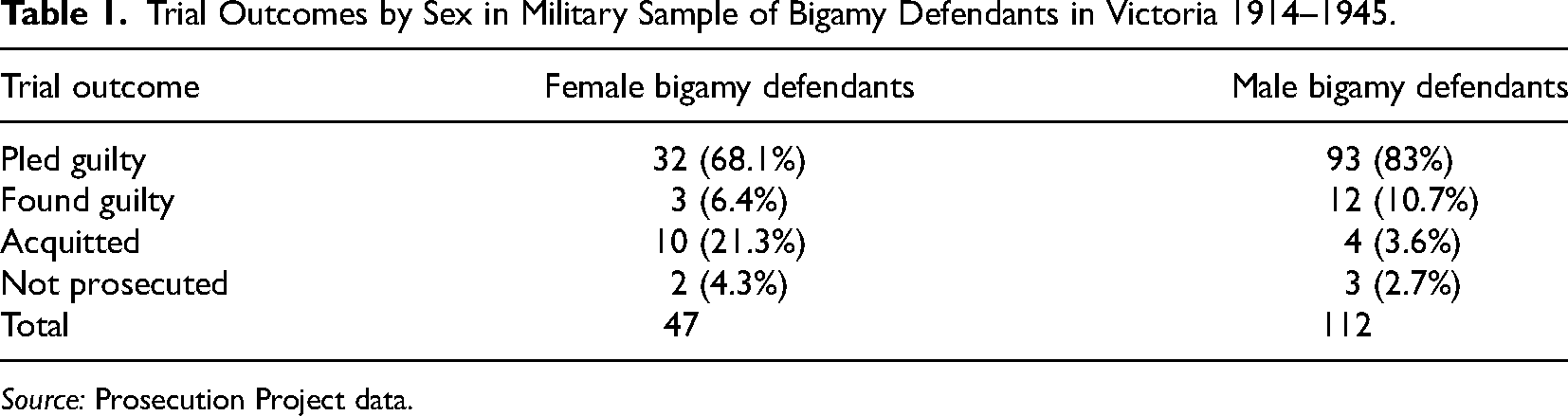
During the First World War, it is estimated that 7.9 percent of Victoria's population enlisted, 7 with this figure rising to 10.28 percent during the Second World War. 8 Of 377 men committed for trial in Victoria for bigamy between 1914 and 1945, 112 percent or 30 percent were identified as former or active servicemen. Of 131 women prosecuted across the same period, 47 percent or 36 percent had at least one spouse who had or was serving in the military. Almost all of these 159 cases proceeded to trial, with only five prosecutions being discontinued after committal (see Table 1). Depositions from those involved in these cases illuminate the different ways that war could destabilize marital relationships while encouraging new romantic and sexual relationships to form. This was true of both World Wars, although it makes sense that the risk was higher in the Second World War when the Pacific front meant ADF members spending more time in Australia itself, leading to bigamous relationships that fell under Australian court jurisdictions. While the volume of cases tried in Victoria in the Second World War is thus far larger—with 105 cases in the study being tried across 1939–1945, compared to just fifty-four cases across the 1914–1938 period—the circumstances they involved, such as impulsive wartime marriages, were largely similar to those from the First World War period. I argue that war not only created conditions conducive to bigamy, but, in line with Schwartzberg's findings regarding the American Civil War, also facilitated its increased detection as competing claims for spousal support allotments alerted military authorities to potential bigamies.
Trial Outcomes by Sex in Military Sample of Bigamy Defendants in Victoria 1914–1945.
Source: Prosecution Project data.
I begin by discussing general community attitudes towards bigamy in order to contextualize how society and the courts reacted to the spike in bigamy prosecutions during the Second World War and the conviction outcomes and sentences given to those in the military sample. I then survey the myriad of explanations that defendants offered to justify their bigamies, from unhappy marriages or unplanned pregnancies to claims they were not legally responsible for their actions or believed they were free to remarry. While on the surface such explanations appear unconnected to military service or wartime conditions, deeper analysis reveals the multiple ways that these factors were often entangled within defendants’ accounts of why they committed bigamy. I conclude by interrogating how bigamies were brought to the attention of authorities, and in particular the role that the military played in their detection from 1940. Together, this analysis not only offers an explanation for the slow rise in bigamy prosecutions in the interwar period and their upsurge in the Second World War, but offers insights into the intimate relationships of Australians during a period in which conceptions of marriage, romance, and gender were fraught and in flux.
Attitudes Towards Bigamy
Both in courtrooms and in society, attitudes towards bigamy and those who committed it varied widely. There has been debate among bigamy scholars on the extent to which bigamy was prevalent and tolerated in the community. Ginger Frost suggests that in nineteenth-century England the practice was regarded as preferable to unmarried cohabitation and occurred far more often than prosecutions statistics indicate.
9
Conversely, Rebecca Probert argues that examination of non-prosecuted cases shows that many individuals were in fact careful to wait the seven years that the law prescribed couples needed to be separated before remarrying in order to avoid committing bigamy, perhaps intimating that bigamy was not so readily accepted or practiced by nineteenth-century society.
10
Moving forward to twentieth-century England, Langhamer observes that bigamy evoked contradictory responses: It is both serious and not so serious, shameful and not shameful, a crime, but also not really a crime. It can be forged in love and romance or deception and cruelty. Even the criminal justice system has difficulty pinning it down.
11
The ambiguous position of bigamy in public perceptions is evident in early twentieth-century Australia as well. At law, it was a serious offense—a felony liable to up to five years imprisonment under Victoria's Crimes Act. 12 Justice Martin's remarks on bigamy's seriousness were echoed by other judges, especially in the face of rising prosecution numbers. In 1944, Chief Justice Sir Edmund Herring, while sentencing a soldier who pled guilty to bigamy to two years’ imprisonment, opined that “The whole family life of the community was dependent upon the sanctity of marriage, and anybody offending against the law in that respect must be severely punished.” 13
Yet such remarks sometimes appear like an attempt to convince others of the crime's magnitude. While marriage was regarded legally at this time as a binding contract that could only be dissolved with difficulty, historians of the family in Australia point out that its realities were far more fluid and flexible. The difficulties and costs of divorce meant de facto relationships were a common feature of Australian society from the colonial period, but often occurred under the outward pretense that the couple was married in order to garner social acceptance. 14 From there it was potentially a short step to bigamy, and it has been suggested that conditions in nineteenth-century Australia—particularly high migration from overseas as well as mobility within the colonies themselves—both encouraged illegal remarriages and meant that a great number of bigamies likely occurred that were never detected. 15
While there had been some liberalization of divorce laws across Australia by the start of the twentieth century, it remained an expensive process, at least for the working classes. An article in Melbourne's Weekly Times in 1933 advised readers that employing a solicitor to file a divorce case would typically cost between £20 and £30. 16 The basic or minimum wage in Australia that same year was around £3 per week. 17 Petitioners also had to be able to prove specific grounds for divorce, such as adultery, desertion by their spouse for more than three years, severe domestic violence, lengthy imprisonment, or habitual drunkenness coupled with other conditions like cruelty, failure to provide economic support (husband) or failure to fulfill domestic duties (wife). Even with evidence demonstrating such grounds, the divorce could still be denied if the petitioner had committed marital breaches themselves. 18 The divorce process was not only legally difficult but frequently humiliating due to the salacious news reporting of divorces typical at the time. 19 Although illegal, bigamy was thus a crime that in some cases was viewed as understandable.
As an example of how bigamy was sometimes treated in a light-hearted manner by the community, many cartoons about bigamy appeared in Australian newspapers across the early twentieth century. These cartoons depicted the offense as incomprehensible, their “humour” centered on the idea that marriage—specifically for men—was such an awful institution that it was amazing any man would subject himself to it twice. This was the clear message in a 1947 cartoon headlined, “What makes people commit bigamy?” featuring a man being yelled at by two women, each holding a squalling infant. 20 A 1929 cartoon featured a young boy asking his father, “Daddy, what does bigamy mean?” and his father replying “Trouble multiplied by two, my boy.” 21 In a similar vein, a 1939 cartoon stated that the penalty for bigamy was “Two mothers-in-law.” 22 Other cartoons depicted imprisonment for bigamy as a welcome respite from angry wives. 23 Such humor forms part of a more general discourse evident in Australian culture from the 1890s through to the 1950s that constructed marriage as antithetical to masculinity—an institution that threatened to feminize men at a time when Australian masculine ideals were being challenged by women's social advancement, 24 and later by the difficulties many returned soldiers experienced in adjusting to life on the home-front. 25
Notably, in all these cartoons, the presumed bigamist is male. This perhaps reflects attitudes engrained in courtrooms that treated bigamy as a serious offense, or an offense capable of causing harm, mostly when it was men committing it. Sarah McDougall observes that in medieval Europe bigamy was often constructed as a “male crime,” not because only men committed it, but because it was only when men committed it that it was seen as a threat to community values around marriage and sexual propriety. 26 Méthot, examining bigamy cases across nineteenth- and twentieth-century Alberta, argues that society viewed cases of male and female bigamy very differently, and this influenced the lower rate of prosecutions of women. 27 When men committed bigamy, they were deemed as having “ruined” their second wife by essentially obtaining sexual intercourse under false pretenses; some judges even likened the offense to rape, but where fraud not force was used. Given the sexual double standard, the same “harm” was not caused to men duped into bigamous marriages by women.
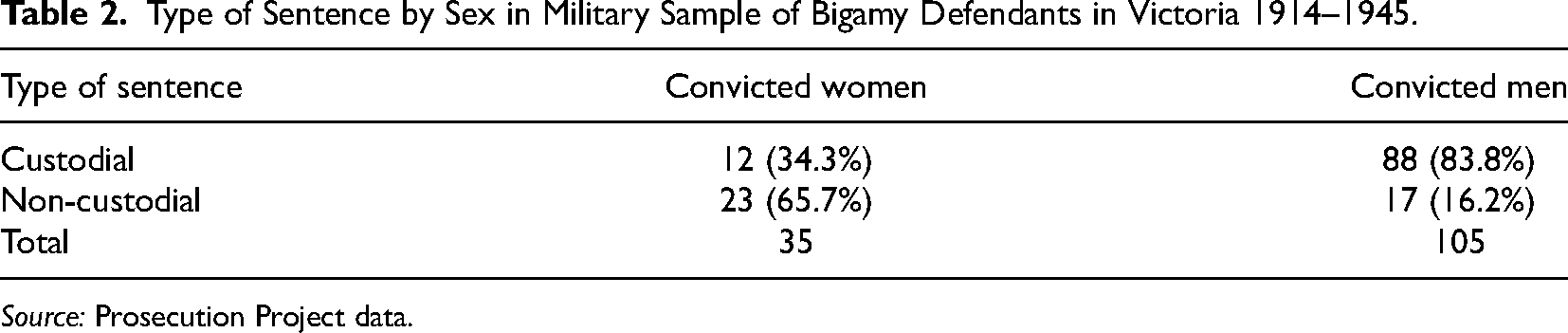
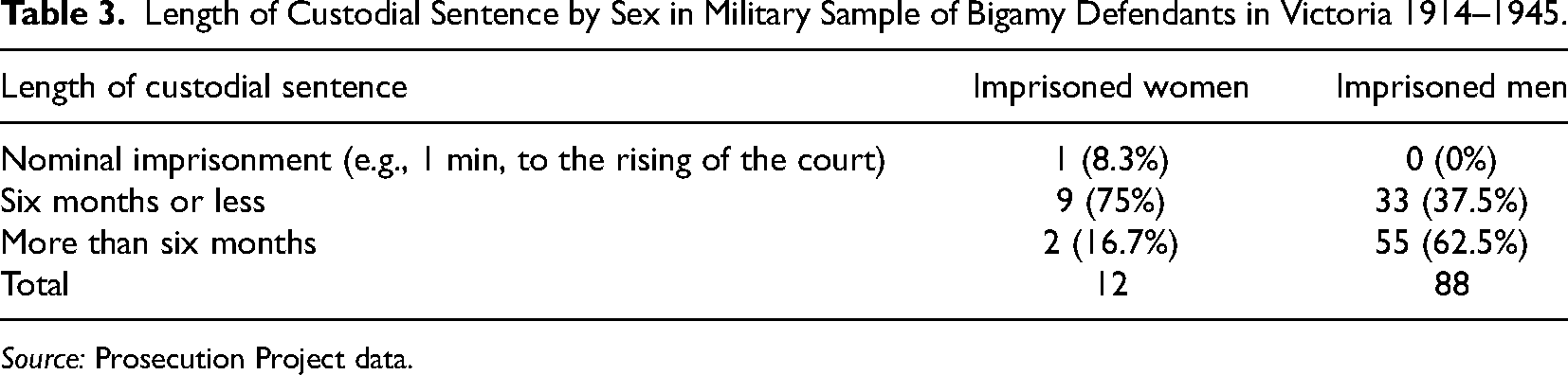
As with most offenses, more men were prosecuted for bigamy than women, but, at 25.8 percent, women still comprised a significant proportion of those charged with bigamy in Victoria during the 1914–1945 period. Women appear at a slightly higher rate in the military sample at 29.5 percent of cases, probably because having two husbands increased the chances that one would have a military connection. The difference in attitudes to male and female bigamy is evident in trial outcomes in the military sample, which also largely reflects the patterns in Victoria more generally. Women were significantly more likely to be acquitted than men, at 21.3 percent of female defendants compared to 3.6 percent of male defendants (see Table 1). Moreover, when women were convicted of bigamy they were more likely to be given a non-custodial sentence, at 65.7 percent of convicted women compared to 16.3 percent of men (see Table 2). Women who did receive custodial sentences also served shorter sentences, with only 16.7 percent of women imprisoned for bigamy sentenced to a period of more than six months, compared to 62.5 percent of men imprisoned for bigamy (see Table 3). While the courts had the power to sentence individuals convicted of bigamy to a maximum of five years in prison, the longest sentence meted out to any defendant in the sample was two years, a term imposed on several men.
Type of Sentence by Sex in Military Sample of Bigamy Defendants in Victoria 1914–1945.
Source: Prosecution Project data.
Length of Custodial Sentence by Sex in Military Sample of Bigamy Defendants in Victoria 1914–1945.
Source: Prosecution Project data.
That these differences in outcomes were based upon a gendered conception of the harms that bigamy involved is clear from the sentencing remarks of judges. In sentencing women, judges frequently observed that “no harm” had been done to anyone by their crime. 28 Conversely, judges often commented on the “great harm” men had done in bedding women under the false pretenses of matrimony. 29 Justice MacFarlan, adjudicating bigamy involving a member of the Royal Australian Navy (RAN) in 1923, went so far as to remark that “This is very like a capital offense. He took advantage of the girl by a false representation … Most likely he has ruined the girl's life.” 30 While men's motivations in marrying women were perceived to be to gratify their sexual desires, women's motivations in remarrying were often characterized as securing an economic provider, an objective that attracted greater judicial sympathy. One woman prosecuted in 1924 explained that she “wanted a refuge, was sick and without a home or friends” after her first husband deserted her before enlisting in the army in 1914. Her second husband apparently knew she was already married when they wed. Justice McArthur concluded that “no harm had been done to the man involved in the second ‘marriage’” and gave her a suspended sentence. 31
Part of the harm of bigamy was considered the duplicity. Female defendants more often claimed that their second spouses were aware that they were married prior to committing bigamy than male defendants did, at 27.7 percent compared to 9.8 percent (unlike in some jurisdictions, like New South Wales, in Victoria spouses who knowingly married an already-married person were not themselves liable to bigamy charges 32 ). Even in cases where duped wives were forgiving towards a male defendant, the courts were not. When soldier George O’Goerk was charged with bigamy in 1942, both his first and second wives pleaded for leniency for him, his first wife stating they had separated amicably by mutual agreement and his second wife stating she was willing to continue living with him as a man and wife. The judge acknowledged these factors, but proclaimed that the offense was a serious one and must be sentenced accordingly, imposing a penalty of 18 months’ hard labor. 33 Whereas women were often treated leniently due to the perception that their bigamy was prompted by the need to secure an economic provider, men not only had no such excuse, but were liable to be judged particularly harshly if they had abandoned their first wife without financial support. In 1925, returned soldier George Lawton was prosecuted not only for bigamy, but deserting his wife and their two children. When asked at his committal hearing how he expected his wife and children to live after abandoning them, Lawton answered callously “I could not help them. I suppose they had to struggle like I did.” The magistrate responded that as a war hero, Lawton should be ashamed of himself, seemingly taking the view that his war services only exacerbated his conduct. 34
With respect to English courts, Langhamer suggests that character evidence, such as prior military service, was especially important in bigamy trials, as bigamy was an offense that represented a betrayal of trust and a clean war record could suggest this was an out-of-character act. 35 Arlie Loughnan similarly argues that veterans charged with crimes in interwar Australia were treated leniently as über-citizens whose services to the nation warranted sentencing discounts. 36 Police-prepared character reports about defendants, which in Victoria as elsewhere in Australia went from being short statements occasionally provided to the prosecution and judge in the 1920s to a lengthy document issued as standard by the 1940s, 37 certainly often noted details of military service favorably.
Yet there is little evidence of discretion towards servicemen in bigamy cases in trial outcomes. The overall conviction rate of men charged with bigamy in Victoria was 93 percent, not far removed from the 93.7 percent among the returned or active soldiers (see Table 1). Custodial sentences were slightly more likely in the military sample, at 83.8 percent compared to 77.4 percent among all men convicted of bigamy in Victoria from 1914 to 1945 (see Table 2). Several men in the military sample promised to re-enlist or urged that they were in active service and eager to go to the front, but this likewise seems to have had little effect on outcomes. If anything, active servicemen were slightly more likely to be given a custodial sentence (53.4 percent compared to 46.4 percent of returned servicemen), and a sentence of more than six months’ imprisonment (56.4 percent to 43.6 percent). This may have reflected a belief that such cases were bringing the ADF into disrepute and a sense by judges—exemplified in Martin's sentencing remarks in 1943—of a need to stamp out an offense that was becoming “too prevalent” as the Second World War went on. Surprisingly though, despite judicial rhetoric expressing concern about the increasing bigamy prosecutions, there was no statistically significant difference in conviction or sentencing outcomes during the Second World War compared to the cases from earlier in the sample. This is perhaps a reflection of how the factors defendants urged as justification or mitigation for their bigamies remained similar across the period.
Unhappy Marriages
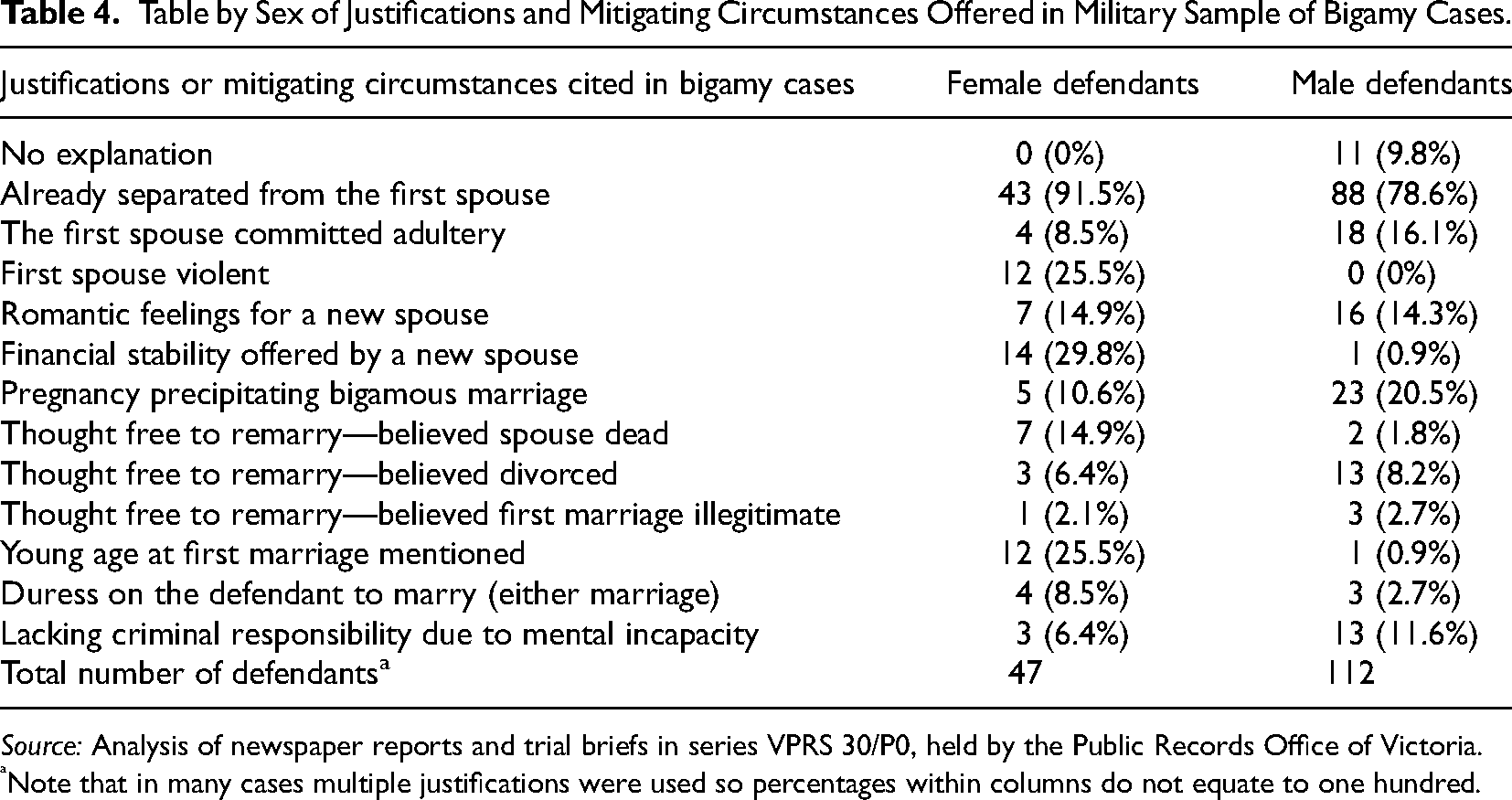
As a relatively uncommon offense, one treated humorously in newspaper cartoons, it is possible that not all defendants realized the seriousness of their actions when committing bigamy. Yet many defendants would have been aware of the possible consequences of their actions, especially with the increased volume of newspaper reporting on bigamy trials in the 1940s. Why then did some people feel compelled to commit bigamy? Almost all defendants or their lawyers had some sort of excuse to offer the court for their actions, with many citing a combination of factors as justifications or mitigating circumstances (see Table 4). For only eleven men was no explanation for their crime discernible in either trial briefs or newspaper reports. Some of these were deliberately bent on concealing the impetus behind their bigamy, such as one soldier who in 1944 declared in a written statement “There are a number of reasons why I committed bigamy but I do not want them made public.” 38 Possibly this was a chivalric attempt to conceal a pregnancy-motivated marriage, a commonly cited motivation among bigamists (see Table 4). No news report could be located for the case that might elucidate what the judge made of this pronouncement, but a sentence of nine months’ hard labor was imposed. There were no women for whom no excuse for their offense was proffered.
Table by Sex of Justifications and Mitigating Circumstances Offered in Military Sample of Bigamy Cases.
Source: Analysis of newspaper reports and trial briefs in series VPRS 30/P0, held by the Public Records Office of Victoria.
Note that in many cases multiple justifications were used so percentages within columns do not equate to one hundred.
Most bigamies were the result of unhappy first marriages. Over three-quarters of male defendants, and 90 percent of female defendants, were already separated from their first spouse when they remarried bigamously. Apart from having been divorced or had their marriage annulled, the main legal exception and potential defence to bigamy provided under section 61 of Victoria's Crimes Act was that the continual absence of a husband or wife for a period of seven years, without any intelligence to indicate they were living, left their spouse free to remarry. In 1942, the judge thus directed the jury to return a not-guilty verdict against a woman who had married a member of the AIF after not hearing from her first husband in more than seven years. 39 Yet while stories of unhappy marriages were common, invocations of the seven-year defense were rare in the military sample. Indeed, in more than half the cases the time that had elapsed between the first and second marriage taking place was itself less than seven years, let alone the period of separation.
The longest period between marriages was 30 years between Lillian Henderson's first marriage on 20 May 1911 and her bigamous remarriage on 17 November 1941. Although she had been separated from her first husband since 1927, she was well aware that he was still alive as they both resided in the suburb of Fitzroy. Despite this, she responded to her second husband's notice seeking a wife in the newspaper, which the prosecution implied she did simply to secure his pay allotment from the military. She was one of the few female defendants given a custodial sentence, receiving six months’ imprisonment. 40 The shortest period between marriages was the thirty-nine days from Marjorie See's marriage to a US naval officer on 7 July 1942 and her second to a member of the ADF on 15 August 1942. Police described the 19-year-old See as a “scatter brained type of girl who does not appear to know her own mind,” apparently drawn both to the glamour of an American serviceman and the romance of marrying an Australian soldier with whom she had started a correspondence while he was stationed overseas. 41
While certainly not relevant in all cases, the war did act as a contributory factor to marital breakdown—and thereafter to new romances—across many. Marriages hastily contracted in wartime on short acquaintances broke down once incompatibilities were revealed. Soldier Edmund Davis had known his first wife for just a month when they married in 1939, separating only a few weeks later. He apparently learned the value of prior acquaintance, bigamously remarrying in 1942 to a woman he had known for six years. 42 Marriages contracted while men were stationed overseas sometimes floundered when women were unable or unwilling to adjust to life in Australia. One Englishwoman who married an Australian soldier in 1917 returned to England without him after only six months in her new country. Perhaps thinking distance would prevent detection, he bigamously remarried in 1923. 43 Similarly, a wireless telegraphist in the Australian Navy committed bigamy in 1928 after his English wife refused for years to join him in Australia, as she had previously agreed. 44
Marriages that had been stable prior to the war sometimes collapsed when soldiers returned home changed men. 45 Herbert Currington married his first wife in 1912, and they lived together happily until he departed for military service in 1914. When he finally returned home five years later, their married life was characterized by constant quarrels. A few months after they separated, he married a nurse who treated him when he contracted the Spanish flu. 46 Another man told his wife after his discharge from the Australian Imperial Force (AIF) in 1916 that he wanted “to have a good time with the boys,” re-enlisting despite her pleas that he was needed at home. Discharged again in 1919, instead of returning home he met another woman whom he eventually married bigamously. 47
In many bigamy cases, it is evident that desertion, adultery, or violent cruelty provided clear grounds for divorce. In some cases, the judge even remarked that the defendant would have been entitled to a divorce. 48 That this solution was not sought was probably often due to the associated expense. One soldier admitted he had wanted to divorce but could not afford it. 49 Likely in an effort to garner courtroom sympathies, many defendants dwelt upon the extreme unhappiness of their first marriages, usually attributing its failure to their spouse's actions.
Among male defendants, this typically involved allegations that their first wife was adulterous (see Table 4). Men's absence from military service increased opportunities for infidelity. When Percy Watson was discharged in 1919 after three years in the AIF he discovered that his wife was living with another man. He bigamously married another woman in 1920, having six children and remaining with her for over two decades before his offense was discovered in 1944. 50 An army sergeant likewise returned home in 1942 to find his wife living with and pregnant to another man. He offered to forgive the affair if she would end it, but his wife refused. The following year he started keeping company with a woman, marrying her after learning she was pregnant. 51
Conversely, over a quarter of female defendants mentioned that domestic violence had contributed to the breakdown of their first marriage (Table 4). At the end of the First World War, anxieties were quickly expressed in Australia that the return of large numbers of men trained to kill and traumatized by battle would inevitably lead to an increase in violent crime. While it might be supposed that some domestic violence was a response to war trauma, there is no strong evidence of this in the cases themselves. In fact, in over half the cases where female defendants alleged their first husbands had been violent, it was actually their second husbands who saw military service. Elizabeth Nelson in her study of domestic violence in interwar Australia likewise found that such abuse was not particularly elevated among returned servicemen, but rather a common, and often socially tolerated, behavior among Australian men in general. 52
Military service, in addition to contributing to the breakdown of existing relationships, also sometimes led to the blossoming of new romances. Several defendants bigamously married women who nursed them after being wounded or whom they met at military social functions. Corporal William Eade described how his first marriage broke down in 1941 after his wife stopped writing to him while he was serving overseas, resulting in a formal separation when he returned home on leave to discover his wife had deserted their home and their children were living in squalor. While stationed at Port Moresby in 1944, he met a woman at a military dance, bigamously marrying her in 1945. 53 Several men emphasized the loneliness of being stationed far from home in explaining why they pursued relationships with women despite being married. 54 The threat of death also encouraged both recklessness and a sense of entitlement to romantic fulfillment. One 1941 defendant rationalized that after years in an unhappy marriage he “wanted some happiness before going overseas, as I may not have come back.” 55 A member of the Royal Australian Air Force (RAAF) charged with bigamy in 1945 similarly argued that “in view of the years of unhappiness in my first home, I felt, unfortunately, justified in acting just as I did.” 56
Such responses reveal the growing importance that love was understood to have as a basis and ongoing requirement for marriage across the early twentieth century. 57 Men and women mentioned romantic or affectionate feelings towards new partners at about the same rate, with 14.3 percent and 14.9 percent referencing such reasons for bigamy, respectively (Table 4). Men's declarations of love were often more dramatic and verbose, such as Hubert Gerrard's plea that after the heartbreak of separation from his first wife, he had got to know his second by chance and soon “discovered we loved each other more than life itself” and “so afraid that I would lose the love which I had lost but found again” he had taken the rash step of bigamy. 58 Women's expression of feelings often seem more tepid, such as one defendant's admission that she “thought a lot” of her second husband and another that she “liked” her second spouse “in a way.” 59
The importance of marriage as an economic proposition for women prior to the opening up of more employment opportunities during the postwar era is evident from the nearly 30 percent of women who mentioned the financial stability that their new spouse offered as part of their reasons for committing bigamy (Table 4). One woman even described how after her husband deserted her without funds, she had been reduced to sleeping rough in Melbourne's Alexandra Gardens. When she applied to a male acquaintance for financial assistance, hoping to get money to return to her parents in New South Wales, the man persuaded her to marry him instead—even though he was aware she had a husband. 60 The sympathetic judge released her on bond.
Only one man cited financial considerations in his reasons for committing bigamy, claiming that he bigamously remarried as he believed that he would have greater opportunities of securing employment if he had a wife. 61 Other men may have bigamously remarried partly to secure the domestic labor of new wives. Military pensioner Frederick Leveson, whose first wife left him for a returned soldier she met while he and Leveson were in the military hospital together, claimed he bigamously remarried in order to provide a mother for the son who was left in his care. As the child was sixteen at the time, the judge was unsympathetic to this reasoning. 62 Nevertheless, while romance was an increasing part of the rationale of twentieth-century marriages, it is clear this was often in tandem with more prosaic reasons.
Pregnancy
Pregnancy was another common reason for bigamy (see Table 4). One in five male defendants and one in ten female defendants stated their second marriage was to avoid having a child be born illegitimate or to “give her child a name” as one naval defendant claimed in 1924. 63 It is possible that such reasons were equally common among men and women, but that female defendants were more reluctant to disclose this in court due to the greater stigmatization they potentially faced in admitting to pre-marital sex. While bigamous marriages precipitated by pregnancy were not contingent on wartime conditions, there was again a link in the opportunities the war provided for new romances to bloom. Walter Tucker told the court that, despite being a happily married man with four children, he quickly became “infatuated” with his second wife, a hostess at Navy House, after his military duties started to frequently take him there. He married her after she revealed she was pregnant, trying to maintain both his marriages until he was discovered and sentenced to 12 months’ imprisonment in 1944. 64
Military service may have also had a more subjective effect in influencing such marriages by emphasizing a culture of masculine honor. That it was an expected thing that a man would marry a girl he impregnated is clear from a diary entry by First World War soldier Eric Evans describing a conversation he had with a fellow soldier: We then went on to talk about the amount of marriages that occur [in wartime]. Lads realise their ultimate end, in 20 percent of cases, is death, so they pick up with a girl, and like it or not get her into trouble and then he marries her—there's no question of love in most instances. It is just to do the honourable thing by the girl he has imposed upon.
65
While Evans and his compatriot were not discussing bigamous marriages specifically, the effect these values had in encouraging such marriages is clear.
While marrying a pregnant woman, even bigamously, was often asserted to be the “honourable” thing to do, in some cases, it was all men were prepared to do. One navy man impregnated then married two teenage girls before quickly abandoning them, likely in an effort to avoid carnal knowledge charges. 66 The judge consequently took a particularly dim view of the case, sentencing him to 18 months’ hard labor. Conversely, some pregnancy-induced marriages were allegedly not to the father of the child at all, but a man prepared to assume the role. Another naval man claimed he had secretly bigamously married the teenage girl he and his wife had informally fostered for several years to protect her reputation after she told him in 1941 that she was pregnant to a married man in the Air Force. The marriage was kept secret from his wife who he continued living with, setting his foster daughter up in her own apartment. By the time his bigamy was discovered in 1945 his daughter–wife had perished in childbirth, so was not available to contradict his story if there was a darker reason for their marriage. 67 In another instance, a female bigamist married her first husband in 1939 after discovering she was pregnant with the man who would later become her second husband. When her child's father returned from overseas service in 1943, they moved in together and had another child the following year, before giving in to family pressure to marry in order to legitimize their children. She pled guilty and was given a suspended sentence. 68
Interestingly, around 10.6 percent of women, and 3.6 percent of men, indicated that pregnancy had precipitated their original marriage, pointing to the role that pre-marital sex played in compelling marriages more generally. First marriages having been compelled by pregnancy were usually mentioned in the context of explaining why the marriage was unhappy. One woman described how her first husband had married her under duress upon her parents discovering she was pregnant, but had never offered her or their child any financial support, and she continued to live with her parents. When she met a soldier from the Geelong military camp in 1916, she decided to marry him after only a few weeks’ acquaintance in order to secure “a home of my own.” 69 She was released on bond.
Several bigamy cases suggest that conflict between men and women over control of family fertility represented a significant source of marital tensions by the first half of the twentieth century. One woman deposed she left her first husband in 1940 after he forced her to have an abortion. 70 Another had the opposite problem, saying that after having three children in six years she left her first husband around 1936 “because he continually wanted to have children.” 71 A male defendant revealed how he had tried to heal his rocky marriage to his first wife by persuading her to have a second child in the hopes this might “help her to settle down,” but she refused before grudgingly agreeing to adopt a child from the Salvation Army Home. While her husband was away working for the railways, she returned the adopted child to the orphanage and disappeared from her husband's life, along with their biological son. 72
These marital conflicts perhaps reflect wider societal tensions about Australia's slowing birth rate. Concerns about this had emerged in the early 1900s but were exacerbated by the massive loss of life experienced during both world wars. It was largely women who were blamed for failing to fulfill their national duty to repopulate, accused of resorting to contraception or abortion rather than adding to the population of white Australia and helping avert the “race-suicide” commentators feared was coming. 73 It is possible that men like Charles Stubblety and Sidney Webb, who blamed the breakdown of their first marriages on their wives’ refusal to have children (with Stubblety suggesting his wife had actively terminated pregnancies through “gin, pills, salts, and other medicines”), were attempting to appeal to judicial sympathies by invoking what was by then the familiar folk-devil of the aborting woman. 74 This figure may have also been preying on the mind of the police officer who prepared the character report in 1944 of Robert Watson. Describing Watson as “one of the renowned ‘Tobruk Rats’” (a much-vaunted group of Australian soldiers who withstood the German forces in Egypt in 1941) and “not the usual criminal type,” the character report suggested that his second wife, who years earlier been charged with concealment of birth (a charge usually substituted when it was too difficult to prove infanticide), must have “had some evil influence over him.” 75 Justice O’Bryan remained unpersuaded by this, noting that the crime of bigamy was becoming “too prevalent” and imposing the salutary sentence of 12 months’ hard labor on Watson. 76
Marriage Legitimacy
Many defendants claimed that they thought they were free to remarry, due to a belief their spouse was dead, had divorced them, or that their first marriage was invalid (see Table 4). War contributed to such misapprehensions—or at least the believability with which defendants could claim such misapprehensions. For women, the war created reasonable uncertainty about whether their first husband was alive. One woman whose sailor husband had deserted her before the First World War, leaving her with three children to support, decided to remarry in 1918 after hearing he had died at sea in the conflict. 77 The Crown Solicitor apparently agreed that this was a fair assumption, deciding not to prosecute the case. Another woman against whom a double bigamy charge was brought in 1919 said she had remarried in 1916 after hearing her first husband had died while working as a stretcher-bearer. Her only excuse for marrying a third man while her second husband was fighting overseas was that her latest spouse had been very persistent in persuading her to do so. In what seems to be a fairly apparent case of jury nullification, she was acquitted on both charges. 78 In a rarer case of a male bigamist believing his first wife was dead, in 1920, a returned soldier claimed he remarried because while serving abroad the military paymaster had read him a notification stating his first wife had died during an operation. However, he could offer no corroboration for this assertion and had married his second wife under a fake name, influencing his conviction and sentencing to 12 months’ hard labor. 79
Many bigamy cases suggest confusion about laws of marriage and divorce, with some servicemen or their wives remarrying upon the granting of a decree nisi without waiting for it to be made absolute, and others claiming they believed that a separation of three years (the period necessary to sue for divorce on grounds of desertion) automatically left them free to remarry. The time constraints imposed by military service discouraged some from doing due diligence to make sure they really were divorced. A corporal whose first wife had told him she would be seeking divorce before he sailed overseas in 1940 simply assumed that since he had agreed not to contest the divorce that it had gone through. With only 14 days’ leave in Australia before his next military posting, he did not check this before rushing to marry the woman with whom he had been corresponding while serving overseas. 80 A similar excuse was proffered by a man who in 1940 hurried into a new marriage without confirming that the divorce his first wife had said she would be applying for in 1938 had actually occurred, “owing to short leave after returning from overseas and going into action stations immediately”. 81 Another man who had separated from his first wife in 1930 heard from acquaintances in 1939 that she had since remarried, and simply concluded she must have divorced him. In 1942 he remarried, only for his first wife to serve him with divorce papers shortly afterwards. Realizing he was guilty of bigamy, he reported the matter immediately to his superiors in the RAAF and then to the police. Despite this, he was sentenced to three months’ hard labor. 82
The rushed nature of many wartime marriages was also the reason some men concluded that their first marriage had been invalid. In 1918, one man married his first cousin in a Catholic ceremony right before departing for active service. 83 On his return, he sought advice from a priest, who informed him that because he had failed to disclose their consanguinity, and had never lived with his bride, the marriage was “null and void” in the eyes of the church. He failed to realize that civil authorities took a different view until his arrest for bigamy in 1923. That same year, another returned soldier pled guilty to bigamy but explained he thought that his first marriage, contracted while serving in England in 1915, was invalid. His reason for thinking this was that the day after the wedding he had woken up alone and with £20 missing from his wallet. As his bride had used a different name on the marriage certificate than the one she had given him previously, he concluded the whole marriage was a sham that she had probably perpetrated on other men previously. Describing himself as “a victim of circumstances resulting from the War,” he stated he had never heard from his first wife again. He moreover asked for consideration due to the length of his military service (1343 days), which had resulted in a nervous breakdown and admission to an institution for several months following his discharge. The judge acknowledged these mitigating circumstances, but still inflicted a sentence of three months’ imprisonment. 84
Having been married young was another factor often raised, particularly by women, either as a justification for believing their first marriage was invalid or a mitigating circumstance to their actions (Table 4). In most instances, women had married as teenagers due to pregnancy, often under pressure from their families. One 16-year-old was forced to marry her 60-year-old great-uncle in 1938 after his 30-year-old son got her pregnant while she was living with them as their housekeeper. Her great-uncle used her pregnancy with his son to pressure her into marriage with himself, threatening to throw her out otherwise. After her uncle-husband started demanding she fulfil her wifely duties of sexual intercourse, she left him and a few years later married a member of the ADF. The jury acquitted her after only three minutes of deliberation. 85 The youngest defendant to be charged with bigamy was only 13 years old when, pregnant, she married her 21-year-old soldier boyfriend in 1941. Her mother consented to this marriage, and also to her marriage to another soldier the following year. When her first husband returned from New Guinea in 1943, he reported the matter to the police. The then 15-year-old pled guilty and was released on bond. 86 The only man to raise the age in his defense was one who at 15 had both married and enlisted in the AIF, giving his age on both occasions as twenty-one. His first wife received a military allotment while he served overseas, but he did not reach out to her otherwise. In 1942, he remarried to a member of the Women's Auxiliary Australian Air Force. He then stopped his first wife's allotment and transferred to the Navy, starting an allotment for his second wife with them. If this transfer of service divisions was an attempt to avoid detection of his bigamy, it was unsuccessful. In 1943, having just turned 18, he was convicted but released on bond. 87
Duress was another factor that could be raised as a justification for believing a marriage was invalid, although it was more commonly cited as a mitigating circumstance to a defendant's action. In some instances of female bigamy, men used their military service to urge their partners to wed them. One woman's soldier’s second husband pressed for marriage, despite knowing she was already married, because he believed he would have a better chance of being kept stationed in Australia if he was married. 88 Another woman agreed to marry her soldier boyfriend after he told her that he was absent about leave, but might not be punished if he informed his superiors he had been getting married. 89 Fear of the impact of scandal on their military careers could also coerce men into marriages they did not want. Frederick Knight, a distinguished officer of the RAN for over twenty years, claimed thoughts of his career prompted both his first and second marriage. 90 He had become engaged to his first wife in 1902 when he was only sixteen; they rarely saw each other over the next seven years while he completed his education and naval training. In 1909, about to be sent by the navy to England, he suggested they break off their engagement, but his fiancée threatened to sue for breach of promise if he did. Fearing the damage of such a suit to his career prospects, he reluctantly married her. The marriage was troubled, and in 1913 they separated. After being hospitalized during the First World War, he fell in love with a nurse. When she fell pregnant, he married her to protect both her reputation and his own, again fearing the repercussions to his career if he was known to have an illegitimate child, or if he was involved in a divorce suit with his first wife. Knight had only recently retired from the navy and was standing for parliamentary election when the bigamy was discovered in 1927. He pled guilty and was sentenced to six months’ hard labor.
Criminal Responsibility
Another defense to bigamy that some defendants raised was that they were not responsible for their actions due to intoxication or mental impairment (Table 4). A number of male defendants blamed war service as the root cause of both these conditions. In 1918, Gallipoli veteran Parker Brown claimed he had no recollection of having married the sister of his still-living wife. Brown's lawyer blamed this temporary amnesia on the psychological impact of Brown's “fearful experiences at the front,” exacerbated by the drugs to which he “had recourse to ease his shocking sufferings.” 91 That same year Charles Kilpatrick stated that he was not only drunk when he bigamously married the woman who had been nursing him since he was wounded in action, but was mentally worn from months of heavy drinking to relieve ongoing pain from the injury. 92
Another First World War soldier blamed memory loss from “shell shock” for committing bigamy in 1920. 93 His first wife also expressed the belief he was “not really responsible for his actions,” describing how during their brief six-week marriage he had exhibited nervous and erratic behavior, and shown signs of morphia addiction. The prosecution ridiculed this defense by pointing out that his war service consisted of transport duty, claiming it was unlikely he ever “heard a gun fired.” 94 He was convicted and sentenced to nine months’ imprisonment. Twenty years later, a Second World War anti-aircraft gunner who blamed being wounded in a bomb blast for the nerves and memory lapse to which he attributed his bigamy was treated with similar incredulity by the judge. Noting the “many cases of servicemen committing bigamy,” the judge imposed six months’ hard labor. 95 The derision with which the bigamy defense of war-induced amnesia was sometimes met in court is evidenced in a cartoon by Jack Quayle that appeared in the Adelaide News in 1942. In it, a woman (appearing in a uniform-style dress) remarks to a man (similarly wearing what appears to be military garb) “Well, well—a soldier charged with bigamy said he didn’t remember his first marriage.” The man responds “Tch, tch—he should have kept a diary.” 96
While judges gave little credence to men who blamed shell shock and amnesia for their offenses, they seem to have been more prepared to listen to men whose claims of mental incapacity were rooted in having suffered head trauma during the war. At Joseph Cane's trial in 1920, his first wife testified that they had been happily married from 1909 up until he suffered shrapnel to his skull at the Battle of Gallipoli, after which he suffered persistent headaches, occasional fits, and personality changes. Cane claimed since his injury he suffered periods of blackout, experiencing one when he married again in 1918. The judge declared that in view of the “peculiar circumstances” of the case, he would be lenient, imposing a suspended sentence. 97 Likewise, at John Carroll's trial in 1944, his first wife testified that he had been unwell and out of character since a head injury saw him discharged as medically unfit from the army following ongoing post-concussion headaches and anxiety symptoms. Carroll stated that he was “unbalanced” when he committed bigamy, a position the Government Medical Officer supported, writing to the prosecution that Carroll's case was likely the result of brain trauma-induced personality changes and “a general lowering of self-control” brought about by his head injury. Carroll was released on a good behavior bond. 98
Few women used mental incapacity or lack of criminal responsibility as a defense. One of the few who did was Sarah Mott. Mott met soldier Edward Stokes on a train in 1916 while she was on her way to undergo an operation that was supposed to help with the fertility issues she was experiencing with her husband. Mott later claimed that it was pain from the operation, and from the condition requiring it, that left her vulnerable to Stokes’ persuasion that she should marry him before his impending departure to the front. Stokes was unaware that Mott was already married, having wed a farmer just the year before. Despite her claims that the bigamy was due to the weakened mental state produced by a painful operation, it seems more likely that Mott, like others, was simply swept up in a wartime romance that offered a reprieve to what she admitted she had discovered was a “very lonely” life on her husband's remote property. The judge was nevertheless sympathetic, imprisoning her until the rising of the court (meaning that she was free to go once the court sessions for that day was done, a nominal sentence judges used when they did not believe offenders should be punished). 99
Detecting Bigamy
While war featured as a background factor to many of the explanations servicemen or their spouses offered for committing bigamy, military service also played a role in the increased prosecution rate during the Second World War through increased detection. Bigamy was an offence that even into the mid-twentieth century could go undetected in the community for years, even decades. The mean average between committing bigamy and being brought to trial in the sample was 809 days, with the longest period being 24 years. 100 Two-thirds of defendants did not even use a false name when remarrying. Those who did use a false name were slightly more likely to receive a custodial sentence (76.1 percent) than those who did not (69.1 percent), suggesting evidence of intent to deceive may have attracted additional severity.
Frustratingly, it is not clear in most cases how bigamy came to light, as police in their depositions usually just refer to having acted on information received without specifying their sources. The depositions of other witnesses or the accused themselves only occasionally offer clues as to the informants. Spouses unsurprisingly appear to be a frequent source. This was sometimes unintentional, such as when a first spouse's application for divorce or maintenance led to evidence of bigamy. Second spouses also reported defendants, sometimes immediately after learning the truth, sometimes later following discord in the marriage. One woman's second husband reported his wife for bigamy in 1942 to revenge himself on her for reporting him for not having shown up to his military training. 101 Disapproving in-laws were another potential source, with one woman suspecting that she had been reported in 1943 by xenophobic family members who disapproved of her second marriage to a Netherlands East Indies soldier. 102 Police investigations into other crimes also occasionally led to discoveries of bigamy. The offenses being investigated ranged from larceny to military desertion, with the bigamy defendants who were also military deserters seeming to attract particularly harsh penalties. 103
However, probably the biggest driver of the detection of bigamy cases during the Second World War was the military encountering discrepancies or competing claims in applications for the payment of spousal allotments. Allotments even prompted bigamies. William Coppin had been in a de facto relationship for fifteen months when he decided to bigamously marry the woman he was living with upon his enlistment in 1940 so that she would be entitled to claim his pay from the military. 104 A quarter of the 1940s’ trial briefs mention a defendant or defendant's spouse receiving or applying for a military allotment; this may have been true in other cases as well where it was simply not brought into evidence. In several cases, there was no doubt that bigamy charges had arisen due to queries related to pay allotments. In 1944, one aircraftsman who unintentionally committed bigamy before his decree nisi was made absolute was alerted to his mistake by the military after they investigated his application to transfer his allotment to his new wife. 105 The jury accepted this as an honest mistake, acquitting him at trial. Investigation of military spousal support could also lead to the disclosure of bigamies contracted long before the war. One soldier's offense was discovered in 1940 after he had been married bigamously for six years and had four children with his second wife, when his first wife, whom he had separated from in 1930, filed a claim against his pay. 106
The frequency with which the military played a role in the increased prosecutions of bigamy during the Second World War is evidenced by correspondence within the military itself. Just six months after the war commenced, a District Finance Officer sent an inquiry to the Secretary of the Military Board as to what action should be taken with respect to the “frequently arising” problem of bigamy among military personnel. The initial advice was essentially that no action should be taken; if bigamy had occurred, it was a matter for the civil court, and it was the responsibility of the victimized wife, not the military, to refer such matters to the police. 107 A follow-up query on 2 April 1940 asked how the Finance Officer should respond to women seeking allotments for husbands already supporting other wives. The response was that such women should be advised that an allotment was already being made on behalf of the soldier, along with the name and address of the person receiving the stipend, but without mentioning the terms bigamy or adultery. 108 By the following month, the RAAF had made a policy that they would inform the police in such cases, and it was suggested that the Army follow suit, particularly given the “frequency of the crime, no less than five cases being dealt with during the last week.” 109 By 1942, the regularity of such reports had led to the creation of a special military form for notifying the police of bigamy cases. 110 The military seldom took any action to punish the offenders themselves, beyond occasionally discharging men convicted of bigamy from service. However, especially as the war went on, some bigamists returned to the military after serving the prison term imposed by the civilian courts. Bigamy was only punishable by court-marital if it occurred in a jurisdiction outside of Australia or allies whose jurisdiction in such matters Australia recognized, and such military prosecutions appear to have been rare. 111
Conclusion
The slow rise in bigamy prosecutions across the interwar period and their spike during the Second World War in Australia can be attributed to the role of military service in both the incidence and detection of this crime. Wartime conditions created ideal circumstances for bigamy to occur by weakening existing marital bonds and encouraging new ones among men stationed away from home, where their offense might not be detected. It led some women to conclude their husbands were dead, or men to be in too much of a rush to wed before their leave expired to check whether they were truly free to remarry. The lingering physical and mental trauma of war, as well as efforts to cope with this through drink and drugs, may have also encouraged impulsive decision-making among some men. Notably, though, many of the explanations provided for bigamy—marital separation, pregnancy, confusion about one's marital status—would also apply within the general populace. A key difference in the 1940s was that the military's spousal support system helped expose instances where individuals engaged in bigamy as an easier alternative to divorce.
The rate of bigamy prosecutions in Australia started to fall back down in the post-war decades, at the same time as national divorce rates were rising sharply. 112 Annual crime statistics published in the Victorian Year Books show that annual prosecutions for bigamy in the state were numbering in the low single digits by the late 1960s and early 1970s, a dramatic decline from the fifty-nine prosecutions in Victoria in 1943. 113 The introduction of no-fault divorce in Australia in 1975 appears to have made prosecutions even rarer, with none at all in Victoria in 1976, just one in 1977, and none again in 1978. 114 When a man in Western Australia was convicted in 2023 for bigamy—having married in Canada in 2015, then again in Australia in 2020—the case was described in the media as a “rare” and “unusual” offense. 115 Legal scholar Theodore Bennett has even argued that bigamy should be removed as an offense in Australia due to its anachronism, suggesting that its criminalization serves no purpose today beyond potentially targeting individuals for their religious and cultural beliefs and that cases that do involve actual harm can best be prosecuted under other laws, such as fraud. 116 While bigamy may largely be confined to the past, it has continued relevance for understanding how the upheavals of the twentieth century, from war to changing gender and sexual politics, affected the intimate details of people's marriages and relationships.
Footnotes
Declaration of Conflicting Interests
The author(s) declared no potential conflicts of interest with respect to the research, authorship, and/or publication of this article.
Funding
The author(s) disclosed receipt of the following financial support for the research, authorship, and/or publication of this article: This work was supported by the Australian Research Council (grant number DP210100772).
