



Abstract
Recent articles on temple desecration in pre-modern India and Indo-Muslim states by Richard M. Eaton published in Frontlilne have contributed to the popular Western narratives about India and Indian history. There are many contested areas, misunderstandings and misinterpretations in Eaton’s deliberations on the problem arising out of the conventional historiographic method. Here, an attempt has been made to critically review some of the arguments of Eaton on temple desecration in pre-modern India in a wider methodological perspective, that is, beyond historiography. The historiographic evidence alone in interpreting Indian history may not be enough in view of the complexity of Indian situation, thus necessitating validation of historiography by careful application of contemporary ethnological evidence, circumstantial material evidence and specific Indian contextual situation.
Introduction
A set of two articles ‘Temple desecration in pre-modern India’ and ‘Temple desecration and Indo-Muslim states’ by Richard M. Eaton published in Frontline (22 December 2000 and 5 January 2001) has continued contemporary relevance in India. It has been argued that the political and economic factors were the principal reasons behind the temple desecration in pre-modern India, which had nothing to do with Islamic iconoclasm. In support, it has been argued that the desecration of Hindu temples by Hindus for political reasons had been widespread in pre-Islamic India. Some of the Eaton’s arguments that had already been told by other historians, Catherine B. Asher, Muhammad Habib and Romila Thapar, 1 have contributed further to the growing popular Western narratives about India and Indian history. ‘Aurangzeb: The Man and the Myth’ by Audrey Truschke published in 2017, discrediting the much acclaimed two volumes ‘History of Aurangzib based on Persian Sources’ by Sir Jadunath Sarkar published in 1912, quickly become an indispensable part of this genera. Back in India, whatever is popularised in the West is blindly copied in the mainstream Home narratives. Indian Congress Parliamentarian, Shashi Tharoor, in his book Why I Am a Hindu (2019) wastes no time to retell in Home narratives what Eaton and Truschke established in the West. Soon it is repeated by another Congress Parliamentarian, Salman Khurshid, in his book Sunrise Over Ayodhya (2021). The trend of citing and reciting continued down the corridor of narratives without fact-check and critical analysis. The Western education model and materials have influenced not only all branches of education in India but also ‘India’ as a subject. The history of India has been largely written looking through the Western prism by Western scholars. There are many contested areas in Eaton’s deliberations on the problem. Therefore, this current critical discussion on the articles by Eaton become essential.
With the emergence of the right-wing political party in India, the popular historical writings are now increasingly getting polarised between two bandwagons—Hindutva (also called communal or Hindu nationalist) and anti-Hindutva (also called professional or secular) writings. A trend increasingly found in contemporary Indian political debates, to some extent even in academic discourse, that irrespective of factual position whatever is written and goes on the line of pro-Hindu interests, is often branded as Hindutva. Hinduism is not a simplistic kind of organised religion that viewing it through any fixed optical lance only would blur the vision. This is the cardinal point around which all Western narratives about India do require some corrections. Here, an attempt has been made to critically review some of the arguments of Richard M. Eaton on temple desecration in pre-modern India in a wider methodological and contextual perspective. The problem of Indian history for being ‘lack of perspective’ had been discussed by K.N. Munshi way back in 1942 and was recently summarised by Michel Danino. 2 Historiographic evidence alone in interpreting Indian history may not be enough in view of the complexity of the Indian situation, thus necessitating validation of historiography by careful application of contemporary ethnological evidence, circumstantial material evidence and specific Indian contextual situation.
Hinduism: Facts and Opinions
Before deliberation on the core issue of temple desecration by Islamic invasion in India, it would be pertinent to critically discuss some of the misunderstandings or differential understandings about Hinduism so as to place the problem in question in a broad contextual perspective.
Hinduism makes a clear distinction from Abrahamic religions that it lacks any instrument of proselytisation, apostasy, any definitive religious scripture, any religious antithesis and law of blasphemy. Without any missionary activities, having strict customary hereditary membership rule (that is, by birth or marriage), in Hinduism there is no formal process of conversion. Any incorporation into Hinduism happened through a long-time-perspective natural process of assimilation by the eventual formation of new endogamous group (e.g., caste, sect, etc.). Such a natural process of assimilation freely operated down the history into the formation of composite Hindu culture. Thus, at a short-time-perspective apparently a rigid system, actually inherently ever remained ‘open’ to incorporate endless rituals, practices, traditions and scriptures of both complimentary and contradictory nature. Literally, it can be said that without organisational rigidity and antithesis or distinguishing identity, Christianity, Islam or any other religion can be easily assimilated into Hinduism. The process of Hinduisation is a spontaneous natural process like urbanisation or modernisation process through which new members or groups are incorporated without conscious knowledge.
Time, place and context are very important in historical comparison. In Indian context, the time and space perspectivism is more critical in the absence of any kind of organisational rigidity. Once established, Christianity or Islam hardly undergone any change in time. This rule cannot be applied for Hinduism. The early census commissioners of India enumerated the Hindu population by applying the principle of exclusion, that is, whoever is not Sikh, or Jain or Buddhist, or professedly animistic, or included in one of the foreign religions, such as Islam, Judaism, Christianity or Hebraism is Hindu by default. Brahmanical Hinduism, non-Brahmanical Hinduism, Arya Samaj, Brahmo Samaj, Kabir-panthi, Lingayat, Satnami, etc., were enumerated here and there in one census or the other. The religion enumeration in census finally settled down into seven religion categories, viz., Hindu, Muslim, Christian, Sikh, Buddhist, Jain and ‘Other Religion & Persuasions’.
3
Paradoxically, when census has crystalised the different religious and social identities in India, it has at the same time documented the historical diversity, flexibility and fluidity of such different identities. At this point, we all have to be careful in interpreting the time-variant census data. The Census 1901 recorded Buddhism, Jainism and Sikhism to be not much different from other Hindu sects, and that their independent religious identity is more due to political reasons than differences in tenets. To quote:
The question whether any particular tenets professed by persons of Hindu origin should be regarded as constituting a separate religion or merely as forming a Hindu sect seems, therefore, to depend less on the character of the tenets than on the external circumstances attending their development. Considerations of their history and past political importance have led to the elevation of Buddhism, Jainism and Sikhism to the rank of independent religions while the numerous other schismatic bodies are held to be only sects.
4
Categorising of Hinduism on the same plan as organised Abrahamic religions yielded misunderstandings. The Hindus are divided into several sects, panths, groups, etc., and their identity is a flux. The sectarian identity is a constantly changing fact, as reflected in fluctuating population return from census to census (Table 1). Many Hindu sects enumerated more than lakhs in early censuses are no longer return (e.g., Kamanandi, Darya-panthi, Ramanandi, Bishnoi, etc.), others now returned only a few thousand and do vary from census to census (e.g., Satnami, Lingayat, Kabir-panthi, etc.). Organisation around such Hindu denominations is not effective for their identity is not perpetual and the allegiance to such religious denominations often cuts across even the smallest social unit (e.g., family). Within a single family, the members may have allegiance to different Hindu religious denominations. In Assam, Sankardevia Vaishnavism (or Mahapurushia) and Brahmanical Hinduism are often found coexisted.
5
Srimanta Sankardev became a household name through which the Assamese identity is now articulated. The sixteenth-century Sankardevia Vaishnavism, however, never emerged as an independent religion in Assam. In Punjab, Sikhism, contemporary to Assamese Vaishnavism, assumed a distinct religious identity only recently. A custom of giving away the eldest son by a Hindu couple to become Sikh continued into the twentieth century. In early census, Sikhs were identified through their male members in the family, while women were freely married from both Hindu and Sikh affiliations.
6
In 1891 Census, the Sikhs were distinguished as the so-called true Sikhs or the Govindi (i.e., followers of the tenth Sikh Guru, Guru Gobind Singh) from the different Brahmanic castes returned as Nanak-panthi, Nanak-sahi, etc., and the latter entries were not considered in counting the true Sikh population. To quote:
The Superintendent of the Panjab census shows in his report that in British territory the Sikhs have increased by 24 per cent, whereas in the States under that Government, their numbers have declined to the extent of 19 per cent. He attributes the latter fact to greater accuracy of definition only, and it is probably due in great measure to the exclusion of the Brahmanic classes returning the Nanakpanth, &c. as their sects. Undoubtedly this is the cause of the notable decrease in the number of Sikhs returned from Sindh, where there are few, if any, of the true, or Govindi, Sikhs, outside native regiments.
7
Hindu Sects Enumerated in Census (1981–2011).
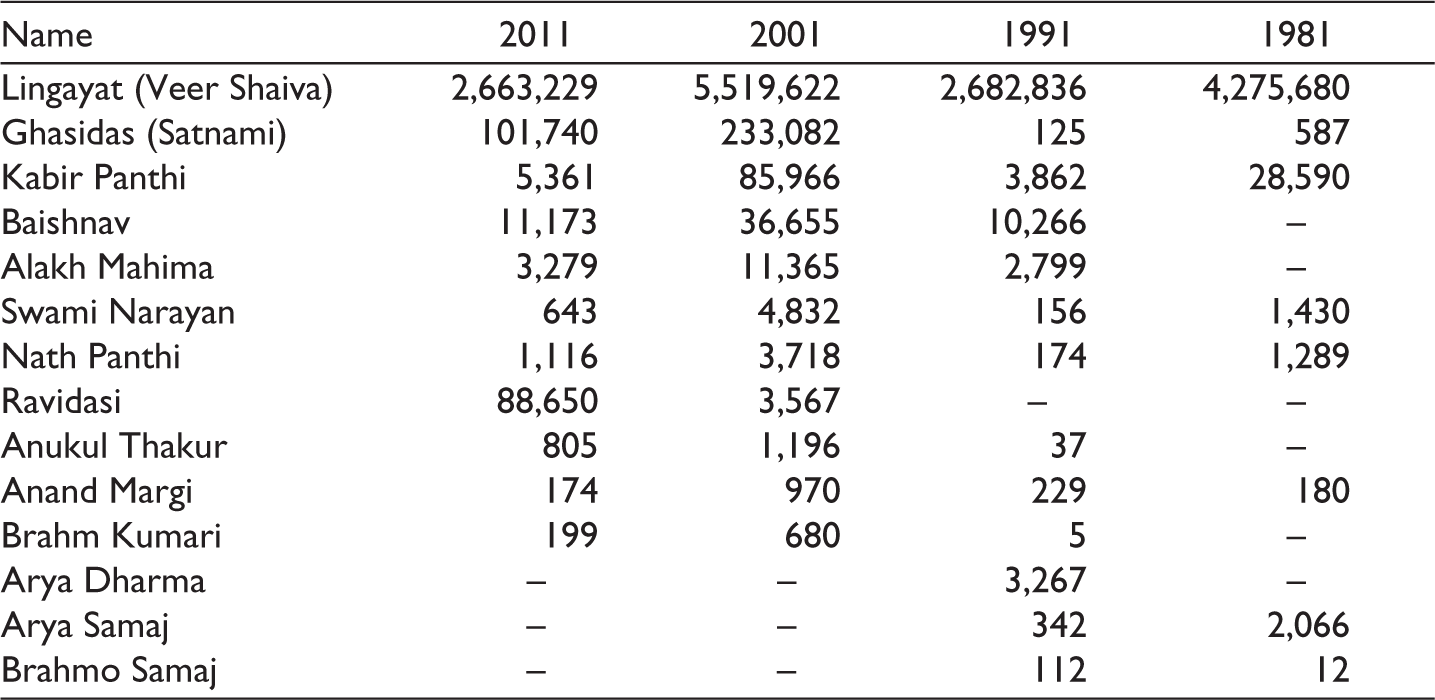
The observation recorded in 1901 Census is also relevant here, to quote:
…the line between Sikhism and Hinduism is very vague and the practical definition adopted at the present census and in 1891 that ‘a (male) Sikh is one who wears the hair long and refrains from smoking’ is said to have resulted in the exclusion from the return of many of the muna Sikhs who cut their hair but are generally regarded as Sikhs.’
8
In the 1901 Census, more than a hundred sects under Sikh had been enumerated in Punjab; many of these sects are actually followers of particular Guru originated locally, which even today would be difficult to separate from Hinduism (e.g., Guru Gorakh Nath, Guru Gopi Chand, Radha Swami, Kabir-panthi, Nirankari, etc.), and many others, which are in fact the Hindu sects (e.g., Durga Upasak, Devi Dharam, Vaishno, Deo Dharm, etc.). 9
On the other hand, Buddhism and Jainism assumed ‘distinct religious identity’ perhaps a little earlier. By all probabilities, originally, they were like other sects of Hinduism. Jainism is traced down to Vardhamána or Maháviraas far back as the sixth century
The intricate fragmented system of the Hindu religion rendered it to be further complex by the even more diverse social groupings interwoven through an equally diverse hierarchical order of arrangements called the caste system. 10 The Hindus as a consolidated block that only spontaneously and arbitrarily gets organised, mechanically and momentarily, is intrinsically a weak ephemeral. However, the very reason for which the Hindus ever remained a weak consolidation also remained its inherent strength against all cultural and religious onslaughts. The slow spread of Islam in India, which has been grossly misunderstood, could be primarily due to this reason. Despite the long 800 years of Islamic political occupation only 16% of its population got converted. The complex system of Indian society segmented through castes, sects, languages, etc., hindered the spread of any new idea, concept, habit and so also the spread of any new religion, indigenous or foreign. Every new creed that emerged in India could spread only to a limited extent, thus resulting in further diversity.
The much-criticised Hindu caste system is held responsible for Islamic conversion,
11
which is again a grossly misunderstood fact contributed through early census writings. Attempts were made based on physical anthropological traits to establish that the converted Muslims in the eastern Indian subcontinent were mostly taken from the low-caste Hindus such as Rajbansi, Koch, Chandal, Pod, who, as claimed, have converted to Islam to overcome their social deprivation of caste system. To quote:
The Musalman religion, with its doctrine that all men are equal in the sight of God, must necessarily have presented far greater attractions to the Chandáls and Koches, who were regarded as outcastes by the Hindus, than to the Bráhmans, Baidyas and Káyasths, who in the Hindu caste system enjoy a position far above their fellows. The convert to Islám could not of course expect to rank with the higher classes of Muhammadans, but he would escape from the degradation which Hinduism imposes on him….
12
Contradictorily, however, in the subsequent 1931 Census, the Koch-Rajbansis were not found untouchable (i.e., exterior caste), nor they were considered as a primitive tribe. The Koch-Rajbansis had a thriving royal tradition until the early eighteenth century. 13 The Koch kingdom is acknowledged for the construction of most of the important Hindu temples in Assam and Bengal, including the famous temple of Kamakhya 14 (Figure 1a–b). Regarding the Chandals, also called Namasudras, the community was recorded as untouchables in Bengal, Assam and Madras provinces in 1931 Census. They are in fact a dominating cultivating caste that acquired a low social status only due to some historical reasons. 15 If deprivations in caste system had been a reason for Islamic conversion, then the Hindu castes, whose status is even lower than theirs, all would have been converted by now. The prevalent fact, however, is something different. Why was Islamic conversion record low in Hindu heartlands where a robust caste system once existed? Only 25% to 30% of the Muslims are Other Backward Classes (OBCs), which includes all untouchable Hindus (i.e., all Hindu Scheduled Castes and OBCs converted to Islam). 16 Why have only a small percentage of the total converted Muslims actually come from the backward Hindu castes?

Close-up view of Kamakhya temple.

Despite being an egalitarian religion, the early conversion to Islam, the elitist religion represented by the ruling class, most unlikely included the lowest stratum of the invaded society. 17 Any truth to this argument would completely overturn the theory of Hindu caste discrimination to be a reason for Islamic conversion. During the early Muhammadan rule, religion conversion, at least in the Hindu heartland, possibly involved only the clean caste Hindus. Those who surrendered to the dominion of the conquered most likely preferred the religion of the conqueror to reinforce their allegiance. In the forefront, the ruling communities such as Rajputs, Marathas and Jats were among the early converts. Others preferred conversion for social status, or favour of the ruling class, or to avoid persecution, religious taxes (Jizya and Ushr) and other hindrances or for marital alliance. All elements of caste system unlikely would go at one instant immediately on Islamic conversion. 18 Instead, more likely, the neo-converts would continue with many of their pre-conversion features for several generations. Therefore, conversion of unclean castes possibly was restricted further, as the neo-Muslims taken from various clean castes would not readily accept any unclean caste into their cohort. This fact could be reasonably argued at least in regions where the caste system had been very rigid. Possibly, it was only during the late Mughal and early modern period, when the importance of demographic number in the modern democratic set-up become evident, the conversion activities actually involved people without any precondition. Quite evidently, the Muslim population in the Indian subcontinent suddenly surged from 16% to 25% during that period. 19 The Hindu unclean castes converted to Islam continue to retain their caste identities and occupations, what is now claimed as, caste system, among the Muslims. This speaks of their comparatively recent conversion 20 and their continued separation from the elitist Muslims. In contrast, in fringe regions with lax Hindu influence and weak caste structure, such as in the eastern Indian subcontinent, the Islamic conversion had been a far quicker process.
The caste system and its historic socio-economic discrimination in Hindu India are now uncontested facts. However, when nothing is final even in material science, can our argument be ceased on such a complex sociological issue? The emergence of the modern economy, first through the agroeconomic revolution and then through the industrial revolution, caused the emergence of unfair class or racial discrimination all over the world. In India, such class and race formation have got manifested in the caste system, a possible fact that has been completely ignored in Indian historical and sociological research. 21 How the long Islamic occupation of India has affected the various Hindu institutions, including the caste system? And also, how the long 800 years of political, cultural and religious subjugation backed by the aggressive Islamic regime could not completely absorb India? These questions are not yet taken up seriously. The problem of caste in Hinduism has been further inflated in colonial interest. 22 And as a continuing legacy, the Secular Marxist historians do effortlessly discover the convenient answer for all social and economic evils rooted to the Hindu caste system. Going by the same logic, all indigenous religions’ emergence including Bhakti 23 movements are attributed to the evils of Brahmanical Hinduism.
As argued above on Islamic conversion, if Buddhism, Jainism, Sikhism and various Bhakti cults had truly emerged as a reaction to the Brahmanical caste oppressions, then all the depressed castes would have been converted into one or the other of them way back in the history itself. But that has never happened. On the contrary, Jainism spread among the influential Vaishya castes; Sikhism mostly among the dominant Jats; and Buddhism and different Bhakti cults, although officially discouraged the Brahmanical caste system, involved the upper/dominant castes with preferential status. The various early census reports have documented well that such religious movements never were confined to any specific caste or caste groups. Quite evidently, such different contesting, conflicting and alternate religious ideologies spontaneously emerged in India down the history under different historical and social contexts but not necessarily always as a reaction to the Brahmanical system of caste oppression.
In post-colonial India, Buddhism become a synonym for Dalit (i.e., untouchable castes) emancipation and has been projected diagonally opposite to Hinduism. In fact, no antithesis ever existed between Buddhism and Brahmanical Hinduism. Taranatha’s history of Buddhism in India,
24
although is not a purely historical account, takes us on a time travel narrating events of togetherness pursuing doctrines (e.g., meditation, yoga, etc.) as well as Brahmanical rituals (e.g., homa, worshipping deity with the help of articles). Tibetan Buddhism, which is a form of Mahayana Buddhism developed in Tibet and now spread across Himalayan regions, known for its rich mythology, iconography and belief in reincarnation, exhibits close affinity with Hinduism. Taranatha’s history mentions separate as well as common temples dedicated to preaching doctrines (i.e., Buddhism) as well as performing homa (i.e., Brahmanical rituals).
25
Most possibly, the early Buddhism was neither a religion of proselytisation nor a separate one from Hinduism. With the growth of the Buddhist monastery organisation, probably the first of its kind was established by Ashoka (c. 304–232
The influence of Ashoka the Great after his initiation to Buddhism helped to spread it far and wide. This tradition continued in subsequent dynasties until the Pala period (750–1160
Taranatha assumed the end of Vikramasila and Odantapuri for the end of Buddhism in India.
28
Debiprasad Chattopadhyaya edited the English translation of Taranatha’s ‘History of Buddhism in India’ (1970). While writing the Preface of this English edition expressed his concern for the lack of history on this subject and forwarded his argument for possible reasons. He wrote:
The causes that contributed to the internal decay of Buddhism in India constitute indeed an extremely important subject for investigation. Our historians are yet to work these out fully. Could it, however, be that at least one of the important causes of this was the continued patronage of merchants, feudal chiefs and monarchs, primarily on which Buddhism thrived for centuries?
29
Very unrealistically that Hindus having such a complex social structure and without having any formal process of conversion once converted to rigid Buddhism in Maurya or Pala period, and then returned back to Hinduism afterward. At the same time without any negation or aversion for any other religion once practised cultural and religious elements, most unlikely would be completely erased from the folk traditions. In Assam-Bengal-Bihar region, once thought to be following Buddhism, no discernible element of the past practices of Buddhism is traceable in any folk tradition of the region, except uses as popular personal names like Buddha, Gautam, Siddharth, etc. 30 Therefore, any argument for the early extensive practice of Buddhism in India, at least as a common household religion, can be contested.
Without denial and organisational rigidity, Hinduism always remains accommodative. Contemporary trends suggest that the early form of Buddhism most likely existed like other sects of Hinduism. 31 And the affiliation constantly kept changing between Buddhism and Hinduism, very much like the fluctuating population of different sects of Hinduism today. 32 The extensive fragmented Hindu social structure has allowed easy accommodation, but at the same time resisted free run for any new idea, be it material or religious. When the organized Islamic proselytisation for long 800 years converted only 16% of its population, one can guess what percentage of the Maurya dynasty had been Buddhist. Having discussed the elements of Hinduism and other religions in a relevant socio- historical perspective, the problem of temple desecration in pre-modern India as raised in Richard M. Eaton’s arguments can now be examined in a broad contextual background.
Questioning the Evidence?
Much of the contemporary evidence on temple desecration cited by the Hindu nationalists 33 is found in Persian materials translated and published by the colonial historians with colonial political interests, as alleged by Richard M. Eaton. The History of India as Told by Its Own Historians (1849), edited by Sir Henry M. Elliot, claimed to be the most influential one, in which Elliot was keen to contrast what he understood as the justice and efficiency of British rule with the cruelty and despotism of the Muslim rulers who had preceded that rule. It is claimed that Elliot’s motives for delegitimising the Indo-Muslim rulers who had preceded English rule were quite clear.
Why rely on Persian sources when the theology of iconoclasm is intrinsic in orthodox Islam? Fundamentalist orthodox Islam strongly promotes the denial of god other than the one in Islam, branding of non-Islamic practices as kafir, 34 the moral conduct of converting kafirs into Islam, etc. Quite purposively, Mr Eaton avoided any reference to far-rigid Islamic evidence on the question of theology of iconoclasm but relied strongly on the sixth-century singular Brhatsamhita, which was never a rigid religious scripture in Hinduism. It has been argued that the inseparable bonding among king, god, temple and land in early medieval India, and the dynastic authority associated with images and temples rendered Hindu temples to be politically vulnerable. Here, the complexity of Hinduism has been completely misunderstood. Hinduism is not an organised religion based on any specific scripture or even a well-defined set of scriptures. Whatever has been illustrated in Brhatsamhita most likely never applied uniformly and rigidly across Hindu India. The conclusion drawn here is too much of stretching the act of simplification of the problem.
The mosque at Qutub Miner is called the ‘Quwwat-Ul-Islam’ masjid, meaning the ‘Might of Islam’ mosque. The inscription in the Qutub Miner written over there in Persian by its maker narrates the violent and tyrannical history of building it by destroying 27 Hindu and Jain temples. The very name of the mosque that signifies the ‘might of Islam’, the inscription justifying the desecration of Hindu and Jain temples, and aggressive vandalism of Hindu idols by mutilation, defacing or even beheading undisputedly speak for theological iconoclasm unleashed by Islamic zealots behind such acts.
Lack of historiography does not mean ‘no history’. Archaeological remains confirmed once the distribution of idol worship right from Anatolia in the Near East, throughout Mainland Asia, down through Far Eastern region of Java, Sumatra, Indonesia, Malaysia, Borneo, etc. The spread of Islam has wiped out virtually all material existence of Hinduism. A comprehensive survey is compiled by Meenakshi Jain in her Flight of Deities and Rebirth of Temples (2019) recording temples after temples across time and space preserving definitive evidence of iconoclastic practices down the history. Deliberate execution can be conspicuously distinguished from wartime plundering and vandalism activities, and accidental damages. Almost every temple in the West, North and Central Indian states under prolonged Muslim rule faced aggression from one or the other rulers. In these regions, either very few are left or virtually nothing is left today from the past Hindu India, not even any ruins.
Comparatively, the Central Indian Himalayan states including Nepal, Bhutan and the North Eastern states where the advent of Muslim rule either never penetrated or was late have experienced far less ravage. Yet, there is no dearth of instances of iconoclastic executions of idols. The original temple of Kamakhya is assumed to be constructed in the eighth century during the Buddhist-inclined Pala dynasty.
35
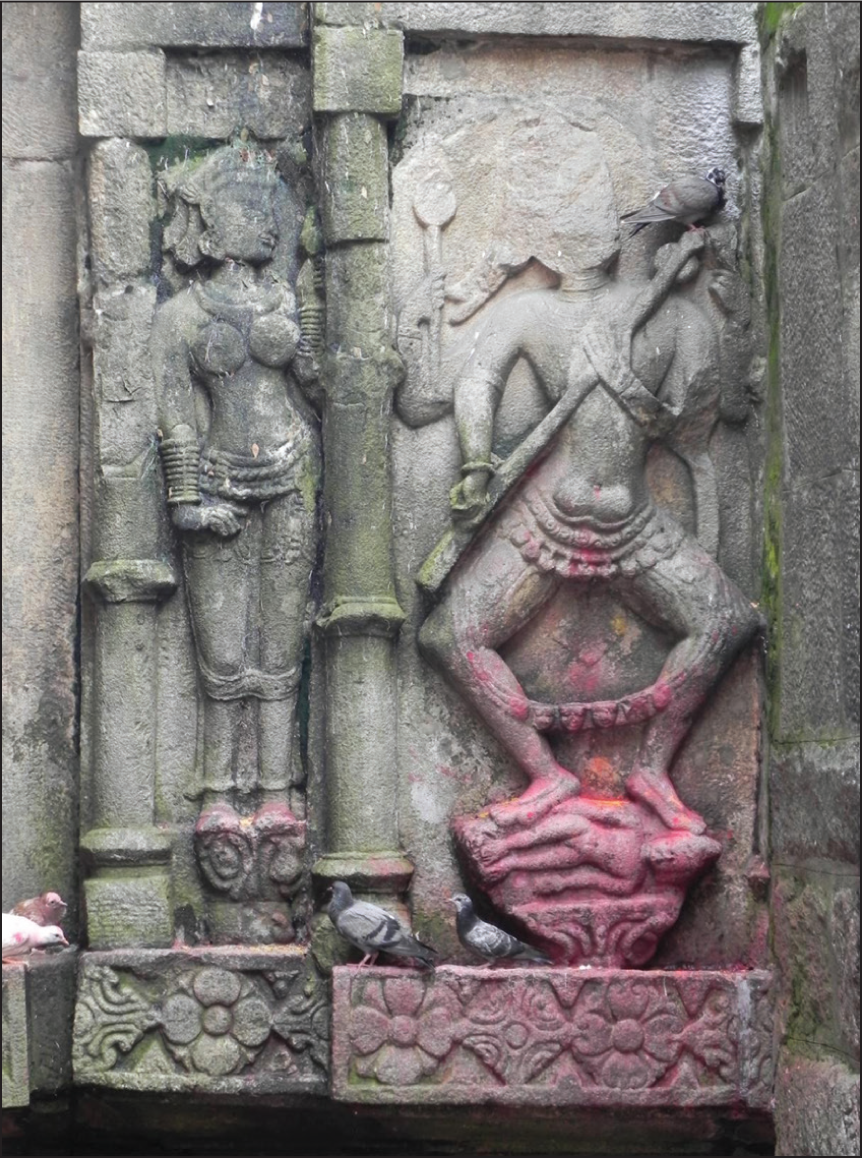
The temple was destroyed by Islamic iconoclasts sometime in the early sixteenth century (Figure 1a–i). The modern Kamakhya temple had been reconstructed from rubble by the Koch kings in 1565
First stone panel decorating the outer wall of the sanctum sanctorum on the left of the main entrance to the Kamakhya temple showing a male and a female deity. The head of the four-hand male deity is completely sliced off (still bearing several punch-hammer marks), and one of the left hands is partially damaged; in the case of the female, her face is partially damaged, which could be due to natural withering.
Broken image of a four-hand mother goddess on stone (legs and the right hands are partially damaged).

Broken images of a celestial warrior. Many such broken images are strewn here and there in the Kamakhya temple premises.

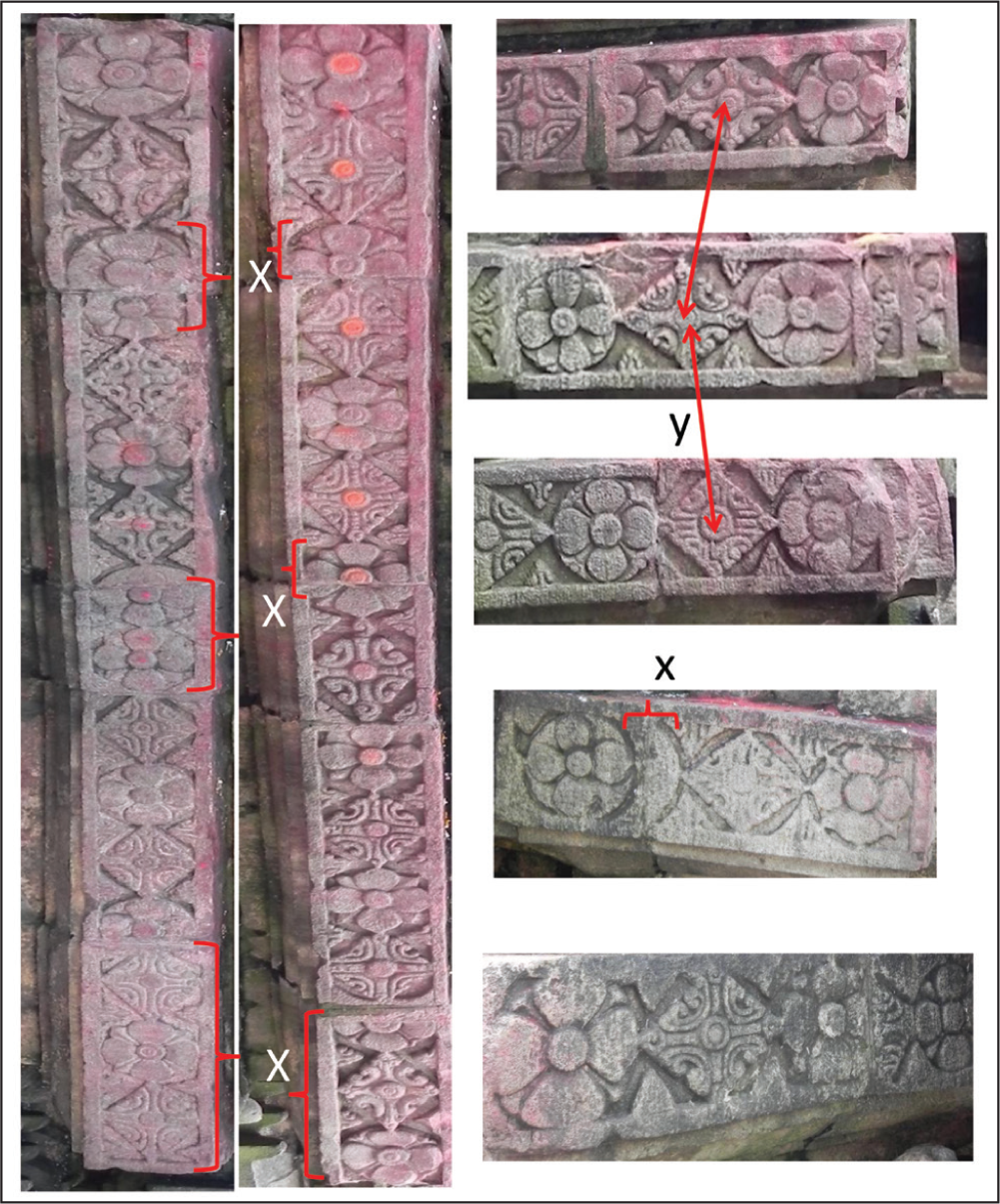
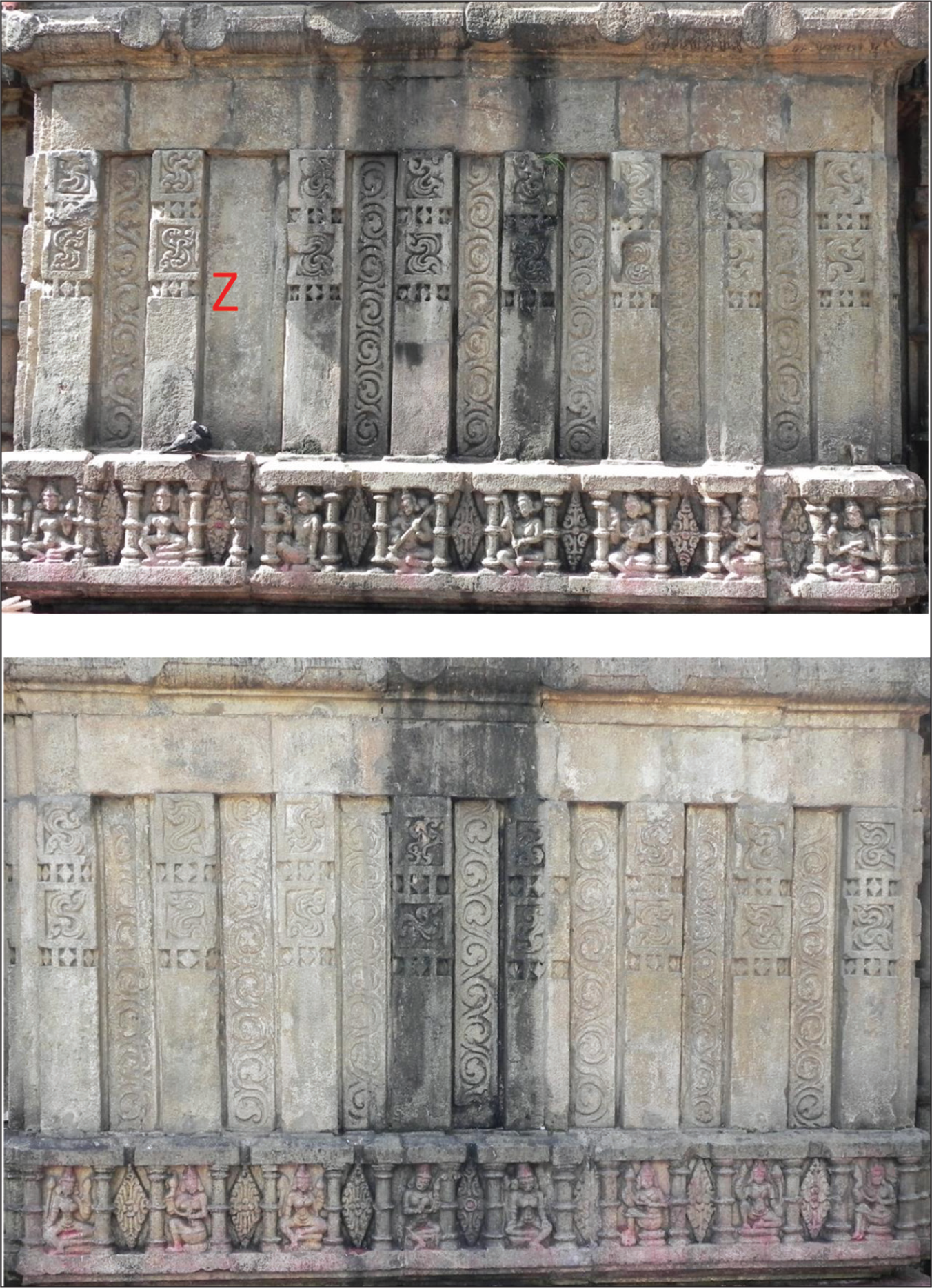
Stone panels of floral and geometric motifs decorating the outer walls of the sanctum sanctorum of the Kamakhya temple. Distorted patterns due to mismatch of panels ‘X’, missing panels ‘Z’, etc., indicate reconstruction on rubble. There are also stylistic variations in motif ‘Y’, which indicate either poor craftsmanship or crafting by different craftsmen.
Head iconography of different idols decorating the outside walls of the sanctum sanctorum of the Kamakhya temple. There are clear punch marks (in some cases) for deliberate destruction of the nasal part.

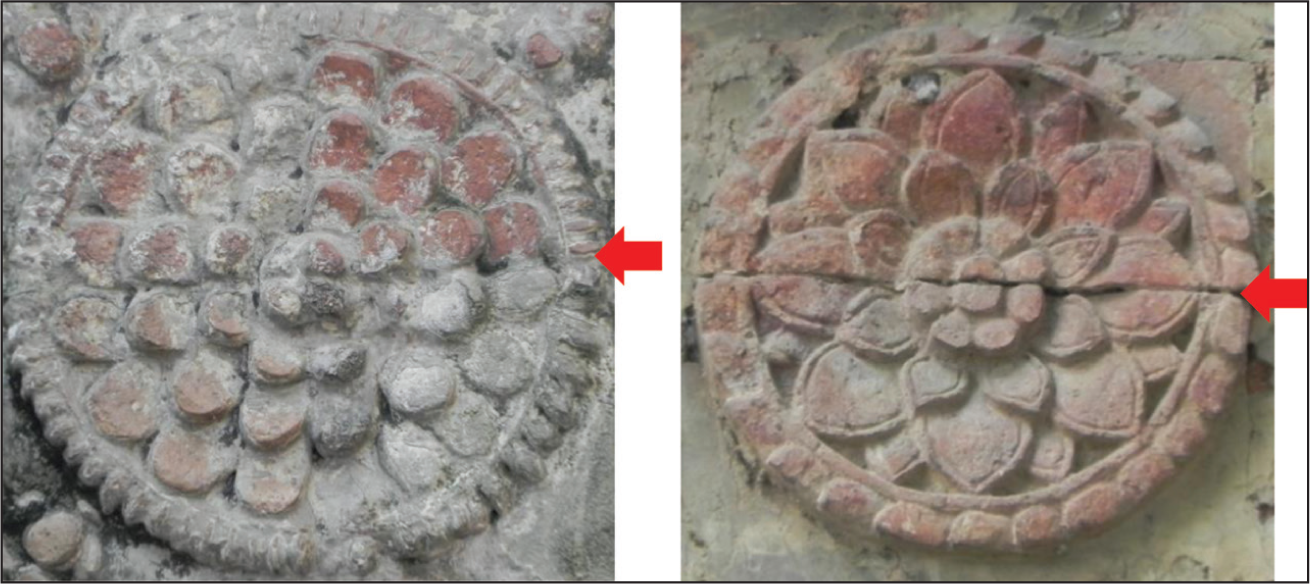
(Left) Floral motif on a burnt brick circular panel from one of the secondary domes of Kamakhya temple reconstructed by Naranarayan in 1565 ce . (Right) Nearly equivalent structure from sixteenth- or seventeenth-century Kachari Royal Palace at Dimapur. In both these cases, the circular panel is made by joining two semi-circular plates at the centre (shown by arrow) that indicate possible common technology and time.

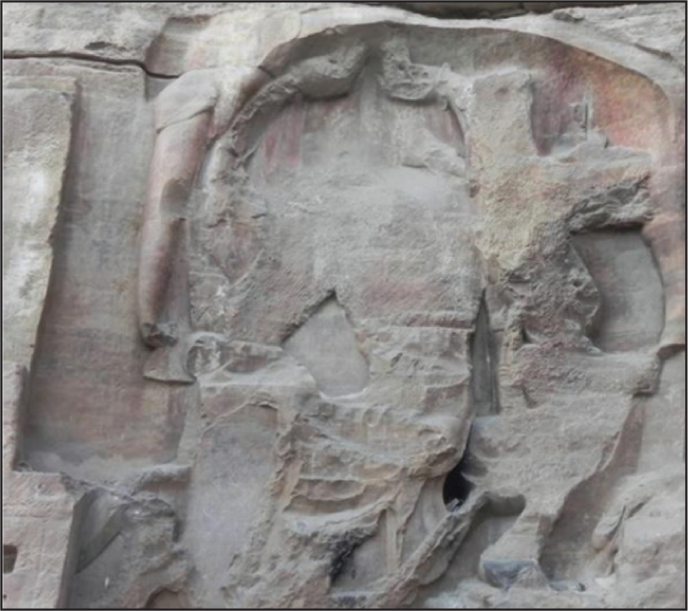
Siva-Parbati.
Ganesh.

Vishnu.

Completely damaged, image not identifiable. (Right) Partially damaged, Ganesh.
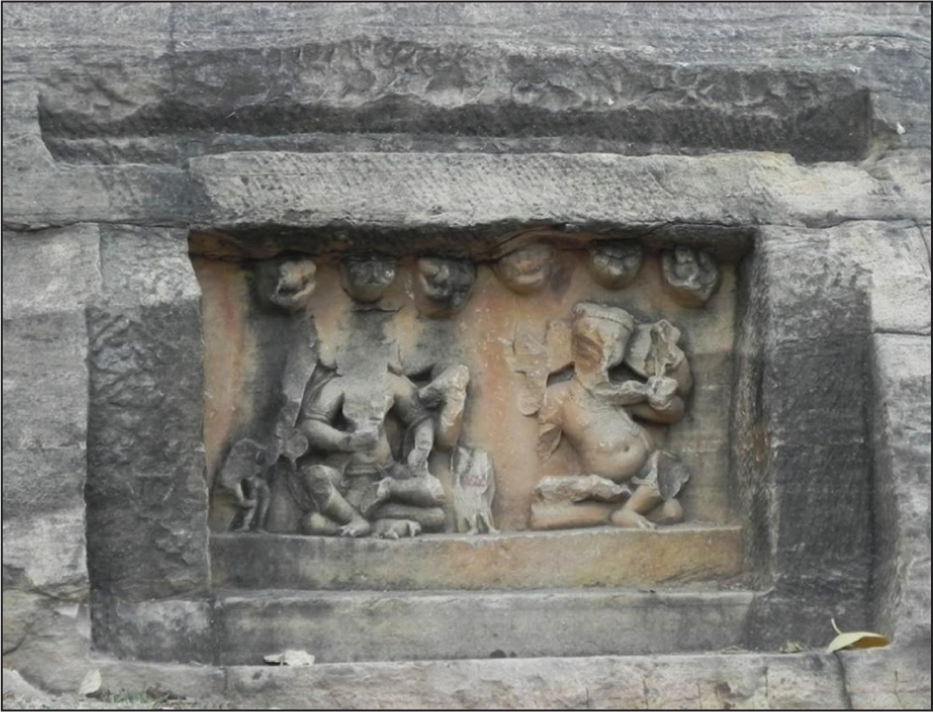
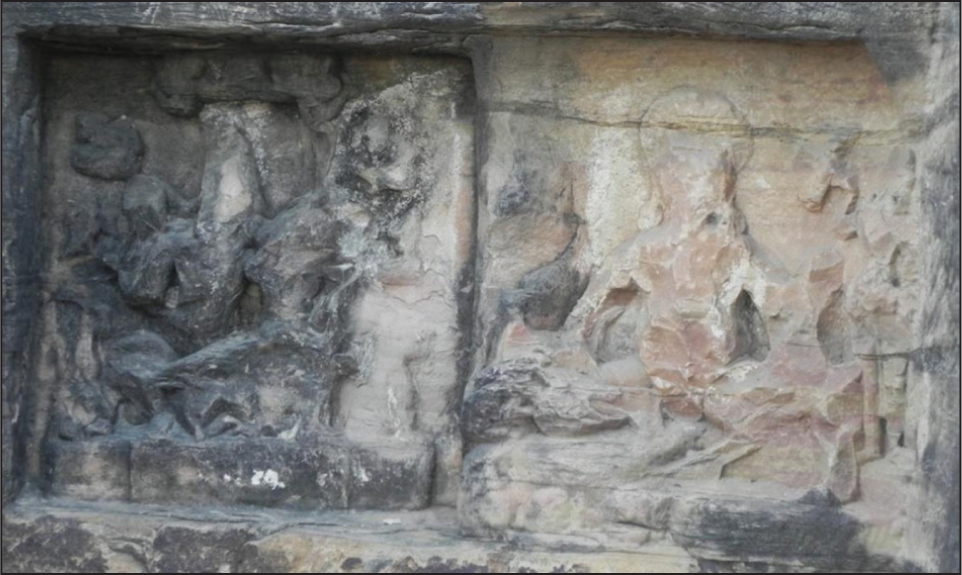
Image completely damaged, not identifiable.
Gwalior Fort, interior decoration.
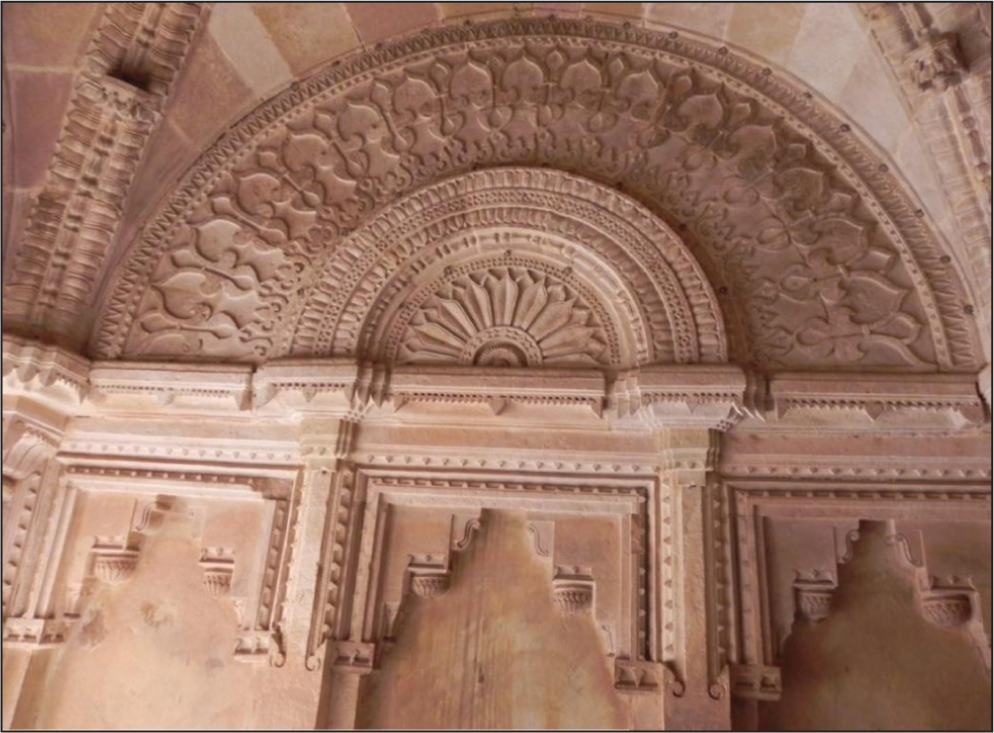
Gwalior Fort, exterior decoration.

In Gwalior Fort, iconoclastic execution of Jain (a) and Hindu (b) to (f) idols are clearly evident in meticulous defacing and amputation of body vital parts (e.g., head, limbs, breasts, etc.) in convincing execution style as found in numerous remains (collected from within the Fort and also from neighbouring temple ruins) now preserved and displayed in the Gujari Palace Museum.
Jain Chatustika, Gwalior Fort, 10th Century ad .

Vishnu, Gwalior Fort, 11th Century ad .
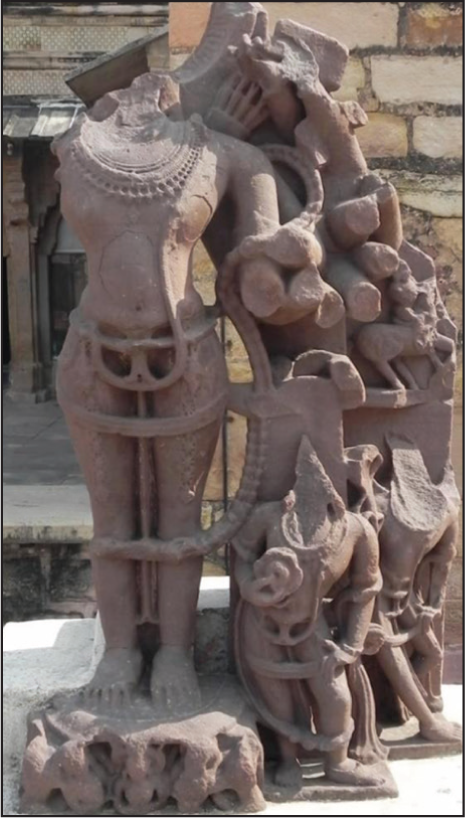
Laxmi-Narayan riding on Garud, Vidisa, 11–12th Century ad .
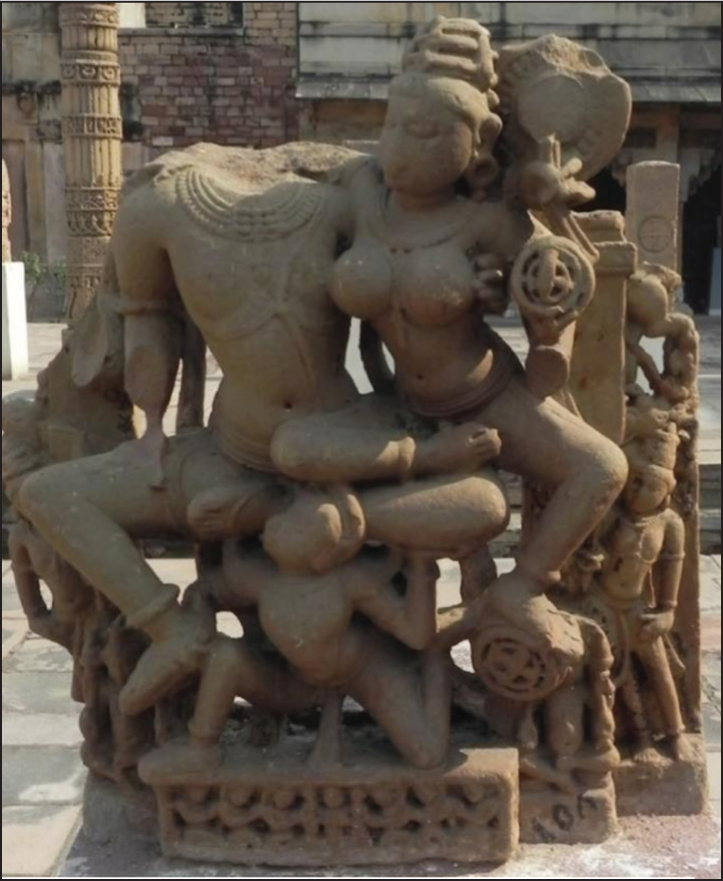
(Unknown).
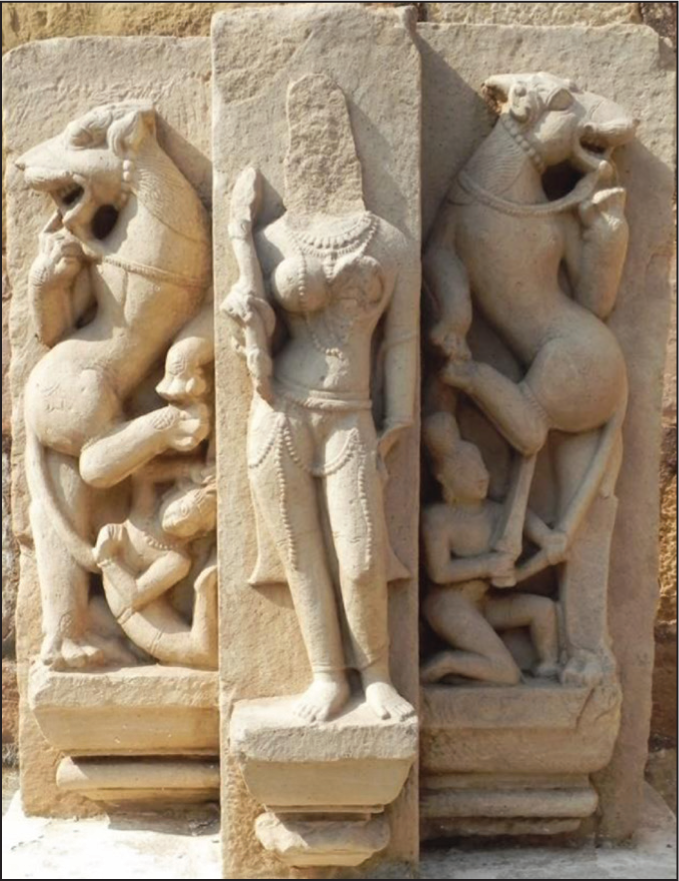
Bhayavati, Morena 13th Century ad .
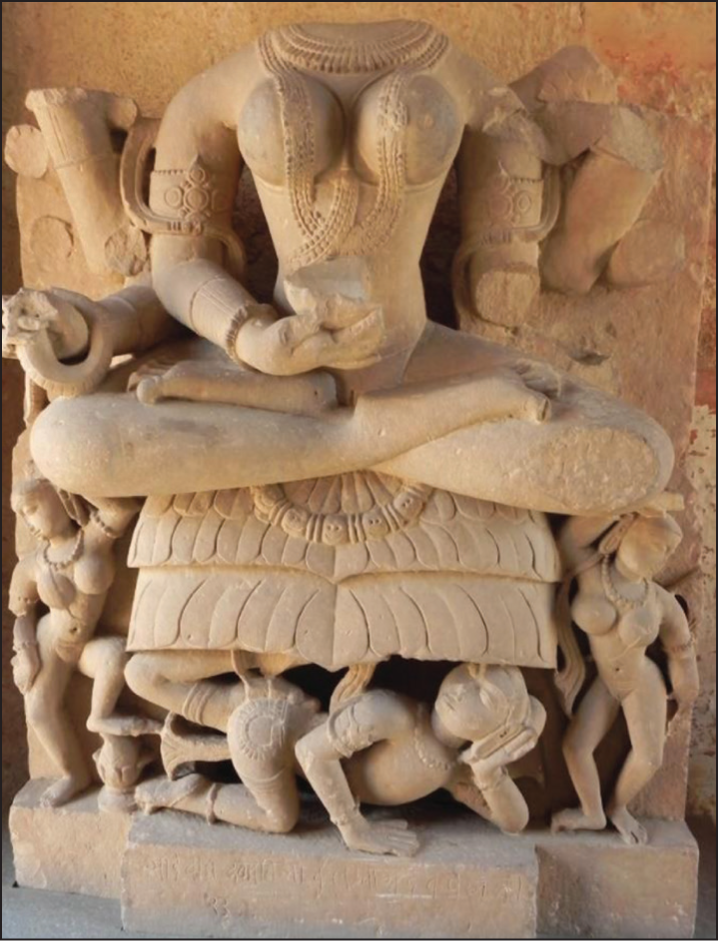
Durga (Unknown).

Fifteenth-century rock-cut sculpture(s) of Jain Tirthankara(s), Gwalior Fort (a). An idol of seating Tirthankara, majestic size and marvellously made, face completely smashed (b) .
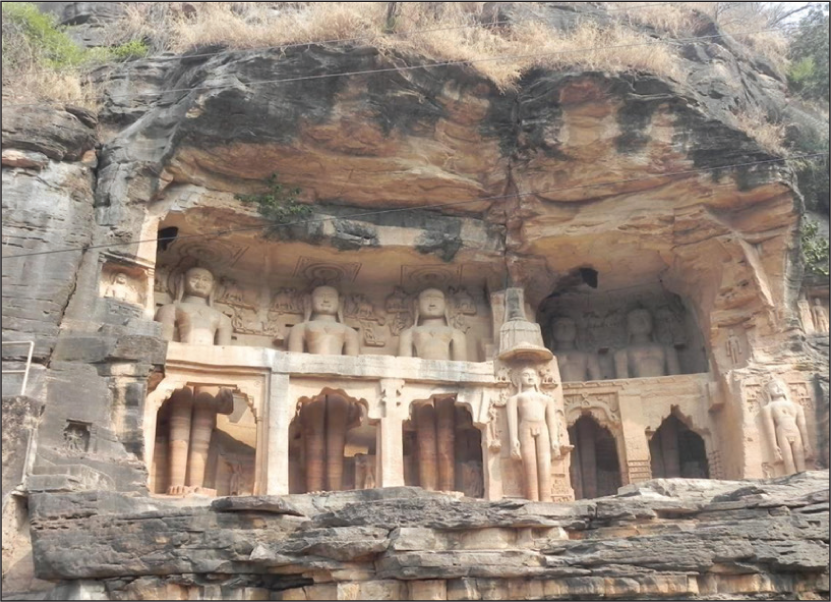
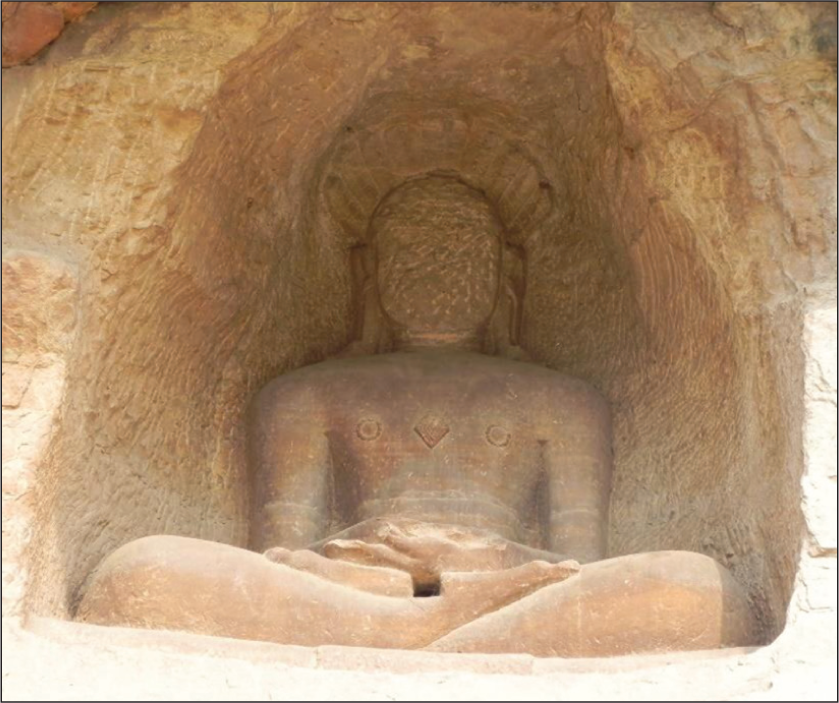

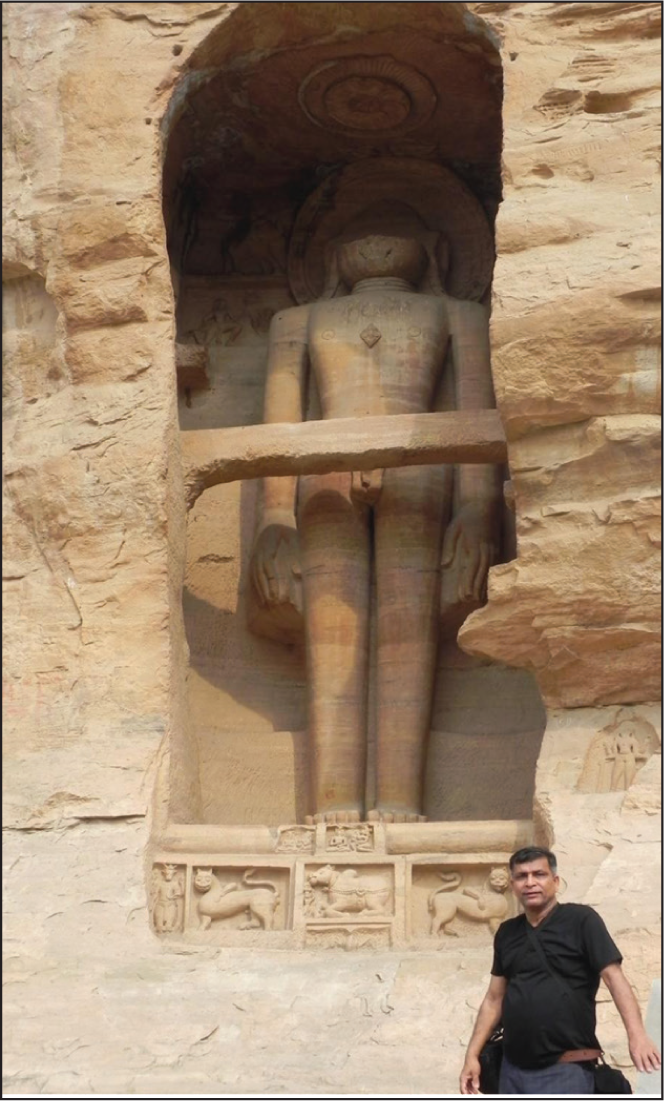
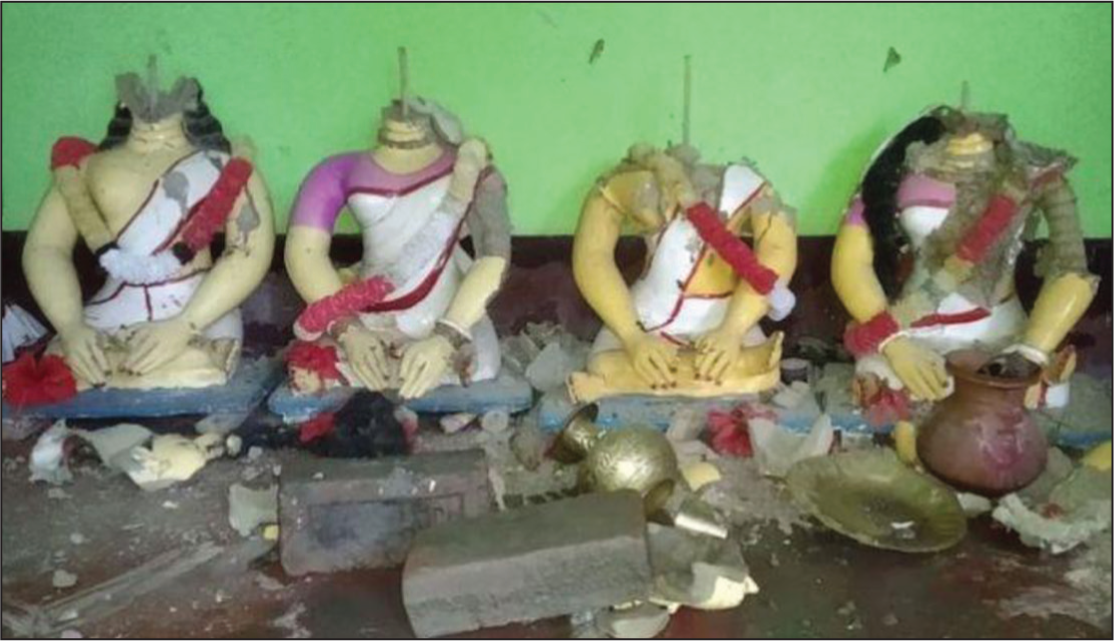
Here, neither the Kamakhya temple in Guwahati nor the Jain temple of Gwalior had any exclusive connection with any political dominion, apart from the fact that Brhatsamhita has nothing to do with Jainism, which clearly refutes Eaton’s argument raised relying on Brhatsamhita. In the twenty-first century modern world, why was the Bamiyan Buddha destroyed by Taliban fanatics? This event is correctly referred to as the first large-scale live act of performative iconoclasm. 37 No historiography is required that this incidence was rooted in the theological iconoclasm of orthodox and militant Islam.
Historiographic evidence always remains incomplete, no matter how well the relevant documents have been preserved. There are always dotted lines that require to be filled by subjective interpretations of historians. No matter how objective they wanted to remain, in the absence of any material facts their objectivity always remains at bay. Ethnographic parallels and contemporary circumstantial evidence may rescue the historian from this debacle. At this point the Anthropological methods and historiography can profitably marry. The contemporary situation in the Islamic states of Afghanistan, Pakistan and throughout the Middle East region provides circumstantial testimony to the systematic extermination of non-Islamic existence that today virtually nothing is left over there. Desecration of Hindu idols is a common occurrence in Bangladesh (Figure 5a and b). No ancient temple of significance is survived or remained intact in the north and north-western parts of undivided India, the citadel of Islamic rule, compares to the Southern and North Eastern parts of India, where the entry of Islam was late, and inaccessible places (e.g., Himalayan Highlands dotted with several ancient temples), where the Islamic rule never penetrated.
History often dominates the interest of the ruling class. If Sir Henry M. Elliot deliberately presented the distorted history to suit his colonial interest to legitimise the colonial rule in India, Mr Eaton now indulging in the same mistake to suit his interest in narratives. The details of the material facts presented in Elliot’s edited volume cannot be simply ignored, what is found very shallow in Eaton’s presentation in contrast. Search for Persian chronicles just for the sake of professional historiography, while ignoring the very circumstantial and material evidence by Richard M. Eaton, only speak for his choice of narratives.
Desecration of Hindu Temples by Hindu Kings?
Before embarking on the question of temples, the place of temples in Hindu India needs some clarification. The sacred complex concept involving Hindu iconic temples become well understood after L. P. Vidyarthi’s Sacred Complex of Hindu Gaya. Hindu temples, such as Kasi, Mathura and Ayodhya, found mention in ancient texts and always remained common pilgrimage centres of great significance to the Hindus irrespective of any political demarcations. India as a miniature form is replicated again and again around these temples. That means, every temple replicates a mini-India around it. Every Hindu panth, sect, linguistic group, regional group, caste, community and their representatives participate in temple affairs, ritual services, supply chain, hospitality industry, etc. Pilgrimages from all over India visit these temples. They find their family priests and their preferred hospitality service providers (lodge, hotel and restaurant) from their own community in and around the temple premises. 38 There are settlements in and around the temple from every corner of India representing each local situation. Thus, a mini-India is replicated around such a temple. India as a modern nation-state is a post-colonial emergence, but India as a nation is not new. In fact, India as a living and continuously rejuvenating cultural and religious nation always existed around its temples regardless of any political boundaries.
On the question of Hindu temple desecration by Hindu kings, Richard M. Eaton strived hard to establish his thesis that the desecration of Hindu temples, looting and carrying off images of state deities had been an established practice for the sixth century onwards among the local Hindu kings. In his efforts, several instances of Hindu temple desecration by Hindu kings are cited. Such as: In the early tenth century, the Pratihara king Herambapala seized a solid gold image of Vishnu Vaikuntha by defeating the king of Kangra. Later, the Candella king Yasovarman sieged it and installed in the Lakshmana temple of Khajuraho. In the early eleventh century, the Chola King Rajendra I sieged the images of idols by defeating several Hindu kings, such as the images of Durga and Ganesha from the Chalukyas; the images of Bhairava, Bhairavi and Kali from the Kalingas and a bronze image of Siva from the Palas. In the late eleventh century, the Kashmiri king Harsha even raised the plundering of temples to an institutionalised activity; and in the late twelfth and the early thirteenth centuries, the king of the Paramara dynasty attacked and plundered the Jain temples in Gujarat. In the 1460s, Kapilendra, the founder of the Suryavamshi Gajapati dynasty in Orissa, sacked both Saiva and Vaishnava temples in the Cauvery delta during wars of conquest in the Tamil country. In 1514, Krishnadevaraya looted an image of Balakrishna from Udayagiri. Six years later, he acquired control over Pandharpur from where he looted the Vittala image and carried it back to Vijayanagara. The Bengali troop, as reported, had destroyed the image of Vishnu Vaikuntha—the state deity of the king Lalitaditya of Kashmir.
Considering a few instances on the one hand while ignoring the extensive large-scale evidences on the other has unquestionable methodological flaw in Eaton’s deliberation. Very clearly, these incidences of Hindu temple destruction by Hindu kings, as pointed out by Eaton, do not show any sign of iconoclastic practices. The image of Durga seized from the Chalukyas by Rajendra I and the image of door guardian brought by Lord Vijayarajendradeva after burning the Chalukya capital, as referred, 39 are intact even today. And that none of the incidences cited by Eaton involved any sacred complex of the Hindu Great Tradition. Hindus have never been a singular organisational and temporally stable identity. Any generalisation that Hindu kings desecrated Hindu temples obscures the real sociopolitical contexts of such events. The problem is compounded by identifying Hinduism to be a singular identity, and by our lack of ground knowledge about early Buddhism, etc. It will be erroneous to put Hinduism, Buddhism and Jainism historically as exclusive identity as we now can distinguish them. Besides, the normative and institutionalised practices, the circumstantial material evidence and the theological justifications of temple desecration are completely ignored. Can any act of retrieving or obtaining one’s coveted temple image be labelled as looting? A king after being victorious would prefer to take away all precious wealth of the defeated king. And to a devoted Hindu king, there could be nothing more precious than the idol in the royal temple. Even if we agree with the historiographic evidence as referred by Mr Eaton, it would be wrong to interpret such incidences to be identical to the institutionalized iconoclasm practices signified by deliberate and selective act of defacing, amputation of body vital parts in clear execution style, complete removal of idols by extensive and careful method, etc.
The argument that the Hindu kings had destroyed Hindu temples in political and economic interests is taken further back in history beyond the sixth-century
Why Desecration of Temples Selectively?
Mughals destroyed some temples again and again, while promoted some others by donating land and temple grants. Temples were desecrated selectively indicating, as claimed, that such acts were carried out only in economic and political interests. It is claimed that there was no interest to attack the common people and the numerous temples of lesser economic and political significance. Mr Eaton wrote:
Temples that were not so identified, or temples formerly so identified but abandoned by their royal patrons and thereby rendered politically irrelevant, were normally left unharmed. Such was the case…with the famous temples at Khajuraho….
40
Such generalisation may be too simple. There were perhaps different regional political interests and administrative requirements. However, a clear trend is that such temple grants were extended to regions that were not yet brought under control, possibly to win political acceptance by the common people over there. Auranzeb’s temple grants to southern and far eastern India (e.g., Umananda in Assam) can be seen from such a diplomatic perspective. The reason why Khajuraoho temples were not desecrated can be easily found if we analyse the geography and the conditions in which these temples existed. The Khajuraho temples were abandoned in the desolate forests away from any crossroad of Mughal dominion. Abandoned temples are no longer functional temples. So, they have no economic, political, social or religious interest. Why the abandoned temples in the desolate forests having no significance whatsoever would be attacked? Who would react if anyone destroys such abandoned temples? Any act of destruction is not free of cost. Then why anybody would invest? Richard M. Eaton has failed to understand these facts.
Discussion
Be it religion or social institution (e.g., caste system), Hindu India is an unpredictably complex subject that dealing with it in a conventional frame of reference may lead to some distorted narratives. France structural-anthropologist Louis Dumont in his Homo Hierarchicus (1970) very exhaustively investigated the Hindu caste system using immensely huge materials in constructing his caste system model on purity-pollution dichotomy. The 1901 Census conducted under the supervision of Sir Herbert Hope Risley remained the only pan-India level field exercise ever conducted documenting Hindu castes according to social precedence on which Louis Dumont further consolidated his argument on social hierarchy. Structuralism is no longer remains fancy. 41 Louis Dumont’s structuralism failed to visualise the real complexity of Hindu social structure. His interpretation of caste in the purity–pollution model has created more misunderstandings than revealing the actual complexity of the problem. The Hindu concept of purity–pollution is far more prevalent and widespread. Even an individual can be in a differential state of purity or pollution at different context, place and time. So, the apparently much scientific-looking clichés of the caste system pivoted around the purity–pollution dichotomy becomes redundant to address the different contexts and gets completely collapsed at the individual level. Although the potential fallacy of the idea on social precedence of castes had been well experienced in conducting the 1901 Census itself, and that it was never employed again, the idea got subsequently crystalised through Dumont’s writings, which eventually become the most important axiomatic frame in interpreting caste.
Several flaws are evident in Eaton’s interpretation of temple desecration. The limitation of writing history has been exposed everywhere, which is more so in the Indian context. Without having any centralised organisational mechanism and without any precise scripture or a set of scriptures in Hinduism, both India’s formal or great traditions and the informal folk or local traditions always are in flux. The problem of historians is compounded here as efforts are required to identify and reconstruct the specific formal traditions and the local traditions from their respective flux content. History writing is essentially a practice of establishing the chronology of events. Time-perspective generalisation of events is now found very problematic in prehistoric archaeological practices. 42 The same has implications in historical analysis as well. However, when applied to any material in Hindu India, the problem is further compounded. Unlike the religion of organised monotheism pivoted around a singular historical event or a set of events, Hinduism, although theoretically can be traced back to certain specific scriptures, practically never remained the same in time and space, but constantly kept evolving or changing. This being so, how much reliably the historical events of time and space, which are sporadically preserved in historiographic evidence here and there, in bits and pieces, and that too in some foreign chronicles (such as Persian records), can be used in reconstructing India’s historical past, it would always invite question.
Given the complexity of the situation, the historiographic evidence in interpreting Indian history needs validation by careful application of contemporary ethnological evidence, circumstantial material evidence and the specific Indian contextual situation. How much the people, in general, had been affected by the state’s adoption of Buddhism in Maurya (324–180
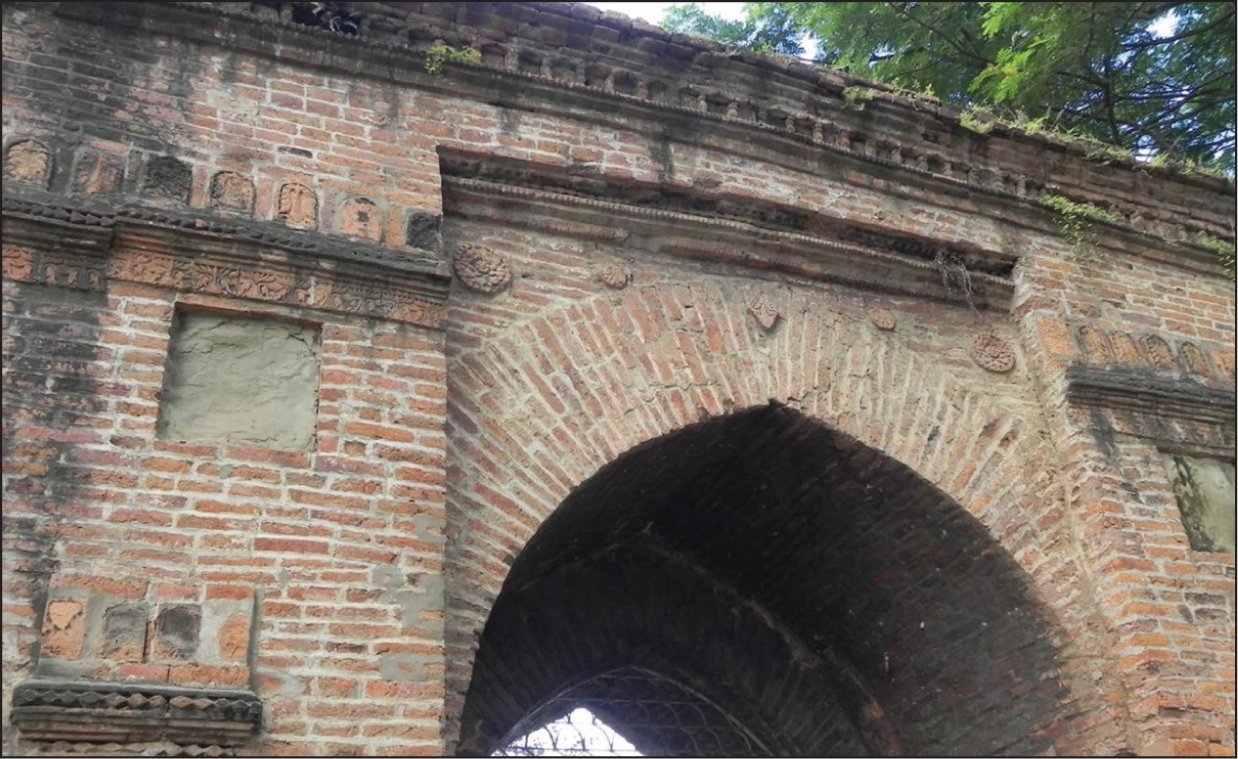
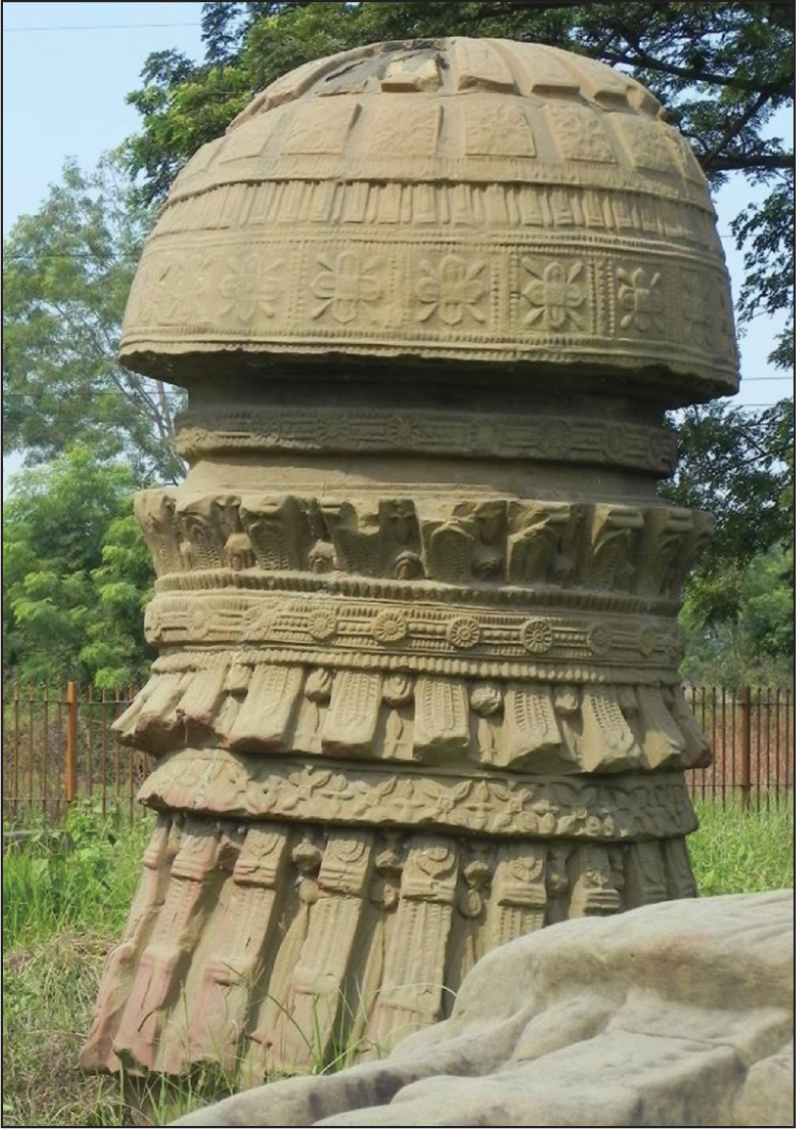
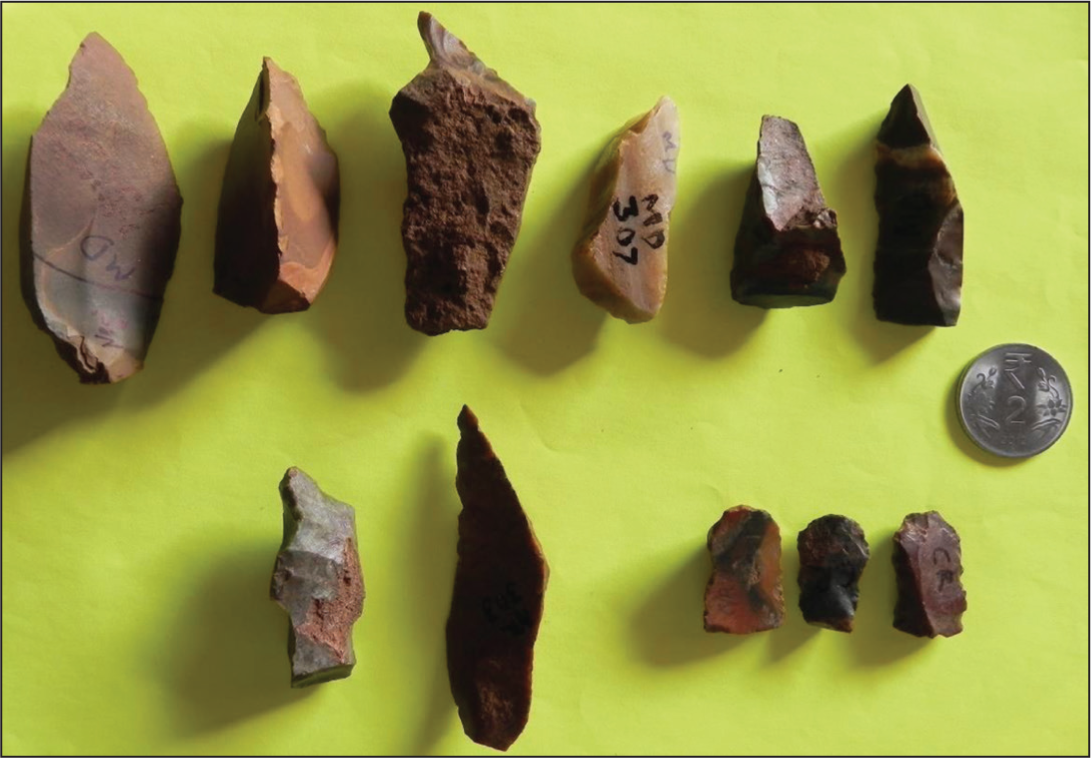
Kachari Victory posts at Dimapur, Nagaland. These are also popularly known as mushroom-domed pillars because of their shape. The real purpose of these pillars is still shrouded in mystery. The extensive decoration of these pillars with beautiful curving of floral motives indicates some kind of significant religious purpose.
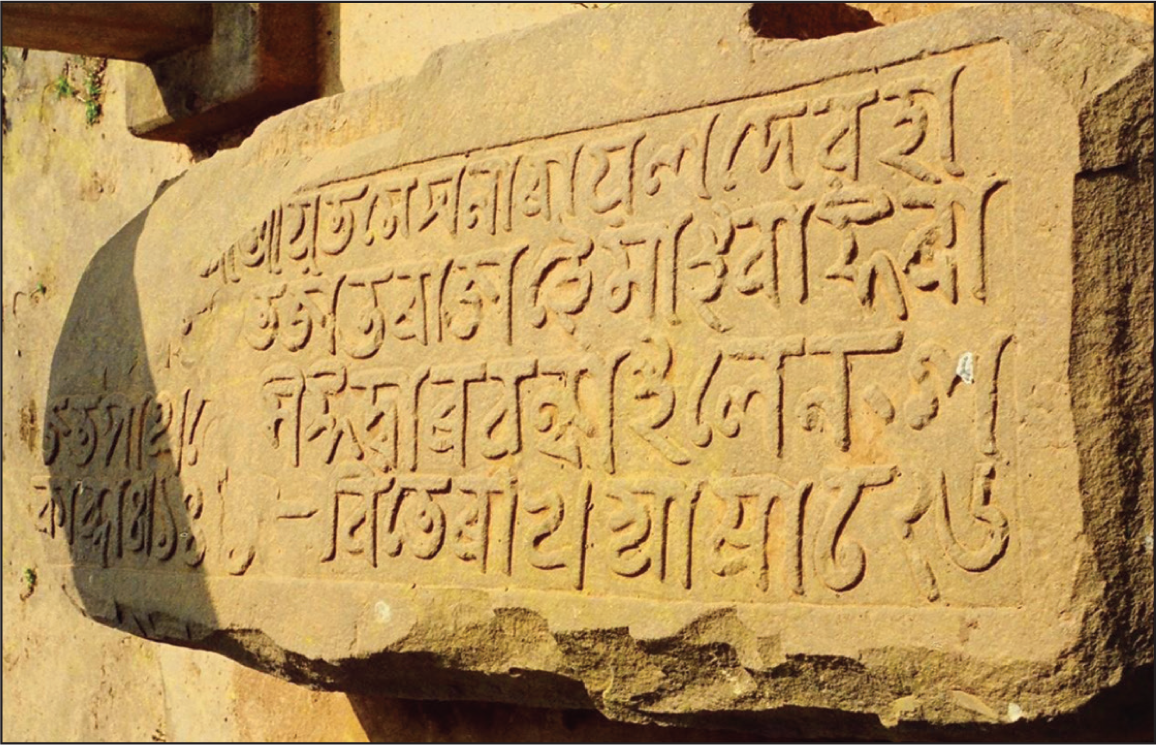
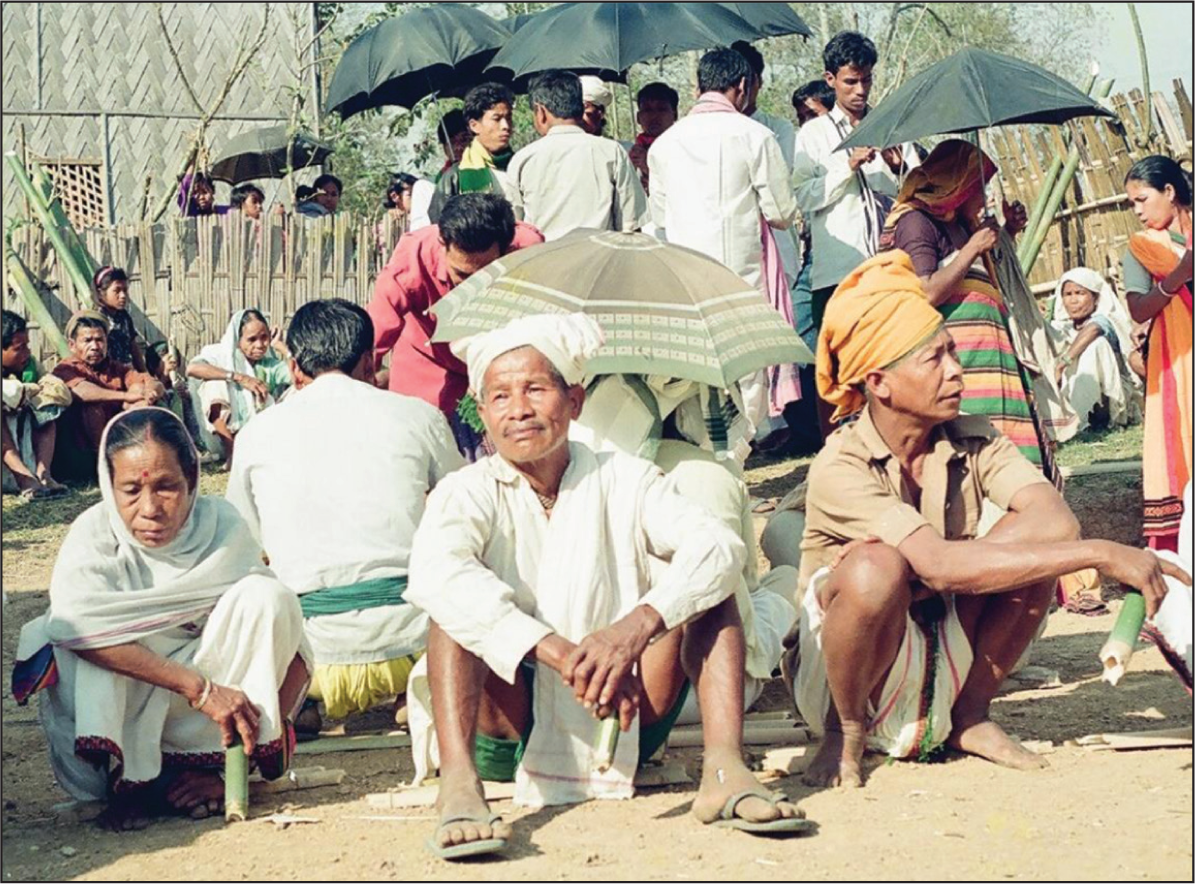
Social gathering of Dimasa Kachari men and women, drinking rice-beer in traditional bamboo cup, Maibang, N. C. Hills District (Dima Hasao) of Assam.
The iconic Hindu temples, such as Somnath, Kashi and Mathura, had been invaded time and again. The economic reason behind the act of temple desecration and looting of the valuables cannot be denied. The political justification for Hindu temple desecration cannot also be denied entirely. However, theological iconoclasm intrinsic in orthodox Islam undoubtedly remained the institutional norm, the single most dominant reason, behind such acts. Why only some temples were desecrated while others left untouched? There could be more than one reason. A handful of Islamic invaders established their dominion in India. Under no circumstance was it possible to coerce such a large population, who speak different languages, have separate culture and pursue their own established religion, to be converted instantly. So, the desecration of all Hindu temples at one go was difficult and unnecessary a target to accomplish. Certainly, neither it was practically possible due to the vastness of the region, nor it was necessary to destroy every temple to send any kind of religious or political message.
The Hindu temples were intrinsically attached to the sovereignty of a state, and, therefore, they were destroyed for political interest. It would not be quite safe to draw such a general conclusion merely based on certain historiographic evidence, particularly in Hindu India, where any connection between scriptures and practice is always unpredictable. However, Meenakshi Jain 52 has pointed out that such a reasoning does not hold true for any mosque. In the long list of incidences, she cited, the Islamic conquerors did not even touch the mosques built by the rulers whom they had defeated. What is completely misunderstood is that the Hindu iconic temples, which were attacked again and again, always remained the highest sacred pilgrimage for the Hindus across political demarcations. These temples stand more as a symbol of the Hindu universe than being exclusive to any sovereign state. Sponsoring temples of this stature instead would have been more rewarding in effective administration by a handful of invaders. But it happened otherwise. The reason apparently was far from being as plain as political or economic. Here we have examined the usefulness of material and circumstantial evidence gathered through other non-historical methods (e.g., ethnology, demography, contemporary studies, etc.) in validating the historiographic documents in interpreting history.
To conclude, Professor Richard M. Eaton in his analysis has ignored what is more obvious, widespread and contemporary, but relied keenly on some less obvious and obscure materials and problematic/doubtful historiography on this subject. Ancient Hindu temples were rich in wealth so they were looted for economic gain, and when temples were destroyed and vandalised the acts were more likely to give a political message of subjugation. But, when temples were destroyed selectively leaving non-religious structures completely untouched, and idols defaced or mutilated or beheaded, obviously not at a sudden spurt of aggression, but executed quite purposefully and specifically with diligence (e.g., Hindu and Jain temples of Gwalior, Kamakhya in Guwahati), and when the obnoxious shattered pieces meticulously displayed, obviously not in aesthetic sense, in the newly constructed structure built over the temple ruins (e.g., Quwwat-Ul-Islam masjid), such acts unlikely were as simple as vandalism or acts of political justification. When historiographic evidence is doubtful or problematic, it requires validation with other possible evidence. There is no lacking in material evidence on Hindu temple desecration in India. But, a specific study on such materials is still lacking. In future, a focused scientific/archaeological investigation on such material evidence along with other possible evidences (e.g., contemporary ethnography) may address this problem, which may not be to denigrate any community or religion but to enrich our understanding of our historical past.
Footnotes
Declaration of Conflicting Interests
The author declared no potential conflicts of interest with respect to the research, authorship and/or publication of this article.
Funding
The author received no financial support for the research, authorship and/or publication of this article.