



Abstract
Dietary vitamin A inadequacy remains a serious public health problem, especially among young children. Food and condiment fortification programs and policies are in place in many countries to address this issue, but degradation of the vitamin A added via fortification can reduce the quantity of vitamin A reaching consumers. We modeled the impacts of vitamin A degradation on program effectiveness and cost-effectiveness in fortified wheat flour, sugar, and (hypothetical) bouillon cubes in Nigeria. We used secondary data to estimate the prevalence of vitamin A inadequacy among young children (6-59 months), and the programs’ modeled contributions to reducing vitamin A inadequacy at selected levels of vitamin A degradation. The Lives Saved Tool was used to estimate child-lives saved. Program costs were estimated using activity-based models. Vitamin A degradation had a large negative impact on program effectiveness. Over the 0% to 80% vitamin A degradation range, accounting for other existing programs, fortification of sugar (7.5 mg/kg), wheat flour (2 mg/kg), and bouillon cubes (96 mg/kg) would reduce inadequacies among children by 2.9 to 0.7 percentage points, 3.9 to 0.7 percentage points, and 20.6 to 9.6 percentage points, respectively. Over the same vitamin A degradation range, average annual child-lives saved ranged from 3984 to 769 (sugar), 3036 to 739 (wheat flour), and 15 301 to 7153 (bouillon cubes); estimated cost/child-life saved ranged from US$ 550 to US$ 2848 (sugar), US$ 1039 to US$ 4271 (wheat flour), and US$ 944 to US$ 2018 (bouillon cubes). Vitamin A fortificant selection, technological innovations in vitamin A fortificants, and/or changes in premix and fortified food handling and storage could reduce degradation; these options could increase program costs, but merit consideration.
Plain Language Title
The Modeled Impacts of Vitamin A Degradation on the Performance of Wheat Flour, Sugar, and Bouillon Fortification Programs in Nigeria
Plain Language Summary
Dietary vitamin A inadequacy remains a serious public health problem, especially among young children. Food and condiment fortification programs are in place in many countries to address this issue, but degradation of vitamin A can reduce program impacts and efficiency. We estimated the impacts of vitamin A degradation on fortified wheat flour, sugar, and (hypothetical) bouillon cubes in Nigeria. We focus on vitamin A inadequacy and mortality among young children (6-59 months of age), and fortification programs’ contributions to reducing inadequacy and mortality at different levels of vitamin A degradation. Program costs are included in this analysis. Vitamin A degradation had large negative effects on program impacts and efficiency. Technical and policy options exist for reducing vitamin A degradation; these options could increase program costs, but all merit consideration.
Highlights
Vitamin A fortification programs and policies can reduce dietary inadequacies and hence child morbidity and child mortality; in the context of Nigeria, these programs cost millions of US$ per year.
Vitamin A is known to degrade when exposed to heat, light, and/or high humidity.
We provide the first modeled estimates of the impacts of vitamin A degradation on the effectiveness and cost-effectiveness of wheat flour, sugar, and (hypothetical) bouillon fortification programs in the context of Nigeria.
While some programs generate higher levels of nutritional and child mortality benefits than others, vitamin A degradation can substantially undermine the impacts and cost-effectiveness of all of the fortification programs examined.
Policy and technological options exist for reducing vitamin A degradation.
Degradation of vitamin A can seriously undermine the impacts and cost-effectiveness of food fortification programs. If vitamin A losses were 0, a hypothetical bouillon cube fortification program in the context of Nigeria aiming to contribute 30% of Codex Nutrient Reference Value for vitamin A per 2.5 g/p/d for adults would save an estimated ∼153k child-lives over 8 years at a cost of US$ 944 per child-life saved; if 80% of vitamin A were lost, only ∼72k child-lives would be saved at a cost of US$ 2018 per child-life saved. Improved premix and fortified food storage and handling practices, and perhaps especially technological advances to stabilize vitamin A, could help reduce vitamin A degradation and increase the benefits of these programs to all consumers.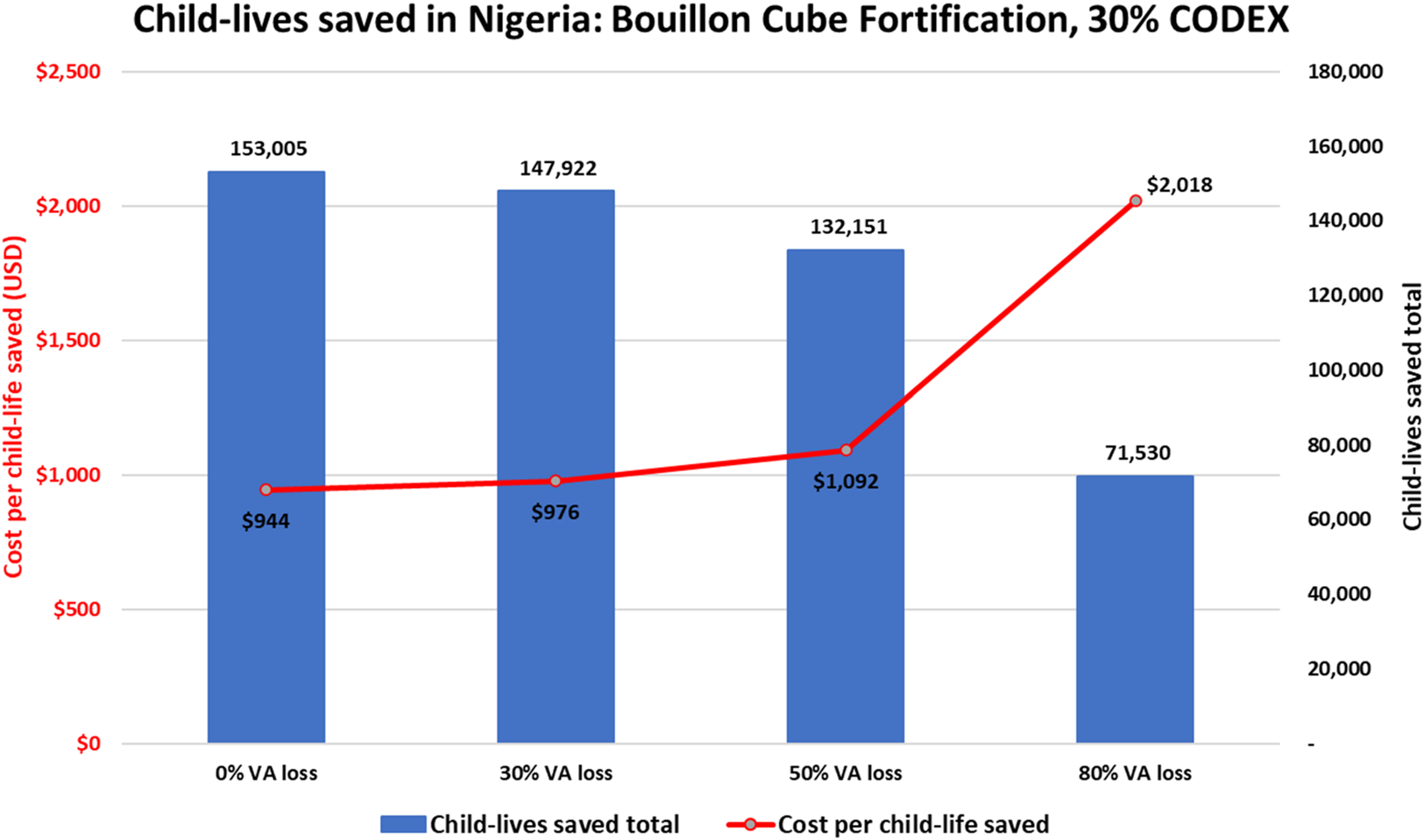
Get full access to this article
View all access options for this article.