




Abstract
In this article we estimate the growth elasticity of employment by gender for 160 countries during 1990-2010. We then econometrically model these elasticities to draw out the structural contexts in which gendered employment outcomes respond differently to growth, including measures of economic structure, demographic change, macroeconomic stability, global stance and policy, and income distribution and institutional development. Our investigation shows that the relative size of the service sector and the ratio of female to male labor force participation are key determinants of differences in employment elasticities by gender, creating higher elasticities for women than men. We also find that the terms of global integration, as measured by the current account balance, growth in the terms of trade, and the share of foreign direct investment in investment, are important for both female and male employment elasticities.
1. Introduction
For many countries, the growth elasticity of employment – the responsiveness of employment to economic growth – has been on the decline since the early 1980s (Heintz 2006; ILO 2009). Although this is associated with productivity gains, it reflects a reduced capacity for economies to generate employment from a given level of growth. In the midst of what the ILO refers to as a deep jobs crisis, employment generation is a primary policy concern for many regions (ILO 2012a). In this article, we evaluate one particular aspect of the growth-employment nexus from a gender-aware perspective: whether and how macroeconomic structure is associated with different employment elasticities for women and men. Our intent is to open a research agenda aimed at better understanding how macroeconomic structures – and the policies that shape them – determine the responsiveness of employment to growth. Such an understanding is of particular relevance to policymakers concerned with the linkages between growth and human development, as the question of whether the benefits of economic growth are broadly shared is one that centers on the capacity of economies to generate high-quality employment.
We first estimate global and OECD versus non-OECD employment intensities by gender for 160 countries during 1990-2010. We then econometrically model male and female employment intensities to draw out the structural contexts in which employment outcomes respond differently to growth, including measures of economic structure, demographic change, macroeconomic stability, global stance and policy, and income distribution and institutional development. Our investigation shows that the relative size of the service sector and the ratio of female to male labor force participation are key determinants of differences in employment elasticities by gender, creating higher elasticities for women than men. We also find that the terms of global integration, as measured by the current account balance, growth in the terms of trade, and the share of foreign direct investment (FDI) in investment, are important for both female and male employment elasticities. Though we do not detect statistically significant differences in these effects by gender, that the lines of causality are likely to be different defines a clear path for next steps in research.
2. The Employment Intensity of Growth, 1990-2010
While growth may be necessary for development, it is not sufficient; it is the “employment nexus” that enables individuals to participate in the benefits of growth (Osmani 2004; Van der Hoeven and Lubker 2006). The employment intensity of growth provides one way to analyze this nexus. Employment intensities depend on a number of factors including the sectoral composition of output, labor intensity of techniques used, domestic and international terms of trade improvements for workers, and how well various demographic groups are situated to take advantage of new opportunities (Osmani 2004, 2006). It is important to note that there is no ideal figure to which countries’ historical elasticities should be compared. What is high enough will depend on a country’s rate of growth in output and labor force among other factors (ILO 2009). A country that has high GDP growth and low labor force growth may not require as high an employment elasticity as another.
Equation (1) gives the arithmetic identity that output (Y) for country i is, by definition, equal to employment (E) multiplied by labor productivity (q, which equals output divided by employment). If we consider changes in these variables, as represented by delta (Δ) in equation (2), then changes in output are distributed between changes in employment and productivity. If the responsiveness of employment to economic growth declines, productivity improvements, which are ultimately necessary to increase wages and improve living standards, will have negative effects on labor demand (Heintz 2006). 1


Note that considering gender-disaggregated elasticities introduces some complexity into interpreting equation (2). Nothing concrete can be said of productivity changes without a measure of output contributed by the female (male) group. Of course, gendered output data are not a part of our statistical lexicon, so gendered employment elasticities should be interpreted with caution when making productivity inferences.
We follow the strategy outlined by Kapsos (2005) by estimating employment elasticities as follows,

where E, Y, and i are as before, D is a country dummy variable, and t subscripts the time period. This gives the following expression for the employment elasticity,

We estimate equation (3) for female and male employment over five-year intervals between 1990 and 2010. As Kapsos (2005: 6) points out, countries with low GDP growth may exhibit large swings in elasticities arising from small changes in the underlying variables. It is thus important to consider the relative size of GDP growth along with elasticity to get a sense of how much employment actually changed. Though we include a country dummy variable, important time-varying phenomena remain unaccounted for that are important for a gender disaggregated study. Namely, secular increases in women’s labor force participation will tend to inflate estimates of women’s employment elasticities. In the multivariate analysis to follow, we can tackle this issue more directly.
Employment data from 1990-2010 are from the ILO’s Key Indicators of the Labor Market 7th edition (ILO 2012b). Output data are from the World Bank’s Development Indicators 2012 database and are in constant 2000 USD (World Bank 2012). After elasticities are estimated for 160 countries, they are aggregated globally as well as by OECD membership (a proxy for level of industrial development), weighted by the respective country’s share of the group’s labor force. The labor force is defined as the summation of all employment for every country in the group that is present in the sample. Table 1 presents the elasticity estimates. Focusing on the global results first, we see that female employment elasticities are generally higher and more volatile than men’s; the average female-to-male elasticity ratio is 1.4. In the period encompassing the last global recession, 2007-10, female elasticity fell below that of men, 0.17 versus 0.25. So, for women at least, a much higher proportion of the growth that did occur was captured by productivity gains in the latter relative to earlier periods. But we do not find evidence of a secular decline in elasticity in the 2000s relative to the 1990s, at least at the global level.
Employment Elasticity Trends.
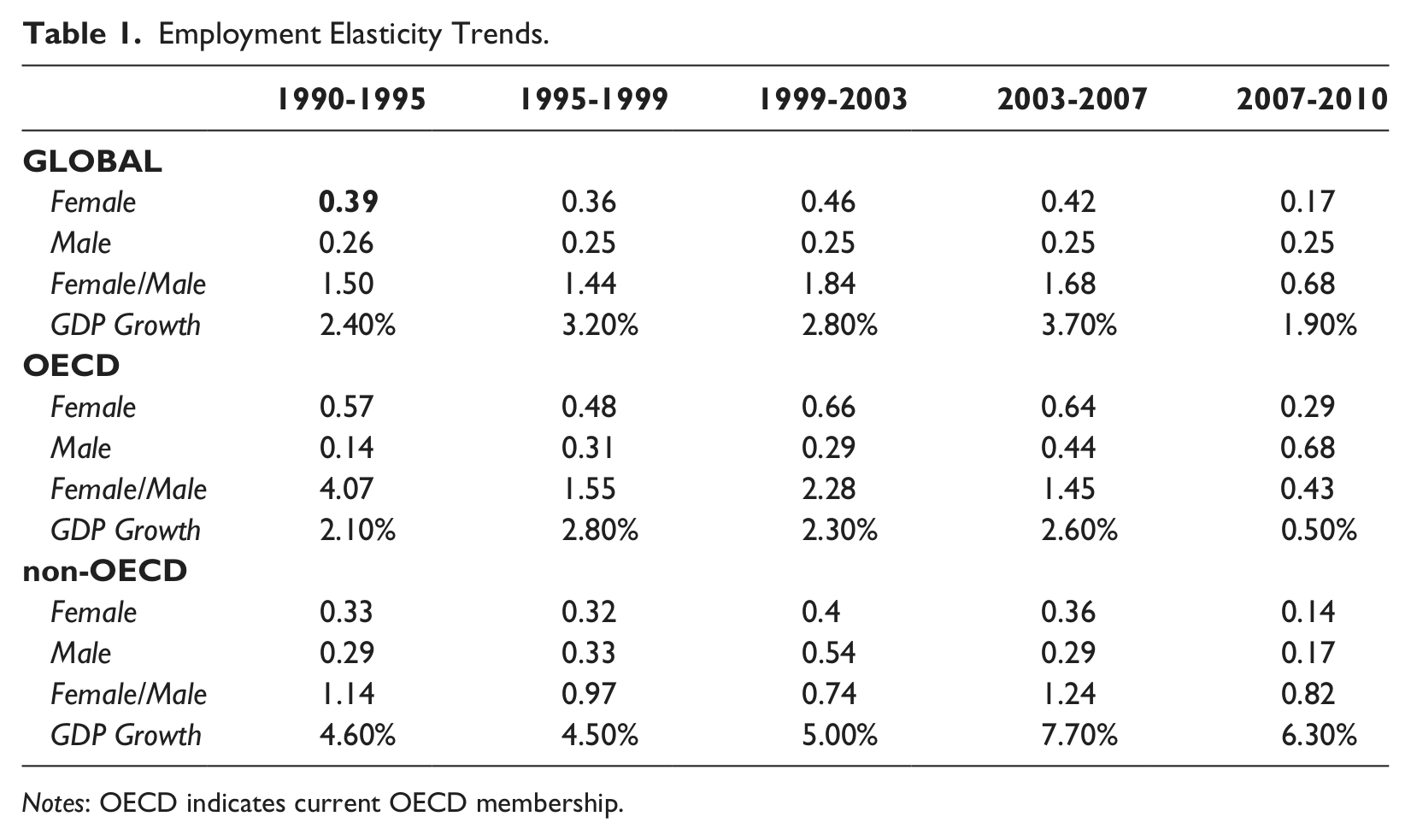
Notes: OECD indicates current OECD membership.
Looking to the OECD versus the non-OECD results, more differences emerge. Female elasticity in the OECD is higher than in the non-OECD group, while the reverse is true for men, at least up through the early 2000s. The result is that there are more gender differences in elasticity in the OECD than in the non-OECD group, as reflected by comparing the female-to-male elasticity ratios. This suggests that it is important to account for differences in macroeconomic structure when assessing employment elasticities by gender, a task to which we now turn.
3. Macroeconomic Structure and Gendered Employment Outcomes
We begin by estimating equation (3) by country and gender for the entire 1990-2010 period and then regress these estimates on a collection of structural variables for male and female elasticities. Our initial sample includes 145 countries for which complete data are available, and many of the concerns from above apply here. 2 Namely, omitted variable bias and the contemporaneous nature of right- and left-hand side variables require us to interpret these results as correlations, not evidence of causation. Nonetheless, our results help identify the structural context in which gendered employment outcomes are more or less responsive to growth, and what types of questions we should pursue in the future.
Table 2 presents descriptive statistics and explanations of each variable used in the regressions. Unless otherwise noted, variables are from authors’ calculations based on data from the World Development Indicators Database (World Bank 2012). The independent variables include controls for economic structure, demographic change, macroeconomic stability, global stance and policy, and income distribution and political institutions. We briefly describe the salient features of each and our a priori expectations before presenting OLS results.
Descriptive Statistics.

Notes: All variables are percentages except elasticities and rule. Summary statistics refer to sample used in regressions (3) – (4) in Table 3. Values do not differ appreciably for regressions (1) – (2). Time period is 1990-2010. Where averages are figured and years are missing, we use the available subset. Elasticities estimated as described in text. All other data are calculated based on data from the WDI database, except for rule which is from Rodrik, et al. (2004).
Beginning with the macro structural controls, we include the share of total employment in the economy dedicated to services and industry; the agricultural sector is omitted, so coefficient estimates are relative to its share. We expect industrialized economies to have lower employment elasticities relative to agricultural economies due to the greater capital intensity of industry, but that larger service sectors will be positively associated with the employment intensity of growth. We also include the ratio of manufacturing exports to imports to capture industrial upgrading, a phenomenon we expect to be negatively associated with employment elasticity. As a country moves up the industrial ladder, we would expect to see the ratio rise, though semi-industrialized countries that import large amounts of capital and high-tech goods may experience a slower increase over time (Braunstein and Seguino 2012).
Turning to demographics, working age population growth is expected to be positively associated with employment elasticities. All else equal, increases in labor supply put downward pressure on real wages and increase employment. Such increases also serve as additional sources of aggregate demand, further increasing employment. We also include the ratio of female to male labor force participation rates to capture the impact of increasing female labor force participation on elasticity. We expect that lower ratios are associated with higher employment elasticities as unused opportunities for women to enter the labor market are greater.
Inflation is our proxy for macroeconomic stability, an addition in line with the literature’s emphasis on the importance of macroeconomic stability for just about anything. On the contrary, we suspect that some inflation is actually good for growth and employment generation, as tight money and high interest rates tend to discourage both.
For global stance and policy, we include the ratio of the current account balance to GDP, growth in the terms of trade, and the ratio of foreign direct investment (FDI) to gross fixed capital formation. We expect the current account balance to be positively associated with employment elasticities, especially for women since export strength is often associated with labor- and female-intensive employment (Braunstein 2012). Increasing terms of trade indicate that a country’s exports are becoming more expensive relative to its imports, hence indicating a decline in export competitiveness with potentially negative consequences for employment. Conversely, increases in the terms of trade due to exports with low price elasticities of demand (e.g. natural resources) may add to public coffers in ways that support employment expansion, as has happened recently in parts of Latin America (Braunstein and Seguino 2012). The ratio of FDI to gross fixed capital formation captures the relative size of long-term foreign investment as a percent of total investment in the economy. All else equal, FDI tends to be more capital-intensive than domestic investment – even in labor-intensive sectors – so we expect this relationship to be negative (Barba Navaretti and Venables 2004).
Last, we include controls for the distribution of income and institutional development. Income distribution is measured as the share of income going to the middle quintile relative to the top quintile. This may be viewed as a proxy for the wage share of income: the higher it is, the more workers share in the income benefits of growth. A positive correlation between income equality and employment elasticity suggests that as wages are higher, the responsiveness of employment to growth is also higher, perhaps via positive effects on employment-generating aggregate demand. Institutional development is measured as an index of the rule of law taken from Rodrik, et al. (2004). We include it primarily as a robustness check to consider whether its inclusion affects the other coefficient estimates.
Table 3 presents the regression results. We limit the initial discussion to the results for the full sample in columns (1) and (2), and then consider the effects of adding additional control variables to a smaller sample in columns (3) and (4). Overall the results bear out our predictions, though the effect of inflation is consistently statistically equivalent to zero. 3
The Elasticity of Employment by Gender, 1990–2010.

Notes: Dependent variable is elasticity of employment by gender. Robust standard errors in parentheses;
significant at 10%; ** significant at 5%; *** significant at 1%. All regressions are OLS.
Focusing on differences by gender, only the share of services in employment and the ratio of female-to-male labor force participation show statistically significant differences by gender in estimate coefficients. To get a sense of the economic significance of these differences, it is helpful to compare the impact of a one standard deviation change in the independent variable being considered (refer to Table 2 for the magnitude of these standard deviations). For instance, a one standard deviation increase in the share of services relative to agriculture in employment is associated with a 0.27 percentage point increase in female elasticity, and a 0.17 percentage point increase in male elasticity. As services tend to be a more important source of employment for women than for men, this result is not surprising. Lower female relative to male labor force participation rates are also associated with relatively higher employment elasticities for women: a one standard deviation increase in this ratio is correlated with a 0.2 percentage point increase in women’s employment elasticity and a 0.08 increase in men’s. This difference probably reflects the impact of secular increases in female labor force participation discussed earlier, indicating the importance of accounting for such an effect when comparing elasticities by gender.
We did not pick up any statistically significant gender differences in the coefficient estimates for the global structure and policy variables, though some small differences do exist that we plan on exploring further and deserve mention here. The current account balance is positively associated with employment elasticity for both women and men, though the magnitude is slightly higher for women, while increases in the terms of trade and the share of FDI in gross fixed capital formation are associated with lower elasticities for women and men. Considering that imports and exports relate to gendered employment dynamics in different ways in different economies (with, for instance, export-oriented employment more important for women in some instances and import competition more important for men in others), our not being able to disentangle these effects with this simple specification points to the importance of constructing more specific measures of global integration.
Turning now to the regression results in columns (3) and (4), which add measures of income distribution and the rule of law, none of the other coefficient estimates, and the differences between them, change all that much (keep in mind the sample is slightly different as well). The original intent was to provide a sort of robustness check on our coefficient estimates informed by the kinds of controls that are included in standard growth regression analysis, but the results on these variables themselves are also interesting as indicators for future work. The income distribution results, that a higher share of income going to the middle income quintile relative to the top lowers employment elasticities, runs counter to what we intuitively expected, particularly in regard to the relationship between middle class wages, aggregate demand, and employment generation. It could simply be that higher wages serve as a sort of proxy for productivity; more work needs to get done to sort this out. Interpreting the rule of law result also requires more investigation. One possibility is that better legal institutions are associated with stronger labor institutions, which makes it more expensive to create jobs. But this seems to be quite a leap, particularly in light of research showing that better labor standards actually generate employment (e.g. Kucera 2002). Alternatively, we could be picking up some aspect of advanced industrialization missed in the other variables, as rule of law is highly correlated with the share of employment in industry and services, as well as manufacturing exports to imports. Once again, more work remains to be done.
4. Concluding Remarks
On the face of it, it is not clear what level of employment elasticity is a “good” one. After all, elasticities capture sensitivity on both the down as well as the up side. So higher elasticities mean more employment losses when growth turns negative as well as more employment gains when growth is positive. These measures also abstract from the distribution of income gains that are a result of productivity growth. From a growth and human development perspective, however, it is essential to better understand the macroeconomic circumstances under which growth does generate employment, as having a paying job is the way the vast majority of us access many of growth’s benefits. And because women and men throughout the world participate in different labor markets in very different ways, it is also essential that any such analysis employ a gender-aware perspective. This article is an initial step in that direction.
Footnotes
Declaration of Conflicting Interests
The author(s) declared no potential conflicts of interest with respect to the research, authorship, and/or publication of this article.
Funding
The author(s) received no financial support for the research, authorship, and/or publication of this article.
1
This paragraph is drawn from Kapsos (2005) and  .
.
2
For a full country list, please contact the authors.
3
A quick inspection of the descriptive statistics reveals sizable outliers on inflation. Though the coefficient estimates on the inflation variable itself show some sensitivity to alternative treatment of outliers (there is no elasticity benefit to having very low inflation relative to those countries with high inflation), the estimates of the other independent variables were robust to alternative treatments of inflation outliers.