



Abstract
This paper offers an analysis of the current economic crisis in the United States that began in 2008, which is understood not as a business cycle recession but as a structural crisis. It presents a case that the current economic crisis is a particular type of crisis of over-investment, called an asset bubble induced over-investment crisis. It explains what is meant by that type of crisis and presents empirical evidence for the period since 1979 that supports this interpretation of the crisis. It argues that the forces that led to the current crisis cannot be seen in the behavior of the rate of profit.
1. Introduction 1
The real sector crisis that began in the United States in 2008 has seen an unusually sharp downturn followed by an anemic recovery. Conservative analysts implausibly blame government regulation and tax policy, as they did in the 1930s. Many economists point to the financial crisis as the reason for the steep and prolonged real sector crisis. An article by Reinhardt and Rogoff (2009) found that historically recessions associated with a financial crisis have been relatively severe and long-lasting. A common interpretation is that a financial crisis restricts credit availability for the real sector, producing a sharp real sector crisis followed by a slow recovery. However, the very low interest rates and huge excess reserves in the banks in the United States do not seem consistent with that explanation.
The Marxist crisis theory tradition has long distinguished between short-run business cycle recessions and severe and long-lasting economic crises, although there is no agreement about what factors explain the difference. The social structure of accumulation (SSA) theory, developed by Marxist economists in the United States in the 1980s, offers an explanation for the periodic occurrence of severe and long-lasting economic crises. 2 According to the SSA theory, the key element missing from mainstream theories of the economic crisis, as well as from some Marxist theories, is the concept of capitalist institutional structures. Capitalism has existed for several centuries, but it has taken different institutional forms in various periods.
The SSA theory argues that understanding the periodic severe economic crises in capitalism requires taking account of the institutional form of capitalism, referred to as a social structure of accumulation. 3 A particular SSA − which includes economic, political, and cultural institutions − promotes profit making and accumulation for several decades, but eventually its contradictions undermine the ability of the SSA to continue to do so. There follows a structural crisis that cannot be resolved within capitalism by any automatic mechanism, or even by policy changes. The resolution of such a crisis within capitalism requires major institutional restructuring, that is, the construction of a new SSA. Past structural crises occurred in the late nineteenth century, the 1930s, and the 1970s, and each was followed by a major restructuring of capitalism.
According to this view, the current economic crisis is a different kind of crisis from the periodic business cycle recession. Business cycle recessions are self-correcting through the normal working of a capitalist economy, although Keynesian policy interventions can speed the recovery. Treating the current crisis as just another business cycle recession, albeit one that is unusually severe and long-lasting, misses its real character. The Great Depression of the 1930s was a decade of structural crisis, during which there were recessions (1929-33 and 1937-38) and also expansions (1933-37), but the entire period was one of structural crisis. The structural crisis of the 1930s was not finally resolved until after World War II when capitalism emerged in the significantly altered form of “regulated capitalism.”
The current crisis in the United States, and in the global system, appears to be a structural crisis of the neoliberal form of capitalism that has been in place since the early 1980s. The SSA theory’s main claim about the nature of a structural crisis – that it results from contradictions that undermine the ability of an existing SSA to promote profit-making and accumulation – does not tell us just what contradictions led to the crisis. There remains the job of analyzing a particular SSA to determine how, over time, it became unable to promote further long-run accumulation. In a previous paper (Kotz 2009) this author analyzed the roots of the current crisis in the United States in the institutions of neoliberal capitalism. The argument in that earlier paper focused on features of neoliberal capitalism that first brought relatively long and stable economic expansions for some 25 years but at the same time produced trends that were unsustainable over the long run. The current crisis emerged when the trends finally in fact became unsustainable (this argument will be explained further in section 2 below).
A crisis due to “unsustainable trends” is not a part of traditional Marxist crisis theory. This paper offers an interpretation of the current structural crisis from the perspective of Marxist crisis theory. It is argued that the current crisis can be understood as a particular kind of over-investment crisis. Section 2 explains the concept of a crisis of over-investment. Section 3 provides empirical evidence that supports the interpretation of this crisis as one of over-investment. Section 4 offers concluding comments.
2. The Over-investment Crisis Tendency
The Marxist crisis theory literature, which dates back to the late nineteenth century, has produced a number of different theories about the cause of capitalist crises, known as “crisis tendencies.” After Marx, at first the best-known Marxist analysts stressed disproportionality (among branches of production) or underconsumption as the root of economic crisis. In the 1920s-30s another crisis theory arose in the literature, the tendency of the rate of profit to fall due to a rising organic composition of capital. That crisis theory is based on the Marxist view that surplus value arises only from direct labor, so that replacing workers by means of production tends to lower the rate of profit. In the 1970s the “profit squeeze” crisis tendency was put forward, 4 which agreed that a falling rate of profit was the key to crisis but found the cause in real wages that rise faster than labor productivity when the unemployment rate falls very low. 5 Since the disproportionality crisis tendency eventually disappeared from the literature, by the 1970s – a period in which capitalism seemed to have entered another period of structural crisis – the English language Marxist crisis theory literature consisted mainly of debates among the advocates of underconsumption, the rising organic composition of capital, and the profit squeeze. These three crisis tendencies have continued to occupy center stage in the Marxist crisis theory literature.
Most Marxist economists viewed the crisis of the 1970s as a consequence of a falling rate of profit. As Figure 1 shows, the rate of profit in the United States began to fall sharply after 1966, and by the time the crisis of the 1970s began to affect macroeconomic variables – usually dated as following the 1973 business cycle peak – the profit rate had fallen substantially. 6 From its peak in 1965 to its next peak in 1972, the rate of profit fell by 29.1 percent. This was persuasive evidence that the forces causing this crisis were acting via the profit rate. Much of the debate about that crisis was over whether the declining rate of profit was due to a rising organic composition of capital or a profit squeeze due to real wages rising faster than labor productivity.

Rate of Profit of the U.S. Nonfinancial Corporate Business Sector, 1961-2011.
However, Figure 1 shows that no such pronounced drop in the rate of profit preceded the crisis that began in 2008. In the neoliberal era, cyclical peaks in the profit rate rose from 1984 to 1988 to 1997. While the profit rate dropped sharply after 1997, it had recovered most of its decline by 2006, the year before the next business cycle peak. The profit rate decline from 1997 to the next cyclical profit rate peak in 2006 was only 6.5 percent. This renders unconvincing any interpretation of the crisis of 2008 as stemming from a long-term fall in the rate of profit, given the contrast between the mildness of the profit rate decline and the cliff-like collapse in the real sector.
The features of neoliberal capitalism would appear to lead to a crisis of underconsumption, given the long period of stagnating real wages while profits soared and household income inequality reached a level not seen since 1928 (Kotz 2009). However, neoliberal capitalism was able to operate as a SSA for the very reason that its institutions were able to prevent a crisis of underconsumption for 25 years. An underconsumption crisis occurs when stagnating or declining real wages alongside rising profits result in inadequate consumer demand, causing a realization crisis. However, in the neoliberal era, despite stagnating real wages, consumer demand grew rapidly in expansions and increased relative to GDP over the whole period. As Figure 2 shows, consumer spending as a share of GDP showed no trend from the early 1950s to the early 1980s. After 1982 that series has a marked upward trend. From 1979 to 2007– both business cycle peak years – consumer spending as a percentage of GDP rose from 62.1 percent to 69.7 percent. Even during the investment boom of the 1990s, the consumption share of GDP increased from 66.1 percent in 1990 to 68.6 percent in 2000.
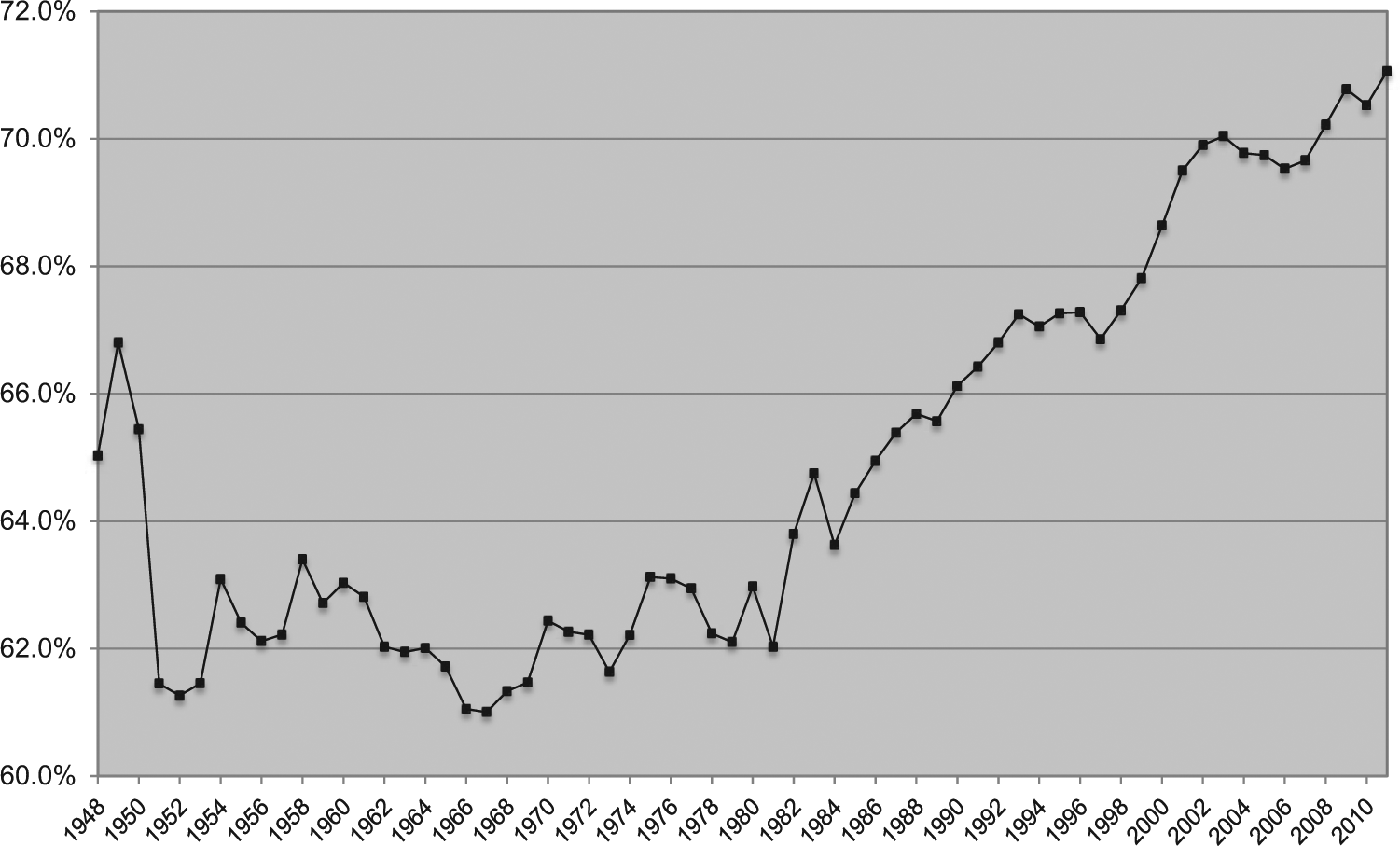
Consumer Spending as a Percentage of GDP, 1948-2011.
If the current crisis is not one of underconsumption, what kind of crisis tendency was operating over the long run? This crisis can be understood as one of over-investment. By over-investment is meant the creation of too much fixed capital relative to a sustainable level of demand. The actual crisis emerges when demand, which had been elevated above a sustainable level, returns to a “normal” or sustainable level, causing fixed capital that had appeared necessary in relation to demand to suddenly become excess fixed capital. A severe realization crisis follows.
The best-known form of the over-investment crisis tendency is found in the work of RobertBrenner (2006), in which the nature of competition among capitalists leads to excessive fixed capital. This paper argues that a different form of over-investment developed in neoliberal capitalism, which can be called asset bubble induced over-investment. Kotz (2009) argued that asset bubbles played an essential role in the ability of neoliberal capitalism to promote rising profits and accumulation over the long run. While the whole set of neoliberal institutions tended to produce a growing gap between profits and wages, neoliberal capitalism also produced asset bubbles of growing size. 7 Asset bubbles in turn enabled households, facing stagnating or declining real wages, to borrow against their rising asset wealth to support consumer spending.
A large asset bubble leads to over-investment in two ways: 1) consumer spending rises relative to disposable personal income over time as households increasingly rely on borrowing to support consumer spending. In response, firms invest to increase their productive capacity in order to satisfy the growing consumer demand. 2) Asset bubbles tend to produce exaggerated expectations of the future profitability of investment, which also leads to expanding investment. This is a more pronounced effect for a bubble in corporate stocks, but even a real estate bubble creates a sense of euphoria and confidence in the future among corporate decision-makers, which stimulates real investment. Note that the second channel should lead to a declining observed rate of capacity utilization, if the expectations about the future are indeed exaggerated. However, the first channel would not itself produce a declining rate of capacity utilization since the rising consumer demand due to rising borrowing based on the bubble is real. However, once the bubble deflates, the ability of consumers to continue borrowing abruptly falls and with it consumer spending, and as a result the productive capacity created to satisfy the debt-financed consumer spending is suddenly found be in excess.
3. Evidence for Over-investment as the Cause of the Current Crisis
The key unsustainable trend deriving from neoliberal capitalism in the United States was the long-term rise in household debt. Figure 3 shows that household debt as a percentage of disposable personal income nearly doubled over the neoliberal era, from 1980 to 2007. This was made possible by a sequence of asset bubbles. In the 1980s there was a bubble in Southwestern commercial real estate, in the 1990s a much bigger stock market bubble, and in the 2000s a still larger real estate bubble. Figure 4 shows the break in the trend of consumer spending as a percentage of disposable personal income at the start of the neoliberal era. From 1948 to the early 1980s that ratio trended downward, reaching a low of 86.0 percent in 1982. Thereafter it trended upward, reaching a high of 94.9 percent in 2005 at the height of the real estate bubble; the latter percentage was the highest since 1938. One study found that extraction of funds from home equity rose to 9-10 percent of disposable personal income during 2004-06 (Greenspan and Kennedy 2007). This process set up the economy for a crisis of over-investment.
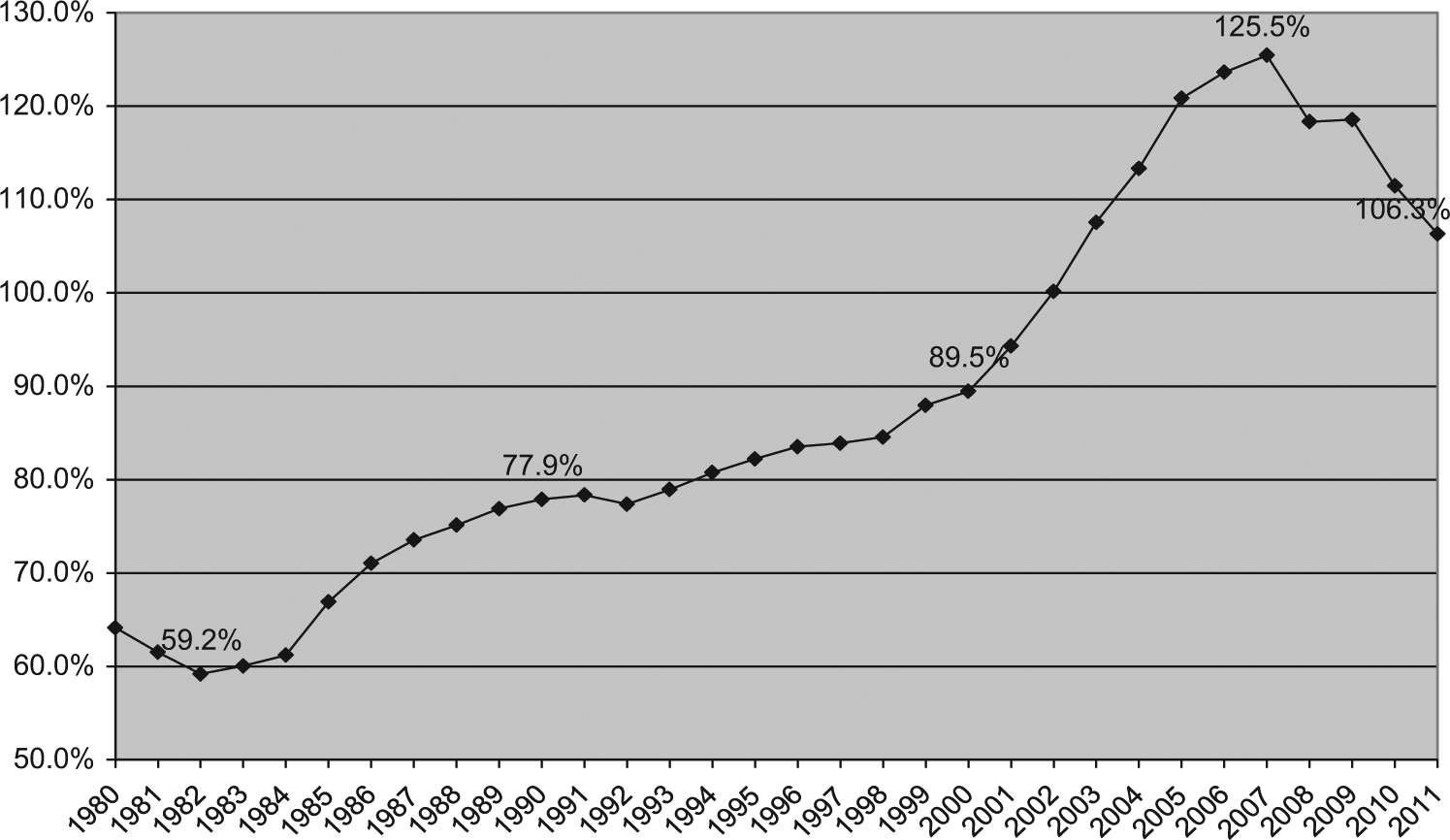
Household Debt as a Percentage of Disposable Personal Income.

Consumer Expenditure as a Percentage of Disposable Personal Income, 1948-2011.
Figure 5, which shows the capacity utilization rate in manufacturing, suggests that the second channel of over-investment noted above was also operating. 8 In the last three business cycle peaks of the era of regulated capitalism in the United States (from 1948-73), the capacity utilization rate in manufacturing rose from peak to peak. However, in the last three cycle peaks of the neoliberal era, capacity utilization declined from peak to peak, and it was substantially lower in the last peak of 2007 than it had been in the last peak of the regulated capitalist era. Regulated capitalism did not produce asset bubbles, and the real wage rose at approximately the same rate as output per hour. Aggregate demand was not a problem in that form of capitalism, and firm decision-makers were not misled about future profits by asset bubbles. However, in the neoliberal era it appears that the exaggerated expectations about future profits due to the succession of asset bubbles led to some upward creep in productive capacity relative to actual sales.

Capacity Utilization Rate in Manufacturing.
Annual consumer spending actually increased in almost every recession since 1948. Before the current crisis, the only exceptions occurred during the previous structural crisis, when consumer spending declined slightly during two recessions, by 0.8 percent in 1973-74 and 1.2 percent in 1979-80. 9 However, after the business cycle peak in the 4th quarter of 2007, consumer spending declined by 3.4 percent through the trough in the 2nd quarter of 2009 as the share of consumer spending in disposable income dropped (U.S. Bureau of Economic Analysis 2012: Table 1.1.6). This is consistent with the claim of the over-investment crisis tendency, that consumer spending had grown beyond a normal relation to income, falling significantly once the last big bubble began to deflate in late 2007.
The recession started with consumer spending falling at a 1.0 percent annual rate in the first quarter of 2008. Nonresidential fixed investment soon followed. After declining at a slower rate than consumer spending in the first quarter of 2008, at a 0.8 percent annual rate, nonresidential fixed investment fell at an accelerating pace in the following quarters, reaching an annual rate of decline of 28.9 percent by the first quarter of 2009 (U.S. Bureau of Economic Research 2012: Table 1.1.1). This is also consistent with the over-investment crisis tendency. Figure 6 shows the rate of capital accumulation since 1948. In 2009 the rate of capital accumulation fell to 0.4 percent, which was less than one-quarter of its previous low (1.7 percent) since 1948. The rate of accumulation recovered to only 1.0 percent in 2011, despite a rapid recovery in the rate of profit in 2010 and a further increase in 2011 that almost reached its previous 2006 high (Figure 1).

Net Non-Residential Investment as a Percentage of Net Non-Residential Fixed Assets (Inflation-Corrected).
Given that Figure 6 shows that the average rate of capital accumulation was lower in the neoliberal era than it had been in the regulated capitalist era, it might seem odd to refer to “over-investment” as the underlying cause of the crisis of neoliberal capitalism. However, the term “over-investment” does not mean that the absolute rate of investment was unusually high; over-investment refers to the rate of investment relative to a sustainable level of final demand. The warranted rate of capital accumulation over a period is related to the growth rate of output, among other variables. A period with faster economic growth requires a higher investment rate to produce the necessary capital stock, assuming a given desired output-capital ratio; in such a simple model the desired capital stock and output would grow at the same rate. 10 Table 1 suggests that the average rate of capital accumulation in the neoliberal era was high, by comparison to that of the regulated capitalist era, in relation to the growth rate of GDP, consumer spending, or what is probably the most relevant output measure, nonfinancial corporate business sector output. 11
Compounded Annual Growth Rates of the Capital Stock, GDP, Consumer Spending, and Nonfinancial Corporate Business Sector Value Added During Two Periods.
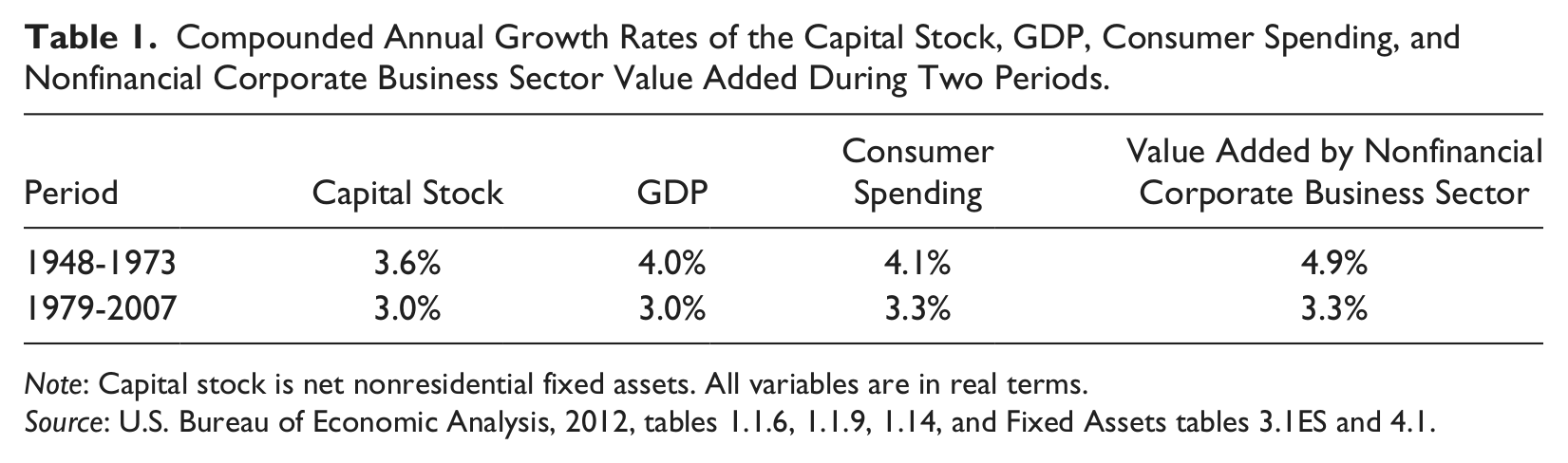
Note: Capital stock is net nonresidential fixed assets. All variables are in real terms.
Source: U.S. Bureau of Economic Analysis, 2012, tables 1.1.6, 1.1.9, 1.14, and Fixed Assets tables 3.1ES and 4.1.
4. Concluding Comments
If the current economic crisis is an over-investment crisis, this has implications for our understanding of its severity and likely duration. According to the SSA theory, every structural crisis of capitalism is relatively severe and lasts a long time. It takes time to construct a new SSA, and until that can be accomplished, the crisis will continue. However, the current crisis appears to be more severe and likely to last longer than the 1970s structural crisis. During the peak-to-peak period 1973-79 – the heart of the 1970s structural crisis – the U.S. economy grew at an average rate of 3.0 percent per year, which is well above the level of stagnation (U.S. Bureau of Economic Analysis 2012: Table 1.1.6). That crisis did not take the form of a sudden and persistent collapse of GDP but rather was characterized by rising inflation, rising unemployment, and instability in the international monetary system. Kotz (2010) argues that this difference can be explained by the different type of structural crisis produced by a liberal SSA, such as the neoliberal era (or the liberal period of the 1920s preceding the Great Depression), compared to the crisis of a regulated SSA such as the postwar form of capitalism. However, the argument of this paper – that the current crisis can be understood as an over-investment crisis – offers further insight into the reason(s) why the current crisis has been so severe and is likely to last for a long time.
Regarding severity, asset bubble induced over-investment tends to give rise to a sudden and large drop in consumer demand followed by an even larger collapse in business investment. That explains the big bang character of the start of such a crisis. Also, a crisis of over-investment leaves a large overhang of unused productive capacity. Even as the profit rate has bounced back, business has little incentive to invest. 12 The collapse of the process that created over-investment – the sequence of asset bubbles driving growing consumer borrowing – leaves the household sector with little ability to increase its spending. This leaves the private sector with no source of growing demand to restore economic growth. This condition can last for some time.
Keynesians propose that government should fill in the gap through increased public spending. Such an approach, if the spending were large enough, could restore economic growth. However, unless it were continued for a long enough period to bring all of the excess private sector productive capacity into utilization, that route would not bring self-sustaining growth. 13
This structural crisis of asset bubble induced over-investment is not likely to be resolved until major economic restructuring takes place, which will not be a simple process. The political possibilities of this type of crisis are much wider than for the structural crisis of the 1970s, which was driven by a falling rate of profit. The latter type of crisis tends to unify and mobilize capital against labor, to find a way to boost the rate of profit again. A resolution of the current crisis appears to require the abandonment of neoliberalism, with a shift toward a bigger role for the state if capitalism is to bring economic expansion again. This crisis has created persistent mass unemployment and huge numbers of home foreclosures. The nature of this crisis has exposed the extreme inequality and exploitation of the system.
We have recently seen a significant popular mobilization against big capital, in the United States and elsewhere, that was not possible in the 1970s, despite the wave of youth radicalization of that period. The various segments of capital are likely to soon abandon their current effort to prop up neoliberalism, which cannot succeed even for capital, and start moving toward building an alternative structure for capitalism. They are likely to be joined by unwelcome participants in the struggle over restructuring, as the 99 percent take the stage. This opens the possibility of superseding the outmoded system of capitalism entirely.
Footnotes
Declaration of Conflicting Interests
The author(s) declared no potential conflicts of interest with respect to the research, authorship, and/or publication of this article.
Funding
The author(s) received no financial support for the research, authorship, and/or publication of this article.
1
Olivia Geiger provided research assistance for this paper.
2
The major early work in the SSA literature is Gordon, Edwards, and Reich (1982). For a recent review of the SSA theory, see McDonough, Reich, and Kotz (2010).
3
The regulation theory, which has significant similarities to the SSA theory, utilizes the terms “regime of accumulation” and “mode of regulation” rather than social structure of accumulation.
4
See Boddy and Crotty (1975). Much earlier Sweezy (1942: ch. 9) had called attention to the profit squeeze crisis tendency, noting that it is found in  : ch. 25), but it did not find a following in the literature until the 1970s.
5
The advocates of all of the Marxist crisis tendencies cited here, as well as several others, can point to quotes from Marx that seem to endorse their favored crisis tendency.
7
The causes of large asset bubbles in neoliberal capitalism were, first, inequality which led to the volume of investible funds exceeding the productive investment opportunities, so that some of those funds went into purchasing assets; and, second, a deregulated, risk-seeking financial sector that was willing and in fact eager to lend for speculation in assets.
8
Unfortunately capacity utilization rates are available only for manufacturing and the slightly broader category of “industry” which includes mining and power. The industrial capacity utilization series has a similar pattern to that of the series for manufacturing but the former starts only in 1967.
9
The percentage declines in consumer spending are from quarterly peak to trough.
10
The desired output-capital ratio is affected by technical change and other factors.
11
While the net nonresidential fixed capital stock from includes the financial sector, it is a reasonable approximation to compare it to nonfinancial business sector output, since the portion of the fixed capital stock located in the financial sector has never been above 4 percent of the total over the whole period.
12
Business investment has several motivations. Some types of investment would be less affected by excess capacity, such as that intended to replace older by newer and more productive capital goods.
13
In the 1930s the New Deal produced rapidly growing federal spending after 1933, but when the Roosevelt administration shifted toward balancing the budget in 1937 after 4 years of expansionary policies, the economy plunged back into recession the following year. In that period federal spending was much smaller relative to GDP, which made it more difficult for the federal government to effectively stimulate the economy through spending.