



Abstract
The global value chain (GVC) approach has become an increasingly relevant tool not only for the analysis of the current strategies of firms in global economic networks, but also for the economic development policies promoted by supranational institutions. The paper argues that this supranational institutionalization of such an approach has been contributing to legitimate a subordinated and exclusive pattern of integration to networks governed by the transnational fraction of capital rather than constituting a tool for enabling the strategies of developing countries and their actors. This is made possible through the transformation of the GVC into a neoliberal device for strategies implemented by global political networks as well as through the uncritical assimilation of a group of limitations in the GVC theoretical and methodological corpus, when those global political networks incorporate that theoretical approach. The paper concludes by suggesting the necessity of a new approach capable of overcoming the limitations of the GVC inspired policy prescriptions as a condition for forging global alternatives to neoliberal fast policies dominating the Global South.
Introduction
Over the last decade and a half, the global value chain (GVC) approach appeared as one of the most stimulating tools for the analysis of the geo-economic dynamics of globalization. While a group of researchers and consultants have used the concept quite vaguely when advising governments and organizations on regions’ and firms’ competitiveness (Porter 1985), another group of academics, grounded in a more systemic and sophisticated theoretical tradition, have used it to explain the way in which different industrial global networks operate (Gereffi 1996; Gereffi and Kaplinsky 2001; Kaplinsky 2000).
Expanded through a plethora of worldwide case studies specially focused on developing countries, this approach has thus become a prescriptive policy field to advise on industrial and economic policies, encouraged from and by a complex set of supranational institutions, not only those more related to “heterodox” economic policies and development perspectives – like UNCTAD, ILO, UNIDO, ECLAC – but also those linked to the more orthodox and Washington Consensus (WC) approach – like IDB, WB, OECD, and the EU. By analyzing different types of chains, their economic actors, and their possibilities for upgrading, the GVC approach has been able to deploy an extended empirical research program about the global network dynamics and the possibilities for local development and territorially embedded collective and horizontal organizations (Humphrey and Schmitz 2002).
The rapid rise of this academic and political tool invites a serious evaluation of the quality, effectiveness, and limitations of the GVC, so as to understand the insertion of developing regions and countries and their actors in global networks, as well as the capacity of the governments to elaborate consistent economic policies capable of promoting development by reversing the unequal dynamics that reinforce both: dependence and exclusion.
I argue that the institutionalization of the GVC approach has legitimated a subordinated and exclusive process of integration of these actors into networks governed by the transnational fraction of capital rather than a tool to enable economic actors from developing countries to reach strategic positions in global economic networks. In accordance with such a process and from an institutional point of view, the GVC approach has also operated as a neoliberal device for fragmentary strategies implemented by global political networks and conducted by those supranational institutions. In order to illustrate this point, I identify a group of limitations in the GVC theoretical and methodological corpus, the existence of which enables it to become a neoliberal device for global political networks, and limits its evolution as a tool for a solid advance in developing countries, towards which those networks are to a large extent oriented.
My argument is developed as follows: first, consider briefly those more relevant contributions made by the GVC approach since its birth under the world system theory (WST) up to its final association with the network paradigm. I seek to determine not only how the GVC approach has been positioned in relation to the limitations of that paradigm, but also to detail its contributions to understanding the economic and institutional functioning of the globalization process.
Second, by incorporating the elements previously indicated, and in order to evaluate critically the GVC approach, consider the limitations in its theoretical framework, associated to: the dilutive role of power as capacity; the under-consideration of national and regional trajectories (and their socio-economic-political structures and dynamics); and the absence of financial capital and the financialization processes in the analysis of the reproduction of unequal dynamics generated by global transnational actors over regionally positioned small and medium actors.
Next, I analyze the links between the GVC analysis and the supranational institutional policy networks responsible for spreading this approach as a tool of policy and research. I examine the significance of reconnecting the GVC approach with the actors, logic, and interests implicated in these networks in order to show how the GVC approach, notwithstanding its heterodox origins in WST, has finally been absorbed into global political networks, operating as a new fragmentary neoliberal device in the Global South, and working in consonance with the consolidation of global fractions of capital governing the global economic networks. I intend to clarify how those limitations present in the theoretical corpus have been contributing to building up this dynamic.
Finally, I stress the need to tackle these aspects as a condition to evaluate the alternatives and the differentiated regional and national capabilities of responses to those subordinating and exploitative processes advanced by economic and institutional supranational actors. The paper suggests incorporating these last elements in the developing Global South as a platform for researchers and policymakers to formulate alternative strategies of global insertion.
1. From the “World System” Theory (WST) to Global Network Perspective: Emergence, Differences, and Contributions of the GVC
The term commodity chains was coined by Hopkins and Wallerstein during the second half of the ‘70s, under the influence of the WST (Bair 2005). Such perspective was influenced by the explanation of the macro-historical dynamics of capitalism and its contradictory core-periphery structure, playing an important role for understanding how networks work in this contradictory system (Brown et al. 2010).
Presented as “a network of labor and production processes whose end result is a finished commodity” (Hopkins and Wallerstein 1986: 159), the concept of commodity chains (CC) was not initially used to highlight the recent transformations of the global economy. It rather helped us to understand how historical capitalism has deployed its cyclical, contradictory, and unequal logic since the 16th century and how the longue durée of capitalism is shaped and reproduced hierarchically (Bair 2005).
However, since the 1990s, the concept of a global commodity chain (GCC) was first introduced by Gary Gereffi, and then by a group of researchers through multiple workshops where the scope of the concept and its methodological details were discussed (Sturgeon 2008). Finally, the GVC concept has replaced GCC since 2000, avoiding the disproportionate attention given to the notion of commodities in relation to primary products and the need of introducing new forms of governance into the chains (Bair 2005).
Both concepts (GCC and GVC) brought along a progressive alteration in meaning with respect to CC (Gereffi et al. 2005), representing the attempt of using the approach as a novel tool for understanding the specificities of the current globalization processes. In that sense, the GVC concept and its empirical application deviated from the method provided by the WTS to commodity chains. This was done not in order to comprehend the holistic structure of the capitalist system – its composition (centers and periphery) and its historical hierarchical and asymmetric reproduction, which marked its longue durée – but to focus on the organizational logic of different global industries and the role of the firms that compose those industries under the current globalization process (Bair 2008).
The specificity of this process is given by its promoters as a result of a new form of economic reproduction, based on a functional integration of internationally dispersed activities that replaces the mere spread of economic activities that has characterized internationalization (Dicken 1992). To account for this, the approach has stepped back from state-centric analysis and the quantitative criterion of the international processes based only on growth at an international trade level, or on the FDI (Glassman 2011). Instead, it has highlighted the qualitative element introduced by the change in industrial organization, driven by TNCs across a variety of sectors, and changed the priorities of the internal scale economies via vertical integration towards external economies related to outsourcing (Gibbon; Ponte 2005). In spatial terms, this has made room for highly fragmented and geographically dispersed value chains where TNCs break up the production process in different parts and locate them on a global scale (Startitz 2012).
From the GVC approach it is assumed that a holistic perspective has been preserved, not to comprehend the capitalist system as a whole, but to analyze a certain network of enterprises that do business at a global level in a certain activity, transcending national and regional boundaries. In this sense, the approach suggests tackling the issue as “international structure of production, trade, and consumption of commodities (which) is disaggregated into stages that are embedded in a network of activities controlled by firms” (Ponte 2004: 1). Aimed to analyze such activity networks, the concepts of governance and upgrading have been introduced as the principal tools for understanding the top-down and bottom-up dynamics that constitute the GVC, and which organize its functioning (Gereffi; Fernandez Stark 2011).
The concept of governance with which the top-down approach is realized intends to unravel the way in which large firms obtain governance over the GVC and additionally fix its dynamics based on the control over certain strategic functions. The GVC literature originally distinguished broadly between “producer-driven” and “buyer-driven” value chain governance. “Producer-driven” chains are usually found in sectors with high technological and capital requirements, where capital and proprietary know-how constitute the main entry barriers (automobiles, aircrafts, and computers). In these chains, producers tend to keep control of capital-intensive operations and sub-contract more labor-intensive functions, often in the form of vertically-integrated networks. Instead, “buyer-driven” chains are found in generally more labor-intensive sectors, where information cost, product design, advertising, and advanced supply management systems set the entry barriers (garments, footwear, many agro-food commodities). In these chains, production functions are usually outsourced and key actors concentrate on branding, design, and marketing functions. 1
The purpose of the concept of upgrading with which the bottom-up approach is propounded is to examine the processes and ways in which firms which do not govern the chain (and which therefore are subordinated) climb steps in the international ladder of value-added activities, moving from low-value to high-value activities to increase the benefits of participating in GVCs (Bair and Gereffi 2003). To this end, three essential forms of upgrading are distinguished: 1) upgrading of a product (improving its quality or design); 2) upgrading of a process (in scale and speed, and efficiency and productivity); 3) and functional upgrading (acquisition of new functions to increase the added value of activities in the chain) (Gereffi 1999).
Placed in this new scenario, and appealing to the concepts of governance and upgrade, the main contribution of the GVC to study the current globalization process has been a simple but powerful tool to understand the way in which space and economic activities interact and evolve along different stages of production, conforming each global economic network, and the way in which value is produced and distributed in those activities (Gereffi et al. 2005), not only focused upon manufacturing activities, but also including marketing and distribution (Giuliani et al. 2005). While working to integrate retail and consumption activities into the chains, the GVC analysts have become able to consider the reproductive process as a whole (Leslie and Reimer 1999).
In many aspects, the GVC approach has been useful as it offers global geo-economic maps that allow us to determine who the actors, sectors, regions, and institutions linked to different activities are, how the capabilities of producing value are distributed among these activities, and how power is configured in the GVC (Gereffi and Korzeniewicz 1990). The relative simplicity in creating those maps and the non-conflictual way in which concepts are introduced has encouraged the international presence of the GVC approach, presented by its academic promoters as a more complete and realistic tool than the self-regulatory market strategies spread during the 1990s under the neoliberal WC (Sturgeon 2008). Capitalizing on the loss of prestige of the neoliberal tools and policies inspired by the WC dogma, the GVC approach has gained increasing presence in the supranational agenda, providing new theoretical inputs for many assistance programs, financial projects, institutional advisers, and institutional workshops that a few years ago were outstandingly committed to self-regulative market theory.
However, to what extent do these new theoretical insights reflect a new approach that adds coherence and accuracy to those analyses of global transformation processes, as well as capability of understanding the real possibilities in developing countries of being successfully incorporated to these changes through correct economic policies?
I respond to that question arguing that despite its contributions and its increasing analytical and political relevance, the GVC exhibits persistent limitations that threaten to turn it into a tool unsuccessful in understanding and modifying the subordinated positions of actors in developing regions where they seek to operate.
In order to understand this, I first analyze those limitations belonging to the theoretical corpus of the GVC. From then on, and in order to give a plausible explanation about the way through which actors and their interests develop and connect with the official GVC approach, I explore how the theoretical corpus of the GVC and its limitations have been transferred into policy and assimilated in the political networks of supranational organizations.
2. Beyond the Improvements: Revisiting the Global Value Chain Limitations
Some of the limitations of the GVC approach have been considered mainly in the contributions of the Manchester School and its “global production networks” (GPN).This approach has been developed in the spirit of recognizing the contributions of the GVC for transcending the limits of globalization studies centered in states as a main analysis unit (Dicken et al. 2001; Hess and Coe 2005). However, these limitations still require deeper understanding and articulation to lead to a better determination of their consequences and to overcome a risky eclecticism that survives in much of the literature.
We can organize these weaknesses into three interconnected groups of issues: i. the conception of power and its consequences in networks and chains; ii. the under-consideration of the national trajectories and dynamics – their specific matrix of social and economic power, and the role and capabilities of the historically shaped state – as result of an analytical over-centralization on firms; and iii. the lack of attention to the financialization process and financial capital in global networks, and their role in the relationship with the involvement in different chains.
2.1 The conception of power and its consequences
According to GVC’s researchers, the GVC approach has highlighted the possibility of knowing “how power is distributed and exerted among firms and other actors in the chain” (Sturgeon 2008: 2), and that means the possibility of determining: 1. which actors control the chain?; 2. what are the sources of this power?; 3. what determines the distribution of the income or value stream between the different actors in the chain?
In other words, the GVC allows the identification of who is in charge of generating and preserving those more dynamic functions – in terms of value control – that is, it allows us to identify how power is distributed and what form power assumes in terms of network and nodal governance (Gereffi et al. 2005). In such identification, the two conceptual instruments aforementioned intervene, and they account for their functioning structure:
i. The concept of governance which, as indicated, classifies the GVC into producer-driven and buyer-driven. In the case of the producer-driven GVC, which is linked to intensive activities in terms of capital and technology, governance is a nodal productive activity. On the other hand, in the case of the buyer-driven GVC, linked to intensive activities in terms of work (garments, footwear, and many agro-food commodities), GVC governance works in the form of vertically-integrated networks, where information costs, product design, advertising, and advanced supply management systems set the entry barriers. In these chains, production functions are usually outsourced, and key actors concentrate on branding, design, and marketing functions.
These forms of governance vary according to historical conditions. Thereby, according to Gereffi’s investigation: “There is an affinity between the transition from ISI to EOI development strategies and the shift from producer-driven to buyer-driven global value chains” (Gereffi 2001). At the same time, as already mentioned (footnote 1), other forms of governance appear, introducing a variety of options in their link to the GVC, and which are in many occasions related to the emergence of new sectors, such as the Internet (Gereffi 2001).
ii. On the other hand, within the framework of the different kinds of governance of the chains, the concept of upgrading is introduced assuming a bottom-up perspective and intending to consider the capability of the actors that integrate subordinately to the GVC to improve their conditions of generation and their value capture, as well as their position in the chain. For that purpose, as previously mentioned, upgrading is evaluated in terms of quality and diversity of products, the efficiency to produce them, or in the control of new functions of a higher valorization. Within those three types of upgrading, it is the functional upgrading that turns out to be the most essential, as it determines the capability of taking control of those activities with higher value generation; basically, the capability of moving from manufacturing production to design or marketing (Gereffi 1999; Humphrey and Schmitz 2002).
However, despite the fact that these guidelines allow us to identify who controls the chain (governance), and how those non-leader firms can dynamically integrate (upgrading), the approach left an empty space which leaves us with an imprecise concept of power, based on which analysis is made of the link between the actors in charge of governance (top-down) and those which are subordinately challenged to unite achieving a progressive upgrading (bottom-up).
The concept of power that filled that empty space and which acquired dominance among the analyses of the GVC comes from the approach of networks, to which it has been strongly attached to highlight the macro and micro dimensional aspects of social organization that cannot be explained from hierarchical and market social relations (Messner 2002).This incorporation of network concepts and instruments into the GVC approach has been achieved by some improvements brought to the network paradigm first developed from the embedded network perspective (EN) coming from economic and organizational sociology through the seminal contribution of Granovetter (1985); and the recent actor-network theory (ANT) (Latour 2005), with an important impact in geographical and relational thought (Allen 1997).
The influence of this relational notion of power in the analysis of global chains found a more explicit theoretical attention through the contributions of the global production network (GPN) approach. Its distinctive trait is the displacement of this notion of power as “capacity of action over others” – present in its birth under the WST – and its replacement by the idea of power as a result of “collective endeavors” developed from the basis of network relationships (Hess 2008). This conception facilitates the analysis of the connections between actors based on win-win processes, from which empowerment is accessible for almost all actors involved in those collective endeavors.
Aligned with endeavors of actors playing win-win games, this notion of power as collective coproduction has been progressively acquiring dominance to address the GVC, taking inspiration from the explanation of the structural forms of dominance that is part of the WTS and its analysis of commodity chains. In turn, it aligns with those academic concerns related to the way in which local dynamics can be more effectively connected with global networks. The connection has taken place through the improvement gotten from both intra-local cooperation and interactions from a distance with global actors (Humphrey and Schmitz 2004), allowing to learn and move up toward more value-added forms of production that respond to global standards (Nadvi 2004; Lund-Thomsen and Nadvi 2010).
Besides the American strand led by Gereffi, this task has gained ground through a group of researchers gathered around the Institute of Development Studies (IDS), who carried out empirical studies on a multiplicity of sectors and actors on the analysis of the role of cooperation between local actors from different clusters in the developing countries (horizontal) and the connections between them and the leader firms (vertical) (Nadvi and Schmitz 1999; Schmitz and Knorringa 2000; Giuliani et al. 2005). Along similar lines, other analysts have highlighted the relevance of the learning and innovation processes, which may be fostered by these inter-firm arrangements and linkages within the chains (Morrison et al. 2008).The results obtained, along with their specificities, intend to account for the fact that such interaction coming from the clustered firms which integrated into quasi-hierarchical relations may experience rapid product and process upgrading (Humphrey and Schmitz 2002).
Based on these studies and empirical results, the “big family” of proponents and analysts of cooperative practices – horizontal and vertical – tend to consider that integrating into the GVC is indispensable for firms from developing countries (especially SME). Consequently, priority is given to interrelations and cooperative actions in which “there are no zero-sum games” (Abonyi 2005) and in which co-productive conception of power allows both to complement top-down and botton-up ways of interactions and emphasize the range of opportunities (or challenges) posed for those not governing the GVC.
However, assuming power as a co-production through networks, and displacing its notion as “capacity of imposing on others” (i.e. power as dominance and subordination) implies the unfounded elimination of a crucial aspect for understanding the governing control over the chain that increasingly transnational leader firms have, and the structural restrictions they fix for those interested in joining subordinately. More precisely, it is that notion that helps explain many empirical results obtained by a big number of early and more recent studies within the GVC. These studies realized in developing countries have shown asymmetries emerging from the increasing concentration of power in big actors, which control – as retailers or producers – the more dynamic functions of the global chain (mostly those related to marketing and design). Analyses such as those carried out by exponents from the IDS on the footwear chain highlight how the dominance lies in the strong and concentrated power of the global buyers and in the limitations that make it harder for the local producers to achieve the functions of design, marketing, and branding (Schmitz and Knorringa 2000; Bazan and Navas-Alemán 2004), in spite of the variations in the governance of the global chains existing within such activity (more or less hierarchical) and of the possibility of getting better upgrading in the less hierarchical. Such power concentrated in strategic functions and their capacity of running in selective and subordinate ways over those trying to get upgrading has been reaffirmed by another group of studies covering a wide range of countries and activities, like blue jeans in Mexico (Bair and Gereffi 2001); horticulture (Dolan and Humphrey 2000) and the coffee market (Ponte 2004) in Africa; the fresh fruit in Chile (Baim 2010); or the cashew nut in India (Harilal et al. 2006), to name just a few. Even in new areas that manage alternative forms of governance and that would make functional upgrading more viable – as the computer industry (Gereffi 2001) – studies show how companies like Apple, despite the off-shore growth of their activities, keep the strategic functions linked to innovation and the brand to retain the biggest part of the value from the final product, and to preserve the selective control of the chain (Linden et al. 2009).
All this empirical research recognizes, along with their specificities, the strong limitations for developing a functional upgrading which could allow them to reach those “core competences” selectively controlled by actors increasingly transnationalized. As Gereffi opportunely pointed out: “Governance involves the ability of one firm in the chain to influence or determine the activities of other firms in the chain…. This power is exercised through the leader firms’ control over key resources needed in the chain, decisions about entry to and exit from the chain and monitoring of suppliers” (Gereffi et al. 2001: 5). Turned into such a selective control of the core competences, such power involves reaffirming the asymmetrical, subordinating, and structurally restrictive role that large global firms establish based on the governance of chains over firms from the Global South. From this position, the latter can be excluded or selected to enter the GVC. However, in that case, their performance is conditioned by the standards fixed by the leader firms, and their functional upgrading is limited to a position from which they are prevented from affecting those activities controlled by the ETs, which allow a greater value capture and command of the chain. This is well exemplified in studies such as those carried out by Dolan et al. (2000) on horticulture in Africa, or Ponte’s (2004) on coffee in the same continent. On the other hand, studies realized in the component industry in Brazil showed that the acquisition of standards fixed by leader firms often cannot guarantee obtaining upgrading or improvement in cooperative forms (Quadros 2002).
Therefore, although cooperative logic derived from a relational perspective of power offers possibilities to understand and promote collective building processes based on win-win games (Hess 2008), the qualifications offered to these non-dominant actors do not always exist, and when they do, it does not only mean no threat to those concentrated actors, but also a reinforcement of their capabilities of the GVC’s command. In any case, all that these actors can expect when fighting for new upgrading through cooperation or the qualification of the assemblages at a distance (Allen and Cochrane 2007) is to be “coupled in the best way,” assimilating subordinating and standardized rules offered by those transnational buyers and producers (Gibbon and Ponte 2008).
If something can be inferred from this gap between the evidence and the theoretical proposal it is the remarkable incapability to recognize that the GVC have been constructed over an always asymmetrical structure of capitalism, with consequences that demand to be tackled in order to think about the development of territories and actors from the periphery:
From the point of view of actors: the big transnational companies’ control over the strategic functions of the GVC implies a structural restriction for subordinated actors developing functions with less value generation. It also means a threat for many of the actors linked to these functions, which cannot be disciplined or selected into the macro actor strategies and standards (Dolan and Humprey 2000; Gibbon 2001).
From a spatial point of view: the concentrated control of strategic functions of the GVC has been developed along with a highly rigid spatial hierarchy produced by the unequal accumulation process that divides North and South (Somel 2003). Power as capacity is grounded in a spatial logic dominated by the reproduction of an unequal structure described by the WST.
This logic has experienced a stimulating recovery and update from the contributions of Giovanni Arrighi and his colleagues (Arrighi et al. 2003), showing that the industrialization of results from the relocation of productive processes in the South is not oriented to transform but to be functional to – and reproductive of – a general logic of accumulation in which the concentrated actors controlling the most dynamic functions of the GVC remain in the North/central areas of the world system (Arrighi et al. 2003). For example, if we examine the leading transnational firms at a global level, paying attention to their origins, where the most dynamic activities are chiefly concentrated and the biggest portion of value is obtained in the chains, data remain unquestionable. Despite the recent participation of firms from East Asia in this group – China particularly − 77 percent of the first 500 transnational companies (financial and non-financial) at a global level belong to central countries, within the United States-Europe-Japan triangle (Fortune 2011). 2 For this reason, industrialization in the South is not equivalent to development and can be just – in most of cases except East Asia – “a developmentalist illusion.”
In sum, the dominant approach of the GVC, based on the study of governance (top-down) and upgrading (bottom-up), has solved the way of analyzing the relations of power linking those concepts and actors in the chains from the displacement of the notion of power as capacity of imposing, i.e. as dominance. It has replaced such a notion with one that – based on the assimilation of perspectives like EN and ANT – associates power with collective co-production processes and win-win games. Introducing this perspective within the framework of those top-down and bottom-up relations contributes to ignoring (as the cited studies show) the structural limitations posed for economic actors from developing countries to: 1) get control over the chains through collective processes of cooperation, and 2) avoid functioning for an asymmetric, subordinating, and restrictive integration.
Undoubtedly, recovering the displaced conception of power and reconnecting it to the WST perspective is fundamental for reinstalling a holistic view of capitalism which helps understand the strategies and restrictions not only for firms, but also for workers and institutions located in the Global South. Only complementing this conception, the co-productive conception of the power dominating the GVC could gain sense for subordinate or excluded actors. Nevertheless, even with that qualification, the theoretical framework is not consistent enough to find responses to questions related to processes that have been taking place: why has a part of Asia become an exceptional space in the rigid, hierarchical, and increasingly unequal global landscape? Why have their actors been able to break the subordinating and exclusive logic of global capitalism? Why have their national and regional networks been able to connect to and build up global networks in such an effective way? Why have other scenarios of the Global South like Africa and Latin America (Prochnik 2010) not been able to follow that process? Finding answers for these questions requires tackling the second – analytically linked – limitation.
2.2 The under-consideration of the specificities of national trajectories
Notwithstanding the argument that global chains are “…situationally specific, socially constructed, and locally integrated, underscoring the social embeddings of economic organization” (Gereffi et al. 1994: 2), one of the most visible weaknesses of the dominant empirical and theoretical agenda of the GVC perspective is its overwhelming focus on the firm (Bair 2008). As a consequence of that, the activities, forms of relationships, functional changes, value distribution, and finally the forms of governance of chains at a global scale are considered separately from the complex of elements that shape the national trajectories, specially the state.
Largely encouraged by a critical position toward state-centrism (Glassman 2011), the GVC approach has prioritized the analysis of upgrading and governance based on a local-global design that ignores the complex and articulated body of elements related to the role of the state, the social classes, and the institutions within the configuration of certain national trajectories. Sharing this ignorance, the lines of research developed by the GVC approach focused intensely on the sectorially and spatially outlined analysis of the local clusters in global networks governed from outside nations. Apart from the already mentioned, another important host of studies related to the theories of clusters and the GVC intended to evaluate the ways and limits in which the cooperation between agglomerated firms in certain regions of the developing countries – like East Asia and Latin America – can facilitate the upgrading and qualify the insertion into the global chains (Archibugi and Pietrobelli 2003; Giuliani et al. 2005; Humphrey and Schmitz 2002; Pietrobelli and Rabellotti 2004; Kishimoto 2004; Chaminade and Vang 2008).
Centralizing these studies on the analysis of the role of firms and their local clustering, and ignoring the elements and historical ways in which certain national trajectories are configured, prevent us from properly explaining how and why specific macro-regions and countries could have been affected by a specific chain. And conversely, it prevents us from explaining how chains affect and are affected by those national processes.
These problems cannot be overcome if the analysis of the local (bottom-up) is substituted by the top-down analysis (governance). The latter considers the role of leader firms and the variable relation and autonomy they give to suppliers in developing countries in the context of different macro-regional and national scenarios, as Gereffi and Memedovic did when analyzing the apparel industry in the United States, Asia, and Europe (Gereffi and Memedovic 2003). Again, centralizing these studies within the firms’ network prevents us from considering the elements configuring national trajectories and their variable – and bidirectional – connection with the GVC, suppressing elements fundamental for the analysis of the different restrictions and potentialities which mediate the link between the local (clusters) and the global (GVC).
For this reason, even when some accept the national constitution of commodity chains (Smith et al. 2002), this does not contribute to overcome the problem without specifying which elements should be removed in order to introduce the national dimension, and without evaluating the implications of assessing this embedded context of national trajectories of the GVC. This entails the necessity of considering the way in which certain historically shaped socio-economic-political structures and dynamics determine the way in which global chains penetrate or develop in a certain space, and the way in which they affect the total of those economic and institutional actors.
Considering the national trajectories and specificities from those socio-economic-political structures and dynamics means going beyond the over-centralized interest in firms, including actors (state and labor) (Smith et al. 2002) and determining aspects related to: i. the particular existence and qualities of actors that represent different fractions of capital, labor, and the state; ii. the collective historical trajectories of those actors and their relationships in a coherent but transitory way; and iii. the scalar articulation.
The particular form of its existence and qualities implies: In relation to the state, its consideration not merely as an institution among others participating in the governance structure, but as a specific actor with different degrees of strength in its configuration (Evans 1995), interacting with the power of social class coalitions implicated in the historical creation of state capabilities (Chibber 2003). Recognizing the strengths and weaknesses that configure these state capabilities is essential to knowing the possibilities and constraints from which regional and national representation of capital and labor elaborate upgrading in GVCs (Dicken et al. 2001). In relation to labor, not restricting its consideration to issues related to the cost impact in the chain performance or at the firm level, but, externally, to its own organization and regulation at a national and regional scale (Peck and Tickell 1992). This external dimension allows us to specify the level of organization and formal integration into the labor market (Portes and Haller 2005), together with its participation in national income distribution (Pinto 2008).
The examination of the origin and historical collective trajectories of those actors implies: Understanding each actor in the framework of the collective path dependencies produced from their relations with other institutional and economic actors, which represent different capital fractions, patterns of labor organization, and the state in its different forms and scales. Considering the re-composition of those path dependencies in collective terms requires evaluation of how the interrelation between economic and institutional actors is responsible not only for generating “lock-in” processes, but also for developing changes through breaking path dependent social trajectories (Crouch and Farrel 2004).
Finally, a scalar articulation of those actors and their relationships (Dicken et al. 2001) implies overcoming the tendency to associate chains with the micro dynamics of small local agglomerations (clusters) that neglect the insertion of these local processes into macro-national dynamics, historically consolidated. Certainly, conflictive strategies are developed by economic and institutional actors in order to deploy changing forms of scalar articulation that provide regional and national actors with different capabilities to respond to global strategies of transnational actors (Fernández 2010).
All these issues, with a scarce or nonexistent presence in GVC studies, are important to help us determine why and how more complex and comprehensive instances – like regions and nations – and actors (firms) are prepared differently to develop their global insertions in GVCs.
2.3 The omitted consideration of finance and financialization in the GVC approach
A final limitation of the GVC approach reintroduces the role of power understood as the capability of certain actors over others. The limitation has to do with the remarkable absence of finance and financialization issues in the GVC (Williams 2000) and its conceptual apparatus. As Palpacuer pointed out: “…paradoxically, while the notion of governance has been acknowledged as central to Global Commodity Chain analysis… the financialization of lead firms and its consequences for supplier relations have gone fairly unnoticed in this literature” (Palpacuer 2008: 398).
Ignoring financialization means not being able to recognize that the interrelationship between the productive and financial forms of capital has reached such a level of development that we could consider the TNCs as an “organizational modality of finance capital” (Serfati 2008). When this gap is filled as finance and financialization are introduced, two aspects emerge as critical for the analysis of the links between producers from peripheral countries and big transnational agents from the central ones.
On the one hand, the role that financialization imprints on the leader firms governing the chains and relations within them with actors from the Global South, where production processes take place. The scarce works addressing the process of financialization in the GVCs see their results heading toward this direction. This is the case of the ones carried out in the value chain of coffee, considering the links between producers from African countries (Uganda, Tanzania) and transnational commercialization companies (Newman 2009). It explains how, in a context dominated by a process of liberalization, concentration, and transnationalization of companies controlling the chains, their strategies disassociated from the productive forms and increasingly aimed at speculative ones linked to finances. Among many other effects, this highlights the deepening inequalities affecting the progressively more vulnerable and fragmented producers located in the countries of origin, and limiting their processes of accumulation (Newman 2009).
On the other hand, considering the role of finances within the GVC brings about a crucial aspect to identifying asymmetries in the access to a vital element, such as credit. The privileged access that the leader – non-financial – firms have to the instruments which strengthen the financialization dynamics and their relation with both financial investors and banks, contrasts with that of those economic actors from developing countries – mostly SMEs – localized in the subordinated functions of the GVC, with traditional problems of financial assistance related to risk, scale, and asymmetric information, to name just a few (UNCTAD 2001). 3
Consequently, the financialization process (as well as the financial system) tends to deepen the asymmetric control of power, and establishes entry barriers for mainly small actors. In order to improve their functions and positions in the GVC through new financial investments, these latter actors rest on the assistance offered by either leader firms or by national and international coordinated programs from international institutions of development and financial assistance. Because structured and coordinated national financial systems in developing countries are in general not well developed, the regional SMEs have become increasingly dependent either on their own revenue generation or on international financial programs, most of which are channeled through national and regional governments.
This dependence is relevant for considering the last central limitation of the GVC associated with the way in which the theory is related – externally – with international political networks.
3. From the Limitations of the GVC Approach to Its Unexplored Connection with Supranational Political Networks
Paradoxically, as the relevance of the GVC approach has been strengthened by its increasing assimilation by international organizations, the relationship between this approach and those organizations has not been academically tackled. Exploring such a relation could allow us to understand more accurately how and why the main limitations of GVC are linked to the ideas and interests that integrate the economic and institutional global networks. In order to explore the connection among actors, institutions, and networks, we concomitantly have to tackle two questions: why were the heterodox instruments presented by the GVC pioneers as an alternative to the Washington Consensus’s analytical pattern finally incorporated by international institutions’ promoters of the WC’s programs and the neoliberal order during the 1990s? Why does the GVC approach appear as a tool for those supranational institutions and their multi-scalar networks?
Obtaining responses to those questions demands paying attention to three important and interrelated aspects: a. the reasons – and ways – to incorporate the GVC approach into those ideas, institutions, and policies that configure the global political networks; b. the way in which that approach and its role in those global political networks are related with the asymmetrical logic and interests developed in global economic networks; c. the way in which those limitations in the theoretical corpus play a central role in the uncritical assimilation of “fast policies” and in the creation of the neoliberal device that makes possible, from a process of fragmentation, the continuity of relationships of subordination or exclusion.
3.1. Global value chains in global political networks: Their role as a new neoliberal device for the Global South
Expressing a deepening penetration of capitalism into political and social institutions (Harvey 2005), neoliberalism could be considered as a process aimed at imposing a market-oriented or market-disciplinary course to re-regulation (Brenner et al. 2010a), and a restructuring of the “embedded liberalism” (Ruggie 1982) deployed under postwar Fordist-Keynesian capitalism.
Established through an ever-increasing articulation of think tanks, and finding its political and institutional materialization through various national projects in the North (the UK and the United States) and South (Chile and later on Argentina), the first big impulse of neoliberalism took place during the 1970s. However, the complete installation of the “global neoliberal machinery,” understood as a complex process of ideas, institutions, and practices, was able to consolidate itself throughout the 1980s and, fundamentally, in the 1990s under the coordination of and dissemination from supranational institutions and their global networks (Peck 2008).
Since then and through the development of those networks, neoliberalism has manifested itself as “a rapid succession of regulatory projects and counter projects” (Brenner et al. 2010a: 4), with a tendency to work with “the imposition of blueprints based on idealized versions of Anglo-American institutions” (Evans 2004: 30), that dominated during the WC. Those projects and blueprints were channeled through an increasing deployment of a heterogeneous panoply of “micro practices,” rapidly adaptable to different national and regional scenarios.
These practices represent an interconnected system of “fast policies,” through which multiple scales are articulated in different ways in order to extend and reproduce the commodification processes and the market-oriented social and productive strategies in local spaces. Understood in this way, neoliberalism should not be considered as a monolithic and nationally based project (exported from one nation to others), but as a multi-scalar restructuring process of socio-institutional arrangements developed under the Fordist-Keynesian accumulation regime, and composed of a complex and constantly redefined and recreated set of ideas and institutional/social technologies (Peck 2008).
Likewise, these ideas and technologies are produced and merged through a complex network of supranational institutions, expressed mainly in those financial organizations previously mentioned, which interact with local and national public and private actors, connecting an interpenetrated amalgam of practices, managers, messages, consultants, and, fundamentally, resources. Notwithstanding the technocratic image provided by those supranational institutions, the unfolding of these networks and practices is dominated by the creation and recreation of disciplinary and consensual forms of power (Gill 1995). While macro disciplinary forms are developed for compelling institutional structures and organizations to align their collective and individual behaviors, other more capillary and micro social practices are promoted procuring particular cooperative – and cooptative – forms of consensus.
In the rough and changing regulatory landscape of neoliberal networks and policies (Brenner et al. 2010b), these combined processes of disciplinary and consensual forms of social involvement are shaped through an extended set of socio-political networks that manage variable technologies and forms of scalar articulation. These technologies implicate a transfer system of ideas and practices that reinforce the structural patterns led by market-driven mechanisms, allowing the deployment of micro devices with a rapid and micro-flexible adaptation of those patterns emergent from embedded local and regional requirements and daily life performances (Peck 2002).
In such assimilation into the supranational institutions previously mentioned, the GVC functionality should be examined within the transnational and multi-scalar networks of the Global South. The institutionalization of the GVC approach within the international organizations had its beginning by the early 2000s, specifically through the implication of different United Nations agencies dedicated to development and commerce (UNCTAD 2010), industrial development (UNIDO 2004), and working conditions (ILO 2005). Added early to those institutions we find the Inter-American Development Bank (IDB) (Pietrobelli, Rabelloti-IDB 2004) and, more recently, as will be discussed, leader organizations like OCDE and the World Bank (WB).
This progressive settling of the GVC approach as a tool of analysis and politics of the United Nations organisms (ILO, UNCTAD, UNIDO) and mainly its active presence in the organisms of international financing (the IDB and the WB), needs to be framed within the growing problems of social legitimacy produced by the “roll back” period of the WC and the necessity of repositioning the market before the effects generated by its ideologies of diffusion.
Facing this scenario, and presented as an alternative to the prior self-regulative market conception promoted by the WC during the ‘90s, the GVC approach has gained relevance, mainly in the Global South, as an heterodox and more complex perspective that, from a macro point of view, offers a network world in which not only almost all regional and local actors could participate in the global chains, but also – depending on their own collective efforts – they could benefit from that participation by improving their collective organization and following the global rules.
The neoliberal device of analysis and action thus represented comes along with two complementary processes, summarized in Figure 1. Chronologically, the first of these processes has been gaining ground from the first half of the last decade through the assimilation of the concept of GVC within the international organisms linked to the UN, and their integration as consultants of the very academic staff connected to the GVC in documents which fundamentally orient those organisms’ policies (Kaplinsky; Readman/UNIDO 2001) incorporated in the approach at an early stage, followed by ILO (Núñez and Sievers-ILO 2011), as well as, outside the UN and within that first half of the last decade, international financial institutions as the IDB (Pietrobelli, Rabelloti-IDB 2004).
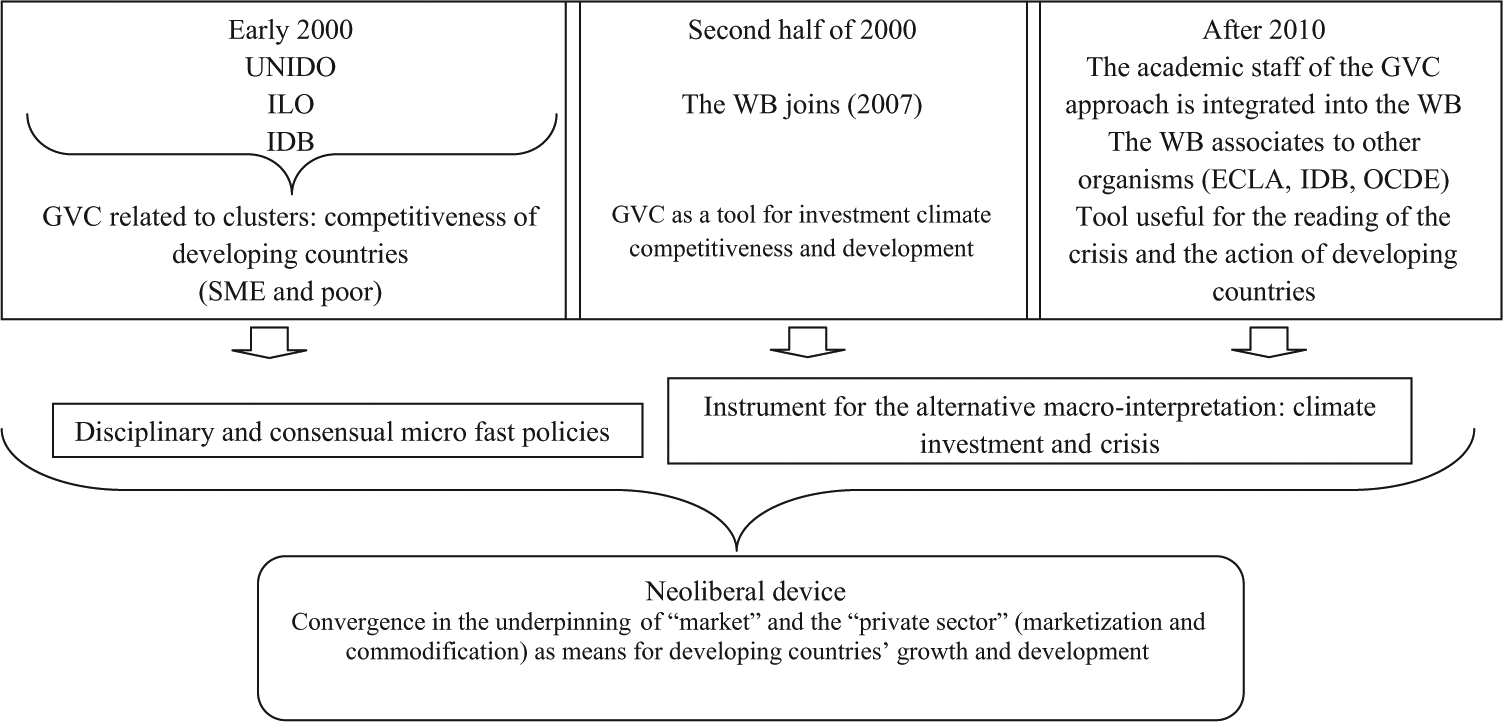
According to these organisms’ perspective, the insertion of the GVC approach has been associated with the concern about how the local processes and learning and innovation dynamics of the developing countries (analyzed under concepts such as clusters or regional systems of innovation) could be introduced in the global chains. In the examination and promotion of that connection between local clusters and the GVC, the presence of the aforementioned categories of governance and upgrade has been a constant factor in fulfilling the common goal of either achieving the SME’s competitiveness or fighting poverty.
The organization of the SMEs and the poor under forms of local clusters in order to enter and be qualified in the GVC (supported by supranational institutions) seems to be enrolled in that environment of micro disciplinary and consensual “fast policies”; stimulating local governments and civil organizations to assume the global network scenario as inevitable, and recognizing how their specificities can be adapted and enhanced in order to improve their insertions into global value chains. The financing that compels the SMEs – and the poor – to believe in salvation through local cooperation and upgrading in the GVCs is combined and reinforced by a consensual and non-conflictive introduction of “best practices” manuals, diffused through training programs and international and local seminars, as well as by the promotion of illustrative and successful experiences.
Combining discipline and consensus, the materialization of those fast policies becomes social and political technologies, supported not only in documents and action guides but also in the proliferation of projects and programs of the organisms that have been promoting the approach, either from the UN (like UNIDO and ILO) 4 or on behalf of financial institutions, as the IDB. 5 All of them share the primary objective of strengthening the clusters of the SME, or else of alleviating poverty through the development of productive activities and their insertion into the GVC, with emphasis on the organizations of the UN, mainly SMEs and the IDB.
Oriented by a consensual (non-conflictive) logic, these projects and programs share the dominant idea of introducing “win-win” strategies. Within such, local and regional actors from the Global South playing as poor or SME, by taking part, help achieve a precise knowledge of the local scenarios that are to be prepared to move into chains. Under this assimilative logic, the “fast policies” associated with the promotion of the GVC in the Global South are envisioned as a refreshing opportunity for developing a novel theoretical proposal in which neither Darwinian market competition nor vertical paternalist state assistance is the central key to enhance competitiveness and the new local/global relations.
As a complement for this first process operating through fast policies, in the second half of 2000 an action emerged, no longer micro to operate specifically in local scenarios, but more holistic and interpretative of the new ways of addressing insertion into the global economy and crisis, in which the same organisms that had encouraged the Washington Consensus (such as the World Bank) have gotten involved.
It is along these lines that the GVC approach and its basic concepts were adopted by the World Bank to evaluate (based on case studies previously realized on the shrimp industry in Nigeria and tourism in Mozambique) the ways of arriving at an environment more willing to invest and develop ways of competitiveness in firms within the global landscape, ways able to surpass the Washington Consensus’s simplistic view (World Bank 2007). 6 Since 2010, the WB commissioned the development of different case studies applying the GVC approach, including a good deal of the academic staff of this approach. 7 Based on such studies, and adding members from its own staff, this international organism issued a comprehensive document for analyzing the development crisis and strategies to be implemented, based on the recovery after such crisis (Cattaneo et al./ World Bank 2010).
In the same holistic spirit, after 2010, at the same time that the United Nations established a value chain development group comprised of nine member agencies (Stamm; von Drachenfels/ILO 2011), 8 the WB has gotten involved as an active organizer of international events, as the one carried out in Mexico in 2012 under the title “Latin America’s Prospects for Upgrading in Global Value Chains,” in cooperation with other organisms, like ECLAC, IDB, and OECD. 9 In consonance with other joint events, 10 these institutional meetings have shown a supranational urge for installing the GVC as a global tool of analysis and inspiration in the creation of post-crisis paths. Such efforts share the objective of directing the policy makers in the fitting together of the upgrading of Latin American firms in global value chains, and of encouraging private investment and development through the market.
Precisely, that last factor is fundamental to understanding how those two procedures (through which the GVC approach was institutionalized) and its policies jointly configure a neoliberal device. Effectively, the first institutionalization process (based on micro fast policies and their localized disciplinary and consensual practices) and the second and more holistic process (aimed at installing the GVC in the interpretation of strategies post-crisis) equally help actors from the Global South (poor, small entrepreneurs, etc.) underpin their market and be inserted into the “private sector.” Through this and all the micro and macro instruments involved, an increasing and subordinate integration to the permanent and unequalizing marketization and commodification process is being encouraged as the only way out. Such process dominates the always recreated neoliberal project and its institutional intervention devices.
In other words, the assimilation of the GVCs – through the two indicated processes – represents a creative incorporation into the machinery of discipline and consensus implemented through the international network of supranational institutions. That insertion of the GVC perspective into the transnational political networks has enriched the unsettled and transformed neoliberal devices, configured through regulative practices and institutions that are not targeted to challenge but to reinforce the market-driven axis that guides the neoliberal process from the beginning.
However, precisely as a requirement for the conformation and functionalization of this neoliberal device, the two already indicated aspects appear concealed, along with the asymmetric logic and the interests accompanying the installation of the device, and the already tackled weaknesses in the theoretical corpus.
3.2. The GVC perspective into global political networks: Relations with those asymmetrical logic and interests developed in the global economic networks
When we re-associate the economic network with the role of these global political networks, we verify that the consensual and disciplinary incorporation of the GVC perspective into the political and institutional networks, and “their technologies of power travelling through space” (Peet 2001) is not neutral from the point of view of how they have an impact on actors and their different interests. The integration of highly fragmented local and regional actors from the Global South into a complex “system of inter-jurisdictional policy transfer” promoting a fragmentary incorporation to the GVC, and the assimilation of its concepts and functional logic, does not alter but recreate the subordinating, excluded, and hierarchical structure of global chains that have been previously considered here.
Working through these fragmentary mechanisms of financial assistance and training, the transnational political networks have become a strategic tool for the consolidation of a structure that shows increasing benefits for those TNCs, which handle the most dynamic and valuable portions of global chains and ensure the subordinated and selective integration of the majority of small and medium economic actors of the Global South within the framework of the economic network.
As a new victim of co-opted concepts, the GVC has finally become integrated within a standardized tale that hides the exploitative and subordinated structures of global reproduction by exalting the consensual form of incorporation into win-win games. Playing this harmonious – and non-contradictory or non-conflictive – role is in fact a disciplinary condition to obtain the “political acceptance” that allows integration into international financial assistance programs.
3.3. Limitations in the GVC approach theoretical corpus for enabling the neoliberal device and interests
The fast and fragmentary ways that conform this neoliberal device under which the GVC approach operates in the GPN, as well as the impact they have on the consolidation of the subordinating and exclusive ways of integration, are enabled by the intrinsic weaknesses of such a theoretical device, associated, as we have seen, to the notion of power, the absence of national dynamics and trajectories, and the negligence of the role of financialization and the unequal access of actors from developing countries to financial capital.
In relation to power, its assumption as the mobilization of resources from collective endeavors rather than the capacity for action over others makes room for an entrepreneurial discourse, dominated by the associative practices and the win-win games. This makes it difficult to visualize the ways of structural subordination that are reinforced or enhanced when the implementation of fragmentary “neoliberal fast policies” takes place.
In such a context, the absence of the national dimension and its historical trajectories, along with the consideration of the strategic role that the state plays and the variable strength of the strategic actors associated with capital and labor, prevents the GVC approach from being inserted within a more holistic reading. Such absence turns out to be essential for, on the one hand, visualizing the general results of the extension of the fragmentary ways of commodification in the neoliberal device of “fast policies” in which this approach is enrolled; and, on the other hand, for evaluating in a realistic way the position that the different actors sponsored by such policies in the different GVC can aspire to.
Finally, the specific national trajectories have an impact on the differentiated capacity of responding to the financialization logics inserted in GVC by leader firms and to the dependence dominating in developing countries as regards the financing organisms themselves. Within the framework of the most holistic reading suggested, those firms or actors inserted in national trajectories (whose accumulation processes, local financing systems, and state fiscal capacity are weaker) are surrounded by the conditionings of international financing and its “fragmentary fast policies,” along with the hierarchical, subordinated, and unequal integration they entail.
Therefore, when all three of them - power seen as capacity of imposing and subordinating, national trajectories along with their different matrixes of accumulation and redistribution, and the differential capacity of financing that emerges from there - are recuperated and put together, what comes up more clearly is: i. the limited room for developing countries and their entrepreneurial actors to alter the ways of hierarchical integration of the capitalist world system; ii. the way in which neoliberal devices of fast policies and new holistic perspectives promoted at a supranational scale reinforce this; and iii. the capacity of certain elements which are shown in the national trajectories of going along with this, or taking a different way.
4. Conclusion
It has been one of the main objectives to show how the GVC approach, increasingly transformed in a strategic instrument of analysis and politics of the international organisms that promote development at a global scale, has gone in the opposite direction to the achievement of the initial objectives pursued by its “academics pioneers”: providing analytical tools – and politics – for reverting processes of exclusion and subordination that affect both economics and institutional actors from developing countries.
As a demonstration of this opposite direction, I highlighted the way in which the GVC conception has been assimilated by transnational policy networks and progressively converted into an important element of neoliberal devices. This role is played by promoting a mechanism of fragmented and, at the same time, centralized coupling of the actors, regions, and countries of the periphery. This process permits the continuity in the subordinated and excluded integration of those actors into the economic networks, and strengthens the interests of the globalized fractions of capital that control them.
I have also explained how, distanced from the WST (as it is associated more closely with the network perspective), the GVC approach has finally been linked to a set of limitations based on: the disregard of those forms of power that allow detecting the processes of domination; the adoption of a perspective which loses sight of the complex socio-economic contexts dominating the peripheral scenarios and their economic actors; and, finally, the neglect of the role played by the financialization process increasingly dominating capitalism and reproducing the structural asymmetries inside the GVC.
It is under those weaknesses in the theoretical frame of this approach that I have considered the ways in which these networks assimilate and use expansively the GVCs’ conceptual instruments. By considering such assimilation I have argued that it is possible to verify how the GVC concepts can be coupled to the fragmentary effects of those neoliberal devices promoted by international organizations, enhancing asymmetrically the interests of the globalized fractions of capital and consolidating – more than reverting – the subordinated position, if not the exclusion, of actors conforming the Global South.
In order to overcome the weaknesses and formulate alternative ways of analysis and action, I stress the need to rethink the way in which the GVCs are studied and politically used. This includes incorporating those elements whose absence helps generate such limitations in the approach and the way in which it has been inserted in the GPN. This also implies:
First of all, coming back to the theoretical sources of the approach, assuming, as the WST, the need of considering the functioning of different GVC within the global dynamic of the contemporary capitalist system, and realizing in that framework explicit recognition of structural dynamics and the differential power between spaces and actors inserted in transnational economic networks.
With point a. in mind, I should also include a careful examination of the differential strengths and weaknesses – not of a certain firm or cluster of firms but – of specific accumulation processes and institutional regulation resulting from different national trajectories in the Global South. From these different national trajectories and through an examination of the “path dependencies” shaped by the state, the central capitalist actors, and the labor force that conforms to the matrixes of national power, it is relevant to identify the specific national capacities of giving answers, conditioning entries, or providing alternatives to the global chains from peripheral positions.
To advance in this last sense, specifying the elements through which global networks are linked to national trajectories with differentiated potentialities playing within the frame of structurally unequal and exclusive global economic networks, is probably one of the most stimulating ways forward for researchers and policymakers committed to forging an alternative agenda to neoliberal economic policies from the Global South. This agenda, however, demands to recognize that: the forms assumed by the links between global networks – economical (GVC) as well as political (expressed by the IO) – and the national processes historically conformed, are clearly interpenetrated. In this sense, the former cannot omit the relevance of these national trajectories and the way in which they “mediate” global and local relations. In the same way, such trajectories – as Sassen was right to warn – cannot be considered from a methodological nationalism which positions the national as a “sealed container” from which answers for the global networks emerge (Sassen 2003). On the contrary, such trajectories should be recognized, along with those actors which represent them (as national) taking into account the constant penetration and reconfiguration realized by the networks, actors, and economic and global institutional actions, and the fact that the global is multi-scalar and constantly structured “…inside what has historically been constructed as national” (Sassen 2005: 529).
Second, the attempt of the GVC approach to present its analysis as an original tool for considering the specificity of globalization cannot conceal the way in which the GCVs are structured over historical and structural relations of constant subordination and unequalization; aspects not only present in the designers of such a concept (Wallerstein/Hopkins), but also in the whole still current tradition of “dependentist” analysis (Frank, Amin, Furtado, Prebisch). Once this historical and structural element is introduced, the “agreed” utilization of the GVC concept by the global politic network (displacing the dominant dimension of power) loses the capability of operating as a dangerous device for actors from the periphery, and, in spite of its promoters’ efforts, becomes a scarcely original tool for interpretation.
For the Global South, particularly for scenarios like Latin America and Africa, being able to rely on an original tool comprehends the need to avoid focusing only on the idea of “climbing the value chains” (Gereffi 2013), by structurally limited upgradings and always controlled by leader firms from the “center,” but also to shift the attention – from the recognition of the different national and regional trajectories, limits of power, and capacities of their states – to the formulation of integral strategies which consider alternative networks for their development.
Footnotes
Declaration of Conflicting Interests
The author declared no potential conflicts of interest with respect to the research, authorship, and/or publication of this article.
Funding
The author received no financial support for the research, authorship, and/or publication of this article.
1
3
4
In the case of the ILO, the growing presence of projects has been encouraged from the Job Creation and Enterprise Development department (Núñez and Sievers 2011). In UNIDO the Medium-term Programme Framework 2010-2013 stands out:  .
.
5
In the case of the IDB, the projects have maintained continuously alongside the program developed by the FOMIN, financial branch of the IDB, currently the largest technical assistance provider for the development of the private sector in Latin America and the Caribbean.
6
The World Bank’s document “Moving Toward Competitiveness: A Value Chain Approach” (2007) reflects the recent relevance of the GVC approach for international credit organisms, formerly protagonists of the WC.
7
Studies on different sectors and countries appear here, as the ones realized by Gereffi and Frederick (apparel), Fernandez-Stark (offshore services), Ahmed (call centers in Egypt), Bamber (horticulture in Honduras), and Christian (tourism in Kenya).
8
This includes the following institutions: FAO, IFAD, ILO, ITC, UNCDF, UNCTAD, UNECE, UNDP, UNIDO, and WFP.
10
An example of this is the international summit in Beijing “Global Value Chains in the 21st Century: Policy Implications on Trade, Investment, Statistics and Developing Countries,” co-organized by MOFCOM-WTO-UNCTAD-OECD. I can also mention the conference “Guidelines for Multinational Enterprises Latin America and Caribbean: Conference on International Value Chains,” co-organized by OCDE, the government of Costa Rica, and the Inter-American Development Bank (IDB).
Author Biography
. He has published more than 60 articles in refereed journals and 10 books.