



Abstract
We argue that corporate social responsibility depends on two distinct stylized facts concerning régulation and power. The first—institutional CSR—is institutional in nature, the other—strategic CSR—is economic and productive. The former permits and stabilizes the latter, which in turn gives rise to political compromises structuring institutional mechanisms. CSR strategies and institutions correspond to a private, oligopolistic régulation which shows no signs of being able to pursue a sustainable development regime.
Amongst the numerous definitions of corporate social responsibility, the most widely accepted today is that of the companies’ “voluntary contribution to sustainable development.” Over the past century, however, CSR policies have undergone considerable change, with a shift from the responsibility of the manager alone to the company’s overall responsibility within the society. As it emerged after the Second World War, this responsibility was initially based on the ethics of company heads. Marked by its North American origin related to the founding text of Howard Bowen (1953), this conception of responsibility was individual, non-normative, and highly moral, even religious. It was gradually transformed to become more directly utilitarian during the 1970s and 1980s: the company’s social behavior was supposed to serve its economic performance. For the company, CSR was thus considered in terms of efficiency. Since 1992, with the adoption of the Rio polluter-payer principle, company behavior has come to address “sustainability” concerns under the pressure of public criticism. As a result, the scope of CSR has been considerably broadened to encompass overall concerns of sustainability. 1
Most definitions of CSR make explicit reference to sustainable development and integrate the three pillars of the Brundtland Report: environmental, social, and economic well-being. This is the case, for example, with the Green Paper issued by the Commission of the European Communities in 2001, which was tied to various other initiatives such as the sustainable development strategy adopted by the European Council at the 2001 Göteborg Summit: “Business should be encouraged to take a pro-active approach to sustainable development in their operations both within the EU and elsewhere.” This is also the case with the OECD guidelines stipulating that multinational companies should promote sustainable development, with the European Council’s Lisbon Summit in 2000 which “made a special appeal to companies’ sense of social responsibility” (Green Paper: 3), or again, the United Nations Global Compact initiative (2000). The same is true for the Commission’s Green Paper which states that companies should “embrace an open governance, reconciling interests of various stakeholders in an overall approach of quality and sustainability” (ibid.). The ISO 26000 standard on CSR, meanwhile, defines it as the “responsibility of an organization for the impacts of its decisions and activities on society and the environment, through transparency and ethical behavior that contribute to sustainable development.”
CSR is thus presented as the “corporate” or “organization” component of sustainable development, aimed at providing company-level solutions to the worldwide ecological and social crisis. In our view, this stated ambition raises the question of how CSR actually constitutes the company’s contribution to sustainable development. 2 In other words, is CSR capable of changing or challenging neoliberalism and shaping a logic of sustainable development?
The analytical framework we have adopted to address this question is that of régulation theory (RT). 3 This approach gives a central place to the characterization of the dominant regime, where régulation is understood as the convergence of the mechanisms contributing to its overall reproduction in the context of the economic structures and social forms in force (Boyer and Saillard 2002). RT is thus concerned with the reproduction of capitalism and its successive historical configurations, with particular attention paid to the formation of social compromises. Within the threefold perspective of Marxism, Keynesianism, and the French annales school (especially Fernand Braudel and Ernest Labrousse), RT has produced a macroeconomics which is at once institutional and historical. Its ongoing elaboration leads to regular exchanges with (and borrowings from) the institutionalism of Veblen and Commons in particular. The key concept of RT is the mode of régulation, which is defined as a set of procedures and individual and collective behavior patterns with the threefold property of reproducing fundamental social relations through the convergence of historically determined institutional forms; supporting and guiding the accumulation regime currently in force; ensuring the dynamic compatibility of a group of decentralized decisions (Boyer and Saillard 2002).
Historically, RT has identified several modes of régulation, beginning with Fordism (Boyer and Saillard 2002: 87-93) and then a finance-led (or neoliberal) régulation (Boyer 2009). In the current period, the dominant players are the multinational enterprises (MNEs) (Michalet 1985) which are able to shape and define CSR concepts and instruments. This is why we have opted to focus on the MNEs, without pretending that they are the only category of enterprises using CSR schemes. Nor will we deal with the whole of the companies’ real responsibilities as such, but with “CSR” as a phenomenon promoted by the MNEs.
In order to understand how CSR functions, the article is structured around the definition of two stylized facts, both of which have to do with régulation and power. The first, which we call institutional CSR (part 1), is of an institutional/political nature. It permits and stabilizes the second, strategic CSR (part 2), which is of an economic/productive nature and gives rise in turn to political compromises structuring the institutional mechanisms. We conclude by questioning the ability of CSR, as the “corporate component” of sustainable development, to contribute to improving ecological and social responsibility by integrating them into political and economic dynamics which both feed and limit each other.
1. Institutional CSR: Reproduction of the Powers of Financialized Régulation
The dynamics of CSR are constituted, or even defined, by the institutional mechanisms established in its name; it proceeds as a political issue. Thus, the fact of defining CSR at the level of the companies and other structures relaying its action (submissive NGOs, influence networks, lobbies) involves an issue of power over the definition of the rules structuring that action. Institutional CSR follows the chaotic process of defining CSR set out by numerous international institutions. In this sense, the CSR institutionalization process is a “disturbing but significant proliferation of economic power relationships” (Chanteau 2011).
As an institution, CSR could be taken as a political necessity for the financialized régulation; it serves to provide legitimization (1.1.). This institution implementation is intrinsically tied to the structure of the globalized firm and the diminution of its formal responsibility (1.2.), which brings out the limits of the power relations likely to curb the mechanisms of finance and soften competition.
1.1. Institutional CSR: A political necessity for the financialized régulation
During the 1990s, the régulation approach showed that the growth regime had assumed a mainly financialized dimension through the domination of the financial sphere and its ability to appropriate value (Boyer 2000). In 1998, Aglietta spoke of a “patrimonial growth regime” (Aglietta and Rebérioux 2004) which would emerge in a single country and function through a strictly financial domination, maintained by the instruments and mechanisms of finance. Lordon (1999), meanwhile, identified a financialized accumulation regime which co-existed with multiple modes of régulation, mainly neoliberal. The domination of finance over the accumulation regime is reflected in different political responses aimed at the reproduction of fundamental social relations, as well as particular forms of competition and the wage-labor nexus (WLN). 4 In spite of recurring crises since 1987, and the major crisis beginning in 2007, the regime still endures because of the sharply instituted nature of financial instruments.
Institutional CSR refers to the ability of CSR’s institutional mechanisms to concretize a political logic leading to a social compromise. Régulation theory defines the institutionalized social compromises as the result from situations of social conflict between groups at the conclusion of which some institutions or organizations are established and function as rules. 5 Institutional CSR produces and supports compromises which are weak; however, they remain reversible and asymmetrical because the companies are able to break their commitments unilaterally. For this reason, they cannot structurally modify financialized régulation. By generating new rules and obligations, institutional CSR provides a framework for the strategic CSR dynamics.
Institutional CSR fits into the deregulation process, proper to financialized régulation, which challenges the founding mechanisms and compromises of Fordism: liberalization of financial markets, increased labor-market flexibility, privatization of public services, calling into question social protection and competitive disinflation. It arose from a reaction to the spread of social and ecological criticism at the time when it became politically necessary to develop a response to the perceptible deterioration of social and environmental conditions.
Institutional CSR obeys a logic of self-regulation, which transposes the institutional decentralization of production to company level. In this respect, CSR operates at the right distance from public rules, both legal and common, in order to promote a commitment which is private, voluntary, and nonbinding. Ultimately, it is when the company is no longer sufficiently considered an institution in the service of stakeholders that institutional CSR emerges, generating a political discourse and loosely enforced rules.
If today’s CSR is associated with sustainability, its origins lie in defensive measures intended to respond to the societal criticism expressed by various social groups in face of the companies’ economic and social “irresponsibilities” (Figure 1). These defensive reactions are the point of departure of most CSR measures, whether at the level of individual companies, which, under attack for their practices, have adopted a defensive stance in order to protect their reputations, or that of enterprises collectively defending common interests. The business collectives are composed of blocks of players backed up in their respective sectors by professional organizations. They have a common interest in limiting any regulatory reaction from the government at the national level and improving the image of the companies’ actions when these are denounced.
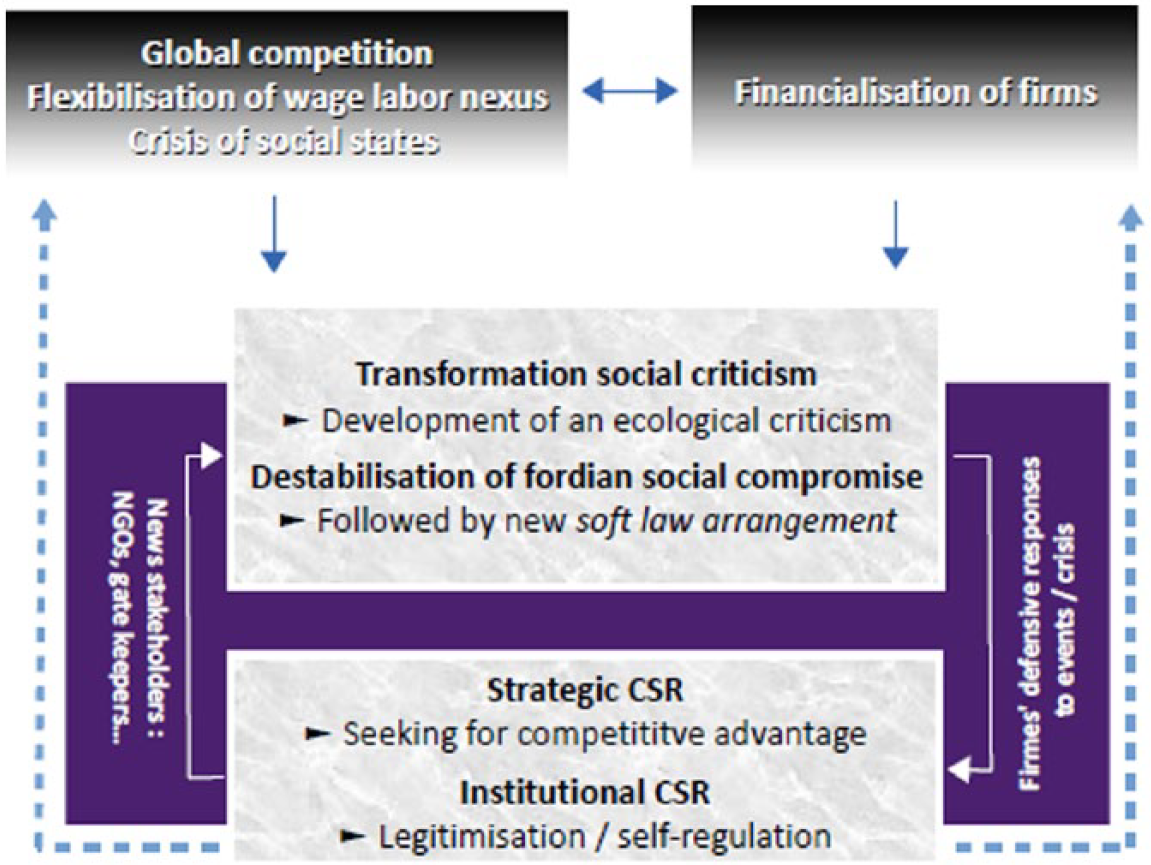
A micro process corresponding to the players’ decentralised actions under pressure from the macro regime.
Such approaches are direct responses to the demands of players outside the company, the NGOs in particular. For optimists, the NGOs are the new stakeholders; for sceptics, they are the Trojan horse of neoliberal globalization (Banerjee 2011). The defensive reactions correspond to a dynamics of justification and legitimization in the context of an unequal regime which has reduced the social justice previously promoted by the social state and the forms of the Fordist WLN. It is marked by a lengthy chronology of events/accidents, from the controversial 1995 sinking of Shell’s Brent Star platform in the North Sea, which was denounced by Greenpeace, to the 2013 collapse of the Rana Plaza garment factory building in Dhaka.
The CSR dynamics are thus structured by events which lead to crises for the companies, a phenomenon at firm level which echoes historian Ernest Labrousse’s dictum that “economies have the crises of their structures.” In other words, the crisis serves as an indicator of what underlies the régulation.
The communications process is one of the key points in the dissemination of a CSR culture in the companies. The defensive reactions translate into “commitments” to avoid a new accident. However, the real impact on production sites and structures (part 2) is considerably less significant than the translation into internal rules, which thus amount to so many weak institutional schemes. That said, the accident, in the sense of an event/crisis, and its potential effect in terms of losses of image capital and markets, guarantee that a form of “CSR discipline” will be imposed.
The institutionalization process thus stems from defensive approaches aimed at replying to interrogations. Boltanski and Chiapello (2006) have demonstrated the central role of criticism in the history of capitalism. Their main idea is that capitalist societies owe their long life to their ability to take criticism into account and assimilate it. For instance, during post-WW2, the capitalist economies responded to social criticism by the constant raise of wages, whereas we are currently dealing with the centrality of ecological criticism (Chiapello 2013). The success of this criticism stems from its ability to invade the media and the political arena through media strategies (name and shame, boycotts). This is the case, for example, with the campaign against Shell’s offshore drilling in the Alaskan Arctic, where the company itself is directly challenged by opponents. 6 But some of the protest actions function indirectly at the same time. Thus, when Greenpeace and a coalition of NGOs targeted LEGO, one of Shell’s longstanding marketing partners, they not only succeeded in putting an end to the partnership but brought pressure to bear on the oil company. 7
The older conservative criticism, with its paternalistic antecedents, nevertheless nourishes CSR themes through the ideas of managerial ethics particularly present in North America. This criticism converges with other criticisms, notably the critique of consumer society, the search for authenticity, and a demand for professional development and autonomy, as well as with a revival of social criticism focused on the exploitation of the Southern hemisphere countries, human rights, and growing inequalities. For Chiapello, “ecological criticism” contributes to building the norms of capitalism by forcing it to incorporate values which have in fact served to criticize it. CSR serves this function with regards to the companies’ activities and is part of a movement legitimizing the firm in society’s eyes. It also offers the advantage of limiting what might have arrived in the absence of a response, namely the enactment of laws which are at once more coercive and more binding. In the process, this criticism leads the companies to broaden the field of their prerogatives by assuming an environmental responsibility alongside their (financial) responsibility to shareholders. The spread of ecological criticism in response to crisis events is reflected in institutional CSR, which should thus be understood as the codification of this new social relationship largely dominated by the major firms.
The intense debates on CSR indicate that many players see this issue as a means of renegotiating certain social relations where Fordism had placed them in a position of weakness and which financialized régulation has now made more malleable. These mainly involve the WLN and the forms of competition, but also the state’s exercise of public authority at the national level. This situation has resulted in an exploitation of CSR in line with the delegitimization of public authority (state failures) by different groups (companies, think tanks) asserting that externalities are better handled at company level than by public administration.
The recognition of the firm’s primacy of its own “responsibilities” marks a turning point in relation to the Fordist period, during which the social state had a broad range of social responsibilities. Thus, the 22 March 2006 communication of the Commission of the European Communities declaring that CSR depends exclusively on a voluntary approach left up to the companies alone marked a clear retreat by public authorities and an institutionalization of the companies’ capacities for self-regulation.
In France, where hard law is one of the most developed, two legal instruments have been adopted: the New Economic Regulations Law in 2001 and article 225 of the so-called Grenelle 2 Law in 2007. In both cases, the companies’ involvement in co-authoring the texts is symptomatic of their intention to limit the impact of the law, notably with regard to the range of businesses concerned, the nature of the required disclosures, and the form of monitoring implemented (Clos 2013). The fact that firms were ultimately given the possibility of substituting EMAS for the reporting obligation required by the law shows that the final version of the text has transformed the stated intention. 8 The legal instrument has been re-oriented from the idea of monitoring and verification found in the Grenelle 2 Law to serve as a support mechanism for the companies.
At the same time, the normative process leading to the adoption of the ISO 26000 standard in 2010 illustrates the players’ determination to produce their own quality rules, and this is in fact what makes it a “non-standard standard” (Capron et al. 2011). What is involved is not only a private procedure but more fundamentally a collective one entailing the creation of common mechanisms: the ISO standard, sector-based guidelines, training schemes, procedures, management tools, the emergence of a profession. As a non-binding definition of the contours, rules, and obligations of social responsibility, institutional CSR constitutes a collective intangible investment.
Institutional CSR becomes intangible resources shared between players from the same power group. In the case of ISO 26000, the production of the standard cannot be reduced to either a competitive confrontation intermediated by the construction of mechanisms or a collusion on the companies’ part against certain stakeholders (even if the “firms” group was omnipresent during the negotiations). The ISO 26000 standard as an institutional innovation is drawn on by certain players, and in turn it imposes a framework on relations between them. One of the anticipated effects of the ISO standard is to focus the evaluation of company responsibility on an internal management process.
1.2. The globalized firm and the diminution of formal responsibility
The organization of globalized production transforms the company’s perimeter and leads to a de facto diminution of its formal, legal responsibility. The rupture occurring at the end of the last century between a globalization encompassing the circulation of goods alone to that of production itself explains the importance assumed by inter-company relations at that level.
The spreading out of global value chains (GVC) (Gereffi et al. 2005) or interlocking via different kinds of subsidiaries allows both distancing (non-ownership as a guarantee of reversibility) and control of production (via the contract). The governance of production is thus based on the tandem of greater formal autonomy (delegating) and greater economic responsibility of subcontractors.
The changes affecting the large company, from a dynamics of multinationalization to the constitution of financialized firms, (1) is combined with the absence of a legal definition of the enterprise, which reduces the latter’s responsibility (2). In this context, the spread of institutional CSR does not radically alter financialization of the regime (3).
The “global capitalism” which developed in the last quarter of the 20th century emerged from a triple changeover which placed the MNEs in a central position (Michalet 1985). The first two corresponded to the shift from international exchanges of goods and services to the internationalization of production and, by extension, the multinationalization of the firms. By internalizing national disparities, the globalized companies managed to occupy a key role in this globalization. Historically, globalization was oligopolistic and dominated by the big firms even before financialization. The power of the MNEs no longer lies essentially in international trade because the trade dimension is supplanted by activities abroad and intra-firm exchanges. Their oligopolistic position allows them to dominate their chain of suppliers. The relationship of subordination established with a certain number of countries is not unilateral, however, since the states’ assistance to the companies depends on the countries’ resources.
In this context, CSR is an instrument mobilized worldwide against certain state prerogatives, which include not only the elaboration of binding regulations but also the social compromises imposed by the balance of power within the country. MNEs are the product of the global economic system but also actors in its construction.
The multinationalization of production thus serves to transfer the constraint onto suppliers. The aim is to avoid costly (environmental or labor) regulations and confront the historical extension of the WLN at national level, namely the increasing socialization of the labor force (Michel 2013). Indeed, in the companies’ view, social spending is primarily a cost to be reduced; the GVC then becomes an instrument for crushing the WLN. It is one of the links in the financialization process, even for non-financial corporations (Milberg 2008).
With the rising power of the financialized growth regime, the companies themselves come under pressure from market finance to generate high rates of return on capital. The transfer of constraint onto suppliers is thus accelerated.
The growing concentration of finance capital in the hands of institutional investors, now the managers of group savings, structures managerial power. New efficiency criteria favor restored shareholder power. The dominant players are now the MNEs and institutional investors operating on globalized financial markets. The maximization of shareholder value becomes a driving principle of corporate governance. The shareholder conception of the enterprise spreads to all sectors because of the power of the institutions of finance. Due to their private oligopolistic power, the MNEs are able to legitimate themselves via institutional CSR at this global level which, owing to the political weakness of worldwide governance, is less subject to standards.
The dominant players draw on legal provisions and shape standards, whether these are of a general, public nature or a private one. Such institutional strategies lead to so-called soft-law proposals, whereby the companies avoid legislative processes by producing their own bodies of private rules (charters, guides, codes of conduct) which are then applied within strategic CSR.
The legal responsibility of the firm, and that of the MNEs in particular, poses major problems because, in contrast to the corporation and the company, which are defined by law, there is no legal definition of the MNE, or even the notions of enterprise and firm. The enterprise is an economic organization with no official legal existence and no defined membership. Unlike the company, which is a legal entity, the enterprise remains an economic organization bringing together multiple components or even different companies.
Even more than other enterprises, the MNEs are able to define their legal boundaries through the structures of their capital, namely by defining the boundaries between legally constituted companies (at the international level in particular). From a formal, legal standpoint, the dividing line between the legally recognized company and the enterprise as an economic entity not defined by law releases the company from its responsibilities outside of its legal definition. Once the globalized enterprise does not operate as a legally defined company, it can disclaim its legal responsibility.
Following Blair (2000), many authors have drawn on legal and economic arguments to demonstrate the structuring role of agency theory in the restoration of shareholder primacy. By providing a framework for the fiction of enterprise ownership, this theory effaces the distinction between enterprise and company and confuses ownership rights over the shares and property rights over the enterprise itself. Agency theory functions as if ownership were transitive: the owner of a company’s shares would be the owner of the legal entity’s assets. Admittedly, the owners of the shares are far from powerless but they are not the owners of the enterprise and they are not legally responsible for it. Between these two levels of ownership, one of which is proven (ownership of shares) and the other declared (ownership of the enterprise), lies the question of power. The power exercised by the shareholder is not solely legal; it utilizes the law but is expressed in many other instruments, such as subordination, symbolic domination, or the establishment of standards, but also the power to escape legal responsibility.
During the multinationalization phase, the MNEs develop through the dissociation of legal boundaries and the firm’s economic perimeter. In this sense, social institutionalized compromises, and in particular those concerning labor and labor law, are circumvented by MNE. By choosing both its size and the boundaries of its legal responsibility, the firm defines the limits of the latter, which amounts to a veritable invitation to avoid its legally binding duties (Collins 1990). The legal definition of the company is conditioned by a strategic approach to production (organizing the multinational allocation of resources whilst reducing formal responsibility).
The rise of CSR occurs within this interaction between institutional motives and strategic dynamics. Even though the interlocking structures within the value chain constitute an evasion of responsibility and its transfer onto suppliers, the CSR process gradually seizes upon this key issue to shape a new power relationship which is reflected in the creation of additional institutional mechanisms (of soft law), albeit quite modestly in comparison to the instituted power of the legally recognized company giving the orders.
None of the mechanisms of institutional CSR call into question the concept of the firm’s shareholder governance according to Jensen and Meckling, which has imposed itself in opposition to the managerial conception (cf. Berle and Means; Chandler). The firm conceived in terms of a set of contracts and the agency relationship produced a legal fiction adapted to the neoliberal era which challenges the managerial firm conceived as a collective space for accumulating skills and managed as an instituted entity (Weinstein 2012). The essential issue of the relationship between managers and shareholders concurs with the analysis of Duménil and Lévy (2011), who maintain that the managerial class is central to the compromise with shareholders and has permitted the re-establishment of their power. The financialization of the executives’ compensation is one of the key mechanisms of this compromise, aligning managers’ incentives with the interests of market finance. These kinds of arrangements allow us to measure how the very definition of the firm basically remains that of financialized régulation. The mechanisms proper to institutional CSR are in this respect ineffective for opposing the returns of finance and the benefits the directors draws from them, in terms of power over the firm and compensation alike.
The controversy between investment funds and “shareholder democracy” offers a good indication of the tension existing between the endogenous evolution of régulation (e.g. reproduction) and its structural modification. Although Aglietta and Rebérioux (2004) consider that the management of employee saving plans allows both employees and trade unions to reduce the information asymmetry relative to shareholders and manage long-term investment, many other authors argue that the performance standard for these funds structurally prevents any change in the financial régulation. These standards leave no room for maneuver and function as rules. A financial innovation of this kind, in principle favorable to employees and typical of institutional CSR, does not offer a way out of the standards and radical uncertainties of finance. Thus, the finance professionals managing these funds operate in the same way, regardless of the order givers, to demand the same returns as market finance.
Arising from the decentralized action of participants, institutional CSR brings new stakeholders into play (NGOs, international bodies, gatekeepers). But with the questioning of the states’ public prerogatives (economic policies, regulation of work) the hierarchy between these players reinforces the dominant position of the MNEs.
Institutional CSR develops as a political necessity within financialized régulation through a process of legitimization. The political issue involves the elaboration of principles and fixed rules governing the society in order to define the players’ responsibilities and standards of justice. Institutional CSR gives rise to régulation mechanisms relating to the general interest within a logic of sustainable development. Rather than constituting a break with financialized régulation, however, it corresponds to an endogenous régulation (i.e. the reproduction of the regime). By implementing additional mechanisms of endogenous selection, CSR institutions function within financialized régulation. Just as the evolution of capitalism is punctuated by innovations permitting its reproduction, CSR is part of the institutional innovations (Bodet and Lamarche 2007) allowing the reproduction of financialized capitalism.
A difficulty confronting the social sciences, and one which is closely related to group decision making, has to do with analyzing mechanisms which are not intended solely to reproduce the established order but to improve it; this involves the implicit normative dimension which follows the construction of stylized facts. The régulation approach therefore focuses on the understanding of what allows a given economy to endure even though conflict relationships might be a source of permanent instability. In this respect, it goes back to the fundamental question of political economy raised by Adam Smith: how to explain the fact that each person’s pursuit of individual interests does not lead to chaos? Régulation theory does not deal with equilibrium but with temporary social compromises permitting tensions and contradictions to be reduced. It thus proceeds through the structural analysis of capitalism.
Through the very way the institutional mechanisms of CSR are socially situated, the conditions of their emergence and exploitation demonstrate that they contribute to the reproduction of the dominant model. They proceed, however, from a constantly changing social relationship and serve to reinforce certain players, in particular recent arrivals. Thus, these mechanisms do not depend on an identical reproduction of financialized régulation. The concept of social reproduction, moreover, in no way refers to an identical reproduction; rather, a representation of the reproduction is constructed by the stylized facts constructed ex post. In the present circumstances, the CSR mechanisms reproduce the established order. It is, however, the very nature of an institution to modify or reinforce the balance of power and, as a result, institutional CSR is not simply an instrument of reproduction.
An analysis in terms of régulation shows us that institutions impose themselves and structure the fundamental social relations only when they take action within the economic order. It is therefore necessary to turn to strategic CSR (part 2) with the aim of seeing how CSR is capable of sustaining economic dynamics which would strengthen institutional CSR. Examining what an accumulation process integrating certain CSR principles actually is allows us to answer the question of what CSR institutions produce. They can only produce a re-orientation or a break in the regime if they are capable of permitting “CSR” economic dynamics. This is underway, but still uncertain.
2. Strategic CSR: Integration into Productive Structures
We have seen that institutional CSR does not produce by itself the conditions necessary for going beyond financialized régulation; on the contrary, it tends to reinforce it. We will show that the development of what we call strategic CSR, as permitted by institutional CSR, can in turn make these institutional mechanisms evolve. The political dynamics resulting in the production of new rules (part 1) is only possible when they are reflected in production, and thus in a form of efficiency. Strategic CSR may thus be understood as the concretization of the principles promoted by institutional CSR within the production side; this is what conditions the acceleration of CSR which remains hypothetical for the time being. When the CSR process originating the political side is reflected in that of production, there is a shift towards new compromises between the different centers of accumulation (mainly the firms). These transformations are partial, however, and often unforeseen. CSR mechanisms have difficulty producing the anticipated, proclaimed effects; they continue to obey a logic of legitimization by MNE.
Strategic CSR will only be able to impose itself if it guarantees a certain level of profitability. The very high expected level of return on capital is a central feature of the financialized accumulation regime but one which gives rise to its political unsustainability (Dannreuther and Petit 2013). Thus, strategic CSR can only gain ground if it meets these performance obligations, unless a structure escaping financialization can be envisioned. In this sense, there is an opportunity for restoring a managerial firm instead of a financialized one through strategic CSR dynamics which would allow it to regain a foothold within an oligopolistic régulation. However, such a régulation offers the firms little leeway.
At present, CSR mechanisms are inter-firm instruments of power within the GVC: conferring legitimacy on the powers that be, they reinforce the productive structures of the financialized growth regime and its profit-sharing rules (2.1.). Strategic CSR gives rise to some conventions of quality which integrate indicators of responsibility, but are not durable because there is no compatible demand regime. So, the conditions for the emergence of a new accumulation regime are not met (2.2.).
2.1. CSR as inter-firm instrument of power: Global value chains
Contrary to what stakeholder theory—a key reference for CSR—would have us believe, company networking does not lead to joint governance of production. Rather, what we will stress now is a legitimization of the MNEs’ domination over their suppliers through CSR strategies, with responsibility displaced onto the latter, as well as onto employees, who are subject to the paradoxical order to denounce the structural practices permitting them to make a living.
The productivity gains’ slowdown in OECD member countries in the 1970s, followed by the globalization of capital and neoliberal policies on value sharing in the 1980s and 1990s, encouraged commitment to the idea of CSR in order to seek new strategic niches and to confront the productivist crisis. The construction of competitive advantages was thus conceived in terms of differentiation rather than economies of scale and variety; this new approach led to targeting different market niches likely to increase profit margins. We can cite, for example, products labelled “fair trade” and “organic,” which correspond to different forms of consumer commitment (Dubuisson-Quellier 2013).
Notwithstanding a large number of meta-analyses (Margolis and Elfenbein 2008), however, it has never been possible to arrive at an econometric determination of the effect of CSR policies alone on financial performance, whether positive or negative. The uncertainty of these studies, and in particular the variety of the different situations, has favored a reading which validates CSR insofar as it does not have a negative effect. Two opposing explanations are invoked: 1) CSR remains a communications approach and therefore does not limit the companys’ financial performances; 2) CSR permits an increase in the value of its intangible assets by strengthening its property rights or producing concrete proofs in response to ecological criticism.
In that context, a utilitarian conception of CSR has been developed in relation to the degree of control over the value chain. What we call strategic CSR is based on the logic of production, combining the definition of profit strategies and the search for competitive advantages associated to CSR policies. 9 This productive dynamic is based on the players’ creation of a multiplicity of definitions of quality bearing on responsibilities of uneven, limited impact. As strategic CSR develops, it gives rise to new instruments of inter-firm governance within GVCs, with the support of the schemes promoted by institutional CSR. Strategic CSR then becomes an attribute of the company’s power within globalization, whilst it has partially abandoned its national implantation and thus broken the national compromises which had supported its rise. In this globalized context, CSR is used by top managers as a guarantee in the face of the growing transnationalization of the large MNEs.
At the same time, CSR is utilized in order to strengthen ties with suppliers, employers, or even customers. This strategic CSR line is less often identified, even though it lies at the heart of the shareholder conception of the company which makes the enhancement of the latter’s assets paramount (Lamarche and Rubinstein 2012). To this end, the MNEs increase their power over their subcontractor networks. Networked development is a key element in the globalization of production and the vertical disintegration of the company. The internationalization of the value chains, which involves more than the simple extension of subcontracting, can go as far as the total outsourcing of production.
In this context, CSR is used to make up for the failings of shareholder governance. Strategic CSR thus plays a role in structuring the governance of the business network, with its complex coordination and potentially negative consequences, because the reputations of the prime contractors are at stake. The institutional mechanisms and their translation into strategic CSR nonetheless provide legitimacy in response to demands for compliance with principles of justice supported by NGOs. Relying on CSR, there is a standardization of the practices and constraints imposed on subcontractors. The company thus manages to increase its productive flexibility by outsourcing much of its activity whilst developing risk management for potential objections to its subcontractors’ practices.
Far from encouraging a better distribution of surplus or new arenas for debate within the sectors, CSR leads to transferring risk from the strong player in the GVCs to the weak one. The MNEs are thus relieved of the burden of responsibility, in both formal and legal terms. The codes of conduct, meanwhile, transfer this responsibility to the sub-contractors, whilst ethical warnings transfer it to the employees, who are encouraged, if not required, to denounce practices on which they depend and which are not of their doing. These mechanisms thus accentuate inequalities (Palpacuer 2008) and place entire categories of players in a position of accepting a mode of organization and failings which are of a structural nature. The individualization strategy within the company places the blame on the employee rather than the order givers.
By modifying production structures, strategic CSR gives rise to new power relationships and forms of control through the use of different instruments which impose rules to be integrated into factories. In the end, the improvement of the prime contractor’s social responsibility can go hand-in-hand with a deterioration of labor relations in partner companies (Gereffi et al. 2005) because of the double constraint imposed.
Strategic CSR thus serves as an instrument of discipline in the GVC and an instrument of inter- and intra-firm governance. As such, it confirms the productive organization directed by a few large firms while adding an additional dose of legitimacy worldwide. In that case, CSR contributes to the reinforcement of intangible private capital.
From the moment strategic CSR approaches are anticipated as factors determining the value of intangible assets, and despite the absence of proof, they are likely to enter shareholder dynamics and strengthen them. CSR strategies are then integrated into finance-based schemes and their yield becomes the subject of strategic expectations. Within this logic of shareholder returns, as described by Orléan (2014), the value at play is not “substantial” and thus does not need to be proven (demonstrated by empirical research). What is necessary for the shareholder value is its valuation by the relevant market. The development of strategic CSR is thus relayed by a mimetic process proper to finance: it acts on the positive anticipation of players.
What is at issue here is not the questioning of the objective of maximizing shareholder value but the awareness that this objective cannot be pursued without the other stakeholders and without formally distinct concessions or compromises. From this perspective, strategic CSR is perceived as the keystone of a fairly low-cost strategic response to pressures from ecological and societal criticisms (Miller 2008). While institutional CSR attempts to legitimate company activity along political lines, strategic CSR operates in terms of production and governance, but to the same end of legitimization.
Following Fligstein (1990), who defines different “conceptions of control” (in the sense of the successive representations of the company, its strategies and its objectives over time), it is possible to identify a new configuration which has been termed the “shareholder-CSR compatible” conception (Lamarche and Rubinstein 2012). Within such a framework, strategic CSR approaches mainly rely on a modification of private rules, which confirms the interaction between the dynamics of the rules and the productive process. Institutional CSR permits strategic CSR and stabilizes it; in return, the latter calls for soft law mechanisms which the former then generates.
The originality of the interaction between institutional and strategic CSR stems from the CSR institutionalization process, which is marked by its voluntary nature and specific form of enforcement. One of the keys to the success of the shareholder-CSR compatible conception is to be found in this decentralization of the production of rules: the companies’ ability to design these rules, at their own level and on a general scale, permits CSR to be made compatible and consistent with shareholder governance whilst compensating for certain of the latter’s weaknesses.
Through its integration into the GVCs, strategic CSR becomes a component of the forms of competition and thus plays a disciplinary role in relation to the WLN. The structural domination of competition over the WLN is not modified by CSR, which only deals marginally with the distribution of value and social protection. CSR does not positively affect the unequal distribution between wages and profit proper to the neoliberal regime or the dynamics of labor flexibilization. In fact, strategic CSR does not replace the asymmetrical governance of the GVCs but is added to it. It is integrated into the globalized forms of competition.
The inclusion of social and environmental obligations corresponds to certain sustainable development issues but without challenging the system of price-based competition and cost pressure. A major contradiction arises here: integrating the respect of certain labor law standards (working hours, wages, work conditions, safety, etc.) into the codes of conduct is of little or no benefit to employees. Cost constraints on the one hand and the international mobility of production on the other offer means of avoidance.
The role of CSR may thus be understood in relation to the changing WLN. Financialization uses the permanent destabilization of the WLN to generate margins, and this destabilization is cumulative because of the competition between national WLNs. Structurally destabilized, the WLN loses the central role that it plays in Fordist accumulation (Michel 2013) and is no longer the structuring component of global demand. The financialized WLN, which is more unstable and individualized, has been reconfigured so as to bring more flexibility to production. And the spread of strategic CSR does not change this at all because it is a major factor of additional competitiveness. We regularly come upon such separations between the deterioration in working conditions in a given company and the same company’s communication on CSR denying the problems identified by independent expert assessments. 10
The dynamics of the states’ international integration into production, through the strengthening of globalized competition, leads to a reduction of social protection systems. With the embedding of supplier networks developed by the GVCs, the labor force is recruited outside of any work contract formally involving the prime contractor. The situation reflects the MNEs’ non-accountability in relation to wage-earners. In the governance developed by the globalized firms, workers are kept at a distance from the lead firm, which is the employer de facto but not de jure. The WLN is thus circumvented by these worldwide organizational and production schemes. Because the labor force is outside of any work contract, it does not come under the relevant legal protection systems. The relationship between the prime contractor and the worker is no longer regulated by social and labor law but by other legal systems, whereby social law is displaced towards lex mercatoria: commercial law. In this way, the relationship with trade unions is partly circumvented and, opposed locally, it nonetheless returns at the global level (e.g. ISO 26000 process, International Framework Agreements). 11 Insofar as it levels a whole group of issues (from social and environmental rights to human rights and well-being at work), CSR plays an ambivalent role without providing an improvement of the WLN at the international level. In this respect, it contributes to a de-institutionalization of Fordist WLN (liberalization and flexibilization).
The codes and charters integrated into the value chains give the MNEs new instruments of management in addition to the networked governance which is highly structured. Certain factors of régulation are thus at work in the MNEs: given the current balance of power, the strategic CSR mobilized to respond to social criticism results in reinforced control over suppliers. This does not attenuate the oligopolistic nature of financialized régulation. CSR mechanisms (combined with other control factors, concerning prices and quality in particular) participate in the régulation of contradictory relationships between companies, but also between capital and labor at the international level. However, this coordination is relegated to the production level and does not play a role in macroeconomic stabilization; it is rather a kind of mesoeconomic régulation at the scale of GVC. The finance-dominated regime, even when it is associated with institutional CSR, comes up against its inability to generate a level of productive activity corresponding to its expected financial performance (Figure 2).
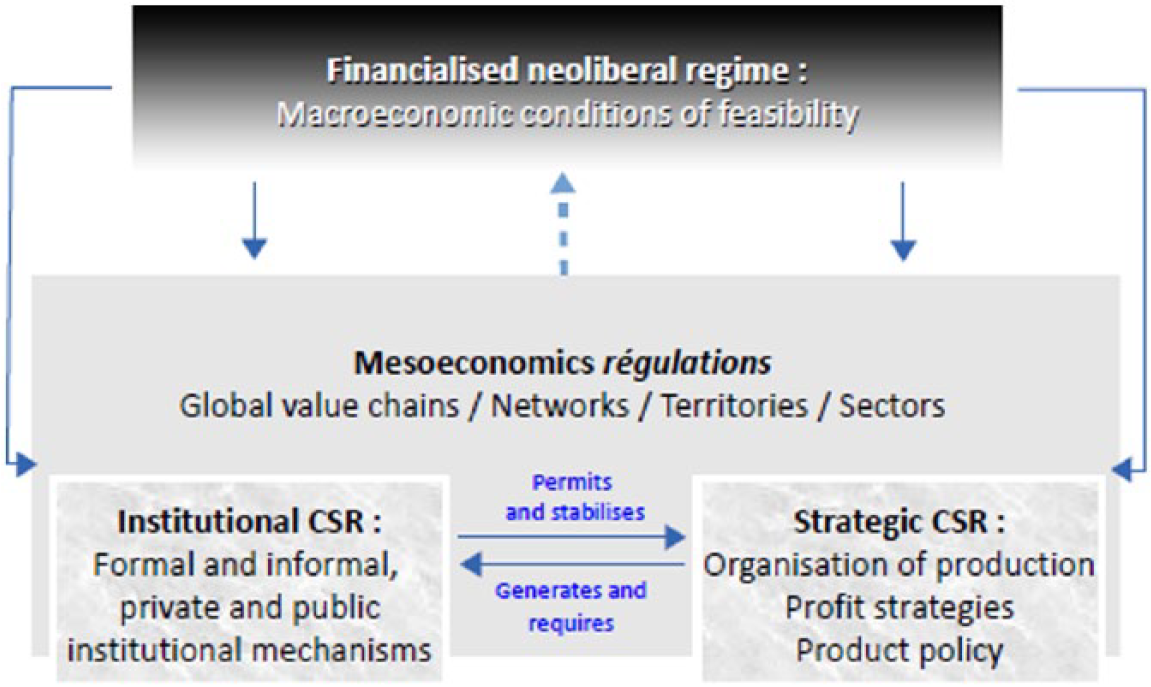
Reinforcement rather than modification of the financialised mode of régulation.
2.2. The variety of conventions of quality and competitive advantages: No CSR growth regime
As we have seen, strategic CSR is closely tied to the rules produced within the evolving context of globalized capitalism, with the MNEs profiting from the demand for responsibility in the control they exercise over their suppliers. This upstream process is then associated with a downstream one closely tied to the emergence of new quality conventions which could integrate responsibility. We accept with Storper (2000) that convention is understood at the same time: as a rule taken for granted and to which everybody submits; as the result of an agreement; or as a founding moment (e.g. a constitution). The notion of “convention of quality” (Eymard-Duvernet 1989) introduced a plurality of modes of qualification corresponding with different modes of assessment of the quality. We will discuss a new kind of such a convention which we term “quality-responsible.”
The economics of conventions considers quality a criterion of identity (which value characterizes a given quality?). Whilst normalization is held to be a test of compliance, which process permits the validation of an expected quality? 12 However, a convention of quality could only be stabilized if it guarantees profitability, in some ways corresponding to the interest of the founding groups.
At the same time, this process presumes that the conventions in question fit with some consumers. Quality conventions are thus set at the level of the large firms. They vary in their force and content and compete with one another. Such conventions act as an institution; their working principle is a symbolic power over individuals’ social representations which have both material and ideal dimensions. At the company level, strategic CSR translates into a variety of schemes for increasing the value of products through multiple qualities of an environmental, social, or territorial nature. Unfortunately, these “responsible”qualities are mobilized in the competitive dynamics alongside other attributes which are not always compatible with them (innovation, price).
At present, however, existing market conditions cannot impose a competition standard structured by a convention on “responsible quality,” regardless of its definition, because its production costs are too high. There has been a proliferation of initiatives in this area but no dominant, structuring, and widely accepted convention. Thus, the ISO 26000 standard struggles to live up to the role of a single, internationalized quality convention as its initiators had wished.
The spread of quality management schemes is a way for internal management to safeguard its leeway in the face of shareholder constraints. However, conditions for producing “responsible quality” can only be found in expanded social relations (WLN; human rights; relations with local populations, with resources, and the environment) and strategic CSR dynamics do not deal with these external effects. They remain subject to a system of international competition in which prices are determinant and do not allow the overall integration of such effects. Two years after the Rana Plaza building collapse, to cite this example alone, not only has there been no upgrading of production standards in the clothing industry, but several major brands have not yet compensated the victims. 13
Neoliberal dynamics are based on a conflict of wage-profit distribution largely dominated by capital (Duménil and Levi 2011). The long-term evolution of course of the division of value added over the long term shows that the share of wages has declined in all the developed countries (8 percentage points in the European Union from 1961 to 2009) and the share of profits increases correspondingly. In most developed countries, dividends rise with the drop in the investment rate (Husson 2010). But CSR mechanisms do not address this crucial point, which continues to impose a limit on the reproduction of the financialized growth regime and increases its fragility (Setterfield 2011).
At the macro level, the spread of social responsibility principles, from the GVCs to an overall régulation, comes up against a depressive level of demand. The pressure on the purchasing power of the bulk of wage-earners in the North does not offer an outlet for the “responsible quality” convention and thus does not allow the perpetuation of quality labelling. For the most part, demand regimes in the South do not turn to markets integrating these quality conventions; rather, they are driven by the emergence of a middle class concerned with primary equipment and quality in industrial terms. In such a regime of stagnating demand, the forms of competition are structured by prices.
Perpetuating a growth regime calls for compensation (whether in terms of wage distribution or bargaining power about working conditions) which CSR cannot provide. On the contrary, institutional CSR excludes social and wage-related issues from their sphere of operation or situates them in areas outside of production (charity, foundations, etc.). In this sense, CSR implicitly obliterates the social dimension.
Although CSR is integrated into modes of coordination and the organization of production, there is no substantial modification of the accumulation regime, or even signs of one foreshadowing recovery from the crisis. The CSR institutionalization process is indicative of economic power relationships and reflects the tension between regulatory power and the appearance of unilateral mechanisms engendered by strategic arrangements which, as is, do not produce a stable standard. Indeed, the standards emerging within strategic CSR are unstable because they can be called into question with changes in competitive relations.
The nature and scope of the information needed to produce a convention of responsibility for an entire value chain presumes an access which is exclusively possible for internal management. Managerial power thus lies in the mastery of the GVC, and the varied, complex questions addressed by strategic CSR serve to reinforce this internal power. Control over information acts as a rent for those who have such an informational advantage, which comes back to the pivotal position of top executives. Integrated into the institutional schemes of finance and international competition, strategic CSR in fact strengthens the financialized mode of régulation rather than attenuating it (Figures 2 and 3).
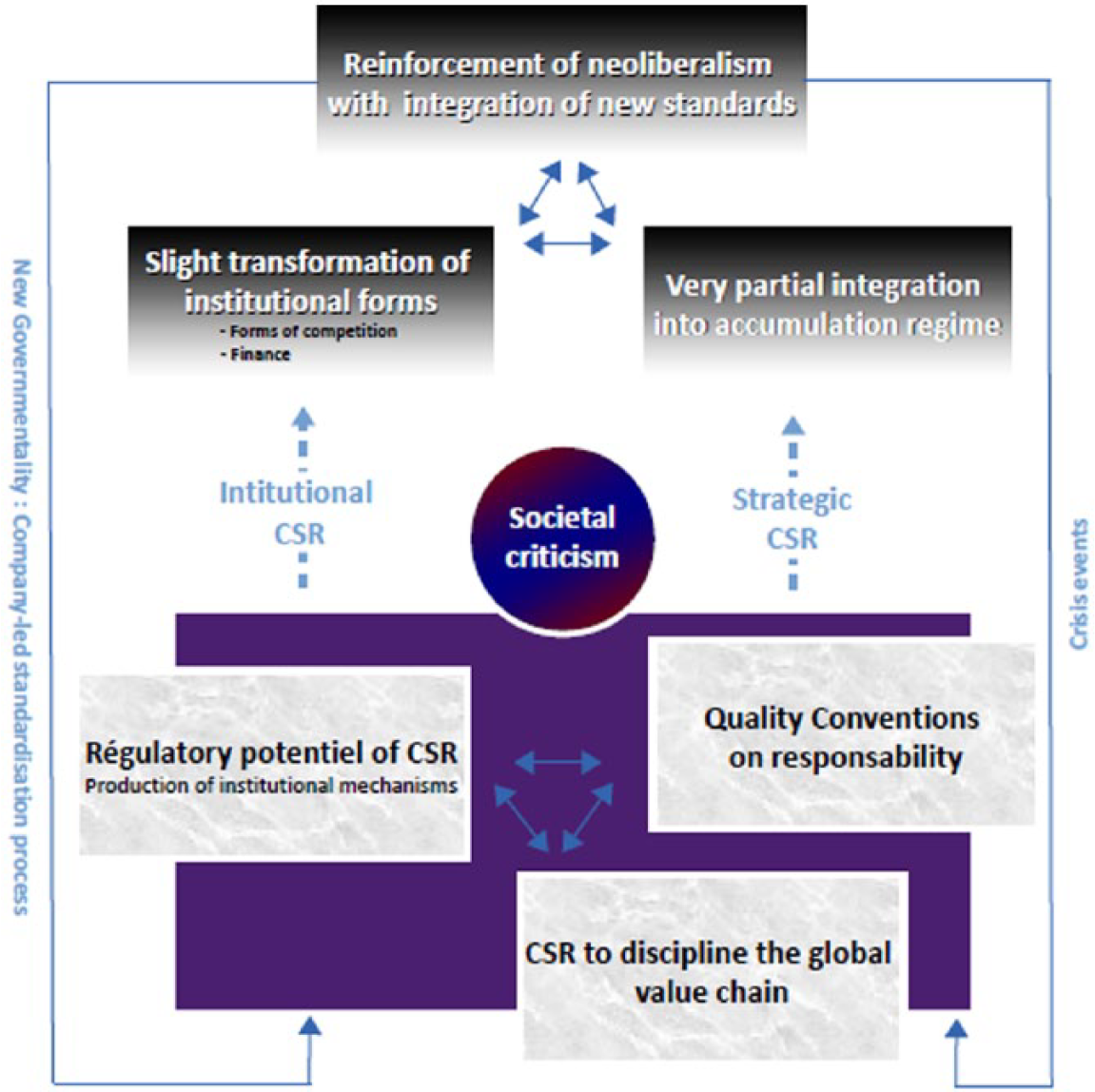
Institutional /Strategic CSR Interaction: micro interplay behind macro structures.
3. Concluding Remarks
In our investigation of the companies’ overall, systemic contribution to sustainable development, we have used a régulation approach as a means of analyzing the construction of institutionalized social compromises. This framework allows us to characterize the institutions which ensure the reproduction of capitalism by tempering conflicts in various ways depending on historical and national configurations. Such an approach is aimed in particular at understanding the institutions which permit the sidestepping between social groups. The essential concept of the reproduction of capitalism encompasses the identification of regularities and that of changes (generated above all by crises, but also by technical, organizational, or institutional innovations).
The fact that the MNEs (echoed by numerous international institutions) present CSR as their contribution to SD prompted us to undertake a characterization of the practice in order to grasp its potential for structural transformation. Drawing on a régulation approach, we have shown that CSR obeys a double logic, or a double meaning. We have characterized two stylized facts, which constitute two ways of representing a single social reality. By demonstrating the double role of CSR through two concepts (institutional CSR and strategic CSR), we have brought out the interaction between political and institutional dynamics on the one hand and economic and strategic dynamics (at the firm level) on the other.
This framework has the advantage of explaining how institutional change occurs through CSR, and in particular the logic of legitimization which is central to it. That said, institutional CSR can only have a formal impact if it is translated into economic terms, namely profits for the dominant players, the MNEs. This explains why we associate the notion of strategic CSR with it, in order to grasp what makes the latter effective within the present financialized regime and examine its ability to foster an alternative (albeit hypothetical) regime. In short, the two notions cannot be understood separately. We have therefore produced this framework in order to clarify how a new regime is formed and identify institutions which produce structuring effects. The same grid might thus be used at sectoral or territorial level in order to understand the possible social compromises currently at stake or in the process of emerging, and which are often quite uneven for the wage-earners and local players pitted against each other.
In this case, the régulation approach leads to the conclusion that CSR is presently unable to re-orient the financialized regime towards more sustainable development, in environmental and social terms alike. Indeed, the dominant firms have essentially made CSR a tool for increasing their power.
If the current balance of power is unfavorable to SD as a whole, the crisis of financialized régulation is a source of great instability. The social actors will not fail to remind the MNEs of their unfulfilled commitments and the association of these new stakeholders (ONGs) and the traditional social forces (trade unions) is thus a development worth following. 14
Footnotes
Acknowledgements
The authors would like to thank Miriam Rosen for her translation, as well as the valuable questions which accompanied it.
Declaration of Conflicting Interests
The author(s) declared no potential conflicts of interest with respect to the research, authorship, and/or publication of this article.
Funding
The author(s) received no financial support for the research, authorship, and/or publication of this article.
2
3
Translator’s note: The French term régulation used here does not refer to politico-legal “regulation” in English. “Régulation is the study of transformation of social relations that creates new economic and noneconomic forms, organized in structures and reproducing a determining structure, the mode of production” (Boyer and Saillard 2002: 343). For a critical approach see  . In order to avoid confusion, we have left régulation in French.
4
The wage-labor nexus, another key concept for RT, provides the framework for analyzing the reproduction of the labor force. The broad definition of the WLN adopted by RT integrates the organization of work, qualifications, methods of wage-earner retention, and wage formation, but also the mode of consumption ().
7
8
EMAS - Eco Management and Audit Scheme - also known as eco-audit was set out in a 1995 European regulation aimed at defining a framework for voluntary eco-management approaches.
10
In a previous study, we compared the SD reports of two major companies with the Health and Safety Committee reports carried out at the request of the trade unions (). Thus, at the very same time one car manufacturer produced its SD report, the Health and Safety Committee report criticized the fusion of two assembly lines as extremely anxiety-provoking and encouraged employees to defer their leaves, even those resulting from work injuries. In this case, the SD report does not even address social issues. The same is true for a telecommunications operator confronted with a significant number of employee suicides but whose SD report is very positive in terms of social action. (The nature of the research on this field of social conflict excludes revealing the names of the companies concerned.)
11
12
Trans. note: The economics of conventions approach, which emerged in French social sciences during the 1980s, has been developed within both institutional economics and economic sociology. For an overview, see Søren Jagd, ‘Economics of Convention and New Economic Sociology: Mutual Inspiration and Dialogue’, Current Sociology 55/1 (2007), pp. 75-91.
14
Cf. the 2013 complaint filed against Samsung by several French NGOs and trade unions in co-operation with the independent not-for-profit organization China Labor Watch. The plaintiffs charged that the manufacturer’s ethical commitments constituted deceptive marketing practices. Although the case was dismissed in early 2015, it served to draw public attention to the issue and demonstrated the possibility of mobilising the legal arena.
Author Biographies
and vice president of the French Association for Political Economy.
.