




Abstract
Like several other countries in Latin America, after 2003 Argentina took considerable steps to distance itself from the neoliberal policies it had followed for almost 30 years. Yet there have also been critical continuities from the neoliberal era. Our argument is that these continuities manifest themselves most clearly in the nature of economic growth and in the endurance of some of the most troubling trends in labor markets over the last 30 years.
1. Introduction
Like several other countries in Latin America, after 2003 Argentina took considerable steps to distance itself from the neoliberal policies it had followed for almost 30 years. The austerity policies of the 1990s were largely abandoned, the economy recovered significantly, and the abysmal rates of both unemployment and poverty fell substantially. Despite these changes, there were significant continuities with the previous era. Indeed, patterns of wealth distribution and a range of institutional arrangements have stayed much the same. In particular, the high levels of precarious work that characterized the work experience of a large number of Argentineans since the 1990s proved resilient to change. To understand the persistence of precarious forms of employment in this new context, we examine Argentinean labor markets during the period of recovery and vigorous growth starting in mid-2002 and lasting until 2012, analyzing the diverse set of policies and the economic and socio-political dynamics that have played a vital role in the configuration and regulation of these markets. The policies implemented by the Néstor Kirchner (2003-2007) and Cristina Fernández de Kirchner (2007-2015) administrations had a direct impact on the distribution of wealth between capital and labor and the relative power of capitalists and workers to struggle for their share of national income. The conditions that shaped the political arena during these 12 years were different from those that accompanied the process of neoliberal restructuring, namely state violence in the late 1970s and early 1980s and the threat of hyperinflation and the disciplinary effects of high unemployment in the late 1980s and the1990s. Starting in 2012, economic growth slowed down considerably in the country, complicating already difficult challenges the government encountered to sustain the political alliances upon which its power rested. Since its electoral defeat of November 2015 at the hands of the right wing coalition Let’s Change (Cambiemos), Argentina has entered now a new phase very likely to be considerably less conducive to addressing some of the problems in labor markets we identify in our paper, although it is still too early to know exactly how the new direction that country is taking will impact workers.
To provide context to our discussion, we briefly review the nature of the structural reforms and consider the main transformations of labor markets in Argentina during the 1990s. We then focus on the crisis of these structural reforms and the nature of the economic recovery that followed. We identify two main periods based on the performance of labor markets (2003-07 and 2007-11), paying attention to the relationship between this performance and economic, labor, and social policies. We include a discussion of the actions and political alignments of workers’ organizations and how the state has responded to their demands and strategies. Based on this background, we then consider some of the key elements that have shaped the relation between capital and labor relations in the period. Through this analysis focused on Argentina, we seek to contribute to a debate that places power and contestation at the center of discussions about labor relations, the role of the state in shaping and regulating them, and the growing incidence of precarious work.
2. Understanding Employment Relations in the Era of Labor Precariousness
Scholars have used the categories of informality and precariousness to depict an increasingly diverse universe of employment situations that deviate from standard employment. The generally accepted definition of informality refers to salaried workers and the self-employed in microenterprises, domestic workers, and non-salaried family workers that are more likely to escape state regulation either fully or partially.
In 2003, the International Labor Organization (ILO) broadened the term to include salaried workers in the formal sector not protected under existing labor legislation. The intention was to modify data collection to capture more accurately the transformation of labor markets, reflecting the distinction the ILO drew between “employment in the informal sector” and “informal employment,” that is, the “total number of informal jobs, whether carried out in the formal sector enterprises, informal sector enterprises, or household” (Hussmanns 2004: 5).
Changes in the experience of work since the 1980s also prompted some experts in the field to challenge the conception of informality as a space beyond state control, as usually conceived, noting that, on the contrary, it is precisely the active regulatory role of the state that dictates new work conditions resembling those of what had previously been exclusive of informal employment: temporary, poorly-paid, and unprotected work and a reduction in employers’ contributions to the social security system (Olmedo and Murray 2002: 428-429). In the case of Argentina, rather than abandoning its regulatory role, by the mid-1990s the state undertook the task of planning and overseeing the flexibilization of labor markets to satisfy capitalists’ demands to reduce what were perceived as excessive labor costs. Its intervention helped to weaken the institutional boundaries that had previously separated formal from informal work (ibid.). Changes in the legislation during the 1990s have allowed legal contracts that incorporate job insecurity; very low pay; and lack of access to social security coverage, union representation, and other legal benefits like holidays and family allowance.
Thus, as working conditions move away from what the ILO defines as a “standard employment relationship,” the concept of precariousness has come to more thoroughly capture the transformation in the world of work over the last decades (Lindenboim 2003: 76-77). A broad construction of the notion of precariousness includes not only unregistered workers, both in the formal and informal sectors, but also registered workers affected by the flexibilization of labor legislation. Interns, workers hired through temporary employment agencies, and people in disguised employment relations are also in precarious working conditions. 2 In addition, growing unemployment and the drive to reduce wages associated with processes of structural adjustment have helped to expand the informal sector, including a growing number of disguised employment relations, self-employed workers, microenterprises, unpaid family work, and domestic work. These workers may lack a living wage, stability, benefits and/or other rights.
The universe of precarious workers refers then to those workers in a particularly disadvantaged position in the labor market either because they are unregistered (that is, they have no legal protections under existing legislation and do not benefit from social security) or are subject to other forms of non-standard work. These workers may lack a living wage, stability, benefits, and/or other rights. Measuring precariousness poses methodological challenges as there are several overlapping categories that point to different dimensions of a very heterogeneous phenomenon (such as unregistered employment, temporary contracts, high turnover, more than one job, involuntary underemployment, work in the informal sector) or are not usually identified in national statistics (the temporary agency sector and dispatched labor, disguised labor relations, among others).
Since there is considerably more precision in measuring unregistered work, our discussion follows transformations in this variable in Argentina. 3 We are aware that the measure does not fully capture the challenges that workers face and leaves outside of our discussion other forms of precarious and informal work that place workers in equally vulnerable positions, particularly the self-employed. 4 Nonetheless, it is our view that focusing on salaried work provides a reliable means to analyze the transformation of labor markets over a critical period in the transformation of labor relations in Argentina. Informal work tends to be concentrated in micro and small enterprises within the informal economy. However, between 1980 and 2002, the incidence of unregistered work in medium- and large-sized enterprises doubled (Neffa 2010: 65-6; Novick et al. 2008: 38). Employing unregistered workers became a key strategy that firms adopted to adjust to neoliberal restructuring in both the formal and informal sectors and in firms of all sizes. Similarly, many informal and precarious workers were historically incorporated into standard labor markets in a pro-cyclical fashion. But as a sign of the depth of the transformation in labor markets, informality and precariousness have tended to remain high despite the rapid rates of growth experienced in Argentina since 2003 and the high levels of employment generation, as we discuss below. 5 The number of precarious workers in the formal economy indicates the centrality of this strategy for employers since the 1990s. In particular, the persistence and economic significance of informal employment point to some of the obstacles that continue to hinder the regulation and control of informality and precariousness with traditional legal instruments. Furthermore, the prevalent conceptualization of precariousness as an anomaly or deviation from “standard” employment does little to illuminate the nature of work and production processes within current patterns of capitalist accumulation.
3. Neoliberal Structural Reforms and Their Crisis
Neoliberal reforms in Argentina were responses to a long period of stagnation and high inflation—including the pandemonium of hyperinflation—and the burdensome sovereign debt of the 1980s. President Carlos Menem (1989-1999) privatized most state-owned companies, opened up borders to trade and finance, liberalized a broad range of economic activities, imposed fiscal austerity and monetary discipline, “flexibilized” labor, and brought Argentina into international financial markets as a major sovereign borrower. These reforms were justified as the only viable option to leave the country’s economic malaise behind once and for all and considered essential to create the business-friendly climate upon which sustained economic growth would be based. Unfortunately though, Argentina’s record shows that these policies were instead a recipe for recession, increased unemployment, poverty, and, ultimately, economic collapse and political turmoil.
The so-called Convertibility Plan, implemented in 1991, tied the peso to the U.S. dollar and succeeded in stabilizing the economy and creating conditions for the onset of a period of growth. Over the ensuing decade of trade openness and gradual currency overvaluation, external competition became a growing predicament for the domestic economy. In this context, the government concentrated on reducing taxes and labor costs in an effort to boost the competitiveness of domestic production and to soothe the demands of domestic manufacturing corporations. The tax cuts put further strain on fiscal revenue, prompting successive rounds of fiscal adjustment. The government introduced a combination of policies to reduce labor costs, all with equally negative consequences for workers, as discussed below. Contrary to neoliberal promises, not only did wages drop, but also unemployment, underemployment, and various forms of precarious work increased significantly during the decade of Convertibility. Eventually, the negative effects of reforms generated a level of opposition that drastically curtailed the political viability of further adjustment programs.
Similarly, Argentina’s dependence on external borrowing to balance the trade deficit and service its sovereign debt made the country extremely vulnerable to international financial turmoil. After the Russian and Brazilian crises, the country risk premium rose to unprecedented levels and capital inflows fell dramatically. The government responded by furthering austerity and implementing additional structural reforms to demonstrate its will to service the sovereign debt and regain investors’ confidence. By late 2001, however, not only did the government’s efforts to recover investors’ confidence prove futile, they also aggravated the existing recession and fuelled social conflict. By December of that year, the country faced virtual economic paralysis, and Argentina erupted in a massive wave of social protest; Menem’s successor, President Fernando de la Rúa (1999-2001), resigned; the country defaulted on the public debt; and, ultimately, it abandoned the currency board in January 2002.
4. Neoliberal Reforms and the Reshaping of Labor Markets
President Menem’s reforms included direct measures to “flexibilize” labor markets. According to the neoliberal dogma of the time, once the artificially high—that is, regulation-imposed—price of hiring and firing workers had been reduced and wages reflected a value closer to equilibrium, companies would respond by increasing their demand for labor. The prevalence of these more “flexible” conditions in the labor market was said to secure not only more jobs in general, but more formal work in particular. Greater rates of labor absorption would also multiply the impact of growth, and thus the deregulation of labor markets would be one more conduit in the virtuous cycle of economic expansion. It is worth pointing out that formal employment in this context was not in conflict with growing precariousness, since it was only under conditions of flexibility that firms were expected to increase their number of employees.
Along these lines, labor law reform and economic restructuring worked together during the 1990s to transform labor markets, with a pernicious impact on workers. Both the Menem and de la Rúa governments oversaw various reforms to labor legislation that altered the parameters that had organized labor markets in Argentina since at least the 1940s, during the country’s period of industrialization. The overall direction of these reforms was unambiguously toward creating more flexible labor conditions (Marshall 2004: 12). They reduced the costs of hiring and firing workers, facilitated the use of temporary and part-time workers, and reduced employers’ contributions to social security (González 2003: 99-100). There was also a substantial increase in the proportion of collective agreements negotiated at the plant level, rising from 18.3 percent in 1991 to 88.3 percent in 1998 (Bisio et al. 1999: 157). These kinds of agreements were one more vehicle for flexibilization, in many cases permitting working conditions below the standards established by the existing collective agreement for the activity and sector at the national level.
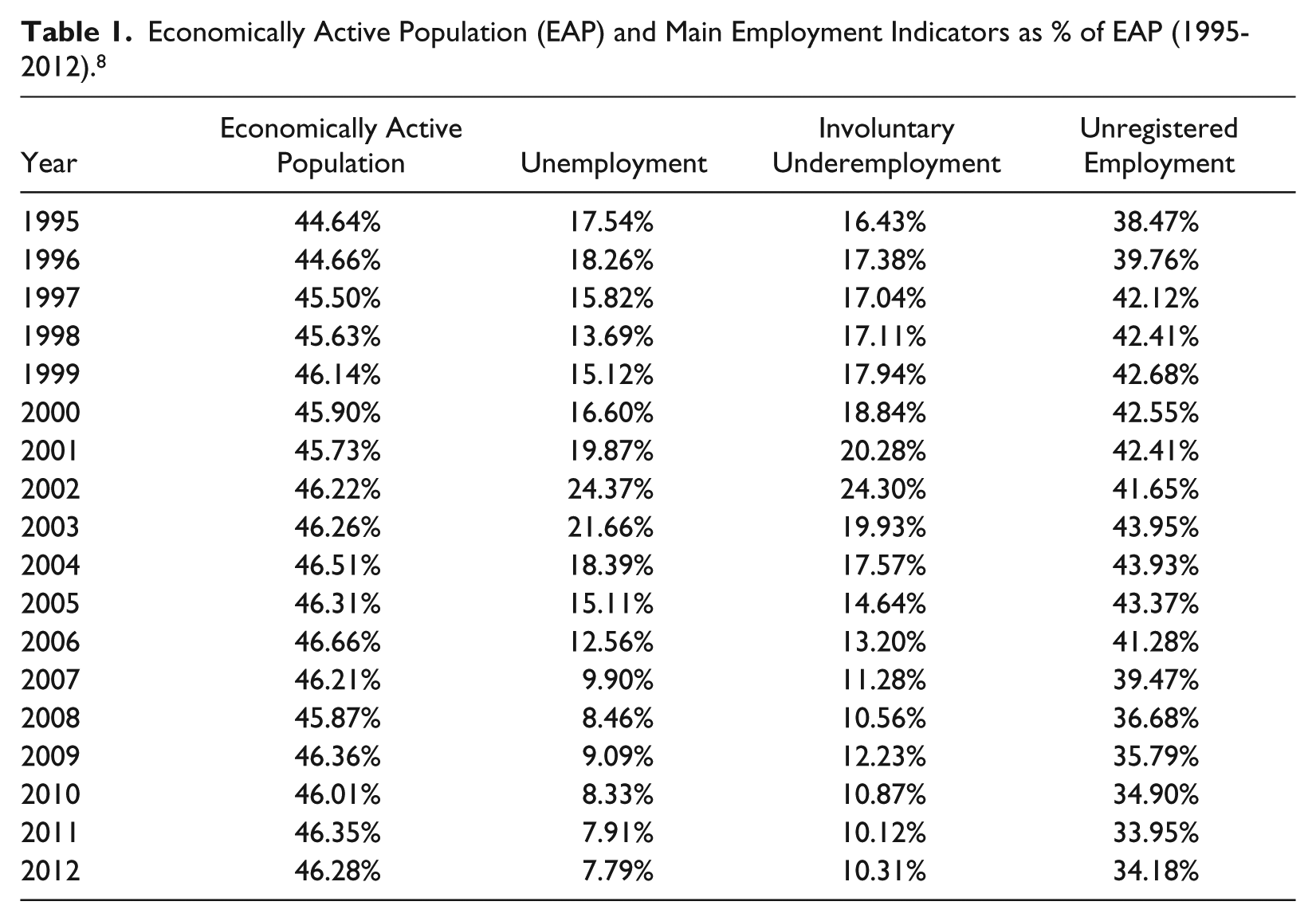
In addition, the new direction of economic policies and the periods of stagnation that afflicted the country between 1994 and 1996 and between 1998 and 2002 fuelled unemployment and raised workers’ fears of losing their jobs (see Figure 2 and Table 1). Such conditions imposed a discipline of their own on workers, which aggravated labor precariousness and reinforced the flexibilizing direction of the legal reforms. To put it differently, labor flexibilization was not only the product of labor policy reform but also the de facto outcome of economic restructuring and of the precarious and uncertain conditions that this restructuring generated for all workers. Under the conditions imposed by the Convertibility Plan, in particular the combination of trade liberalization and an increasingly appreciated currency, the manufacturing sector underwent a major transformation, with a significant impact on workers. To remain competitive and adjust to the terms imposed by artificially low-priced imports, some domestic producers acquired new capital-intensive technology rendered relatively affordable by the overvalued exchange rate. Many firms, however, did not have access to the financial resources required to modernize their plants and thus succumbed to the weight of foreign competition. This had a strong impact on manufacturing, which, by 1998, contributed only 17 percent of GDP, compared to 22.4 percent in 1982. This scenario was negative in terms of employment as well, as the sector lost more than 186,000 jobs between 1995 and 2002. While the share of employment in manufacturing fell, other activities including construction, retailing, transportation, and the public sector accounted for a growing share of the total number of jobs. Nevertheless, most of them were equally hit by the deep recession of the late 1990s (see Table 2).
Economically Active Population (EAP) and Main Employment Indicators as % of EAP (1995-2012). 8
People Employed by Industry as % of Total Employment (1995-2012).

Labor deregulation and structural adjustment in Argentina also resulted in growing unemployment. Yet, even as the employment crisis deepened in Argentina over the course of the 1990s, the government continued to promote labor reforms as the only possible way to encourage employment generation. In reality, the urgent need to control production costs in an economic context that made labor costs the only viable source of adjustment intensified the push for greater labor flexibilization. At the same time, the high levels of unemployment and underemployment also contributed to the growing power of employers to impose more flexible labor conditions.
5. The Worsening of the Crisis and the Incipient Recovery (2002-2003)
Between the end of 2001 and the beginning of 2002, many of the legal and institutional arrangements that had framed the economy during the previous years were modified. In particular, the government defaulted on part of the sovereign debt, abandoned the decade-long currency board, and allowed the peso to depreciate. Initially these policies pushed the country deeper into the ongoing depression and contributed to the gloom that pervaded forecasts for the Argentine economy. In addition, the acute exchange volatility that accompanied the end of convertibility fuelled inflation and dramatic changes in relative prices (see Figure 4).
By mid-2002, the economic debacle that began in 1998 and led to total social and political turmoil in December 2001 and early 2002, had reached its worst moment. By May 2002, unemployment had risen to 21.5 percent and underemployment to 18.6 percent. Figures for poverty and extreme poverty reached their all-time historical highs in modern Argentina in May 2002, when 53 percent of the population was living below the poverty line, and 24.8 percent was living below the extreme poverty line. Structural changes and their impact on labor markets also led to an increase in the gap between the rich and the poor. It is important to note that while poverty levels were closely related to the growth of unemployment and precariousness, work itself was not necessarily a springboard out of poverty; for many, wages were not sufficient to satisfy basic needs (see Figure 1).
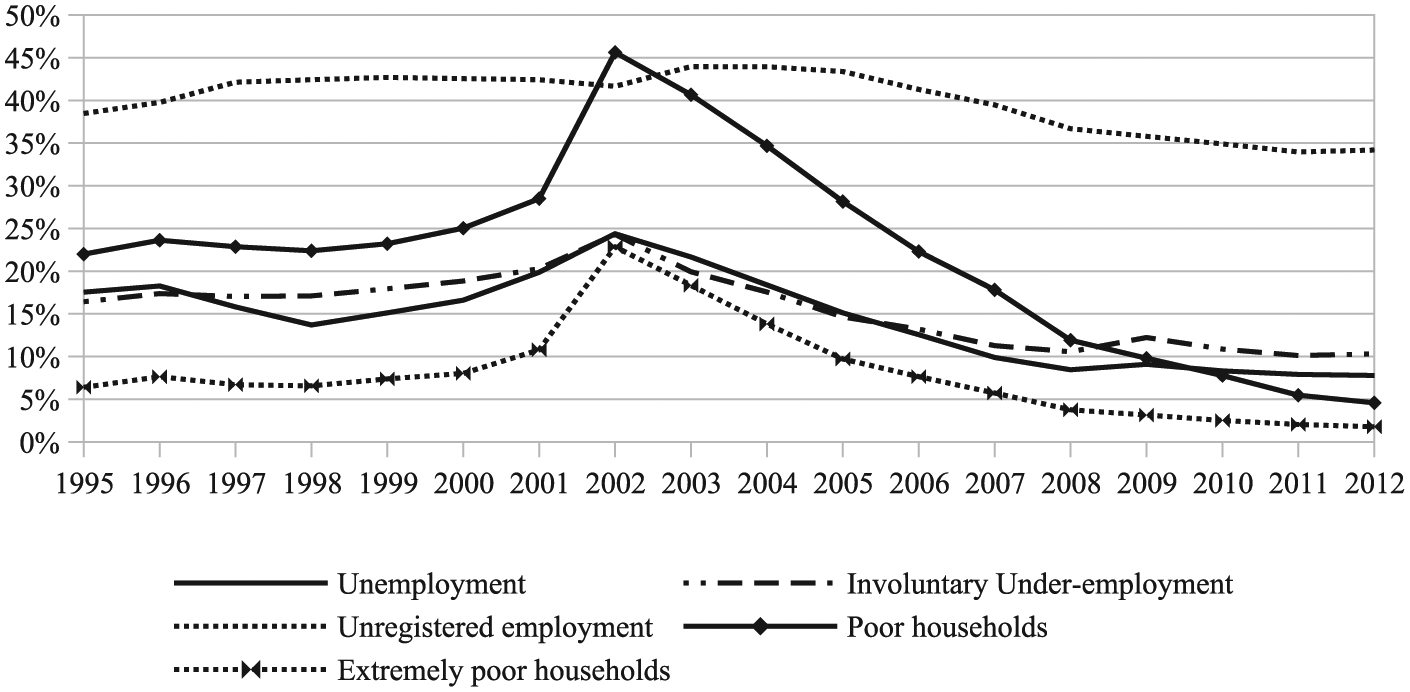
Unemployment, precarious employment and poverty (1995-2012). 6
A shift from a free float adopted in early-2002 to a dirty float by mid-2002 was instrumental in stopping the run against the peso and controlling the rising inflation that had followed devaluation. Stabilization, combined with the effects of devaluation on price competitiveness, fuelled a process of growth based on both import substitution and growing exports. The inflationary surge that followed the devaluation of the currency sharply affected domestic relative prices, with a strong reduction in real wages that, together with a freeze imposed on the prices of public utilities, lowered domestic production costs. At the same time, the state introduced a tax on exports of primary commodities, thus appropriating part of the foreign exchange windfall. This, in turn, helped to solve the twin deficit (external and fiscal) that had affected the country during the previous decade of currency overvaluation.
Starting with President Eduardo Duhalde’s (2002-2003) decision in July 2002 to decree a small across-the-board wage increase for all private-sector employees, wage decline slowed down. Government intervention was thus able to at least partially offset the effects of inflation on workers’ income (see Table 3). As we argue below, changes in social policy were also vitally important in this first stage of recovery.
Average Real Income (in constant ARS $), Main Job, by Industry and Economic Sector (1995-2012)
(CPI January 2005 = 100).

Note: Arguably, starting in 2007 the underestimation of CPI growth in official statistics results in the overestimation of real income.
6. The Virtuous Cycle of Growth and Employment (2003-2007)
After the dismal performance of 2002, Argentina emerged from a five-year recession to experience unprecedented rates of growth between 2003 and 2007. Over this period, the average growth in gross domestic product (GDP) stood at 8.8 percent (see Figure 2), in an international context in which commodity prices were rising and there was growing demand for agricultural commodities and some of their industrial products, which constitute the core of the country’s exports. Rates of employment generation increased, while unemployment and underemployment decreased (see Table 2).
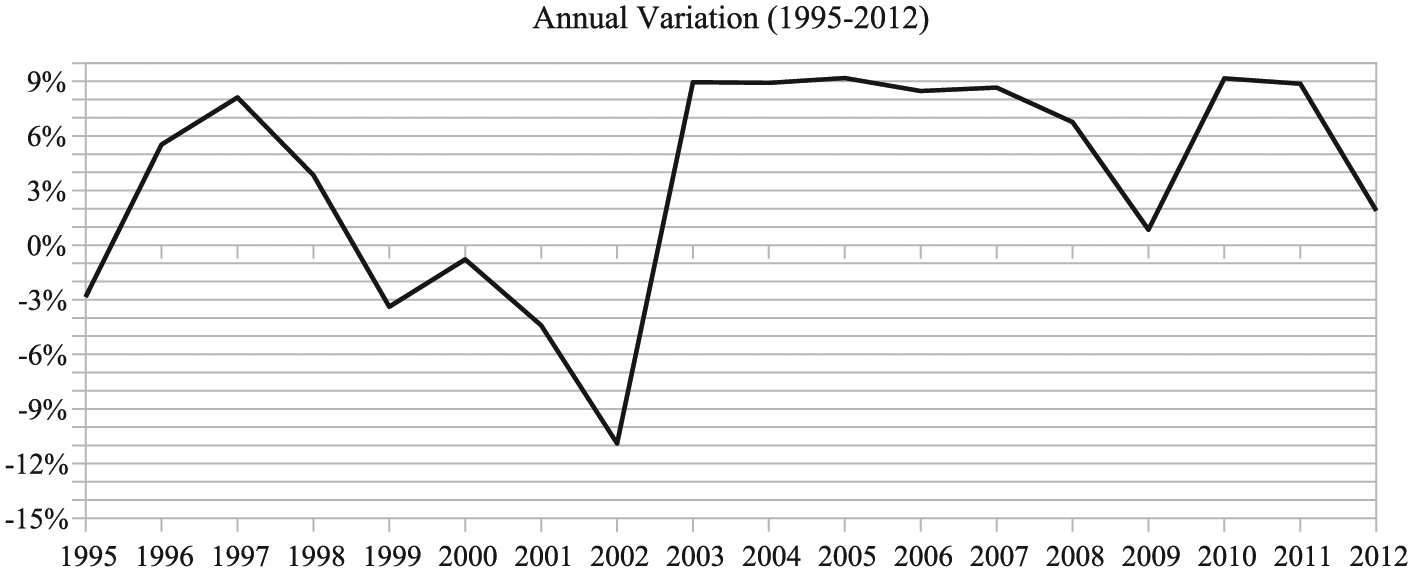
GDP. Constant Prices.
Reversing the trend of the 1990s, the rate of labor absorption rose considerably between 2003 and 2008, as labor-intensive industries contributed significantly to the economic reactivation. Similarly, whereas the growth of manufacturing lagged behind the growth of GDP in the 1990s, in the early 2000s manufacturing expanded at an above-average rate (Campos 2010: 60). 7
The performance of labor markets during this period of accelerated growth was quite different, too, from that of the early 1990s, in which growth had been accompanied by the elimination of jobs, the loss of legal labor rights, and wage discipline. Yet, while shifts in employment were indeed substantial, they nonetheless fell short of improving the very low quality work still held by a large portion of workers in Argentina. At the same time, the uneven distribution of income among workers in different industries and sectors persisted (see Table 3). To interpret these trends, we focus on three aspects that we see as central for understanding how labor markets were reshaped during this economic upswing in Argentina. The first involves the growth of employment in key economic sectors. The second relates to how the state intervened in the regulation of labor markets and addressed some of its main tensions; and the third and final aspect is related to how labor organizations responded to the new political conditions. In our view, we cannot fully understand changes since 2003 without considering the fundamental role of social mobilization in delegitimizing the previous consensus concerning neoliberalism. In the same way, the course that economic change has taken in the post-convertibility period must be considered in terms of the political context that made it possible.
6.1. The performance of labor markets in the recovery
The reduction in the rate of unemployment was without question one of the most significant features of the period of economic recovery. For the country as a whole, unemployment fell from 24.4 percent to around 8.5 percent between 2002 and 2008. The increase in the number of new formal salaried jobs, that is jobs registered for social security purposes, was also remarkable: while during the 1990s only 6 percent of new jobs satisfied this legal requirement, between 2003 and 2008, 85 percent of new jobs were registered (Panigo and Neffa 2009: 9). Thus, by 2009, 35.8 percent of salaried workers were unregistered, a significant decline from the peak of 44 percent in 2003 (see Table 1). Nonetheless, this remained substantially higher than the 27.2 percent unregistered workers in 1990 (Neffa 2010: 68-70) and the 19 percent in 1980 (Chitarroni and Cimillo 2007: 6). 8
The competitive advantages created by the 2002 devaluation and the considerable improvement in domestic demand that further encouraged the substitution of imports until at least 2007 boosted the performance of the manufacturing sector, which largely accounts for the improvement in the quality of jobs created in this period. The rapid expansion in manufacturing also created a sizeable amount of unregistered work, but by the end of 2007 unregistered work in this sector had dropped to 34.7 percent from the 42.5 percent it had reached in 2003, a considerable achievement, though still almost 5 percent higher than the level reached in 1995. In total numbers, employment in manufacturing grew by approximately 400,000 jobs from the worst moment for the sector in 2002 to 2012 (see Table 2), a remarkable increase of 37 percent. However, if we take 1997 as the base year, which was the last year of economic growth before the beginning of the final crisis of neoliberalism, the increase is only 14 percent.
Other sectors also grew rapidly, but their contribution to the creation of better quality jobs was less marked. For example, the growth of total employment in the construction and retail sectors was significant: 60.5 percent in the case of the former and 32 percent in the latter between 1997 and 2012. The growth is even more pronounced for construction with 2002 as the base year (94.49 percent). However, this growth differs sharply with the experience of the manufacturing sector due to the high incidence of unregistered employment in these sectors. Almost 82 percent of construction workers in 2002 were unregistered, and, while the figure has improved since then, it remains extremely high at around 67 percent of workers in 2007 (see Figure 3).

Unregistered Employment (1995-2012).
The composition of growth, then, might have direct implications on the quantity of protected jobs generated and, therefore, also on the longer-term potential to sustain the creation of better quality employment. Thus, while the manufacturing sector might on average be a sector characterized by better quality work, employment in this sector has not increased significantly since 1997. In contrast, of the sectors with a sizeable proportion of total employment growth like construction, wholesale and retail, restaurants and hotels, employment has grown substantially, but unregistered work constitutes a very high proportion of the sectors’ total employment.
Similarly, workers in the growing number of very small companies and family firms and self-employed workers linked to larger firms in the formal sector through the outsourcing of activities remain trapped in situations of vulnerability and precariousness (Gioza Zuazúa 2007: 332-334).
Inflation in 2002 eroded salaries and aggravated the already abysmal levels of poverty, 9 but starting in 2003, workers’ incomes changed significantly (see Table 3). At first, general lump-sum payments determined by decree during 2002 and 2003 benefited most workers. Starting in 2004, wages became more closely connected to the reactivation of collective bargaining between workers and employers with the mediation of the state. The reactivation of wage negotiation, however, did little to change the existing variation in workers’ incomes, reflecting their divergent positions in a fragmented labor market. Precarious workers benefited from some wage improvement due to both the increase in the legal minimum wage and the general rise in salaries, but their wages have remained consistently below the salaries of formal workers (Chitarroni and Cimillo 2007: 7-8).
Overall, by 2007, real wages recovered their pre-devaluation levels (González 2011: 42). Wage increases, in combination with the gradual fall of unemployment and the implementation of comprehensive social assistance programs, reduced the high levels of poverty and extreme poverty that had characterized the turn of the decade.
6.2. The role of the state in the reshaping of labor markets and the management of conflict
Important legal and institutional changes accompanied, and to some extent fuelled, changes in employment and workers’ income. First, the annulment of the convertibility regime made it possible once again to obtain wage increases unrelated to productivity increases, bringing back wage negotiations that had been virtually eliminated during the previous decade. Then, in 2004, a legal amendment eliminated some forms of unprotected work previously sanctioned by legal reforms (“trash labor contracts” as they became known in Argentina). Accompanying the recovery, and in contrast to the policies of the 1990s, post-crisis governments encouraged collective bargaining that resulted in considerable wage increases for workers represented by stronger unions. The government also used incentives to encourage companies to regularize unregistered workers, with modest results. It concentrated its efforts on simplifying the procedures for registering workers, on implementing a tax moratorium for employers that registered their workers, and on intensifying audits. The results, however, have mostly benefited unregistered workers in formal firms.
Important modifications in assistance policies accompanied changes in the performance of labor markets, particularly after 2004 as the recovery was consolidated. The new administration of Néstor Kirchner introduced modifications to the Program for Unemployed Heads of Family (PJJHD, Programa Jefes y Jefas de Hogares Desocupados) that clearly reflect the changing approach to social policy. The PJJHD was created in January 2002 in response to both the crisis produced by the collapse of neoliberal reforms and the social unrest that this crisis triggered. It consisted of a small cash transfer for unemployed and working poor with dependents under 18 years old. The program differed significantly from the rigid conditionality and targeting criteria of the workfare programs of the previous decade (Logiudice 2011: 66). It required less demanding forms of community work, training, school attendance, and health controls for children, and it reached an exponentially larger number of beneficiaries than previous workfare programs: 2 million people by the end of 2002 compared to 170,000 beneficiaries in the previous workfare program, Trabajar. Moreover, it was conceived as a universal program, although the incorporation of beneficiaries was closed in mid-2002 due to budgetary restrictions (Neffa 2009: 286). While the changes in the delivery of workfare programs were then substantial—and probably inescapable considering the scope of the crisis—there were also key continuities in the conception of social assistance. In particular, like previous programs, the PJJHD provided an extremely low level of income. 10 Moreover, as with the programs of the 1990s, the PJJHD did not provide healthcare or social security coverage.
Under Kirchner’s leadership, there was an attempt at first to restore the link between assistance and workfare, in large part because this made the program more politically palatable for the middle classes and foreign donors. Early in his mandate, Kirchner also sought to use social assistance programs as a way to benefit some organizations of unemployed workers and other social groups aligned with the government. The strategy proved useful at a time of heightened political instability and uncertainty. However, as the Kirchner government consolidated the bases for its own political power and as the economy started to show clear signs of recovery, the government’s priorities changed considerably. First of all, renewed economic growth expedited the incorporation of many PJJHD recipients into the labor market. 11 In addition, the complexities inherent in the size of the program brought many to believe that it needed to be scaled down. To this end, beneficiaries not absorbed by the market but considered “employable” were transferred to programs administered by the Ministry of Labor, in particular to a new Employment and Training Insurance program (Seguro de Capacitación y Empleo) created in 2006. Another important program during this period was Let’s Get to Work (Manos a la Obra), which granted financial and technical assistance for social organizations that carried out productive projects within what increasingly gained prominence in public discourse as the social economy.
Other groups of beneficiaries, defined as structurally disadvantaged and “unemployable,” were transferred to programs offered by the Ministry of Social Development, the most important being Families for Social Inclusion (Familias por la Inclusión Social) created in 2004. 12 Families for Social Inclusion forms part of a number of social programs aimed at addressing not the issue of unemployment directly, but rather poverty and social exclusion. The National Program of Food Security (Programa Nacional de Seguridad Alimentaria) also falls into this group, reaching a total of 1 million families in 2004.
A key transformation in these new programs was that they eliminated the expectation of work in return for assistance. The programs for those considered employable required participation in training activities, replacing requirements for direct involvement in productive activities. For the unemployable, assistance became conditional upon ensuring that children in the household attended school and received basic health services. The central political objective underlying this fundamental change in the conditions and mechanisms for allocating assistance was to reduce the influence of the groups and organizations that had previously had a central role in the distribution of programs (Logiudice 2011: 74). This was a welcome transformation for the government, as it granted Kirchner additional autonomy during a period of increasing political clout.
Finally, the creation of these new social assistance programs reflected a gradual shift away from the argument that growth alone would suffice to address the deficiencies of labor markets, adopting instead the premise that strengthening social and human capital was a necessary first step to help workers improve their quality of life (Logiudice 2011).
6.3. The transformation of labor struggles
While the factors discussed above certainly affected the performance of labor markets, workers’ organizations also played a crucial role in reshaping these markets and orienting the policies that affected them. The position of key labor organizations with respect to the most pressing issues facing workers in the post-2003 period was closely related to their overall stance vis-à-vis the government. First, the Kirchner government presented the organizations of the unemployed—known collectively as the piquetero movement, which became a central political actor during the last stages of convertibility—with a very different set of challenges. Partly because the government recognized many of the demands raised by the workers most affected by neoliberal reforms in the 1990s, some organizations within the piquetero movement became closer to the state, as it offered them the possibility of new, viable channels to influence policymaking. This was a way to institutionalize the demands of these organizations at a time when increasing the basis of support was critical for the government itself. The main outcome of this new political scenario was twofold. On the one hand, along with the considerable decline in unemployment, a very large segment of organizations within the piquetero movement became progressively demobilized. On the other, it also prevented these organizations from becoming central actors during this period, in what would have arguably been a natural extension of their previous demands for work into struggles for protected, formal work.
Second, as part of the government’s support for re-establishing the central role of collective bargaining in the determination of wages, the traditional labor movement—represented by the historical ally of the Peronist party, the General Confederation of Labor (CGT, Confederación General del Trabajo)—weakened by the neoliberal transformation of the country during the 1990s, recovered strength and political primacy. It played a central role in negotiating salary increases, in line with the overall macroeconomic targets set by the government.
The new strength the CGT acquired during this period did not, however, mean that it was able or, more importantly, even willing to effectively represent all workers’ struggles or the plight of precarious workers. In fact, struggles against precarious employment have not occupied a primary position in negotiations with employers or interventions with the government, having for the most part been circumscribed to local initiatives and conflicts. 13
Third, while the behavior of the CGT might have been in line with its political trajectory, the situation was quite different with the Central of Argentine Workers (CTA, Central de Trabajadores de Argentina), a union federation that emerged precisely as an alternative to the CGT and provided representation to those workers most affected by the restructuring in the 1990s, including precarious, informal, and unemployed workers. However, both the demobilization of the organizations of the unemployed and precariously employed and the reaffirmation of the position of the CGT vis-à-vis the government constrained the CTA’s capacity to represent and organize these workers in the post-convertibility period. There were also deep disagreements within the CTA about a government that positioned itself as progressive but that supported rebuilding the central role of traditional unionism. As a result, in 2010 the CTA divided into two factions with opposing views about the costs and benefits of an alliance with the government.
Politically, then, this new stage meant that the organizations more inclined to take on the demands of precarious workers lost the dynamism they had acquired in their struggle against neoliberalism in the 1990s. Moreover, while the CGT and the unions it represents did gain a position of substantial power during the period under study, they were neither institutionally prepared nor politically inclined to become effective channels for the representation of precarious workers.
7. The Emergence of Tensions, Changes in the Performance of Labor Markets, and Policy Shifts since 2007
Inflation rose as an unintended consequence of growth and the recovery of the purchasing power of wages in an international context of rising commodity prices. In 2006, the government took pains to sign price agreements with large companies, though it helped to contain inflation only temporarily. As these negotiations began to reveal their limitations, the National Institute for Statistics and Censuses (INDEC, Instituto Nacional de Estadísticas y Censos) changed its methods to measure inflation in a way that seriously damaged the legitimacy of official statistics (see Figure 4). 14 In addition, after 2007, the exchange rate became a key anti-inflationary anchor, resulting in the gradual real appreciation of the peso (Campos, González, and Sacavini 2010). This, in turn, affected the competitiveness of domestic manufacturers, a problem that became central to some of the demands they made on the state (Féliz 2010).
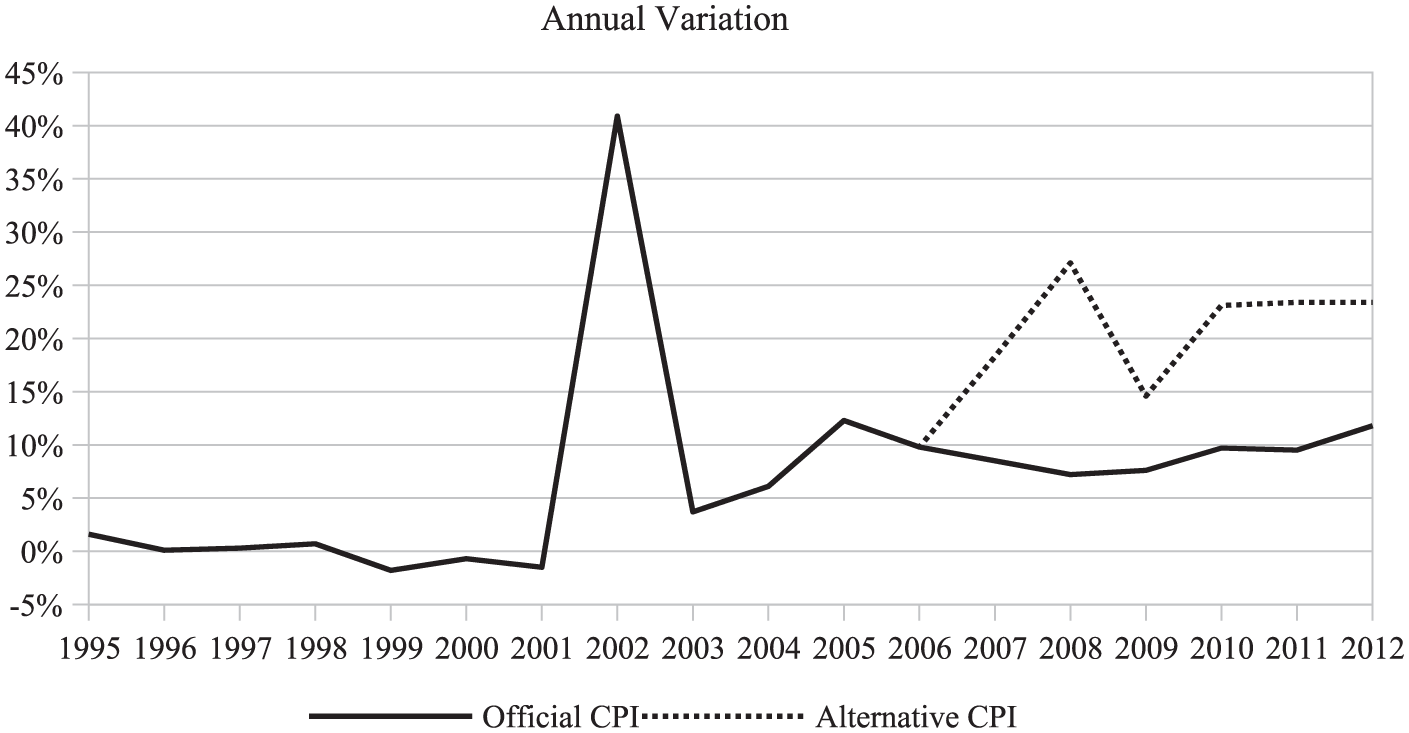
Consumer Price Index (1995-2012).
In March 2008, the government introduced a sliding-scale tax for the export of soybeans and sunflower seed oil that would fluctuate along with changes in international prices. The tax was intended to delink the domestic prices of foodstuffs from the unprecedentedly high international prices of soybean and other export crops and transfer to the state part of the extraordinary rents accrued to agricultural producers due to these prices and the high fertility of Argentine soil. The expectation was that the initiative would alleviate inflationary pressures and create incentives for farmers to switch from export crops to staple foods. Instead, the country’s main landowner organizations immediately launched a lockout that lasted more than three months and managed to gather broad social support in both the countryside and several large cities. The government abandoned its proposal after failing to obtain congressional support. The political consequences of this conflict outlived the demise of the tax, as the rebellion catalyzed an informal political, economic, and social force strongly opposed to a government it saw as populist, authoritarian, and irresponsible. The poor performance of the incumbent party in the 2009 mid-term election clearly reflected the political cost of this conflict. After six years of vigorous growth, in 2009 GDP growth stood at only 0.9 percent, with negative consequences for employment (see Figure 2 and Table 1).
The economy recovered quickly from the crisis, with 9.2 percent GDP growth in 2010, and by the end of that year unemployment had fallen to 7.3 percent. Along with the economic recovery, the government managed to leave the political crisis behind. In 2011 Cristina Kirchner was re-elected with 54.1 percent of the vote, a substantial increase from the 45.29 percent with which she had secured her first electoral victory in 2007. It was an overwhelming presidential victory but it was not sufficient to prevent the growing weight of an opposition that finally defeated the incumbent party in the 2015 presidential elections. The four years that preceded this defeat encompassed a number of economic challenges, most prominently the downturn in international markets for the country’s primary exports, and the slowing down of the economy, including growing external, fiscal, and macroeconomic imbalances.
Economic policies followed increasingly contradictory paths. On the one hand, a number of policies seemed to be aimed at re-integrating the country into international finance and meeting the financial commitments of the state. On the other hand, some decisions intensified the challenges to the “pro-market orthodoxy” associated with these goals. When the worst consequences of the 2008 crisis were overcome, inflation regained momentum, considerably exceeding international figures (Katz 2010). 15 High inflation eroded the workers’ wage gains of the previous years. It also reduced the domestic competitiveness of Argentine businesses and led the capitalist establishment to push for the devaluation of the peso. The government resisted this demand, fearing the inflationary effects of further devaluation, and instead addressed declining domestic competitiveness by increasing subsidies and compensations for different industries (Katz 2010: 31) while imposing gradually stricter exchange regulations.
The currency was eventually devalued in 2014 but the most powerful capitalist fractions demanded further devaluation and the lifting of a number of economic regulations in increasingly confrontational terms amidst high rates of inflation and dwindling foreign reserves. Deteriorating economic conditions and political turmoil prompted social mobilization as well, putting increasing distance between the government and sectors at the core of the governing alliance, not the least among them some factions within the labor movement. In 2015, amidst a very high level of political conflict, Mauricio Macri of Cambiemos (Let’s Change) managed to defeat the candidate backed by the government only in the second round and by less than 3 percent of the vote. Immediately after Macri’s inauguration, exchange controls were eliminated resulting in a major devaluation, and export tariffs on commodities were eliminated or dramatically reduced. Expectably, prices, especially food prices, have soared.
After 2007 the performance of labor markets changed significantly when compared to the period between 2003 and 2007. 16 Job creation slowed down, and the majority of new jobs were remunerated at a rate below the average wage (ILO 2012). Although registered employment continued to grow, as of 2007—that is, before the effects of the world crisis reached the country late in 2008—it did so at a slower rate, from 12 percent at its most dynamic point in the last quarter of 2004 to 6.8 percent in the second quarter of 2008 (Campos et al. 2009: 6). 17 The change in the rate of employment growth was more accentuated in the manufacturing sector and less so in services (ibid.: 6-7 and Figure 5). The upward trend of better quality work continued, but the incidence of unregistered work only fell from 35.8 percent in 2009 to 34.2 percent in 2012. 18 For workers in general, real wages remained practically stagnant between 2007 and the second trimester of 2010. The performance of wages for unregistered workers was particularly affected by inflation (Campos et al. 2009: 5).
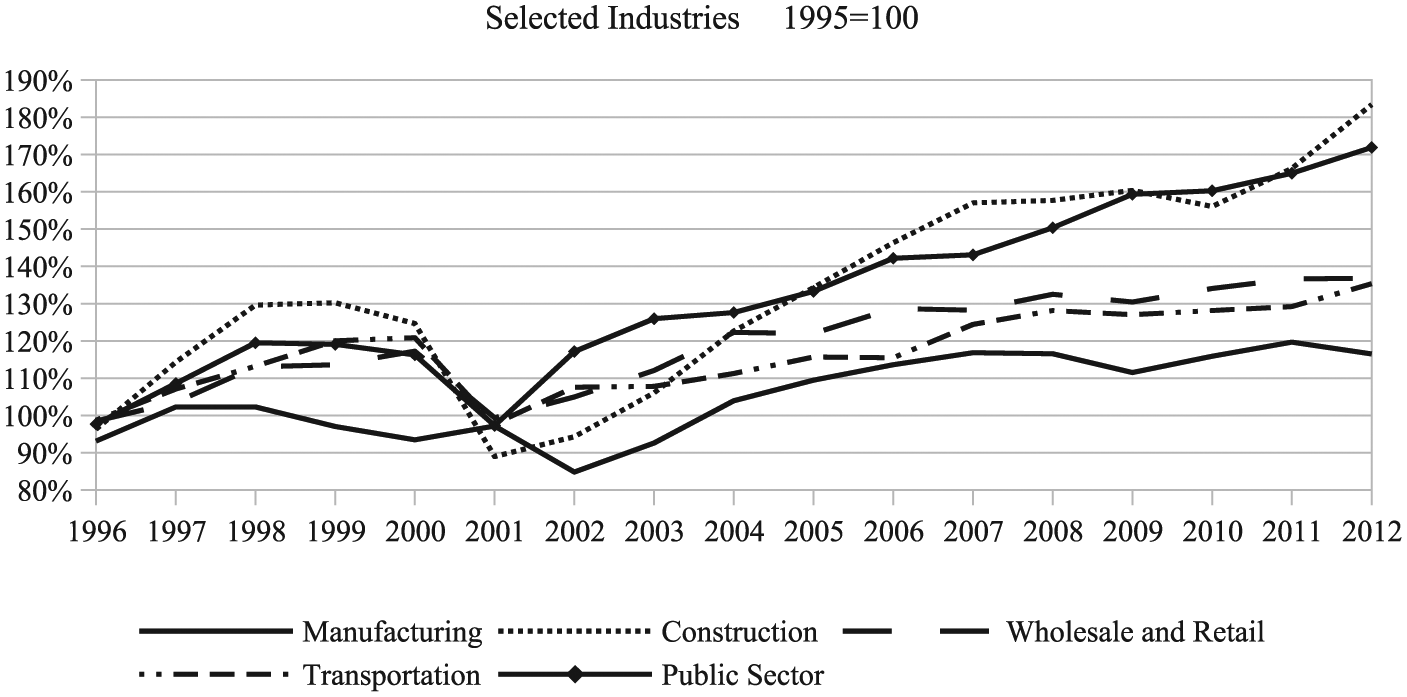
Employment Creation (1995-2012).
As a response to the effects of the crisis on growth and employment, the government took a series of important policy initiatives. First, in 2008 it nationalized pension funds that had been partially privatized in 1994, thus channeling the contribution of employers and active workers to the state. These funds gave the state more room to increase spending. 19 By late 2009, when companies were announcing dismissals and work stoppages, the government offered subsidies to those companies that committed to maintaining their staff. 20 However, it was the electoral defeat in the 2009 mid-term elections that prompted some important re-thinking in social policy. In an attempt to regain the political spaces lost during this critical moment in Argentina, the government, now under the leadership of Cristina Fernández de Kirchner (2007-2015), sought to further extend social protection to disadvantaged segments of the population. A key initiative in this stage was the implementation of the Universal Allowance per Child (AUH, Asignación Universal por Hijo), a cash transfer program for informal workers with children. The government broadened the scope of assistance programs in mid-2009 with the program Social Income with Work—Argentina Works (Ingreso Social con Trabajo—Argentina Trabaja), which fosters the creation of worker cooperatives of up to 70 members, granting them a monthly stipend to carry out public works in poor cities, towns, or neighborhoods. Even though workers are organized in cooperatives, the program maintains the logic of social assistance programs in that the state brings them together, sets their goals, and finances their work. The amount of workers’ stipends, however, is considerably higher than that of other assistance programs, and beneficiaries receive health insurance and social security benefits as self-employed workers (Logiudice 2010). Crucially, beneficiaries of the program are legally members of co-ops and not salaried workers. Their economic intervention has thus been framed as part of the growing social economy, defined by the government as a sector with the potential to provide progressive options to address issues of poverty and marginalization. By 2010, 150,000 workers, organized in 1,600 cooperatives, have joined the program (Guimenez and Hopp 2011).
Even though these programs did not fully prevent the negative impact of the economic slowdown on workers, they constituted an important change in the orientation of social policies toward less focused, more universal programs and also toward a new relationship with some social organizations, aligned with the government, which have taken a more active role in the implementation of Argentina Works. The effectiveness of the programs must be measured at least partially by their relevance in building support and helping the government overcome its political crisis at the time.
8. Conclusion: Is There a Way Toward More Inclusive Growth?
Without denying the substantial improvements the country has achieved in key economic and social indicators with a direct impact on workers, the accomplishments are considerably less impressive when we extend the time frame for the comparison. In this case, not surprisingly, we can identify a transformation in the conditions that workers encounter when they sell their labor power that is very much in line with the growing capacity of capital worldwide, beginning in the mid-1970s, to roll back the concessions that labor attained during the previous period of expansion starting in the 1940s. Over the last 30 years, what we have come to identify as “globalization” has been principally characterized by the deterioration of working conditions and of the income and levels of protections that workers had previously enjoyed. Nonetheless, Argentina is a special case in at least three respects. One is the violence through which the disarticulation of labor power was pursued in the 1970s, including the use of state terrorism against union organizers and activists as part of the generalized fear the military sought to spread throughout society. The second relates to the intensity and scope of the structural adjustment during the 1990s and the magnitude of the economic and political crisis—including widespread social conflict—that brought this period to an end. The third feature of the country’s recent transformation is the fast and unexpected recovery of the early 2000s and the neutralization of the social actors that so decisively carried forward the struggles that broke down the consensus around neoliberalism.
Policies in the area of labor relations were particularly significant in the wake of the employment crisis, the alarming levels of poverty, the demands of organizations representing precarious and unemployed workers, and the deep political crisis that afflicted the country at the turn of the century. Reducing unemployment was clearly a central priority, but addressing poverty also demanded higher wages and specific welfare policies that targeted the working poor. As unemployment fell and wages improved, the labor movement regained some of the power it had previously possessed. All this, in turn, eroded the initial relevance of low wages as the foundation of the recovery, eventually becoming a major source of conflict between unions, the state, and business (Campos 2010: 65-66).
Commodity exports have been pivotal in the pattern of growth taking shape since 2003. They helped procure the hard currency that made it possible to sustain both state spending and the imports necessary for a manufacturing sector mostly geared toward the domestic market. In many ways, this pattern mirrors the structural contradictions of the import-substituting model, though now under a more open and globally integrated national economy. A unifying factor among dissenting capitalist interests is, in a somewhat contrasting fashion from the classical import substitution period, the concern about labor costs and state spending. The persistent heterogeneity of working conditions is one of the key characteristics in this development experience. The rapid pace of economic growth between 2003 and 2012 has not sufficed to reverse this fragmentation. On the contrary, pervasive inequalities between workers and diverse forms of labor precariousness have outlasted the neoliberal policies and economic context in which they grew so exponentially. In this sense, it is reasonable to conclude that the fragmentation of labor markets is a structural feature of the country today, whose resolution lay beyond the confines of Argentina’s economic strategy during the period of our study.
Access to jobs that provide a living wage, stability, benefits, safety at work, freedom of association, and the right to collective bargaining is a primary means by which populations potentially benefit from economic growth. Thus, the persistence of precariousness undermines the capacity of growth to address deep-seated poverty and inequality and to create the conditions for more inclusive development. In the specific case of Argentina, where key social rights are received by being legally recognized as workers, unregistered employment jeopardizes access to paid health care services, pensions, and other benefits. Moreover, unregistered workers do not qualify for unemployment insurance or compensation in the case of accidents at work (Neffa 2010: 62-63). Without innovative policy interventions, the problems of precariousness and unregistered work are not likely to diminish further. However, the possibilities for more active labor policy largely depend upon the political capacity of working-class organizations to move beyond defensive actions and to struggle instead to regain and consolidate labor rights. As our analysis shows, their actions should be directed at challenging the pattern of economic growth the country has followed. Ultimately, the question at the core of Argentina’s current challenges is whether ensuring protection for workers is compatible with the form and depth of the country’s integration into the international economy since the 1990s.
Judging from the very first economic decisions of the new Macri administration, this pattern of growth might actually be exacerbated. The lifting of exchange controls to favor primary exporters, the opening up of the country once again to trade and financial flows, the signs of “good will” extended to international finance, and the commitment to end the “harassment of private investors” as The Economist suggested (Nov. 28, 2015) are all indications of a privileging of interests historically in opposition to those of labor. The outcomes of the new government’s economic policies and the future performance of labor markets are yet to be seen. Even though the political leanings of the government and the economic prospects of the country do not allow for much optimism, actual policies and the reshaping of labor relations will depend on the balances between those actors behind the new government’s policy shifts and workers’ organizing capacities to continue to struggle for more just and equitable forms of economic growth.
Footnotes
Declaration of Conflicting Interests
The author(s) declared no potential conflicts of interest with respect to the research, authorship, and/or publication of this article.
Funding
The author(s) received no financial support for the research, authorship, and/or publication of this article.
1
An earlier version of this article was presented at the Second ISA Forum of Sociology, Social Justice, and Democratization, Buenos Aires, Argentina, August 1-4, 2012. The authors thank the three reviewers for their insightful comments on a previous version of the article, Shana Yael Shubs for her editorial work, and Mariana Álvarez for her assistance in collecting and organizing statistical data. Needless to say, all mistakes and omissions are ours.
2
Interestingly, the hiring of workers as service providers became a generalized modality for the federal and local states in Argentina, which speaks to the active involvement of the state in extending labor informality and precariousness.
3
As specified in paragraph 9 (6) of the “Resolution concerning statistics of employment in the informal sector,” adopted by the Fifteenth International Conference of Labor Statisticians in 1993, “Employees may be considered registered if they are employed on the basis of an employment or apprenticeship contract which commits the employer to pay relevant taxes and social security contributions on behalf of the employee or which makes the employment relationship subject to standard labor legislation.” In the specific case of Argentina, an unregistered worker is a person not registered in the registry established by the Law of Employment Contract (Ley de Contrato de Trabajo) and is not covered by social security or contributes to the pension system as existing labor legislation specified. For statistical purposes, unregistered workers are those who answer the Permanent Household Survey (EPH for its Spanish acronym) saying their employers do not contribute on their behalf to the social security system ( : 61-62).
4
For example, : 5) estimated that 43.8 percent of the total workforce was unregistered in 2010. For the same year, around 58 percent of self-employed workers were unregistered while, as we will see below, the rate of unregistered work among salaried workers was lower at approximately 38 percent. Salaried workers represented that year 76 percent of all employed individuals.
5
According to the Ministry of Labor 95 percent of workers in unregistered jobs accepted the positions because it was the only way in which the employer was willing to hire them (Ministerio de Trabajo, Empleo y Seguridad Social, Argentina 2013: 8-9).
6
Except where otherwise noted, tables and figures are prepared by the authors with the assistance of Mariana Álvarez, based on data from the Permanent Household Survey, Argentina’s National Institute for Statistics and Census.
7
Between 2002 and 2006, manufacturing grew 39.9 percent more than the average rate of growth (Campos 2010: 60).
8
These figures do not capture the magnitude of labor precariousness that affects temporary, self-employed, and underemployed workers and those with multiple occupations. According to , by 2008, 60 percent of workers were working in precarious conditions, with average wages 40 percent below the legal minimum wage.
9
10
While families assisted by the PJJHD received ARS $150, by October 2002 the cost of the basic food basket for a family of two adults and two children, equivalent to the line of extreme poverty, was ARS $346.07. To cover all basic needs, that is to reach the line of poverty, the same family would have needed ARS $764.84 (: 300).
11
12
Approximately 300,000 former beneficiaries of PJJHD had been transferred to this program by the end of 2007 (Casanova 2008). Assistance was conditional upon sending children to school and taking them to periodic health care controls. Authors agree that the program discouraged women’s participation in labor markets (: 73).
13
Moreover, the legitimacy of the CGT in general has been compromised on more than one occasion due to well-founded charges against it in connection with its support for the subcontracting of jobs and activities to companies in which it has an economic interest as a shareholder.
14
Arguably, this change was made in order to limit the cost of servicing debt bonds whose yields were tied to the evolution of the CPI index. But speculation about the actual inflation figures may also have helped to increase inflationary expectations and has made wage bargaining more conflictive.
15
Private estimates based on provincial statistics calculate a yearly 25 percent CPI growth in 2010 and 2011 (Katz 2011).
16
It is worth mentioning that the growing gap between GDP and employment growth might be overestimated because of the under-estimation of the inflation rate in official statistics.
17
During this period, registered work also grew faster than employment, as some formal jobs were not new but rather conversions from unregistered positions.
18
19
By investing part of these funds, the state gained seats on the boards of directors of several large companies. The government also used these funds to finance a number of initiatives and projects.
20
The Program for Productive Recovery (REPRO, Programa de Recuperación Productiva) was created to address the threat of massive dismissals. Companies applied to get part of their workers’ wages covered by the state for a period up to 12 months on the condition that they refrain from laying off workers.