




Abstract
Unequal exchange arises when spatial production of value is disjointed from its geographical distribution. A disaggregated monetary model of the world economy is presented on the grounds of Marx’s labor theory of value. All the forms of unequal exchange in international trade are explained, on the basis of a coherent definition of the forms of international value of traded commodities. Estimates of value transfers for recent years show the ongoing relevance of the unequal exchange in the modern capitalist world economy.
1. Introduction
The belief that international trade is mutually beneficial to all partners dates back to Ricardo’s theory of comparative advantage, and it represents the theoretical justification of neoliberal trade policies. The simultaneous increase in trade and global inequality in recent decades, however, does not accord with this belief, or at least benefits are not equally distributed.
In the period 1990–2007, the growth in volume of international trade was 362 percent, almost two and a half times greater than the growth of world real output (World Trade Organization [WTO] 2011), and the trade openness of the global economy reached its maximum historical level, well above the levels attained in the previous stages of economic globalization in the nineteenth and twentieth centuries (Federico and Tena-Junguito 2017). In parallel, absolute global income inequality rose (Bosmans, Decancq, and Decoster 2014; Goda and García 2017), and between-country inequality explains most of today’s overall inequality (Anand and Segal 2015). In the present world, geographical location is the most important factor determining personal income opportunity, and it accounts for more than half of the variability of global income differences (Milanovic 2012, 2015). For these reasons, the age of globalization is at the same time the age of mass migration caused by increasing global inequality (Bastia 2013).
The belief of mutual benefits of free trade has been questioned according to different arguments, from ancient mercantilism to the latest economic theories (Brolin 2007; Shaikh 1980), and the theory of unequal exchange is one of the most influential among them. Unequal exchange arises when spatial production of value is disjointed from its geographical distribution, in the same way as social production of value diverges from its distribution between social classes (Harvey 2006: 439–42). Production and capture of value by locations are two different things, and trade is one of the ways of their uncoupling (Henderson et al. 2002).
Several schools of economic thought, competing with the neoclassical mainstream, have been influenced by unequal exchange theory. The recent theoretical frameworks of global commodity chains (Heintz 2006; Selwyn 2012, 2015; Somel 2005), as well as ecological economics (Foster and Holleman 2014; Hornborg 2014; Lonergan 1988; Nordlund 2014), share common features with the unequal exchange tradition. The persistent unequal development makes unequal exchange in international trade still crucial for analyzing the economic mechanisms of globalization, despite the rapid industrialization of some formerly peripheral countries, most notably China (Baiman 2006; Bieler and Morton 2014; Itoh 2009). The recent growth of North-South trade has stimulated further research on the opposite effects for the North, deriving from the coexistence of unequal value transfers and deindustrialization, in terms of higher income and lower employment (Kollmeyer 2009).
The aim of this article is to give a theoretical and empirical cross-cutting contribution to the debates about globalization, unequal exchange theory, and the new international division of labor, in the context of Marx’s labor theory of value (LTV). Section 2 presents a critical review of the theoretical and empirical literature, where competing views on the sources of unequal exchange are compared. Section 3 discusses the meaning of unequal exchange in Marx’s LTV by applying the analysis of rent generation presented in volume 3 of Capital to the case of international trade. In Marx’s theory, unequal exchange is the result of structural disequilibrium conditions between and within branches of production, originating a quantitative mismatch between value in production and value in circulation, which manifests itself in the form of absolute, or intraindustry, and differential, or interindustry, rent. Section 4 introduces a multisectoral, multicountry monetary model of the world economy, with heterogeneous labor and nonspecific commodities, to investigate all possible value transfers in trade, on the basis of a coherent definition of the forms of international value of traded commodities. The model is built on a disaggregate version of the New Interpretation (NI) of Marx’s LTV, able to overcome in a consistent manner the traditional problem in Marxist economics of the reduction of heterogeneous labor into homogeneous labor, and to account for international labor productivity differentials in estimating trade value transfers. This general theoretical framework encompasses all the previous partial accounts of unequal exchange proposed in the literature.
In section 5, empirical estimates of value transfers for recent years (1995, 2000, and 2007) are presented by use of the World Input Output Database (WIOD), showing the continuing relevance of unequal exchange in the modern capitalist global economy. Two aspects, in particular, deserve attention: first, during the period considered, the relative size of intraindustry value transfers is increased at the expense of interindustry value transfers, thereby confirming the thesis of a new international division of labor based on an ongoing process of industrial convergence between developed and emerging countries; second, the social distribution of gains and losses of unequal exchange between wages and profits challenges Emmanuel’s view of a North “labor aristocracy” as exclusive beneficiary of unequal exchange to the detriment of peripheral workers.
Finally, section 6 is devoted to some concluding remarks.
2. The Unequal Exchange Debate
The term unequal exchange was originally coined by Emmanuel (1962, 1972, 1973, 1975) to indicate international transfer of value hidden behind apparent equality in trade (for critical reviews, see Brolin 2016; Edwards 2015; Evans 1984; Lichtenstein 2016; Raffer 1987; Sheppard 2012). In Emmanuel’s view, differences in monetary wages between countries, deriving from institutional factors such as trade union power in central countries, are the cause of inequality in trade and international value transfers from poor to rich economies. According to Gibson (1980), the “Fundamental Theorem” of Emmanuel’s unequal exchange relates increase/decrease in relative monetary wages between countries and improvement/deterioration in barter terms of trade. This thesis can be explicated either by Marxian price of production schemas or by Sraffian price systems (Bacha 1978; Barnes 1985).
In the controversy following the publication of Emmanuel’s works, different strands of criticism emerged, among them the lack of consideration of the transformation problem from values to prices of production (Palloix 1970; Somaini 1973); the restriction of the analysis to complete specialization, unable to treat nonspecific, intraindustry trade assuming increasing relevance in the contemporary world economy (De Janvry and Kramer 1979); the assumption of wages as exogenous variables, independent from differences in labor productivity between countries due to different techniques of production (Houston and Paus 1987); and the extreme assumption of worldwide identical rates of profit, not substantiated by empirical evidence (Bernal 1980). The generally accepted conclusion of this long debate was the proper definition of unequal exchange as a condition in which double-factorial terms of trade are different from one (Erten 2011; Findlay 1984; Liodakis 1996; Ocampo 1986).
The assumptions of perfect international capital mobility, relative immobility of labor, and competitive markets make Emmanuel’s unequal exchange theory different from previous structuralist and Marxist theories on inequality in trade. Structuralist unequal exchange theory was inspired by the works of Arthur Lewis (1954, 1969, 1978, 1979), Raul Prebisch (Economic Commission for Latin America and the Caribbean 1950; Prebisch 1959), and Hans Singer (1950).
The core of Lewis’s argument is the labor market dualism in peripheral countries, between a traditional sector and a modern one (Fields 2004). In the traditional sector, the unlimited supply of labor blocks wages to the subsistence level, while in the modern sector, wages are higher to encourage labor migration from “country” to “town,” but the latent competition of traditional workers keeps them below labor productivity level. By contrast, in central countries, the labor market is fully integrated, and the wage rate is set to the productivity level. Under the classical assumption of international equalization of profit rates, the productivity growth in peripheral countries results in lower export prices, benefiting consumers of central countries. As a result, intersectoral wage differentials, due to labor market segmentation, are a source of unequal exchange by causing a deterioration in terms of trade for countries specializing in low-wage sectors, and a value transfer to countries specializing in high-wage sectors (Burgstaller 1987; Evans 1976, 1989; Findlay 1980, 1989; Thirlwall 2015).
Prebisch and Singer’s thesis states that there is a long-run trend toward worsening in net barter terms of trade between primary products and manufactured goods (for an empirical analysis, see Ram 2004). Adverse international specialization in low-income and low-price exporting sectors leads to a continuous decline in terms of trade, which is not reversed by increasing integration of world markets (Mollick et al. 2008). As a result, gains from international trade are not equally distributed, penalizing peripheral countries exporting raw materials and benefiting central countries exporting industrial goods. Two factors would explain this divergent trend (Toye and Toye 2003): a lower income and price elasticity of demand for primary products, and monopolistic conditions in industrial markets allowing higher profits than in competitive primary markets. In this analysis, therefore, the source of unequal exchange lies in profit-rate differentials between competitive and monopolistic sectors of the world economy.
The emphasis on the role of monopoly power as a fount of exploitation of the center on the periphery is also typical of a neo-Marxist approach, known as “monopoly capitalism” (Amin 1976; Baran 1957; Baran and Sweezy 1966), asserting that the increasing concentration and centralization of capital produce a commercial and technological dualism between a few transnational corporations (TNCs) and a large number of small producers. TNCs’ predatory practices, as price manipulation, super-exploitation of labor in poor countries, and “imperialist rent” deriving from the control of strategic resources (Higginbottom 2014), lead to a transfer of surplus from peripheral to central countries in the form of supra-profits. In monopoly capitalism theory, therefore, the unequal exchange arises from the enduring difference in profit rates between national capitals.
Monopoly power is not the only form of unequal exchange in Marxist theory. Formerly, another source was identified, the so-called non-equivalent exchange, or “unequal exchange in a broad sense” (Bettelheim 1962). According to Marx’s LTV, in a capitalist economy, commodities do not exchange at their values but at prices of production to equalize profit rates between branches with different capital intensity, and value transfers occur from labor-intensive to capital-intensive sectors through interindustry competition. Applying this schema to different regions (Bauer [1907] 2000) or nations (Carchedi 1988, 1989; Grossmann [1929] 1992; Seretis and Tsaliki 2012), unequal exchange arises via the normal functioning of the price-formation mechanism in a competitive capitalist economy. International differences in organic composition of capital (OCC) have been, thus, identified as another source of unequal exchange.
In summary, two main factors of unequal exchange arise from the literature: differences in industrial specialization, causing interindustry transfers, and international differences in labor and capital incomes, causing intraindustry transfers.
Several attempts have been made to measure the size of unequal value transfers, both in international and interregional trade (Amin 1976; Gibson 1980; Joseph and Tomlinson 1991; Marelli 1983; Nakajima and Izumi 1995; Webber and Foot 1984; Williams 1985). The main limitations of these empirical analyses are the measure of the gap between values, prices of production, and market prices within classical LTV on one hand, and the shortage of statistical data, now overcome by the publication of WIOD, on the other.
A new methodology to estimate unequal exchange has been recently proposed (Reich 2007, 2014), based on the gap between current and purchasing power parity (PPP) exchange rates, the so-called Exchange Rate Deviation Index (ERDI). In the real world, the terms of trade do not depend only on relative prices and productivity but also on nominal exchange rates as independent variables. In the foreign exchange market, the long-run equilibrium is not established according to the law of PPP because other factors, including interest rate parity and real market imperfections, systematically affect currency prices, the so-called PPP puzzle (Rogoff 1996). As a consequence, there is no common unit of measurement of value in the world, and the spatial distribution of gains from trade is affected by monetary and exchange rate constraints (Dunford et al. 2014). From this perspective, several empirical works calculate value transfers by the difference between actual monetary value of exports/imports and their fair value measured in PPP exchange rates, and unequal exchange would result from the persistent real undervaluation of the currencies of less-developed countries (Elmas 2009; Köhler 2015; Köhler and Tausch 2002; Somel 2003; Tausch 2005). The ERDI approach to unequal exchange has been criticized because ERDI can measure unequal exchange only if labor is homogeneous between countries (Raffer 2006). Comparison between PPP wages should, therefore, take into account productivity differences, and it does not seem plausible that international value transfers would completely disappear when current exchange rates are aligned with the PPP. 1
3. Value Transfers in Marx’s LTV
In the previous section, several forms of unequal exchange emerged from the literature, but a theoretical framework encompassing all of them is still lacking. Marx’s analysis of rent in volume 3 of Capital, however, can offer valuable insights in this regard.
In Marx’s theory, value transfers appear as a consequence of the twofold character of socially necessary labor, as magnitude of the substance of value, abstract labor. The social character of necessary labor has a double meaning (Rubin 1973), triggering the splitting of value into two different forms: value in production and value in circulation. Value in production represents the general human labor power necessary to produce a particular commodity, and its specific measure is homogeneous labor-time. Because technical conditions of production differ between industries, homogeneous labor, defined as labor working with an average combination of productive forces, can be determined only within each particular industry (Saad-Filho1997). Value in circulation indicates the general human labor power necessary to satisfy a particular social need, and its specific measure is the purchasing power, represented by the quantity of money needed to buy a particular commodity.
The dual character of socially necessary labor originates a twofold, intrinsic and extrinsic, measure of value, each with its specific unit of measurement (Ramos-Martinez 1995, 1998). The relationship between intrinsic and extrinsic measures of value is constituted by their ratio (Rodríguez-Herrera 1996), or real measure of value, which is represented by the monetary expression of value (MEV), and its inverse, the value of money. The former measures the value created by a unit of homogeneous labor in producing a particular commodity, and it is equal for all the industries constituting the whole economy. The latter instead measures the value realized in circulation by the same commodity, and it can be different for different industries (Saad-Filho 1996).
For each particular commodity, value in production and value in circulation are equivalent when the real measure of one is equal to the inverse of the other. This equivalence holds in a simple commodity production, in which value takes the form of market value, and value created in production exchanges with the same quantity of value in circulation. In a capitalist economy, however, normally this equivalence is not verified for individual commodities, but only in the aggregate as social average, because of the equalization of profit rates between industries with different OCC, which normally leads to prices of production different from market values. Capitalist market exchange is, by its very nature, a nonequivalent exchange that implies interindustry value transfers or unequal exchange in a broad sense.
Market values and prices of production are long-run concepts, assuming market clearing conditions, and they represent the gravitational center around which short-run market prices fluctuate. In classical political economy, long-run equilibrium is a thought experiment aimed at analyzing the conditions of reproduction of a decentralized market economy (Foley 2013). Defining long-run equilibrium is a necessary and preliminary condition for studying real phenomena that would otherwise appear as a chaotic combination of accidental events. In the real world, however, disequilibrium conditions normally prevail, and other types of value transfers occur, originating unequal exchange in the strict sense. In a capitalist space economy, disequilibrium is an endogenous result of the complex dynamics between individual actions and social structures, in which firms’ competition interacts with class conflicts and spatial antagonisms (Sheppard 1990). In this context, unequal exchange in a strict sense is, by definition, the result of a state of disequilibrium.
It was precisely for analyzing disequilibrium conditions, in the context of ground rent generation, that Marx introduced the form of market price of production in volume 3, part IV, of Capital. 2 This form of value appears when production relations do not coincide with exchange relations, causing a discrepancy between potential value and realized value (Lee 1998). Market price of production allows the consideration of the effects of both supply and demand on the short-run distribution of value between industries (Kristjanson-Gural 2003, 2005). In market clearing conditions, the market price of production coincides with the price of production. Under structural conditions of excess or deficient demand in particular industries caused by market imperfections, such as scarcity of fertile soils and mines in the primary sector or barriers to entry in secondary and tertiary sectors, the market price of production is different from the price of production because it incorporates a profit rate higher or lower than the general average. This difference can persist for a long time without causing a general crisis if the market price of production remains within defined limits. 3
The market price of production is a more concrete form of value than the price of production because the short-run profit-rate equalization between industries is not assumed in advance (Mariña-Flores 1998). Industries with a market price of production higher than price of production have a differential rent, obtained via value transfers from sectors in the opposite situation. Differential rent differs from absolute rent, which comes from a market price higher than market price of production and results in transfers from competitive to monopolistic firms within the same sector.
4. A Marxian Model of Unequal Exchange in International Trade
Marx’s analysis of value transfers constituting different forms of rent, presented in the previous section, is the basis of a model of the world economy, characterized by the formation of international values, 4 in which differential rents give rise to interindustry value transfers, deriving from different industrial specializations, whereas absolute rents give rise to intraindustry value transfers, deriving from different labor and capital remunerations.
The model presented below has some common features with the NI of Marx’s LTV (Duménil 1980; Duménil & Foley 2008; Foley 1982), but it differs from it in a crucial point. 5 In the literature, there are different contending views on the possibility of extending the NI theoretical framework at a disaggregated level. Some authors argue that the NI focuses only on macroeconomic relations between aggregate variables, and it is indifferent with respect to any microeconomic specification (Fine, Lapavitsas, and Saad-Filho 2004; Mohun 2004). Others instead claim that the NI theoretical tools can be similarly applied to the micro level to capture fundamental aspects of the capitalist economy (Duménil, Foley, and Lévy 2009; Rieu 2006, 2008). In doing so, however, the question that arises is that of the determination of homogeneous labor at the industry level (Meng 2015; Rieu 2009).
One of the main assumptions of the NI is the identity between total aggregate homogeneous labor and total aggregate direct labor as a result of the macroeconomic identity between total value added and total direct labor-time. In the macro framework of the NI, homogeneous labor is defined as labor with average aggregate productivity, and the issue of sectoral homogeneous labor is addressed in terms of redistributing homogeneous labor among various industries. 6 In a disaggregated framework, however, the appropriate procedure should be from industries to the whole economy, and not the reverse.
As discussed in the previous section, for each particular commodity, homogeneous labor is determined by the average technical conditions of production, which can be defined only on an industry level because of the heterogeneity of the production processes. Homogeneous labor, then, is labor with average industry productivity, and this definition implies equivalence between industry direct labor and industry homogeneous labor. Aggregate direct labor is equal to aggregate homogeneous labor just because this identity is first verified at the industry level. On this basis, I present a general, disaggregated model of the world economy to analyze the various forms of unequal exchange in international trade.
Consider a world economy with n countries and m nonspecific commodities, freely traded in integrated international markets. Subscript letters j, w, and i indicate industry, world, and country, respectively. Commodities are demanded both as intermediates and as final consumer goods. Each national industry uses national direct labor, working with given intensity, skills, and means of production, to produce a unit of good. No prior assumptions are made on capital and labor mobility. Each country has its currency, and international values are expressed in dollars.
International homogeneous labor is defined as labor with world industry average productivity, measured in international currency. At the world level, this normalization leads to the identity between direct labor (L) and homogeneous labor (Lh):

The ratio between world aggregate value added

Things are different in converting national direct labor-time into international homogeneous units. In national industries with productivity higher than average world industry productivity, the international homogeneous labor-time is a multiple of the national direct labor-time, and vice versa; in the case of lower productivity, international homogeneous labor-time is smaller than that of national direct labor. The difference between the two different measures of the same quantity of labor used in production (international homogeneous labor-time and national direct labor-time) derives from the different degree of intensity and productivity of labor in different countries, as Marx explains in chapter XXII of the first volume of capital: Only a degree of intensity above the national average affects, in a given country, the measure of value by the mere duration of the working time. This is not the case on the universal market, whose integral parts are the individual countries. The average intensity of labor changes from country to country; here it is greater, there less. These national averages form a scale, whose unit of measure is the average unit of universal labor. The more intense national labor, therefore, as compared with the less intense, produces in the same time more value, which expresses itself in more money. But the law of value in its international application is yet more modified by this, that on the world market the more productive national labor reckons also as the more intense, so long as the more productive nation is not compelled by competition to lower the selling price of its commodities to the level of their value. (Marx 1995: 559)
The factor preventing market prices of individual national commodities to equalize in the world market is the product differentiation between national varieties of the same commodity, which explains to a large extent the growth of intraindustry trade in the last few decades. 8 The most productive countries produce varieties of better quality and higher market price, having an absolute advantage in terms of trade, 9 while the less productive countries specialize in lower quality varieties with lower market price, and specialization in international trade is within-product and not across-product (Schott 2004).
Within an industry, a unit of international homogeneous labor has, by definition, identical productivity in all countries. To distinguish national varieties of the same commodity is, therefore, necessary to apply a different conversion coefficient between international homogeneous labor and different national direct labors, quantitatively proportional to the difference in productivity between national industries. For each national industry, the international homogeneous labor-time, required for producing the national variety, is an aliquot part of world industry labor, equivalent to the aliquot part of national industry value added on world industry value added. 10 Furthermore, to ensure an equivalent weight of all national productions, the national value added has to be measured in PPP terms. Normalizing PPP with the world as 1, national industry homogeneous labor is, therefore, determined by the following equation:

where
Each national variety is different from other national varieties of the same world industry, and, consequently, the international market value and market price of a national variety are different from those of other varieties. The international market price of production is, instead, the same for all national varieties of the same world industry, being the world average price of the industry.
The total international market value (MV) of a national variety is given by the sum of the MEV, multiplied for the units of international homogeneous labor used in its production, and constant capital (C):

The total international market price of a national variety (MP) is given by the sum of national value added in dollars and constant capital:

Under the usual assumption in sectoral analysis of identical input coefficients for all final uses of product, the difference between market price and market value determines the value transfer (tij) in exports of national variety:

where
By substituting (3) in (6), after the same algebraic manipulations, interindustry transfer

where



Equation 7 shows that even when current exchange rates are equal to the purchasing parity level, there can be unequal exchange in both broad and strict senses. The ERDI approach captures international value transfers deriving from absolute rent but not those resulting from differential rent, and therefore it is only a partial measure of unequal exchange.
Decomposing value added in different categories of revenue (wages and profits), and defining OCC as the ratio between constant capital and international homogeneous labor, with the hypothesis of wages paid ex-post, interindustry and intraindustry transfer can be rewritten as follows:


where
r = rate of profit, and
w = wage per unit of international homogeneous labor.
In equation 8, value transfers deriving from differences in interindustry profit rates and capital intensities are merged together. To separate these two different components of unequal exchange, we need to add and subtract

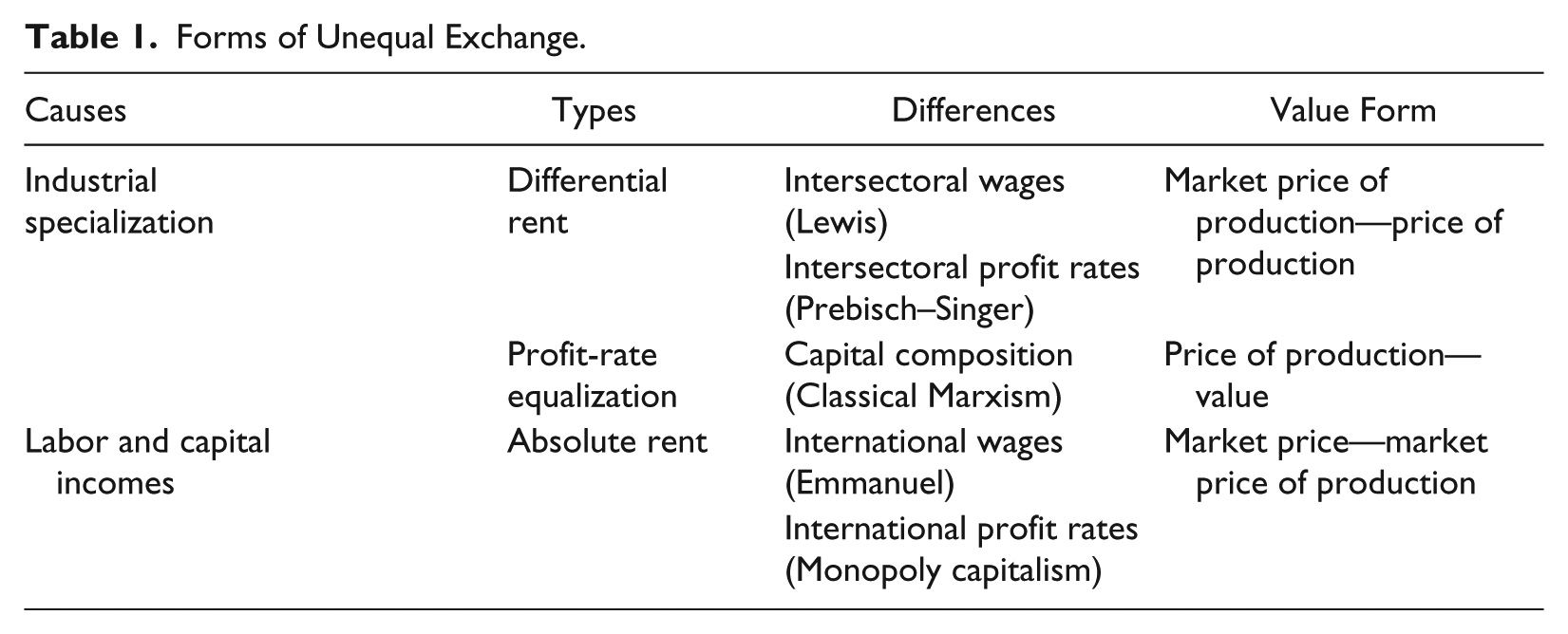
Equation 10 shows that interindustry value transfer depends on three factors: (1) difference in monetary wages per unit of international homogeneous labor between industries, corresponding to Lewis’s type of unequal exchange; (2) difference in profit rates between industries, corresponding to the Prebisch-Singer hypothesis on unequal exchange; and (3) equalization of profit rates between industries with different organic compositions of capital, corresponding to broad unequal exchange of classical Marxist theory.
Equation 9 shows that intraindustry value transfer depends on two factors: (1) difference between national industry monetary wages per unit of international homogeneous labor and world industry monetary wages, corresponding to Emmanuel’s type of unequal exchange, adjusted for differences in labor productivity; and (2) difference between national and world industry rates of profit, corresponding to monopoly capitalism theory of unequal exchange.
Table 1 summarizes the forms of unequal exchange derived from the model, which includes all the various forms identified in previous literature.
Forms of Unequal Exchange.
Differently from Emmanuel’s thesis on “labor aristocracy” in central countries, unequal exchange may benefit both workers and capitalists of recipient countries, in the forms of higher nominal wages per unit of international homogeneous labor and profits, at the expense of workers and capitalists of provider countries. Only ad hoc assumptions on labor and capital mobility could produce a priori one result rather than the other. Furthermore, higher monetary wages do not necessarily translate in higher purchasing power because of the possible misalignment of the currency exchange rates measured by the ERDI. The issue of the distribution of benefits and losses between social classes deriving from unequal exchange is a pragmatic one, and therefore it needs to be addressed by empirical analysis.
5. The Size of Value Transfers in the Modern Capitalist World Economy
Net national transfer in industry j results from the difference between exports and imports of commodity j, as shown in equation 11:

where
Tij = transfers of value of national industry, and
Minj = value of imports of country i from country n in current dollars.
The data used for the estimation come from WIOD (release 2013) 13 for bilateral trade at basic prices and current exchange rates, hours worked, wages, profits, gross output, and value added at basic prices. The sources of PPP exchange rates are World Bank, and IMF for Taiwan. All industries of WIOD are considered, except for household service. 14
The analysis covers the period of the rapid upsurge of the economic globalization, from the creation of WTO in 1995 to 2007, the last year of global economic growth before the outbreak of the Great Recession. Forty countries, grouped according to twelve regions, are considered: North America (Canada and the United States); North European Monetary Union (Austria, Belgium, Germany, Finland, France, Luxemburg, the Netherlands); South European Monetary Union (Cyprus, Spain, Greece, Ireland, Italy, Malta, Portugal); North Europe (Denmark, the United Kingdom, Sweden); East Europe (Bulgaria, Czech Republic, Estonia, Hungary, Lithuania, Latvia, Poland, Romania, Slovakia, Slovenia); Latin America (Brazil, Mexico); China, India, North East Asia (Japan, South Korea); other Asian countries (Indonesia, Turkey, Taiwan); Russia; and Australia. In 2007, these countries accounted for 88 percent of total world value added at basic prices and 78 percent of world gross exports.
The estimation of value transfers was performed according to the following procedure: (1) calculate world total aggregate and industry hours of labor in equation 1 by using Socio Economic Accounts (SEA) of WIOD; (2) calculate the vector of national industry homogeneous labors according to equation 3 and derive the vector ratio between national industry homogeneous labors and national industry total output; (3) multiply the vector ratio by the WIOD matrix of international trade in current dollars to transform it in terms of hours of homogeneous labor; (4) calculate the MEV according to equation 2; (5) derive the vector of the difference between national market prices and world market values, and multiply it by the matrix of international trade in homogeneous labor, according to equation 6, to derive the matrix of industry total value transfers in current dollars; (6) decompose the market prices/market values vector to derive the two vectors of intraindustry and interindustry transfers, and multiply each of them by the matrix of international trade in homogeneous labor, according to equation 7, to derive the two matrices of intraindustry and interindustry value transfers; (7) calculate the vectors of intraindustry and interindustry wage differentials per unit of homogeneous labor, and multiply them by the matrix of international trade in homogeneous labor, according to equations 8 and 9, to derive the matrices of intraindustry and interindustry wages value transfers; (8) derive the two matrices of intraindustry and interindustry profit value transfers by the differences between the total value transfer matrix and wage value transfer matrices 15 ; and (9) calculate the net total transfers according to equation 11.
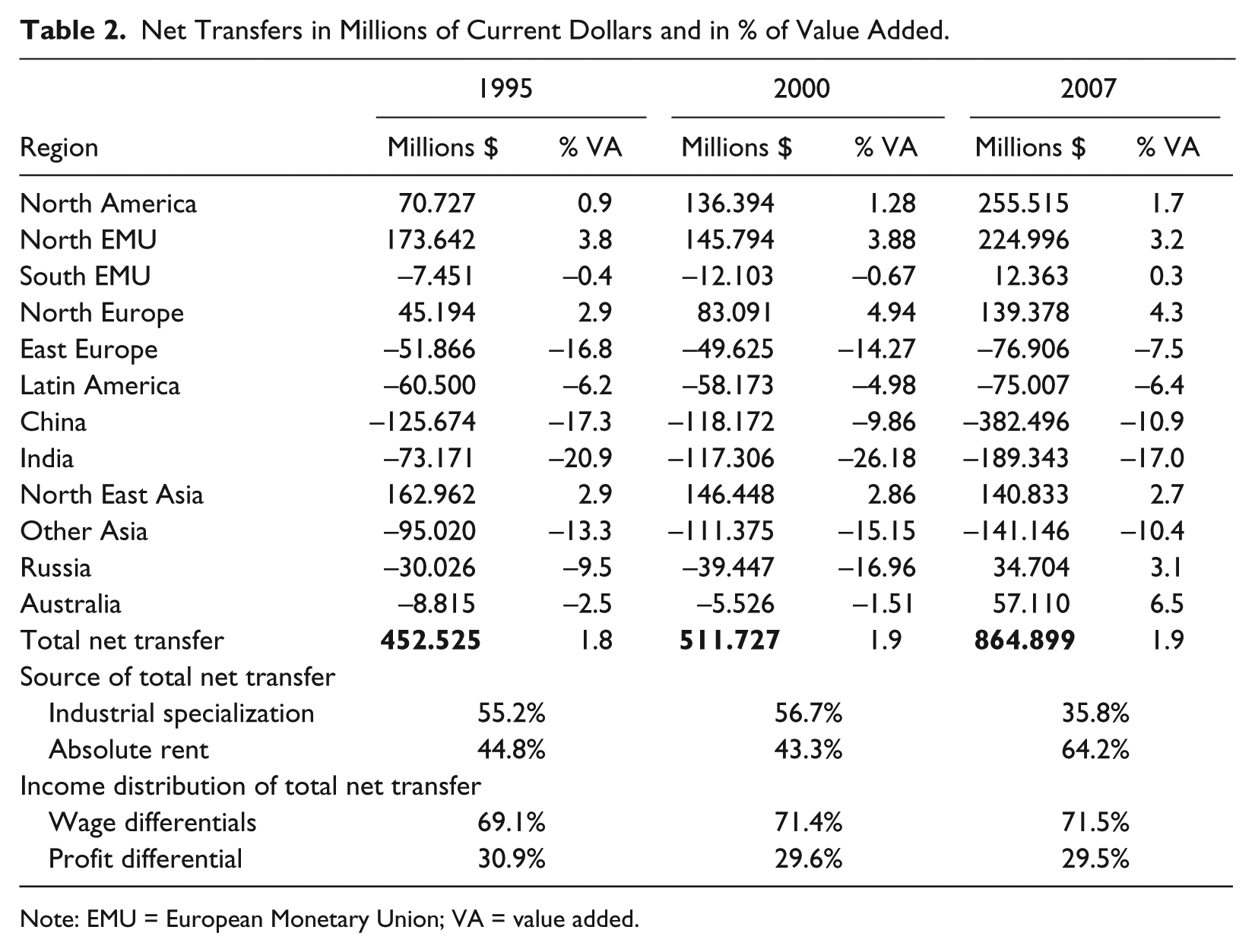
Table 2 shows the size in millions of dollars, and in percentage of domestic value added, of international value transfers in 1995, 2000, and 2007.
Net Transfers in Millions of Current Dollars and in % of Value Added.
Note: EMU = European Monetary Union; VA = value added.
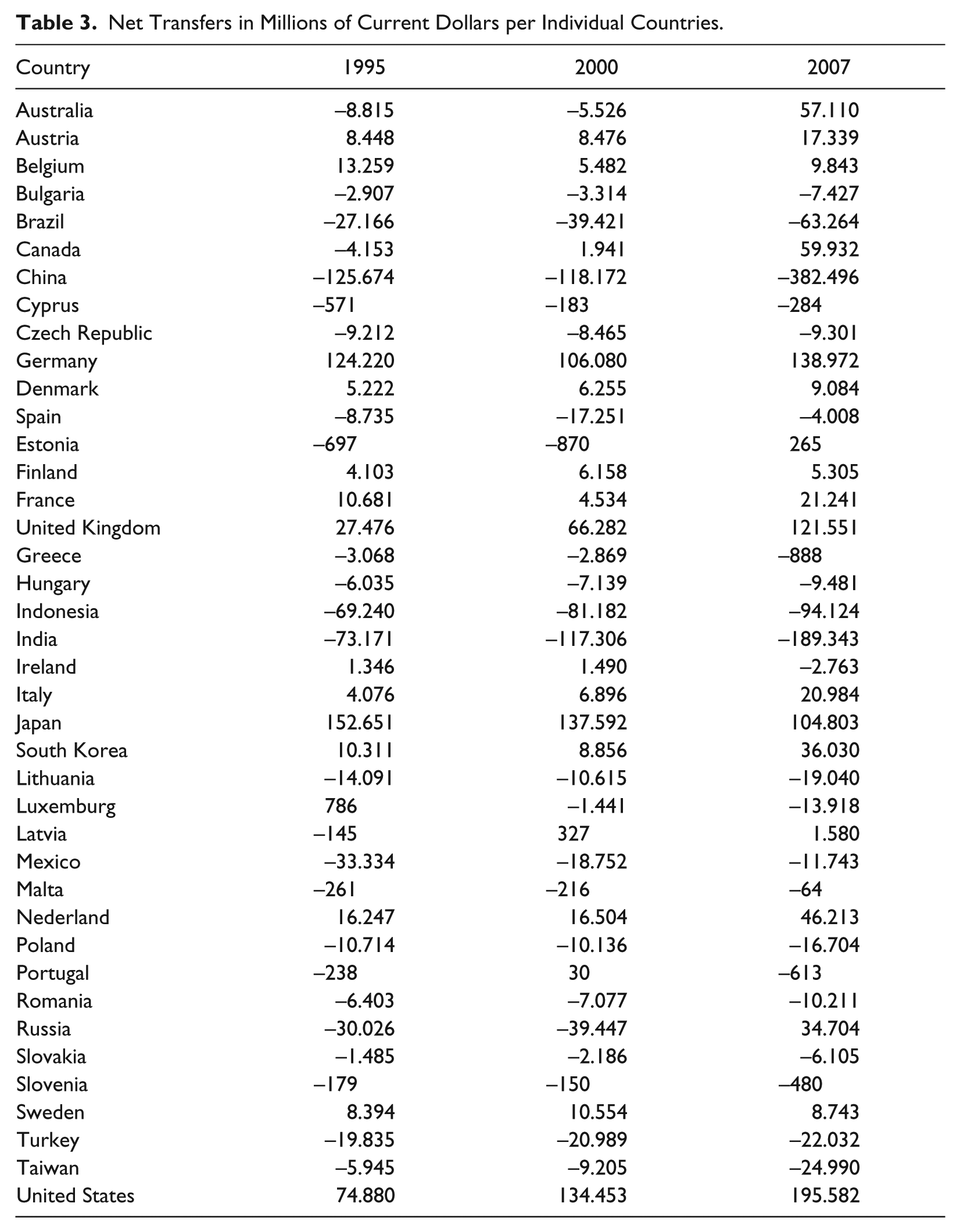
Over the period, the global amount of value transfers, net of intraregional trade, was considerable, increasing from $453 billion in 1995, corresponding to the 1.8 percent of global value added and 12.1 percent of global exports, to $865 billion in 2007 (1.9 percent of global value added and 9.1 percent of global exports). 16 Four regions (North America, North EMU, North Europe, and North East Asia) always had an inflow transfer, while five regions (East Europe, Latin America, China, India, and Other Asia) had an outflow transfer. Three regions (South EMU, Russia, and Australia) went from an initial deficit to a surplus at the end of the period. For developing economies, and in particular for Asian and East European countries, the relative size of outflow transfers was very consistent, ranging from 10 to 20 percent of the domestic value added. For developed countries, by contrast, the economic contribution of inflow transfers was substantial, especially for North EMU and North Europe. As shown in Table 3, in terms of individual countries, the bulk of transfers came from China, India, Indonesia, Mexico, and Brazil, to the benefit of the United States, Germany, Japan, the United Kingdom, the Netherlands, and Canada.
Net Transfers in Millions of Current Dollars per Individual Countries.
In terms of income distribution, contrary to Emmanuel’s view, international differences in monetary wages are not the only source of unequal exchange, since they explain about 70 percent of value transfers compared with around 30 percent of profit differential. Finally, the increasing importance of absolute rent as a source of value transfers with respect to industrial specialization is also noteworthy, indicating a process of convergence of industrial structures between advanced and developing economies, combined with an enhancing of monopolistic conditions within individual markets. This pattern is consistent with the thesis of a new international division of labor, characterized by a restructuring of a global production network originating new forms of dependency, different from the traditional division between central industrialized countries and peripheral agriculture and mining economies (see Charnock and Starosta 2016).
In conclusion, the sharp increase in international trade, subsequent to the creation of the WTO, was combined with a considerable increase, in absolute terms, of value transfers from emerging economies to the core of the capitalist world system. In this period, moreover, the fast increase in foreign direct investments, combined with the exponential rise in the number of TNCs, has resulted in a substantial increase in intra-firm TNC trade, now estimated in around one-third of global trade (Baiman 2017, chap. 8). The trade mispricing, due to transfer pricing practices within the same multinational group, is missed in standard trade data, and this fact probably leads to underestimating the real dimension of unequal exchange transfers. What seems certain, in any case, is that the industrialization and modernization of former poor agricultural countries, like China and other Asian countries, now fully integrated in global production and trade networks, did not substantially affect the economic power hierarchy of the capitalist world economy. The drain of value from the “periphery” to the “center” deriving from unequal exchange, albeit carried out in different forms than past colonial and neo-colonial relations, is firmly in the works in the age of globalization and continues to contribute to the uneven social and spatial reproduction of the modern capitalist economy.
6. Conclusion
In the current age of economic globalization, increasing world inequality and mass migration make the topic of unequal exchange in international trade even more relevant than in the past. Different schools of economic thought contributed to defining this concept. From the extensive literature on the subject, two main factors driving unequal exchange arise: differences in industrial specialization and differences in labor and capital incomes between countries. Several empirical studies have been devoted to measuring the quantitative dimension of value transfers in international and interregional trade. Recently, a new approach has been proposed, based on the difference between nominal and PPP exchange rates. The lack of a coherent theoretical framework has, however, limited empirical research only to particular aspects of unequal exchange.
The model presented in section 4, inspired by Marx’s analysis of rent in volume 3 of Capital, encompasses all the various forms of unequal exchange identified in the previous literature, on the basis of a proper definition of the different forms of international values. Value transfers originate from the contradictory character of socially necessary labor, which gives rise to a potential discrepancy between two different measures of value: value in production and value in circulation. In structural disequilibrium conditions between supply and demand, unequal exchange in a strict sense appears in the form of differential rent, due to different industrial specializations, and absolute rent, due to different labor and capital incomes. The former depends on the difference between market price of production and market value, and leads to interindustry value transfers, while the latter relies on the difference between market price and market price of production, and leads to intraindustry value transfers. In addition, there are interindustry value transfers due to different organic compositions of capital, or unequal exchange in a broad sense, deriving from the difference between international price of production and market value.
The model provides useful insights to the theoretical and empirical analysis of international value transfers. First, it overcomes a traditional problem triggered in Marxist unequal exchange theory by the presence of heterogeneous labor and nonspecific commodities. A consistent reduction procedure from national heterogeneous direct labors into international homogeneous labor, on one hand, and a trade network based on different national varieties of the same commodity, on the other, are presented, allowing us to define the different forms of international values of traded commodities. Second, the model shows that a recent empirical methodology of measuring international value transfers, based on the difference between current and PPP exchange rates, could only partially capture the full extent of unequal exchange in the world economy. Specifically, this approach does not succeed in considering interindustry value transfers.
Finally, estimates of unequal exchange in global trade for recent years are presented, showing that the size of value transfers, from developing and emerging countries to the core of the capitalist world economy, is relevant, both in absolute and relative terms. During the period considered (1995–2007), the relative size of differential rent decreased, to the benefit of absolute rent, indicating a process of convergence of industrial structures and, at the same time, a reduction in competition within individual markets, consistent with the thesis of a new international division of labor. In terms of income distribution, unlike Emmanuel’s thesis on Northern workers as exclusive beneficiaries of unequal exchange, value transfers are reflected in both higher profits and higher monetary wages per unit of international homogeneous labor in inflow countries.
In conclusion, the empirical analysis shows that unequal exchange is a relevant issue in the actual world economy, and therefore it should find greater consideration in trade negotiations, and in defining development policies. International value transfers deriving from global trade, without being the only cause of unfair international economic relations, represent an important mechanism in the reproduction of uneven development in the modern capitalist world economy. Unequal exchange in real trade deals with the distribution of the new value created in a given period, and it is studied by a flow analysis. But there are other mechanisms of unfair international economic relations, such as those related to the functioning of financial markets and the variation of the value of accumulated wealth (capital gains/losses), which would require a stock analysis able to include “wealth transfer effects” in addition to “(new) value transfer effects.” This issue could represent a suggestion for further research, aimed at extending the theoretical model and the empirical analysis to other important aspects of capitalist globalization.
Footnotes
Acknowledgements
The author would like to thank Ron Baiman, Marco Boffo, and Benan Eres for insightful comments. Financial assistance from the Department of Economics, Politics and Society (DESP) of the University of Urbino is gratefully acknowledged.
Declaration of Conflicting Interests
The author declared no potential conflicts of interest with respect to the research, authorship, and/or publication of this article.
Funding
The author disclosed receipt of the following financial support for the research, authorship, and/or publication of this article: This study was financially supported by the Department of Economics, Politics and Society (DESP) of the University of Urbino.
1
2
“Competition, on the other hand, shows. . . the fluctuations of market prices, which reduce the average market price of commodities in a given period of time, not to the market value, but to a very different market price of production, which diverges considerably from this market value” (Marx 1998: 206), and “It is in general in the form of the market-price, and, furthermore, in the form of the regulating market-price, or market-price of production, that the nature of the value of commodities asserts itself” (Marx 1998: 634).
3
In overproduction sectors, the lower limit is the production cost of the least-efficient producer, below which conditions of capital reproduction are not satisfied and supply declines. In underproduction sectors, the market price of production is the individual price of the least-efficient producer, and more efficient producers have a rent in the form of super profits and/or higher wages.
4
The discussion around Marx’s international values is particularly developed in Japanese and Eastern European traditions; see Matsui (1970) and  .
.
5
6
According to Foley (2005), within the framework of the NI, this is a pragmatic issue that can be addressed through econometric analysis. In this context, Rieu, Lee, and Ahn (2014) have suggested a model in which sectoral homogeneous labor is a function of sectoral skills and labor productivity. Sectors with skills and productivity higher than average have a conversion coefficient of direct labor into homogeneous labor higher than sectors under the opposite conditions. Without specifying the quantitative relations, however, the definition of sectoral homogeneous labor is confined to a qualitative dimension.
7
8
For a discussion on product differentiation and monopolistic competition in Marx’s theory of price, see Nicholas (2011). On the growth of intraindustry trade, see , which estimates that in 2006, intraindustry trade counted for 44 percent of global trade.
9
Absolute advantage in trade, deriving from higher productivity, cannot be considered a form of unequal exchange. However, it is a source of asymmetric trade, benefiting more developed economy and reproducing uneven development, as shown in Seretis and Tsaliki (2015) and Tsaliki, Paraskevopoulou, and Tsoulfidis (2017).
10
On the “aliquot part” reasoning in Marx’s LTV, see Roberts (2004, ).
11
We have to apply
12
14
To estimate how international trade redistributes among countries, the value created in production, the controversial issue, in Marxist theory of value, of distinguishing between productive and unproductive sectors does not arise.
15
As shown above, value transfers originating from profit rate differentials and equalization of profit rates are merged together in equation 8. Theoretically, it is possible to separate them as in equation 10, but empirically, this would imply capital calculations for each national industry. In addition to theoretical problems concerning the definition of capital composition (see ), the WIOD does not include data on total capital stocks. For this reason, in the empirical analysis, it has not been possible to distinguish the two forms of interindustry profit transfers.
16
In 2009, the last year fully covered by WIOD data, there is a slight reduction to $713 billion, mainly due to the reduction in trade flows following the economic crisis.