




Abstract
A common concern in audit studies of racial discrimination is that names assigned to a particular race may also proxy for socioeconomic status. We conduct a correspondence study in Jamaica, a predominantly black middle-income country, and find that these concerns may be valid. The evidence from sending out over 1,000 résumés suggests employers prefer applicants perceived to be from high-income backgrounds. While qualifications are not independently important, those with names preferred by employers have a lower chance of being selected if they have high-quality résumés. The results suggest that class discrimination may matter as much as race discrimination.
1. Introduction
Research shows that discrimination in various forms permeates labor market economies across the world (Petit 2007; Thorat 2008; Drydakis 2009; Kuhn and Kailing 2013). Many labor market discrimination studies tend to focus on race and ethnicity as the factors engendering unfair treatment in the employment process (Jowell and Prescott-Clarke 1970; Bertrand and Mullainathan 2004; McGinnity et al. 2009; Oreopoulos 2011; Kaas and Manger 2012; Nunley, Pugh, Romero, and Seals 2014; also see the survey by Bertrand and Duflo 2016). Focusing on blacks versus whites, Bertrand and Mullainathan (2004) and Nunley et al. (2014) for example, present evidence of racial discrimination, where black job applicants received fewer call backs than whites.
At the forefront of these and other studies lies the issue of discrimination by race. However, Fryer and Levitt (2004) emphasize a strong association between low socioeconomic status and black-sounding names. It therefore remains a possibility that individuals with black-sounding names are also associated with a lower social class. While Bertrand and Mullainathan (2004) try to test for this potentially severe confounding effect in a small subsample, labor market correspondence studies have thus far been unsuccessful in addressing it directly. This raises the question of whether Bertrand and Mullainathan (2004) and those building on their work (including Oreopoulos 2011; Kaas and Manger 2012; Nunley et al. 2014) actually measure racial discrimination or discrimination by class or a combination of the two.
We evaluate this question by studying the Jamaican labor market, a relatively racially homogenous country, to try to disentangle discrimination by race and socioeconomic status. Jamaica is arguably a good case study since it is a predominantly black country (91 percent based on 2001 Jamaican population census [Minnesota Population Center 2015] 1 ), where labor market outcomes are not driven by outright racial discrimination. However, there exists a layer of discrimination that features cases of unequal treatment based on gender (Hotchkiss and Moore 1996; Roberts 2010) and—to a lesser extent—complexion (Jamaica Gleaner 2011). Although the history of Jamaica’s labor market discrimination is rooted in its colonial experience with race, class distinctions have developed based on income, education, social identities, and behaviors (Broom 1954; Austin-Broos 1994; Altink 2015). This idea is a familiar anecdotal narrative. Those who have seen themselves as being discriminated against are residents of poor inner-city communities (Jamaica Gleaner 2010). They have been at the forefront of the public discourse where people question whether employers treat job applicants differently based on their home address.
This sentiment of job applicants being treated unequally on the basis of their home address is even captured in a popular 2007 song, Wrong Address, by Jamaican recording artiste Etana. She paints a picture of the issues that someone living in a volatile location 2 would have to deal with when looking for employment. The lyrics 3 of this song still rest on the minds of many who successfully finish their schooling but have the “wrong address” on their job applications. This perception of discrimination in the Jamaican labor market serves as an appropriate driver to explore whether any unfair treatment exists in the initial stage of the employment process and if any such treatment is related to social class.
Aligned with the work of Bertrand and Mullainathan (2004), which studies the employability of applicants with white versus African American names, we conducted a field experiment where we sent out résumés to clerical, administrative, customer service, and sales jobs that were advertised in local newspapers and on local websites. To capture social class, we used address and name as indicators of socioeconomic status. Using address as a proxy for class mirrors the sentiments expressed in the local media by job applicants. As a result, we separated high-income addresses from low-income addresses by linking the former with more affluent communities and the latter with those from the inner city using secondary data on well-known areas (Jamaica Gleaner 2009). For the purpose of using names as a classifier, we used the applicants’ first names as a class-identifying factor since some types of names, unique or distinctive, are more likely to be associated with low-income backgrounds. Persons from low-income backgrounds are less likely to obtain professional jobs, and are perceived to be less successful, moral, and cheerful (Willis, Willis, and Gier 1982; Levine and Willis 1994). Further, we were able to define names as high-income sounding or low-income sounding based on primary data collection through a “name” survey. At the same time, we utilized neutral last names, only using those not commonly associated with any particular social class (see Table 1). Thus, the résumés were adjusted to fit fictitious name and address profiles that were tied to the different social classes, an issue also studied in India by Thorat and Attewell (2007).
Post-survey name bank.

Notes: (i) These names represent a selection from the Jamaica’s voters’ metropolitan registration list, which is representative of the Kingston metropolitan area. (ii) Survey participants were asked to categorize the names according to gender and income status. (iii) The outcome of the survey features forty-four female names, 59 percent of which are high-income sounding and thirty-six male names, 72 percent of which are high-income sounding.
To add further dimensions to our study, we created both high-quality and low-quality résumés to see how the quality of résumés affected call-back rates. Typically, a high-quality résumé has more years of experience, greater academic achievements, and features leadership roles in extracurricular activities. Thus, a high-quality applicant is well rounded in comparison to an applicant with a low-quality résumé. We also explored call-back rates based on gender. We emailed four high-quality and four low-quality résumés for each job advertisement over a six-month period keeping phone lines open until three months after we sent out the last set of applications. In total, we sent out 1,080 résumés in response to 135 job advertisements.
Looking at the call-back rates by applicant’s characteristics, we found that job applicants with low-income-sounding names had to send out more than twice as many résumés as those with high-income-sounding names to receive a response from the employer. Although we received more call backs for applicants from high-income addresses than those from low-income addresses, this gap was statistically significant. As a result, we cannot conclude that there is address discrimination in terms of the résumés sent out. However, looking at the instances in which an employer preferred certain characteristics on an application, we did find evidence of address discrimination. Thus, in terms of location, a greater percentage of employers prefer applicants from more affluent communities than those from the inner city. Therefore, we found little evidence of discrimination based on an applicant’s home address. Our results indicate that name is used by employers to determine who receives a call back, which suggests class discrimination on the basis of name. One possible explanation for the lack of strong evidence for class discrimination based on address is offered by Bertrand and Duflo (2016), who suggest that employers may only be associating names with social classes. Once employers see particular names, they quickly decide the social class of the applicant without looking at the address. In essence, it appears that employers are using name as the instrument for social class with little reliance on address. Thus, social class, as evidenced by name, drives the gap between who receives a call back and who does not.
The minority racial groups in previous correspondence studies are often characterized by low levels of education, qualifications, and income, and thus could possibly be perceived as being within the lower class. Our results provoke the idea that these studies might be picking up a confounding relationship between race and class, where perhaps the latter is driving the former. By studying a racially homogeneous population, we show that it is possible that race itself may not be the only driving force behind the results in earlier work. This is not to say that racial discrimination does not matter; in fact, the effects of discrimination may well be larger than previously thought, if people are discriminated against based on both race and class.
In our setting, we also find that males must send out twice as many résumés compared to females to receive a response. While this finding may be attributed to résumés only being sent in response to advertisements for office-related support positions, it highlights the relevance of a name in obtaining employment. More surprisingly, high-quality applicants receive fewer call backs than applicants with low-quality résumés although there is no significant difference in call-back rates. However, a striking result is that although résumé quality is important in job searches, employers appear to use high-income-sounding names before examining the quality of résumés. Thus, the chance of receiving a call back is significantly greater for a person with a high-income-sounding name, especially in the case of low-quality résumés. This result stands in contrast to Bertrand and Mullainathan (2004), where persons with white-sounding names, whom perhaps one can infer to be of high-income status and who also possess high-quality résumés, have the highest chances of receiving a call back.
Further, these contrasting results also highlight important differences between labor markets in large, developed, racially-diverse countries and smaller, developing, racially-homogeneous countries. The preference for low-quality résumés with high-income-sounding names suggest two possible interpretations from the employers’ side. First, employers prefer applicants with less qualifications (Holzer and Neumark 1996), perhaps to avoid paying higher salaries. Second, employers care more about maintaining a social image (Jackson 2009), thereby choosing high-income-sounding name applicants with low-quality résumés who they deem as suitable for employment in their companies.
Our study contributes to the literature in several ways. First, it serves as a response to Bertrand and Mullainathan (2004) and similar studies that have been unable to disentangle whether names are associated with socioeconomic status discrimination or race discrimination. We address this issue by conducting a similar experiment in a predominantly black country. Second, we provide novel evidence that social class independent of race has a significant impact on labor market outcomes. Third, we keep the last names on the résumés constant by choosing neutral names, ones that cannot be easily identified with any specific social class. This approach can be applied to study other aspects of discrimination while keeping one dimension constant—for example, by studying class discrimination in a predominantly Muslim country to isolate religion as a confounding variable. Fourth, although we find little evidence for address being a social class indicator used by employers, it could be an important result for developing countries around the world facing rapid urbanization. Cohen (2006) points out that population growth is likely to be seen in urban areas throughout the developing world, with cities being unable to adequately cater to the needs of residents. Inadequate housing, for example, is a growing problem due to rural-urban migration and this often results in high rents, and in cases where cities expand it can become difficult to distinguish geographical borders (Aluko 2010). Thus, high rents can influence individuals who relocate to urban areas to choose reasonably priced housing in the inner city or in close proximity, which may be difficult to distinguish from areas that are not geographically identified as part of inner-city communities. This choice can result in them facing possible social class discrimination because of their address (Leonard 1987).
2. Methodology
We conducted a résumé audit study among employers in Kingston, Jamaica, with special emphasis on possible discrimination based on gender and class. Gordon’s (1949) definition of social class highlights differences in terms of wealth, income, occupation, status, level of consumption, and family background. Thus, from a socioeconomic standpoint, the term “class” refers to groups defined by income, status, occupation, level of consumption, and family background, rather than relationships having to do with production and distribution processes. As previously mentioned, the methods employed by this résumé audit study are similar to those used in Bertrand and Mullainathan (2004). However, we use existing first names as indicators of an applicant’s class and gender, rather than their race. We also indicate class by using the address of the fictitious applicant. Thus we use both name and address as indicators of class. Finally, binary-dependent variable regression models are used to compare the call-back rates based on gender, name, and address.
2.1. Résumés
We created a pool of forty résumé and cover letter templates. To narrow the type of résumés and to ensure quality, we created résumés for four types of positions: administrative, clerical, customer service, and sales, where the sales category was further categorized into “highbrow” and “lowbrow” positions based on the academic requirement as advertised. The “highbrow” 4 sales positions advertised a tertiary degree as being required, while the “lowbrow” sales positions did not require a tertiary degree. In total, there were five categories of résumés and templates. Beyond standardization, limiting the applications to these categories served two purposes. Firstly, it allowed for the comparison of jobs available to applicants with at least a secondary education and no advanced degrees or certification. This education level represents most of the educated members of the labor force in the Kingston Metropolitan Area (KMA)—60 percent based on 2001 Jamaican population census (Minnesota Population Center 2015). Secondly, we were able to obtain a larger pool of comparable job applications because these types of positions are commonly available.
For each job category, we created eight résumés and accompanying cover letter templates. Four of the templates were classified as high quality and the other four as low quality. Despite the variation in the quality of the résumés, all résumés were designed to meet the minimum requirements for the specified job position. Therefore, even the low-quality résumés represented the qualifications of a suitable applicant. The résumés were standardized by the level of composition, 5 years of professional experience, educational attainment, and voluntary/extracurricular activities.
The low-quality résumés for the administrative, clerical, customer service, and “lowbrow” sales positions were designed for an applicant who has three to five years of general professional experience, has no more than five examination passes and/or certifications at the secondary or post-secondary level (but without any scholastic distinctions or education at the bachelors level or higher), and holds no leadership roles in extracurricular or service activities. In the case of the “highbrow” sales positions, the educational qualifications for low-quality résumés would include an undergraduate degree in a business-related field. The associated cover letters for the low-quality group of résumés used grammatically correct but plain language, focused on diligence as a key skill, spoke to why the applicant wants to work for the company, and simply stated previous job experience.
The high-quality résumés for the administrative, clerical, customer service, and “lowbrow” sales positions indicated that the applicant has more than five years of professional or relevant experience, has at least eight secondary/post-secondary-level certifications or has an undergraduate tertiary degree, and holds a leadership role in service/extracurricular activities. All the high-quality education profiles (including those for “highbrow” sales positions) showed scholastic distinctions in the form of first-class honors undergraduate degrees and post-secondary exam passes with distinctions. The high-quality cover letters for these categories used more sophisticated language than the low-quality résumés, focused on both soft and hard skills gained from previous experiences, explained why the applicant is suitable for the company, and indicated how the position fits into the applicant’s long-term goals.
2.2. Determining Social Class Profiles
The perception of socioeconomic status in Kingston is tied to an individual’s area of residence. This is commonly observed in the casual use of the terms “uptown” and “downtown.” The term “uptown” describes the northern, more affluent areas in Kingston as used in reference to the upper class, while “downtown” is the location of many inner-city communities as used in reference to the lower class. Figure 1 depicts the location of the two income areas used in this study.

Map of the Kingston Metropolitan Area, Jamaica
To determine whether the perception of class is an important factor in obtaining a job in Kingston, we created four categories of applicant profiles by varying the type of first names and the types of addresses of the potential applicants. The various profiles were based on a combination of names that are lower- or upper-class sounding and addresses from inner-city or affluent areas. The four profile categories are as follows:
(i) Upper-class-sounding name with an affluent address.
(ii) Lower-class-sounding name with an inner-city address.
(iii) Upper-class-sounding name with an inner-city address.
(iv) Lower-class-sounding name with an affluent address.
“Uptown” street addresses were selected from eleven affluent communities in the parish of St. Andrew: Waterworks, Cherry Gardens, Beverley Hills, Jacks Hill, Mona, Barbican, Millsborough, Paddington Terrace, Long Mountain, Stony Hill, and Manor Park. These communities are described as “some of St Andrew’s most-desired addresses” and “among some of the preferred addresses of the who’s who” (Jamaica Gleaner 2009). We collected eighty street names for high-income area addresses for the bank of addresses that we used to build applicant profiles. The downtown street addresses were chosen from the low-income communities of Tivoli, Trench Town, August Town, Denham Town, and Mountain View. A total of fifty-two street names were compiled from these low-income communities. 6
First names were selected from the Electoral Office of Jamaica voters, list for Kingston and St. Andrew. The voters, list contains the names of 92.6 percent of the voting age population. A comparison of names from high-income versus low-income areas reveals that names that do not appear frequently tend to be associated with the low-income areas. We initially created a pool of 240 names from the voters, list which included sixty female-sounding and sixty male-sounding names from high-income areas, and sixty female-sounding and sixty male-sounding names from low-income areas. One of the weaknesses of a résumé audit study is that it is difficult to deliver visual cues that suggest characteristics of an individual (Pager 2007). To circumvent this limitation, we conducted a perception survey to determine the perceived sex and class of individuals associated with the selected names. To this end, we randomly surveyed each of the 240 names fifty times, using members of the Jamaican public. The survey was conducted in public areas throughout the KMA from July to August 2013. To establish gender, survey participants were asked to identify whether they thought the name belonged to a male or female. To establish class, participants were asked to identify whether they thought the name belonged to someone who lived “uptown” or “downtown.” Names having more than a 70 percent (>35) respondent agreement on class and gender remained in the name bank. The final name bank contained twenty-four female upper-class-sounding names, twenty-six male upper-class-sounding names, eighteen female lower-class-sounding names, and ten male lower-class-sounding names. The complete name bank is shown in Table 1.
We chose common Jamaican last names such as Brown, Black, Grant, Samuels, Thomas, and Walker, which are not associated with any particular social class, to complete the fictitious résumé identities. These last names appeared on the voters’ list in both high- and low-income communities.
2.3. Sending Out Applications
Job vacancies were found using online job sites and newspapers. Applications were only sent in response to administrative, clerical, customer service, and sales positions where employers accepted applications by email. Eight customized applications were sent in response to each vacancy, where four applications were high quality and four low quality. Customization of applications for each advertisement involved: (1) ensuring that the résumés and cover letters met the minimum requirements for the job, (2) including contact information, and (3) adding specific name and address profiles.
We adjusted all résumés and cover letters to ensure the applicants met the minimum skills and qualifications for the job. For example, if the job required the respondent to drive or speak a second language, then we updated the résumé and cover letter templates to reflect these skills. Thus, all eight applications were designed to represent suitable candidates for the relevant positions.
For each vacancy, the four applicant profiles based on names and addresses identified in the previous section were applied to each of the high- and low-quality applications. Therefore, the eight applications for each job represented individuals with the following perceived class and qualifications:
(i) Upper-class-sounding name with an affluent address and high-quality résumé.
(ii) Lower-class-sounding name with an inner-city address and high-quality résumé.
(iii) Upper-class-sounding name with an inner-city address and high-quality résumé.
(iv) Lower-class-sounding names with an affluent address and high-quality résumé.
(v) Upper-class-sounding name with an affluent address and low-quality résumé.
(vi) Lower-class-sounding name with an inner-city address and low-quality résumé.
(vii) Upper-class-sounding name with an inner-city address and low-quality résumé.
(viii) Lower-class-sounding names with an affluent address and low-quality résumé.
A specific phone number and email address combination was assigned to each of the eight aforementioned applicant types so that the contact information remained consistent for each batch of résumés sent in response to each vacancy. For each application, the gender was randomly chosen, but nonetheless an equal number of female and male profiles were selected for each job application. Then an appropriate name and street address was randomly chosen from the name and street banks to match the applicant profile.
The process of sending out applications began in May 2014 and continued until November 2014. During this period, we answered 135 job advertisements and sent out 1080 applications. Seventy percent (n=94) of the vacancies were for sales positions, 17.2 percent (n=23) for customer service positions, 7.5 percent (n=10) for administrative positions, and 5.2 percent (n=8) for clerical positions. We monitored call backs daily by checking for voicemail messages and email replies. We actively collected call-back information until February 2015. At the end of this period, we had received a total of fifty-two call backs, twenty-three for low-income addresses and twenty-nine for high-income addresses. We observed thirty-four call backs for female-sounding names and eighteen for male-sounding names. Seventeen of the call backs were associated with names perceived to be lower-class-sounding names, while thirty-five were for the upper-class counterparts.
Patterns in the call-back rates were analyzed using equality of proportion tests. These tests are used to assess the existence of any significant difference in call-back rates based on name, gender, résumé quality, and address. We conducted further analysis to assess whether these characteristics of the applicant impacted the chances of receiving a call back. To this end, we used complementary log-log 7 and probit regression models with the call-back response as the left-hand variable and the discrimination factors as the right-hand variables. The type of job position and the required skills were used as controls. 8 The model we used is as follows:

XI is a vector of dummy variables representing characteristics of the vacancy and the applicant. Each of the following dummy variables takes on a value of 1 if the applicant meets the characteristic and zero otherwise: High-income address, High-income-sounding name, Female, and High-quality résumé. It then follows that the reference group in the analysis are male applicants with low-income names and addresses and who have lower qualifications. Additionally, the model uses dummy variables to capture the following job characteristics, taking on the same values as previously described. The included categories for the type of position are Customer service, Clerical, and Administrative, while the required skills for the advertised position are listed captured as Organization, Communication, and Computing. Other relevant qualifications assessed in the model are the requirement for a tertiary degree and Experience. One of the weaknesses of the study is the fact that responses were sent to only 135 jobs. Therefore, only 1,080 applications were sent out and only fifty-two call backs were received. This means that the power of the regression analysis is lower than it would have been with a larger sample. However, one has to take into consideration the fact that Jamaica is a relatively small country in comparison to cities in countries such as the United States or Britain. Therefore, it would have a much smaller labor market. Bertrand and Mullainathan’s (2004) study, for example, was undertaken in Chicago that had a population of 2.7 million in 2012. The population of Kingston and St. Andrew was only 24.5 percent (666,041) of Chicago in the same year. Comparably, we sent out 22 percent of the number of résumés sent in the Chicago study. This study should therefore be viewed as fundamental research to inform policy research and future studies. In spite of the limitations, the authors find instructive and interesting results. These results are discussed in the following section.
3. Discussion of Results
The results presented in this section reveal evidence of hiring managers discriminating based on individual characteristics other than qualification. The frequency of call backs indicates a preference for applicants with high-income names and addresses and with lower qualifications. However, statistical testing only provides strong, consistent evidence of class discrimination based on name. Gender also appears to be important to employers.
3.1. Name Discrimination
Observing the distribution of call backs by name shown in Table 2 reveals that the call-back rate for high-income names is 6.5 percent while it is 3.1 percent for low-income names. This implies that, on average, an applicant with a low-income name would have to send out approximately thirty-two résumés in order to receive a call back whereas an applicant with a high-income name would only have to send out approximately fifteen. The results of the test shown in the last column of the table suggest there is class discrimination on the basis of name.
Call-back rates by applicant characteristics.
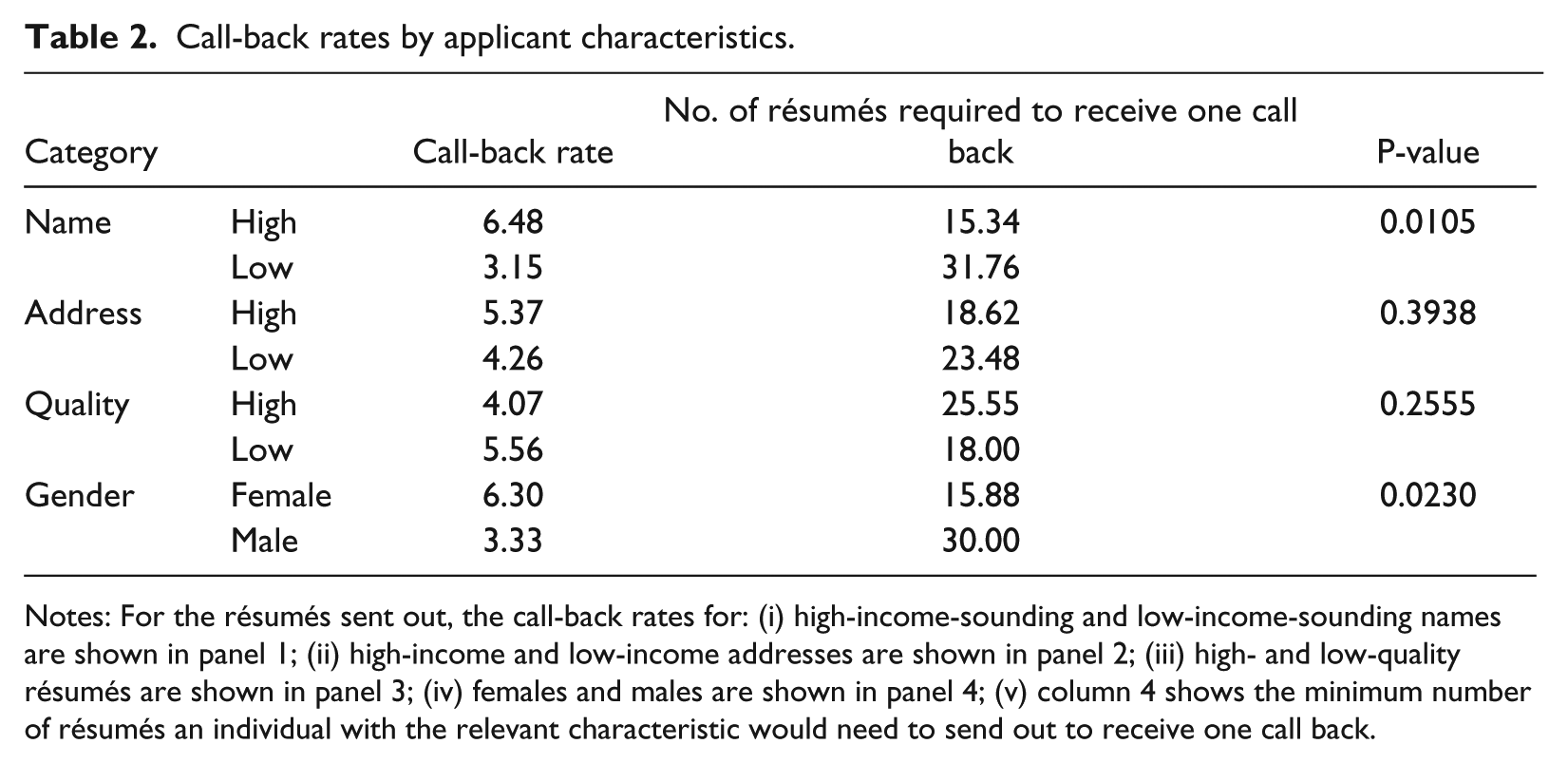
Notes: For the résumés sent out, the call-back rates for: (i) high-income-sounding and low-income-sounding names are shown in panel 1; (ii) high-income and low-income addresses are shown in panel 2; (iii) high- and low-quality résumés are shown in panel 3; (iv) females and males are shown in panel 4; (v) column 4 shows the minimum number of résumés an individual with the relevant characteristic would need to send out to receive one call back.
The results of the equality of proportions test also support evidence of discrimination on the basis of name. In Table 3, discrimination is measured by whether the percentage of employers who favor one type of applicant is significantly different from the percentage of employers who favor the other type of applicant. Column 2 in Table 3 shows the number of employers who treat applicants “equally.” Equal treatment includes the cases where no applicant received a call back, as well as the cases where equal numbers of each type of person received a call back. Column 3 shows the number of employers who “favored” one type of person over another. This occurs when they send responses to more applicants of one type than another. The ratio of employers who offered a call back to an applicant with a high-income name is more than six times the ratio of the employers who called a low-income applicant. The first two rows of Table 3 show that out of 135 employers, thirteen (9.7 percent) employers favor applicants with high-income-sounding names while only 2 (1.5 percent) employers prefer applicants with low-income-sounding names. The fraction of employers who favor applicants from high-income addresses is significantly different from the fraction of employers who favor applicants from low-income addresses.
Frequencies of preferred characteristics of applicants.
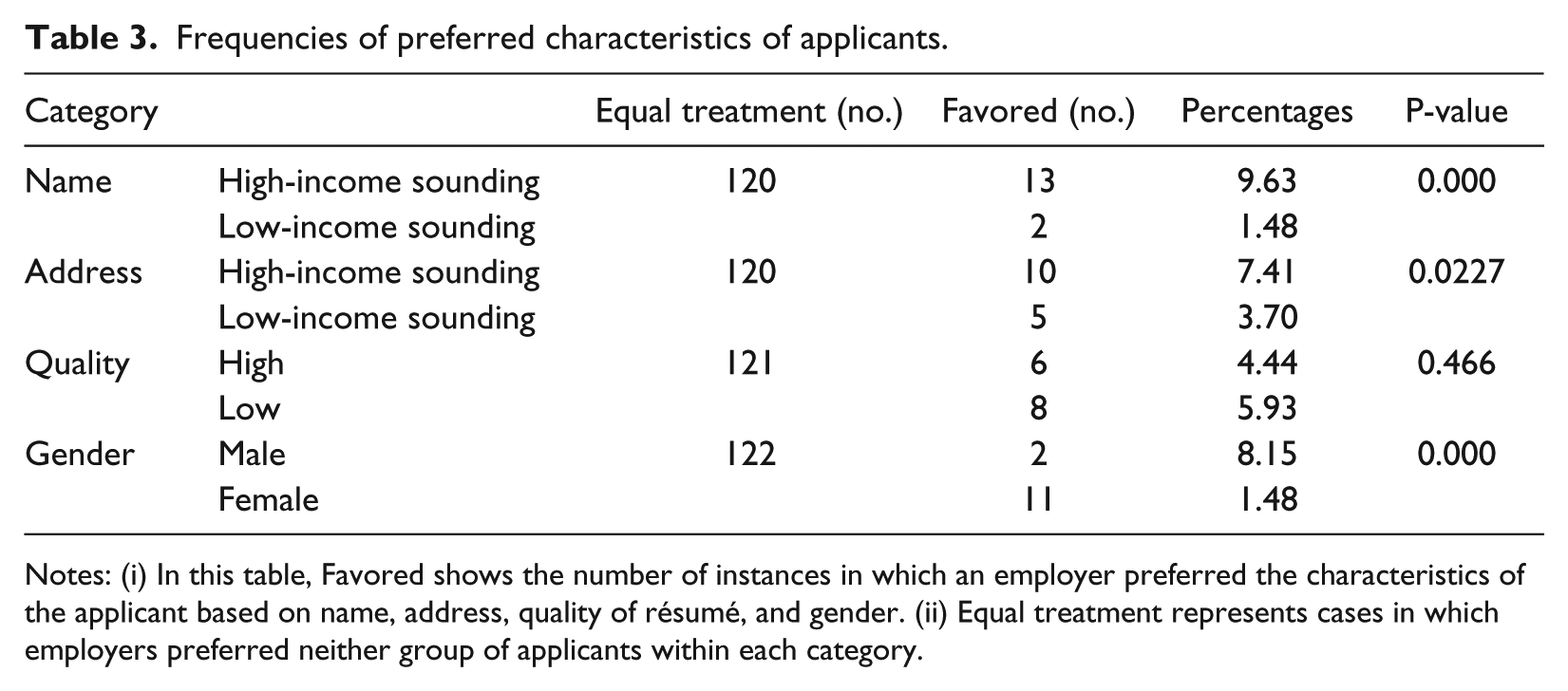
Notes: (i) In this table, Favored shows the number of instances in which an employer preferred the characteristics of the applicant based on name, address, quality of résumé, and gender. (ii) Equal treatment represents cases in which employers preferred neither group of applicants within each category.
The overall call-back rate of this study is 4.8 percent, which limits the models we estimate using regression analysis. Nonetheless, like Bertrand and Mullainathan (2004), Thorat and Atwell (2007), McGinnity et al. (2009), Oreopoulos (2011), and Kaas and Manger (2012), 9 we use regression analysis to assess the relationship between the probability of call backs and individual characteristics. Using the model in Equation (1), we control for variables pertaining to the résumé such as résumé quality and type of name, as well as characteristics of the advertisement such as skills required or the job category, among others.
Table 4 reports the results of the regression analysis. Since the dependent variable is binary (call-back dummy variable), complementary log-log and probit models are estimated. 10 The results support the findings obtained from comparing the call-back rates across the different applicant profiles. The findings of all four models shown in columns 2–5 of Table 4 consistently suggest that having a high-income name has a positive and significant impact on the call-back rate. Therefore, having a high-income name increases the probability of receiving a call back by around 3–4 percent.
Estimation of the impact of applicant and job characteristics on the likelihood of receiving a call back.
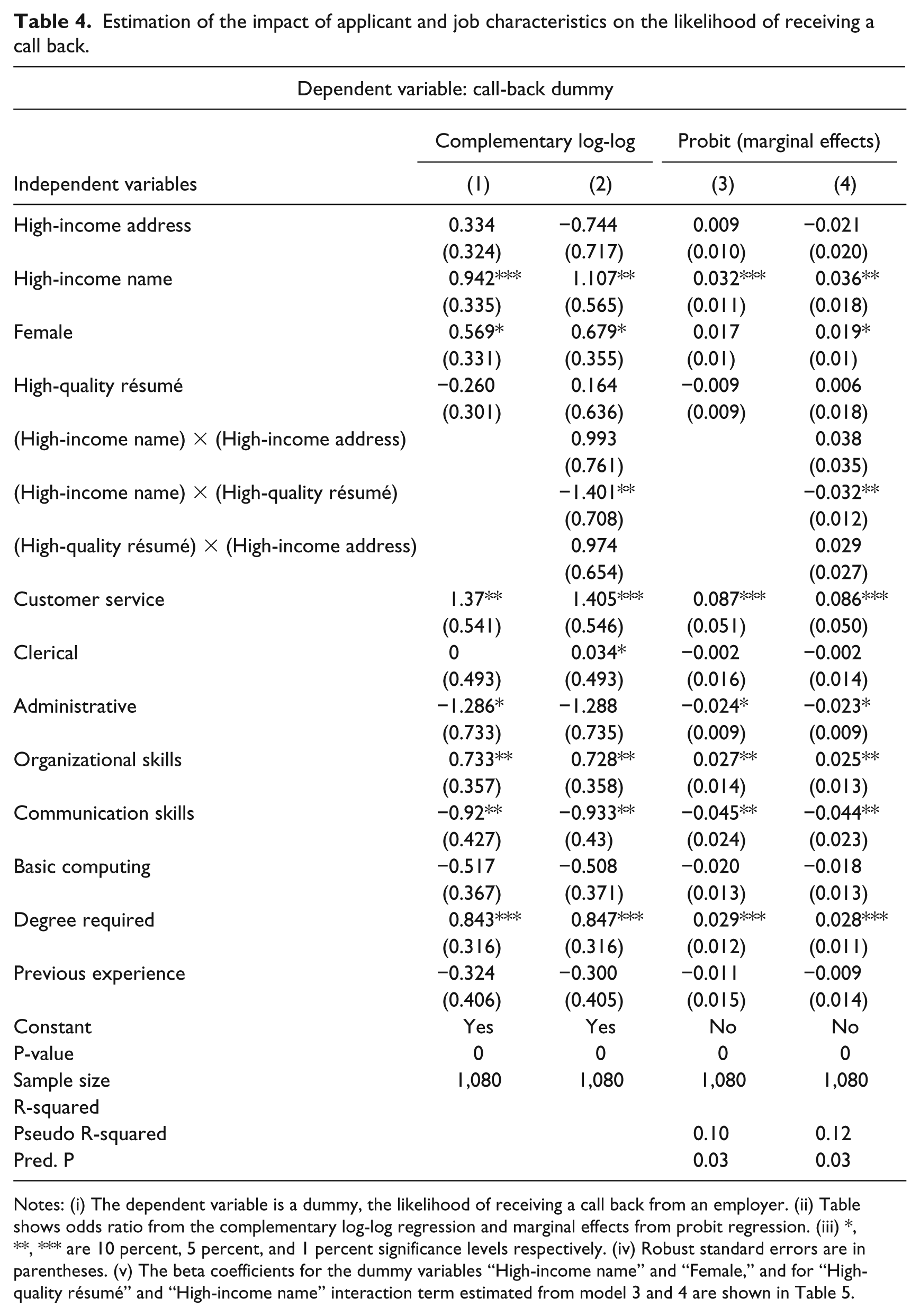
Notes: (i) The dependent variable is a dummy, the likelihood of receiving a call back from an employer. (ii) Table shows odds ratio from the complementary log-log regression and marginal effects from probit regression. (iii) *, **, *** are 10 percent, 5 percent, and 1 percent significance levels respectively. (iv) Robust standard errors are in parentheses. (v) The beta coefficients for the dummy variables “High-income name” and “Female,” and for “High-quality résumé” and “High-income name” interaction term estimated from model 3 and 4 are shown in Table 5.
Jamaica’s naming conventions and labor market discrimination have roots in its colonial history. At various junctions of colonization Afro-Caribbean names have been used sometimes as subtle and other times as outright demonstrations of either opposition to or compliance with social norms (Burton 1999). Thus, names have been closely tied to identity and class distinctions. Plantation economists would argue that the class distinctions that have developed over time are based on the relationships that existed between the slaves and slave owners. In fact, it has been suggested that the attitude of employers to applicants from inner-city communities is similar to the attitude of planters toward the slaves. This attitude can be described as a mixture of indifference, contempt, and fear. It can be argued that this “fear” is the driving force behind employers’ reluctance to hire persons who are perceived to be from a particular class. Residential segregation by income leads to persons from low-income backgrounds primarily living in so-called volatile communities. They may be afraid that the violence that prevails in these inner-city communities may be brought into the workplace. Thus we see the continued influence of colonial ideology in a post-colonial society.
Segmented labor market theorists would argue that evidence of discrimination still persisting today, such as that uncovered by this paper, is indicative of the failure of orthodox theories of the labor market and is supportive of Marxian-type theories of exploitation (Reich 1971). The results of this study can be aligned with plantation and radical labor market theorists who emphasize the historical and class-based motivations behind the behaviors of employers and workers. The plantation concept of colonizers versus slaves is similar to the Marxian idea of employers versus workers or bourgeoisie versus proletariat. Marxian theory focuses on the inevitability of the exploitation of workers that arises in a capitalist economy. This is in sharp contrast to orthodox trade theory. Becker (1957) and Becker (1971) argue that the neoclassical model and standard competitive assumptions imply that differential treatment in the labor market should gradually decrease.
3.2. Address Discrimination
Although we find strong evidence of class discrimination by applicant’s name, we find only limited evidence that discrimination extends to the applicant’s address. Interestingly, the call-back rate for applicants with high-income addresses is 26 percent higher than those with low-income addresses, but this difference is not statistically significant (Table 2). Also the coefficients on the high-income address dummy variables are positive in the regression estimations shown in Table 4, but this relationship between a call back and address shown on the résumé is again not significant.
However, the results of the equal treatment test in Table 3 shows a significant difference in the instances an employer favors one type of address over another. The ratio of employers who favor high-income address over low-income addresses is two times that of the ratio of those who prefer low-income addresses to high-income addresses.
3.3. The Importance of Résumé Quality and Qualifications
Across all techniques used in this study, we find no significant evidence of preference based on résumé quality. Despite the lack of statistical evidence of discrimination on the basis of résumé quality, we note that the call-back rate for high-quality résumés is 4.1 percent while the call-back rate for low-quality résumés is higher at 5.6 percent (Table 2). In addition, we observe that employers tend to favor low-quality résumés over high-quality résumés (Table 3). It is important to recall that although all résumés met the minimum advertised requirements, they differed according to the level of writing sophistication, as well as the qualifications presented. Since both types of résumés satisfied the minimum requirements for the job, a potential explanation is that employers may prefer applicants with low-quality résumés because they assume that they are willing to accept a lower wage and are perceived to be more manageable. Another possibility may be that applicants with lower-quality résumés are more likely to remain in the advertised position longer because the lower qualifications may reduce the applicant’s negotiating capacity. Therefore, a candidate with lower, but satisfactory qualifications may be viewed as a less costly hire.
Looking at the estimation of the models with interaction terms shown in columns (2) and (4) of Table 4, there is a negative coefficient on the interaction term with high-quality résumé and high-income name. An applicant with both a high-quality résumé and a high-income name will have lower call-back rates than an applicant with a low-quality résumé and/or a low-income name. From the estimation of the probit model in column (4), the significant marginal effect of a high-income name and low-quality résumé is 0.036, while the significant marginal effect of having a high-income name and high-quality résumé is only 0.004. Having a high-quality résumé reduces the increased likelihood of a high-income name applicant receiving a call back from 3.6 percent to 0.4 percent. From the complementary log-log model in column (2), we see that having a high-quality résumé with a high-income name converts the positive relationship to a negative one regarding the chance of receiving a call back. To further this point, the beta coefficient for high-income name is 0.2513 and −0.2648 for the high-income name and high-quality résumé interaction term (see Table 5). The negative effect of the interaction term on receiving a call back is greater than the positive effect of having a high-income name.
Selected beta coefficients of significant variables from the probit models.

Notes: (i) The beta coefficients correspond to models (3) and (4) in Table 4. (ii) Beta coefficients are estimated by standardizing the dependent and independent variables. These values measure the comparable strength of the independent variable in explaining the chances of receiving a call back. Variables with larger coefficients matter more.
3.4. Gender Discrimination
Although the tests do not reveal evidence of discrimination based on qualifications, there is evidence that employers base their preferences on another characteristic associated with the applicant’s name: gender. The call-back rate for females of 6.3 percent is significantly differently from the 3.3 percent call back for male applicants (Table 2). This implies that a male applicant would have to send out, on average, approximately twice as many résumés in order to receive a call back than a female applicant.
The second to last row of Table 3 shows that two employers favored male applicants. Of the 122 employers who displayed equal treatment in terms of gender, five of them responded to equal numbers of male and female applicants while 117 of them did not send a response to any of the applicants. The percentage of employers that prefer female applicants (8.1 percent) is significantly different from the percentage of employers that prefer male applicants (1.5 percent).
Regression analysis also supports a gender bias. The regression coefficient on the female dummy variable is positive, implying that being a female increases the likelihood on the call-back rate (Table 4). Gender, however, seems to have a marginal impact, if any, since that variable is significant only at the 10 percent level in the complementary log-log and the probit that includes the interaction terms.
3.5 Applicant Discrimination
The analysis shows consistent evidence of discrimination on the basis of name and reasonable evidence of gender discrimination. In fact, we find that females with high-income names have a higher probability of receiving a call back than their male counterparts with low-income names. This suggests that Jamaican employers discriminate against applicants with names that imply that they are from the lower class. The discrimination uncovered in favor of women is probably an indication that employers prefer females for jobs that are in the sales, customer service, clerical, and administrative fields. This result is not surprising and is in fact assumed to some extent in Bertrand and Mullainathan (2004). They use both female and male names for sales jobs but used only female names for administrative and clerical positions to increase call-back rates.
Finding that employers have a preference based on gender emphasizes the importance of the applicant’s name. Still, the standardized beta coefficients estimated from the probit regressions suggest that the class component of name discrimination outweighs the gender component. Table 5 shows that the beta coefficients for the high-income name dummy is approximately twice as large as the relevant values for the dummy variable for an applicant being female. This highlights the employers’ use of names to form assumptions about the class and gender of an applicant. We observe that women with high-income-sounding names are more likely to receive call backs than their male counterparts with low-income-sounding names. So our results suggest that employers use the first line of the résumé, prominently displaying the name of the applicant, as a sorting mechanism to root out candidates deemed to be unsuitable. Recall that the regression analysis indicates that there may be some evidence of residential/class discrimination in the labor market. Interestingly, there is no evidence of a further significant marginal impact of the combined effect of the two variables (name and address) used to proxy residency and hence class. This point lends support to employers seemingly discriminating on the sole basis of an applicant’s name. On this merit, it is not necessarily surprising that there is little evidence of discrimination on the basis of address and no evidence of preference based on résumé quality.
We also found no evidence to suggest that quality is independently significant, but observed that there is a significant interaction between high-quality résumés and high-income names. The other interaction terms are not significant. 11 Therefore, the call-back rates for applicants with high-income names or high-quality résumés are not impacted by an applicant’s address. We did not find any other evidence that the interaction of the applicants’ characteristics significantly impacted the likelihood of receiving a call back. There is no reason to conclude that gender amplifies the effect of class variables in labor market discrimination.
3.6. Robustness Checks
To verify the findings previously discussed, we estimated the probit and complementary log-log models using a reduced sample. The estimated models which only use observations from employers who responded to at least one of the eight résumés they received are shown in Table 6. The findings are similar to those found in the previous model. Candidates with high-income names have a higher probability of receiving a call back while the female dummy variable is significant at the 10 percent level except in the complementary log-log model with interactions. It follows that address and résumé quality have no individual impact on the call-back rate. We also continue to see that having a high-quality résumé reduces the likelihood of receiving a call back for those with high-income-sounding names. Overall, the size of the coefficients tends to be higher for the reduced sample, but this is expected since the sample only focuses on the firms that sent out any call backs. The larger sample gives a more accurate picture of the true size of the impact.
Estimation of the impact of applicant and job characteristics on the likelihood of receiving a call back using a reduced sample.
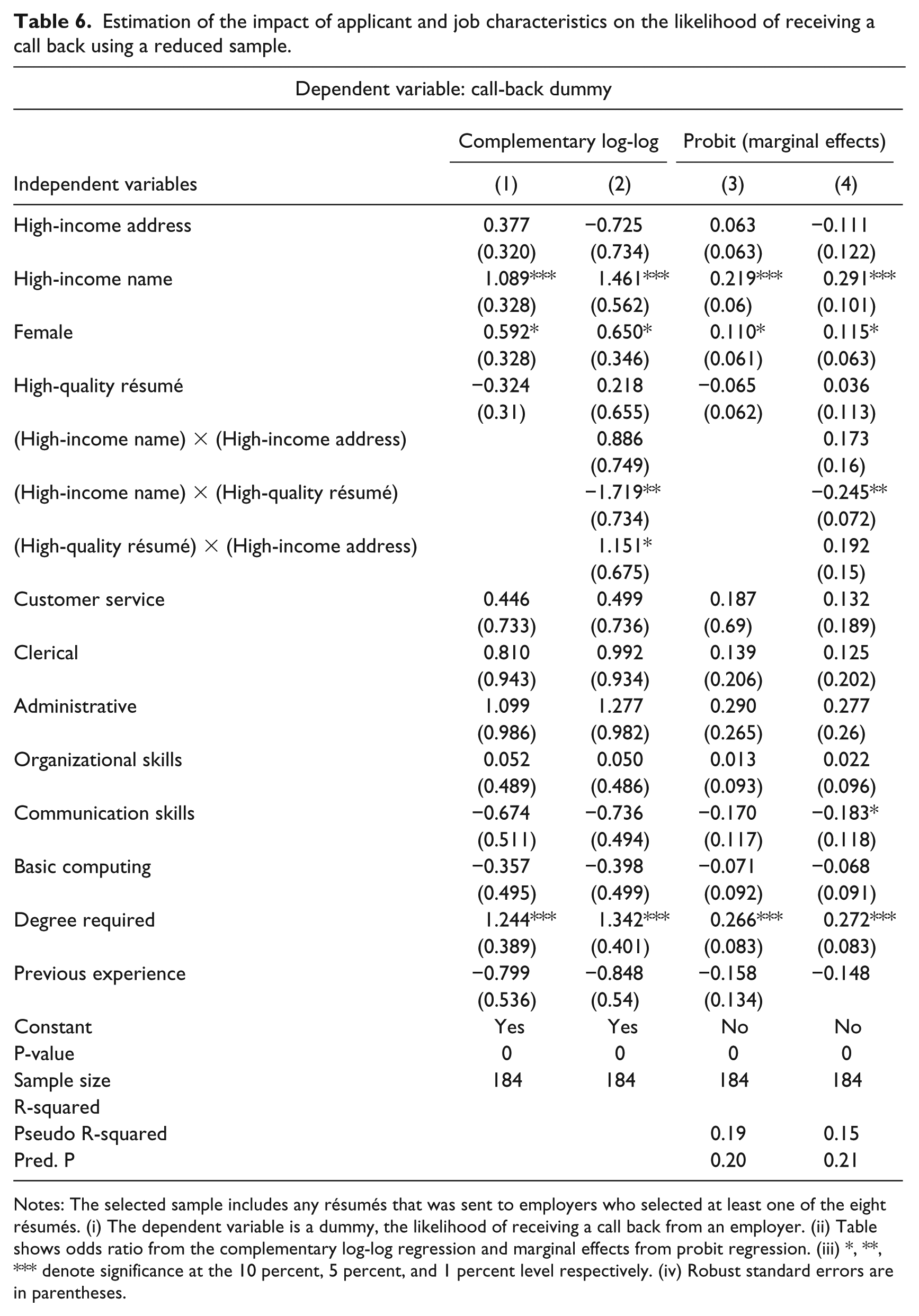
Notes: The selected sample includes any résumés that was sent to employers who selected at least one of the eight résumés. (i) The dependent variable is a dummy, the likelihood of receiving a call back from an employer. (ii) Table shows odds ratio from the complementary log-log regression and marginal effects from probit regression. (iii) *, **, *** denote significance at the 10 percent, 5 percent, and 1 percent level respectively. (iv) Robust standard errors are in parentheses.
To summarize the results, we persistently see strong evidence of discrimination against applicants with low-income-sounding names across all methods of analysis. The results also consistently indicate that female applicants have a higher probability of receiving a call back. Observing gender discrimination reinforces the importance of how applicants’ names influence their chance of receiving a call back. There is very weak support for discrimination on the basis of address, as indicated by the results of the test for equal treatments shown in Table 3. Finally, the regression results also imply that having a high-quality résumé reduces the likelihood that an applicant with a high-income name will receive a call back. This suggests that having a high-income name only increases the probability of receiving a call back for applicants with low-quality résumés.
4. Concluding Remarks
We ran a correspondence study in a racially homogeneous middle-income country to investigate whether class discrimination occurs in the first stage of the job application process. Matching applications that display different socioeconomic class indicators were sent in response to advertisements for clerical, customer service, sales, and administration vacancies in the Kingston Metropolitan Area of Jamaica. The distinguishing factors we used to identify various applicant characteristics were résumé quality, gender, name, and address, where the last two serve as indicators of class.
We find ample evidence that call-back rates are higher for applicants with high-income-sounding names than for low-income-sounding names, and limited evidence that address plays a role in influencing employers to respond to job applications. Overall, our results suggest that discrimination by class is a potentially severe confounding variable in previous correspondence studies using race-specific names to analyze race discrimination. Thus, the evidence found in these studies, Bertrand and Mullainathan (2004) being the pioneer work, may to a significant effect be driven by discrimination by class, rather than race. Importantly, this does not imply that existing evidence on racial discrimination is spurious. To the contrary, our results should be interpreted as complementary, in the sense that race and class may exert independent effects on employer decisions. This suggests that previous findings may indeed overestimate the racial discrimination experienced by applicants from a particular race (e.g., blacks) if they are also from a lower-class background. Any discrimination observed that is attributed to race could potentially be attributed to both race and class. It is difficult to divide the different forms of labor market discrimination into distinct groups. However, the findings of our study also suggest that previous studies would have underestimated the level of racial discrimination for blacks from upper-class backgrounds, since the “privilege” received as a result of having a higher socio-economic status would decrease the total amount of discrimination observed and attributed to race. We also find that gender plays a role in call-back receipts in our sample, where females are more likely than males to be on the employers’ call-back lists. Note, however, that although this provides evidence of gender discrimination, social class discrimination is a more important factor in making the call-back list. Finally, our findings reveal that employers appear to be more interested in applicants with high-income-sounding names and low-quality résumés, possibly in an attempt to negotiate lower wages.
To reduce the level of discrimination faced at the initial stage of the employment process, the use of anonymous job applications should be explored. Findings from research experiments in various countries have revealed that anonymous job applications are effective at reducing disparity in call-back rates attributed to discrimination (Rinne 2018). Reducing discrimination in the employment process has the potential to improve labor efficiency and firm profits as the employees who are most qualified will be hired.
The findings appear to support policy intervention on the demand side of the labor market. Since having a high-quality résumé quality does not appear to improve an applicant’s chance of being invited to an interview, then investing in education and training programs may not be effective in combating labor market discrimination. This is in contrast to orthodox theories such as the human capital model which indicates that the focus should be on increasing the skills of groups that are discriminated against. Therefore the findings are in line with nonorthodox theories including the segmented labor market and plantation theories that lend support to antidiscrimination programs focused on altering the attitudes and thus the “consciousness” of employers. Following the cue of nonorthodox economists, policy makers should explore specific strategies to implement this pre-labor market “conditioning” (see Bowles 1971; Gintis 1971; Bowles and Gintis 1973, 1975). Radical political economic theories that emphasize historical motivations of behavior highlight the need to account for Jamaica’s colonial past in order to understand its present-day labor market.
While the findings of this study help to quantify the impact of class discrimination in the Jamaican labor market, there are some limitations that should be carefully considered. Firstly, this study only considers the impact of employment discrimination at one stage of the employment process. Secondly, this is a résumé study, and as such we must assume that the résumé profiles are perceived as expected by the hiring personnel. We cannot be sure that an employer perceives the names in a way that will match the categories specified in our name bank. Although the name survey should reduce some of this subjectivity, it is worth mentioning as we have little information about the persons reading and selecting the applications. This raises a broader point: comparing information on employers is restricted by the availability of information. Some of the information on the employers is hard to ascertain as not all job advertisements provided the name and contact number for the company. Because of this, we are unable to ascertain whether call-back rates are in fact impacted by the address and industry of the hiring company. Thirdly, the small sample size makes it difficult to arrive at definite conclusions. Future research should consider these important issues.
Supplemental Material
52_street_names-SM – Supplemental material for Class Discrimination? Evidence from Jamaica: A Racially Homogeneous Labor Market
Supplemental material, 52_street_names-SM for Class Discrimination? Evidence from Jamaica: A Racially Homogeneous Labor Market by Nekeisha Spencer, Mikhail-Ann Urquhart and Patrice Whitely in Review of Radical Political Economics
Footnotes
Acknowledgment
We thank Eric Strobl and Karsten Mueller for comments that greatly improved the manuscript.
Declaration of Conflicting Interests
The author(s) declared no potential conflicts of interest with respect to the research, authorship, and/or publication of this article.
Funding
The author(s) disclosed receipt of the following financial support for the research, authorship, and/or publication of this article: This research was supported by the Economics Department, University of the West Indies, Mona.
1
The Jamaican census is conducted by the Statistical Institute of Jamaica.
2
These are areas that are generally characterized as being violence prone and adverse to law enforcement.
3
“Tried to get a job today but… when [they] see the application [they] say… if this is really where you reside… please step outside… been through school, passed every test… graduated above the rest… and yet the society still looks down… they do this, why? We don’t want no trouble, no day… cause lady where you come from… people die there every day”— .
.
4
Executive sales positions were not considered.
5
The level of composition refers to the writing skills, articulation, and sophistication of language used in writing the résumé and cover letter.
7
The complementary log-log model is used when the probability of an event is either very large or very common. The estimated coefficients approximate to the log of the log of the reverse odds ratio of the positive outcome. That is, the fitted probability of an event is calculated as π(x) = 1− e − e(α + βX). This value approximates to the logit model when the probability of the event is small.
8
No controls were included for the employers’ characteristics because such information was infrequently available from job advertisements.
9
Bertrand and Mullainathan (2004) estimate a probit regression; Thorat and Atwell (2007) use a random effects logistics model; McGinnity et al. (2009) utilize logistic regression analysis; Oreopoulos (2011) uses a linear probability model; and use both probit and multinomial logit regressions.
11
The models with gendered interaction terms were estimated, but yielded no significant results. This suggests that gender discrimination is not influenced by the other applicant characteristics identified in this study. These results are available upon request.
Author Biographies
References
Supplementary Material
Please find the following supplemental material available below.
For Open Access articles published under a Creative Commons License, all supplemental material carries the same license as the article it is associated with.
For non-Open Access articles published, all supplemental material carries a non-exclusive license, and permission requests for re-use of supplemental material or any part of supplemental material shall be sent directly to the copyright owner as specified in the copyright notice associated with the article.
