




Abstract
The relationship between militarism, military spending, and the development of capitalism has been widely debated among Marxist scholars, with no clear consensus. This article contributes to this discussion by examining how military expenditure relates to profit and output in the world’s largest military spender, the United States. Focusing on a single-country case study enables a more detailed analysis than recent cross-national research. After reviewing key heterodox theoretical perspectives, the study tests them using newly available data. Applying time-series cointegration methods, it empirically explores the role of military spending in capitalist crises and its connection to the profit rate. Findings indicate that military expenditure supported the profit rate until the early 1980s but has not done so since, reflecting structural changes in the military-industrial complex.
1. Introduction
With the conflict in Ukraine, the expansion of NATO, and the growth in military spending across Europe and beyond, the declining trend that started around the end of the Cold War are well and truly over, though patterns are not consistent across all regions. Europe and the United States are now committed to major increases in military burdens (SIPRI 2025). 1 Although there have been conflicts before the Russian attack on Ukraine, and the conflict in the Middle East, the major pressure to increase military spending had not been the result of obvious strategic needs, but more likely internal pressures by vested interests. General trends do, of course, always hide more complex patterns, and some countries have increased military spending because of local insecurity. There was certainly continuous use of economic arguments to justify security expenditures (or to argue against their reduction), despite the lack of empirical evidence to support them. Overall, there has been little or no empirical support for a positive effect on economic growth in the literature, and it is more likely to have a negative effect, or at best no significant impact at all. However, the debate continues, driven by the lack of any theoretical consensus, the variety of approaches and results, and the support of vested interests (Dunne and Tian 2020). With inevitable increases in military spending in the present geopolitical situation, improved understanding of the likely impact of these increases has become a much more important task for researchers.
This lack of consensus on any theoretical understanding of the role of military spending in the economy is striking. In empirical studies, a neoclassical model often provides a starting point, but the final estimating equation often reflects relatively ad hoc formulations. Much of this debate has taken place within a rather limited theoretical understanding of the role of military spending in the development of capitalism. This ad hoc nature of much of the empirical literature can be seen as a strength rather than a weakness, as it provides more realistic and detailed estimating equations. However, it has tended to marginalize the theoretical debates that have taken place outside the dominant paradigm. In particular, the effect of militarism on the development of capitalism has been an issue of considerable debate among Marxist scholars, again with no real consensus, but with an impressive legacy of theoretical development (Dunne 2013). Unfortunately, this has not been reflected in the empirical debates, aside from a few notable exceptions, in particular the analysis summarized in Elveren (2019).
This paper contributes to this debate by considering the relationship between military spending, profits, and output in the main military spender in the world, the United States. It updates the analysis of Dunne (2013), to better reflect the more recent strategic situation. The next section reviews the theoretical perspectives on the role of militarism in capitalist economies, followed in section 3 by a discussion of the likely relation of militarism to Marxist crisis theory. Section 4 then develops an empirical model relating military burden to profit and presenting some empirical results. Finally, section 5 presents some conclusions.
2. The Role of Militarism in Capitalism
In understanding the economic role of the military sector, the basic neoclassical perspective would see the state as reflecting national interests and providing security, recognizing the trade-off of guns versus butter. Defense is considered a pure public good (although in actual fact the state is usually providing security for itself rather than the population). 2 A basic Keynesian perspective would see military spending as one component of government spending, with effective demand/multiplier effects (Pieroni et al. 2008). In this way, military spending can be good for an economy, getting out of recession, and helping plan expansions in effective demand. It is generally accepted, however, that war would have a negative impact upon the economy (Coulomb and Dunne 2008; Crippa et al. 2025).
Institutionalists provided a more complex understanding of the processes at work and the role of military power and conflict. A military industrial complex (MIC) is argued to create internal pressures for increases in military spending and forces independent of threat, and creates inefficiencies in the economy. This leads to and so can have negative economic effects (particularly as the nature of defense production changed during the Cold War and became very different from civil) as well as other externality effects through influences on the civil sector and crowding out (Melman 1974; Dunne 1995).
Institutionalist and more radical Keynesian perspectives were heavily influenced by the rich Marxist analyses of militarism. Initially, Marx in fact had little to say on militarism, and it was Engels who provided most of the specialist writing. Following Marx, Kautsky considered the need for capitalism to expand its markets by colonial expansion, but suggested that this plays a contradictory role, as it has costs. Lenin developed his analysis of imperialism from Kautsky, essentially providing a pseudo-mercantilist view that war is the continuation of economic competition by other means. Luxemburg offered an analysis based on the expanded reproduction schema, suggesting that there could be positive effects if military spending was financed by labor and that it could play an ideological and disciplining role on labor but could also reduce the profit rate in the longer run. In contrast, Bukharin argued that military expenditure cuts into surplus value and so hinders reproduction, and so rather than helping to realize surplus value, it constrains the production of value (Coulomb and Dunne 2008; Howard and King 1992). Luxemburg’s contribution has caused controversy: For some economists, it is a theory of underconsumption, with military expenditure being a way to invest surplus without increasing production capacities. For others, the theory shows the important role of military expenditure as a stimulant of capital accumulation. It is seen as encouraging technological progress and destroying the internal obstacles to capitalist expansion (Coulomb and Dunne 2008). This debate continued after World War II, with some Marxist economists defending the idea of a positive impact of military expenditure on the capitalist system, presenting militarism as a factor in the stabilization of capitalism. Kidron (1969), focusing on the threat of overproduction rather than underconsumption, saw military spending as diverting capital from accumulation, thus creating a “permanent arms economy.” Thus, overproduction and unemployment were contained in the 1950s and 1960s thanks to a high level of military expenditure, which prevented overinvestment and which generated technological spillovers to the civil sector, while favoring exports. While military expenditure slowed down economic growth, it also slowed down the growth of the organic composition of capital (OCC) in civil activities, by diverting resources that could have been used for productive investment. In this way, it acted to prevent a fall in profits (Howard and King 1992).
The theory of underconsumption is the only economic theory that has military spending as an integral and important part of the capitalist system. Based on the “surplus” approach to Marxist analysis, which emphasized the monopoly nature of the postwar system, this approach saw military spending as important in preventing realization crises, through the absorption of surplus without raising wages or capital. Other government expenditures could not do this. Baran and Sweezy (1966) were more circumspect, providing a more nuanced and historically specific narrative of the underconsumption thesis than later proponents. Pivetti (1989) and Cypher (1987) argued that military spending was a conscious instrument of economic policy and had a stimulating effect on the economy. The empirical analysis in Smith (1977) rejected this form of the underconsumptionist/effective demand thesis. 3 Despite further debate, that conclusion has remained valid, as the debate between Smith and Dunne (1994) and Pivetti (1994) shows. 4
In a more general analysis, the regulation school argued that regimes of accumulation existed, coordinating production and consumption, and dealing with the contradictions between the forces of production and social relations (Lipietz 1987). In the United States, the social structures of accumulation school saw an accord between capital and labor that allowed prosperity in the United States, though country and historically specific (Bowles et al. 1984; Kotz et al. 1994). Neither of these two approaches prioritize military spending as Baran and Sweezy did, though Kotz et al. (1994) did see militarization as one of the most important factors in the long-wave expansion. 5 Serfati (1995) developed the regulation approach to consider the military industrial complex within the globalized world economy. Mandel’s long-wave analysis saw a high OCC in military production accelerating the decline in the rate of profit, with the wave of postwar prosperity resulting from countervailing tendencies (Mandel 1987). With the thawing of the Cold War, the possible benefits of disarmament were considered in the form of a peace dividend (Gleditsch et al. 1996; Knight et al. 2019), but this lasted only until the late 1990s, when military spending started to increase again (SIPRI 2025). Hossein-zadeh (2006) provides a comprehensive review of the political economy of US militarism, criticizing several theoretical approaches and focusing on vested interests disguised as neoconservative justification.
More recently, the focus has shifted to the increasing influence of finance in capitalism. The shift to financial activities or fictionalization (Ansari 2018; Tabb 2019; Akçagün-Narin and Elveren 2019). Similarly, Brenner’s long-wave analysis focused on overproduction and global competition, seeing postwar reconstruction and the flood of cheap manufactured goods from Germany and Japan and the protection of inefficient domestic firms through Keynesian policies. Some Marxists see this as a symptom of stagnation rather than a cause and go back to the OCC argument (Kliman 2015).
The next section considers how empirical models might be constructed from Marx’s theory of crises to analyze the effect of military spending.
3. Military Spending and Crisis
Marxist crisis theories can be categorized through their focus on the different components of the rate of profit. Starting from the value rate of profit as a composite of the rate of surplus value and the OCC:

where r is the rate of profit, c is constant capital, and V is variable capital, all in value terms. The rate of profit can also be written as S/V, the rate of surplus value (rate of exploitation) divided by the OCC C/V plus one.
Following Weisskopf (1979) and using the measurable money rate of profit P/K, this can be decomposed:

where
The theories of crisis focus on different components of the formula. First, a rising OCC, which leads to a tendency for the rate of profit to fall; second, a rising share of wages, which leads to a squeeze on profits and too high employment; third, a lack of effective demand, with low output relative to its potential, leading to underconsumption; fourth, a combination of production and realization crises; and fifth, disproportionality in the structure of capitalist production. When crises occur (financial collapse, long waves, and cyclical downturns), they are usually not monocausal, but the law of the tendency for the rate of profit to fall provides the backdrop, but there are countervailing tendencies (Dunne 1991).
Militarism can certainly be considered to have an impact within the context of Marx’s crisis theory. One possibility is that the military sector acts as a countervailing tendency to the rising OCC, by diverting capital from accumulation toward small-batch/high-R&D production, meaning low OCC, and spin-off cheapening constant capital/increase relative surplus value. A second is that the sector acts as a countervailing tendency to the rising share of labor, through coercing workers to prevent wage increases and imposing control over the work process. This can be through the direct use of force to break strikes and/or indirectly through the use of militarism/jingoism. A third is that the sector acts as a countervailing tendency to realization problems, with wasteful military production reducing the general overproduction of commodities and the introduction of demand into the system through military spending, reducing underconsumption. 6
To formalize, the components of profit and changes in the OCC are influenced by the phase of the trade cycle reflected by unemployment, by technology represented by a trend, and by the growth in the economy (increasing accumulation) (Georgiou 1992). Military spending (M) can be added, giving:

Similarly, the rate of surplus value (RS) will be affected by unemployment (U), through its effect upon wages and effort, and technical progress (T), through the introduction of more productive means of production, which again influences unemployment and surplus value. Again, military spending can be added:

This implies that the money rate of profit (R) can be written as:

This can be used to specify an estimable empirical relationship. 7
An important area of debate has been on how to measure these variables. There are three approaches that can be taken to quantify Marxist categories. The first is to measure them directly, which is no more difficult than the orthodox accounts, but would require resources that are not available. Second, it is possible to adjust the orthodox categories to bring them closer to the required Marxist categories. This requires measuring output as productive output, in the sense of producing value and identifying productive and unproductive labor, as only productive labor creates value and surplus value. Then the categories can be computed using an input output framework and/or by adjusting national accounts data (Shaikh and Tonak 1996; Freeman 2013). There has been some debate over the details (Basu et al. 2022; Mohun 2013). Third, one can use Marxist categories to explain the movement in orthodox statistics. This has fewer practical problems but greater conceptual difficulties (Glyn 2006; Dunne 1991; Weisskopf 1979). In the past, the “transformation problem” was seen by orthodox economists as Marxism’s Achilles’ heel because it prevented linking value and prices in empirical analysis. Since then, the static problem has been solved (Desai 1991), and empirical work has confirmed Ricardo’s original supposition that values are approximately proportional to prices of production and have found other more dynamic solutions. Probabilistic approaches have argued against the need for a uniform rate of profit, and a theoretical approach based on an ex-post accounting framework has shown that value and price rates are equal at the aggregate level (Basu et al. 2022). In measuring the profit rate, researchers have to deal with a number of problems. The first problem is that profits are observed in market prices, and they are not the “natural” rates of classical economics. One could use trend profit to get at the long run, but there are both conceptual and accounting problems with this approach, such as whether rent and interest are included in a measure of profit and whether the denominator should include circulating capital. There is an aggregation problem, as normally prices are used, but the debate showed that prices are not independent of the distribution of income. There is also the issue of distinguishing cycles from trends. Marx refers to the long run, but it is not obvious what the long run is in his work.
There is also an issue as to what the relation is of the rate of profit in the price system to the internal rate of return. The valuation of the capital stock can be measured at historic or replacement cost, and depreciation needs to be measured or estimated, but it is not clear how. In addition, when inflation exists, it is not clear how stock appreciation should be treated. In the empirical literature, all methods of measuring profit have been used, trying to measure Marxian categories directly, identifying value with price categories and adjusting the available price categories (Basu et al. 2022; Dunne 1991).
Weisskopf (1979) found that the long-term decline in the rate of profit from 1949 to 1975 was almost entirely attributable to an increase in the share of wages, indicating an increase in the strength of labor. It is largely defensive in nature, not commensurate with an increase in productivity, merely more successful than capitalists. The rate of profit in the nonfinancial corporate business sector of the United States declined during the postwar period from 1949 to 1975 at an average rate of about 2 percent per year. The 1960s was the only period when this was less important, a period of increasing profit trend. Labor pressure on the profit share led to a premature peak in the rate of profit before the rate of output and led to a secular decline in profits. There is no evidence of a secular change in capacity utilization leading to a falling rate of profit, and the rising OCC made only a small contribution.
The literature has expanded both to update the original study and to apply regression methods to the analysis (e.g., see the contributions in Dunne 1991; Duménil and Lévy 2011). 8 There remains debate over details, such as the treatment of inventory valuation adjustment in profits, lack of error analysis, using the share of profits in national income as a measure of the rate of surplus, the issue of unproductive labor, and the lack of adequate theoretical rationale for statistical adjustments. It has meant that there is still disagreement over how to undertake the measurement of the Marxist theoretical constructs, with an alternative measure for the United States being provided by Shaikh (2016), Bakir and Campbell (2006), and Roberts (2022) among others. Rather than focusing on a single aggregate profit rate, some researchers, such as Shaikh (2016) and Duménil and Lévy (2002), considered the convergence of sectoral rates of profit and found convergence toward a uniform value. Others have focused on the random nature of the processes. As Weisskopf (1979) argued, if we are going to try to get close to Marx, there are numerous adjustments that should be made, but it is important to start somewhere. 9
The approach taken here is to use the extensive consistent profit data series recently provided in Basu et al. (2022). This is a valuable resource, using the Extended PENN World Tables, to create and make available measures of the rate of profit at both the world and the single-country level. 10 Using data that exclude nonfinancial, nonresidential areas gets closer to a measure reflecting productive labor (Mohun 2014).
Measuring military spending is not straightforward, but fortunately, the Stockholm International Peace Research Institute (SIPRI) provides country data based on particular definitions and provides long series. To get a sense of the commitment to the military sector, the share of military spending is used in most studies.
It is possible to consider whether the composition of the US military spending has influenced the profit rate. This is valuable because an underconsumption story would suggest that a positive effect of military spending on the rate of profit is due to the components that may have no effect on the accumulation of capital of the private sector, that is, military consumption expenditure. The US Bureau of Economic Analysis (2021) provides data on federal defense consumption, obtained as the difference between federal defense consumption and the expenditures on durable goods. 11
4. Military Spending and the Profit Rate
There are some studies that have started somewhere. In a pioneering empirical analysis, Georgiou (1992) considered the relation between the rate of profit and military burden in the United Kingdom, the United States, and West Germany during the period 1958–1987, finding that the profit rate in the United States was positively affected by military spending, while the other two countries did not show a significant effect. d’Agostino et al. (2013) then found some evidence of a positive impact of military spending on profits in the United States. A few case studies exist: Dunne (2013) found a positive effect of military spending on the profit rate in the United States, while Elveren and Hsu (2018) found a nonlinear relationship for Turkey that varied depending on the broader macroeconomic scenario. Kollias and Maniatis (2003) provided a study of Greece for 1962–1994, with its high shares of military spending in both GDP and government spending. Despite short-run positive effects on profitability, they found that military expenditure was detrimental for growth and profitability in the long run. In an analysis of the impact of Keynesian aggregate demand policies on the rate of profit in the manufacturing sector during financialization in the United States, Ansari (2018) found that military expenditure did not have a detrimental effect on the rate of profit.
More recent work includes Elveren and Hsu (2015), who considered twenty-four Organisation for Economic Co-operation and Development (OECD) countries during 1963–2008 and found a positive impact of military spending on the rate of profit for the complex of countries during the entire period of analysis, but this did not hold in more recent neoliberal decades, the effect turning negative. Elveren and Hsu (2018) then found a positive impact for arms-exporting countries (Granger causal) but not for importers. Elveren and Taşıran (2021) link this to inequality and find a positive effect of military expenditure on the rate of profit. In particular, Elveren (2020) found that military expenditure counteracted the tendency of the rate of profit to fall.
4.1. Empirical analysis
Following the approach taken by Georgiou and developed by d’Agostino et al. (2013) and Elveren (2019), the relation between the rate of profit and military spending is conditioned on unemployment, output, and a trend for and estimated as in general first order dynamic log linear specification of the form:

where

which are also reported. Unit root tests suggested that the variables were integrated of order 1, that is, I(1) variables, and so could be cointegrated. The specification used can be considered as a form of error correction model.
Taking advantage of these data together with the SIPRI military burden data gives the plot in figure 1. This shows the evolution of the rate of profit from 1950 to the end of the post–World War II boom in 1965 (the so called “Golden Age”); the stagflation crisis, 1966–1982; the boom, 1982–2007; and the current crisis from 2008. The military burden shows a marked decline from the heights of the Korean War and the increase from trend during the Vietnam War, the cooling of the Cold War in the mid-1980s, and the upward pressure due to military involvement overseas. Of course, this might also reflect the use of military spending as a fiscal stimulus for the economy, rather than just major responses to strategy, as Pivetti (1992) argued and Smith and Dunne (1994) challenged, but statistical analysis is required to identify linkages.
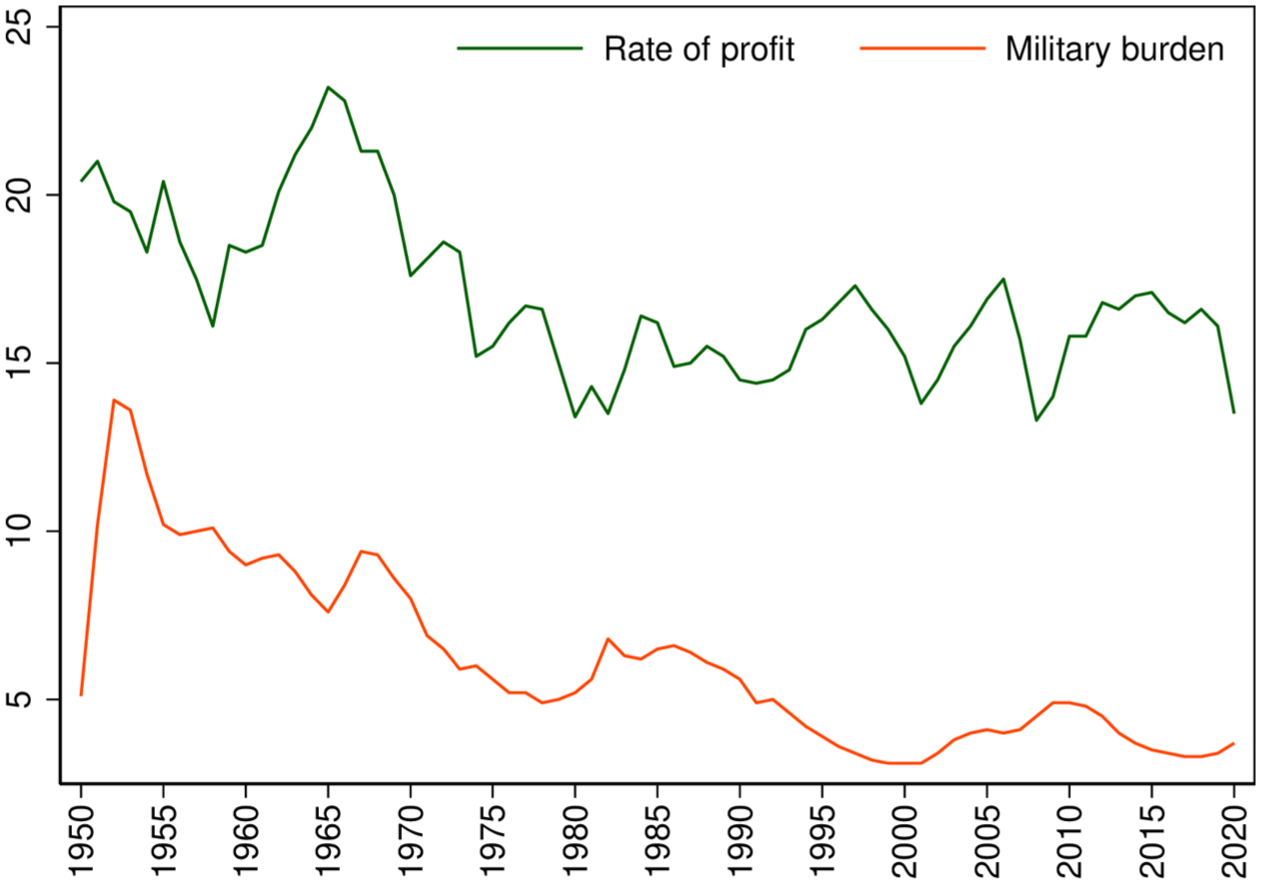
Evolution of the rate of profit and of military burden, 1950–2020.
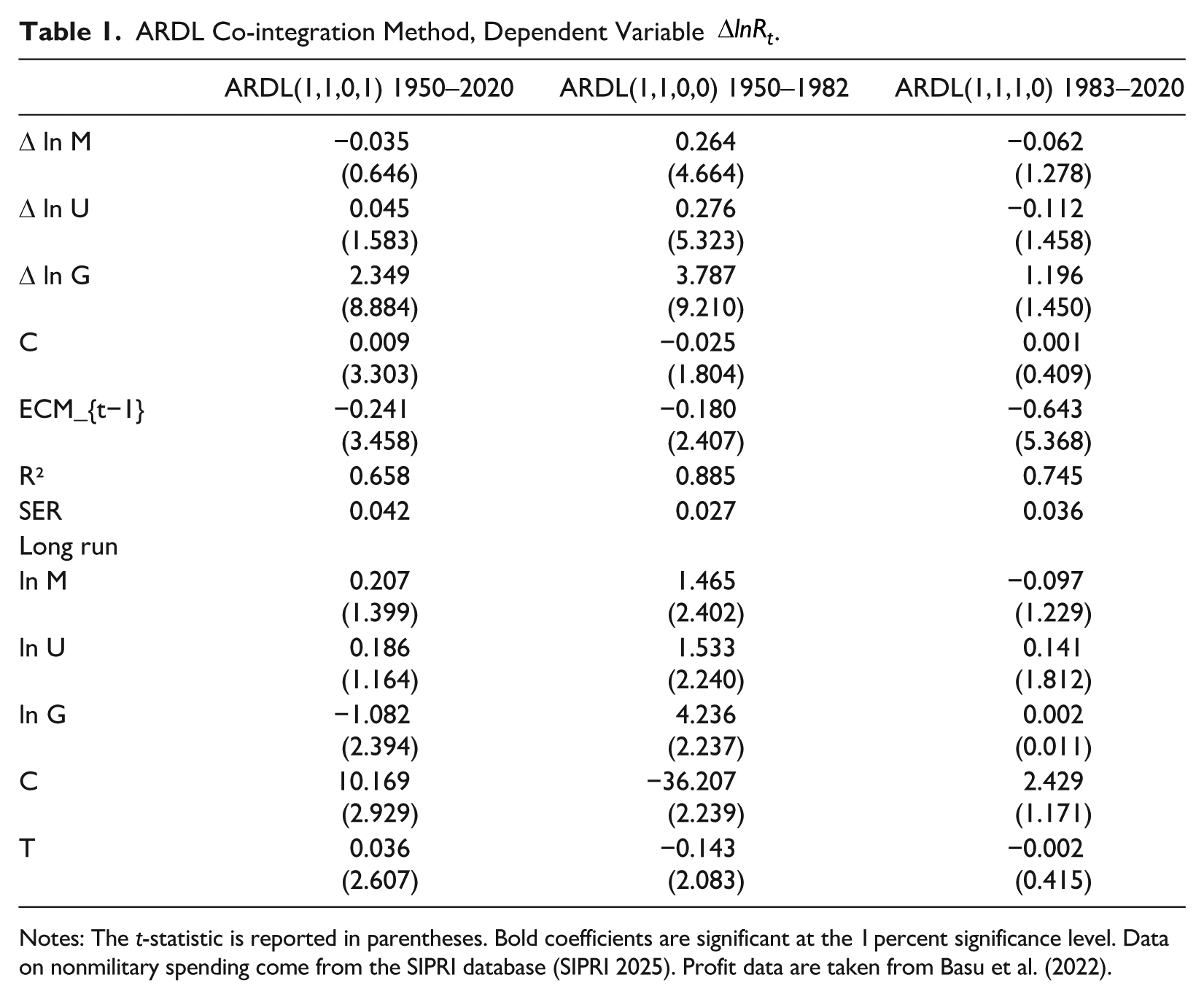
To further consider the dynamic structure, the ARDL cointegration procedure was used. This undertakes a search across possible dynamic specifications and then presents the error correction form of the model. It gave the result in table 1.
ARDL Co-integration Method, Dependent Variable
Notes: The t-statistic is reported in parentheses. Bold coefficients are significant at the 1 percent significance level. Data on nonmilitary spending come from the SIPRI database (SIPRI 2025). Profit data are taken from Basu et al. (2022).
In column two of table 1 the main results of the analysis for the period 1950–1982 are presented, using constant prices. The results show no significant effect of the growth in military burden or unemployment on the growth of the profit rate, with GDP growth being significant both in the short and long run. Relatively large residuals are apparent for 1975 (+), 1979 (−), 1986 (−), 2002 (+), 2008 (−), 2009 (+). A time trend squared was added to allow for nonlinearity, but was not significant, and when a dummy variable for positive outliers and one for negative outliers was added, it gave significant coefficients but did not alter the substantive conclusions from the original regression. Some other attempts were made to allow for outliers, using dummy variables for factors such as the end of the Vietnam War, but without any significant change in the results. 12
The model was estimated for periods that represent the stages in the development of the economy identified in figure 1. The postwar reconstruction “Golden Age” to 1965, the stagflation period 1966–1982, the neoliberal boom 1982–2007 and the current crisis from 2008. Although there are limited degrees of freedom, the results were interesting in suggesting that the last two of these periods could be modeled as an AR(1) process in the log of the profit rate but with significant impacts of other variables in the first two periods. The last two columns of table 1 break the time series into two periods, considering before and after 1982 (i.e., the “Golden Age” and the stagflation period). The results show that for the period 1950–1982, the military burden is positive and significant, in both the short and long run, while for 1983–2020, military burden is negative but not significant. This is further evidence that any positive effect on profits of military spending is being driven by the earlier period. 13
4.2. Military consumption expenditure
Moving on to consider the impact of the composition of the US military spending on the profit rate, figure 2 shows that over the period for which data for military consumption are available, annual military burden and annual military consumption have relatively similar patterns, but the latter has a less pronounced pattern. In addition, the composition of military consumption changed over the period, with a decline in the share of nondurable goods and an increase in the share of services.
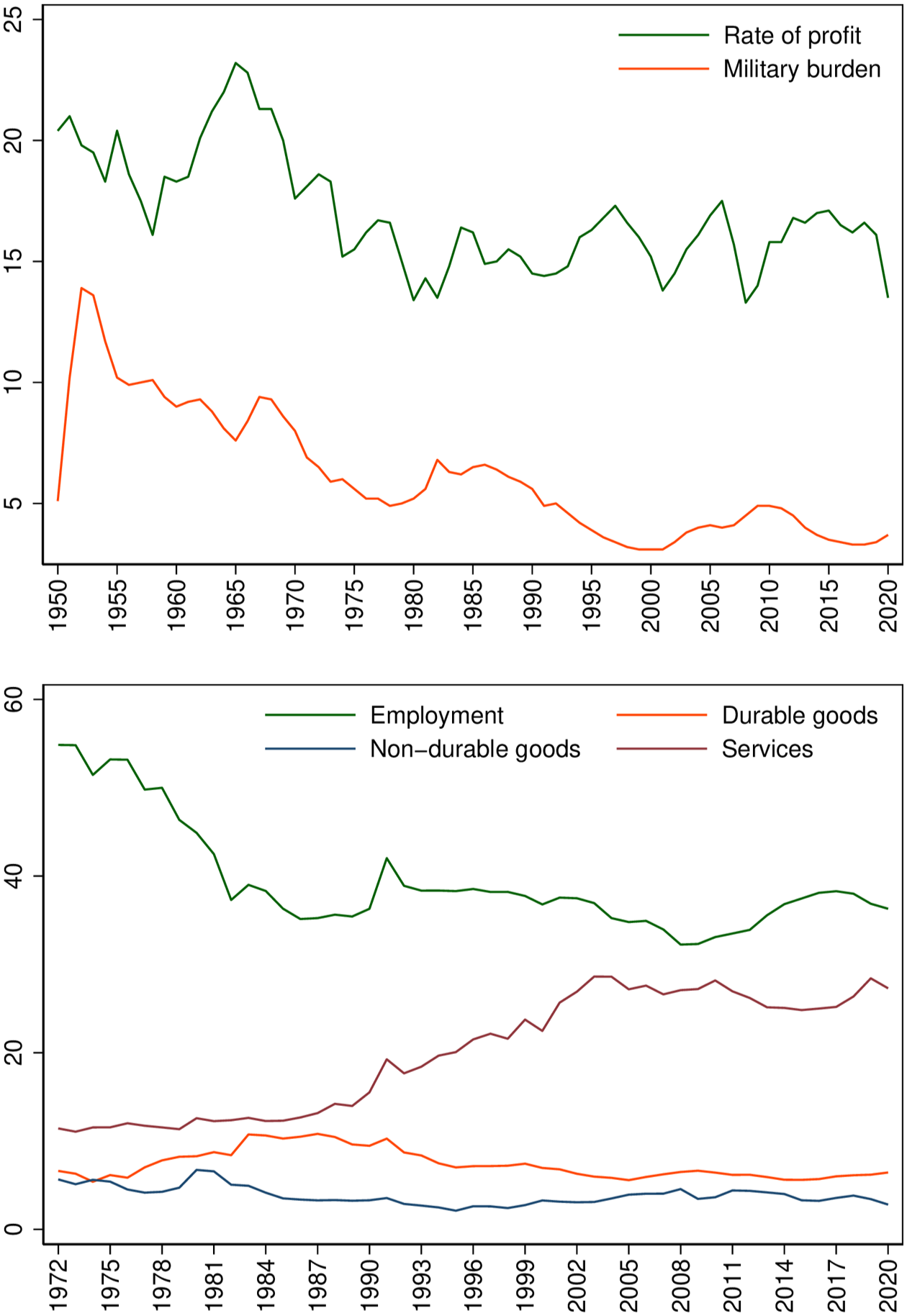
Evolution of military consumption.
To analyze the effect of these components of military spending, equation 2 is expanded along the lines of d’Agostino et al. (2017) to give:

where
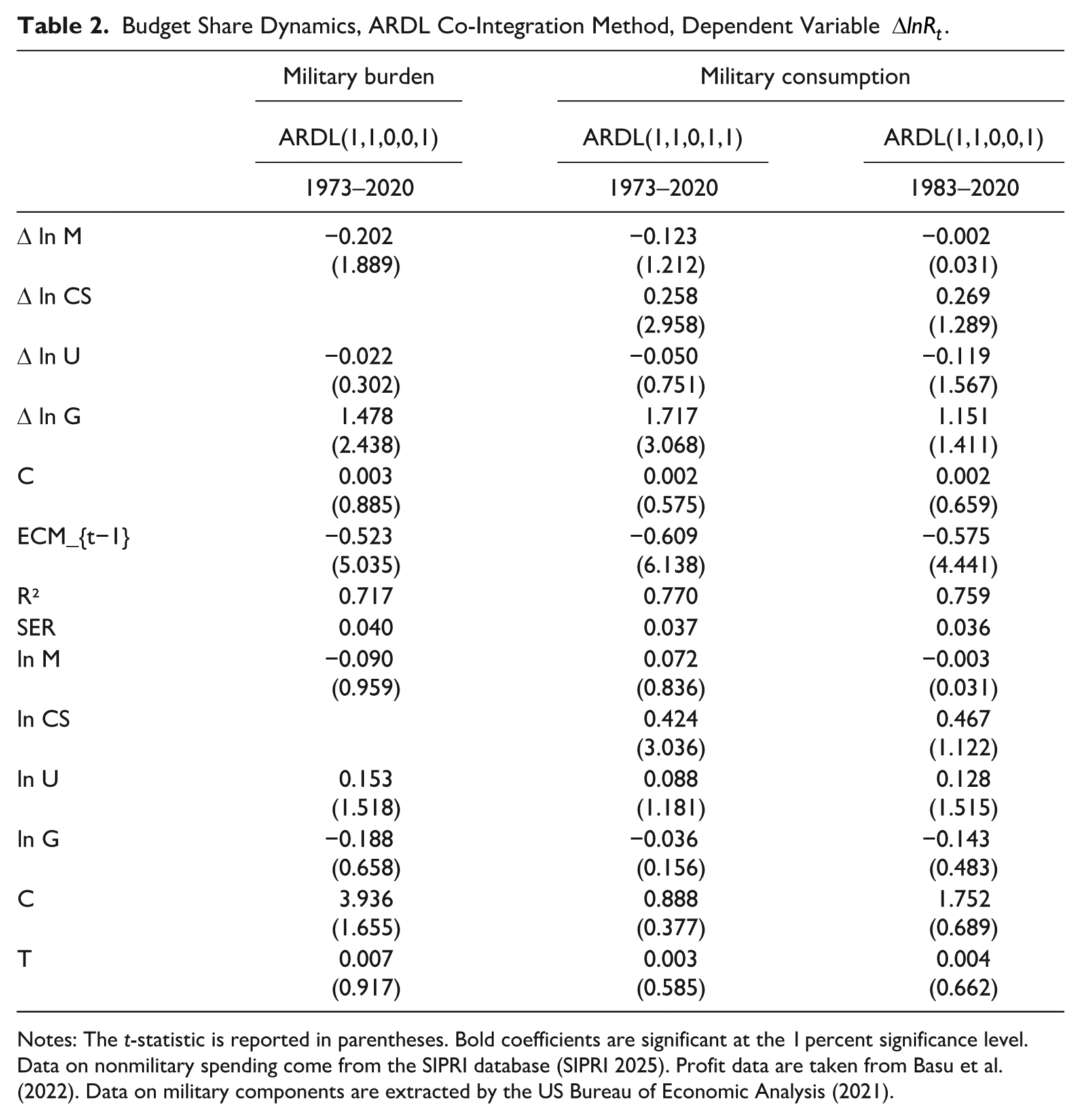
Column two in table 2 presents the model from table 1 estimated over the period 1973–2020 for comparison with the estimates when military consumption was included. Military consumption has a significant positive effect both in the short and long run, but military burden is insignificant. This suggests that it was the allocation to consumption within the defense budget that influenced the profit rate in both the long and the short term. Looking only at the period from 1983, the results change, and the significant effect on military consumption disappears. This suggests that the positive effect on profit could well be down to a compositional change in 1973–2020. 14
Budget Share Dynamics, ARDL Co-Integration Method, Dependent Variable
Notes: The t-statistic is reported in parentheses. Bold coefficients are significant at the 1 percent significance level. Data on nonmilitary spending come from the SIPRI database (SIPRI 2025). Profit data are taken from Basu et al. (2022). Data on military components are extracted by the US Bureau of Economic Analysis (2021).
5. Conclusions
This article has considered the relation between military spending and growth within the rich Marxist theoretical tradition. Having considered the likely role of military spending within Marxist crisis theory and building upon the empirical work in the area, a simple empirical model was used to investigate the impact of military burden on the rate of profit. Applying this to time series data for the major military spender, the United States, provided some interesting results.
In an earlier study, d’Agostino et al. (2013) found some evidence of a positive long run relation between military burden and the profit rate in the United States. This provided some support for the Marxist argument that military spending provides a means to overcome the declining profit rate, potentially in a manner consistent with Rosa Luxemburg’s theory. This was also a conclusion in Elveren (2019), though with some caveats. It is certainly less evident here.
Estimating the profit equation 1950–2020 suggested only GDP growth was significant, but breaking the sample up to reflect before and after 1982 (i.e., the “Golden Age” and the stagflation period), military burden was positive and significant, in both the short and long run for the period 1950–1982. For 1983–2020, military burden is negative but not significant, suggesting that any positive effect on profits of military spending is being driven by the earlier period. 15
The share of military consumption in total military spending was considered as possibly being more relevant to the underconsumptionist argument that military spending provides wasteful expenditure. The component data were only available from 1973, but estimating the original model for 1973–2020 showed signs and patterns of significance similar to the full period estimates. Adding in the military consumption variable showed that it was significant and the total military burden was insignificant, suggesting that the compositional change may have been important and supporting an underconsumptionist explanation for this period. Estimating from 1983 again left only the error correction term significant.
These results do suggest that the relationship between profit and military spending in the United States may be changing. This is not surprising given the changes that have been taking place within the US economy, military sector, industrial sector, and MIC. New analyses of Marxist crisis theory have emphasized the growing fictionalization of the economy and the impact of changing global competition (Ansari 2018). At the same time, the Ukraine war represents a major change in the strategic environment, with a major war in Europe that has shown the limitations of the weapon systems and tactics developed during the cold war.
It is also clear that civil technology is becoming increasingly important for the military sector. 16 Although the major arms companies still prosper, the nature of the MIC is beginning to change. The growth of IT, autonomous systems, cloud storage, and security is changing the nature of weapon systems, and new entrants into the market are becoming important players. The increasing role of large new tech civilian companies that are larger than the established arms producers is changing the dynamics. It is a very different industry from that analyzed by Baran and Sweezy. It is also clear that the changes taking place have some way to go, and it is not clear what the outcomes will be for the MIC (Dunne and Sköns 2021).
Footnotes
Acknowledgements
We are grateful to the referees and editors for helpful comments. We are also grateful to Stefano Di Bucchianico for assistance and to Ron Smith, Andrew Mearman, Al Campbell, and Erdogan Bakir for comments on an earlier version of the article. The usual disclaimer applies.
Declaration of Conflicting Interests
The authors declared no potential conflicts of interest with respect to the research, authorship, and/or publication of this article.
Funding
The authors received no financial support for the research, authorship, and/or publication of this article.
1
Indeed, the “war on terror” in the United States meant that military spending started to increase in real terms in 1999.
2
There are developments of this simple perspective to arms race models, the importance of property rights, the analysis of alliances, burden sharing, free riding, and rational agent theories of conflict.
3
4
5
In addition, Tabb (2019: 165) referred to the growth of military spending in the face of neoliberal fiscal policy that led to reductions in social spending.
6
There are a number of countervailing tendencies identified by Marx that may have some impact, but it is not completely clear how the military sector affects them. These include relative overpopulation: deaths, new industries, and lower OCC; and foreign expansion: control of raw materials and development of international hegemony.
7
Following Foley (1986),  offers a theoretical model in which the military sector can exert a direct effect on profitability. This effect passes through the share of the government sector devoted to military activities: The higher the military share, the higher is the rate of profit. The general model is consistent with this.
8
Recent literature has also considered the links between profit and other indicators, such as military spending and inequality (Elveren 2020), and linked into post-Keynesian analysis of fiscal policy (Ansari 2018) and the creation of a military security system ().
9
As ) points out, most economic variables have such concerns when being operationalized for empirical work, e.g., the measurement of capital stock and the use of average market prices rather than equilibrium prices for neoclassical models. It is just that generally accepted measures have developed over the years
10
They also provide measures that make further adjustments. A second measure subtracts import taxes from net value added, a third also subtracts net interest payments and net business transfer payments, a fourth also subtracts taxes on corporate income, and a fifth also subtracts dividend payments. We focus on the benchmark rate in this article.
11
12
In moving from the theory to the empirical model, it is not clear whether the variables in the analysis should be in terms of the values as they would present themselves in reality to capitalists, current prices, or in real terms, which implies some computation to allow for inflation. When estimated in current prices, the lagged level of the log of military spending remains insignificant, whereas there is a negative and significant effect for the growth of unemployment, and significant level effects of GDP. The significant time trend is positive, so not suggestive of a general “tendency” for profit to decline, as found. Noting that current prices can give different results and that this could be considered to make any conclusions guarded, the focus of the rest of the article is on the constant price data.
13
The estimates in the first and third columns have been further refined by incorporating a dummy variable that accounts for a significant shift in the financing mechanism of US military spending. Before 1985, military expenditures were primarily funded through deficit spending, as noted by Kee (1987). However, during the Reagan administration, a combination of tax cuts and an aggressive military build-up led to a rapid increase in the federal deficit, and overall spending. In response to this fiscal challenge, the Gramm-Rudman-Hollings Balanced Budget Act of 1985 was enacted. This legislation imposed caps on discretionary spending, aiming to curtail the federal deficit. As a consequence, the Reagan administration’s ambitious military expansion was effectively halted, leading to a substantial reduction in defense expenditures after 1985, as reported by . These two factors could suggest a structural break in the data. Despite the inclusion of this shift dummy variable in our estimation, the coefficients remain remarkably stable.
14
A similar result was found when military consumption was disaggregated into its components.
15
When a shift dummy variable was introduced to reflect the Gramm-Rudman-Hollings Balanced Budget Act of 1985, the coefficients remained remarkably stable.
16
It is generally accepted that there is “spin-in” of technology to the military sector rather than the “spin-off” benefits from military to civil posited in the past.