



Abstract
In the large group philogenetic regression is very easy. It concerns more ‘the masses’. The large group is more concerned with the primordial level of the Foulkes’ matrix, with the archetypal representations of the collective unconscious.
The small group, the ‘family group’, is more concerned with transferential phenomena of the matrix.
In the median group, the social group, the transference phenomena almost disappears and the specific non-transferential phenomena of group analysis occurs: mirroring, resonance, ego-self training in action etc., are in the foreground, together with the archetypal representations of the primordial level of the matrix.
Introduction
Group analysis is based on the relationship between the individual unconscious and the social unconscious continually interacting in a dynamic reciprocal influencing.
Forerunners
S. Freud
C.G. Jung
W. Bion
T.Burrow
Masters
‘Maestri’
S.H. Foulkes
E. Foulkes
J. Anthony
P. de Maré
D. Brown
M. Pines
R. Usandivaras
Group Analysis: From Freud to de Maré
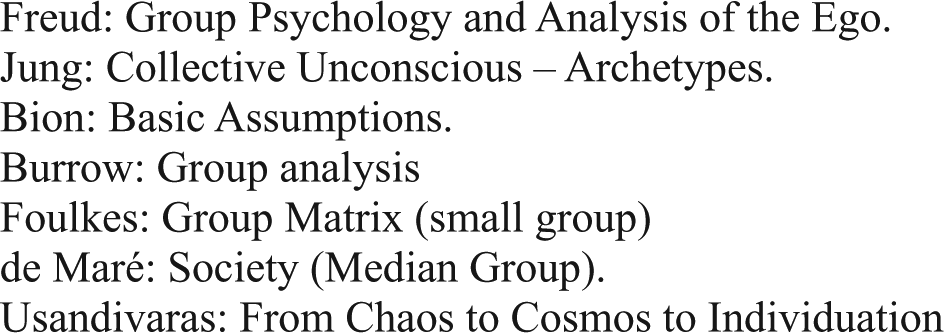
In his book Group Psychology and the Analysis of the Ego (1921), Freud says that a primary group consists of a certain number of individuals who have put a single identical object in the place of the Ego-ideal and have identified with each other in their Ego. A fundamental phenomenon of collective psychology is the individual’s lack of liberty within the group. This is a leader centric narcissistic group.
Jung (1934) studied in-depth the collective unconscious and archetypes. The collective unconscious contains the phylogenetic heritage and, as the sum total of all the archetypes, it is the storehouse of all human experiences from the very first to the most obscure ones.
For Jung the process of maturation and individuation is an archetypal process that involves the integration of all the split parts within the personality.
Bion’s basic assumptions (1961) are a completion of Freud’s observations on the masses. Bion individuated one of the basic drives for groups’ aggregation in the defence of individual psychotic anxiety over splitting, fragmentation and destruction.
Foulkes’ group analysis (Foulkes, 1948; 1964; 1965; 1975) begins precisely from the point where Freud, Jung and Bion stopped. With the constitution of the small analytical group matrix, Foulkes structures an inverse process. The conductor begins a process of gradual strategic withdrawal in a crescendo of decentralization to the advantage of free communication between individual members (free floating discussion). So the individuals are put in a position to acquire functional autonomy freed from the head and the other members, that is individuation.
De Maré begins where Foulkes stops—with displacement from the small group (family by proxy) to the median group (society) (de Maré, 1989; 1990; 1991; 2003).
R. Usandivaras deepens the primordial level of the Foulkes’ matrix and the process of individuation: from chaos to cosmos, to individuation (Usandivaras, 1985; 1986).
In the last part of his book Perspectives in Group Psychotherapy (1972), speaking of the third stage of the evolution of a closed small group (pre-genital archaic stage, family stage, social stage), de Maré concludes that not only the outcome of a neurosis, but the destiny of our entire civilization necessarily depends on the ability to achieve fellowship or Koinonia.
Group matrix is a network of relations and communications.
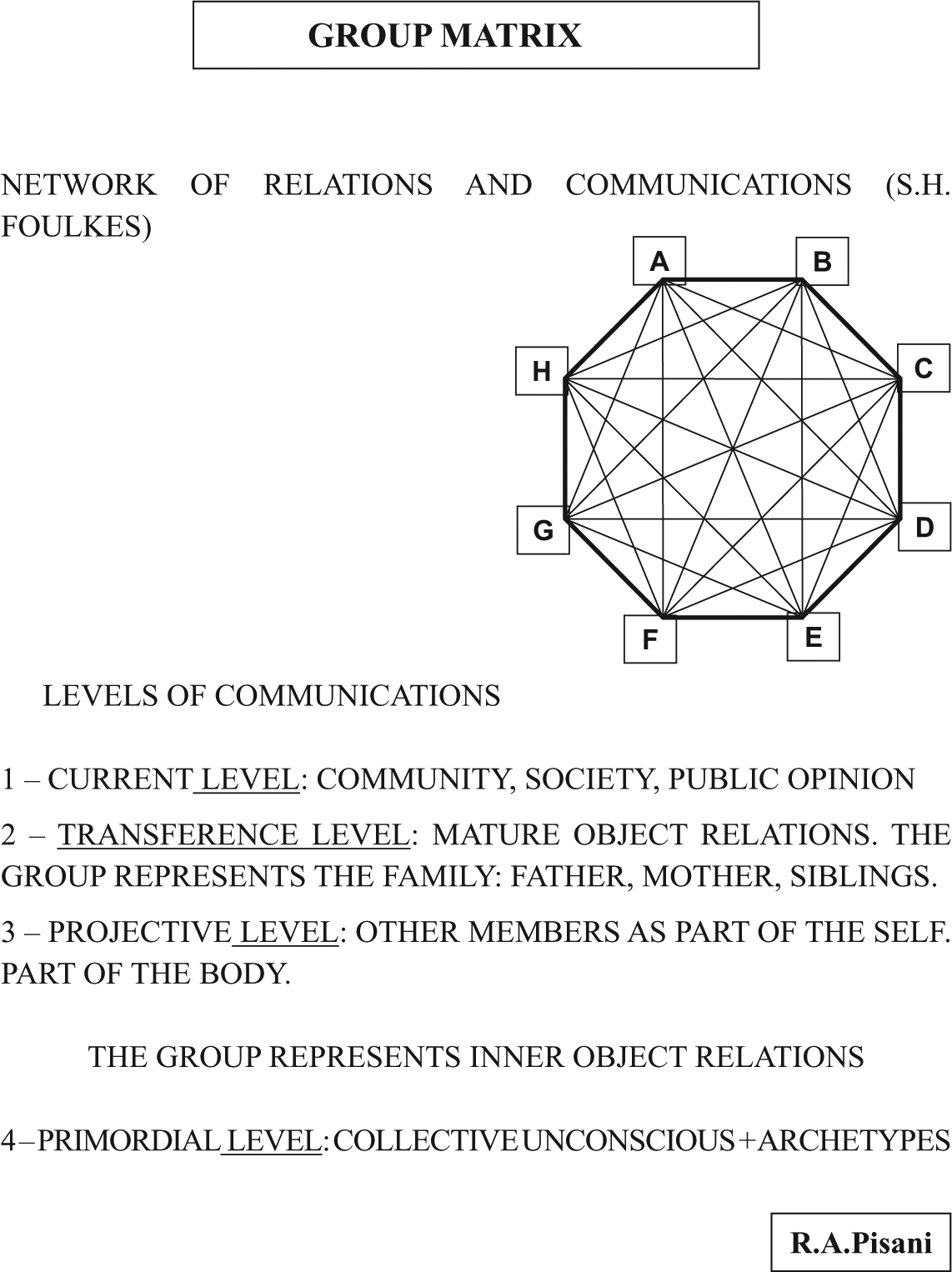
The large group concerns more the masses, and philogenetic regression is very easy. The large group is involved in archetypal representations of the primordial level of the matrix. The Great Mother and Great Father archetypes are in the foreground. In Foulkes’ words: ‘Emergence of the individual as a self, as a being of his own, from the total symbiotic unity with the mother … large group very clearly symbolizes this all-embracing archaic mother’ (Foulkes, 1975: 54). That is, the positive aspect of the Great Mother archetype.
But:
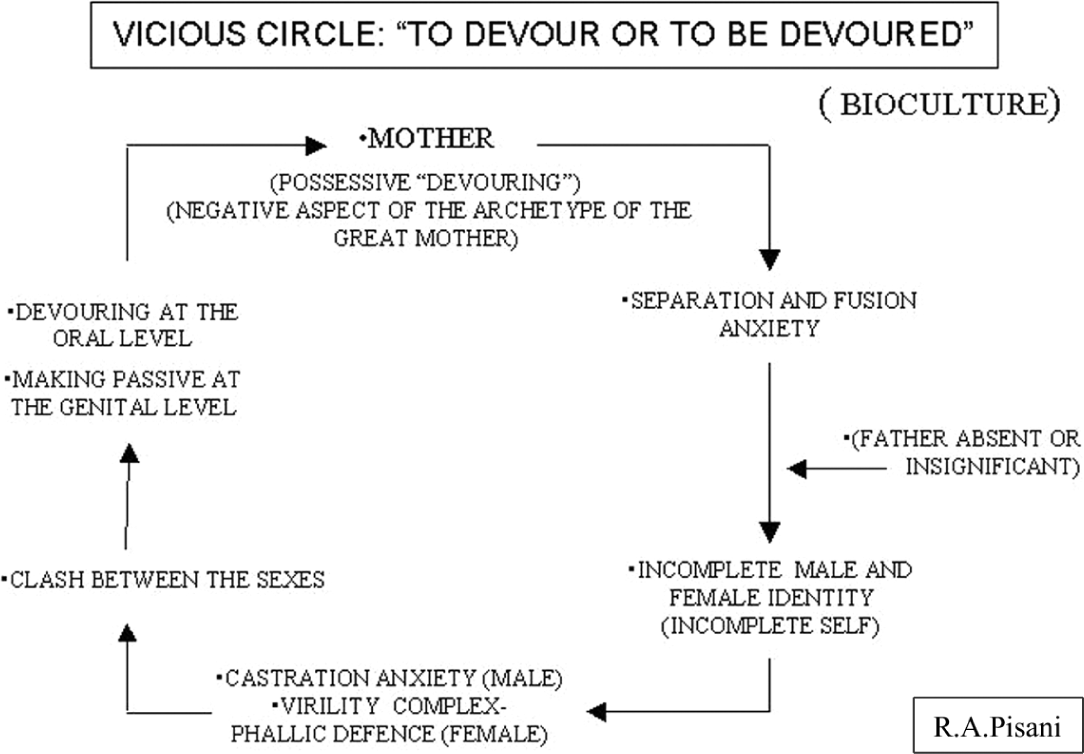
As a network the matrix has the characteristics of a spider’s web or snare: it can trap and devour … (labyrinth, terrible mother’s deadly womb, spider’s web) (Prodgers, A., 1990), that is, the negative aspect of the Great Mother. (Pisani, 1998; 2000 b)
Large and median groups usually start with chaos: (de Maré, 1991; Island, 1995; 2003; Menoutis, 2000; Shaked, 1995; 2003; Schneider, 2003; Weinberg, 2003; Wilke, 2003).
The danger of persecutory attack by the group and dissolution of individuals into the mass is responsible for panic of near psychotic intensity, i.e. chaos.
Mass: is a terrible Great Mother. Individuals are looking for an omnipotent leader (Great Father).
For Foulkes the conductor represents an ideal parental figure or a primordial leader image, in a sense the phallic executive of the mother group (Foulkes, 1964: 286).
For Neumann (Neumann, 1949; 1956) chaos corresponds to the great mother earth and the myth of united progenitors: female and male principle (bisexual archetype).
Mother Earth archetype is a variation of uroboros (chaotic circularity).
Male force is mother’s chaos son. Son becomes hero who has to fight to change chaos into cosmos. He has become autonomous from the great goddess and creator of a cultural order: founder ancestor, hero (first expression of the father archetype).
Greek Mythology
According to Hesiod Chaos, Gaia and Eros are the three primordial elements.
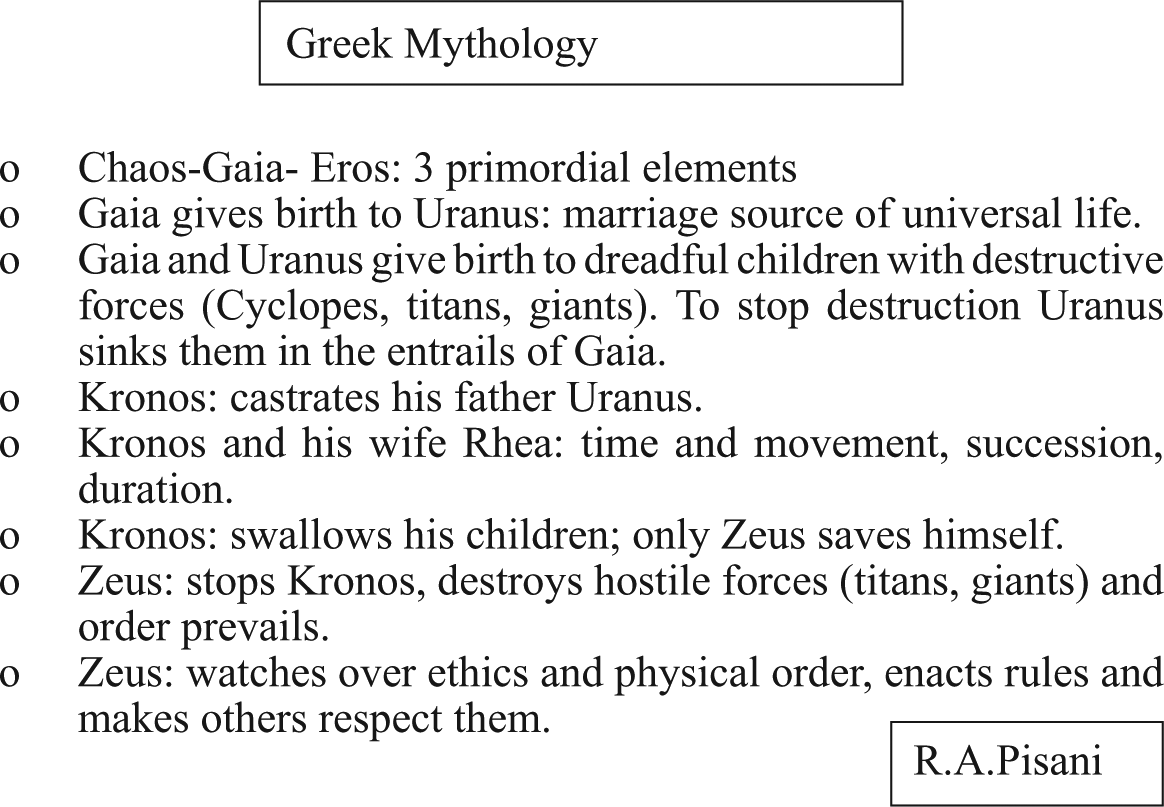
Before anything there is Chaos; after Chaos comes Gaia. Eros is the primitive force of attraction. With his energy all elements tend to unite and from this union life starts (Kritikou and Menoutis, 2001).
The small group, the family by proxy, is more concerned with the transference level of the group matrix.
It is possible, through a regression, even a partial regression, to relive and repeat the first infantile affective emotional relationships, both on an Oedipal and on a pre-Oedipal level. Transference on the conductor is certainly in the foreground. From time to time it may assume paternal or maternal connotations. But multiple collateral transferences are also important. From time to time other members may assume paternal or maternal elements, but more probably those of brothers or sisters. The group as a whole is perceived and lived as a mother and develops a maternal transference. Incestuous infantile bonds, conflictual problems of rivalry for possession of the opposite sex parent and elimination of the same sex parent, with related castration anxieties, as well as for the possession of brothers and sisters, are relived more readily. Problems related to sphincter control of the anal phase and conflicts of oral dependence are relived. Separation anxieties coincide or alternate with fusion anxieties. More or less serious difficulties in following the process of separation-individuation emerge in the foreground.
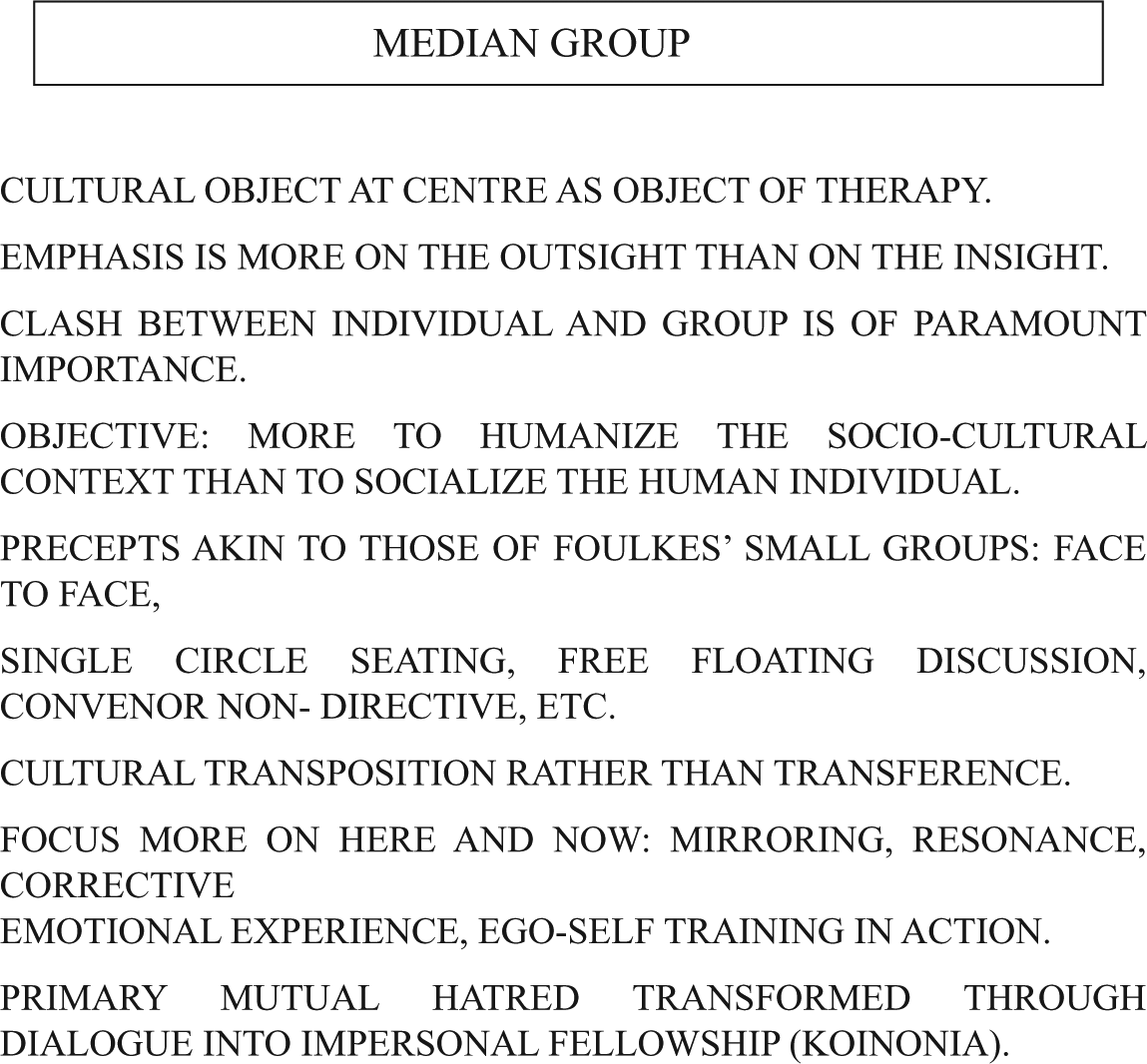
The median group is a transitional space for getting out of the kinship (the narcissistic family) and getting into the kithship (the citizenship–society).
The median group is more concerned with the projective and the primordial level of the group matrix.
As in and more than in the small group, in the median group the function of the conductor is to put the individuals in a position to acquire individuation in a more developed atmosphere of social interactions. His purpose is to put individuals in a position to develop free-floating dialogue (Idioculture). Dialogue constitutes the transformative process that converts what does not make sense into understanding and meaning. It is a matter of cultural transposition rather than transference. The non-transference aspects are much vaster than in the small group. Mirroring is particularly in the foreground, together with resonance, corrective emotional experience, ego-self training in action etc.
In the median group individuals learn to express and handle the emotions that emerge. This becomes a very active exercise for the Ego (Ego training in action), which is trained to face the repressive forces and emotions aroused. The individual Ego gradually learns to speak and think spontaneously, creating the premises for the affirmation of one’s own individuality. Relationships between Ego and Id on the one hand and Ego Super-Ego and external reality on the other, are modified in favour of the Ego’s greater freedom and strength.
Initially the danger represented by the group’s persecutory attack on the individual or by the dissolution of the individual into the mass leads to panic of near psychotic intensity, as it does in the large group, albeit to a lesser degree. Fear of speaking and losing one’s identity leads to narcissistic isolation, which generates primary mutual ‘hatred’. But if the dialogue continues, the identity (Self) arises from the Koinonic atmosphere of social interaction. Dialogue encourages the fall of the defence mechanisms and free individual expression (Pisani, 2000). Dialogue allows individual narcissistic barriers to the outside world to be overcome. Primary reciprocal hatred becomes koinonia: sharing, joint participation, communion, companionship (from the Latin cum panis: those who eat the same bread).
Dialogue with the outside allows the internal dialogue to be reorganized. The individual gets to know himself/herself through the reaction he/she causes in others and the image that is given back to him/her (Mirroring). Unconscious aspects of the Self are discovered through interaction and dialogue with others. The individual is differentiated through a constant confrontation of similarities and differences with others (Brown, 1986).
Briefly the group-analytical relationship is expressed in a work of individuation through the recognition and re-establishment of the split parts of the Self (Self training in action).
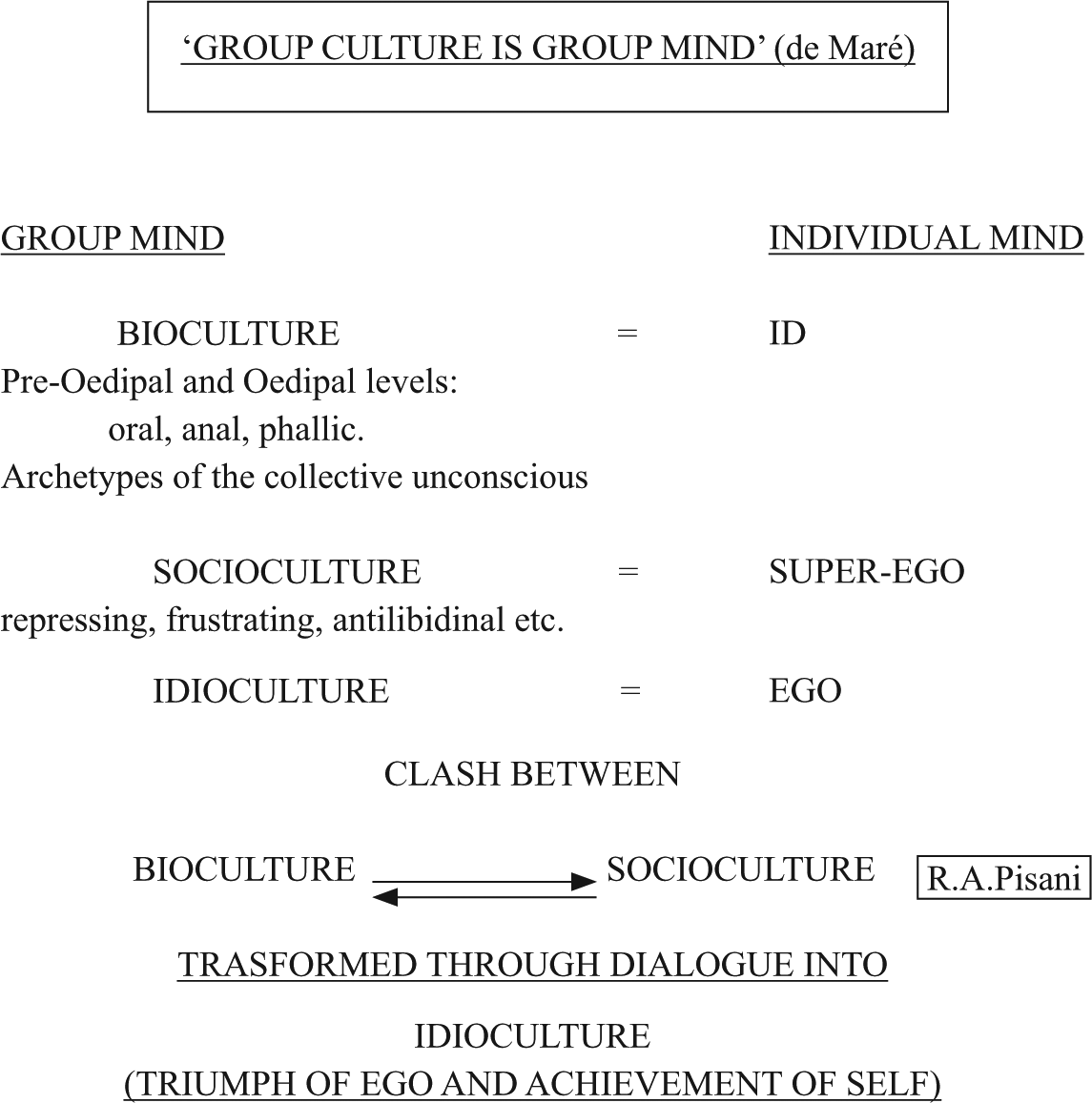
For de Maré (de Maré, 1989; 1990; 1991) group culture is group mind. There are three cultures:
Bioculture: equivalent to the Id of the individual mind. It consists of behavioural patterns based on the fully shared stage of psychosexual development. That is, it includes pre-Oedipal (oral, anal, phallic) and Oedipal levels, and the archetypes of the collective unconscious. Thus we have cultures of an oral, anal, phallic or genital nature.
Socioculture: equivalent to the Superego of the individual mind (repressing, frustrating, anti-libidinal). It consists of ideologies, morali laws, values, ideals etc.
Idioculture is equivalent to the Ego of the individual mind. It cultivates the Ego and the Self and mind (de Maré and Schollberger, 2003; Pisani, 2000a).
In the Median Group clash between Bioculture and Socioculture is transformed, through dialogue, into Idioculture (figure 5).
The vicious circle is an expression of Bioculture (Pisani, 2000a; 2000b). (Figure 6).
How can we Change Chaos into Cosmos and Start a Process of Individuation?
We have to change the clash between bioculture and socioculture into idioculture (figure 5).
For R. Usandivaras the therapeutic process becomes a ritual: the therapeutic group allows its member to return to archaic stages of human evolution, where magical thought prevails and archetypal images emerge as ancient myths stored in the collective unconscious. Thus the group therapeutic process becomes a ritual (Usandivaras, 1985).
For Usandivaras (1986) there are four stages in the process of individuation:
chaos stage: fear of loosing identity, rage, distrust, panic.
fusion, disintegration stage: centripetal forces of indiscriminate union, centrifugal of separation + disintegration.
communitas stage: free floating dialogue, sharing. emergence of the individual + collective unconscious (cosmos, koinonia).
individuation stage: recognition, rejoining of the split parts of the self. Members recover their individuality.
Conclusions
Dialogue is the transformative process from chaos to cosmos and to individuation.
As Margarita Kritikou maintains: in Athenian democracy dialogue, which is the basis of eleutheria or freedom and one of the greatest gifts of ancient Greece to humanity, was cultivated in depth (Kritikou, 2000).
Plato is the inventor of dialogue. Language and communication are its instrument. The confusion and plurality of languages (Tower of Babel) comes from an act of pride, represented by the biblical person Nimrod; as if to say that narcissism is at the basis of the lack of relational communication and that, vice versa, the lack of relations and communication leads to narcissistic isolation (Pisani, 2000c). Dialogue is the instrument, par excellence, for overcoming narcissistic barriers. It is the condition and means for transforming chaos into cosmos and for getting individuation (Brown, 1986; de Maré, 1991; Pisani, 2000a; Usandivaras, 1986).
Large, median and small groups are absolutely complementary in promoting and getting individuation through dialogue. The large group is basic for having insight into the collective and cultural unconscious, for deepening in the small group, through insight and working through at the family and individual level. The median group is fundamental for getting out of the kinship (the narcissistic family) and getting into the kithship (the citizenship–society).
